Search Results: "ana"

15 April 2015

Petter Reinholdtsen: Debian Edu interview: Shirish Agarwal

It was a surprise to me to learn that project to create a complete computer system for schools I've involved in, Debian Edu / Skolelinux, was being used in India. But apparently it is, and I managed to get an interview with one of the friends of the project there, Shirish Agarwal. Who are you, and how do you spend your days? My name is Shirish Agarwal. Based out of the educational and historical city of Pune, from the western state of Maharashtra, India. My bread comes from giving training, giving policy tips, installations on free software to mom and pop shops in different fields from Desktop publishing to retail shops as well as work with few software start-ups as well. How did you get in contact with the Skolelinux / Debian Edu project? It started innocently enough. I have been using Debian for a few years and in one local minidebconf / debutsav I was asked if there was anything for schools or education. I had worked / played with free educational softwares such as Gcompris and Stellarium for my many nieces and nephews so researched and found Debian Edu or Skolelinux as it was known then. Since then I have started using the various education meta-packages provided by the project. What do you see as the advantages of Skolelinux / Debian Edu? It's closest I have seen where a package full of educational software are packed, which are free and open (both literally and figuratively). Even if I take the simplest software which is gcompris, the number of activities therein are amazing. Another one of the softwares that I have liked for a long time is stellarium. Even pysycache is cool except for couple of issues I encountered #781841 and #781842. I prefer software installed on the system over web based solutions, as a web site can disappear any time but the software on disk has the possibility of a larger life span. Of course with both it's more a question if it has enough users who make it fun or sustainable or both for the developer per-se. What do you see as the disadvantages of Skolelinux / Debian Edu? I do see that the Debian Edu team seems to be short-handed and I think more efforts should be made to make it popular and ask and take help from people and the larger community wherever possible. I don't see any disadvantage to use Skolelinux apart from the fact that most apps. are generic which is good or bad how you see it. However, saying that I do acknowledge the fact that the canvas is pretty big and there are lot of interesting ideas that could be done but for reasons not known not done or if done I don't know about them. Let me share some of the ideas (these are more upstream based but still) I have had for a long time : 1. Classical maths question of two trains in opposing directions each running @x kmph/mph at y distance, when they will meet and how far would each travel and similar questions like these. The computer is a fantastic system where questions like these can be drawn, animated and the methodology and answers teased out in interactive manner. While sites such as the Ask Dr. Math FAQ on The Two Trains problem (as an example or point of inspiration) can be used there is lot more that can be done. I dunno if there is a free software which does something like this. The idea being a blend of objects + animation + interaction which does this. The whole interaction could be gamified with points or sounds or colourful celebration whenever the user gets even part of the question or/and methodology right. That would help reinforce good behaviour. This understanding could be used to share/showcase everything from how the first wheel came to be, to evolution to how astronomy started, psychics and everything in-between. One specific idea in the train part was having the Linux mascot on one train and the BSD or GNU mascot on the other train and they meeting somewhere in-between. Characters from blender movies could also be used. 2. Loads of crossword-puzzles with reference to subjects: We have enormous data sets in Wikipedia and Wikitionary. I don't think it should be a big job to design crossword puzzles. Using categories and sub-categories it should be doable to have Q&A single word answers from the existing data-sets. What would make it easy or hard could be the length of the word + existence of many or few vowels depending on the user's input. 3. Jigsaw puzzles - We already have a great software called palapeli with number of slicers making it pretty interesting. What needs to be done is to download large number of public domain and copyleft images, tease and use IPTC tags to categorise them into nature, history etc. and let it loose. This could turn to be really huge collection of images. One source could be taken from commons.wikimedia.org, others could be huge collection of royalty-free stock photos. Potential is immense. Apart from this, free software suffers in two directions, we lag both in development (of using new features per-se) and maintenance a lot. This is more so in educational software as these applications need to be timely and the opportunity cost of missing deadlines is immense. If we are able to solve issues of funding for development and maintenance of such software I don't see any big difficulties. I know of few start-ups in and around India who would love to develop and maintain such software if funding issues could be solved. Which free software do you use daily? That would be huge list. Some of the softwares are obviously apt, aptitude, debdelta, leafpad, the shell of course (zsh nowadays), quassel for IRC. In games I use shisen-sho while card-games are evenly between kpat and Aiselriot. In desktops it's a tie between gnome-flashback and mate. Which strategy do you believe is the right one to use to get schools to use free software? I think it should first start with using specific FOSS apps. in whatever environment they are. If it's MS-Windows or Mac so be it. Once they are habitual with the apps. and there is buy-in from the school management then it could be installed anywhere. Most of the people now understand the concept of a repository because of the various online stores so it isn't hard to convince on that front. What is harder is having enough people with technical skills and passion to service them. If you get buy-in from one or two teachers then ideas like above could also be asked to be done as a project as well. I think where we fall short more than anything is in marketing. For instance, Debian has this whole range of fonts in its archive but there isn't even a page where all those different fonts in the La Ipsum format could be tried out for newcomers. One of the issues faced constantly in installations is with updates and upgrades. People have this myth that each update and upgrade means the user interface will / has to change. I have seen this innumerable times. That perhaps is one of the reasons which browsers like Iceweasel / Firefox change user interfaces so much, not because it might be needed or be functional but because people believe that changed user interfaces are better. This, can easily be pointed with the user interfaces changed with almost every MS-Windows and Mac OS releases. The problems with Debian Edu for deployment are many. The biggest is the huge gap between what is taught in schools and what Debian Edu is aimed at. Me and my friends did teach on week-ends in a government school for around 2 years, and gathered some experience there. Some of the things we learnt/discovered there was :
  1. Most of the teachers are very territorial about their subjects and they do not want you to teach anything out of the portion/syllabus given.
  2. They want any activity on the system in accordance to whatever is in the syllabus.
  3. There are huge barriers both with the English language and at times with objects or whatever. An example, let's say in gcompris you have objects falling down and you have to name them and let's say the falling object is a hat or a fedora hat, this would not be as recognizable as say a Puneri Pagdi so there is need to inject local objects, words wherever possible. Especially for word-games there are so many hindi words which have become part of english vocabulary (for instance in parley), those could be made into a hinglish collection or something but that is something for upstream to do.

13 April 2015

Mehdi Dogguy: DPL campaign 2015

This year's DPL campaign is over and voting period is also almost over. Many did not vote yet and they really should consider doing so. This is meant as a reminder for them. If you didn't have time to dig into debian-vote's archives and read questions/answers, here is the list with links to candidates' replies:
Compared to past years, we had a comparable number of questions. All questions did not start big threads as it used to be the case sometimes in the past :-) The good side of this is that we are trolling DPL candidates less than we used to do :-P

Now, if you still didn't vote, it is really time to do so. The voting period ends on Tuesday, April 14th, 23:59:59 UTC, 2015. You have only a few hours left!

10 April 2015

Andrew Shadura: Kallithea 0.2 released

This post is almost a carbon copy of the Kallithea 0.2 release notes. Kallithea project have just released Kallithea 0.2. Kallithea is a Python-based GPLv3 source code management software for web-based hosting of Mercurial and Git repositories. This release brings many changes since 0.1. Notably, pull requests system have been improved, making contributing changes more robust. The visual appearance has also been refined: modern font-based symbolic icons from FontAwesome and GitHub Octicons have replaced the previously used bitmap icons, and revision graphs are now drawn with HiDPI display support. Kallithea now supports Mercurial 3.3 and Dulwich 0.9.9. Several fixes in the database code boosted performance significantly. We have also updated our Javascript libraries: jQuery, CodeMirror and Mergely. Javascript and CSS code have been cleaned up, with less and less code depending on Yahoo UI library. Since 0.1 we have discovered two security issues, so all users are strongly recommended to upgrade. For more details on these issues, please see our Security Notices page For more information, see https://kallithea-scm.org/ or http://docs.kallithea-scm.org/. The summary of the changes since 0.1 release is below. Bug fixes: Features and improvements: Changes (might influence workflows): Cleanup:

8 April 2015

Gunnar Wolf: Guests in the classroom: C sar Y ez (@caesarcomptus) talks about memory assignation algorithms

Once again, on March 11 I had a great guest to save me some work and give a talk at my class! This time it was C sar Y ez, and he talked about memory management algorithms, emphasizing on ARC. The video is available, both at this server and in archive.org. Thanks a lot!
7 April 2015

Mario Lang: I am sorry, but this looks insane

I am a console user. I really just started to use X11 again about two weeks ago, to sometimes test an a Qt application I am developing. I am not using Firefox or anything similar, all my daily work happens in shells and inside of emacs, in a console, not in X11. BRLTTY runs all the time, translating the screen content to something that my braille display can understand, sent out via USB. So the most important programs to me, are really emacs, and brltty. This is my desktop, that is up since 179 days.
PID   USER      PR  NI    VIRT    RES    SHR S  %CPU %MEM     TIME+ COMMAND
 1227 message+  20   0    7140   2860    672 S   0,0  0,1 153:33.10 dbus-daemon
21457 root      20   0   44456   1116    788 S   0,0  0,1 146:42.47 packagekitd
    1 root      20   0   24348   2808   1328 S   0,0  0,1 109:16.99 systemd
 7897 mlang     20   0  585776 121656   4188 S   0,0  6,0 105:22.40 emacs
13332 root      20   0   10744    432    220 S   0,0  0,0  91:55.96 ssh
19581 root      20   0    4924   1632   1076 S   0,0  0,1  53:33.56 systemd
19596 root      20   0   20312   9764   9660 S   0,0  0,5  48:10.76 systemd-journal
10172 root      20   0   85308   2472   1672 S   0,0  0,1  20:30.18 NetworkManager
   29 root      20   0       0      0      0 S   0,0  0,0  18:40.24 kswapd0
13334 root      20   0  120564   5748    304 S   0,0  0,3  16:20.89 sshfs
    7 root      20   0       0      0      0 S   0,0  0,0  15:21.15 rcu_sched
14245 root      20   0    7620    316    152 S   0,0  0,0  15:08.64 ssh
  438 root      20   0       0      0      0 S   0,0  0,0  12:14.80 jbd2/dm-1-8
11952 root      10 -10   42968   2028   1420 S   0,0  0,1  10:36.20 brltty
I am sorry, but this doesn't look right, not at all. I am not even beginning to talk about dbus-daemon and systemd. Why the HECK does packagekitd (which I definitely don't use actively) use up more then two hours of plain CPU time? What did it do, talk to NSA via an asymmetric cipher, or what?! I play music via sshfs, sometimes FLAC files. That barely consumed more CPU time then brltty, which is probably the most active daemon on my system, erm, it should be. I don't want to chime into any flamewars. I have accepted that we have systemd. But this does not look right! I remember, back in the good old days, emacs and brltty were my top CPU users.

Carl Chenet: Backup Checker, the ServerSpec for your backups

Follow me on Identi.ca or Twitter or Diaspora*diaspora-banner Sysadmins usually know ServerSpec, a tool allowing to check if your servers are correctly configured. The use of automated deployment tools makes deployments easier and easier, but lot of unexpected situations can come up using this tool, especially when more and more servers are implied. ServerSpec allows to verify that the result of your deployments are what you were expecting for and that no exception or unexpected event goes undetected. serverspec Backup Checker (Github stars appreciated :)) offers the same kind of controls, but for your backups. Once you have backups, you don t know if they contain what you are expecting for. And this is especially important because having broken backups mean losing your data after a major outage! Moreover if you think you are well protected with backups but they are eventually broken (corrupted archives, archives being filled with empty files, saving useless files ), you will perform your server or database upgrades without being really protected, leading to terrible situations.
github-logo

Backup Checker on github

Backup Checker offers lots of controls over backups: Use Backup Checker with Backup-Manager or Rsnapshot Starting from Backup Checker 1.7,if you use a backup tool like Backup-Manager or Rsnapshot, you ll be glad to know that Backup Checker perfectly works with them. The documentation is available on the Backup Checker Community page with the howtos to install and configure Backup Checker with Backup-Manager or with Rsnapshot. weneedyou What about you? Let us know in the comments what you think of Backup Checker and its features to connect with other backup tools. We would be happy to get your feedbacks about how you use Backup Checker or what you expect from a backup checking solution.

5 April 2015

Ingo Juergensmann: It has been 30 years now...

Sometimes you happen to realize how old you are when listening to the radio where they announce hits from your days of youth as "oldies". Or when todays youth asking you what a music casette or a 5.25" floppy disk is. You're even older than that when you still know 8" disks. We have one of those on our pin board. Or you may realize your age when your favorite computer of your youth will celebrate its 30th anniversary this year! In 1985 the Amiga was introduced to the public - and 30 years later Amigas around the world are still running! Some are still operated under AmigaOS, some are running maybe NetBSD, but some are running the Debian m68k port - even though the port was expelled from Debian years ago! But some people still take care of this port and it is keeping up with building packages, although mostly due to emulators doing the most work. But anyway, the Amiga is turning 30 this year! And what a great machine this was! It brought multitasking, colorful graphics and multi-channel audio to the masses. It was years ahead of its competitors, but it was doomed to fail because of management failures by the producing company Commodore, which went bankrupt in 1994. The "30th Anniversary Event" will take place on July 25th at the Computer History Museum in Mountain View, California, USA - if the kickstarting the event will be successful during the next two weeks. So, when you earned your first merits in computing on an Amiga as well, you might want to give your Amiga history another kickstart! Not the Kickstart floppy as the A1000 needed to boot up, but fundraising the event on kickstart.org! I think this event is not only important to old Amiga users from the good old days, but for the rememberance of computing history in general. Without doubt the Amiga set new standards in computer history and is an important part of industrial heritage.
Kategorie:

2 April 2015

Rudy Godoy: No SSH for you how to fix OpenRG routers

I find interesting when faced a taken-for-granted situation, in particular in the tech world. This time s history is about an Internet ADSL connection that allows all traffic but SSH. Yes, you read it correctly. It was very bizarre confirming such event was a real-life situation. I don t claim to be a networking expert but at least I want to think I m well educated. After few minutes I ve focused my efforts on dealing with the ADSL router/modem s networking configuration. The device is provided by Movistar (formerly Telefonica) and it runs OpenRG. I ve discovered that other people have experienced the same issue and what Movistar did was basically replacing the device. Of course the problem is gone after that. So, this post is dedicated to those who don t give up. Following the steps below will allow SSH outbound traffic for a OpenRG-based device. OpenRG device specs
Software Version: 6.0.18.1.110.1.52 Upgrade
Release Date: Oct 7 2014
Diagnostic When you do the command below, it shows nothing but timeout. Even when you SSH the router it doesn t establish connection to it.
ssh -vv host.somewhere.com
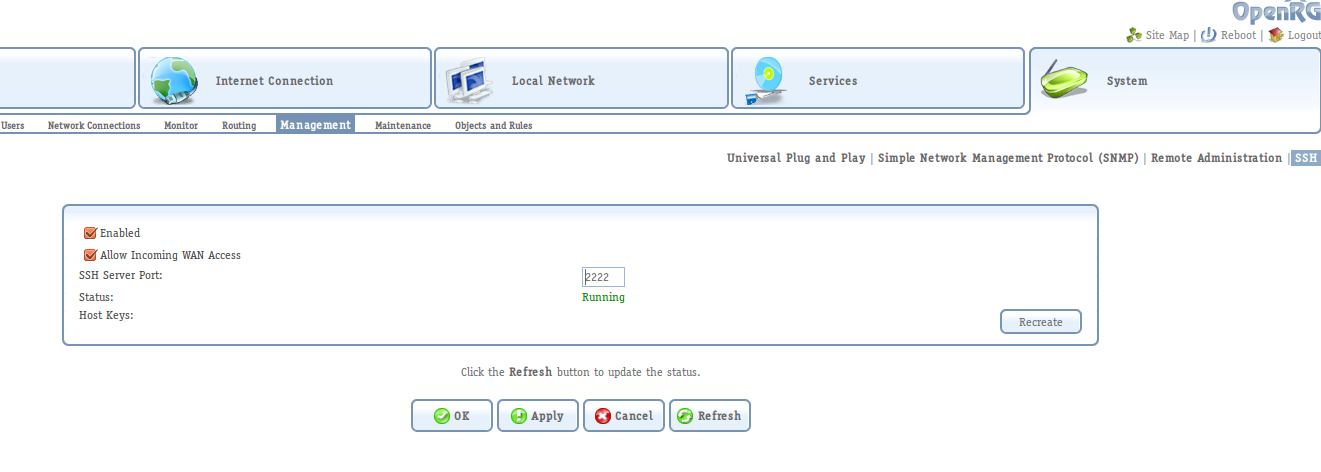
Solution Change router s SSH service port. This step will allow you to access the console-based configuration for the router (since I haven t found any way to do the steps described below from the web management interface). To do so, go to System > Management > SSH. Update the service port to something else than 22, for instance 2222.
OpenRG SSH service configuration

OpenRG SSH service configuration

Connect to the SSH interface Once you have changed the SSH service port, you can access it from a SSH client.
ssh -p 2222 admin@192.168.1.1
admin@192.168.1.1's password: 
OpenRG>
Once you have the console prompt, issue the following commands to allow SSH outbound traffic coming from the LAN and Wifi networks. After the last command, which saves and updates the device s configuration, you should be able to do SSH from any computer in your network to the Internet (thanks to tips from inkhorn).
OpenRG> conf set fw/policy/0/chain/fw_br0_in/rule/0/enabled 0
Returned 0
OpenRG> conf set fw/policy/0/chain/fw_br1_in/rule/0/enabled 0
Returned 0
OpenRG> conf reconf 1
Returned 0

1 April 2015

Clint Adams: The SFLC is Hiring

The SFLC is hiring: idealist job posting This is not actually an April 1 joke.

Raphaël Hertzog: My Free Software Activities in March 2015

My monthly report covers a large part of what I have been doing in the free software world. I write it for my donators (thanks to them!) but also for the wider Debian community because it can give ideas to newcomers and it s one of the best ways to find volunteers to work with me on projects that matter to me. Debian LTS This month I have been paid to work 15.25 hours on Debian LTS. In that time I did the following: That s it for the paid work. But still about LTS, I proposed two events for Debconf 15: A Debian LTS logoIn my last Freexian LTS report, I mentioned briefly that it would be nice to have a logo for the LTS project. Shortly after I got a first logo prepared by Damien Escoffier and a few more followed: they are available on a wiki page (and the logo you see above is from him!). Following a suggestion of Paul Wise, I registered the logo request on another wiki page dedicated to artwork requests. That kind of collaboration is awesome! Thanks to all the artists involved in Debian. Debian packaging Django. This month has seen no less than 3 upstream point releases packaged for Debian (1.7.5, 1.7.6 and 1.7.7) and they have been accepted by the release team into Jessie. I m pleased with this tolerance as I have argued the case for it multiple times in the past given the sane upstream release policy (bugfix only in a given released branch). Python code analysis. I discovered a few months ago a tool combining the power of multiple Python code analysis tools: it s prospector. I just filed a Request for Package for it (see #781165) and someone already volunteered to package it, yay \o/ update-rc.d and systemd. While working on a Kali version based on Jessie, I got hit by what boils down to a poor interaction between systemd and update-rc.d (see #746580) and after some exchanges with other affected users I raised the severity to serious as we really ought to do something about it before release. I also opened #781155 on openbsd-inetd as its usage of inetd.service instead of openbsd-inetd.service (which is only provided as a symlink to the former) leads to multiple small issues. Misc Debian France. The general assembly is over and the new board elected its new president: it s now official, I m no longer Debian France s president. Good luck to Nicolas Dandrimont who took on this responsibility. Salt s openssh formula. I improved salt s openssh formula to make it possible to manage the /etc/ssh/ssh_known_hosts file referencing the public SSH keys of other managed minions. Tendenci.com. I was looking for a free software solution to handle membership management of a large NPO and I discovered Tendenci. It looked very interesting feature wise and written with a language/framework that I enjoy (Python/Django). But while it s free software, there s no community at all. The company that wrote it released it under a free software license and it really looks like that they did intend to build a community but they failed at it. When I looked their development forums were web-based and mostly empty with only initial discussion of the current developers and no reply from anybody there s also no mention of an IRC channel or a mailing list. I sent them a mail to see what kind of collaboration we could expect if we opted for their software and got no reply. A pity, really. What free software membership management solution would you use when you have more than 10000 members to handle and when you want to use the underlying database to offer SSO authentication to multiple external services? Thanks See you next month for a new summary of my activities.

2 comments Liked this article? Click here. My blog is Flattr-enabled.

Benjamin Mako Hill: More Community Data Science Workshops

Pictures from the CDSW sessions in Spring 2014Pictures from the CDSW sessions in Spring 2014
After two successful rounds in 2014, I m helping put on another round of the Community Data Science Workshops. Last year, our 40+ volunteer mentorss taught more than 150 absolute beginners the basics of programming in Python, data collection from web APIs, and tools for data analysis and visualization and we re still in the process of improving our curriculum and scaling up. Once again, the workshops will be totally free of charge and open to anybody. Once again, they will be possible through the generous participation of a small army of volunteer mentors. We ll be meeting for four sessions over three weekends: If you re interested in attending, or interested in volunteering as mentor, you can go to the information and registration page for the current round of workshops and sign up before April 3rd.

31 March 2015

Zlatan Todori : Fruit flies like a banana

I started working for Valve as a community manager.

Zlatan Todori : Interviews with FLOSS developers: Francesca Ciceri

Debian and FLOSS community don't only occupy coding developers. They occupy people who write news, who talk about FLOSS, who help on booths and conferences, who create artistic forms of the community and so many others that contribute in countless ways. A lady, that is doing many of that is Francesca Ciceri, known in Debian as MadameZou. She is non-packaging Debian Developer, a fearless warrior for diversity and a zombie fan. Although it sounds intimidating, she is deep caring and great human being. So, what has MadaZou to tell us? Picture of MadameZou Who are you? My name is Francesca and I'm totally flattered by your intro. The fearless warrior part may be a bit exaggerated, though. What have you done and what are you currently working on in FLOSS world? I've been a Debian contributor since late 2009. My journey in Debian has touched several non-coding areas: from translation to publicity, from videoteam to www. I've been one of the www.debian.org webmasters for a while, a press officer for the Project as well as an editor for DPN. I've dabbled a bit in font packaging, and nowadays I'm mostly working as a Front Desk member. Setup of your main machine? Wow, that's an intimate question! Lenovo Thinkpad, Debian testing. Describe your current most memorable situation as FLOSS member? Oh, there are a few. One awesome, tiring and very satisfying moment was during the release of Squeeze: I was member of the publicity and the www teams at the time, and we had to pull a 10 hours of team work to put everything in place. It was terrible and exciting at the same time. I shudder to think at the amount of work required from ftpmaster and release team during the release. Another awesome moment was my first Debconf: I was so overwhelmed by the sense of belonging in finally meeting all these people I've been worked remotely for so long, and embarassed by my poor English skills, and overall happy for just being there... If you are a Debian contributor I really encourage you to participate to Debian events, be they small and local or as big as DebConf: it really is like finally meeting family. Some memorable moments from Debian conferences? During DC11, the late nights with the "corridor cabal" in the hotel, chatting about everything. A group expedition to watch shooting stars in the middle of nowhere, during DC13. And a very memorable videoteam session: it was my first time directing and everything that could go wrong, went wrong (including the speaker deciding to take a walk outside the room, to demonstrate something, out of the cameras range). It was a disaster, but also fun: at the end of it, all the video crew was literally in stitches. But there are many awesome moments, almost too many to recall. Each conference is precious on that regard: for me the socializing part is extremely important, it's what cements relationships and help remote work go smoothly, and gives you motivation to volunteer in tasks that sometimes are not exactly fun. You are known as Front Desk member for DebConf's - what work does it occupy and why do you enjoy doing it? I'm not really a member of the team: just one of Nattie's minions! You had been also part of DebConf Video team - care to share insights into video team work and benefits it provides to Debian Project? The video team work is extremely important: it makes possible for people not attending to follow the conference, providing both live streaming and recording of all talks. I may be biased, but I think that DebConf video coverage and the high quality of the final recordings are unrivaled among FLOSS conferences - especially since it's all volunteer work and most of us aren't professional in the field. During the conference we take shifts in filming the various talks - for each talk we need approximately 4 volunteers: two camera operators, a sound mixer and the director. After the recording, comes the boring part: reviewing, cutting and sometimes editing the videos. It's a long process and during the conference, you can sometimes spot the videoteam members doing it at night in the hacklab, exhausted after a full day of filming. And then, the videos are finally ready to be uploaded, for your viewing pleasure. During the last years this process has become faster thanks to the commitment of many volunteers, so that now you have to wait only few days, sometimes a week, after the end of the conference to be able to watch the videos. I personally love to contribute to the videoteam: you get to play with all that awesome gear and you actually make a difference for all the people who cannot attend in person. You are also non-packaging Debian Developer - how does that feel like? Feels awesome! The mere fact that the Debian Project decided - in 2009 via a GR - to recognize the many volunteers who contribute without doing packaging work is a great show of inclusiveness, in my opinion. In a big project like Debian just packaging software is not enough: the final result relies heavily on translators, sysadmins, webmasters, publicity people, event organizers and volunteers, graphic artists, etc. It's only fair that these contributions are deemed as valuable as the packaging, and to give an official status to those people. I was one of the firsts non-uploading DD, four years ago, and for a long time it was just really an handful of us. In the last year I've seen many others applying for the role and that makes me really happy: it means that finally the contributors have realized that they deserve to be an official part of Debian and to have "citizenship rights" in the project. You were the leading energy on Debian's diversity statement - what gave you the energy to drive into it? It seemed the logical conclusion of the extremely important work that Debian Women had done in the past. When I first joined Debian, in 2009, as a contributor, I was really surprised to find a friendly community and to not be discriminated on account of my gender or my lack of coding skills. I may have been just lucky, landing in particularly friendly teams, but my impression is that the project has been slowly but unequivocally changed by the work of Debian Women, who raised first the need for inclusiveness and the awareness about the gender problem in Debian. I don't remember exactly how I stumbled upon the fact that Debian didn't have a Diversity Statement, but at first I was very surprised by it. I asked zack (Stefano Zacchiroli), who was DPL at the time, and he encouraged me to start a public discussion about it, sending out a draft - and helped me all the way along the process. It took some back and forth in the debian-project mailing list, but the only thing needed was actually just someone to start the process and try to poke the discussion when it stalled - the main blocker was actually about the wording of the statement. I learned a great deal from that experience, and I think it changed completely my approach in things like online discussions and general communication within the project. At the end of the day, what I took from that is a deep respect for who participated and the realization that constructive criticism does require certainly a lot of work for all parts involved, but can happen. As for the statement in itself: these things are as good as you keep them alive with best practices, but I think that are better stated explicitly rather than being left unsaid. You are involved also with another Front Desk, the Debian's one which is involved with Debian's New Members process - what are tasks of that FD and how rewarding is the work on it? The Debian Front Desk is the team that runs the New Members process: we receive the applications, we assign the applicant a manager, and we verify the final report. In the last years the workflow has been simplified a lot by the re-design of the nm.debian.org website, but it's important to keep things running smoothly so that applicants don't have too lenghty processes or to wait too much before being assigned a manager. I've been doing it for a less more than a month, but it's really satisfying to usher people toward DDship! So this is how I feel everytime I send a report over to DAM for an applicant to be accepted as new Debian Developer: Crazy pic How do you see future of Debian development? Difficult to say. What I can say is that I'm pretty sure that, whatever the technical direction we'll take, Debian will remain focused on excellence and freedom. What are your future plans in Debian, what would you like to work on? Definetely bug wrangling: it's one of the thing I do best and I've not had a chance to do that extensively for Debian yet. Why should developers and users join Debian community? What makes Debian a great and happy place? We are awesome, that's why. We are strongly committed to our Social Contract and to users freedom, we are steadily improving our communication style and trying to be as inclusive as possible. Most of the people I know in Debian are perfectionists and outright brilliant in what they do. Joining Debian means working hard on something you believe, identifying with a whole project, meeting lots of wonderful people and learning new things. It ca be at times frustrating and exhausting, but it's totally worth it. You have been involved in Mozilla as part of OPW - care to share insights into Mozilla, what have you done and compare it to Debian? That has been a very good experience: it meant have the chance to peek into another community, learn about their tools and workflow and contribute in different ways. I was an intern for the Firefox QA team and their work span from setting up specific test and automated checks on the three version of Firefox (Stable, Aurora, Nightly) to general bug triaging. My main job was bug wrangling and I loved the fact that I was a sort of intermediary between developers and users, someone who spoke both languages and could help them work together. As for the comparison, Mozilla is surely more diverse than Debian: both in contributors and users. I'm not only talking demographic, here, but also what tools and systems are used, what kind of skills people have, etc. That meant reach some compromises with myself over little things: like having to install a proprietary tool used for the team meetings (and getting crazy in order to make it work with Debian) or communicating more on IRC than on mailing lists. But those are pretty much the challenges you have to face whenever you go out of your comfort zone . You are also volunteer of the Organization for Transformative Works - what is it, what work do you do and care to share some interesting stuff? OTW is a non profit organization to preserve fan history and cultures, created by fans. Its work range from legal advocacy and lobbying for fair use and copyright related issues, developing and maintaining AO3 -- a huge fanwork archive based on open-source software --, to the production of a peer-reviewed academic journal about fanworks. I'm an avid fanfiction reader and writer, and joining the OTW volunteers seemed a good way to give back to the community - in true Debian fashion . As a volunteer, I work for the Translation Committee: we are more than a hundred people - divided in several language teams - translating the OTW website, the interface of AO3 archive, newsletter, announcements and news posts. We have a orga-wide diversity statement, training for recruits, an ever growing set of procedures to smooth our workflow, monthly meetings and movie nights. It's an awesome group to work with. I'm deeply invested in this kind of work: both for the awesomeness of OTW people and for the big role that fandom and fanworks have in my life. What I find amazing is that the same concept we - as in the FLOSS ecosystem - apply to software can be applied to cultural production: taking a piece of art you love and expand, remix, explore it. Just for the fun of it. Protect and encourage the right to play in this cultural sandbox is IMO essential for our society. Most of the participants in the fandom come from marginalised group or minorities whose point of view is usually not part of the mainstream narratives. This makes the act of writing, remixing and re-interpreting a story not only a creative exercise but a revolutionary one. As Elizabeth Minkel says: "My preferred explanation is the idea that the vast majority of what we watch is from the male perspective authored, directed, and filmed by men, and mostly straight white men at that. Fan fiction gives women and other marginalised groups the chance to subvert that perspective, to fracture a story and recast it in her own way." In other words, "fandom is about putting debate and conversation back into an artistic process". On a personal side - you do a lot of DIY, handmade works. What have you done, what joy does it bring to you and share with us a picture of it? I like to think that the hacker in me morphs in a maker whenever I can actually manipulate stuff. The urge to explore ways of doing things, of create and change is probably the same. I've been blessed with curiousity and craftiness and I love to learn new DIY techniques: I cannot describe it, really, but if I don't make something for a while I actually feel antsy. I need to create stuff. Nowadays, I'm mostly designing and sewing clothes - preferably reproductions of dresses from the 40s and the 50s - and I'm trying to make a living of that. It's a nice challenge: there's a lot of research involved, as I always try to be historically accurate in design, sewing tecniques and material, and many hours of careful attention to details. I'm right in the process of make photoshoots for most of my period stuff, so I'll share with you something different: a t-shirt refashion done with the DebConf11 t-shirt! (here's the tutorial) T-shirt pic

Niels Thykier: Jessie is coming the 2015-04-25

Indeed, we settled on a release date for Jessie and pretty quick too. I sent out a poll on the 28th of March and yesterday, it was clear that the 25th of April was our release date. :) With that said, we still have some items left that needs to be done.
Filed under: Debian, Release-Team

Dirk Eddelbuettel: R / Finance 2015 Open for Registration

The annoucement below just went to the R-SIG-Finance list. More information is as usual at the R / Finance page.
Registration for R/Finance 2015 is now open! The conference will take place on May 29 and 30, at UIC in Chicago. Building on the success of the previous conferences in 2009-2014, we expect more than 250 attendees from around the world. R users from industry, academia, and government will joining 30+ presenters covering all areas of finance with R. We are very excited about the four keynote presentations given by Emanuel Derman, Louis Marascio, Alexander McNeil, and Rishi Narang.
The conference agenda (currently) includes 18 full presentations and 19 shorter "lightning talks". As in previous years, several (optional) pre-conference seminars are offered on Friday morning. There is also an (optional) conference dinner at The Terrace at Trump Hotel. Overlooking the Chicago river and skyline, it is a perfect venue to continue conversations while dining and drinking. Registration information and agenda details can be found on the conference website as they are being finalized.
Registration is also available directly at the registration page. We would to thank our 2015 sponsors for the continued support enabling us to host such an exciting conference: International Center for Futures and Derivatives at UIC Revolution Analytics
MS-Computational Finance and Risk Management at University of Washington Ketchum Trading
OneMarketData
RStudio
SYMMS On behalf of the committee and sponsors, we look forward to seeing you in Chicago! For the program committee:
Gib Bassett, Peter Carl, Dirk Eddelbuettel, Brian Peterson,
Dale Rosenthal, Jeffrey Ryan, Joshua Ulrich
See you in Chicago in May!

This post by Dirk Eddelbuettel originated on his Thinking inside the box blog. Please report excessive re-aggregation in third-party for-profit settings.

30 March 2015

Carl Chenet: Verify the backups of backup-manager

Follow me on Identi.ca or Twitter or Diaspora*diaspora-banner Backup-manager is a tool creating backups and storing them locally. It s really usefult to keep a regular backup of a quickly-changing trees of files (like a development environment) or for traditional backups if you have a NFS mount on your server. Backup-managers is also able to send backup itself to another server by FTP. In order to verify the backups created by backup-manager, we will use also Backup Checker (stars appreciated :) ), the automated tool to verify backups. For each newly-created backup we want to control that: Installing what we need We install backup-manager and backup checker. If you use Debian Wheezy, just use the following command:
apt-key adv --keyserver pgp.mit.edu --recv-keys 2B24481A \
&& echo "deb http://debian.mytux.fr wheezy main" > /etc/apt/sources.list.d/mytux.list \
&& apt-get update \
&& apt-get install backupchecker backup-manager
Backup Checker is also available for Debian Squeeze, Debian Sid, FreeBSD. Check out the documentation to install it from PyPi or from sources. Configuring Backup-Manager Backup-manager will ask what directory you want to store backups, in our case we choose /home/joe/dev/wip In the configuration file /etc/backup-manager.conf, you need to have the following lines:
export BM_BURNING_METHOD="none"
export BM_UPLOAD_METHOD="none"
export BM_POST_BACKUP_COMMAND="backupchecker -c /etc/backupchecker -l /var/log/backupchecker.log"
Configuring Backup Checker In order to configure Backup Checker, use the following commands:
# mkdir /etc/backupchecker && touch /var/log/backupchecker.log
Then write the following in /etc/backupchecker/backupmanager.conf:
[main]
name=backupmanager
type=archive
path=/var/archives/laptop-home-joe-dev-wip.%Y%m%d.master.tar.gz
files_list=/etc/backupchecker/backupmanager.list
You can see we re using placeholders for the path value, in order to match each time the latest archive. More information about Backup Checker placeholders in the official documentation. Last step, the description of your controls on the backup:
[files]
wip/data  type d
wip/config/accounts  md5 27c9d75ba5a755288dbbf32f35712338
wip/dump/dump.sql  >100mb
Launch Backup Manager Just launch the following command:
# backup-manager
After Backup Manager is launched, Backup Checker is automatically launched and verify the new backup of the day where Backup Manager stores the backups. Possible control failures Lets say the dump does not have the expected size. It means someone may have messed up with the database! Backup Checker will warn you with the following message in /var/log/backupchecker.log:
$ cat /var/log/backupchecker.log
WARNING:root:1 file smaller than expected while checking /var/archives/laptop-home-joe-dev-wip-20150328.tar.gz: 
WARNING:root:wip/dump/dump.sql size is 18. Should have been bigger than 104857600.
Other possible failures : someone created an account without asking anyone. The hash sum of the file will change. Here is the alert generated by Backup Checker:
$ cat /var/log/backupchecker.log
WARNING:root:1 file with unexpected hash while checking /var/archives/laptop-home-joe-dev-wip-20150328.tar.gz:
WARNING:root:wip/config/accounts hash is 27c9d75ba5a755288dbbf32f35712338. Should have been 27c9d75ba3a755288dbbf32f35712338.
Another possible failure: someone accidentally (or not) removed the data directory! Backup Checker will detect the missing directory and warn you:
$ cat /var/log/backupchecker.log
WARNING:root:1 file missing in /var/archives/laptop-home-joe-dev-wip-20150328.tar.gz: 
WARNING:root:wip/data
Awesome isn t it? The power of a backup tool combined with an automated backup checker. No more surprise when you need your backups. Moreover you spare the waste of time and efforts to control the backup by yourself. weneedyou What about you? Let us know what you think of it. We would be happy to get your feedbacks. The project cares about our users and the outdated feature was a awesome idea in a feature request by one of the Backup Checker user, thanks Laurent!

Matthias Klumpp: Limba Project: Another progress report

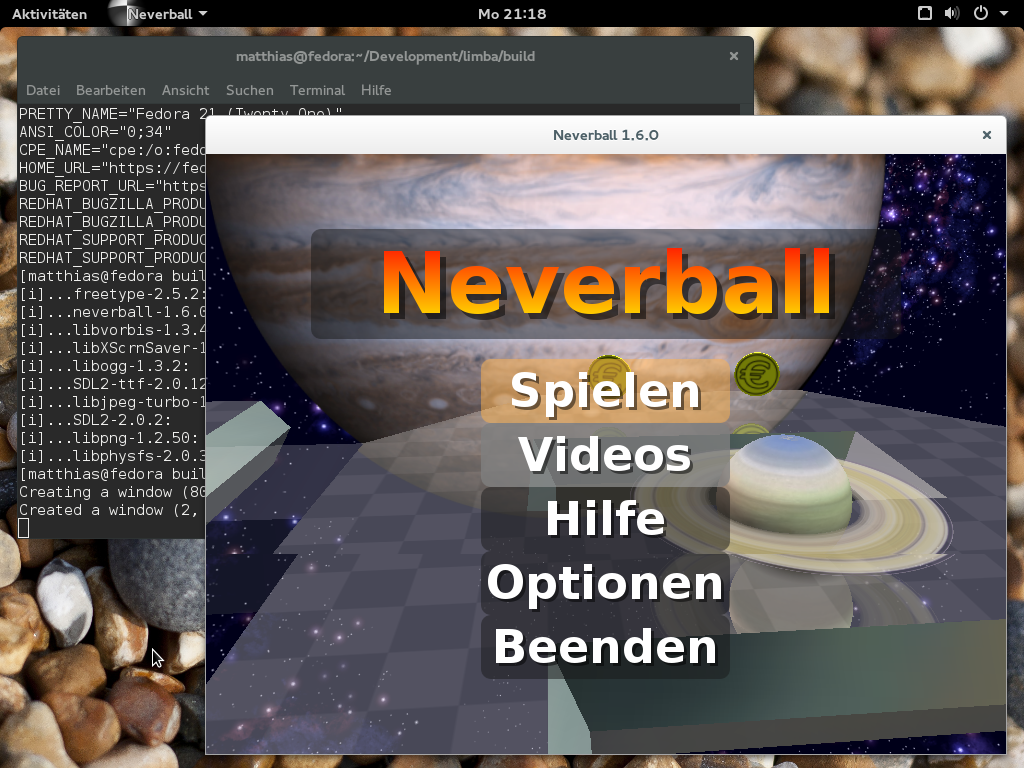
And once again, it s time for another Limba blogpost :-)limba-small Limba is a solution to install 3rd-party software on Linux, without interfering with the distribution s native package manager. It can be useful to try out different software versions, use newer software on a stable OS release or simply to obtain software which does not yet exist for your distribution. Limba works distribution-independent, so software authors only need to publish their software once for all Linux distributions. I recently released version 0.4, with which all most important features you would expect from a software manager are complete. This includes installing & removing packages, GPG-signing of packages, package repositories, package updates etc. Using Limba is still a bit rough, but most things work pretty well already. So, it s time for another progress report. Since a FAQ-like list is easier to digest. compared to a long blogpost, I go with this again. So, let s address one important general question first: How does Limba relate to the GNOME Sandboxing approach? (If you don t know about GNOMEs sandboxes, take a look at the GNOME Wiki Alexander Larsson also blogged about it recently) First of all: There is no rivalry here and no NIH syndrome involved. Limba and GNOMEs Sandboxes (XdgApp) are different concepts, which both have their place. The main difference between both projects is the handling of runtimes. A runtime is the shared libraries and other shared ressources applications use. This includes libraries like GTK+/Qt5/SDL/libpulse etc. XdgApp applications have one big runtime they can use, built with OSTree. This runtime is static and will not change, it will only receive critical security updates. A runtime in XdgApp is provided by a vendor like GNOME as a compilation of multiple single libraries. Limba, on the other hand, generates runtimes on the target system on-the-fly out of several subcomponents with dependency-relations between them. Each component can be updated independently, as long as the dependencies are satisfied. The individual components are intended to be provided by the respective upstream projects. Both projects have their individual up and downsides: While the static runtime of XdgApp projects makes testing simple, it is also harder to extend and more difficult to update. If something you need is not provided by the mega-runtime, you will have to provide it by yourself (e.g. we will have some applications ship smaller shared libraries with their binaries, as they are not part of the big runtime). Limba does not have this issue, but instead, with its dynamic runtimes, relies on upstreams behaving nice and not breaking ABIs in security updates, so existing applications continue to be working even with newer software components. Obviously, I like the Limba approach more, since it is incredibly flexible, and even allows to mimic the behaviour of GNOMEs XdgApp by using absolute dependencies on components. Do you have an example of a Limba-distributed application? Yes! I recently created a set of package for Neverball Alexander Larsson also created a XdgApp bundle for it, and due to the low amount of stuff Neverball depends on, it was a perfect test subject. One of the main things I want to achieve with Limba is to integrate it well with continuous integration systems, so you can automatically get a Limba package built for your application and have it tested with the current set of dependencies. Also, building packages should be very easy, and as failsafe as possible. You can find the current Neverball test in the Limba-Neverball repository on Github. All you need (after installing Limba and the build dependencies of all components) is to run the make_all.sh script. Later, I also want to provide helper tools to automatically build the software in a chroot environment, and to allow building against the exact version depended on in the Limba package. Creating a Limba package is trivial, it boils down to creating a simple control file describing the dependencies of the package, and to write an AppStream metadata file. If you feel adventurous, you can also add automatic build instructions as a YAML file (which uses a subset of the Travis build config schema) This is the Neverball Limba package, built on Tanglu 3, run on Fedora 21: Limba-installed Neverball Which kernel do I need to run Limba? The Limba build tools run on any Linux version, but to run applications installed with Limba, you need at least Linux 3.18 (for Limba 0.4.2). I plan to bump the minimum version requirement to Linux 4.0+ very soon, since this release contains some improvements in OverlayFS and a few other kernel features I am thinking about making use of. Linux 3.18 is included in most Linux distributions released in 2015 (and of course any rolling release distribution and Fedora have it). Building all these little Limba packages and keeping them up-to-date is annoying Yes indeed. I expect that we will see some bigger Limba packages bundling a few dependencies, but in general this is a pretty annoying property of Limba currently, since there are so few packages available you can reuse. But I plan to address this. Behind the scenes, I am working on a webservice, which will allow developers to upload Limba packages. This central ressource can then be used by other developers to obtain dependencies. We can also perform some QA on the received packages, map the available software with CVE databases to see if a component is vulnerable and publish that information, etc. All of this is currently planned, and I can t say a lot more yet. Stay tuned! (As always: If you want to help, please contact me) Are the Limba interfaces stable? Can I use it already? The Limba package format should be stable by now since Limba is still Alpha software, I will however, make breaking changes in case there is a huge flaw which makes it reasonable to break the IPK package format. I don t think that this will happen though, as the Limba packages are designed to be easily backward- and forward compatible. For the Limba repository format, I might make some more changes though (less invasive, but you might need to rebuilt the repository). tl;dr: Yes! Plase use Limba and report bugs, but keep in mind that Limba is still in an early stage of development, and we need bug reports! Will there be integration into GNOME-Software and Muon? From the GNOME-Software side, there were positive signals about that, but some technical obstancles need to be resolved first. I did not yet get in contact with the Muon crew they are just implementing AppStream, which is a prerequisite for having any support for Limba[1]. Since PackageKit dropped the support for plugins, every software manager needs to implement support for Limba.
So, thanks for reading this (again too long) blogpost :) There are some more exciting things coming soon, especially regarding AppStream on Debian/Ubuntu! [1]: And I should actually help with the AppStream support, but currently I can not allocate enough time to take that additional project as well this might change in a few weeks. Also, Muon does pretty well already!

28 March 2015

Matt Zimmerman: What I think about thought

Only parts of us will ever
touch o n l y parts of others
one s own truth is just that really one s own truth.
We can only share the part that is u n d e r s t o o d b y within another s knowing acceptable t o t h e o t h e r t h e r e f o r e so one
is for most part alone.
As it is meant to be in
evidently in nature at best t h o u g h perhaps it could make
our understanding seek
another s loneliness out.
unpublished poem by Marilyn Monroe, via berlin-artparasites This poem inspired me to put some ideas into words this morning, an attempt to summarize my current working theory of consciousness. Ideas travel through space and time. An idea that exists in my mind is filtered through my ability to express it somehow (words, art, body language, ), and is then interpreted by your mind and its models for understanding the world. This shifts your perspective in some way, some or all of which may be unconscious. When our minds encounter new ideas, they are accepted or rejected, reframed, and integrated with our existing mental models. This process forms a sort of living ecosystem, which maintains equilibrium within the realm of thought. Ideas are born, divide, mutate, and die in the process. Language, culture, education and so on are stable structures which form and support this ecosystem. Consciousness also has analogues of the immune system, for example strongly held beliefs and models which tend to reject certain ideas. Here again these can be unconscious or conscious. I ve seen it happen that if someone hears an idea they simply cannot integrate, they will behave as if they did not hear it at all. Some ideas can be identified as such a serious threat that ignoring them is not enough to feel safe: we feel compelled to eliminate the idea in the external world. The story of Christianity describes a scenario where an idea was so threatening to some people that they felt compelled to kill someone who expressed it. A microcosm of this ecosystem also exists within each individual mind. There are mental structures which we can directly introspect and understand, and others which we can only infer by observing our thoughts and behaviors. These structures communicate with each other, and this communication is limited by their ability to speak each other s language . A dream, for example, is the conveyance of an idea from an unconscious place to a conscious one. Sometimes we get the message, and sometimes we don t. We can learn to interpret, but we can t directly examine and confirm if we re right. As in biology, each part of this process introduces uncountable errors , but the overall system is surprisingly robust and stable. This whole system, with all its many minds interacting, can be thought of as an intelligence unto itself, a gestalt consciousness. This interpretation leads to some interesting further conclusions: Naturally, this is by no means an original idea (can such a thing exist?). It is my own take on the subject, informed both consciously and unconsciously by my own study, first-hand experience, conversations I ve had with others, and so on. It s informed by the countless thinkers who have influenced me. Its expression is limited by my ability to write about it in a way that makes sense to other people.
Maybe some of this makes sense to you, and maybe I seem insane, or maybe both. Hopefully you don t find that you have an inexplicable unconscious desire to kill me!

27 March 2015

Olivier Berger: New short paper : Designing a virtual laboratory for a relational database MOOC with Vagrant, Debian, etc.

Here s a short preview of our latest accepted paper (to appear at CSEDU 2015), about the construction of VMs for the Relational Database MOOC using Vagrant, Debian, PostgreSQL (previous post), etc. :

Designing a virtual laboratory for a relational database MOOC Olivier Berger, J Paul Gibson, Claire Lecocq and Christian Bac Keywords: Remote Learning, Virtualization, Open Education Resources, MOOC, Vagrant Abstract: Technical advances in machine and system virtualization are creating opportunities for remote learning to provide significantly better support for active education approaches. Students now, in general, have personal computers that are powerful enough to support virtualization of operating systems and networks. As a conse- quence, it is now possible to provide remote learners with a common, standard, virtual laboratory and learning environment, independent of the different types of physical machines on which they work. This greatly enhances the opportunity for producing re-usable teaching materials that are actually re-used. However, configuring and installing such virtual laboratories is technically challenging for teachers and students. We report on our experience of building a virtual machine (VM) laboratory for a MOOC on relational databases. The architecture of our virtual machine is described in detail, and we evaluate the benefits of using the Vagrant tool for building and delivering the VM. TOC :
  • Introduction
    • A brief history of distance learning
    • Virtualization : the challenges
    • The design problem
  • The virtualization requirements
    • Scenario-based requirements
    • Related work on requirements
    • Scalability of existing approaches
  • The MOOC laboratory
    • Exercises and lab tools
    • From requirements to design
  • Making the VM as a Vagrant box
    • Portability issues
    • Delivery through Internet
    • Security
    • Availability of the box sources
  • Validation
    • Reliability Issues with VirtualBox
    • Student feedback and evaluation
  • Future work
    • Laboratory monitoring
    • More modular VMs
  • Conclusions
Bibliography
  • Alario-Hoyos et al., 2014
    Alario-Hoyos, C., P rez-Sanagust n, M., Kloos, C. D., and Mu oz Merino, P. J. (2014).
    Recommendations for the design and deployment of MOOCs: Insights about the MOOC digital education of the future deployed in Mir adaX.
    In Proceedings of the Second International Conference on Technological Ecosystems for Enhancing Multiculturality, TEEM 14, pages 403-408, New York, NY, USA. ACM.
  • Armbrust et al., 2010
    Armbrust, M., Fox, A., Griffith, R., Joseph, A. D., Katz, R., Konwinski, A., Lee, G., Patterson, D., Rabkin, A., Stoica, I., and Zaharia, M. (2010).
    A view of cloud computing.
    Commun. ACM, 53:50-58.
  • Billingsley and Steel, 2014
    Billingsley, W. and Steel, J. R. (2014).
    Towards a supercollaborative software engineering MOOC.
    In Companion Proceedings of the 36th International Conference on Software Engineering, pages 283-286. ACM.
  • Brown and Duguid, 1996
    Brown, J. S. and Duguid, P. (1996).
    Universities in the digital age.
    Change: The Magazine of Higher Learning, 28(4):11-19.
  • Bullers et al., 2006
    Bullers, Jr., W. I., Burd, S., and Seazzu, A. F. (2006).
    Virtual machines an idea whose time has returned: Application to network, security, and database courses.
    SIGCSE Bull., 38(1):102-106.
  • Chen and Noble, 2001
    Chen, P. M. and Noble, B. D. (2001).
    When virtual is better than real [operating system relocation to virtual machines].
    In Hot Topics in Operating Systems, 2001. Proceedings of the Eighth Workshop on, pages 133-138. IEEE.
  • Cooper, 2005
    Cooper, M. (2005).
    Remote laboratories in teaching and learning-issues impinging on widespread adoption in science and engineering education.
    International Journal of Online Engineering (iJOE), 1(1).
  • Cormier, 2014
    Cormier, D. (2014).
    Rhizo14-the MOOC that community built.
    INNOQUAL-International Journal for Innovation and Quality in Learning, 2(3).
  • Dougiamas and Taylor, 2003
    Dougiamas, M. and Taylor, P. (2003).
    Moodle: Using learning communities to create an open source course management system.
    In World conference on educational multimedia, hypermedia and telecommunications, pages 171-178.
  • Gomes and Bogosyan, 2009
    Gomes, L. and Bogosyan, S. (2009).
    Current trends in remote laboratories.
    Industrial Electronics, IEEE Transactions on, 56(12):4744-4756.
  • Hashimoto, 2013
    Hashimoto, M. (2013).
    Vagrant: Up and Running.
    O Reilly Media, Inc.
  • Jones and Winne, 2012
    Jones, M. and Winne, P. H. (2012).
    Adaptive Learning Environments: Foundations and Frontiers.
    Springer Publishing Company, Incorporated, 1st edition.
  • Lowe, 2014
    Lowe, D. (2014).
    MOOLs: Massive open online laboratories: An analysis of scale and feasibility.
    In Remote Engineering and Virtual Instrumentation (REV), 2014 11th International Conference on, pages 1-6. IEEE.
  • Ma and Nickerson, 2006
    Ma, J. and Nickerson, J. V. (2006).
    Hands-on, simulated, and remote laboratories: A comparative literature review.
    ACM Computing Surveys (CSUR), 38(3):7.
  • Pearson, 2013
    Pearson, S. (2013).
    Privacy, security and trust in cloud computing.
    In Privacy and Security for Cloud Computing, pages 3-42. Springer.
  • Prince, 2004
    Prince, M. (2004).
    Does active learning work? A review of the research.
    Journal of engineering education, 93(3):223-231.
  • Romero-Zaldivar et al., 2012
    Romero-Zaldivar, V.-A., Pardo, A., Burgos, D., and Delgado Kloos, C. (2012).
    Monitoring student progress using virtual appliances: A case study.
    Computers & Education, 58(4):1058-1067.
  • Sumner, 2000
    Sumner, J. (2000).
    Serving the system: A critical history of distance education.
    Open learning, 15(3):267-285.
  • Watson, 2008
    Watson, J. (2008).
    Virtualbox: Bits and bytes masquerading as machines.
    Linux J., 2008(166).
  • Winckles et al., 2011
    Winckles, A., Spasova, K., and Rowsell, T. (2011).
    Remote laboratories and reusable learning objects in a distance learning context.
    Networks, 14:43-55.
  • Yeung et al., 2010
    Yeung, H., Lowe, D. B., and Murray, S. (2010).
    Interoperability of remote laboratories systems.
    iJOE, 6(S1):71-80.

26 March 2015

Daniel Pocock: WebRTC: DruCall in Google Summer of Code 2015?

I've offered to help mentor a Google Summer of Code student to work on DruCall. Here is a link to the project details. The original DruCall was based on SIPml5 and released in 2013 as a proof-of-concept. It was later adapted to use JSCommunicator as the webphone implementation. JSCommunicator itself was updated by another GSoC student, Juliana Louback, in 2014. It would be great to take DruCall further in 2015, here are some of the possibilities that are achievable in GSoC:
  • Updating it for Drupal 8
  • Support for logged-in users (currently it just makes anonymous calls, like a phone box)
  • Support for relaying shopping cart or other session cookie details to the call center operative who accepts the call
Help needed: could you be a co-mentor? My background is in real-time and server-side infrastructure and I'm providing all the WebRTC SIP infrastructure that the student may need. However, for the project to have the most impact, it would also be helpful to have some input from a second mentor who knows about UI design, the Drupal way of doing things and maybe some Drupal 8 experience. Please contact me ASAP if you would be keen to participate either as a mentor or as a student. The deadline for student applications is just hours away but there is still more time for potential co-mentors to join in. WebRTC at mini-DebConf Lyon in April The next mini-DebConf takes place in Lyon, France on April 11 and 12. On the Saturday morning, there will be a brief WebRTC demo and there will be other opportunities to demo or test it and ask questions throughout the day. If you are interested in trying to get WebRTC into your web site, with or without Drupal, please see the RTC Quick Start guide.

Next.

Previous.