Search Results: "agi"

7 January 2012

Craig Sanders: fstrim and XFS

Does anyone use fstrim on an XFS formatted SSD partition? I ve got two systems with XFS root partitions that fstrim seems to do (almost) nothing on, but it seems to work correctly on another system with formatted with ext4.

Details follow: System 1 is an AMD 1090T with a Patriot Torqx 2 128GB SSD. System 2 is also an AMD 1090T with a Patriot Pyro 120GB SSD. I ve been running both for several months without any TRIM support because I (incorrectly) assumed that XFS support for TRIM was automatically enabled. I ve recently discovered that it s not, and also that it s better performance-wise to run fstrim regularly from cron for batch-mode TRIM operations. Anyway, System 1 takes over 7 minutes to run fstrim, and claims to have trimmed about 16GB .but if i run it again it still takes over 7 minutes and claims to have trimmed about the same amount of data (slightly less).
# time fstrim -v /
/: 16777764864 bytes were trimmed
real 7m31.089s user 0m0.004s sys 0m9.705s
# time fstrim -v /
/: 16772276224 bytes were trimmed
real 7m8.973s user 0m0.000s sys 0m9.165s
System 2 takes over 28 minutes to run fstrim and claims to trim about 51GB of data (it s had an SSD for a lot longer than System 1. It also has /home on /, whereas System 1 has /home on a separate disk). Similarly, running it again immediately afterwards also takes about the same amount of time and claims to trim about the same amount of data.
# time fstrim -v /
/: 51594948608 bytes were trimmed
real 28m19.832s user 0m0.000s sys 0m6.264s
# time fstrim -v /
/: 51499814912 bytes were trimmed
real 28m29.230s user 0m0.000s sys 0m6.328s
(interestingly, the Pyro is a *much* faster SSD than the Torqx2. it s SATA3 and is capable of about 500-550MB/s. The Torqx 2 is SATA 2 and is capable of about 230MB/s seems as if TRIM speed is roughly the
same for both drives, proportional to the amount of data to be trimmed. almost certainly limited by the flash speed with the internal controller differences being negligible for this task) OK, so it seems as if fstrim claims X bytes were trimmed, but it doesn t actually happen. On a third system, I have / on an SSD formatted with ext4. System 3 is an Intel Xeon E5607, and the SSD is an OCZ AGILITY3 120GB.
# time fstrim -v /
/: 14267424768 bytes were trimmed
real 2m25.222s user 0m0.000s sys 0m0.636s
# time fstrim -v /
/: 0 bytes were trimmed
real 0m0.001s user 0m0.000s sys 0m0.000s
on ext4 fstrim seems to work as expected. The OCZ SSD is also a LOT faster than the Patriot SSDs (roughly 14GB trimmed in 2.5 minutes). anyone seen this before? is it a bug in XFS SSD handling? or am i just misinterpreting the results? my google-fu can t find anyone with similar problems, just mailing list articles and an XFS wiki page saying that it works, and that running fstrim regularly is recommended over using the discard mount time option. fstrim and XFS is a post from: Errata

6 January 2012

Matthew Garrett: Firmware bugs considered enraging

Part of our work to make it possible to use UEFI Secure Boot on Linux has been to improve our EFI variable support code. Right now this has a hardcoded assumption that variables are 1024 bytes or smaller, which was true in pre-1.0 versions of the EFI spec. Modern implementations allow the maximum variable size to be determined by the hardware, and with implementations using large key sizes and hashes 1024 bytes isn't really going to cut it. My first attempt at this was a little ugly but also fell foul of the fact that sysfs only allows writes of up to the size of a page - so 4KB on most of the platforms we're caring about. So I've now reimplemented it as a filesystem[1], which is trickier but avoids this problem nicely.

Things were almost working fine - I could read variables of arbitrary sizes, and I could write to existing variables. I was just finishing hooking up new variable creation, but in the process accidentally set the contents of the Boot0002 variable to 0xffffffff 0xffffffff 0x00000000. Boot* variables provide the UEFI firmware with the different configured boot devices on the system - they can point either at a raw device or at a bootloader on a device, and they can do so using various different namespaces. They have a defined format, as documented in chapter 9 of the UEFI spec. At boot time the boot manager reads the variables and attempts to boot from them in a configured order as found in the BootOrder variable.

Now, obviously, 0xffffffff 0x00000000 is unlikely to conform to the specification. And when I rebooted the machine, it gave me a flashing cursor and did nothing. Fair enough - I should be able to choose another boot path from the boot manager. Except the boot manager behaves identically, and I get a flashing cursor and nothing else.

I reported this to the EDK2 development list, and Andrew Fish (who invented EFI back in the 90s) pointed me at the code that's probably responsible. It's in the BDS (Boot Device Selection) library that's part of the UEFI reference implementation from Intel, and you can find it here. The relevant function is BdsLibVariableToOption, which is as follows (with irrelevant bits elided):
BdsLibVariableToOption (
  IN OUT LIST_ENTRY                   *BdsCommonOptionList,
  IN  CHAR16                          *VariableName
  )
 
  UINT16                    FilePathSize;
  UINT8                     *Variable;
  UINT8                     *TempPtr;
  UINTN                     VariableSize;
  VOID                      *LoadOptions;
  UINT32                    LoadOptionsSize;
  CHAR16                    *Description;
  //
  // Read the variable. We will never free this data.
  //
  Variable = BdsLibGetVariableAndSize (
              VariableName,
              &gEfiGlobalVariableGuid,
              &VariableSize
              );
  if (Variable == NULL)  
    return NULL;
   
So so far so good - we read the variable from flash and put it in Variable, Variable is now 0xffffffff 0xffffffff 0x00000000. If it hadn't existed we'd have skipped over and continued. VariableSize is 12.
  //
  // Get the option attribute
  //
  TempPtr   =  Variable;
  Attribute =  *(UINT32 *) Variable;
  TempPtr   += sizeof (UINT32);
Attribute is now 0xffffffff and TempPtr points to Variable + 4.
  //
  // Get the option's device path size
  //
  FilePathSize =  *(UINT16 *) TempPtr;
  TempPtr      += sizeof (UINT16);
FilePathSize is 0xffff, TempPtr points to Variable + 6.
  //
  // Get the option's description string size
  //
  TempPtr     += StrSize ((CHAR16 *) TempPtr);
TempPtr points to 0xffff 0x0000, so StrSize (which is basically strlen) will be 4. TempPtr now points to Variable + 10.
  //
  // Get the option's device path
  //
  DevicePath =  (EFI_DEVICE_PATH_PROTOCOL *) TempPtr;
  TempPtr    += FilePathSize;
TempPtr now points to Variable + 65545 (FilePathSize is 0xffff).
  LoadOptions     = TempPtr;
  LoadOptionsSize = (UINT32) (VariableSize - (UINTN) (TempPtr - Variable));
LoadOptionsSize is now 12 - (Variable + 65545 - Variable), or 12 - 65545, or -65533. But it's cast to an unsigned 32 bit integer, so it's actually 4294901763.
  Option->LoadOptions = AllocateZeroPool (LoadOptionsSize);
  ASSERT(Option->LoadOptions != NULL);
We attempt to allocate just under 4GB of RAM. This probably fails - if it does the boot manager exits. This probably means game over. But if it somehow succeeds:
CopyMem (Option->LoadOptions, LoadOptions, LoadOptionsSize);
we then proceed to read almost 4GB of content from uninitialised addresses, and since Variable was probably allocated below 4GB that almost certainly includes all of your PCI space (which is typically still below 4GB) and bits of your hardware probably generate very unhappy signals on the bus and you lose anyway.

So now I have a machine that won't boot, and the clear CMOS jumper doesn't clear the flash contents so I have no idea how to recover from it. And because this code is present in the Intel reference implementation, doing the same thing on most other UEFI machines would probably have the same outcome. Thankfully, it's not something people are likely to do by accident - using any of the standard interfaces will always generate a valid entry, so you could only trigger this when modifying variables by hand. But now I need to set up another test machine.

[1] All code in Linux will evolve until the point where it's implemented as a filesystem.

comment count unavailable comments

Michal Čihař: Adding API to Django application

One of Django applications I maintain is our internal tool used at SUSE used for managing incoming L3 requests. Recently request to add some API arose (read only for now). Looking at available solutions, I came to conclusion that django-piston should be the best choice for me. Adding simple model based API with it is indeed quite simple, all basic information you need is written in getting started part of their documentation. On the other side, things can never go without problems, so I was hit by well known bug. Fortunately fix exists, though it is not yet merged upstream. While digging so deep into problem anyway, I've submitted a request to include this patch in devel:languages:python OBS repo.

Filed under: Django English Suse 4 comments Flattr this!

4 January 2012

Matthew Garrett: The economic incentive to violate the GPL

My post yesterday on how Google gains financial benefit from vendor GPL violations contained an assertion that some people have questioned - namely, "unscrupulous hardware vendors save money by ignoring their GPL obligations". And, to be fair, as written it's true but not entirely convincing. So instead, let's consider "unscrupulous hardware vendors have economic incentives to ignore their GPL obligations".

The direct act of compliance costs money
Complying with the GPL means having the source code that built the binaries you ship. This is easy if your workflow involves putting source in at one end and getting binaries out at the other, but getting to that workflow means having a certain degree of engineering rigour. If your current build process involves mixing a bunch of known good binaries you got from somewhere but you can't remember where with a hacked up source tree that exists on someone's hard drive and then pushing all of these into a tool that only runs on Windows ME, before taking the resulting image and replacing chunks of it by hand, compliance is effectively impossible.

We all know that this is against all kinds of best practices and probably causes so many problems that it's more expensive in the long term, but retooling and hiring someone to oversee all of this takes time and money, and given the margins on many of these devices that's probably enough to make you uncompetitive for a couple of product cycles. Maybe you'll be in a better position afterwards, but you don't know that there'll be an afterwards.

Suppliers who don't provide you with the source code may be cheaper than those who do
You can't be in compliance if you don't have the source code in the first place. The same arguments that apply to the hardware vendors also apply to the people selling you your chips, so there's also an economic incentive for them to avoid complying. And there's an obvious incentive for you to choose the cheaper chipset, even if they don't comply.

Getting the source may cost money
Buying a chipset doesn't necessarily get you the software that makes it work - several silicon vendors will charge you for the SDK. But many of these devices are effectively reference platforms, so are basically identical from a hardware perspective. So if one of your competitors paid for the SDK, you can just dump the binaries off their machine, flash them onto your own boards and save yourself a decent amount of money. You obviously don't get the source, and nor do you have the standing to insist that the vendor whose binaries you misappropriated give you the source.

In the absence of enforcement, GPL compliance only works if it's the norm
Let's imagine two companies, A and B. Both build a tablet device, and buy the full SDK including source code. Both find a bunch of bugs in the vendor SDK and fix a different subset of them. They ship. A provides source code. B doesn't. B can now take A's bugfixes and incorporate them, resulting in a more compelling product without any significant extra cost. You now have two products that can sell for the same price, but B's is better. A would need to prove that B copied their bugfixes rather than simply fixing them themselves , which probably isn't going to happen.

In a larger market, if B is the only vendor who does this then their advantage isn't large - some of A's work is misappropriated by B, but A does benefit from the engineering work contributed by C, D, E, F and G. A combination of social pressure and legal threats may bring B into compliance. But if infringement is the norm, A has no incentive at all to release the source - by doing so they'll be helping not only B, but also C, D, E, F and G. Everyone undercuts A and they go out of business quite quickly.

Moral: In the absence of enforcement, if everyone else is infringing, a single company who complies is at a disadvantage.

If compliance cost nothing then everyone would do it
You can argue that cheap tablets from China are infringing simply because nobody knows better. But what's HTC's excuse? They've clearly decided that there's a benefit in holding back their source code releases[1], balancing this against the risk of being sued. They know full well what they're doing. If compliance was free they'd ship the source at the same time as they shipped the binaries. Other significant vendors are also fully aware of their obligations but choose to ignore them anyway.

Summary
There are economic incentives to infringe the GPL, and therefore (all else being equal) an infringing device can be sold for less money. All else being equal, a cheaper device will sell more units. More sales means more devices selling adverts for Google. Google makes more money because Android vendors infringe the GPL.

Edited to add:

But don't just take my word for it - Jean-Baptiste Queru says the same here (search for "scrubbing" - is there any way to link directly to a Google plus comment?)

[1] The usual argument is "We will release the source code within 120 days", implying that it's a process that takes time and we should just be patient. Every single time I've started making threatening noises, the source has appeared within a week.

comment count unavailable comments

3 January 2012

Raphaël Hertzog: My Debian Activities in December 2011

This is my monthly summary of my Debian related activities. If you re among the people who made a donation to support my work (364.18 , thanks everybody!), then you can learn how I spent your money. Otherwise it s just an interesting status update on my various projects. Dpkg and Multiarch I had some hope to have a multiarch-enabled dpkg in sid for Christmas as Guillem told me that it was realistic. Alas Guillem got sick. We re in January and we re still not there. While some of Guillem s commits in December were related to multi-arch, the size of his pu/multiarch/master branch did not really shrink. We still have 36 commits to merge most of the work he did was refactoring some parts of the code that were already merged. And he initiated some discussion on interface changes. I participated to those discussions hoping to bring them to a quick resolution. I m still maintaining my own pu/multiarch/full branch, it is based on Guillem s branch but with further fixes that I developed and that he has not yet merged and with a change reverted (Guillem s branch allows crossgrading packages between different architectures while dpkg does not manage this correctly yet). I can only hope that January will be the last month of this never-ending saga. It s been one year since I started working on this project. :- Misc dpkg work I reviewed (and later merged) a patch of Kees Cook to enhance dpkg-buildflags so that it can report which hardening features are enabled. This feature might then be used by tools like lintian to detect missing hardening features. I mentored Gianluca Ciccarelli who is trying to enhance dpkg-maintscript-helper to take care of replacing a directory by a symlink and vice-versa. I took care of #651993 so that dpkg-mergechangelogs doesn t fail when it encounters an invalid version in the changelog, and of #652414 so that dpkg-source --commit accepts a relative filename when a patch file is explicitly given. Guillem also merged a fix I developed for LP#369898. Packaging work WordPress 3.3 came out so I immediately packaged it. Despite my upstream bug report, they did not update their GPL compliance page which offers the corresponding sources for what s bundled in the tarball. So I hunted for the required sources myself, and bundled them in the debian.tar.xz of the Debian source package. It s a rather crude solution but this allowed me to close the release critical bug #646729 and to reintroduce the Flash files that were dropped in the past which is great since the Flash-based file uploader is nicer than the one using the browser s file field. Quilt 0.50 came out after 2 years of (slow) development. The Debian package has many patches and several of them had to be updated to cope with the new upstream release. Fortunately some of them were also merged upstream. It still took an entire morning to complete this update. I also converted the packaging from CDBS to dh with a short rules file. Zim 0.54 came out and I immediately updated the package since it fixed a bug that was annoying me. Review of the ledgersmb packaging As the sql-ledger maintainer (and a user of this software for my accounting), I have been hoping to get ledgersmb packaged as a possible replacement for it. I have been following the various efforts initiated over time but none of them resulted in a real package in Debian. This is a real pity so I tried to fix this by offering to sponsor package uploads. That s why I did a first review of the packaging. It took several hours because you have to explain everything that s not good enough. I also filed a wishlist bug against lintian (#652963) to suggest that lintian should detect improper usage of dpkg-statoverride (this is a mistake that was present in the package that I reviewed). nautilus-dropbox work I wanted to polish the package in time for the Ubuntu LTS release and since Debian Import Freeze is in January, I implemented some of the important fixes that I wanted. The Debian package diverges from upstream in that the non-free binaries are installed in /var/lib/dropbox/ instead of $HOME.
Due to a bug, the files were not properly root-owned so I first fixed this (unpacking the tarball as root lead to reuse of the embedded user & group information, and those information changed recently on the Dropbox side apparently). Then we recently identified other problems related to proxy handling (see #651065). I fixed this too because it s relatively frequent that the initial download triggered during the package configuration fails and in that case it s the user that will re-trigger a package download after having given the appropriate credentials through PackageKit. Without my fix, usage of pkexec would imply the loss of the http_proxy environment variable and thus it would not be possible for a user to download through a proxy. Last but not least I reorganized the Debian specific patches to better separate what can and should be merged upstream, from the changes that upstream doesn t want. Unfortunately Dropbox insists on being able to auto-update their non-free binaries, they are, thus, against the installation under /var/lib/dropbox and the corresponding changes. Book update We re making decent progress in the translation of the Debian Administrator s Handbook, about 6 chapters are already translated (not yet reviewed though). The liberation campaign is also (slowly) going forward. We re at 67% now (thanks to 90 new supporters!) while we were only at 60% at the start of December. Thanks See you next month for a new summary of my activities.

No comment Liked this article? Click here. My blog is Flattr-enabled.

2 January 2012

Michal Čihař: ColorHug for Debian and in Czech

Today, I've spent some time on ColorHug software (which I've preordered some time ago). The first missing bit there were Debian packages. There are already some packages available for Ubuntu, but I've chosen clean start and did all the packaging on my own. The packages are now waiting in NEW queue (which is amazingly empty in last months) and will hopefully get accepted soon. In case you are too impatient, you can look to git repository on Alioth (you will need libgusb as well). Packaging effort lead to writing (quite minimalistic) man page for colorhug-ccmx, which I've also sent upstream. The other thing, where I can help right now (not owning the device itself) is translation. As you can see on Transifex, my task is done here and Czech translation is complete :-).

Filed under: Debian English Photography 0 comments Flattr this!

1 January 2012

Tanguy Ortolo: Debian Developper

Debian red swirl For this new year I got a quite specific present : a Debian Developer account. Of course this is not an end by itself but rather a beginning, or perhaps a continuation of my modest effort to contribute to the greater good of our users and free software. As an introduction, I would like to quickly explain how I came to this point, and I also have some people to thank.

Debianist journey
1997-2003
First family computer, a PC running Microsoft Windows 98. I became a power-user, and I progressively replaced all the pieces of that computer, except it operating system (though I reinstalled it several times).
2003
First contact with GNU/Linux: at my preparatory school, we use XEmacs and Kile under Mandrake Linux 9.2 to do some works in Caml Light and LaTeX. I start enjoying free software at home, with Mozilla Firefox, Thunderbird and Libre^WOpenOffice.org.
2005, preparatory school
I try Knoppix at home and eventually install Mandriva Linux 10.2 for my own use. Since then I have never used Microsoft Windows for personal work any more.
2005, engineer school
I integrate Centrale Paris and I join the team of VIA Centrale R seaux, which I believe is a known den of debianists. So I start using Debian on my personal laptop.
2006
Debian power-user. I start reporting bugs.
2007
First small contributions: some of my bug reports now include patches. I also start maintaining a French training document about Debian: formation Debian GNU/Linux.
2008
First packaging work with the help of adn, a modification and split of frozen-bubble to have a server-only package (contribution finally refused, actually).
2010
First package: I adopt dokuwiki with the help of adn. I become a Debian Maintainer, with the intent of applying as a Debian Member later.
2012
I am now a Debian Developer, responsible for a handful of packages and able to do NMUs and to sponsor new contributors.
As you may guess, I have always been a tinkerer, about computers but also about bikes (the ones that work with manpower, not the ones that make noise and smoke ;-)). And I also always wanted to publish my works somehow, because I hate to think that someone could have to do again some reusable work I had to do before instead of taking advantage of it. Well, it happened that free software was a way to achieve both goals: to hack and to make my work available for anyone. Thanks I would like to thank all those who helped me to discover and contribute to free software, especially: adn, who helped me with my first steps to directly contribute to Debian, dererk and all the Debian Developers that patiently reread and sponsored my packages, and my Application Manager gwolf, who gave quite a lot of time asking me questions, reading my replies, and replying to some questions that arose during the process. Outside of the Debian Project I have to thank Alexis de Lattre, who wrote the original Formation Linux that I am now maintaining under the name of Formation Debian GNU/Linux , a document which helped me to discover GNU/Linux and Debian specifically. More generally, I would like to thank all the Free Software community that made that possible: Debian Developers, hackers and users from everywhere. We have built and we are still building quite an impressive pile of very useful work, and we can be proud of it. Notes
  1. Here in the northern hemisphere our school years begin in the middle of the civil year, which makes it tricky to tell them apart
  2. This is almost a synonym for tinkering, in the context of free software, is it not?

Lucas Nussbaum: Re: Ubuntu vs Ruby

(original post) > If Ubuntu 12.04 if a LTS release, and Ruby 1.8.7 goes out of support in June of
> 2013, then why is the default still 1.8.7?
>
> Ruby 1.9.2 was released in 2010. Ruby 1.9.3 was released in October of this year. First, there s almost nobody in the Ubuntu development community doing any Ruby work. Packages are just imported from Debian, and Ubuntu follows what is done on the Debian side. In the Debian/Ruby team, we are currently transitioning to a new packaging helper (gem2deb) that makes it much
easier to support several Ruby versions. Once this will be done, switching to 1.9.3 by default will be very easy. We already provide a way for the sysadmin to change the default on a system. Now, doing that transition takes time, and we could have used *your* help (and could still use it). We are still quite on time to do it for Debian wheezy, but it sounds very hard to do it for Ubuntu 12.04 unless someone from Ubuntu steps
up to help.

31 December 2011

Russell Coker: My Blog Server was Cracked

On the 1st of August I noticed that the server which runs my blog among other things was having an occasional SEGV from a sshd process. Unfortunately I was busy and didn t pay much attention to this, which turned out to be a big mistake. On the 12th of September I started investigating this properly and noticed that when someone tried to connect to ssh with password authentication sshd would SEGV after it was denied access to a shared memory region or a semaphore which had a SE Linux type of unconfined_t. I added some SE Linux auditallow rules and discovered that the memory region in question was created by the ssh client. Shortly after that I came to the conclusion that this wasn t some strange feature of ssh (or one of the many shared objects it uses) but hostile activity. The ssh client appeared to be storing passwords that it used in a shared memory region and sshd was also collecting passwords in the same region and presumably offering them to a ssh client which uses some extension to the ssh protocol. The sshd process was crashing because it couldn t handle EPERM on access to shared memory or semaphores. Presumably if the system in question wasn t running SE Linux then the exploit would have remained undetected for a lot longer. At this stage we don t know how the attacker got in. Presumably one of the people with root access ran a ssh client on a compromised system and had their password sniffed. One such client system was mysteriously reinstalled at about that time, the sysadmin of the system in question claimed to have no backups which made it impossible to determine if that system had been compromised. I believe that the sysadmin of the client system knew that their system was compromised, kept that information secret, and allowed other systems to become and remain compromised. The attacker made no good effort to conceal their presence, they replaced ssh, sshd, and ssh-add and didn t bother changing the Debian checksums so the debsums program flagged the files as modified. Note that I have kept copies of the files in question and am willing to share them with anyone who wants to analyse them. Steinar H. Gunderson has named this trojan Ebury [1]. Recovery By the evening of the 13th of September I had the system mostly working again. Jabber still isn t working because ejabberd is difficult to get working at the best of times, I am now investigating whether there is a better Jabber server to use, but as I don t use Jabber often this hasn t been a priority for me. Some of the WordPress plugins I use and all of the WordPress themes that are installed were outside the Debian packaging system, as I couldn t be sure that they hadn t been altered (because the people who wrote WordPress plugins don t keep old versions online) I had to upgrade to the newer versions. Of course the newer versions weren t entirely compatible so I had to use a different theme and I couldn t get all plugins working. Link Within no longer works, not that it ever worked properly [2], I wanted to try Outbrain again but their web site won t let me login (and they haven t responded to my support request). Does anyone know of a good WordPress plugin to provide links to related content? Either related content on my blog or on the Internet in general will be OK. Some people have asked me about the change in appearance of my blog. It was simply impossible (for someone with my PHP skills) to get my blog looking the same way as it did before the server was cracked. I think that the new look is OK and don t mind if people think it looks likw a VW advert VW make great cars, I was very satisfied with the VW Passat I used to drive. Future Plans I had bought some Yubikeys (USB devices that generate one-time passwords) [3] to control access to that server, if I had configured the software to use them then this might not have happened. The use of one-time password devices can prevent passive password-sniffing attacks. It would still allow active attacks (such as using ControlPath/ControlMaster options on the ssh client to allow a hostile party to connect later (EG the -M, -S, and -o ControlPersist options for the ssh client). It s a pity that there doesn t seem to be a way to configure the ssh server to disable ControlMaster. Conclusion It would be good to have some changes to sshd to allow more restrictions on what a client can request, as ControlMaster functionality isn t needed by most users it should be possible to disable it. SE Linux doesn t protect against a compromised client system or any other way of stealing passwords. It did do a good job of stopping Ebury from doing all the things it wanted to do and thus making me aware of the problem. So I count this as a win for SE Linux. Yubikeys are the cheapest and easiest way of managine one-time passwords. I had already bought some for use on the system in question but hadn t got around to configuring them. I have to make that a priority.

28 December 2011

Russell Coker: Secure Boot and Protecting Against Root

There has been a lot of discussion recently about the recent Microsoft ideas regarding secure boot, in case you have missed it Michael Casadevall has written a good summary of the issue [1]. Recently I ve seen a couple of people advocate the concept of secure boot with the stated idea that root should be unable to damage the system, as Microsoft Software is something that doesn t matter to me I ll restrict my comments to how this might work on Linux. Restricting the root account is something that is technically possible, for much of the past 9 years I have been running SE Linux Play Machines which have UID 0 (root) restricted by SE Linux such that they can t damage the system [2] there are other ways of achieving similar goals. But having an account with UID 0 that can t change anything on the system doesn t really match what most people think of as root , I just do it as a way of demonstrating that SE Linux controls all access such that cracking a daemon which runs as root won t result in immediately controlling the entire system. As an aside my Play Machine is not online at the moment, I hope to have it running again soon. Root Can t Damage the System One specific claim was that root should be unable to damage the system. While a secure boot system can theoretically result in a boot to single user mode without any compromise that doesn t apply to fully operational systems. For a file owned by root to be replaced the system security has to be compromised in some way. The same compromise will usually work every time until the bug is fixed and the software is upgraded. So the process of cracking root that might be used to install hostile files can also be used at runtime to exploit running processes via ptrace and do other bad stuff. Even if the attacker is forced to compromise the system at every boot this isn t a great win for the case of servers with months of uptime or for the case of workstations that have confidential data that can be rapidly copied over the Internet. There are also many workstations that are live on the Internet for months nowadays. Also the general claim doesn t really make sense on it s own. root usually means the account that is used for configuring the system. If a system can be configured then the account which is used to configure it will be able to do unwanted things. It is theoretically possible to run workstations without external root access (EG have them automatically update to the latest security fixes). Such a workstation configuration MIGHT be able to survive a compromise by having a reboot trigger an automatic update. But a workstation that is used in such a manner could be just re-imaged as it would probably be used in an environment where data-less operation makes sense. An Android phone could be considered as an example of a Linux system for which the root user can t damage the system if you consider root to mean person accessing the GUI configuration system . But then it wouldn t be difficult to create a configuration program for a regular Linux system that allows the user to change some parts of the system configuration while making others unavailable. Besides there are many ways in which the Android configuration GUI permits the user to make the system mostly unusable (EG by disabling data access) or extremely expensive to operate (EG by forcing data roaming). So I don t think that Android is a good example of root being prevented from doing damage. Signing All Files Another idea that I saw advocated was to have the secure boot concept extended to all files. So you have a boot loader that loads a signed kernel which then loads only signed executables and then every interpreter (Perl, Python, etc) will also check for signatures on files that they run. This would be tricky with interpreters that are designed to run from standard input (most notably /bin/sh but also many other interpreters). Doing this would require changing many programs, I guess you would even have to change mount to check the signature on /etc/fstab etc. This would be an unreasonably large amount of work. Another possibility would be to change the kernel such that it checks file signatures and has restrictions on system calls such as open() and the exec() family of calls. In concept it would be possible to extend SE Linux or any other access control system to include access checks on which files need to be signed (some types such as etc_t and bin_t would need to be signed but others such as var_t wouldn t). Of course this would mean that no sysadmin work could be performed locally as all file changes would have to come from the signing system. I can imagine all sorts of theoretically interesting but practically useless ways of implementing this such as having the signing system disconnected from the Internet with USB flash devices used for one-way file transfer because you can t have the signing system available to the same attacks as the host system. The requirement to sign all files would reduce the use of such a system to a tiny fraction of the user-base. Which would then raise the question of why anyone would spend the effort on that task when there are so many other ways of improving security that involve less work and can be used by more people. Encrypted Root Filesystem One real benefit of a secure boot system is for systems using encrypted filesystems. It would be good to know that a hostile party hasn t replaced the kernel and initrd when you are asked for the password to unlock the root filesystem. This would be good for the case where a laptop is left in a hotel room or other place where a hostile party could access it. Another way of addressing the same problem is to boot from a USB device so that you can keep a small USB boot device with you when it s inconvenient to carry a large laptop (which works for me). Of course it s theoretically possible for the system BIOS to be replaced with something that trojans the boot process (EG runs the kernel in a virtual machine). But I expect that if someone who is capable of doing that gets access to my laptop then I m going to lose anyway. Conclusion The secure boot concept does seem to have some useful potential when the aim is to reboot the system and have it automatically apply security fixes in the early stages of the boot process. This could be used for Netbooks and phones. Of course such a process would have to reset some configuration settings to safe defaults, this means replacing files in /etc and some configuration files in the user s home directory. So such a reboot and upgrade procedure would either leave the possibility that files in /etc were still compromised or it would remove some configuration work and thus give the user an incentive to avoid applying the patch. Any system that tries to extend signature checks all the way would either be vulnerable to valid but hostile changes to system configuration (such as authenticating to a server run by a hostile party) or have extreme ease of use issues due to signing everything. Also a secure boot will only protect a vulnerable system between the time it is rebooted and the time it returns to full operation after the reboot. If the security flaw hasn t been fixed (which could be due to a 0-day exploit or an exploit for which the patch hasn t been applied) then the system could be cracked again. I don t think that a secure boot process offers real benefits to many users.

26 December 2011

Asheesh Laroia: Short key IDs are bad news (with OpenPGP and GNU Privacy Guard)

Summary: It is important that we (the Debian community that relies on OpenPGP through GNU Privacy Guard) stop using short key IDs. There is no vulnerability in OpenPGP and GPG. However, using short key IDs (like 0x70096AD1) is fundementally insecure; it is easy to generate collisions for short key IDs. We should always use 64-bit (or longer) key IDs, like: 0x37E1C17570096AD1 or 0xEC4B033C70096AD1. TL;DR: This now gives two results: gpg --recv-key 70096AD1

Some background, and my two keys Years ago, I read dkg's instructions on migrating the Debian OpenPGP infrastructure. It told me that the time and effort I had spent getting my key into the strong set wasn't as useful as I thought it had been. I felt deflated. I had put in quite a bit of effort over the years to strongly-connect my key to a variety of signatures, and I had helped people get their own keys into the strong set this way. If I migrated off my old key and revoked it, I'd be abandoning some people for whom I was their only link into the strong set. And what fun it was to first become part of the strong set! And all the eyebrows I raised when I told people I was going meet up with people I met on a website called Biglumber... I even made it my Facebook.com user ID. So if I had to generate a new key, I decided I had better really love the short key ID. But at that point, I already felt pretty attached to the number 0x70096AD1. And I couldn't come up with anything better. So that settled it: no key upgrade until I had a new key whose ID is the same as my old key. That dream has become a reality. Search for my old key ID, and you get two keys!
$ gpg --keyserver pgp.mit.edu --recv-key 0x70096AD1
gpg: requesting key 70096AD1 from hkp server pgp.mit.edu
gpg: key 70096AD1: public key "Asheesh Laroia <asheesh@asheesh.org>" imported
gpg: no ultimately trusted keys found
gpg: Total number processed: 2
gpg:               imported: 2  (RSA: 1)
I also saw it as an opportunity: I know that cryptography tools are tragically easy to mis-use. The use of 32-bit key IDs is fundamentally incorrect -- too little entropy. Maybe shocking people by creating two "identical" keys will help speed the transition away from this mis-use.

A neat stunt abusing --refresh-keys Thanks to a GNU Privacy Guard bug, it is super easy to get my new key. Let's say that, like many people, you only have my old key on your workstation:
$ gpg --list-keys   grep 70096AD1
pub   1024D/70096AD1 2005-12-28
Just ask GPG to refresh:
$ gpg --keyserver pgp.mit.edu --refresh-keys
gpg: refreshing 1 key from hkp://pgp.mit.edu
gpg: requesting key 70096AD1 from hkp server pgp.mit.edu
gpg: key 70096AD1: public key "Asheesh Laroia <asheesh@asheesh.org>" imported
gpg: key 70096AD1: "Asheesh Laroia <asheesh@asheesh.org>" not changed
gpg: Total number processed: 2
gpg:               imported: 1  (RSA: 1)
gpg:              unchanged: 1
gpg: no ultimately trusted keys found
You can see that it set out to refresh just 1 key. It did that by querying the keyserver for the short ID. The keyserver provided two hits for that query. In the end, GPG refreshes one key and actually imports a new key into the keyring! Now you have two:
$ gpg --list-keys   grep 70096AD1
pub   1024D/70096AD1 2005-12-28
pub   4096R/70096AD1 2011-03-11
There is a bug filed in GNU Privacy Guard about this. It has a patch attached. There is, at the moment, no plan for a new release.

A faster attack, but nothing truly new My friend Venkatesh tells me there is an apocryphal old Perl script that could be used to generate key ID collisions. Here in the twenty-first century, l33t h4x0rz like Georgi Guninski are trying to create collisions. In May 2010, "halfdog" posted a note to the full-disclosure list that generates PGP keys with chosen short key IDs. I haven't benchmarked or tested that tool, but I have used a different tool (private for now) that can generate collisions in a similar fashion. It takes about 3 hours to loop through all key IDs on a dinky little netbook. You don't have to use any of these tools. You can just rent time on an elastic computing service or a botnet, or your own personal computer, and generate keys until you have a match. I think that it's easy to under-estimate the seriousness of this problem: tools like the PGP Key Pathfinder should be updated to only accept 64-bit (or longer) key IDs if we want to trust their output.

My offer: I will make you a key I've been spending some time wondering: What sort of exciting demonstration can I create to highlight that this is a real problem? Some ideas I've had:
  • Publish a private/public key pair whose key ID is the same as Phil Zimmerman's, original author of PGP
  • Publish a private/public key pair whose key ID is the same as Werner Koch's, maintainer of GNU Privacy Guard
  • Publish a set of public keys that mimic the entire PGP strong set, except where I control the private key of all these keys
The last one would be extremely amusing, and would be a hat-tip to some work discussed in Raph Levien's Google Tech Talk about Advogato. For now, here is my offer: If you send me a request signed with a key in the strong set, I will create a 4096-bit RSA public/private key pair whose 32-bit key ID is one greater than yours. So if you are 0x517DD4E4 I will generate 0x517DD4E5. I will post the keys here, along a note about who requested it, and instructions on how to import them into your keyring. (Note: I will politely decline to create a new key whose 32-bit key ID would create a collision; apologies if your key ID is just one away from someone else's.) P.S. The prize for best sarcastic retort goes to Ian Jackson. He said, "I should go and create a lot of keys with your key ID. I'll set the real name to 'Not Asheesh Laroia' so everyone is totally clear about what is going on."

25 December 2011

Matthew Palmer: The Other Way...

Chris Siebenmann sez:
The profusion of network cables strung through doorways here demonstrates that two drops per sysadmin isn t anywhere near enough.
What I actually suspect it demonstrates is that Chris company hasn t learnt about the magic that is VLANs. All of the reasons he cites in the longer, explanatory blog post could be solved with VLANs. The only time you can t get away with one gigabit drop per office and an 8 port VLAN-capable switch is when you need high capacity, and given how many companies struggle by with wifi, I m going to guess that sustained gigabit-per-machine is not a common requirement. So, for Christmas, buy your colleages a bunch of gigabit VLAN capable switches, and you can avoid both the nightmare of not having enough network ports, and the more hideous tragedy of having to crawl around the roofspace and recable an entire office.

19 December 2011

Benjamin Mako Hill: The Influence of the Ecstasy of Influence

/copyrighteous/images/andy-warhol-mickey.jpg Back in 2007, Harpers Magazine published The Ecstasy of Influence: a beautiful article by Jonathan Lethem on reuse in art and literature. Like Lewis Hyde in The Gift (quite like Hyde, as readers discover) Lethem blurs the line between plagiarism, remix, and influence and points to his subject at the center of artistic production. Lethem's gimmick, which most readers only discover at the end, is that the article is constructed entirely out of "reused" (i.e., plagiarized) quotations and paraphrases. A couple months ago, I suggested to my friend Andr s Monroy-Hern ndez a very similar project: a literature review on academic work on remixing and remixing communities constructed entirely of text lifted from existing research. After some searching around, Andr s pointed out that Lethem had essentially beaten us to the punch and linked me to his article. Only after I visited the link did I remember that I had read Lethem's article when it was published and loved the idea then. Over time, I'd forgotten I read ever it. Without knowing it, I had read, loved, forgotten, and then -- influenced, if unconsciously -- copied and reproduced the idea myself in slightly modified form. And I suppose that was the point.

17 December 2011

Nikita Youshchenko: Quick backup with git

There are probably many ways. But this one looks pretty simple and takes seconds.

git add . && git commit -m "backup-$(date +%Y%m%d-%H%M)" && git reset HEAD^
After this command, nothing is changed in working tree or in branch history. But reflog gets a reference to the current tree content, which could be extracted (git help reflog) if you suddenly realize that you ve messed things up. Con s: depends on proper .gitignore to avoid garbage in repository; can t be used if there is something valuable in the staging area; reflog has limited lifetime, decreased even more by large rebases

Matthew Palmer: Rethtool: How I Learned to Stop Worrying and Love the ioctl

Damn those unshaven yaks I m trying to write a Nagios plugin for work that will comprehensively monitor network interfaces and make sure they re up, passing traffic, all those sorts of things. Of course, I m doing it all in Ruby, because that s how I roll. So, I need to Know Things about the interface. Everyone does that with ethtool. Right? Sure, if your eyeballs are parsing it. But have you ever tried to machine parse it? To put it as eloquently as possible:
# ethtool eth0
Settings for eth0:
 Supported ports: [ TP MII ]
 Supported link modes:   10baseT/Half 10baseT/Full 
                         100baseT/Half 100baseT/Full 
                         1000baseT/Half 1000baseT/Full 
 Supports auto-negotiation: Yes
 Advertised link modes:  10baseT/Half 10baseT/Full 
                         100baseT/Half 100baseT/Full 
                         1000baseT/Half 1000baseT/Full 
 Advertised pause frame use: No
 Advertised auto-negotiation: Yes
 Link partner advertised link modes:  10baseT/Half 10baseT/Full 
                                      100baseT/Half 100baseT/Full 
                                      1000baseT/Half 1000baseT/Full 
 Link partner advertised pause frame use: No
 Link partner advertised auto-negotiation: Yes
 Speed: 1000Mb/s
 Duplex: Full
 Port: MII
 PHYAD: 0
 Transceiver: internal
 Auto-negotiation: on
 Supports Wake-on: pumbg
 Wake-on: g
 Current message level: 0x00000033 (51)
 Link detected: yes
Parse that, bitch!
Or perhaps not. At any rate, I decided that it would be most advantageous if I went straight to the source and twiddle the ioctl until it did my bidding. And thus, about 5 hours later, was Rethtool born. Once I worked out a less-than-entirely-crackful way of dealing with C structs in Ruby (after a bit of digging around, I went with the appallingly-undocumented-but-sufficiently-featureful CStruct), and after I finally worked out I was passing the wrong damned struct to ioctl(SIOCETHTOOL) (speaking of appallingly-undocumented: fuck you, ioctl, and all your twisty-passages children), it was smooth sailing. So, if you re one of the eight or so people on earth who will ever need to get at the grubby internals of your network interfaces using Ruby (and can t do it via some sysfs magic), Rethtool is for you.

16 December 2011

Julien Danjou: My OpenStack work

Like I already wrote here last week, I've been heavily working on OpenStack for the last weeks. My first assignment was to package OpenStack for Debian. The packages already present in unstable were mainly done by Thomas Goirand, who based its work on the one done in Ubuntu. Therefore, the packages where not in a very good shape for Debian. Today Ghe Rivero and I (members of the OpenStack Debian packaging team) managed to push the OpenStack Essex 2 milestone into unstable with great success. You can now test and deploy OpenStack Essex 2 very easily! Packaging OpenStack made me write several patches, mainly related to packaging, patches which were all accepted and merged by upstream. This is nice because most of the OpenStack Debian packages lost their debian/patches directories now! Finally, I've finished to implement one blueprint I really missed: the ability to boot from an ISO image using libvirt. The code still needs a review, but it should be included in the Essex 3 milestone if everything's right.

Kai Wasserb ch: QApt was accepted into Debian's archives

Today QApt was accepted into Debian's archives. It took me some time, in fact a lot more than I hoped it'd take, to get the final pieces into place [UPDATE](the inital work was done by Jos , the co-maintainer of QApt)[/UPDATE], but now you're able to use QApt as a simple-to-use wrapper around the whole APT, DPKG and Xapian stack. The target users are C++ programs using the Qt framework. The use cases range from graphical package manager to allowing easy updates of certain packages from within another program. My interest in QApt comes from me being co-maintainer of Kingston, the update notification Plasmoid for KDE. We have a wishlist bug open against Kingston, requesting the addition of a "do update" button. We could have used the update-manager infrastructure, but both Sune and myself weren't too thrilled with that. Luckily there is an alternative in the form of QApt. I'll hope I find some time during the next weeks to implement the update mechanism for Kingston. The next things to come for QApt will be minor cleanups, already waiting in Git, a new upstream bug fix release (no date is set yet) and a multiarchification (already partly done in a local branch).

14 December 2011

Patrick Schoenfeld: Facebook aggressively advertising dubious features

Yesterday some confusion arised on my side when I saw a new facebook advertising campaign in my facebook account (yes, I am a member of facebook, although I'm aware of the privacy concerns). Basically it was saying that I should try the friends finder and that some of my friends (showing and naming me three of them) would have used it already.

Some background:
The friends finder feature of facebook is a feature that asks for the password of your e-mail account. It will then crawl through your emails to find contacts that might already be on facebook but not connected to you (in a facebook sense).

My first feeling was: Oh my god. How can it be that friends (and family) of mine are so naive? Especially since there were people included which I consider to be quiet clever. But honestly: Who would be so naive to give an unknown company direct unsupervised (you can't tell what they really do) access to your mail account? Would you give it to your friend? Your husband? Your father? I guess the answer will be "No" in the most cases and these people are most likely people you trust. Well, I know, you could state similar things for Googlemail who crawl your mails to show you personalized advertising. And in fact you are right. But if one decides to use gmail for your email hosting you have to trust them anyway. Like you have to trust anybody else you retain to host your mails (who could do the same but just don't tell you). But in this case its a third party, Facebook.

But if you now think that this becomes a rant against my friends: You are wrong. Over the day I found out that it basically shows up all my friends in a rotation. Every time I open the start page it randomly picks three people from my friend list and shows them to me, telling the same lie to me all over again.

So what do we have here? Facebook tries to advertise the most dubious feature they have in the most aggressive way one could imagine. By pretending wrong facts. Wouldn't that even be an element of crime in Germany ("Irref hrung" 5 UWG or maybe also 4 UWG, "unsachliche Beeinflussung")?

Facebook, you can do better.

Update: Stefano raised a good point. I didn't actually make clear that it has been verified that those people actually did not use the "feature":

1. I asked some of them. They said, they didn't use it and were in fact surprised that I asked.
2. Others told me they saw that ad stating that I used the feature. I definitely did not use this "feature".
3. Probably weak: IMHO its highly unlikely that all of my friends used that feature and at the point I've written this it had already shown my whole friend list.

13 December 2011

Rapha&#235;l Hertzog: People behind Debian: Ben Hutchings, member of the kernel team

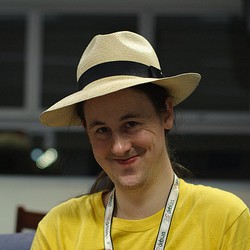
Ben Hutchings, photo by Andrew Mc Millan, license CC-BY-2.0

Ben Hutchings is a rather unassuming guy but hiding behind his hat, there s a real kernel hacker who backports new drivers for the kernel in Debian stable so that our flagship release supports very recent hardware. Read on to learn more about Ben and the kernel team s projects for Debian Wheezy! Raphael: Who are you? Ben: I m a professional programmer, living in Cambridge, England with my long-suffering wife Nattie. In Debian, I mostly work on the Linux kernel and related packages. Raphael: How did you start contributing to Debian? Ben: I started using Debian in 1998 and at some point I subscribed to Debian Weekly News. So in 2003 I heard about the planned Debian 10th birthday party in Cambridge, and thought I would like to go to that. Somehow I persuaded Nattie that we should go, even though it was on the day of our wedding anniversary! We both enjoyed it; we made new friends and met some old ones (small world). From then on we have
both been socially involved in Debian UK. In 2004 there was a bug-squashing party in Cambridge, and we attended that as well. That s where I really started contributing fixing bugs and learning about Debian packaging. Then in 2005 I made my first package (sgt-puzzles), attended DebConf, and was persuaded to enter the New Maintainer process. NM involved a lot of waiting, but by the time I was given questions and tasks to do I had learned enough to get through quite quickly. In April 2006 I was approved as a Debian Developer. Meanwhile, I looked at the videos from DebConf 5 and thought that it would be useful to distribute them on a DVD. That led me to start writing video software and to get involved in the video team for the next year s DebConf. Raphael: You have been one the main driver behind the removal of non-free firmwares from the kernel. Explain us what you did and what s the status nowadays? Ben: That s giving me a bit more credit than I deserve. For a long time the easy way for drivers to load firmware programs was to include them as a blob in their static data, but more recently the kernel has included a simple method for drivers to request a named blob at run-time. These requests are normally handled by udev by reading from files on disk, although there is a build-time option to include blobs in the kernel. Several upstream and distribution developers worked to convert the older drivers to use this method. I converted the last few of these drivers that Debian included in its binary packages. In the upstream Linux source, those blobs have not actually been removed; they have been moved to a firmware subdirectory. The long-term plan is to remove this while still allowing the inclusion of blobs at build-time from the separate linux-firmware repository. For now, the Debian source package excludes this subdirectory from the upstream tarball, so it is all free software. There are still a few drivers that have not been converted, and in Debian we just exclude the firmware from them (so they cannot be built). And from time to time a driver will be added to the staging section of Linux that includes firmware in the old way. But it s understood in the kernel community that it s one of the bugs that will have to be fixed before the driver can move out of staging . Raphael: Do you believe that Debian has done enough to make it easy for users to install the non-free firmwares that they need? Ben: The installer, the Linux binary packages and initramfs-tools will warn about specific files that may be needed but are missing. Users who have enabled the non-free section should then be able to find the necessary package with apt-cache search, because each of the
binaries built from the firmware-nonfree source package includes driver and file names within its description. For the installer, there is a single tarball that provides everything. We could make this easier, but I think we have gone about as far as we can while following the Debian Social Contract and Debian policy. Raphael: At some point in the past, the Debian kernel team was not working very well. Did the situation improve? Ben: Back in 2008 when I started working on the Linux kernel package to sort out the firmware issues, I think there were some problems of communication and coordination, and quite possibly some members were burned-out. Since then, many of the most active kernel team members have been able to meet face-to-face to discuss future plans at LPC 2009 in Portland and the 2010 mini-DebConf in Paris. We generally seem to have productive discussions on the debian-kernel mailing list and elsewhere, and I think the team is working quite well. Several new contributors have joined after me. I would say our biggest problem today is that we just don t have enough time to do all we want to. Certainly, almost all my Debian time is now taken up with integrating upstream kernel releases and handling some fraction of the incoming bug reports. Occasionally I can take the time to work on actual features or the other packages I m neglecting!
Our biggest problem today is that we just don t have enough time to do all we want to.
Raphael: It is widely known that Linux is maintained in a git repository. But the Debian kernel team is using Subversion. I believe a switch is planned. Why was not git used from the start? Ben: The linux-2.6 source package dates from the time when Linus made his first release using git. I wasn t part of the team back then so I don t know for sure why it was imported to Subversion. However, at that time hardly anyone knew how to use git, no-one had experience hosting public git repositories, and Alioth certainly didn t offer that option. Today there are no real blockers: everyone on the kernel team is familiar with using git; Alioth is ready to host it; we don t have per-architecture patches that would require large numbers of branches. But it still takes time to plan such a conversion for what is a relatively complex source package (actually a small set of related source packages). Raphael: What are your plans for Debian Wheezy? Ben: Something I ve already done, in conjunction with the installer team, is to start generating udebs from the linux-2.6 source package. The kernel and modules have to be repacked into lots of little udebs to avoid using too much memory during installation. The configuration for this used to be in a bunch of separate source packages; these could get out of step with the kernel build configuration and this would only be noticed some time later. Now we can update them both at the same time, they are effectively cross-checked on every upload, and the installer can always be built from the latest kernel version in testing or unstable. I think that we should be encouraging PC users to install the 64-bit build (amd64), but many users will still use 32-bit (i386) for backward compatibility or out of habit. On i386, we ve slightly reduced the variety of kernel flavours by getting rid of 686 and making 686-pae the default (previously this was called 686-bigmem ). This means that the NX security feature will be used on all systems that support it. It should also mean that the first i386 CD can have suitable kernel packages for all systems. I have been trying to work on providing a full choice of Linux Security Modules (LSMs). Despite their name, they cannot be built as kernel modules, so every enabled LSM is a waste of memory on the systems that don t use it. This is a significant concern for smaller Debian systems. My intent is to allow all unused LSMs to be freed at boot time so that we can happily enable all of them. I recently proposed to drop support for older x86 systems, starting with 486-class processors in wheezy. In general, this would allow the use of more compiler optimisations throughout userland and the kernel. However it seems that there isn t that much to be gained unless we also drop 586-class processors, and there are still quite a few of those in use. So I think this will have to wait. Uwe Kleine-K nig has been working to include real-time support (also known as PREEMPT_RT). This can provide low and very predictable I/O latency, which is useful for live audio synthesis, for example. It still requires a number of patches and a build configuration change, resulting in a separate binary package. We re currently only building that for 64-bit PCs. (You may notice this is missing for Linux 3.1, because the real-time developers skipped this release.) Raphael: What s the biggest problem of Debian? Ben: I think we try too hard to accommodate every possible option, without regard for the cost to developers and users in general. As an example, we now have sysvinit, file-rc, upstart and systemd all in testing. Daemon maintainers can t rely on any advanced features of upstart or systemd because we refuse to choose between them. And the decision to support the FreeBSD kernel means that we cannot choose upstart or systemd as the only option. So all daemon maintainers will have to maintain those baroque init scripts for the indefinite future. We really should be able to decide as a distribution that when one option is technically good and popular then it can be made the only option. But no-one really has the authority to do that, so we muddle along with the pretence that all the options are equally valid and functional, while none of them is supported as well as they should be.
We try too hard to accommodate every possible option, without regard for the cost to developers and users in general.
We also try to build every package on every architecture, in general. I m quite sure there are many (package, architecture) combinations that have no users, ever. But if at some point that combination FTBFS, developers will waste time investigating and fixing that time that could have been spent working on bugs and features that users actually care about. Yes, sure, portability is good but you can t prove portability just by making a package compile on every architecture. This also applies to the selection of drivers for the kernel, by the way. Raphael: Is there someone in Debian that you admire for their contributions? Well, there are many people, but I will pick out just a few: Steve McIntyre, for his work as DPL to improve communication with the various Debian derivatives and to bring fresh blood into various core teams. Also for being a generous host for countless Debian social and bug-squashing events. Stefano Zacchiroli, for improving further on communications with both downstream and upstream projects, and for regularly exercising his power to lead discussions to the benefit of the project. Julien Cristau, for maintaining good humour while not only fighting against the tide of graphics driver regressions in X and the Linux kernel but also working on release management. Jonathan Nieder, for taking on the unglamorous and frustrating task of kernel bug triage as a non-maintainer and developing it to a fine art.
Thank you to Ben for the time spent answering my questions. I hope you enjoyed reading his answers as I did.

Subscribe to my newsletter to get my monthly summary of the Debian/Ubuntu news and to not miss further interviews. You can also follow along on Identi.ca, Google+, Twitter and Facebook .

4 comments Liked this article? Click here. My blog is Flattr-enabled.

12 December 2011

Christian Perrier: Defoma removal

Thanks to the longstading work by Paul Wise in nearly 3 years...and with some help from my side (and from other members of the font packaging team), we're getting closer of a longstanding goal : removing Defoma from the archive. Defoma is indeed obsoleted by fontconfig, which doesn't need these "hints" file, turning the packaging of fonts into a very simple process. On last Saturday, Paul sent the removal request for defoma. The request mentions blocking bugs that are, for most of them, requests for font packages to drop the dependency on defoma. As we already sent patches for these bugs, I started NMU'ing the remaining packages this week-end. Most of them were apparently nearly abandoned packages, so I had no shame doing that so quickly. Indeed, I no longer fear NMU'ing packages even for non critical issues and I even sometimes no longer fear adding a few other fixes when the packages are very obviously poorly maintained (things like source v3, debhelper compatibility bump, build- indep arch targets support, etc.). After this NMU wave, we should be left, in one week, with only five packages blocking the removal of defoma. I might even NMU some of them, though some are TeX-related packages providing T1 fonts additionnally to TrueType ones...something I'l less familiar with. Whatever happens, I now nearly sure that wheezy will not have defoma. Yay! Hats off to Paul.

Next.

Previous.