Here is my transparent report for my work on the Debian Long Term Support (LTS) and Debian Extended Long Term Support (ELTS), which extend the security support for past Debian releases, as a paid contributor.
In July, the monthly sponsored hours were split evenly among contributors depending on their max availability - I was assigned 25.25h for LTS (out of 30 max; all done) and 13.25h for ELTS (out of 20 max; all done).
We shifted suites: welcome Stretch LTS and Jessie ELTS. The LTS->ELTS switch happened at the start of the month, but the oldstable->LTS switch happened later (after finalizing and flushing proposed-updates to a last point release), causing some confusion but nothing major.
ELTS - Jessie
New local build setup
ELTS buildds: request timezone harmonization
Reclassify in-progress updates from jessie-LTS to jessie-ELTS
python3.4: finish preparing update, security upload ELA 239-1
net-snmp: global triage: bisect CVE-2019-20892 to identify affected version, jessie/stretch not-affected
nginx: global triage: clarify CVE-2013-0337 status; locate CVE-2020-11724 original patch and regression tests, update MITRE
Reclassify in-progress/needed updates from stretch/oldstable to stretch-LTS
rails: upstream security: follow-up on CVE-2020-8163 (RCE) on upstream bug tracker and create pull request for 4.x (merged), hence getting some upstream review
rails: global security: continue coordinating upload in multiple Debian versions, prepare fixes for common stretch/buster vulnerabilities in buster
DebConf4
This tshirt is 16 years old and from DebConf4. Again, I should probably wash it at 60 celcius for once...
DebConf4 was my 2nd DebConf and took place in Porto Alegre, Brasil.
Like many DebConfs, it was a great opportunity to meet people:
I remember sitting in the lobby of the venue and some guy asked me what I did in Debian and I told
him about my little involvements and then asked him what he was doing, and he told me he wanted to
become involved in Debian again, after getting distracted away. His name was Ian Murdock...
DebConf4 also had a very cool history session in the hallway track (IIRC, but see below) with
Bdale Garbee, Ian Jackson and Ian Murdock and with a young student named Biella Coleman busy writing notes.
That same hallway also saw the kickoff meeting of the Debian Women project, though sadly
today http://tinc.debian.net ("there's no cabal") only shows an apache placeholder page and not
a picture of that meeting.
DebCon4 was also the first time I got a bit involved in preparing DebConf, together with
Jonas Smedegaard I've set up some computers there, using FAI. I had no idea that this was
the start of me contributing to DebConfs for text ten years.
And of course I also saw some talks, including one which I really liked, which then in turn made
me notice there were no people doing video recordings, which then lead to something...
I missed the group picture of this one. I guess it's important to me to mention it because
I've met very wonderful people at this DebConf... (some mentioned in this post, some not. You know
who you are!)
Afterwards some people stayed in Porto Alegre for FISL,
where we saw Lawrence Lessing present Creative Commons to the world for the first time. On the flight
back I sat next to a very friendly guy from Poland and we talked almost the whole flight and then
we never saw each other again, until 15 years later in Asia...
Oh, and then, after DebConf4, I used IRC for the first time. And stayed in the #debconf4 IRC channel
for quite some years
Finally, DebConf4 and more importantly FISL, which was really big (5000 people?) and after that,
the wizard of OS conference in Berlin
(which had a very nice talk about Linux in different places in the world, illustrating the
different states of 'first they ignore you, then they laugh at you, then they fight you, then you win'),
made me quit my job at a company supporting Windows- and Linux-setups as I realized I'd better
start freelancing with Linux-only jobs. So, once again, my life would have been different
if I would not have attended these events!
Note: yesterdays post about DebConf3 was thankfully corrected twice. This might well happen
to this post too!
DebConf3
This tshirt is 17 years old and from DebConf3. I should probably wash it at 60 celcius for once...
DebConf3 was my first DebConf and took place in Oslo, Norway, in 2003. I was very happy to be invited,
like any Debian contributor at that time, and that Debian would provide food and accomodation for everyone.
Accomodation was sleeping on the floor in some classrooms of an empty school and I remember having
tasted grasshoppers provided by a friendly Gunnar Wolf there, standing in line on the first day with the
SSH maintainer (OMG!1 (update: I originally wrote here that it wasn't Colin back then, but Colin
mailed me to say that he was indeed maintaining SSH even back then, so I've met a previous maintainer
there)) and meeting the one Debian person I had actually
worked with before: Thomas Lange or MrFAI (update: Thomas also mailed me and said this was at DebConf5).
In Oslo I also was exposed to Skolelinux / Debian Edu for the first
time, saw a certain presentation from the FTP masters and also noticed some people recording the talks,
though as I learned later these videos were never released to the public. And there was this fiveteen year old
called Toresbe, who powered on the PDP's which were double his age. And then actually made use of them. And and and.
I'm very happy I went to this DebConf. Without going my Debian journey would have been very different today.
Thanks to everyone who made this such a welcoming event. Thanks to anyone who makes any event welcoming!
Here s my (tenth) monthly update about the activities I ve done in the F/L/OSS world.
Debian
This was my 17th month of contributing to Debian.
I became a DM in late March last year and a DD last Christmas! \o/
Well, this month I didn t do a lot of Debian stuff, like I usually do, however, I did a lot of things related to Debian (indirectly via GSoC)!
Anyway, here are the following things I did this month:
Also, I log daily updates at gsocwithutkarsh2102.tk.
Whilst the daily updates are available at the above site^, I ll breakdown the important parts of the later half of the second month here:
Marc Andre, very kindly, helped in fixing the specs that were failing earlier this month. Well, the problem was with the specs, but I am still confused how so. Anyway..
Finished documentation of the second cop and marked the PR as ready to be reviewed.
David reviewed and suggested some really good changes and I fixed/tweaked that PR as per his suggestion to finally finish the last bits of the second cop, RelativeRequireToLib.
Merged the PR upon two approvals and released it as v0.2.0!
We had our next weekly meeting where we discussed the next steps and the things that are supposed to be done for the next set of cops.
Introduced rubocop-packaging to the outer world and requested other upstream projects to use it! It is being used by 13 other projects already!
Started to work on packaging-style-guide but I didn t push anything to the public repository yet.
Worked on refactoring the cops_documentation Rake task which was broken by the new auto-corrector API. Opened PR #7 for it. It ll be merged after the next RuboCop release as it uses CopsDocumentationGenerator class from the master branch.
Whilst working on autoprefixer-rails, I found something unusual. The second cop shouldn t really report offenses if the require_relative calls are from lib to lib itself. This is a false-positive. Opened issue #8 for the same.
Continuation of GSoC for other Ruby related stuff!
Whilst working on rubocop-packaging, I contributed to more Ruby projects, refactoring their library a little bit and mostly fixing RuboCop issues and fixing issues that the Packaging extension reports as offensive .
Following are the PRs that I raised:
Debian (E)LTS
Debian Long Term Support (LTS) is a project to extend the lifetime of all Debian stable releases to (at least) 5 years. Debian LTS is not handled by the Debian security team, but by a separate group of volunteers and companies interested in making it a success.
And Debian Extended LTS (ELTS) is its sister project, extending support to the Jessie release (+2 years after LTS support).
This was my tenth month as a Debian LTS and my first as a Debian ELTS paid contributor.
I was assigned 25.25 hours for LTS and 13.25 hours for ELTS and worked on
the following things:
Other(s)
Sometimes it gets hard to categorize work/things into a particular category.
That s why I am writing all of those things inside this category.
This includes two sub-categories and they are as follows.
Personal:
This month I did the following things:
Released v0.2.0 of rubocop-packaging on RubyGems!
It s open-sourced and the repository is here.
Bug reports and pull requests are welcomed!
Released v0.1.0 of get_root on RubyGems!
It s open-sourced and the repository is here.
Wrote max-word-frequency, my Rails C1M2 programming assignment.
And made it pretty neater & cleaner!
Refactored my lts-dla and elts-ela scripts entirely and wrote them in Ruby so that there are no issues and no false-positives!
Check lts-dla here and elts-ela here.
And finally, built my first Rails (mini) web-application!
The repository is here. This was also a programming assignment (C1M3).
And furthermore, hosted it at Heroku.
Open Source:
Again, this contains all the things that I couldn t categorize earlier.
Opened several issues and PRs:
Issue #8273 against rubocop, reporting a false-positive auto-correct for Style/WhileUntilModifier.
Issue #615 against http reporting a weird behavior of a flaky test.
PR #3791 for rubygems/bundler to remove redundant bundler/setup require call from spec_helper generated by bundle gem.
Issue #3831 against rubygems, reporting a traceback of undefined method, rubyforge_project=.
Issue #238 against nheko asking for enhancement in showing the font name in the very font itself.
PR #2307 for puma to constrain rake-compiler to v0.9.4.
And finally, I joined the Cucumber organization! \o/
Thank you for sticking along for so long :)
Until next time. :wq for today.
rejected
autotalent (not the package),
bart (logo),
mumble-server (client UI),
hpcc (not a screenshot)
approved deletion of
theli (replacing incorrect screenshot)
rejected deletion of
gnome-bluetooth/aptitude/torbrowser-launcher (unintelligible),
phpbb3/hashcat/onboard/kcharselect (spam),
various packages (not the place to report abuse),
vim (not the place to send kudos)
Administration
Debian wiki:
unblock IP addresses,
approve accounts,
reset email addresses
I was assigned 20 hours of work by Freexian's Debian LTS initiative,
but only worked 5 hours this month and returned the remainder to the
pool.
Now that Debian 9 'stretch' has entered LTS, the stretch-backports
suite will be closed and no longer updated. However, some stretch
users rely on the newer kernel version provided there. I prepared
to add Linux 4.19 to the stretch-security suite, alongside the standard
package of Linux 4.9. I also prepared to update the
firmware-nonfree package so that firmware needed by drivers in Linux
4.19 will also be available in stretch's non-free section. Both
these updates will be based on the packages in stretch-backports,
but needed some changes to avoid conflicts or regressions for users
that continue using Linux 4.9 or older non-Debian kernel versions.
I will upload these after the Debian 10 'buster' point release.
Here is my monthly update covering what I have been doing in the free and open source software world during July 2020 (previous month):
Opened a pull request to make the build reproducible in PyERFA, a set of Python bindings for various astronomy-related utilities (#45), as well as one for PeachPy assembler to make the output of codecode/x86_64.py reproducible (#108).
As part of being on the board of directors of the Open Source Initiative and Software in the Public Interest I attended their respective monthly meetings and participated in various licensing and other discussions occurring on the internet, as well as the usual internal discussions regarding logistics and policy etc. This month, it was SPI's Annual General Meeting and the OSI has been running a number of remote strategy sessions for the board.
Updated travis.debian.net, my hosted service for projects that host their Debian packaging on GitHub, to use the Travis CI continuous integration platform) to fix a compatibility issue with the latest version of mk-build-deps. [...][...]
For Lintian, the static analysis tool for Debian packages:
Update the regular expression to search for all the released versions in a .changes file. [...]
Avoid false-positives when matching sensible-utils utilities such as i3-sensible-pager. (#966022)
Rename the send-patch tag to patch-not-forwarded-upstream. [...]
Drop reminders from 26 tags that false-positives should be reported to Lintian as this is implicit in all our tags. [...]
Reproducible Builds
One of the original promises of open source software is that distributed peer review and transparency of process results in enhanced end-user security. However, whilst anyone may inspect the source code of free and open source software for malicious flaws, almost all software today is distributed as pre-compiled binaries. This allows nefarious third-parties to compromise systems by injecting malicious code into ostensibly secure software during the various compilation and distribution processes.
The motivation behind the Reproducible Builds effort is to ensure no flaws have been introduced during this compilation process by promising identical results are always generated from a given source, thus allowing multiple third-parties to come to a consensus on whether a build was compromised.
The project is proud to be a member project of the Software Freedom Conservancy. Conservancy acts as a corporate umbrella allowing projects to operate as non-profit initiatives without managing their own corporate structure. If you like the work of the Conservancy or the Reproducible Builds project, please consider becoming an official supporter.
This month, I:
Opened pull requests to make the build reproducible in pyerfa (#45) as well as one for PeachPy to make the output of codecode/x86_64.py reproducible (#108).
In Debian:
Submitted the following patches to fix reproducibility-related toolchain issues within Debian:
dh-fortran-mod: Please make the output reproducible. (#965255)
gem2deb: should not install mkmf.log files. (#964772)
nmap: Please make the obfuscated nmap_service.exe file reproducible. (#964369)
strip-nondeterminism is our tool to remove specific non-deterministic results from a completed build. This month, I made sure that we did not install the internal handler documentation generated from Perl POD documents [...] and fixed a trivial typo [...].
diffoscope
Elsewhere in our tooling, I made the following changes to diffoscope, including preparing and uploading versions 150, 151, 152, 153 & 154 to Debian:
New features:
Add support for flash-optimised F2FS filesystems. (#207)
Don't require zipnote(1) to determine differences in a .zip file as we can use libarchive. [...]
Allow --profile as a synonym for --profile=-, ie. write profiling data to standard output. [...]
Increase the minimum length of the output of strings(1) to eight characters to avoid unnecessary diff noise. [...]
Drop some legacy argument styles: --exclude-directory-metadata and --no-exclude-directory-metadata have been replaced with --exclude-directory-metadata= yes,no . [...]
Bug fixes:
Pass the absolute path when extracting members from SquashFS images as we run the command with working directory in a temporary directory. (#189)
Correct adding a comment when we cannot extract a filesystem due to missing libguestfs module. [...]
Don't crash when listing entries in archives if they don't have a listed size such as hardlinks in ISO images. (#188)
Output improvements:
Strip off the file offset prefix from xxd(1) and show bytes in groups of 4. [...]
Don't emit javap not found in path if it is available in the path but it did not result in an actual difference. [...]
Fix ... not available in path messages when looking for Java decompilers that used the Python class name instead of the command. [...]
Logging improvements:
Add a bit more debugging info when launching libguestfs. [...]
Reduce the --debug log noise by truncating the has_some_content messages. [...]
Fix the compare_files log message when the file does not have a literal name. [...]
Codebase improvements:
Rewrite and rename exit_if_paths_do_not_exist to not check files multiple times. [...][...]
Add an add_comment helper method; don't mess with our internal list directly. [...]
Replace some simple usages of str.format with Python 'f-strings' [...] and make it easier to navigate to the main.py entry point [...].
In the RData comparator, always explicitly return None in the failure case as we return a non-None value in the success one. [...]
Tidy some imports [...][...][...] and don't alias a variable when we don't end up using. [...]
Clarify the use of a separate NullChanges quasi-file to represent missing data in the Debian package comparator [...] and clarify use of a 'null' diff in order to remember an exit code. [...]
Frontdesk duties, including responding to user/developer questions, reviewing packages, participating in mailing list discussions, offering comments on our survey and attended our IRC contributor meeting. I also made some changes to tools after the move from the Debian version supported [...].
Issued DLA 2273-1 for shiro, first to fix a path-traversal issue where a specially-crafted request could cause an authentication bypass (CVE-2020-1957) and then to fix an encoding issue introduced in the handling of the previous CVE-2020-1957 path-traversal issue which itself could have also caused an authentication bypass (CVE-2020-11989).
Issued DLA 2274-1 to fix a possible signature verification issue in the fwupd firmware update tool as the return value of gpgme_op_verify_result was not being checked.
Issued DLA 2299-1 and ELA 252-1 in order to prevent a privilege escalation vulnerability discovered in Net-SNMP, a set of tools for collecting and organising information about devices on computer networks.
Issued DLA 2300-1 as it was discovered that there was an issue where kdepim-runtime would default to using unencrypted POP3 communication despite the user interface indicating that encryption was in use.
You can find out more about the project via the following video:
Here are my uploads for the month of July, which is just a part of my free software activities, I ll try to catch up on the rest in upcoming posts. I haven t indulged in online conferences much over the last few months, but this month I attended the virtual editions of Guadec 2020 and HOPE 2020. HOPE isn t something I knew about before and I enjoyed it a lot, you can find their videos on archive.org.
Debian Uploads
2020-07-05: Sponsor backport gamemode-1.5.1-5 for Debian buster-backports.
2020-07-06: Sponsor package piper (0.5.1-1) for Debian unstable (mentors.debian.net request).
2020-07-14: Upload package speedtest-cli (2.0.2-1+deb10u1) to Debian buster (Closes: #940165, #965116).
2020-07-15: Upload package calamares (3.2.27-1) to Debian unstable.
2020-07-15: Merge MR#1 for gnome-shell-extension-dash-to-panel.
2020-07-15: Upload package gnome-shell-extension-dash-to-panel (38-1) to Debian unstable.
2020-07-15: Upload package gnome-shell-extension-disconnect-wifi (25-1) to Debian unstable.
2020-07-15: Upload package gnome-shell-extension-draw-on-your-screen (6.1-1) to Debian unstable.
2020-07-15: Upload package xabacus (8.2.8-1) to Debian unstable.
2020-07-15: Upload package s-tui (1.0.2-1) to Debian unstable.
2020-07-15: Upload package calamares-settings-debian (10.0.2-1+deb10u2) to Debian buster (Closes: #934503, #934504).
2020-07-15: Upload package calamares-settings-debian (10.0.2-1+deb10u3) to Debian buster (Closes: #959541, #965117).
2020-07-15: Upload package calamares-settings-debian (11.0.2-1) to Debian unstable.
2020-07-19: Upload package bluefish (2.2.11+svn-r8872-1) to Debian unstable (Closes: #593413, #593427, #692284, #730543, #857330, #892502, #951143).
2020-07-19: Upload package bundlewrap (4.0.0-1) to Debian unstable.
2020-07-20: Upload package bluefish (2.2.11+svn-r8872-1) to Debian unstable (Closes: #965332).
2020-07-22: Upload package calamares (3.2.27-1~bpo10+1) to Debian buster-backports.
2020-07-24: Upload package bluefish (2.2.11_svn-r8872-3) to Debian unstable (Closes: #965944).
So a few months ago kiddo one dropped an apparently fairly large cup of coffee onto her one and only trusted computer. With a few months (then) to graduation (which by now happened), and with the apparent genuis bar verdict of it s a goner a new one was ordered. As it turns out this supposedly dead one coped well enough with the coffee so that after a few weeks of drying it booted again. But give the newer one, its apparent age and whatnot, it was deemed surplus. So I poked around a little on the interwebs and conclude that yes, this could work.
Fast forward a few months and I finally got hold of it, and had some time to play with it. First, a bootable usbstick was prepared, and the machine s content was really (really, and check again: really) no longer needed, I got hold of it for good.
tl;dr It works just fine. It is a little heavier than I thought (and isn t air supposed to be weightless?) The ergonomics seem quite nice. The keyboard is decent. Screen-resolution on this pre-retina simple Air is so-so at 1440 pixels. But battery live seems ok and e.g. the camera is way better than what I have in my trusted Lenovo X1 or at my desktop. So just as a zoom client it may make a lot of sense; otherwise just walking around with it as a quick portable machine seems perfect (especially as my Lenovo X1 still (ahem) suffers from one broken key I really need to fix ).
Below are some lightly edited notes from the installation. Initial steps were quick: maybe an hour or less? Customizing a machine takes longer than I remembered, this took a few minutes here and there quite a few times, but always incremental.
Initial Steps
Download of Ubuntu 20.04 LTS image: took a few moments, even on broadband, feels slower than normal (fast!) Ubuntu package updates, maybe lesser CDN or bad luck
Plug into USB, recycle power, press Option on macOS keyboard: voila
After a quick hunch no to live/test only and yes to install, whole disk
install easy, very few questions, somehow skips wifi
so activate wifi manually and everythings pretty much works
Customization
First deal with fn and ctrl key swap. Install git and followed this github repo which worked just fine. Yay. First (manual) Linux kernel module build needed need in half a decade? Longer?
Fire up firefox, go to download chrome , install chrome. Sign in. Turn on syncing. Sign into Pushbullet and Momentum.
syncthing which is excellent. Initially via apt, later from their PPA. Spend some time remembering how to set up the mutual handshakes between devices. Now syncing desktop/server, lenovo x1 laptop, android phone and this new laptop
keepassx via apt and set up using Sync/ folder. Now all (encrypted) passwords synced.
Discovered synergy now longer really free, so after a quick search found and installed barrier (via apt) to have one keyboard/mouse from desktop reach laptop.
Added emacs via apt, so far empty , so config files yet
Added ssh via apt, need to propagate keys to github and gitlab
Added R via add-apt-repository --yes "ppa:marutter/rrutter4.0" and add-apt-repository --yes "ppa:c2d4u.team/c2d4u4.0+". Added littler and then RStudio
Added wajig (apt frontend) and byobu, both via apt
Created ssh key, shipped it to server and github + gitlab
Cloned (not-public) dotfiles repo and linked some dotfiles in
Many people labour under the assumption that pop culture is trivial and useless while only 'high' art can grant us genuine and eternal knowledge about the world. Given that we have a finite time on this planet, we are all permitted to enjoy pop culture up to a certain point, but we should always minimise our interaction with it, and consume more moral and intellectual instruction wherever possible.
Or so the theory goes. What these people do not realise is that pop and mass culture can often provide more information about the world, humanity in general and what is even more important ourselves.
This is not quite the debate around whether high art is artistically better, simply that pop culture can be equally informative. Jeremy Bentham argued in the 1820s that "prejudice apart, the game of push-pin is of equal value with the arts and sciences of music and poetry", that it didn't matter where our pleasures come from. (John Stuart Mill, Bentham's intellectual rival, disagreed.) This fundamental question of philosophical utilitarianism will not be resolved here.
However, what might begin to be resolved is our instinctive push-back against pop culture. We all share an automatic impulse to disregard things we do not like and to pretend they do not exist, but this wishful thinking does not mean that these cultural products do not continue to exist when we aren't thinking about them and, more to our point, continue to influence others and even ourselves.
Take, for example, the recent trend for 'millennial pink'. With its empty consumerism, faux nostalgia, reductive generational stereotyping, objectively ugly sthetics and tedious misogyny (photographed with Rose Gold iPhones), the very combination appears to have been deliberately designed to annoy me, curiously providing circumstantial evidence in favour of intelligent design. But if I were to immediately dismiss millennial pink andanyoftheothercountlessculturaltrendsIdislikesimplybecauseIfindthemdisagreeable, I would be willingly keeping myself blind to their underlying ideology, their significance and their effect on society at large.
If I had any ethicalorpoliticalreservations I might choose not to engage with them economically or to avoid advertising them to others, but that is a different question altogether.
Even if we can't notice this pattern within ourselves we can first observe it in others. We can all recall moments where someone has brushed off a casual reference to pop culture, be it Tiger King, TikTok, team sports or Taylor Swift; if you can't, simply look for the abrupt change of tone and the slightly-too-quick dismissal. I am not suggesting you attempt to dissuade others or even to point out this mental tic, but merely seeing it in action can be highly illustrative in its own way.
In summary, we can simultaneously say that pop culture is not worthy of our time relative to other pursuits while consuming however much of it we want, but deliberately dismissing pop culture doesn't mean that a lot of other people are not interacting with it and is therefore undeserving of any inquiry. And if that doesn't convince you, just like the once-unavoidable millennial pink, simply sticking our collective heads in the sand will not mean that wider societal-level ugliness is going to disappear anytime soon.
Anyway, that's a very long way of justifying why I plan to re-watch TNG.
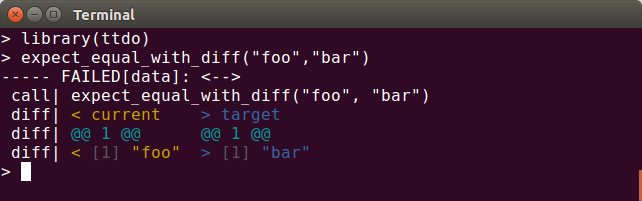
A bugfix release of our (still small) ttdo package arrived on CRAN overnight. As introduced last fall, the ttdo package extends the most excellent (and very minimal / zero depends) unit testing package tinytest by Mark van der Loo with the very clever and well-done diffobj package by Brodie Gaslam to give us test results with visual diffs:
This release corrects a minor editing error spotted by the ever-vigilant John Blischak.
The NEWS entry follow.
Changes in ttdo version 0.0.6 (2020-07-27)
Correct a minor editing mistake spotted by John Blischak.
Hmm, this is the latest I ve posted my monthly updates yet (nearly by a month!). June was both crazy on the incoming side, and at the same time I just wasn t that productive (at least since then I caught up a lot). In theory, lockdown means that I spend less time in traffic, in shops or with friends and have more time to do stuff, in practice I go to bed later and later and waste more time watching tv shows and playing mobile games. A cycle that I have at least broken free from since June.
Debian Package Uploads
2020-06-04: Upload package btfs (2.21-1) to Debian unstable.
2020-06-04: Upload package gnome-shell-extension-disconnect-wifi (24-1) to Debian unstable.
2020-06-18: Sponsor package gamemode (1.5.1-5) for Debian unstable (Games team request).
2020-06-21: Upload package calamares (3.2.26-1) to Debian unstable.
2020-06-21: Upload package s-tui (1.0.1-1) to Debian unstable.
2020-06-29: Sponsor package libinih (48-1~bpo10+1) for Debian buster-backports.
2020-06-30: Upload packge calamares (3.2.26-1~bpo10+1) to Debian buster-backports.
2020-06-30: Upload package toot (0.27.0-1) to Debian unstable.
2020-06-30: Upload package calamares (3.2.26.1-1) to Debian unstable.
Sometimes I enjoy reading the source code to projects I like, use, or am about to install for the first time. This was something I used to do on a very regular basis, looking for security issues to report. Nowadays I don't have so much free time, but I still like to inspect the source code to new applications I install, and every now and again I'll find the time to look at the source to random projects.
Reading code is good. Reading code is educational.
One application I've looked at multiple times is redis, which is a great example of clean and well-written code. That said when reading the redis codebase I couldn't help noticing that there were a reasonably large number of typos/spelling mistakes in the comments, so I submitted a pull-request:
Sadly that particular pull-request didn't receive too much attention, although a previous one updating the configuration file was accepted. I was recently reminded of these pull-requests when I was when I was doing some other work. So I figured I'd have a quick scan of a couple of other utilities.
In the past I'd just note spelling mistakes when I came across them, usually I'd be opening each file in a project one by one and reading them from top to bottom. (Sometimes I'd just open files in emacs and run "M-x ispell-comments-and-strings", but more often I'd just notice them with my eyes). It did strike me that if I were to do this in a more serious fashion it would be good to automate it.
So this time round I hacked up a simple "dump comments" utility, which would scan named files and output the contents of any comments (be they single-line, or multi-line). Once I'd done that I could spell-check easily:
 $ go run dump-comments.go *.c > comments
 $ aspell -c comments
Anyway the upshot of that was a pull-request against git:
We'll see if that makes its way live sometime. In case I get interested in doing this again I've updated my sysbox-utility collection to have a comments sub-command. That's a little more robust and reliable than my previous hack:
First off - nothing I'm going to talk about in this post is novel or overly surprising, I just haven't found a clear writeup of it before. I'm not criticising any design decisions or claiming this is an important issue, just raising something that people might otherwise be unaware of.
With that out of the way: Automatic deduplication of data is a feature of modern filesystems like zfs and btrfs. It takes two forms - inline, where the filesystem detects that data being written to disk is identical to data that already exists on disk and simply references the existing copy rather than, and offline, where tooling retroactively identifies duplicated data and removes the duplicate copies (zfs supports inline deduplication, btrfs only currently supports offline). In a world where disks end up with multiple copies of cloud or container images, deduplication can free up significant amounts of disk space.
What's the security implication? The problem is that deduplication doesn't recognise ownership - if two users have copies of the same file, only one copy of the file will be stored[1]. So, if user a stores a file, the amount of free space will decrease. If user b stores another copy of the same file, the amount of free space will remain the same. If user b is able to check how much free space is available, user b can determine whether the file already exists.
This doesn't seem like a huge deal in most cases, but it is a violation of expected behaviour (if user b doesn't have permission to read user a's files, user b shouldn't be able to determine whether user a has a specific file). But we can come up with some convoluted cases where it becomes more relevant, such as law enforcement gaining unprivileged access to a system and then being able to demonstrate that a specific file already exists on that system. Perhaps more interestingly, it's been demonstrated that free space isn't the only sidechannel exposed by deduplication - deduplication has an impact on access timing, and can be used to infer the existence of data across virtual machine boundaries.
As I said, this is almost certainly not something that matters in most real world scenarios. But with so much discussion of CPU sidechannels over the past couple of years, it's interesting to think about what other features also end up leaking information in ways that may not be obvious.
(Edit to add: deduplication isn't enabled on zfs by default and is explicitly triggered on btrfs, so unless it's something you've enabled then this isn't something that affects you)
[1] Deduplication is usually done at the block level rather than the file level, but given zfs's support for variable sized blocks, identical files should be deduplicated even if they're smaller than the maximum record size
"I grew up on a farm" is something I sometimes what I tell people. It isn't true, but it is a useful shorthand. What is true is that my parents both come from a farming background, my father's family up in Scotland, my mother's down in Yorkshire.
Every summer my sisters and myself would have a traditional holiday at the seaside, which is what people do in the UK (Blackpool, Scarborough, Great Yarmouth, etc). Before, or after, that we'd spend the rest of the summer living on my grandmother's farm.
I loved spending time on the farm when I was a kid, and some of my earliest memories date from that time. For example I remember hand-feeding carrots to working dogs (alsatians) that were taller than I was. I remember trying to ride on the backs of those dogs, and how that didn't end well. In fact the one and only time I can recall my grandmother shouting at me, or raising her voice at all, was when my sisters and I spent an afternoon playing in the coal-shed. We were filthy and covered in coal-dust from head to toe. Awesome!
Anyway the only reason I bring this up is because I have a little bit of a farming background, largely irrelevant in my daily life, but also a source of pleasant memories. Despite it being an animal farm (pigs, sheep, cows) there was also a lot of home-grown food, which my uncle Albert would deliver/sell to people nearby out of the back of a van. That same van that would be used to ferry us to see the fireworks every November. Those evenings were very memorable too - they would almost always involve flasks of home-made vegetable soup.
Nowadays I live in Finland, and earlier in the year we received access to an allotment - a small piece of land (10m x 10m) for 50/year - upon which we can grow our own plants, etc.
My wife decided to plant flowers and make it look pretty. She did good.
I decided to plant "food". I might not have done this stuff from scratch before, but I was pretty familiar with the process from my youth, and also having the internet to hand to make the obvious searches such as "How do you know when you can harvest your garlic?"
Before I started I figured it couldn't be too hard, after all if you leave onions/potatoes in the refrigerator for long enough they start to grow! It isn't like you have to do too much to help them. In short it has been pretty easy and I'm definitely going to be doing more of it next year.
I've surprised myself by enjoying the process as much as I have. Every few days I go and rip up the weeds, and water the things we've planted. So far I've planted, and harvested, Radish, Garlic, Onions, and in a few more weeks I'll be digging up potatoes.
I have no particular point to this post, except to say that if you have a few hours spare a week, and a slab of land to hand upon which you can dig and plant I'd recommend it. Sure there were annoyances, and not a single one of the carrot-seeds I planted showed any sign of life, but the other stuff? The stuff that grew? Very tasty, om nom nom ..
(It has to be said that when we received the plot there was a jungle growing upon it. Once we tidied it all up we found raspberries, roses, and other things. The garlic I reaped was already growing so I felt like a cheat to harvest it. That said I did plant a couple of bulbs on my balcony so I could say "I grew this from scratch". Took a while, but I did indeed harvest my own garlic.)
I released version 2.4 of ledger2beancount, a ledger to beancount converter.
There are two notable changes in this release:
I fixed two regressions introduced in the last release. Sorry about the breakage!
I improved support for hledger. I believe all syntax differences in hledger are supported now.
Here are the changes in 2.4:
Fix regressions introduced in version 2.3
Handle price directives with comments
Don't assume implicit conversion when price is on second posting
Improve support for hledger
Fix parsing of hledger tags
Support commas as decimal markers
Support digit group marks through commodity and D directives
Support end aliases directive
Support regex aliases
Recognise total balance assertions
Recognise sub-account balance assertions
Add support for define directive
Convert all uppercase metadata tags to all lowercase
Improve handling of ledger lots without cost
Allow transactions without postings
Fix parsing issue in commodity declarations
Support commodities that contain quotation marks
Add --version option to show version
Document problem of mixing apply and include
Thanks to Kirill Goncharov for pointing out one regressions, to Taylor R Campbell for for a patch, to Stefano Zacchiroli for some input, and finally to Simon Michael for input on hledger!
You can get ledger2beancount from GitHub
Final call to participate in the LTS survey
After 6 years of existence, we, the Debian LTS contributors, wanted to run a survey
to learn more about how Debian LTS is used and perceived. Please
take
a few minutes to participate in the survey at https://surveys.debian.net/...!
Also, please hurry up, the survey will close at the end of July 27th on
Samoa,
which is in roughly 48h from now.
A new minor release of the anytime package arrived on CRAN overnight. This is the nineteenth release, and it comes just over six months after the previous release giving further indicating that we appear to have reached a nice level of stability.
anytime is a very focused package aiming to do just one thing really well: to convert anything in integer, numeric, character, factor, ordered, format to either POSIXct or Date objects and to do so without requiring a format string. See the anytime page, or the GitHub README.md for a few examples.
This release mostly plays games with CRAN. Given the lack of specification for setups on their end, reproducing test failures remains, to put it mildly, somewhat challenging . So we eventually gave up and weaponed up once more and now explicitly test for the one distribution where tests failed (when they clearly passed everywhere else). With that we now have three new logical predicates for various Linux distribution flavours, and if that dreaded one is seen in one test file the test is skipped. And with that we now score twelve out of twelve OKs. This being a game of cat and mouse, I am sure someone somewhere will soon invent a new test
The full list of changes follows.
Changes in anytime version 0.3.8 (2020-07-23)
A small utility function was added to detect the Linux distribution used in order to fine-tune tests once more.
 Here is my transparent report for my work on the Debian Long Term Support (LTS) and Debian Extended Long Term Support (ELTS), which extend the security support for past Debian releases, as a paid contributor.
In July, the monthly sponsored hours were split evenly among contributors depending on their max availability - I was assigned 25.25h for LTS (out of 30 max; all done) and 13.25h for ELTS (out of 20 max; all done).
We shifted suites: welcome Stretch LTS and Jessie ELTS. The LTS->ELTS switch happened at the start of the month, but the oldstable->LTS switch happened later (after finalizing and flushing proposed-updates to a last point release), causing some confusion but nothing major.
ELTS - Jessie
 DebConf4
This tshirt is 16 years old and from DebConf4. Again, I should probably wash it at 60 celcius for once...

 Finally, DebConf4 and more importantly FISL, which was really big (5000 people?) and after that,
the


 In May, I got selected as a


 August and feels like it finally. July didn't feel like July and felt like June because it rained so much. This is summer.
 I was assigned 20 hours of work by Freexian's Debian LTS initiative,
but only worked 5 hours this month and returned the remainder to the
pool.
Now that Debian 9 'stretch' has entered LTS, the stretch-backports
suite will be closed and no longer updated. However, some stretch
users rely on the newer kernel version provided there. I prepared
to add Linux 4.19 to the stretch-security suite, alongside the standard
package of Linux 4.9. I also prepared to update the
firmware-nonfree package so that firmware needed by drivers in Linux
4.19 will also be available in stretch's non-free section. Both
these updates will be based on the packages in stretch-backports,
but needed some changes to avoid conflicts or regressions for users
that continue using Linux 4.9 or older non-Debian kernel versions.
I will upload these after the Debian 10 'buster' point release.
 Here is my monthly update covering what I have been doing in the free and open source software world during July 2020 (

 Here are my uploads for the month of July, which is just a part of my free software activities, I ll try to catch up on the rest in upcoming posts. I haven t indulged in online conferences much over the last few months, but this month I attended the virtual editions of Guadec 2020 and HOPE 2020. HOPE isn t something I knew about before and I enjoyed it a lot, you can find their
 Only a short update on the current status of my KDE/Plasma package for Debian sid and testing:
 So a few months ago kiddo one dropped an apparently fairly large cup of coffee onto her one and only trusted computer. With a few months (then) to graduation (which by now
 Fast forward a few months and I finally got hold of it, and had some time to play with it. First, a bootable usbstick was prepared, and the machine s content was really (really, and check again: really) no longer needed, I got hold of it for good.
tl;dr It works just fine. It is a little heavier than I thought (and isn t air supposed to be weightless?) The ergonomics seem quite nice. The keyboard is decent. Screen-resolution on this pre-retina simple Air is so-so at 1440 pixels. But battery live seems ok and e.g. the camera is way better than what I have in my trusted Lenovo X1 or at my desktop. So just as a zoom client it may make a lot of sense; otherwise just walking around with it as a quick portable machine seems perfect (especially as my Lenovo X1 still (ahem) suffers from one broken key I really need to fix ).
 Below are some lightly edited notes from the installation. Initial steps were quick: maybe an hour or less? Customizing a machine takes longer than I remembered, this took a few minutes here and there quite a few times, but always incremental.
 This release corrects a minor editing error spotted by the ever-vigilant
 Sometimes I enjoy reading the source code to projects I like, use, or am about to install for the first time. This was something I used to do on a very regular basis, looking for
 First off - nothing I'm going to talk about in this post is novel or overly surprising, I just haven't found a clear writeup of it before. I'm not criticising any design decisions or claiming this is an important issue, just raising something that people might otherwise be unaware of.
 I released version 2.4 of