Search Results: "tin"

14 February 2022

Petter Reinholdtsen: Updated vlc bittorrent plugin in Debian (version 2.14)

I am very happy to report that a new version of the VLC bittorrent plugin was just uploaded into debian. The changes since last time is mostly code clean in the download code. The package is currently in Debian unstable, but should be available in Debian testing son. To test it, simply install it like this:
apt install vlc-plugin-bittorrent
After it is installed, you can try to use it to play a file downloaded live via bittorrent like this:
vlc https://archive.org/download/Glass_201703/Glass_201703_archive.torrent
It can also use magnet links and local .torrent files like the ones provided by the Internet Archive. Another example is the Love Nest Buster Keaton movie, where one can click on the 'Torrent' link to get going. As usual, if you use Bitcoin and want to show your support of my activities, please send Bitcoin donations to my address 15oWEoG9dUPovwmUL9KWAnYRtNJEkP1u1b.

13 February 2022

Junichi Uekawa: Troubleshooting network issues.

Troubleshooting network issues. Completely forgot how to use dig command.

Gunnar Wolf: Got to boot a RPi Zero 2 W with Debian

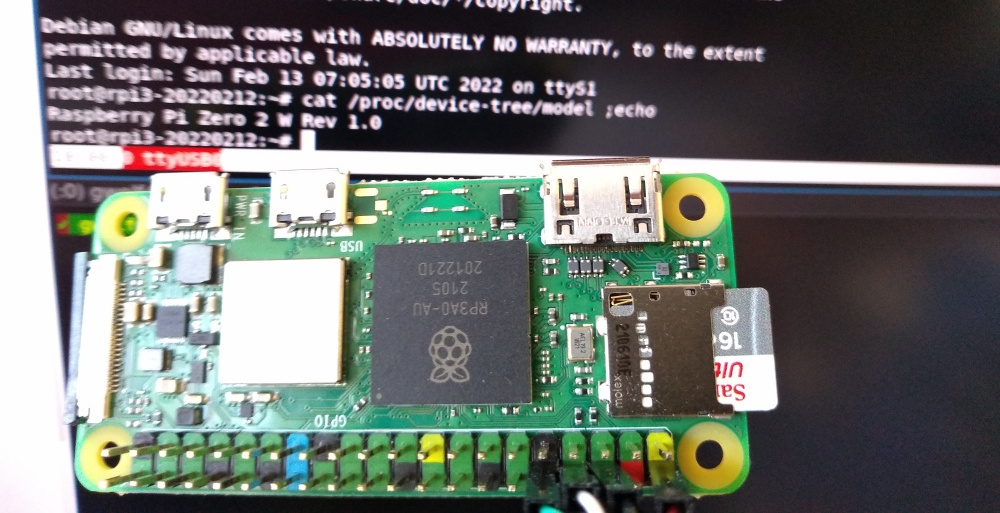
About a month ago, I got tired of waiting for the newest member of the Raspberry product lineup to be sold in Mexico, and I bought it from a Chinese reseller through a big online shopping platform. I paid quite a bit of premium (~US$85 instead of the advertised US$15), and got it delivered ten days later Anyway, it s known this machine does not yet boot mainline Linux. The vast majority of ARM systems require the bootloader to load a Device Tree file, presenting the hardware characteristics map. And while the RPi Zero 2 W (hey what an awful and confusing naming scheme they chose!) is mostly similar to a RPi3B+, it is not quite the same thing. A kernel with RPi3B+ s device tree will refuse to boot. Anyway, I started digging, and found that some days ago Stephan Wahren sent a patch to the linux-arm-kernel mailing list with a matching device tree. Read the patch! It s quite simple to read (what is harder is to know where each declaration should go, if you want to write your own, of course). It basically includes all basic details for the main chip in the RPi3 family (BCM2837), pulls in also the declarations from the BCM2836 present in the RPi2, and adds the necessary bits for the USB OTG connection and the WiFi and Bluetooth declarations. Registers the model name as Raspberry Pi Zero 2 W, which you can easily see in the following photo, informs the kernel it has 512MB RAM, and Well, really, it s an easy device tree to read, don t be shy! So, I booted my RPi 3B+ with a freshly downloaded Bookworm image, installed and unpacked linux-source-5.15, applied Stephan s patch, and added the following for the DTB to be generated in the arm64 tree as well:
--- /dev/null   2022-01-26 23:35:40.747999998 +0000
+++ arch/arm64/boot/dts/broadcom/bcm2837-rpi-zero-2-w.dts       2022-02-13 06:28:29.968429953 +0000
@@ -0,0 +1 @@
+#include "arm/bcm2837-rpi-zero-2-w.dts"
Then, ran a simple make dtbs, and Failed, because bcm283x-rpi-wifi-bt.dtsi is not yet in the kernel . OK, no worries: Getting wireless to work is a later step. I commented out the lines causing conflict (10, 33-35, 134-136), and:
root@rpi3-20220212:/usr/src/linux-source-5.15# make dtbs
  DTC     arch/arm64/boot/dts/broadcom/bcm2837-rpi-zero-2-w.dtb
Great! Just copied over that generated file to /boot/firmware/, moved the SD over to my RPiZ2W, and behold! It boots! When I bragged about it in #debian-raspberrypi, steev suggested me to pull in the WiFi patch, that has also been submitted (but not yet accepted) for kernel inclusion. I did so, uncommented the lines I modified, and built again. It builds correctly, and again copied the DTB over. It still does not find the WiFi; dmesg still complains about a missing bit of firmware (failed to load brcm/brcmfmac43430b0-sdio.raspberrypi,model-zero-2-w.bin). Steev pointed out it can be downloaded from RPi Distro s GitHub page, but I called it a night and didn t pursue it any further ;-) So I understand this post is still a far cry from saying our images properly boot under a RPi 0 2 W , but we will get there

11 February 2022

Ingo Juergensmann: Old Buildd.Net Database

Since March/April 2000 I was deeply involved in Debian m68k and operated multiple m68k autobuilder for over a decade. In fact my Amiga 3000 named arrakis was the second buildd for m68k in addition to the Debian owned Amiga 3000UX named kullervo . Back in that time there was some small website running on Kullervo to display some information about the Debian autobuilder. After some time we (as m68k porters) moved that webpage away from Kullervo to my root server. Step by step this site evolved to Buildd.Net and extended to other archs and suites beside unstable like backports or non-volatile. The project got more and more complex and beyond my ability to do a complete necessary rewrite. So, in 2016 I asked for adoption of the project and in 2018 I shut it down, because (apparently) there was nobody taking over. From November 2005 until January 2018 I do have entries in my PostgreSQL database for Buildd.Net. I think the data in the database might be interesting for those that want to examine that data. You can use the data to see how build times have increased over time, which e.g. led to the expulsion of m68k as release arch, because the arch couldn t keep up anymore. I could imagine that you could do other interesting analysis with that data. For example how new versions of the toolchain increased the build times, maybe even if a specific version of e.g. binutils or gcc had a positive effect on certain archs, but a negative effect on other archs. If there is interest in this data I could open the database to the public or even upload the dump of the database so that you can download and install it on your own.

Reproducible Builds (diffoscope): diffoscope 204 released

The diffoscope maintainers are pleased to announce the release of diffoscope version 204. This version includes the following changes:
[ Chris Lamb ]
* Don't run the binwalk comparator tests as root (or fakeroot) as the
  latest version of binwalk has some security protection against doing
  precisely this.
* If we fail to scan a file using binwalk, return 'False' from
  BinwalkFile.recognizes rather than raise a traceback.
* If we fail to import the Python "binwalk" module, don't accidentally report
  that we are missing the "rpm" module instead.
[ Mattia Rizzolo ]
* Use dependencies to ensure that "diffoscope" and "diffoscope-minimal"
  packages always have the precise same version.
You find out more by visiting the project homepage.

10 February 2022

Patryk Cisek: Automating Let's Encrypt certificates with Gandi LiveDNS

As a Debian Developer I have a discount on using Gandi and I ve been using it for quite a long time and have been very happy with it. I ve been using it for registering domains. For example this blog s domain is managed by my Gandi account. Using publicly registered domain in private-only setup In addition to using this DNS registrar for public stuff, like a blog, one can also use it for a domain accessible only within a private network.

Russell Coker: Mouse and Teflon

I had a problem with my mouse. The slippery plastic bits on the bottom weren t glued on well and came off, which then gave more friction when moving on the desk. After asking advice on a mailing list the best suggestion was Teflon sticky tape. I bought a few meters of such tape (a lifetime supply for mouse repair) and used an 8cm strip on each side of the bottom of my mouse which made it slippery enough. Ebay seems like a good place to buy that, most of the offers are well below $20 for a reel of tape including postage. One thing to note is that they also sell non-adhesive teflon tape. I made the mistake of investigating the capabilities of teflon tape then buying the cheapest one on offer which turned out to be plumber s tape which doesn t have adhesive, fortunately it was well below $10. I now have a lifetime supply of plumber s tape if I can ever find a use for it.

9 February 2022

Kentaro Hayashi: Writing Debian New Contributor Guide

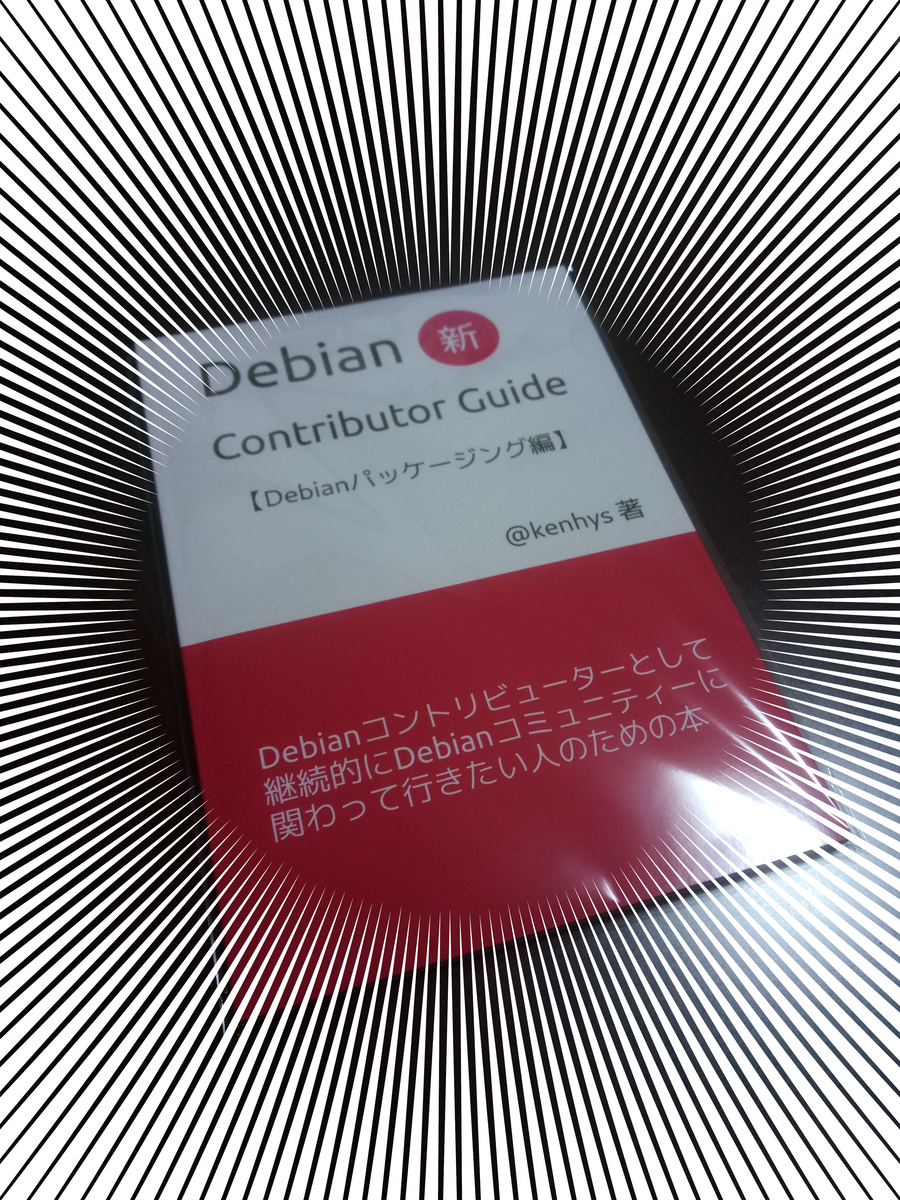
Recently, I've wrote Debian New Cotributor Guide in Japanese. Here is the photo of on-demand printed version.
f:id:kenhys:20220207163644j:plainDebian New Contributor Guide
This book (JIS-B5 128p) was published for online event - Techbookfest 12th. It covers how to package a new software in Debian. techbookfest.org Mostly PDF format is preferred, and a few printed versions were distributed.

Norbert Preining: KDE/Plasma 5.24 for Debian

Yesterday, KDE released version 5.24 of the Plasma desktop with the usual long list of updates and improvements. This release will be considered a LTS release. And Plasma 5.24 is now available for all Debian releases. (And don t forget KDE Gears/Apps 21.12!) As usual, I am providing packages via my OBS builds. If you have used my packages till now, then you only need to change the plasma5XX line to read plasma524. To give full details, I repeat (and update) instructions for all here: First of all, you need to add my OBS key say in /etc/apt/trusted.gpg.d/obs-npreining.asc and add a file /etc/apt/sources.list.d/obs-npreining-kde.list, containing the following lines, replacing the DISTRIBUTION part with one of Debian_11 (for Bullseye), Debian_Testing, or Debian_Unstable:
deb https://download.opensuse.org/repositories/home:/npreining:/debian-kde:/other-deps/DISTRIBUTION/ ./
deb https://download.opensuse.org/repositories/home:/npreining:/debian-kde:/frameworks/DISTRIBUTION/ ./
deb https://download.opensuse.org/repositories/home:/npreining:/debian-kde:/plasma524/DISTRIBUTION/ ./
deb https://download.opensuse.org/repositories/home:/npreining:/debian-kde:/apps2112/DISTRIBUTION/ ./
deb https://download.opensuse.org/repositories/home:/npreining:/debian-kde:/other/DISTRIBUTION/ ./
The sharp eye might have detected also the apps2112 line, yes the KDE Gear suite of packages has been updated to 21.12 some time ago and is also available in my OBS builds (and in Debian/experimental). Just one warning, but I guess most people using these repos already know it: Since I am not using Debian (lovely politics!) for my main machine anymore (only for my laptop for now), I haven t tested these packages as solidly as the one up to now. Still, I got already one positive installation feedback. Enjoy the new Plasma!

8 February 2022

Neil Williams: Django Model Mommy moving to Model Bakery

Some Django applications use Model Mommy in unit tests: https://tracker.debian.org/pkg/python-model-mommy Upstream, model mommy has been renamed model bakery: https://model-bakery.readthedocs.io/en/latest/
Model Bakery is a rename of the legacy model_mommy s project. This is because the project s creator and maintainers decided to not reinforce gender stereotypes for women in technology. You can read more about this subject here
Hence: https://bugs.debian.org/1005114 and https://ftp-master.debian.org/new/python-model-bakery_1.4.0-1.html So this is a heads-up to all those using Debian for their Django unit tests. Model Mommy will no longer get updates upstream, so model mommy will not be able to support Django4. Updates will only be done, upstream, in the Model Bakery package which already supports Django4. Bakery is not a drop-in replacement. Model Bakery includes a helper script to migrate: https://salsa.debian.org/python-team/packages/python-model-bakery/-/blob/master/utils/from_mommy_to_bakery.py This is being packaged in /usr/share/ in the upcoming python3-model-bakery package. It is a tad confusing that model-mommy is at version 1.6.0 but model-bakery is at version 1.4.0 but that only reinforces that Django apps using Model Mommy will need editing to move to Model Bakery. I'll be using the migration script for a Freexian Django app which currently uses Model Mommy. Once Model Bakery reaches bookworm, I plan to do a backport to bullseye. Then I'll file a bug against Model Mommy. Severity of that bug will be increased when Django4 enters unstable (the 4.0 dev release is currently in experimental but there is time before the 4.2 LTS is uploaded to unstable). https://packages.debian.org/experimental/python3-django Model Bakery is in NEW and Salsa Update: Django 4.2 LTS would be the first Django4 release in unstable.

7 February 2022

John Goerzen: KDE: A Nice Tiling Envieonment and a Surprisingly Awesome DE

I recently wrote that managing an external display on Linux shouldn t be this hard. I went down a path of trying out some different options before finally landing at an unexpected place: KDE. I say unexpected because I find tiling window managers are just about a necessity. Background: xmonad Until a few months ago, I d been using xmonad for well over a decade. Configurable, minimal, and very nice; it suited me well. However, xmonad is getting somewhat long in the tooth. xmobar, which is commonly used with it, barely supports many modern desktop environments. I prefer DEs for the useful integrations they bring: everything from handling mount of USB sticks to display auto-switching and sound switching. xmonad itself can t run with modern Gnome (whether or not it runs well under KDE 5 seems to be a complicated question, according to wikis, but in any case, there is no log applet for KDE 5). So I was left with XFCE and such, but the isues I identified in the shouldn t be this hard article were bad enough that I just could not keep going that way. An attempt: Gnome and PaperWM So I tried Gnome under Wayland, reasoning that Wayland might stand a chance of doing things well where X couldn t. There are several tiling window extensions available for the Gnome 3 shell. Most seemed to be rather low-quality, but an exception was PaperWM and I eventually decided on it. I never quite decided if I liked its horizontal tape of windows or not; it certainly is unique in any case. I was willing to tolerate my usual list of Gnome problems for the sake of things working. For instance: Under Wayland, I found a disturbing lack of logs. There was nothing like /var/log/Xorg.0.log, nothing like ~/.xsession-errors, just nothing. Searching for answers on this revealed a lot of Wayland people saying it s a Gnome issue and the trail going cold at that point. And there was a weird problem that I just could not solve. After the laptop was suspended and we-awakened, I would be at a lock screen. I could type in my password, but when hitting Enter, the thing would then tend to freeze. Why, I don t know. It seemed related to Gnome shell; when I switched Gnome from Wayland to X11, it would freeze but eventually return to the unlock screen, at which point I d type in my password and it would freeze again. I spent a long time tracking down logs to see what was happening, but I couldn t figure it out. All those hard resets were getting annoying. Enter KDE So I tried KDE. I had seen mentions of kwin-tiling, a KDE extension for tiling windows. I thought I d try this setup. I was really impressed by KDE s quality. Not only did it handle absolutely every display-related interaction correctly by default, with no hangs ever, all relevant settings were clearly presented in one place. The KDE settings screens were a breath of fresh air lots of settings available, all at one place, and tons of features I hadn t seen elsewhere. Here are some of the things I was pleasantly surprised by with KDE: Tiling So how about the tiling system, kwin-tiling? The out of the box experience is pretty nice. There are fewer built-in layouts than with xmonad, but the ones that are there are doing a decent job for me, and in some cases are more configurable (those that have a large window pane are configurable on its location, not forcing it to be on the left as with many systems.) What s more, thanks to the flexibility in the KDE shortcut settings, I can configure it to be nearly keystroke-identical to xmonad! Issues Encountered I encountered a few minor issues: In short, I m very impressed.

Dirk Eddelbuettel: x13binary 1.1.57-3 on CRAN: Packaging Updates

Release 1.1.57-3 of the x13binary package providing the X-13ARIMA-SEATS program by the US Census Bureau arrived late yesterday on CRAN. This release relaxes the download requirement on macOS and Linux: if a user supplies a path in an environment variable X13_PATH we check for a suitable binary there and omit the download. This helps with air-gapped installation (and alike). Courtesy of my CRANberries, there is also a diffstat report for this release showing changes to the previous release. If you like this or other open-source work I do, you can sponsor me at GitHub.

This post by Dirk Eddelbuettel originated on his Thinking inside the box blog. Please report excessive re-aggregation in third-party for-profit settings.

Russ Allbery: Review: Embers of War

Review: Embers of War, by Gareth L. Powell
Series: Embers of War #1
Publisher: Titan Books
Copyright: February 2018
ISBN: 1-78565-519-1
Format: Kindle
Pages: 312
The military leadership of the Outward faction of humanity was meeting on the forest world of Pelapatarn, creating an opportunity for the Conglomeration to win the war at a stroke. Resistance was supposed to be minimal, since the Outward had attempted to keep the conference secret rather than massing forces to protect it. But the Outward resistance was stronger than expected, and Captain Deal's forces would not be able to locate and assassinate the Outward leadership before they could escape. She therefore followed orders from above her and ordered the four incoming Carnivore heavy cruisers to jump past the space battle and bomb the planet. The entire planet. The Carnivores' nuclear and antimatter weaponry reduced the billion-year-old sentient jungle of Pelapatarn to ash. Three years later, Sal Konstanz is a ship captain for the House of Reclamation, a strictly neutral search and rescue force modeled after a long-vanished alien fleet that prioritizes preservation of life above all else. Anyone can join Reclamation, provided that they renounce their previous alliances and devote themselves to the Reclamation cause. Sal and her crew member Alva Clay were Outward. The ship medic was Conglomeration. So was the ship: the Trouble Dog, a sentient AI heavy cruiser built to carry an arsenal of weapons and three hundred crew, and now carrying three humans and a Druff mechanic. More precisely, the Trouble Dog was one of the four Carnivores that destroyed Pelapatarn. Meanwhile, Ona Sudak, a popular war poet, is a passenger on a luxury cruise on the liner Geest van Amsterdam, which is making an unscheduled stop in the star system known as the Gallery. The Gallery is the home of the Objects: seven planets that, ten thousand years earlier, were carved by unknown aliens into immense sculptures for unknown reasons. The Objects appear to be both harmless and mysterious, making them an irresistible tourist attraction for the liner passengers. The Gallery is in disputed space, but no one was expecting serious trouble. They certainly weren't expecting the Geest van Amsterdam to be attacked and brought down on the Object known as the Brain, killing nearly everyone aboard. The Trouble Dog is the closest rescue ship. This book was... fine. It's a perfectly serviceable science fiction novel that didn't stand out for me, which I think says more about the current excellent state of the science fiction field than about this book. When I was a teenager reading Asimov, Niven, and Heinlein, I would have devoured this. It compares favorably to minor Niven or Heinlein (The Integral Trees, for example, or Double Star), but the bar for excellent science fiction is just so much higher now. The best character in this book (and the reason why I read it) is the Trouble Dog. I love science fiction about intelligent space ships, and she did not disappoint. The AI ships in this book are partly made from human and dog neurons, so their viewpoint is mostly human but with some interesting minor variations. And the Trouble Dog would be a great character even if she weren't an intelligent ship: ethical, aggressive, daring, and introspective, with a nuanced relationship with her human crew. Unfortunately, Embers of War has four other viewpoint characters, and Powell chose to write them all in the first person. First person narration depends heavily on a memorable and interesting character because the reader is so thoroughly within their perspective. This works great for the Trouble Dog, and is fine for Nod, the Druff who serves as the ship mechanic. (Nod's perspective is intriguing, short, almost free-verse musings, rather than major story segments.) Sal, the ship captain, is a bit of a default character, but I didn't mind her much. Neither of the other two viewpoint characters are interesting enough to warrant the narrative attention. The Conglomerate agent Ashton Childe has such an uninteresting internal monologue that I would have liked the character better if he'd only been seen through other people's viewpoints, and although Powell needs some way to show Ona Sudak's view of events, I didn't think her thoughts added much to the story. The writing is adequate but a bit clunky: slightly flat descriptions, a bit too predictable at the sentence level, and rarely that memorable. There is a bit of fun world-building of the ancient artifact variety and a couple of decent set pieces (and one rather-too-obvious Matrix homage that I didn't think was as effective as the author did), but most of the story is focused on characters navigating their lives and processing trauma from the war. The story kept me turning the pages with interest, but I also doubt it will surprise anyone who has read much science fiction. I suspect a lot of it is setup for the following two books of the trilogy, and there are plenty of hooks for more stories in this universe. I really wanted a first-person story from the perspective of the Trouble Dog, possibly with some tight third-person interludes showing Ona Sudak's story. What I got instead was entertaining but not memorable enough to stand out in the current rich state of science fiction. I think I'm invested enough in this story to want to read the next book, though, so that's still a recommendation of sorts. Followed by Fleet of Knives. Rating: 6 out of 10

6 February 2022

Jonathan McDowell: Free Software Activities for 2021

About a month later than I probably should have posted it, here s a recap of my Free Software activities in 2021. For previous years see 2019 + 2020. Again, this year had fewer contributions than I d like thanks to continuing fatigue about the state of the world, and trying to work on separation between work and leisure while working from home. I ve made some effort to improve that balance but it s still a work in progress.

Conferences No surprise, I didn t attend any in-person conferences in 2021. I find virtual conferences don t do a lot for me (a combination of my not carving time out for them in the same way, because not being at the conference means other things will inevitably intrude, and the lack of the social side) but I did get to attend a few of the DebConf21 talks, which was nice. I m hoping to make it to DebConf22 this year in person.

Debian Most of my contributions to Free software continue to happen within Debian. As part of the Data Protection Team I responded to various inbound queries to that team. Some of this involved chasing up other project teams who had been slow to respond - folks, if you re running a service that stores personal data about people then you need to be responsive to requests about it. Some of this was dealing with what look like automated scraping tools which send no information about the person making the request, and in all the cases we ve seen so far there s been no indication of any data about that person on any systems we have access to. Further team time was wasted dealing with the Princeton-Radboud Study on Privacy Law Implementation (though Matthew did the majority of the work on this). The Debian Keyring was possibly my largest single point of contribution. We re in a roughly 3 month rotation of who handles the keyring updates, and I handled 2021.03.24, 2021.04.09, 2021.06.25, 2021.09.25 + 2021.12.24 For Debian New Members I m mostly inactive as an application manager - we generally seem to have enough available recently. If that changes I ll look at stepping in to help, but I don t see that happening. I continue to be involved in Front Desk, having various conversations throughout the year with the rest of the team, but there s no doubt Mattia and Pierre-Elliott are the real doers at present. I did take part in an NM Committee appeals process. In terms of package uploads I continued to work on gcc-xtensa-lx106, largely doing uploads to deal with updates to the GCC version or packaging (8 + 9). sigrok had a few minor updates, libsigkrok 0.5.2-3, pulseview 0.4.2-3 as well as a new upstream release of sigrok CLI 0.7.2-1. There was a last minute pre-release upload of libserialport 0.1.1-4 thanks to a kernel change in v5.10.37 which removed termiox support. Despite still not writing any VHDL these days I continue to keep an eye on ghdl, because I found it a useful tool in the past. Last year that was just a build fix for LLVM 11.1.0 - 1.0.0+dfsg+5. Andreas Bombe has largely taken over more proactive maintenance, which is nice to see. I uploaded OpenOCD 0.11.0~rc1-2, cleaning up some packaging / dependency issues. This was followed by 0.11.0~rc2-1 as a newer release candidate. Sadly 0.11.0 did not make it in time for bullseye, but rc2 was fairly close and I uploaded 0.11.0-1 once bullseye was released. Finally I did a drive-by upload for garmin-forerunner-tools 0.10repacked-12, cleaning up some packaging issues and uploading it to salsa. My Forerunner 305 has died (after 11 years of sterling service) and the Forerunner 45 I ve replaced it with uses a different set of tools, so I decided it didn t make sense to pick up longer term ownership of the package.

Linux My Linux contributions continued to revolve around pushing MikroTik RB3011 support upstream. There was a minor code change to Set FIFO sizes for ipq806x (which fixed up the allowed MTU for the internal switch + VLANs). The rest was DTS related - adding ADM DMA + NAND definitions now that the ADM driver was merged, adding tsens details, adding USB port info and adding the L2CC and RPM details for IPQ8064. Finally I was able to update the RB3011 DTS to enable NAND + USB. With all those in I m down to 4 local patches against a mainline kernel, all of which are hacks that aren t suitable for submission upstream. 2 are for patching in details of the root device and ethernet MAC addresses, one is dealing with the fact the IPQ8064 has some reserved memory that doesn t play well with AUTO_ZRELADDR (there keeps being efforts to add some support for this via devicetree, but unfortunately it gets shot down every time), and the final one is a hack to turn off the LCD backlight by treating it as an LED (actually supporting the LCD properly is on my TODO list).

Personal projects 2021 didn t see any releases of onak. It s not dead, just resting, but Sequoia PGP is probably where you should be looking for a modern OpenPGP implementation. I continued work on my Desk Viking project, which is an STM32F103 based debug tool inspired by the Bus Pirate. The main addtion was some CCLib support (forking it in the process to move to Python 3 and add some speed ups) to allow me to program my Zigbee dongles, but I also added some 1-Wire search logic and some support for Linux emulation mode with VCD output to allow for a faster development cycle. I really want to try and get OpenOCD JTAG mode supported at some point, and have vague plans for an STM32F4 based version that have suffered from a combination of a silicon shortage and a lack of time. That wraps up 2021. I d like to say I m hoping to make more Free Software contributions this year, but I don t have a concrete plan yet for how that might happen, so I ll have to wait and see.

Christian Kastner: New release of sbuild-qemu Utilities

I just released a new version of the sbuild-qemu utilities as part of sbuild. Notable changes are support for new architectures, and a new sbuild-qemu-boot utility to start a VM and interact with its console directly through the terminal. As a reminder, these utilities leverage functionality in vmdb2, autopkgtest, and sbuild to use QEMU VM images for building and testing packages in strongly isolated environments and/or on foreign architectures and/or that might break the system. For example, the following would create an image for sid on the ppc64el architecture, and then use that image to build a package:
# Creating an image still requires root, unfortunately
$ sudo sbuild-qemu-create --arch ppc64el -o simple.img unstable http://deb.debian.org/debian
$ sudo chown <user>:<group> simple.img

# Building a package doesn't
$ sbuild-qemu --arch ppc64el --image simple.img -d unstable [<other sbuild options>] FOO.dsc

# Neither does updating the image (runs apt-get update && dist-upgrade in the VM)
$ sbuild-qemu-update --arch ppc64el simple.img
Since the sbuild-qemu utilities build on top of the autopkgtest utilities, the created images can also be used for running autopkgtests:
$ autopkgtest <test params> -- qemu --dpkg-architecture ppc64el simple.img
sbuild-qemu-boot This new release now ships with sbuild-qemu-boot which boots a VM directly to a console, where it can be used as a porterbox, or to evaluate changes that might break the system, etc. By default, the VM is started in read-only mode, so changes are not saved when the VM is shut down. This can be changed with the --read-write option. With the --shared-dir option, a directory can be shared with the host. It will be mounted at /shared within the VM.
$ sbuild-qemu-boot --arch ppc64el --shared-dir /path/to/folder simple.img
Note that the console in the VM is 24x80 by default. This can be changed within the VM with stty to match your host, e.g.:
$ stty rows M cols N
I'm still pondering whether to automate this in sbuild-qemu-create.
New Architectures Thanks to updates to vmdb2 and autopkgtest, the sbuild-qemu utilities now also support new architectures. Currently, amd64, i386, arm64, armhf, and ppc64el are supported, so most of the official architectures. However, there's an autopkgtest issue (#10031002) with the host-guest communication bridge on armhf and on multi-core arm64 (single-core seems to work fine) that currently makes images unusable for sbuild and autopkgtest. I haven't yet figured out what the problem seems to be, but for the time being, the images can still be used with sbuild-qemu-boot.

5 February 2022

Reproducible Builds: Reproducible Builds in January 2022

Welcome to the January 2022 report from the Reproducible Builds project. In our reports, we try outline the most important things that have been happening in the past month. As ever, if you are interested in contributing to the project, please visit our Contribute page on our website.
An interesting blog post was published by Paragon Initiative Enterprises about Gossamer, a proposal for securing the PHP software supply-chain. Utilising code-signing and third-party attestations, Gossamer aims to mitigate the risks within the notorious PHP world via publishing attestations to a transparency log. Their post, titled Solving Open Source Supply Chain Security for the PHP Ecosystem goes into some detail regarding the design, scope and implementation of the system.
This month, the Linux Foundation announced SupplyChainSecurityCon, a conference focused on exploring the security threats affecting the software supply chain, sharing best practices and mitigation tactics. The conference is part of the Linux Foundation s Open Source Summit North America and will take place June 21st 24th 2022, both virtually and in Austin, Texas.

Debian There was a significant progress made in the Debian Linux distribution this month, including:

Other distributions kpcyrd reported on Twitter about the release of version 0.2.0 of pacman-bintrans, an experiment with binary transparency for the Arch Linux package manager, pacman. This new version is now able to query rebuilderd to check if a package was independently reproduced.
In the world of openSUSE, however, Bernhard M. Wiedemann posted his monthly reproducible builds status report.

diffoscope diffoscope is our in-depth and content-aware diff utility. Not only can it locate and diagnose reproducibility issues, it can provide human-readable diffs from many kinds of binary formats. This month, Chris Lamb prepared and uploaded versions 199, 200, 201 and 202 to Debian unstable (that were later backported to Debian bullseye-backports by Mattia Rizzolo), as well as made the following changes to the code itself:
  • New features:
    • First attempt at incremental output support with a timeout. Now passing, for example, --timeout=60 will mean that diffoscope will not recurse into any sub-archives after 60 seconds total execution time has elapsed. Note that this is not a fixed/strict timeout due to implementation issues. [ ][ ]
    • Support both variants of odt2txt, including the one provided by the unoconv package. [ ]
  • Bug fixes:
    • Do not return with a UNIX exit code of 0 if we encounter with a file whose human-readable metadata matches literal file contents. [ ]
    • Don t fail if comparing a nonexistent file with a .pyc file (and add test). [ ][ ]
    • If the debian.deb822 module raises any exception on import, re-raise it as an ImportError. This should fix diffoscope on some Fedora systems. [ ]
    • Even if a Sphinx .inv inventory file is labelled The remainder of this file is compressed using zlib, it might not actually be. In this case, don t traceback and simply return the original content. [ ]
  • Documentation:
    • Improve documentation for the new --timeout option due to a few misconceptions. [ ]
    • Drop reference in the manual page claiming the ability to compare non-existent files on the command-line. (This has not been possible since version 32 which was released in September 2015). [ ]
    • Update X has been modified after NT_GNU_BUILD_ID has been applied messages to, for example, not duplicating the full filename in the diffoscope output. [ ]
  • Codebase improvements:
    • Tidy some control flow. [ ]
    • Correct a recompile typo. [ ]
In addition, Alyssa Ross fixed the comparison of CBFS names that contain spaces [ ], Sergei Trofimovich fixed whitespace for compatibility with version 21.12 of the Black source code reformatter [ ] and Zbigniew J drzejewski-Szmek fixed JSON detection with a new version of file [ ].

Testing framework The Reproducible Builds project runs a significant testing framework at tests.reproducible-builds.org, to check packages and other artifacts for reproducibility. This month, the following changes were made:
  • Fr d ric Pierret (fepitre):
    • Add Debian bookworm to package set creation. [ ]
  • Holger Levsen:
    • Install the po4a package where appropriate, as it is needed for the Reproducible Builds website job [ ]. In addition, also run the i18n.sh and contributors.sh scripts [ ].
    • Correct some grammar in Debian live image build output. [ ]
    • Shell monitor improvements:
      • Only show the offline node section if there are offline nodes. [ ]
      • Colorise offline nodes. [ ]
      • Shrink screen usage. [ ][ ][ ]
    • Node health check improvements:
      • Detect if live package builds encounter incomplete snapshots. [ ][ ][ ]
      • Detect if a host is running with today s date (when it should be set artificially in the future). [ ]
    • Use the devscripts package from bullseye-backports on Debian nodes. [ ]
    • Use the Munin monitoring package bullseye-backports on Debian nodes too. [ ]
    • Update New Year handling, needed to be able to detect real and fake dates. [ ][ ]
    • Improve the error message of the script that powercycles the arm64 architecture nodes hosted by Codethink. [ ]
  • Mattia Rizzolo:
    • Use the new --timeout option added in diffoscope version 202. [ ]
  • Roland Clobus:
    • Update the build scripts now that the hooks for live builds are now maintained upstream in the live-build repository. [ ]
    • Show info lines in Jenkins when reproducible hooks have been active. [ ]
    • Use unique folders for the artifacts from each live Debian version. [ ]
  • Vagrant Cascadian:
    • Switch the Debian armhf architecture nodes to use new proxy. [ ]
    • Misc. node maintenance. [ ].

Upstream patches The Reproducible Builds project attempts to fix as many currently-unreproducible packages as possible. In January, we wrote a large number of such patches, including:

And finally If you are interested in contributing to the Reproducible Builds project, please visit our Contribute page on our website. However, you can get in touch with us via:

Thorsten Alteholz: My Debian Activities in January 2022

FTP master This month I accepted 342 and rejected 57 packages. The overall number of packages that got accepted was 366. Lately I was asked: Is it ftpmaster s opinion and policy that there is no difference in NEW queue review process between bin and src? This is a yes/no-question and in this generality the answer is clearly: Every package in NEW needs a full review. Of course there are circumstances with exceptions. For example after an upload of -1, which would get a full review, the upload of -2 afterwards, introducing a new binary package, would get a much faster review. In this case it would make sense to ping on IRC and draw attention to this. Nevertheless the evaluation of a light review might differ between the maintainer and the person doing the review. Debian LTS This was my ninety-first month that I did some work for the Debian LTS initiative, started by Raphael Hertzog at Freexian. This month my all in all workload has been 40h. During that time I did LTS and normal security uploads of: I also started to work on security support for golang packages. Though this sounds like an easy task, the devel is in the details.
As CVEs need to be fixed in unstable first, at the moment it looks like this is the most time consuming task. I will report later on my journey to fix open CVEs in golang-github-russellhaering-goxmldsig Further I worked on packages in NEW on security-master and injected missing sources. Last but not least I did some days of frontdesk duties and attended an LTS meeting on IRC. Debian ELTS This month was the forty-third ELTS month. During my allocated time I uploaded: Further I worked on an update for apache2 Last but not least I did some days of frontdesk duties. Debian Printing I was finally able to upload a new version of hplip and Ubuntu is now able to build new snaps for their next release.
Altogether I uploaded new upstream versions or improved packaging of: Now the dashboard looks rather good and my next task for February is an update of cups. Debian Astro As there was a release of version 1.9.4 of INDI and indi-3rdparty, I also uploaded the new version of all INDI drivers and releated libs from indi-3rdparty. Other stuff This month I uploaded lots of new upstream releases of golang packages.

Steve Kemp: Removing my last server?

In the past I used to run a number of virtual machines, or dedicated hosts. Currently I'm cut things down to only a single machine which I'm planning to remove. Email Email used to be hosted via dovecot, and then read with mutt-ng on the host itself. Later I moved to reading mail with my own console-based email client. Eventually I succumbed, and now I pay for Google's Workspace product. Git Repositories I used to use gitbucket for hosting a bunch of (mostly private) git repositories. A bad shutdown/reboot of my host trashed the internal database so that was broken. I replaced the use of gitbucket, which was very pretty, with gitolite to perform access-control, and avoid the need of a binary database. I merged a bunch of repositories, removed the secret things from there where possible, and finally threw them on a second github account. GPG-encryption added where appropriate. Static Hosts Static websites I used to host upon my own machine are now hosted via netlify. There aren't many of them, and they are rarely updated, I guess I care less. Dynamic Hosts That leaves only dynamic hosts. I used to have a couple of these, most notably the debian-administration.org, but that was archived and the final commercial thing I did was retired in January. I now have only one dynamic site up and running, https://api.steve.fi/, this provides two dynamic endpoints: Both of these are used by my tram-display device. Running these two services locally, in Docker, would probably be fine. However there is a third "secret" API - blog-comment submission. When a comment is received upon this blog it is written to a local filesystem, and an email is sent to me. The next time my blog is built rsync is used to get the remote-comments and add them to the blog. (Spam deleted first, of course). Locally the comments are added into the git-repository this blog is built from - and the remote files deleted now and again. Maybe I should just switch from writing the blog-comment to disk, and include all the meta-data in the email? I don't wanna go connecting to Gmail via IMAP, but I could probably copy and paste from the email to my local blog-repository. I can stop hosting the tram-APIs publicly, but the blog comment part is harder. I guess I just need to receive incoming FORM-submission, and send an email. Or maybe I drop blog-comments and sidestep the problem entirely? After all I wrote five posts in the whole of last year ..

Louis-Philippe V ronneau: Migrating from ledger to hledger

I first started using ledger the original plain-text accounting software in 2017. Since then, I had been pretty happy with my accounting routine, but grew a little annoyed by the repetitive manual work I had to do to assign recurring transactions to the right account. To make things easier, I had a collection of bash scripts to parse and convert the CSV files from my bank's website1 into ledger entries. They were of course ugly, unreadable piles of sed-grep-regex and did not let met achieve the automation complexity I longed for. Dissatisfied with ledger's features, I decided to migrate to hledger. Contrary to ledger, hledger comes with a CSV parser one can use to import and classify recurring transactions automagically. Having a proper DSL for this makes all the difference: I can easily add new rules and understand the old ones. In the end, I get a very consistent result, something my old bash scripts weren't great at. Here is what my debit.csv.rules file looks like. It is used to tell hledger how CSV data from my debit card should be parsed:
# skip the headings line:
skip 1
# assign fields
fields , , , date, , description, , amount2-in, amount2-out
# assign account where the money comes from
# 99 to get it at the bottom of the transaction
account99 assets:checking
include matchers.rules
As you can see, the rules matching transactions to specific accounts are imported from another file, matchers.rules. I'm doing this since I want to be able to use the same set of rules for debit and credit and use the cards interchangeably. Here's a snippet of my matchers.rules file:
# house
if Loyer/bail
  account2  expenses:rent
# leisure
if PAYPAL .*STEAM GAMES
  account2  expenses:leisure:videogame
if PAYPAL .*BANDCAMP
  account2  expenses:leisure:music
Using this ruleset, a transaction looking like this:
"SOME ACCOUNT DESC","111111","EOP","2022/01/03",00002,"Loyer/bail","",521.00,"","","","",""
Would be transformed into:
2022-01-03 Loyer/bail
    expenses:rent                               521.00
    assets:checking
Sadly, hledger's CSV rules won't let you do arithmetics. This can be useful when you know a certain transaction needs to be split between accounts. This is where auto postings come in. They are a way to specify arbitrary rules when an account is encountered. Going back to my previous rent example, I split it 50/50 with my SO using this rule:
= expenses:rent
    assets:receivable:rent    *0.5
    assets:checking
After it is applied, the final transaction looks like this:
2022-01-03 Loyer/bail  ; modified:
    expenses:rent                               521.00
    assets:receivable:rent                      260.50  ; generated-posting: = expenses:rent
    assets:checking
Neat eh? Here is the little bash script I've written to automate all these steps:
 #!/bin/bash
#
# Convert CSV to ledger using hledger
declare -a assets=("credit" "debit")
# Read the array values with space
for i in "$ assets[@] "
do
  if test -f "$i.csv"
  then
    # convert to ledger
    LEDGER=$(hledger -f "$i.csv" --rules-file rules/"$i.csv".rules print)
    # add auto_postings
    LEDGER=$(printf "include rules/auto_postings.ledger\n\n$LEDGER\n"   hledger print -f- --auto)
    # remove superfluous assets:checking lines
    LEDGER=$(printf "$LEDGER"   sed '/assets:checking \+; generated.\+/d')
    printf "$LEDGER" > "$i.ledger"
  else
    printf "File $i.csv does not exist\n"
  fi
done
Migrating to hledger, I've cut down the time I spend on accounting from 1 hour per month to about 10 minutes, all while making my workflow much cleaner. Many thanks to the kind folks on #hledger @irc.libera.chat for the help!

  1. One for my checking+savings account and another one for my credit card.

Dirk Eddelbuettel: corels 0.0.4 on CRAN: M1 Update

An updated version of the corels package is now on CRAN! The Certifiably Optimal RulE ListS (Corels) learner provides interpretable decision rules with an optimality guarantee. The change is (just like the previous one) chiefly an update to configure.ac in order to ensure R on M1 macOS finds the locally-added GNU GMP. Our thanks to the infatiguable Brian Ripley for the heads-up even containing the two needed assignments to LD and CPPFLAGS.. If you like this or other open-source work I do, you can now sponsor me at GitHub.

This post by Dirk Eddelbuettel originated on his Thinking inside the box blog. Please report excessive re-aggregation in third-party for-profit settings.

Next.

Previous.