Search Results: "ron"

29 December 2015

Neil Williams: Experimenting with LXQt in Debian

LXQt is a Qt lightweight desktop the Qt port of LXDE. Packages exist in Debian albeit without a top level metapackage or task package to make installing it easier. So I wrote up a simple-ish vmdebootstrap call:
$ sudo vmdebootstrap --image lxqt.img --size=5G --package=lxqt-panel --package=libqt5xcbqpa5 --package=qterminal --package=openbox --package=xdm --package=lxqt-session --package=lxqt-about --package=lxqt-policykit --package=lxqt-globalkeys --package=lxqt-notificationd --package=lxqt-sudo --package=dbus-x11 --package=lxqt-admin --package=lxqt-runner --package=lxqt-config --package=task-desktop --package=locales --package=xserver-xorg-core --package=oxygen-icon-theme --grub --distribution=unstable --mirror=http://mirror.bytemark.co.uk/debian --configure-apt --enable-dhcp --serial-console --sudo --verbose --owner=neil --user='neil/neil'
(You ll need to adapt the last two commands to be a real user.) This uses xdm instead of lxdm as this tests LXQt without having any GTK+ dependencies installed. lxdm does give a nicer experience at the cost of needing GTK+. YMMV. Note the explicit additions:--package=libqt5xcbqpa5 --package=dbus-x11 as debootstrap does not follow Recommends, libqt5xcbqpa5 needs to be specified explicitly or the desktop will fail to start. dbus-x11 is also needed to get things working. task-desktop adds the Debian artwork and needs to be in the list of packages passed to debootstrap so that the Recommends of the task packages are not selected. (Note that I have so far failed to get LXQt to use the Debian artwork as a desktop background.) So, what is it like? Well alpha is how I might describe it. Not in terms of stability, more in terms of functionality. I do have a second install using lxdm which has been tweaked but it depends on your objective. If your aim is to not have GTK+ but not have KDE, then LXQt is a beginning only. In particular, if you really are intent on not having GTK+ at all, your choice of web browser is somewhat limited, to lynx. (There s no bare Qt file manager in Debian pcmanfm-qt depends on libfm-modules which uses GTK+ nor a bare text editor despite this being one of the simplest examples of a QApplication). There is a large gap in the software availability which is Qt but not KDE, despite the power and flexibility of Qt itself. (I ve written applications using Qt directly before, it is much more flexible and configurable than GTK+). So there would seem to be a reason why a metapackage and a task package do not yet exist, there is a lot more to do. I m happy to mix GTK+ applications, so my test environment can use iceweasel, chromium, leafpad and thunar. Overall, this was an interesting diversion prompted by a separate discussion about the merits and controversies of GTK+, GNOME etc. I failed to work out why the icon theme works if lxdm was installed but not with xdm (so there s a missing package but I m not yet sure exactly which), so the screenshot is more bare than I expected. lxqt-unstable With iceweasel installed and various other tweaks:
lxqt-unstable-2 Finally, note #809339 I have local changes which are being tested to use systemd-networkd but currently the masking of PredictableInterfaceNames as documented does not work, so some editing of /etc/network/interfaces.d/setup (or enable systemd-networkd yourself and add a suitable file to /etc/systemd/network/) will be needed to get a working network connection in the VM.

Ritesh Raj Sarraf: Device Mapper Multipath status in Debian

For Debian Jessie, the multipath support relied on sysvinit scripts. So, if you were using systemd, the level of testing would have been minimal. At DebConf15, I got to meet many people whom I'd worked with, over emails, over the years. With every person, my ask was to use the SAN Storage stack in a test environement, and report bugs early. Not after the next release. This applies also to the usual downstream distribution projects. That said, today, I spent time building a Root File System on SAN setup using the following stack, of the versions that'd be part of the next stable release:
  • Linux
  • Open-iSCSI Initiator
  • Device Mapper Multipath
  • LIO Target
I'm pretty happy that nothing much has changed in terms of setup, from what has already been documented in README.Debian files. The systemd integration has been very transparent. But that is my first hand experience. I'm request all users of the above mentioned stack to build the setup and report issues, if any. Please do not wait for the last minute of the release/freeze.
root@debian-sanboot:~# systemctl status -l multipath-tools
  multipathd.service - Device-Mapper Multipath Device Controller
   Loaded: loaded (/lib/systemd/system/multipathd.service; enabled; vendor preset: enabled)
   Active: active (running) since Tue 2015-12-29 18:38:58 IST; 1min 23s ago
  Process: 246 ExecStartPre=/sbin/modprobe dm-multipath (code=exited, status=0/SUCCESS)
 Main PID: 260 (multipathd)
   Status: "running"
   CGroup: /system.slice/multipathd.service
            260 /sbin/multipathd -d -s
Dec 29 18:39:04 debian-sanboot multipathd[260]: sdb [8:16]: path added to devmap sanroot
Dec 29 18:39:04 debian-sanboot multipathd[260]: sdc: add path (uevent)
Dec 29 18:39:04 debian-sanboot multipathd[260]: sanroot: load table [0 16777216 multipath 0 0 3 1 service-time 0 1 1 8:16 1 service-time 0 1 1 8:0 1 service-time 0 1 1 8:32 1]
Dec 29 18:39:04 debian-sanboot multipathd[260]: sdc [8:32]: path added to devmap sanroot
Dec 29 18:39:04 debian-sanboot multipathd[260]: sdd: add path (uevent)
Dec 29 18:39:04 debian-sanboot multipathd[260]: sanroot: load table [0 16777216 multipath 0 0 4 1 service-time 0 1 1 8:16 1 service-time 0 1 1 8:32 1 service-time 0 1 1 8:48 1 service-time 0 1 1 8:0 1]
Dec 29 18:39:04 debian-sanboot multipathd[260]: sdd [8:48]: path added to devmap sanroot
Dec 29 18:39:13 debian-sanboot multipathd[260]: sanroot: sda - directio checker reports path is up
Dec 29 18:39:13 debian-sanboot multipathd[260]: 8:0: reinstated
Dec 29 18:39:13 debian-sanboot multipathd[260]: sanroot: remaining active paths: 4
root@debian-sanboot:~# multipath -ll
sanroot (36001405ead943c8222140268e019ba49) dm-0 LIO-ORG,IBLOCK
size=8.0G features='0' hwhandler='0' wp=rw
 -+- policy='service-time 0' prio=1 status=active
   - 4:0:0:0 sdb 8:16 active ready running
 -+- policy='service-time 0' prio=1 status=enabled
   - 3:0:0:0 sdc 8:32 active ready running
 -+- policy='service-time 0' prio=1 status=enabled
   - 5:0:0:0 sdd 8:48 active ready running
 -+- policy='service-time 0' prio=1 status=enabled
   - 2:0:0:0 sda 8:0  active ready running
root@debian-sanboot:~# iscsiadm -m session
tcp: [1] 172.16.20.40:3260,1 iqn.2003-01.org.linux-iscsi.debian.sanboot (non-flash)
tcp: [2] 172.16.20.41:3260,1 iqn.2003-01.org.linux-iscsi.debian.sanboot (non-flash)
tcp: [3] 172.16.20.42:3260,1 iqn.2003-01.org.linux-iscsi.debian.sanboot (non-flash)
tcp: [4] 172.16.20.43:3260,1 iqn.2003-01.org.linux-iscsi.debian.sanboot (non-flash)
root@debian-sanboot:~# mount   grep sanroot
/dev/mapper/sanroot on / type ext4 (rw,relatime,errors=remount-ro,stripe=8191,data=ordered)

Categories:

Keywords:

Like:

Antoine Beaupr : Bridging Ikiwiki and Twitter with Python and feed2tweet

Typical:
  1. find new interesting software (feed2tweet)
  2. try it out, file two issues:
  3. itch enough that i need to scratch it and file 3 pull requests to ask for forgiveness:
All fairly trivial, but it allowed me to make a simple cronjob to post my Ikiwiki blog posts straight out to my Twitter account. It's basically abusing my RSS feed to bridge with Twitter: the most boring and annoying part is setting up a new app, pasting the credentials in the config file and then running the thing in a cron job. But in the end, I really ended up spending one more hour at a time when I should be really sleeping, scratching an itch that I didn't have before I started working on this thing in the first place. Coincidentally, I requested to be added to Python Planet, looks like a fun place...

28 December 2015

Steinar H. Gunderson: The difference between logs and no logs

An USB3 device of mine stopped working one day. In Windows (its native environment; Linux is not officially supported), there would be a device plugged in sound and then nothing. Nothing in the event log, no indication there was ever a device of any kind in Device Manager. In Linux, after 20 seconds or so, this would come up:
[   71.831659] usb usb2-port1: Cannot enable. Maybe the USB cable is bad?
I bought a new and shorter cable. The card started working again.

27 December 2015

Vincent Sanders: The only pleasure I get from moving house is stumbling across books I had forgotton I owned

I have to agree with John Burnside on that statement, after having recently moved house again rediscovering our book collection has been a salve for an otherwise exhausting undertaking. I returned to Cambridge four years ago, initially on my own and then subsequently the family moved down to be with me.

We rented a house but, with two growing teenagers, the accommodation was becoming a little crowded. Melodie and I decided the relocation was permanent and started looking for our own property, eventually finding something to our liking in Cottenham village.

Melodie took the opportunity to have the house cleaned and decorated while empty because of overlapping time with our rental property. This meant we had to be a little careful while moving in as there was still wet paint in places.

Some of our books
Moving weekend was made bearable by Steve, Jonathan and Jo lending a hand especially on the trips to Yorkshire to retrieve, amongst other things, the aforementioned book collection. We were also fortunate to have Andy and Jane doing many other important jobs around the place while the rest of us were messing about in vans.

The desk in the study
The seemingly obligatory trip to IKEA to acquire furniture was made much more fun by trying to park a luton van which was only possible because Steve and Jonathan helped me. Though it turns out IKEA ship mattresses rolled up so tight they can be moved in an estate car so taking the van was unnecessary.

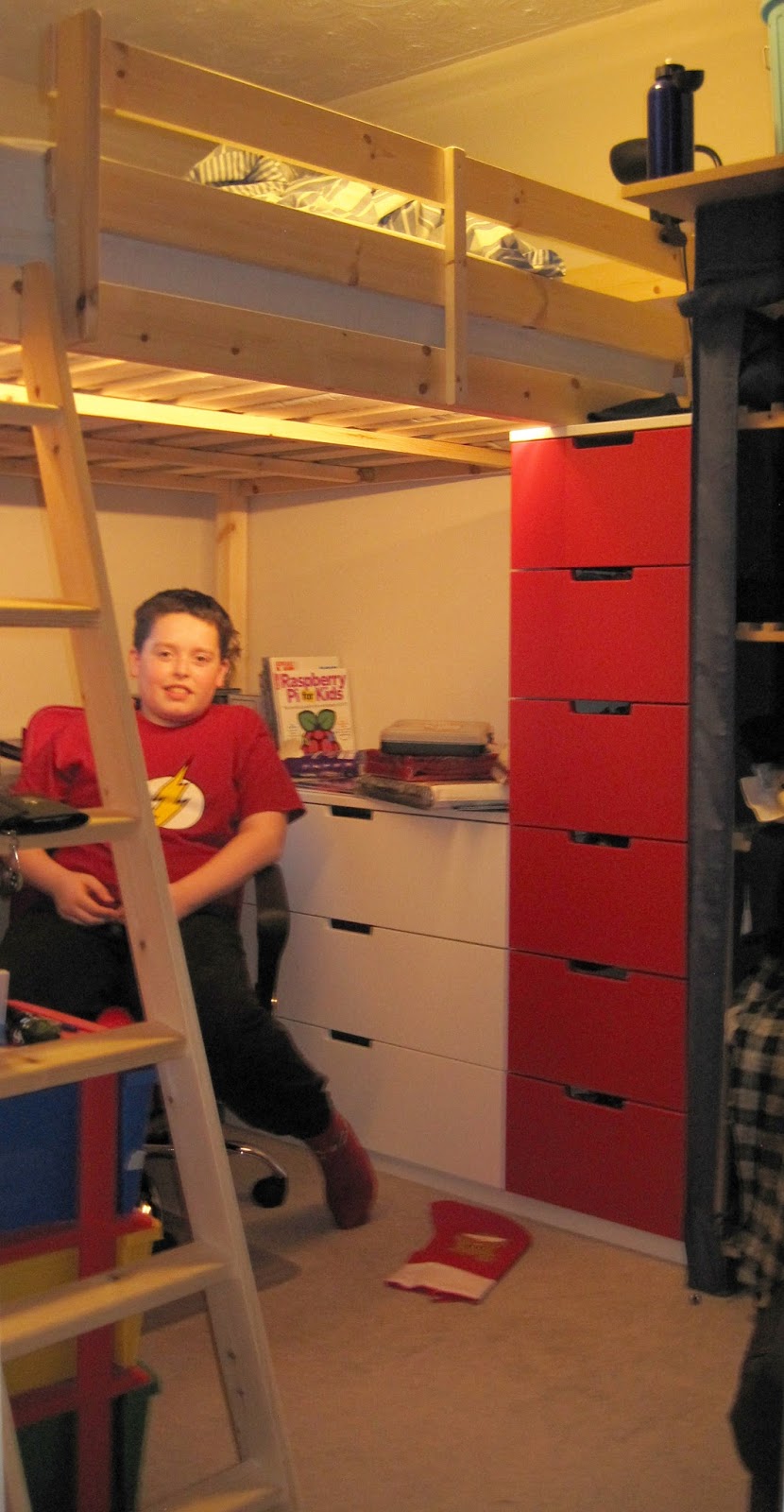
Alex under his loft bed
Having moved in it seems like every weekend is filled with a never ending "todo" list of jobs. From clearing gutters to building a desk in the study. Eight weeks on and the list seems to be slowly shrinking meaning I can even do some lower priority things like the server rack which was actually a fun project.


Joshua in his completed roomThe holidays this year afforded me some time to finish the boys bedrooms. They both got loft beds with a substantial area underneath. This allows them both to have double beds along with a desk and plenty of storage. Completing the rooms required the construction of some flat pack furniture which rather than simply do myself I supervised the boys doing it themselves.

Alexander building flat pack furniture
Teaching them by letting them get on with it was a surprisingly effective and both of them got the hang of the construction method pretty quickly. There was only a couple of errors from which they learned immediately and did not repeat (draw bottoms having a finished side and front becomes back when you are constructing upside down)

Joshua assembling flat pack furniture
The house is starting to feel like home and soon all the problems will fade from memory while the good will remain. Certainly our first holiday season has been comfortable here and I look forward to many more re-reading our books.

Steve Kemp: Some things are universal?

I don't often do retrospectives, but this year has been an unusual one for me, as I moved to Finland almost six months ago. The topic has come up in conversation a lot over the past few months, so when people ask me what I think I can give some simple answers without too much thought. Here's a brief summary. There are some obvious changes:
The Traffic
The traffic drives on the right-hand side of the roads, which took a bit of getting used to, but isn't a huge surprise as I've travelled in Europe in the past. There aren't so many countries that drive on the left after all so most people probably wouldn't even notice this as odd. When it comes to traffic one thing nice about Helsinki is that most junctions are "zebra crossings". Sure they don't have flashing lights, but they have shaded areas, and pedestrians have right of way. As for transport the city of Helsinki has local trains, trams, buses and taxis. The trams and buses all use the same card for payment so transport is integrated very well. I buy a time-based card, spending about 50 for a month of unlimited travel. If you prefer you may add euros to your card and pay for distinct journeys - but that works out more expensive if you travel twice, or more, a day.
The Money
Finland uses the Euro these days, having switched from the Finnish markka in 2002. Enough said. Costs are largely in line with what I'd expect: Cigarettes are cheap, beer is expensive. Some things are very expensive, some things are very cheap. Largely the expensive things are those that are imported. It is a very small country after all.
The Language
Finnish is .. complex. But I've not struggled too much. Mostly I can buy what I want without difficulty. There are weird exceptions though for example I went out to buy soup one day and had to return carrying only shame and disappointment: I can't read the language on the tins and what I thought was soup turned out to be a can of chopped tomatoes. Food is good though, and available easily (!!). The only significant surprise when it comes to shopping is that loose goods must be weighed yourself. You pick up a bunch of bananas, take it to the scales, press the button that has a picture of a banana on it, and it prints out a label you attach to them - at the till the cashier will scan the label and charge you. If you forget, or don't know how to do it they'll tut and complain. In daily life I use two phrases frequently and they are sufficient for communcation:
  • "minua haluan ... kahvi kakku olut"
    • "I want ... coffee cake beer".
  • "kiitos"
    • "Thanks"
Usually people speak to me in English, which is a little annoying as it means I'm not learning as much as I could. But that said over the past few months I've had proper conversations entirely in Finnish with shop-keepers, and similar. So I'm getting better.
The Culture
Finnish people are friendly, but terse. That's the reputation. The Finnish people are alcoholics, and have high rates of suicide. Also the reputation. Finally we know that the Finnish people consume more coffee than the rest of the world. All those things are true, but they're not enough by far to describe the people. Obviously they're all different, and we have a lot of people from other parts of the world here too - Russians, Asians, Somalians. So culture is complex .. but markedly different than in the UK. I could write more about this, but I think for the moment I'll just draw a line under culture and say that I'm enjoying the interactions with people here, and while many things are slightly "off", it's not bad. Just different. Also saunas are fun. I've never had any qualms about being naked with strangers, so I don't really understand why Americans, and others, find this so difficult/surprising. But yeah, saunas are great. Things that Finland is known for internationally: The invention of the molotov cocktail, rally-driving, hockey, world's strongest man, Moomins, Tom of Finland, Salmiakki.
The Weather
Not too hot. Not too cold. But that's largely because I'm one of those "hot" people who doesn't really get cold even at the best of times. My ideal temperatures are about 13 C. My wife prefers 15 C, or more. We don't fight any more. Mostly. Winter is apparently full of snow, but this year has been poor. We had the first snowfall yesterday, here in Helsinki, and we woke this morning a blanket of snow about two inches high. It looks pretty. The biggest thing about weather in Finland is the constant darkness in winter, and the constant sun in Summer. In Summer there were like 22 hours of sunlight a day which made sleeping hard when we moved into our flat - with no curtains. In winter it feels like there is 20 minutes of sunlight a day. It's not that bad here in the south, although I think it is something like five hours and less in the north. I've never had any real issues with depression, or similar: People have good days and bad days, I'd generally be "OK" or "great". In the darkness? I've been grumpy at colleagues, I've made bad choices, I've lapsed attention. I'm not sure I can blame it on the weather, or my reaction to the weather, but I know I've not been as "happy" as I "should". It requires effort to be enthusiastic in a way I've never experienced before. Thankfully once I (slowly) realized this I took action and I think I'm good now. Unlike the UK the buildings here are relatively modern. I think that's the biggest contributing factor to how houses are "warm". Houses have all been built in the last 50-100 years, so you have proper insulation. Even though it might be very very cold outdoors indoors you can be naked without heating. Try that in the UK and you might freeze in some of the older leakier houses! You do have to laugh, though, when people point out "the oldest pub" in the city though. Where I come from if I pub isn't 500+ years old you wouldn't give it a seconds thought - places like The Golden Fleece, etc.
I could write more. I probably should. But it has been an interesting year, and although there are things I miss about the UK, and Edinburgh specifically, I have no regrets. I'm glad I came. What triggered this post? I said "Some things are universal" to my wife, when I saw a child riding a bicycle they'd obviously just received for Christmas. Her reaction "No Finnish person would buy a bicycle at Christmas - they'd expect too much snow!". So perhaps it was another immigrant family. Christmas bicycles universal, or not, it doesn't really matter.

Russ Allbery: Review: The Outskirter's Secret

Review: The Outskirter's Secret, by Rosemary Kirstein
Series: Steerswomen #2
Publisher: Del Rey
Copyright: 1992, 2001
Printing: 2001
ISBN: 0-345-46105-3
Format: Trade paperback
Pages: 389
This is a direct sequel to The Steerswoman, and I don't recommend starting here. I read this novel as part of The Steerswoman's Road omnibus, which is the edition reflected in the metadata (except for the page count, which is just this novel). There are a few plot constructs that occur depressingly often in SFF and almost always annoy me. One is books where nearly all of the book is just a journey from one place to another, without much interesting landscape along the way. Subtract additional points if the land is hostile and there are constant worries about food. Another is illness, or being unable to trust one's senses, or, worse, both. Somehow, this book manages to do both of those things and was still thoroughly enjoyable. This is exceptionally rare. After the conclusions reached in the previous book, Rowan and Bel are even more determined to reach the origin of the jewels on Bel's belt and gather more information. This means travel into the Outskirts, where Rowan has never been (and where people from the Inner Land almost never go). It also means close contact with Bel's people, who have an entirely different set of social rituals and who are notoriously prickly. Nearly all of The Outskirter's Secret is travel through the Outskirts while navigating Outskirter society, politics, and customs. It's anthropological fiction of a sort, particularly given the inquisitive and analytical mindset that Rowan brings to anything new. Anthropological SFF is another one of those things that normally leaves me cold, but which totally worked for me in this book. I rarely remember being this engaged in, or caring this much about, the customs and traditions of an invented and relatively primitive culture. Partly this is because Rowan's mindset continues to be fascinating and contagious. I kind of want to compare this series to Neal Stephenson's Anathem, but where Stephenson's novel was about the practice of organized science, the Steerswomen series is about the individual scholar and scientist. This could go badly in the hands of a lesser author, but Kirstein brilliantly balances analysis and theories with Rowan's child-like wonder in learning, peculiar and determined ethics, and emotional growth. She isn't a disinterested observer or an engineer with a wrench. She lets the world change her, works hard at finding her place and her own strength, and engages with it emotionally as much as she does intellectually. She's a wonderfully compelling character. Another significant factor to this book's success is the slow and deliberate way Kirstein mixes world-building revelations with the day-to-day struggles of the characters. There's much more to that than just the target of Rowan's investigations, and far more complexity and significance to the Outskirters than showed in first appearances. The world is also set up in a way that lets the readers guess various details before the characters, with their more limited knowledge, can work out: another tricky technique that Kirstein gets almost perfect. I never wanted to shake the characters for being dumb; usually, both Rowan and Bel leap to correct conclusions just shortly after the reader, and long before the reader is tired of following their thought processes. There was only one bit of world-building that took Rowan most of the book to figure out despite being obvious to me early in this novel, and I think that one was fair. She didn't have anywhere near enough information to work it out. Bel continues to be wonderful in numerous ways. But even better, Kirstein introduces us to Bel's people and highlights both similarities and differences. It's an excellent job of building a complex culture that feels human: varied, tradition-laden, practical, but also well-adapted to their environment and situation, and far more sophisticated than they might appear. I'm normally a hard sell for this sort of thing, but Kirstein got me thoroughly invested. One scene late in this novel where a tribe welcomes a newcomer is masterful and probably my favorite single moment of the series so far. Once again, unfortunately, the conclusion is a bit less than satisfying. The characters come away knowing more, planning more, but still with numerous unanswered questions. This is not a series that's in a hurry to get to major plot payoffs. Instead, it's a series that takes a close look at the cultures, relationships, emotions, and lives that it touches, and describes them in deft and engaging ways. The Outskirter's Secret is even better than The Steerswoman. Recommended. I bought the third and fourth books while only a little ways into this one and am eager to read them. Followed by The Lost Steersman. Rating: 9 out of 10

26 December 2015

Norbert Preining: Debian/TeX Live 2015.20151226-1

Before I disappear into the Japanese winter holidays, here the Christmas update of all TeX Live packages. Nothing spectacular here, just the usual bunch of updates of loads of packages. There is a bug with respect to a file move from one package to another, will be fixed in an upload soon. Debian - TeX Live 2015 Updated packages apnum, appendix, archaeologie, babel, babel-french, babel-greek, babel-hungarian, bangorcsthesis, beamer-verona, bhcexam, bibarts, bidi, bxjscls, chemfig, commado, comprehensive, context, cslatex, csplain, ctanify, doclicense, dvips, ejpecp, exsheets, fbb, fibeamer, fithesis, fontools, francais-bst, gitinfo2, glossaries, gnuplottex, greek-fontenc, hyph-utf8, indextools, ksp-thesis, l3build, l3experimental, l3kernel, l3packages, latexcourse-rug, lollipop, lstbayes, lualibs, luaotfload, luatexja, luatexko, luatodonotes, make4ht, mcf2graph, media9, mex, mfirstuc, mhchem, mptopdf, nameauth, nevelok, newtx, nicetext, nucleardata, ocgx2, pageslts, petri-nets, phonrule, pkuthss, powerdot, proofread, proposal, pst-labo, pst-solides3d, reledmac, sapthesis, serbian-lig, showlabels, t2, tcolorbox, tempora, testhyphens, tetex, tex4ebook, tex4ht, texlive-scripts, texsis, thuthesis, toptesi, tudscr, ucharcat, versonotes, xcharter, xepersian, xifthen, xindy, xint. New packages beamertheme-detlevcm, beamertheme-metropolis, beamertheme-phnompenh, beamer-verona, bitpattern, carbohydrates, delimseasy, drawmatrix, einfuehrung2, ellipse, ffslides, gitlog, greektonoi, ksp-thesis, longfbox, options, simpler-wick, unicode-data. Enjoy.

Julian Andres Klode: Much faster incremental apt updates

APT s performance in applying the Pdiffs files, which are the diff format used for Packages, Sources, and other files in the archive has been slow. Improving performance for uncompressed files The reason for this is that our I/O is unbuffered, and we were reading one byte at a time in order to read lines. This changed on December 24, by adding read buffering for reading lines, vastly improving the performance of rred. But it was still slow, so today I profiled using gperftools the rred method running on a 430MB uncompressed Contents file with a 75 KB large patch. I noticed that our ReadLine() method was calling some method which took a long time (google-pprof told me it was some _nss method, but that was wrong [thank you, addr2line]). After some further look into the code, I noticed that we set the length of the buffer using the length of the line. And whenever we moved some data out of the buffer, we called memmove() to move the remaining data to the front of the buffer. So, I tried to use a fixed buffer size of 4096 (commit). Now memmove() would spend less time moving memory around inside the buffer. This helped a lot, bringing the run time on my example file down from 46 seconds to about 2 seconds. Later on, I rewrote the code to not use memmove() at all opting for start and end variables instead; and increasing the start variable when reading from the buffer (commit). This in turn further improved things, bringing it down to about 1.6 seconds. We could now increase the buffer size again, without any negative effect. Effects on apt-get update I measured the run-time of apt-get update, excluding appstream and apt-file files, for the update from todays 07:52 to the 13:52 dinstall run. Configured sources are unstable and experimental with amd64 and i386 architectures. appstream and apt-file indexes are disabled for testing, so only Packages and Sources indexes are fetched. The results are impressive: That s a tenfold increase in performance. By the way, running without PDiffs took 20 seconds, so there s no reason not to use them. Future work Writes are still unbuffered, and account for about 75% to 80% of our runtime. That s an obvious area for improvements. rred-profile Performance for patching compressed files Contents files are usually compressed with gzip, and kept compressed locally because they are about 500 MB uncompressed and only 30MB compressed. I profiled this, and it turns out there is not much we can do about it: The majority of the time is spent inside zlib, mostly combining CRC checksums: rred-gz-profile Going forward, I think a reasonable option might be to recompress Contents files using lzo they will be a bit bigger (50MB instead of 30MB), but lzo is about 6 times as fast (compressing a 430MB Contents file took 1 second instead of 6).
Filed under: Debian, Uncategorized

24 December 2015

Clint Adams: Before the Tet Offensive

Kurt has trouble keeping his mouth shut. This became widely apparent when he was expelled from Catholic school for telling a visiting dignitary to go fuck himself. WB used to preach angrily against casual sex. Kurt enlisted in the Army, and due to his high IQ he ended up in the Army Security Agency. After training, he was stationed in Germany where he performed signals intelligence functions like direction finding and passing on information to the CIA and NSA. One day WB shagged a boy with a leather hat. Contrary to what one might assume, Kurt had awareness of consequences. He refused officer training because that would have extended his commitment from 4 to 6 years. He purposefully flunked his French language proficiency exam. He wanted there to be no chance of him getting transferred to Vietnam. The following day, WB found herself confronted and asked to explain why she had had a change of heart about casual sex. Oh, it wasn't casual sex, she explained. He came over and said, I've been dying to make love with you for the past three hours, so it was special, she clarified. Thus the nature of the past communication failure became clear to everyone but WB. Despite all his efforts to avoid Vietnam, Kurt, of course, had trouble keeping his mouth shut. So in 1967 he pissed off the wrong person and found himself having to choose between Leavenworth and Saigon. He chose life of alcoholism over prison.

23 December 2015

David Bremner: Offline key signing with caff

After a mildly ridiculous amount of effort I made a bootable-usb key. I then layered a bash script on top of a perl script on top of gpg. What could possibly go wrong?
 #!/bin/bash
 infile=$1
 keys=$(gpg --with-colons  $infile   sed -n 's/^pub//p'   cut -f5 -d: )
 gpg --homedir $HOME/.caff/gnupghome --import $infile
 caff -R -m no "$ keys[*] "
 today=$(date +"%Y-%m-%d")
 output="$(pwd)/keys-$today.tar"
 for key in $ keys[*] ; do
     (cd $HOME/.caff/keys/;   tar rvf "$output" $today/$key.mail*)
 done
The idea is that keys are exported to files on a networked host, the files are processed on an offline host, and the resulting tarball of mail messages sneakernetted back to the connected host.

22 December 2015

John Goerzen: Amtrak Airlines

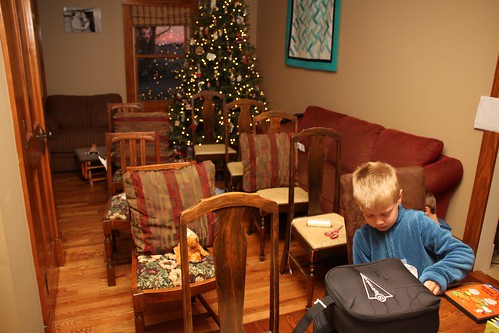
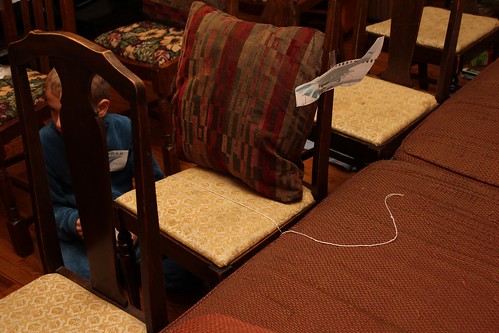
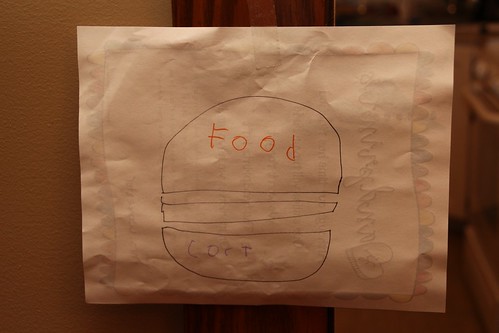
I came downstairs this morning and found a surprise waiting for me. Chairs from all over had been gathered up and arranged in rows, airline style. Taped to the wall was a food court sign. At the front was a picture of an airplane, decked out with the Amtrak logo of all things, and a timetable taped to our dining room table. IMG_6123 Jacob soon got out string to be seatbelts, too. And, using his copy machine, printed out a picture of a wing to tape to the side of the airplane . IMG_6128 And here is the food court sign Oliver made: IMG_6126 This plane was, according to the boys, scheduled to leave at 9:30. It left a fashionable 2 hours late or so. They told me I would be the pilot, and had me find headphones to be my headset . (I didn t wear my real headset on the grounds that then I wouldn t be able to hear them.) Jacob decided he would be a flight attendant, his grandma would be the co-pilot, and Oliver would be the food court worker. The food court somehow seemed to travel with the plane. Oliver made up a menu for the food court. It consisted of, and I quote: trail mix, banana, trail mix, half banana, trail mix, trail mix, trail mix . He s already got the limited selection of airport food down pat, I can see. Jacob said the flight would be from Chicago to Los Angeles, and so it was. Since it was Amtrak Airlines, we were supposed to pretend to fly over the train tracks the whole way. If it s not Christmas yet, we just invent some fun, eh? Pretty clever.

Ian Wienand: Platform bootstrap for OpenStack Infrastructure

This is a terse guide on bootstrapping virtual-machine images for OpenStack infrastructure, with the goal of adding continuous-integration support for new platforms. It might also be handy if you are trying to replicate the upstream CI environment. It covers deployment to Rackspace for testing; Rackspace is one of the major providers of capacity for the OpenStack Infrastructure project, so it makes a good place to start when building up your support story. Firstly, get an Ubuntu Trusty environment to build the image in (other environments, like CentOS or Fedora, probably work -- but take this step to minimise differences to what the automated machinery of what upstream does). You want a fair bit of memory, and plenty of disk-space. The tool used for building virtual-machine images is diskimage-builder. In short, it takes a series of elements, which are really just scripts run in different phases of the build process. I'll describe building a Fedora image, since that's been my focus lately. We will use a fedora-minimal element -- this means the system is bootstrapped from nothing inside a chroot environment, before eventually being turned into a virtual-machine image (contrast this to the fedora element, which bases itself off the qcow2 images provided by the official Fedora cloud project). Thus you'll need a few things installed on the Ubuntu host to deal with bootstrapping a Fedora chroot
apt-get install yum yum-utils python-lzma
You will hit stuff like that python-lzma dependency on this road-less-travelled -- technically it is a bug that yum packages on Ubuntu don't depend on it; without it you will get strange yum errors about unsupported compression. At this point, you can bootstrap your diskimage-builder environment. You probably want diskimage-builder from git, and then build up a virtualenv for your support bits and pieces.
git clone git://git.openstack.org/openstack/diskimage-builder
virtualenv dib_env
. dib_env/bin/activate
pip install dib-utils
dib-utils is a small part of diskimage-builder that is split-out; don't think too much about it. While diskimage-builder is responsible for the creation of the basic image, there are a number of elements provided by the OpenStack project-config repository that bootstrap the OpenStack environment. This does a lot of stuff, including caching all git trees (so CI jobs aren't cloning everything constantly) and running puppet setup.
git clone git://git.openstack.org/openstack-infra/project-config
There's one more trick required for building the VHD images that Rackspace requires; make sure you install the patched vhd-util as described in the script help. At this point, you can probably build an image. Here's something approximating what you will want to do
break=after-error \
TMP_DIR=~/tmp \
ELEMENTS_PATH=~/project-config/nodepool/elements \
DIB_DEV_USER_PASSWORD="password"  DIB_DEV_USER_PWDLESS_SUDO=1 \
DISTRO=23 \
./bin/disk-image-create -x --no-tmpfs -t vhd \
   fedora-minimal vm devuser simple-init \
   openstack-repos puppet nodepool-base node-devstack
To break some of this down This goes and does its thing; it will take about 20 minutes. Depending on how far your platform diverges from the existing support, it will require a lot of work to get everything working so you can get an image out the other side. To see a rough example of what should be happening, see the logs of the official image builds that happen for a variety of platforms. At some point, you should get a file image.vhd which is now ready to be deployed. The only reasonable way to do this is with shade. You can quickly grab this into the virtualenv we created before
pip install shade
Now you'll need to setup a clouds.yaml file to give yourself the permissions to upload the image. It should look something like
clouds:
  rax:
    profile: rackspace
    auth:
       username: your_rax_username
       password: your_rax_password
       project_id: your_rax_accountnum
    regions:
    - IAD
You should know your user-name and password (whatever you log into the website with), and when you login to Rackspace your project_id value is listed in the drop-down box labeled with your username as Account #. shade has no UI as such, so a simple script will do the upload.
import shade
shade.simple_logging(debug=True)
cloud = shade.openstack_cloud(cloud='rax')
image = cloud.create_image('image-name', filename='image.vhd', wait=True)
Now wait -- this will also take a while. Even after upload it takes a fair while to process (you will see the shade debug output looping around some glance calls seeing if it is ready). If everything works, the script should return and you should be able to see the new image in the output of nova list-images. At this point, you're ready to try booting! One caveat is that the Rackspace web interface does not seem to give you the option to boot with a configuration drive available to the host, essential for simple-init to bring up the network. So boot via the API with something like
nova boot --flavor=2 --image=image-uuid --config-drive 1 test-image
This should build and boot your image! This will allow you to open a whole new door of debugging to get your image booting correctly. You can now iterate by rebuilding/uploading/booting as required. Note these are pretty big images, and uploaded in broken-up swift files, so I find swift delete --all helpful to reset between builds (obviously, I have nothing else in swift that I want to keep). The Rackspace java-based console UI is rather annoying; it cuts itself off every time the host reboots. This makes it quite difficult to catch the early bootup, or modify grub options via the boot-loader, etc. You might need to fiddle timeout options, etc in the image build. If you've managed to get your image booting and listening on the network, you're a good-deal of the way towards having your platform supported in upstream OpenStack CI. At this point, you likely want to peruse the nodepool configuration and get an official build happening here. Once that is up, you can start the process of adding jobs that use your platform to test! Don't worry, there's plenty more that can go wrong from here -- but you're on the way! OpenStack infra is a very dynamic environment, which many changes in progress; so in general, #openstack-infra on freenode is going to be a great place to start looking for help.

21 December 2015

David Bremner: Bootable Debian USB

Umm. Somehow I thought this would be easier than learning about live-build. Probably I was wrong. There are probably many better tutorials on the web. Two useful observations: zeroing the key can eliminate mysterious grub errors, and systemd-nspawn is pretty handy. One thing that should have been obvious, but wasn't to me is that it's easier to install grub onto a device outside of any container. Find device
 $ dmesg
Count sectors
 # fdisk -l /dev/sdx
Assume that every command after here is dangerous. Zero it out. This is overkill for a fresh key, but fixed a problem with reusing a stick that had a previous live distro installed on it.
 # dd if=/dev/zero of=/dev/sdx bs=1048576 count=$sectors
Make file system. There are lots of options. I eventually used parted
 # parted
 (parted) mklabel msdos
 (parted) mkpart primary ext2 1 -1
 (parted) set 1 boot on
 (parted) quit
Make a file system
 # mkfs.ext2 /dev/sdx1
 # mount /dev/sdx1 /mnt
Install the base system
 # debootstrap --variant=minbase jessie /mnt http://httpredir.debian.org/debian/
Install grub (no chroot needed)
 # grub-install --boot-directory /mnt/boot /dev/sdx1
Set a root password
 # chroot /mnt
 # passwd root
 # exit
create up fstab
# blkid -p /dev/sdc1   cut -f2 -d' ' > /mnt/etc/fstab
Now edit to fix syntax, tell ext2, etc... Now switch to system-nspawn, to avoid boring bind mounting, etc..
# systemd-nspawn -b -D /mnt
login to the container, install linux-base, linux-image-amd64, grub-pc EDIT: fixed block size of dd, based on suggestion of tg.

Alessio Treglia: Creativity, Innovation and the Included Middle logic

The pressure of the post-modernism is establishing its bases on our general lack of ability to overcome a number of dualisms that have become ingrained in the modern way of thinking[1]. This is mainly due to the strong influence of past centuries scientific Reductionism , which postulated that any system to be understood had to be reduced to its minimum component elements.

However, a so defined system is a closed system, which does not interact with the surrounding environment and it can exist (not always) only in a reality-isolated laboratory. The logic of Complexity , instead, takes into account the open systems and all the interconnections and influences of the system itself with the world around it, in every physical, social, psychological and symbolic aspect

<Read more >

Keith Packard: TeleLaunchTwo

TeleLaunchTwo A Smaller Wireless Launch Controller I've built a wireless launch control system for NAR and OROC. Those are both complex systems with a single controller capable of running hundreds of pads. And, it's also complicated to build, with each board hand-made by elves in our Portland facility (aka, my office). A bunch of people have asked for something simpler, but using the same AES-secured two-way wireless communications link, so I decided to just build something and see if we couldn't eventually come up with something useful. I think if there's enough interest, I can get some boards built for reasonable money. Here's a picture of the system; you can see the LCO end in a box behind the pad end sitting on the bench. Radio Link Each end has a 35mW 70cm digital transceiver (so, they run in the 440MHz amateur band). These run at 19200 baud with fancy forward error correction and AES security to keep the link from accidentally (or maliciously) firing a rocket at the wrong time. Using a bi-directional link, we also get igniter continuity and remote arming information at the LCO end. The LCO Box In the LCO box, there's a lipo battery to run the device, so it can be completely stand-alone. It has three switches and a button -- an arming switch for each of two channels, a power switch and a firing button. The lipo can be charged by opening up the box and plugging it into a USB port. The Pad Box The pad box will have some cable glands for the battery and each firing circuit. On top, it will have two switches, a power switch and an arming switch. The board has two high-power FETs to drive the igniters. That should be more reliable than using a relay, while also allowing the board to tolerate a wider range of voltages -- the pad box can run on anything from 12V to 24V. The Box Unlike the OROC and NAR systems, these boards are both designed to fit inside a specific box, the Hammond 1554E, and use the mounting standoffs provided. This box is rated at NEMA 4X, which means it's fairly weather proof. Of course, I have to cut holes in the box, but I found some NEMA 4X switches, will use cable glands for the pad box wiring and can use silicone around the BNC connector. The result should be pretty robust. I also found a pretty solid-seeming BNC connector, which hooks around the edge of the board and also clips on to the board. Safety Features. There's an arming switch on both ends of the link, and you can't fire a rocket without having both ends armed. That provides an extra measure of safety while working near the pad. The pad switch is a physical interlock between the power supply and the igniters, so even if the software is hacked or broken, disarming the box means the igniters won't fire. The LCO box beeps constantly when either arming switch is selected, giving you feedback that the system is ready to fire. And you can see on any LED whether the pad box is also armed.

20 December 2015

Iustin Pop: Nikkor 200-500mm f5.6E ED VR tests

So, lately I've been on a telephoto lens learning curve; after the 300mm prime, I said to test a zoom lens. As I found the prime reasonably easy to adapt to (compared to shorter focal length lenses), I thought that a zoom (heavier, bigger) will be the same. Oh, I was wrong. My keeper rate for the first outdoors test was quite bad around 50% only, which (when talking only about focus/sharpness) is much below my standards. I started easy; some close or medium range shots, nothing special: Usual flower picture Lonely snag But then, moving to further distances, things became less straightforward. Shooting two pictures each time meant that usually one of them was sharp, but the other not. I got really confused at this step; the shutter speed was 1/2000s and I also had VR on; either VR was unneeded (i.e. contributing blur instead of helping) or something else was going on. After much head scratching, I think it's a combination of the following factors: So, for such style of shooting, I need to train more both photographic technique and arm strength at the gym In the meantime, it is possible to get such shots reasonably sharp, for example this picture of the (start of the) Alps taken from what is technically still Z rich city: The Alps  viewed from Z rich! I'm happy with the detail (at this distance), however I was not able to correct the colour due to the haze between me and the mountains; note that the trees on the bottom of the distance were not near me, but on the next or after-next hill. This picture confirms that with more practice things will get better. Coming back to shorter distances, and shorter focal lengths, things are looking better. We were passing somewhat near some people playing with RC-controlled planes not near enough to hear them, but near enough to see the plane quickly flying. Switched camera quickly to AF-C and Dynamic-21 focus, and - to my surprise - I was able to capture four good pictures, two so-so and four more clearly out of focus. But, for such a heavy length, hand-held and on the short notice, I was happy; the first picture is one of the so-so ones, but I kept it as I like the way the propeller is seen. All pictures at 290mm plus some cropping, 1/1250s, ISO between 900 and 1800, f/5.6 (i.e wide open): RC plane: continous focus tests RC plane #2 RC plane #3: good results! RC plane #4 RC plane #5: landing? From this exercise, the conclusion is that the lens is OK-ish for tracking, although the not-so good keeper rate tells me that I need to be careful; I'll have to see how a subject moving not left-right, but instead approaching or moving away from the camera would be tracked. But enough pictures of small planes. At 500mm, but still somewhat close, trees: Trees @ 500mm At this step I'm starting to wonder if stopping down a bit would help with the sharpness; I'll have to test that in the future. Walking some more, finally a bird in flight; one of the hopes when I took the camera/lens out was that I'll see some birds, but this was the first. 500mm, heavily cropped, but quite good result for myself (same autofocus settings as before): Bird in flight @ 500mm Bird in flight: difficult light The only problem here is, as always with crows (I think these are crows), is the black bird against the light-blue sky (not even strong blue), which means the picture has a high dynamic range; recovering the shadows on the bird is difficult. But in any case, it's clear the lens can deliver, if the photographer is good. Next, a helicopter was gracious enough to pass by (pretty close): Helicopter: close shot Two minutes later, it was quite far, but since it was going in the direction of the Alps, it gave the opportunity for a nice shot: Helicopter: flying towards the Alps This picture is less sharp, but still I like it due to composition; not successful on small screens though, only if you see it full screen. Light is very difficult though and about 10 seconds earlier would have been even better (more separation between the helicopter and the mountain). And since we're talking about planes, let's see a plane at 500m, directly overhead, and quite high: High-flying plane This picture (@500mm, cropped, 1/2000s) has the most detail of a plane flying high enough to have trails (not sure how to estimate, but at least 5km, maybe more around 7-8 I'd say) that I ever took. So yes, the lens can deliver, but it's not easy. This shot, being shot more or less straight up, had the least distance through low-altitude atmosphere, so it has less problems compared to the mountains pictures. It's still not really sharp (lens wide open), but the amount of detail I'm sold :) And to finish on a more close note: Hunting!! A long focal length lens allows one to get "close" without getting close, which means animals are not disturbed. The first picture with the cat (not shown) had the cat less alert; ears not fully up, although eyes were still seeking; this picture shows it fully alert and concentrated, like it was a wild cat hunting for its survival, and not a city cat, out just for fun. So, summary: All the best to everybody for the coming holidays, and thanks for reading.

19 December 2015

Dirk Eddelbuettel: RcppTOML 0.0.5

After a short hiatus, a new version of the (wonderfully useful, if I dare say so ;-) RcppTOML package is now on CRAN. RcppTOML lets R read the (absolutely awesome) TOML configuration file format--which is simply fabulous as it emphasizes strong readability for humans while at the same time supporting strong typing as well as immediate and clear error reports. At work, we're all fans now. The new version on CRAN mostly updates to an updated version of the underlying cpptoml library by Chase. Nothing much changed on the R side. Courtesy of CRANberries, there is a diffstat report for this release More information and examples are on the RcppTOML page.

This post by Dirk Eddelbuettel originated on his Thinking inside the box blog. Please report excessive re-aggregation in third-party for-profit settings.

Zlatan Todori : What is wrong with Jolla?

Jolla management really seems to not understand a first thing about how to deal with consumers. They "sailed" on wings people believing it will be open source product. They got litterally hunderds of request and question for why it isn't? Answers, I found once something along in these lines "we plan in future". The reallity - they aren't a good company. They still didn't ship tablets, they don't even know how to deal with that, they don't answer on people question and they even don't issue refunds for people that gave money for tablets. Jolla, you suck! They got some new funding with it but their blog post about it also sucks big time. Unless they open source SailfishOS they will go nowhere nor do I have any further interest in such bad behavior of one company that plays on community feeling. If you want a better experience and more open source then you should go with Tizen, FirefoxOS (although Mozilla closed development), Cyanogen, Android, Replicant and so on...

18 December 2015

Martin Pitt: What s new in autopkgtest: LXD, MaaS, apt pinning, and more

The last two major autopkgtest releases (3.18 from November, and 3.19 fresh from yesterday) bring some new features that are worth spreading. New LXD virtualization backend 3.19 debuts the new adt-virt-lxd virtualization backend. In case you missed it, LXD is an API/CLI layer on top of LXC which introduces proper image management, seamlessly use images and containers on remote locations, intelligently caching them locally, automatically configure performant storage backends like zfs or btrfs, and just generally feels really clean and much simpler to use than the classic LXC. Setting it up is not complicated at all. Install the lxd package (possibly from the backports PPA if you are on 14.04 LTS), and add your user to the lxd group. Then you can add the standard LXD image server with
  lxc remote add lco https://images.linuxcontainers.org:8443
and use the image to run e. g. the libpng test from the archive:
  adt-run libpng --- lxd lco:ubuntu/trusty/i386
  adt-run libpng --- lxd lco:debian/sid/amd64
The adt-virt-lxd.1 manpage explains this in more detail, also how to use this to run tests in a container on a remote host (how cool is that!), and how to build local images with the usual autopkgtest customizations/optimizations using adt-build-lxd. I have btrfs running on my laptop, and LXD/autopkgtest automatically use that, so the performance really rocks. Kudos to St phane, Serge, Tycho, and the other LXD authors! The motivation for writing this was to make it possible to move our armhf testing into the cloud (which for $REASONS requires remote containers), but I now have a feeling that soon this will completely replace the existing adt-virt-lxc virt backend, as its much nicer to use. It is covered by the same regression tests as the LXC runner, and from the perspective of package tests that you run in it it should behave very similar to LXC. The one problem I m aware of is that autopkgtest-reboot-prepare is broken, but hardly anything is using that yet. This is a bit complicated to fix, but I expect it will be in the next few weeks. MaaS setup script While most tests are not particularly sensitive about which kind of hardware/platform they run on, low-level software like the Linux kernel, GL libraries, X.org drivers, or Mir very much are. There is a plan for extending our automatic tests to real hardware for these packages, and being able to run autopkgtests on real iron is one important piece of that puzzle. MaaS (Metal as a Service) provides just that it manages a set of machines and provides an API for installing, talking to, and releasing them. The new maas autopkgtest ssh setup script (for the adt-virt-ssh backend) brings together autopkgtest and real hardware. Once you have a MaaS setup, get your API key from the web UI, then you can run a test like this:
  adt-run libpng --- ssh -s maas -- \
     --acquire "arch=amd64 tags=touchscreen" -r wily \
     http://my.maas.server/MAAS 123DEADBEEF:APIkey
The required arguments are the MaaS URL and the API key. Without any further options you will get any available machine installed with the default release. But usually you want to select a particular one by architecture and/or tags, and install a particular distro release, which you can do with the -r/--release and --acquire options. Note that this is not wired into Ubuntu s production CI environment, but it will be. Selectively using packages from -proposed Up until a few weeks ago, autopkgtest runs in the CI environment were always seeing/using the entirety of -proposed. This often led to lockups where an application foo and one of its dependencies libbar got a new version in -proposed at the same time, and on test regressions it was not clear at all whose fault it was. This often led to perfectly good packages being stuck in -proposed for a long time, and a lot of manual investigation about root causes. . These days we are using a more fine-grained approach: A test run is now specific for a trigger , that is, the new package in -proposed (e. g. a new version of libbar) that caused the test (e. g. for foo ) to run. autopkgtest sets up apt pinning so that only the binary packages for the trigger come from -proposed, the rest from -release. This provides much better isolation between the mush of often hundreds of packages that get synced or uploaded every day. This new behaviour is controlled by an extension of the --apt-pocket option. So you can say
  adt-run --apt-pocket=proposed=src:foo,libbar1,libbar-data ...
and then only the binaries from the foo source, libbar1, and libbar-data will come from -proposed, everything else from -release. Caveat:Unfortunately apt s pinning is rather limited. As soon as any of the explicitly listed packages depends on a package or version that is only available in -proposed, apt falls over and refuses the installation instead of taking the required dependencies from -proposed as well. In that case, adt-run falls back to the previous behaviour of using no pinning at all. (This unfortunately got worse with apt 1.1, bug report to be done). But it s still helpful in many cases that don t involve library transitions or other package sets that need to land in lockstep. Unified testbed setup script There is a number of changes that need to be made to testbeds so that tests can run with maximum performance (like running dpkg through eatmydata, disabling apt translations, or automatically using the host s apt-cacher-ng), reliable apt sources, and in a minimal environment (to detect missing dependencies and avoid interference from unrelated services these days the standard cloud images have a lot of unnecessary fat). There is also a choice whether to apply these only once (every day) to an autopkgtest specific base image, or on the fly to the current ephemeral testbed for every test run (via --setup-commands). Over time this led to quite a lot of code duplication between adt-setup-vm, adt-build-lxc, the new adt-build-lxd, cloud-vm-setup, and create-nova-image-new-release. I now cleaned this up, and there is now just a single setup-commands/setup-testbed script which works for all kinds of testbeds (LXC, LXD, QEMU images, cloud instances) and both for preparing an image with adt-buildvm-ubuntu-cloud, adt-build-lx[cd] or nova, and with preparing just the current ephemeral testbed via --setup-commands. While this is mostly an internal refactorization, it does impact users who previously used the adt-setup-vm script for e. g. building Debian images with vmdebootstrap. This script is now gone, and the generic setup-testbed entirely replaces it. Misc Aside from the above, every new version has a handful of bug fixes and minor improvements, see the git log for details. As always, if you are interested in helping out or contributing a new feature, don t hesitate to contact me or file a bug report.

Next.

Previous.