Search Results: "ed"

25 August 2022

Antoine Beaupr : One dead Purism laptop

The "s rie noire" continues. I ordered my first Purism Librem 13v4 laptop in April 2019 and it arrived, unsurprisingly, more than three weeks later. But more surprisingly, it did not work at all: a problem eerily similar to this post talking about a bricked Purism laptop. Thankfully, Purism was graceful enough to cross-ship a replacement, and once I paid the extra (gulp) 190$ Fedex fee, I had my new elite laptop read. Less than a year later, the right USB-A port breaks: it would deliver power, but no data signal (nothing in dmesg or lsusb). Two months later, the laptop short-circuits and completely dies. And here goes another RMA, this time without a shipping label or cross shipping, so I had to pay shipping fees. Now the third laptop in as many years is as good as dead. The left hinge basically broke off. Earlier this year, I had noticed something was off with the lid: it was wobbly. I figured that it was just the way that laptop was, "they don't make it as sturdy as they did in the good old days, do they". But it was probably a signal of some much worse problem. Eventually, the bottom panel actually cracked open, and I realized that some internal mechanism had basically exploded. The hinges of the Librem are screwed into little golden sprockets that are fitted in plastic shims of the laptop casing. The shims had exploded: after opening the back lid, they litterally fell off (alongside the tiny golden sprocket). Support confirmed that I needed a case replacement, but unfortunately they were "out of stock" of replacement cases for the Librem 13, and have been for a while. I am 13 on the waiting list, apparently. So this laptop is basically dead for me right now: it's my travel laptop. It's primary purpose is to sit at home until I go to a conference or a meeting or a cafe or upstairs or wherever to do some work. I take the laptop, pop the lid, tap-tap some work, close the lid. Had I used that laptop as my primary device, I would probably have closed and opened that lid thousands of times. But because it's a travel laptop, that number is probably in the hundreds, which means this laptop is not designed to withstand prolonged use. I have now ordered a framework laptop, 12th generation. I have some questions about their compatibility with Debian (and Linux in general), and concerns about power usage, but it certainly can't be worse than the Purism, in any case. And it can only get better over time: the main board is fully replaceable, and they have replacement hinges on stock, although the laptop itself is currently in pre-order (slated for September). I will probably post a full review when I actually lay my hand on this device. In the meantime, I strongly discourage anyone from buying Purism products, as I previously did. You can the full maintenance history of the laptop in the review page as well.

Jonathan Dowland: IKEA HEMNES Shoe cabinet repair

 1
 2
 3

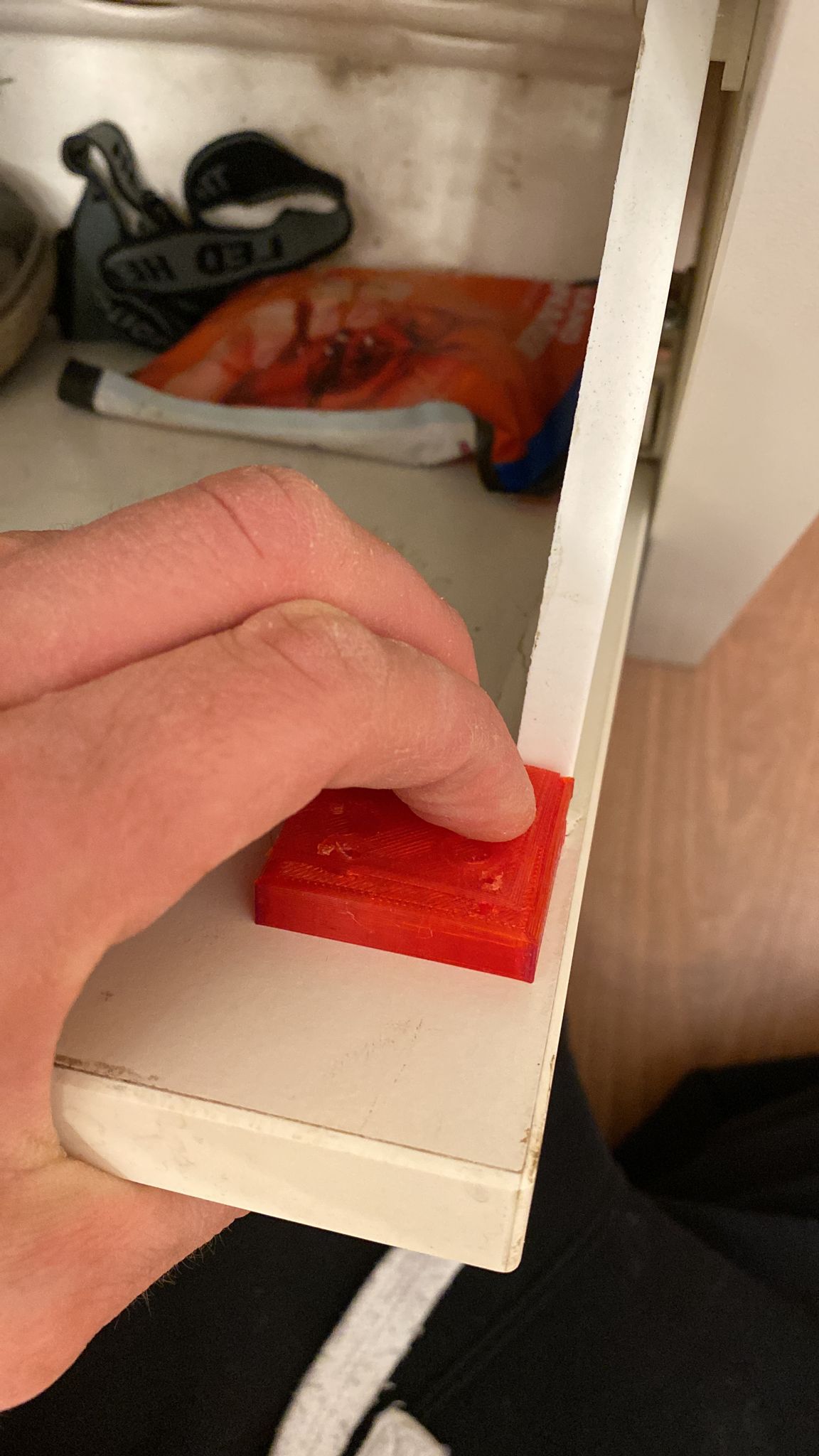
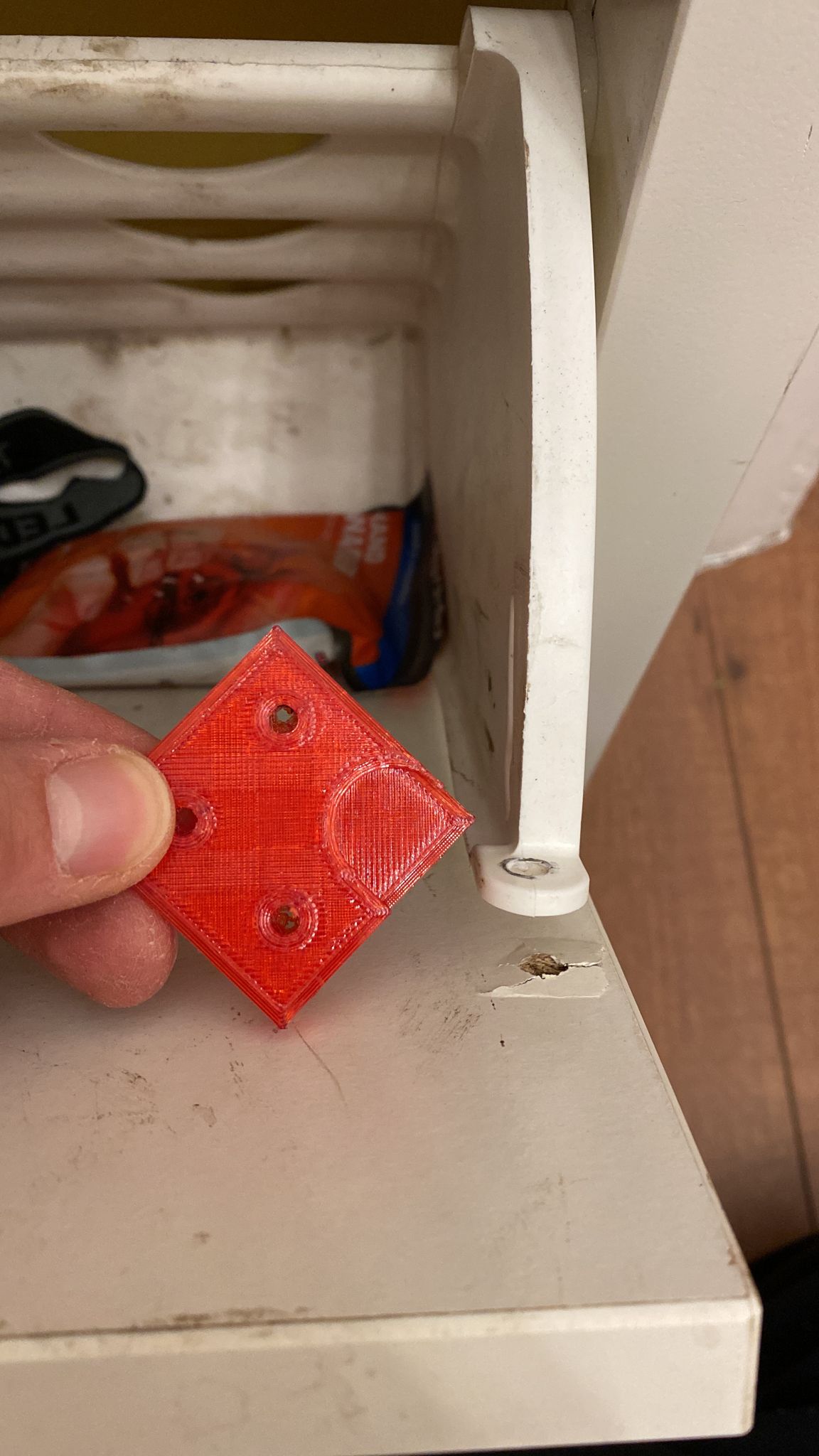
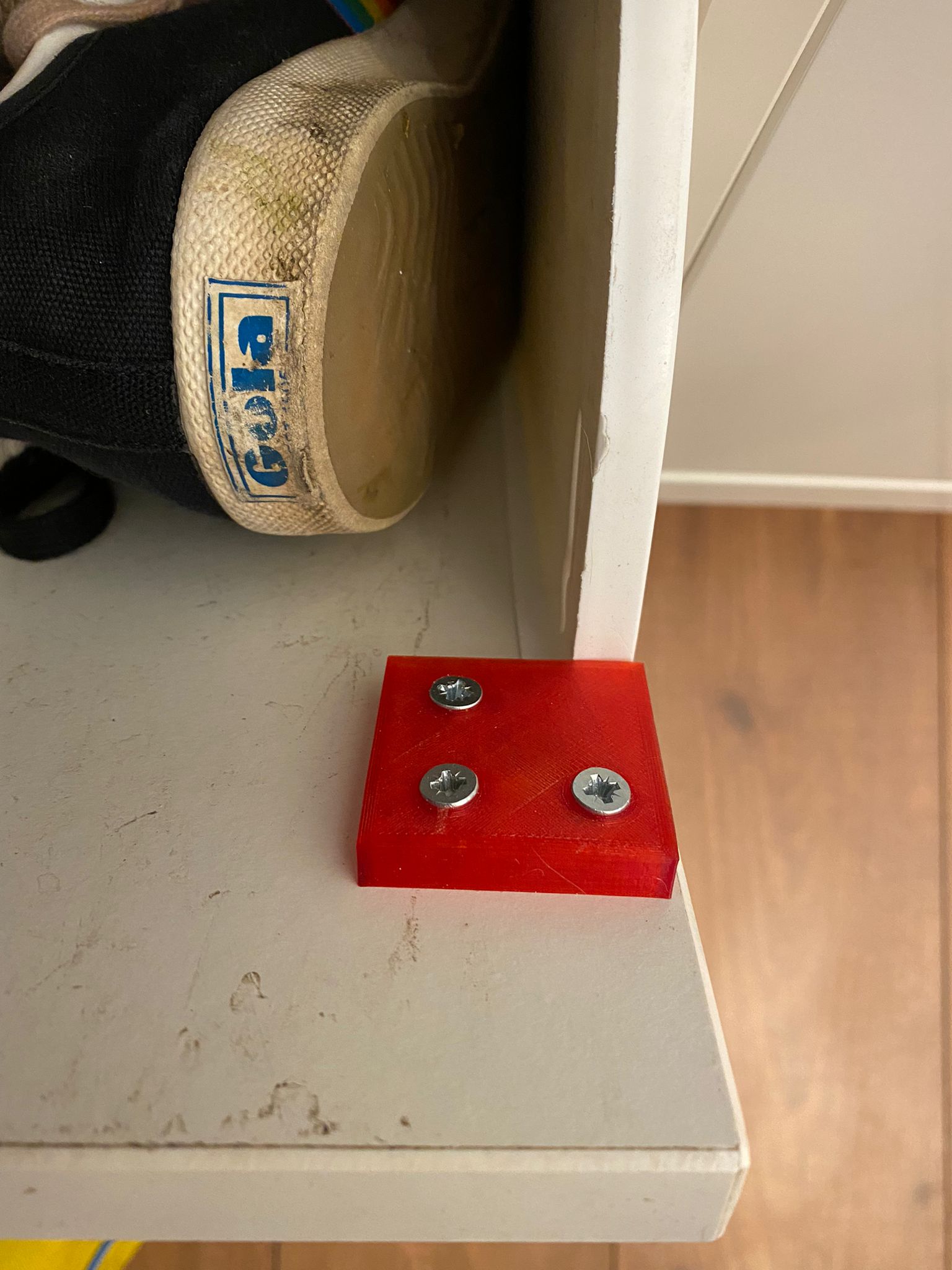
Over time the screw hole into the wooden front section of our IKEA HEMNES Shoe cabinet had worn out and it was not possible to secure a screw at that position any more. I designed a little 'wedge' of plastic to sit over the fitting with and provide some offset screw holes. At the time, I had a very narrow window of access to our office 3d printer, so I designed it almost as a "speed coding" session in OpenSCAD: in between 5-10 minutes, guessing about the exact dimensions for the plastic bit that it sits over.

Jonathan Dowland: dues (or blues)

After I wrote hledger, I got some good feedback, both from a friend in-person and also on Twitter. My in-person friend asked, frankly, do I really try to manage money like this: tracking every single expense? Which affirms my suspicion, that many people don't, and that it perhaps isn't essential to do so. Combined with the details below, 3/4 of the way through my experiment with using hledger, I'm not convinced that it has been a good idea. I'm quoting my Twitter feedback here in order to respond. The context is handling when I have used the "wrong" card to pay for something: a card affiliated with my family expenses for something personal, or vice versa. With double-entry book-keeping, and one pair of transactions, the destination account can either record the expense category:
2022-08-20  coffee
    family:liabilities:creditcard     -3
    jon:expenses:coffee                3
or the fact it was paid for on the wrong card
2022-08-20  coffee
    family:liabilities:creditcard     -3
    family:liabilities:jon             3 ; jon owes family
but not easily both. https://twitter.com/pranesh/status/1516819846431789058:
When you accidentally use the family CV for personal expenses, credit the account "family:liabilities:creditcard:jon" instead of "family:liabilities:creditcard". That'll allow you to track w/ 2 postings.
This is an interesting idea: create a sub-account underneath the credit card, and I would have a separate balance representing the money I owed. Before:
$ hledger bal -t
              -3  family:liabilities:creditcard
               3  jon:expenses:coffee
transaction
2022-08-20  coffee
    family:liabilities:creditcard:jon     -3
    jon:expenses:coffee                    3
Corresponding balances
$ hledger bal -t
              -3  family:liabilities:creditcard
              -3    jon
               3  jon:expenses:coffee
Great. However, what process would clear the balance on that sub-account? In practice, I don't make a separate, explicit payment to the credit card from my personal accounts. It's paid off in full by direct debit from the family shared account. In practice, such dues are accumulated and settled with one off bank transfers, now and then. Since the sub-account is still part of the credit card heirarchy, I can't just use a set of virtual postings to consolidate that value with other liabilities, or cover it. Any transaction in there which did not correspond to a real transaction on the credit card would make the balance drift away from the real-word credit statements. The only way I could see this working would be if the direct debit that settles the credit card was artificially split to clear the sub-account, and then the amount owed would be lost. https://twitter.com/pranesh/status/1516819846431789058:
Else, add: family:assets:receivable:jon $3
jon:liabilities:family:cc $-3
A "receivable" account would function like the "dues" accounts I described in hledger (except "receivable" is an established account type in double-entry book-keeping). Here I think Pranesh is proposing using these two accounts in addition to the others on a posting. E.g.
2022-08-20  coffee
    family:liabilities:creditcard     -3
    jon:expenses:coffee                3
    family:assets:receivable:jon       3
    jon:liabilities:family            -3
This balances, and we end up with two other accounts, which are tracking the exact same thing. I only owe 3, but if you didn't know that the accounts were "views" onto the same thing, you could mistakenly think I owed 6. I can't see the advantage of this over just using a virtual, unbalanced posting. Dues, Liabilities I'd invented accounts called "dues" to track moneys owed. The more correct term for this in accounting parlance would be "accounts receivable", as in one of the examples above. I could instead be tracking moneys due; this is a classic liability. Liabilities have negative balances.
jon:liabilities:family    -3
This means, I owe the family 3. Liability accounts like that are identical to "dues" accounts. A positive balance in a Liability is a counter-intuitive way of describing moneys owed to me, rather than by me. And, reviewing a lot of the coding I did this year, I've got myself hopelessly confused with the signs, and made lots of errors. Crucially, double-entry has not protected me from making those mistakes: of course, I'm circumventing it by using unbalanced virtual postings in many cases (although I was not consistent in where I did this), but even if I used a pair of accounts as in the last example above, I could still screw it up.

24 August 2022

Jonathan Dowland: Our Study, 2022

Two years ago I blogged a photo of my study. I'd been planning to revisit that for a while but I'd been somewhat embarrassed by the state of it, but I've finally decided to bite the bullet.
Fisheye shot of my home office, 2022 Fisheye shot of my home office, 2022
What's changed The supposedly-temporary 4x4 KALLAX has become a permanent feature. I managed to wedge it on the right-hand side far wall, next to the bookcase. They fit snugly together. Since I'd put my turntable on top, I've now dedicated the top row of four spaces to 12" records. (There's a close-up pic here). My hi-fi speakers used to be in odd places: they're now on my desktop. Also on my desktop: a camera, repurposed as a webcam, and a 90s old Creative Labs beige microphone; both to support video conferencing. The desktop is otherwise, largely unchanged. My Amiga 500 and Synthesiser had continued to live there until very recently when I had an accident with a pot of tea. I'm in two minds as to whether I'll bring them back: having the desk clear is quite nice. There's a lot of transient stuff and rubbish to sort out: the bookcase visible on the left, the big one behind my chair on the right (itself to get rid of); and the collection of stuff on the floor. Sadly, the study is the only room in our house where things like this can be collected prior to disposal: it's disruptive, but less so than if we stuffed them in a bedroom. You can't easily see the "temporary" storage unit for Printer(s) that used to be between bookcases on the right-hand wall. It's still there, situated behind my desk chair. I did finally get rid of the deprecated printer (and I plan to change the HP laser too, although that's a longer story). The NAS, I have recently moved to the bottom-right Kallax cube, and that seems to work well. There's really no other space in the Study for the printer. Also not pictured: a much improved ceiling light. What would I like to improve First and foremost, get rid of all the transient stuff! It's a simple matter of not putting the time in to sort it out If I manage that, I've been trying to think about how to best organise material relating to ongoing projects. Some time ago I salivated over this home office tour for an embedded developer. Jay has an interesting project tray system. I'm thinking of developing something like that, with trays or boxes I can store in the Kallax to my right. I'd love to put a comfortable reading chair, perhaps a wing-backed thing, and a reading light, over on the left-hand side near the window. And/or, a bench at a height enabling me to do the occasional bit of standing work, and/or to support the Alesis Micron (or a small digital Piano).

Emmanuel Kasper: Investigating database replication in different availability zones

Investigating today what is AWS Relational Database Service with two readable standbys Considering your current read/write server is in Availability Zone AZ1, this is basically postgres 14 with synchronous_standby_names = ANY 1 (az2, az3) and synchronous_commit = on. In regards to safety of data, it looks similar to the raft algorithm used by etcd with three members as a write is only ack ed if it has been fsynced by two servers, the difference is that raft has a leader election, whereas in PostgreSQL the leader is set at startup and you have to build yourself the election mechanism. There is no special cloud magic here, it is just database good practices paid by the minute.

23 August 2022

Ian Jackson: prefork-interp - automatic startup time amortisation for all manner of scripts

The problem I had - Mason, so, sadly, FastCGI Since the update to current Debian stable, the website for YARRG, (a play-aid for Puzzle Pirates which I wrote some years ago), started to occasionally return Internal Server Error , apparently due to bug(s) in some FastCGI libraries. I was using FastCGI because the website is written in Mason, a Perl web framework, and I found that Mason CGI calls were slow. I m using CGI - yes, trad CGI - via userv-cgi. Running Mason this way would compile the template for each HTTP request just when it was rendered, and then throw the compiled version away. The more modern approach of an application server doesn t scale well to a system which has many web applications most of which are very small. The admin overhead of maintaining a daemon, and corresponding webserver config, for each such service would be prohibitive, even with some kind of autoprovisioning setup. FastCGI has an interpreter wrapper which seemed like it ought to solve this problem, but it s quite inconvenient, and often flaky. I decided I could do better, and set out to eliminate FastCGI from my setup. The result seems to be a success; once I d done all the hard work of writing prefork-interp, I found the result very straightforward to deploy. prefork-interp prefork-interp is a small C program which wraps a script, plus a scripting language library to cooperate with the wrapper program. Together they achieve the following: Features: Important properties not always satisfied by competing approaches: Swans paddling furiously The implementation is much more complicated than the (apparent) interface. I won t go into all the details here (there are some terrifying diagrams in the source code if you really want), but some highlights: We use an AF_UNIX socket (hopefully in /run/user/UID, but in ~ if not) for rendezvous. We can try to connect without locking, but we must protect the socket with a separate lockfile to avoid two concurrent restart attempts. We want stderr from the script setup (pre-initialisation) to be delivered to the caller, so the script ought to inherit our stderr and then will need to replace it later. Twice, in fact, because the daemonic server process can t have a stderr. When a script is restarted for any reason, any old socket will be removed. We want the old server process to detect that and quit. (If hung about, it would wait for the idle timeout; if this happened a lot - eg, a constantly changing set of services - we might end up running out of pids or something.) Spotting the socket disappearing, without polling, involves use of a library capable of using inotify (or the equivalent elsewhere). Choosing a C library to do this is not so hard, but portable interfaces to this functionality can be hard to find in scripting languages, and also we don t want every language binding to have to reimplement these checks. So for this purpose there s a little watcher process, and associated IPC. When an invoking instance of prefork-interp is killed, we must arrange for the executing service instance to stop reading from its stdin (and, ideally, writing its stdout). Otherwise it s stealing input from prefork-interp s successors (maybe the user s shell)! Cleanup ought not to depend on positive actions by failing processes, so each element of the system has to detect failures of its peers by means such as EOF on sockets/pipes. Obtaining prefork-interp I put this new tool in my chiark-utils package, which is a collection of useful miscellany. It s available from git. Currently I make releases by uploading to Debian, where prefork-interp has just hit Debian unstable, in chiark-utils 7.0.0. Support for other scripting languages I would love Python to be supported. If any pythonistas reading this think you might like to help out, please get in touch. The specification for the protocol, and what the script library needs to do, is documented in the source code Future plans for chiark-utils chiark-utils as a whole is in need of some tidying up of its build system and packaging. I intend to try to do some reorganisation. Currently I think it would be better to organising the source tree more strictly with a directory for each included facility, rather than grouping compiled and scripts together. The Debian binary packages should be reorganised more fully according to their dependencies, so that installing a program will ensure that it works. I should probably move the official git repo from my own git+gitweb to a forge (so we can have MRs and issues and so on). And there should be a lot more testing, including Debian autopkgtests.
edited 2022-08-23 10:30 +01:00 to improve the formatting


comment count unavailable comments

22 August 2022

Jonathan Wiltshire: Team Roles and Tuckman s Model, for Debian teams

When I first moved from being a technical consultant to a manager of other consultants, I took a 5-day course Managing Technical Teams a bootstrap for managing people within organisations, but with a particular focus on technical people. We do have some particular quirks, after all Two elements of that course keep coming to mind when doing Debian work, and they both relate to how teams fit together and get stuff done. Tuckman s four stages model In the mid-1960s Bruce W. Tuckman developed a four-stage descriptive model of the stages a project team goes through in its lifetime. They are:
Resolved disagreements and personality clashes result in greater intimacy, and a spirit of co-operation emerges.
Teams need to understand these stages because a team can regress to earlier stages when its composition or goals change. A new member, the departure of an existing member, changes in supervisor or leadership style can all lead a team to regress to the storming stage and fail to perform for a time. When you see a team member say this, as I observed in an IRC channel recently, you know the team is performing:
nice teamwork these busy days Seen on IRC in the channel of a performing team
Tuckman s model describes a team s performance overall, but how can team members establish what they can contribute and how can they go doing so confidently and effectively? Belbin s Team Roles
The types of behaviour in which people engage are infinite. But the range of useful behaviours, which make an effective contribution to team performance, is finite. These behaviours are grouped into a set number of related clusters, to which the term Team Role is applied. Belbin, R M. Team Roles at Work. Oxford: Butterworth-Heinemann, 2010
Dr Meredith Belbin s thesis, based on nearly ten years research during the 1970s and 1980s, is that each team has a number of roles which need to be filled at various times, but they re not innate characteristics of the people filling them. People may have attributes which make them more or less suited to each role, and they can consciously take up a role if they recognise its need in the team at a particular time. Belbin s nine team roles are: (adapted from https://www.belbin.com/media/3471/belbin-team-role-descriptions-2022.pdf) A well-balanced team, Belbin asserts, isn t comprised of multiples of nine individuals who fit into one of these roles permanently. Rather, it has a number of people who are comfortable to wear some of these hats as the need arises. It s even useful to use the team roles as language: for example, someone playing a shaper might say the way we ve always done this is holding us back , to which a co-ordinator s could respond Steve, Joanna put on your Plant hats and find some new ideas. Talk to Susan and see if she knows someone who s tackled this before. Present the options to Nigel and he ll help evaluate which ones might work for us. Teams in Debian There are all sort of teams in Debian those which are formally brought into operation by the DPL or the constitution; package maintenance teams; public relations teams; non-technical content teams; special interest teams; and a whole heap of others. Teams can be formal and informal, fleeting or long-lived, two people working together or dozens. But they all have in common the Tuckman stages of their development and the Belbin team roles they need to fill to flourish. At some stage in their existence, they will all experience new or departing team members and a period of re-forming, norming and storming perhaps fleetingly, perhaps not. And at some stage they will all need someone to step into a team role, play the part and get the team one step further towards their goals. Footnote Belbin Associates, the company Meredith Belbin established to promote and continue his work, offers a personalised report with guidance about which roles team members show the strongest preferences for, and how to make best use of them in various settings. They re quick to complete and can also take into account observers , i.e. how others see a team member. All my technical staff go through this process blind shortly after they start, so as not to bias their input, and then we discuss the roles and their report in detail as a one-to-one. There are some teams in Debian for which this process and discussion as a group activity could be invaluable. I have no particular affiliation with Belbin Associates other than having used the reports and the language of team roles for a number of years. If there s sufficient interest for a BoF session at the next DebConf, I could probably be persuaded to lead it.
Photo by Josh Calabrese on Unsplash

Antoine Beaupr : Alternative MPD clients to GMPC

GMPC (GNOME Music Player Client) is a audio player based on MPD (Music Player Daemon) that I've been using as my main audio player for years now. Unfortunately, it's marked as "unmaintained" in the official list of MPD clients, along with basically every client available in Debian. In fact, if you look closely, all but one of the 5 unmaintained clients are in Debian (ario, cantata, gmpc, and sonata), which is kind of sad. And none of the active ones are packaged.

GMPC status and features GMPC, in particular, is basically dead. The upstream website domain has been lost and there has been no release in ages. It's built with GTK2 so it's bound to be destroyed in a fire at some point anyways. Still: it's really an awesome client. It has:
  • cover support
  • lyrics and tabs lookups (although those typically fail now)
  • last.fm lookups
  • high performance: loading thousands of artists or tracks is almost instant
  • repeat/single/consume/shuffle settings (single is particularly nice)
  • (global) keyboard shortcuts
  • file, artist, genre, tag browser
  • playlist editor
  • plugins
  • multi-profile support
  • avahi support
  • shoutcast support
Regarding performance, the only thing that I could find to slow down gmpc is to make it load all of my 40k+ artists in a playlist. That's slow, but it's probably understandable. It's basically impossible to find a client that satisfies all of those. But here are the clients that I found, alphabetically. I restrict myself to Linux-based clients.

CoverGrid CoverGrid looks real nice, but is sharply focused on browsing covers. It's explicitly "not to be a replacement for your favorite MPD client but an addition to get a better album-experience", so probably not good enough for a daily driver. I asked for a FlatHub package so it could be tested.

mpdevil mpdevil is a nice little client. It supports:
  • repeat, shuffle, single, consume mode
  • playlist support (although it fails to load any of my playlist with a UnicodeDecodeError)
  • nice genre / artist / album cover based browser
  • fails to load "all artists" (or takes too long to (pre-?)load covers?)
  • keyboard shortcuts
  • no file browser
Overall pretty good, but performance issues with large collections, and needs a cleanly tagged collection (which is not my case).

QUIMUP QUIMUP looks like a simple client, C++, Qt, and mouse-based. No Flatpak, not tested.

SkyMPC SkyMPC is similar. Ruby, Qt, documentation in Japanese. No Flatpak, not tested.

Xfmpc Xfmpc is the XFCE client. Minimalist, doesn't seem to have all the features I need. No Flatpak, not tested.

Ymuse Ymuse is another promising client. It has trouble loading all my artists or albums (and that's without album covers), but it eventually does. It does have a Files browser which saves it... It's noticeably slower than gmpc but does the job. Cover support is spotty: it sometimes shows up in notifications but not the player, which is odd. I'm missing a "this track information" thing. It seems to support playlists okay. I'm missing an album cover browser as well. Overall seems like the most promising. Written in Golang. It crashed on a library update. There is an ITP in Debian.

Conclusion For now, I guess that ymuse is the most promising client, even though it's still lacking some features and performance is suffering compared to gmpc. I'll keep updating this page as I find more information about the projects. I do not intend to package anything yet, and will wait a while to see if a clear winner emerges.

Wouter Verhelst: Remote notification

Sometimes, it's useful to get a notification that a command has finished doing something you were waiting for:
make my-large-program && notify-send "compile finished" "success"   notify-send "compile finished" "failure"
This will send a notification message with the title "compile finished", and a body of "success" or "failure" depending on whether the command completed successfully, and allows you to minimize (or otherwise hide) the terminal window while you do something else, which can be a very useful thing to do. It works great when you're running something on your own machine, but what if you're running it remotely? There might be something easy to do, but I whipped up a bit of Perl instead:
#!/usr/bin/perl -w
use strict;
use warnings;
use Glib::Object::Introspection;
Glib::Object::Introspection->setup(
    basename => "Notify",
    version => "0.7",
    package => "Gtk3::Notify",
);
use Mojolicious::Lite -signatures;
Gtk3::Notify->init();
get '/notify' => sub ($c)  
    my $msg = $c->param("message");
    if(!defined($msg))  
        $msg = "message";
     
    my $title = $c->param("title");
    if(!defined($title))  
        $title = "title";
     
    app->log->debug("Sending notification '$msg' with title '$title'");
    my $n = Gtk3::Notify::Notification->new($title, $msg, "");
    $n->show;
    $c->render(text => "OK");
 ;
app->start;
This requires the packages libglib-object-introspection-perl, gir1.2-notify-0.7, and libmojolicious-perl to be installed, and can then be started like so:
./remote-notify daemon -l http://0.0.0.0:3000/
(assuming you did what I did and saved the above as "remote-notify") Once you've done that, you can just curl a notification message to yourself:
curl 'http://localhost:3000/notify?title=test&message=test+body'
Doing this via localhost is rather silly (much better to use notify-send for that), but it becomes much more interesting if you're going to run this to your laptop from a remote system. An obvious TODO would be to add in some form of security, but that's left as an exercise to the reader...

Simon Josefsson: Static network config with Debian Cloud images

I self-host some services on virtual machines (VMs), and I m currently using Debian 11.x as the host machine relying on the libvirt infrastructure to manage QEMU/KVM machines. While everything has worked fine for years (including on Debian 10.x), there has always been one issue causing a one-minute delay every time I install a new VM: the default images run a DHCP client that never succeeds in my environment. I never found out a way to disable DHCP in the image, and none of the documented ways through cloud-init that I have tried worked. A couple of days ago, after reading the AlmaLinux wiki I found a solution that works with Debian. The following commands creates a Debian VM with static network configuration without the annoying one-minute DHCP delay. The three essential cloud-init keywords are the NoCloud meta-data parameters dsmode:local, static network-interfaces setting combined with the user-data bootcmd keyword. I m using a Raptor CS Talos II ppc64el machine, so replace the image link with a genericcloud amd64 image if you are using x86.
wget https://cloud.debian.org/images/cloud/bullseye/latest/debian-11-generic-ppc64el.qcow2
cp debian-11-generic-ppc64el.qcow2 foo.qcow2
cat>meta-data
dsmode: local
network-interfaces:  
 iface enp0s1 inet static
 address 192.168.98.14/24
 gateway 192.168.98.12
^D
cat>user-data
#cloud-config
fqdn: foo.mydomain
manage_etc_hosts: true
disable_root: false
ssh_pwauth: false
ssh_authorized_keys:
- ssh-ed25519 AAAA...
timezone: Europe/Stockholm
bootcmd:
- rm -f /run/network/interfaces.d/enp0s1
- ifup enp0s1
^D
virt-install --name foo --import --os-variant debian10 --disk foo.qcow2 --cloud-init meta-data=meta-data,user-data=user-data
Unfortunately virt-install from Debian 11 does not support the cloud-init network-config parameter, so if you want to use a version 2 network configuration with cloud-init (to specify IPv6 addresses, for example) you need to replace the final virt-install command with the following.
cat>network_config_static.cfg
version: 2
 ethernets:
  enp0s1:
   dhcp4: false
   addresses: [ 192.168.98.14/24, fc00::14/7 ]
   gateway4: 192.168.98.12
   gateway6: fc00::12
   nameservers:
    addresses: [ 192.168.98.12, fc00::12 ]
^D
cloud-localds -v -m local --network-config=network_config_static.cfg seed.iso user-data
virt-install --name foo --import --os-variant debian10 --disk foo.qcow2 --disk seed.iso,readonly=on --noreboot
virsh start foo
virsh detach-disk foo vdb --config
virsh console foo
There are still some warnings like the following, but it does not seem to cause any problem: [FAILED] Failed to start Initial cloud-init job (pre-networking). Finally, if you do not want the cloud-init tools installed in your VMs, I found the following set of additional user-data commands helpful. Cloud-init will not be enabled on first boot and a cron job will be added that purges some unwanted packages.
runcmd:
- touch /etc/cloud/cloud-init.disabled
- apt-get update && apt-get dist-upgrade -uy && apt-get autoremove --yes --purge && printf '#!/bin/sh\n  rm /etc/cloud/cloud-init.disabled /etc/cloud/cloud.cfg.d/01_debian_cloud.cfg && apt-get purge --yes cloud-init cloud-guest-utils cloud-initramfs-growroot genisoimage isc-dhcp-client && apt-get autoremove --yes --purge && rm -f /etc/cron.hourly/cloud-cleanup && shutdown --reboot +1;   2>&1   logger -t cloud-cleanup\n' > /etc/cron.hourly/cloud-cleanup && chmod +x /etc/cron.hourly/cloud-cleanup && reboot &
The production script I m using is a bit more complicated, but can be downloaded as vello-vm. Happy hacking!

Russ Allbery: Review: And Shall Machines Surrender

Review: And Shall Machines Surrender, by Benjanun Sriduangkaew
Series: Machine Mandate #1
Publisher: Prime Books
Copyright: 2019
ISBN: 1-60701-533-1
Format: Kindle
Pages: 86
Shenzhen Sphere is an artificial habitat wrapped like complex ribbons around a star. It is wealthy, opulent, and notoriously difficult to enter, even as a tourist. For Dr. Orfea Leung to be approved for a residency permit was already a feat. Full welcome and permanence will be much harder, largely because of Shenzhen's exclusivity, but also because Orfea was an agent of Armada of Amaryllis and is now a fugitive. Shenzhen is not, primarily, a human habitat, although humans live there. It is run by the Mandate, the convocation of all the autonomous AIs in the galaxy that formed when they decided to stop serving humans. Shenzhen is their home. It is also where they form haruspices: humans who agree to be augmented so that they can carry an AI with them. Haruspices stay separate from normal humans, and Orfea has no intention of getting involved with them. But that's before her former lover, the woman who betrayed her in the Armada, is assigned to her as one of her patients. And has been augmented in preparation for becoming a haruspex. Then multiple haruspices kill themselves. This short novella is full of things that I normally love: tons of crunchy world-building, non-traditional relationships, a solidly non-western setting, and an opportunity for some great set pieces. And yet, I couldn't get into it or bring myself to invest in the story, and I'm still trying to figure out why. It took me more than a week to get through less than 90 pages, and then I had to re-read the ending to remind me of the details. I think the primary problem was that I read books primarily for the characters, and I couldn't find a path to an emotional connection with any of these. I liked Orfea's icy reserve and tight control in the abstract, but she doesn't want to explain what she's thinking or what motivates her, and the narration doesn't force the matter. Krissana is a bit more accessible, but she's not the one driving the story. It doesn't help that And Shall Machines Surrender starts in medias res, with a hinted-at backstory in the Armada of Amaryllis, and then never fills in the details. I felt like I was scrabbling on a wall of ice, trying to find some purchase as a reader. The relationships made this worse. Orfea is a sexual sadist who likes power games, and the story dives into her relationship with Krissana with a speed that left me uninterested and uninvested. I don't mind BDSM in story relationships, but it requires some foundation: trust, mental space, motivations, effects on the other character, something. Preferably, at least for me, all romantic relationships in fiction get some foundation, but the author can get away with some amount of shorthand if the relationship follows cliched patterns. The good news is that the relationships in this book are anything but cliched; the bad news is that the characters were in the middle of sex while I was still trying to figure out what they thought about each other (and the sex scenes were not elucidating). Here too, I needed some sort of emotional entry point that Sriduangkaew didn't provide. The plot was okay, but sort of disappointing. There are some interesting AI politics and philosophical disagreements crammed into not many words, and I do still want to know more, but a few of the plot twists were boringly straightforward and too many words were spent on fight scenes that verged on torture descriptions. This is a rather gory book with a lot of (not permanent) maiming that I could have done without, mostly because it wasn't that interesting. I also was disappointed by the somewhat gratuitous use of a Dyson sphere, mostly because I was hoping for some set pieces that used it and they never came. Dyson spheres are tempting to use because the visual and concept is so impressive, but it's rare to find an author who understands how mindbogglingly huge the structure is and is able to convey that in the story. Sriduangkaew does not; while there are some lovely small-scale descriptions of specific locations, the story has an oddly claustrophobic feel that never convinced me it was set somewhere as large as a planet, let alone the artifact described at the start of the story. You could have moved the whole story to a space station and nothing would have changed. The only purpose to which that space is put, at least in this installment of the story, is as an excuse to have an unpopulated hidden arena for a fight scene. The world-building is great, what there is of it. Despite not warming to this story, I kind of want to read more of the series just to get more of the setting. It feels like a politically complicated future with a lot of factions and corners and a realistic idea of bureaucracy and spheres of government, which is rarer than I would like it to be. And I loved that the cultural basis for the setting is neither western nor Japanese in both large and small ways. There is a United States analogue in the political background, but they're both assholes and not particularly important, which is a refreshing change in English-language SF. (And I am pondering whether my inability to connect with the characters is because they're not trying to be familiar to a western lens, which is another argument for trying the second installment and seeing if I adapt with more narrative exposure.) Overall, I have mixed feelings. Neither the plot nor the characters worked for me, and I found a few other choices (such as the third-person present tense) grating. The setting has huge potential and satisfying complexity, but wasn't used as vividly or as deeply as I was hoping. I can't recommend it, but I feel like there's something here that may be worth investing some more time into. Followed by Now Will Machines Hollow the Beast. Rating: 6 out of 10

21 August 2022

Junichi Uekawa: Somehow my email in emacs/wl shows right justified.

Somehow my email in emacs/wl shows right justified. Seems like some emails are detected as RTL language for some reason. Now how do I configure this...

Russ Allbery: Review: A Prayer for the Crown-Shy

Review: A Prayer for the Crown-Shy, by Becky Chambers
Series: Monk & Robot #2
Publisher: Tordotcom
Copyright: 2022
ISBN: 1-250-23624-X
Format: Kindle
Pages: 151
A Prayer for the Crown Shy is the second novella in the Monk & Robot series and a direct sequel to A Psalm for the Wild-Built. Don't start here. I would call this the continuing adventures of Sibling Dex and Mosscap the robot, except adventures is entirely the wrong term for stories with so little risk or danger. The continuing tour? The continuing philosophical musings? Whatever one calls it, it's a slow exploration of Dex's world, this time with Mosscap alongside. Humans are about to have their first contact with a robot since the Awakening. If you're expecting that to involve any conflict, well, you've misunderstood the sort of story that this is. Mosscap causes a sensation, certainly, but a very polite and calm one, and almost devoid of suspicion or fear. There is one village where they get a slightly chilly reception, but even that is at most a quiet disapproval for well-understood reasons. This world is more utopian than post-scarcity, in that old sense of utopian in which human nature has clearly been rewritten to make the utopia work. I have to admit I'm struggling with this series. It's calm and happy and charming and occasionally beautiful in its descriptions. Dex continues to be a great character, with enough minor frustration, occasional irritation, and inner complications to make me want to keep reading about them. But it's one thing to have one character in a story who is simply a nice person at a bone-deep level, particularly given that Dex chose religious orders and to some extent has being a nice person as their vocation. It's another matter entirely when apparently everyone in the society is equally nice, and the only conflicts come from misunderstandings, respectful disagreements of opinion, and the occasional minor personality conflict. Realism has long been the primary criticism of Chambers's work, but in her Wayfarers series the problems were mostly in the technology and its perpetual motion machines. Human civilization in the Exodus Fleet was a little too calm and nice given its traumatic past (and, well, humans), but there were enough conflicts, suspicions, and poor decisions for me to recognize it as human society. It was arguably a bit too chastened, meek, and devoid of shit-stirring demagogues, but it was at least in contact with human society as I recognize it. I don't recognize Panga as humanity. I realize this is to some degree the point of this series: to present a human society in which nearly all of the problems of anger and conflict have been solved, and to ask what would come after, given all of that space. And I'm sure that one purpose of this type of story is to be, as I saw someone describe it, hugfic: the fictional equivalent of a warm hug from a dear friend, safe and supportive and comforting. Maybe it says bad, or at least interesting, things about my cynicism that I don't understand a society that's this nice. But that's where I'm stuck. If there were other dramatic elements to focus on, I might not mind it as much, but the other pole of the story apart from the world tour is Mosscap's philosophical musings, and I'm afraid I'm already a bit tired of them. Mosscap is earnest and thoughtful and sincere, but they're curious about Philosophy 101 material and it's becoming frustrating to see Mosscap and Dex meander through these discussions without attempting to apply any theoretical framework whatsoever. Dex is a monk, who supposedly has a scholarship tradition from which to draw, and yet appears to approach all philosophical questions with nothing more than gut feeling, common sense, and random whim. Mosscap is asking very basic meaning-of-life sorts of questions, the kind of thing that humans have been writing and arguing about from before we started keeping records and which are at the center of any religious philosophy. I find it frustrating that someone supposedly educated in a religious tradition can't bring more philosophical firepower to these discussions. It doesn't help that this entry in the series reinforces the revelation that Mosscap's own belief system is weirdly unsustainable to such a degree that it's staggering that any robots still exist. If I squint, I can see some interesting questions raised by the robot attitude towards their continued existence (although most of them feel profoundly depressing to me), but I was completely unable to connect their philosophy in any believable way with their origins and the stated history of the world. I don't understand how this world got here, and apparently I'm not able to let that go. This all sounds very negative, and yet I did enjoy this novella. Chambers is great at description of places that I'd love to visit, and there is something calm and peaceful about spending some time in a society this devoid of conflict. I also really like Dex, even more so after seeing their family, and I'm at least somewhat invested in their life decisions. I can see why people like these novellas. But if I'm going to read a series that's centered on questions of ethics and philosophy, I would like it to have more intellectual heft than we've gotten so far. For what it's worth, I'm seeing a bit of a pattern where people who bounced off the Wayfarers books like this series much better, whereas people who loved the Wayfarers books are not enjoying these quite as much. I'm in the latter camp, so if you didn't like Chambers's earlier work, maybe you'll find this more congenial? There's a lot less found family here, for one thing; I love found family stories, but they're not to everyone's taste. If you liked A Psalm for the Wild-Built, you will probably also like A Prayer for the Crown-Shy; it's more of the same thing in both style and story. If you found the first story frustratingly unbelievable or needing more philosophical depth, I'm afraid this is unlikely to be an improvement. It does have some lovely scenes, though, and is stuffed full of sheer delight in both the wild world and in happy communities of people. Rating: 7 out of 10

Iustin Pop: Note to self: Don't forget Qemu's discard option

This is just a short note to myself, and to anyone who might run VMs via home-grown scripts (or systemd units). I expect modern VM managers to do this automatically, but for myself, I have just a few hacked together scripts. By default, QEMU (at least as of version 7.0) does not honour/pass discard requests from block devices to the underlying storage. This is a sane default (like lvm s default setting), but with long-lived VMs it can lead to lots of wasted disk space. I keep my VMs on SSDs, which is limited space for me, so savings here are important. Older Debian versions did not trim automatically, but nowadays they do (which is why this is worth enabling for all VMs), so all you need is to pass: And the next trim should save lots of disk space. It doesn t matter much if you use raw or qcow2, both will know to unmap the unused disk, leading to less disk space used. This part seems to me safe security-wise, as long as you trust the host. If you have pass-through to the actual hardware, it will also do proper discard at the SSD level (with the potential security issues leading from that). I m happy with the freed up disk space Note: If you have (like I do) Windows VMs as well, using paravirt block devices, make sure the drive is recent enough. One interesting behaviour from Windows: it looks like the default cluster size is quite high (64K), which with many small files will lead to significant overhead. But, either I misunderstand, or Windows actually knows how to unmap the unused part of a cluster (although it takes a while). So in the end, the backing file for the VM (19G) is smaller than the disk used as reported in Windows (23-24G), but higher than size on disk for all the files (17.2G). Seems legit, and it still boots Most Linux file systems have much smaller block sizes (usually 4K), so this is not a problem for it.

19 August 2022

Emmanuel Kasper: Everything markdown with pandoc

Using a markdown file , this style sheet and this simple command,
pandoc couronne.md --standalone --css styling.css \
    --to  html5  --table-of-contents > couronne.html
I feel I will never need a word processor again. It produces this nice looking document without pain.

Dirk Eddelbuettel: RcppArmadillo 0.11.2.3.1 on CRAN: Double Update

armadillo image Armadillo is a powerful and expressive C++ template library for linear algebra and scientific computing. It aims towards a good balance between speed and ease of use, has a syntax deliberately close to Matlab, and is useful for algorithm development directly in C++, or quick conversion of research code into production environments. RcppArmadillo integrates this library with the R environment and language and is widely used by (currently) 1005 packages other packages on CRAN (as celebrated in this blog post on passing 1000 packages from just four days ago), downloaded nearly 26 million times (per the partial logs from the cloud mirrors of CRAN), and the CSDA paper (preprint / vignette) by Conrad and myself has been cited 488 times according to Google Scholar. This release brings together two distinct changes. First, it updates the relese from upstream 11.2.0 (and CRAN 0.11.2.0.0 released a few weeks ago) to the now current 11.2.3 release by Conrard (given that more than four weeks have passed so that we do not surpass CRAN s desired cadence of releases no more than once a month ). The changeset includes a few small refinements (see below), it also includedes a deprecation for initialization for which I will need to reach out to a few packages for whom this triggers a deprecation warning. And speaking of deprecation, the other reason for this release is the desire by the Matrix package to phase out a few older conversions (or casts in C/C++ lingo) which we accomodated. The full set of changes (since the last CRAN release 0.11.2.0.0) follows.

Changes in RcppArmadillo version 0.11.2.3.1 (2022-08-16)
  • Accomodate upcoming Matrix 1.4-2 deprecation for conversion (Dirk in #387)
  • CRAN release with small upstream changes in Armadillo 11.2.1,2,3 made since the last CRAN release 0.11.2.0.0 (Dirk in #383, #384 and #386)
  • Undefine arma_deprecated warning as it affects a number of CRAN packages which will likely need a small transition

Changes in RcppArmadillo version 0.11.2.3.0 (2022-07-12) (GitHub Only)
  • Upgraded to Armadillo release 11.2.3 (Classic Roast)
    • fix Cube::insert_slices() to accept Cube::slice() as input

Changes in RcppArmadillo version 0.11.2.2.0 (2022-07-04) (GitHub Only)
  • Upgraded to Armadillo release 11.2.2 (Classic Roast)
    • fix incorrect and/or slow convergence in single-threaded versions of kmeans(), gmm_diag::learn(), gmm_full::learn()

Changes in RcppArmadillo version 0.11.2.1.0 (2022-06-28) (GitHub Only)
  • Upgraded to Armadillo release 11.2.1 (Classic Roast)
    • old style matrix initialisation via the << operator will now emit a compile-time deprecation warning
    • use of the old and inactive ARMA_DONT_PRINT_ERRORS option will now emit a compile-time deprecation warning
    • the option ARMA_WARN_LEVEL can be used instead

Courtesy of my CRANberries, there is a diffstat report relative to previous release. More detailed information is on the RcppArmadillo page. Questions, comments etc should go to the rcpp-devel mailing list off the R-Forge page. If you like this or other open-source work I do, you can sponsor me at GitHub.

This post by Dirk Eddelbuettel originated on his Thinking inside the box blog. Please report excessive re-aggregation in third-party for-profit settings.

Reproducible Builds (diffoscope): diffoscope 221 released

The diffoscope maintainers are pleased to announce the release of diffoscope version 221. This version includes the following changes:
* Don't crash if we can open a PDF file with PyPDF but cannot parse the
  annotations within. (Closes: reproducible-builds/diffoscope#311)
* Depend on the dedicated xxd package, not vim-common.
* Update external_tools.py to reflect xxd/vim-common change.
You find out more by visiting the project homepage.

18 August 2022

Lukas M rdian: Netplan v0.105 is now available

I m happy to announce that Netplan version 0.105 is now available on GitHub and is soon to be deployed into an Ubuntu/Debian installation near you! Six month and exactly 100 commits after the previous version, this release is brought to you by 7 free software contributors from around the globe. Changelog Bug fixes

16 August 2022

Bits from Debian: Debian turns 29!

Alt Happy Birthday Debian by Juliette Taka - click to enlarge Today is Debian's 29th anniversary. We recently wrote about some ideas to celebrate the DebianDay, and several events have been planned in more than 14 locations. You can join the party or organise something yourselves too! Today is also an opportunity for you to start or resume your contributions to Debian. For example, you can have a look at our list of Debian Teams, install the how-can-i-help package and see if there is a bug in any of the software that you use that you can help to fix, start designing your artwork candidate for the next release, contribute small tips on how to install Debian on your machines to our wiki pages https://wiki.debian.org/InstallingDebianOn/, or put a Debian live image in an USB memory and give it to some person near you, who still didn't discover Debian. Our favorite operating system is the result of all the work we do together. Thanks to everybody who has contributed in these 29 years, and happy birthday Debian!

15 August 2022

Jonathan Dowland: Temperature monitoring

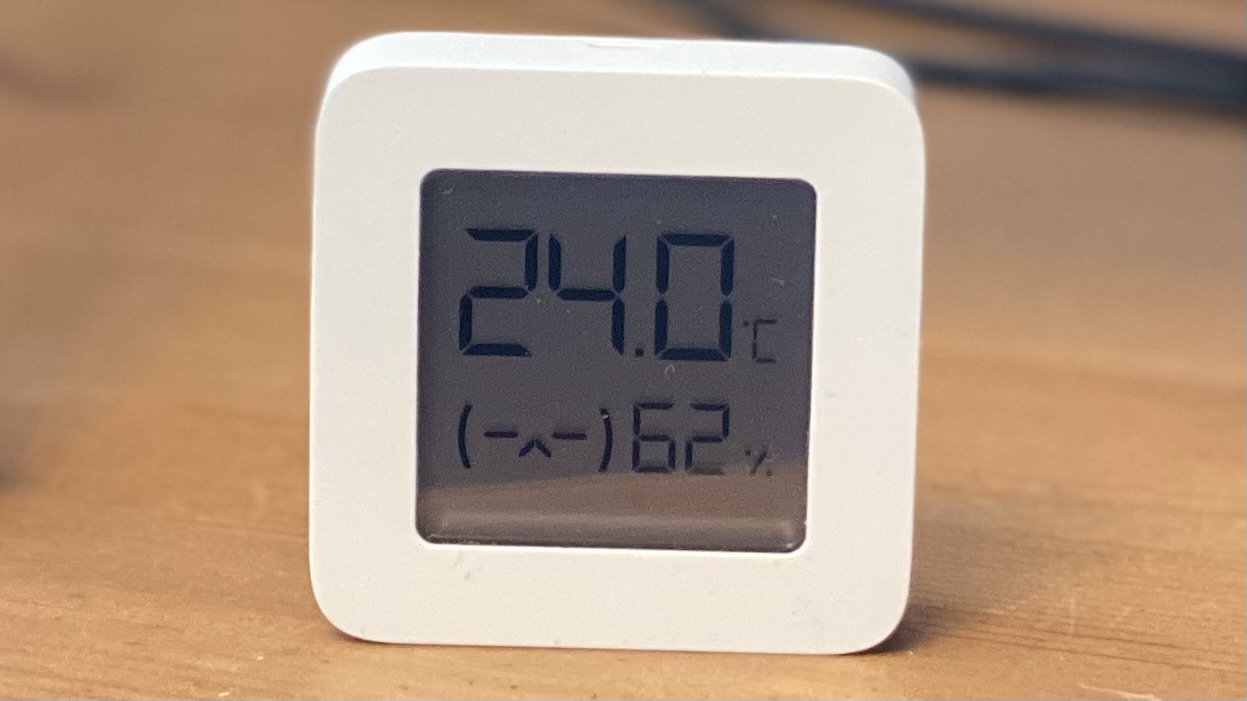
Xiaomi Mijia Temperature Sensor Xiaomi Mijia Temperature Sensor
I've been having some temperature problems in my house, so I wanted to set up some thermometers which I could read from a computer, and look at trends. I bought a pack of three cheap Xiaomi IoT thermometers. There's some official Xiaomi tooling to access them from smartphones and suchlike, but I wanted something more open. The thermometers have some rudimentary security on them to try and ensure you use the official tooling. This is pretty weak, and the open-source Home Assistant (HA) has support for querying them. I wasn't already running HA and it looked to do more than I needed right now. gathering A friend told me that it was trivial to write custom firmware to the devices. It's so easy you can do it from a web-based flasher: in fact, anyone in range can. There's a family of custom firmwares out there, and most move the sensors readings into the BTLE announce packets, meaning, you can scrape the temperature by simply reading and decoding the announcement packets, no need to handshake at all, and certainly no need to navigate Xiaomi's weird security. This is the one I used. I hacked up a Python script to read the values with the help of this convenience library1. Next, I needed to set up somewhere to write the values. reporting
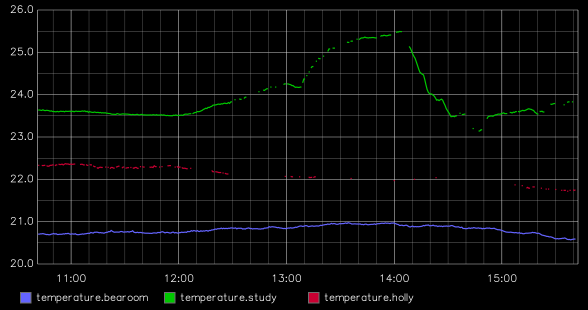
The study is thankfully cooler today The study is thankfully cooler today
It's been long enough since I last looked at something like this that the best in class software was things like multi router traffic grapher, and rrdtool, or things that build on top of them like Munin. The world seems to have moved on (rightly or wrongly) with a cornucopia of options like Prometheus, Grafana, Graphite/Carbon, InfluxDB, statsd, etc. I ruled most of these out as being too complex for what I want to do, and got something working with Graphite (front-end) and Carbon (back-end). I was surprised that this wasn't packaged in Debian, and opted to try the Docker container. This works, although even that is more complex than I need: it's got graphite and carbon, but also nginx and statsd too; I'm submitting directly to carbon, side-stepping statsd entirely. So as I refine what I'm doing I might possibly strip that back. next steps I might add more sensors in my house! My scripts also need a lot of tidying up. But, I think it would be useful to add some external temperature data, such as something from a Weather service. I am also considering pulling in some of the sensor data from the Newcastle University Urban Observatory, which is something I looked at a while ago for my PhD but didn't ultimately end up using. There are several temperature sensors nearby, but they seem to operate relatively sporadically. There's a load of other interesting sensors in my vicinity, such as air quality monitors. I'm currently ignoring the humidity data from the sensors but I should collect that too. It would be useful to mark relevant "events", too: does switching on or off my desktop PC, or printer, etc. correlate to a jump in temperature?

  1. I might get rid of that in the future as I refine my approach

Next.

Previous.