Search Results: "bod"

23 November 2009

Martín Ferrari: Media center

Dear Lazyweb, I'm tempted to buy one of this neat boxes with embedded hard drive, network interface, sound card and TV output to use as a media center for the house. I've seen some of them in an ample range of prices, but all of them lack any detailed description of what's running inside. I'll bet that most of them are running Linux, but I'd like to be able to modify it to my heart's content. For example to use MPD as a music server, be able to mount filesystems with sshfs, and whatnot. I'm also tempted to take the 'Neuf box' that was given by the internet company, add a USB sound card and external hard drive; but already some people jumped to warn me about the dreaded terms of use contract, and all that jazz. Plus, having everything in a compact box seems more convenient for a not so big price. Does anybody have a recommendation on this? Being able to buy it in France is a plus :) Tags: Planet Lugfi, Planet Debian

21 November 2009

Sandro Tosi: Goodbye MIA team

I can't simply put up any longer with all the shit thrown on the face being unable to do punish such bad behavior. There are just so many other things that increase my anger (like, for example, "WTH is python2.6 still not in unstable?!") that I don't need another one.

For sure, I don't advocate or encourage anyone to join the MIA team, and I'm speaking with a lot of experience... There is a proposal, from zack, to restructure how MIA works (another bright example of collaboration...): when will it be implemented? nobody knows. will it help? I don't think so (much).

My work (MIA work in general) was almost invisible, like invisible were all the harsh and aggressive replies I got. The nice part is that those replies came from people with the worst situation. Something like:
and several other non-sense replies doesn't leave anything but a huge frustration in you.

And when you got really pissed off, and want to see some sort of reaction on such bad and unmotivated attacks and ask the "People with Powers", what do you got? "sorry, we can't do anything to help you, it's your problem". Something should be done to protect people from fuckheads, make them behave, or else kick them out of the project as far away as we can. But what we got is nothing (and nothing seems to be changing on this side).

Well, now it's not my problem anymore, it's someone else: in perfect Debian-style.

Eddy Petrișor: Vote at the presidential elections!

Yesterday was the last day of presidential campaign, the most poisonous campaign since 1989, when the communist rule has fallen ... or so says history.

This campaign period was one of firsts of all kinds, mostly bad.

This is the first presidential campaign:This is the first time I realise how important it is for everybody to go and cast a vote for the candidate they prefer to dilute the effects of the frauds.

Go and vote for the candidate you agree the most!

Don't cast a "useful vote", otherwise you will disservice your prefered candidate in three ways:

Don't forget, tomorrow, the 22nd of November spare some 15-30 minutes and vote for the person that represents you most! Don't follow the flock, vote sincerely!


Vote, because your vote counts! Otherwise why would they bother to convince you to vote for them?

20 November 2009

Clint Adams: Ripped from the BTSlines

[The following story is fictional and does not depict any actual person or event, just like in Law & Order.] James filed an RC bug on a package, complaining that it attempted to execute an illegal instruction on a Netwinder, running Linux 2.6.xx. This was sort of an ironic hipster tribute to the olden times when buildd admins would actually do their jobs, keeping chroots clean and current, reviewing buildd logs, and filing FTBFS bugs where appropriate, except that he didn't actually do any of those things. 18 minutes later, Aurelien replied, asking for more information in order to debug the problem. Teh-oh said James, but nobody could hear him because he was talking to his Raggedy Ann doll. Stephen suggested that Aurelien contact Vince or Steve to get access to different Netwinders, and Aurelien tried to reproduce the problem on other ARM machines unsuccessfully. Could you tell me the exact kernel version on this Netwinder, and the one on europa, which seems to have the same problem? Aurelien asked James. Aaagh, they're trying to steal my precious bodily fluids! hissed James, but nobody could hear him because he was talking to his inflatable astronut. Also, the contents of /proc/cpuinfo would be nice. Aurelien added. We hates them, Clive Oven! James announced, but nobody could hear him because he was talking to his EASY-BAKE REAL MEAL Oven. The Netwinder you were talking about is europa, wasn't it? Could you tell us the kernel versions on europa and elara? There's no problem on other Netwinders, so it's probably a kernel issue. THE MARTIANS ARE COMING! James cried, but nobody could hear him because he was talking to a small band of subservient deaf-mute milkmen. It's been more than a week since this bug has been filed, and there has been no useful information provided at all. Can anybody help? asked Peter. HELLO. IS THIS THING ON? Could you have the elementary courtesy to follow up to the bugs you report? asked Pierre. Bromeliads.. I'll buy you some bromeliads, James muttered, but no one could hear him because he was talking to his ficus plant. Lo c looked around, slipped into a cave, sprinted through a maze of tunnels, and sped in a small nuclear-powered submarine to James's secret undersea lair. Rapping on the bulkhead three times, he uttered the code phrase and James let him in. After a conversation that took place strictly through pantomime, Lo c departed and James said, For fuck's sake, but no one could hear him because he was talking to a broken sonar antenna. Yo, James is busy, but he said that it's okay to downgrade the bug since it's not a problem with other Netwinders, reported Lo c. I never said that! I don't even know who that guy is! I'm going to convert him into a kangaroo! James sang, but no one could hear him since he was alone on a beach in Normandy. A month later, Riku wrote to Woody, Hey, we have this bug. Could you take a look? Sure, replied Woody, and he gave Aurelien access, and Aurelien debugged the problem in under an hour. Now everyone knows that europa and elara were running Linux 2.6.11. This is a breach of national security! declared James, but nobody could hear him because he was talking to the crushed skull of a kitten who had recently been sunning himself.

Ian Wienand: Go L4!

By now everybody has now heard about Go, Google's expressive, concurrent, garbage collecting language. One big, glaring thing stuck out at me when I was reading the documentation:
Do not communicate by sharing memory; instead, share memory by communicating.
One of the examples given is a semaphore using a channel, which I'll copy here for posterity.
var sem = make(chan int, MaxOutstanding)
func handle(r *Request)  
    sem <- 1;    // Wait for active queue to drain.
    process(r);  // May take a long time.
    <-sem;       // Done; enable next request to run.
 
func Serve(queue chan *Request)  
    for  
        req := <-queue;
        go handle(req);  // Don't wait for handle to finish.
     
 
Here is a little illustration of that in operation. Semaphores with Google Go Serve creates goroutines via the go keyword; each of which tries to get a slot in the channel. In the example there are only 3 slots, so it acts like a semaphore of count 3. When done, each thread returns its slot to the channel, which allows anyone blocked to be woken and continued. This instantly reminded me of the very first thing you need to do if you ever want to pass Advanced Operating Systems -- write a semaphore server to provide synchronisation within your OS. In L4, threads communicate with each other via inter-process communication (IPC). IPC messages have a fixed format - you specify a target thread, bundle some data into the available slots in the IPC format and fire it off. By default you block waiting for a reply -- this all happens within a single call for efficiency. On the other side, you can write servers who are listening for remote IPC connections, where everything happens in reverse. Here's another illustration the of the trivial semaphore server concept Shehjar and I implemented. L4 semaphore server example Look familiar? Instead of a blocking push of a number into a slot into a channel, you make a blocking IPC call to a remote server. My point here is that both take the approach of sharing memory via communication. When using IPC, you bundle up all your information into the available slots in the IPC message and send it. When using a channel, you bundle your information into an entry in the channel and call your goroutine. Receiving the IPC is the same as draining a channel - both result in you getting the information that was bundled into it by the caller.
IPCGo
Start threadStart goroutine
New thread blocks listening for IPC messageGoroutine blocks draining empty channel
Bundle information into IPC messageBundle data into type of your channel
Send IPC to new threadPush data into channel
Remote thread unbundles IPCgoroutine drains channel and gets data
Whenever you mention the word "microkernel", people go off the deep-end and one thing they seem to forget about is the inherent advantages of sharing state only via communication. As soon as you do that, you've broken open an amazing new tool for concurrency, which is now implicitly implied. By communicating via messages/channels rather than shared global state, it doesn't matter where you run! One of those threads in the example could be running on another computer in your cloud, marshalling up it's IPC messages/channel entries and sending them over TCP/IP -- nobody would care! At any rate, do not communicate by sharing memory; instead, share memory by communicating is certainly an idea whose time has come.

17 November 2009

Florian Maier: another debian bug squasing party at limux office

To celebrate the move to our new office building, there will be another Debian Bug Sqashing Party! The event will take place from 27.11. to 29.11. Here is the Google Maps link. The BSP starts on Friday afternoon at about 17:00. As always, everybody with moderate Unix skills is welcome to participate. Some Debian or programming knowledge is also desirable. For Debian Newbies, there will be a packaging introduction on Friday evening. Please be prepare your Notebooks for a Wireles LAN setup, as we're still not done with the cabling after our move to the new office building last week. Last, but not least i'm glad we will be able to sponsor some pizza for the hungry developer crowd ;-) More information about BSPs is available here:

16 November 2009

Gunnar Wolf: Personal assessment about myself: Being slow everywhere

Sigh I am starting to fill up my annual report for my real-life work. You know, that chore you must do every year where you score little bullets next to each completed project and talk well about yourself. For my workplace, fortunately, I do not have to lie and convince people I am worth rehiring - As this year I achieved definitividad as a T cnico Acad mico Asociado C de Tiempo Completo at my University, I can say for sure I have long-term job safety. UNAM is the best place for me to work, and I am most grateful Even if I do want to advance for the future, even though I would strongly like at some point to start working in a real academic position My job is mostly operative, limited to keeping things running smoothly in our network and servers. I work in a social sciences (Economics) research institute, and even though I have taken on an interesting project that is viewed from the social sciences I do expect to finish with a very interesting product in the near future, my interest lies in computing as a science. Anyway, back on track This is the time of year to start evaluating many things, many factors, from many different sides. And yes, for me that involves measuring how am I faring in my involvement in the projects I most care about Specifically, Debian, but also several other Free Software projects, even if my involvement in them is mostly organizational. I am once again going through a tough period in my personal life, and the impact it carries is obviously deep. However, I am not fond of finding excuses for my underachievement or underperformance. And that's what I feel now. Even more when I see posts such as Zack's and Tim's status updates, and when I see that we continue to be on a history-high streak of RC bugs. Regarding the several teams I am (at least formally) involved with in Debian, I have been away from the pkg-perl group for far too long... It is still my first group when it comes to identifying myself with - Both as on a personal level, as I consider them as good friends and great people to work with, and I do feel the responsability to share the load with them, as maintaining >1300 packages (even if they are so highly regular) is just not an easy task. But for over a year, my involvement has been basically zero. I have been a bit more active on pkg-ruby-extras, maybe paradoxically as it is a smaller team and with less packages (as I know it is much less probable for somebody to keep my packages in adequate shape if I don't do it)... and also because I am working more with Ruby than Perl nowadays. And finally, about Cherokee, I decided during DebConf9 to redo the packaging to fully use DH7 instead of our old-style quasimanual style. I have had several bursts of activity, and am almost-almost-ready to do the first newstyle upload... But so far, have been unable to do so. Of course, keyring-maint: With Jonathan's help, I have come to terms with most of the processes. Both Jonathan and I have been swamped lately, but at least I think I am finally helping speed up the process instead of holding it down. We do, yes, have several pending updates - but are working our way up the queue, and I hope not to leave people waiting for too long. And yes, we have discussed several ways of documenting and automating several of the tasks we currently sustain, and that should come soon I have been also leaving maybe a bit too much responsability aside on EDUSOL, for which today we are entering the second week of activity, and I'm very sorry to see our server is just too overloaded to even reply to even answer to me And even lacking admin powers myself, I should have worked earlier on setting up redundancy on a more automatic way (as we have an off-site backup we can promote to live and redirect to, but I am unable to do this... Given that I am the techie person on board/the only "professional" sysadmin). This year I also quietly finished the bulk of the Comas rewrite. What? Comas? Still alive? Yes, and you can expect me to show it off to more people soon, and get it used for more conferences. I will talk more about it (and its motivation, and its current status) later on But basically, the only two things that Comas shares in common with the mod_perl-based system most of you got to know (mainly at CONSOL 2004-2008 or at Debconf 5 and 6, although I know of several other conferences which used it) and the current incarnation are The (most) basic database structure and the name. The project underwent a full rewrite, and is now a far more flexible, far easier to install, Ruby-on-Rails based application. And most important, it does no longer involve your name being Gunnar Wolf as a prerequisite for successfully setting it up ;-) Regarding DebConf, I have promoted a Central American MiniDebConf, and we are right on track for holding it in late March in Panam City. Everybody's invited, and we will have (surprise, surprise!) the very professional involvement of Mr. Anto Recio as local team, as it seems he didn't have enough with last year's DebConf9 and wants to suffer further. What am I lacking here? Motivation. I have been quite pessimistic, possibly turning some people away, even though we have a good first sampling of interested people's profiles and expectations. If you want to get involved, tomorrow (Tuesday 17-nov) we will have a meeting at Freenode's #sl-centroamerica, 17:00 GMT-6. Please note we do need involvement from the Central American communities, it is more than just a motivational issue. Last meeting it seemed Anto and I were the only people pushing the MiniDebConf - and frankly, that would be a basis for not even holding it. We need motivation from the very people involved in it! Anyway You can see I have (and it seems to be a constant in my life) a series of contradictions going on. However, the excercise of putting it all into writing helps me understand better where I am standing. When I started writing this post I felt much heavier, much more at a loss Right now I feel I want to refocus my energy on the same projects and teams I have been involved with, yes, but feel it at least more plausible. Hope so.

Josselin Mouette: Recipe for FAIL #47: rely on software without any people maintaining it

So, it s been 3 months since the last commit on GNote, and 1 month since it was officially abandoned. And nobody stepped up to maintain it. I can certainly understand why Hubert s motivation declined, GNote being a project to fight boredom , and all the innovation happening in tomboy. But if you remember all the fuss around Tomboy and GNote, thanks to Roy Schestowitz and his little minions, this is actually quite a tasty way for things to turn out. The utmost victory of the anti-Mono zealots was the decision from Fedora to include GNote by default and to drop Mono. Well done. I m still savoring my pop-corn.

11 November 2009

John Goerzen: In-Depth Review: Motorola Droid (with some iPhone comparisons)

The Motorola Droid A855 is the first Android 2.0 phone. I have been using one since Monday, having switched from a BlackBerry Pearl. I also wrote about Terah s iPod Touch recently, so I ll be making comparisons to it too. Here s my review. Hardware Physically, the device is very nice. It fits well in my hand. It comes in a fairly small box. It s surprisingly heavy for such a small device, but it isn t so heavy as to be a problem. It feels solid, sturdy, and durable throughout. Terah has the most recent iPod Touch 8GB, and compared to that, the Droid is thicker and heavier. The Droid s screen is awesome; a little longer but not as wide as the iPod Touch s. The iPod Touch screen seemed to offer less friction as I d slide my finger over it, which was nice but not a terribly big deal. I don t share some other people s annoyance with the keyboard. It is far better than the BlackBerry Pearl, or many other BlackBerries I ve seen. Along the bottom of the screen are some silkscreened buttons. My gripe with them is that they are easy to accidentally press. I ve done that more than once while using the phone in speakerphone mode, but you can lock the phone keyboard while you re on a call. I also don t share the complaint about battery life. It is excellent compared to the Pearl. Despite having a long-life battery, if I had it charged fully when leaving work at 5PM, by the next morning at 7AM it would often be completely discharged (though sometimes only half discharged). I believe that has to do with my home being in a poor reception area, and it spending a lot of energy looking for signals. In any case, the Droid has impressed me with its battery life and I have no complaints there. The screen, as I said, is brilliant and sharp. It is readable in various lighting conditions. By default, its brightness adjusts with the brightness of the ambient light. That s normally fine, but it can be annoying to stand in front of a light with the Droid in a shadow, watch its screen darken, and then shift a bit and it becomes bright again. There is a setting to disable automatic brightness. Button-wise, it has four physical buttons: the power/lock button at the top, volume up/down on the side, and a camera button on the side. The camera button only works when the phone isn t suspended (locked), and disappointingly can t be remapped to something actually useful. Just beneath the screen are four touch buttons: back, menu, home, and search. These are the ones I complained were easy to accidentally press. MicroSD and USB The Droid comes by default with a 16GB MicroSD card already installed. This is one huge advantage over the iPhone or iPod Touch: you can actually put things on the phone yourself, directly, without having to use iTunes and its limited features. I have, for instance, downloaded a PDF on the Droid and later copied it to my PC. I also copied a KeePassX encrypted password database from my Linux computer to the Android, for use with KeePassDroid. The iPhone/iPod Touch password programs don t support this kind of copying of files from your PC to the device, though one will let you put a database up on a webserver you control and download it from there. Plugging in a MicroUSB cable will start charging the Droid automatically. In order to make the SD card mountable, you must simply drag down the notification bar (which is how you get detail about what it s telling you normally) and touch the USB icon. When the SD is mounted on the computer, the Droid won t see it, of course. Touch the USB icon again to mount it on the Droid again, or just unplug USB. Wireless and Wifi The wifi support works like you might expect: pretty well. The cell phone reception works well, as does its Bluetooth support. It has an easily-activated airplane mode which disables all wireless features, which can then later be re-enabled. You can also individually disable wifi and Bluetooth. Oddly, you can t disable the cell phone network individually. The only way I could find to disable it is via Airplane Mode. User Interface The user interface, overall, is very slick and polished. However, I would have to say it is not as slick and polished as the iPhone/Touch interface. A few of the animated effects have a low framerate, which isn t really a big deal. More of a big deal is that settings and options can be scattered in many different locations, making them hard to track down at times. The device also offers fewer visual cues than the iPhone/Touch, though that is perhaps not significant. Like Apple s device, the Android 2.0 UI offers you three home panels, which you switch between by dragging your finger left and right. The iPhone shows some dots at the bottom of the screen, a standard UI indicator on that device that you can flick left/right, while there is no such indication on the Android. This is somewhat nitpicky though. I would put Android 2.0 and iPhone in the same general class of user interfaces, way above any other such device I ve tried. The Droid has an on-screen keyboard similar to the iPhone/Touch, though somehow it felt like the keys were smaller or easier to mistype. I m not sure why that is; maybe they really are smaller. The physical keyboard can be used at any point too, of course. Background Apps This is an area where Android really shines over iPhone. Android supports background apps everywhere. That means that your weather widget can be always correct, instead of being hardcoded at the factory to show 73 degrees as iPhone s weather icon does until you tap to open it. It means that more apps remember where you were and what you were doing when you switch to/from them. And it means that you can do things while that PDF downloads. Finally, it means that you can have native Jabber clients on the Android without having to do some mess with Apple push notifications plus third party servers, significantly reducing the complexity of such apps. Browser Now moving on to the applications preloaded on the phone, I ll start with the browser. It is, in a word, awesome. It is far faster and reliable than the browser in my N810. Compared to BlackBerries, of course, this is a real browser, not their limited one; and even so, it is still faster. It is also faster than the iPhone/Touch browser, sometimes significantly so. The pinch to zoom feature of the iPhone/Touch is lacking, and it must be said is both useful and pretty. Zooming softkeys appear on the screen when you tap, and do work well. It also automatically zooms if you tap on the page to fill out a form, for instance. The bookmarks save thumbnail images similar to the iPhone, and you can put bookmarks on your home screens as well. Rotating the Droid to landscape orientation causes the browser to also rotate, and on most websites it will also zoom in by default at that point, since it s got a wider orientation and doesn t have to shrink stuff to fit as much. The physical keyboard is very nice for filling in usernames and passwords. iPhone-optimized sites, such as Bloglines, work great on the Android. Though many of them fail to autodetect the Android as an iPhone-like device, and thus you have to manually ferret out their iPhone-optimized URLs. Email This is both a strong and a weak spot of the Droid. First off, it comes with two email client apps preinstalled: one for Gmail, and one for everything else. I haven t used the Gmail one, so this review doesn t consider it. You can connect the email program to your IMAP, POP, SMTP, or Exchange (ActiveSync) accounts in the predictable way. Each account can be configured with its own notification preferences, so you can easily see an icon, vibration, or beep when you get new mail on one account and not the other. All folders on an IMAP account are accessible, which is a very nice feature that is not shared by the BlackBerry. You can view your mail as a unified INBOX if you prefer. In such a few, a thin color bar to the left of each message summary tells you which account it came from by its color. This is a nice way to quickly deal with all new email, wherever it may be from, and ought to be emulated by some desktop clients. You can, of course, also view each account individually. The email program supports attachments, both viewing and sending. It does not appear to have the iPhone/Touch bug if failing to display emails forwarded as attachments. Now to the drawbacks. First of all, it inexplicably doesn t support the IMAP IDLE command. As a result, IMAP accounts are polling-only; there is no near-instant notification of new mail as there is with Exchange accounts, even though IMAP supports that trivially. Like the iPhone/Touch, Android 2.0 s mail program has a great deal of trouble with self-signed SSL certs, or SSL certs that are unusual in any way. Both devices refuse, by default, to talk to mail servers with self-signed SSL certs. Neither one offers to let you add an exception to recognize a particular cert in the manner that the built-in web browser on these devices would do. On the iPhone/Touch, at this point you need to obtain the cert by other means, stick it up on a web server, browse to it from the device, and add it that way. This trick doesn t work on Android 2.0, nor does adding it using the import from SD option. There appears to be absolutely no way to teach the mail program to use a self-signed cert on Android. The good(?) news is that you can choose to have Android accept any certificate. Many people in forums suggest that, and it does let it connect. Of course, it also removes much of the security benefit of using SSL/TLS in the first place, and is a terrible excuse for the lack of proper self-signed cert support. Both iPhone and Android devices have a horrible user experience in this area Quickoffice The Droid comes with some sort of Quickoffice software pre-installed. It can be used to view PDF, Word, and Excel files (at least; maybe more). But it is a rather strange beast. It has no icon on the applications screen. The only way to open Quickoffice is by opening a file that it supports in another app. So, for instance, tap on a PDF in the browser or open a Word attachment in email. I haven t played with it much, but I can say that it s read-only but seems to have high-quality rendering of all document types. Its PDF viewer is glacially slow on any page that has graphics. Flip the page to one with graphics and up pops a progress bar. And good thing too, because it might take 15-30 seconds to render a page. I will be looking for better PDF viewers in the Market; there are quite a few. Lack of file manager And that brings us to the next surprising limitation: there is no built-in file manager. I downloaded a PDF from the browser, and saved it to the SD card, but there was no way to look at it from the phone! Absolutely none. No way to delete it, rename it, etc. Several people recommended Astro, which solved all of those problems. Not having such a program built in is a weird glaring oversight. Of course, the iPhone/Touch doesn t have one built in, but in their case the glaring oversight is not having any files to manage Calender, Contacts, and PIM features This is an area of exceptional strength for the Android. I believe it s got the best PIM features of any mobile device out there, though it s not without its quirks. There are two calendar apps on the Droid, and they both have virtually identical interfaces and feature sets. I am rather at a loss as to why we are burdened with two separate apps. In any case, the app called Calendar works with a local calendar, or with Google Calendar syncing. It supports all the features you d expect, and plenty you wouldn t, including excellent support for meetings, viewing other people s calendars that you ve configured access to on google.com/calendar, viewing subscribed iCal calendars, etc. It has push syncing with Google Calendar, so new events appear in about 10 seconds. It is well-executed and completely flawless in every way I could see. Corporate Calendar is the same, but for hooking into Exchange or Exchange-compatible calendars via ActiveSync. We are evaluating groupware, and have so far tested it with Zimbra and Scalix. It worked well with Zimbra, and not so well with Scalix. That s not to say there were no problems. The meeting invitation emails Corporate Calendar generated appeared to have no body in the Zimbra mail client, or in Thunderbird (though if you look at the raw email, you see it does have a vcal entry in it). Meeting invitations sent to the Android can be displayed in the Email program, but the Email program doesn t offer accept/decline buttons, so you have to manually pull up the event on your calendar to accept or decline it. Other than that, it worked flawlessly with Zimbra. Scalix exhibited several data integrity issues that will probably make it unsuitable for syncing with an Android at this time. There is a built-in Calendar widget you can put on your home screen. It will show you the date and info about your next appointment. I miss the BlackBerry Pearl theme that showed me the next two appointments. There are some apps that claim to do this, but none of them work well. Contacts are also quite powerful. The contacts viewer aggregates your contacts from multiple sources into a single view, which is nice. It can sync in Gmail contacts, ActiveSync, and Facebook contacts. (How s that for a device with corporate and personal appeal?) The viewer works better than Apple s, and creating a new contact lets you choose which source you d like to add it to if you have more than one available. Continuing the trend of many recent devices, the Droid has no task/todo list support built in. Maps I ve heard people be all excited about Google Maps, saying it s the best maps ever in a phone (though I suspect they have forgotten that Garmin has added on a phone to their GPS products in the past). In general, they are probably right. And also they are probably irrelevant. The first thing that must be said is that the maps on the Android, like the iPhone/Touch and other such devices, are not actually installed on the Android. Consequently, for mapping or navigation to work, you must have a data signal, either wifi or CDMA. That immediately turns this into a GPS accessory, not a go-to device, because who wants to be stuck without a working GPS someplace without cell phone reception? (Such as several areas right near my house) I have a Garmin Nuvi 500 (see my review), and despite not being a terribly expensive GPS, it runs circles around the mapping in Android 2.0 (or iPhone for that matter). The 3D display on the Nuvi is very helpful for driving in dense city streets, and that s not available on Android or iPhone. The Nuvi has nice features such as one-touch detour calculation, excellent geocaching integration, accurate and sensitive receiver, etc. I will not be leaving it at home for trips just because the Android supports maps. That said, there is something to be said for having maps of Android s quality. It can be a nice crutch if you re somewhere unfamiliar but didn t expect to be, and thus left your GPS at home. It also can give you routing on transit sources, which Garmin can t, so if you re in an urban area with bus/subway options, the Android maps could be very helpful. I will probably try that out when we re in Chicago next and still pack the Garmin unit for driving around rural Indiana. The Phone The last built-in app to discuss is the phone feature. Yes, the Android is a phone. As expected, the phone integrates well with the system. There is not much of any great interest to discuss here. It s a phone. It integrates with contacts. It works. I use Google Voice, and have had their BlackBerry app for some time now. The Google Voice android app is far nicer. You have the option to make all calls via Google Voice, none via Google Voice, prompt each time, or only international calls via GV (which is presumably cheaper for such than your carrier). A couple of annoyances, though. One is that you have to touch a button to activate the keypad (to send touch-tone digits while you re on a call). It should be activated by default. Android Market vs. App Store I know some people love it, but to me the Apple App Store is like a cross between the sleazy guy selling watches from his car trunk and the tourist trap strip malls that sell 50-cent useless plastic memorabilia for $20. Yes, there are some quality apps in the App Store that aren t overpriced, don t violate your privacy, and do something useful. But you ll have to look hard. It still boggles the mind that most of the secure password storage tools for Android think they need access to the GPS, Internet, and at least one of your contacts, phone number, logs, etc. Yes, you heard me right. A password storage tool wants GPS and Internet access. And, being Apple, we all know how tight they ve locked down the App Store. Emulators are banned. Useful apps get arbitrarily banned at various points. Now, the Android App Market is better than the Apple App Store in the sense that it has a lower percentage of the crappy apps, and perhaps more useful apps, at least to my taste. That s not to say it s without crappy apps. It boggles my mind why most weather applets on the Market think they need to know my phone s status and identity, and why some apps that have nothing to do with the Internet or location services want to know all of the above. I don t install such apps. But there are gems out there. The small 400K weather applets that do what they advertise, and do it well. My absolute favorite is droid48, an emulator for my beloved HP 48GX calculator. Yes, an emulator. You can also find various NES, SNES, and C-64 emulators on the Market; Apple famously removed the latter from their App Store recently. And you re not tied to the Market either; you can install apps from wherever you like. KeePassDroid is another one. It reads the same database as KeePassX for Linux or KeePass (.kdb format only) for Windows. It s a secure password management system, and I can periodically copy the file from my desktop over to the Droid and have all my passwords at my fingertips but encrypted, of course. There is simply nothing that convenient for the iPhone/Touch because the device doesn t permit it. Music and Video I haven t played with these much, but the music player seems to just see MP3s placed anywhere on the SD and presents them as you d expect a music player to do. It looks fully-functional and easy to use. Conclusion Overall, I think the Droid is a very nice phone. It isn t perfect, but it bests the iPhone in a number of areas. I think it s probably the best phone for many right now, and the iPhone for some others. Update Nov 11: Two other annoyances I forgot to mention. One is that the power-button shortcut menu, as well as the lock screen, have a quick shortcut to put the phone into silent mode. Very well. Except, confusingly, these buttons not only enable silent mode but also disable vibrate mode while checking the silent mode checkbox in settings does nothing to vibrate mode. There is no built-in shortcut to enable vibrate mode; you d have to unlock the device, use the volume keys to go down the vibrate. The app Silent Mode Jammer helps with this. Second is that the documentation is as poor as any other cell phone around. For instance, there s a setting that says Voice Privacy. It s a checkbox. The description is Enable enhanced privacy mode. Thanks, but that tells me nothing. Nobody online seems to know either. A few overconfident forum posters claim it s encryption, linking to posts from 2003 about a Sony phone with a checkbox with the same name. Maybe it is encryption, but that is hardly definitive. The bottom line is it s not documented anywhere. Neither of these change my conclusion above though.

10 November 2009

Gunnar Wolf: PieSpy: Modelling IRC interactions

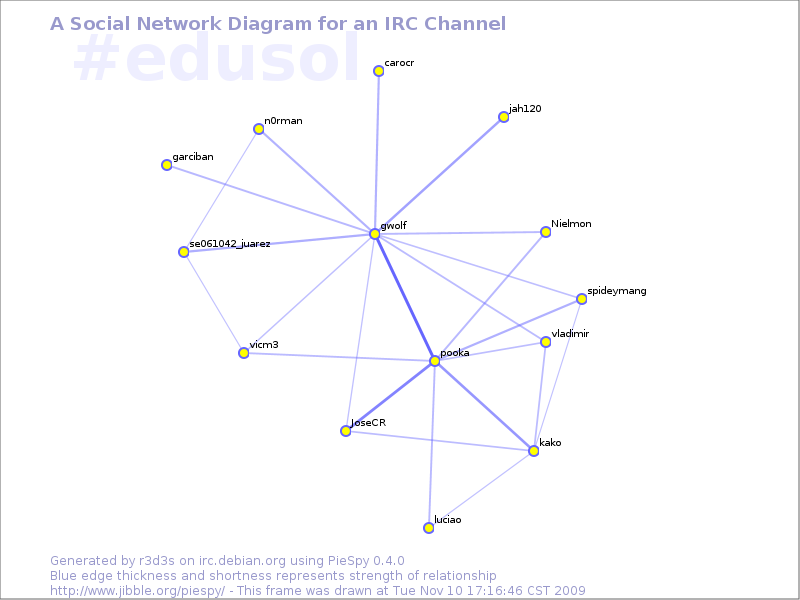
As some of you know, yesterday we started the two weeks of activities for the Fifth On-line Encounter of Free Education, Culture and Software. This year, the main topic for the conference is social networks, but not in the twitter-facebook sense Social networks as ways of understanding and modelling human-to-human interactions. Of course, there is interest from many attendees in using and taking advantage of said social network systems (and others), but the topic is far broader. One of the core tools of EDUSOL, and the only tool that is constantly active through our two weeks of activity, is IRC Which is somewhat of a challenge, as we receive some not-tech-savvy users from all over the world. The first year or two we asked everybody to connect via an IRC client (and we had even decided that it would be a technological filter We thought we would not cater for people without the technical skills to install and use IRC). Life proved us wrong, and we ended up using two web-to-IRC gateways: One of them, via an instance of CGI:IRC, and the other one via a third-party service, Mibbit. Now, the core mind behind EDUSOL is Alejandro Miranda, Pooka; I am not really into education (it is a very interesting topic but far from what I am good at). Pooka has been invovled in on-line communities analysis for several years already, since we worked together at FES Iztacala. For a long time he wanted to graph the interactions at EDUSOL, which was obviously possible given it was all centered on three tools (IRC for live chat, Drupal for generic information and Moodle for the talks and workshops' material This has changed this year, as we are giving much more weight to Drupal and taking it off Moodle), and so last year he was finally able to generate a EDUSOL 2008 conference photo (warning: 2MB image, 4311x3352px), where each person's avatar appears where most of his interactions were. This photo was (unfortunately) achieved using non-free software, but is very much looking at! Now, this year Pooka stumbled upon a great tool, PieSpy (available in Debian package piespy). Piespy generates very interesting interaction graph for IRC channels, as you can see here: Piespy is a bot that sits in the IRC channel logging everything that any given user "says" directly to another one, and graphs it. Not much to say here, only that it generates a very good (and practically real-time) view of what happens on the channel. For this particular channel, and during EDUSOL, you can see here the latest IRC snapshots. Very fun to see - and somewhat addictive how it morphs across time :)
AttachmentSize
EDUSOL 2008 - Conference photo1.97 MB
Current (Monday+Tuesday) interaction graph for our IRC channel39.89 KB

Yves-Alexis Perez: Call for help: update

Ok so there were some reactions to the Call for help post. I had three direct offers for help in pkg-xfce, not sure if other teams had such propositions. Some people asked me to correct various number for the active contributors . Basically, the numbers are what the feeling I got from people working in those team. Julien Cristau wants me to correct the number of debian-x active contributors to 0. (yes, zero, that means nobody, nadie, personne). Basically he doesn't have time anymore, and Brice Goglin can't really keep up. So, for those who care about shiny X effects, and stuff like that, you help would be gladly appreciated (and no, you don't have to own each and every chipset in the world to give some time). Aurelien Jarno wants me to add that at the moment there are 2 (two) active libc contributors, plus one on GNU/Hurd and one on kfreebsd. Frans Pop wants me to add that there are ~85 people working on d-i and that the problems the team might face aren't only related to the lack of manpower (and I don't really want to enter politics) Finally, it seems that some people (well, only one at the moment, but it's enough for to feel the need to precise) though the numbers previously given would dismiss contributions for the active contributors. That wasn't my intention, so I apologize if you are an active contributor in one of that team and thought I dismissed your contribution. If it wasn't clear enough, my point is to show that quite some teams are lacking manpower (some team miss other things too, like leadership, coordination or whatever) and users shouldn't be scared to contribute to them. Those are core teams, without them Debian wouldn't work at all (not to mention derivatives), so it's a good idea to join them. Now, what if you do want to help, but don't know how. On the previous post I gave links to teams website, wiki page or QA page. You should be able to find a mailing list or contact mail you should be able to write to. Just write that you want to offer some help, that you don't know how and where to start. Add what you're interested in, what you find fun, and your technical knowledge. Don't be shy, and you don't need to be a Debian Developer (nor even a Debian Maintainer) to contribute. Thanks!

Yves-Alexis Perez: Call for help

So yesterday we had a really nice meeting with few french Debian folks. Luk and Ralf were visiting us, so we went at Prosper's for some meat and wine (and Aberlour). We were a bit too much to be able to speak to everybody (so mainly there were two 6-packs of people), but it was fine anyway. Though, the main point of the evening was that some (most?) teams in Debian are really (*really*) understaffed, and it might become problematic in the near future (like now). For example, from what I understood: I don't know the state of other teams, but it doesn't really look fine for the incoming freeze. So if you want to give some help, even if you're not yet technical enough, feel free to offer it to the teams above. Usually, starting with just using the package is enough. If you use it, you want it well-maintained, and there _are_ stuff to do to which don't require large technical knowledge, and the (few) active contributor will be happy to have some help and point you to what you can do. If you want to give some time to Debian, before filing some ITPs (even if you'd really like to have that package you use everyday), check if you can't do something for those above teams (and others which might need help too, like release team or kernel). Oh, and don't be scared, working on Debian is fun. It's time consuming, but it's rewarding. Don't let it become not fun.

9 November 2009

Dirk Eddelbuettel: Rcpp 0.6.7

Version 0.6.7 of the Rcpp package---a set of C++ classes making it easier to glue C/C++ code to R---is now on CRAN and Debian. This is a fairly incremental release that contains just a few small changes that arose since the previous release in August. One change is that a new type RcppList was added which allows us to build R 'list' types in C++. In particular, this makes it possible to have data structures of different types and dimensions. We had not previously accomodated this as our data structures where more regularised (i.e. think matrices or vectors of various types). The need for this came out of the work with the recently started RProtoBuf package which interfaces the Google ProtoBuf library. The incredible Romain Fran ois has joined the project and added a number of nice tricks; this will need another blogpost sooner rather than later. In the meantime, check out the RProtoBuf pages at R-Forge. Another small change was the addition of a self-contained example of a function callback from C++ into R which wasn't all that well documented before; this was in response to a user request. Finally, I started RcppList as a first step in reorganising the code a little better and split the class header and body off into separate files. This required changes to the infrastrucure files Makevars, cleanup, ... and I promptly forgot the Makevars.win Windoze variant which will require a 0.6.8 release real soon.

8 November 2009

David Paleino: Finally a DD!

Finally, it happened! I became a Debian Developer! I wish to thank everybody involved in this process: from those who helped me in my initial packaging efforts, to who actually created the account. Many thanks to the pkg-perl team for accepting newbies and helping them: props to Damyan Ivanov, Gregor Herrmann, Gunnar Wolf! Thanks to Debian-Med and Debian CLI: they always believed in me, and I had a great time in these teams. A special thanks goes to Andreas Tille, who advocated my NM candidature. Thanks to my two AMs, Bart Martens and Bernd Zeimetz. Even if my NM was long, difficult and not so flawless, it all went good, at the end Smile. A special thanks to Enrico Zini: he was the first DD signing my GPG key, thus allowing me to have more "rights" (being a DM), and experience some more responsibility than I previously had. Thanks to his "Become a DD. NOW!" right after checking my ID in Palermo -- Enrico, it finally happened! Thanks to Christoph Berg, Ron Lee, and Stephen Gran, which handled the final steps of the overall process. And now, dapal is here to break the world. Be warned! Smile

7 November 2009

Benjamin Mako Hill: Mr. Postman

The mailbox in my building is broken. Nobody can remember it being any other way. The lock is busted so anyone in the building can get access to every apartment's individual boxes in the same way that the mailman does. It's not a huge problem since there are only four apartments in the building and the box is behind a locked door to the street. I saw the mailman come one day to deliver mail. He used a key to unlock a box on the outside of the building from which he retrieved a key to first unlock the outside door and then another to "unlock" the mailbox. Every day, my mailman unlocks a mailbox that is always unlocked and, in fact, unlockable. As far as I can tell, he's been doing it for years. I don't have the heart to tell him the truth.

6 November 2009

Matt Brubeck: Android 2.0 ships with V8 JavaScript engine

Google has not yet released most of the Android 2.0 source code, but they did publish source for a very small number of components, including a WebKit snapshot. I was very excited to see that the snapshot includes Google's V8 virtual machine! (Previous Android releases used Safari's JavaScriptCore/"SquirrelFish Extreme" VM.) But without the rest of the source tree, there was no way to build and run this on a real Android phone. The SDK includes a binary image that runs only in the qemu-based emulator. Today I got to try out a Motorola Droid. Here is how its browser compares to Android 1.6 on my HTC Dream (Android Dev Phone / T-Mobile G1) in the V8 Benchmark Suite (version 5):
Test Dream Droid Change
Richards 13.5 15.6 16%
DeltaBlue 5.23 12.9 147%
Crypto 13.2 10.9 -17%
RayTrace 10.9 80.1 635%
EarleyBoyer 23.5 74.7 218%
RegExp did not complete 16.5
Splay did not complete did not complete
Some tests (Richards, Crypto) see little or no improvement, while others (DeltaBlue, RayTrace, EarleyBoyer) are dramatically faster. Just for comparison, let's run the same benchmark on Safari 4 (JavaScriptCore) and a Chromium 4 nightly build (V8) on a Mac Pro:
Test Safari Chromium Change
Richards 4103 4640 13%
DeltaBlue 3171 4418 39%
Crypto 3331 3643 9%
RayTrace 3509 6662 90%
EarleyBoyer 4737 7643 61%
RegExp 1268 1187 -6%
Splay 1198 7290 509%
The precise ratios are different, but the same tests that showed the most improvement from Android 1.6 to 2.0 also show the most improvement from Safari to Chrome. Based on this plus the source code snapshot, I'm pretty sure that Android 2.0 is indeed using V8. This is exciting news. It makes Droid the first shipping product I know that uses V8 on an ARM processor, although V8 has included an ARM JIT compiler for some time now. For mobile web developers (like me), it means we're one step closer to having desktop-quality rich web applications on low-power handheld devices. Final thought: Although the Motorola Droid is still 100 times slower than Chromium on a Mac Pro, it's actually faster at some benchmarks than IE8 on a low-end Windows machine, or Firefox 2 on hardware from just a few years ago.

5 November 2009

Eddy Petri&#537;or: Know your rights!

It is only a few days since my last post about the referendum which is due to happen on the same day as the Presidential elections, but I am forced to make another post because there are lots of incorrect views on the subject.

So let's try take the issues one by one and see what is the problem with every one of them, using reason and the information we have available from more mature democracies than Romania's.

What's the referendum about

The referendum, in this case, is about two issues:

Information on the subject

For an election such as the referendum (basically asking the population on a subject of national importance) every citizen has the right to be correctly informed about the options of the referendum, what each implies, what are the pros and cons for every option, what problems does the referendum tries to resolve.

There is no information on the subject, no videos, no spots, no fliers, nothing, just biased posters (I'll explain later).

Debate on the subject

In order to have a correct information, a clear public debate which should happen, without the pressure of a presidential campaign at the same time as the debate.


Well, we have no debate, so I guess there is no problem of overlapping (sad, but true), but on the other hand, there is no information on the subject.

Analysis of the options

Now let's analyse the two proposed measures in opposition to the current situation.

  1. reducing the number of representatives
    • pros
      • reducing costs
      • minorities have a bigger influence (they can defend their rights - see comments for explanations)
    • cons
      • easier to corrupt (obtaining a corrupt 5% in a 300 seats parliament is easier than in a 500 seats parliament)
      • minorities have a bigger influence (they are disproportionally powerful, in regard to the population they represent - see comments)
      • absence of a representative with a big vote power could allow passing an abusive law (to pass a regular law there is a need of a majority relative to the number of present representatives, not the total number), but, in a numerous parliament, the absence of a person isn't that risky (other colleagues would be present to stop the abusive initiative)
  2. one chamber instead of two
    • pros
      • faster processing of decisions
      • less bureaucratic
    • cons
      • in the current system there can be a passive vote (law passes silently if not discussed) which has just one occasion to be caught, while in the current system silent passing is allowed only in one of the chambers, but needs to be discussed in the other
      • there is a chance that one chamber might amend/catch abusive initiatives with "two chambers", but with "one chamber" there is one chance only
      • more prone to power abuse

So, there are pros and cons for all solutions, but now we can make an informed decision and know the risks for each option.

This shouldn't have been taken in haste without any public debate.


I don't want to influence anyone's vote, so I'll abstain from telling my options.

The president has the right to associate his image with one of the options.

OK, let's analyse that.

The law doesn't explicitly forbids this, but there are some recommendations from Venice on fair elections (sorry, I couldn't find the link) which say that in a vote such as the presidential elections there shouldn't be an unfair advantage for one of the candidates. Why is that relevant? Because the current president actually uses the referendum as his campaign and he's speculating people's innate hatred for political figures.

His election material is only comprised of virulent attacks at the representatives or calls to the population to vote in favour of both questions.


Why is that unfair? Because the current president is using his current position (president) as launch ramp for his campaign as a candidate.

OTOH, if the seal of the presidency was used instead his face, the problem wouldn't have been that bad.


Organisational issues

There were various rumours about how the voting will take place. Here is a list of things I heard:
  1. there will be a single list for both presidential elections and referendum and there will be a single column for signature to confirm your presence at vote
  2. there will be one paper, but two columns for signatures
  3. no matter what the list looks like, you'll be given both sets of ballots, but you can annul the one you don't want to vote on
All the variants above are incorrect from a democratic pov, but to different degrees:

  1. a single signature covering for either of the vaiants "presidential vote only", "refrendum only", "both" asks for trouble because unused ballots in "only" variants might be added later to the valid votes as if they were expressed by voters; since there is no distinct count for each of the ballots to confront that with signatures, before the counting period one could use unused ballots and vote for you on the issue you didn't want to express an opinion on
  2. informing on what to do in some cases such as "only" vote is essential to prevent fraud; e.g.: strike through the cell corresponding to the the election you don't want to express a vote on, instead of signing
  3. giving the ballot unconditionally to everybody, leaving you to decide to annul it or not is abusive, because vote is not compulsory in Romania; more than that, this artificial presence burst (even with void votes) could end up validating the referendum since a 50%+1 presence is needed to pass Constitution modification, as we have here
So, recap:
  1. favours fraud by allowing inside people to obtain untraceable/unaccounted ballots
  2. preventing fraud isn't of any concern, it seems (and could be achieved)
  3. forced voting might lead to validation of the referendum because the voting presence is sufficient, even if there are many annuled ballots
Vote validation and artificial voter presence

Since validation of a referendum on the changes on the constitution depends on sufficient voter presence (there is some mandatory threshold, but I can't find references now), it is in the interest of people wanting to promote the changes to mobilize people to vote.

By different measures the vote presence at the referendum is artificially increased raising the risk of validation, when people, in fact, wouldn't want to validate it and would, to express neutrality, will be be forced to annul the ballot.

Also, a high presence in the referendum might increase the number of voters for presidency, and the people mobilized this way may have a high chance to be biased in favour of the current president because he associates himself with the violent message against the representatives.

What does it take to implement, if referendum passes

If the referendum passes, the changes aren't immediate. The proposed changes are discussed in the Parliament and a final proposal for the constitution changes is made; after approval of the proposals by the Parliament, the ball goes back to population for final approval.

This means it will take a while to see a changed parliament.

Conclusions

Romania is not a true democracy yet and there are areas where individuals should know what their rights are and not let authorities fool them into buying any argument uncritically.

Romanians must learn their rights so they can't be manipulated whenever somebody wants to trick them into some scheme by knowingly omitting issues and creating insane situations.


Romanians, wake up, learn you have rights, form your own oppinion, as distinct individuals, then we might see a change.

4 November 2009

Rob Bradford: GNOME in Moblin: People panel

Previously i d talked about how we use GNOME technologies in the Moblin Myzone. Now i m going to talk about another component that i m responsible for, the People Panel. An important aspect of the Moblin user experience is about communicating with others and this panel provides quick access to do this. The core of the content is provided by an abstraction, simplification and aggregation library called Anerley. This provides a feed of items (an addressbook of people) that aggregates across the system addressbook, powered by EDS, and your IM roster, powered by Telepathy. You have small set of actions you can do on these people such as start an IM conversation / email / edit them with Contacts. The core of our IM experience is supplied by the awesome Empathy. We ve been working with the upstream maintainers to accomodate some of the needs of Moblin into the upstream source. This included the improvements to the accounts dialog and wizard that landed for GNOME 2.28. One of the biggest problems with the IM experience in Moblin 2.0 was that it was easy to miss when somebody was talking to you. If you were looking away when the notification popped up, whoops, it s gone. With our switch to Mission Control 5 I was able to integrate a Telepathy Observer into Anerley and the People Panel. An Observer will be informed of channels that are requested on the system. This allows us to show ongoing conversations in the panel and by exploiting channel requests and window presentation allow the user to switch between ongoing conversations. This wouldn t have been possible without the assistance of the nice folks in #telepathy and at Collabora: Sjoerd, Will, Jonny and countless others.

3 November 2009

Daniel Leidert: Toshiba Tecra A10 (PTSB5E) - Part I

I recently got a Toshiba Tecra A10-1HU laptop. This is a series describing my experiences with this hardware using Debian Sid. This one comes without any operating system. So I got a recent testing-netinstall CD-image and ran the installer procedure (in expert mode). Everything went fine and I ended with a shiny Squeeze and kernel 2.6.30. Because I use Sid as my usual system, my first action was a dist-upgrade to Sid. This is what lspci -nn tells:
00:00.0 Host bridge [0600]: Intel Corporation Mobile 4 Series Chipset Memory Controller Hub [8086:2a40] (rev 07)
00:02.0 VGA compatible controller [0300]: Intel Corporation Mobile 4 Series Chipset Integrated Graphics Controller [8086:2a42] (rev 07)
00:02.1 Display controller [0380]: Intel Corporation Mobile 4 Series Chipset Integrated Graphics Controller [8086:2a43] (rev 07)
00:03.0 Communication controller [0780]: Intel Corporation Mobile 4 Series Chipset MEI Controller [8086:2a44] (rev 07)
00:19.0 Ethernet controller [0200]: Intel Corporation 82567LM Gigabit Network Connection [8086:10f5] (rev 03)
00:1a.0 USB Controller [0c03]: Intel Corporation 82801I (ICH9 Family) USB UHCI Controller #4 [8086:2937] (rev 03)
00:1a.1 USB Controller [0c03]: Intel Corporation 82801I (ICH9 Family) USB UHCI Controller #5 [8086:2938] (rev 03)
00:1a.2 USB Controller [0c03]: Intel Corporation 82801I (ICH9 Family) USB UHCI Controller #6 [8086:2939] (rev 03)
00:1a.7 USB Controller [0c03]: Intel Corporation 82801I (ICH9 Family) USB2 EHCI Controller #2 [8086:293c] (rev 03)
00:1b.0 Audio device [0403]: Intel Corporation 82801I (ICH9 Family) HD Audio Controller [8086:293e] (rev 03)
00:1c.0 PCI bridge [0604]: Intel Corporation 82801I (ICH9 Family) PCI Express Port 1 [8086:2940] (rev 03)
00:1c.1 PCI bridge [0604]: Intel Corporation 82801I (ICH9 Family) PCI Express Port 2 [8086:2942] (rev 03)
00:1c.2 PCI bridge [0604]: Intel Corporation 82801I (ICH9 Family) PCI Express Port 3 [8086:2944] (rev 03)
00:1d.0 USB Controller [0c03]: Intel Corporation 82801I (ICH9 Family) USB UHCI Controller #1 [8086:2934] (rev 03)
00:1d.1 USB Controller [0c03]: Intel Corporation 82801I (ICH9 Family) USB UHCI Controller #2 [8086:2935] (rev 03)
00:1d.2 USB Controller [0c03]: Intel Corporation 82801I (ICH9 Family) USB UHCI Controller #3 [8086:2936] (rev 03)
00:1d.7 USB Controller [0c03]: Intel Corporation 82801I (ICH9 Family) USB2 EHCI Controller #1 [8086:293a] (rev 03)
00:1e.0 PCI bridge [0604]: Intel Corporation 82801 Mobile PCI Bridge [8086:2448] (rev 93)
00:1f.0 ISA bridge [0601]: Intel Corporation ICH9M-E LPC Interface Controller [8086:2917] (rev 03)
00:1f.2 SATA controller [0106]: Intel Corporation ICH9M/M-E SATA AHCI Controller [8086:2929] (rev 03)
01:00.0 Network controller [0280]: Intel Corporation Wireless WiFi Link 5100 [8086:4232]
05:0b.0 CardBus bridge [0607]: Ricoh Co Ltd RL5c476 II [1180:0476] (rev ba)
05:0b.1 FireWire (IEEE 1394) [0c00]: Ricoh Co Ltd R5C832 IEEE 1394 Controller [1180:0832] (rev 04)
05:0b.2 SD Host controller [0805]: Ricoh Co Ltd R5C822 SD/SDIO/MMC/MS/MSPro Host Adapter [1180:0822] (rev 21)
05:0b.3 System peripheral [0880]: Ricoh Co Ltd R5C843 MMC Host Controller [1180:0843] (rev ff)
05:0b.4 System peripheral [0880]: Ricoh Co Ltd R5C592 Memory Stick Bus Host Adapter [1180:0592] (rev 11)
05:0b.5 System peripheral [0880]: Ricoh Co Ltd xD-Picture Card Controller [1180:0852] (rev 11)
Things that worked out-of-the-box: Display/Graphics (Intel GMA 4500M HD) The integrated graphics chipset, an Intel GMA 4500M HD, works with the xserver-xorg-video-intel package and the default X.org configuration. No custom /etc/X11/xorg.conf is necessary. The (IMHO non-reflecting?) display runs at 1280 800 at 60 Hz. Cable network device The integrated Intel 82567LM Gigabit Network device works with the e1000e kernel module. No customization was necessary. Touchpad/Trackpoint The notebook comes with the so called Toshiba Dual Pointing Device a touchpad (+2 buttons) and a trackpoint (+2 buttons). Both worked without customization. Energy savings/Suspend/Resume apmd and acpid handle this. No problems yet. Suspend/Resume works. I did not yet test (and I m not sure if I should) hibernate and uswsusp. Webcam The webcam is a CNA7157 model or at least detected as such. The video4linux modules handle it and the cheese application produces pictures. Volume-control wheel It works. Module and package information will follow as soon as I figure them out. Things that needed customization WLAN (Intel WiFi Link 5100) The notebook comes with an Intel WiFi Link 5100 device. It does not work out-of-the-box. Following this article, I ve installed the firmware-iwlwifi package and loaded the iwlagn module. Sound (Intel) For the sound device to work the snd_hda_intel module is necessary. Further the following lines must be added to /etc/modprobe.d/alsa-base.conf
# not sure about the first line, start adding the second only
options snd-cmipci mpu_port=0x330 fm_port=0x388
options snd-hda-intel index=0 model=toshiba position_fix=1
Unsure/Not yet working Temperature sensor After installing the sensors-applet I got two identical temperature displays. I m not sure what they show. Anybody an idea how to examine this? Modem The notebook comes with an internal modem device:
00:03.0 Communication controller [0780]: Intel Corporation Mobile 4 Series Chipset MEI Controller [8086:2a44] (rev 07)
From what I read I need hsfmodem or the sl-modem packages. Unfortunately the latest version is not available for amd64 from the archive, although it seems to have been built. Untested I did not yet test Summit This what lspci -k -nn tells about the used kernel modules:
00:00.0 Host bridge [0600]: Intel Corporation Mobile 4 Series Chipset Memory Controller Hub [8086:2a40] (rev 07)
	Subsystem: Toshiba America Info Systems Device [1179:0001]
	Kernel driver in use: agpgart-intel
00:02.0 VGA compatible controller [0300]: Intel Corporation Mobile 4 Series Chipset Integrated Graphics Controller [8086:2a42] (rev 07)
	Subsystem: Toshiba America Info Systems Device [1179:0004]
00:02.1 Display controller [0380]: Intel Corporation Mobile 4 Series Chipset Integrated Graphics Controller [8086:2a43] (rev 07)
	Subsystem: Toshiba America Info Systems Device [1179:0004]
00:03.0 Communication controller [0780]: Intel Corporation Mobile 4 Series Chipset MEI Controller [8086:2a44] (rev 07)
	Subsystem: Toshiba America Info Systems Device [1179:0001]
00:19.0 Ethernet controller [0200]: Intel Corporation 82567LM Gigabit Network Connection [8086:10f5] (rev 03)
	Subsystem: Toshiba America Info Systems Device [1179:0001]
	Kernel driver in use: e1000e
00:1a.0 USB Controller [0c03]: Intel Corporation 82801I (ICH9 Family) USB UHCI Controller #4 [8086:2937] (rev 03)
	Subsystem: Toshiba America Info Systems Device [1179:0001]
	Kernel driver in use: uhci_hcd
00:1a.1 USB Controller [0c03]: Intel Corporation 82801I (ICH9 Family) USB UHCI Controller #5 [8086:2938] (rev 03)
	Subsystem: Toshiba America Info Systems Device [1179:0001]
	Kernel driver in use: uhci_hcd
00:1a.2 USB Controller [0c03]: Intel Corporation 82801I (ICH9 Family) USB UHCI Controller #6 [8086:2939] (rev 03)
	Subsystem: Toshiba America Info Systems Device [1179:0001]
	Kernel driver in use: uhci_hcd
00:1a.7 USB Controller [0c03]: Intel Corporation 82801I (ICH9 Family) USB2 EHCI Controller #2 [8086:293c] (rev 03)
	Subsystem: Toshiba America Info Systems Device [1179:0001]
	Kernel driver in use: ehci_hcd
00:1b.0 Audio device [0403]: Intel Corporation 82801I (ICH9 Family) HD Audio Controller [8086:293e] (rev 03)
	Subsystem: Toshiba America Info Systems Device [1179:0001]
	Kernel driver in use: HDA Intel
00:1c.0 PCI bridge [0604]: Intel Corporation 82801I (ICH9 Family) PCI Express Port 1 [8086:2940] (rev 03)
	Kernel driver in use: pcieport-driver
00:1c.1 PCI bridge [0604]: Intel Corporation 82801I (ICH9 Family) PCI Express Port 2 [8086:2942] (rev 03)
	Kernel driver in use: pcieport-driver
00:1c.2 PCI bridge [0604]: Intel Corporation 82801I (ICH9 Family) PCI Express Port 3 [8086:2944] (rev 03)
	Kernel driver in use: pcieport-driver
00:1d.0 USB Controller [0c03]: Intel Corporation 82801I (ICH9 Family) USB UHCI Controller #1 [8086:2934] (rev 03)
	Subsystem: Toshiba America Info Systems Device [1179:0001]
	Kernel driver in use: uhci_hcd
00:1d.1 USB Controller [0c03]: Intel Corporation 82801I (ICH9 Family) USB UHCI Controller #2 [8086:2935] (rev 03)
	Subsystem: Toshiba America Info Systems Device [1179:0001]
	Kernel driver in use: uhci_hcd
00:1d.2 USB Controller [0c03]: Intel Corporation 82801I (ICH9 Family) USB UHCI Controller #3 [8086:2936] (rev 03)
	Subsystem: Toshiba America Info Systems Device [1179:0001]
	Kernel driver in use: uhci_hcd
00:1d.7 USB Controller [0c03]: Intel Corporation 82801I (ICH9 Family) USB2 EHCI Controller #1 [8086:293a] (rev 03)
	Subsystem: Toshiba America Info Systems Device [1179:0001]
	Kernel driver in use: ehci_hcd
00:1e.0 PCI bridge [0604]: Intel Corporation 82801 Mobile PCI Bridge [8086:2448] (rev 93)
00:1f.0 ISA bridge [0601]: Intel Corporation ICH9M-E LPC Interface Controller [8086:2917] (rev 03)
	Subsystem: Toshiba America Info Systems Device [1179:0001]
00:1f.2 SATA controller [0106]: Intel Corporation ICH9M/M-E SATA AHCI Controller [8086:2929] (rev 03)
	Subsystem: Toshiba America Info Systems Device [1179:0001]
	Kernel driver in use: ahci
01:00.0 Network controller [0280]: Intel Corporation Wireless WiFi Link 5100 [8086:4232]
	Subsystem: Intel Corporation Device [8086:1201]
	Kernel driver in use: iwlagn
05:0b.0 CardBus bridge [0607]: Ricoh Co Ltd RL5c476 II [1180:0476] (rev ba)
	Subsystem: Toshiba America Info Systems Device [1179:0001]
	Kernel driver in use: yenta_cardbus
05:0b.1 FireWire (IEEE 1394) [0c00]: Ricoh Co Ltd R5C832 IEEE 1394 Controller [1180:0832] (rev 04)
	Subsystem: Toshiba America Info Systems Device [1179:0001]
	Kernel driver in use: firewire_ohci
05:0b.2 SD Host controller [0805]: Ricoh Co Ltd R5C822 SD/SDIO/MMC/MS/MSPro Host Adapter [1180:0822] (rev 21)
	Subsystem: Toshiba America Info Systems Device [1179:0001]
	Kernel driver in use: sdhci-pci
05:0b.3 System peripheral [0880]: Ricoh Co Ltd R5C843 MMC Host Controller [1180:0843] (rev ff)
	Kernel driver in use: ricoh-mmc
05:0b.4 System peripheral [0880]: Ricoh Co Ltd R5C592 Memory Stick Bus Host Adapter [1180:0592] (rev 11)
	Subsystem: Toshiba America Info Systems Device [1179:0001]
05:0b.5 System peripheral [0880]: Ricoh Co Ltd xD-Picture Card Controller [1180:0852] (rev 11)
	Subsystem: Toshiba America Info Systems Device [1179:0001]

1 November 2009

John Goerzen: First impressions of the iPod Touch

So far, our household has resisted any piece of the iPhone onslaught. Yes, I carry an iPod Classic, but that s different. Terah s old Palm m100 is becoming a problem. The platform is dead, and the desktop sync drivers for it are decaying rapidly in every operating system. Not only that, but we would really like to be able to share calendars between us. Terah doesn t need a phone or a mobile data plan. After thinking about it a bit and getting some advice, we decided to get her the $200 8GB iPod Touch. And it arrived Friday. I ve used portable devices plenty before. I had my share of PalmOS devices: III, V, Clie; an HP 200LX DOS-based err netbook; a Zaurus; and an N810. The first thing that struck me about the iPod Touch was beauty no surprise there. The interface exuded an air of stability, like it wasn t going to just crash when something went wrong. It felt solid and well-planned. Physically, it s thin. Really thin. That s perhaps the most impressive thing about it of all. Sometimes the GUI masked underlying performance issues. For instance, it may take awhile to draw a web page. On the N810, you get to watch as different bits of the screen appear. On the iPod Touch, you sit there staring at a white screen with a spinning wheel for awhile, and then suddenly poof, the webpage is there. I d have to say the Apple approach feels better. Terah and I decided to sync with Google Calendar, and that setup was easy and well-done on the iPod Touch easier than on the Blackberry with Google s own app, in fact. The only question was that Contacts was a bit counter-intuitive; select the Google account and nothing shows up, but everything is there under the generic Contacts bucket. The Calendar worked very well, even properly handling meetings and invitations. The mail app works well, though it takes a long very long time to scroll through a lengthy email to get to the attachment at the bottom. There s no go to bottom of message feature that I could see, and my idea of pinching the screen to make the text tiny to make scrolling faster didn t work. The mail setup, though, is a complete and utter pain. There is no way anybody that doesn t know a lot of details about SSL certs could have made this work. When you add a mail account, it requires you to have an IMAP and SMTP server defined. It would like to use SSL/TLS with these, which is great. But if it can t validate the cert, it pops up a dialog box asking if you want to continue. You can say yes, but it just sits there for a couple of minutes and then fails with a mysterious error. I had to put my cert up on a webserver, point Safari at it, and install the cert to the device before it would talk to it. That solved IMAP. SMTP was another matter too. Strangely, on the initial account setup, there is no way to put in the port number for SMTP server. Yet it won t save your account until it can connect to one. Of course, most ISPs block the smtp port, so this was bound to fail. Finally I pointed it at a server on my local network temporarily, then went in and edited the account to point it to the real server with the second non-25 port it listens on for just such situations. Safari works really well. It s probably the best mobile browser I ve seen yet (I haven t seen Android or Palm Pre yet.) It is far better than the N810 browser, both in terms of speed and in terms of ability to reformat pages to fit the device. The tabbed browsing is a lot faster switching than the N810 s separate windows, and nicer too. The app store essentially lived up to my expectations. It was very easy to use, and obviously a closed proprietary ecosystem. The free apps that existed there mostly were adware. I looked for a Jabber client, and wasn t happy with any option. Some of them required Apple Push Notifications, with a complex network of two servers between the device and the Jabber server. No thanks to that invasion of privacy. And that brings me to the topic of weird limitations. iPod Touch apps, in general, can t run in the background. You exit Safari, and when you get back in, it s reloading that webpage. Now many apps are good at remembering their state, but this feels very PalmOS to me. You can t use the iPod Touch at all until you first sync it with iTunes. That is incredibly weird. The device has Wifi, people. Plus, why should I have to register it with Apple anyhow? And then there s the lack of a file manager, or anything like it. I can t scp a file from my computer to the iPod Touch like I can my N810, nor the other way round. It is generally unclear how much of the 8GB is in use, and by what. Terah needs a password-keeping program. There are several in the app store. I d really like one that uses Bruce Schneier s standard Password Safe format which is supported on just about any platform you care to name. Couldn t find one. Even if I could, I guess it wouldn t do me any good, since you can t copy the file to a PC anyhow. Sigh. Overall, Terah is very excited with the device, and I must admit to being so too. Its faster web browser means it s probably a good replacement for the N810 especially if you want a calendar, which the N810 completely lacks. It makes an excellent PDA, perhaps the first PDA I ve seen that equals the usability of the old PalmOS. On the other hand, it isn t really a power user s device. There are a lot of surprising limitations and missing features that competing devices have had for years.

Next.

Previous.