Search Results: "ana"

2 May 2015

Dirk Eddelbuettel: Rcpp 0.11.6

The new release 0.11.5 of Rcpp arrived on the CRAN network for GNU R yesterday; the corresponding Debian package has also been uploaded. Rcpp has become the most popular way of enhancing GNU R with C++ code. As of today, 373 packages on CRAN depend on Rcpp for making analyses go faster and further; BioConductor adds another 57 packages, and casual searches on GitHub suggests many more. This version adds a little more polish and refinement around things we worked on previous releases to solidify builds, installation and the run-time experience. It does not bring anything new or majorrelease continues the 0.11.* release cycle, adding another large number of small bug fixes, polishes and enhancements. As always, you can follow the development via the GitHub repo and particularly the Issue tickets and Pull Requests. And any discussions, questions, ... regarding Rcpp are always welcome at the rcpp-devel mailing list. See below for a detailed list of changes extracted from the NEWS file.
Changes in Rcpp version 0.11.6 (2015-05-01)
  • Changes in Rcpp API:
    • The unwinding of exceptions was refined to protect against inadvertent memory leaks.
    • Header files now try even harder not to let macro definitions leak.
    • Matrices have a new default constructor for zero-by-zero dimension matrices (via a pull request by Dmitrii Meleshko).
    • A new empty() string constructor was added (via another pull request).
    • Better support for Vectors with a storage policy different from the default, i.e. NoProtectStorage, was added.
  • Changes in Rcpp Attributes:
    • Rtools 3.3 is now supported.
Thanks to CRANberries, you can also look at a diff to the previous release As always, even fuller details are on the Rcpp Changelog page and the Rcpp page which also leads to the downloads page, the browseable doxygen docs and zip files of doxygen output for the standard formats. A local directory has source and documentation too. Questions, comments etc should go to the rcpp-devel mailing list off the R-Forge page.

This post by Dirk Eddelbuettel originated on his Thinking inside the box blog. Please report excessive re-aggregation in third-party for-profit settings.

1 May 2015

Clint Adams: This is an example of fair use.

New month, new life.

Petter Reinholdtsen: What would it cost to store all phone calls in Norway?

Many years ago, a friend of mine calculated how much it would cost to store the sound of all phone calls in Norway, and came up with the cost of around 20 million NOK (2.4 mill EUR) for all the calls in a year. I got curious and wondered what the same calculation would look like today. To do so one need an idea of how much data storage is needed for each minute of sound, how many minutes all the calls in Norway sums up to, and the cost of data storage. The 2005 numbers are from digi.no, the 2012 numbers are from a NKOM report, and I got the 2013 numbers after asking NKOM via email. I was told the numbers for 2014 will be presented May 20th, and decided not to wait for those, as I doubt they will be very different from the numbers from 2013. The amount of data storage per minute sound depend on the wanted quality, and for phone calls it is generally believed that 8 Kbit/s is enough. See for example a summary on voice quality from Cisco for some alternatives. 8 Kbit/s is 60 Kbytes/min, and this can be multiplied with the number of call minutes to get the storage requirements. Storage prices varies a lot, depending on speed, backup strategies, availability requirements etc. But a simple way to calculate can be to use the price of a TiB-disk (around 1000 NOK / 120 EUR) and double it to take space, power and redundancy into account. It could be much higher with high speed and good redundancy requirements. But back to the question, What would it cost to store all phone calls in Norway? Not much. Here is a small table showing the estimated cost, which is within the budget constraint of most medium and large organisations:
YearCall minutesSizePrice in NOK / EUR
200524 000 000 0001.3 PiB3 mill / 358 000
201218 000 000 0001.0 PiB2.2 mill / 262 000
201317 000 000 000950 TiB2.1 mill / 250 000
This is the cost of buying the storage. Maintenance need to be taken into account too, but calculating that is left as an exercise for the reader. But it is obvious to me from those numbers that recording the sound of all phone calls in Norway is not going to be stopped because it is too expensive. I wonder if someone already is collecting the data?

30 April 2015

Eddy Petrișor: Linksys NSLU2 JTAG help requested

Some time ago I have embarked on a jurney to install NetBSD on one of my two NSLU2-s. I have ran into all sorts of hurdles and problems which I finally managed to overcome, except one:

The NSLU I am using has a standard 20 pin ARM JTAG connector attached to it (as per this page http://www.nslu2-linux.org/wiki/Info/PinoutOfJTAGPort, only TDI, TDO, TMS, TCK, Vref and GND signals), but, although the chip is identified, I am unable to halt the CPU:
    $ openocd -f interface/ftdi/olimex-arm-usb-ocd.cfg -f board/linksys_nslu2.cfg
    Open On-Chip Debugger 0.8.0 (2015-04-14-09:12)
    Licensed under GNU GPL v2
    For bug reports, read
    http://openocd.sourceforge.net/doc/doxygen/bugs.html
    Info : only one transport option; autoselect 'jtag'
    adapter speed: 300 kHz
    Info : ixp42x.cpu: hardware has 2 breakpoints and 2 watchpoints
    0
    Info : clock speed 300 kHz
    Info : JTAG tap: ixp42x.cpu tap/device found: 0x29277013 (mfg: 0x009,
    part: 0x9277, ver: 0x2)
    [..]
    $ telnet localhost 4444
    Trying ::1...
    Trying 127.0.0.1...
    Connected to localhost.
    Escape character is '^]'.
    Open On-Chip Debugger
    > halt
    target was in unknown state when halt was requested
    in procedure 'halt'
    > poll
    background polling: on
    TAP: ixp42x.cpu (enabled)
    target state: unknown
My main goal is to make sure I can flash the device via JTAG, in case I break it, but it would be ideal if I could use the JTAG to single step through the code.

I have found that other people have managed to flash the device via JTAG without the other signals, and some have even changed the bootloader (and had JTAG confirmed as backup solution), so I am stuck.

So if anyone can give some insights into ixp42x / Xscale / NSLU2 specific JTAG issues or hints regarding this issue on OpenOCD or other such tool, I would be really grateful.


Note: I have made a hacked second stage Apex bootloader to laod the NetBSD image via TFTP, but the default RedBoot sequence 'boot; exec 0x01d00000' should be 'boot; go 0x01d00000' for NetBSD to work, so I am considering changing the RedBoot partition to alter that command. The gory details can be summed as my Apex is calling RedBoot functions to be network enabled (because Intel's NPE current code is not working on Apex) and I have tested this to work with go, but not with exec.

27 April 2015

Matthew Garrett: Reducing power consumption on Haswell and Broadwell systems

Edit to add: These patches on their own won't enable this functionality, they just give us a better set of options. Once they're merged we can look at changing the defaults so people get the benefit of this out of the box.

Haswell and Broadwell (Intel's previous and current generations of x86) both introduced a range of new power saving states that promised significant improvements in battery life. Unfortunately, the typical experience on Linux was an increase in power consumption. The reasons why are kind of complicated and distinctly unfortunate, and I'm at something of a loss as to why none of the companies who get paid to care about this kind of thing seemed to actually be caring until I got a Broadwell and looked unhappy, but here we are so let's make things better.

Recent Intel mobile parts have the Platform Controller Hub (Intel's term for the Southbridge, the chipset component responsible for most system i/o like SATA and USB) integrated onto the same package as the CPU. This makes it easier to implement aggressive power saving - the CPU package already has a bunch of hardware for turning various clock and power domains on and off, and these can be shared between the CPU, the GPU and the PCH. But that also introduces additional constraints, since if any component within a power management domain is active then the entire domain has to be enabled. We've pretty much been ignoring that.

The tldr is that Haswell and Broadwell are only able to get into deeper package power saving states if several different components are in their own power saving states. If the CPU is active, you'll stay in a higher-power state. If the GPU is active, you'll stay in a higher-power state. And if the PCH is active, you'll stay in a higher-power state. The last one is the killer here. Having a SATA link in a full-power state is sufficient to keep the PCH active, and that constrains the deepest package power savings state you can enter.

SATA power management on Linux is in a kind of odd state. We support it, but we don't enable it by default. In fact, right now we even remove any existing SATA power management configuration that the firmware has initialised. Distributions don't enable it by default because there are horror stories about some combinations of disk and controller and power management configuration resulting in corruption and data loss and apparently nobody had time to investigate the problem.

I did some digging and it turns out that our approach isn't entirely inconsistent with the industry. The default behaviour on Windows is pretty much the same as ours. But vendors don't tend to ship with the Windows AHCI driver, they replace it with the Intel Rapid Storage Technology driver - and it turns out that that has a default-on policy. But to make things even more awkwad, the policy implemented by Intel doesn't match any of the policies that Linux provides.

In an attempt to address this, I've written some patches. The aim here is to provide two new policies. The first simply inherits whichever configuration the firmware has provided, on the assumption that the system vendor probably didn't configure their system to corrupt data out of the box[1]. The second implements the policy that Intel use in IRST. With luck we'll be able to use the firmware settings by default and switch to the IRST settings on Intel mobile devices.

This change alone drops my idle power consumption from around 8.5W to about 5W. One reason we'd pretty much ignored this in the past was that SATA power management simply wasn't that big a win. Even at its most aggressive, we'd struggle to see 0.5W of saving. But on these new parts, the SATA link state is the difference between going to PC2 and going to PC7, and the difference between those states is a large part of the CPU package being powered up.

But this isn't the full story. There's still work to be done on other components, especially the GPU. Keeping the link between the GPU and an internal display panel active is both a power suck and requires additional chipset components to be powered up. Embedded Displayport 1.3 introduced a new feature called Panel Self-Refresh that permits the GPU and the screen to negotiate dropping the link, leaving it up to the screen to maintain its contents. There's patches to enable this on Intel systems, but it's still not turned on by default. Doing so increases the amount of time spent in PC7 and brings corresponding improvements to battery life.

This trend is likely to continue. As systems become more integrated we're going to have to pay more attention to the interdependencies in order to obtain the best possible power consumption, and that means that distribution vendors are going to have to spend some time figuring out what these dependencies are and what the appropriate default policy is for their users. Intel's done the work to add kernel support for most of these features, but they're not the ones shipping it to end-users. Let's figure out how to make this right out of the box.

[1] This is not necessarily a good assumption, but hey, let's see

comment count unavailable comments

26 April 2015

Erich Schubert: Your big data toolchain is a big security risk!

This post is a follow-up to my earlier post on the "sad state of sysadmin in the age of containers". While I was drafting this post, that story got picked up by HackerNews, Reddit and Twitter, sending a lot of comments and emails my way. Surprisingly many of the comments are supportive of my impression - I would have expected to see much more insults along the lines "you just don't like my-favorite-tool, so you rant against using it". But a lot of people seem to share my concerns. Thanks, you surprised me!
Here is the new rant post, in the slightly different context of big data:

Everybody is doing "big data" these days. Or at least, pretending to do so to upper management. A lot of the time, there is no big data. People do more data anylsis than before, and therefore stick the "big data" label on them to promote themselves and get green light from management, isn't it?
"Big data" is not a technical term. It is a business term, referring to any attempt to get more value out of your business by analyzing data you did not use before. From this point of view, most of such projects are indeed "big data" as in "data-driven revenue generation" projects. It may be unsatisfactory to those interested in the challenges of volume and the other "V's", but this is the reality how the term is used.
But even in those cases where the volume and complexity of the data would warrant the use of all the new toys tools, people overlook a major problem: security of their systems and of their data.

The currently offered "big data technology stack" is all but secure. Sure, companies try to earn money with security add-ons such as Kerberos authentication to sell multi-tenancy, and with offering their version of Hadoop (their "Hadoop distribution").
The security problem is deep inside the "stack". It comes from the way this world ticks: the world of people that constantly follow the latest tool-of-the-day. In many of the projects, you no longer have mostly Linux developers that co-function as system administrators, but you see a lot of Apple iFanboys now. They live in a world where technology is outdated after half a year, so you will not need to support product longer than that. They love reinstalling their development environment frequently - because each time, they get to change something. They also live in a world where you would simply get a new model if your machine breaks down at some point. (Note that this will not work well for your big data project, restarting it from scratch every half year...)
And while Mac users have recently been surprisingly unaffected by various attacks (and unconcerned about e.g. GoToFail, or the fail to fix the rootpipe exploit) the operating system is not considered to be very secure. Combining this with users who do not care is an explosive mixture...
This type of developer, who is good at getting a prototype website for a startup kicking in a short amount of time, rolling out new features every day to beta test on the live users is what currently makes the Dotcom 2.0 bubble grow. It's also this type of user that mainstream products aim at - he has already forgotten what was half a year ago, but is looking for the next tech product to announced soon, and willing to buy it as soon as it is available...
This attitude causes a problem at the very heart of the stack: in the way packages are built, upgrades (and safety updates) are handled etc. - nobody is interested in consistency or reproducability anymore.
Someone commented on my blog that all these tools "seem to be written by 20 year old" kids. He probably is right. It wouldn't be so bad if we had some experienced sysadmins with a cluebat around. People that have experience on how to build systems that can be maintained for 10 years, and securely deployed automatically, instead of relying on puppet hacks, wget and unzipping of unsigned binary code.
I know that a lot of people don't want to hear this, but:
Your Hadoop system contains unsigned binary code in a number of places, that people downloaded, uploaded and redownloaded a countless number of times. There is no guarantee that .jar ever was what people think it is.
Hadoop has a huge set of dependencies, and little of this has been seriously audited for security - and in particular not in a way that would allow you to check that your binaries are built from this audited code anyway.
There might be functionality hidden in the code that just sits there and waits for a system with a hostname somewhat like "yourcompany.com" to start looking for its command and control server to steal some key data from your company. The way your systems are built they probably do not have much of a firewall guarding against such. Much of the software may be constantly calling home, and your DevOps would not notice (nor would they care, anyway).
The mentality of "big data stacks" these days is that of Windows Shareware in the 90s. People downloading random binaries from the Internet, not adequately checked for security (ever heard of anybody running an AntiVirus on his Hadoop cluster?) and installing them everywhere.
And worse: not even keeping track of what they installed over time, or how. Because the tools change every year. But what if that developer leaves? You may never be able to get his stuff running properly again!
Fire-and-forget.
I predict that within the next 5 years, we will have a number of security incidents in various major companies. This is industrial espionage heaven. A lot of companies will cover it up, but some leaks will reach mass media, and there will be a major backlash against this hipster way of stringing together random components.
There is a big "Hadoop bubble" growing, that will eventually burst.
In order to get into a trustworthy state, the big data toolchain needs to:
  • Consolidate. There are too many tools for every job. There are even too many tools to manage your too many tools, and frontends for your frontends.
  • Lose weight. Every project depends on way too many other projects, each of which only contributes a tiny fragment for a very specific use case. Get rid of most dependencies!
  • Modularize. If you can't get rid of a dependency, but it is still only of interest to a small group of users, make it an optional extension module that the user only has to install if he needs this particular functionality.
  • Buildable. Make sure that everybody can build everything from scratch, without having to rely on Maven or Ivy or SBT downloading something automagically in the background. Test your builds offline, with a clean build directory, and document them! Everything must be rebuildable by any sysadmin in a reproducible way, so he can ensure a bug fix is really applied.
  • Distribute. Do not rely on binary downloads from your CDN as sole distribution channel. Instead, encourage and support alternate means of distribution, such as the proper integration in existing and trusted Linux distributions.
  • Maintain compatibility. successful big data projects will not be fire-and-forget. Eventually, they will need to go into production and then it will be necessary to run them over years. It will be necessary to migrate them to newer, larger clusters. And you must not lose all the data while doing so.
  • Sign. Code needs to be signed, end-of-story.
  • Authenticate. All downloads need to come with a way of checking the downloaded files agree with what you uploaded.
  • Integrate. The key feature that makes Linux systems so very good at servers is the all-round integrated software management. When you tell the system to update - and you have different update channels available, such as a more conservative "stable/LTS" channel, a channel that gets you the latest version after basic QA, and a channel that gives you the latest versions shortly after their upload to help with QA. It covers almost all software on your system, so it does not matter whether the security fix is in your kernel, web server, library, auxillary service, extension module, scripting language etc. - it will pull this fix and update you in no time.
Now you may argue that Hortonworks, Cloudera, Bigtop etc. already provide packages. Well ... they provide crap. They have something they call a "package", but it fails by any quality standards. Technically, a Wartburg is a car; but not one that would pass todays safety regulations...
For example, they only support Ubuntu 12.04 - a three year old Ubuntu is the latest version they support... Furthermore, these packages are roughly the same. Cloudera eventually handed over their efforts to "the community" (in other words, they gave up on doing it themselves, and hoped that someone else would clean up their mess); and Hortonworks HDP (any maybe Pivotal HD, too) is derived from these efforts, too. Much of what they do is offering some extra documentation and training for the packages they built using Bigtop with minimal effort.
The "spark" .deb packages of Bigtop, for example, are empty. They forgot to include the .jars in the package. Do I really need to give more examples of bad packaging decisions? All bigtop packages now depend on their own version of groovy - for a single script. Instead of rewriting this script in an already required language - or in a way that it would run on the distribution-provided groovy version - they decided to make yet another package, bigtop-groovy.
When I read about Hortonworks and IBM announcing their "Open Data Platform", I could not care less. As far as I can tell, they are only sticking their label on the existing tools anyway. Thus, I'm also not surprised that Cloudera and MapR do not join this rebranding effort - given the low divergence of Hadoop, who would need such a label anyway?
So why does this matter? Essentially, if anything does not work, you are currently toast. Say there is a bug in Hadoop that makes it fail to process your data. Your business is belly-up because of that, no data is processed anymore, your are vegetable. Who is going to fix it? All these "distributions" are built from the same, messy, branch. There is probably only a dozen of people around the world who have figured this out well enough to be able to fully build this toolchain. Apparently, none of the "Hadoop" companies are able to support a newer Ubuntu than 2012.04 - are you sure they have really understood what they are selling? I have doubts. All the freelancers out there, they know how to download and use Hadoop. But can they get that business-critical bug fix into the toolchain to get you up and running again? This is much worse than with Linux distributions. They have build daemons - servers that continuously check they can compile all the software that is there. You need to type two well-documented lines to rebuild a typical Linux package from scratch on your workstation - any experienced developer can follow the manual, and get a fix into the package. There are even people who try to recompile complete distributions with a different compiler to discover compatibility issues early that may arise in the future.
In other words, the "Hadoop distribution" they are selling you is not code they compiled themselves. It is mostly .jar files they downloaded from unsigned, unencrypted, unverified sources on the internet. They have no idea how to rebuild these parts, who compiled that, and how it was built. At most, they know for the very last layer. You can figure out how to recompile the Hadoop .jar. But when doing so, your computer will download a lot of binaries. It will not warn you of that, and they are included in the Hadoop distributions, too.
As is, I can not recommend to trust your business data into Hadoop.
It is probably okay to copy the data into HDFS and play with it - in particular if you keep your cluster and development machines isolated with strong firewalls - but be prepared to toss everything and restart from scratch. It's not ready yet for prime time, and as they keep on adding more and more unneeded cruft, it does not look like it will be ready anytime soon.

One more examples of the immaturity of the toolchain:
The scala package from scala-lang.org cannot be cleanly installed as an upgrade to the old scala package that already exists in Ubuntu and Debian (and the distributions seem to have given up on compiling a newer Scala due to a stupid Catch-22 build process, making it very hacky to bootstrap scala and sbt compilation).
And the "upstream" package also cannot be easily fixed, because it is not built with standard packaging tools, but with an automagic sbt helper that lacks important functionality (in particular, access to the Replaces: field, or even cleaner: a way of splitting the package properly into components) instead - obviously written by someone with 0 experience in packaging for Ubuntu or Debian; and instead of using the proven tools, he decided to hack some wrapper that tries to automatically do things the wrong way...

I'm convinced that most "big data" projects will turn out to be a miserable failure. Either due to overmanagement or undermanagement, and due to lack of experience with the data, tools, and project management... Except that - of course - nobody will be willing to admit these failures. Since all these projects are political projects, they by definition must be successful, even if they never go into production, and never earn a single dollar.

Bits from Debian: Debian 8.0 Jessie has been released!

Alt Jessie has been released There's a new sheriff in town. And her name is Jessie. We're happy to announce the release of Debian 8.0, codenamed Jessie. Want to install it? Choose your favourite installation media among Blu-ray Discs, DVDs, CDs and USB sticks. Then read the installation manual. For cloud users Debian also offers pre-built OpenStack images ready to use. Already a happy Debian user and you only want to upgrade? You are just an apt-get dist-upgrade away from Jessie! Find how, reading the installation guide and the release notes. Do you want to celebrate the release? Share the banner from this blog in your blog or your website!

25 April 2015

Neil Williams: ARMMP Jessie

Whilst the rest of Debian was very busy actually making the Jessie release, I was trying to prepare the ground to test the armhf installer images. Cubietruck is fine, it s a nice install and the documentation on the wiki works nicely. I tried to automate it (as it would be something I d like to test in LAVA which is new in Jessie) with preseeding but although I have got a jessie-x86 preseed file which works in libvirt, the cubietruck installer doesn t seem to want to listen to all of the preseeding. Some of the options (notably the wifi firmware screen, hostname and user passwords) don t go away. x86 wasn t completely as expected either though it works nicely in libvirt and Virtual Machine Manager but trying to (automate it again) do it manually on the command line with qemu raised an awkward grub2 bug where it couldn t work out where to install and failed to then reboot if manually installed. iMX.53 was the next target got a few steps along the road with that one, except that the kernel in the installer isn t able to see the SATA even though the bootloader can, nor can it see the USB stick. This means that the only media the installer can see is the SD card from which the installer was booted trying to use that ends badly. Beaglebone-black required a little bit of tweaking. Don t forget that the firmware & partition.img together don t give a lot of space, so creating a second partition on the SD card upon which to put the CD image itself is useful. The Debian ARMMP kernel in Jessie doesn t see USB, so the option here is actually what I wanted. Install from SD card onto eMMC. It s a 2Gb space, but it s ideal for a default location, leaving the SD card for other testing. I ran out of time to see about preseeding BBB installs to eMMC but one word of warning, installing to the eMMC doesn t mean that you have a bootloader on the eMMC the SD card is still needed to reboot, unless that is fixed manually post-install. (Haven t got that working yet either.) Speaking of time, this post is more brief on the detail than I would like for a couple of reasons:
  1. I haven t actually got things working well enough (clearly from some of the end states above)
  2. the new code to test these in LAVA isn t ready yet either
I did mean to test on an iMX6.quad Wandboard will see about that, hopefully, later. In general, the armhf SD card support is the best start for installing Jessie on a range of ARMv7 hardware. (I haven t got as far as ARMv8 yet either.) However, when I describe that as the best start , it is lacking in many areas typically due to restrictions in the u-boot support, mainline kernel support and general board variability. It s a lot easier than it used to be but ARMv7 boards are some distance from a single installer setup or even a single set of installer documentation, for any distribution.

24 April 2015

Jonathan Wiltshire: What to expect on Jessie release day

Release day is a nerve-wracking time for several teams. Happily we ve done it a few times now*, so we have a rough idea of how the process should go. There have been some preparations going on in advance:
  1. Last week we imposed a quiet period on migrations. That s about as frozen as we can get; it means that even RC bugs need to be exceptional if they aren t to be deferred to the first point release. Only late-breaking documentation (like the install guide) was accepted.
  2. The security team opened jessie-updates for business, carried out a test upload, and have since released several packages so that those updates are available immediately after release.
  3. The debian-installer team made a final release.
  4. Final debtags data was updated.
  5. Yesterday the testing migration script britney and other automatic maintenance scripts that the release team run were disabled for the duration.
  6. We made final preparations of things that can be done in advance, such as drafting the publicity announcements. These have to be done in advance so translators get chance to do their work overnight (the announcement was signed off at 15:30UTC today, translations are starting to arrive right now!).
The following checklist makes the release actually happen:
  1. Once dinstall is completed at 07:52, archive maintenance is suspended the FTP masters will do manual work for now.
  2. Very large quantities of coffee will be prepared all across Europe.
  3. Release managers carry out consistency checks of the Jessie index files, and confirm to FTP masters that there are no last-minute changes to be made. RMs get a break to make more coffee.
  4. While they re away FTP masters begin the process of relabelling Wheezy as oldstable and Jessie as stable. If an installer needs to be, er, installed as well, that happens at this point. Old builds of the installer are removed.
  5. A new suite for Stretch (Debian 9) is initialised and populated, and labelled testing.
  6. Release managers check that the newly-generated suite index files look correct and consistent with the checks made earlier in the day. Everything is signed off both in logistical and cryptographic terms.
  7. FTP masters trigger a push of all the changes to the CD-building mirror so that production of images can begin. As each image is completed, several volunteers download and test it in as many ways as they can dream up (booting and choosing different paths through the installer to check integrity).
  8. Finally a full mirror push is triggered by FTP masters, and the finished CD images are published.
  9. Announcements are sent by the publicity team to various places, and by the release team to the developers at large.
  10. Archive maintenance scripts are re-enabled.
  11. The release team take a break for a couple of weeks before getting back into the next cycle.
During the day much of the coordination happens in the #debian-release, #debian-ftp and #debian-cd IRC channels. You re welcome to follow along if you re interested in the process, although we ask that you are read-only while people are still concentrating (during the Squeeze release, a steady stream of people turned up to say congratulations! at the most critical junctures; it s not particularly helpful while the process is still going on). The publicity team will be tweeting and denting progress as it happens, so that makes a good overview too. If everything goes to plan, enjoy the parties! (Disclaimer: inaccuracies are possible since so many people are involved and there s a lot to happen in each step; all errors and omissions are entirely mine.) * yes yes, I am being particularly English today.
What to expect on Jessie release day is a post from: jwiltshire.org.uk Flattr

23 April 2015

Zlatan Todori : Internet freedom

Why did internet succeed and is growing by incredible pace? Because there were no politicians, no lawyers no economist or managers. Period.

Steve McIntyre: Ready for Jessie! (aka bits from the debian-cd team)

I'm happy with the progress we've made for debian-installer and related packages for the Jessie release. We're going to end up with a release that's better in a number of ways than what we've had before. 1. Big EFI enhancements I've already blogged a lot about the stuff I've worked on here, so I'll just summarise for now some of the improvements we've got over Wheezy.
  1. A fix for systems that (badly) dual-boot in EFI and BIOS mode such that after installing Debian you wouldn't get a sensible choice of which OS to boot (#763127).
  2. A workaround for broken EFI implementations: an option to install the grub-efi bootloader to the removable media path in case the system firmware does not load grub-efi from the correctly registered boot path. (#746662).
  3. Addition of 32-bit EFI to our i386 installation images, to support both some older systems and some brand new systems that need it. This has unfortunately stopped those i386 images from working on some of the oldest Intel-based Apple Mac machines, so we've added an extra Mac-only flavour of i386 netinst without EFI in case people need it.
  4. Significantly better support for Intel-based Apple Macs in general, to the point that installing Debian on lots of these machines should now be much easier and doesn't depend on extra third-party software such as rEFIt or rEFInd. I've massively updated the Debian wiki page at https://wiki.debian.org/MacMiniIntel with more details for specific models of Mac Mini. I'm hoping to provide similarly updated information for Mac laptops too - see below!
    Massive thanks to the lovely folks at Mythic Beasts for providing me with a range of machines to test with here!
  5. Support for mixed-mode EFI systems like the Intel Bay Trail: a 64-bit platform crippled with a 32-bit EFI firmware. I believe Jessie will be the first release of a Linux distribution to support these machines fully!
2. Openstack images In collaboration with Thomas Goirand, we now have amd64 Openstack Jessie image builds being produced every week, and there will be an official image made to go with the Jessie release too. See http://cdimage.debian.org/cdimage/openstack/testing/ for the current image. 3. Debian-live images As of a few weeks ago, we've also added started doing weekly builds of live Debian images for amd64 and i386, using software and configuration from the Live Systems Project. See http://cdimage.debian.org/cdimage/weekly-live-builds/ for the current weekly images. These will be produced in sync with the Jessie release too. 4. New architectures We've added installation media for the two new architectures added in Jessie: arm64 and ppc64el. I'm particularly proud of the arm64 images. With help from Ian Campbell, Leif Lindholm and Thomas Schmitt I've managed to make EFI-compatible CD images in an isohybrid design that means they should also work when copied directly to a USB stick. Hopefully this will help this new platform to become just as easy to install as any x86 PC is today. Hopefully post-Jessie we'll even be able to start providing live images and openstack images for more architectures too. More help needed yet! First of all, we're planning to release Jessie as Debian 8 this coming Saturday (25th April). Help with testing the installation and live images as they're produced would be lovely - please join us on the #debian-cd channel on irc.debian.org and we'll co-ordinate there. Secondly, there's an almost endless variety of machines out there. I've updated information about how Debian installation works on some of the more awkward Mac Mini machines, but we don't yet cover all the bases even there. It would be great to update the information about other machines such as the Macbook range as well - currently a lot of these pages are well out of date and won't be helpful for new users. Please test on machines if you have them, and help improve Debian's documentation here.

22 April 2015

Jonathan Wiltshire: Jessie Countdown: 3

Three is the new number for continuing oldstable security support: thanks to the efforts of those behind the Long-Term Support initiative, the full stable lifecycle of a release has therefore become five years (source: https://www.debian.org/News/2014/20140424). Where do those numbers come from? 2 years as stable, 1 year overlap support as oldstable, plus 2 new years under LTS = 5 years. Having been successful for Squeeze (6), LTS is widely anticipated to follow a similar pattern for Wheezy (7) and Jessie (8) for the same lifetimes. Some reduction in coverage is unavoidable (for example, Squeeze only covers the most popular amd64 and i386 architectures), but for a majority of users this reduces the need to follow a three-year upgrade cycle invaluable when you are managing hundreds or thousands of servers and can t achieve that in a single year.
Jessie Countdown: 3 is a post from: jwiltshire.org.uk Flattr

Tollef Fog Heen: Temperature monitoring using a Beaglebone Black and 1-wire

I've had a half-broken temperature monitoring setup at home for quite some time. It started out with a Atom-based NAS, a USB-serial adapter and a passive 1-wire adapter. It sometimes worked, then stopped working, then started when poked with a stick. Later, the NAS was moved under the stairs and I put a Beaglebone Black in its old place. The temperature monitoring thereafter never really worked, but I didn't have the time to fix it. Over the last few days, I've managed to get it working again, of course by replacing nearly all the existing components. I'm using the DS18B20 sensors. They're about USD 1 a piece on Ebay (when buying small quantities) and seems to work quite ok. My first task was to address the reliability problems: Dropouts and really poor performance. I thought the passive adapter was problematic, in particular with the wire lengths I'm using and I therefore wanted to replace it with something else. The BBB has GPIO support, and various blog posts suggested using that. However, I'm running Debian on my BBB which doesn't have support for DTB overrides, so I needed to patch the kernel DTB. (Apparently, DTB overrides are landing upstream, but obviously not in time for Jessie.) I've never even looked at Device Tree before, but the structure was reasonably simple and with a sample override from bonebrews it was easy enough to come up with my patch. This uses pin 11 (yes, 11, not 13, read the bonebrews article for explanation on the numbering) on the P8 block. This needs to be compiled into a .dtb. I found the easiest way was just to drop the patched .dts into an unpacked kernel tree and then running make dtbs. Once this works, you need to compile the w1-gpio kernel module, since Debian hasn't yet enabled that. Run make menuconfig, find it under "Device drivers", "1-wire", "1-wire bus master", build it as a module. I then had to build a full kernel to get the symversions right, then build the modules. I think there is or should be an easier way to do that, but as I cross-built it on a fast AMD64 machine, I didn't investigate too much. Insmod-ing w1-gpio then works, but for me, it failed to detect any sensors. Reading the data sheet, it looked like a pull-up resistor on the data line was needed. I had enabled the internal pull-up, but apparently that wasn't enough, so I added a 4.7kOhm resistor between pin 3 (VDD_3V3) on P9 and pin (GPIO_45) on P8. With that in place, my sensors showed up in /sys/bus/w1/devices and you can read the values using cat. In my case, I wanted the data to go into collectd and then to graphite. I first tried using an Exec plugin, but never got it to work properly. Using a [python plugin] worked much better and my graphite installation is now showing me temperatures. Now I just need to add more probes around the house. The most useful references were In addition, various searches for DS18B20 pinout and similar, of course.

21 April 2015

Dirk Eddelbuettel: Introducing ghrr: GitHub Hosted R Repository

ghrr logo

Background R relies on package repositories for initial installation of a package via install.packages(). A crucial second step is update.packages(): For all currently installed packages, a list of available updates is constructed or offered for either one-by-one or bulk updates. This keeps the local packages in sync with upstream, and provides for a very convenient way to obtain new features, bug fixes and other improvements. So by installing from a repository, we automatically have the ability to track the repository for updates.

Enter drat Fairly recently, the drat package was added to the R ecosystem. It makes both aspects of package distribution easy: providing a package (if you are an author) as well as installing it (if you are a user). Now, because drat is at the same time source code (as it is also a package providing the functionality), and a repository (using what drat provides ib features), the "namespace" becomes a little cluttered. But because a key feature of drat is the "one variable" unique identification via the GitHub, I opted to create a drat repository in the name of a new organisation: ghrr. This is a simple acronym for GitHub Hosted R Repository.

Use cases We can outline several use case for packages in ghrr:
  • packages not published in a repo by their authors: I already use two like that:
    • fasttime, an impeccably fast parser for ISO datetimes by Simon Urbanek which was however never released into a repo by Simon, and
    • RcppR6, a very nice extension to both R6 (by Winston) and Rcpp, by Rich FitzJohn; similarly never released beyond GitHub;
  • packages possibly unsuitable for mainline repos:
    • Rblpapi is a great package by Whit Armstong and John Laing to which I have been contributing quite a bit of late. As it requires a free-to-use but not open source library and headers from Bloomberg, it will never make it to the mainline repository for R, but hosting it in ghrr is perfect as I can easily update several machines at work once I cut a new development release;
    • winsorize is a small package I needed a few weeks ago; it is spun out of robustHD but does not yet contain new code so Andreas and I are content to keep it in this drat for now;
  • packages in pre-relase mode:
    • RcppArmadillo where I announced both a release candidate before Armadillo 5.000 came out, as well as the actual RcppArmadillo 0.500.0.0 which is not (yet) on the mainline repository as two affected packages need a small update first. Users, however, can get RcppArmadillo already from the sibling Rcpp drat repo.
    • RcppToml is a new package I am currently working on implementing a toml parser based on cpptoml. It works, but it not quite ready for public announcements yet, and hence perfect for ghrr.

Going forward ghrr is meant to be open. While anybody can open a drat repository, particularly on GitHub, it may be beneficial to somehow group packages. This is however not something that can be planned ex-ante: it may just happen if others who see similar benefits in this can in fact contribute. In that spirit, I strongly encourage pull requests. Early on, I made my commit messages conform to a pattern of package version sha1 repourl to make code provenance of every commit very clear. Ideally, subsequent commits would conform to such a scheme, or replace it with a better one.

Some Resources A few links to learn more about drat and ghrr: Comments and questions via email or issue tickets are more than welcome. We hope that others find ghrr to be a useful tool for easy repository management and use via GitHub.

This post by Dirk Eddelbuettel originated on his Thinking inside the box blog. Please report excessive re-aggregation in third-party for-profit settings.

20 April 2015

B lint R czey: Hot upgrading Erlang applications using tools in Debian

Erlang lets you write applications supporting zero downtime by switching one live system to another running a different application version converting the application s state on the fly to the new representation. Debian packages however can have only one installed version on a system which prevents using Erlang s hot-upgrade feature easily. Engineers at Yakaz (Jean-S bastien P dron) came up with a nice solution by creating separate directories for each application release and creating .deb packages for managing the transitions. I had to solve the same problem recently and found that the erlsvc Perl application they created needed a few patches to be usable with latest Erlang and other packages and with the changes it worked perfectly. Yakaz was not interested in accepting the patches and developing it further, but let me continue the maintenance. Please find the updated erlsvc application under my GitHub account and feel free to submit patches if you find something to fix in it. I have also packaged erlsvc as an official Debian package and it is waiting in the NEW queue for being accepted. When it enters unstable you will have to make very little effort to make your applications hot-upgradeable on Debian!

Russ Allbery: Review: The Girls from Alcyone

Review: The Girls from Alcyone, by Cary Caffrey
Series: Girls from Alcyone #1
Publisher: Tealy
Copyright: 2011
ISBN: 1-105-33727-8
Format: Kindle
Pages: 315
Sigrid is a very special genetic match born to not particularly special parents, deeply in debt in the slums of Earth. That's how she finds herself being purchased by a mercenary corporation at the age of nine, destined for a secret training program involving everything from physical conditioning to computer implants, designed to make her a weapon. Sigrid, her friend Suko, and the rest of their class are a special project of the leader of the Kimura corporation, one that's controversial even among the corporate board, and when the other mercenary companies unite against Kimura's plans, they become wanted contraband. This sounds like it could be a tense SF thriller, but I'll make my confession at the start of the review: I had great difficulty taking this book seriously. Initially, it had me wondering what horrible alterations and mind control Kimura was going to impose on the girls, but it very quickly turned into, well, boarding school drama, with little of the menace I was expecting. Not that bullying, or the adults who ignore it to see how the girls will handle it themselves, are light-hearted material, but it was very predictable. As was the teenage crush that grows into something deeper, the revenge on the nastiest bully that the protagonist manages to not be responsible for, and the conflict between unexpectedly competent girls and an invasion of hostile mercenaries. I'm not particularly well-read or informed about the genre, so I'm not the best person to make this comparison, but the main thing The Girls from Alcyone reminded me of was anime or manga. The mix of boarding-school interpersonal relationships, crushes and passionate love, and hypercompetent female action heroes who wear high heels and have constant narrative attention on their beauty had that feel to it. Add in the lesbian romance and the mechs (of sorts) that show up near the end of the story, and it's hard to shake the feeling that one is reading SF yuri as imagined by a North American author. The other reason why I had a hard time taking this seriously is that it's over-the-top action sequences (it's the Empire Strikes Back rescue scene!) mixed with rather superficial characterization, with one amusing twist: female characters almost always end up being on the side of the angels. Lady Kimura, when she appears, turns into exactly the sort of mentor figure that one would expect given the rest of the story (and the immediate deference she got felt like it was lifted from anime). The villains, meanwhile, are hissable and motivated by greed or control. While there's a board showdown, there's no subtle political maneuvering, just a variety of more or less effective temper tantrums. I found The Girls from Alcyon amusing, and even fun to read in places, but that was mostly from analyzing how closely it matched anime and laughing at how reliably it delivered characteristic tropes. It thoroughly embraces its action-hero story full of beautiful, deadly women, but it felt more like a novelization of a B-grade sci-fi TV show than serious drama. It's just not well-written or deep enough for me to enjoy it as a novel. None of the characters were particularly engaging, partly because they were so predictable. And the deeper we got into the politics behind the plot, the less believable I found any of it. I picked this up, along with several other SFF lesbian romances, because sometimes it's nice to read a story with SFF trappings, a positive ending, and a lack of traditional gender roles. The Girls from Alcyone does have most of those things (the gender roles are tweaked but still involve a lot of men looking at beautiful women). But unless you really love anime-style high-tech mercenary boarding-school yuri, want to read it in book form, and don't mind a lot of cliches, I can't recommend it. Followed by The Machines of Bellatrix. Rating: 3 out of 10

19 April 2015

Patrick Schoenfeld: Resources about writing puppet types and providers

When doing a lot of devops stuff with Puppet, you might get to a point, where the existing types are not enough. That point is usually reached, when a task at hand becomes extraordinary complex when trying to achieve it with the Puppet DSL. One example of such a case could be if you need to interact with a system binary a lot. In this case, writing your own puppet type might be handy. Now where to start, if you want to write your own type? Overview: modeling and providing types First thing that you should know about puppet types (if you do not already): a puppet resource type consists of a type and one or more providers. The type is a model of the resource and describes which properties (e.g. the uid of a user resource) and parameters (like the managehome parameter) a resource has. It s a good idea to start with a rough idea of what properties you ll be manage with your resource and what values they will accept, since the type also does the job of validation. What actually needs to be done on the target system is what the provider is up to. There can be different providers for different implementations (e.g. a native ruby implementation or an implementation using a certain utility), different operating systems and other conditions. A combination of a type and a matching provider is what forms a (custom) resource type. Resources Next I ll show you some resources about puppet provider development, that I found useful: Official documentation: Actually types and resources is quiet well documented in the official documentation, although it might not get to much in the details: Blog posts:
A hands-on tutorial in multiple parts with good explanations are the blog posts by Gary Larizza: Books:
The probably most complete information, including explanations of the puppet resource model and it s resource abstraction layer (RAL), can be found in the book Puppet Types and providers by Dan Bode and Nan Liu. The puppet source:
Last but not least, it s always worth a peek at how others did it. The puppet source contains all providers of the official puppet release, as well as the base libraries for puppet types and providers with their api documentation: https://github.com/puppetlabs/puppet/

Laura Arjona: Six months selfhosting: my userop experiences

Note: In this post I mention some problems and ask questions (to myself, like thinking aloud ). The goal is not to get answers to those questions (I suppose that I will find them soon or later in the internet, manuals and so), but to show the kind of problems and questions that arise in my selfhosting adventures, which I suppose are common to other people trying to administer a home server with some web services. Am I an userop? Well I m something in the middle of (GNU/Linux) user and sysadmin: I have studied computer technical engineering but most of my experience has been in helpdesk, providing support for Windows users. I m running Debian in some LAMP boxes at work (without GUI) since 2008 or so, and in my desktops (with GUI) since 2010. I don t code nor package, but I don t mind trying to read code and understand it (or not). I know a bit of C, a bit of Python, of PHP, and enough Perl to open a Perl file and close it after two minutes, understanding that it s great, but too much for me :) I translate software, so I m not scared to clone a repository, edit files, commit or submit a patch. I m not scared of compiling a program (except if it s an Android app: I try to avoid setting up the development environment just to try some translation that I made but I built my Puma before it was the binary available for download or in F-Droid). In conclusion, I feel more like a GNU/Linux power user than a sysadmin . Sometimes just a user or even a newbie (for example, I don t know very well the Unix/Linux folder tree where are the wallpapers stored? Does it depend on the desktop that I use?). Anyway. I won t stop my free software + free networks digital life because I don t know many things. I bought a small server for home last September, and I wanted to try to selfhost some services, for me and for my family. I want to be a home sysadmin or something like that, so I joined the userops mailing list :) Here you have my experiences on selfhosting/being an userop until now. Mail I even didn t try to setup my mail server, because many people say it s a pain (although nice articles were published about how to do it, for example this series in ArsTechnica) and I need a static IP which is 14 /month more to my ISP, and Gandi, the place where I rented my domain name, provides mail, and they use Debian and Roundcube, and sponsor Debian too, so I decided to trust on them. So this is my strategy now, to try to keep mail under my control: MediaGoblin I ve setup two MediaGoblin instances (yes, two!). I managed to do it in Debian 7 stable (I think NodeJS npm was not needed then), but soon later I upgraded to Jessie so now it s even better. I installed Nginx and PostgreSQL via apt, to use them for both instances (and probably some more software later). One instance is public, and I use a Debian user, a PostgreSQL database, and it s running in http://media.larjona.net
I have requested an SSL cert to Gandi but I still didn t deployed it (lazy LArjona!!). The other instance is private, for family photos. I didn t know very well how much of my existing setup could reuse and how to keep both instances in case of downtimes or attack I know more or less the concept or chroot but I don t know how to deploy it in my machine. So I decided to use another Debian user, another PostgreSQL database, deploy MediaGoblin in a different folder, and create another virtual server in my Nginx to serve it. I managed to setup that virtual server to http-authenticate and to serve content via a different port, and use a self-signed SSL certificate (it s only for family, so it does not matter). I created another (unprivileged) Debian user with a password for the nginx authentication, and gave my family the URL in the form https://mediaprivate.larjona.net:PortNumber and the user and password (mediaprivate is a string, and PortNumber is a number). I think they don t use the instance too much, but at least I upload photos there from time to time and email the link instead of emailing the photos themselves (they don t use GPG either ). Upgrades I upgraded MediaGoblin from 0.7.1 to 0.8.0 successfully, I sent a report about how I did it to the mailing list. First I upgraded the public instance, when I figure out the process, I upgraded the second instance to test my instructions, and then, I sent the report with the instructions to the mailing list. Static site and LimeSurvey: the power of free software (with instructions) I wanted to act as a mirror of floss2013.libresoft.es and surveys.libresoft.es since they suffer a downtime and I participated in that project (not in the sysadmin part, but in the research and content creation). The static site floss2013.libresoft.es offered a zip with the whole website tree (since the website was licensed as AGPL), and I had access to the git repo holding the development copy of the website. So I just cloned the repository and setup another nginx virtual server in my machine, and tuned my DNS zone in Gandi website to serve floss2013.larjona.net from home. 10 minutes setup YAY! #inGitWeTrust #FreeSoftwareFTW :) For surveys.larjona.net I had to install a LimeSurvey instance. I knew how to do it because we use LimeSurvey at work, but at home I had Nginx instead of Apache, and PostgreSQL instead of MySQL. And no PHP I searched about how to install PHP in Nginx (I can use apt-get, nice!) and how to install LimeSurvey with Nginx and PostgreSQL (I had documentation about that, so I followed, and it worked). For making available the data (one survey and its results, so people can login as visitor to query and get statistics), I downloaded the LimeSurvey export dataset that we were providing in the static website, followed the replication instructions (hey, I wrote them!), and they worked #oleole! (And here, dear researchers, gets demonstrated that free software and free culture really empower your research and help spreading your results). Etherpad: not so easy, it seems! I m trying to install Etherpad-Lite, but I m suffering a bit. I think I did everything ok according to some guides but I get Bad Gateway and these kind of errors when trying to browse with Lynx in the host:
[error] 3615#0: *24 upstream timed out (110: Connection timed out) 
while reading response header from upstream, 
client: 127.0.0.1, 
server: pad.larjona.net, 
request: "GET / HTTP/1.0", 
upstream: "http://127.0.0.1:9001/", 
host: "pad.larjona.net"
2015/04/17 20:52:56 [error] 3615#0: *24 connect() failed 
(111: Connection refused) while connecting to upstream, 
client: 127.0.0.1, 
server: pad.larjona.net, 
request: "GET / HTTP/1.0", 
upstream: "http://[::1]:9001/", 
host: "pad.larjona.net"
I m not sure if I need to open some port in iptables, my router, or change my nginx configuration because the guides assume you re only serving one website in the port 80 (and I have several of them, now ), or what I ve spent three chunks of time (maybe ~2h each?) on this, in different days, and couldn t figure it out, so I decided to round-robin in my TODO list. Userops thoughts Debian brings peace of mind (for me) On one side, maintaining a Debian box it s quite easy, and the more software that it s packaged, the less time that I spend installing or upgrading. I like being in stable, I m in Jessie now (I migrated when it was frozen), but I ll stay in stable as much as I can. I like that I can use the software that I installed via apt-get for several services (nginx, PostgreSQL ). About the software that is not packaged (MediaGoblin, LimeSurvey, EtherPad, maybe others later), I wonder how dependencies and updates are handled. And maybe (probably) I have installed some components several times, one for each service (this sounds like a Windows box #grr). For example MediaGoblin uses PyPump. PyPump 0.5 is packaged in Debian Jessie. MediaGoblin uses PyPump 0.7+. What if PyPump 0.7+ gets, let s say, into Jessie-backports? Can I benefit from that? I know that MediaGoblin upgrade instructions includes upgrading the dependencies, but what about some security patch in one dependency? Should I upgrade the pip modules periodically? How to know if some upgrade is recommended because patches a vulnerability, or it s just new features (and maybe breaking my setup)? This kind of things are the peace of mind that Debian packaging brings to me: when some piece of software is packaged, I know maybe I need to care about proper setup and configuration, but later, it s kind-of-easy to maintain (since the Debian maintainers care about the rest). I don t mind about cloning a repo and compiling, I mind about later, or coexistance with other program/services. I trust in the MediaGoblin community and I m an active member (I m not developer, but hang on IRC, follow the mailing list, etc) but for example I don t know anything about the EtherPad project. And I don t feel like joining the community (I m already an active member in Debian, MediaGoblin, F-Droid, Pump.io, translator of LimeSurvey and many other small apps that I use, and in the future will use more services, like OwnCloud, XMPP ), joining the community of each software that I use is becoming not sustainable :s Free software is more than software I follow the userop mailing list, and it s becoming very technical. I mostly understand the problems (which are similar to the problems that I face: how to isolate different services, how to easily-configure them, how to make them installable by average user ) But I don t understand most of the solutions proposed, and I think that probably we need technical solutions, but in the meanwhile, some issues can be addressed not with software, but with other means: good documentation, community support, translations, beta-testers This is my conclusion until now. When a project is well documented, I think I can find my way to selfhost no matter if the software is packaged (or contained ) or not. MediaGoblin, and LimeSurvey, are well documented, and the user support channels are very responsive. I find lots of instructions that assume that you will use a whole machine for their service (and not for other things). And lots of documentation for the LAMP stack, but not for Nginx + PostgreSQL and Node instead of PHP So, for each particularity of my setup, I search the internet and try to pick good sources to help me do what I wanted to do. I m kind of privileged Some elements, not software related, to take into account as pre-requisites for succeed selfhosting services: These aspects are not present in a lot of people. If I look around to the computer users that I know (mostly Windows+Android, some GNU/Linux users, some Mac OSX users, some iOS users), I find that they search things like X does not work or they cannot write a proper search query in English. Or they trust some random person writing a recipe in their blog, without trying first to understand what the recipe does. Other people just say I m not a professional sysadmin, I ll just do what everybody does (aka use Google services or whatever). What if I try and I don t succeed? . Things like that. We may need some technical solutions (and hackers are thinking about that, and working on that). But I feel that we need (more) a huge group of beta-testers, dogfooding people, aventurers that try the half-cooked solutions and provide successful and unsuccessful experiences, to guide the research and make software technologies advance. I m not sure if I am an userop, but I feel part of that vanguard force , I want to be part of the future of free software and free networks. Comments? You can comment about this post on this pump.io thread.
Filed under: My experiences and opinion Tagged: Communities, Contributing to libre software, Debian, Developer motivations, English, free networks, Free Software, Freedom, innovation, MediaGoblin, Moving into free software, Project Management, selfhosting, sysadmin

15 April 2015

Joachim Breitner: Talk and Article on Monads for Reverse Engineering

In a recent project of mine, a tool to analyze and create files for the Ravensburger Tiptoi pen, I used two interesting Monads with good results: As that s quite neat, I write a blog post for the German blog funktionale-programmierung.de about it, and also held a talk at the Karlsruhe functional programmers group. If you know some German, enjoy; if not, wait until I have a reason to hold the talk in English. (As a matter of fact, I did hold the talk in English, but only spontaneously, so the text is in German only so far.)

Raphaël Hertzog: Looking back at the Debian Long Term Support project

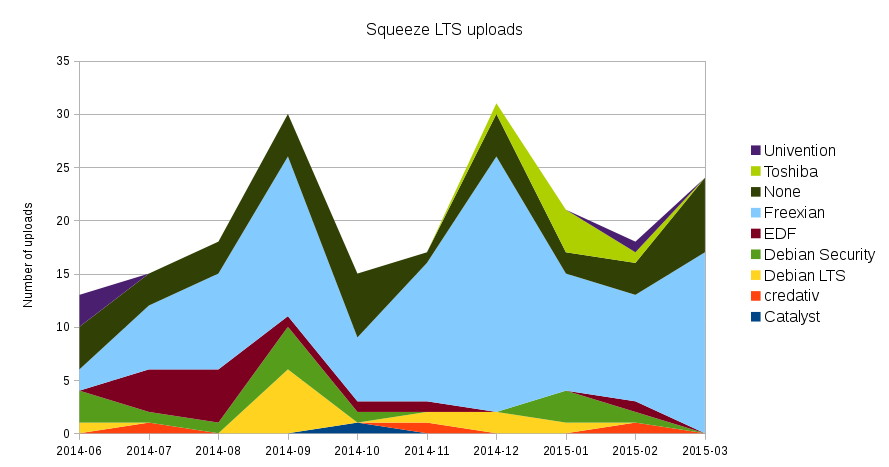
On Sunday I gave a talk about Debian LTS during the Mini-DebConf in Lyon. Obviously I presented the project and the way it s organized, but I also took the opportunity to compute some statistics. You can watch the presentation (thanks to the video team!) or have a look at the slides to learn more. Here are some extracts of the statistics I collected: The number of the uploads per affiliation (known affiliations are recorded in the LTS/Team wiki page) is displayed on the graph below. None corresponds to packages maintainers taking care of their own packages, Debian Security corresponds to members of the security team who also contributed to LTS, Debian LTS corresponds to individual members of the LTS team without any explicit affiliation. Freexian represents in fact 29 financial sponsors (see detail here). Debian LTS uploads over time Top 12 contributors (in number of uploads): The talk also contains explanations about the current funding setup. Hopefully this clears things up for people who were still wondering how the LTS project is working.

One comment Liked this article? Click here. My blog is Flattr-enabled.

Next.

Previous.