Search Results: "ads"

13 August 2020

Erich Schubert: Publisher MDPI lies to prospective authors

The publisher MDPI is a spammer and lies. If you upload a paper draft to arXiv, MDPI will send spam to the authors to solicit submission. Within minutes of an upload I received the following email (sent by MDPI staff, not some overly eager new editor):
We read your recent manuscript "[...]" on
arXiv, and sincerely invite you to submit it to our journal Future
Internet, if it has not been published or submitted elsewhere.
Future Internet (ISSN 1999-5903, indexed by Scopus, Ei compendex,
*ESCI*-Web of Science) is a journal on Internet technologies and the
information society. It maintains a rigorous and fast peer review system
with a median publication time of 35 days from submission to online
publication, and 3 days from acceptance to publication. The journal
scope is shown here:
https://www.mdpi.com/journal/futureinternet/about.
Editorial Board: https://www.mdpi.com/journal/futureinternet/editors.
Since Future Internet is an open access journal there is a publication
fee. Your paper will be published, with a 20% discount (amounting to 200
CHF), and provided that it is accepted after our standard peer-review
procedure. 
First of all, the email begins with a lie. Because this paper clearly states that it is submitted elsewhere. Also, it fits other journals much better, and if they had read even just the abstract, they would have known. This is predatory behavior by MDPI. Clearly, it is just about getting as many submissions as possible. The journal charges 1000 CHF (next year, 1400 CHF) to publish the papers. Its about the money. Also, there have been reports that MDPI ignores the reviews, and always publishes even when reviewers recommended rejection The reviewer requests I have received from MDPI came with unreasonable deadlines, which will not allow for a thorough peer review. Hence I asked to not ever be emailed by them again. I must assume that many other qualified reviewers do the same. MDPI boasts in their 2019 annual report a median time to first decision of 19 days in my discipline the typical time window to ask for reviews is at least a month (for shorter conference papers, not full journal articles), because professors tend to have lots of other duties, hence they need more flexibility. Above paper has been submitted in March, and is now under review for 4 months already. This is an annoying long time window, and I would appreciate if this were less, but it shows how extremely short the MDPI time frame is. They also claim 269.1k submissions and 106.2k published papers, so the acceptance rate is around 40% on average, and assuming that there are some journals with higher standards there then some must have acceptance rates much higher than this. I d assume that many reputable journals have 40% desk-rejection rate for papers that are not even on-topic The average cost to authors is given as 1144 CHF (after discounts, 25% waived feeds etc.), so they, so we are talking about 120 million CHF of revenue from authors. Is that what you want academic publishing to be? I am not happy with some of the established publishers such as Elsevier that also overcharge universities heavily. I do think we need to change academic publishing, and arXiv is a big improvement here. But I do not respect publishers such as MDPI that lie and send spam.

12 August 2020

Norbert Preining: KDE/Plasma Status Update 2020-08-13

Short status update on my KDE/Plasma packages for Debian sid and testing: Hope that helps a few people. See this post for how to setup archives. Enjoy.

Michael Stapelberg: distri: 20x faster initramfs (initrd) from scratch

In case you are not yet familiar with why an initramfs (or initrd, or initial ramdisk) is typically used when starting Linux, let me quote the wikipedia definition: [ ] initrd is a scheme for loading a temporary root file system into memory, which may be used as part of the Linux startup process [ ] to make preparations before the real root file system can be mounted. Many Linux distributions do not compile all file system drivers into the kernel, but instead load them on-demand from an initramfs, which saves memory. Another common scenario, in which an initramfs is required, is full-disk encryption: the disk must be unlocked from userspace, but since userspace is encrypted, an initramfs is used.

Motivation Thus far, building a distri disk image was quite slow: This is on an AMD Ryzen 3900X 12-core processor (2019):
distri % time make cryptimage serial=1
80.29s user 13.56s system 186% cpu 50.419 total # 19s image, 31s initrd
Of these 50 seconds, dracut s initramfs generation accounts for 31 seconds (62%)! Initramfs generation time drops to 8.7 seconds once dracut no longer needs to use the single-threaded gzip(1) , but the multi-threaded replacement pigz(1) : This brings the total time to build a distri disk image down to:
distri % time make cryptimage serial=1
76.85s user 13.23s system 327% cpu 27.509 total # 19s image, 8.7s initrd
Clearly, when you use dracut on any modern computer, you should make pigz available. dracut should fail to compile unless one explicitly opts into the known-slower gzip. For more thoughts on optional dependencies, see Optional dependencies don t work . But why does it take 8.7 seconds still? Can we go faster? The answer is Yes! I recently built a distri-specific initramfs I m calling minitrd. I wrote both big parts from scratch:
  1. the initramfs generator program (distri initrd)
  2. a custom Go userland (cmd/minitrd), running as /init in the initramfs.
minitrd generates the initramfs image in 400ms, bringing the total time down to:
distri % time make cryptimage serial=1
50.09s user 8.80s system 314% cpu 18.739 total # 18s image, 400ms initrd
(The remaining time is spent in preparing the file system, then installing and configuring the distri system, i.e. preparing a disk image you can run on real hardware.) How can minitrd be 20 times faster than dracut? dracut is mainly written in shell, with a C helper program. It drives the generation process by spawning lots of external dependencies (e.g. ldd or the dracut-install helper program). I assume that the combination of using an interpreted language (shell) that spawns lots of processes and precludes a concurrent architecture is to blame for the poor performance. minitrd is written in Go, with speed as a goal. It leverages concurrency and uses no external dependencies; everything happens within a single process (but with enough threads to saturate modern hardware). Measuring early boot time using qemu, I measured the dracut-generated initramfs taking 588ms to display the full disk encryption passphrase prompt, whereas minitrd took only 195ms. The rest of this article dives deeper into how minitrd works.

What does an initramfs do? Ultimately, the job of an initramfs is to make the root file system available and continue booting the system from there. Depending on the system setup, this involves the following 5 steps:

1. Load kernel modules to access the block devices with the root file system Depending on the system, the block devices with the root file system might already be present when the initramfs runs, or some kernel modules might need to be loaded first. On my Dell XPS 9360 laptop, the NVMe system disk is already present when the initramfs starts, whereas in qemu, we need to load the virtio_pci module, followed by the virtio_scsi module. How will our userland program know which kernel modules to load? Linux kernel modules declare patterns for their supported hardware as an alias, e.g.:
initrd# grep virtio_pci lib/modules/5.4.6/modules.alias
alias pci:v00001AF4d*sv*sd*bc*sc*i* virtio_pci
Devices in sysfs have a modalias file whose content can be matched against these declarations to identify the module to load:
initrd# cat /sys/devices/pci0000:00/*/modalias
pci:v00001AF4d00001005sv00001AF4sd00000004bc00scFFi00
pci:v00001AF4d00001004sv00001AF4sd00000008bc01sc00i00
[ ]
Hence, for the initial round of module loading, it is sufficient to locate all modalias files within sysfs and load the responsible modules. Loading a kernel module can result in new devices appearing. When that happens, the kernel sends a uevent, which the uevent consumer in userspace receives via a netlink socket. Typically, this consumer is udev(7) , but in our case, it s minitrd. For each uevent messages that comes with a MODALIAS variable, minitrd will load the relevant kernel module(s). When loading a kernel module, its dependencies need to be loaded first. Dependency information is stored in the modules.dep file in a Makefile-like syntax:
initrd# grep virtio_pci lib/modules/5.4.6/modules.dep
kernel/drivers/virtio/virtio_pci.ko: kernel/drivers/virtio/virtio_ring.ko kernel/drivers/virtio/virtio.ko
To load a module, we can open its file and then call the Linux-specific finit_module(2) system call. Some modules are expected to return an error code, e.g. ENODEV or ENOENT when some hardware device is not actually present. Side note: next to the textual versions, there are also binary versions of the modules.alias and modules.dep files. Presumably, those can be queried more quickly, but for simplicitly, I have not (yet?) implemented support in minitrd.

2. Console settings: font, keyboard layout Setting a legible font is necessary for hi-dpi displays. On my Dell XPS 9360 (3200 x 1800 QHD+ display), the following works well:
initrd# setfont latarcyrheb-sun32
Setting the user s keyboard layout is necessary for entering the LUKS full-disk encryption passphrase in their preferred keyboard layout. I use the NEO layout:
initrd# loadkeys neo

3. Block device identification In the Linux kernel, block device enumeration order is not necessarily the same on each boot. Even if it was deterministic, device order could still be changed when users modify their computer s device topology (e.g. connect a new disk to a formerly unused port). Hence, it is good style to refer to disks and their partitions with stable identifiers. This also applies to boot loader configuration, and so most distributions will set a kernel parameter such as root=UUID=1fa04de7-30a9-4183-93e9-1b0061567121. Identifying the block device or partition with the specified UUID is the initramfs s job. Depending on what the device contains, the UUID comes from a different place. For example, ext4 file systems have a UUID field in their file system superblock, whereas LUKS volumes have a UUID in their LUKS header. Canonically, probing a device to extract the UUID is done by libblkid from the util-linux package, but the logic can easily be re-implemented in other languages and changes rarely. minitrd comes with its own implementation to avoid cgo or running the blkid(8) program.

4. LUKS full-disk encryption unlocking (only on encrypted systems) Unlocking a LUKS-encrypted volume is done in userspace. The kernel handles the crypto, but reading the metadata, obtaining the passphrase (or e.g. key material from a file) and setting up the device mapper table entries are done in user space.
initrd# modprobe algif_skcipher
initrd# cryptsetup luksOpen /dev/sda4 cryptroot1
After the user entered their passphrase, the root file system can be mounted:
initrd# mount /dev/dm-0 /mnt

5. Continuing the boot process (switch_root) Now that everything is set up, we need to pass execution to the init program on the root file system with a careful sequence of chdir(2) , mount(2) , chroot(2) , chdir(2) and execve(2) system calls that is explained in this busybox switch_root comment.
initrd# mount -t devtmpfs dev /mnt/dev
initrd# exec switch_root -c /dev/console /mnt /init
To conserve RAM, the files in the temporary file system to which the initramfs archive is extracted are typically deleted.

How is an initramfs generated? An initramfs image (more accurately: archive) is a compressed cpio archive. Typically, gzip compression is used, but the kernel supports a bunch of different algorithms and distributions such as Ubuntu are switching to lz4. Generators typically prepare a temporary directory and feed it to the cpio(1) program. In minitrd, we read the files into memory and generate the cpio archive using the go-cpio package. We use the pgzip package for parallel gzip compression. The following files need to go into the cpio archive:

minitrd Go userland The minitrd binary is copied into the cpio archive as /init and will be run by the kernel after extracting the archive. Like the rest of distri, minitrd is built statically without cgo, which means it can be copied as-is into the cpio archive.

Linux kernel modules Aside from the modules.alias and modules.dep metadata files, the kernel modules themselves reside in e.g. /lib/modules/5.4.6/kernel and need to be copied into the cpio archive. Copying all modules results in a 80 MiB archive, so it is common to only copy modules that are relevant to the initramfs s features. This reduces archive size to 24 MiB. The filtering relies on hard-coded patterns and module names. For example, disk encryption related modules are all kernel modules underneath kernel/crypto, plus kernel/drivers/md/dm-crypt.ko. When generating a host-only initramfs (works on precisely the computer that generated it), some initramfs generators look at the currently loaded modules and just copy those.

Console Fonts and Keymaps The kbd package s setfont(8) and loadkeys(1) programs load console fonts and keymaps from /usr/share/consolefonts and /usr/share/keymaps, respectively. Hence, these directories need to be copied into the cpio archive. Depending on whether the initramfs should be generic (work on many computers) or host-only (works on precisely the computer/settings that generated it), the entire directories are copied, or only the required font/keymap.

cryptsetup, setfont, loadkeys These programs are (currently) required because minitrd does not implement their functionality. As they are dynamically linked, not only the programs themselves need to be copied, but also the ELF dynamic linking loader (path stored in the .interp ELF section) and any ELF library dependencies. For example, cryptsetup in distri declares the ELF interpreter /ro/glibc-amd64-2.27-3/out/lib/ld-linux-x86-64.so.2 and declares dependencies on shared libraries libcryptsetup.so.12, libblkid.so.1 and others. Luckily, in distri, packages contain a lib subdirectory containing symbolic links to the resolved shared library paths (hermetic packaging), so it is sufficient to mirror the lib directory into the cpio archive, recursing into shared library dependencies of shared libraries. cryptsetup also requires the GCC runtime library libgcc_s.so.1 to be present at runtime, and will abort with an error message about not being able to call pthread_cancel(3) if it is unavailable.

time zone data To print log messages in the correct time zone, we copy /etc/localtime from the host into the cpio archive.

minitrd outside of distri? I currently have no desire to make minitrd available outside of distri. While the technical challenges (such as extending the generator to not rely on distri s hermetic packages) are surmountable, I don t want to support people s initramfs remotely. Also, I think that people s efforts should in general be spent on rallying behind dracut and making it work faster, thereby benefiting all Linux distributions that use dracut (increasingly more). With minitrd, I have demonstrated that significant speed-ups are achievable.

Conclusion It was interesting to dive into how an initramfs really works. I had been working with the concept for many years, from small tasks such as debug why the encrypted root file system is not unlocked to more complicated tasks such as set up a root file system on DRBD for a high-availability setup . But even with that sort of experience, I didn t know all the details, until I was forced to implement every little thing. As I suspected going into this exercise, dracut is much slower than it needs to be. Re-implementing its generation stage in a modern language instead of shell helps a lot. Of course, my minitrd does a bit less than dracut, but not drastically so. The overall architecture is the same. I hope my effort helps with two things:
  1. As a teaching implementation: instead of wading through the various components that make up a modern initramfs (udev, systemd, various shell scripts, ), people can learn about how an initramfs works in a single place.
  2. I hope the significant time difference motivates people to improve dracut.

Appendix: qemu development environment Before writing any Go code, I did some manual prototyping. Learning how other people prototype is often immensely useful to me, so I m sharing my notes here. First, I copied all kernel modules and a statically built busybox binary:
% mkdir -p lib/modules/5.4.6
% cp -Lr /ro/lib/modules/5.4.6/* lib/modules/5.4.6/
% cp ~/busybox-1.22.0-amd64/busybox sh
To generate an initramfs from the current directory, I used:
% find .   cpio -o -H newc   pigz > /tmp/initrd
In distri s Makefile, I append these flags to the QEMU invocation:
-kernel /tmp/kernel \
-initrd /tmp/initrd \
-append "root=/dev/mapper/cryptroot1 rdinit=/sh ro console=ttyS0,115200 rd.luks=1 rd.luks.uuid=63051f8a-54b9-4996-b94f-3cf105af2900 rd.luks.name=63051f8a-54b9-4996-b94f-3cf105af2900=cryptroot1 rd.vconsole.keymap=neo rd.vconsole.font=latarcyrheb-sun32 init=/init systemd.setenv=PATH=/bin rw vga=836"
The vga= mode parameter is required for loading font latarcyrheb-sun32. Once in the busybox shell, I manually prepared the required mount points and kernel modules:
ln -s sh mount
ln -s sh lsmod
mkdir /proc /sys /run /mnt
mount -t proc proc /proc
mount -t sysfs sys /sys
mount -t devtmpfs dev /dev
modprobe virtio_pci
modprobe virtio_scsi
As a next step, I copied cryptsetup and dependencies into the initramfs directory:
% for f in /ro/cryptsetup-amd64-2.0.4-6/lib/*; do full=$(readlink -f $f); rel=$(echo $full   sed 's,^/,,g'); mkdir -p $(dirname $rel); install $full $rel; done
% ln -s ld-2.27.so ro/glibc-amd64-2.27-3/out/lib/ld-linux-x86-64.so.2
% cp /ro/glibc-amd64-2.27-3/out/lib/ld-2.27.so ro/glibc-amd64-2.27-3/out/lib/ld-2.27.so
% cp -r /ro/cryptsetup-amd64-2.0.4-6/lib ro/cryptsetup-amd64-2.0.4-6/
% mkdir -p ro/gcc-libs-amd64-8.2.0-3/out/lib64/
% cp /ro/gcc-libs-amd64-8.2.0-3/out/lib64/libgcc_s.so.1 ro/gcc-libs-amd64-8.2.0-3/out/lib64/libgcc_s.so.1
% ln -s /ro/gcc-libs-amd64-8.2.0-3/out/lib64/libgcc_s.so.1 ro/cryptsetup-amd64-2.0.4-6/lib
% cp -r /ro/lvm2-amd64-2.03.00-6/lib ro/lvm2-amd64-2.03.00-6/
In busybox, I used the following commands to unlock the root file system:
modprobe algif_skcipher
./cryptsetup luksOpen /dev/sda4 cryptroot1
mount /dev/dm-0 /mnt

11 August 2020

Dirk Eddelbuettel: RcppSimdJson 0.1.1: More Features

A first update following for the exciting RcppSimdJson 0.1.0 release last month is now on CRAN. Version 0.1.1 brings further enhancements such direct parsing of raw chars, working with compressed files as well as much expanded querying ability all thanks to Brendan, some improvements to our demos thanks to Daniel as well as a small fix via a one-liner borrowed from upstream for a reported UBSAN issue. RcppSimdJson wraps the fantastic and genuinely impressive simdjson library by Daniel Lemire and collaborators. Via very clever algorithmic engineering to obtain largely branch-free code, coupled with modern C++ and newer compiler instructions, it results in parsing gigabytes of JSON parsed per second which is quite mindboggling. The best-case performance is faster than CPU speed as use of parallel SIMD instructions and careful branch avoidance can lead to less than one cpu cycle use per byte parsed; see the video of the talk by Daniel Lemire at QCon (also voted best talk). The detailed list of changes follows.

Changes in version 0.1.1 (2020-08-10)
  • Corrected incorrect file deletion when mixing local and remote files (Brendan in #34) closing #33.
  • Added support for raw vectors, compressed files, and compressed downloads (Dirk and Brendan in #36, #39, and #45 closing #35 and addressing issues raised in #40 and #44).
  • Examples in two demos are now more self-sufficient (Daniel Lemire and Dirk in #42).
  • Expanded query functionality to include single, flat, and nested queries (Brendan in #45 closing #43).
  • Split error handling parameters from error_ok/on_error into parse_error_ok/on_parse_error and query_error_ok/on_query_error (Brendan in #45).
  • One-line upstream change to address sanitizer error on cast.

Courtesy of CRANberries, there is also a diffstat report for this release. For questions, suggestions, or issues please use the issue tracker at the GitHub repo. If you like this or other open-source work I do, you can now sponsor me at GitHub. For the first year, GitHub will match your contributions.

This post by Dirk Eddelbuettel originated on his Thinking inside the box blog. Please report excessive re-aggregation in third-party for-profit settings.

Jonathan Carter: GameMode in Debian

What is GameMode, what does it do? About two years ago, I ran into some bugs running a game on Debian, so installed Windows 10 on a spare computer and ran it on there. I learned that when you launch a game in Windows 10, it automatically disables notifications, screensaver, reduces power saving measures and gives the game maximum priority. I thought Oh, that s actually quite nice, but we probably won t see that kind of integration on Linux any time soon . The very next week, I read the initial announcement of GameMode, a tool from Feral Interactive that does a bunch of tricks to maximise performance for games running on Linux. When GameMode is invoked it:

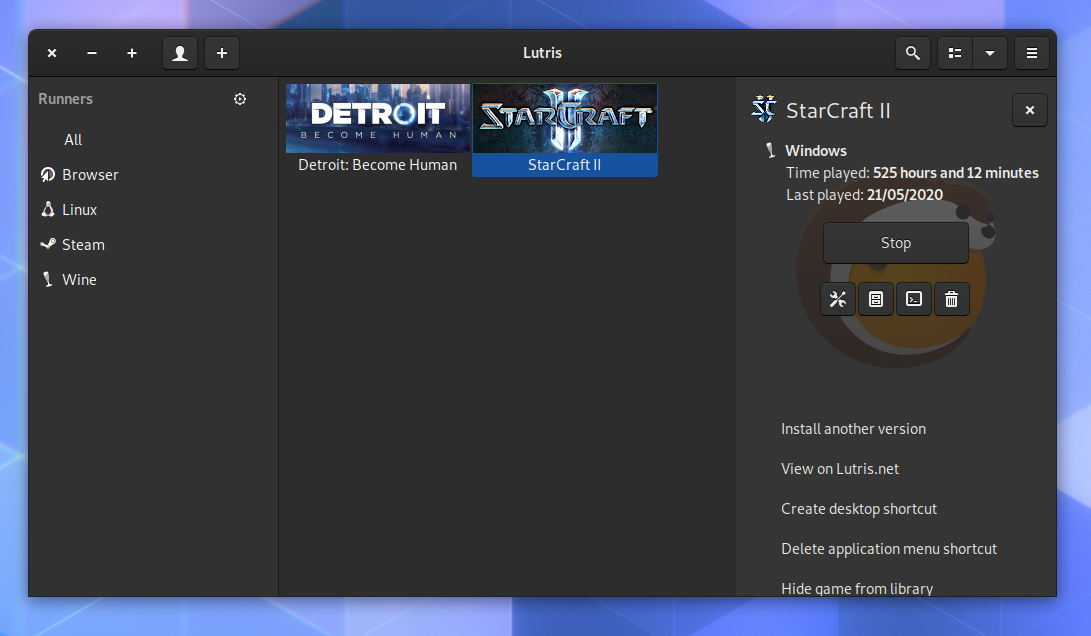
How GameMode is invoked Some newer games (proprietary games like Rise of the Tomb Raider , Total War Saga: Thrones of Britannia , Total War: WARHAMMER II , DiRT 4 and Total War: Three Kingdoms ) will automatically invoke GameMode if it s installed. For games that don t, you can manually evoke it using the gamemoderun command. Lutris is a tool that makes it easy to install and run games on Linux, and it also integrates with GameMode. (Lutris is currently being packaged for Debian, hopefully it will make it in on time for Bullseye).

Screenshot of Lutris, a tool that makes it easy to install your non-Linux games, which also integrates with GameMode.

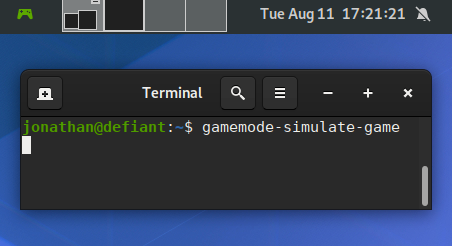
GameMode in Debian The latest GameMode is packaged in Debian (Stephan Lachnit and I maintain it in the Debian Games Team) and it s also available for Debian 10 (Buster) via buster-backports. All you need to do to get up and running with GameMode is to install the gamemode package. GameMode in Debian supports 64 bit and 32 bit mode, so running it with older games (and many proprietary games) still work. Some distributions (like Arch Linux), have dropped 32 bit support, so 32 bit games on such systems lose any kind of integration with GameMode even if you can get those games running via other wrappers on such systems. We also include a binary called gamemode-simulate-game (installed under /usr/games/). This is a minimalistic program that will invoke gamemode automatically for 10 seconds and then exit without an error if it was successful. Its source code might be useful if you d like to add GameMode support to your game, or patch a game in Debian to automatically invoke it. In Debian we install Gamemode s example config file to /etc/gamemode.ini where a user can customise their system-wide preferences, or alternatively they can place a copy of that in ~/.gamemode.ini with their personal preferences. In this config file, you can also choose to explicitly allow or deny games. GameMode might also be useful for many pieces of software that aren t games. I haven t done any benchmarks on such software yet, but it might be great for users who use CAD programs or use a combination of their CPU/GPU to crunch a large amount of data. I ve also packaged an extension for GNOME called gamemode-extension. The Debian package is called gnome-shell-extension-gamemode . You ll need to enable it using gnome-tweaks after installation, it will then display a green controller in your notification area whenever GameMode is active. It s only in testing/bullseye since it relies on a newer gnome-shell than what s available in buster.

Running gamemode-simulate-game, with the shell extension showing that it s activated in the top left corner.

Mike Gabriel: No Debian LTS Work in July 2020

In July 2020, I was originally assigned 8h of work on Debian LTS as a paid contributor, but holiday season overwhelmed me and I did not do any LTS work, at all. The assigned hours from July I have taken with me into August 2020. light+love,
Mike

10 August 2020

Dirk Eddelbuettel: nanotime 0.3.1: Misc Build Fixes for Yuge New Features!

The nanotime 0.3.0 release four days ago was so exciting that we decided to do it again! Kidding aside, and fairly extensive tests notwithstanding we were bitten by a few build errors: who knew clang on macOS needed extra curlies to be happy, another manifestation of Solaris having no idea what a timezone setting America/New_York is, plus some extra pickyness from the SAN tests and whatnot. So Leonardo and I gave it some extra care over the weekend, uploaded it late yesterday and here we are with 0.3.1. Thanks again to CRAN for prompt processing even though they are clearly deluged shortly before their (brief) summer break. nanotime relies on the RcppCCTZ package for (efficient) high(er) resolution time parsing and formatting up to nanosecond resolution, and the bit64 package for the actual integer64 arithmetic. Initially implemented using the S3 system, it has benefitted greatly from work by Leonardo Silvestri who rejigged internals in S4 and now added new types for periods, intervals and durations. The NEWS snippet adds full details.

Changes in version 0.3.1 (2020-08-09)
  • Several small cleanups to ensure a more robust compilation (Leonardo and Dirk in #75 fixing #74).
  • Show Solaris some extra love by skipping tests and examples with a timezone (Dirk in #76).

Thanks to CRANberries there is also a diff to the previous version. More details and examples are at the nanotime page; code, issue tickets etc at the GitHub repository. If you like this or other open-source work I do, you can now sponsor me at GitHub. For the first year, GitHub will match your contributions.

This post by Dirk Eddelbuettel originated on his Thinking inside the box blog. Please report excessive re-aggregation in third-party for-profit settings.

9 August 2020

Junichi Uekawa: Started writing some golang code.

Started writing some golang code. Trying to rewrite some of the tools as a daily driver for machine management tool. It's easier than rust in that having a good rust compiler is a hassle though golang preinstalled on systems can build and run. go run is simple enough to invoke on most Debian systems.

Charles Plessy: Thank you, VAIO

I use everyday a VAIO Pro mk2 that I bought 5 years ago with 3 years of warranty. It has been a few months that I was noticing that something was slowly inflating inside. In July, things accelerated to the point that its thickness had doubled. After we called the customer service of VAIO, somebody came to pick up the laptop in order to make a cost estimate. Then we learned on the phone that it would be free. It is back in my hands in less than two weeks. Bravo VAIO !

8 August 2020

Holger Levsen: 20200808-debconf8

DebConf8 This tshirt is 12 years old and from DebConf8. DebConf8 was my 6th DebConf and took place in Mar de la Plata, Argentina. Also this is my 6th post in this series of posts about DebConfs and for the last two days for the first time I failed my plan to do one post per day. And while two days ago I still planned to catch up on this by doing more than one post in a day, I have now decided to give in to realities, which mostly translates to sudden fantastic weather in Hamburg and other summer related changes in life. So yeah, I still plan to do short posts about all the DebConfs I was lucky to attend, but there might be days without a blog post. Anyhow, Mar de la Plata. When we held DebConf in Argentina it was winter there, meaning locals and other folks would wear jackets, scarfs, probably gloves, while many Debian folks not so much. Andreas Tille freaked out and/or amazed local people by going swimming in the sea every morning. And when I told Stephen Gran that even I would find it a bit cold with just a tshirt he replied "na, the weather is fine, just like british summer", while it was 14 celcius and mildly raining. DebConf8 was the first time I've met Valessio Brito, who I had worked together since at least DebConf6. That meeting was really super nice, Valessio is such a lovely person. Back in 2008 however, there was just one problem: his spoken English was worse than his written one, and that was already hard to parse sometimes. Fast forward eleven years to Curitiba last year and boom, Valessio speaks really nice English now. And, you might wonder why I'm telling this, especially if you were exposed to my Spanish back then and also now. So my point in telling this story about Valessio is to illustrate two things: a.) one can contribute to Debian without speaking/writing much English, Valessio did lots of great artwork since DebConf6 and b.) one can learn English by doing Debian stuff. It worked for me too! During set up of the conference there was one very memorable moment, some time after the openssl maintainer, Kurt Roeckx arrived at the venue: Shortly before DebConf8 Luciano Bello, from Argentina no less, had found CVE-2008-0166 which basically compromised the security of sshd of all Debian and Ubuntu installations done in the last 4 years (IIRC two Debian releases were affected) and which was commented heavily and noticed everywhere. So poor Kurt arrived and wondered whether we would all hate him, how many toilets he would have to clean and what not... And then, someone rather quickly noticed this, approached some people and suddenly a bunch of people at DebConf were group-hugging Kurt and then we were all smiling and continuing doing set up of the conference. That moment is one of my most joyful memories of all DebConfs and partly explains why I remember little about the conference itself, everything else pales in comparison and most things pale over the years anyway. As I remember it, the conference ran very smoothly in the end, despite quite some organisational problems right before the start. But as usual, once the geeks arrive and are happily geeking, things start to run smooth, also because Debian people are kind and smart and give hands and brain were needed. And like other DebConfs, Mar de la Plata also had moments which I want to share but I will only hint about, so it's up to you to imagine the special leaves which were brought to that cheese and wine party! ;-) Update: added another xkcd link, spelled out Kurt's name after talking to him and added a link to a video of the group hug.

Thorsten Alteholz: My Debian Activities in July 2020

FTP master This month I accepted 434 packages and rejected 54. The overall number of packages that got accepted was 475. Debian LTS This was my seventy-third month that I did some work for the Debian LTS initiative, started by Raphael Hertzog at Freexian. This month my all in all workload has been 25.25h. During that time I did LTS uploads of: I started to work on python2.7 as well but stumbled over some hurdles in the testsuite, so I did not upload a fixed version yet. This month was much influenced by the transition from Jessie LTS to Stretch LTS and one or another workflow/script needed some adjustments. Last but not least I did some days of frontdesk duties. Debian ELTS This month was the twenty fifth ELTS month. During my allocated time I uploaded: Like in LTS, I also started to work on python2.7 and encountered the same hurdles in the testsuite. So I did not upload a fixed version for ELTS as well. Last but not least I did some days of frontdesk duties. Other stuff In this section nothing much happened this month. Thanks a lot to everybody who NMUed a package to fix a bug.

Dirk Eddelbuettel: RVowpalWabbit 0.0.15: Some More CRAN Build Issues

Another maintenance RVowpalWabbit package update brought us to version 0.0.15 earlier today. We attempted to fix one compilation error on Solaris, and addressed a few SAN/UBSAN issues with the gcc build. As noted before, there is a newer package rvw based on the excellent GSoC 2018 and beyond work by Ivan Pavlov (mentored by James and myself) so if you are into Vowpal Wabbit from R go check it out. CRANberries provides a summary of changes to the previous version. More information is on the RVowpalWabbit page. Issues and bugreports should go to the GitHub issue tracker. If you like this or other open-source work I do, you can now sponsor me at GitHub. For the first year, GitHub will match your contributions.

This post by Dirk Eddelbuettel originated on his Thinking inside the box blog. Please report excessive re-aggregation in third-party for-profit settings.

7 August 2020

Jonathan Dowland: Vimwiki

At the start of the year I begun keeping a daily diary for work as a simple text file. I've used various other approaches for this over the years, including many paper diaries and more complex digital systems. One great advantage of the one-page text file was it made assembling my weekly status report email very quick, nearly just a series of copies and pastes. But of course there are drawbacks and room for improvement. vimwiki is a personal wiki plugin for the vim and neovim editors. I've tried to look at it before, years ago, but I found it too invasive, changing key bindings and display settings for any use of vim, and I use vim a lot. I decided to give it another look. The trigger was actually something completely unrelated: Steve Losh's blog post "Coming Home to vim". I've been using vim for around 17 years but I still learned some new things from that blog post. In particular, I've never bothered to Use The Leader for user-specific shortcuts. The Leader, to me, feels like a namespace that plugins should not touch: it's like the /usr/local of shortcut keys, a space for the local user only. Vimwiki's default bindings include several incorporating the Leader. Of course since I didn't use the leader, those weren't the ones that bothered me: It turns out I regularly use carriage return and backspace for moving the cursor around in normal mode, and Vimwiki steals both of those. It also truncates the display of (what it thinks are) URIs. It turns out I really prefer to see exactly what's in the file I'm editing. I haven't used vim folds since I first switched to it, despite them being why I switched. Disabling all the default bindings and URI concealing stuff and Vimwiki is now much less invasive and I can explore its features at my own pace:
let g:vimwiki_key_mappings =   'all_maps': 0,  
let g:vimwiki_conceallevel = 0
let g:vimwiki_url_maxsave = 0 
Followed by explicitly configuring the bindings I want. I'm letting it steal carriage return. And yes, I've used some Leader bindings after all.
nnoremap <leader>ww :VimwikiIndex<cr>
nnoremap <leader>wi :VimwikiDiaryIndex<cr>
nnoremap <leader>wd :VimwikiMakeDiaryNote<cr>
nnoremap <CR> :VimwikiFollowLink<cr>
nnoremap <Tab> :VimwikiNextLink<cr>
nnoremap <S-Tab> :VimwikiPrevLink<cr>
nnoremap <C-Down> :VimwikiDiaryNextDay<cr>
nnoremap <C-Up> :VimwikiDiaryPrevDay<cr>
,wd (my leader) now brings me straight to today's diary page, and I can create separate, non-diary pages for particular work items (e.g. a Ticket reference) that will span more than one day, and keep all the relevant stuff in one place.

6 August 2020

Dirk Eddelbuettel: nanotime 0.3.0: Yuge New Features!

A fresh major release of the nanotime package for working with nanosecond timestamps is hitting CRAN mirrors right now. nanotime relies on the RcppCCTZ package for (efficient) high(er) resolution time parsing and formatting up to nanosecond resolution, and the bit64 package for the actual integer64 arithmetic. Initially implemented using the S3 system, it has benefitted greatly from work by Leonardo Silvestri who rejigged internals in S4 and now added new types for periods, intervals and durations. This is what is commonly called a big fucking deal!! So a really REALLY big thank you to my coauthor Leonardo for all these contributions. With all these Yuge changes patiently chisseled in by Leonardo, it took some time since the last release and a few more things piled up. Matt Dowle corrected something we borked for integration with the lovely and irreplacable data.table. We also switched to the awesome yet minimal tinytest package by Mark van der Loo, and last but not least we added the beginnings of a proper vignette currently at nine pages but far from complete. The NEWS snippet adds full details.

Changes in version 0.3.0 (2020-08-06)
  • Use tzstr= instead of tz= in call to RcppCCTZ::parseDouble()) (Matt Dowle in #49).
  • Add new comparison operators for nanotime and charcters (Dirk in #54 fixing #52).
  • Switch from RUnit to tinytest (Dirk in #55)
  • Substantial functionality extension in with new types nanoduration, nanoival and nanoperiod (Leonardo in #58, #60, #62, #63, #65, #67, #70 fixing #47, #51, #57, #61, #64 with assistance from Dirk).
  • A new (yet still draft-ish) vignette was added describing the four core types (Leonardo and Dirk in #71).
  • A required compilation flag for Windows was added (Leonardo in #72).
  • RcppCCTZ function are called in new 'non-throwing' variants to not trigger exeception errors (Leonardo in #73).

We also have a diff to the previous version thanks to CRANberries. More details and examples are at the nanotime page; code, issue tickets etc at the GitHub repository. If you like this or other open-source work I do, you can now sponsor me at GitHub. For the first year, GitHub will match your contributions.

This post by Dirk Eddelbuettel originated on his Thinking inside the box blog. Please report excessive re-aggregation in third-party for-profit settings.

Chris Lamb: The Bringers of Beethoven

This is a curiously poignant work to me that I doubt I would ever be able to communicate. I found it about fifteen years ago, along with a friend who I am quite regrettably no longer in regular contact with, so there was some complicated nostalgia entangled with rediscovering it today. What might I say about it instead? One tell-tale sign of 'good' art is that you can find something new in it, or yourself, each time. In this sense, despite The Bringers of Beethoven being more than a little ridiculous, it is somehow 'good' music to me. For example, it only really dawned on me now that the whole poem is an allegory for a GDR-like totalitarianism. But I also realised that it is not an accident that it is Beethoven himself (quite literally the soundtrack for Enlightenment humanism) that is being weaponised here, rather than some fourth-rate composer of military marches or one with a problematic past. That is to say, not only is the poem arguing that something universally recognised as an unalloyed good can be subverted for propagandistic ends, but that is precisely the point being made by the regime. An inverted Clockwork Orange, if you like. Yet when I listen to it again I can't help but laugh. I think of the 18th-century poet Alexander Pope, who first used the word bathos to refer to those abrupt and often absurd transitions from the elevated to the ordinary, contrasting it with the concept of pathos, the sincere feeling of sadness and tragedy. I can't think of two better words.

Joey Hess: Mr Process's wild ride

When a unix process is running in a directory, and that directory gets renamed, the process is taken on a ride to a new location in the filesystem. Suddenly, any "../" paths it might be using point to new, and unexpected locations. This can be a source of interesting behavior, and also of security holes. Suppose root is poking around in ~user/foo/bar/ and decides to vim ../../etc/conffile If the user notices this process is running, they can mv ~/foo/bar /tmp and when vim saves the file, it will write to /tmp/bar/../../etc/conffile AKA /etc/conffile. (Vim does warn that the file has changed while it was being edited. Other editors may not. Or root may be feeling especially BoFH and decide to overwrite the user's changes to their file. Or the rename could perhaps be carefully timed to avoid vim's overwrite protection.) Or, suppose root, in the same place, decides to archive ../../etc with tar, and then delete it:
tar cf etc.tar ../../etc; rm -rf ../../etc
Now the user has some time to take root's shell on a ride, before the rm starts ... and make it delete all of /etc! Anyone know if this class of security hole has a name?

5 August 2020

Holger Levsen: 20200805-debconf7

DebConf7 This tshirt is 13 years old and from DebConf7. DebConf7 was my 5th DebConf and took place in Edinburgh, Scotland. And finally I could tell people I was a DD :-D Though as you can guess, that's yet another story to be told. So anyway, Edinburgh. I don't recall exactly whether the video team had to record 6 or 7 talk rooms on 4 floors, but this was probably the most intense set up we ran. And we ran a lot, from floor to floor, and room to room. DebConf7 was also special because it had a very special night venue, which was in an ex-church in a rather normal building, operated as sort of community center or some such, while the old church interior was still very much visible as in everything new was build around the old stuff. And while the night venue was cool, it also ment we (video team) had no access to our machines over night (or for much of the evening), because we had to leave the university over night and the networking situation didn't allow remote access with the bandwidth needed to do anything video. The night venue had some very simple house rules, like don't rearrange stuff, don't break stuff, don't fix stuff and just a few little more and of course we broke them in the best possible way: Toresbe with the help of people I don't remember fixed the organ, which was broken for decades. And so the house sounded in some very nice new old tune and I think everybody was happy we broke that rule. I believe the city is really nice from the little I've seen of it. A very nice old town, a big castle on the hill :) I'm not sure whether I missed the day trip to Glasgow to fix video things or to rest or both... Another thing I missed was getting a kilt, for which Phil Hands made a terrific design (update: the design is called tartan and was made by Phil indeed!), which spelled Debian in morse code. That was pretty cool and the kilts are really nice on DebConf group pictures since then. And if you've been wearing this kilt regularily for the last 13 years it was probably also a sensible investment. ;) It seems I don't have that many more memories of this DebConf, British power plugs and how to hack them comes to my mind and some other stuff here and there, but I remember less than previous years. I'm blaming this on the intense video setup and also on the sheer amount of people, which was the hightest until then and for some years, I believe maybe even until Heidelberg 8 years later. IIRC there were around 470 people there and over my first five years of DebConf I was incredible lucky to make many friends in Debian, so I probably just hung out and had good times.

Dirk Eddelbuettel: RcppCCTZ 0.2.8: Minor API Extension

A new minor release 0.2.8 of RcppCCTZ is now on CRAN. RcppCCTZ uses Rcpp to bring CCTZ to R. CCTZ is a C++ library for translating between absolute and civil times using the rules of a time zone. In fact, it is two libraries. One for dealing with civil time: human-readable dates and times, and one for converting between between absolute and civil times via time zones. And while CCTZ is made by Google(rs), it is not an official Google product. The RcppCCTZ page has a few usage examples and details. This package was the first CRAN package to use CCTZ; by now at least three others do using copies in their packages which remains less than ideal. This version adds three no throw variants of three existing functions, contributed again by Leonardo. This will be used in an upcoming nanotime release which we are finalising now.

Changes in version 0.2.8 (2020-08-04)
  • Added three new nothrow variants (for win32) needed by the expanded nanotime package (Leonardo in #37)

We also have a diff to the previous version thanks to CRANberries. More details are at the RcppCCTZ page; code, issue tickets etc at the GitHub repository. If you like this or other open-source work I do, you can now sponsor me at GitHub. For the first year, GitHub will match your contributions.

This post by Dirk Eddelbuettel originated on his Thinking inside the box blog. Please report excessive re-aggregation in third-party for-profit settings.

Holger Levsen: 20200804-debconf6

DebConf6 This tshirt is 14 years old and from DebConf6. DebConf6 was my 4th DebConf and took place in Oaxtepec, Mexico. I'm a bit exhausted right now which is probably quite fitting to write something about DebConf6... many things in life are a question of perception, so I will mention the waterfall and the big swirl and the band playing with the fireworks during the conference dinner, the joy that we finally could use the local fiber network (after asking for months) just after discovering that the 6h shopping tour forgot to bring the essential pig tail connectors to connect the wireless antennas to the cards, which we needed to provide network to the rooms where the talks would take place. DebConf6 was the first DebConf with live streaming using dvswitch (written by Ben Hutchings and removed from unstable in 2015 as the world had moved to voctomix, which is yet another story to be told eventually). The first years (so DebConf6 and some) the videoteam focussed on getting the post processing done and the videos released, and streaming was optional, even though it was an exciting new feature and we still managed to stream mostly all we recorded and sometimes more... ;) Setting up the network uplink also was very challenging and took, I don't remember exactly, until day 4 or 5 of DebCamp (which lasted 7 days), so there were group of geeks in need of network, and mostly unable to fix it, because for fixing it we needed to communicate and IRC was down. (There was no mobile phone data at that time, the first iphone wasn't sold yet, it were the dark ages.) I remember literally standing on a roof to catch the wifi signal and excitingly shouting "I got one ping back! ... one ping back ...", less excitingly. I'll spare you the details now (and me writing them down) but I'll say that the solution involved Neil McGovern climbing an antenna and attaching a wifi antenna up high, probably 15m or 20m or some such. Finally we had uplink. I don't recall if that pig tail connector incident happened before of after, but in the end the network setup worked nicely on the wide area we occupied. Even though in some dorms the cleaning people daily removed one of our APs to be able to watch TV while cleaning ;) (Which kind of was ok, but still... they could have plugged it back in.) I also joyfully remember a certain vegetarian table, a most memorable bus ride (I'll just say 5 or rather cinco, and, unrelated except on the same bus ride, "Jesus" (and "Maria" for sure..)!) and talking with Jim Gettys and thus learning about the One Laptop per Child (OLPC) project. As for any DebConf, there's sooo much more to be told, but I'll end here and just thank Gunnar Wolf (as he masterminded much of this DebConf) and go to bed now :-)

3 August 2020

Holger Levsen: 20200803-debconf5

DebConf5 This tshirt is 15 years old and from DebConf5. It still looks quite nice! :) DebConf5 was my 3rd DebConf and took place in Helsinki, or rather Espoo, in Finland. This was one of my most favorite DebConfs (though I basically loved them all) and I'm not really sure why, I guess it's because of the kind of community at the event. We stayed in some future dorms of the universtity, which were to be first used by some European athletics chamopionship and which we could use even before that, guests zero. Being in Finland there were of course saunas in the dorms, which we frequently used and greatly enjoyed. Still, one day we had to go on a trip to another sauna in the forest, because of course you cannot visit Finland and only see one sauna. Or at least, you should not. Another aspect which increased community bonding was that we had to authenticate using 802.10 (IIRC, please correct me) which was an authentication standard mostly used for wireless but which also works for wired ethernet, except that not many had used it on Linux before. Thus quite some related bugs were fixed in the first days of DebCamp... Then my powerpc ibook also decided to go bad, so I had to remove 30 screws to get the harddrive out and 30 screws back in, to not have 30 screws laying around for a week. Then I put the harddrive into a spare (x86) laptop and only used my /home partition and was very happy this worked nicely. And then, for travelling back, I had to unscrew and screw 30 times again. (I think my first attempt took 1.5h and the fourth only 45min or so ;) Back home then I bought a laptop where one could remove the harddrive using one screw. Oh, and then I was foolish during the DebConf5 preparations and said, that I could imagine setting up a team and doing video recordings, as previous DebConfs mostly didn't have recordings and the one that had, didn't have releases of them... And so we did videos. And as we were mostly inexperienced we did them the hard way: during the day we recorded on tape and then when the talks were done, we used a postprocessing tool called 'cinelerra' and edited them. And because Eric Evans was on the team and because Eric worked every night almost all night, all nights, we managed to actually release them all when DebConf5 was over. I very well remember many many (23 or 42) Debian people cleaning the dorms thoroughly (as they were brand new..) and Eric just sitting somewhere, exhausted and watching the cleaners. And everybody was happy Eric was idling there, cause we knew why. In the aftermath of DebConf5 Ben Hutchings then wrote videolink (removed from sid in 2013) which we used to create video DVDs of our recordings based on a simple html file with links to the actual videos. There were many more memorable events. The boat ride was great. A pirate flag appeared. One night people played guitar until very late (or rather early) close to the dorms, so at about 3 AM someone complained about it, not in person, but on the debian-devel mailinglist. And those drunk people playing guitar, replied immediatly on the mailinglist. And then someone from the guitar group gave a talk, at 9 AM, and the video is online... ;) (It's a very slowwwwwww talk.) If you haven't been to or close to the polar circles it's almost impossible to anticipate how life is in summer there. It get's a bit darker after midnight or rather after 1 AM and then at 3 AM it get's light again, so it's reaaaaaaally easy to miss the night once and it's absolutly not hard to miss the night for several nights in a row. And then I shared a room with 3 people who all snore quite loud... There was more. I was lucky to witness the first (or second?) cheese and whine party which at that time took place in a dorm room with, dunno 10 people and maybe 15 kinds of cheese. And, of course, I met many wonderful people there, to mention a few I'll say Jesus, I mean mooch or data, Amaya and p2. And thanks to some bad luck which turned well, I also had my first time ever Sushi in Helsinki. And and and. DebConfs are soooooooo good! :-) I'll stop here as I originally planned to only write a paragraph or two about each and there are quite some to be written! Oh, and as we all learned, there are probably no mosquitos in Helsinki, just in Espoo. And you can swim naked through a lake and catch a taxi on the other site, with no clothes and no money, no big deal. (And you might not believe it, but that wasn't me. I cannot swim that well.)

Next.

Previous.