Search Results: "pm"

13 May 2011

Pietro Abate: Eating you own dog food - mpm

After a bit of work, today I decided to start using mpm, the mancoosi package manager, to upgrade my laptop. My first use of it on a production system - until now I run all my experiments in throw-away virtual machines - and it works ! Not rocket science here. During the last month David Kalnischkies (of APT fame) visited our offices in Paris and together with zack worked out a communication protocol between apt-get and the mancoosi cudf solvers (EDSP). I guess somebody is going to announce all details about this endeavor soon. This cooperation enabled us to advance in the integration of apt-get and the mancoosi technology. Reusing the same protocol and backend I developed to translate the apt problem to cudf (and to call a suitable solver), I've re-wrote large part of mpm and added the possibility to generate the installation plan before calling dpkg and really installing the selected packages. Below notice the intermediate calls as Inject Model , Simulate, Compare Models . These are at the moment stubs that are going to call the simulation framework developed at mancoosi. The food :
abate@zed.fr:~/Projects/git-svn-repos/mpm$sudo ./mpm.py -c mpm.conf update
Reading package lists... Done
Building dependency tree
Reading state information... Done
Inject Model ...


abate@zed.fr:~/Projects/git-svn-repos/mpm$sudo ./mpm.py -c mpm.conf upgrade
Reading package lists... Done
Building dependency tree
Reading state information... Done
The following new packages will be installed:
libtracker-client-0.8-0 libnet-ip-perl libio-socket-ssl-perl libasyncns0 libapr1
5 to install
Simulate
Proceed ? yes/[no]
yes
Reading package fields... Done
Reading package status... Done
Retrieving bug reports... Done
Parsing Found/Fixed information... Done
Reading changelogs... Done
apt-listchanges: Mailing root: apt-listchanges: changelogs for zed
Reading package fields... Done
Reading package status... Done
Retrieving bug reports... Done
Parsing Found/Fixed information... Done
Reading changelogs... Done
apt-listchanges: Mailing root: apt-listchanges: changelogs for zed
(Reading database ... 179534 files and directories currently installed.)
Preparing to replace libapr1 1.4.2-8 (using .../libapr1_1.4.4-1_amd64.deb) ...
Unpacking replacement libapr1 ...
Preparing to replace libasyncns0 0.8-1 (using .../libasyncns0_0.8-2_amd64.deb) ...
Unpacking replacement libasyncns0 ...
Preparing to replace libio-socket-ssl-perl 1.40-1 (using .../libio-socket-ssl-perl_1.43-1_all.deb) ...
Unpacking replacement libio-socket-ssl-perl ...
Preparing to replace libnet-ip-perl 1.25-2 (using .../libnet-ip-perl_1.25-3_all.deb) ...
Unpacking replacement libnet-ip-perl ...
Preparing to replace libtracker-client-0.8-0 0.8.17-2 (using .../libtracker-client-0.8-0_0.8.18-1_amd64.deb) ...
Unpacking replacement libtracker-client-0.8-0 ...
Processing triggers for man-db ...
Setting up libapr1 (1.4.4-1) ...
Setting up libasyncns0 (0.8-2) ...
Setting up libio-socket-ssl-perl (1.43-1) ...
Setting up libnet-ip-perl (1.25-3) ...
Setting up libtracker-client-0.8-0 (0.8.18-1) ...
localepurge: Disk space freed in /usr/share/locale: 0 KiB
localepurge: Disk space freed in /usr/share/man: 0 KiB
localepurge: Disk space freed in /usr/share/gnome/help: 0 KiB
localepurge: Disk space freed in /usr/share/omf: 0 KiB

Total disk space freed by localepurge: 0 KiB

localepurge: Disk space freed in /usr/share/locale: 0 KiB
localepurge: Disk space freed in /usr/share/man: 0 KiB
localepurge: Disk space freed in /usr/share/gnome/help: 0 KiB
localepurge: Disk space freed in /usr/share/omf: 0 KiB

Total disk space freed by localepurge: 0 KiB

Inject Model ...
Compare Models ...
abate@zed.fr:~/Projects/git-svn-repos/mpm$
Reg the installation plan, this is an xml file that will be passed to a simulator developed by the university of L'Aquila to make sure that the installation script (well, a model of them), will not cause any problem during the installation. The format is a very simple xml file as follows :
<selectionStates>
<selectionState type="Install">
<param name="package" value="libapr1" />
<param name="version" value="1.4.4-1" />
<param name="architecture" value="amd64" />
</selectionState>
<selectionState type="Install">
<param name="package" value="libasyncns0" />
<param name="version" value="0.8-2" />
<param name="architecture" value="amd64" />
</selectionState>
<selectionState type="Install">
<param name="package" value="libio-socket-ssl-perl" />
<param name="version" value="1.43-1" />
<param name="architecture" value="all" />
</selectionState>
[...]

Soon APT will ship a patch to use the very same infrastructure of mpm (yeii !!!). This will on one hand make mpm useless as package manager on its own. It is a simple hack in python and I never tough to compete with its big brothers. On the other hand I think it will stand as a nice workbench to experiment with new ideas, to prototype new features and to make it easier for poeple that are not c++ experts to play with the APT library (thanks to python-apt) in a semi structured environment. The code is in the mancoosi svn if you want to have a look.

Pietro Abate: Eating my own dog food - mpm

After a bit of work, today I decided to start using mpm, the mancoosi package manager, to upgrade my laptop. My first use of it on a production system - until now I run all my experiments in throw-away virtual machines - and it works ! Not rocket science here. During the last month David Kalnischkies (of APT fame) visited our offices in Paris and together with zack worked out a communication protocol between apt-get and the mancoosi cudf solvers (EDSP). I guess somebody is going to announce all details about this endeavor soon. This cooperation enabled us to advance in the integration of apt-get and the mancoosi technology. Reusing the same protocol, and backend I developed to translate the apt problem to cudf (and to call a suitable solver), I've re-wrote large part of mpm and added the possibility to generate the installation plan before calling dpkg and really installing the selected packages. Below notice the intermediate calls as Inject Model , Simulate, Compare Models . These are at the moment stubs that are going to call the simulation framework developed at mancoosi. The food :
abate@zed.fr:~/Projects/git-svn-repos/mpm$sudo ./mpm.py -c mpm.conf update
Reading package lists... Done
Building dependency tree
Reading state information... Done
Inject Model ...


abate@zed.fr:~/Projects/git-svn-repos/mpm$sudo ./mpm.py -c mpm.conf upgrade
Reading package lists... Done
Building dependency tree
Reading state information... Done
The following new packages will be installed:
libtracker-client-0.8-0 libnet-ip-perl libio-socket-ssl-perl libasyncns0 libapr1
5 to install
Simulate
Proceed ? yes/[no]
yes
Reading package fields... Done
Reading package status... Done
Retrieving bug reports... Done
Parsing Found/Fixed information... Done
Reading changelogs... Done
apt-listchanges: Mailing root: apt-listchanges: changelogs for zed
Reading package fields... Done
Reading package status... Done
Retrieving bug reports... Done
Parsing Found/Fixed information... Done
Reading changelogs... Done
apt-listchanges: Mailing root: apt-listchanges: changelogs for zed
(Reading database ... 179534 files and directories currently installed.)
Preparing to replace libapr1 1.4.2-8 (using .../libapr1_1.4.4-1_amd64.deb) ...
Unpacking replacement libapr1 ...
Preparing to replace libasyncns0 0.8-1 (using .../libasyncns0_0.8-2_amd64.deb) ...
Unpacking replacement libasyncns0 ...
Preparing to replace libio-socket-ssl-perl 1.40-1 (using .../libio-socket-ssl-perl_1.43-1_all.deb) ...
Unpacking replacement libio-socket-ssl-perl ...
Preparing to replace libnet-ip-perl 1.25-2 (using .../libnet-ip-perl_1.25-3_all.deb) ...
Unpacking replacement libnet-ip-perl ...
Preparing to replace libtracker-client-0.8-0 0.8.17-2 (using .../libtracker-client-0.8-0_0.8.18-1_amd64.deb) ...
Unpacking replacement libtracker-client-0.8-0 ...
Processing triggers for man-db ...
Setting up libapr1 (1.4.4-1) ...
Setting up libasyncns0 (0.8-2) ...
Setting up libio-socket-ssl-perl (1.43-1) ...
Setting up libnet-ip-perl (1.25-3) ...
Setting up libtracker-client-0.8-0 (0.8.18-1) ...
localepurge: Disk space freed in /usr/share/locale: 0 KiB
localepurge: Disk space freed in /usr/share/man: 0 KiB
localepurge: Disk space freed in /usr/share/gnome/help: 0 KiB
localepurge: Disk space freed in /usr/share/omf: 0 KiB

Total disk space freed by localepurge: 0 KiB

localepurge: Disk space freed in /usr/share/locale: 0 KiB
localepurge: Disk space freed in /usr/share/man: 0 KiB
localepurge: Disk space freed in /usr/share/gnome/help: 0 KiB
localepurge: Disk space freed in /usr/share/omf: 0 KiB

Total disk space freed by localepurge: 0 KiB

Inject Model ...
Compare Models ...
abate@zed.fr:~/Projects/git-svn-repos/mpm$
Reg the installation plan, this is an xml file that will be passed to a simulator developed by the university of L'Aquila to make sure that the installation script (well, a model of them), will not cause any problem during the installation. The format is a very simple xml file as follows :
<selectionStates>
<selectionState type="Install">
<param name="package" value="libapr1" />
<param name="version" value="1.4.4-1" />
<param name="architecture" value="amd64" />
</selectionState>
<selectionState type="Install">
<param name="package" value="libasyncns0" />
<param name="version" value="0.8-2" />
<param name="architecture" value="amd64" />
</selectionState>
<selectionState type="Install">
<param name="package" value="libio-socket-ssl-perl" />
<param name="version" value="1.43-1" />
<param name="architecture" value="all" />
</selectionState>
[...]
Soon APT will ship a patch to use the very same infrastructure of mpm (yeii !!!). This will on one hand make mpm useless as package manager on its own. It is a simple hack in python and I never tough to compete with its big brothers. On the other hand I think it will stand as a nice workbench to experiment with new ideas, to prototype new features and to make it easier for poeple that are not c++ experts to play with the APT library (thanks to python-apt) in a semi structured environment. The code is in the mancoosi svn if you want to have a look.

12 May 2011

Matthew Garrett: LightDM, or: an examination of a misunderstanding of the problem

LightDM's a from-scratch implementation of an X display manager, ie the piece of software that handles remote X connections, starts any local X servers, provides a login screen and kicks off the initial user session. It's split into a nominally desktop-agnostic core (built directly on xcb and glib) and greeters, the idea being that it's straightforward to implement an environment-specific greeter that integrates nicely with your desktop session. It's about 6500 lines of code in the core, 3500 lines of code in the gtk bindings to the core and about 1000 in the sample gtk greeter, for a total of about 11,000 lines of code for a full implementation. This compares to getting on for 60,000 in gdm. Ubuntu plan to switch to LightDM in their next release (11.10).

This is a ridiculous idea.

To a first approximation, when someone says "Lightweight" what they mean is "I don't understand the problems that the alternative solves". People see gtk and think "Gosh, that's kind of big for a toolkit library. I'll write my own". And at some point they have to write a file dialog. And then they need to implement support for handling remote filesystems. And then they need to know whether the system has a functioning network connection or not, and so they end up querying state from Network Manager. And then they suddenly have a library that's getting on for the size of gtk, has about the same level of complexity and has had much less testing because why would you want to use a lightweight toolkit that either does nothing or is 90% of the size of the alternative and crashes all the time.

Adding functionality means that code gets larger. Given two codebases that are of significantly different sizes, the two possible conclusions are either that (a) the smaller one is massively more competently written than the larger one, or (b) the smaller one does less. The gdm authors have never struck me as incompetent, even if some people may disagree with some of their design decisions, and the LightDM authors don't seem to have argued on that basis either. So the obvious conclusion is that LightDM does less.

And, indeed, LightDM does less. Part of this is by design - as the proposal to the Gnome development list shows, one of the key advantages of LightDM is claimed as it not starting a Gnome session. And from that statement alone, we can already see that there's been a massive failure of understanding the complexity of the problem.

Let's go back to the comparisons of code size. LightDM's simple GTK greeter is about 1000 lines of code. gdm's greeter is almost 20,000. Some of this is arbitrary shiny stuff like the slidy effects that occur, but a lot of it is additional functionality. For example, some of it is devoted to handling the interface with AccountsService so gdm can automatically update when users are created or deleted. Some of it is providing UI for accessibility functionality. Some of it is drawing a clock, which I'll admit may be a touch gratuitous.

But if your argument is that your software is better because it's doing less, you should be able to ensure that you can demonstrate that the differences aren't important. And the differences here are important. For example, one of the reasons gdm starts a local gnome session is that it wants gnome-power-manager to be there to handle power policy. Closing the lid of my laptop should suspend the system regardless of whether it's logged in or not. LightDM takes a different approach. Because there's no session, it has to take care of this kind of thing itself. So the backend daemon code speaks to upower directly, and the greeters ask the daemon to implement their policy decisions.

This is pretty obviously miserable. Now you've got two sets of policy - one at the login screen, and one in your session. How do I ensure they're consistent? The only sane solution is to ignore the functionality the backend provides and have my greeter run gnome-power-manager. And now how about accessibility preferences? Again, if I want to have the same selection of policy, I need to run the same code. So you end up with a greeter that's about as complex and large as the gdm one, and unused functionality in the backend. Lighter weight through code duplication. We have always been at war with Eurasia.

The entirety of LightDM's design is based on a false premise - that you can move a large set of common greeter functionality into a daemon and just leave UI presentation up to the greeter code. And if you believe that, then yes, you can absolutely implement a greeter in 1000 lines of code. It'll behave differently to your desktop - the range of policy you can implement will be limited to what the daemon provides, even if your desktop environment has a different range of features. It'll have worse accessibility for much the same reason. And eventually you'll end up with a daemon that's absolutely huge in order to attempt to provide the superset of functionality that each different desktop makes use of.

The only real problem LightDM solves is that it makes it easier to write custom greeters, and if you're really seeking to differentiate your project based on your login screen then maybe your priorities are a little out of line. I'm sure that Ubuntu will release with a beautiful 3D greeter that has a wonderful transition to the desktop. It's just a shame that it won't do any of the useful things that the existing implementations already do.

And if you think that when LightDM finally has the full feature set of gdm, kdm and lxdm it'll still be fewer lines of code and take less memory - I hear the BSD kernel is lighter weight than Linux. Have fun with it.

( Comments Comment on this)

11 May 2011

Michal &#268;iha&#345;: phpMyAdmin 3.4.0 is out

Today, Marc has released phpMyAdmin 3.4.0. This is huge step and introduces lot of new features. The most noteworthy are: As you can see, many of new features come from last GSoC, it took us almost half year to stabilize all new stuff and make it work nicely together. Thanks to last minute improvements in Japanese, it is fully translated to 15 languages, other translations are little behind, but you can still help improving them for future releases. The master branch is now open to development and we will start to merge patches accumulated in patch tracker for addition after feature freeze. PS: I forgot to mention that this release fixed largest number of feature requests and bugs ever - over 160 issues from sf.net tracker got closed. This can be nicely seen on tracker stats. PS2: Package with new version was just uploaded to Debian.

Filed under: English Phpmyadmin 8 comments Flattr this!

9 May 2011

Michal &#268;iha&#345;: StarDict dictionaries for openSUSE

While working on dictionaries for StarDict today, I've decided to finally bring them to openSUSE as well. First step was to fix my favorite tool to access them - sdcv. The fixed package is now in my home project and will be hopefully soon accepted to Education project so that it is more visible (see request 69901 if it is already the case). When I had the tool working, it was time to package dictionaries themselves. It was quite simple task and the rpms are available in my home project. To install packages on openSUSE 11.4 simply do:
zypper ar http://download.opensuse.org/repositories/home:/Nijel:/stardict/openSUSE_11.4/ stardict
zypper ref
zypper in  stardict-czech  stardict-english-czech  stardict-german-czech

Filed under: English Stardict Suse 0 comments Flattr this!

Jonathan McDowell: A minor keyring-maint rant

This should probably be an official FAQ, but a) I wanted to rant a bit more than is probably acceptable for something "official" and b) the sort of person this information is directed at never bloody reads keyring.debian.org, which is the logical place for it. Who are keyring-maint? Currently Gunnar Wolf (good cop) and Jonathan McDowell (bad cop). Previous keyring maintainers include Igor Grobman & James Troup. I'd like to be a DM/DD. Do I send you my key? No. You go through the DebianMaintainer or NM processes. Then the DM team or DAM tell us to add your key to the appropriate keyring. I'd like to replace my DM/DD key in the Debian keyring. What should I do? Read the instructions at http://keyring.debian.org/replacing_keys.html I have a new key that isn't signed by anyone else, will you accept it? No. Did you read http://keyring.debian.org/replacing_keys.html ? I've got a single DD signature on my new key. That's enough, right? Not unless your old key has been lost and you're getting a different DD to request the replacement for you (and if they're prepared to ask for a key replacement we'll wonder why they're not prepared to sign the new key too). Did you read http://keyring.debian.org/replacing_keys.html ? I'm still really confused about how I should request a key replacement. Help? Try reading https://rt.debian.org/Ticket/Display.html?id=3141 (which just happens to be a recent decent example). Clear subject line (I'd have added a real name too, but it's still fairly clear), full fingerprint of the old and new keys, inline signed so RT doesn't mangle it. New key signed by old key and 3 other DDs. Request signed by old key. That RT link needs a login. I don't have one. Have you tried reading up on the Debian RT system? There's a generic read only login that'll get you access. That's too hard. Can't you just give me the details? Damnit. It appears the read-only login details are currently disabled due to misuse (one wonders how). Try reading http://wiki.debian.org/rt.debian.org Why are you using RT? Isn't bugs.debian.org more appropriate? We need the ability to for people to contact us is in a private fashion, for example if they need to us to remove a key because it's been lost or compromised. We could only use RT for that purpose and use bugs.d.o for things that can be public, but this way all the information is in one place and we get to make the call about when it becomes a publicly viewable ticket. What's with jetring? Should I send you a jetring changeset? jetring is a tool written by Joey Hess that used to be used to manage the Debian Maintainers keyring. keyring-maint borrowed a number of good ideas from jetring but don't use it at all. We ignore jetring changesets. So you just want key fingerprints, not attached keys? Yes. Of course you have to make sure your key is actually on a public keyserver so we can get it. the.earth.li is a good choice (because Jonathan runs it and thus pays more attention to it), but subkeys.pgp.net or pool.sks-keyservers.net are also commonly used. My key has expired and I want to update the key expiry date. I should email RT asking for this to be done, right? No, you should send the updated key via HKP to keyring.debian.org. You can do this with "gpg --keyserver keyring.debian.org --send-key <keyid>" Obviously replace <keyid> with your own key ID. I tried to send an entirely new key via HKP to keyring.debian.org, but I can't see it there. What gives? keyring.debian.org only accepts updates to keys it already knows about. That means you can send updated expiry dates, new uids and new signatures to your existing key, but not an entirely new key. I sent my updated key via HKP to keyring.debian.org and can see it's updated there, but the Debian archive processing tools (eg dak) don't seem to recognize the update. Why not? The updates sent via HKP are folded back into the HKP server automatically every 15 minutes or so. They are folded into the live Debian keyrings on a manual basis, at least once a month. This means if your key has an expiry date then you probably want to update your key at least a month before it expires. Where can I find these live Debian keyrings? They're what's available via rsync from keyring.debian.org::keyrings/keyrings/ This is canonical location for the current Debian Developers and Debian Maintainers keyrings. What about the debian-keyring package? This is a convenience package of the keyrings. It's usually the most out of date. We update it sporadically and try to ensure that the version shipped with a stable Debian release is current at the point of release. It is not used by any of the official Debian infrastructure. Why don't you automatically update my key in the live keyring when I send an update via HKP? We think that automatic updates of keys that allow uploads to Debian are a bad thing and that invoking a human eye at some step of the process is a useful sanity check. Paranoid much? Never enough. How are updates to the keyring tracked? We use bzr to maintain the keyring, with a separate file per key that can then be easily combined into the various keyrings. You can see the repository at: http://bzr.debian.org/scm/loggerhead/keyring/debian-keyring/changes Note that this is only updated when a keyring is pushed to live; the working tree may contain details of compromised keys and thus isn't public. What's with the whole replacement of 1024 bit keys? 2 things. Firstly 1024 bit keys tend to use SHA1 as a hash algorithm, which has been shown to be weaker than expected. While we're not aware of active exploits against this updating all of the keys Debian uses is not a trivial process and it's wiser to get it done /before/ there's a known issue. Secondly computing power has moved on and we feel that upgrading to larger key sizes is prudent. Elliptic curve cryptography (ECC) keys look like the future. Can I use one for Debian? No, not at present. When there are tools that are part of a Debian stable release that support them we'll look into it, after discussion with the major users of the keyring (DSA, ftpmaster, the secretary).

8 May 2011

Stefano Zacchiroli: debconf11 and you

DebConf11 program, the FOSS way
I'm going to DebConf11 and, once more, I'm thrilled at idea of living for about 2 weeks immersed in a very very very, very Debian-ic life. DebConf10, DebConf edition of last year, has been for me one of the most intense DebConfs ever, it would be hard to match it. But one of the nice things about DebConf, no matter the edition, is that it's very "open source" and do-ocratic in they way it is organized: everyone could contribute into making it even better than the previous edition. For one thing, there is no "event organizer" company behind DebConf. Rather, most of the hard work that goes into making a DebConf possible is done by the DebConf team, a volunteer team formed by a mixture of Debian contributors, local team members, and DebConf enthusiasts. But while they take care of most of the work and hence deserve the thanks of all DebConf attendees for that they do not account for all that makes a DebConf a great DebConf. For instance, having a great program is up to DebConf participants and the event proposals they submit: talks, BoF, panel discussions, film projections, contests, you name it. Today, in deadline frenzy mode (read on), I've submitted for review the following events for DebConf11: That's it from me, how about you?
Are you going to DebConf and willing to attend a conference with a great program? Great, then start submitting a great event yourself! Anything you are working on in Debian or you are excited about qualifies. And don't worry if you've never attended DebConf either, video archives from past DebConfs can give you more than a feeling of typical DebConf events. While the first deadline for events submission expires today, submissions will be open all the way to the end of the conference, but you should better hurry up as the early birds get the best scheduling slots (and missing the deadline, you'll miss the round of the review for the main program ... but you still have a few hours left :)). Good luck and see you in Banja Luka.

6 May 2011

Daniel Kahn Gillmor: Please use unambiguous tag names in your DVCS

One of the nice features of a distributed version control system (DVCS) like git is the ability to tag specific states of your project, and to cryptographically sign your tags. Many projects use simple tag names with the version string like "0.35". This is a plea to ensure that the tags you make explicitly reference the project you're working on. For example, if you are releasing version 0.35 of project Foo, please make your tag "foo_0.35" for security and for future disambiguation. There is more than one reason to care about unambiguous tags. I'll give two reasons below, but they come from the same fundamental observation: All git repositories are, in some sense, the same git repository; some just store different commits than others. it's entirely possible to merge two disjoint git repositories, and to have two unassociated threads of development in the same repo. you can also merge threads of developement later if the projects converge.
Avoid tag replay attacks
Let's assume Alice works on two projects, Foo and Bar. She wraps up work on a new version of Foo, and creates and signs a simple tag "0.32". She publishes this tag to the Foo project's public git repo. Bob is trying to attack the Bar project, which is currently at version 0.31. Bob can actually merge Alice's work on Foo into the Bar repository, including Alice's new tag. Now looks like there is a tag for version 0.32 of project Bar, and it has been cryptographically-signed by Alice, a known active developer! If she had named her tag "foo_0.32" (and if all Bar tags were of the form "bar_X.XX"), it would be clear that this tag did not belong to the Bar project.
Be able to merge projects and keep full history
Consider two related projects with separate development histories that later decide to merge (e.g. a library and its most important downstream application). If they merge their git repos, but both projects have a tag "0.1", then one tag must be removed to make room for the other. If all tags were unambiguously named, the two repos could be merged cleanly without discarding or rewriting history.
I noticed this because of a general principle i try to keep in mind: when making a cryptographic signature, ensure that the thing you are signing is context-independent -- that is, that it cannot be easily misinterpreted when placed in a different context. For example, do not sign e-mails that just say "I approve" -- say specifically what you are approving of in the body of the signed mail. Otherwise, someone could re-send your "I approve" e-mail In-Reply-To a topic that you do not really approve of. By extension, signing a simple tag is like saying "the source tree in this specific state (and with this specific history) is version 0.3". A close inspection of the state and the history by a sensitive/intelligent human skilled in the art of looking at source code can probably figure out what the project is from its contents. But it's much less ambiguous to say "the source tree in this specific state (and with this specific history) is version 0.3 of project Foo". Once you start using unambiguous tag names, you make it safe for people to set up simple tools that do automated scans of your repository and can take action when a new signed tag appears. And you respect (and help preserve) the history of any future project that gets merged with yours.Tags: git, security

Asheesh Laroia: I'm going to Libre Graphics Meeting 2011

This is just a quick note to say: Next week, I am going to be at: My goals for the conference: I'm going to arrive in Montreal at 6:30am on Tuesday on an overnight Greyhound bus from Boston. So another goal: If you want to say hi to me during the conference, email me and make sure we meet up!

5 May 2011

Andrew Pollock: [life] Zoe at 12 months

I got in early this time and started working on this post a day early. Well, we've made it. We've all managed to survive parenting to the 1 year mark. Zoe continues to do fabulously. Today she had her 12 month paediatrician appointment, and weighed in at 19 pounds and 8 ounces (8.8 kg), which has brought her up from the 25th percentile for weight to around the 50th percentile. She's also up from the 25th to the 50th percentile for height. She got four shots today, which she was singularly unimpressed about even before she was jabbed. Somewhat surprisingly (to us) Zoe still isn't walking. She'll stand on her own if you distract her with something, but otherwise she'll fall down and prefers to crawl everywhere. She'll cruise around with the help of furniture, and she'll happily walk while pushing something. Go figure. I really thought she'd be walking into her 12 month appointment at the paediatrician. Developmentally, she's waving and pointing now. I'll usually get a wave goodbye out of her when I head out the door to work in the mornings. She seems to be picking up things pretty quickly now. One of her traits has been she'd always toss her sippy cup on the floor when she was done taking a drink from it. She's been doing this for months. In one sitting, I taught her to hold it out to me and say "ta!" instead, which is great, because now at mealtimes, I'm not picking up the sippy cup off the floor a dozen times. We had another trip back to Australia last month, and this one was purely vacation, so we had a nice couple of weeks of pottering around with family. Zoe again handled the flights very well, although the jet lag upon returning to the US seemed a lot worse than I remembered after our first trip. The pilot was pretty punchy with the seat belt sign on the way to Australia, so we had to keep taking Zoe out of the bassinet while she was asleep. Incredibly we were able to do this about four times before she woke up. She had a bit of a cold before we left for Australia, and that turned into a nasty cough, which was diagnosed as bronchitis the first week we were there. We got some antibiotics for her, and that cleared the cough up. She also had a couple of spontaneous vomiting incidents, which were out of character for her (but Sarah contracted some kind of tummy bug herself, so it wasn't entirely surprising). Despite these health issues, she was still in excellent spirits the whole time, and I think she thoroughly enjoyed herself. We went to Surfers Paradise for a couple of nights in the first week, and rented an apartment on the 23rd floor of the Chevron Renaissance, and pottered around the Gold Coast a little bit. We went down to Palm Beach, where we used to holiday every year when I was a kid, and caught up with my cousin who lives there, and Zoe had fun on the beach. That weekend, we held an early first birthday party for family and friends in a park and had a barbecue lunch. The following week we spent a few days on the Sunshine Coast, with some of Sarah's extended family, and pottered around on the beaches up there. Our flight back ended up being delayed 9 hours, but fortunately we found out before we got to the airport, so we had a nice, unexpected extra day in Brisbane. It also meant that we flew back for Zoe's night time sleeping time, which made for a pretty good flight (but made the jet lag worse for her once we got back). I wonder what the next year will bring us? At a guess, more teeth, talking and walking. Zoe at (almost) 12 months

Gunnar Wolf: I am going to DebConf11 Banja Luka, Bosnia & Herzegovina

Yay! I'm going to DebConf11 As others have started posting in Planet Debian, I'll do my part: Yesterday I finished booking our flights, so if everything goes as planned, Reg and me will be arriving to Zagreb (Croatia) at 21:30, Monday July 18, to take part of the 12th Debian development conference, DebConf11, in Banja Luka, Bosnia & Herzegovina! Of course, reiterating this will never hurt: Do you want to support a global-scale, well-recognized, community-based Free Software project development? Be a sponsor for DebConf11!" Be a sponsor for DebConf11! Want some more DebConf11 banners and posters?

4 May 2011

Daniel Kahn Gillmor: test-driven development: refactoring, difficulties

liw recently wrote about test-driven development:
This all sounds like a lot of bureaucratic nonsense, but what I get out of this is this: once all tests pass, I have a strong confidence that the software works. As soon as I've added all the features I want to have for a release, I can push a button to push it out
To my mind, this is only one of the benefits. He doesn't describe another major benefit, which is the confidence with which you can take on re-factoring in projects with well-developed test infrastructure. If your project has no test infrastructure at all, and you make a deep and/or potentially invasive change, you might well produce something that is heinously broken for users who have a different pattern of using the tool than you do. But if you have a well-developed, reasonable test suite with fairly wide coverage, you can make a deep or invasive change, and be confident that -- if the tests all pass -- the stuff you release isn't going to be too horrific. And if you do break something with a change which the test suite didn't cover, that's an indication that the test suite is lacking. Hopefully, you can factor out a problem report into its own test, so that future changes will ensure that the behavior doesn't regress too. The upshot of more-confident re-factoring is that your development can be much bolder, you can roll out new features more quickly, and you can spend less time agonizing about whether you've got the various abstraction layers exactly right the first time through. These are all good things (though i do think the agony of abstraction perfectionism is well-warranted in some contexts, like API definitions, and wouldn't want test-driven development to make people give up on that necessary task). when testing can't cover everything Some things are just hard to test well. for example, if you have 20 different boolean options to a command-line tool, you can't realistically test them in all combinations and permutations; that would be over a million tests. User experience is also notoriously difficult to test, as are tools that rely heavily on network interaction, which can be flakey and unpredictable. other downsides Test suites themselves require maintenance, as the components they rely on can change over time. More than once, i've had a test suite failure that was really a failure of the test infrastructure, not the code itself. But in those same projects, that's usually followed or preceded by a test suite failure that picks out a particularly nasty or subtle bug in the tested code that might have persisted for quite a while unnoticed. So the test suite does in some sense create more work all around. more and better testing is good for Debian Even when we know that coverage isn't perfect, and even with its additional overhead, well-integrated tests (at the unit level and more generally) are worth the tradeoffs. It's worth doing because of the robustness and guarantees that we can give each other with regularly-tested code. It's a more stable foundation which surprisingly also gives us more flexibility going forward. This is good for free software in general. It also helps us find our bugs before our users do, so it's better for our users. So more and better testing directly supports the two main priorities outlined in the Debian Social Contract.

3 May 2011

Kai Wasserb ch: Taking over the maintenance of Chronicle

Steve Kemp recently announced his resignation from Debian. That left a few of his packages without a maintainer, one of them was Chronicle. As a Debian Developer using Chronicle, I've adopted this package. The upstream development will still be mostly done by Steve. The packaging is done in a Git repository. The 4.6-1 upload consists of a new upstream version and some housekeeping stuff on the packaging side (like switching to a minimal debian/rules, fixing some Lintian warnings and complying with the latest version of the Debian Policy). I'd like to take this opportunity and thank Steve for all his work for Debian. Hopefully he'll be back to Debian in the future.

Pietro Abate: On the apt-get installation plan

One important aspect of the mancoosi project is to build a model of the installation process in order to simulate packages upgrades before committing the changes on the machine. This work described here and here (and in upcoming publications) relays on the availability installation plan of the meta-installer (the exact order in which packages will be installed, configured and removed ) to run a simulation of maintainers scripts and check for potential problems accordingly to the model. Thanks to the help of Julian Andres Klode upstream and maintainer of the python-apt bindings it is now possible to extract the installation plan from apt-get without resorting to debug printout or other hacks. A forthcoming integration with mpm (Mancoosi-Package-Manager, our testbed meta-installer) will give us the possibility to hook the model checker to the meta-installer and to run it before every upgrade. The two important changes in the python-apt bindings that will make this possible are the new bindings to the class OrderList and the sub-classing of the class package manager. PackageManager . Regarding the latter, this is a small example (thanks again Julien !) that you can use to get the installation plan as computed by apt-get. In theory, this will also allow to experiment with different back-ends (like rpm - blah ! :) ) easily without the need to hack the c++ code.
import apt_pkg, sys
import apt

class PkgManager(apt_pkg.PackageManager):

parent = apt_pkg.PackageManager
depcache = apt_pkg.DepCache(apt_pkg.Cache())
installionplan = []

def install(self, pkg, file):
#print "Installing", pkg.get_fullname(True)
self.installionplan.append((pkg,"Inst"))
return True

def configure(self, pkg):
#print "Configuring", pkg.get_fullname(True)
self.installionplan.append((pkg,"Conf"))
return True

def remove(self, pkg, purge):
#print "Removing", pkg.get_fullname(True)
self.installionplan.append((pkg,"Rem"))
return True

def go(self, fd):
for (p,a) in self.installionplan :
if a == "Inst" or a == "Conf" :
ver = self.depcache.get_candidate_ver(p)
else :
ver = p.current_ver
print a, p.name, ver.ver_str, ver.arch

return True

apt_pkg.PackageManager = PkgManager


cache = apt.Cache()
pkg = cache["python"]
if pkg.is_installed:
pkg.mark_delete()
else:
pkg.mark_install()

apt_pkg.config.set("APT::Get::Simulate","true")
apt_pkg.config.set("dir::cache","/tmp")

print "COMMIT"
cache.commit(install_progress=apt.progress.base.InstallProgress())
And this is the result on my machine :
abate@zed.fr:~$python pkgmanager-test.py
Reading package lists... Done
Building dependency tree
Reading state information... Done
COMMIT
Rem alacarte 0.13.2-1 all
Rem apt-listchanges 2.85.7 all
Rem apt-xapian-index 0.41 all
Rem gnome-accessibility 1:2.30+7 all
Rem gok 2.30.0-1 amd64
Rem dasher 4.11-1 amd64
Rem gnome-orca 2.30.2-2 all
Rem python-pyatspi 1.30.1-3 all
Rem at-spi 1.30.1-3 amd64
Rem bluetooth 4.91-1 all
Rem gnome-bluetooth 2.30.0-2 amd64
Rem bluez 4.91-1 amd64
Rem brasero 2.30.3-2 amd64
Rem gthumb 3:2.13.1-1 amd64
Rem libbrasero-media0 2.30.3-2 amd64
Rem brasero-common 2.30.3-2 all
Rem bzr 2.3.1-2 all
Rem gnome-core 1:2.30+7 amd64
Rem gnome-control-center 1:2.30.1-3 amd64
Rem capplets-data 1:2.30.1-3 all
Rem cheese 2.30.1-2 amd64
Rem cheese-common 2.30.1-2 all
Rem cython 0.14.1-5 amd64
Rem dasher-data 4.11-1 all
Rem deluge 1.3.1-1 all
Rem deluge-gtk 1.3.1-1 all
Rem deluge-common 1.3.1-1 all
Rem deskbar-applet 2.32.0-1+b1 amd64
Rem dia 0.97.1-8 amd64
Rem dia-common 0.97.1-8 all
Rem doxygen 1.7.4-1 amd64
Rem doxygen-latex 1.7.4-1 all
Rem dput 0.9.6.2 all
Rem duply 1.5.4.2-1 all
Rem duplicity 0.6.13-1 amd64
Rem edos-debcheck 1.0-9 all
Rem edos-distcheck 1.4.2-12 amd64
Rem eog 2.30.2-1 amd64
Inst libxp6 1:1.0.1-1 amd64
Inst lesstif2 1:0.95.2-1 amd64
Inst xpdf 3.02-12 amd64
Conf libxp6 1:1.0.1-1 amd64
Conf lesstif2 1:0.95.2-1 amd64
Conf xpdf 3.02-12 amd64
[ ... ]

Michal &#268;iha&#345;: phpMyAdmin translation status

It's time to report again progress on phpMyAdmin translations. I will make it shorter this time :-). There has been great progress in translation progress. Japanese translation is near completing (only 55 messages are missing right now) thanks to Yuichiro who did tremendous work there. There is also ongoing effort for Sinhala translation lead by Madhura Jayaratne. Nevertheless the number of complete translations is still 14 (see my previous post for complete list). Besides translating phpMyAdmin itself, there was lot of work on translating documentation, so we now have complete documentation translated to Spanish and very good progress on Chinese one. As the final release of 3.4.0 is really close, anybody is welcome to translate missing bits. Any Norwegian, Polish or Finnish readers of this blog? I'm sure you can still make your translation complete! (Others are welcome as well of course.)

Filed under: English Phpmyadmin 0 comments Flattr this!

Josselin Mouette: Rolling release

Since this has been a major request from users for a long time, I can only cool with the idea of seeing the Debian project support a rolling release. However I m not pleased with the proposed ideas, since they don t actually include any serious plan to make this happen. Sorry guys, but a big GR that says We want a pony rolling release to happen doesn t achieve anything. Let me elaborate. First of all, discussions have focused a lot on what to do when we re in a freeze phase. Numerous cool ideas have been proposed, including PPAs (which again, won t happen until someone implements them). This is all good, but this is only the tip of the iceberg. Above all, before wondering what can happen in a freeze that lasts 20% of the time, let s wonder what can happen for the 80% remaining time. Once you have something that works in the regular development phase, you can tune it to make it happen, even if in a less optimal way, when the distribution is frozen. So let s not put the cart before the horse. There are three options if you want to make a rolling release happen.
  1. Make unstable usable. to make it happen, you have to prevent the disasters that rarely but unavoidably happen here. You don t want to make all rolling systems unusable because someone broke grub or uploaded a new version of udev that doesn t work with the kernel.
  2. Make testing usable. This sounds easy since RC-buggy packages are already prevented from migrating, but actually it is not. A large number of RC bugs are discovered at the time of testing migration, when some packages migrate and others don t. Worst of all, they require several days to be fixed, and it is very often that they require several months, when one of the packages gets entangled in a transition.
  3. Create a new suite for rolling usage.
The proponents of the CUT project obviously believe in option 2. Unfortunately, I haven t seen many things that could make it happen. A possible way to fix the situation would be to run large-scale regression testing on several upgrade paths. I don t know if there are volunteers for this, but that won t be me. That would also imply to make a lot of important bugs RC, since they could have a major effect on usability, but the release team will not be keen to make it happen. Because of the testing situation, when someone asks me for a rolling release, I point her to unstable with apt-listbugs. As of today, this is the closest thing we have to a rolling release, so we should probably examine more deeply option 1. Is it that complicated to write a tool to prevent upgrades to broken packages? A 2-day delay in mirror propagation and a simple list of broken packages/versions (like the #debian-devel topic, would be enough. Add an overlay archive, that works like experimental, and you can now handle freezes smoothly. Wait isn t that aptosid? We would probably gain a lot of insight from the people who invented this, instead of trying to reinvent the wheel. Finally, option 3 could open new horizons. There s a risk that it might drive users away from the testing and unstable suites, and this makes us wonder how we could have proper testing for our packages. Still, build a process that would (and that s really only an example) freeze unstable every month, give people 10 days to fix the most blatant issues, add a way to make security updates flow in from unstable, and you have a really nice rolling distribution. So overall, it only requires people to make things happen. You want option 2 to happen? Instead of working on GR drafts, start working with maintainers and release managers on ways to avoid breakage in testing. You want option 3 to happen? Start it as a new .debian.net service and see how it works. Personally, I d be in favor of offering aptosid developers to become DDs and offer their solution as a Debian service. It would bring in new people rather than driving away existing developers from working on our releases.

Rapha&#235;l Hertzog: My Debian activities in April 2011

This is my monthly summary of my Debian related activities. If you re among the people who support my work, then you can learn how I spent your money. Otherwise it s just an interesting status update on my various projects. GNOME 3 packaging Right after the GNOME 3 release, I was eager to try it out so I helped the pkg-gnome team to update some of the packages. I did some uploads of totem, totem-pl-parser, gvfs, mutter, gnome-shell, gnome-screensaver. I also kept people informed via my blog and prepared a pinning file for adventurous users who wanted to try it out from experimental (like me). One month later, I m still using GNOME 3. There are rough edges still, but not so many. And I m starting to get used to it. Debian Rolling planning Debian Rolling is a project on my TODO list for quite some time. I decided it was time to do something about it and started a series of articles to help clarify my ideas while getting some early feedback. My goal was to prepare a somewhat polished proposal before posting it to a Debian mailing list. But as usual with Murphy s law, my plan did not work out as expected. Almost immediately after my first post the discussion started on debian-devel:

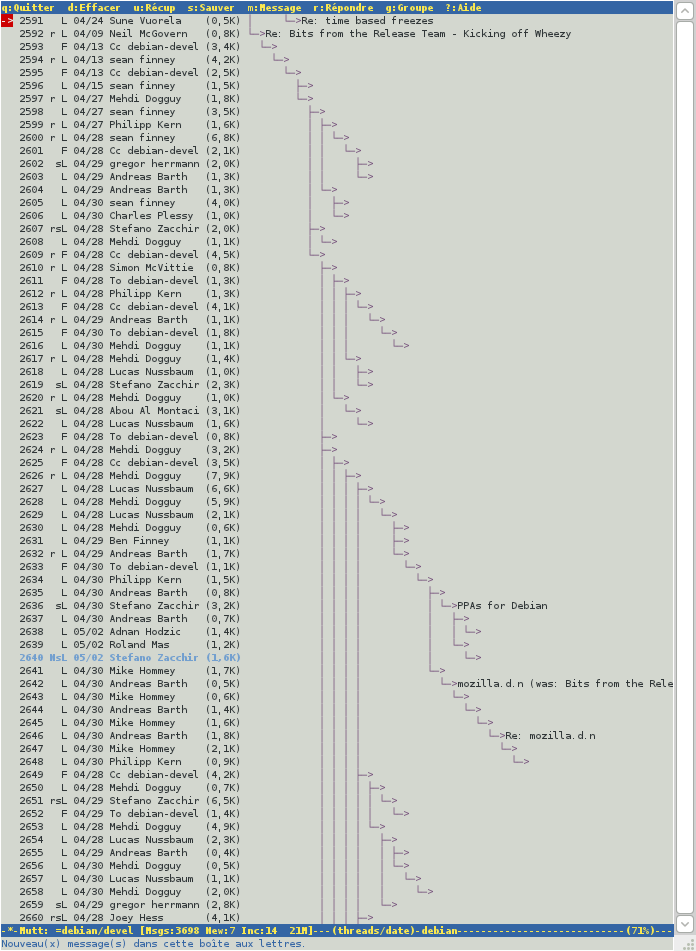
At this point it s a discussion thread of several hundreds of messages (there are several screens of messages like the one above). Many of the sub-threads have been interesting, but the general discussions mixed too many different things so that there s no clear outcome yet. Lucas Nussbaum tried to make a summary. Obviously I must adjust my plan, there s lots of feedback to process. I accepted to drive a DEP together with Sean Finney to help structure the part of the discussion that focuses on allowing development to continue during freezes. But I m also eager to fix the marketing problem of testing and have the project recognize that testing is a product in itself and that end-users should be encouraged to use it. Package Tracking System maintenance The Package Tracking System is an important tool for Debian developers, and it has been broken by some change on the Bug Tracking System. I worked around it quite quickly so that few people noticed the problem but Cron kept reminding me that I had to properly fix it. I ended up doing it last week-end. While working on the PTS, I took the opportunity to merge a patch from Jan Dittberner to enhance the news RSS feed that the PTS provides. And I also integrated information from backports.debian.org (thanks to Mehdi Dogguy for reminding me #549115). Multiarch update Not much new this month. I fixed two bugs in the multiarch dpkg branch thanks to bug reports from Ubuntu users (LP 767634, LP 756381). I m still waiting on Guillem Jover finishing his review of the multiarch branch. I m pinging him from time to time but it looks like multi-arch is no longer in his short term priority list. :-( I ve been running this code for more than 2 months and it works fine. I want to see it merged. I m ready to update my code should anything need to be changed to please Guillem. But without any feedback we re in a deadlock. Misc dpkg work While fixing a bug in update-alternatives (found in one of the valid reports on launchpad), I noticed that there was room for improvements in the error messages output by update-alternatives. I changed them to reuse the same strings that were already used in other parts of dpkg. The result is that there are a few strings less to translate (always a nice thing for the poor translators who have to deal with the thousands of strings that dpkg contains). I also tried to fix some of the most cryptic error messages in dpkg (see #621763) but that work is stalled at the request of Guillem. Book update We (me and Roland Mas) are almost done with the update of our French book for Debian Squeeze. It will hit the shelves in July or September. I m starting to prepare the fundraising campaign to make an English translation of it. We ll use ulule.com for this. On my blog I have been pleased to interview Meike Reichle, it s the first women that I have interviewed in the series but it s certainly not the last one. I also interviewed Adam D. Barratt, one of our tireless release managers. Thanks Many thanks to the people who gave me 180.35 in March and 235.37 in April. That represents 1.5 and 2 days of work for those months. See you next month for a new summary of my activities.

8 comments Liked this article? Click here. My blog is Flattr-enabled.

Luke Faraone: Your release sucks.

I look forward to Ubuntu s semiannual release day, because it s the completion of 6ish months of work by Ubuntu (and by extension Debian) developers.I also loathe it, because every single time we get people saying This Ubuntu release is the worst release ever! .Ubuntu releases are always rocky around release time, because the first time Ubuntu gets widespread testing is on or after release day.We ship software to 12 Million Ubuntu Users with only 150 MOTUs who work directly on the platform. That s a little less than 1 developer with upload rights to the archive for every 60,000 users.1 Compared to Debian, which (at last estimate in 2010) had 1.5 million uniques on security.debian.org, yet has around 1000 Debian Developers.Debian has a strong testing culture; someone once estimated that around of Debian users are running unstable or testing. In Ubuntu, we don t have good metrics on how many people are using the development release that I m aware of (pointers welcome), but I d guess that it s a very very small percentage. A common thread in bug reports, if we get a response at all, goes on as follows:

Triager:2 Is this a problem in $devel?

User: I ll let you know when it hits final

Triager: It s too late then. Then we ll want you to test in the next release. We have to fix it BEFORE its final

User: Ok, I ll test at beta.

Triager: That s 2 weeks before release, which will be too late. Please test ASAP if you want us to have time to fix it Of course, there are really important bugs with hardware support which keep on cropping up. But if they re just getting reported on or around release day, there are limits to what can be done about them this cycle.We need to make it easier for people to run early development versions, and encourage more people to use them (as long as they re willing to deal with breakage). I m not sure whether unstable/testing is appropriate for Ubuntu, and I m fairly confident that we don t want to move to a rolling release (currently being discussed in Debian, summary). But we badly need more developers, and equally importantly, more testers to try it out earlier in the release process.To users: please, please try out the development versions. Download a LiveCD and run a smoketest, or check if bugs you reported are in fact fixed in the later versions. And do it early and often.

  1. This number, like all other usage data, is dated, and probably wasn t even accurate when it was first calculated
  2. Developer, bugcontrol member, etc. Somebody who is not experiencing the problem but wants to help.

2 May 2011

Lucas Nussbaum: Debian rolling discussion on -devel@

Here is my attempt at a summary of the rolling discussion currently happening on debian-devel@. It might not be complete, it s probably a bit biased, but I hope that it s still better than nothing. It was also posted on debian-devel@. If you are involved in Debian development, please discuss it on debian-devel@, rather than in the comments of this blog. If you want to provide feedback about the Debian rolling idea, use this Doodle poll and/or the comments of this blog.

Update : Someone had the good idea to vandalize the poll, and remove all the votes from people in favor of rolling. Before the vadalism (log), the results were:
37 votes: I am a Debian user, I use testing or unstable, and I would like rolling to happen.
6 votes: I am a Debian user, I use testing or unstable, and I DON T want rolling to happen.
17 votes: I am a Debian user, I use stable, and I would like rolling to happen.
3 votes: I am a Debian user, I use stable, and I DON T want rolling to happen.
7 votes: I am NOT a Debian user, but I would probably use it if rolling happened.
1 vote: I am NOT a Debian user, and I don t care about rolling. Motivations There s some user demand for rolling releases. For evidence, one can look at the usage of Debian testing or unstable which clearly goes further than the Debian development community. Or at the quickly growing market share of ArchLinux. Or at the interest in LinuxMint and Aptosid. Or at the DPL s report of his interactions with the press. Debian s only official product is its stable releases. While it s a clearly great and useful product, many users and developers don t recognize themselves in it: it contains software that is too old for their needs. The success of Ubuntu is related to this problem: Ubuntu proposes a different compromise between stability and up-to-date-ness. While concurrencing Ubuntu with more frequent stable releases (released every 6-months, for example) doesn t look like the right thing to do, Debian is in a perfect position to provide a rolling release with marginal additional work, since Debian already has testing (and unstable) to build on. The rolling discussion investigates how we could endorse the concept of a rolling release, provided as a product in addition to stable releases. This rolling release would be based on the current testing branch. Benefits for Debian: Current proposed plan for rolling (Disclaimer: this is mostly my view. It is shared by others, but some details might not be) rolling is mostly about (external) communication. It is not expected to change our development processes fundamentally.
It would be a statement by the project (through a GR, for example). A very preliminary draft was proposed by Raphael Hertzog:
Title: Debian endorses usage of testing by end-users, and renames it to rolling The Debian project recognizes that the Debian testing distribution initially created to make it easier to prepare and test the next stable release has become a useful product of its own. It satisfies the needs of users who are looking for the latest stable versions of software and who can cope (or even appreciate) a system that s constantly evolving. The Debian project decides to endorse this usage and will strive to provide a good experience to users of testing . To better communicate this policy change to our users, testing will be renamed rolling .
Yes, it s mostly PR bullshit , and I don t expect it to significantly change Debian development processes. However, communication is necessary if we want to attract new users. What would change is more attention from developers to what happens in testing/rolling, which is a good thing since a better testing/rolling makes it easier to create stable releases from it. Open questions Most of the discussion is about the influence of the introduction of rolling on Debian development processes, and in particular, on the painful process resulting in stable releases. Many fear that, with rolling , it will be harder to get stable releases out. The root question is: if we do rolling, what do we do during freezes? Several options have been mentioned in the thread:
  1. We could decide not to do anything special: just freeze rolling for ~6 months, as we used to freeze testing. That might bore people who like the constant flux of new upstream releases, but if we decide that it s the only way to ensure high-quality stable releases, so be it.
  2. We could decide to fork a frozen branch when we freeze, and continue to manage rolling using migrations from unstable.
  3. We could mix both solutions: freeze rolling for 3 months, so that most of the stabilization work occurs with a single active branch, and then, for the final release preparation, fork frozen off rolling, and unfreeze rolling.
Two kinds of objections have been raised: Other things that were discussed: Tentative personal conclusion I have the impression that advertising testing as a rolling release usable by end-users is generally considered a good thing.
The renaming of testing to rolling is not as consensual, but most opponents have a whatever ; if you want position. How we deal with freezes is the hard point in this discussion. I m personnally in favor of the freeze rolling for 3 months, then fork frozen and unfreeze rolling plan, though it has some problems too (it is not clear whether the required manpower really decreases at the end of freezes). Where do we go from there? After another round of discussion, we might postpone the how to deal with freezes question to later, and proceed with a GR to measure the support for the testing for end-users + s/testing/rolling/ proposal.

1 May 2011

Christian Perrier: [life] Bhutanese music

I really don't know how I ended up spending this entire evening listening to Bhutanese music. But I did well. I particularly enjoyed Rang Sem Kar Ga Mikar and Gayser Jang Lu Jonpi Gang, which I both found on YouTube. The former reminded be the pleasure and (apparent) simplicity of Bhutanese dances, which I had the privilege to share with guests in Thimphu a few years ago. The latter gives a great idea of the peacefulness of that place of the world (I recommend scenery views some of which probably taken at Dochula Pass). And that language is so beautiful even when one doesn't understand a word. Maybe some readers of this blog will become listeners of Bhutanese music for some time after reading this. I just can wish this. And, doh, I really can't wait until I go back there. I will, one day or another. "Ku Zu Zang Po La" to those who made me discover that place.

Next.

Previous.


