Search Results: "mak"

7 February 2017

Jonathan McDowell: GnuK on the Maple Mini

Last weekend, as a result of my addiction to buying random microcontrollers to play with, I received some Maple Minis. I bought the Baite clone direct from AliExpress - so just under 3 each including delivery. Not bad for something that s USB capable, is based on an ARM and has plenty of IO pins. I m not entirely sure what my plan is for the devices, but as a first step I thought I d look at getting GnuK up and running on it. Only to discover that chopstx already has support for the Maple Mini and it was just a matter of doing a ./configure --vidpid=234b:0000 --target=MAPLE_MINI --enable-factory-reset ; make. I d hoped to install via the DFU bootloader already on the Mini but ended up making it unhappy so used SWD by following the same steps with OpenOCD as for the FST-01/BusPirate. (SWCLK is D21 and SWDIO is D22 on the Mini). Reset after flashing and the device is detected just fine:
usb 1-1.1: new full-speed USB device number 73 using xhci_hcd
usb 1-1.1: New USB device found, idVendor=234b, idProduct=0000
usb 1-1.1: New USB device strings: Mfr=1, Product=2, SerialNumber=3
usb 1-1.1: Product: Gnuk Token
usb 1-1.1: Manufacturer: Free Software Initiative of Japan
usb 1-1.1: SerialNumber: FSIJ-1.2.3-87155426
And GPG is happy:
$ gpg --card-status
Reader ...........: 234B:0000:FSIJ-1.2.3-87155426:0
Application ID ...: D276000124010200FFFE871554260000
Version ..........: 2.0
Manufacturer .....: unmanaged S/N range
Serial number ....: 87155426
Name of cardholder: [not set]
Language prefs ...: [not set]
Sex ..............: unspecified
URL of public key : [not set]
Login data .......: [not set]
Signature PIN ....: forced
Key attributes ...: rsa2048 rsa2048 rsa2048
Max. PIN lengths .: 127 127 127
PIN retry counter : 3 3 3
Signature counter : 0
Signature key ....: [none]
Encryption key....: [none]
Authentication key: [none]
General key info..: [none]
While GnuK isn t the fastest OpenPGP smart card implementation this certainly seems to be one of the cheapest ways to get it up and running. (Plus the fact that chopstx already runs on the Mini provides me with a useful basis for other experimentation.)

Olivier Berger: Making Debian stable/jessie images for OpenStack with bootstrap-vz and cloud-init

I m investigating the creation of VM images for different virtualisation solutions. Among the target platforms is a destop as a service platform based on an OpenStack public cloud. We ve been working with bootstrap-vz for creating VMs for Vagrant+VirtualBox so I wanted to test its use for OpenStack. There are already pre-made images available, including official Debian ones, but I like to be able to re-create things instead of depending on some external magic (which also means to be able to optimize, customize and avoid potential MitM, of course). It appears that bootstrap-vz can be used with cloud-init provided that some bits of config are specified. In particular the cloud_init plugin of bootstrap-vz requires a metadata_source set to NoCloud, ConfigDrive, OpenStack, Ec2 . Note we explicitely spell it OpenStack and not Openstack as was mistakenly done in the default Debian cloud images (see https://bugs.debian.org/854482). The following snippet of manifest provides the necessary bits :
---
name: debian- system.release - system.architecture - %Y %m %d 
provider:
  name: kvm
  virtio_modules:
  - virtio_pci
  - virtio_blk
bootstrapper:
  workspace: /target
  # create or reuse a tarball of packages
  tarball: true
system:
  release: jessie
  architecture: amd64
  bootloader: grub
  charmap: UTF-8
  locale: en_US
  timezone: UTC
volume:
  backing: raw
  partitions:
    #type: gpt
    type: msdos
    root:
      filesystem: ext4
      size: 4GiB
    swap:
      size: 512MiB
packages:
  # change if another mirror is closer
  mirror: http://ftp.fr.debian.org/debian/
plugins:
  root_password:
    password: whatever
  cloud_init:
    username: debian
    # Note we explicitely spell it 'OpenStack' and not 'Openstack' as done in the default Debian cloud images (see https://bugs.debian.org/854482)
    metadata_sources: NoCloud, ConfigDrive, OpenStack, Ec2
  # admin_user:
  #   username: Administrator
  #   password: Whatever
  minimize_size:
    # reduce the size by around 250 Mb
    zerofree: true
I ve tested this with the bootstrap-vz version in stretch/testing (0.9.10+20170110git-1) for creating jessie/stable image, which were booted on the OVH OpenStack public cloud. YMMV. Hope this helps

Sean Whitton: reclaiming conversation

On Friday night I attended a talk by Sherry Turkle called Reclaiming Conversation: The Power of Talk in a Digital Age . Here are my notes.
Turkle is an anthropologist who interviews people from different generations about their communication habits. She has observed cross-generational changes thanks to (a) the proliferation of instant messaging apps such as WhatsApp and Facebook Messenger; and (b) fast web searching from smartphones. Her main concern is that conversation is being trivialised. Consider six or seven college students eating a meal together. Turkle s research has shown that the etiquette among such a group has shifted such that so long as at least three people are engaged in conversation, others at the table feel comfortable turning their attention to their smartphones. But then the topics of verbal conversation will tend away from serious issues you wouldn t talk about your mother s recent death if anyone at the table was texting. There are also studies that purport to show that the visibility of someone s smartphone causes them to take a conversation less seriously. The hypothesis is that the smartphone is a reminder of all the other places they could be, instead of with the person they are with. A related cause of the trivialisation of conversation is that people are far less willing to make themselves emotionally vulnerable by talking about serious matters. People have a high degree of control over the interactions that take place electronically (they can think about their reply for much longer, for example). Texting is not open-ended in the way a face-to-face conversation is. People are unwilling to give up this control, so they choose texting over talking. What is the upshot of these two respects in which conversation is being trivialised? Firstly, there are psycho-social effects on individuals, because people are missing out on opportunities to build relationships. But secondly, there are political effects. Disagreeing about politics immediately makes a conversation quite serious, and people just aren t having those conversations. This contributes to polarisation. Note that this is quite distinct from the problems of fake news and the bubbling effects of search engine algorithms, including Facebook s news feed. It would be much easier to tackle fake news if people talked about it with people around them who would be likely to disagree with them. Turkle understands connection as a capacity for solitude and also for conversation. The drip feed of information from the Internet prevents us from using our capacity for solitude. But then we fail to develop a sense of self. Then when we finally do meet other people in real life, we can t hear them because we just use them to try to establish a sense of self. Turkle wants us to be more aware of the effects that our smartphones can have on conversations. People very rarely take their phone out during a conversation because they want to escape from that conversation. Instead, they think that the phone will contribute to that conversation, by sharing some photos, or looking up some information online. But once the phone has come out, the conversation almost always takes a turn for the worse. If we were more aware of this, we would have access to deeper interactions. A further respect in which the importance of conversation is being downplayed is in the relationships between teachers and students. Students would prefer to get answers by e-mail than build a relationship with their professors, but of course they are expecting far too much of e-mail, which can t teach them in the way interpersonal contact can. All the above is, as I said, cross-generational. Something that is unique to millenials and below is that we seek validation for the way that we feel using social media. A millenial is not sure how they feel until they send a text or make a broadcast (this makes them awfully dependent on others). Older generations feel something, and then seek out social interaction (presumably to share, but not in the social media sense of share ). What does Turkle think we can do about all this? She had one positive suggestion and one negative suggestion. In response to student or colleague e-mails asking for something that ought to be discussed face-to-face, reply I m thinking. And you ll find they come to you. She doesn t want anyone to write empathy apps in response to her findings. For once, more tech is definitely not the answer. Turkle also made reference to the study reported here and here and here.

6 February 2017

Wouter Verhelst: FOSDEM 2017 is finished...

... but that doesn't mean the work is over. One big job that needs to happen after the conference is to review and release the video recordings that were made. With several hundreds of videos to be checked and only a handful of people with the ability to do so, review was a massive job that for the past three editions took several months; e.g., in 2016 the last video work was done in July, when the preparation of the 2017 edition had already started. Obviously this is suboptimal, and therefore another solution was required. After working on it for quite a while (in my spare time), I came up with SReview, a video review and transcoding system written in Perl. An obvious question that could be asked is why I wrote yet another system, though, and did not use something that already existed. The short answer to that is "because what's there did not exactly do what I wanted to". The somewhat longer answer also involves the fact that I felt like writing something from scratch. The full story, however, is this: there isn't very much out there, and what does exist is flawed in some ways. I am aware of three other review systems that are or were used by other conferences:
  1. A bunch of shell scripts that were written by the DebConf video team and hooked into the penta database. Nobody but DebConf ever used it. It allowed review via an NFS share and a webinterface, and required people to watch .dv files directly from the filesystem in a media player. For this and other reasons, it could only ever be used from the conference itself. If nothing else, that final limitation made it impossible for FOSDEM to use it, but even if that wasn't the case it was still too basic to ever be useful for a conference the size of FOSDEM.
  2. A review system used by the CCC "voc" team. I've never actually seen it in use, but I've heard people describe it. It involves a complicated setup of Samba servers, short MPEG transport stream segments, a FUSE filesystem, and kdenlive, which took someone several days to set up as an experiment back at DebConf15. Critically, important parts of it are also not licensed as free software, which to me rules it out for a tool in support of FOSDEM. Even if that wasn't the case, however, I'm still not sure it would be ideal; this system requires intimate knowledge of how it works from its user, which makes it harder for us to crowdsource the review to the speaker, as I had planned to.
  3. Veyepar. This one gets many things right, and we used it for video review at DebConf from DebConf14 onwards, as well as FOSDEM 2014 (but not 2015 or 2016). Unfortunately, it also gets many things wrong. Most of these can be traced back to the fact that Carl, as he freely admits, is not a programmer; he's more of a sysadmin type who also manages to cobble together a few scripts now and then. Some of the things it gets wrong are minor issues that would theoretically be fixable with a minimal amount of effort; others would be more involved. It is also severely underdocumented, and so as a result it is rather tedious for someone not very familiar with the system to be able to use it. On a more personal note, veyepar is also written in the wrong language, so while I might have spent some time improving it, I ended up starting from scratch.
Something all these systems have in common is that they try to avoid postprocessing as much as possible. This only makes sense; if you have to deal with loads and loads of video recordings, having to do too much postprocessing only ensures that it won't get done... Despite the issues that I have with it, I still think that veyepar is a great system, and am not ashamed to say that SReview borrows many ideas and concepts from it. However, it does things differently in some areas, too:
  1. A major focus has been on making the review form be as easy to use as possible. While there is still room for improvement (and help would certainly be welcome in that area from someone with more experience in UI design than me), I think the SReview review form is much easier to use than the veyepar one (which has so many options that it's pretty hard to understand sometimes).
  2. SReview assumes that as soon as there are recordings in a given room sufficient to fill all the time that a particular event in that room was scheduled for, the whole event is available. It will then generate a first rough cut, and send a notification to the speaker in question, as well as the people who organized the devroom. The reviewer will then almost certainly be required to request a second (and possibly third or fourth) cut, but I think the advantage of that is that it makes the review workflow be more intuitive and easier to understand.
  3. Where veyepar requires one or more instances of per-state scripts to be running (which will then each be polling the database and just start a transcode or cut or whatever script as needed), SReview uses a single "dispatch" script, which needs to be run once for the whole system (if using an external scheduler) or once per core that may be used (if not using an external scheduler), and which does all the database polling required. The use of an external scheduler seemed more appropriate, given that things like gridengine exist; gridengine is a job scheduler which allows one to submit a job to be ran on any node in a cluster, along with the resources that this particular job requires, and which will then either find an appropriate node to run the job on, or will put the job in a "pending" state until the required resources can be found. This allows me to more easily add extra encoding capacity when required, and allows me to also do things like allocate less resources to a particular part of the whole system, even while jobs are already running, without necessarily needing to abort jobs that might be using those resources.
The system seems to be working fine, although there's certainly still room for improvement. I'm thinking of using it for DebConf17 too, and will therefore probably work on improving it during DebCamp. Additionally, the experience of using it for FOSDEM 2017 has given me ideas of where to improve it further, so it can be used more easily by different parties, too. Some of these have been filed as issues against a "1.0" milestone on github, but others are only newly formed in my gray matter and will need some thinking through before they can be properly implemented. Certainly, it looks like this will be something that'll give me quite some fun developing further. In the mean time, if you're interested in the state of a particular video of FOSDEM 2017, have a look at the video overview page, which lists all talks along with their review/transcode status. Also, if you were a speaker or devroom organizer at FOSDEM 2017, please check your mailbox and review your talk! With your help, we should hopefully be able to release all our videos by the end of the week. Update (2017-02-06 17:18): clarified my position on the qualities of some of the other systems after feedback from people who were a bit disappointed by my description of them... and which was fair enough. Apologies. Update (2017-02-08 16:26): Fixes to the c3voc stuff after feedback from them.

Russell Coker: SE Linux in Debian/Stretch

Debian/Stretch has been frozen. Before the freeze I got almost all the bugs in policy fixed, both bugs reported in the Debian BTS and bugs that I know about. This is going to be one of the best Debian releases for SE Linux ever. Systemd with SE Linux is working nicely. The support isn t as good as I would like, there is still work to be done for systemd-nspawn. But it s close enough that anyone who needs to use it can use audit2allow to generate the extra rules needed. Systemd-nspawn is not used by default and it s not something that a new Linux user is going to use, I think that expert users who are capable of using such features are capable of doing the extra work to get them going. In terms of systemd-nspawn and some other rough edges, the issue is the difference between writing policy for a single system vs writing policy that works for everyone. If you write policy for your own system you can allow access for a corner case without a lot of effort. But if I wrote policy to allow access for every corner case then they might add up to a combination that can be exploited. I don t recommend blindly adding the output of audit2allow to your local policy (be particularly wary of access to shadow_t and write access to etc_t, lib_t, etc). But OTOH if you have a system that s running in enforcing mode that happens to have one daemon with more access than is ideal then all the other daemons will still be restricted. As for previous releases I plan to keep releasing updates to policy packages in my own apt repository. I m also considering releasing policy source to updates that can be applied on existing Stretch systems. So if you want to run the official Debian packages but need updates that came after Stretch then you can get them. Suggestions on how to distribute such policy source are welcome. Please enjoy SE Linux on Stretch. It s too late for most bug reports regarding Stretch as most of them won t be sufficiently important to justify a Stretch update. The vast majority of SE Linux policy bugs are issues of denying wanted access not permitting unwanted access (so not a security issue) and can be easily fixed by local configuration, so it s really difficult to make a case for an update to Stable. But feel free to send bug reports for Buster (Stretch+1).

Daniel Stender: Howto create a Debian 9 preview as Vagrant box with Packer

I ve got some little scripts and a template here to automatically create Vagrant boxes from cutting edge Debian testing daily snapshots (netinstall ISO image) using HashiCorp s Packer. To create Vagrant boxes with these, you first need a running binary of Packer. There is a Debian package available if that s also your working environment, but Packer is going to be introduced into the stable branch with the upcoming Stretch release itself. However, Ubuntu already has it, and some other derivatives, too. And there are prebuild binaries available from the developer s site which run fine out-of-the-box (you just have to put the single binary somewhere into you $PATH, or expand that to find it). The JSON template should run with any Packer which is available for any of the different systems. Vagrant itself isn t needed to build the box with Packer, but Virtualbox is of course needed to pre bake the machine image within a virtual machine. In Debian the base binaries of Virtualbox are in the contrib archive section, so that source might be added to /etc/apt/sources.list, if haven t already. The scripts have been tested to run with 5.1.10, and I haven t seen that any late versions are demanded in particular, but of course heavily outdated versions might not work properly. Packer installs the guest additions ISO file for Virtualbox into the virtual machine (and the shipped provisioning script then builds them inside). For that, the Debian package which ships that (which is in non-free) is recognized if it is installed, and then could be used by Packer. When the ISO isn t available in the places which Packer checks on the host the builder then automatically downloads the corresponding ISO from http://download.virtualbox.org/virtualbox. When the tarball with the scripts is unpacked, just do make create and the process should run through, if Packer and Virtualbox are available. If your environment doesn t have GNU Make nor wget you might want to copy the relevant lines from the Makefile and run it manually. But if it does, just do it like this:
/tmp/debian-testing-vagrantbox$ make create
virtualbox-iso output will be in this color.
==> virtualbox-iso: Downloading or copying Guest additions
    virtualbox-iso: Downloading or copying: file:///usr/share/virtualbox/VBoxGuestAdditions.iso
==> virtualbox-iso: Downloading or copying ISO
    virtualbox-iso: Downloading or copying: http://cdimage.debian.org/cdimage/daily-builds/daily/arch-latest/amd64/iso-cd/debian-testing-amd64-netinst.iso
    virtualbox-iso: Download progress: 10%
 ... 
    virtualbox-iso: Download progress: 96%
==> virtualbox-iso: Starting HTTP server on port 8219
==> virtualbox-iso: Creating virtual machine...
==> virtualbox-iso: Creating hard drive...
==> virtualbox-iso: Creating forwarded port mapping for communicator (SSH, WinRM, etc) (host port 2885)
==> virtualbox-iso: Starting the virtual machine...
==> virtualbox-iso: Waiting 10s for boot...
==> virtualbox-iso: Typing the boot command...
==> virtualbox-iso: Waiting for SSH to become available...
The Virtualbox window then pops up and the build process continues within the virtual machine for a while. You might want to file a Github issue when there s a problem on your machine, please! (please include the tail of your packer.log) The Packer template (debian-testing-vagrant.json) is described in the documentation of the virtualbox-iso builder. A preseeding script for the Debian Installer (preseed.cfg) is also included which gets injected into the virtual build environment during the build process. The creation progress of the Debian base installation could be easily monitored since the Virtualbox window is fully shown during the Packer run (if you loose your mouse pointer by clicking inside that window, do <Right>+<Control> to escape). For good performance, a fast internet connection is needed since a whole base system must be downloaded if that s available the whole automated process very only takes a couple of minutes to complete on a non-SSD machine. When Packer has finished and a fresh box is created (the size is about 690 MB), it then could be used with Vagrant. Just add the new box with:
/tmp/debian-testing-vagrantbox$ vagrant box add stretch-preview debian-testing-vagrant.box
==> box: Box file was not detected as metadata. Adding it directly...
==> box: Adding box 'stretch-preview' (v0) for provider: 
    box: Unpacking necessary files from: file:///tmp/debian-testing-vagrantbox/debian-testing-vagrant.box
==> box: Successfully added box 'stretch-preview' (v0) for 'virtualbox'!
It then could be initialized within a random working directory with:
/tmp/myproject$ vagrant init stretch-preview
A  Vagrantfile  has been placed in this directory. You are now
ready to  vagrant up  your first virtual environment! Please read
the comments in the Vagrantfile as well as documentation on
 vagrantup.com  for more information on using Vagrant.
After that, you could launch the virtual box with:
/tmp/myproject$ vagrant up
Bringing machine 'default' up with 'virtualbox' provider...
==> default: Importing base box 'stretch-preview'...
==> default: Matching MAC address for NAT networking...
==> default: Setting the name of the VM: myproject_default_1486321215067_75270
==> default: Clearing any previously set network interfaces...
==> default: Preparing network interfaces based on configuration...
    default: Adapter 1: nat
==> default: Forwarding ports...
    default: 22 (guest) => 2222 (host) (adapter 1)
==> default: Booting VM...
==> default: Waiting for machine to boot. This may take a few minutes...
    default: SSH address: 127.0.0.1:2222
    default: SSH username: vagrant
    default: SSH auth method: private key
    default: 
    default: Vagrant insecure key detected. Vagrant will automatically replace
    default: this with a newly generated keypair for better security.
    default: 
    default: Inserting generated public key within guest...
    default: Removing insecure key from the guest if it's present...
    default: Key inserted! Disconnecting and reconnecting using new SSH key...
==> default: Machine booted and ready!
==> default: Checking for guest additions in VM...
==> default: Mounting shared folders...
    default: /vagrant => /tmp/myproject
/tmp/myproject$
Then you can SSH into it by doing (touch is used here only to point to the shared folder):
/tmp/myproject$ touch hello!
/tmp/myproject$ vagrant ssh
The programs included with the Debian GNU/Linux system are free software;
the exact distribution terms for each program are described in the
individual files in /usr/share/doc/*/copyright.
Debian GNU/Linux comes with ABSOLUTELY NO WARRANTY, to the extent
permitted by applicable law.
/usr/bin/xauth:  file /home/vagrant/.Xauthority does not exist
vagrant@packer-virtualbox-iso-1486319595:~$ $ cat /etc/debian_version
9.0
vagrant@packer-virtualbox-iso-1486319595:~$ ls /vagrant/
hello!  Vagrantfile
vagrant@packer-virtualbox-iso-1486319595:~$ exit
logout
Connection to 127.0.0.1 closed.
/tmp/myproject$ vagrant halt
==> default: Attempting graceful shutdown of VM...
/tmp/myproject$
If you haven t worked with Vagrant before, maybe this is appealing. The user experience is somehwhat different from working with a chroot. Packer makes it very convenient to keep freshly created boxes for it coming. Have fun!

5 February 2017

Iustin Pop: Short rant/review of La La Land

Warning: Spoilers below. Rant below. Much angry, MANY ALL-CAPS. You've been warned! So, today we went to see "La La Land", because I've heard good things about it, and because I do enjoy good musicals. And because of this, I wrote this post, instead of what I originally had in mind (related to kernel configuration). Was it a good movie? Definitely yes. Was it a good musical? So and so. Did I like the ending? HELL NO, over and over NO. The movie itself was much better than I expected. I don't read plot details in advance nor real reviews, so I expected more of a musical, and less of a good plot. But the movie had a very good plot. Two young people, striving to fulfil their artistic dreams, fall in love, and they fight through-sometimes helping, sometimes hindering each other until, finally, each gets their own breakthrough, etc. The choice of actress was spot on halfway through the movie, I was thinking that I can't imagine the same plot played by a different actress. Of course many other actresses could have played the part, but Emma Stone played so well, I have trouble seeing the same character with the same always half-happy, half-sad attitude. The choice of actor was I think OK at first I was in doubt, but he played also well. Or maybe it was just that I couldn't identify with him at first. Not that I identify well with artists in general The dance scenes were OK, and the singing good, but as I said, the musical part was secondary to the actual struggles of the characters. The movie itself was, technically, very well done; a lot of filming was in bars/clubs/locations with difficult lighting, and the shooting was very good. They also had a scene on a pier, looking towards the ocean and the setting sun, and the characters walking towards the beach so heavily back-lighted, and I kept thinking "If I get only one shot this perfectly exposed and colour correct(ed), I'm happy". So high notes here. Back to the plot. The story of how she and him fought their own struggles was very nicely told. Tick-tack, up and down (hope and rejection), leaning on the other to get morale back, is a captivating story. The cliff-hanger at the pre-end with her career, the going back home, the last minute save, all very well told. So at this stage, I would have given the movie a 9/10. And I was happy. Then we have the usual "one character has to go away to a far away country for a long time", except in this case it was just 4 months. And they have the usual discussion "what do we do with our relation, where do we take it", and she says "I will always love you", to which he replies "And I will too" (or equivalent). In my mind, this means they'll have to survive during the break, they'll have to also survive through his touring months/years, but in the end love will be stronger. Because this is what the movie told us until now, that she made it because of him, and he made it because of her. Neither of them would have been this strong without the other (he wouldn't have picked up the invitation from his old pal, she wouldn't have gone to the final audition request nor write the play which got her the audition/recognition). Estimated movie ending: awesome. And then something happens. The timeline jumps 5 years in the future (as expected), and she is famous, married (WITH SOMEONE ELSE) and happy mother of a 3-year old. Through fate, she and her husband enter the club of Sebastian (as he also fulfilled his dream), she and Sebastian see each other, he plays their song, during which we're served a re-run of the movie but in stupid "everything goes well" style (all bad events eliminated), in which it is she and Sebastian who enter the club (which belongs now to somebody else), and then we're back in real time, song ends, she and her husband leave, but before that she and Sebastian exchange one last smile, THE END. And I'm sitting there, not believing my eyes. WHAT THE? So I get home, not write this post for four hours to calm down, but I can't. Because this doesn't make sense. AT ALL. What does the internet say? Quoting from this CNN article, written exactly today. The director says:
"That ending was there from the get-go," [director Damien Chazelle] told CNN in a recent interview. "I think I just have a thing about love stories where the lovers don't wind up together at the end; I find it very romantic."
Huh, excuse me?
"I think there's a reason why most of the greatest love stories in history don't end with happily ever after," Chazelle said. "To me, if you're telling a story about love, love has to be bigger than the characters." Chazelle sees Mia and Sebastian's love as a "third character" and something that "lives on." "[The ending gives] you that sense that even if the relationship itself might be over in practical terms, the love is not over," he said. "The love lasts, and I think that's just a beautiful kind of thing."
OH FOR THE LOVE OF. This is a wishy-washy explanation that tries to approach the thing from the artistic side. No, this is bullshit, because of multiple things. Let me try to roll back and explain what I think was the intention.
  1. An earlier fight between Mia and Sebastian points to the fact that they're both very dedicated to their careers, and this means it's hard for them to stay together if they both chase their dream. He has to be on tour, and she has to rehearse for her play, so they won't see each other for at least two weeks (in this instance). Later, she calls him and leaves a message that she hasn't seen him in a while (complex scene which ends in another fight, which is very well done). So we see the conflict that seems to say "You can't have a relation of equals; one party has to give up their dream". While this might be partially true in the real world, I don't go to movies to see the real world.
  2. After the year-long window into their life, I can't think that either Sebastian or Mia can be really successful without the other; because they are so alike, so passionate about their dreams, that a normal person wouldn't be able to understand and push the other when they need. However, the ending show both Mia and Sebastian quite successful, so one has to wonder: did they make it alone? Sebastian seems so (we don't see a partner for him), Mia unclear, likely not. How did Sebastian get through? What did Mia find in her husband?
  3. This is very one-sided, since I'm a man, so bear with me: Sebastian helped Mia through her tough time. Once she got the breakthrough (and they split), she found somebody else, and I have to wonder in what circumstances they met. In the sense that maybe her husband only knew "successful Mia" and not "struggling/aspiring Mia". Her husband seems completely oblivious to all the eye contact between Mia and Sebastian in the club, seems to know Sebastian/about Sebastian not. How deep is their relation?
  4. This is still one sided, sorry. When they break up (before Mia leaves for Paris), Sebastian asks "so where do we go from here?". Mia says "Nowhere". He asks once more, she rejects him again. So after one year of mad love and cries and happy moments, he gives up over two sentences? He's been following his dream (proper Jazz) in spite of all downturns in life until then, but he gives up on his real love over this? It doesn't make sense; trying to identify my self with the character, I can't reconcile this scene at all, unless he didn't really love her.
So no, I don't see them ending apart as romantic. I see it as the director is saying "You can't have both love and your [career] dreams. Choose either.", and he gives the "love" fake ending in the mini-re-roll of the movie, and the "career" wrong ending in the actual ending. And worse, he does it by negating significant parts of the character development done until now. Moreover, this conclusion is wrong. Wrong because this is a movie, and if movies don't manage to make you dream that you can achieve all, if movies tell you "choose either", then all is lost. Their love is not a separate character; them struggling to find each other in the successful phase of their life, learning to adapt to the new "he" and "she", would be the third thing. As it was shown, their love is simply a young love, that can't really survive the changes in life; they each said "I'll love you forever", but with this ending it sounds more "I'll cherish the memory of young you forever". Or differently said, it sounded like a cheap excuse to use when ending their relationship, in order to not negate the relationship itself. My version of the movie is another half hour long. It explains how Sebastian get over the "only jazz is pure old jazz" and manages to build a successful business around his old-style-but-modern jazz, instead of the pop-style jazz of the touring band (while thinking about her). It explains how Mia becomes a successful actress and gets over her first/second movies (while thinking about him), because one movie doesn't make one really successful (that reminds me: 3 year old child after 5 year forward-jump? when/how did her career go?). Hell, make it even more bitter show how their correspondence starts strong but becomes more and more sporadic over time, dying after the first 2 years. Show how both of them try other relations, and not find the same spark that they had before. And then, after they have matured, they meet again. And, just like the first time, they fall for each other, once again. She for his music, him for her passion for acting/for acting itself. She finds that him naming his club after her suggestion is oh-so-grown-up-and-sweet, he is happy that she finally grew into what he saw in her from the beginning. And he sings their song once more. But no. I'm not an artist, so I can only get the "die hope die die die love because I can" version. I still recommend the movie, but not the "after 5 years" scenes. Also, I didn't get time to bike today nor yesterday, so all you really get here is an ANGRY RANT. Because while I drink the coffee black and the tea without sugar, I like my happy endings, DAMN IT.

Vincent Bernat: A Makefile for your Go project

My most loathed feature of Go is the mandatory use of GOPATH: I do not want to put my own code next to its dependencies. Hopefully, this issue is slowly starting to be accepted by the main authors. In the meantime, you can workaround this problem with more opinionated tools (like gb) or by crafting your own Makefile. For the later, you can have a look at Filippo Valsorda s example or my own take which I describe in more details here. This is not meant to be an universal Makefile but a relatively short one with some batteries included. It comes with a simple Hello World! application.

Project structure For a standalone project, vendoring is a must-have1 as you cannot rely on your dependencies to not introduce backward-incompatible changes. Some packages are using versioned URLs but most of them aren t. There is currently no standard tool to handle vendoring. My personal take is to vendor all dependencies with Glide. It is a good practice to split an application into different packages while the main one stay fairly small. In the hellogopher example, the CLI is handled in the cmd package while the application logic for printing greetings is in the hello package:
.
  cmd/
    hello.go
    root.go
    version.go
  glide.lock (generated)
  glide.yaml
  vendor/ (dependencies will go there)
  hello/
    root.go
    root_test.go
  main.go
  Makefile
  README.md

Down the rabbit hole Let s take a look at the various features of the Makefile.

GOPATH handling Since all dependencies are vendored, only our own project needs to be in the GOPATH:
PACKAGE  = hellogopher
GOPATH   = $(CURDIR)/.gopath
BASE     = $(GOPATH)/src/$(PACKAGE)
$(BASE):
    @mkdir -p $(dir $@)
    @ln -sf $(CURDIR) $@
The base import path is hellogopher, not github.com/vincentbernat/hellogopher: this shortens imports and makes them easily distinguishable from imports of dependency packages. However, your application won t be go get-able. This is a personal choice and can be adjusted with the $(PACKAGE) variable. We just create a symlink from .gopath/src/hellogopher to our root directory. The GOPATH environment variable is automatically exported to the shell commands of the recipes. Any tool should work fine after changing the current directory to $(BASE). For example, this snippet builds the executable:
.PHONY: all
all:   $(BASE)
    cd $(BASE) && $(GO) build -o bin/$(PACKAGE) main.go

Vendoring dependencies Glide is a bit like Ruby s Bundler. In glide.yaml, you specify what packages you need and the constraints you want on them. Glide computes a glide.lock file containing the exact versions for each dependencies (including recursive dependencies) and download them in the vendor/ folder. I choose to check into the VCS both glide.yaml and glide.lock files. It s also possible to only check in the first one or to also check in the vendor/ directory. A work-in-progress is currently ongoing to provide a standard dependency management tool with a similar workflow. We define two rules2:
GLIDE = glide
glide.lock: glide.yaml   $(BASE)
    cd $(BASE) && $(GLIDE) update
    @touch $@
vendor: glide.lock   $(BASE)
    cd $(BASE) && $(GLIDE) --quiet install
    @ln -sf . vendor/src
    @touch $@
We use a variable to invoke glide. This enables a user to easily override it (for example, with make GLIDE=$GOPATH/bin/glide).

Using third-party tools Most projects need some third-party tools. We can either expect them to be already installed or compile them in our private GOPATH. For example, here is the lint rule:
BIN    = $(GOPATH)/bin
GOLINT = $(BIN)/golint
$(BIN)/golint:   $(BASE) #  
    go get github.com/golang/lint/golint
.PHONY: lint
lint: vendor   $(BASE) $(GOLINT) #  
    @cd $(BASE) && ret=0 && for pkg in $(PKGS); do \
        test -z "$$($(GOLINT) $$pkg   tee /dev/stderr)"   ret=1 ; \
     done ; exit $$ret
As for glide, we let the user a chance to override which golint executable to use. By default, it uses a private copy. But a user can use its own copy with make GOLINT=/usr/bin/golint. In , we have the recipe to build the private copy. We simply issue go get3 to download and build golint. In , the lint rule executes golint on each package contained in the $(PKGS) variable. We ll explain this variable in the next section.

Working with non-vendored packages only Some commands need to be provided with a list of packages. Because we use a vendor/ directory, the shortcut ./... is not what we expect as we don t want to run tests on our dependencies4. Therefore, we compose a list of packages we care about:
PKGS = $(or $(PKG), $(shell cd $(BASE) && \
    env GOPATH=$(GOPATH) $(GO) list ./...   grep -v "^$(PACKAGE)/vendor/"))
If the user has provided the $(PKG) variable, we use it. For example, if they want to lint only the cmd package, they can invoke make lint PKG=hellogopher/cmd which is more intuitive than specifying PKGS. Otherwise, we just execute go list ./... but we remove anything from the vendor directory.

Tests Here are some rules to run tests:
TIMEOUT = 20
TEST_TARGETS := test-default test-bench test-short test-verbose test-race
.PHONY: $(TEST_TARGETS) check test tests
test-bench:   ARGS=-run=__absolutelynothing__ -bench=.
test-short:   ARGS=-short
test-verbose: ARGS=-v
test-race:    ARGS=-race
$(TEST_TARGETS): test
check test tests: fmt lint vendor   $(BASE)
    @cd $(BASE) && $(GO) test -timeout $(TIMEOUT)s $(ARGS) $(PKGS)
A user can invoke tests in different ways:
  • make test runs all tests;
  • make test TIMEOUT=10 runs all tests with a timeout of 10 seconds;
  • make test PKG=hellogopher/cmd only runs tests for the cmd package;
  • make test ARGS="-v -short" runs tests with the specified arguments;
  • make test-race runs tests with race detector enabled.

Tests coverage go test includes a test coverage tool. Unfortunately, it only handles one package at a time and you have to explicitely list the packages to be instrumented, otherwise the instrumentation is limited to the currently tested package. If you provide too many packages, the compilation time will skyrocket. Moreover, if you want an output compatible with Jenkins, you ll need some additional tools.
COVERAGE_MODE    = atomic
COVERAGE_PROFILE = $(COVERAGE_DIR)/profile.out
COVERAGE_XML     = $(COVERAGE_DIR)/coverage.xml
COVERAGE_HTML    = $(COVERAGE_DIR)/index.html
.PHONY: test-coverage test-coverage-tools
test-coverage-tools:   $(GOCOVMERGE) $(GOCOV) $(GOCOVXML) #  
test-coverage: COVERAGE_DIR := $(CURDIR)/test/coverage.$(shell date -Iseconds)
test-coverage: fmt lint vendor test-coverage-tools   $(BASE)
    @mkdir -p $(COVERAGE_DIR)/coverage
    @cd $(BASE) && for pkg in $(PKGS); do \ #  
        $(GO) test \
            -coverpkg=$$($(GO) list -f '  join .Deps "\n"  ' $$pkg   \
                    grep '^$(PACKAGE)/'   grep -v '^$(PACKAGE)/vendor/'   \
                    tr '\n' ',')$$pkg \
            -covermode=$(COVERAGE_MODE) \
            -coverprofile="$(COVERAGE_DIR)/coverage/ echo $$pkg   tr "/" "-" .cover" $$pkg ;\
     done
    @$(GOCOVMERGE) $(COVERAGE_DIR)/coverage/*.cover > $(COVERAGE_PROFILE)
    @$(GO) tool cover -html=$(COVERAGE_PROFILE) -o $(COVERAGE_HTML)
    @$(GOCOV) convert $(COVERAGE_PROFILE)   $(GOCOVXML) > $(COVERAGE_XML)
First, we define some variables to let the user override them. We also require the following tools (in ):
  • gocovmerge merges profiles from different runs into a single one;
  • gocov-xml converts a coverage profile to the Cobertura format;
  • gocov is needed to convert a coverage profile to a format handled by gocov-xml.
The rules to build those tools are similar to the rule for golint described a few sections ago. In , for each package to test, we run go test with the -coverprofile argument. We also explicitely provide the list of packages to instrument to -coverpkg by using go list to get a list of dependencies for the tested package and keeping only our owns.

Final result While the main goal of using a Makefile was to work around GOPATH, it s also a good place to hide the complexity of some operations, notably around test coverage. The excerpts provided in this post are a bit simplified. Have a look at the final result for more perks!

  1. In Go, vendoring is about both bundling and dependency management. As the Go ecosystem matures, the bundling part (fixed snapshots of dependencies) may become optional but the vendor/ directory may stay for dependency management (retrieval of the latest versions of dependencies matching a set of constraints).
  2. If you don t want to automatically update glide.lock when a change is detected in glide.yaml, rename the target to deps-update and make it a phony target.
  3. There is some irony for bad mouthing go get and then immediately use it because it is convenient.
  4. I think ./... should not include the vendor/ directory by default. Dependencies should be trusted to have run their own tests in the environment they expect them to succeed. Unfortunately, this is unlikely to change.

Francois Marier: IPv6 and OpenVPN on Linode Debian/Ubuntu VPS

Here is how I managed to extend my OpenVPN setup on my Linode VPS to include IPv6 traffic. This ensures that clients can route all of their traffic through the VPN and avoid leaking IPv6 traffic, for example. It also enables clients on IPv4-only networks to receive a routable IPv6 address and connect to IPv6-only servers (i.e. running your own IPv6 broker).

Request an additional IPv6 block The first thing you need to do is get a new IPv6 address block (or "pool" as Linode calls it) from which you can allocate a single address to each VPN client that connects to the server. If you are using a Linode VPS, there are instructions on how to request a new IPv6 pool. Note that you need to get an address block between /64 and /112. A /116 like Linode offers won't work in OpenVPN. Thankfully, Linode is happy to allocate you an extra /64 for free.

Setup the new IPv6 address If your server only has an single IPv4 address and a single IPv6 address, then a simple DHCP-backed network configuration will work fine. To add the second IPv6 block on the other hand, I had to change my network configuration (/etc/network/interfaces) to this:
auto lo
iface lo inet loopback
allow-hotplug eth0
iface eth0 inet dhcp
    pre-up iptables-restore /etc/network/iptables.up.rules
iface eth0 inet6 static
    address 2600:3c01::xxxx:xxxx:xxxx:939f/64
    gateway fe80::1
    pre-up ip6tables-restore /etc/network/ip6tables.up.rules
iface tun0 inet6 static
    address 2600:3c01:xxxx:xxxx::/64
    pre-up ip6tables-restore /etc/network/ip6tables.up.rules
where 2600:3c01::xxxx:xxxx:xxxx:939f/64 (bound to eth0) is your main IPv6 address and 2600:3c01:xxxx:xxxx::/64 (bound to tun0) is the new block you requested. Once you've setup the new IPv6 block, test it from another IPv6-enabled host using:
ping6 2600:3c01:xxxx:xxxx::1

OpenVPN configuration The only thing I had to change in my OpenVPN configuration (/etc/openvpn/server.conf) was to change:
proto udp
to:
proto udp6
in order to make the VPN server available over both IPv4 and IPv6, and to add the following lines:
server-ipv6 2600:3c01:xxxx:xxxx::/64
push "route-ipv6 2000::/3"
to bind to the right V6 address and to tell clients to tunnel all V6 Internet traffic through the VPN. In addition to updating the OpenVPN config, you will need to add the following line to /etc/sysctl.d/openvpn.conf:
net.ipv6.conf.all.forwarding=1
and the following to your firewall (e.g. /etc/network/ip6tables.up.rules):
# openvpn
-A INPUT -p udp --dport 1194 -j ACCEPT
-A FORWARD -m state --state NEW -i tun0 -o eth0 -s 2600:3c01:xxxx:xxxx::/64 -j ACCEPT
-A FORWARD -m state --state NEW -i eth0 -o tun0 -d 2600:3c01:xxxx:xxxx::/64 -j ACCEPT
-A FORWARD -m state --state ESTABLISHED,RELATED -j ACCEPT
in order to ensure that IPv6 packets are forwarded from the eth0 network interface to tun0 on the VPN server. With all of this done, apply the settings by running:
sysctl -p /etc/sysctl.d/openvpn.conf
ip6tables-apply
systemctl restart openvpn.service

Testing the connection Now connect to the VPN using your desktop client and check that the default IPv6 route is set correctly using ip -6 route. Then you can ping the server's new IP address:
ping6 2600:3c01:xxxx:xxxx::1
and from the server, you can ping the client's IP (which you can see in the network settings):
ping6 2600:3c01:xxxx:xxxx::1002
Once both ends of the tunnel can talk to each other, you can try pinging an IPv6-only server from your client:
ping6 ipv6.google.com
and then pinging your client from an IPv6-enabled host somewhere:
ping6 2600:3c01:xxxx:xxxx::1002
If that works, other online tests should also work.

Shirish Agarwal: Flights of fancy how to figure trends for Airline tickets.

Google Flights Fees tracking

Google Flights Fees tracking between PNQ and YUL and back, economy fares.

Couple of weeks ago, either on some mailing list, on IRC or somewhere else, somebody mentioned that people always put higher amount of airline expenditure for self when asking for sponsorship. Now last year, between sending the application and getting the approval for sponsorship, there was 3 months of difference between the two. Now if you put up an application for sponsorship like I did last year, I had added 10% to the cost of flight tickets of the cheapest prevailing prices at that point in time on skyscanner or any of the meta-search-engines were showing me at that point in time. I was sceptical whether the amount that I had put for the to and fro tickets would be enough or not. Strangely, I was lucky enough to get my ticket around the new estimated price. I would have to mention though that there were only 2 tickets left at the new price and if I had waited just a few hours more, those tickets would have gone too and all other tickets were around 25% more than before. The only reasons I could fathom are a. Luck, pure and simple. b. Going at the end of the tourism season This was evident as I was able to book my extended stay at any hostel just 2 days before my stay at UCT (University of Cape Town) was over. Was corroborated by hostel staff, shop-owners as well as whatever info. I found on the web before and during my stay in SA. c. South Africa being more lenient than probably Canada is giving and processing visas. While looking at the third point, thought I better check world tourism rankings and saw the Wikipedia page for it. Interestingly, South Africa seems to have a slight edge over Canada when it comes to statistics and hence strengthens my assumptions that probably more people apply for SA than Canada as they know the possibility of more people making through visa processing. It would stand to be logical that more people would apply for a tourist or similar short-term resident visas if they know they have a good chance going through. While researching on the topic I also came across/ hunted to find the hardest places to get a Visa for and was surprised to find India being lasted therein.Coincidentally, that site also has a UK domain.It does burst the bubble in Incredible India a little bit. As a newbie who had no clue I knew I was probably a victim of Information Asymmetry where the airlines have much more information about travel trends, ongoing trends at Airports, Politics and Economics of Countries, Price of Crude Oil, Profit, Competition and probably many more factors that I haven t taken into account which decide fares. While researching on the topic, one of the interesting finds I had while trying to figure the above is that Airlines didn t pass on fuel savings to their customers. Now I don t know whether this was the same around the world or was this only in UK. I am shocked that British (and by definition EU, as UK was part of EU at that time) travellers or consumer groups didn t file a suit in the court of law as reading the above smells of anticompetitive behaviour. The most shocking statement was this Average fares to Spain rose by 10 per cent over the same period. Telegraph, UK. In order to lessen this information asymmetry a bit, I used google flights and its data of the past 2 months to see how the fares have been changing to have some insight of where the fares might end up. I know google is hated by one and all, but in this instance I couldn t find any comparable site which does this kind of thing. As can be seen in the graph, the tickets had started relatively cheap from around INR 65k ish to around 80k ish at this point in time. That is a jump of around 30% in the last couple of months. All of these flights have a layover somewhere in Europe and taking a second flight from there to Canada. The one which didn t show much of action is the direct plan between BOM YUL and back but then this seems to be a premium service . Taking a direct flight from BOM YUL is north of INR 90k/- which doesn t make much sense unless one is fond of spending 13+ hours in flight. Definitely not my cup of tea. With layovers it makes the experience a bit more bearable. While the real action is probably 3 or bit more months away, its interesting to see how things are panning out at least on airline price tickets and the dynamics involved therein. Even with all the above attempts at finding the answer, I m no closer to figuring out to estimate airline ticket prices when window is largish 3 months in making. Any ideas anybody? If the previous jump is any indication, then 10-15% escalation bit might not hack this time around. Any strategies that people could advise while trying to put a ball-park figure.
Filed under: Miscellenous Tagged: #air-travel, #Airfares, #Competition, #Price Estimation, #Sponsorship

4 February 2017

Markus Koschany: My Free Software Activities in January 2017

Welcome to gambaru.de. Here is my monthly report that covers what I have been doing for Debian. If you re interested in Java, Games and LTS topics, this might be interesting for you. Debian Games Debian Java Debian LTS This was my eleventh month as a paid contributor and I have been paid to work 12,75 hours on Debian LTS, a project started by Rapha l Hertzog. In that time I did the following: Misc

Niels Thykier: The stretch freeze is coming

The soft freeze has been on going for almost a month now and the full stretch freeze will start tomorrow night (UTC). It has definitely been visible in the number of unblock requests that we have received so far. Fortunately, we are no where near the rate of the jessie freeze. At the moment, all unblock requests are waiting for the submitter (either for a clarification or an upload). Looking at stretch at a glance (items are in no particular order): Secure boot support Currently, we are blocked on two items: After they are done, we are missing a handful of uploads to provide a signed bootloader etc. plus d-i and some infrastructure bits need to be updated. At the moment, we are waiting for a handful of key people/organisations to move on their part. As such, there is not a lot you can do to assist here (unless you are already involved in the work).
On the flip side, if both of these items are resolved soon, there is a good chance that we can support secure boot in stretch.See bug#820036 and blockers for more information on the remaining items. Where can you help with the release? At the moment, the best you can do is to: Release Critical Bug report The UDD bugs interface currently knows about the following release critical bugs:
Filed under: Debian, Release-Team

3 February 2017

Benjamin Mako Hill: New Dataset: Five Years of Longitudinal Data from Scratch

Scratch is a block-based programming language created by the Lifelong Kindergarten Group (LLK) at the MIT Media Lab. Scratch gives kids the power to use programming to create their own interactive animations and computer games. Since 2007, the online community that allows Scratch programmers to share, remix, and socialize around their projects has drawn more than 16 million users who have shared nearly 20 million projects and more than 100 million comments. It is one of the most popular ways for kids to learn programming and among the larger online communities for kids in general.
Front page of the Scratch online community (https://scratch.mit.edu) during the period covered by the dataset.
Since 2010, I have published a series of papers using quantitative data collected from the database behind the Scratch online community. As the source of data for many of my first quantitative and data scientific papers, it s not a major exaggeration to say that I have built my academic career on the dataset. I was able to do this work because I happened to be doing my masters in a research group that shared a physical space ( The Cube ) with LLK and because I was friends with Andr s Monroy-Hern ndez, who started in my masters cohort at the Media Lab. A year or so after we met, Andr s conceived of the Scratch online community and created the first version for his masters thesis project. Because I was at MIT and because I knew the right people, I was able to get added to the IRB protocols and jump through the hoops necessary to get access to the database. Over the years, Andr s and I have heard over and over, in conversation and in reviews of our papers, that we were privileged to have access to such a rich dataset. More than three years ago, Andr s and I began trying to figure out how we might broaden this access. Andr s had the idea of taking advantage of the launch of Scratch 2.0 in 2013 to focus on trying to release the first five years of Scratch 1.x online community data (March 2007 through March 2012) most of the period that the codebase he had written ran the site. After more work than I have put into any single research paper or project, Andr s and I have published a data descriptor in Nature s new journal Scientific Data. This means that the data is now accessible to other researchers. The data includes five years of detailed longitudinal data organized in 32 tables with information drawn from more than 1 million Scratch users, nearly 2 million Scratch projects, more than 10 million comments, more than 30 million visits to Scratch projects, and much more. The dataset includes metadata on user behavior as well the full source code for every project. Alongside the data is the source code for all of the software that ran the website and that users used to create the projects as well as the code used to produce the dataset we ve released. Releasing the dataset was a complicated process. First, we had navigate important ethical concerns about the the impact that a release of any data might have on Scratch s users. Toward that end, we worked closely with the Scratch team and the the ethics board at MIT to design a protocol for the release that balanced these risks with the benefit of a release. The most important features of our approach in this regard is that the dataset we re releasing is limited to only public data. Although the data is public, we understand that computational access to data is different in important ways to access via a browser or API. As a result, we re requiring anybody interested in the data to tell us who they are and agree to a detailed usage agreement. The Scratch team will vet these applicants. Although we re worried that this creates a barrier to access, we think this approach strikes a reasonable balance. Beyond the the social and ethical issues, creating the dataset was an enormous task. Andr s and I spent Sunday afternoons over much of the last three years going column-by-column through the MySQL database that ran Scratch. We looked through the source code and the version control system to figure out how the data was created. We spent an enormous amount of time trying to figure out which columns and rows were public. Most of our work went into creating detailed codebooks and documentation that we hope makes the process of using this data much easier for others (the data descriptor is just a brief overview of what s available). Serializing some of the larger tables took days of computer time. In this process, we had a huge amount of help from many others including an enormous amount of time and support from Mitch Resnick, Natalie Rusk, Sayamindu Dasgupta, and Benjamin Berg at MIT as well as from many other on the Scratch Team. We also had an enormous amount of feedback from a group of a couple dozen researchers who tested the release as well as others who helped us work through through the technical, social, and ethical challenges. The National Science Foundation funded both my work on the project and the creation of Scratch itself. Because access to data has been limited, there has been less research on Scratch than the importance of the system warrants. We hope our work will change this. We can imagine studies using the dataset by scholars in communication, computer science, education, sociology, network science, and beyond. We re hoping that by opening up this dataset to others, scholars with different interests, different questions, and in different fields can benefit in the way that Andr s and I have. I suspect that there are other careers waiting to be made with this dataset and I m excited by the prospect of watching those careers develop. You can find out more about the dataset, and how to apply for access, by reading the data descriptor on Nature s website.

Marc 'Zugschlus' Haber: insecssh

Yes, You Should Not discard cached ssh host keys without looking. An unexpected change of an ssh host key is always a reason to step back from the keyboard and think. However, there are situations when you know that a systems ssh host key has changed, for example when the system reachable under this host name has been redeployed, which happens increasingly often proportionally to the devopsness of your environment, or for example in test environments. Later versions of ssh offer you the ssh-keygen -R command line to paste from the error message, so that you can abort the connection attempt, paste the command and reconnect again. This will still ask for confirmation of the new host key though. Almost every sysadmin has an alias or wrapper to make handling of this situation easier. Solutions range from using StrictHostKeyChecking no and/or UserKnownHostsFile /dev/null , turning off this layer of securit altogether either globally or usually too broadly, to more-or-less sophisticated solutions that involve turning off know-host file hashing, parsing client output and/or grep-sed-awk magic. grml even comes with an insecssh script that is rather neat and that I used until I developed my own. Later ssh versions (not including the 6.7 in Debian jessie, but the 7.4 in debian sid) do offer a -G command line option which will give access to configuration options after the complete client configurtion was processed. This will allow you to neatly get access to the actual hostname the ssh client will connect to. This can, in turn be used to obtain the IP address so that all traces of the host and its IP addresses can be removed from the known_hosts file before the actual connection is done. The following script is the insecssh that I currently use. It only uses documented interfaces to the ssh client which I consider rather neat.
#!/bin/bash
HOSTNAME=$(ssh -G  $@    grep  ^hostname '   awk  print $2 )
CNAME= 1 
while [ -n  $CNAME  ]; do
  CNAME=$(dig +short +search -t CNAME  $HOSTNAME )
  if [ -n  $CNAME  ]; then
    HOSTNAME= $CNAME 
  fi
done
IP4ADDRESS=$(dig +short +search -t A  $HOSTNAME )
IP6ADDRESS=$(dig +short +search -t AAAA  $HOSTNAME )
echo  HOSTNAME $HOSTNAME 
echo  IP4ADDRESS $IP4ADDRESS 
echo  IP6ADDRESS $IP6ADDRESS 
[ -n  $HOSTNAME  ] && ssh-keygen -R  $HOSTNAME 
[ -n  $IP4ADDRESS  ] && ssh-keygen -R  $IP4ADDRESS 
[ -n  $IP6ADDRESS  ] && ssh-keygen -R  $IP6ADDRESS 
ssh -oStrictHostKeyChecking=no -oVisualHostKey=yes  $@ 
Ugliness results from the necessity of following CNAMEs manually since there is - to my knowlegde (educate me!) - no command line utility that has the output simplicity and selection powers of dig which can automatically follow CNAMEs without relying on the recursor having the CNAME cached or not. Use this script if you know that a host has changed its host key. It will first zap all knowledge of the previous host key from known_hosts and then invoke the ssh client with the given arguments from its command line, with options added so that you ll see the new host key in random art and that you don t need to manually confirm the new host key.

Petter Reinholdtsen: A day in court challenging seizure of popcorn-time.no for #domstolkontroll

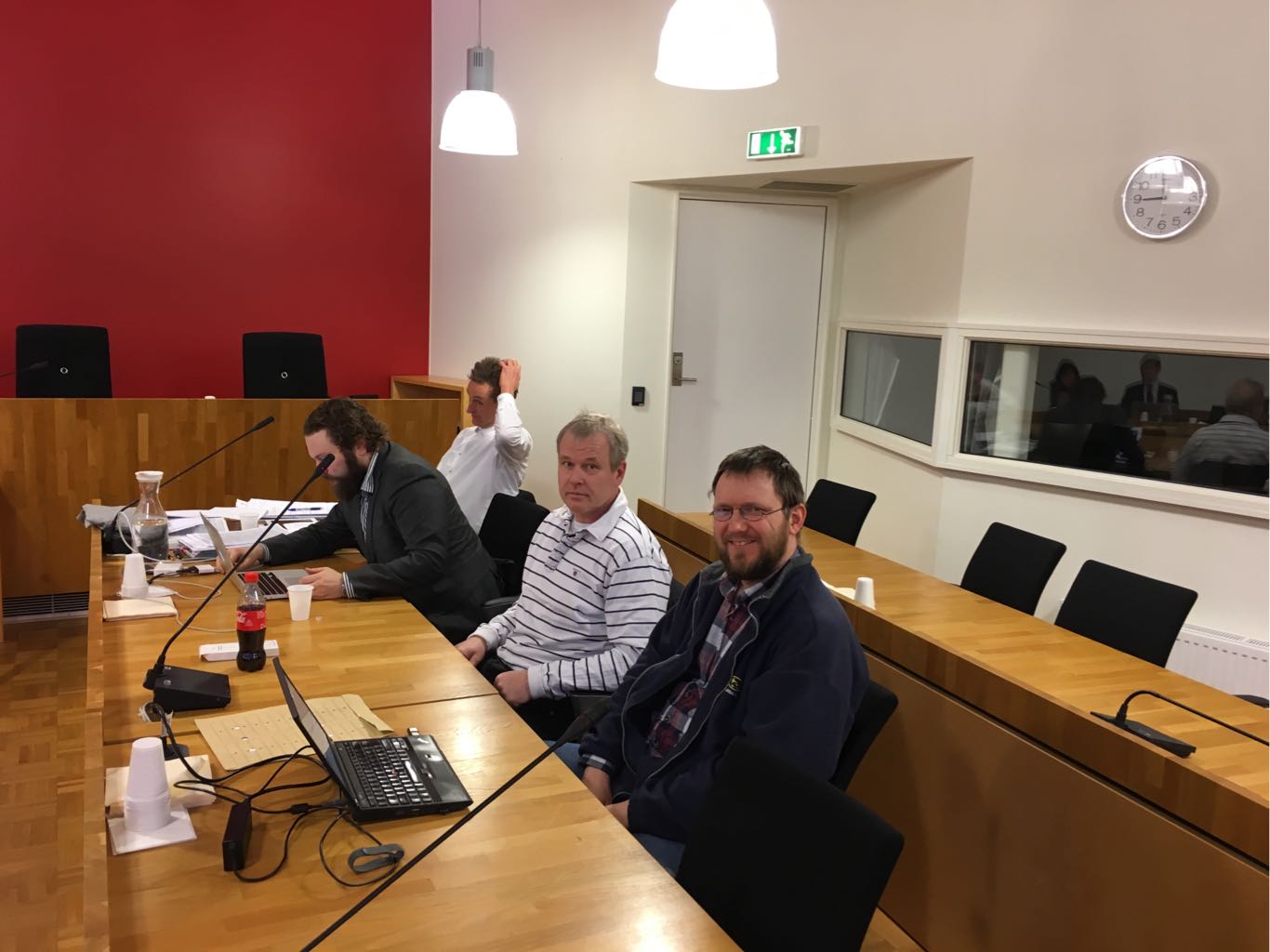
On Wednesday, I spent the entire day in court in Follo Tingrett representing the member association NUUG, alongside the member association EFN and the DNS registrar IMC, challenging the seizure of the DNS name popcorn-time.no. It was interesting to sit in a court of law for the first time in my life. Our team can be seen in the picture above: attorney Ola Tellesb , EFN board member Tom Fredrik Blenning, IMC CEO Morten Emil Eriksen and NUUG board member Petter Reinholdtsen. The case at hand is that the Norwegian National Authority for Investigation and Prosecution of Economic and Environmental Crime (aka kokrim) decided on their own, to seize a DNS domain early last year, without following the official policy of the Norwegian DNS authority which require a court decision. The web site in question was a site covering Popcorn Time. And Popcorn Time is the name of a technology with both legal and illegal applications. Popcorn Time is a client combining searching a Bittorrent directory available on the Internet with downloading/distribute content via Bittorrent and playing the downloaded content on screen. It can be used illegally if it is used to distribute content against the will of the right holder, but it can also be used legally to play a lot of content, for example the millions of movies available from the Internet Archive or the collection available from Vodo. We created a video demonstrating legally use of Popcorn Time and played it in Court. It can of course be downloaded using Bittorrent. I did not quite know what to expect from a day in court. The government held on to their version of the story and we held on to ours, and I hope the judge is able to make sense of it all. We will know in two weeks time. Unfortunately I do not have high hopes, as the Government have the upper hand here with more knowledge about the case, better training in handling criminal law and in general higher standing in the courts than fairly unknown DNS registrar and member associations. It is expensive to be right also in Norway. So far the case have cost more than NOK 70 000,-. To help fund the case, NUUG and EFN have asked for donations, and managed to collect around NOK 25 000,- so far. Given the presentation from the Government, I expect the government to appeal if the case go our way. And if the case do not go our way, I hope we have enough funding to appeal. From the other side came two people from kokrim. On the benches, appearing to be part of the group from the government were two people from the Simonsen Vogt Wiik lawyer office, and three others I am not quite sure who was. kokrim had proposed to present two witnesses from The Motion Picture Association, but this was rejected because they did not speak Norwegian and it was a bit late to bring in a translator, but perhaps the two from MPA were present anyway. All seven appeared to know each other. Good to see the case is take seriously. If you, like me, believe the courts should be involved before a DNS domain is hijacked by the government, or you believe the Popcorn Time technology have a lot of useful and legal applications, I suggest you too donate to the NUUG defense fund. Both Bitcoin and bank transfer are available. If NUUG get more than we need for the legal action (very unlikely), the rest will be spend promoting free software, open standards and unix-like operating systems in Norway, so no matter what happens the money will be put to good use. If you want to lean more about the case, I recommend you check out the blog posts from NUUG covering the case. They cover the legal arguments on both sides.

Pau Garcia i Quiles: Almost at FOSDEM. Video volunteers?

I am boarding my flight to Brussels to attend FOSDEM. The Desktops DevRoom will be a blast again this year. While I have been in charge of it for 6? years already, the last two (since my twins) were born I had organized remotely and local duties were carried on by the Desktops DevRoom team (thank you Christophe Fergeau, Philippe Caseiro and others!). I am anxious at meeting old friends again. I will be at the beer event today. Video streaming will be available thanks to the Video Team. If you want to help, please contact us in the desktops-devroom@lists.fosdem.org mailing list, or directly at the devroom. Also, this year will be the first for me using the job corner to recruit: my company (everis) is recruiting globally for many open positions. Drop us a mail at fosdem@everis.com with your CV, desired position and location (we have direct presence in 13 countries and indirect in 40 countries) and I will make sure it reaches the right inbox.

2 February 2017

intrigeri: First Tails beta release based on Stretch

Today, I have released the first beta for Tails 3.0, that will be the first version of Tails based on Debian 9 (Stretch). Our automated test suite pretends it works pretty well and matches our safety expectations. I'm inclined to trust it. But as we learned after porting Tails to Squeeze, Wheezy and Jessie: quick, exploratory testing of pre-releases will not identify all the remaining regressions. So this time I'm trying to change this narrative a bit. I have committed to provide security updates for the 3.0~ series, just like we do for stable versions of Tails. This was the only missing bit to make me feel comfortable asking my fellow Tails contributors to upgrade to Tails 3.0~beta1 for their daily usage. I hope this helps us release a great Tails 3.0 on June 13 and a better Debian Stretch too: the more early users of Tails based on Stretch, the more chances they identify a few annoying regressions in Stretch before it's called stable :) For details, see the official announcement. Next step: FOSDEM. And then, back to organizing an event that aims at improving both social and technical aspects of Debian (to be announced in about a week, stay tuned); because the way we get organized and how power is distributed matter.

Shirish Agarwal: The $100 used laptop and getting riled up.

Lenovo-ThinkPad-T500 - Source - Wikimedia commons

Lenovo-ThinkPad-T500 Source Wikimedia commons

I was reading a thread on phoronix where a student was sharing that it is or can be expensive to get even a used laptop and he shared his predicament and was hammered a bit for it to some going to the extent of questioning his life-choices. While I m not a student it still triggered something in me. I am not dirt poor but neither am I insanely rich. The same questions he has, similar questions I have had. While in his case he is probably in his early to late 20 s, I am pushing 40. Most of the money I make goes in for everyday purchases, veggies, house-rent, electricity, landline, broadband and cell phone bills. What little is left is most of the time kept for a rainy day as there is no Government pension. From what I have heard and read on the web, in the west specifically in the States, if I buy a used laptop, I usually get a 6 months 1 year warranty . Here, while you could get a used laptop for around INR 10k there is no warranty/guarantee, so I never get into that. It s buyer s beware all the time. For people who like/want FOSS or specifically something like Free DOS (like me), I had to wait for almost 6 years to get a model I was happy with, with the specs. I was ok with. Was really lucky enough to get a Thinkpad T440 with 8 GB of RAM for around INR 80k/- with Free DOS. The specs T440 Core I 5 (4300) / Dos (NEW MODEL) 20B7A1SD00 Intel Core i5 4300M (2.5 GHz / 3 MB / 5 GT/s) / Intel QM87 Chipset / Integrated 802.11 n WIFI LAN + Bluetooth 4.0 / 8GB DDR III Memory (2 DIMM SLOT) / 500 GB SATA HDD @ 7200 RPM / 14.0 HDy / FPR / Dos / 2 USB , VGA Port , RJ 45 Port /GB LAN /Track Point with 5 button Glass Touch Pad /Stereo Speakers with Dolby Enhanced Audio / 6 Cell Battery /Approx 2.14KG/ While it is/was actually pretty expensive but then wanted something which can take a beating, deal with all the heat, noise and dust (specifically where I live, right in the middle of the city). The reason I used the word lucky is that now there is no model in the T-series range which has FreeDOS on it. Of course, I hopefully will use it for another 4-5 years at the very least depending on how much it cooperates with me, I have heard that Thinkpads function for a long period of time even in dusty environments so banking on that.  What probably pissed me is the condensing note in the comment, how does he know what pressures an another individual might be in. It s almost like saying You are refugee because you made a wrong life choice or something to that effect which again is stupid. I actually feel/felt embarrassed to bring this up as I truly am lucky to be safe, secure, have food on the table, am able to sleep on a bed at night, have a workstation AND a laptop, have somewhat of a sound mind  and a body which is able to move around without any hassles. Add to that, incredibly as it may sound, was also able to see another country for a few days In relation to people being persecuted and having to run off to save their own lives or even people living on the streets, I am actually living in luxury. While I can t go through life feeling guilty for all the good things that have happened with me, I do feel disgusted when I see some people put blinding statements like that. One of the biggest reasons that GNU/Linux and Debian in particular gelled with me was that it s incredibly flexible and generous. Nobody tells me which packages I should or shouldn t have. I do right things, good, I do something wrong, an opportunity to learn and hopefully learn from my mistakes. In either case, one of the most forgiving kind of system to learn and hack on. While speaking of mistakes, could somebody look at #849684 . It almost feels like a tennis match going between the maintainers concerned. While I don t have the technical skills to ascertain who s right and who is not, it would be nice if some cooler heads can make sense and see if a way could be found out. Can somebody help ?
Filed under: Miscellenous Tagged: #debian, #Life Choices, #Thinkpad440, laptop

Guido G nther: Debian Fun in January 2017

Debian LTS November marked the 21st month I contributed to Debian LTS under the Freexian umbrella. I had 8 hours allocated which I used for: Other Debian stuff Some other Free Software activites

Paul Wise: FLOSS Activities January 2017

Changes

Issues

Review

Administration
  • Debian: reboot 1 non-responsive VM, redirect 2 users to support channels, redirect 1 contributor to xkb upstream, redirect 1 potential contributor, redirect 1 bug reporter to mirror team, ping 7 folks about restarting processes with upgraded libs, manually restart the sectracker process due to upgraded libs, restart the package tracker process due to upgraded libs, investigate failures connecting to the XMPP service, investigate /dev/shm issue on abel.d.o, clean up after rename of the fedmsg group.
  • Debian mentors: lintian/security updates & reboot
  • Debian packages: deploy 2 contributions to the live server
  • Debian wiki: unblacklist 1 IP address, whitelist 10 email addresses, disable 18 accounts with bouncing email, update email for 2 accounts with bouncing email, reported 1 Debian member as MIA, redirect 1 user to support channels, add 4 domains to the whitelist.
  • Reproducible builds: rescheduled Debian pyxplot:amd64/unstable for themill.
  • Openmoko: security updates & reboots.

Debian derivatives
  • Send the annual activity ping mail.
  • Happy new year messages on IRC, forward to the list.
  • Note that SerbianLinux does not provide source packages.
  • Expand URL shortener on SerbianLinux page.
  • Invite PelicanHPC, Netrunner, DietPi, Hamara Linux (on IRC), BitKey to the census.
  • Add research publications link to the census template
  • Fix Symbiosis sources.list
  • Enquired about SalentOS downtime
  • Fixed and removed some 404 BlankOn links (blog, English homepage)
  • Fixed changes to AstraLinux sources.list
  • Welcome Netrunner to the census

Sponsors I renewed my support of Software Freedom Conservancy. The openchange 1:2.2-6+deb8u1 upload was sponsored by my employer. All other work was done on a volunteer basis.

Next.

Previous.