Jonas Smedegaard: IT@school
 Siri and I are on a journey through India and Nepal,
with the aim of learning about needs of Debian derivatives,
to improve Debian and encourage closer integration.
Siri and I are on a journey through India and Nepal,
with the aim of learning about needs of Debian derivatives,
to improve Debian and encourage closer integration.
 Xerces is an XML library for several languages, but if a very common library in Java.
I recently came across a problem with code intermittently throwing a NullPointerException inside the library:
java.lang.NullPointerException
        at org.apache.xerces.dom.ParentNode.nodeListItem(Unknown Source)
        at org.apache.xerces.dom.ParentNode.item(Unknown Source)
        at com.example.xml.Element.getChildren(Element.java:377)
        at com.example.xml.Element.newChildElementHelper(Element.java:229)
        at com.example.xml.Element.newChildElement(Element.java:180)
You may also find the NullPointerException in ParentNode.nodeListGetLength() and other locations in ParentNode.
Debugging this was not helped by the fact that the xercesImpl.jar is stripped of line numbers, so I couldn t find the exact issue. After some searching, it appeared that the issue was down to the fact that Xerces is not thread-safe. ParentNode caches iterations through the NodeList of children to speed up performance and stores them in the Node s Document object. In multi-threaded applications, this can lead to race conditions and NullPointerExceptions. And because it s a threading issue, the problem is intermittent and hard to track down.
The solution is to synchronise your code on the DOM, and this means the Document object, everywhere you access the nodes. I m not certain exactly which methods need to be protected, but I believe it needs to be at least any function that will iterate a NodeList. I would start by protecting every access and testing performance, and removing some if needed.
/**
 * Returns the concatenation of all the text in all child nodes
 * of the current element.
 */
public String getText()
StringBuilder result = new StringBuilder();

synchronized ( m_element.getOwnerDocument())
NodeList nl = m_element.getChildNodes();
for (int i = 0; i < nl.getLength(); i++)
Node n = nl.item(i);

if (n != null && n.getNodeType() == org.w3c.dom.Node.TEXT_NODE)
result.append(((CharacterData) n).getData());


return result.toString();
Notice the synchronized ( m_element.getOwnerDocument()) block around the section that deals with the DOM. The NPE would normally be thrown on the nl.getLength() or nl.item() calls. Since putting in the synchronized blocks, we ve gone from having 78 NPEs between 2:30am and 3:00am, to having zero in the last 12 hours, so I think it s safe to say, this has drastically reduced the problem. The post NullPointerExceptions in Xerces-J appeared first on David Pashley.com.
I refuse to be bound by software I cannot negotiate with.
 http://social.gl-como.it/photos/valhalla/image/75f28c7ef6c17319f09b858b882bca49
 The last days, after about 20 hours of gameplay, I have finally finished Portal Stories: Mel, the single player mod for Portal 2. After having played Portal and Portal 2, I have to say this one mod took be by surprise. I remember very well that, after having played through Portal 2 and found it to easy, I was pointed to Portal Stories: Mel in several comments, I thought Well, it cannot be that difficult! . I couldn t have been more wrong!
 Portal Stories: Mel is really difficult, at least for me. I remember game sessions where I just started the game, looked at the configuration of the current riddle for 20min, and then quit the game without actually moving around an inch. This kind of logical riddles, paired with a certain element of action and speed, is exactly what I am enjoying.
 It took me quite some time, and I have to admit, I had to cheat at some points during the game being stuck completely without an idea. Only the finish was a bit surprising surprisingly simple. The big boss at the end was not really worth it. Still, leaving the testing facilities at the end gave me some kind or relieve

 Considering that Portal Stories: Mel is something like a fan-art, developed by Prism Studios, a group made up of eight fans of the Portal games, this is a fantastic achievement. I really loved it, and I am deeply impressed by the ingenuity of the creators. Thanks!
next branch without any new release. I used some time during the new yeargit push.-f.GIT_SSH and GIT_SSH_COMMAND environment variables.git cinnabar now has a proper argument parser for all its subcommands.git cinnabar python command allows to run python scripts or open agit cinnabar rollback command allows to roll back togit cinnabar bundle command allows to create mercurial bundles,master branch was dedicated tonext branch, until a newrelease branch will take dot-release fixes and newmaster branch will receive all changes that arenext branch will receive changes to be tested in CI when thingsmaster.
 When I was thinking about using Ghost, I did read the installations guide and then I just closed the browser window.
docker to work with service docker restart
# docker pull ghost
# mkdir -p /srv/docker/ghost/
# cat > /etc/systemd/system/ghost.service << EOF
[Unit]
Description=GHost Service
After=docker.service
Requires=docker.service
[Service]
ExecStartPre=-/usr/bin/docker kill ghost
ExecStartPre=-/usr/bin/docker rm ghost
ExecStartPre=-/usr/bin/docker pull ghost
ExecStart=/usr/bin/docker run  --name ghost --publish 2368:2368 --env 'NODE_ENV=production' --volume /srv/docker/ghost/:/var/lib/ghost ghost
ExecStop=/usr/bin/docker stop ghost
[Install]
WantedBy=multi-user.target
EOF
# systemctl enable ghost && systemctl daemon-reload && systemctl start ghost
systemctl daemon-reload.
Now you should have listening something on port 2368:
# netstat -tapn   grep 2368
tcp6       0      0 :::2368                 :::*                    LISTEN      7061/docker-proxy
--restart always will take care that it is brought up again if Docker or (even) the whole system will get restarted. For real I used that before and might be a lightweight solution, but I liked the systemd unit file solution a lot more.
/srv/docker/ghost/. So your blog will still have content, even if the ghost Docker images is updated:
# ls /srv/docker/ghost/
apps  config.js  data  images  themes

 While the details about how to join the set of paid contributors have always been public (here) we did not advertise this fact very much outside of the people already interested in LTS (and thus subscribed to debian-lts@lists.debian.org). But right now we would like to have a few more paid contributors on board and I m thus posting this call for volunteers.
Who can apply?
You need to meet those requirements:
One comment Liked this article? Click here. My blog is Flattr-enabled.


 Since moving to Japan, I got more and more interested in history, especially the recent history of the 20th century. The book I just finished, Ian Buruma (Wiki, home page) Wages of Guilt Memories of War in Germany and Japan (Independent, NYRB), has been a revelation for me. As an Austrian living in Japan, I am experiencing the discrepancy between these two countries with respect to their treatment of war legacy practically daily, and many of my blog entries revolve around the topic of Japanese non-reconciliation.
Willy Brandt went down on his knees in the Warsaw ghetto, after a functioning democracy had been established in the Federal Republic of Germany, not before. But Japan, shielded from the evil world, has grown into an Oskar Matzerath: opportunistic, stunted, and haunted by demons, which it tries to ignore by burying them in the sand, like Oskar s drum.
Ian Buruma, Wages of Guilt, Clearing Up the Ruins
 The comparison of Germany and Japan with respect to their recent history as laid out in Buruma s book throws a spotlight on various aspects of the psychology of German and Japanese population, while at the same time not falling into the easy trap of explaining everything with difference in the guilt culture. A book of great depth and broad insights everyone having even the slightest interest in these topics should read.
This difference between (West) German and Japanese textbooks is not just a matter of detail; it shows a gap in perception.Only thinking about giving a halfway full account of this book is something impossible for me. The sheer amount of information, both on the German and Japanese side, is impressive. His incredible background (studies of Chinese literature and Japanese movie!) and long years as journalist, editor, etc, enriches the book with facets normally not available: In particular his knowledge of both the German and Japanese movie history, and the reflection of history in movies, were complete new aspects for me (see my recent post (in Japanese)). The book is comprised of four parts: The first with the chapters War Against the West and Romance of the Ruins; the second with the chapters Auschwitz, Hiroshima, and Nanking; the third with History on Trial, Textbook Resistance, and Memorials, Museums, and Monuments; and the last part with A Normal Country, Two Normal Towns, and Clearing Up the Ruins. Let us look at the chapters in turn:
Ian Buruma, Wages of Guilt, Romance of the Ruins
What is so convenient in the cases of Germany and Japan is that pacifism happens to be a high-minded way to dull the pain of historical guilt. Or, conversely, if one wallows in it, pacifism turns national guilt into a virtue, almost a mark of superiority, when compared to the complacency of other nations.
Hitler s doom and the emperor s speech, the end of one symbol and the odd continuity of another. Whatever their symbolic differences, both would be associated forever with ruins ruined cities, ruined people, ruined ideals.
Here the past had fossilized into something monumental or, as Adorno would have put it, museal.
The problem with this quasi-religious view of history is that it makes it hard to discuss past events in anything but nonsecular terms. Visions of absolute evil are unique, and they are beyond human explanation or even comprehension. To explain is hubristic and amoral. If this is true of Auschwitz, it is even more true of Hiroshima. The irony is that while there can be no justification for Auschwitz unless one believes in Hitler s murderous ideology, the case for Hiroshima is at least open to debate. The A-bomb might have saved lives; it might have shortened the war. But such arguments are incompatible with the Hiroshima spirit.
Yet the question remains whether the raping and killing of thousands of women, and the massacre of thousands, perhaps hundreds of thousands, of other unarmed people, in the course of six weeks, can still be called extreme conduct in the heat of battle. The question is pertinent, particularly when such extreme violence is justified by an ideology which teaches the aggressors that killing an inferior race is in accordance with the will of their divine emperor.
The Nuremberg trials were to be a history lesson, then, as well as a symbolic punishment of the German people a moral history lesson cloaked in all the ceremonial trappings of due legal process. They were the closest that man, or at least the men belonging to the victorious powers, could come to dispensing divine justice.Also, the differences in war trials in East and West Germany is compared. The East Germany Waldheimer trials, as well as the thorough purge of Nazis from East German jurisdiction and politics, which was in stark contrast to both West German s very restricted trials, as well as Japan s absolute non-purge of criminals.
As long as the emperor lived, Japanese would have trouble being honest about the past. For he had been formally responsible for everything, and by holding him responsible for nothing, everybody was absolved, except, of course, for a number of military and civilian scapegoats, Officers and Outlaws, who fell victim to victors justice.
The judges and some of the counsel for the ministry sat back with their eyes closed, in deep concentration, or fast asleep. Perhaps they were bored, because they had heard it all before. Perhaps they thought it was a pointless exercise, since they knew already how the case would end. But it was not a pointless exercise. For Ienaga Saburo had kept alive a vital debate for twenty-seven years. One cussed schoolteacher and several hundred supporters at the courthouse might not seem much, but it was enough to show that, this time, someone was fighting back.
The tragedy is not just that the suicide pilots died young. Soldiers (and civilians) do that in wars everywhere. What is so awful about the memory of their deaths is the cloying sentimentality that was meant to justify their self-immolation. There is no reason to suppose they didn t believe in the patriotic gush about cherry blossoms and sacrifice, no matter how conventional it was at the time. Which was exactly the point: they were made to rejoice in their own death. It was the exploitation of their youthful idealism that made it such a wicked enterprise. And this point is still completely missed at the Peace Museum today.
It was not an ignoble enterprise, but he should have recognized that Historisierung, even forty-three years after the war, was still a highly risky business. For a normal society, a society not haunted by ghosts, cannot be achieved by normalizing history, or by waving cross and garlic. More the other way around: when society has become sufficiently open and free to look back, from the point of view neither of the victim nor of the criminal, but of the critic, only then will the ghosts be laid to rest.On the Japanese side the case of Motoshima Hitoshi , who dared to question Hirohito:
Forty-three years have passed since the end of the war, and I think we have had enough chance to reflect on the nature of that war. From reading various accounts from abroad and having been a soldier myself, involved in military education, I do believe that the emperor bore responsibility for the war.which led to hitherto unseen of demonstration of extreme-right-wing groups issuing death treats that lead to a failed assassination of Motoshima, all under the completely complacent Japanese police and politics letting the right-wingers play their game.
By breaking a Japanese taboo, Motoshima struck a blow for a more open, more normal political society, and very nearly lost his life. Jenninger, I like to think, wanted to strike a blow for the same, but failed, and lost his job. Perhaps he wasn t up to the task. Or perhaps even West Germany was not yet normal enough to hear his message.
I asked him again about the local camp and the small hidden memorial. Dominik showed signs of distress. It was difficult, he admitted, very difficult. I know what you mean. But let me give you my personal opinion. When you have a crippled arm, you don t really want to show it around. It was a low point in our history, back then. But it was only twelve years in thousands of years of history. And so people tend to hide it, just as a person with a crippled arm is not likely to wear a short-sleeved shirt.A similar incident is recounted on the Japanese side, the Hanaoka incident (detailed article) and its unveiling by Nozoe Kenji, where 800 Chinese slave workers, after escaping from a forced-work camp for the Kajima Corporation, where rabbit-hunted down and slaughtered. He, too, got death threats, and was virtually expelled from his home area because he dared to publish his findings.
I think it is this basic distrust, this refusal to be told what to think by authorities, this cussed insistence on asking questions, on hearing the truth, that binds together Nozoe, Rosmus, and others like them. There are not many such people in Japan, or anywhere else for that matter. And I suspect they are not much liked wherever they live.
The state was run by virtually the same bureaucracy that ran the Japanese empire, and the electoral system was rigged to help the same corrupt conservative party to stay in power for almost forty years. This arrangement suited the United States, as well as Japanese bureaucrats, LDP politicians, and the large industrial combines, for it ensured that Japan remained a rich and stable ally against Communism. But it also helped to stifle public debate and stopped the Japanese from growing up politically.His description of current Japanese society, written in 1995, is still hauntingly true in 2016:
There is something intensely irritating about the infantilism of postwar Japanese culture: the ubiquitous chirping voices of women pretending to be girls; the Disneylandish architecture of Japanese main streets, where everything is reduced to a sugary cuteness; the screeching television talents rolling about and carrying on like kindergarten clowns; the armies of blue-suited salarymen straphanging on the subway trains, reading boys comics, the maudlin love for old school songs and cuddly mama-sans.
The Nanking Massacre, for leftists and many liberals too, is the main symbol of Japanese militarism, supported by the imperial (and imperialist) cult. Which is why it is a keystone of postwar pacifism. Article Nine of the constitution is necessary to avoid another Nanking Massacre. The nationalist right takes the opposite view. To restore the true identity of Japan, the emperor must be reinstated as a religious head of state, and Article Nine must be revised to make Japan a legitimate military power again. For this reason, the Nanking Massacre, or any other example of extreme Japanese aggression, has to be ignored, softened, or denied.While there are signs of resistance in the streets of Japan (Okinawa and the Hanako bay, the demonstrations against secrecy law and reversion of the constitution), we are still to see a change influenced by the people in a country ruled and distributed by oligarchs. I don t think there will be another Nanking Massacre in the near future, but Buruma s books shows that we are heading back to a nationalistic regime similar to pre-war times, just covered with a democratic veil to distract critics.
Ian Buruma, Wages of Guilt, Nanking
[ ] mainstream conservatives made a deliberate attempt to distract people s attention from war and politics by concentrating on economic growth.
The curious thing was that much of what attracted Japanese to Germany before the war Prussian authoritarianism, romantic nationalism, pseudo-scientific racialism had lingered in Japan while becoming distinctly unfashionable in Germany.In Romance of the Ruins:
The point of all this is that Ikeda s promise of riches was the final stage of what came to be known as the reverse course, the turn away from a leftist, pacifist, neutral Japan a Japan that would never again be involved in any wars, that would resist any form of imperialism, that had, in short, turned its back for good on its bloody past. The Double Your Incomes policy was a deliberate ploy to draw public attention away from constitutional issues.In Hiroshima:
The citizens of Hiroshima were indeed victims, primarily of their own military rulers. But when a local group of peace activists petitioned the city of Hiroshima in 1987 to incorporate the history of Japanese aggression into the Peace Memorial Museum, the request was turned down. The petition for an Aggressors Corner was prompted by junior high school students from Osaka, who had embarrassed Peace Museum officials by asking for an explanation about Japanese responsibility for the war.
The history of the war, or indeed any history, is indeed not what the Hiroshima spirit is about. This is why Auschwitz is the only comparison that is officially condoned. Anything else is too controversial, too much part of the flow of history .In Nanking, by the governmental pseudo-historian Tanaka:
Unlike in Europe or China, writes Tanaka, you won t find one instance of planned, systematic murder in the entire history of Japan. This is because the Japanese have a different sense of values from the Chinese or the Westerners.In History on Trial:
In 1950, Becker wrote that few things have done more to hinder true historical self-knowledge in Germany than the war crimes trials. He stuck to this belief. Becker must be taken seriously, for he is not a right-wing apologist for the Nazi past, but an eminent liberal.
There never were any Japanese war crimes trials, nor is there a Japanese Ludwigsburg. This is partly because there was no exact equivalent of the Holocaust. Even though the behavior of Japanese troops was often barbarous, and the psychological consequences of State Shinto and emperor worship were frequently as hysterical as Nazism, Japanese atrocities were part of a military campaign, not a planned genocide of a people that included the country s own citizens. And besides, those aspects of the war that were most revolting and furthest removed from actual combat, such as the medical experiments on human guinea pigs (known as logs ) carried out by Unit 731 in Manchuria, were passed over during the Tokyo trial. The knowledge compiled by the doctors of Unit 731 of freezing experiments, injection of deadly diseases, vivisections, among other things was considered so valuable by the Americans in 1945 that the doctors responsible were allowed to go free in exchange for their data.
Some Japanese have suggested that they should have conducted their own war crimes trials. The historian Hata Ikuhiko thought the Japanese leaders should have been tried according to existing Japanese laws, either in military or in civil courts. The Japanese judges, he believed, might well have been more severe than the Allied tribunal in Tokyo. And the consequences would have been healthier. If found guilty, the spirits of the defendants would not have ended up being enshrined at Yasukuni. The Tokyo trial, he said, purified the crimes of the accused and turned them into martyrs. If they had been tried in domestic courts, there is a good chance the real criminals would have been flushed out.
After it was over, the Nippon Times pointed out the flaws of the trial, but added that the Japanese people must ponder over why it is that there has been such a discrepancy between what they thought and what the rest of the world accepted almost as common knowledge. This is at the root of the tragedy which Japan brought upon herself.
Emperor Hirohito was not Hitler; Hitler was no mere Shrine. But the lethal consequences of the emperor-worshipping system of irresponsibilities did emerge during the Tokyo trial. The savagery of Japanese troops was legitimized, if not driven, by an ideology that did not include a Final Solution but was as racialist as Hider s National Socialism. The Japanese were the Asian Herrenvolk, descended from the gods.
Emperor Hirohito, the shadowy figure who changed after the war from navy uniforms to gray suits, was not personally comparable to Hitler, but his psychological role was remarkably similar.
In fact, MacArthur behaved like a traditional Japanese strongman (and was admired for doing so by many Japanese), using the imperial symbol to enhance his own power. As a result, he hurt the chances of a working Japanese democracy and seriously distorted history. For to keep the emperor in place (he could at least have been made to resign), Hirohito s past had to be freed from any blemish; the symbol had to be, so to speak, cleansed from what had been done in its name.In Memorials, Museums, and Monuments:
If one disregards, for a moment, the differences in style between Shinto and Christianity, the Yasukuni Shrine, with its relics, its sacred ground, its bronze paeans to noble sacrifice, is not so very different from many European memorials after World War I. By and large, World War II memorials in Europe and the United States (though not the Soviet Union) no longer glorify the sacrifice of the fallen soldier. The sacrificial cult and the romantic elevation of war to a higher spiritual plane no longer seemed appropriate after Auschwitz. The Christian knight, bearing the cross of king and country, was not resurrected. But in Japan, where the war was still truly a war (not a Holocaust), and the symbolism still redolent of religious exultation, such shrines as Yasukuni still carry the torch of nineteenth-century nationalism. Hence the image of the nation owing its restoration to the sacrifice of fallen soldiers.In A Normal Country:
The mayor received a letter from a Shinto priest in which the priest pointed out that it was un-Japanese to demand any more moral responsibility from the emperor than he had already taken. Had the emperor not demonstrated his deep sorrow every year, on the anniversary of Japan s surrender? Besides, he wrote, it was wrong to have spoken about the emperor in such a manner, even as the entire nation was deeply worried about his health. Then he came to the main point: It is a common error among Christians and people with Western inclinations, including so-called intellectuals, to fail to grasp that Western societies and Japanese society are based on fundamentally different religious concepts . . . Forgetting this premise, they attempt to place a Western structure on a Japanese foundation. I think this kind of mistake explains the demand for the emperor to bear full responsibility.In Two Normal Towns:
The bust of the man caught my attention, but not because it was in any way unusual; such busts of prominent local figures can be seen everywhere in Japan. This one, however, was particularly grandiose. Smiling across the yard, with a look of deep satisfaction over his many achievements, was Hatazawa Kyoichi. His various functions and titles were inscribed below his bust. He had been an important provincial bureaucrat, a pillar of the sumo wrestling establishment, a member of various Olympic committees, and the recipient of some of the highest honors in Japan. The song engraved on the smooth stone was composed in praise of his rich life. There was just one small gap in Hatazawa s life story as related on his monument: the years from 1941 to 1945 were missing. Yet he had not been idle then, for he was the man in charge of labor at the Hanaoka mines.In Clearing Up the Ruins:
But the question in American minds was understandable: could one trust a nation whose official spokesmen still refused to admit that their country had been responsible for starting a war? In these Japanese evasions there was something of the petulant child, stamping its foot, shouting that it had done nothing wrong, because everybody did it.
Japan seems at times not so much a nation of twelve-year-olds, to repeat General MacArthur s phrase, as a nation of people longing to be twelve-year-olds, or even younger, to be at that golden age when everything was secure and responsibility and conformity were not yet required.
For General MacArthur was right: in 1945, the Japanese people were political children. Until then, they had been forced into a position of complete submission to a state run by authoritarian bureaucrats and military men, and to a religious cult whose high priest was also formally chief of the armed forces and supreme monarch of the empire.
I saw Jew S ss that same year, at a screening for students of the film academy in Berlin. This showing, too, was followed by a discussion. The students, mostly from western Germany, but some from the east, were in their early twenties. They were dressed in the international uniform of jeans, anoraks, and work shirts. The professor was a man in his forties, a 68er named Karsten Witte. He began the discussion by saying that he wanted the students to concentrate on the aesthetics of the film more than the story. To describe the propaganda, he said, would simply be banal: We all know the what, so let s talk about the how. I thought of my fellow students at the film school in Tokyo more than fifteen years before. How many of them knew the what of the Japanese war in Asia.
 Automatic Calendar Management Notmuch + Calypso
One of the big features of outlook/exchange in my world is
automatically merging of incoming calendar updates from email. This
makes my calendar actually useful in knowing what meetings people have
asked me to attend. As I'm not willing to otherwise tolerate outlook,
I decided to try and provide that in my preferred environment; notmuch
and calypso.
Identifying calendar updates
The first trick is how to identify incoming messages with calendar
updates. I'd love to be able to search for specific mime content
types, but I haven't been able to construct such a search. Failing
that, I'm just looking for messages containing the string
'text/calendar':
notmuch search --output=messages tag:inbox AND text/calendar
notmuch search --output=messages tag:inbox AND text/calendar AND not tag:calendar
jq -r '.. select(."content-type"? == "text/calendar") .content'
#!/bin/bash
SEARCH="tag:inbox AND not tag:calendar AND text/calendar"
TMP= mktemp
trap "rm -r $TMP" 0 1 15
notmuch search --output=messages $SEARCH   while read message; do
    notmuch show --format=json $message
        jq -r '..   select(."content-type"? == "text/calendar")   .content' > $TMP
    if [ -s $TMP ]; then
        calypso --import private/calendar $TMP && notmuch tag +calendar $message
    else
        notmuch tag +calendar $message
    fi
done
2 comments Liked this article? Click here. My blog is Flattr-enabled.
 The above sign was at the Melbourne Docks in December 2014 when I was returning from a cruise. I have no idea why there are 3 men and 1 woman on the sign (and a dock worker was also surprised when I explained why I was photographing it). I wonder whether a sign that had 3 women and 1 man would ever have been installed or not noticed if it was installed.
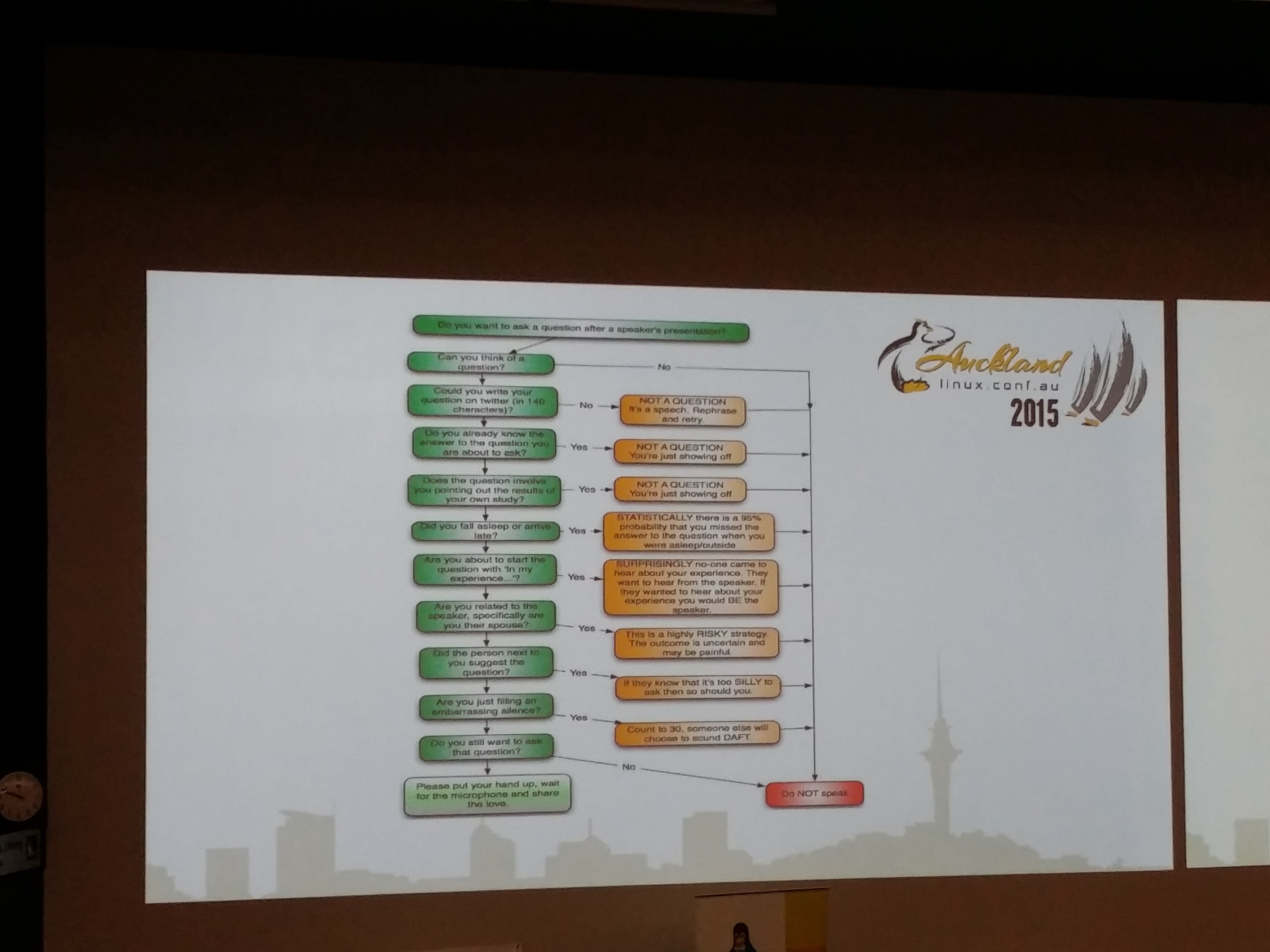 At the start of the first day of LCA 2015 the above was displayed at the keynote as a flow-chart for whether someone should ask a question at a lecture. Given that the first real item in the list is that a question should fit in a tweet I think it was inspired by my blog post about the length of conference questions [1].
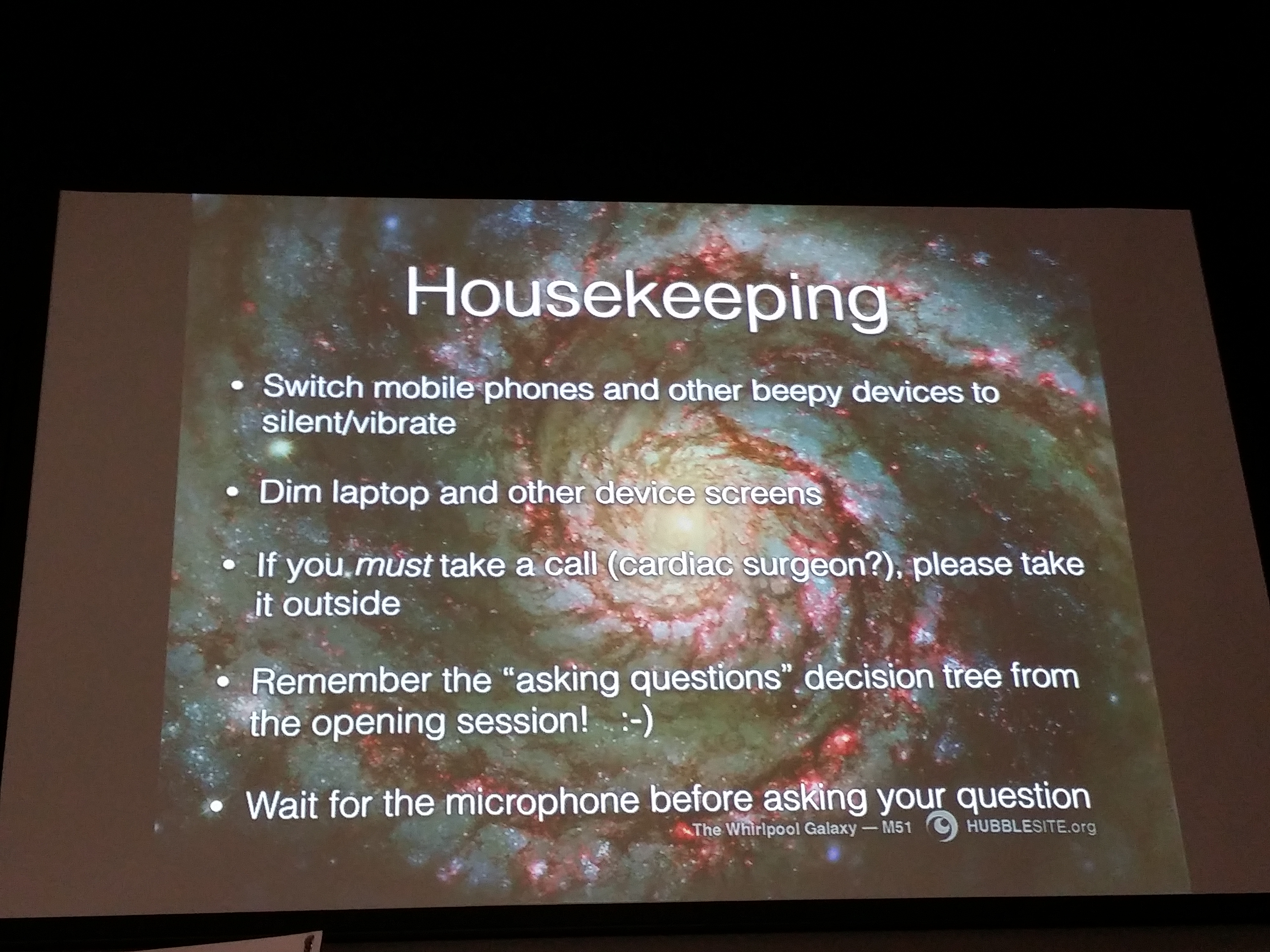 At the introduction to the Astronomy Miniconf the above slide was displayed. In addition to referencing the flow-chart for asking questions it recommends dimming laptop screens (among other things).
 The above sign was at a restaurant in Auckland in January 2015. I thought that sort of sexist joke went out of fashion a few decades ago.
 The above photo is from a Melbourne department store in February 2015. Why gender a nerf gun? That just doesn t make sense. Also it appeared that the only nerf crossbow was the purple/pink one, is a crossbow considered feminine nowadays?
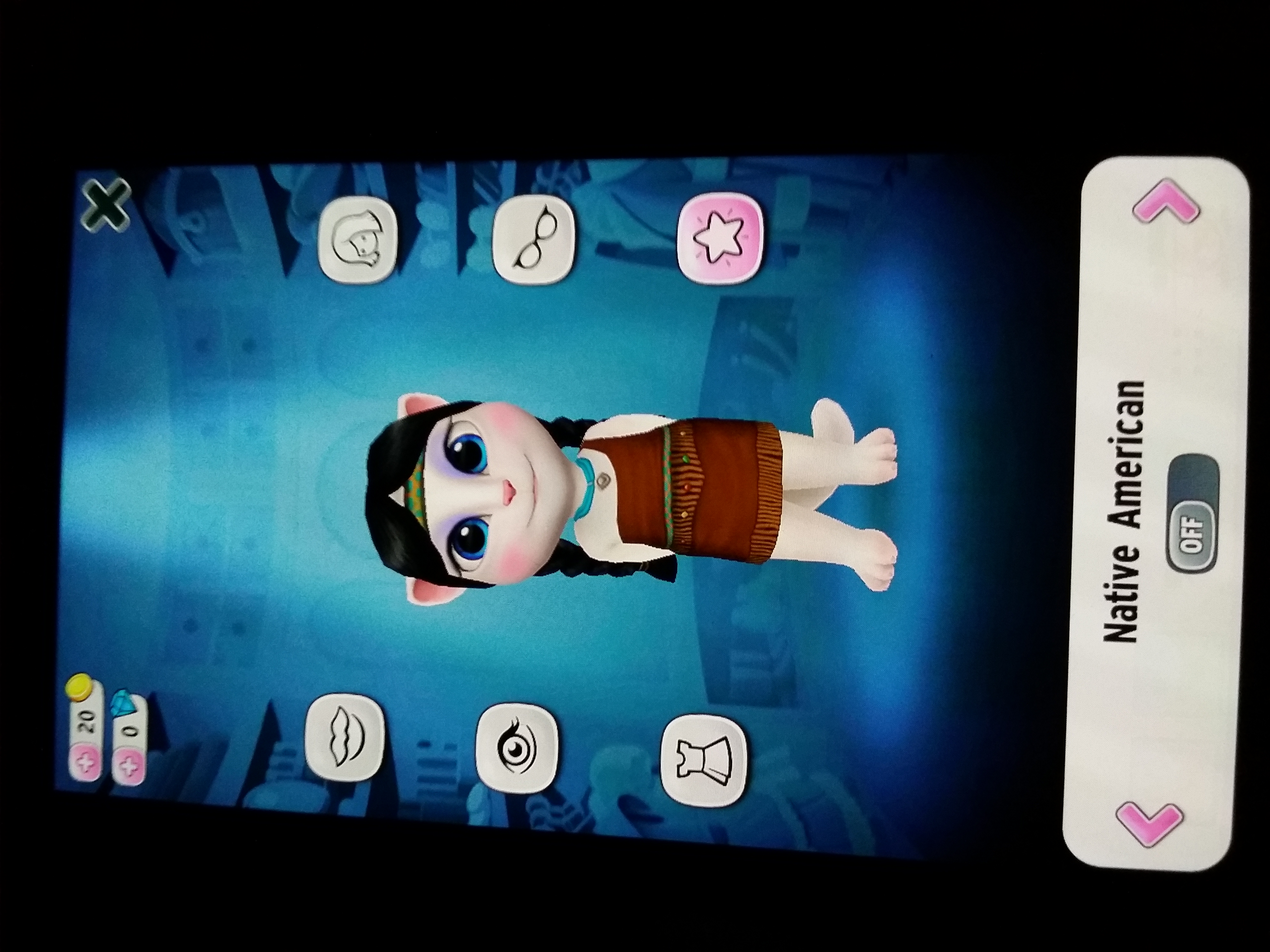 The above picture is a screen-shot of one of the Talking Angela series of Android games from March. Appropriating the traditional clothing of marginalised groups is a bad thing. People of Native American heritage who want to wear their traditional clothing face discrimination when they do so, when white people play dress-up in clothing that is a parody of Native American style it s really offensive. The site Racialicious.com has a tag for articles about appropriation [2].
 The above was in a library advertising an Ebook reader. In this case they didn t even have pointlessly gendered products they just had pointlessly gendered adverts for the same product. They also perpetuate the myth that only girls read vampire books and only boys read about space. Also why is the girl lying down to read while the boy is sitting up?
 Above is an Advent calendar on sale in a petrol station. Having end of year holiday presents that have nothing to do with religious festivals makes sense. But Advent is a religious observance. I think this would be a better candidate for war on Christmas paranoia than a coffee cup of the wrong colour.
 The above photo is of boys and girls pipette suckers. Pointlessly gendered recreational products like Nerf guns is one thing, but I think that doing it to scientific equipment is a bigger problem. Are scientists going to stop work if they can t find a pipette sucker of the desired gender? Is worrying about this going to distract them from their research (really bad if working with infectious or carcinogenic solutions). The Integra advertising claims to be doing this to promote breast cancer research which is also bogus. Here is a Sociological Images article about the problems of using pink to market breast cancer research [3] and the Sociological Images post about pinkwashing (boobies against breast cancer) is also worth reading [4].
As an aside I made a mistake in putting a pipette sucker over the woman s chest in that picture. The way that Integra portreyed her chest is relevant to analysis of this advert. But unfortunately I didn t photograph that.
Here is a link to my sociological images post from 2014 [5].
AltOS 1.6.2 TeleMega v2.0 support, bug fixes and documentation updates
Bdale and I are pleased to announce the release of
AltOS version 1.6.2.
AltOS is the core of the software
for all of the Altus Metrum products. It
consists of firmware for our cc1111, STM32L151, STMF042, LPC11U14 and ATtiny85
based electronics and Java-based ground station software.
This is a minor release of AltOS, including support for our new
TeleMega v2.0 board, a small selection
of bug fixes and a major update of the documentation
AltOS Firmware TeleMega v2.0 added
 The updated six-channel flight computer, TeleMega v2.0,
has a few changes from the v1.0 design:
 In December I carried over 15 hours from October/November and was
assigned another 15 hours of work
by Freexian's
Debian LTS initiative. I worked a total of 20 hours despite the
holidays.
I uploaded a security and bug fix update to linux-2.6 early in
December, and
sent DLA-360-1.
I also backported several more security fixes, released in the new
year. I sent several of the fixes to Willy Tarreau for inclusion in
Linux 2.6.32-longterm.
I prepared an update to sudo to
fix CVE-2015-5602.
This turned out not to have been properly fixed upstream, so I
finished the job and am now in the process of backporting and
uploading fixes for all suites.
I reviewed the packages affected
by CVE-2015-8614
and the upstream fix in claws-mail, and found that that was also
incomplete. This resulted in
another
CVE ID being issued.
I had another week in the front desk role, over the new year, and
triaged about 20 new issues. About half of them affected packages
supported in squeeze-lts.
Updated: I also found a bug in
the contact-maintainers script used by the LTS front desk.
It used apt-cache show to find out the maintainers of a
source package, which may result in outdated information
particularly if you configure APT to fetch squeeze sources in order
to work on LTS! I modified the script to grab maintainer
information out of the RDF description provided by
packages.qa.debian.org (not yet implemented on tracker.debian.org).
I feel there ought to be an easier way to do this, but at least I
learned something about RDF.

As the Buddha said 2500 years ago... we're all out of our fucking minds. (Albert Ellis)There have been a few occasions over the last year where people suffering mental illnesses have been the subject of much discussion. In March 2015 there was the tragic loss of Germanwings flight 9525. It was discovered that the co-pilot, Andreas Lubitz, had been receiving treatment for mental illness. Under strict privacy laws, nobody at his employer, the airline, had received any information about the diagnosis or treatment.
 During the summer, the private mailing list for a large online community discussed the mental illness of a contributor to a project. Various people expressed opinions that appeared to be generalizations about all those with mental illness. Some people hinted the illness was a lie to avoid work while others speculated about options for treatment. Nobody involved mentioned having any medical expertise.
It is ironic that on the one hand, we have the dramatic example of an aircraft crashing at the hands of somebody who is declared unfit to work but working anyway and on the other hand when somebody else couldn't do something, the diagnosis is being disputed by people who find it inconvenient or don't understand it.
More recently, there has been openly public discussion about whether another developer may have had mental illness. Once again, there doesn't appear to be any evidence from people with any medical expertise or documentation whatsoever. Some of the comments appear to be in the context of a grudge or justifying some other opinion.
What's worse, some comments appear to suggest that mental illness can be blamed for anything else that goes wrong in somebody's life. If somebody is shot and bleeds to death, do you say low blood pressure killed him or do you just say he was shot? Likewise, if somebody is subject to some kind of bullying and abused, does this have no interaction with mental illness? In fact, Google reveals an enormous number of papers from experts in this field suggesting that mental illness can arise or be exacerbated by bad experiences. Although it may not have been clear at that point in time, when we look back at Alan Turing's death today, suicide was not a valid verdict and persecution was a factor.
Statistics tell us that 1 in 4 people experience a mental health problem in the UK each year. In the USA it is 26% of the adult population, each year. These may be long term conditions or they may be short term conditions. They may arise spontaneously or they may be arising from some kind of trauma, abuse or harassment in the home, workplace or some other context.
For large online communities, these statistics imply it is inevitable that some participants will be suffering from mental illness and others will have spouses, parents or children suffering from such conditions. These people will be acutely aware of the comments being made publicly about other people in the community. Social interaction also relates to the experience of mental illness, people who are supported by their community and society are more likely to recover while those who feel they are not understood or discriminated against may feel more isolated, compounding their condition.
As a developer, I wouldn't really like the idea of doctors meddling with my code, so why is it that some people in the IT and business community are so happy to meddle around in the domain of doctors, giving such strong opinions about something they have no expertise in?
Despite the tragic loss of life in Germanwings 9525, observing some of these other discussions that have taken place reminds me why Germany and some other countries do have such strict privacy laws for people who seek medical treatment.
(You can Follow or Tweet about this blog on Twitter)
 This is not a new world, this is simply an extension of the old one. I'm not going to write here about sweeping changes that are happening now, but changes that have been taking place in plain sight for many decades. No one has flipped a switch, only tweaked and tuned variables here and there to lead us down this path. I'd like to reflect on where we are now but there is no way I could describe how it is we got here, the journey was far too complex and filled with ommissions, half-truths and outright lies. It's likely we will never know what has brought us here.
I live in Scotland, a country that is a part of the United Kingdom and a member of the European Union. We have a Scottish Government, although certain matters are still handled by the UK Government. The European Government also handles some matters and these can take effect across the entire European Union. I do not feel that I can hold trust in any of these bodies anymore.
The European Convention on Human Rights was, for me at least, a beacon of hope. A series of fundamental rights guaranteed to be upheld for every person within the European Union. A series of fundamental rights that has been ignored by governments repeatedly:
"nearly all passengers, if they fully understand the procedures, would be unlikely to opt for [the alternative of a private search]"Even with this display of confidence that they believe the public are happy with the invasion of privacy brought by the security scanners, they have still chosen to not fully inform the public in the way in which the scanner operates. It is the lies that anger me the most. We claim to live in a democracy and you cannot have a democracy without transparency. It is not too late for the Government to earn back my trust, but for now, they haven't given me good reason to believe anything they produce. If you have read this article and you would like to support efforts for change in the United Kingdom, please consider joining the Open Rights Group and perhaps getting involved in their work.
 Debian LTS
December was the eighth month I contributed to Debian LTS under the
Freexian umbrella. It was a bit of a funny month since most of the
time most open CVEs were already taken care of by other team members
(which is nice) but it resulted in me not releasing a single DLA which
feels weird.
Nevertheless in total I spent nine hours working on:
Next.