Search Results: "dom"

21 April 2010

Russell Coker: Upgrading a SE Linux system to Debian/Testing (Squeeze)

Upgrade Requirements Debian/Squeeze (the next release of Debian) will be released some time later this year. Many people are already upgrading test servers, and development systems and workstations that are used to develop code that will be deployed next year. Also there are some significant new features in Squeeze that compel some people to upgrade production systems now (such as a newer version of KVM and Ext4 support). I ve started working on an upgrade plan for SE Linux. The first thing you want when upgrading between releases is a way of supporting booting a new kernel independently of the other parts of the upgrade. Either supporting the old user-space with the new kernel or the new kernel with the old user-space. It s not that uncommon for a new kernel to have a problem when under load so it s best to be able to back out of a kernel upgrade temporarily while trying to find the cause of the problem. For workstations and laptops it s not uncommon to have a kernel upgrade not immediately work with some old hardware, this can usually be worked around without much effort, but it s good to be able to keep systems running while waiting for a response to a support request. Running a Testing/Unstable kernel with Lenny Policy deb http://www.coker.com.au lenny selinux In Lenny the version of selinux-policy-default is 2:0.0.20080702-6. In the above APT repository I have version 2:0.0.20080702-18 which is needed if you want to run a 2.6.32 kernel. The main problem with the older policy is that the devtmpfs filesystem that is used by the kernel for /dev in the early stages of booting [1] is not known and therefore unlabeled so most access to /dev is denied and booting fails. So before upgrading to testing or unstable it s a really good idea to install the selinux-policy-default package from my Lenny repository and then run selinux-policy-upgrade to apply the new changes (by default upgrading the selinux-policy-default package doesn t change the policy that is running we consider the running policy to be configuration files that are not changed unless the user requests it). There are also some other kernel changes which require policy changes such as a change to the way that access controls are applied to programs that trigger module load requests. Upgrading to the Testing/Unstable Policy While some details of the policy are not yet finalised and there are some significant bugs remaining (in terms of usability not security) the policy in Unstable is usable. There is no need to rush an upgrade of the policy, so at this stage the policy in Unstable and Testing is more for testers than for serious production use. But when you upgrade one thing you need to keep in mind is that we don t to support upgrading the SE Linux policy between different major versions of Debian while in multi-user mode. The minimum requirement is that after the new policy package is installed you run the following commands and then reboot afterwards: setenforce 0
selinux-policy-upgrade
touch /.autorelabel If achieving your security goals requires running SE Linux in enforcing mode all the time then you need to do this in single-user mode. The changes to names of domains and labeling of files that are entry-points for domains is significant enough that it s not practical to try and prove that all intermediate states of partial labeling are safe and that there are suitable aliases for all domains. Given that you need to reboot to install a new kernel anyway the reboot for upgrading the SE Linux policy shouldn t be that much of an inconvenience. The relabel process on the first boot will take some time though. Running a Lenny kernel with Testing/Unstable Policy In the original design SE Linux didn t check open as a separate operation, only read/write etc. The reason for this is that the goal for SE Linux was to control information flows. The open() system call doesn t transfer any data so there was no need to restrict access to it as a separate operation (but if you couldn t read or write a file then an attempt to open it would fail). Recent versions of the SE Linux policy have added support for controlling file open, the reason for this is to allow a program in domain A to open a file and then let a program in domain B inherit the file handle and continue using the file even if it is not normally permitted to open the file this matches the Unix semantics where a privileged process can allow an unprivileged child to inherit file handles or use Unix domain sockets to pass file handles to another process with different privileges. SELinux: WARNING: inside open_file_mask_to_av with unknown mode:c1b6 Unfortunately when support was added for this a bug was discovered in the kernel, this post to the SE Linux mailing list has the conclusion to a discussion about it [2]. The symptom of this problem is messages such as the above appearing in your kernel message log. I am not planning to build a kernel package for Lenny with a fix for this bug. The command dmesg -n 1 will prevent such messages from going to the system console which is something you want to do if you plan to login at the console as they can occur often.

20 April 2010

Brandon Holtsclaw: My Email Setup

A few People on IRC have ask me to elaborate on my email reading setup. ( As far as hosting I use Google Apps for your domain, but I wont be getting into the details of that. )

First this will work for anyone that uses IMAP to currently fetch their mail, no matter the provider even though I'll be hi-lighting Gmail because thats what I use. This also works well for GMail and/or IMAP Backup of your email.

In short the setup is as follows:
IMAP Server --> offlineimap --> Local Maildir --> Evolution Reading Local Maildir

Soo lets get to the meat of this, first install offlineimap sudo apt-get install offlineimap then lets configure it, below is my config file, most everything should be straight forward (the formating below seems wrong on planet click the post link to copy/paste):
[general] accounts = brandonholtsclaw maxsyncaccounts=1 ui = Noninteractive.Basic metadata=~/.offlineimap [Account brandonholtsclaw] localrepository = gmailLocal remoterepository = gmailRemote [Repository gmailLocal] type = Maildir localfolders = /home/bholtsclaw/.maildir/brandonholtsclaw/ sep = / [Repository gmailRemote] type = Gmail remoteuser = me@brandonholtsclaw.com remotepass=XXXX realdelete = no # This translates folder names such that everything (including your Inbox) # appears in the same folder (named root). #nametrans = lambda foldername: re.sub('\[G.*ail\] ^\.INBOX\.*', '.', re.sub('^', './', foldername)) nametrans = lambda foldername: re.sub('^(\[G.*ail\] INBOX)', '.', foldername) # This excludes some folders from being synced. You will almost # certainly want to exclude 'All Mail', 'Trash', and 'Starred', at # least. Note that offlineimap does NOT honor subscription details. folderfilter = lambda foldername: foldername not in ['[Gmail]/All Mail', '[Gmail]/Trash','[Gmail]/Spam','[Gmail]/Starred']
Save that file as ~/.offlineimaprc and then create the directory ~/.maildir/

Make sure to chmod 0600 ~/.offlineimaprc so because it stores your email password and you dont want anyone else reading that. Other than that you are now all set, just Setup a new email account in Evolution and tell it to use Maildir , point it at your ~/.maildir directory and your golden.

If anyone else uses a setup similar to this and noticed something glaring I missed please drop me a comment, and I'll update the post ( plus I might learn something new ).

Cheers!
P.S. Dont forget to add a crontab to run offlineimap once in a while ( every ~10 minutes ) to check for new mail and sync your local changes back to the IMAP server.

John Goerzen: Moral obligations of Free Software authors?

I ve got a bit of a problem. I enjoy writing software. I often write software to solve some sort of problem that I ve had. Usually virtually any code I write winds up in my git repositories, on the theory that it might be useful to someone else. Some of the code that I think might really be useful to people gets even better treatment. OfflineIMAP, for instance, has a very comprehensive manpage, heavily commented example config file, wiki, mailing list, public bug tracker, etc. Most of these I did the majority of the work to create, but OfflineIMAP does occasionally receive code and documentation contributions from others. Now here s my dilemma. For my purposes, OfflineIMAP is, well, finished. It does everything I ever wanted it to do, and does it better than I ever expected it would. There are some people that would like it to do other things; for instance, optimize performance for IMAP folders with 100,000 messages in them, do UTF-8 folder name translation, and retry a sync if a connection is lost rather than crash (OfflineIMAP was designed to crash gracefully and be automated, so this has never bothered me.) None of these are features that I care about, and I don t have much time to devote to OfflineIMAP these days. It is not an interesting problem to me anymore as, well, I ve solved it already. Yet I ll be honest and say I feel guilty about the bug reports that are stacking up in the OfflineIMAP bug tracking system. OfflineIMAP is used by people that have an expectation for improvement. My efforts to hand over maintainership of OfflineIMAP have failed (the people have gone AWOL shortly after agreeing to maintain it). This problem is even more acute for hpodder, my command-line podcatcher. hpodder works great and is simple. But I no longer listen to podcasts. At all. (I blame my Kindle for that.) Therefore I no longer even use hpodder. Again, I feel guilty for not working on it; for instance, when language changes broke its UTF-8 support, I haven t gone in to fix it. Neither has anybody else, for that matter. This leads me to a dilemma. If I do nothing with my code but toss it on git.complete.org, few people will benefit from it. Most people need documentation, packages for their distribution, etc. git repos don t tend to show up highly in search engines. So, although technically I ve shared things with the world by putting them there, practically speaking I haven t done people many favors. On the other hand, if I go the whole responsible maintainer route, writing documentation, wiki, mailing list, Debian packages, etc., then I have the problem of, well, actual users who want actual support. I feel bad if I m not in a position to give it to them. Many people seem to have the expectation that software is never finished and will continue to be improved. (Ah, if only my name were Knuth I might stand a chance to evade that one. But only a chance, given all the TeX spinoffs.) This expectation, in turn, reduces my enthusiasm for publishing my code online as Free Software. Because now I can t just toss it up there and say help yourselves . Now I get angry emails about all the bug reports piling up. On the other hand, I also get occasional small contributions via my PayPal tip jar , which are awesome and motivating. Despite my grumbling, I do continue to maintain OfflineIMAP, primarily as a patch reviewer these days. I take an aggressive stance on quality, and when I get patches that add features without documentation, I usually write documentation for them before committing them. If I have evidence that a patch hurts quality, I yank it (as I had to do with IDLE support, which was a great feature, but the patch caused all sorts of stability problems due to its requirement of imaplib2.py). For that reason, I suspect, forks haven t taken off. So what s a person that writes niche software to do? OfflineIMAP isn t at the level of popularity of something like Gnome, or even debhelper, and never will be; its userbase consists of people that think that IMAP support in $MUA isn t good enough. hpodder is the somewhat small domain of console-loving podcast listeners. What are your suggestions? Should I abolish the bug trackers and just go for simple? Is there something more I could be doing to make the community feel more empowered? Is simple posting on git.complete.org not as bad as I thought?

18 April 2010

Steve Kemp: Different cultures call us by different names

This past week has had a couple of minor software releases:

chronicle
I made a new release which improves support for foreign language; so dates can be internationalised, etc. The online demos now include one in with French month names.
slaughter
The perl-based sysadmin tool had a minor update earlier today, after it was pointed out that I didn't correctly cope with file content checks. I'm still pretty pleased with the way this works out, even if it is intentionally simple.
milli
This is a simple bug-record-thingy which I was playing with recently, and I've now started using to record bugs in other projects. I'll pretend its a fancy distributed-bug-tracker, but actually it isn't. It's nothing more than a bunch of text-files associated with a project, which have sufficiently random names that collisions are unlikely and which thus becomes semi-distributed-friendly.
Today I'll be learning to love Javascript a little more. I want to use the gallerific image gallery - but it doesn't make thumbnails automatically - which galleria does. I need to either come up with my own which looks like galleriffic, or port the thumbnail bits over. (I'm currently using a slightly modified version of gallerifific for my people-shots.) ObFilm: Hancock

Russell Coker: ATI ES1000 Video on Debian/Squeeze

The Problem I ve just upgraded my Dell PowerEdge T105 [1] from Debian/Lenny to Debian/Squeeze. Unfortunately the result of the upgrade was that everything in an X display looked very green while the console display looked the way it usually did. I asked for advice on the LUV mailing list [2] and got a lot of good advice. Daniel Pittman offered a lot of great advice. The first suggestion was to check the gamma levels, the program xgamma displays the relative levels of Red, Green, and Blue (the primary colors for monitors) where it is usually expected that all of them will have the value of 1.0. This turned out to not be the problem, but it s worth noting for future instances of such problems. It s also worth noting the potential use of this to correct problems with display hardware, I ve had two Thinkpads turn red towards the end of their lives due to display hardware problems and I now realise I could have worked around the problem with xgamma. He also suggested that it might be ICC, the command xprop -root grep -i icc might display something if that was the case. I m still not sure what ICC is about but I know it s not set on my system. The next suggestion was to use the VESA display driver to try and discover whether it was a bug in the ATI driver. It turned out that the VESA driver solved that problem, I was tempted to continue using the VESA driver until I realised that the VESA driver has a maximum resolution of 1280*1024 which isn t suitable for a 1680*1050 resolution display. After reviewing my Xorg configuration file Daniel noted that my frame buffer depth of 16 bits per pixel is regarded as unusual by today s standards and probably isn t tested well. As 24bpp is generally implemented with 32bits for each pixel that means it takes twice the frame-buffer storage (both in the X server and in some applications) as well as twice the memory bandwidth to send data around. So I generally use 16bpp for my systems to make them run a little faster. (II) RADEON(0): Not using mode 1680 1050 (mode requires too much memory bandwidth) I tried using a depth of 24bpp and then I saw messages such as the above in /var/log/Xorg.0.log. It seems that the display hardware in my ATI ES1000 (the on-motherboard video card in the Dell server) doesn t have the memory bandwidth to support 1680*1050*24bpp. I tried using the gtf to generate new mode lines, but it seems that there is no 24bpp mode which has a low enough vertical refresh rate to not exhaust memory bandwidth but which is also high enough for the monitor to get a signal lock. The Solution My current solution is to use 15bpp mode which gives almost the same quality as 16bpp and uses the same small amount of memory bandwidth. It seems that 15bpp doesn t trigger the display driver bug. Of course one down-side to this is that the default KDE4 desktop background in Debian seems perfectly optimised to make 15bpp modes look ugly, it has a range of shades of blue that look chunky. What I really want to do is to get a better video card. Among other things I want to get a 1920*1080 resolution monitor in the near future, Dell is selling such monitors at very low prices and there are a bunch of affordable digital cameras that record video at that resolution. Even if I can get the ES1000 to work at 1920*1080 resolution it won t support playing Full HD resolution video I can barely play Youtube videos with it! I ve previously described my experience with the awful Computers and Parts Land (CPL) store [3] where they insisted that a PCIe*16 graphics card would work in my PCIe*8 system and then claimed to be doing me a favor by giving me a credit note for the full value (not a refund). This convinced me to not bother trying to buy such a card for the past year. But now it seems that I will be forced to buy one. What I Want to Buy I want a PCIe*8 video card that supports 1920*1080 resolution at 24bpp and has good enough performance with free Linux drivers to support Full HD video playback. Also PCIe*4 would do, and I m prepared to compromise on support of Full HD video. Basically anything better than the ES1000 will do. Does anyone know how I can buy such a card? I would prefer an ATI card but will take an NVidia if necessary. Note that I have no plans to cut one of the PCIe sockets on my motherboard (it s an expensive system and I m not going to risk breaking it). I will consider cutting the excess pins off a video card as a last resort. But I would rather just buy a PCIe*8 video card. Note that I am not going to pay cash in advance to a random person who reads my blog. Anyone who wants to sell me a second-hand card must either have a good reputation in the Linux community or ship the card to me on the condition that I pay after it passes the tests. Update: The first version of this post said that I upgraded TO Lenny, not FROM it.

Christian Perrier: Debian Installer localization status

I just published the following in debian-i18n. If you read this on Planet Debian, please followup on debian-i18n. The situation for D-I translations is currently the following. It is not that brilliant, I have to say. And I limit details to "level 1". In very short: 33 languages are in good shape. *26 languages are in danger of being deactivated* More details The safe side 16 languages are complete:
ar bg cs de es fr ga it ja lt nb pt ru sk th vi
14 languages were complete before changes to sublevel 5 and only have 5 fuzzy strings to very seldomly used packages:
ast bn el eo et eu fi gu mr pl sl sq sv tr zh_TW
3 languages have a few strings to update in sublevels 1 to 3 but have active translators who will probably easy cope with them:
be nl zh_CN
The unsafe side 12 languages had random updates since lenny but not on a regular basis. These languages are at risk of being deactivated for Squeeze if they are not complete for sublevels 1 and 2:
da gl ko pa ro he hi hu ka pt_BR ml tl
8 languages were complete in lenny but had no update since then. These languages are at risk of being deactivated for Squeeze if they are not complete for sublevels 1 and 2: bs ca dz hr id km lv mk ne nn ta wo Other languages are in various situations. Those marked "(P)" are not activated and have nearly no chance to be activated for Squeeze, the exception being Sinhala (si) which is making great progress. The 6 active languages listed below are at risk of being deactivated:
089%  uk     1
087%  ku     1
086%  am     1
083%  kk
083%  si (P) 2
072%  sr     1
069%  cy     1
064%  is (P) 1
043%  ms (P) 1
034%  kn (P) 1
025%  br (P) 1
015%  se     1
014%  mg (P)
014%  te (P) 2
012%  fa (P) 1
009%  xh (P) 1
008%  ur (P) 1
002%  hy (P) 1
000%  lo (P)
Squeeze release plans have not been made yet but I would say this is time to become aware of the situation and start hunting for translators for "endangered" languages.

14 April 2010

Adrian von Bidder: Harold and Maude. And some others.

The friend who lent me his Kottan ermittelt DVDs gave me the 1981 movie (cinema, not TV) Den T chtigen geh rt die Welt. I guess a warning is in order: if you liked the TV series, it's possible that you'll share my disappointment with this film. There are reports of a new movie to be made this year, and I also haven't seen the first 9 episodes of the TV series yet, so I'll probably report on Kottan again some time in the future. I was surprised but liked the film: There's a coherent plot and even a happy end. And it's till a film by David Lynch: Wild at Heart. Also by Lynch: the very early Eraserhead. Now this is Lynch (at least for me, since I started with Lost Highway and Mulholland Drive ), and I really like the hairstyle of Henry Spencer. Something completely different: Harold and Maude, or what happens when a bored high society youth falls in love with an 80 years old eccentric who shares his hobby of going to funerals of some random people.

11 April 2010

John Goerzen: Final comments on our trip to Europe

I wrote a lot about our trip to Europe here, and I had a few more comments to share. I had a great time there. It was fun to stay with people, and it was also fun to explore cities on our own. I am eager to be able to go back. Communication
I ll admit I wasn t sure how I d do there. I speak only a little German, and no Czech at all. I have never been in a situation in which I don t speak the dominant language, and this is probably typical for Americans. (I m not going to count the few exceptions of eating at small Mexican restaurants in the USA where the staff speaks little English, as it s not really the same experience to be in that situation for an hour or two.) I was most apprehensive about our time in Berlin and Prague. In those cities, we didn t know anyone. And, although I speak a little German, I speak no Czech at all. In the end, though, it all worked out fine. I never saw anyone get frustrated with us for our lack of language knowledge, and we also never got rattled. With patience and a bit of ingenuity, we figured things out in every different situation. I feel a sense of accomplishment from that, and I think it s left me more ready to travel in the future. And, I d also have to say, that was one of the most interesting lessons of the trip: how two people that don t share a common language can still communicate. It might be slow, but it s also rewarding and easier than I might ever have thought. I remember particularly buying a couple of fragile carved wood souvenirs at the Zeidler Holzkunst (wood art) shop in the Altes Rathaus in Leipzig (Seiffener Volkskunsterzeugnisse was on the window). The shopkeeper spoke no English. We were interested in some rather fragile items, and I wanted to ask her if she could pack it in a box. I didn t know the German words for pack or box . So after a couple seconds thought, I realized I knew how to tell her, in German, that we re from America. And then I asked, Can you? (in German) and gestured for a square box, figuring maybe she d put it together that we d need to pack it well to take it home with us. Success. She quickly produced a box, and asked if that s what we wanted. A few minutes later, a bit of pointing towards the glass case communicated what we wanted to buy. It took a little longer than it would have from someone that spoke English, but this was more rewarding in the end. The train station in Prague was another challenge. It didn t have nearly as much English signage as other train stations we d been in. We did a little wondering around, and some educated guesses, and a brief English conversation in a bank, we eventually found an ATM, a place to change the big bills for smaller ones, and a Metro ticket shop that was open. Clothes Many Americans, and American travel books, suggest not wearing jeans and tennis shoes in Europe. Many commented that people dressed more formally in Europe. That advice appeared to be rather wrong, especially in L beck, where it appeared that many people dressed less formally than in the USA. As we went south and east, we saw fewer jeans, but still they were rather common. Our biggest blunder here was probably the shoes that we brought for Terah. She brought some shoes that looked nice, but weren t very good for walking. She wound up with some painful blisters on her feet, and wished she had just brought her regular tennis shoes. Luggage and Packing We try to travel light when we can. All of our luggage for the entire trip fit into two carryon-size suitcases, though we sometimes separated some items out into a backpack for ease of use in airports/airplanes. This worked out about right. We did laundry once in Germany so we didn t have to pack enough clothes for the entire trip. As far as electronics go, we brought along an international GSM phone from onesimcard.com, my Droid (which could use Wifi but not GSM), Terah s iPod Touch, a GPS, my digital camera, and a laptop. That also was about right. We used the Droid to call back to Indiana to check on the boys, using SIP over WiFi for free calling via Google Voice. The laptop is a small one, so didn t add a lot of weight or bulk. It was nice to have to check out maps and Facebook. The GPS was somewhat less useful than I had anticipated. I had pre-loaded it with street-level maps of most of Europe, and also put on it points in Berlin that had been suggested to us. The transit maps were really more useful most places, especially when combined with a detailed street-level map. In Berlin, though, the detail on the street-level map from our hotel was somewhat lacking, so the GPS came in handy. It was also nice to quickly be able to see where the nearest S-Bahn and U-Bahn stops were, then cross-referencing with our transit map to figure out how to get where we wanted to go. One night in Leipzig, after a concert at the Gewandhaus, we made a couple of wrong turns on our way to a tram stop. The GPS would have saved us 15 minutes of walking had we brought it along, but we figured it out with our street map and it wasn t really a problem. Rick Steves is a big advocate of money belts when traveling. These are a belt with a zippered pouch, and are worn under your pants (though over your shirt, if it s tucked in). The idea is that it s hard to pickpocket. He suggests having a days worth of cash in a front pocket, and passports and larger bills in the money belt. We brought one but never used it. I kept small cash in my pocket, and we kept passports and my wallet (with larger bills) in Terah s purse, which was on a strap around her neck, zippered shut, and held under her arm. We had no problems. I tend not to keep my wallet in my back pocket even when traveling in the USA. Also, the hotels we stayed in had safes, and the residences were of course plenty safe, so we had no problem leaving valuables there. I brought only a single lens for my Digital Rebel XTi, a 28mm fixed lens that is small and light. That was just fine, and I was happy to have a fixed lens for photography in dark churches. Also, I wouldn t have wanted to carry around a bulky zoom lens all over. We sometimes took the camera with us, and sometimes not. In Berlin in particular, we just left it in the hotel room. I figured (correctly) that there would be plenty of photos on Flickr of the sites we were visiting, and we could just enjoy the time a little better if we weren t worrying about a camera too. But I was glad to have it along. Transportation The transportation systems in the cities we visited felt more, well, balanced than they often are in the USA. It s not that there weren t busy car-filled avenues, but more that there were also quiet shopping streets where cars were banned. Cars often seemed to be more of an option than a necessity, and not always the best option at that. Public transportation was common, as were pedestrian routes and bicycle lanes. The only American city I ve visited that felt even close to this approach was Portland, OR. I wish we adopted it more often here. I also admire the German intercity rail service, operated by Deutsche Bahn. You can get all over the country pretty quickly. The trains we rode on were quiet, smooth, and timely. I wish we had that kind of service in more parts of the USA.

Andrew Pollock: [life] I (apparently) have obstructive sleep apnea

A while ago now, Sarah commented that one night when she's woken up in the middle of the night, that she'd observed me stop breathing for a while in my sleep. She wanted me to go see the sleep doctors that she'd seen (she was diagnosed with obstructive sleep apnea a couple of years ago). So I eventually packed myself off to the Stanford Sleep Disorders Clinic, which is at Stanford's shiny new outpatient centre in Redwood City. They took a look at me, and declared I had a crowded mouth, and a narrow airway, and asked me to do a sleep study. I did the sleep study in the middle of January. That was "interesting". I had a ton of wires glued to me, and needless to say, I didn't sleep particularly well, but apparently I slept enough for them to be able to diagnose me. A couple of weeks later, I got a letter with the results. I had a Respiratory Disturbance Index of 16.6. The letter from the clinic defined RDI as including "events of 10 seconds or more with cessation of airflow or discernable reduction in airflow associated with arousal or oxygen desaturation of 3% or more". I had one obstructive sleep apnea event, and 119 obstructive hypopnea events during the sleep study. At one point my O2 saturation dropped to 89%, but it was very briefly. The overall average was 96%. A month ago I did another sleep study, this time while I was hooked up to a CPAP machine, and they fiddled with the pressure. I was fairly exhausted that night, and slept like a log. Based on the results of the second sleep study, I've been prescribed an auto PAP machine with a pressure ranging between 13 to 15 cm of water pressure (whatever that means). I got the machine, a ResMed S8 AutoSet II a week ago last Friday. It's slightly more advanced than the CPAP machine that Sarah uses, in that it'll adjust its pressure within the range it is set to, as it deems necessary throughout the night. It also backs off the pressure when you exhale, like Sarah's does. I'm not particularly thrilled to be sleeping with this thing on my face. The first night I used it, I slept fine. Something like from 10:30pm until 6am. Subsequently, I keep waking up at precisely 3:30am for some reason, and it's hard to get back to sleep with it on, so I take it off. A few nights, some sort of mask leakage alarm has gone off at some random point in the night. I haven't been in any state to try and diagnose what's going on when that happens, so I just take off the mask and turn the whole thing off. I was curious as to whether I'd notice some sort of life-changing difference between using it and not using it, like Sarah does, but so far, I can't say I've noticed any discernable difference. I also haven't gone a night without using it yet. Getting a properly fitting mask was a bit of a challenge. I spent ages at the durable medical equipment supplier trying on different sorts of masks. The one I've currently got still leaves a bit of a red mark across the bridge of my nose. I can take it back in the first 30 days, and get refitted, so I might still be doing that.
10 April 2010

John Goerzen: Jacob has a new computer and a favorite shell

Earlier today, I wrote about building a computer with Jacob, our 3.5-year-old, and setting him up with a Linux shell. We did that this evening, and wow he loves it. While the Debian Installer was running, he kept begging to type, so I taught him how to hit Alt-F2 and fired up cat for him. That was a lot of fun. But even more fun was had once the system was set up. I installed bsdgames and taught him how to use worm. worm is a simple snake-like game where you use the arrow keys to eat the numbers. That was a big hit, as Jacob likes numbers right now. He watched me play it a time or two, then tried it himself. Of course he crashed into the wall pretty quickly, which exits the game. I taught him how to type worm at the computer, then press Enter to start it again. Suffice it to say he now knows how to spell worm very well. Yes, that s right: Jacob s first ever Unix command was . worm. He d play the game, and cackle if he managed to eat a number. If he crashed into a wall, he d laugh much harder and run over to the other side of the room. Much as worm was a hit, the Linux shell was even more fun. He sometimes has a problem with the keyboard repeat, and one time typed worrrrrrrrrrrrrrrrrrm . I tried to pronounce that for him, which he thought was hilarious. He was about to backspace to fix it, when I asked, Jacob, what will happen if you press Enter without fixing it? He looked at me with this look of wonder and excitement, as if to say, Hey, I never thought of that. Let s see! And a second later, he pressed Enter. The result, of course, was: -bash: worrrrrrrrrrrrrrrrrrm: command not found Dad, what did it do? I read the text back, and told him it means that the computer doesn t know what worrrrrrrrrrrrrrrrrrm means. Much laughter. At that point, it became a game. He d bang at random letters, and finally press Enter. I d read what it said. Pretty soon he was recognizing the word bash , and I heard one time, Dad, it said BASH again!!! Sometimes if he d get semicolons at the right place, he d get two or three bashes . That was always an exciting surprise. He had more fun at the command line than he did with worm, and I think at least half of it was because the shell was called bash. He took somewhat of an interest in the hardware part earlier in the evening, though not quite as much. He was interested in opening up other computers to take parts out of them, but bored quickly. The fact that Terah was cooking supper probably had something to do with that. He really enjoyed the motherboard (and learned that word), and especially the CPU fan. He loved to spin it with his finger. He thought it interesting that there would be a fan inside his computer. When it came time to assign a hostname, I told Jacob he could name his computer. Initially he was confused. Terah suggested he could name it kitty , but he didn t go for it. After a minute s thought, he said, I will name it Grandma Marla. Confusion from us did he really understand what he was saying? You want to name your computer Grandma Marla? Yep. That will be silly! Sure you don t want to name it Thomas? That would be silly! No. I will name my computer Grandma Marla. " OK then. My DNS now has an entry for grandma-marla. I had wondered what he would come up with. You never know with a 3-year-old! It was a lot of fun to see that sense of wonder and experimentation at work. I remember it from the TRS-80 and DOS machine, when I would just try random things to see what they would do. It is lots of fun to watch it in Jacob too, and hear the laughter as he discovers something amusing. We let Jacob stay up 2 hours past his bedtime to enjoy all the excitement. Tomorrow the computer moves to his room. Should be loads of excitement then too.

9 April 2010

David Welton: US Exports: "The Cloud"?

An Economist special report in last week's print edition talks about how the US will need focus more on savings and exports:

A special report on America's economy: Time to rebalance I've been thinking about that for a while too, especially after the dollar's recent weakness, although it has been strengthening some, lately, apparently due to the state of Greece's finances... I think that the computing industry is, in general, well poised to take advantage of that. For instance, what could be easier to export than computing power or "Software as a Service"? All it takes is a few minutes for someone in Europe to sign up to a US-based service with a credit card. For instance, compare Linode's prices and good service with most of their European competitors (gandi.net for instance, who are good people, and you have to love that they put "no bullshit" right on their front page). Not that they don't have good service in Europe, but it's very difficult to compete on price with the dollar being significantly cheaper. With the dollar where it is right now, gandi is almost, but not quite, competitive with Linode. If you don't include taxes. If the dollar weakens again, though, things could easily tilt far in Linode's favor. Besides a weak dollar, I think it will be important for companies in a position to do so in the US to focus on "the rest of the world". The US is a big, populous country where it's very easy to forget about far-off lands. Compare my home town of Eugene, Oregon to where I live in Padova. Google Maps says that it takes 7+ hours to drive to Vancouver, Canada (which, to tell the truth, isn't all that foreign in that they speak English with an accent much closer to mine than say, Alabama or Maine). Going south, Google says it's 15+ hours just to San Diego, although I think that's optimistic myself, given traffic in California. From Padova, I can be in France in 5 hours, according to Google, 3 hours to Switzerland, 4 to Innsbruck, in Austria, less than 3 hours to the capital of Slovenia, Ljubljana, and around 3 hours to Croatia, too. And if you wanted to throw in another country, the Republic of San Marino is also less than 3 hours away, according to Google's driving time estimates. You could probably live your entire life in a place like Eugene and never really deal much with foreigners, whereas here, nearby borders are both a historic and an ever-present fact. The outcome of this is that, to some degree, people in the US have traditionally focused their businesses "inwards" until they got to a certain size. Which is, of course, a natural thing to do when you have such a big, homogenous market to deal with before you even start thinking about foreign languages, different laws, exchange rates and all the hassle those things entail. However, if exchange rates hold steady or favor the US further, and internal spending remains weaker, it appears as if it may be sensible for companies to invest some time and energy to attract clients in "the rest of the world". "Cloud" (anyone got a better term? this one's awfully vague, but I want to encompass both "computing power" like Linode or Amazon's EC2, as well as "software as a service") companies likely will have a much easier time of things: for many services, it's easy to just keep running things in the US for a while, and worry about having physical or legal infrastructure abroad later. Your service might not be quite as snappy as it may be with a local server, but it'll do, if it performs a useful function. Compare that with a more traditional business where you might have to do something like open a factory abroad, or at the very least figure out the details of how to ship physical products abroad and sell them, and do so in a way that you're somewhat insured against the large array of things that could go wrong between sending your products on their merry way, and someone buying them in Oslo, Lisbon or Prague. Since this barrier to entry is lower, it makes more sense to climb over it earlier on. As an example, Linode recently did a deal to provide VPS services from a London data center, to make their service more attractive to European customers. However, they still don't appear have marketing materials translated into various languages, and presumably they don't have support staff capable of speaking languages like Chinese, German or Russian either (well, at least not in an official capacity). This isn't to pick on them; they may have considered those things and found them too much of an expense/distraction/hassle for the time being - they certainly know their business better than I do - and that they simply are content to make do with English. Other businesses, however, may decide that a local touch is important to attracting clients. What do you need to look at to make your service more attractive to people in other countries? In no particular order:

There's certainly no lack of work there, but on the other hand, it's possible to do almost all of it from wherever you happen to be located, rather than spending lots of money and time flying around to remote corners of the globe, as is still common practice in many industries.

8 April 2010

Stefano Zacchiroli: RC bugs of the week - issue 26

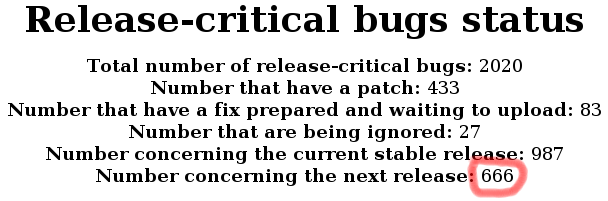
RCBW - #26 RC bug count: 666 It is getting down, even though the current number is scary. My personal RC bug count is not so mystical and as low as 205 RC bugs to go, which is quite encouraging. Without any further ado, here are this week squashes: Random points:

Stefano Zacchiroli: campaigning woes

lots of votes! In principle, I just meant to blog saying that I've really enjoyed campaigning this year: thanks to the other candidates and to all the people who asked questions. (... and kudos to a couple of who-know-who-you-are-persons which have managed to ask very inflammable questions with a lot of tact) But given that a blog post that way would have been too empty for my standards, here are a couple of extra random remarks:
  1. I believe that the campaigning summary on my DPL 2010 page is now complete
  2. One week into the voting period, we seem to have quite more votes than last year: we've just passed the 200 ballot thresholds, whereas last year the very same threshold got passed only after the second call for votes (which corresponds to steep increases in most Debian votes). Considering that the number of potential voters is lower this year (i.e. a bit more than 1'000 vs a bit less than 900), this might well be the first year after a while, in which the percentage of voters increases (which I consider to be a good indicator of interest, no matter what).

John Goerzen: Face to Face With Destruction

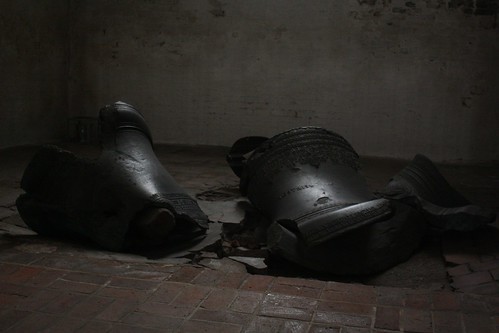
IMG_2641 Seeing these church bells in L beck wasn t easy for me. They melted and fell to the ground after an air raid in 1942, and have been left exactly as they fell. I wasn t alive in 1942, and even my parents hadn t yet been born. My grandfather was relocated by the American government because he refused to fight in the military for religious reasons. And yet, I still felt a sense of embarrassment, being an American standing there in Germany next to those bells. My country* did things like this. Why? Even if there s a war on, and whatever the other side may be doing, do we really have to bomb all their churches? Then, we went to the Dom (cathedral). It has a small gallery of photos of the destruction in 1942, and how it took 40 years to restore (though some original works are simply irreplaceable.) Burning L beck Cathedral after an air raid in 1942 I had just been walking through the beautiful Dom, and then saw pictures like that. It was very sad. I imagined the people in 1942, seeing the smoking remains of so many buildings that had been important to the town for centuries. Places where, no doubt, some of them worshiped, and their parents and grandparents had too. I imagined my sadness if a country bombed one of the churches that my ancestors helped start or build. I felt ashamed of what the democracy in which I live (and its allies) did to the Dom, to Marienkirche, and to the other churches and civilians there. Then, a few days ago, Wikileaks posted a video from an American helicopter in which our soldiers begged Come on, let us shoot! at people, most or all of which were completely unarmed. They killed a bunch of people. Then a van came to try to get the wounded to the hospital. Then the soldiers in helicopter killed those people, and wounded some children. Even if they thought their lives were in danger, I d expect to hear some quiet sadness at what they thought was a regrettable need to use force. Instead, you d hear them cheering whenever they killed someone, as if they had just won a round on some video game. They killed civilians, and considered it a fun experience and a mission accomplished. There was no sadness for knocking a man to the ground, leaving him writhing. Just jokes. There was no more care for human life here than there was 60 years ago. It saddens me that every year we celebrate our military on independence day celebrating its ability to kill, not its ability to feed. I wish that we could rather celebrate the times Americans have saved lives, whether in Berlin or in Port-au-Prince, or helped to topple dictatorships. Military power shouldn t be our first choice so often. L beck wasn t attacked for any strategic purpose; the British did it to destroy the morale of the enemy civil population , as the Americans did in Dresden or the Germans in London. In other words, those bells fell to the ground for no reason other than that they were German. People lost their lives for the same reason in Germany and in London. The British had no reason to believe that those civilians meant them any harm, that they were anything but caught between two strong powers. And the same held true in Iraq. When we went to Berlin, we walked through the replica of Checkpoint Charlie, with the big sign announcing that you are leaving the American sector. There is little positive to be said about the Cold War, but there is something the British and American military did of which I am not the least ashamed: the Berlin Airlift. Although I didn t see it, I feel a sense of the USA having been a force for good when I read about the Berlin Airlift Monument at Tempelhof, which has the names of the 70 British and American men that lost their lives in the airlift (due to accidents), above the inscription They gave their lives for the freedom of Berlin. That s the spirit I wish we d see more often in the world today: people giving their lives not just for their own security, but for strangers in need on a different continent. We Americans have been, compared to many countries in Europe, relatively sheltered from the ravages of war in our own midst. I wish that more of us would have the opportunity to gaze at fallen church bells, to wonder through a magnificent old church and then to see photos of it on fire, or to see a monument to our soldiers in a far away land. Perhaps then we could better learn from history, and see firsthand that some of our most positive contributions to the world have come in the form of coal and candy bars instead of incendiary devices. A small post script Many historic buildings or locations we saw in Germany had plaques on their exterior with a brief history, often in German and in English. I was interested to note that some (though not all) of these plaques had language such as destroyed by fire in 1942 , with no mention that the cause of the fire was a bombing. I was even more interested to note that same sort of description at several sites in Prague Castle, mentioning that the original building was lost in the fire of 1142. It was only on the third or fourth building in the Castle that we learned that the fire of 1142 was caused by a military siege of Prague Castle. * I know it was the British at L beck, but the Americans did similar things elsewhere. I also acknowledge that, at a macro level at least, the Berlin Airlift wasn t purely an altruistic act, as there were geopolitical factors in play. But I am speaking of the actions of the airmen here, who took on considerable risk to help others.

7 April 2010

Jon Dowland: tesco

Tesco Car Insurance (and most likely their other financial products) operate a commercial email system which is populated by anyone who submits their address to them as part of searching for a car insurance quote. That's not particularly unusual. Each mail that Tesco sends includes unsubscribe instructions - standard industry practise. However Tesco's instructions do not work. I have followed them at least three times since January this year to no avail. Despite this I have continued to receive unsolicitied commercial email (spam) from Tesco. Tesco do not answer mail to their postmaster or abuse addresses, and do not accept mail for those local parts at many of their domains (they use more than one domain for their business: tescofinance.com, tesco.com, tescocompare.com, contact.tescocompare.com, tescoinsurance.com). I would advise that nobody ever submit their details to a Tesco-affiliated company for these reasons. I have given up and blacklisted them on the mail servers which I control. Based on the unrelated experiences of a friend of mine, I would have strong reservations regarding the quality of the services they offer, too - in particular their home insurance products.

3 April 2010

Bernd Zeimetz: deb.li - the Debian ShortURL Service - beta test

After several other Debian developers convinced me that a ShortURL service, which is under control of a Debian Developer would be useful for them, I've spent some time to write the necessary code for it. And if it will be used regulary, I'll ask DSA if they want to host it on a proper machine. So I'm happy to announce the public beta test of deb.li (also available under go.debian.net)! Please note that neither the content of the pages nor the CSS is finished... :) As this should not become just another random, spammer-attracting ShortURL service, I will not provide a web based form to add new URLs. Instead new URLs have to be added via a simple JSON-RPC based interface. Other ways to add new URLs will be added on request (or by sending patches ;)), at least an email-gateway similar to db.debian.org is planned. The small piece of documentation which exists so far is available at wiki.debian.org/deb.li And if you want to give it a try now, log into alioth.debian.org and have a look into

/var/lib/gforge/chroot/home/users/bzed/godebian-client
- the usage is documented in the README file and should be pretty straight forward. I hope it will be useful - comments, bugreports and patches are welcome!

Joerg Jaspert: Fun with broken hardware

As you might have read, one of Debians slightly important machines had some hardware trouble. Before I get into more details of this story, let me say thank you to all the people who worked on this issue: - The DSA (Debian System Administrators) team, - the local admins at Brown University Computer Science department. I intentionally leave out the HP support here, I think their work in this issue was pretty suboptimal. While they do follow a certain schema, it took a bit long and the stunt with the technician not finding the replacement board and later on leaving without further notice wasn t all that great. (Update: Just to clarify this: In general we are happy with HP and the hardware and relationship and all that stuff. And usually the support works pretty well, like for all the times we had to replace broken disks.) Now, the story. This all started by us noticing something in ries kernel output telling about some trouble with the ram:
ries kernel: [168074.392016] Northbridge Error, node 0, core: -1
ries kernel: [168074.392186] K8 ECC error.
This was first noticed somewhere at the beginning of January. A DSA member then used the usual HP tools to check whats up, none of it reported an error. There wasn t much of an option left besides waiting what happens in the future. No support would do anything here. Until March we did not have any trouble. But at the 14th of March this changed, as the HP tools now found a serious error, reporting Status: DIMM is degraded for the third DIMM module. A support ticket was opened at this point and a replacement DIMM got sent out. Unfortunately the well known Mr. Murphy did look at this issue and so the wrong thing was sent out to the wrong place. Countdown continued and 10 days later the host decided to randomly lockup. And as HP servers have an Automatic Server Reset function in such cases, the whole machine rebooted. Not only once. Guess how much a filesystem likes such things when the machine is active. And for added fun a second DIMM got reported as broken, we now had DIMM #3 and #4 gone off. A certain ping-pong with HP support later we asked the local admins to take out the broken DIMMs and then also to change the order in which the remaining DIMMs are arranged. Unfortunately this did not help, the errors stayed. At this time we already turned off the services running on the machine and it mostly waited in the HP Insight Diagnostics test from HPs SmartStart CD. (And it always locked itself at 97% here). The support asked us to try another round of work on the machine, which our DSA team and the local admins did. But as it already was the 30th of March and nothing helped, our DSA got a little more direct in asking for a working solution. Like replacing the board and sending a technician to look and fix the machine. This was scheduled for the 1st of April, but turned out to not work as hoped. For some reason the technician was not able to find the board that was sent as replacement (no fault of our local admins!), so nothing happened the 1st of April except us getting a little upset. DSA communicated this to HP support, asking for escalation and finally getting this fixed. Our local admins could at last greet a HP technician on the 2nd of April then and he even had the replacement board with him, so he did his work there. He also confirmed that the two DIMMs mentioned above are faulty. For some reason he did not replace them, but left them outside of the machine. He also left the place without telling the Brown CS staff, so it wasn t the best performance he made. Fortunately the machine was in a working state again, only missing 2 of its DIMMs, 4Gb RAM. This has to be replaced by HP in the next days. When the Brown CS staff found out the technician left without notice they enabled our DSA to access the ilo of the machine again, so they could get the machine back up. Of course the first run was the HP SmartStart stuff again, running a full test. It reported no error, pheeew. There had been a few more steps in getting the settings of the ilo correct again and running a full filesystem check on it, but somewhere in the night the machine was back up and ready for us FTPMasters and Release team to get the services back. As the machine was back up in the middle of the night where I was sleeping, I did start my work somewhere this morning. At 10:25 CEST this started with a md5sum check of all files we have in our pool/ structure, ie. the Debian archive. We had 655k files to check, so it naturally took a while. Luckily we only found 32 broken files. Even better a set of them is already fixed, the rest of them is easily fixable with a set of binnmus the buildd people helpfully schedule, so not too much work involved in fixing this issue. Could have been worse. (Actually, when the first reboots happened, before the long downtime, we also had some broken logfiles, unreadable changes files and such things. But those I already fixed back then). More or less in parallel to the md5sum check we also started the queue daemons again, to let our upload queues from the other hosts forward their files to the central queue on ftp-master, tested the triggers to the new buildd peoples machine and the release team did a britney run. This took the first 5 hours (and a bit) of the process. As a second step, and we are still in this, we started the processing of the incoming queue. Turned out we have to process 10gigabytes of new uploads, in a total of 1285 uploads. This process is still running at the time I write this blog post, having processed about 1100 uploads. A good 9 til 10 hours run, but this was expected. I actually thought it will take even longer. When this is done I will go and have a manual dinstall run. That is, I will run every action a dinstall is usually doing by hand. And verify each step. Usually dinstall takes some 2 hours, manually it can take a bit more. Somewhere during this run a mirror push will also be done, a fairly huge one this time, with all those updates. When this all works I will turn on FTPMaster cronjobs after this dinstall, or at latest tomorrow morning, as usual, and service is back as usual. As far as I know the release team plans to turn on their cronjobs tomorrow morning too, so this will all be nice then. Apropos release: Please note what I wrote in my latest d-d-a mail:
As a sidenote from me: If you have a package that might be involved in
whatever transition to testing, or simply might get involved, it could
really help if you wait a day or two with the next upload, so the
release team can sort through all before you give them new trouble. If
in doubt, try mailing debian-release@lists.debian.org and ask. :)
So, thats it, enough annoyance with all those status bits here and there. I go leave you alone now. :)

30 March 2010

Russell Coker: Why Comments?

Russ Albery has described why he doesn t support comments on his blog [1]. I respect his opinion and I m not going to try and convince him to do otherwise. But I think it s worth describing why I want comments on my blog and feel that they are worth having for many (possibly most) other blogs. Types of Blog The first thing to consider is the type of post on the blog. Some blogs are not well suited to comments. I have considered turning off comments on my documents blog [2] because it gets a small number of readers and is designed as reference material rather than something you might add to a public Planet feed or read every week as it has a small number of posts that are updated. So conversations in the blog comments are unlikely to happen. One thing that has made me keep comments open on my documents blog is the fact that I am using blog posts as the main reference pages for some of my projects and some people are using the comments facility for bug reports. I may make this the main bug reporting facility I will delete the comments when I release a version of the software with the bugs fixed. One particular corner case is a blog which has comments as a large part of it s purpose. Some blogs have a regular open thread where anyone can comment about any topic, blogs which do such things have the owners act more like editors than writers. One example of this is the Making Light blog by Teresa and Patrick Nielsen Hayden [3] who are both professional editors. The next issue is the content of the post. If I was to create a separate blog for authoritative posts about SE Linux then there wouldn t be much point in allowing comments, there are very few people who could correct me when I make a mistake and they would probably be just as happy to use email. When I write about issues where there is no provably correct answer (such as in this post) the input of random people on the net is more useful. Another content issue is that of posts of a personal nature. Some people allow comments on most blog posts apart from when they announce some personal matter. I question the wisdom of blogging about any topic for which you would find comments intolerable, but if you are going to do so then turning off comments makes sense. Finally there is the scale of the blog. If you don t get enough readers to have a discussion in the comments then there is less benefit in having the facility turned on the ratio of effort required to deal with spam to the benefit in comments isn t good enough. In his FAQ about commenting [4] Russ claims that controlling spam can take a tremendous amount of time or involve weird hoop-jumping required for commenters . I have found the Block Spam by Math [5] Wordpress plugin to be very effective in dealing with the spam, so for this blog it s a clear benefit to allow comments. Since using that plugin my spam problem has decreased enough that I now allow comments on posts which are less than 1 year old previously comments were closed after 90 days. The plugin is a little annoying but I changed the code to give an error message that describes the situation and prevents a comment from being lost so the readers don t seem too unhappy. The Purpose of Comments Russ considers the purpose of comments to be meaningfully addressed to the original post author or show intent to participate in a discussion . That s a reasonable opinion, but I believe that in most cases it s best if comments are not addressed to the author of the post and are instead directed towards the general readers. I believe that participating in a discussion and helping random people who arrive as the result of a Google search are the main reasons for commenting. For my blog an average post will get viewed about 500 times a year and the popular posts get viewed more than 200 times per month, so when over the course of a year more than 1000 people read the comments on a post (which is probably common for one of my posts) then 99.9% of readers are not me and commentators might want to direct their comments accordingly. Of course a comment can be addressed at the blog author so the unknown audience can enjoy watching the discussion. For some of my technical posts I don t have time to respond to all comments. If I have developed a solution to a technical problem that is good enough I may not feel inclined to invest some extra work in developing an ideal solution. So when a reader suggests a better option I sometimes don t test that out and therefore can t respond to the comment. But the comment is still valuable to the 1000+ other people who read the comment section. So a commentator should not assume that I will always entirely read a comment on a technical matter. Comment threads can end up being a little like mailing lists. I don t think that general discussions really work well in comment threads and don t aim for such things. But if a conversation starts then I think you might as well continue as long as it s generally interesting. Generally for most blogs I think that providing background information, supporting evidence, and occasionally evidence of errors is a major part of the purpose of blog comments. But entertainment is always welcome. I would be happy to see some poems in the comments section of technical posts, sometimes a Limerick or haiku could really help make a technical point. Political blog posts can be a difficult area. Generally the people who feel inclined to write political blog posts or comment on them are not going to be convinced to entirely change course, but as there are many people who can t seem to understand this fact a significant portion of the comments on political blog posts consist of different ways of saying you re wrong . The solution to this is to moderate the comments aggressively, too many political blogs have comments sections that are all heat and no light. I m happy for people to go off on tangents when commenting on my political posts or to suggest a compromise between my position and their preferred option. But my tolerance of comments that simply disagree is quite small. Generally I think that blogs which directly advocate a certain political position should have the comments moderated accordingly, people will read a site in the expectation of certain content and I believe that the comments should also meet that expectation to some degree. Comments on political posts can provide insights into different points of view and help discover compromise positions if moderated well. How to provide Feedback Russ advocates commenting to the blog author via email it is now the only option he accepts. My observation is that the number of people who are prepared to comment via email (which generally involves giving away their identity) is vastly smaller than those who use Blog comment facilities. This means that you will miss some good comments. One of the most valuable commentators on my blog uses the name Anonymous and has not felt inclined to ever identify themself to me, I wouldn t want to miss the input of that person and some of the other people who have useful things to say but who don t want to identify themself. I have previously written about how not all opinions are equal and anonymous comments are given a lower weight [6]. That post inspired at least one blogger to configure their blog to refuse anonymous comments, it was not my intent to inspire such reactions (although they are logical actions based on a different opinion of the facts I presented). I believe that someone who is anonymous can gain authority by repeatedly producing quality work. Another option is for people to write their own blog posts referencing the post in question. I don t believe that my core reader base desires short posts so I won t write a blog post unless I have something significant to say. I expect that many other people believe that the majority of their blog comments would not meet the level of quality that their readers expect from their posts (posts are expected to be more detailed and better researched than comments). As an aside forcing people to comment via blog posts will tend to increase your Technorati rating. :-# A final option is for people to use services such as Twitter to provide short comments on posts. While Twitter is well designed for publishing short notes the problem with this is that it s a different medium. There are many people who like reading and discussing blog posts but who don t like Twitter and thus using a different service excludes them from the conversation. For my blog I prefer comments for short responses and blog posts for the longer ones. If you write a blog post that references one of my posts then please enter a comment to inform me and the readers of my blog. Email is not preferred but anyone who wants to send me some is welcome to do so. If this post inspires you to change your blog comment policy then please let me know. I would like to know whether I inspire people to allow or deny blog comments.

29 March 2010

Mauro Lizaur: Drawing with CSS.

I've been watching several people drawing random figures with only CSS and letters, Rom n Cort s in particular, who made Homer Simpson, an Origami Crane (bird), a "3D" can of Coke among other stuff.
The other day I was bored and with some free time so I "drew" the Debian logo :-)
Debian CSS
The logo above is a screenshot of how it looks using epiphany-webkit (2.29.3-1) which, btw, works better on every update. On the other hand, on Iceweasel (3.5.8-1) doesn't look that good but it looks good enough.

Well, if you want to see how it looks on your browser click here. Also, if you think you can improve the looks, leave me a comment or contact me and I'll update it.

Dominique Dumont: V1.0: To release or not to release ?

Hello As the author of Config::Model, I ve often pondered whether my project was mature enough to be released as 1.0. After all, every time I seriously use it, I find new bugs or need to make it easier to use or even add some new features. So I thought that my software was not good enough for V1.0. Then again, all other software have the same issues: fix bugs, improve usage and follow user requirements. Then, I ve realized that wondering about software quality is not the right question. Sure, you need a decent quality level for 1.0. But the more important is not there. The most important is the compatibility pledge. Do I pledge to keep backward compatibility so people can rely on me and my software? Will I do my utmost to preserve the work done by others ? In fact, that s what I ve been doing for several months now, all the changes I ve made are backward compatible (even if warnings are issued) and people have a smooth migration path. So, yesterday, I ve released Config::Model V1.001. Ta-da ! :-D

Next.

Previous.