Search Results: "bod"

21 January 2010

Jaldhar Vyas: There's No Hope With Dope

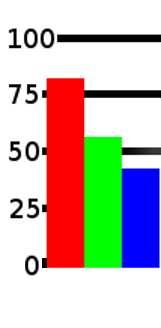
With Guantanamo Bay about to be shut down, and President Obamas' first year in office complete, what do the American public think of him?
% of Americans who approved of Pres. Bush after one year in office
% of Americans who favor waterboarding the Christmas bomber
% of Americans who approve of Pres. Obama after one year in office
How did this happen? Well, once upon a time, the USA was really racist. Then a light skinned African American with no negro dialect entered the presidential contest and the country entered a new post-racial era. Unfortunately not everyone had the audacity to hope. Things got so bad, people wanted to cut obamas nuts off but the change we sought within us prevailed and became president. Unfortunately some parts of the US are still filled with overweight Jesus and gun loving Walmart shoppers who insist on voting Republican even though that party doesn't exist anymore. Why? Racism. It's the only possible explanation

20 January 2010

MJ Ray: Get the Survey Monkey Off Your Back

I ve been asked why I dislike surveymonkey surveys, I don t want to reply fully in that forum (because it s off-topic there) and I want to publish this for your feedback now. surveymonkey really frustrates me. In short, it s often confusing, I think it doesn t follow UK accessiblity laws and I m unsure if it complies with our privacy laws. It seems like another triumph of marketing over good sense. It s a free market failure, possibly based on lack of information on the drawbacks of this option. If a survey is on Surveymonkey, it s easiest for able-bodied users of full-fat browsers with low security and privacy settings to answer. Using NoScript or a privacy tool? You ll get an error message (which contradicts the VPAT_SurveyMonkey.pdf description). Unable to see graphics clearly? The forms will be hard to read because they ve replaced the browser form widgets (such as checkboxes and radio buttons) with javascript-driven images for no good reason. Those sort of faults will probably bias results a bit how much will depend on the subject. It s a particular case of a problem I first mentioned in the last-but-one bullet point on my debian surveys page back in 2006. Basically, I think you should keep open surveys as open as possible. Statistics literature is littered with bizarre spurious results from when the survey method accidentally favours some particular subset of the population. Finally, surveymonkey surveys can be left with answer requirements which make no sense, such as ticking Other requiring a text input, but the text box not accepting input. Is that the fault of the survey owner not being able to work the admin interface, or the interface having some subtle flaws? I m not completely sure, but I ve had that experience a few times. So, can I persuade people to use limeservice, doodle or even Google Docs rather than Surveymonkey, please? I think Limeservice is better because it s based in Germany (so EU data protection and privacy laws apply) and is cooperatively-developed FOSS software. Doodle and Google aren t, but are quicker and easier to use for straw polls. If you want something to install on your own site and the downloadable limesurvey software seems a bit heavy, then askpeople seems another good option. Our co-op can host either of those if you re willing to pay. (If someone would be willing to sponsor it, we d host some free surveys too let me know.) Lots of people use surveymonkey, but popularity doesn t always mean it s the best tool. Please consider the alternatives and pick the best tool for the job.

19 January 2010

Torsten Landschoff: quiltrc for Debian packaging

Working on another laptop, I was missing my quiltrc settings. I think, I got them from a this email by Marco d Itri. Perhaps it is of help to somebody (for example, when I go searching for it again). BTW, I changed it locally to check only for debian folder in parent directories and create debian/patches automatically if needed:
1
2
3
4
5
6
7
8
for d in . .. ../.. ../../.. ../../../.. ../../../../..; do
if [ -d $d/debian ]; then
if ! [ -d $d/debian/patches ]; then
mkdir $d/debian/patches
fi
export QUILT_PATCHES=debian/patches
fi
done
I d rather end up with a patches dir inside the debian folder instead of having it at a random place in the package sources when adding the first quilt patch. I wonder if we should ship this with the quilt package!?

18 January 2010

Russell Coker: Why Internet Access in Australia Sucks

In a comment on my post about (relatively) Cheap Net Access in Australia [1] sin from Romania said Somebody needs to whack the aussie ISP in the head with a cluebat. The prices that you pay are insane . In Eastern Europe you have optic fibers from Germany and other western European countries that carry vast amounts of data. As the demand for capacity increases it s not THAT difficult to lay more fibers. You also have competition between different companies that lay fiber. To get data to Australia you must lay cables under the sea, this is expensive and can t be done quickly. Therefore all international data transfers are expensive to cover the expense of laying the cables. I don t think that we have any real competition in the market for International connectivity from Australia either. Now the links between Europe and the US aren t cheap either, but I believe that there are economies of scale (as well as shorter distances) that make them significantly cheaper than the links to Australia. Also a good portion of the traffic that you generate as a customer of a European ISP will stay within Europe as there are heaps of good sites in Europe. The number of people living in Europe who speak English as their first language is more than twice that of Australia. The number of Europeans who communicate in English almost as fluently as the native speakers (such as about half the population of the Netherlands) is also quite significant. I expect that the amount of English-language material on the net that is published from the EU is more than three times greater than the quantity published from Australia. People who speak languages that have a more limited geographic spread (IE anything other than English, Spanish, French, and Portuguese) will have a higher portion of local traffic which is therefore cheaper for their ISP. So based on the relative population sizes we should expect to have Australians making a higher portion of their Internet bandwidth be expensive international data transfers than that of Europeans. Then of course there is the issue of server costs. Running servers in Australia is horribly expensive, while user access to the net is merely annoyingly expensive, the costs of hosting servers are significant and usually the offers have slower hardware and slower transfers (particularly to the important US and EU markets). My blog is hosted in Germany because the company that was offering me free hosting in Australia encouraged me to host it elsewhere due to the price. Also hosting in Germany gives me slightly lower ping times to the US and significantly lower ping times to Europe. As about half the readers of my blog are based in the US, a significant quantity of the readers are based in the EU, and Australia only contains a small portion of the readers the overall experience for readers of my blog is improved by having it hosted outside Australia. It would be better to have it hosted in the US (where most of my readers are located) but I was offered free hosting in the EU. It would be nice if there was a cheap and easy way of getting a mirror of my blog running in Australia with Geo-DNS so that people using Australian IP addresses would get a local server. Putting the static images on an Australian server would be trivial, setting up Geo-DNs would be painful and probably increase reliability issues later on but isn t insurmountable (I have root on both DNS servers). The Debian blog gives some basic information on how to setup GeoDNS [2]. Then I would need to set up a MySQL slave for Wordpress data and modify Wordpress to send it s writes to the master server which is probably impossible for me unless someone else has already written a Wordpress plugin for this, I m really not good at PHP programming. Another possibility would be one of the Wordpress cache plugins that maintain static files to avoid needless database lookups. Until/unless I do such things, every Australian reader of my web site (and those of my friends who do similar things to me regarding hosting) will slightly tilt the balance of Internet transfers in favor of expensive data from foreign servers instead of cheap content from local servers. Sometimes it just sucks to live on an island.

17 January 2010

Mirco Bauer: Smuxi 0.7 Release + Smuxi 0.8 Plans + FOSDEM 2010

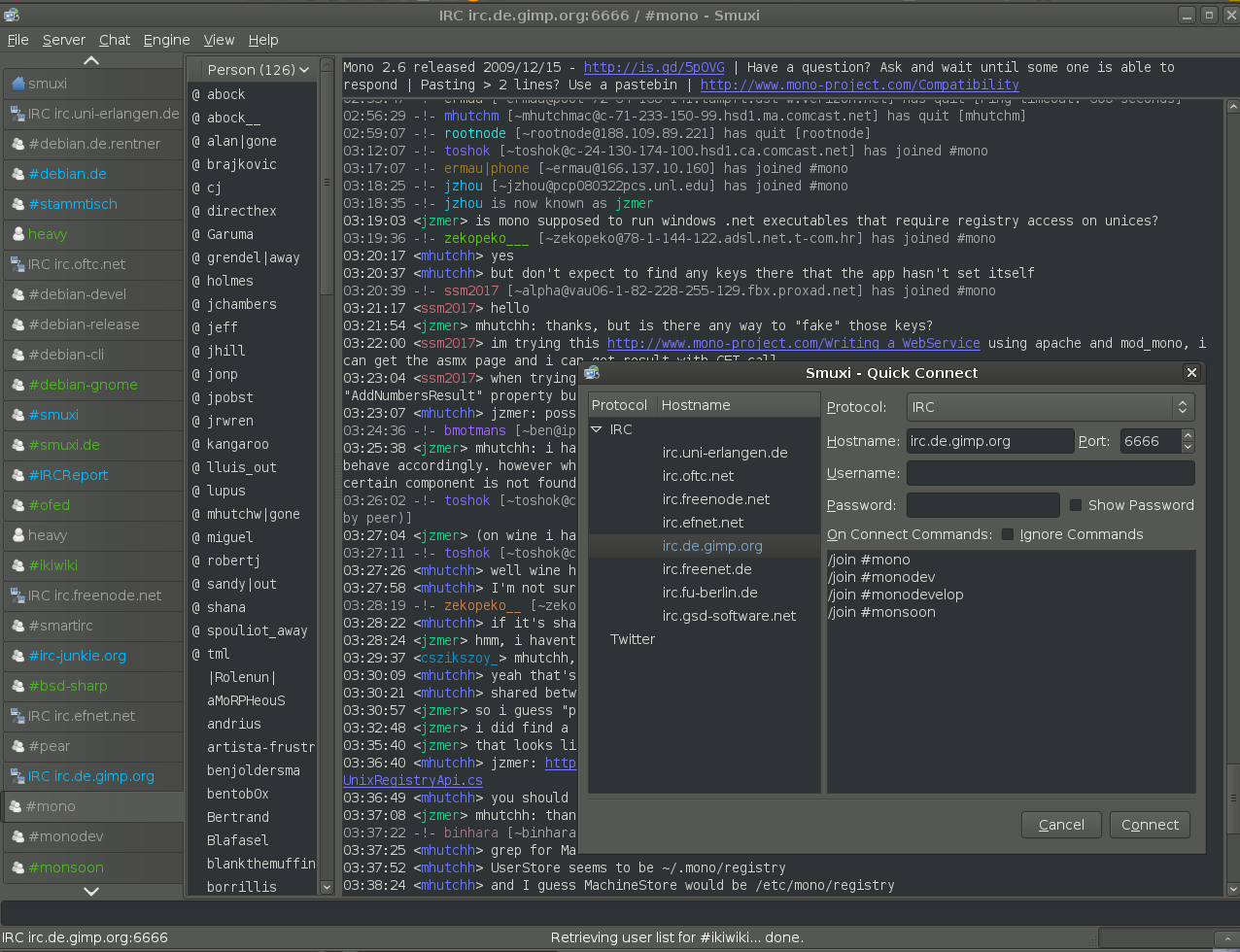
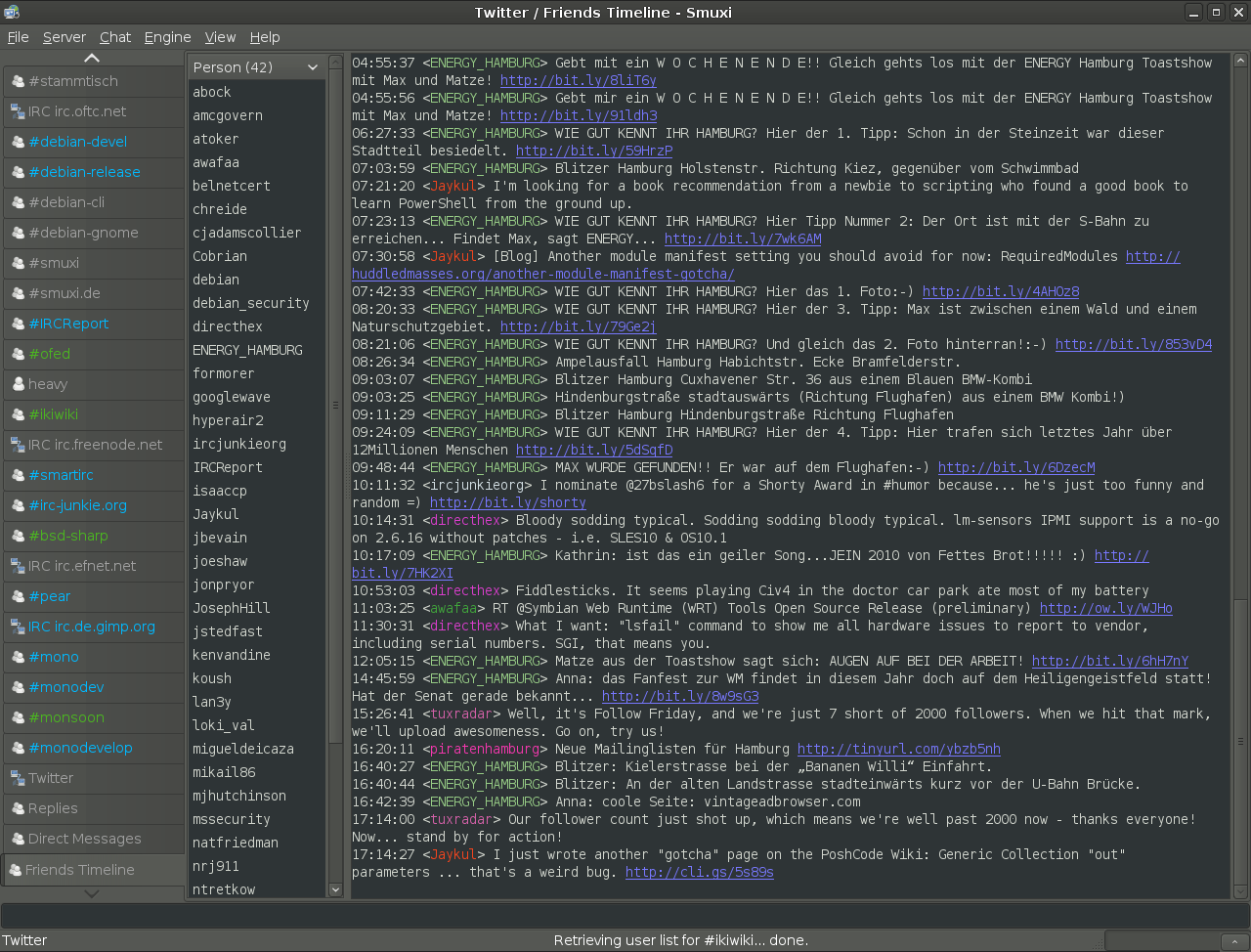
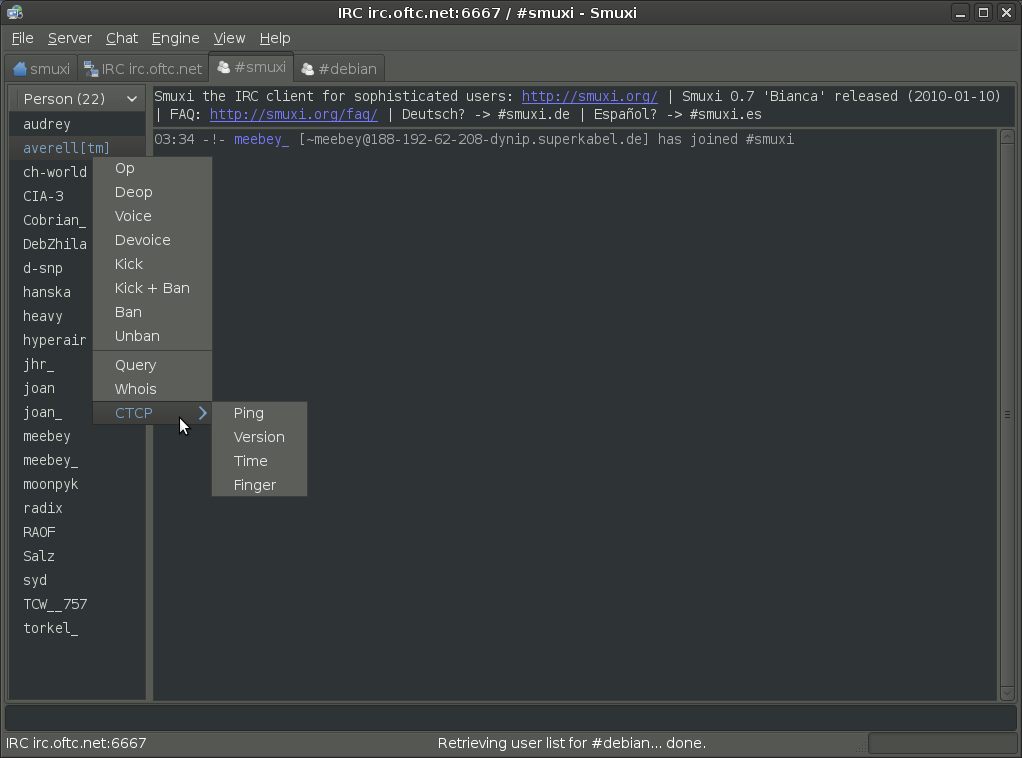
Merry Christmas! Happy New Year! Yeah, it's that time of year again, I am writing a blog post bigsmile.png. As some of you have probably already noticed I managed to get Smuxi 0.7 released a few days ago. Almost all of my Xmas vacation I was hacking on Smuxi. This is the best Smuxi release ever (guaranteed!). The most notable features I implemented in the 0.7 release are: Twitter support, handling for high latency networks (UTMS, WLAN, busy DSL) and an improved IRC experience through tweaks such as splitting oversized messages and new context menus. This release also contains very nice contributions from David Paleino [2] and Cl ment Bourgeois. Both joined the hackfest during my Xmas vacation and made the hacking sessions on Smuxi even more fun. Thanks for that guys! Here you can find a full list of changes. As everbody likes screenshots and as screenshots say a thousand words, here they are: Quick Connect
Twitter
User Menu
Which direction will Smuxi head in after the 0.7 release? For the 0.8 release, I plan to focus on making the IRC support feature complete. That means we will get DCC, SSL, IPv6 and logging support. Nothing of that sounds very special but I am already investigating how Smuxi can be integrated with the promising new Zeitgeist project. I interviewed one of the developers for potential communication between Smuxi and Zeitgeist. Last but not least, I want to announce that I will be attending FOSDEM 2010 in Brussels. I also will give a talk about Smuxi there, scheduled on 2010-02-07 at 16:30. If you want to have a chat, a beer, do some GPG keysigning, or ask me any questions, I am available bigsmile.png PS: If you want more updates than once per year, just follow me on Twitter

14 January 2010

John Goerzen: System Administrators Might Save Your Life

There s a lot of responsibility on the shoulders of system administrators. Unless you re one, it s probably hard to grasp the full weight of it. This week has been full of reminders for me. This afternoon, shortly after lunch, I got word that people were having trouble with phones. A few minutes of testing showed that calls within our city were working fine, but it was completely impossible to place or receive long-distance calls. A little while later, a local newspaper s website indicated that numerous cities over a multi-county region, all served by the CenturyLink local telephone company, were out of service in this manner. I figure that represents hundreds of square miles, or a patch of rural Kansas roughly the size of Los Angeles. Adding to the problem was the fact that emergency 911 services are accessed via these long-distance lines that were down. For roughly three hours, 911 was completely down across this entire area. What s more, many cellphone towers and Internet access options were also taken down, since they feed from these same lines. This adds up to a situation that could very easily cost lives due to delayed response of emergency medical, fire, or police services. In the end, the problem was traced to a bad controller card on a Titan 5500 owned by AT&T. Now, here s the system administration angle: If you worked for the phone company and had to troubleshoot a problem that you knew had taken down emergency services for thousands of people, what kind of pressure would you be feeling? Would you be able to keep your cool? I m glad that I don t have that kind of job. I also wouldn t like to be the engineer (or, more likely, accountant) that decided that they didn t need any more redundancy to provide good service to the area. Especially considering this is the second time in the last year or two this has happened. But, ironically, yesterday I signed a purchase order for a new Asterisk PBX (corporate phone) server. When selecting a machine for that task, I am always completely conscious of the responsibility on my shoulders: several hundred employees rely on the machine that is ultimately my responsibility to select. Our own access to 911 would be cut if the machine were to go down. I never forget that the correct operation of the systems that our team sets up and deploys could help save someone s life, and that a malfunction could cost the company dearly in terms of revenue, productivity, image or worse. Nearly four years ago, we switched from an analog PBX, with outsourced support, to a digital VOIP system running Asterisk. Note that we use VOIP in-house, but do not use it externally. Anyhow, I can not say that the Asterisk PBX has been 100% perfect; I doubt that this could be honestly said of any PBX of any complexity. I can say, though, that it saved us well over $100,000 AND has proven far more reliable than the system it replaced. Outages are exceptionally rare and brief now. Plus we have internal expertise to fix it, rather than having to wait for a technician to be dispatched from a city 2 hours away to fix anything. I know I don t have the resources to build a perfect PBX that will never go down (if such a thing is even possible), but I take my responsibility regarding a reliable PBX extremely seriously. We used to have a frequent problem: someone would call 911, then hang up. We suspected this was often on accident maybe people hit 9 for an outside line, then misdialed their number. In any case, 911 dispatch would then call our main office, saying they got a hangup. A person or team would then go across our entire campus making sure nobody was in distress that nobody had managed to dial, then passed out, for instance. With Asterisk, I was able to help this situation. Whenever somebody calls 911 now, two emails are generated: the first contains details about the call, such as the extension number that called and the duration of the call. This goes to all people that are likely to receive a callback from 911. It may not always pinpoint the source (as with somebody using a wireless phone), but almost every time will give us a very good idea where the call came from. The second email is a recording of the call, and serves as an additional clue, but goes to fewer people. I am aware that email isn t a perfect medium, but: it let us make a dramatic (albeit imperfect) solution to a problem that very few institutions our size are able to address nearly so well. There s a lot of weight on our shoulders: keeping the accounting system up, the Internet links up, the web store or the sales phone lines, the shipping systems or the document archives up. These things going down can spell deep trouble in many ways. And sometimes the systems we maintain might save a life. Such as this morning, when someone was feeling symptoms of a heart attack, used our phones to call a colleague for help, that person called 911, and an ambulance was dispatched. I know the system worked exactly as it should, because I had two familiar emails from Asterisk in my mailbox this morning when I got to work.

13 January 2010

Adrian von Bidder: Death

NZZ Folio, the monthly that comes with my newspaper, had this topic in its January edition, sparking a few thoughts about capital punishment. Why am I against capital punishment? Primarily, because no justice system will ever be safe (make no mistakes, know no abuse.) Then there is the fact that life is something special and isn't ours to take away, but on the other hand, we assume that it's ok for us to judge that somebody should be locked in the rest of his life, and I'm not quite sure how big that difference is. Ok, I one thought. Everything else I was going to write was just technical stuff on the execution of death penalty, which I have established I'm against. This engineer's brain can't stop thinking yes but what if ...

12 January 2010

John Goerzen: Review: Shmoop s Coverage of Homer s Iliad

I read The Iliad recently; see my review of it here. This article isn t about The Iliad, but about Shmoop s coverage of it. I have never been a person who puts much stock on study guides before, and my own prejudice is that they have probably earned their reputation as useful for little more than a tool to help students pass exams without reading the material. However, I felt rather unequal to reading The Iliad; after all, it has been many years since I had been exposed to Greek mythology, and even then it was very brief. I had remembered from Amazon s blog that they are offering some of the classics with a Shmoop study guide built in. I figured the $2.39 would be worth it. But I m not sure it was. The resulting ebook has two sections: the main text, and the Shmoop overview. The overview contains essentially the information available for free on their site. This information is pretty good. It has some overviews of the entire book, plus summaries of each chapter. They helpfully provide the backstory in the chapter summaries, so I know why certain gods are on the side of the Trojans and the others on the side of the Achaeans. It helped me figure out the point to some of the actions described on the text. These are linked to at the beginning of each book (chapter) of the Iliad, which was a bit inconvenient because I prefer to read them after reading the main text. Nevertheless, it wasn t a big problem. The summaries were written colloquially, sometimes too much so. I grinned as the less grabbin , more stabbin summary of the Achaeans being told to salvage armor from the dead later and keep fighting now. I cringed as no way Jose , and rolled my eyes as it described how one of the heroes got owned . That would have been less clear than the original for many. I would probably have given the Shmoop edition 4 or 5 stars on Amazon were it not for numerous boneheaded mistakes they made. The commentary uses one translation (Lattimore), while the included text uses a different one (Butler). That s bad enough, but it gets worse: Lattimore uses the Greek names for the gods and heroes, while Butler uses the Roman ones. So you can be reading through the text, learning about Jove, Ulysses, Juno, and Mars. But the commentary refers instead to Zeus, Odysseus, Hera, and Ares. Now, some might have memorized the Greek and Roman names for everyone, but then such people probably aren t wanting a study guide. I finally had to print out a page to help me understand the study guide. That is terrible, and completely inexcusable. They should have used the same translation for the text as the commentary, or at least have provided parenthetical notes throughout the commentary. Next, they really did a poor job of the main text itself. They have apparently grabbed the Butler ASCII text from Project Gutenberg, and cut and pasted it into some editor. I say this because each line renders as a paragraph; that is, the text doesn t reflow to fit the screen as every single other book does. Worse, it s too wide for the Kindle. So you get one line full width, the next only half as wide as the display (some of the first having wrapped), then the next full width again, on down. Butler is a prose, not a poetic, translation, so this is pointless. Moreover, the line endings are exactly where they are at Project Gutenberg. So, what we have here is that somebody at Shmoop cut and pasted from their own website and Project Gutenberg, and nobody bothered to check if the resulting product was crap. At least with the new Kindle firmware you can read in landscape mode to prevent most of the lines from wrapping. Still, I m very annoyed at this. There are other flaws. They highlighted some passages in the text. Clicking on them goes to some commentary about it. OK, fine. But why are some passages highlighted in the text, and some mentioned in the chapter summary? There seemed no rhyme or reason. The highlighted passages commentary was iffy in quality. Sometimes it was useful, and sometimes it asked a question of the sort I might expect in a jr. high English question When has pride helped you in your life? or some such. Worse, not all of the highlights linked to the correct place, and they also suffered from the Greek/Roman name issue. In all, Shmoop has helped me understand The Iliad and place it in context. But they need to spend a lot more effort on copyediting. Even a couple of hours of someone actually looking at their Kindle product on an actual Kindle would have immediately shown these problems. They could have made a far better product with a few hours more effort.

11 January 2010

Gregor Herrmann: RC bugs 2009/53, RC bugs 2010/01

I have to admit, I was a bit lazy in my RC bug squashing efforts during the last two weeks. anyway, a short summary:

10 January 2010

Gunnar Wolf: Winter in the tropics

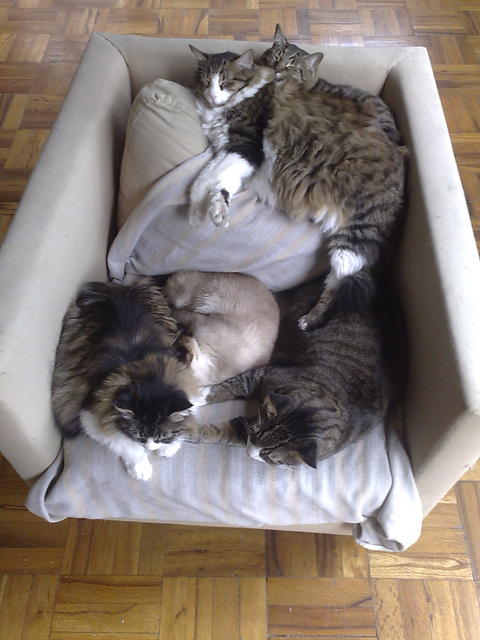
Five out of six experts agree: Five out of six cats cannot be mistaken
It. Is. Cold.
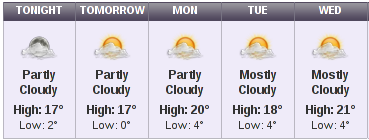
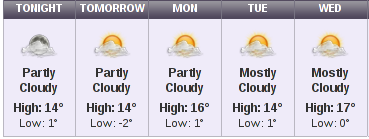
No, we are far from this very impressive picture of a fully-snowed UK seen from the sky that everybody and their dog must have seen by now. Still, in Mexico City we are experiencing the traditional one-or-two-weeks-a-year where it is genuinely cold. And, very strange being this Winter (the rainy season is Summer around here, January should be dry!) we have rain all day long. The Ajusco mountain is around 15Km south from my home, and it is the closest of the giants that surround our valley. Yesterday I managed to get some peeks at it behind the very thick layer of clouds we have. Ajusco looks really gorgeous all snowed, maybe down to the 3400m line (while the city's main area is at 2300m). This picture was not taken this year, we have snow in Ajusco almost every year (although very seldom as much as this time): (last photo is not current, we have not yet had a clear day to take a picture of our Ajusco yet this year) How does it feel? Well, I live in Coyoac n, in the flat area of the valley. Remember that houses here are not built to endure extreme temperatures (and this week is what we call extreme, of course ;-) ). According to Yahoo! Weather: And while the difference appears to be small, what about Magdalena Contreras, ~200m higher, where many people dear to me live (and have even a window pending to be installed)? People say this cold wave is the strongest in 120 years, since records are being taken. Every year people get excited, expecting that this time we will get snow. This has only happened once in at least a century, in 1966 AFAIR. I do not think this year to be atypical. Still, I have a reputation for being insensible to cold weather. Everybody wears heavy jackets while I still go to work with my usual long-sleeved shirt and that's it. But the last two days, I have been using jacket and scarf... But, of course, I don't look as gratious or cute as my cats :-

1 January 2010

Joey Hess: naught but a decade

This has been a big decade for me. Ten years ago, I was living in Sunnyvale, in the heart of Silicon Valley; VA had just had its crazy IPO; my unvested options were worth over a million dollars on paper. I remember sitting in first class[1] on the way out of Atlanta after the holidays and wondering what one did with a million dollars. Avoid working too much? Have a lot of interesting computers? Build a distributed house[2]? Mostly I decided to not count my chickens, which turned out to be the right choice. Six months later, I started debian-installer, in many ways my biggest project to date. In spring of '01, VA was crashing; I was sick of the Valley; gloom was everywhere. I took the hint and quit, cashed in my options for five figures, not seven, bade forewell to the many people I'd come to know, and moved back east. By reading my old journal, I can tell that subconciously, I had long before decided what to do when it was time to leave the Bay Area. So without really thinking too much about why I was able to do this, about how not just my own family, but others were indirectly making it possible, I moved to a 150 acre wooded "farm", and mostly went off and did mostly my own thing for three years. This was such a huge life change. I lived in a building affectionatly called "the shack". It was renovated from a chicken coop in the 70's and leaked during heavy rain, but I preferred it to the main house (warmer). I went back to dialup for internet. I hauled groceries and most everything half a mile in by hand. There was an outhouse and washwater hauled from a creek. I cut barely enough firewood and readapted my body from California to cold. My main tech project during this time was mooix. In some ways my largest failed project, but it was neat to be able to go off and do such a thing. This was a blissful, reflective, peaceful, amazing time. Parts were a second childhood. Somewhere in there I properly confronted my mortality. And learned to use a chainsaw. And over the course of three years, I dug myself into a rut, a hole. I wasn't going anywhere. (Except for a month in Honduras, and my first DebConf in Oslo.) In '04, I found myself talking on the phone to a cosmonaut in a house that had been without power for days in a hard winter. I realized I was ready to leave the farm if I could figure out how to do it, and I almost took him up on the job working on his new Linux distro -- but at the last minute Oslo connections suggested I work for SkoleLinux instead, and so I did. Soon after moving into a rented house in town, I was jaunting off to Brazil for a month, a great time. Followed by a productive year where I got heavily back into debian-installer, started Debian's testing security tream, and generally worked a lot. The next summer I fooled around with an RV, and sort of fell into a job with ADS. But my time on the farm had changed me, I think. I ended up going back to the farm for a year and working part time from there. During this time I also started ikiwiki and other smaller projects. One day I came back from a camping trip and found the kitchen had been torn down in my absence. Reminded unsubtly that I was not the only one with a claim to the place, I got out, though I somehow suspect not for good. For the last four years, I've been more outwardly settled, buying a house in town, continuing to work at the same job, starting little projects like pristine-tar, mr, and etckeeper. About two years in I began to feel antsy sometimes (and had a minor medical scare), and set up the yurt as a relief valve so I can have crazy adventures in the cold woods again. Still, I sometimes feel that a big change is building up. From here, this decade feels like it contained endless changes, important decisions, interesting projects, strong experiences. The 90's, containing only little things like college and moving to California, pale in comparison. Maybe the naught's will be the decade I always remember.. or maybe not. Anything could be around the corner.
  1. Bumped up due to an airline scheduling snafu, not because I was throwing money around.
  2. Concept of mine perhaps not worth explaining here although it was oddly similar to how I ended up living at the farm. Good ol' subconcious..

31 December 2009

Julien Blache: VMware Workstation 7.0.0 packaging

I ve spent the last week packaging VMware Workstation 7.0.0 at work. Looking around on the net, I ve been unable to find anything helpful about packaging this new version, so it seems nobody s got around to packaging it yet. I ve asked our customer for its approval for releasing our packaging scripts to the community and got it, so here are our packaging scripts for this version, courtesy of EDF. See the instructions in debian/README.source for what has to be done to turn it into a full source package. The packaging is based on our previous 6.5.2 packaging, which was itself based (partially, at least) upon the Gento 6.5.2 ebuild. It uses a tweaked vmware-installer to install the products to debian/tmp, then makes use of the vmware-installer database to populate the packages. I think this method should work with any VMware product using vmware-installer 1.1. Packages have been built and tested on Etch and Lenny. Hope it helps! Bugs, comments, questions to the email address listed as Maintainer in debian/control, please :-)

30 December 2009

Gunnar Wolf: Internationalizing into your local customs

It seems strange to me. I don't think I know people as aware of internationalization issues as Bubulle, a.k.a. Christian PERRIER, and I have the feeling his last post regarding how he shall address himself is somewhat short-sighted. That might just mean I am in an even worse position. First, I recognize Christian's concern, but not only when dealing with people from around the globe It happens in my everyday life. When you show an ID stating Gunnar Eyal Wolf Iszaevich, the first reaction is a blank stare of disbelief, only to be followed by a question: So, what is your name? So I understand Christian wants to make it easier for people to guess what his name is in the least obtrusive way possible. I have seen the convention he suggests (uppercasing the family name) AFAICT used by French and Japanese people. But for me, it is intuitively backwards. If I were to emphasize a part of my name, it would be the part by which I expect people to address me with I would write GUNNAR Wolf. And yes, I usually leave out my second given name and my mother's family name, as it is customary here. Well, anyway... Reading my name, few people would guess I live in Mexico. Even fewer will believe I was born here. And if somebody calls me by the wrong part of my name, I won't feel at all offended. I strongly prefer my name to be used, as I like to be addressed casually, but quite often I am introduced as Dr. Wolf, in what at most would be an ex-profeso honoris causas doctorate, or at least an ignoratis causas one.

Torsten Landschoff: libtool silently skips shared libraries without -rpath

Ouch! This is the second time I am running into this so I ll write it up this time. I used libtool via automake for building a python module. Quite unhelpfully, libtool happens to build only the static library. It does that even though I passed the -module option, which should make it clear that a static library does not help at all. There is also no mention why it skips the shared library. After some research, my memory came back: libtool requires to pass the -rpath option to actually build shared libraries. I did not want to pass that options, since it is considered harmful where multiple variants of a library are available. It is even less useful in my specific case, as the module is only used inside the source tree for unit testing. Solution: I changed the Makefile.am to use
1
_helper_la_LDFLAGS = -module -rpath /freaking/libtool/requires/at/least/a/dummy/path
Interestingly, the same scheme (apart from the wording) is used in libtool s own source.

28 December 2009

John Goerzen: Review: Those new-fangled paper books

Everyone seems to be familiar with ebooks these days. I own a Kindle 2, and of course we ve spent weeks hearing how great the Nook will be, then weeks hearing how terrible it turned out to be. But nobody seems to be casting an eye back towards paper, so I thought I d rectify that here, especially since paper books have some serious stability issues that are often overlooked! Before I begin, I feel it wise to offer this hint to the reader: this review should not be taken too literally. If you have an uncontrollable urge to heave a volume of the Oxford English Dictionary at me as if I am some European prime minister, please plant your tongue more firmly in your cheek and begin again. Today I picked up a paper book to read just for fun The Happiest Days of Our Lives by Wil Wheaton. Long-time (since this spring!) Kindle user that I am, I immediately noticed the dashing use of color on its front cover, but when I opened it, I was disappointed that I couldn t scale the font size down from the default. It seems that paper books have only one font option what are all these Kindle forum posters complaining about with its six sizes of a single font? On the very first page, I encountered a word I wasn t familiar with (Namaste). I thought I knew what it meant from the context clues, and even had the thought that on the Kindle, I could just highlight it and confirm my guess. But my paper dictionary was in the basement, so I didn t bother looking it up until I wrote this post. (My hunch was reasonably correct.) Interface-wise, the paper book is solid, and crashes, lockups, or other malfunctions are rare. I have, however, noted severe stability problems when attempting to read outdoors, especially when it s windy (which, since I live in Kansas, is pretty much always). Pages start turning themselves, even without me making the turn page gesture. Sometimes the book will even lose its memory of my last page read. This is rather annoying, and might even involve a lengthy search for a suitable temporary replacement bookmark. Also, I haven t tried it, but I suspect that the trick of putting a Kindle in a ziplock bag to read at the beach or in the tub without risk of getting it wet would be impractical with a paper book. Paper does have its advantages. For one, it s faster to flip rapidly through pages on paper than on an ebook reader. If you know roughly where in the book something was written, but not the precise wording, searching can be faster on paper. On the other had, if you are looking for a particular word or phrase, the ebook reader may win hands-down, especially if the paper book has no index. Paper is so stable that some would argue that the extreme impracticality of making good backups isn t really a problem at all. But on the other hand, paper books degrade slightly each time they are used, and this condition can be aggravated by placement in bags for transport. Eventually, they will wear out. If my Kindle wears out, I can always restore David Copperfield from my backup copy to a new one. If my printed edition (all two volumes) of it wear out, then I have to hope that the used bookstore will still sell me another one for $10. Otherwise I d have to either drive 45 miles to find one for sale, attempt to deal with the DRM for paper books at a library, or wait a couple of days for Amazon to get it to my door. A fire or flood could be devastating. Paper books also have some advantages for showing photos; no ebook reader is close to the size and resolution of glossy paper photos books in a reasonable price. The contrast on most paper books is better than that of my Kindle, but some older ones are actually worse, smell dusty, and suffer from occasional display corruption as bits of them actually break off of the book device. As to cost, it is a mixed bag. Out of copyright classics are free as ebooks from Project Gutenberg and the like, while still costing money on paper. I have found that the accuracy of some of these paper editions can be rather questionable people have sometimes manually removed important bits of the story to save on printing costs, rather than let Google Books OCR mangle it for them automatically. On the other hand, used paper editions of more current works can be found for a fraction of the cost of the new ebook edition though you are often limited in selection of these bargains. But you can usually browse a paper book for a few minutes before buying it, which is rarely available for an ebook. What s more, libraries might let you borrow paper books for free. But you often have to expel greenhouse gases to get to them, and then they enforce DRM on you you only get to read it a certain amount of time before they start adding fees. You could easily wind up paying $2 if you keep it a week longer than you should have. With ebooks, of course, there is no free borrowing (and the Nook feature it too limited to count.) And you of course know that most libraries are run by the government, so they have your address. Trying to circumvent a library s DRM could wind up involving the police, so you had best comply. Making copies of a paper book is expensive and requires specialized equipment, even if you just want a copy for backup. Compatibility problems with paper books are rare, and are usually found among readers with poor eyesight. A few works can be found in large font editions, but most can t, so those readers are left needing expensive specialty magnifiers. All in all, I prefer reading books on my Kindle, but still read on paper when that s how I have a book.

23 December 2009

Gunnar Wolf: Preparing for the geeky holidays with suitable wine

Preparing for the geeky holidays with suitable wine
Quoting The Klezmatics: It's everybody-else's annual end-of-the-year-time holiday, the name of which respectfully we do not choose to say, but that does not prohibit us in any concievable way from wishing you a very merry everybody-else's end-of-the-year-time holiday!
In order to properly welcome this 2010 in a geeky fashion, I got the following wines to share with my friends: Happy $ joyful_ocassion !

Torsten Landschoff: Hitting the dynamic linker wall

I was working on replacing some mockup code for testing an internal library with python. Basically, the C code is incredibly big and I would rather mock the 3rd party API we are using in python. I wrote a generator to create wrapping code that forwards the C API calls to my python module. Now that most of the work is finished, I get the following error message from my python mock:
1
2
3
4
5
6
Traceback (most recent call last):
File "simple_mockup.py", line 2, in <module>
import threading
File "/usr/lib/python2.5/threading.py", line 11, in <module>
from time import time as _time, sleep as _sleep
ImportError: /usr/lib/python2.5/lib-dynload/time.so: undefined symbol: PyExc_ValueError
What s going on here? This issue reminds me of a bug of my ancient Debian times which affected loading of GTK theme engines from python-gtk. The bug (#38138) is so old, it s not even in the BTS archive anymore The problem is illustrated by the following example program (consisting of three files):
demo.c
1
2
3
4
5
6
7
#include <Python.h>

void test_python()

Py_Initialize();
PyRun_SimpleString("import threading\n");
main.c
1
2
3
4
5
6
7
8
9
10
11
12
13
14
15
16
17
18
19
20
21
#include <stdio.h>
#include <dlfcn.h>

int main(void)

const char *error;

void *handle = dlopen("./demo.so", RTLD_LAZY EXTRA_RTLD_FLAGS);
void (*test_python)();
*(void**) &test_python = dlsym(handle, "test_python");
if ((error = dlerror()))
fprintf(stderr, "%s\n", error);
return 1;


printf("Calling test_python @ %p in shared object @ %p.\n", test_python, handle);
(*test_python)();
dlclose(handle);
printf("Feels fine, finishing.\n");
return 0;
run_it.sh
1
2
3
4
5
6
7
8
9
10
11
12
13
#! /bin/sh

gcc -shared python-config --includes -o demo.so demo.c python-config --ldflags

echo "Running example with default RTLD flags:"
gcc -DEXTRA_RTLD_FLAGS=0 -o main main.c -ldl
./main
echo

echo "Passing RTLD_GLOBAL in addition:"
gcc -DEXTRA_RTLD_FLAGS=RTLD_GLOBAL -o main main.c -ldl
./main
echo
On my system, this results in the following output:
torsten@pulsar:~/sh_bug$ ./run_it.sh
Running example with default RTLD flags:
Calling test_python @ 0xb77084bc in shared object @ 0x96bc018.
Traceback (most recent call last):
  File "<string>", line 1, in <module>
  File "/usr/lib/python2.5/threading.py", line 11, in <module>
    from time import time as _time, sleep as _sleep
ImportError: /usr/lib/python2.5/lib-dynload/time.so: undefined symbol: PyExc_ValueError
Feels fine, finishing.
Passing RTLD_GLOBAL in addition:
Calling test_python @ 0xb783f4bc in shared object @ 0x95e1018.
Feels fine, finishing.
Sucky. So embedding Python into an application is easy but if you want to use the interpreter and its modules from a plugin, you are out of luck. Somebody knows a way around this problem? The only solution I can think of is to link libpython.so into each of the python plugins. Update: Work around Small update: For my current problem, the work around is to run the application with the python library preloaded: LD_PRELOAD=/usr/lib/libpython2.5.so.1.0 app. Back to adding functionality

Benjamin Mako Hill: What's in a name?

Over the summer, there was a bit of a tussle at the highest level of Ubuntu governance over whether or not Canonical Ltd., the company that funds the majority of work done directly in Ubuntu, should name its file syncing and backup service Ubuntu One. Canonical's service involved a freely licensed client included in the Ubuntu distribution but, as a network service running on Canonical servers, it was not clearly a part of Ubuntu (the GNU/Linux distribution) or Ubuntu (the community) in the way the term was usually used within the community. Although the network service itself was not Franklin Street Statement free, this was not the most important issue for everyone who objected to the name. The major issue for many seemed to boil down to the fact that, free or not, Ubuntu One is a service run entirely by Canonical outside the reaches of the Ubuntu governance structures. Decisions were made and not everybody -- and maybe not anybody -- was absolutely happy with the outcome. My goal is not try to revive old arguments here. As far as I'm concerned, the issues are settled and the service is called Ubuntu One. That said, the questions raised during the episode are fundamental to Ubuntu and to other firm-sponsored FLOSS projects. Now that the dust has settled, they are worth reflecting on. From a legal perspective, there never was any ambiguity. Canonical "owns" the Ubuntu trademark. In this important sense, "Ubuntu" means whatever Canonical says it means. This is hardly new. As just one example, the Official Ubuntu Book (of which I am an author) was written by community members but became official because Canonical blessed it. But despite the fact that they don't need to, Canonical has often consulted with the community and its governance structures about trademark licensing policy. This was also not a case of Canonical not listening to the community. Canonical employees approached the Ubuntu Community Council (Ubuntu's highest governance board of which I am a member), listened carefully to concerns, and responded thoughtfully. The question was not even about a clash between what Canonical and the CC thought about the issue. An unambiguous majority of the board, including all the Canonical employees and several of the community members, supported the idea of Canonical using the trademark. The question was one about who gets to make the decisions about the Ubuntu name and about what role the community and Canonical would each play. Despite the fact that a majority of the Ubuntu community council was likely to support the proposed name, the CC was told by Canonical CEO Mark Shuttleworth that a vote was irrelevant. Canonical made it clear that decisions about the Ubuntu trademark were simply not in the CC's purview. The decision on how the name was to be used was something that Canonical was not willing to delegate to an "outside" (the firm) governance body. Few businesses would. And although I don't agree with the decision as a community representative, I might have even made the same call from Canonical's shoes. In traditional firms, it's usually pretty clear where the organization's boundary lies. In FLOSS projects -- and especially in FLOSS project like Ubuntu who are sponsored in very large part by a single for-profit company -- boundaries are fuzzier. The conversation about "Ubuntu One" can be seen as a fight over what "Ubuntu" refers to, and, more importantly, who gets to answer that question. In deciding whether to call a service "Ubuntu", a decision is made on what Ubuntu is. Names are powerful. Is Ubuntu just a Canonical project? Are Ubuntu's contributors really just Canonical contributors by proxy? I think the answer to both questions is "no" but the boundary issues involved are complicated and under constant negotiation. Every time Canonical uses the Ubuntu name itself or grants others the ability to do so, these boundary issues are negotiated, one way or another. This boundary setting work reveals an important tension that firms releasing FLOSS must all struggle with. To what extent and in what ways do communities get to decide what a FLOSS project is and to what extent do sponsoring firms get to do so? How should projects and firms do this most effectively? What should we even be optimizing for? I think that any resulting balance has a huge effect on whether a FLOSS project is, on one hand, released under a free license but run like any old corporate project or, on the other, a true "bazaar" style project where no single firm dominates -- or where they fall on that spectrum. Names and trademarks are one way that projects define their own identities and act as an important frontier in this balancing act. As every firm/project negotiates their own answers to questions of names and boundaries, there are important implications for the project's ability to attract volunteers, solicit contributions from other firms, and more. The confusion around conversations about Ubuntu One shows that we still have a lot to learn.

22 December 2009

Lucas Nussbaum: Doctor Capello!

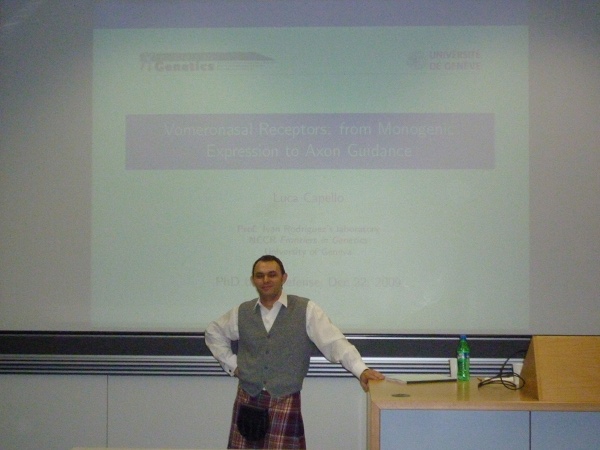
He might too shy to tell everybody, but the world must know. Luca Capello successfully defended his PhD thesis today at Universit de Gen ve, getting a Tr s Bien mention. I must admit that my last biology lesson was 13 years ago, so I m not sure I can really comment on his work on Vomeronasal Receptors: from Monogenic Expression to Axon Guidance. But I was very impressed by the quality of the experimental process, especially compared to what we do in computer science. Debian was well represented at the defense, since Axel Beckert, Didier Raboud and the Debian kilt were also there. Welcome to the list of Debian Developers holding PhD degrees, Luca!

Luca waiting at the door (again).
luca1
Luca ready to start.

Ian Wienand: An open letter to the bald-headed salesman in Harvey Norman, Norwest, Castle Hill

I usally find blog rants useless, but sometimes something is just so annoying one is sufficiently inspired. Today I went with my parents to buy them a Tivo at Harvey Norman, Norwest, Castle Hill, NSW, Australia. I am a big Tivo fan; the interface is good and it "just works". I don't mind paying for (or in this recommending paying for) good products. After selecting the Tivo model, I asked for a HDMI cable. The salesman made a series of questions about what sort of HD TV it was being plugged into; I quickly sensed this as a probe to see what sort of suckers we were, and requested just a "normal" cable. At this point, he insisted on a $130 (you guessed it) Monster cable, and had the audacity to say that we didn't need one of the really expensive cables because our TV wasn't good enough! I openly expressed my concern, but the annoying high-pressure sales pitch had just begun. The amount of, frankly, crap that he spewed about 4-bit this, 10-bit that, legislating of labels, DA signal levels, mythical customers who regretted buying the cheap cables and who knows what else was to the point of being comical if it weren't so insistent and said with such seeming authority. There is only one thing that matters - if the cable has passed the functional requirements for being certified to have the distinctive HDMI logo plastered on it. From the HDMI FAQ:
Q. What testing is required? Prior to mass producing or distributing any Licensed Product or component that claims compliance with the HDMI Specification (or allowing someone else to do such activities), each Adopter must test a representative sample for HDMI compliance. First, the Adopter must self test as specified in the then-current HDMI Compliance Test Specification. The HDMI Compliance Test Specification provides a suite of testing procedures, and establishes certain minimum requirements specifying how each HDMI Adopter should test Licensed Products for conformance to the HDMI Specification.
Now, I can understand that if you buy any old HDMI cable off Ebay for $1, it may be a knock-off that uses the HDMI logo illegally. But there is no way that the certified $50 Philips cable (still very over-priced, but at least not insane, and discounted to $35) performs any differently to some overpriced Monster model certified to exactly the same standard. The thing that annoyed me most was his analogy to buying a tyre. He stated that "if you walked up to a tyre salesman and I said don't want the Pirelli's, just put the cheap-o tires on my Ferrari" I'd be insane, and thus by extension of that logic I was insane for not buying a Monster cable for my great new Tivo. This analogy is completely flawed and really just dishonest. A Ferrari is much more powerful and goes much faster than a standard car. It is plausible it needs a better engineered tyre to perform adequately given the additional stresses it undergoes. A Tivo doesn't put out any more or any less bits than any other HDMI certified equipment, no matter what you do. If the cable is certified as getting all the bits to the other end under whatever environmental conditions specified by the HDMI people, then it's going to work for the 99% of people with normal requirements. Nobody wants to make a significant investment in a piece of audio-visual equipment and feel they are getting something that isn't optimal. Harvey Norman's use of this understandable consumer sentiment to sell ridiculously over-priced cables that do nothing is extremely disappointing. I'm sure the commissions on these things encourage this behaviour, so it is useless expecting the retailer or individual sales assistant to change their policy to reccommend reasonably priced cables. However, it is really Tivo and other manufactuers who get the raw end of this deal; a $130 cable is over 20% of the price the actual Tivo! That is surely affecting people's purchasing decisions. If Tivo and others included a certified HDMI cable with their device, as they do with component cables, and had "Certified HDMI 1.3 cable included" plastered on the box, it would be a harder sell to explain why the manufactuer would bother shipping a certified cable that is supposedly insufficient, and consumers would hopefully avoid the very distasteful high-pressure theatrics I was subjected to today.

Next.

Previous.