Search Results: "dom"

13 May 2010

Aigars Mahinovs: Hacker Neo caught in Latvia

A scandal has been brewing in Latvia over the last half year and yesterday the activity spiked shocking the media and some IT people in the country. I ll go back and explain what happened first, what is happening now and why this could have a heavy impact on IT and journalists in Latvia. At the end of last year, there were rumours that the IT system of Latvia s Internal Revenue System was hacked and millions of documents had been downloaded by multiple organizations. Shortly thereafter more details on the glaring security hole became public (after it was closed). There is a full electronic interface to give all reports to the IRS electronically (at http://eds.vid.gov.lv) and as part of that system you could also view and export monthly report summaries about your organization into XML and PDF files. After the system checked that you are authorized to access the report, you were redirected to the URL to actually download the report by report ID (as a single param in a GET request). Unfortunately, report IDs were predicable and the script that gave the reports for download did not check if you were authorized to get that report. It did not even check if were logged into the system. There were suspicions that the authorization was disabled on purpose to allow to leak data on purpose, but apparently it was an error of forgetting to disable debug code in production environment. The error was discovered only because the firewall administrator noticed an unexplained stable increase of traffic, especially during night hours when typically the traffic fully stopped. Apparently a single hacker (who later identified himself as Neo to the press) discovered the flaw and wrote a script to just try all possible report ids and get as much data out as possible. This had been going on for months, before someone noticed. After the flaw was discovered and a bit of time passed, Neo made his first move he published the list of top salaries in a governmental company, that clearly showed that the top leadership of this company failed to cut their salary by 40%, like everyone elses during harsh budget cuts of 2009. He stripped the names and ids of the specific employees, but named the company which made it pretty easy to figure out who was who. The society was outraged that the top managers in a government owned company failed to comply with the strict pay cut that everyone else in government had to endure. But after a few weeks the outrage subsided and no action followed from the government or law enforcement. Neo continued to release documents detailing salaries of top managers in different Latvian government companies. And each time after short outrage, nothing happened. Neo gave an interview where he said that he was disappointed in the passivity of the Latvian people in face of such blatant injustices. After a few month Neo went silent, promising to return before parliamentary elections this fall. However, this week a new development shocked everyone in the middle of the night two police SWAT teams went into action: one detained Ilm rs Poik ns, a researcher in artificial intelligence at the University of Latvia s Computer Science department and another raided the home of a Latvian TV journalist Ilze Nagle who interviewed Neo. Poik ns confessed of being Neo the next day and was released (with travel restrictions, pending trial) today. Politicians reacted immediately opposition demanded the resignation of the Interior Minister over such blatant disregard of freedom of press and another politician (who is also a famous lawyer) Aleksejs Loskutovs volunteered to defend Neo pro-bono (on Twitter, no less). Almost all Latvian online media have the arrest of Neo and the raid on the home of a journalist as main stories of the day. As a legal titbit, we also know that Neo is being charged with breaking statutes 145 and and 244p2 of the criminal law. Statute 145 is hard to find applicable in this situation as talks about actions done by people authorized (..) to access [private] information . Statute 244p2 will also be hard to pin down as it mentions influencing system resources of (an IT system) and if such action caused severe harm . It looks like the first part talks about at least a DoS attack (which did not happen in this case) and also there was no measurable harm from these leaks. Also Neo was careful to strip all personally identifying information (such as names, social security numbers and addresses of the employees in question), so it will be hard to pin him on that. Also no actual breaking or other modification of an IT system occurred. And no specialized software was used beyond a trivial script such as :
for i in range(0,7000000):
    wget('https://eds.vid.gov.lv/getRep.aspx?id='+str(i))
A lot of commentators on the Internet likened the situation to walking trough an unlocked door and stealing something. I think that analogy is very incorrect there was no door, and nothing went missing after the action. I came up with a different analogy there was this corridor with a lot of doors in IRS, locked steel doors. You were instructed to go to a room with a specified number and given a key to that room to unlock it and see your secret info. However, that corridor opened out to the street on one end, oh and also the walls of the rooms with all the secrets were transparent. So Neo walked into the corridor, looked at some of the secrets, wrote them down (to remember them better) and then went out and discussed the worst examples abuses of power he saw. In the end IRS had to learn their lesson if you have to put naked photos of yourself on the Internet (or something equally embarrassing), then make damn sure you password protect that, but if you don t then don t cry that someone hacked you and stole you pictures. What other people think:
http://freespeechlatvia.blogspot.com/2010/05/neo-released-under-restrictions.html We ll see how the story develops soon.

Jonathan McDowell: Random election related numbers

We appear to have a government again, which is always helpful. Let's see how they do. While all the deliberation was going on Dad and I had a ponder about exactly what your chances of voting for a winner were. The Guardian helpfully have the results dataset available, so I nabbed that. They may have updated it since I did; it certainly seemed to be a bit off compared with the BBC. Anyway.

29,577,337 - total votes cast.
13,982,219 - total votes cast for winning MPs.
7,279,220 - total votes cast for winning MPs in the new government (ie Conservative or LibDem).

So there was a 47.27% chance of a vote being for a winning MP, but only 24.61% chance that a vote was not only for a winning MP but also one that ended up being part of the coalition.

Another interesting number; 220 seats were won with 50% or more of the vote, 540 with more than 40%. That's higher than I expected.

10 May 2010

Stefano Zacchiroli: UDD - consolidating bazaar metadata for QA and data mining

Eclectic paper on the Ultimate Debian Database A few months ago, I've co-authored with Lucas a paper on UDD, which has just been presented at this year IEEE's Mining Software Repository conference, continuing my recent tradition of eclectic papers. The paper is titled The Ultimate Debian Database: Consolidating Bazaar Metadata for Quality Assurance and Data Mining and is available for download from my publications page. For Debian people already familiar with UDD there is probably not much to learn from it, as the main target of the paper is the community of scientists doing data mining on software repositories. For them, UDD offers a valuable entry point to Debian "facts", as data sources reflected in the database are easily joinable together and to some extent already validated by other UDD users (e.g. QA people). Nevertheless the first two sections of the paper are probably of more broad interest. There we have given our point of view on the so called Debian Data Hell: why it exists, how it's related to the nature of Debian and similar distros, etc. I've already noted in the past how that is also related to the culture of freedom that in Debian we value not only in our software, but also in our infrastructure and procedures. We should just get rid of a bit of inertia, and total world domination will then be just around the corner :-) I'm happy to conclude quoting the acknowledgments section of the paper: Acknowledgments
The authors would like to thank all UDD contributors, and in particular: Christian von Essen and Marc Brockschmidt (student and co-mentor in the Google Summer of Code which witnessed the first UDD implementation), Olivier Berger for his support and FLOSSmole contacts, Andreas Tille who contributed several gatherers, the Debian community at large, the "German cabal" and Debian System Administrators for their UDD hosting and support.

Ian Wienand: Cook's Illustrated v Food52 Cookie Challenge

I saw Christopher Kimball, doyen of the Cook's Illustrated empire, at our local bookstore a while ago and, as one of my old professors would say, he was "good value". He did, however, have a bit of a rant about the internet and how random websites just did not produce recipes that could compare to the meticulous testing that a Cook's Illustrated recipe went through. I was interested to see this come to a head on Slate where Cook's Illustrated has put their recipes up against food52.com for a head-to-head battle. So yesterday, my wife and I took up the challenge. We resolved to follow both recipes meticulously, which I believe we achieved after a trip for ingredients. Neither was particularly easier or harder than the other -- the Cook's Illustrated had a lot of fiddling with spices, while the food52.com one required creaming the butter and sugar. Both came out pretty much as you would expect, although the Cook's Illustrated ones were a little flat. The recipe does say to be careful to not overwork the dough; it may be partially user error. We were split. I liked the Cook's Illustrated one better, as the spices really were quite mellow and very enjoyable with a cup of coffee. My wife tended towards the plainer food52.com ones, but she is a big fan of a plain sugar cookie. The ultimate test, however, was leaving both of them on the bench at work with a request to vote. The winner was clear -- 10 votes for Cook's Illustrated and only 3 for food52.com. So, maybe Kimball has a point. Either way, when there's cookies, everyone's a winner! Some photos of the results: <object height="300" width="400"> <param name="flashvars" value="offsite=true&amp;lang=en-us&amp;page_show_url=%2Fphotos%2Fiwienand%2Fsets%2F72157623913498245%2Fshow%2F&amp;page_show_back_url=%2Fphotos%2Fiwienand%2Fsets%2F72157623913498245%2F&amp;set_id=72157623913498245&amp;jump_to="> <param name="movie" value="http://www.flickr.com/apps/slideshow/show.swf?v=71649"> <param name="allowFullScreen" value="true"><embed allowfullscreen="true" flashvars="offsite=true&amp;lang=en-us&amp;page_show_url=%2Fphotos%2Fiwienand%2Fsets%2F72157623913498245%2Fshow%2F&amp;page_show_back_url=%2Fphotos%2Fiwienand%2Fsets%2F72157623913498245%2F&amp;set_id=72157623913498245&amp;jump_to=" height="300" src="http://www.flickr.com/apps/slideshow/show.swf?v=71649" type="application/x-shockwave-flash" width="400"></embed></object>

4 May 2010

Kartik Mistry: lazy hosting for me

* After realize that I can book domain name with payment using Internet banking, I booked one. However, that hosting provider has crap schemes and I want: a. Debian
b. Shell access
c. Payment using Internet banking from India (sorry I has no Credit Card or intend to have one nearly). Lazy lazy web anyone? Size doesn t matter. I want ikiwiki and some static pages for random use.

Chris Lamb: Rotating email into your inbox using imapfilter

I'm not a fan of "life hacks", but I have the adopted the following automated processing of my email inbox: if I don't want to deal with a message today, I move it to (eg.) Mail.DELAYED.4 and it will reappear in my inbox automatically in 4 days. It is inspired by the Inbox Zero, tickler files and the Debian DELAYED queue. My implementation uses imapfilter. You'll need to tweak the move_messages syntax for lenny's version; the following works fine in squeeze and sid:
mbox = IMAP  
    server = 'mail.server.net',
    username = 'username',
    password = 'password',
    ssl = 'ssl3'
 
num = 14
dst = 'INBOX'
prefix = 'Mail.DELAYED.'
for x = num, 1, -1 do
    mbox[prefix .. x]:select_all():move_messages(
        mbox[x == 1 and dst or prefix .. (x - 1)]
    )
end
The messages are moved when I'm (hopefully) asleep:
# m h dom mon dow command
  0 6 *   *   *   imapfilter -c /path/to/delayed.lua >/dev/null

3 May 2010

Russell Coker: Flash, Apple, and Linux

Steve Jobs has published an interesting article about Flash [1]. He criticises Flash for being proprietary, this seems a little hypocritical coming from Apple (who s the only competitor for Microsoft in terms of being the most proprietary computer company) but is in fact correct. Steve advocates HTML5 which is a better technical solution to a lot of the things that Flash does. He claims that Apple users aren t missing out on much, but I think that sites such as Physics Games [2] demonstrate the benefits of Flash. I think that Apple s attack on Flash is generally a good thing. HTML5 web sites will work everywhere which will be a good incentive for web designers to fix their sites. I also think that we want to deprecate it, but as it s unfortunately popular it s useful to have tools such as GNASH to use Flash based web sites with free software. Microsoft has belatedly tried to compete with flash, but it s Silverlight system and the free but patent encumbered Linux equivalent Moonlight have very little content to play and will probably disappear soon. As an aside the relentless determination of GNOME people to force the MONO project (including Moonlight) on it s users convinced me to remove GNOME from all systems that I run. OS News has a good analysis of the MPEG-LA patents [3] which are designed to prevent anyone making any commercial use of H.264 which includes putting such videos on sites that contain Google advertising! These patent terms are so horrible that they want to control video streams that were ever encoded with them, so you can t even transcode a H.264 stream to an open format without potentially having the scum at MPEG-LA going after you. This is worth noting when examining Apple s actions, they support MPEG patents and therefore seem happy to do anything that reduces the freedom of their customers. Apple s 1984 commercial has been proven to be a lie, it s Apple that wants to control our freedom. Charles Stross makes some good points about the issues related to Apple and Flash [4]. He believes that it s all part of an Apple push to cloud computing and that Apple wants to own all our data at the back-end while providing a relatively reliable front-end (IE without all the anti-virus nonsense that is needed on the MS-Windows platform. Cloud computing is a good thing and I can t wait for the Linux support for it to improve, I support a number of relatives who run Linux and it would be a lot easier for me if they could have the primary storage for everything be on the cloud so that I can do central backups of user data and they can use their own data while visiting each other. I think that a network filesystem that is similar in concept to offline-IMAP would be a really good thing, I know that there are some filesystems such as AFS and CODA that are designed for wide area network use with client-side caching but as far as I am aware they aren t designed for the type of operation that offline/caching IMAP supports. Matt Brubeck has given a good status report of the work porting Firefox to Android [5]. He notes that the next version of Fennec (mobile Firefox) will have Electrolysis the Firefox one process per tab feature that was first implemented in Google Chrome [6]. I think that the development of Fennec and the one process per tab feature are both great developments. Matt also says One of my personal goals is to make Firefox compatible with more mobile sites, and to give web developers the tools and information they need to make their sites work great in mobile Firefox. I ll write much more about this in future articles , that sounds great, I look forward to the results of his coding and to reading his blog posts about it!

2 May 2010

Dominique Dumont: Improve config file upgrades Ep 01

Hello The GSoC project Krzysztof and I are working aims to facilitate configuration upgrade during package upgrades. Most of the cases, this upgrade should not require any input from the user, even if the user had previously customized his configuration file. Currently configuration upgrade may ask questions to the user which may be hard to answer for most non-technical users. For more details see PackageConfigUpgrade on Debian wiki. (If you are not familiar with upgrade issues, you might want to read this page.) At the 2 extremes of upgrade tools, we have: Each tool has its own advantages and drawbacks. On the plus side of diff3 tools : On the other hand, here are the issues with diff3 based tools: For more details on diff3 issues, see Benjamin Pierce s paper (thanks to David Lutterkort from Augeas for the info) On the other end of the spectrum, Config::Model pros are: But, Config::Model main problem is: diff3 tools is lackluster for users. While Config::Model puts too much strain on packagers because it requires configuration models where all parameters are defined and declared in the model. For fast evolving projects, this can be a huge recurrent task (been there, done that for Xorg) . (Well, this recurrent task is a problem until doc, implementation and config model can be extracted from a single meta-description But I digress, this may be a project for GSoC 2011 :-p ) So, this GSoC project (for 2010) aims to find a compromise between these 2 extreme cases. On Config::Model, I ve always had a drawer statement whenever I was asked why Config::Model does not handle unknown parameter:
a configuration file cannot be validated if an unknown parameter can t be distinguished from a user typo.
This stance is fine for casual user interaction on a stable system: an unknown parameter is most likely an error. And the user must be warned of his error as soon as possible. For a stable distro release, packagers should have the time to provide complete models, so basing upgrade on complete models should be possible (famous last words ?). On the other hand, a lot of configuration upgrades will be done on unstable systems where software evolve quite fast, where models will likely fall behind software evolutions. Another shorcoming of my drawer statement is that it assumes user interaction where erroneous input is more likely. In case of configuration upgrades, there should be no user interaction. And we can assume that the config file to be upgraded was used (and thus validated) by the old version of the software. So unknown parameters should be tolerated and managed as best as possible. Now, the big question is: how ? In all attempts I ve seen in managing upgrades that goes beyond diff3 tools, the configuration is stored as structured data. Sometimes this structure can be infered from the configuration file syntax (shell vars, INI files, YAML, XML), sometimes not (sshd config file). In the latter case, some structural knowledge must be built in the upgrade tool. Currently, Config::Model is designed to bring a complete description of the structure and semantics of a configuration file. This is perceived as bringing too much structural and semantic knowledge ( too semantic ). So the maintenance cost is perceived as too important. That may be right or wrong, but that does not matter. Perception is more important here. So, let s figure out a way to reduce the amount of work required to perform upgrades (you may want to read a little bit more on configuration model creation before going on ) One possibility would be to support configuration models that allow unknown leaves in nodes. Such a model would provide a kind of fallback leaf description. Something like: this parameter is unknown, let s assume it s a simple string value . Let s consider sshd_config example to see how such a behavior would pan out for some upgrade scenarios. sshd model is made of 2 main classes:
- Sshd
- SshdMatchElement The second one contains all parameters allowed in a Match class (in fact, Match parameter is the only one in sshd that defines a new hierarchical level. All other parameters are simple leaves). Now let s consider typical upgrade scenarios from old version (with old models) to a more modern version. Let s assume that the model is lagging behind and the model does not follow sshd evolutions. So Config::Model will face 3 upgrade cases (extracted from sshd config history):
  1. Unexpected parameter that are actually simple leaf parameters. E.g. introduction of ClientAliveInterval.
  2. Obsolete parameters that should be migrated. E.g KeepAlive is renamed into TCPKeepAlive
  3. New structural parameters (introduction of Match element)
So what would happen with a model allowing unknown parameters but lacking specific instructions for these upgrades:
  1. ClientAliveInterval value would be kept. :-)
  2. KeepAlive would be kept as is.TCPKeepAlive would also be kept. No migration is performed, but the configuration would be good. As long as sshd supports the old parameter, we re good. :-/
  3. Without knowledge of the structure brought by Match parameters, Config::Model would consider that parameter in Match block would duplicate parameters in the main block and remove the duplicate. User data may be lost. :-(
So, there s not silver bullet. Let s resume what we ve learnt: Next step is to figure out what would happen if the same strategy is applied to other types of configuration files. But that will be for another blog. All the best

Dominique Dumont: Config-Model related project for GSoC 2010

Hello It s official: I m going to mentor a project related to config-model (without forgetting Augeas which might also be involved) this year:

Content-aware Config Files Upgrading
by Krzysztof Tyszecki, mentored by Dominique Dumont When a package deliver configuration files, the problem of merging user data with new configuration instructions will arise during package upgrades on users systems. Sometimes merging can be done with 3 way merge, but this process does not insure that the resulting file is correct or even legal. This project intends to create standards,
tools and heuristics to make the scary config file conflict resolution debconf prompt a thing of the past.
This project is hosted by Debian organization. Since this project might interest a lot of people, I will (try to) blog regularly on progress, issues, ideas.

From you people, I d like feedback and more importantly, I d like to get real life use cases.

What are the configuration upgrade scenario that bothered you ? What was your configuration file ? What was the setup done by package maintainer ? What result did you get ? What result did you expected to get ?

All the best


Russell Coker: Lexmark Supposedly Supports Linux

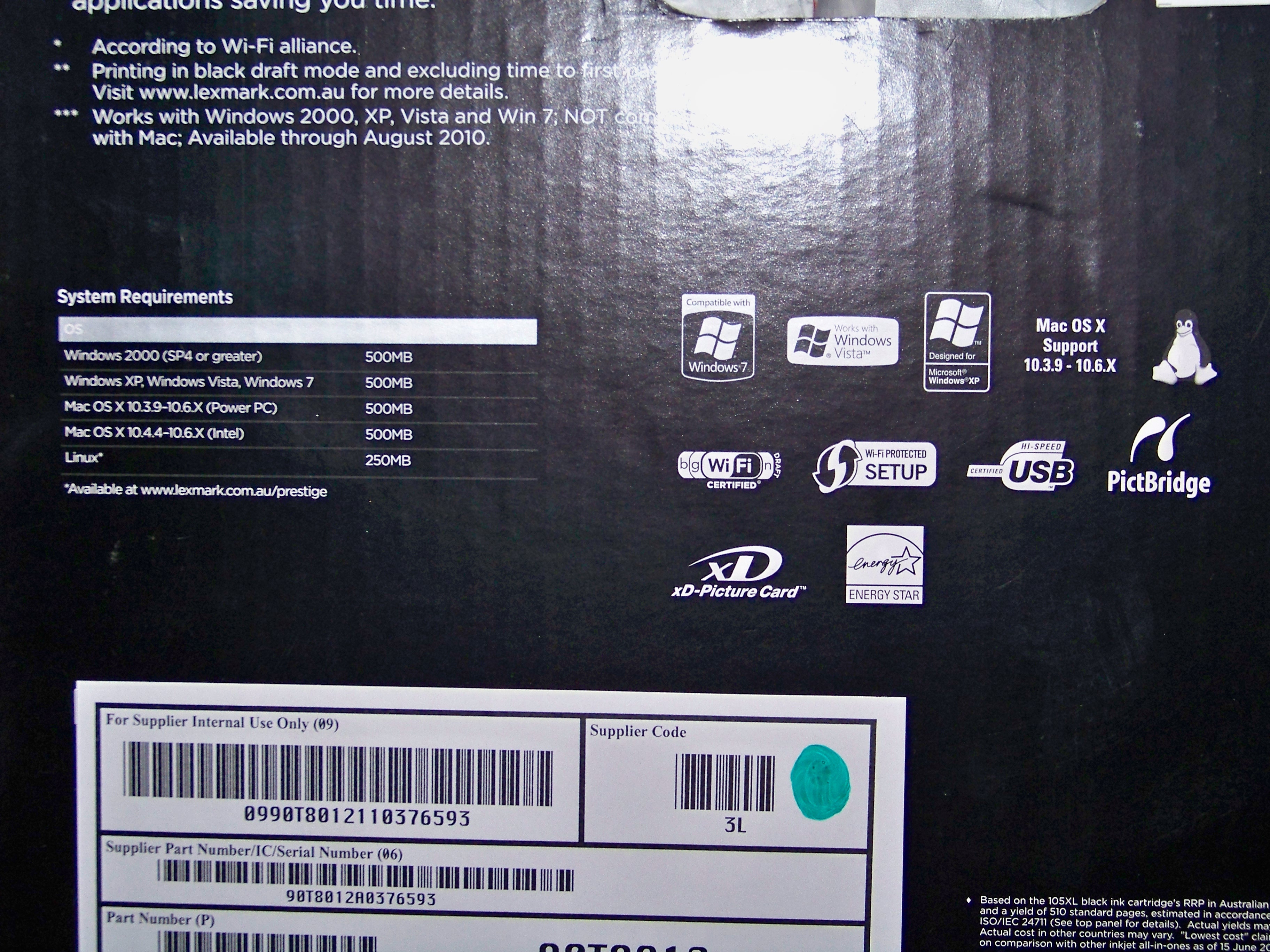
I wanted to get a Lexmark Prestige Pro805 printer to work under Linux, due to bad drivers from Lexmark and no driver support in Debian/Unstable I ve given up and advised the people who purchased it to return it for a refund. I recommend that Lexmark not be considered when purchasing a printer for use with Linux. The box advertises the URL http://www.lexmark.com.au/prestige for downloading Linux drivers. The driver file is named lexmark-inkjet-09-driver-1.5-1.i386_ts.deb.sh.tar.gz which makes anyone expect a tar.gz archive of a shell archive of a Debian package. But that s not what it is at all, in Lexmark-land deb is not the file name extension for a Debian package, but just a random bit of text to identify a file that is somewhat related to Debian, the fact that the Linux driver for Ubuntu/Debian Package Manager based distros doesn t use the string ubu in it s name is something that would lead a typical Linux user to believe that deb means a Debian package. Similarly the file named lexmark-inkjet-09-driver-1.5-1.i386_ts.rpm.sh.tar.gz and described as Linux driver for RedHat Package Manager based distros is not actually an RPM package or inherently for RPM based distros, it s just a shar archive that is built and tested for some unspecified version of some Red Hat distribution (RHEL? Fedora? SUSE?). Now when I execute lexmark-inkjet-09-driver-1.5-1.i386_ts.deb.sh on an AMD64 version of Linux it opens an X11 window, prompts for the root password, and then fails because an i386 Debian package that it somehow built couldn t be installed. When I ran the shar archive with the options --noexec --keep and examined the files it contained it has a few AMD64 executables so obviously the software they used to create the installer has some support for AMD64 but they just decided not to use it. It seems that the only way to buy an i386 system nowadays is to buy an embedded system or a NetBook, all Desktops, laptops, and servers run the AMD64 architecture, as most people do a Linux install that matches the full capabilities of their system (IE running AMD64 software on an AMD64 CPU) that means most systems sold in the last few years can t be used with a new Lexmark printer without an unreasonable amount of work. Sure it is possible to setup a chroot environment or KVM virtual machine for running printer drivers, but I don t really want to do that and a significant portion of the potential customers don t have the skill needed to do so. While technically their claims about having Linux driver support are correct (they support some distributions of Linux on i386), the majority of new systems won t work with it unless someone who has good skills spends some time and effort on it. Probably the majority of Linux Desktop and server systems that are in use today use AMD64 and are run by people who don t know how to setup a chroot so therefore for most real installations it s not supported. Even for i386 systems installation is unlikely to be trouble-free, when they support RPM based distributions (without identifying which of the many wildly different RPM systems they tested on) and Debian (without mentioning a version number) it seems that the incidence of people running a distribution that is supported is going to be quite low. Lexmark uses the Linux logo to claim compatibility Based on this experience I am not inclined to trust Lexmark in future, I will not trust any future claims of Linux support that they may make. The above picture of the Lexmark box shows Tux (the Linux logo), it doesn t mean support out of the box as you would hope, but instead means support for old systems with some effort.

30 April 2010

Biella Coleman: Baby Panda wants YOU to submit to DEBCONF


bad mood destroyer, originally uploaded by the biella.
People s the deadline is fast approaching. Don t worry though, the best ideas come under deadlines and your proposal need not be lengthy. So get those typing hands out and submit a proposal (a few sentences suffices) for a presentation! The annual Debian conference is being held in NYC this year. First time
setting foot in the imperial empire. Are you doing something related to
free software that might be interesting to share, show off or talk about
at Debconf? I bet you are! We are looking for art installations,
performances, movie screenings, maybe you are wanting to host a
roundtable/panel discussion, coordinate a workshop (you dont have to
know the subject deeply to do this!). I know the deadline is soon, but don t let that scare you. The
submission requirement bar is very low, and we are flexible! here is the submission information: [1] ********************* Calling all potential contributors to DebConf10! One more week until
the final submission deadline! The DebConf team is excited to announce that we are now accepting
proposals for contributions to this year s Debian conference! We
invite you to submit proposals for how you would contribute until the
deadline: soon There are many ways you can contribute, you could present a technical
paper, host a panel discussion, put on a tutorial, do a performance,
an art installation, a debate, host a meeting (BoFS, or Birds of a
Feather Session), or other possibilities that you devise. This year we
are also accepting proposals for tracks=E2=80=94a thematic grouping around a
particular subject, and people to coordinate those tracks. If you are
looking for ideas of things that you could contribute, or have ideas
for things that you would like to see happen at DebConf, have a look
at the Contribution Brainstorm[0] page. DebConf talks will be broadcast live on the Internet where possible,
unless otherwise requested. Videos of the talks will be published on
the web along with the presentation slides and papers. =3D=3D Step 1. Submit Proposal =3D=3D Proposals should provide an overview of your proposed contribution,
similar to an abstract, and be no more than 600 words. Since
contributions can cover a range of issues, please describe what your
proposal covers, be it political (Free Software, law, advocacy,
access, etc.), technical (d-i, OpenPGP, etc.), social (Debian
structures and groups). It s okay to hit all three of these. Your
proposal should also include some information on why you re qualified
to present, or coordinate this topic. For example, you can include
links to posts you have made to Debian mailing lists or other material
that indicates your qualifications. Proposals and their abstracts will
be accepted until May 1st, 2010, 23h59 UTC. To submit your proposal, go to Penta[1] and register as an
attendee. Once you are registered, there is a Submit a proposal
link. You will see your proposal on the site. You can choose between
different presentation types. If you are unsure what type you should
use, please read our glossary of definitions[2]. If it s not there for
some reason, or you have questions, please contact us immediately at
mailto:talks@debconf.org. =3D=3D Step 2. Committee Review =3D=3D The review committee for this year will make its decision by May 1st,
2010. All correspondence will be done by email. =3D=3D Step 3. Paper Submission =3D=3D Like last year, we are asking for papers to be submitted along with
the presentations. A full paper is optional, however we strongly
encourage you to submit one if possible as we intend to provide
written information along with transcripts of the sessions for later
viewing. Having written papers in advance will allow us to get
translations done to help non-native-English speakers feel more
comfortable with the topics presented. Papers are due by July 1st,
2010, and should cover the topic in reasonable depth (3 pages A4 text,
plus pictures and diagrams). We will use LaTeX to typeset the
proceedings. Please submit your paper formatted in LaTeX. Should you
be unfamiliar with LaTeX earlier submission in plain text is also
fine. =3D=3D Step 4. Live Presentation =3D=3D Longer presentations may have a break in the middle and should include
workshop items that directly involve the participants. If using slides
or any other presentation, please consider that your audience will
consist of people who use free software, and your choice of
application to prepare and display the slides should reflect this if
at all possible. =3D=3D Fine Print Publication Rights =3D=3D DebConf requires non-exclusive publication rights to papers,
presentations, and any additional handouts or audio/visual materials
used in conjunction with the presentation. The authors have the
freedom to pick a DFSG-free license for the papers themselves and
retain all copyrights. The presentations will be recorded, and may be
broadcast over the Internet. Any copies of the presentation will be
made available =3D=3D Failure to Submit =3D=3D In the event that a deadline is missed we reserve the right to revoke
any offer to present. =3D=3D About DebConf =3D=3D The annual DebConf conference is a technical and social forum for
Debian developers, sponsors, affiliates, and friends. It allows
various groups within Debian a chance to come together, network, and
share their work. Until we see you in the big city,
DebConf Talks Team [1] introduction written by Micah Anderson

28 April 2010

Andrew Pollock: [life/americania] TransLink to become Clipper

No sooner do I discover it, and TransLink up and renames itself to Clipper. I wonder how much that exercise is going to cost? I'm also curious as to what they're going to do in terms of a new domain name. Ah, marketing:
Why is the name being changed? Now that the system is fully operational on five transit agencies - Muni, BART, AC Transit, Caltrain and Golden Gate Transit and Ferry - it is available to the majority of Bay Area transit riders. Giving the system a new name and logo helps make it more appealing to potential customers and also takes away any confusion with other local programs such as FasTrak, Fast Pass, as well as several other transportation programs around the world that are also named TransLink.
With Bay Area public transportation being woefully inadequate, I have to wonder if much of any adoption problems (which is what I presume they're trying to solve with this rebranding) are more a function of overall patronage?

26 April 2010

Jan Hauke Rahm: Talking about Free Software

When I first started using Free Software yes, that s quite some time ago I found it the right thing to do. It felt like I was first time ever really controlling what my computer does. Took just a bit of time to notice I really never knew anything about it. Well, almost at least. Then when I started contributing to Free Software this obviously changed. One of the freedoms is to learn from the code you re running. And I did it by reading, contributing, doing nonsense with it, reimplementing it you know the deal. Starting to work on Debian was something that just evolved out of it. Doing so gave me the opportunity to give back. I never achieved that actually, though. At least I don t consider my contributions even remotely sufficient to make up for the great deal of software that I use sometimes without noticing it. Still there s lots of stuff that I don t have a clue of and I rely on other developers to do their (volunteer) job. Otherwise my knowledge wouldn t help much. I could never continue kernel development if those kernel hackers all stepped back for instance. I guess, it s getting more and more difficult the closer the piece of code is to hardware. Another thought I had was about Free Software in general. It s more than just the code (although it might be the most important part), it s also a concept that needs to be communicated. Firefox on Windows shows how Free Software can have a big market share in an otherwise closed source environment. Yet I m not sure all users know about it being open source and what that means (hear them talk about Freeware instead). And who is dealing with this conceptual stuff? I decided to do something about all that. Now I don t really have money but a bit I thought I could share. And I could set yet another sign by publicly talking about it, or casually mentioning that I consider Free Software and Linux a good thing. So you will see a mail signature now below all my mails. I always wondered what one might gain with such and now I found a reason to include one. It reads:
Debian Developer                                 www.debian.org
Member of the Linux Foundation                    www.linux.com
Fellow of the Free Software Foundation Europe      www.fsfe.org

Obey Arthur Liu: Welcome to our 2010 Debian Google Summer of Code students!

I d like to extend a warm welcome to our selected students for the 2010 Debian Google Summer of Code! They should pop up on Debian Planet soon and you re welcome to come talk to them on #debian-soc on irc.debian.org Aptitude Qt by Piotr Galiszewski, mentored by Sune Vuorela Qt GUI for aptitude. Currently, KDE users need to use Aptitude via the console interface, or install the newly developed GTK frontend, which does not fit well into KDE desktop. Making Qt frontend to Aptitude would solve this problem and bring an advanced and fully Debian-compliant graphical package manager to KDE. Content-aware Config Files Upgrading by Krzysztof Tyszecki, mentored by Dominique Dumont When a package deliver configuration files, the problem of merging user data with new configuration instructions will arise during package upgrades on users systems. Sometimes merging can be done with 3 way merge, but this process does not insure that the resulting file is correct or even legal. This project intends to create standards, tools an heuristics to make the scary config file conflict resolution debconf prompt a thing of the past. Debbugs Bug Reporting and Manipulation API by David Wendt Jr., mentored by Bastian Venthur Currently debbugs supports a SOAP interface for querying Debian s Bug Tracking System. Unfortunately this operation is read-only. This project would create an API for debbugs which supports sending and manipulating bug reports, without having to resort to email. This project does not intend to replace email as mean to manipulate the BTS but rather to enhance the BTS to allow other means of bug creation and manipulation. Debian High Performance Computing on Clouds by Dominique Belhachemi, mentored by Steffen Moeller The project paves a way to combine the demands in high performance computing with the dynamics of compute clouds with Debian. Combining the Eucalyptus cloud computing infrastructure with the TORQUE resource manager and preparing the components for dynamically added and removed instances provides the user with a attractive high performance computing environment. Such a system allows users to share resources with large compute centers with minimal changes in their workflow and scripts. Debian-Installer on Neo FreeRunner and Handheld Devices by Thibaut Girka, mentored by Gaudenz Steinlin This project aims to improve the installation experience of Debian on handheld devices by replacing ad-hoc install scripts by a full-blown and adapted Debian-Installer. The Neo FreeRunner is used as it is the most convenient and open device from a development standpoint, but other devices will also be explored. Hurd port and de-Linux-ization of Debian-Installer by J r mie Koenig, mentored by Samuel Thibault The primary means of distributing the Hurd is through Debian GNU/Hurd. However, the installation CDs presently use an ancient, non-native installer. The goal of this project is to port the missing parts of Debian-Installer to Hurd. To achieve this, all problematic Linux-specific code in Debian-Installer will be replaced by less or non-kernel dependent code, paving the way for better support of other non-Linux ports of Debian. Multi-Arch support in APT by David Kalnischkies, mentored by Michael Vogt Hardware like 64bit processors are perfectly able to execute 32bit opcode but until now this potentiality is disregard as the infrastructure tools like dpkg and APT are not able to install and/or solve dependencies across multiple architectures. The project therefore focuses on enabling APT to work out good solutions in a MultiArch aware environments without the need of hacky and partly working biarch packages currently in use. Package Repository Analysis and Migration Automation by Ricardo O Donell, mentored by Neil Williams Emdebian uses a filter to select packages from the main Debian repositories that are considered useful to embedded devices, excluding the majority of packages. The results of processing the filter are automated but maintaining the filter list is manual. This project seeks to automate certain elements of the filtering process to cope with specific conditions. This project will also generalize to more elaborate and intelligent algorithms to improve the transitions of the main Debian archives. Smart Upload Server for FTP Master by Petr Jasek, mentored by Joerg Jaspert Making packages upload smarter, more interactive and painless for uploaders by switching from anonymous FTP and Cron jobs to a robust protocol and modern package checking and processing daemon. This daemon would test early and report early, saving developers time. More details coming soon on http://wiki.debian.org/gsoc Congratulations everyone and have a fruitful summer!

23 April 2010

Ingo Juergensmann: DDoS, Apache2 and mod_qos

For two or three weeks now someone seems to dislike me. It happens from time to time that during the night, about 1.30 a.m., my webserver got hit by a sync dDoS. Maybe it's someone specific, maybe it's just a random botnet. Anyway, the result is the same: the service is no longer available.

For this problem there exists mod_qos, which was mentioned in the last LinuxMagazin issue (German). Ok, so I download mod_qos, followed the instructions and built the module with "apxs2 -ci mod_qos.c". When I've enabled mod_qos I get the following error:

mod_qos, requires OpenSSL, compile Apache using "--enable-ssl"


Which is quite interesting, because the Apache2 runs a HTTPS site as well. So, some sort of SSL should be available and mod_ssl is loaded as well. Anyway, I added mod_gnutls as well, but no change: it still reports the above error.

System is Debian Lenny and Apache2 is version 2.2.9-10+lenny7.

Any tipps, hints, pointers or advices, please? :-)

UPDATE:
After "apt-get install apache2-threaded-dev libgnutls-dev libssl-dev" mod_qos was loaded successfully and hopefully will prevent me from suffering of another dDoS. Sometimes the solution is so simple... ;-)

Ingo Juergensmann: Cleanternet - for a cleaner and safer Internet

Alexander Lehmann, creator of the great videos "Du bist Terrorist" (You're a Terrorist) and "Rette deine Freiheit" (Save your Freedom), has created another fine piece of video art:


http://cleanternet.org

It's about the new plan by EU commissionar Cecilia Malmstr m of censoring the Internet in the name of the fight against child porn. In Germany we had this discussion in the last year and although a law has been brought into action, all political parties don't want that law anymore. Putting up STOP signs in front of webpages is the wrong way to fight child porn.

22 April 2010

Matthew Garrett: Looks like I picked the wrong week to give up crystal meth

One of the features of Windows 7 is that hitting windows+p will pop up a little dialog that allows you to configure your active display outputs. This is an improvement over previous versions of Windows, which would generally instead have a variety of random vendor-specific tools that would function differently, look ugly and make you cry. So, hurrah to Windows for moving into the 21st century.

Most laptops have a display switch key. This is sent in a variety of ways, generally either via the keyboard controller, via WMI or via ACPI. In Linux we take all of these events and turn them into KEY_SWITCHVIDEOMODE, making it easy to implement standardised behaviour.

This is, obviously, far too straight forward.

Microsoft, rather than introducing an input mechanism that allows all of these events to hook into the windows+p infrastructure, provide the following recommendation:

As documented in this Launchpad bug, vendors are starting to do this. It's been seen in HP and Dell machines, at least, and it's presumably going to become more widespread.

So, if your display switch button now just makes the letter "P" appear, say thanks to Microsoft. There's a range of ways we can fix this, although none of them are straightforward and those of you who currently use left-Windows-p as a keyboard shortcut are going to be sad. I would say that I feel your pain, but my current plan is to spend the immediate future getting drunk enough that I stop caring.

(The good news is that the same set of recommendations says that you can no longer put a Windows sticker on a monitor unless it has a valid and accurate EDID. The bad news is that that implies that you've previously been able to put a Windows sticker on a monitor without it having a valid and accurate EDID)

Matt Zimmerman: On Cloud

If you re convinced that cloud is a useless buzzword, being used to describe everything under the sun, old and new, then well, you re right that is, except for the useless part. It s true that this word is being (ab)used in many different products, services and technologies, which do not seem to relate to each other in any concrete way. Cloud in the abstract is being defined in many different ways, based on different fundamental characteristics of cloud technology . Nonetheless, there is something genuinely important going on here, and this is my view of what it s about. The hype Countless business which only had web sites or web applications in 2008 now call them cloud services . They aren t delivering any new benefits to their users, and they haven t redesigned their infrastructure. What do they mean by this? Cloud is defined, some say, by where your data is kept, and cloud means storing your data on remote servers instead of internal ones. Millions of Gmail and Flickr users have been in the cloud without even knowing it, and so has everyone who reads their mail over IMAP, or uses voicemail. In short, cloud is just data that is somewhere else.

Credit: jurvetson

Last September, I watched a presentation on Cloud computing where Symantec pitched their anti-virus product as having something like three different cloud computing technologies. These, it turned out, all involved downloading files over the Internet. In this view, cloud is essentially about the network, derived from our habit of using a drawing of a cloud in our network diagrams for so many years. Wikipedia currently shares this view, as its Cloud computing article opens with Cloud computing is Internet-based computing . No Internet, no cloud. Maybe cloud is just SaaS, and any service provided on a pay-per-use basis over the Internet is a cloud service. It would seem that cloud is about paying for things, especially on a utility basis. The cloud is computing by the hour; it s something you buy. Others maintain that cloud is just virtualization, so if you re using KVM or VMWare, you ve got a cloud already. In this view, cloud is about operating systems, and whether they re running on real or virtual hardware. Cloud means deploying applications as virtual appliances, and creating new servers entirely in software. If your servers only have one OS on them, then they re not cloud-ready. If this vagueness and contradiction irritates you, then you re not alone. It bugs me, and a lot of other people who are getting on with developing, using and providing technology and services. Cloud is not just a new name for these familiar technologies. In fact, it isn t a technology at all. I don t think it even makes sense to categorize technologies as cloud and non-cloud , though some may be more cloudy than others. Nonetheless, there is some meaning and validity in each of these interpretations of cloud. So what is it? A different perspective

Credit: TangYauHoong

Cloud is a transition, a trend, a paradigm shift. It isn t something which exists or not: it is happening, and we won t understand its essential nature until it s over. Simon Wardley explains this, in presentation format, much better than I could in this blog post, so if you haven t already, I suggest that you take 14 minutes of your time and go and watch him do his thing. This change doesn t have a clear beginning or an end. Early on, it was a disconnected set of ideas without any identity. We re now somewhere in the middle of the bell curve, with enough insight to give it a name, and sufficient momentum to guess at what happens next. In the end, it will be absorbed into the way things are . What s going on? So, what is actually changing? The key trends I see are:
  1. People and organizations are becoming more comfortable relying on resources which do not exist in any particular place. Rather than storing precious metals under our beds, we entrust our finances to banks, which store our data and provide us with services which let us use our money . In computing terms, we re no longer enamored with keeping all of our programs and our data on our hard drive: as it turns out, it s not very safe there after all, and in some ways we can actually exercise more control over programs and data out there than in here . We can no longer hoard our gold, or drive off would-be thieves with a pistol, but that wasn t a productive way to spend our energies anyway. While we can t put our hands on our money, we can know exactly what s happening with it from minute to minute, and use it in a variety of ways at a moment s notice.
  2. IT products are ceding ground to services. In many cases, we no longer need to build software, or even buy it: we can simply use it. As computing needs become better understood, and can be met by commodity products, it becomes more feasible to develop services to meet them on-demand. This is why we see a spike in acronyms ending in aaS . Simon explains the progression in detail in his talk, linked above.
  3. Hardware, software and data are being reorganized according to new models, in order to provide these services effectively. Architectural patterns, such as hardware/OS/framework/application are giving way to new ones, like hardware/OS/IaaS/OS/PaaS/SaaS/Internet/web browser/OS/hardware . These are still evolving, and the lines between them are blurry. It s a bit early to say what the dominant patterns will be, but system, network, data and application architecture are all being transformed. No single technology or architecture defines cloud, but virtualization (at the infrastructure level) and the web (at the application level) both seem to resonate strongly with cloudy design patterns.
These trends are reinforcing and accelerating each other, driving information technologies and businesses in a common direction. That, in a nutshell, is what cloud is all about. So what? This transformation is disruptive in many different ways, but the angles which most interest me at the moment are: I d like to explore some of these topics in future posts.

Chris Lamb: Locating source for any Python module

When I'm too lazy to find API documentation I just read the source code. To make this slightly easier in Python, here's what I use in my ~/.$ SHELL rc:
cdp ()  
  cd "$(python -c "import os.path as _, $ 1 ; \
    print _.dirname(_.realpath($ 1 .__file__[:-1]))"
  )"
 
For packages, this takes you to the corresponding source directory:
$ cdp twisted.web
$ pwd
/usr/share/pyshared/twisted/web
$ ls
_auth/  domhelpers.py  html.py  iweb.py  resource.py
[..]
The realpath and [:-1] hackery follow any python-support symlinks. For "standalone" .py (or .so) modules, cdp will take you to the directory it resides in:
$ cdp subprocess
$ pwd
/usr/lib/python2.5
$ ls subprocess.py
subprocess.py

21 April 2010

Julien Blache: rEFIt on x64: finally fixed

When I got my Mac Mini, one of the very first things I did was to test the Debian build of rEFIt on the machine, given the EFI firmware is x64 on the newer machines whereas it s ia32 on my MacBookPro; it was the very first time I could test the x64 build. And the results weren t good: some images couldn t be loaded, and it all seemed to be random. Disabling optimization in both GNU EFI and rEFIt for the x64 builds helped somewhat, at least it made rEFIt reliable enough to be usable. Now, with this new release, I started getting error messages, requiring a key press before the menu would be displayed. It s annoying but it s also very helpful as I now had an error message to work with, and even if the error message wasn t reliable, it would still point me to some part of the code. The message was: Invalid argument. On x64, the use of a call wrapper is mandatory because the EFI x64 calling convention doesn t match the calling convention of the ELF executables we re building and later disguising as EFI executables. The call wrapper has always been the prime suspect in this issue, it d be an obvious candidate for anyone looking at this issue. Today, digging into the issue with some new data, I realized what the problem was: when using the call wrapper, all arguments need to be of the UINT64 type. That s the type the call wrapper uses when extracting the arguments from its va_list. Introduce some more macros on top of the call wrapper, build, test: voila, it s fixed! That was tricky one. Let s sum it up for the search engines: all the arguments to the EFI interface called through uefi_call_wrapper() in GNU EFI need to be cast to UINT64. rEFIt 0.14-1, available in unstable in a couple hours. Next, I ll see if I can reenable optimization in both GNU EFI and rEFIt.

Next.

Previous.