Search Results: "ag"

3 June 2006

Ben Hutchings: LJ jumps the shark

This email was sent from LiveJournal / Six Apart through Responsys. You are receiving this email because your LiveJournal preferences indicate you are interested in receiving LJ News by email. If you do not want to receive LJ news by email, please login and edit your preferences: http://www.livejournal.com/editinfo.bml
They don't. I never set a preference for it and there is no such preference on that page. And I could have read that on the front page or [info]news anyway. WTF? Updated: Removed broken preformatting of the quoted text.

Robert Pickel: New proposal and info

You can find a pdf of my new proposal here.
.

The latest source can be found at svn:\\live.debian.net\casper-ng

Visit the Debian-Live webpage for more info.

Note: I am pretty sure the page will be moving next week, so I'll post the new info once that site is up.

Erich Schubert: MySpace bullshit: everybody is in your extended network

... in case you wondered, even when you've never even visited myspace, or are using lynx via some anonymization service, reject all cookies and so on: every profile page on myspace has a big banner saying "nickname is in your extended network". Well, if you consider the Internet your extended network that is true. Still that is bullshitting. What a marketing crap.

2 June 2006

DebConf6 Blog: DebConf6 Over - Thanks to all and pictures for the gallery (Posted by The DebConf6 Orga Team)

As you probably know by now: DebConf6 is over! It was an excellent event at a nice location with some amazing network details - such as 1.8km of cable to get all our areas linked into the local network, and having a fiber link into the tower - with 10mbit hubs. We would like to say thank you to all the people who helped to run and organize this conference, taking on tasks such as Additional thanks go to all the people who lent us their hardware, our sponsors for making the event possible in the first place (see the full list at debconf6.debconf.org), and to all the attendees who managed to keep on smiling even when things didn’t always turn out as expected.
While we are at it: There is a central gallery for DebConf6 behind gallery.debconf.org. As it is open for everyone, just create a user there and send a little mail to gallery-admins@debconf.org to get your account activated. We would like to have this as a central point for all pictures taken at DebConf6 (and all prior / following DebConf-Events), so we would really appreciate if you can (in addition to your own gallery) upload the pictures from DebConf6 or all prior events you attended there.

Evan Prodromou: 14 Prairial CCXIV

Registering for the Mesh Conference this year, I was a little dismayed to see so little French content on their Web site. This opened my eyes to the lack of French language text on a lot of grass-roots and community-oriented Web sites in Canada. I think that the large (~25%) portion of the Canadian population that's lost by not having French text and community input in a site can be really damaging to a community effort. Especially for issues that are dealt with at a federal level (like information rights, open content, open source software, freedom, privacy) it's vital to get a cross-Canadian site developed. So I've written an essay (yes, again) about Bilingual Web sites in Canada and how they could be improved.

Wouter Verhelst: ...

Finally, EMILE, the Early Mac Image LoadEr, is part of Debian. It had been in the works for quite a while; First Stephen Marenka filed an ITP for the thing a bit over a year ago; and then I did the same, not noticing Stephen had the ITP out for a few weeks already when I did so. ITP bugs were merged, we set up an SVN repository, and then nothing happened for a long time, mainly because while I could get it to build, I did not succeed in actually booting a kernel off my own-built emile. In the mean time, another version was released—one with wonderful features, such as an ELF loader and gunzip implementation (so that I could ditch the script that I'd written to throw kernels through objdump), the ability to boot off of CD-ROM drives (would be great for d-i), and more. Finally, about a month and a half ago, I got the thing to actually boot on barok, my IIci, when I compiled it myself. And there was much rejoicing. It's spent the last month in NEW, but now Joerg and/or Jeroen are back, so it's been ACCEPTed. Whee! If you're interested in giving emile a try on your m68k machine, then feel free (once you can, after the next mirror pulse), but beware: EMILE does not have the ability to install more than one kernel yet, and you can't boot from EMILE to MacOS yet, either, should you make a mistake. I recommend trying it out on a floppy disk first, or to use a second hard disk which you can place as the second disk in your system, should it be required. In other, only slightly related, news, there's a new release for belpic about to come out, too. But more on that later.

Martin F. Krafft: Keeping an eye on package involvement

I find my developer QA page to be unappropriately long. At the same time, I have completely lost track of which packages I maintain (well, sort of), (am supposed to) co-maintain, and to which packages I've subscribed via the PTS. A script to the rescue! Please excuse that it's bash (which sucks), but there just isn't another more rapid development tool for such petty tasks out there. Without further ado, you can download checkpkgs and give it a whirl:
  # use $DEBEMAIL
$ checkpkgs
  # use explicit email
$ checkpkgs dude@thisrocksmysocks.org
  # use separate PTS subscription email address
$ checkpkgs dude@thisrocksmysocks.org dude-pts@thisrocksmysocks.org
  # use separate PTS subscription email address and $DEBEMAIL
$ DEBPTSEMAIL=dude-pts@thisrocksmysocks.org checkpkgs
The output is quite simply a table of the following form:
hibernate;cameron@patrick.wattle.id.au;0;1;madduck-pts@debian.org
unifdef;bob@proulx.com;0;0;madduck-pts@debian.org
thinkpad;pkg-tpctl-devel@lists.alioth.debian.org;0;1;
The columns are:
  • package name
  • maintainer
  • whether I am the maintainer
  • whether I am a co-maintainer
  • the address with which I am subscribed to the PTS (if at all) (this is either ($1 or $2) or ($DEBEMAIL or $DEBPTSEMAIL))
So from the above output, I know that:
  • I am a co-maintainer of hibernate and I am properly subscribed
  • I am subscribed to unifdef but I am not a maintainer. Since I sponsored the package, I better keep track of it though.
  • I am a co-maintainer of thinkpad, but I have not yet subscribed to the PTS, so I better do this right now.
The script's only a quick hack, but maybe people come to like it. PS: I really need to set up version control again.

Adam Rosi-Kessel: Family News

I’ve been blogging a bit about my family lately — this entry about my brother Jonah’s band and this entry about my wife’s blog, so I didn’t want to leave out my youngest brother, Andrew. He has gained some renown as a tennis star at Macalester College. Men’s tennis gets help from a ‘Trainwreck’ perhaps captures it best:
Picture this: nervous first-year, short shorts, longer t-shirt, brown dress shoes, newly broken glasses taped together with white sports tape. He begins his first varsity tennis practice, he is excited. So excited in fact that he tips over the ball hopper while doing warm-ups, spilling tennis balls all over the court. That’s when they started calling me ‘Trainwreck,’ coach wanted to call me ‘Shoes,’ but the team agreed on Trainwreck,. Andrew ‘Trainwreck’ Kessel ‘07 said.
See also Athlete of the Week (scroll down to “Week 29”) and Cobbers Beat Scots 7-2 in Moorhead . I never even played intramural sports in college, so I can only appreciate Andrew’s success vicariously. Also, I’m now hosting a website for Jonah’s nascent photography business, Kessel Imaging. (Kids these days, they want to do everything with Flash! In my day, we hand-coded HTML and CSS.)

Gerfried Fuchs: Back in the worng timezone

After two weeks and a bit it finally happened: I hit austria again. But, first things first. I guess everyone noticed by now that at the start the network wasn't our best strengths. I helped as much as possible, collected network cable back from one path to lay it out at a different one just to find that the about 200 m were a bit too short (or rather, me was lying the cable with too much safety). Though, it was too long anyway to be relyable, to it was cut in the middle and a small access point was put in. Later it had to be replaced because we were running a bit short of specific power supplies. But it wasn't too bad, waiting for some more rj45 plugs and other things even allowed Ganneff to spend some time in the pool and relax a bit. And given that there seem to have been a few (vegetarian) people less than registered for sponsored meals allowed stockholm and Vagrant to get extra dishes to get fed. People during the debcamp mostly enjoyed themself, mao was played, fights for the gay vegetarian sign, tetrinetx on homer when only local network was available, and I managed to translate the new wesnoth tutorial into german. It wasn't clear by then that the new release will be delayed due to other problems until after the debconf, but in my opinion the tutorial is one of the most important parts of any games because it explains the basics, so I wanted to be sure that there won't be another release without a fully translated one. About enjoying oneself: I tried out the skirts I brought with me and considered them absolutely comfortable. You'll find me more with one, especially when it gets warmer. It helped me to be more "myself". Also I enjoyed the weird looks and repeated questions about my shoes — although it was often that I was walking barefooted; but that got a bit of a pain, especially after noon when you were able to boil eggs on the stones. And given that I forgot myself when I switched from blue/red shoes to red/blue ones you don't have to send in your guesses when it was done because I can't tell who would be the winner anyway. ;) The end of the week came, the Debian Day was here. Closer to its happening more and more people arrived and it was becoming more crowded in the hacklab. The network became more and more stable, the video streaming setup got finalized, and everything looked alright. Some of the mexico city people stayed for the night and enjoyed the friendly atmosphere (and a beer or two ;)). The debconf started for real, the talks started, people were busy all around, zack added me to the alioth pkg-vim project to continue helping with the hijacked debian specific syntax files. Haven't done much yet beside a checkout, still pondering where I can bug around most ;) I was looking forward to bubulle's BoF about the i18n infrastructure. It was really inspiring, and I collected some ideas for what the tool-to-be-created should support. The second BoF later the week just showed that others were mostly thinking along the same lines, so I hadn't much to add. Still I am looking forward to join the effort to make it happen — I was playing with the idea about such a tool for ages now, and I guess this is what it will make it happen, finally. Christian is so much more able to get people interested and together for making it happen than me... :/ There were some more talks I could mention, like Enrico's talk about Advanced tools for wasting time (yes, I have submitted my gnu.cow file in the meantime), or Erin's and aj's Debian's Debugging Debacle: the Debrief (in which I finally got around to fix a RC bug incidentally), and the talk by bubulle and jfs about State of the art for Debian i18n/l10n of course, which features some of the conclusions of the two part BoF. Some of the evening featured interesting things too, like a cheese BoF, the everywhere featured formal dinner with its mariachis, the waterfall and the blackout; special effects you wouldn't be able to plan as well as they happened — though Martin Ferrarri had a small accident with it when water rushed down onto his plate and spilled the sauce over his white shirt and the table. And then there was the hard liquour BoF where I quit after the eggnogg. The week passed, I got my hair dyed and rid of my beard right in time for the group photo. Thank you nattie, a thousands time, it went better than I expected! Really like it. I didn't attend the fun photo in the pool the next day, was a bit late after the talk, didn't had my bathing slip with me, was worried about my newly dyed hairs and was nervous... because a person I was looking forward to meet again was late. But gladly only late, so I got rid of my nervousness and enjoyed the last official talk (formerly mentioned i18n talk) of the week, and explained to some attendee that even in languages like French, German and English (yes, no mistake) there are still areas we have to struggle with all of this, like when keeping things up to date and the likes. It was the last evening in Oaxtepec for me because I refused to leave by bus at 4 in the morning, rather wanted to spend the night in Mexico City to at least be able to have seen a tiny bit of it and eat something my tummy enjoys completely. :) I guess I don't need to point at sandino's gallery about that evening anymore, thanks to Gunnar. And yes, I'm mentally disturbed, but that shouldn't be anything new to people who know me for a while, or is it? ;) This night was too long (less than 4 hours of sleep is even for debconf not much), so I rather went to bed early after a small walk (just 2 blocks or such) in the city and a nice dinner with friends who are missing the nice time too and was wearing too big sort-of shoes. Went to the airport in the morning by taxi whose driver gladly was able to speak english. Met zack and Martin Ferrari again there, and some other people with whom I was taking the same plane with. They were hacking along on the airport, found the open wifi, using power supplies from different spots. Bubulle already wrote about the two loud guys, gladly I wasn't too close to them, and plugged myself into the music and movie channels from the plane. The showed Last Holiday (which I really liked, although in the ending I started to cry — mostly because I started to realize what I was leaving...) and two spanish movies of which I don't remember the titles. People started to hack away in the temporarily set up hacklab and we started to wonder how much power they might have, though they cheated: They used two battery packs... In Madrid some more people parted and we were down to 5 people. I bought totally overpriced playingcards so we could play Mao, had a short nice session and spread the word. We did hack the baby room power supply and hacked along a bit more, and then Peter and me were off heading to vienna, finally. All in all I really enjoyed it. Although there were its down times, sunburned, my butt hurting a bit because in the end I did jump from the 10m platform into the pool, it still was a really nice event and even though I guess many people tried to enjoy themselfes quite some things were acomplished. If not really codewise, then at least social-wise, which will benefit quite well in the future, I'm sure. Hope to see you all next year, wherever that might be.

Christian Perrier: Dzongkha Linux launched

Kudzu Zangpo La (very honored to meet you) So, the reason for which I travelled so long a few days ago was the Dzongkha Linux Launch. This event has been incredibly successful and rich for me, today. Just imagined that several ministries of Bhutan were attending the launch of a Debian-derived distribution, entirely localized in the Dzongkha language, the national language of Bhutan. I expected something really motivating but I can assure you, my dear Debian friends, that I wasn't expecting something with so much importance for that country. Seeing the "Chief Guest" of the event, the Honorable ministry of Education, say that "we had a collective dream and we realized it" and seeing that small CD containing a full Linux system, entirely using the Dzongkha language, that can be used by any, or nearly any, person in Bhutan, is a huge achievement. Actually, I was proud to mention that this "dream" is indeed the dream that motivates many actors of the Free Software Movement since 20 years and me since about 10 years. So, actually, I was deeply honored to represent the Debian project here and be invited to give a keynote lecture about "Free SOftware and the Global Community". I will certainly write a more formal report about this and send it to -devel-announce, but I already wanted to share my enthusiasm with all you, people in the Debian community, who are the ones who make this possible.

Steve Kemp: I don t want to think too much about what I should or shouldn t do

I have a new desktop machine. An AMD3000 with 1Gb of memory. It is almost entirely setup. Only three Xen-related woes: Also gnome-desktop-environment is uninstallable on Sid at the moment. Just when I’d switched all my machines to using it :( So now I have: The two Dell Dimension L800s I used for backup purposes are retired. This is good, they had 128Mb of memory each and were always at 90-100% disk capacity. One to go to my sister in York, the other to the first person who claims it in Edinburgh. Now to find another LCD display …. I have a 19″ and a 15″.

Joey Hess: nontechnical blog

Since Enrico added some useful tagging features to ikiwiki tonight, I'm now able to offer a version of my blog that leaves out all the technical computer bits. If you never get anything more than a headache out of reading those bits, you can use my feed. (Is "lay" really a synonym for "nontechnical"? My dictionary assures me it is.) This assumes that I remember to tag articles as nontechnical of course, which may or may not happen. If anyone for some reason likes reading only the technical bits, let me know and I could set up a feed for that too.

Uwe Hermann: OS Install Experiences - Part 3: PC-BSD [Update]


Note: This article is part of my OS Install Experiences series.
I'll continue with the recently released operating system PC-BSD 1.1, which is based on FreeBSD 6.1. This is actually the first time I installed a BSD-like OS, so I thought it would be a bit of a hassle. But I was surprised to find that the install was really pretty easy (which is a major goal of PC-BSD, as I understand it). I didn't even read a manual or installation instructions or anything... Install
  1. First, I downloaded a PC-BSD 1.1 CD #1 image, burned it on a CD, and booted from that.
  2. The first installer screen is text-based (later it's graphical), and allows you to choose between a normal install ("boot FreeBSD"), install "with ACPI", "safe mode", "single user mode", and "with verbose logging". You can also "escape to loader prompt", or "reboot".
  3. While the installer runs, it merely shows a nice desktop background, pressing any key shows you the boot messages.
  4. After a while you can select a screen resolution for the graphical installer, run fdisk, escape into an "emergency shell", chroot into the root partition, or reboot. Default is to start the installation at a pre-selected screen resolution.
  5. You can choose the language and keyboard layout. Although you can click "back" to return to previous steps in the installer, you can not go back to the language/keyboard selection later!
  6. Partitioning. First, you can choose on which disk to install, then choose the partition to use. The list only shows the primary partitions and an "extended DOS" partition. Device names for disks are a bit different in BSD world. /dev/ad0 (counting starts at 0) is the first disk, /dev/ad0s1 (counting starts at 1) the first "partition" (called "slice" in BSD). It doesn't seem to be possible to install PC-BSD on an extended partition (please correct me if I'm wrong), so I installed it on /dev/hda2 (/dev/ad0s2 in BSD-speak), which is a primary partition. To make things more complex and confusing, a BSD slice can contain multiple "partitions" (not the same as Linux partitions!). I now have /dev/ad0s2a, which is the boot partition, and /dev/ad0s2b, the swap partition. Confused? Me too.
  7. Note that changes made to the partition table seem to be effective immediately, there's no way to go back without losing data! Debian's installer is better at this. The default PC-BSD file system is UFS, btw.
  8. The hardware will be automatically detected (worked quite well for me).
  9. You can now choose to either install the BSD bootloader in the MBR, or install no bootloader at all. Not sure what the best thing for me is here, but I decided to install the BSD bootloader (overwriting GRUB). I might have to re-install GRUB (and tell it about PC-BSD) if the BSD bootloader cannot boot the other (Linux) OSes.
  10. Now I must enter the root password, and I can also create another user. I noticed that passwords can only contain alpha-numeric characters (no %$ ,.#+!? and so on). WTF? They can't be serious... Also, you must enter a real name for the normal user, it won't let you continue until you type something... Pretty annoying. There's a checkbox called "Auto-Login User?" which is enabled by default, but I didn't find out what exactly that does...
  11. The network is successfully auto-configured via DHCP. I was not asked for a hostname, but typed hostname after the install and I got PCBSD.localhost.
  12. Reboot. The CD is not ejected automatically, you have to remove it manually before booting up.
  13. I'm asked to insert CD 2 (language packs), which I don't have (or want), as I only burned CD 1. Clicking "abort" does the trick, and I can continue with English as the default language.
  14. Finally, I'm dropped into a KDE session, and that's it.
Security That's it. Comments, suggestions, flames? Update 2006-06-02: Added IPv6 netstat/sockstat output.

1 June 2006

David Pashley: Tidying Up

A few hours ago I got stressed about the lack of leg room under my desk and ended up spending the next few tidying and moving all of my computers to under the next desk. I also made the mistake of starting to remove keys from my keyboard to clean something sticky and found myself surrounded by keys and a keyless keyboard. It's now nice and shiny, which is more than can be said for the rest of the flat, which is now overrun with all the crap that was around my desk. Another thing that could do with a tidy up is Eddie, my Java liberal feed parsing library. After the initial coding sprint, I've had time to sit back and look at the design of the library and clean up any thing that sticks out. As mentioned in a previous entry, one of the things that has bothered me is that when ever you need to call an object method, you need to be certain that the object is not null. The means you end up with code like:
if (string != null && strong.equals("string"))  
This quickly becomes tiresome and the test for null distracts from the meaning of the code. Fortunately I was reminded of an improvement for string objects. Ideally, we should all be writing comparison conditionals like rvalue == lvalue. (an rvalue mostly is an expresion you can't assign to). The most common rvalue is a literal value like a string constant. The advantage of getting into the habit of writing code like this is that you'll discover at compile time when you accidentally write = rather than ==. Because you can't assign to an rvalue, the compiler will complain. What makes this interesting from a java string point of view is that you can call methods on string literals. Comparing a variable to a string literal, rather than calling .equals() on a variable is that the string literal is not going to be null, so you can remove the test for null and simplify the code:
if("string".equals(string))  
I know it's not everyone's cup of tea, but I prefer it to testing for null every time I look at a string. The other thing is that I've been reading Hardcore Java by Robert Simmons at work. Considering I've only got a few pages in so far. I've received a surprisingly large number of ideas to improve my code. The one that sticks in my head is using assert for doing post and pre conditions on your functions. Using asserts have number of advantages over throwing exceptions, including the fact they get optimised away when you do a production release. In Eddie, during a <feed> element I determine the version of Atom that we are parsing. This had a number of nested if/else if/else blocks. At the end of the function, I wanted to make sure I had set the version string to something, so had the following code:
if (!this.feed.has("format"))  
   throw new SAXParseException("Failed to detect Atom format", this.locator);
 
However, using assertions I can write this as
assert(this.feed.has("format")) : "Failed to detect Atom format";
I highly recommend the Hardcore java book if you want to improve your java programming. It includes sections on the new features of Java 1.5 and using collections. I've made a couple of other cleanups including going through member variable access specifiers to make sure they are right and making several public methods and variables and making them priavte. I also have a couple of ideas about refactoring some of the code to clean it up. Redesigning and refactoring code is almost more fun than writing it in the first place. You get to be in competition with yourself, challenging yourself to write better code and end up with cleaner code in the process. A couple of things I want to do in the near future is use a profiler and code coverage tools. If anyone has recommendations for either of these tools that integrates nicely with eclipse, I'd love to know.

Neil McGovern: And todays award for a good idea goes to...

Thomas Martinsen (tech) for implementing a system that polls IRC, gets and image urls pasted into channels, and dumps them on a web page.

This is, obviously, NOT SAFE FOR WORK!
Have a look at it by visiting http://irc.tnet.no

Martin Zobel-Helas: Bug Squashing Marathon

As i already wrote, i am currently organizing a couple of Bug Squashing Parties this fall. My idea is that we have up to four or five BSPs on one weekend around the globe, and this repeated on three weekends directly after the base freeze. This should help us to get the RC count down to some reasonable number so we can release Etch in - this time. As i have been asked to stick to iso 8601 or rfc 3339 date format (yes, i should have thought about this before sending out the announcement), here are the current planed dates (in a better readable format for international readers):
  1. August 11th, 2006 - August 13th, 2006: Testing d-i and fixing bugs in the installation process
  2. September 08th, 2006 -September 10th, 2006: Testing upgrades from pre-release etch and sarge and fix remaining bugs
  3. October 06th, 2006 - October 8th, 2006: Fixing remaining bugs in core packages
The following places so far have been offered to host a BSP: I still hope we get round about 15 different locations world-wide for all events. If none of the dates above meet your diary, but you would be able to host a BSP on a different date within that timeframe, fine with me, just commit it to the wiki. Or your place is not yet listed, do the same. There is not much you need to host a BSP, just online connection, a room/place where the actual bug squashing will happen and a place where non-local DDs could find a place to sleep. See here for more information. Even so it will be a bit stressful i still plan to attend on all of the above weekends to one BSP in Europe.

Pierre Habouzit: pbuilder goodie

so that the built package go into a subdir of your BUILDRESULT directory, just put that in your .pbuilderrc :
#
# hack so that build result is in $(package)_$(version) dir
#
pkg_version= dpkg-parsechangelog   sed -n 's/^Version: //p' 
pkg_source= dpkg-parsechangelog   sed -n 's/^Source: //p' 
BUILDRESULT="/home/madcoder/debian/results/$ pkg_source _$ pkg_version "
mkdir -p $BUILDRESULT

David Pashley: Join Map Ord Split

Just when you thought Perl couldn't get more unreadable, someone[0] comes up with something like this:
print join ", ", map ord, split //, $foo;
This mess of perl might be easier to understand if I put the brackets in:
print join (", ", map( ord, split( //, $foo)));
What this does is split $foo into a list of characters. It then uses map to run ord() on each item in the list to return a new list containing the numeric character values. We then join these again with ", " to make the output easier to read.
david% perl -e 'print join ", ", map ord, split //, "word";'
119, 111, 114, 100
The map function is familiar to functional programmers and is very powerful, but beware it can reduce the clarity of your code. [0] Me

Robert McQueen: if (n00b); warning

I wasted a non-trivial amount of time yesterday debugging code in which I’d accidentally written:
if (...);
   
    ...
   
Is there any situation where if (foo); can achieve something which just foo; couldn’t? Could the compiler not warn about a conditional that contained no code? Aggravating lapses in competence aside, I’ve realised I’ve not blogged for months, so over the next few days I’m going to try and write a little about what I’ve been working on recently.

Adam Rosi-Kessel: Montreal Memorial Day 2006

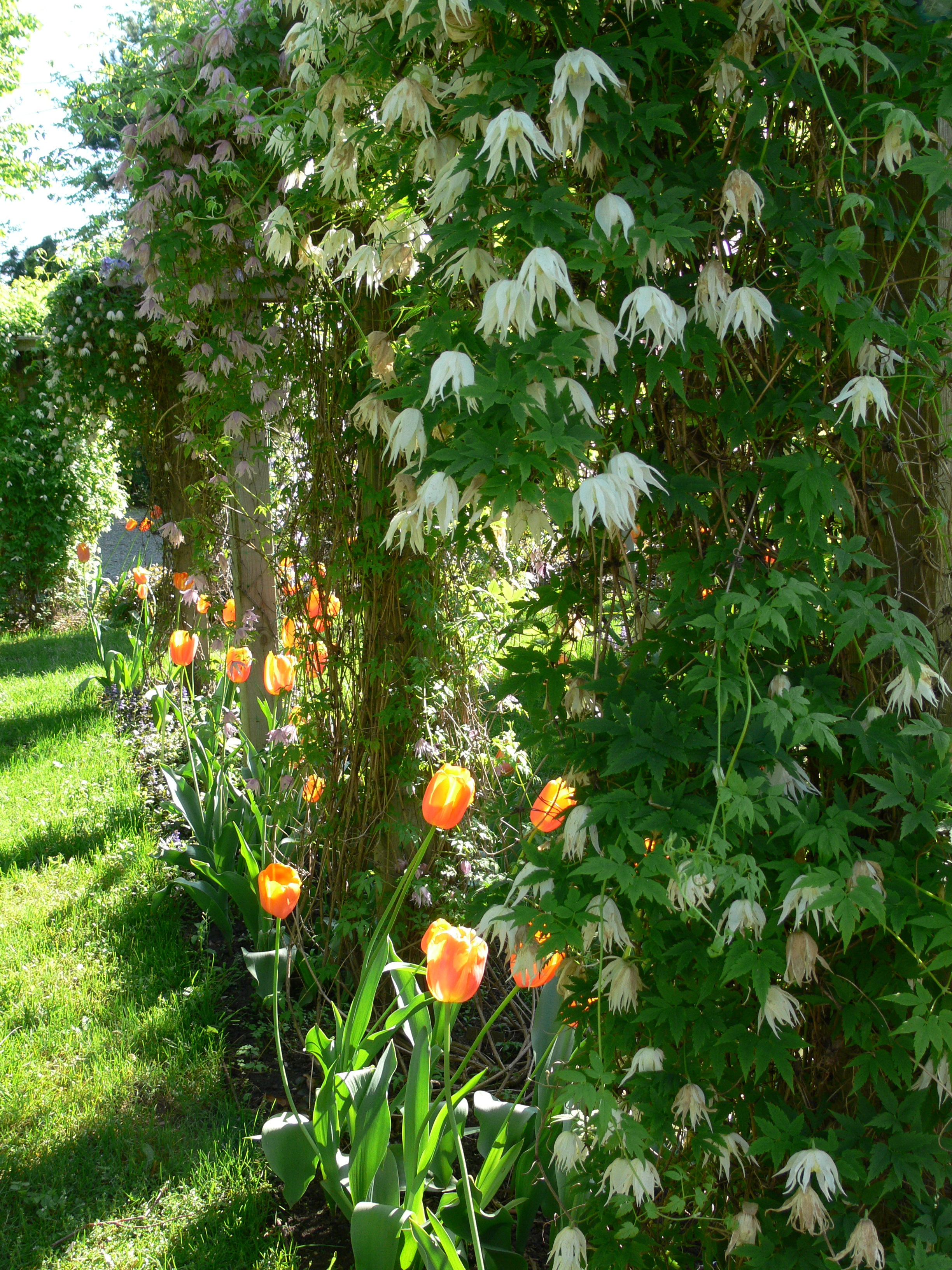
Rachele and I went to Montreal for the day this past weekend. It was the longest time we’ve ever left our one year old daughter Esther—just over twelve hours with my parents. Remarkably, she survived, and didn’t even miss us. Every time I go to Montreal I’m reminded of just how much better Canada is. For example, Senzala, a Brazilian breakfast place in Mile End, served the most delicious gourmet poached eggs (pictured here with Rachele): We also had a great time visiting the Botanical Garden, a vast park that dwarfs anything Boston has to offer. Here are a few examples of the flora—click on the image to see the full size version.
Along with poached eggs, beautiful gardens, and socialized healthcare, what more could one ask for?

Next.

Previous.