Search Results: "tin"

28 March 2022

Russell Coker: Feedburner Seems to be Dying

Many years ago Feedburner was a useful service. It proxied the RSS feed of your blog and gave you analytics of what happened with it. Now feeds using Feedburner randomly give HTTP error 404s. The Feedburner Twitter account is inactive and recommends that people Tweet at Google instead. It seems that Google wants to get rid of the service and random 404s probably aren t a high priority for them. I ve just gone through the config for Planet Linux Australia [1] and changed as many Feedburner URLs as possible to direct feed URLs. I did this by loading the Feedburner feed, getting the URL for the site, and then guessing the feed URL (usually just appending /feed to the domain name). I recommend that everyone abandon Feedburner, it s not reliable enough to use and doesn t seem to have any active support.

Antoine Beaupr : What is going on with web servers

I stumbled upon this graph recently, which is w3techs.com graph of "Historical yearly trends in the usage statistics of web servers". It seems I hadn't looked at it in a long while because I was surprised at many levels:
  1. Apache is now second, behind Nginx, since ~2022 (so that's really new at least)
  2. Cloudflare "server" is third ahead of the traditional third (Microsoft IIS) - I somewhat knew that Cloudflare was hosting a lot of stuff, but I somehow didn't expect to see it there at all for some reason
  3. I had to lookup what LiteSpeed was (and it's not a bike company): it's a drop-in replacement (!?) of the Apache web server (not a fork, a bizarre idea but which seems to be gaining a lot of speed recently, possibly because of its support for QUIC and HTTP/3
So there. I'm surprised. I guess the stats should be taken with a grain of salt because they only partially correlate with Netcraft's numbers which barely mention LiteSpeed at all. (But they do point at a rising share as well.) Netcraft also puts Nginx's first place earlier in time, around April 2019, which is about when Microsoft's IIS took a massive plunge down. That is another thing that doesn't map with w3techs' graphs at all either. So it's all lies and statistics, basically. Moving on. Oh and of course, the two first most popular web servers, regardless of the source, are package in Debian. So while we're working on statistics and just making stuff up, I'm going to go ahead and claim all of this stuff runs on Linux and that BSD is dead. Or something like that.

Dirk Eddelbuettel: RcppCNPy 0.2.11

A minor maintenance release of the RcppCNPy package arrived on CRAN three days ago, but we skipped announcing it right then. RcppCNPy provides R with read and write access to NumPy files thanks to the cnpy library by Carl Rogers along with Rcpp for the glue to R. One of the vignettes created an issue at CRAN with one of the Python modules used, so we simply switched to pre-made vignettes just as we do for a few other packages. Other small changes that had accumulated since the previous release were a new section in the reticulate vignette as well as some more documentation on types as well as some updates to continuous integration and bdages.

Changes in version 0.2.11 (2022-03-24)
  • The reticulate vignette has new section on 3d-arrays.
  • Added clarification to the manual page that the default types are 32-bit integer and 64-bit double (as we are working with R here).
  • Several updates have been made to the CI system; it now runs r-ci.
  • The README.md was updated with some new badges.
  • The vignettes are now pre-made to avoid any external dependencies.

CRANberries also provides a diffstat report for the latest release. As always, feedback is welcome and the best place to start a discussion may be the GitHub issue tickets page.

This post by Dirk Eddelbuettel originated on his Thinking inside the box blog. Please report excessive re-aggregation in third-party for-profit settings.

Russell Coker: Hangouts Replacement

Google is currently in the process of killing Hangouts. Last year Hangouts was quite a nice IM system with integrated video chat and voice calling. Now they have decided to kill it and replace it with Google Chat and Google Meet both of which are integrated with the Gmail app on Android. To start getting people off the old platform they have disabled video and audio chats with more than 2 people in Hangouts. To do a video call you have to use Meet which has a worse user interface and isn t integrated with text chat, so if in a text discussion someone says let s have a video call you have to open a new app. Meet also doesn t appear to have a facility to notify group members that someone has joined a group call so it s required that Chat (or something else) is used to tell people they can join Meet. Many of my relatives use Hangouts because they are forced to have it installed on their Android phones and because it worked quite well. Now it doesn t work well and will soon be going away. So another option is needed. I m considering Matrix as a replacement. Matrix has a good feature set and is being worked on a lot. The video conferencing is through a connection to a Jitsi server and is well integrated giving functionality more like Hangouts than Chat/Meet. For the LUV Matrix server the URL https://luv.asn.au/.well-known/matrix/client has the following contents:
 
  "m.homeserver":  
    "base_url": "https://luv.asn.au"
   
  "jitsi":  
    "preferredDomain": "jitsi.perthchat.org"
   
  "im.vector.riot.jitsi":  
    "preferredDomain": "jitsi.perthchat.org"
   
 
This specifies the Jitsi server to be used for chats started from that Matrix server. The PerthChat.org people seem to be leading the way for self hosted Matrix in Australia. Note that other people shouldn t link to their Jitsi server without discussing it with them first. I only included real data because it s published on the web so there s no point in keeping it secret. The Flounder free software users group [1] uses Matrix a lot. We will probably discuss Matrix at the next meeting on Saturday. There is also Element Call [2] which is apparently more integrated with Matrix (and also newer and possibly buggier). Jitsi works and we can change to a different service easily enough at a later time.

Russell Coker: Reading Glasses

About 4 years ago at a routine eye check the optometrist recommended that I get reading glasses. Apparently I m old enough that my eyes are losing their ability to focus at different distances to having different glasses for close and remote objects (EG reading and driving) is necessary for good vision. The optometrist asked me the distance that I use for reading and I indicated a distance that is good for books and phones (about 20cm). So I got a pair of glasses that worked well for that but didn t work well for the vast majority of my close work which is computer monitors. I found that I could use my reading glasses with my laptop when lying in bed if I had the laptop on my chest with the keyboard touching my chin, which is a reasonable position for watching TV but not for much else. About 2 years ago I had another eye check which determined that the glasses for long distance were good and got reading glasses designed for objects about 80cm away which worked well for monitors and were usable for watching TV. Recently I accidentally broke my newer pair of reading glasses and discovered that the older pair now works for distances of about a meter. So it appears that I have become significantly more long sighted over the last 4 years.

27 March 2022

Russ Allbery: Review: A Song for a New Day

Review: A Song for a New Day, by Sarah Pinsker
Publisher: Berkley
Copyright: September 2019
ISBN: 1-9848-0259-3
Format: Kindle
Pages: 372
Luce Cannon was touring with a session band when the shutdown began. First came the hotel evacuation in the middle of the night due to bomb threats against every hotel in the state. Then came the stadium bombing just before they were ready to go on stage. Luce and most of the band performed anyway, with a volunteer crew and a shaken crowd. It was, people later decided, the last large stage show in the United States before the congregation laws shut down public gatherings. That was the end of Luce's expected career, and could have been the end of music, or at least public music. But Luce was stubborn and needed the music. Rosemary grew up in the aftermath: living at home with her parents well away from other people, attending school virtually, and then moving seamlessly into a virtual job for Superwally, the corporation that ran essentially everything. A good fix for some last-minute technical problems with StageHoloLive's ticketing system got her an upgraded VR hoodie and complimentary tickets to the first virtual concert she'd ever attended. She found the experience astonishing, prompting her to browse StageHoloLive job openings and then apply for a technical job and, on a whim, an artist recruiter role. That's how Rosemary found herself, quite nerve-wrackingly, traveling out into the unsafe world to look for underground musicians who could become StageHoloLive acts. A Song for a New Day was published in 2019 and had a moment of fame at the beginning of 2020, culminating in the Nebula Award for best novel, because it's about lockdowns, isolation, and the suppression of public performances. There's even a pandemic, although it's not a respiratory disease (it's some variety of smallpox or chicken pox) and is only a minor contributing factor to the lockdowns in this book. The primary impetus is random violence. Unfortunately, the subsequent two years have not been kind to this novel. Reading it in 2022, with the experience of the past two years fresh in my mind, was a frustrating and exasperating experience because the world setting is completely unbelievable. This is not entirely Pinsker's fault; this book was published in 2019, was not intended to be about our pandemic, and therefore could not reasonably predict its consequences. Still, it required significant effort to extract the premise of the book from the contradictory evidence of current affairs and salvage the pieces of it I still enjoyed. First, Pinsker's characters are the most astonishingly incurious and docile group of people I've seen in a recent political SF novel. This extends beyond the protagonists, where it could arguably be part of their characterization, to encompass the entire world (or at least the United States; the rest of the world does not appear in this book at all so far as I can recall). You may be wondering why someone bombs a stadium at the start of the book. If so, you are alone; this is not something anyone else sees any reason to be curious about. Why is random violence spiraling out of control? Is there some coordinated terrorist activity? Is there some social condition that has gotten markedly worse? Race riots? Climate crises? Wars? The only answer this book offers is a completely apathetic shrug. There is a hint at one point that the government may have theories that they're not communicating, but no one cares about that either. That leads to the second bizarre gap: for a book that hinges on political action, formal political structures are weirdly absent. Near the end of the book, one random person says that they have been inspired to run for office, which so far as I can tell is the first mention of elections in the entire book. The "government" passes congregation laws shutting down public gatherings and there are no protests, no arguments, no debate, but also no suppression, no laws against the press or free speech, no attempt to stop that debate. There's no attempt to build consensus for or against the laws, and no noticeable political campaigning. That's because there's no need. So far as one can tell from this story, literally everyone just shrugs and feels sad and vaguely compliant. Police officers exist and enforce laws, but changing those laws or defying them in other than tiny covert ways simply never occurs to anyone. This makes the book read a bit like a fatuous libertarian parody of a docile populace, but this is so obviously not the author's intent that it wouldn't be satisfying to read even as that. To be clear, this is not something that lasts only a few months in an emergency when everyone is still scared. This complete political docility and total incuriosity persists for enough years that Rosemary grows up within that mindset. The triggering event was a stadium bombing followed by an escalating series of random shootings and bombings. (The pandemic in the book only happens after everything is locked down and, apart from adding to Rosemary's agoraphobia and making people inconsistently obsessed with surface cleanliness, plays little role in the novel.) I lived through 9/11 and the Oklahoma City bombing in the US, other countries have been through more protracted and personally dangerous periods of violence (the Troubles come to mind), and never in human history has any country reacted to a shock of violence (or, for that matter, disease) like the US does in this book. At points it felt like one of those SF novels where the author is telling an apparently normal story and all the characters turn out to be aliens based on spiders or bats. I finally made sense of this by deciding that the author wasn't using sudden shocks like terrorism or pandemics as a model, even though that's what the book postulates. Instead, the model seems to be something implicitly tolerated and worked around: US school shootings, for instance, or the (incorrect but widespread) US belief in a rise of child kidnappings by strangers. The societal reaction here looks less like a public health or counter-terrorism response and more like suburban attitudes towards child-raising, where no child is ever left unattended for safety reasons but we routinely have school shootings no other country has at the same scale. We have been willing to radically (and ineffectually) alter the experience of childhood due to fears of external threat, and that's vaguely and superficially similar to the premise of this novel. What I think Pinsker still misses (and which the pandemic has made glaringly obvious) is the immense momentum of normality and the inability of adults to accept limitations on their own activities for very long. Even with school shootings, kids go to school in person. We now know that parts of society essentially collapse if they don't, and political pressure becomes intolerable. But by using school shootings as the model, I managed to view Pinsker's setup as an unrealistic but still potentially interesting SF extrapolation: a thought experiment that ignores countervailing pressures in order to exaggerate one aspect of society to an extreme. This is half of Pinsker's setup. The other half, which made less of a splash because it didn't have the same accident of timing, is the company Superwally: essentially "what if Amazon bought Walmart, Google, Facebook, Netflix, Disney, and Live Nation." This is a more typical SF extrapolation that left me with a few grumbles about realism, but that I'll accept as a plot device to talk about commercialization, monopolies, and surveillance capitalism. But here again, the complete absence of formal political structures in this book is not credible. Superwally achieves an all-pervasiveness that in other SF novels results in corporations taking over the role of national governments, but it still lobbies the government in much the same way and with about the same effectiveness as Amazon does in our world. I thought this directly undermined some parts of the end of the book. I simply did not believe that Superwally would be as benign and ineffectual as it is shown here. Those are a lot of complaints. I found reading the first half of this book to be an utterly miserable experience and only continued reading out of pure stubbornness and completionism. But the combination of the above-mentioned perspective shift and Pinsker's character focus did partly salvage the book for me. This is not a book about practical political change, even though it makes gestures in that direction. It's primarily a book about people, music, and personal connection, and Pinsker's portrayal of individual and community trust in all its complexity is the one thing the book gets right. Rosemary's character combines a sort of naive arrogance with self-justification in a way that I found very off-putting, but the pivot point of the book is the way in which Luce and her community extends trust to her anyway, as part of staying true to what they believe. The problem that I think Pinsker was trying to write about is atomization, which leads to social fragmentation into small trust networks with vast gulfs between them. Luce and Rosemary are both characters who are willing to bridge those gulfs in their own ways. Pinsker does an excellent job describing the benefits, the hurt, the misunderstandings, the risk, and the awkward process of building those bridges between communities that fundamentally do not understand each other. There's something deep here about the nature of solidarity, and how you need both people like Luce and people like Rosemary to build strong and effective communities. I've kept thinking about that part. It's also helpful for a community to have people who are curious about cause and effect, and who know how a bill becomes a law. It's hard to sum up this book, other than to say that I understand why it won a Nebula but it has deep world-building flaws that have become far more obvious over the past two years. Pinsker tries hard to capture the feeling of live music for both the listener and the performer and partly succeeded even for me, which probably means others will enjoy that part of the book immensely. The portrayal of the difficult dynamics of personal trust was the best part of the book for me, but you may have to build scaffolding and bracing for your world-building disbelief in order to get there. On the whole, I think A Song for a New Day is worth reading, but maybe not right now. If you do read it now, tell yourself at the start that this is absolutely not about the pandemic and that everything political in this book is a hugely simplified straw-man extrapolation, and hopefully you'll find the experience less frustrating than I found it. Rating: 6 out of 10

Reproducible Builds (diffoscope): diffoscope 209 released

The diffoscope maintainers are pleased to announce the release of diffoscope version 209. This version includes the following changes:
* Update R test fixture for R 4.2.x series. (Closes: #1008446)
* Update minimum version of Black to prevent test failure on Ubuntu jammy.
You find out more by visiting the project homepage.

26 March 2022

Andrew Cater: Part way through testing Debian media images 20220326 1555UTC - Found a new useful utility

For various obscure reasons, I have a mirror of Debian in one room and the main laptop and so on I use in another. The mirror is connected to a fast Internet line - and has a 1Gb Ethernet cable into the back directly from the router, the laptop and everything else - not so much, everything is wired, but depends on a WiFi link across the property. One end is fast - one end runs like a snail.Steve suggested I use a different tool to make images directly on the mirror machine - jigit. Slightly less polished than jigdo but - if you're on the same machine - blazingly fast. I just used it to make the Blu-Ray sized .iso and was very pleasantly surprised. jigit-mkimage -j [jigdo file] -t [template file] -m Debian=[path to mirror of Debian] -o [output filename]
Another nice surprise for me - I have a horrible old Lenovo Ideapad. It's one of the Bay Trail Intel machines with a 32 bit UEFI and a 64 bit processor. I rescued it from the junk heap. Reinstalling it with an image today fixed an issue I had with slow boot and has turned it into an adequate machine for web browsing.All in all, I've done relatively few tests so far - but it's been a good day, as ever.More later.


Andrew Cater: Debian media team - testing and releasing Debian 11.3 - 20220326 1243UTC

And back to relative normality : the usual suspects are in Cambridge. It's a glorious day across the UK and we're spending it indoors with laptops :)We'll also be releasing a point release of Buster as a wrap up of recent changes.Debian 10 should move from full support to LTS on July August 14th - one year after the release of Debian 11 - and there will be a final point release of Buster somewhere around that point.
All seems to be behaving itself well.Thanks to all for the hard work that goes into preparing each release and especially the security fixes of which there seem to be loads lately.


Andrew Cater: Still testing Debian media images 20220326 2026UTC- almost finished 11.3 - Buster starting soon

And we're working through quite nicely.
It's been a long, long day so far and we're about 1/2 way through :)
Shout out to Isy, Sledge and RattusRattus in Cambridge and also smcv.Two releases in a day is a whole bunch :)

25 March 2022

Reproducible Builds (diffoscope): diffoscope 208 released

The diffoscope maintainers are pleased to announce the release of diffoscope version 208. This version includes the following changes:
[ Brent Spillner ]
* Add graceful handling for UNIX sockets and named pipes.
  (Closes: reproducible-builds/diffoscope#292)
* Remove a superfluous log message and reformatt comment lines.
[ Chris Lamb ]
* Reformat various files to satisfy current version of Black.
You find out more by visiting the project homepage.

24 March 2022

Ingo Juergensmann: New Server NVMe Issues

My current server is somewhat aged. I bought it new in July 2014 with a 6-core Xeon E5-2630L, 32 GB RAM and 4x 3.5 hot-swappable drives. Gladly I had the opportunity to extend the memory to 128 GB RAM at no additional cost by using memory from my ex-employer. It also has 4x 2 TB WD Red HDDs with 5400 rpm hooked up to the SATA backplane, but unfortunately only two of them are SATA-3 with 6 Gbit/s. The new server is a used/refurbished Supermicro server with 2x 14-core Xeon E5-2683 and 256 GB RAM and 4x 3.5 hot-swappable drives. It also came with a Hardware-RAID SAS/SATA 8-port controller with BBU. I also ordered two slim drive kits (MCP-220-81504-0N & MCP-220-81506-0N) to be able to use 2x 3.5 slots for rotational HDDs as a cheap storage. Right now I added 2x 128 GB Supermicro SATA DOMs, 4x WD Red 4 TB SSDs and a Sonnet Fusion 4 4 Silent and 4x 1 TB Seagate Firecuda 520 NVMe disks. And here the issue starts: The NVMe should be capable of 4-5 GB/s, but they are connected to a PCIe 3.0 x16 port via the Sonnet Fusion 4 4, which itself features a PCIe bridge, so bifurbacation is not necessary. When doing some tests with bonnie++ I get around 1 GB/s transfer rates out of a RAID10 setup with all 4 NVMes. In fact, regardless of the RAID level there are only transfer rates of about 1 1.2 GB/s with bonnie++. (All software RAIDs with mdadm.) But also when constructing a RAID each NVMe gives around 300-600 MB/s in sync speed except for one exception: RAID1. Regardless of how many NVMe disks in a RAID1 setup the sync speed is up to 2.5 GB/s for each of the NVMe disks. So the lower transfer rates with bonnie++ or other RAID levels shouldn t be limited by bus speed nor by CPU speed. Alas, atop shows upto 100% CPU usage for all tests. I even tested In my understanding RAID10 should perform similar to RAID1 in terms of syncing and better and while bonnie++ tests (up to 2x write and 4x read speed compared to a single disk). For the bonnie++ tests I even made some tests that are available here. You can find the test parameters listed in the hostname column: Baldur is the hostname, then followed by the layout (near-2, far-2, offset-2), chunk size and concurrency of bonnie++. In the end there was no big impact of the chunk size of the RAID. So, now I m wondering what the reason for the slow performance of those 4x NVMe disks is? Bus speed of the PCIe 3.0 x16 shouldn t be the cause, because I assume that the software RAID will need to transfer the blocks in RAID1 as well as in RAID10 over the bus. Same goes for the CPU: the amount of CPU work should be roughly the same for RAID1 and for RAID10. RAID10 should even have an advantage because the blocks only need to be synced to 2 disks in a stripe set. Bonnie++ tests are a different topic for sure. But when testing reading with dd from the md-devices I only get around 1-1.5 GB/s as well. Even when using LVM RAID instead of LVM on top of md RAID. All NVMe disks are already set to 4k and IO scheduler is set to mq-deadline. Is there anything I could do to improve the performance of the NVMe disks? On the other head, pure transfer rates are not that important to a server that runs a dozen of VMs. Here the improved IOPS performance over rotation disks is a clear performance gain. But I m still curious if I could get maybe 2 GB/s out of a RAID10 setup with the NVMe disks. Then again having two independent RAID1 setups for MariaDB and for PostgreSQL databases might be a better choice over a single RAID10 setup?

23 March 2022

Matthew Garrett: AMD's Pluton implementation seems to be controllable

I've been digging through the firmware for an AMD laptop with a Ryzen 6000 that incorporates Pluton for the past couple of weeks, and I've got some rough conclusions. Note that these are extremely preliminary and may not be accurate, but I'm going to try to encourage others to look into this in more detail. For those of you at home, I'm using an image from here, specifically version 309. The installer is happy to run under Wine, and if you tell it to "Extract" rather than "Install" it'll leave a file sitting in C:\\DRIVERS\ASUS_GA402RK_309_BIOS_Update_20220322235241 which seems to have an additional 2K of header on it. Strip that and you should have something approximating a flash image.

Looking for UTF16 strings in this reveals something interesting:

Pluton (HSP) X86 Firmware Support
Enable/Disable X86 firmware HSP related code path, including AGESA HSP module, SBIOS HSP related drivers.
Auto - Depends on PcdAmdHspCoreEnable build value
NOTE: PSP directory entry 0xB BIT36 have the highest priority.
NOTE: This option will NOT put HSP hardware in disable state, to disable HSP hardware, you need setup PSP directory entry 0xB, BIT36 to 1.
// EntryValue[36] = 0: Enable, HSP core is enabled.
// EntryValue[36] = 1: Disable, HSP core is disabled then PSP will gate the HSP clock, no further PSP to HSP commands. System will boot without HSP.

"HSP" here means "Hardware Security Processor" - a generic term that refers to Pluton in this case. This is a configuration setting that determines whether Pluton is "enabled" or not - my interpretation of this is that it doesn't directly influence Pluton, but disables all mechanisms that would allow the OS to communicate with it. In this scenario, Pluton has its firmware loaded and could conceivably be functional if the OS knew how to speak to it directly, but the firmware will never speak to it itself. I took a quick look at the Windows drivers for Pluton and it looks like they won't do anything unless the firmware wants to expose Pluton, so this should mean that Windows will do nothing.

So what about the reference to "PSP directory entry 0xB BIT36 have the highest priority"? The PSP is the AMD Platform Security Processor - it's an ARM core on the CPU package that boots before the x86. The PSP firmware lives in the same flash image as the x86 firmware, so the PSP looks for a header that points it towards the firmware it should execute. This gives a pointer to a "directory" - a list of different object types and where they're located in flash (there's a description of this for slightly older AMDs here). Type 0xb is treated slightly specially. Where most types contain the address of where the actual object is, type 0xb contains a 64-bit value that's interpreted as enabling or disabling various features - something AMD calls "soft fusing" (Intel have something similar that involves setting bits in the Firmware Interface Table). The PSP looks at the bits that are set here and alters its behaviour. If bit 36 is set, the PSP tells Pluton to turn itself off and will no longer send any commands to it.

So, we have two mechanisms to disable Pluton - the PSP can tell it to turn itself off, or the x86 firmware can simply never speak to it or admit that it exists. Both of these imply that Pluton has started executing before it's shut down, so it's reasonable to wonder whether it can still do stuff. In the image I'm looking at, there's a blob starting at 0x0069b610 that appears to be firmware for Pluton - it contains chunks that appear to be the reference TPM2 implementation, and it broadly decompiles as valid ARM code. It should be viable to figure out whether it can do anything in the face of being "disabled" via either of the above mechanisms.

Unfortunately for me, the system I'm looking at does set bit 36 in the 0xb entry - as a result, Pluton is disabled before x86 code starts running and I can't investigate further in any straightforward way. The implication that the user-controllable mechanism for disabling Pluton merely disables x86 communication with it rather than turning it off entirely is a little concerning, although (assuming Pluton is behaving as a TPM rather than having an enhanced set of capabilities) skipping any firmware communication means the OS has no way to know what happened before it started running even if it has a mechanism to communicate with Pluton without firmware assistance. In that scenario it'd be viable to write a bootloader shim that just faked up the firmware measurements before handing control to the OS.

The bit 36 disabling mechanism seems more solid? Again, it should be possible to analyse the Pluton firmware to determine whether it actually pays attention to a disable command being sent. But even if it chooses to ignore that, if the PSP is in a position to just cut the clock to Pluton, it's not going to be able to do a lot. At that point we're trusting AMD rather than trusting Microsoft, but given that you're also trusting AMD to execute the code you're giving them to execute, it's hard to avoid placing trust in them.

Overall: I'm reasonably confident that systems that ship with Pluton disabled via setting bit 36 in the soft fuses are going to disable it sufficiently hard that the OS can't do anything about it. Systems that give the user an option to enable or disable it are a little less clear in that respect, and it's possible (but not yet demonstrated) that an OS could communicate with Pluton anyway. However, if that's true, and if the firmware never communicates with Pluton itself, the user could install a stub loader in UEFI that mimicks the firmware behaviour and leaves the OS thinking everything was good when it absolutely is not.

So, assuming that Pluton in its current form on AMD has no capabilities outside those we know about, the disabling mechanisms are probably good enough. It's tough to make a firm statement on this before I have access to a system that doesn't just disable it immediately, so stay tuned for updates.

comment count unavailable comments

22 March 2022

Ulrike Uhlig: Workshops about anger, saying NO, and mapping one s capacities and desires

For the second year in a row, I proposed some workshops at the feminist hackers assembly at the remote C3. I m sharing them here because I believe they might be useful to others.

Anger workshop Based on my readings about the subject and a mediation training, I created a first workshop about dealing with one s own anger for the feminist hackers assembly in 2020. Many women who attended said they recognized themselves in what I was talking about. I created the exercises in the workshop with the goal of getting participants to share and self-reflect in small groups. I m not giving out solutions, instead proposals on how to deal with anger come from the participants themselves. (I added the last two content pages to the file after the workshop.) This is why this workshop is always different, depending on the group and what they want to share. The first time I did this workshop was a huge success and so I created an improved version for the assembly of 2021. Angry womxn* workshop

The act of saying NO We often say yes, despite wanting to say no, out of a sense of duty, or because we learned that we should always be nice and helpful, and that our own needs are best served last. Many people don t really know how to say no. Sarah Cooper, a former Google employee herself, makes fun of this in her fabulous book How to Be Successful Without Hurting Men s Feelings (highly recommended read!): A drawing of a woman who says: How I say yes: I'd love to. How I say no: sure. That s why a discussion space about saying NO did not seem out of place at the feminist hackers assembly :) I based my workshop on the original, created by the Institute of War and Peace Reporting and distributed through their holistic security training manual. I like this workshop because sharing happens in a small groups and has an immediately felt effect. Several people reported that the exercises allowed them to identify the exact moment when they had said yes to something despite really having wanted to say no. The exercises from the workshop can easily be done with a friend or trusted person, and they can even be done alone by writing them down, although the effect in writing might be less pronounced. The act of saying NO workshop

Mapping capacities and desires Based on discussions with a friend, whose company uses SWOT analysis (strengths weaknesses opportunities threats) to regularly check in with their employees, and to allow employees to check in with themselves, I created a similar tool for myself which I thought would be nice to share with others. It s a very simple self-reflection that can help map out what works well, what doesn t work so well and where one wants to go in the future. I find it important to not use this tool narrow-mindedly only regarding work skills and expertise. Instead, I think it s useful to also include soft skills, hobbies, non-work capacities and whatever else comes to mind in order to create a truer map. Fun fact: During the assembly, a bunch of participants reported that they found it hard to distinguish between things they don t like doing and things they don t know how to do. Mapping capacities and desires

Known issues One important feedback point I got is that people felt the time for the exercises in all three workshops could have been longer. In case you want to try out these workshops, you might want to take this into account.

Tollef Fog Heen: DNSSEC, ssh and VerifyHostKeyDNS

OpenSSH has this very nice setting, VerifyHostKeyDNS, which when enabled, will pull SSH host keys from DNS, and you no longer need to either trust on first use, or copy host keys around out of band. Naturally, trusting unsecured DNS is a bit scary, so this requires the record to be signed using DNSSEC. This has worked for a long time, but then broke, seemingly out of the blue. Running ssh -vvv gave output similar to
debug1: found 4 insecure fingerprints in DNS
debug3: verify_host_key_dns: checking SSHFP type 1 fptype 2
debug3: verify_host_key_dns: checking SSHFP type 4 fptype 2
debug1: verify_host_key_dns: matched SSHFP type 4 fptype 2
debug3: verify_host_key_dns: checking SSHFP type 4 fptype 1
debug1: verify_host_key_dns: matched SSHFP type 4 fptype 1
debug3: verify_host_key_dns: checking SSHFP type 1 fptype 1
debug1: matching host key fingerprint found in DNS
even though the zone was signed, the resolver was checking the signature and I even checked that the DNS response had the AD bit set. The fix was to add options trust-ad to /etc/resolv.conf. Without this, glibc will discard the AD bit from any upstream DNS servers. Note that you should only add this if you actually have a trusted DNS resolver. I run unbound on localhost, so if somebody can do a man-in-the-middle attack on that traffic, I have other problems.

Norbert Preining: Packages for Debian: KDE/Plasma, RSSguard, et al

As mentioned in this post, most of my activity around Debian has come to a complete halt (Send your thanks to da-manager@debian.org!). Since I still have a few computers running Debian, I keep maintaining a few things which I heavily rely on, in particular KDE/Plasma and RSSguard. For KDE/Plasma, there are the well known OBS repos I maintain, please read the blog posts tagged KDE. For RSSguard, I just uploaded a package for the recently released RSSguard 4.2.0 to a new OBS project debian-various. To activate this repository, first of all, you need to add my OBS key say in /usr/local/share/keyrings/obs-npreining.asc and add a file /etc/apt/sources.list.d/obs-npreining-various.list, containing the following line, replacing the DISTRIBUTION part with one of Debian_11 (for Bullseye), Debian_Testing, or Debian_Unstable:
deb [signed-by=/usr/local/share/keyrings/obs-npreining.asc] https://download.opensuse.org/repositories/home:/npreining:/debian-various/DISTRIBUTION/ ./
With that in place you will get a fresh and new rssguard. I will add more packages over time, typical candidates are rspamd and all the other none-KDE/Plasma packages I maintained. Enjoy.

21 March 2022

Gunnar Wolf: Long, long, long live Emacs after 39 years

Reading Planet Debian (see, Sam, we are still having a conversation over there? ), I read Anarcat s 20+ years of Emacs. And.. Well, should I brag contribute to the discussion? Of course, why not? Emacs is the first computer program I can name that I ever learnt to use to do something minimally useful. 39 years ago.
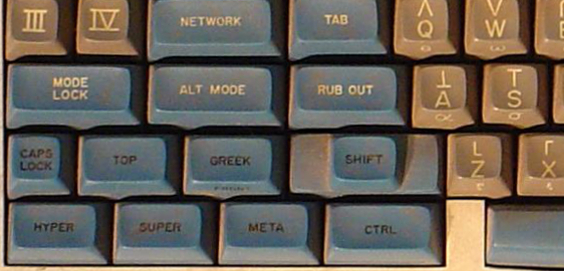
From the Space Cadet keyboard that (obviously ) influenced Emacs early design
The Emacs editor was born, according to Wikipedia, in 1976, same year as myself. I am clearly not among its first users. It was already a well-established citizen when I first learnt it; I am fortunate to be the son of a Physics researcher at UNAM, My father used to take me to his institute after he noticed how I was attracted to computers; we would usually spend some hours there between 7 and 11PM on Friday nights. His institute had a computer room where they had very sweet gear: Some 10 Heathkit terminals quite similar to this one: The terminals were connected (via individual switches) to both a PDP-11 and a Foonly F2 computers. The room also had a beautiful thermal printer, a beautiful Tektronix vectorial graphics output terminal, and some other stuff. The main user for my father was to typeset some books; he had recently (1979) published Integral Transforms in Science and Engineering (that must be my first mention in scientific literature), and I remember he was working on the proceedings of a conference he held in Oaxtepec (the account he used in the system was oax, not his usual kbw, which he lent me). He was also working on Manual de Lenguaje y Tipograf a Cient fica en Castellano, where you can see some examples of TeX; due to a hardware crash, the book has the rare privilege of being a direct copy of the output of the thermal printer: It was not possible to produce a higher resolution copy for several years But it is fun and interesting to see what we were able to produce with in-house tools back in 1985! So, what could he teach me so I could use the computers while he worked? TeX, of course. No, no LaTeX (that was published in 1984). LaTeX is a set of macros developed initially by Leslie Lamport, used to make TeX easier; TeX was developed by Donald Knuth, and if I have this information correct, it was Knuth himself who installed and demonstrated TeX in the Foonly computer, during a visit to UNAM. Now, after 39 years hammering at Emacs buffers Have I grown extra fingers? Nope. I cannot even write decent elisp code, and can barely read it. I do use org-mode (a lot!) and love it; I have written basically five books, many articles and lots of presentations and minor documents with it. But I don t read my mail or handle my git from Emacs. I could say, I m a relatively newbie after almost four decades. Four decades When we got a PC in 1986, my father got the people at the Institute to get him memacs (micro-emacs). There was probably a ten year period I barely used any emacs, but always recognized it. My fingers hve memorized a dozen or so movement commands, and a similar number of file management commands. And yes, Emacs and TeX are still the main tools I use day to day.

Antoine Beaupr : 20+ years of Emacs

I enjoyed reading this article named "22 years of Emacs" recently. It's kind of fascinating, because I realised I don't exactly know for how long I've been using Emacs. It's lost in the mists of history. If I would have to venture a guess, it was back in the "early days", which in that history is mapped around 1996-1997, when I installed my very own "PC" with FreeBSD 2.2.x and painstakingly managed to make XFree86 run on it. Modelines. Those were the days... But I digress.

I am old... The only formal timestamp I can put is that my rebuilt .emacs.d git repository has its first commit in 2002. Some people reading this may be born after that time. This means I'm at least significantly older than those people, to put things gently. Clever history nerds will notice that the commit is obviously fake: Git itself did not exist until 2005. But ah-ah! I was already managing my home directory with CVS in 2001! I converted that repository into git some time in 2009, and therefore you can see all my embarrassing history, including changes from two decades ago. That includes my first known .emacs file which is just bizarre to read right now: 200 lines, most of which are "customize" stuff. Compare with the current, 1000+ lines init.el which is also still kind of a mess, but actually shares very little with the original, thankfully. All this to say that in those years (decades, really) of using Emacs, I have had a very different experience than credmp who wrote packages, sent patches, and got name dropping from other developers. My experience is just struggling to keep up with everything, in general, but also in Emacs.

... and Emacs is too fast for me It might sound odd to say, but Emacs is actually moving pretty fast right now. A lot of new packages are coming out, and I can hardly keep up.
  • I am not using org mode, but did use it for time (and task) tracking for a while (and for invoicing too, funky stuff).
  • I am not using mu4e, but maybe I'm using something better (notmuch) and yes, I am reading my mail in Emacs, which I find questionable from a security perspective. (Sandboxing untrusted inputs? Anyone?)
  • I am using magit, but only when coding, so I do end up using git on the command line quite a bit anyways.
  • I do have which-key enabled, and reading about it reminded me I wanted to turn it off because it's kind of noisy and I never remember I can actually use it for anything. Or, in other words, I don't even remember the prefix key or, when I do, there's too many possible commands after for it to be useful.
  • I haven't setup lsp-mode, let alone Eglot, which I just learned about reading the article. I thought I would be super shiny and cool by setting up LSP instead of the (dying?) elpy package, but I never got around to it. And now it seems lsp-mode is uncool and I should really do eglot instead, and that doesn't help. UPDATE: I finally got tired and switched to lsp-mode. The main reason for choosing it over eglot is that it's in Debian (and eglot is not). (Apparently, eglot has more chance of being upstreamed, "when it's done", but I guess I'll cross that bridge when I get there.) lsp-mode feels slower than elpy but I haven't done any of the performance tuning and this will improve even more with native compilation (see below). I already had lsp-mode partially setup in Emacs so I only had to do this small tweak to switch and change the prefix key (because s-l or mod is used by my window manager). I also had to pin LSP packages to bookworm here and here.
  • I am not using projectile. It's on some of my numerous todo lists somewhere, surely. I suspect it's important to getting my projects organised, but I still live halfway between the terminal and Emacs, so it's not quite clear what I would gain.
  • I had to ask what native compilation was or why it mattered the first time I heard of it. And when I saw it again in the article, I had to click through to remember.
Overall, I feel there's a lot of cool stuff in Emacs out there. But I can't quite tell what's the best of which. I can barely remember which completion mechanism I use (company, maybe?) or what makes my mini-buffer completion work the way it does. Everything is lost in piles of customize and .emacs hacks that is constantly changing. Because a lot is in third-party packages, there are often many different options and it's hard to tell which one we should be using.

... or at least fast enough And really, Emacs feels fast enough for me. When I started, I was running Emacs on a Pentium I, 166MHz, with 8MB of RAM (eventually upgraded to 32MB, whoohoo!). Back in those days, the joke was that EMACS was an acronym for "Eight Megs, Always Scratching" and now that I write this down, I realize it's actually "Eight Megs, and Constantly Swapping", which doesn't sound as nice because you could actually hear Emacs running on those old hard drives back in the days. It would make a "scratching" noise as the hard drive heads would scramble maniacally to swap pages in and out of swap to make room for the memory-hungry editor. Now Emacs is pretty far down the list of processes in top(1) regardless of how you look at it. It's using 97MB of resident memory and close to 400MB of virtual memory, which does sound like an awful lot compared to my first computer... But it's absolutely nothing compared to things like Signal-desktop, which somehow manages to map a whopping 20.5GB virtual memory. (That's twenty Gigabytes of memory for old timers or time travelers from the past, and yes, that is now a thing.) I'm not exactly sure how much resident memory it uses (because it forks multiple processes), probably somewhere around 300MB of resident memory. Firefox also uses gigabytes of that good stuff, also spread around the multiple processes, per tab. Emacs "feels" super fast. Typing latency is noticeably better in Emacs than my web browser, and even beats most terminal emulators. It gets a little worse when font-locking is enabled, unfortunately, but it's still feels much better. And all my old stuff still works in Emacs, amazingly. (Good luck with your old Netscape or ICQ configuration from 2000.) I feel like an oldie, using Emacs, but I'm really happy to see younger people using it, and learning it, and especially improving it. If anything, one direction I would like to see it go is closer to what web browsers are doing (yes, I know how bad that sounds) and get better isolation between tasks. An attack on my email client shouldn't be able to edit my Puppet code, and/or all files on my system, for example. And I know, fundamentally, that's a really hard challenge in Emacs. But if you're going to treat your editor as your operating system (or vice versa, I lost track of where we are now that there's an Emacs Window Manager, which I do not use), at least we should get that kind of security. Otherwise I'll have to find a new mail client, and that's really something I try to limit to once a decade or so.

20 March 2022

Joerg Jaspert: Another shell script moved to rust

Shell? Rust! Not the first shell script I took and made a rust version of, but probably my largest yet. This time I took my little tm (tmux helper) tool which is (well, was) a bit more than 600 lines of shell, and converted it to Rust. I got most of the functionality done now, only one major part is missing.

What s tm? tm started as a tiny shell script to make handling tmux easier. The first commit in git was in July 2013, but I started writing and using it in 2011. It started out as a kind-of wrapper around ssh, opening tmux windows with an ssh session on some other hosts. It quickly gained support to open multiple ssh sessions in one window, telling tmux to synchronize input (send input to all targets at once), which is great when you have a set of machines that ought to get the same commands.

tm vs clusterssh / mussh In spirit it is similar to clusterssh or mussh, allowing to run the same command on many hosts at the same time. clusterssh sets out to open new terminals (xterm) per host and gives you an input line, that it sends everywhere. mussh appears to take your command and then send it to all the hosts. Both have disadvantages in my opinion: clusterssh opens lots of xterm windows, and you can not easily switch between multiple sessions, mussh just seems to send things over ssh and be done. tm instead just creates a tmux session, telling it to ssh to the targets, possibly setting the tmux option to send input to all panes. And leaves all the rest of the handling to tmux. So you can
  • detach a session and reattach later easily,
  • use tmux great builtin support for copy/paste,
  • see all output, modify things even for one machine only,
  • zoom in to one machine that needs just ONE bit different (cssh can do this too),
  • let colleagues also connect to your tmux session, when needed,
  • easily add more machines to the mix, if needed,
  • and all the other extra features tmux brings.

More tm tm also supports just attaching to existing sessions as well as killing sessions, mostly for lazyness (less to type than using tmux directly). At some point tm gained support for setting up sessions according to some session file . It knows two formats now, one is simple and mostly a list of hostnames to open synchronized sessions for. This may contain LIST commands, which let tm execute that command, expected output is list of hostnames (or more LIST commands) for the session. That, combined with the replacement part, lets us have one config file that opens a set of VMs based on tags our Ganeti runs, based on tags. It is simply a LIST command asking for VMs tagged with the replacement arg and up. Very handy. Or also all VMs on host X . The second format is basically free form tmux commands . Mostly commandline tmux call, just drop the tmux in front collection. Both of them supporting a crude variable replacement.

Conversion to Rust Some while ago I started playing with Rust and it somehow clicked , I do like it. My local git tells me, that I tried starting off with go in 2017, but that appearently did not work out. Fun, everywhere I can read says that Rust ought to be harder to learn. So by now I have most of the functionality implemented in the Rust version, even if I am sure that the code isn t a good Rust example. I m learning, after all, and already have adjusted big parts of it, multiple times, whenever I learn (and understand) something more - and am also sure that this will happen again

Compatibility with old tm It turns out that my goal of staying compatible with the behaviour of the old shell script does make some things rather complicated. For example, the LIST commands in session config files - in shell I just execute them commands, and shell deals with variable/parameter expansion, I just set IFS to newline only and read in what I get back. Simple. Because shell is doing a lot of things for me. Now, in Rust, it is a different thing at all:
  • Properly splitting the line into shell words, taking care of quoting (can t simply take whitespace) (there is shlex)
  • Expanding specials like ~ and $HOME (there is home_dir).
  • Supporting environment variables in general, tm has some that adjust behaviour of it. Which shell can use globally. Used lazy_static for a similar effect - they aren t going to change at runtime ever, anyways.
Properly supporting the commandline arguments also turned out to be a bit more work. Rust appearently has multiple crates supporting this, I settled on clap, but as tm supports getopts -style as well as free-form arguments (subcommands in clap), it takes a bit to get that interpreted right.

Speed Most of the time entirely unimportant in the tool that tm is (open a tmux with one to some ssh connections to some places is not exactly hard or time consuming), there are situations, where one can notice that it s calling out to tmux over and over again, for every single bit to do, and that just takes time: Configurations that open sessions to 20 and more hosts at the same time especially lag in setup time. (My largest setup goes to 443 panes in one window). The compiled Rust version is so much faster there, it s just great. Nice side effect, that is. And yes, in the end it is also only driving tmux, still, it takes less than half the time to do so.

Code, Fun parts As this is still me learning to write Rust, I am sure the code has lots to improve. Some of which I will sure find on my own, but if you have time, I love PRs (or just mails with hints).

Github Also the first time I used Github Actions to see how it goes. Letting it build, test, run clippy and also run a code coverage tool (Yay, more than 50% covered ) on it. Unsure my tests are good, I am not used to writing tests for code, but hey, coverage!

Up next I do have to implement the last missing feature, which is reading the other config file format. A little scared, as that means somehow translating those lines into correct calls within the tmux_interface I am using, not sure that is easy. I could be bad and just shell out to tmux on it all the time, but somehow I don t like the thought of doing that. Maybe (ab)using the control mode, but then, why would I use tmux_interface, so trying to handle it with that first. Afterwards I want to gain a new command, to save existing sessions and be able to recreate them easily. Shouldn t be too hard, tmux has a way to get at that info, somewhere.

19 March 2022

Russell Coker: More About the Librem 5

I concluded my previous post about the Purism Librem 5 [1] with the phone working as a Debian/GNOME system with SSH access over the LAN. Before I published that post I managed to render it unbootable, making a new computer unbootable on the first day of owning it isn t uncommon for me. In this case I tried to get SE Linux running on it and changing the kernel commandline parameter security=apparmor to security=selinux caused it to fail the checksum on kernel parameters and halt the boot. That seems to require a fresh install, it seems possible that I could setup my Librem5 to boot a recovery image from a SD card in such situations but that doesn t seem to be well documented and I didn t have any important data to lose. If I do figure out how to recover data by booting from a micro SD card I ll document it. Here s the documentation for reflashing the phone [2], you have to use the --variant luks option for the flashing tool to have an encrypted root filesystem (should default to on to match the default shipping configuration). There is an option --skip-cleanup to allow you to use the same image multiple times, but that probably isn t useful. The image that is available for download today has the latest kernel update that I installed yesterday so it seems that they quickly update the image which makes it convenient to get the latest (dpkg is slow on low power ARM systems). Overall the flash tool is nicely written, does the download and install and instructs you how to get the phone in flashing mode. It is a minor annoyance that the battery has to be removed as part of the flashing process, I will probably end up flashing my phone more often than I want to take the back off the case. A mitigating factor is that the back is well designed and doesn t appear prone to having it s plastic tabs breaking off when removed (as has happened to several other phones I ve owned). The camera doesn t seem to work well at this time, all photos have an unusually low brightness. The audio recording also doesn t work well, speaking clearly into the phone results in quiet recordings. I updated the Debian Wiki page on Mobile devices [3] to include a link to a page about the Librem5 [4] and to also have a section about applications known to work well on mobile devices. Hopefully other people will make some additions to that as most programs in Debian don t work well on mobile devices so we need a list of known good applications as well as applications that can be easily changed to work well. One thing I ve started looking at is the code for the Geary MUA (the default MUA for the Librem5 and the only one in Debian I know to be suitable for a phone). It needs the Thunderbird style autoconfig and it needs the ability to select which IMAP folders to scan as a common practice is to have some large IMAP folders that aren t used on mobile devices. I believe that Android runs each app in a separate UID to prevent them from messing with each other. The configuration on a standard Linux system and on PureOS is to have all apps running with the same permissions, I think this needs to be improved both for phones and for regular Linux systems which will probably benefit more than phones do. I ll write another blog post about this.

Next.

Previous.