Search Results: "tb"

6 June 2011

Kartik Mistry: Some Debian activity

* We re doing heavy uploading and fixing in Debian-IN repository nowadays. Thanks to Vasudev for taking initiative on Git migration + various nice stuffs pending from long time. * Gwibber is till mess. Help wanted as usual! * And, MiniDebConf India at Pune is planned at Pune again. Unless, it is colliding heavily with my wife s plan, I ll be there as last time :)

Vincent Bernat: Ready for World IPv6 day?

On June 8, 2011, will be World IPv6 Day. Major web companies like Google, Yahoo! and Facebook will serve their content through IPv6. While some of them already provide IPv6 content, you either need to use a special URL or get your connection from some selected providers, known to provide working IPv6 connection (the selection is done through DNS).

What s World IPv6 Day about? World IPv6 Day is mostly about major content providers and network operators. End users are not expected to take any special actions. The content will be provided for one day on IPv6 and IPv4 without any special trick to circumvent broken IPv6 setup. If you have an IPv4 only connectivity, all will continue to work (this day is not about switching Internet to IPv6 only). If you have a working IPv6 connectivity of any kind, you will use it to access content. However, if you have a broken IPv6 connectivity, you will find yourself isolated during one day until you solve the problem. You can check your connectivity and determine if you will run into trouble on World IPv6 Day. The main point of this day is to check if IPv6 native content can be provided to anybody without leaving out a large part of the users (the ones with a broken connectivity) which is reason why we don t already have IPv6 native content everywhere. Google explains it this way:
We continuously conduct detailed measurements on the quality of IPv6 connectivity, and our latest results show that making Google services generally available over IPv6 at this time would lead to connection problems and increased latency for a small number of users. User experience is very important to us, and we do not want to impact users on networks that do not yet fully support IPv6. We will continue to re-evaluate the situation as the IPv6 Internet evolves.
While content provider are invited to provide IPv6 content, network operator are expected to troubleshoot their customers problem (and they cannot withdraw themselves from this operation since the main change is done by content providers). If they can enable IPv6 connectivity, that would be great too but this is not mandatory. UPDATED: It s a shame but Microsoft s participation to World IPv6 day is a fix to prefer IPv4 over IPv6. Moreover, this fix will be reverted a few days later. Let s hope that network operators don t follow the lead by not setting up DNS hijacking to remove AAAA record.

What can I do? Even if you are neither a network operator nor a major player in web content publishing, it is expected that World IPv6 Day will also be the playground for most IPv6 related things.

As a user Check if your ISP provides native IPv6 connectivity. This can be an opt-in option. For example, in France, Free allows its users to enable native IPv6 connectivity if they choose the appropriate option. That s easy to do and you get IPv6 in a matter of minutes. If your ISP does not provide native IPv6 connectivity, you can try to bug them about this. This is unlikely to work. You can also get IPv6 through a tunnel broker like SixXS (create an account and apt-get install aiccu) or Hurricane Electric. Wikipedia has a list of IPv6 tunnel brokers. Don t rely on any other transition mechanism, they are unreliable.

As a service provider If you host yourself some services, like your web page or your own mail server, you can enable IPv6 connectivity for those as well. Get an IPv6 connectivity for your services, either native or through a tunnel broker. Then, enable IPv6 on each service you provide. Check that they are listening on IPv6 with ss -6l. All the tips below are meant for very simple setup. Ensure that net.ipv6.bindv6only is set to 0. Here is what I have done:
  • Enable SSH access through IPv6. With the default configuration of OpenSSH, this is already done. Check your ListenAddress directive if you have one.
  • Serve Web content through IPv6. I am using Nginx as a web server and you can mix IPv4 and IPv6 in the same virtual host. Setting up IPv6 is easy. Ensure that IPv6 support is compiled in (nginx -V) use listen [::]:80 instead of listen 80. Apache is equally easy to configure and should even work out of the box since the Listen 80 directive will listen to both IPv4 and IPv6 by default. lighttpd also supports IPv6. An easy way to get started is to use server.use-ipv6 = "enable".
  • Enable IPv6 in Postfix, Dovecot, BIND. For all of those, this works out of the box. Nowadays, most daemons will work fine with IPv6 without any special configuration since they will listen to :: by default which means any IPv4 or IPv6 address as long as net.ipv6.bindv6only is set to 0. Unfortunately, there is still some daemons that do not support IPv6.
  • Add appropriate AAAA record to your DNS because providing IPv6 services is of little use if your users (including you) cannot access them without typing the appropriate IP address. You may also want to provide a NS record reachable through IPv6.
  • Update your monitoring to use IPv6 as well. If you advertise IPv6 service and only IPv4 is working, most IPv6 client will be unable to access them.
  • Adapt your firewall. In Linux, Netfilter handles IPv4 and IPv6 separately. You need to ensure you setup a correct firewall for IPv6 as you have done with IPv4.
Here is a minimal firewall that you can adapt:
 1
 2
 3
 4
 5
 6
 7
 8
 9
10
11
12
13
14
15
16
17
18
19
20
21
22
23
24
ip6tables -A INPUT -m state --state ESTABLISHED,RELATED -j ACCEPT
ip6tables -A OUTPUT -m state --state ESTABLISHED,RELATED -j ACCEPT
for chain in INPUT OUTPUT; do
  ip6tables -A $chain -m rt --rt-type 0 -j DROP
  ip6tables -A $chain -p icmpv6 --icmpv6-type neighbor-solicitation \
     -m hl --hl-eq 255 -j ACCEPT
  ip6tables -A $chain -p icmpv6 --icmpv6-type neighbor-advertisement \
     -m hl --hl-eq 255 -j ACCEPT
  ip6tables -A $chain -m state --state NEW \
     -p icmpv6 --icmpv6-type echo-request -j ACCEPT
done
ip6tables -A INPUT -i lo -j ACCEPT
ip6tables -A OUTPUT -o lo -j ACCEPT
# Put your rules here!
ip6tables -N REJECT_ALL
ip6tables -A REJECT_ALL -p tcp -j REJECT --reject-with tcp-reset
ip6tables -A REJECT_ALL -p udp -j REJECT --reject-with icmp6-adm-prohibited
ip6tables -A REJECT_ALL -j DROP
for chain in INPUT OUTPUT FORWARD; do
    ip6tables -A $chain -j LOG --log-prefix "$chain-reject: "
    ip6tables -A $chain -j REJECT_ALL
done

Debian status There is still a long way for full IPv6 support of all applications in Debian but it is a release goal since Etch. This is not an easy task since adding IPv6 support on some software can be really difficult. DSA also enabled IPv6 support on many servers used by the Debian project including the main web server, the main mirror, the security mirror and the name servers. You should be able to use Debian with an IPv6 only access.

5 June 2011

Russell Coker: Rallying for a Carbon Tax 5th June

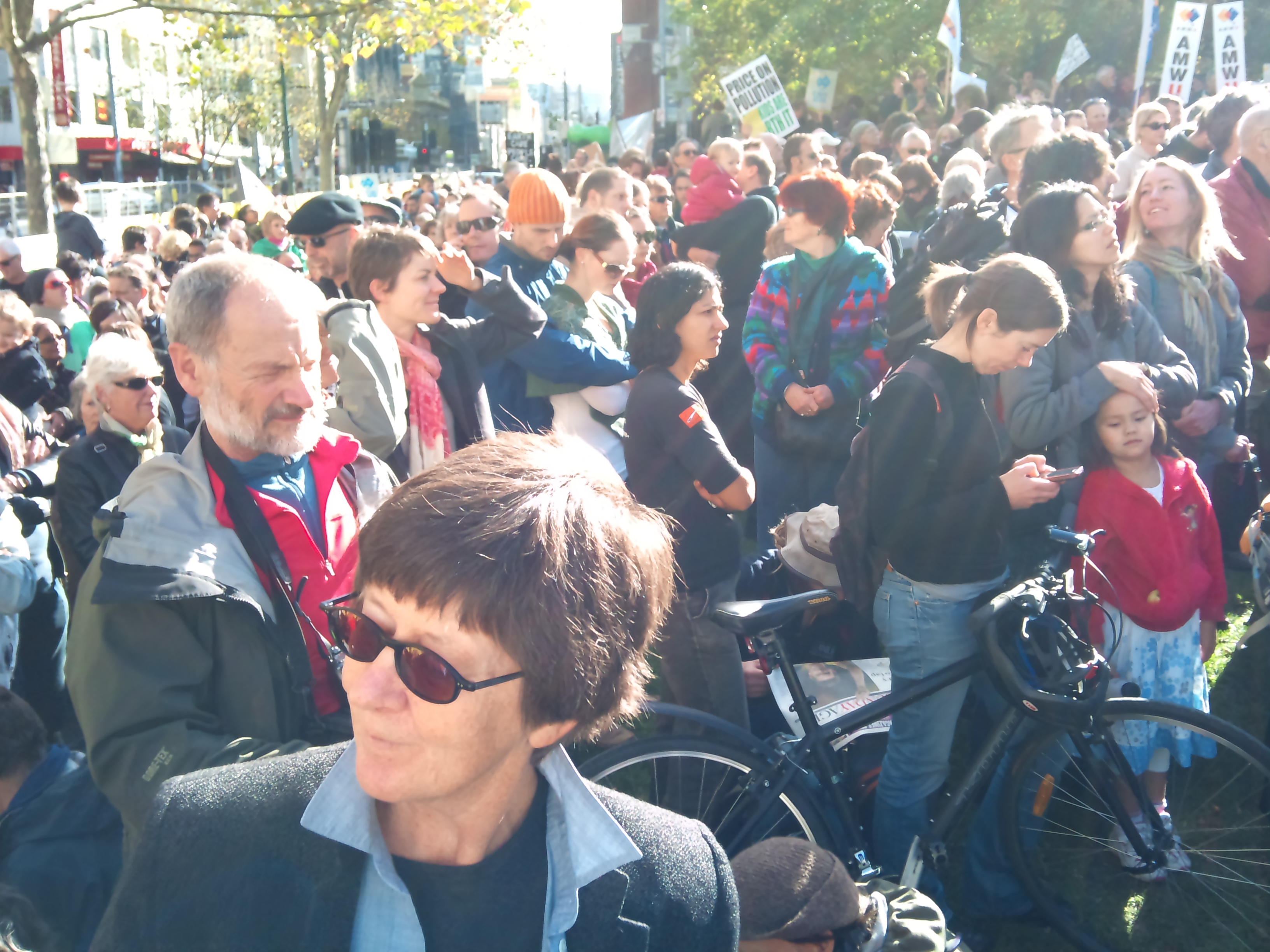
It s not that common to have a rally in favor of creating a new tax, but today I attended the Melbourne rally in favor of a carbon tax [1], it was the second such event this year. The rally was held in front of the state library, there is a reasonable size park there and it s a great place for a few hundred people, and a few thousand can squeeze in there without any problem. But according to the best estimates 10,000 people attended and the venue was obviously a bad choice as all available space was used and the crowd was so great that it wasn t much fun to be there. This was a great contrast to the previous rally in favor of a carbon tax which had maybe about 8,000 people attend and a much larger area [2]. The state library is a great place to hold a small or medium size rally where people can see it, but if you are going to get 10,000 people you need a bigger venue as the exits were partially blocked by road work I m sure that the local government wouldn t have given a permit if so many people were expected. Usually the city center is very quiet on a Sunday afternoon, but this afternoon everything was packed. An extra 10,000 people really makes a difference although admittedly sunny weather would have helped. Australia wide there were apparently about 100,000 people attending similar rallies, that s 0.5% of the population of the country! The aim of the rally was to advocate a large enough tax on coal, oil, and other energy sources that emit CO2 to provide an economic incentive to minimise use and use alternate energy sources where possible. Currently billions of dollars are being given to polluting industries, instead those industries should be taxed and the money raised given to compensate needy people. looking north Looking North towards where I entered. looking east Two pictures from slightly different angles that are roughly East from where I was standing in the center of the crowd. looking east through the bandlooking south Pictures looking east through the band when people were starting to leave and looking south towards the exit I chose while on the way out.

Jonathan McDowell: Building a FreeDOS bootable USB stick under Linux

This is for my own reference more than anything else; periodically I find myself needing to boot DOS. Usually because I want to upgrade a BIOS and the upgrade tool only works with Windows or DOS. Yes, I'm aware of flashrom, but the scary messages about toasting laptops means I'm much happier going the DOS route there. So I need a writable medium with a DOS boot image. The easy way to do it is to find a DOS floppy image and write that to a USB stick with dd, but it's basically a one off and means you can't fit a whole lot on the image. I wanted to do a native USB boot. The following did the trick for me. Firstly, this is all on a Debian testing box, in particular with dosfstools (3.0.9-1), mbr (1.1.11-4) and syslinux (2:4.04+dfsg-2). I don't think I'm using anything particularly new from these tools, so I suspect Debian stable will work just fine. In the below my USB stick is on /dev/sdb, I've got a copy of FreeDOS in ~/FreeDOS/ (I extracted the files from a balder10.img floppy image that's easy enough to find, but all you need is kernel.sys and command.com), and I wanted things neatly in their own subdirectories so I could try and keep the key for repeated use and know which bits I wanted to keep and which were transient. I also added a copy of the Debian Installer for convenience; it would need a copy of the netinst ISO dropped into the root to actually be useful, as there's not enough to do a full netboot from the wider Internet using just the HD initrd.
    # Create a single bootable LBA VFAT partition spanning entire stick.
    echo 0,,C,*   sfdisk /dev/sdb
    # Format as VFAT and give it a disk label.
    mkfs.vfat -n 'DOS BOOT' /dev/sdb1
    # Install an MBR
    install-mbr /dev/sdb
    # Mount it and create some directories for our files.
    mount /dev/sdb1 /media/DOS\ BOOT/
    cd /media/DOS\ BOOT/
    mkdir boot
    mkdir boot/syslinux/
    mkdir FreeDOS
    # Copy the chain.c32 syslinux tool over.
    cp /usr/lib/syslinux/chain.c32 boot/syslinux/
    # Copy FreeDOS over and move the important bits to /
    cp ~/FreeDOS/* FreeDOS/
    mv FreeDOS/command.com .
    mv FreeDOS/autoexec.bat .
    mv FreeDOS/fdconfig.sys .
    # Add the Debian Installer
    mkdir boot/d-i/
    cd boot/d-i/
    wget http://cdn.debian.net/debian/dists/squeeze/main/installer-amd64/current/images/hd-media/initrd.gz
    wget http://cdn.debian.net/debian/dists/squeeze/main/installer-amd64/current/images/hd-media/vmlinuz
    # Install syslinux
    syslinux -d boot /dev/sdb1
I made a boot/syslinux.help file containing:
    Available boot options are: FreeDOS d-i
and a boot/syslinux.cfg with:
    prompt 1
    display syslinux.help
    default FreeDOS
    label FreeDOS
        COM32 /boot/syslinux/chain.c32
        APPEND freedos=/FreeDOS/kernel.sys
    label d-i
        KERNEL /boot/d-i/vmlinuz
        INITRD /boot/d-i/initrd.gz
Initial testing was done using kvm which was a lot easier than constantly rebooting my laptop. Hopefully this is of help to someone. The only neat bit that I didn't see elsewhere when I was looking was the use of chain.c32 to load kernel.sys rather than having to use a FreeDOS provided boot sector image.

4 June 2011

Russell Coker: Leaving Three

In February I started the process of moving my phone and my wife s phone to Virgin from Three [1]. The reason is that Three didn t offer any good phones on affordable contracts, the cheapest that was suitable was a HTC Desire HD which would have cost me $55 per month, while I could justify spending that for my own phone (which is used for responding to SMS from Nagios to fix client servers) I didn t have the budget to spend that much on my wife s phone too and I really want us to have the same type of phone for ease of support. So I chose Virgin who offers the Sony Ericsson Xperia X10 for as little as $29 per month I chose a $39 per month deal that included 1500MB of data transfer and also had three months free which makes it effectively $34.12 per month. When using previous phones that weren t particularly smart I had also carried a Netbook and a 3G modem with me most of the time. Now that I have a phone that is a ssh client I don t need that so I tried to cancel the contract today. Three allows you to do almost everything over the Internet except cancel a contract their web site doesn t even give a phone number to call for that purpose. This must keep their support people busy, Vodaphone (which has just merged with Three) has recently had a horrible security breach because their sales booths used public Internet access for all customer data [2]. Also there is currently a law suit against Vodafone for poor network performance and misleading claims about service areas [3]. My experience with Three performance has been reasonably good apart from the fact that they advertised 3G service in Bendigo and provided none. As Three are apparently desperate to retain customers they offered me free service for 6 months if I don t close the account now. So I have a SIM that supports 1G of 3G data transfer per month for no charge until December (worth $90). What can I do with it? I don t own a 3G modem as I gave that to my parents (who are quite happy with pre-paid 3G net access via Three) and the phones that I have which can be used for tethering are a little slow (usable for ssh and basic web access but not for Youtube etc). Is there a way of selling such a SIM? Note that my name is still on the contract and any excess data or roaming fees will be billed to me so I can t just put it on ebay. I guess that one thing I can do is to use the SIM for receiving phone calls. For example if a friend was visiting from another country and wanted to receive calls without paying roaming fees I could lend them a phone. Any ideas?

3 June 2011

Raphaël Hertzog: My Debian activities in May 2011

This is my monthly summary of my Debian related activities. If you re among the people who made a donation to support my work, then you can learn how I spent your money. Otherwise it s just an interesting status update on my various projects. I have been Doing some work towards Debian Rolling At the start of the month, the discussions about Debian rolling were still very active on debian-devel. Declaring that testing would be rolling did not make it (as I hoped), the argument that some RC bugs last for far too long in that distribution carried the discussion and thus the most consensual proposition ended up being the one of Josselin Mouette were rolling would be testing plus a few selected cherry-picked packages from unstable. I believe it s a workable solution if we only care about a subset of architectures. Otherwise the same reasons that keep the fixed packages out of testing would probably also apply for rolling. Given this, I did setup britney (the software that controls testing) on my laptop to investigate how we can create rolling. It turns out britney is a very specialized software with very few configuration knobs. At the same time Joachim Breitner made a proposition that immediately grabbed my attention. He suggests to use SAT solvers to find out the set of packages that should migrate from unstable to testing. I thought that rolling would be a good testbed for this new implementation of britney (which he calls SAT-britney) so I jumped right in this project. I was not at all familiar with this science field, so I looked up quite some documentation: I learned that all SAT solvers expect the problem to be presented in CNF form, and that DIMACS was the file format of choice to represent those boolean constraints. Several SAT solvers are available in Debian and picosat appears to be one of the best. Then I started some early coding/prototyping to play with the concept. You can find the result in this git repository, you can grab a copy with git clone git://git.debian.org/~hertzog/sat-britney.git. There s not much yet, except some Python code to generate a SAT problem that can be fed to a SAT solver. But I really look forward to this project. Representing Debian during Solutions Linux During the second week, I spent 3 days in Paris to help manage the Debian booth at Solutions Linux. We have responded to lots of queries but most visitors already knew Debian, and many of them use it at work and/or at home. We tried to recruit those people as new members for Debian France, the local association. We also sold all our remaining goodies. The Ubuntu people were interviewed by France 3 (an important TV channel) and we took this opportunity (with the consent of the Ubuntu guys) to show our Debian t-shirts in the background: you can watch the video here (in French), you can see me with Carl Chenet at 1:21. We have also been interviewed by Intelli n TV: here and here (both in French). I m not very good at this exercise. :-) Improving dpkg triggers The third week was a vacation week, in theory I should have stayed away from my computer but I really wanted to take this opportunity to improve the state of dpkg triggers in Debian. I already covered my work in another article: Trying to make dpkg triggers more useful and less painful. The result is not merged yet, I just asked a question to all package maintainers who are using triggers to be able to decide whether I ll merge it as is, or if I can make the new behavior the default one. Supporting users after Alioth s migration When I came back from my vacation, many services provided by Alioth.debian.org were non-functional after a migration to a new setup that involves two machines instead of one. Given that I used to be an Alioth admin, I know that in those periods you tend to be get bogged down on many user support requests. So I re-joined #alioth on IRC and tried to help a bit. I did investigate some of the reported problems and prepared fixes (updated scripts, configuration files, etc.) for some of the issues. I also created a list of remaining issues that should have lasted only a few days but that s still active because there are still regressions left. The most important things still missing are: Improving the 3.0 (quilt) source format I have made some proposals to change the way the new source format would work. The goals are to be less painful for packagers who are using a VCS, and to avoid unexpected changes slipping through a new patch generated by dpkg-source. It seems that the proposals are relatively consensual so I ll implement them at some point. Missing in action on my blog I did a lots of stuff for Debian between travel and vacation, and in the remaining time, I did not manage to write many articles for my blog. In fact, besides the article on my triggers work mentioned above I only published one interview: People behind Debian: Steve Langasek, release wizard. I ll try to do better this month! Thanks Many thanks to the people who gave me 151.61 in May. See you next month for a new summary of my activities.

One comment Liked this article? Click here. My blog is Flattr-enabled.

2 June 2011

Joachim Breitner: Satire on Gender Issues at IIT Bombay

IIT Bombay, like most likely most Indian educational instituates, has some rules and regulations about the interaction between boys and girls that, at least to the uninitiated eye of a foreigner who was brought up in a liberal society, seem arbitrary and archaic. At IIT Bombay, for example, there may be no visits in hostels by students of the other gender (yes, there are separate boys and girls hostels) between 10pm and 7am, and during the day any such visit has to be registered at the reception security guard. And when there was need for more room for girls and they reassigned one wing of a boys hostel to the adjacent girls hostel, they closed the connection by bricking it and split the lawn by a fence. With barbed wire on top. I took this as a theme for a satirical inspection of these policies which comes to the conclusion that IIT Bombay is a very progressive institute that puts these rules in place as affirmative action towards same-gender relationships. After some discussion with the editors the text got actually published in the institutes bi-monthly newspaper Raintree , unfortunately only now, two weeks after I left India. You can read the text on the bottom of page 8 in the 6MB PDF file. I cannot predict how it will be received, but at least Utkarsh Raut, who illustrated the text, clearly got the message right. Thanks for the nice and very fitting drawing!
Russell Coker: Ziggy s Lecture about Nuclear Power

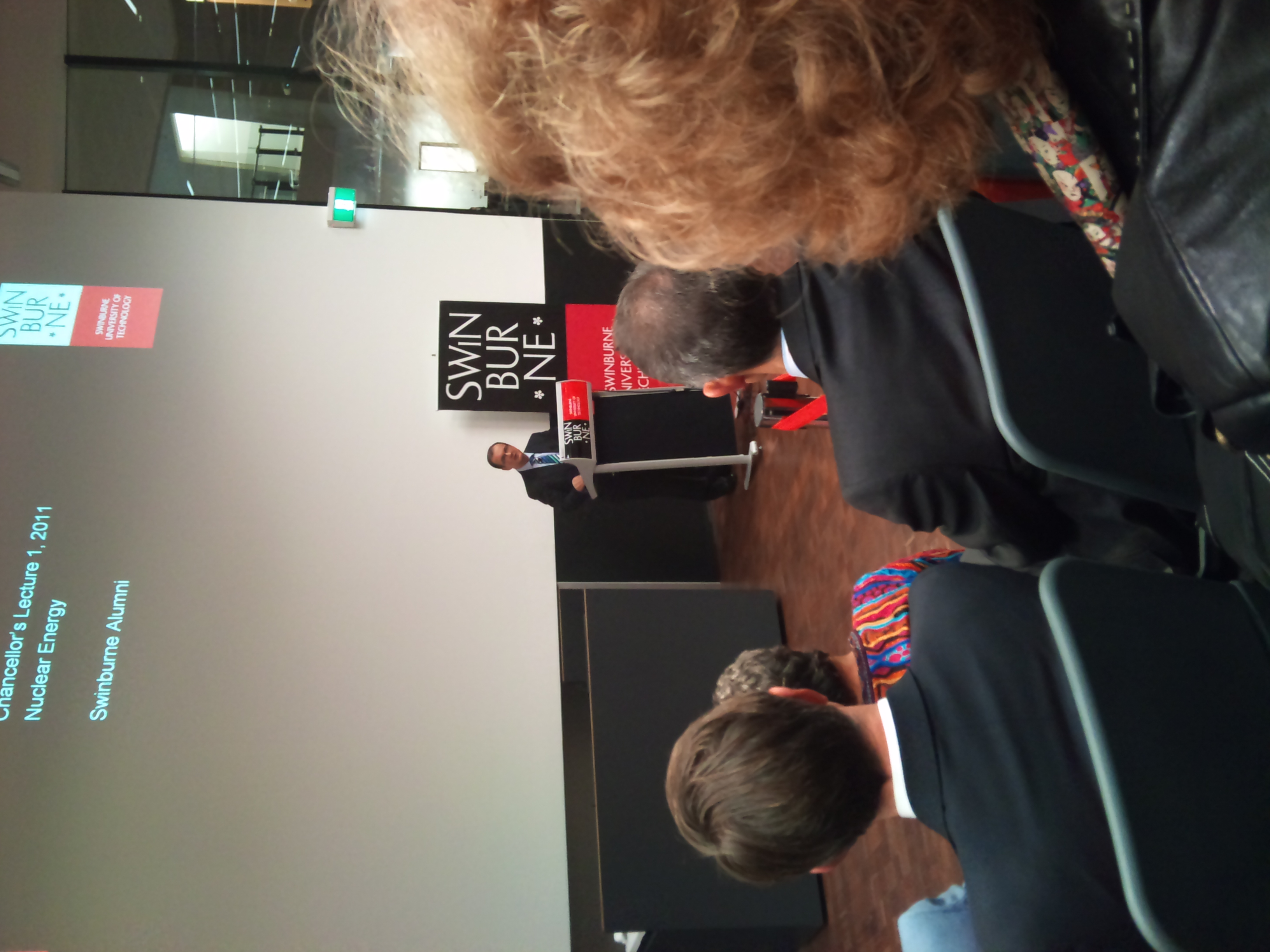
The Event Dr Ziggy Switkowski giving his lecture I just attended a lecture by Dr Ziggy Switkowski (see the above picture) on the topic of nuclear power, for a long time Ziggy has been the most prominent advocate of nuclear power in Australia, so naturally the talk was pro-nuclear. The lecture was free for alumni of Swinburne University and introduced by Swinburne s Chancellor who described Ziggy as a friend. Before the lecture started I handed out flyers for Beyond Zero Emissions [1] with a plan for zero carbon use in Australia by 2020. That was more difficult than handing out Greens polling cards on election day. The people who attended were there for a purpose and they could see the free food and wine on offer inside the building so getting them to stop and take a brochure wasn t easy. There were also people from Friends of the Earth [2] and some other anti-nuclear organisations giving out brochures. specter of nuclear contamination There were also some anti-nuclear protesters dressed as Uranium miners and the specter of nuclear contamination, they made for an interesting picture (which is amazingly good for a phone camera 20 minutes after sunset), but got in the way when I was handing out brochures. There were a few university security people at the door trying to keep the opposition away who were a bit annoying. There was also one policeman in attendance who was quite friendly, he asked whether there was a competition between the different groups as there is when handing out how-to-vote cards on election day. 15 minutes before the lecture was due to start I quit handing out the brochures and went inside for free food and drink (food always tastes better when the other team pays the bill). The Lecture I felt that Ziggy did a poor job of advocating nuclear power. There were a number of gaping flaws in his argument, but I have to commend him for his honesty in his appraisal of how hard it would be to develop a nuclear industry in Australia. Most nuclear advocates are a lot more optimistic about the process of building nuclear power plants and training all the people to run them. I will write a post tomorrow rebutting some of Ziggy s arguments. After the Lecture Immediately after the lecture the vice-chancellor stated that 500 people registered which made it the best attended such lecture that they have held. I don t know how many of the 500 attended, but I did notice that about 1/4 of the seats in the lecture hall were empty. It s rather sad that they can t get more people to such lectures, is TED.com stealing the audience? When I got out of the building I started handing out brochures to people as they left. I noticed that they were a lot friendlier than they were on the way in. I believe that people who left the lecture had greater interest in renewable energy because Ziggy just failed to make a good case for nuclear power. I expect that anyone who hadn t already made up their mind would immediately want to research the alternatives after watching Ziggy s lecture.

1 June 2011

Vincent Bernat: GNOME Power Manager without GNOME desktop

When I installed my new laptop, I decided to switch from sleepd to GNOME Power Manager (GPM). The rationale behind this decision was to get screen dimming for free while keeping other features because GPM uses UPower which uses pm-suspend and pm-powersave behind the scene. This means that it is easy to execute scripts on suspend or when the AC is unplugged by putting them in /etc/pm. I don t use a full GNOME desktop. My desktop is running FVWM which is just a window manager. However, I already use some parts of the GNOME environment:

What s working It happens that most of the features just do not work. However, suspend when closing the lid works fine. The icon in the systray works fine too (but there is a small bug). The screen dimming feature on idle also works (but there are annoying bugs with it). The visual feedback when pressing brightness keys works too.

What s not working It seems that I am not the only one to have problem with GPM: there are currently 115 bugs opened in the Debian BTS. If you want to get some debug output from gnome-power-manager, run it with --verbose flag. --debug flag does nothing (and supersedes --verbose).

Nothing happens when pressing the power button I have configured GPM to ask me what to do when I press the power button. But when I press the button, nothing happens. Looking at the source, here is the snippet of code that is executed:
1
2
3
4
5
6
7
if (policy == GPM_ACTION_POLICY_INTERACTIVE)  
    GpmSession *session;
    egg_debug ("logout, reason: %s", reason);
    session = gpm_session_new ();
    gpm_session_logout (session);
    g_object_unref (session);
 
In fact, this is not GPM that will ask you the question, but GNOME session manager because GPM triggers logout. If you don t run a full GNOME session, nothing will happen. My workaround is just to set the action to Suspend .

Does not sleep when idle GPM is configured to go to sleep after 2 hours on AC or 30 minutes on battery. This does not work for me because idle detection is delegated to external programs. There are four variables used by GPM to determine if we are idle:
  • session_idle which is the idle hint from ConsoleKit,
  • idle_inhibited which is set when another program asks to disable idle detection (a video player which does not want the screen to be dimmed),
  • suspend_inhibited which means a program do not want we going to sleep (a music player for example)
  • x_idle which tells if X is idle or not (someone is moving the mouse or typing on the keyboard).
To allow GPM to suspend when we are idle, x_idle and session_idle must be true while suspend_inhibited and idle_inhibited must be false. For screen dimming purpose, you just need to have x_idle set to true and idle_inhibited set to false. Currently, only GNOME Screensaver seems to tell ConsoleKit if the session is idle or not. XScreenSaver does not contain anything about this. I am using xautolock with xlock and I am pretty sure they won t tell GPM if I am idle. You can use dbus-send to circumvent this problem:
 1
 2
 3
 4
 5
 6
 7
 8
 9
10
11
$ dbus-send --system --dest=org.freedesktop.ConsoleKit \
>   --type=method_call --print-reply --reply-timeout=2000 \
>   /org/freedesktop/ConsoleKit/Manager \
>   org.freedesktop.ConsoleKit.Manager.GetCurrentSession
method return sender=:1.6 -> dest=:1.106 reply_serial=2
   object path "/org/freedesktop/ConsoleKit/Session1"
$ dbus-send --system --dest=org.freedesktop.ConsoleKit \
>   --type=method_call --print-reply --reply-timeout=2000 \
>   /org/freedesktop/ConsoleKit/Session1 \
>   org.freedesktop.ConsoleKit.Session.SetIdleHint boolean:true          
method return sender=:1.6 -> dest=:1.108 reply_serial=2
While I understand what is the rationale behind those choices (no code duplicate and allowing external programs to hinder power management), it lacks some fallback in case you don t use GNOME Screensaver (which is the key component here). I first though this was bug #594706 but this is not the case. I have opened (and closed) bug #628755. UPDATED: Jump to the conclusion for an updated solution for this problem.

Brightness is not restored to the previous value after idle When GPM undims the screen, it does not restore the previous value. It seems to be bug #617310 which is marked as fixed in upstream. I did not investigate it.

Wrong number of batteries reported I only have one battery but after one suspend/resume cycle, GPM thinks I have two. Maybe this is a bug of UPower. Maybe this is bug #606434. I did not investigate it. Maybe there is an happy interaction with bug #456280.

Inability to set configure actions when the UPS runs out of battery This is bug #390602. In addition to laptop batteries, UPower also supports UPS. In this case, GPM displays a special icon to tell if the UPS is fully charged. However, there is no possibility to execute special actions when the UPS is unplugged, like hibernate after 10 minutes or something like this. This seems to be a problem with the interface because looking with gconftool-2, we can spot variables like low_ups or critical_ups which allow to set actions when the UPS is almost out of battery. Moreover, the UPS icon only displays after one suspend/resume cycle but I am too lazy to report and debug this issue. Since, the icon disappear if I restart GPM, I am confident that the bug is in GPM.

Conclusion The conclusion is that GPM is not really that buggy but it really needs to be run in a full-blown GNOME desktop. The main problem is not really GPM. New technologies like UPower and ConsoleKit get pushed by freedesktop.org initiative, they get implemented by GNOME (and, I suppose, KDE) because they have tons of people following the appropriate mailing lists and any alternative just gets crushed by all those unpublicized changes. UPDATED: I got several helpful comments about this problem. There are two possible solutions:
  1. Use xfce4-power-manager. It handles brightness control in a better way and don t need an external program to tell when the current session is idle. It still needs a session manager to ask what to do when using the power button. The drawback to this solution is that you start to pull another desktop environment into your environment. You had some parts of GNOME and now you have some parts of XFCE. This solution was proposed by Sylvain Collilieux.
  2. Use gnome-session, gnome-screensaver and keep gnome-power-manager. As pointed by Julien Valroff, gnome-screensaver needs gnome-session to detect idleness. However, gnome-session starts a whole GNOME desktop. Again, there are two solutions. The first one is to replace gnome-session by something lighter implementing the bare minimum to make gnome-screensaver happy. Another suggestion is to configure gnome-session to start your favorite environment.
I start mine from ~/.xsession and here is what I have added at the top of it:
 1
 2
 3
 4
 5
 6
 7
 8
 9
10
11
12
13
14
15
16
17
# If not done, restart ourself with gnome-session
if [ -z "$SESSION_MANAGER" ]; then
    [ -d ~/.config/autostart ]   mkdir ~/.config/autostart
    rm -f ~/.config/autostart/*
    cat <<EOF > ~/.config/autostart/xsession.desktop
[Desktop Entry]
Name=Xsession
Comment=Start .xsession
Exec=$(readlink -f $0)
Type=Application
X-GNOME-Autostart-enabled=true
EOF
    exec gnome-session --autostart=$HOME/.config/autostart
fi
# Otherwise, keep starting stuff
# [...]
exec fvwm-crystal

Tanguy Ortolo: Coding a new BitTorrent tracker?

The BitTorrent protocol works with trackers, that track the clients or peers that share a given file. This is one specific design of a peer-to-peer protocol, very appropriate for official distribution: for instance, Debian runs a tracker for distributing the installation images.The problem There exists many BitTorrent clients, but, for what I have seen, few BitTorrent tracker. Within Debian, I think the only trackers available are the original BitTorrent's one, and its fork BitTornado. Both suffer from serious drawbacks: Proposed solution Now that I have criticized a lot, let us be more constructive. All these issues could be fixed by modifying the code and the package (well, by adopting it, for the first one). I think it is not worth doing so, exactly because they implement both a client and a tracker: there are many good BitTorrent clients so there is no real need for them as clients, and because a tracker's job is quite different, and easier than a client's, it would be useless to maintain a client with the tracker. So, I am considering coding a BitTorrent tracker. Even though the tracker protocol is based on HTTP, it is completely stateful so it would be a standalone daemon rather than a CGI-style program. I would code it in Python because this is the language I currently prefer, and I may call it tbtt (the BitTorrent tracker, or Tanguy's BitTorrent tracker, or transport blind tout terrain (all terrain armoured transport)). If you have any information or suggestion, please comment! Perhaps I missed some existing tracker that would do the job instead of coding a new one?

31 May 2011

Gunnar Wolf: Invitation Free Software in Mexico: Reflections and Opportunities

I was invited to be part of one of the panels to be present this Thursday (June 2) in a forum that promises to be interesting. The forum is organized by the Science and Technology comission of the Senate of the Republic (of Mexico ;-) ), Universidad Aut noma Metropolitana and Mozilla M xico. The day will be opened by Sen. Francisco Javier Castell n Fonseca and Richard Stallman; starting at 10:00, we will have thematic panels on: The full program (as well as details of interest of those that can physically attend) is attached to this post. I am looking forward to this forum. Not only it is a good opportunity to get our work known in one of those places where it matters, but it's also being organized by several interesting people I'm sure will have something interesting to contribute. And of course, we lacked time to build a better, more complete and more coherent proposal but there is a good probability we will have further such contacts. You might find interesting to read on the list we have been discussing; subscription seems to be open (although access to the archives is not Maybe it will be later on? In any case, I'm saving a mbox ;-) )
AttachmentSize
Activity program352.37 KB

Vincent Bernat: Provide a mobile version with CSS Media Queries

Nowadays, many websites provide a mobile version, like Wikipedia, which usually is a version tailored to device with less bandwidth and smaller screen. CSS Media Queries is a candidate recommendation from the W3C to support different stylesheets depending on the how the document is displayed. This allows to build a mobile version just by providing additional instructions in your CSS style sheet.

Using CSS Media Queries There are two ways to use CSS media queries. You can provide an additional CSS stylesheet and let the browser knows when to use it:
1
<link rel="stylesheet" media="screen and (max-width: 700px)" href="mobile.css">
When the width of the viewport is less than 700 pixels, the stylesheet mobile.css will be used. Another way to use CSS media queries is to declare a section inside your current CSS style sheet:
1
2
3
4
5
@media screen and (max-width: 700px)  
    #article  
       margin: 0.3em 0.2em;
     
 
While there are many available properties, the most two common ones will be max-width and min-width. You can use this feature to modify some aspects of your web site like reducing margins or hiding some extra navigational blocks.

Browser support Current versions of mobile browsers support CSS media queries: Safari Mobile, Android browser and Opera mobile will handle it without a glitch. If you use CSS media queries to provide a mobile version of your web site, you don t really have to worry about browser compatibility. There exists polyfills that will enable this feature on unsupported browsers like Internet Explorer 8. One of them is Respond which is a lightweight polyfill targeted at supporting only min-width and max-width in Internet Explorer 6, 7 and 8.

Example I have added CSS media queries to my website. Try it by resizing the window of your browser. Here are some of the changes depending on the width of the window:
  • the sidebar transforms into a topbar
  • the search box is hidden
  • padding is reduced at various places
Here is the current look in a classic browser: Website look on a classic browser If you reduce the size of your window, you will get something like this: Website look on a narrow window Browse my CSS files for more examples. Look at the end of each file. For further information, have a look at the article from CSS Tricks.

30 May 2011

Julian Andres Klode: 0x15 + 1/365

Yesterday was my 21st birthday, and I received all Hitchhiker s Guide to the Galaxy novels, the five ones in one book, and the sixth one written by Eoin Colfer in another book. Needless to say, the first book weights more than an N900. I did not read them yet, so now is the perfect chance to do so. Yes, I did not know that 25th is towel day, sorry for that. I also bought a Toshiba AC100 before my birthday, a Tegra 2 based notebook/netbook/ web companion with 1 GHz dual core ARM Cortex A9 chip and 512 MB RAM. It runs Android by default, and had a price of 160 which is low compared to anything else with Cortex A9. It currently runs Ubuntu 11.04 with a specialised kernel 2.6.37 from time to time, without sound and accelerated video (and not functioning HDMI). Mostly waiting for Nvidia to release a new binary blob for the video part (And yes, if you just want to build packages, you can probably get happy without those things). Another thing happening last week is the upload of python-apt 0.8.0 to unstable, marking the beginning (or end) of the API transition I started more than a year ago. Almost all packages not supporting it have proper Breaks in python-apt [most of them already fixed, only 2 packages remaining, one of which is "maintained" (well, not really maintained right now) by me], but there may be some which do not work correctly despite being fixed (or at least thought to be fixed). If you know any other interesting thing I did last week, leave a comment, I wrote enough now. And yes, WordPress wants to write a multiplication sign instead of an x, so I had to use &#120 instead.
Filed under: Debian, General, Ubuntu

28 May 2011

Vincent Bernat: SNMP support for keepalived

keepalived keepalived is an high-availability and load-balacing solution. Using VRRP, it allows you to share IP addresses between several servers or routers. At a given moment, only one of them (the master) will be handed the IP address. VRRP is usually setup for redundant routers, but you can also setup redundant services. If the master becomes unavailable or fails, one of the backups will take over the IP address. VRRP is not a cluster resource manager. It is targeted at sharing one (or several) IP between a set of hosts. If you want to share other resources with complex conditions like at least two web servers should run and the database should not run on the same node as a web server , you should look at heartbeat instead. For load-balancing, keepalived relies on IPVS, a Linux subsystem featuring layer-4 switching. keepalived will check if your servers are alive and tell it to IPVS. IPVS will handle incoming connections and send them on the appropriate alive server depending on the policy you can configure. For example, one policy is round-robin: servers are handled new connections in circular order.

keepalived & SNMP keepalived did not feature a native SNMP support. I have added complete SNMP support and I hope those patches will be accepted into mainstream. Meanwhile, you can grab keepalived with SNMP support source code from GitHub. Currently, it is based on the latest version of keepalived. Here is what you can do :
  • query the configuration of the running keepalived without parsing configuration files;
  • query runtime status (like VRRP status, priority or current state of a virtual server) without looking in the logs;
  • query runtime statistics about virtual servers (how many connections were handled by this real server, for example) without parsing the output of ipvsadm;
  • get noticed with the help of SNMP traps when something changed (VRRP transition or a real server that became unavailable);
  • changing the priority of a VRRP instance (to force a transition as master);
  • changing the weight of a real server (to remove it from a pool of servers).

Compilation To use it:
1
2
3
4
5
$ git clone https://github.com/vincentbernat/keepalived.git
$ cd keepalived
$ git checkout snmp-1.2.0
$ ./configure --enable-snmp
$ make
You get bin/keepalived which is the SNMP enabled keepalived daemon. You can use it directly or install it with make install as root. On RHEL, SNMP is not properly packaged. Try the following command instead of make:
1
$ make LDFLAGS="$(net-snmp-config --agent-libs) -lpopt -lssl -lcrypto"

Use To use it, you need to ensure that your main snmpd daemon can become a master agent. Check for the presence of master agentx line in snmpd.conf. The next step is to start keepalived with the -x switch. keepalived will connect to your main snmpd daemon. You can check the logs for a ligne like this:
May 28 17:21:19 L1 Keepalived_vrrp: NET-SNMP version 5.4.3 AgentX subagent connected

Lab To test it, we can setup a little lab with UML. You can find additional details about this kind of lab in my post about network lab with UML. Grab the complete lab from GitHub. Ensure that you correct the path to keepalived sources at the top of the setup script. keepalived & SNMP lab The lab features four web servers that will be merged into a single web service with the help of keepalived. Since, keepalived now supports full IPv6 support, we will also use IPv6 in our lab. Here is the VRRP configuration of the first keepalived :
vrrp_instance VI_1  
   state MASTER
   interface eth2
   dont_track_primary
   track_interface  
      eth0
      eth1
    
   virtual_router_id 1
   priority 150
   advert_int 2
   authentication  
      auth_type PASS
      auth_pass blibli
    
   virtual_ipaddress  
      1.1.1.15/24 dev eth0
      2001:db8::15/64 dev eth0
      192.168.1.1/24 dev eth1
      fd00::1/64 dev eth1
   
 
We define two virtual servers, one for IPv4, one for IPv6. Here is an excerpt of the configuration :
virtual_server_group VS_GROUP_IPv4  
   1.1.1.15 80
 
virtual_server group VS_GROUP_IPv4  
   delay_loop 10
   lb_algo rr
   lb_kind NAT
   protocol TCP
   real_server 192.168.1.10 80  
      weight 1
      HTTP_GET  
        url  
          path /
          status_code 200
         
        connect_timeout 10
       
    
   [...]
 
When running the lab (with ./setup), we can check that everything works as expected. From the client node, we can make several requests, both with IPv4 and IPv6:
1
2
3
4
5
6
7
8
C1# curl  http://1.1.1.15 
W3
C1# curl  http://1.1.1.15
W2
C1# wget -o /dev/null -O - 'http://[2001:db8::15]'
W3
C1# wget -o /dev/null -O - 'http://[2001:db8::15]'
W2
If we put down eth1 on L1, L2 becomes master and everything works as expected. Our client node can still do the requests.

SNMP We can query the configuration of our running keepalived from L1. The appropriate MIB is KEEPALIVED-MIB. The base OID for this MIB is .1.3.6.1.4.1.9586.100.5. It is hosted in the OID space allocated by IANA to the Debian project. For example, to get the configuration of our VRRP instance:
 1
 2
 3
 4
 5
 6
 7
 8
 9
10
11
12
13
14
15
16
17
18
19
# snmpwalk -v2c -cpublic localhost KEEPALIVED-MIB::vrrpInstanceTable
KEEPALIVED-MIB::vrrpInstanceName.1 = STRING: VI_1
KEEPALIVED-MIB::vrrpInstanceVirtualRouterId.1 = Gauge32: 1
KEEPALIVED-MIB::vrrpInstanceState.1 = INTEGER: master(2)
KEEPALIVED-MIB::vrrpInstanceInitialState.1 = INTEGER: master(2)
KEEPALIVED-MIB::vrrpInstanceWantedState.1 = INTEGER: master(2)
KEEPALIVED-MIB::vrrpInstanceBasePriority.1 = INTEGER: 150
KEEPALIVED-MIB::vrrpInstanceEffectivePriority.1 = INTEGER: 150
KEEPALIVED-MIB::vrrpInstanceVipsStatus.1 = INTEGER: allSet(1)
KEEPALIVED-MIB::vrrpInstancePrimaryInterface.1 = STRING: eth2
KEEPALIVED-MIB::vrrpInstanceTrackPrimaryIf.1 = INTEGER: tracked(1)
KEEPALIVED-MIB::vrrpInstanceAdvertisementsInt.1 = Gauge32: 2 seconds
KEEPALIVED-MIB::vrrpInstancePreempt.1 = INTEGER: preempt(1)
KEEPALIVED-MIB::vrrpInstancePreemptDelay.1 = Gauge32: 0 seconds
KEEPALIVED-MIB::vrrpInstanceAuthType.1 = INTEGER: password(1)
KEEPALIVED-MIB::vrrpInstanceLvsSyncDaemon.1 = INTEGER: disabled(2)
KEEPALIVED-MIB::vrrpInstanceGarpDelay.1 = Gauge32: 0 seconds
KEEPALIVED-MIB::vrrpInstanceSmtpAlert.1 = INTEGER: disabled(2)
KEEPALIVED-MIB::vrrpInstanceNotifyExec.1 = INTEGER: disabled(2)
We can get statistics from IPVS subsystem:
 1
 2
 3
 4
 5
 6
 7
 8
 9
10
11
# snmpwalk -v 2c -c public localhost KEEPALIVED-MIB::virtualServerTable   grep Stats
KEEPALIVED-MIB::virtualServerStatsConns.1 = Gauge32: 6 connections
KEEPALIVED-MIB::virtualServerStatsConns.2 = Gauge32: 6 connections
KEEPALIVED-MIB::virtualServerStatsInPkts.1 = Counter32: 36 packets
KEEPALIVED-MIB::virtualServerStatsInPkts.2 = Counter32: 36 packets
KEEPALIVED-MIB::virtualServerStatsOutPkts.1 = Counter32: 24 packets
KEEPALIVED-MIB::virtualServerStatsOutPkts.2 = Counter32: 24 packets
KEEPALIVED-MIB::virtualServerStatsInBytes.1 = Counter64: 2970 bytes
KEEPALIVED-MIB::virtualServerStatsInBytes.2 = Counter64: 3312 bytes
KEEPALIVED-MIB::virtualServerStatsOutBytes.1 = Counter64: 2592 bytes
KEEPALIVED-MIB::virtualServerStatsOutBytes.2 = Counter64: 3072 bytes
We can also disable a real server, for example W1:
 1
 2
 3
 4
 5
 6
 7
 8
 9
10
11
12
# snmpget -v2c -cpublic localhost KEEPALIVED-MIB::realServerAddrType.1.1 \
                                KEEPALIVED-MIB::realServerAddress.1.1
KEEPALIVED-MIB::realServerAddrType.1.1 = INTEGER: ipv4(1)
KEEPALIVED-MIB::realServerAddress.1.1 = Hex-STRING: C0 A8 01 0A 
# snmpget -v2c -cpublic localhost KEEPALIVED-MIB::realServerAddress.2.1 \
                                KEEPALIVED-MIB::realServerAddress.2.1
KEEPALIVED-MIB::realServerAddress.2.1 = Hex-STRING: FD 00 00 00 00 00 00 00 00 00 00 00 00 00 00 10 
# snmpset -v2c -cprivate localhost KEEPALIVED-MIB::realServerWeight.1.1 = 0
KEEPALIVED-MIB::realServerWeight.1.1 = INTEGER: 0
# snmpset -v2c -cprivate localhost KEEPALIVED-MIB::realServerWeight.2.1 = 0
KEEPALIVED-MIB::realServerWeight.2.1 = INTEGER: 0
From C1, you can now check that W1 is not queried anymore. Let s graph the number of connections per second each real server gets. With a simple script using rrdtool, we can get the following graph: rrdtool graph built from stats returned by keepalived SNMP agent

27 May 2011

Joachim Breitner: Conditional Elimination through Code Duplication

My Advanced Compilers course at IIT Bombay under Prof. D. M. Dhamdhere also involved a group project. Our group had the task to pick an existing compiler optimization which works by restructuring the control flow graph of the code, and implement that in LLVM. As we did not quickly find a suitable optimization, I came up with a simple idea by myself. At first, our professor was not really pleased by this move, but after the second presentation or so, when the ideas were more streamlined and we noticed how simple yet possibly widely applicable the transformation is, he allowed us to carry on with it. I concentrated on the theoretical part, writing a paper describing it, while the others in the team implemented parts of it as a pass for the LLVM compiler. The idea is simple: If within one execution of a program the same conditional expression (e.g. a variable debug_enabled) is evaluated several times, then it might be faster to copy the code in between the conditional jumps and thus remember the result without further conditional jumps. Of course this increases the code size, and there is a trade-off, but in some instances the benefits could well be the worth the effort, especially inside tight inner loops. You can read more about it in my paper about CECD, and I m considering uploading it to arxiv.org as well.

26 May 2011

Christoph Berg: DLV removes all *.de records

Because of some problem with Denic's DNSSEC testbed and bind resolvers, dlv.isc.org has removed all DLV records for *.de domains. WTF.

25 May 2011

Russell Coker: Links May 2011

John W. Dean wrote in insightful series of three articles for Findlaw about Authoritarian Conservatives [1]. In summary there are Authoritarian Followers who follow their leader blindly and Authoritarian Leaders who do whatever it takes to gain and maintain power. The Authoritarian mindset lends itself towards right-wing politics. Mick Ebeling gave an inspiring TED talk about his work developing a system to produce art that is controlled by eye movements [2]. The development work was started to support the quadriplegic graffiti artist TEMPT1. Mick s most noteworthy point is that all the hardware design and software are free so anyone can implement it without asking an insurance company or hospital (this is one of the few occasions when a TED speaker has received a standing ovation during a talk). The Eyewriter.org site has the designs and source which is licensed under the GPL [3]. Morgan Spurlock (who is famous for Supersize Me ) gave an amusing TED talk titled The Greatest TED Talk Ever Sold [4]. He provides some interesting information about the brand sponsorship process and his new movie The Greatest Movie Ever Sold . Ralph Langner gave an interesting TED talk about reverse-engineering the Stuxnet worm and discovering that it was targetted at the Iranian nuclear program [5]. The fact that the Stuxnet environment could be turned to other uses such as disrupting power plants is a great concern, particularly as it has special code to prevent automatic safety systems from activating. Angela Belcher gave an interesting TED talk about using nature to grow batteries [6]. She is evolving and engineering viruses to manufacture parts of batteries and assemble them, the aim is to scale up the process to manufacture batteries for the Prius and other large devices at room temperature with no toxic materials. She is also working on biological methods of splitting water into hydrogen and oxygen which has the obvious potential for fuel-cell power and also solar PV cells. As an aside she mentions giving a copy of the Periodic Table to Barack Obama and he told her that he will look at it periodically . Bruce Schnier gave a good overview of the issues related to human perceptions of security in his TED talk about The Security Mirage [7]. There isn t much new in that for people who have been doing computer work but it s good to have an overview of lots of issues. TED has an interesting interview with Gerry Douglas about his work developing touch-screen computer systems for processing medical data in Malawi [8]. This is worth reading by everyone who is involved in software design, many of the things that he has done go against traditional design methods. Mike Matas gave an interesting demo at TED of the first proper digital book [9]. The book is by Al Gore and is run on the iPad/iPhone platform (hopefully they will have an Android version soon). His company is in the business of licensing software for creating digital books. The demonstration featured a mixture of pictures, video, audio, and maps with the pinch interface to move them around. Dr Sommers of Tufts University wrote an interesting post for Psychology Today titled Why it s Never About Race [10]. It seems that there are lots of patterns of people being treated differently on the basis of race but for every specific case no-one wants to believe that racial bias was involved. The Register has an amusing article about what might have happened if Kate had left Prince William at the altar [11]. Fiorenzo Omenetto gave an interesting TED talk about synthetic silk [12]. He is working on developing artificial fibers and solids based on the same proteins as silk which can be used for storing information (DVDs and holograms), medical implants (which can be re-absorbed into the body and which don t trigger an immune response), and cups among other things. Maybe my next tie will have a no pupae were harmed in the production notice. ;) The CDC has released a guide to preparing for a Zombie apocalypse [13], while it s unlikely that Zombies will attack, the same suggestions will help people prepare for the other medical emergencies that involve the CDC. Salon has an interesting article by Glenn Greenwald who interviewed Benjamin Ferencz about aggressive warfare [14]. Benjamin was a prosecutor for war crimes at Nuremberg after WW2 and compares the US actions since 9-11 with what was deemed to be illegal by the standards of WW2. Eli Pariser gave an interesting TED talk about Online Filter Bubbles [15]. He claims that services such as Facebook and Google should give more of a mixture of results rather than targetting for what people want. The problem with this idea is that presenting links that someone doesn t want to click doesn t do any good. It s not as if the filter bubble effect relies on modern media or can be easily solved. Terry Moore gave a TED talk about how to tie shoelaces [16]. Basically he advocates using a doubly-slipped Reef Knot instead of a doubly-slipped Granny Knot. Now I just need to figure out how to tie a doubly-slipped Reef Knot quickly and reliably. Terry uses this as a mathaphor for other ways in which one might habitually do something in a non-optimal way.

24 May 2011

Russell Coker: Are Assholes Essential to a Free Software Project?

What do Assholes do? Rusty just wrote a post titled If you didn t run code written by assholes, your machine wouldn t boot [1] about some of the anti-social tendencies demonstrated by programmers, including some that are implied to be fairly important. His post seems to imply that there are really great programmers who are anti-social and that we should just put up with it because of their great code. One of the problems with his post is that he doesn t define asshole . Holocaust deniers and all other Nazi supporters seem to clearly by assholes by any definition. People who have silly ideas about medicine and tell others seem to be merely misguided (although my dictionary gives stupid or irritating or ridiculous in the definition of asshole so technically they can meet the criteria). In the comments Rusty states that nuttiness is relative . While that is correct it doesn t seem to have much bearing on whether someone is an asshole. For example I know some very nice people who are utterly convinced by creationism. Is Anyone Essential to Free Software? Most projects have one person or several people in leadership positions, usually there seems to be a combination of project management and lead-programmer positions. Such people are obviously quite important to a project. But we have seen examples of people dying, being employed by Microsoft, retiring, relicensing the source in a bad way, and just losing interest without the project ceasing. It seems clear that in most cases when a project which has a significant amount of use has significant bugs and no maintainer then someone will step in. The cases where no-one takes over the project are often resolved by someone creating a competing project. If no-one takes over an abandoned Free Software project then it s a strong indication that the project wasn t particularly important anyway. I have no doubt that if any bug or missing feature made Linux systems stop booting then someone would fix it quite quickly. In a more general sense it seems that every time someone takes a position in a project that is of wide interest they are displacing someone else who might have done the job. When you volunteer to do significant work for a project you may be displacing someone who is more skillful than you this isn t necessarily a bad thing as there are plenty of other projects to work on, some of which require more skill. Growing More Programmers It seems to me that a large part of becoming a great programmer is facing great challenges. People who could be described as optimistic or arrogant will tend to take on more challenging tasks and therefore learn more. I m sure that there are a lot of people out there who have the potential to be great programmers apart from not taking on the challenging work, this seems to be an unfortunate waste of talent. Given a large enough population if someone leaves a senior position there should be someone else who can obtain the skills needed to take over. One advantage of this for Free Software development is that even if the best person to take on the challenge isn t living in the most convenient continent that won t be an obstacle, while with proprietary software development projects the teams are small and it s common that no-one else is capable of stepping up to a lead position. Another advantage is that when the lead developer leaves there are generally many candidates to replace them, all of whom can start work and be judged on the work that they do. I think that the best claims that can be made regarding essential people are not in regard to technical skill alone but to a combination of technical and people skills. Getting a group of programmers to work together is really hard but it s something that needs to be done for any significant project. Also the larger projects tend not to stand alone, being able to get changes included in other projects requires some skill. Ben Collins-Sussman and Brian Fitzpatrick gave an insightful talk at Google IO 2008 titled How to Protect Your Open Source Project From Poisonous People [2]. The first half of their talk is mostly about people who are misguided or difficult rather than what most people would consider poisonous and the second half is more about people who are actively poisonous and need to be removed. They advocate a community based on Politeness, Respect, Trust, and Humility. They describe in detail how the methods they advocate result in the members of their community being more productive, it seems obvious that those principles will lead to better career growth for people within the community and more friendly people wanting to join. When is being an Asshole OK? I once worked for a company that apparently had a team consisting solely of assholes. Apparently one asshole got promoted to management and after some internal transfers they ended up with all the assholes in the company on one team. I guess that when someone has negative interactions with everyone they won t notice the difference if they are put in a team where everyone is difficult. For a corporate environment that lacks a no jerks hiring policy this is probably a good way of improving productivity overall. I am not aware of any significant Free Software project that was comprised of mostly jerks although I have seen a few with dysfunctional environments that encourage the worst behavior from their members. The smaller Free Software projects have less need for people who can relate to other people. There are many useful Free Software projects which have only one developer, in most cases anyone can take the source code and use it without dealing with the author. But even for a single-developer project an asshole can cause some serious problems. One example I know of concerns a developer who had unclear licenses and started making legal threats in response to a request for a clear license. Another example is of a developer who released code that was designed to not work when one particular user compiled it and redistributed the binaries. Both of them caused some significant amounts of time to be wasted by people who were unfortunate enough to develop systems that interacted with the code in question, and even more time was wasted when some misguided people defended them in the inevitable flame-wars. Even for a project with only one developer it s still better for everyone if that developer isn t an asshole. One comment I ve seen related to this issue suggesting that some types of asshole behavior shouldn t be a problem an example that was cited is a colleague who cheats on a romantic partner. Jeremy Clyman (who is currently doing a Ph.D in Psychology) has written an interesting article about this for Psychology Today [3]. He reviews the movie The Dilemma which deals with someone catching their colleague s wife cheating. Jeremy analyses the psychological issues involved and how they can (among other things) impact the ability for such people to work. I once worked in an office where two married employees were very open about having an affair and we were all apparently expected to lie on their behalf if necessary, it really affected the quality of the working environment. Extreme Assholes There are lots of people involved in Free Software development who are difficult and many who are to some extent assholes. But some of them take being an asshole to the extreme, such as Holocaust deniers (an example which Rusty used). In the comments on his post the Westboro Baptist Church is also mentioned. It is possible to entirely disagree with someone on a contentious issue such as abortion but still be able to get along with them. But when someone supports a hate-based organisation such as the WBC or supports Nazis in any way then there will be many people who just can t tolerate them and no-one should be expected to tolerate such people. I have seen two instances where Free Software developers advocated pro-Nazi positions (one had an archive of neo-Nazi propaganda and the other claimed that Nazis were not responsible for the Holocaust). Neither of the pro-Nazi programmers was evicted for defending Nazis, but both of them ended up leaving the community in adverse ways after causing other damage in the mean time. I don t think it takes any great ability to predict the future to determine that someone who defends Nazis will eventually end up doing something that requires expulsion and drive away users and developers in the mean-time. There is no possibility that someone can support the Nazi or WBC ideology only when not associated with your project, it will affect all aspects of their life. When a Holocaust denier is allowed to be a member of a community it also sends out a message that members of the groups which were persecuted by Nazis aren t particularly welcome in the community. Helping Minor Assholes There are a lot of people who don t have malevolent aims but who unintentionally cause some difficulty (it seems that the truly malicious are a tiny minority). I don t think that excusing the bad things that they do on the basis of writing good code helps them in the long term. Many of the suggestions that Ben Collins-Sussman and Brian Fitzpatrick make seem likely to help people who don t want to be assholes and direct them towards positive involvement in the community. One trend that seems apparent is the non-linear response to certain types of bad behavior. There is often little difference in severity between something that gets almost no attention and something that results in a large and extremely hostile reaction. If someone persists in acting like an asshole for long enough it seems to be inevitable that they will eventually exceed some threshold for what is tolerated and get a very significant negative response. It would be good if things didn t need to get to that stage. I think that the most unfortunate aspect of Rusty s blog post is that most people will probably interpret it as encouragement to write better code as a way of getting a free pass for being an asshole. I know that this isn t what Rusty intended, but most people on the Internet don t know Rusty as well as I do. Conclusion Ben Collins-Sussman and Brian Fitzpatrick seem to have some of the best ideas for how to deal with these issues when you control a project, but most of us aren t in that position. Everyone can advocate better behavior. Extreme assholes need to be removed quickly and without a great debate about their contributions, freedom of speech, or other issues. Since considering this issue I ve been wondering about when one should avoid the lesser assholes and asshole-positive environments. People tend to adapt to their environment, so if you associate with assholes a lot then there s a good chance you will start to become like them. Is

Russell Coker: Book Company Bankruptcy

In February Borders went bankrupt [1], since then they have been in the slow process of closing down. Now Borders is trying to clear the last of their stock and offering 80% discounts off the marked price. I bought a book by Stephen Baxter and one by Peter F. Hamilton and those appeared to be the last two books worth buying (IMHO) on the almost empty sci-fi shelves, the books were a little tattered but at 80% discount I m not complaining. It s been almost four years since I last bought books, and I still haven t read all the free sci-fi stories and watched all the free sci-fi movies from the net which interest me [2]. So I m not planning to buy many more books unless I see something better than a 50% discount. Paul Wayper writes about the difficulty of buying ebooks [3]. It s ironic that some people have claimed that ebooks were part of the cause of Borders financial troubles given that they really aren t working well, not even for the most dedicated buyers. In related news Kobo (the company that runs the Borders ebook store) has assured customers that they won t lose the books that they own [4]. There are very few situations in which a company needs to assure customers that they won t lose property that they have paid for and received due to a corporate bankruptcy. As further evidence that Digital Restrictions Management (DRM) is a bad thing, Apple have shut down the iFlow Reader [5] so that they can monopolise ebook sales on the iPhone and iPad. This is a good reason to avoid restricted platforms (such as anything from Apple) and encrypted content. It seems to me that Cory Doctorow s scheme for giving copies of his books to libraries is a more effective way of donating in return for a free ebook [6] (which is rather similar to the buy one get one scheme that they used to run for OLPC). Hopefully Charles Stross will end up doing something similar to make Paul Wayper happy.

23 May 2011

Gregor Herrmann: RC bugs 2011/11 - 2011/20

long time no post about my RC bug fixing activities. & indeed, I haven't been very active during the last weeks. here's a quick update; it includes two NMUs done for the perl 5.12 transition, the rest is just "normal" maintainance work (interesting to see how much stuff can break behind our backs ...). I still hope to find some more time in the future to look at other RC bugs; after all we want to have a not-too-long freeze for wheezy, don't we?

Next.

Previous.