Search Results: "ron"

9 February 2016

Michal Čihař: Weekly phpMyAdmin contributions 2016-W05

Last week was really focused on code cleanups. The biggest change was removal of PmaAbsoluteUri configuration directive, which has caused quite some pain in past and is not really needed these days (when browsers support relative paths in the Location HTTP header). This lead to cleanup in other parts as well - support for dead Mozilla Prism is gone, used HTTPS for OpenStreetMap tiles (the map layer now works on HTTPS as well), removed ForceSSL configuration directive as this is something what really needs to be handled at web server level. To improve test coverage, several tests no longer require runkit as the header() call is wrapped within Response class and can be overridden for testing without using runkit. The list of handled issues is not that impressive this week:

Filed under: English phpMyAdmin 0 comments

8 February 2016

Ingo Juergensmann: rpcbind listening on all interfaces

Currently I'm testing GlusterFS as a replicating network filesystem. GlusterFS depends on rpcbind package. No problem with that, but I usually want to have the services that run on my machines to only listen on those addresses/interfaces that are needed to fulfill the task. This is especially important, because rpcbind can be abused by remote attackers for rpc amplification attacks (dDoS). So, the rpcbind man page states:
-h : Specify specific IP addresses to bind to for UDP requests. This option may be specified multiple times and is typically necessary when running on a multi-homed host. If no -h option is specified, rpcbind will bind to INADDR_ANY, which could lead to problems on a multi-homed host due to rpcbind returning a UDP packet from a different IP address than it was sent to. Note that when specifying IP addresses with -h, rpcbind will automatically add 127.0.0.1 and if IPv6 is enabled, ::1 to the list.
Ok, although there is neither a /etc/default/rpcbind.conf nor a /etc/rpcbind.conf nor a sample-rpcbind.conf under /usr/share/doc/rpcbind, some quick websearch revealed a sample config file. I'm using this one:
# /etc/init.d/rpcbind
OPTIONS=""

# Cause rpcbind to do a "warm start" utilizing a state file (default)
# OPTIONS="-w "

# Uncomment the following line to restrict rpcbind to localhost only for UDP requests
OPTIONS="$ OPTIONS -h 192.168.1.254"
#127.0.0.1 -h ::1"

# Uncomment the following line to enable libwrap TCP-Wrapper connection logging
OPTIONS="$ OPTIONS -l "
As you can see, I want to bind to 192.168.1.254. After a /etc/init.d/rpcbind restart verifying that everything works as desired with netstat is showing...
tcp 0 0 0.0.0.0:111 0.0.0.0:* LISTEN 0 2084266 30777/rpcbind
tcp6 0 0 :::111 :::* LISTEN 0 2084272 30777/rpcbind
udp 0 0 0.0.0.0:848 0.0.0.0:* 0 2084265 30777/rpcbind
udp 0 0 192.168.1.254:111 0.0.0.0:* 0 2084264 30777/rpcbind
udp 0 0 127.0.0.1:111 0.0.0.0:* 0 2084260 30777/rpcbind
udp6 0 0 :::848 :::* 0 2084271 30777/rpcbind
udp6 0 0 ::1:111 :::* 0 2084267 30777/rpcbind
Whoooops! Although I've specified that rpcbind should only listen to 192.168.1.254 (and localhost as described by the man page) rpcbind is still listening on all addresses. Quick check if the process is using the correct options:
root 30777 0.0 0.0 37228 2360 ? Ss 16:11 0:00 /sbin/rpcbind -h 192.168.1.254 -l
Hmmm, yes, -h 192.168.1.254 is specified. Ok, something is going wrong here... According to an entry in Ubuntus Launchpad I'm not the only one that experienced this problem. However this Launchpad entry mentioned that upstream seems to have a fix in version 0.2.3, but I experienced the same behaviour in stable as well as in unstable, where the package version is 0.2.3-0.2. Apparently the problem still exists in Debian unstable. I'm somewhat undecided whether to file a normal bug against rpcbind or if I should label it as a security bug, because it opens a service to the public that can be abused for amplification attacks, although you might have configured rpcbind to just listen on internal addresses.
Kategorie:

Niels Thykier: Performance tuning of lintian, take 3

About 7 months ago, I wrote about we had improved Lintian s performance. In 2.5.41, we are doing another memory reduction, where we primarily reduce the memory consumption of data about ELF binaries. Like previously, memory reductions follows the less is more pattern. My initial test subject was linux-image-4.4.0-trunk-rt-686-pae_4.4-1~exp1_i386.deb. It had a somewhat unique property that the ELF data made up a little over half the cache. At this point, we had reduced the total memory usage from 18.35MB to 8.92MB (the ELF data going from 10.56MB to 1.98MB)[1]. At this point, I figured that I was happy with the improvement and discarded my test subject. While impressive, the test subject was unsurprisingly a special case. The improvement in regular packages[2] (with ELF binaries) were closer to 8% in total. Not being satisfied with that, I pulled one more trick. In the grand total, coreutils 8.24-1 amd64 went from 4.09MB to 3.48MB. The ELF data cache went from 3.38MB to 2.84MB. Similarly, libreoffice/4.2.5-1 (including its ~170 binaries) has also seen a 8.5% reduction in total cache size[3] and is now down to 260.48MB (from 284.83MB). [1] If you are wondering why I in 3fd98d9 wrote The total cache memory usage is approaching 1/3 of the original for that package , then you are not alone. I am not sure myself any more, but it seems obviously wrong. [2] FTR: The sample size of regular packages is 2 in this case. Of which one of them being coreutils [3] Admittedly, since take 2 and not since 2.5.40.2 like the rest.
Filed under: Debian, Lintian

Joachim Breitner: Protecting static content with mod_rewrite

Since fourteen years, I have been photographing digitally and putting the pictures on my webpage. Back then, online privacy was not a big deal, but things have changed, and I had to at least mildly protect the innocent. In particular, I wanted to prevent search engines from accessing some of my pictures. As I did not want my friends and family having to create an account and remember a password, I set up an OpenID based scheme five years ago. This way, they could use any of their OpenID enabled account, e.g. their Google Mail account, to log in, without disclosing any data to me. As my photo album consists of just static files, I created two copies on the server: the real one with everything, and a bunch of symbolic links representing the publicly visible parts. I then used mod_auth_openid to prevent access to the protected files, unless the users logged in. I never got around of actually limiting who could log in, so strangers were still able to see all photos, but at least search engine spiders were locked out. But, very unfortunately, OpenID did never really catch on, Google even stopped being a provider, and other promising decentralized authentication schemes like Mozilla Persona are also phased out. So I needed an alternative. A very simply scheme would be a single password that my friends and family can get from me and that unlocks the pictures. I could have done that using HTTP Auth, but that is not very user-friendly, and the login does not persist (at least not without the help of the browser). Instead, I wanted something that involves a simple HTTP form. But I also wanted to avoid server-side programming, for performance and security reasons. I love serving static files whenever it is feasible. Then I found that mod_rewrite, Apache s all-around-tool for URL rewriting and request mangling, supports reading and writing cookies! So I came up with a scheme that implements the whole login logic in the Apache server configuration. I d like to describe this setup here, in case someone finds it inspiring. I created a login.html with a simple HTML form:
<form method="GET" action="/bilder/login.html">
 <div style="text-align:center">
  <input name="password" placeholder="Password" />
  <button type="submit">Sign-In</button>
 </div>
</form>
It sends the user to the same page again, putting the password into the query string, hence the method="GET" mod_rewrite unfortunately cannot read the parameters of a POST request. The Apache configuration is as follows:
RewriteMap public "dbm:/var/www/joachim-breitner.de/bilder/publicfiles.dbm"
<Directory /var/www/joachim-breitner.de/bilder>
 RewriteEngine On
 # This is a GET request, trying to set a password.
 RewriteCond % QUERY_STRING  password=correcthorsebatterystaple
 RewriteRule ^login.html /bilder/loggedin.html [L,R,QSD,CO=bilderhp:correcthorsebatterystaple:www.joachim-breitner.de:2000000:/bilder]
 # This is a GET request, trying to set a wrong password.
 RewriteCond % QUERY_STRING  password=
 RewriteRule ^login.html /bilder/notloggedin.html [L,R,QSD]
 # No point in loggin in if there is already the right password
 RewriteCond % HTTP:Cookie  bilderhp=correcthorsebatterystaple
 RewriteRule ^login.html /bilder/loggedin.html [L,R]
 # If protected file is requested, check for cookie.
 # If no cookie present, redirect pictures to replacement picture
 RewriteCond % HTTP:Cookie  !bilderhp=correcthorsebatterystaple
 RewriteCond $ public:$0 private  private
 RewriteRule ^.*\.(png jpg)$ /bilder/pleaselogin.png [L]
 RewriteCond % HTTP:Cookie  !bilderhp=correcthorsebatterystaple
 RewriteCond $ public:$0 private  private
 RewriteRule ^.+$ /bilder/login.html [L,R]
</Directory>
The publicfiles.dbm file is generated from a text file with lines like
login.html.en 1
login.html.de 1
pleaselogin.png 1
thumbs/20030920165701_thumb.jpg 1
thumbs/20080813225123_thumb.jpg 1
...
using
/usr/sbin/httxt2dbm -i publicfiles.txt -o publicfiles.dbm
and whitelists all files that are visible without login. Make sure it contains the login page, otherwise you ll get a redirect circle. The other directives in the above configure fulfill these tasks: And that s it! No resource-hogging web frameworks, not security-dubious scripting languages, and a dead-simple way to authenticate. Oh, and if you believe you know me well enough to be allowed to see all photos: The real password is not correcthorsebatterystaple; just ask me what it is.

7 February 2016

Joey Hess: letsencrypt support in propellor

I've integrated letsencrypt into propellor today. I'm using the reference letsencrypt client. While I've seen complaints that it has a lot of dependencies and is too complicated, it seemed to only need to pull in a few packages, and use only a few megabytes of disk space, and it has fewer options than ls does. So seems fine. (Although it would be nice to have some alternatives packaged in Debian.) I ended up implementing this:
letsEncrypt :: AgreeTOS -> Domain -> WebRoot -> Property NoInfo
This property just makes the certificate available, it does not configure the web server to use it. This avoids relying on the letsencrypt client's apache config munging, which is probably useful for many people, but not those of us using configuration management systems. And so avoids most of the complicated magic that the letsencrypt client has a reputation for. Instead, any property that wants to use the certificate can just use leteencrypt to get it and set up the server when it makes a change to the certificate:
letsEncrypt (LetsEncrypt.AgreeTOS (Just "me@my.domain")) "example.com" "/var/www"
     onChange  setupthewebserver
(Took me a while to notice I could use onChange like that, and so divorce the cert generation/renewal from the server setup. onChange is awesome! This blog post has been updated accordingly.) In practice, the http site has to be brought up first, and then letsencrypt run, and then the cert installed and the https site brought up using it. That dance is automated by this property:
Apache.httpsVirtualHost "example.com" "/var/www"
    (LetsEncrypt.AgreeTOS (Just "me@my.domain"))
That's about as simple a configuration as I can imagine for such a website!
The two parts of letsencrypt that are complicated are not the fault of the client really. Those are renewal and rate limiting. I'm currently rate limited for the next week because I asked letsencrypt for several certificates for a domain, as I was learning how to use it and integrating it into propellor. So I've not quite managed to fully test everything. That's annoying. I also worry that rate limiting could hit at an inopportune time once I'm relying on letsencrypt. It's especially problimatic that it only allows 5 certs for subdomains of a given domain per week. What if I use a lot of subdomains? Renewal is complicated mostly because there's no good way to test it. You set up your cron job, or whatever, and wait three months, and hopefully it worked. Just as likely, you got something wrong, and your website breaks. Maybe letsencrypt could offer certificates that will only last an hour, or a day, for use when testing renewal. Also, what if something goes wrong with renewal? Perhaps letsencrypt.org is not available when your certificate needs to be renewed. What I've done in propellor to handle renewal is, it runs letsencrypt every time, with the --keep-until-expiring option. If this fails, propellor will report a failure. As long as propellor is run periodically by a cron job, this should result in multiple failure reports being sent (for 30 days I think) before a cert expires without getting renewed. But, I have not been able to test this.

Ben Armstrong: Bluff Trail icy dawn: Winter 2016

Before the rest of the family was up, I took a brief excursion to explore the first kilometre of the Bluff Trail and check out conditions. I turned at the ridge, satisfied I had seen enough to give an idea of what it s like out there, and then walked back the four kilometres home on the BLT Trail. I saw three joggers and their three dogs just before I exited the Bluff Trail on the way back, and later, two young men on the BLT with day packs approaching. The parking lot had gained two more cars for a total of three as I headed home. Exercising appropriate caution and judgement, the first loop is beautiful and rewarding, and I m not alone in feeling the draw of its delights this crisp morning. Click the first photo below to start the slideshow.
Click to start the slideshowClick to start the slideshow
At the parking lot, some ice, but passable with caution Trail head: a few mm of sleet Many footprints since last snowfall Thin ice encrusts the bog The boardwalk offers some loose traction Mental note: buy crampons More thin bog ice Bubbles captured in the bog ice Shelves hang above receding water First challenging boulder ascent Rewarding view at the crest Time to turn back here Flowing runnels alongside BLT Trail Home soon to fix breakfast If it looks like a tripod, it is Not a very adjustable tripod, however Pretty, encrusted pool The sun peeks out briefly Light creeps down the rock face Shimmering icy droplets and feathery moss Capped with a light dusting of sleet
facebooktwittergoogle_plusredditpinterestlinkedinmail

6 February 2016

Dimitri John Ledkov: Blogging about Let's encrypt over HTTP

So let's encrypt thing started. And it can do challenges over http (serving text files) and over dns (serving .txt records).

My "infrastructure" is fairly modest. I've seen too many of my email accounts getting swamped with spam, and or companies going bust. So I got my own domain name surgut.co.uk. However, I don't have money or time to run my own services. So I've signed up for the Google Apps account for my domain to do email, blogging, etc.

Then later i got the libnih.la domain to host API docs for the mentioned library. In the world of .io startups, I thought it's an incredibly funny domain name.

But I also have a VPS to host static files on ad-hoc basis, run VPN, and an irc bouncer. My irc bouncer is ZNC and I used a self-signed certificate there, thus i had "ignore" ssl errors in all of my irc clients... which kind of defeats the purposes somewhat.

I run my VPS on i386 (to save on memory usage) and on Ubuntu 14.04 LTS managed with Landscape. And my little services are just configured by hand there (not using juju).

My first attempt at getting on the let's encrypt bandwagon was to use the official client. By fetching debs from xenial, and installing that on LTS. But the package/script there is huge, has support for things I don't need, and wants dependencies I don't have on 14.04 LTS.

However I found a minimalist implementation letsencrypt.sh implemented in shell, with openssl and curl. It was trivial to get dependencies for and configure. Specified a domains text file, and that was it. And well, added sym links in my NGINX config to serve the challenges directory & a hook to deploy certificate to znc and restart that. I've added a cronjob to renew the certs too. Thinking about it, it's not complete as I'm not sure if NGINX will pick up certificate change and/or if it will need to be reloaded. I shall test that, once my cert expires.

Tweaking config for NGINX was easy. And I was like, let's see how good it is. I pointed https://www.ssllabs.com/ssltest/ at my https://x4d.surgut.co.uk/ and I got a "C" rating. No forward secrecy, vulnerable to down grade attacks, BEAST, POODLE and stuff like that. I went googling for all types of NGINX configs and eventually found website with "best known practices" https://cipherli.st/ However, even that only got me to "B" rating, as it still has Diffie-Hellman things that ssltest caps at "B" rating. So I disabled those too. I've ended up with this gibberish:

ssl_protocols TLSv1 TLSv1.1 TLSv1.2;
ssl_prefer_server_ciphers on;
ssl_ciphers "EECDH+AESGCM:AES256+EECDH";
ssl_ecdh_curve secp384r1; # Requires nginx >= 1.1.0
ssl_session_cache shared:SSL:10m;
#ssl_session_tickets off; # Requires nginx >= 1.5.9
ssl_stapling on; # Requires nginx >= 1.3.7
ssl_stapling_verify on; # Requires nginx => 1.3.7
#resolver $DNS-IP-1 $DNS-IP-2 valid=300s;
#resolver_timeout 5s;
add_header Strict-Transport-Security "max-age=63072000; includeSubdomains; preload";
add_header X-Frame-Options DENY;
add_header X-Content-Type-Options nosniff;

I call it gibberish, because IMHO, I shouldn't need to specify any of the above... Anyway I got my A+ rating.

However, security is as best as the weakest link. I'm still serving things over HTTP, maybe I should disable that. And I'm yet to check how "good" the TLS is on my znc. Or if I need to further harden my sshd configuration.

This has filled a big gap in my infrastructure. However a few things remain served over HTTP only.

http://blog.surgut.co.uk is hosted by an Alphabet's / Google's Blogger service. Which I would want to be served over HTTPS.

http://libnih.la is hosted by GitHub Inc service. Which I would want to be served over HTTPS.

I do not want to manage those services, experience load / spammers / DDoS attacks etc. But I am happy to sign CSRs with let's encrypt and deploy certs over to those companies. Or allow them to self-obtain certificates from let's encrypt on my behalf. I used gandi.net as my domain names provider, which offers an RPC API to manage domains and their zones files, thus e.g. I can also generate an API token for those companies to respond with a dns-01 challenge from let's encrypt.

One step at a time I guess.

The postings on this site are my own and don't necessarily represent any past/present/future employers' positions, strategies, or opinions.

Andrew Shadura: Community time at Collabora

I haven t yet blogged about this (as normally I don t blog often), but I joined Collabora in June last year. Since then, I had an opportunity to work with OpenEmbedded again, write a kernel patch, learn lots of things about systemd (in particular, how to stop worrying about it taking over the world and so on), and do lots of other things. As one would expect when working for a free software consultancy, our customers do understand the value of the community and contributing back to it, and so does the customer for the project I m working on. In fact, our customer insists we keep the number of locally applied patches to, for example, Linux kernel, to minimum, submitting as much as possible upstream. However, apart from the upstreaming work which may be done for the customer, Collabora encourages us, the engineers, to spend up to two hours weekly for upstreaming on top of what customers need, and up to five days yearly as paid Community days. These community days may be spent working on the code or doing volunteering at free software events or even speaking at conferences. Even though on this project I have already been paid for contributing to the free software project which I maintained in my free time previously (ifupdown), paid community time is a great opportunity to contribute to the projects I m interested in, and if the projects I m interested in coincide with the projects I m working with, I effectively can spend even more time on them. A bit unfortunately for me, I haven t spent enough time last year to plan my community days, so I used most of them in the last weeks of the calendar year, and I used them (and some of my upstreaming hours) on something that benefitted both free software community and Collabora. I m talking about SparkleShare, a cross-platform Git-based file synchronisation solution written in C#. SparkleShare provides an easy to use interface for Git, or, actually, it makes it possible to not use any Git interface at all, as it monitors the working directory using inotify and commits stuff right after it changes. It automatically handles conflicts even for binary files, even though I have to admit its handling could still be improved. At Collabora, we use SparkleShare to store all sorts of internal documents, and it s being used by users not familiar with command line interfaces too. Unfortunately, the version we recently had in Debian had a couple of very annoying bugs, making it a great pain to use it: it would not notice edits in local files, or not notice new commits being pushed to the server, and that led to individual users edits being lost sometimes. Not cool, especially when the document has to be sent to the customer in a couple of minutes. The new versions, 1.4 (and recently released 1.5) was reported as being much better and also fixing some crashes, but it also used GTK+ 3 and some libraries not yet packaged for Debian. Thanh Tung Nguyen packaged these packages (and a newer SparkleShare) for Ubuntu and published them in his PPA, but they required some work to be fit for Debian. I have never touched Mono packages before in my life, so I had to learn a lot. Some time was spent talking to upstream about fixing their copyright statements (they had none in the code, and only one author was mentioned in configure.ac, and nowhere else in the source), a bit more time went into adjusting and updating the patches to the current source code version. Then, of course, waiting the packages to go through NEW. Fixing parallel build issues, waiting for buildds to all build dependencies for at least one architecture But then, finally, on 19th of January I had the updated SparkleShare in Debian. As you may have already guessed, this blog post has been sponsored by Collabora, the first of my employers to encourage require me to work on free software in my paid time :)

5 February 2016

Daniel Pocock: Giving up democracy to get it back

Do services like Facebook and Twitter really help worthwhile participation in democracy, or are they the most sinister and efficient mechanism ever invented to control people while giving the illusion that they empower us? Over the last few years, groups on the left and right of the political spectrum have spoken more and more loudly about the problems in the European Union. Some advocate breaking up the EU, while behind the scenes milking it for every handout they can get. Others seek to reform it from within. Yanis Varoufakis on motorbike Most recently, former Greek finance minister Yanis Varoufakis has announced plans to found a movement (not a political party) that claims to "democratise" the EU by 2025. Ironically, one of his first steps has been to create a web site directing supporters to Facebook and Twitter. A groundbreaking effort to put citizens back in charge? Or further entangling activism in the false hope of platforms that are run for profit by their Silicon Valley overlords? A Greek tragedy indeed, in the classical sense. Varoufakis rails against authoritarian establishment figures who don't put the citizens' interests first. Ironically, big data and the cloud are a far bigger threat than Brussels. The privacy and independence of each citizen is fundamental to a healthy democracy. Companies like Facebook are obliged - by law and by contract - to service the needs of their shareholders and advertisers paying to study and influence the poor user. If "Facebook privacy" settings were actually credible, who would want to buy their shares any more? Facebook is more akin to an activism placebo: people sitting in their armchair clicking to "Like" whales or trees are having hardly any impact at all. Maintaining democracy requires a sufficient number of people to be actively involved, whether it is raising funds for worthwhile causes, scrutinizing the work of our public institutions or even writing blogs like this. Keeping them busy on Facebook and Twitter renders them impotent in the real world (but please feel free to alert your friends with a tweet) Big data is one of the areas that requires the greatest scrutiny. Many of the professionals working in the field are actually selling out their own friends and neighbours, their own families and even themselves. The general public and the policy makers who claim to represent us are oblivious or reckless about the consequences of this all-you-can-eat feeding frenzy on humanity. Pretending to be democratic is all part of the illusion. Facebook's recent announcement to deviate from their real-name policy is about as effective as using sunscreen to treat HIV. By subjecting themselves to the laws of Facebook, activists have simply given Facebook more status and power. Data means power. Those who are accumulating it from us, collecting billions of tiny details about our behavior, every hour of every day, are fortifying a position of great strength with which they can personalize messages to condition anybody, anywhere, to think the way they want us to. Does that sound like the route to democracy? I would encourage Mr Varoufakis to get up to speed with Free Software and come down to Zurich next week to hear Richard Stallman explain it the day before launching his DiEM25 project in Berlin. Will the DiEM25 movement invite participation from experts on big data and digital freedom and make these issues a core element of their promised manifesto? Is there any credible way they can achieve their goal of democracy by 2025 without addressing such issues head-on? Or put that the other way around: what will be left of democracy in 2025 if big data continues to run rampant? Will it be as distant as the gods of Greek mythology? Still not convinced? Read about Amazon secretly removing George Orwell's 1984 and Animal Farm from Kindles while people were reading them, Apple filtering the availability of apps with a pro-Life bias and Facebook using algorithms to identify homosexual users.

Ben Hutchings: Debian LTS work, January 2016

In January I carried over 10 hours from December and was assigned another 15 hours of work by Freexian's Debian LTS initiative. I worked a total of 15 hours. I had a few days on 'front desk' at the start of the month, as my week in that role spanned the new year. I fixed a regression in the kernel that was introduced to all stable suites in December. I uploaded this along with some minor security fixes, and issued DLA 378-1. I finished backporting and testing fixes to sudo for CVE-2015-5602. I uploaded an update and issued DLA 382-1, which was followed by DSA 3440-1 for wheezy and jessie. I finished backporting and testing fixes to Claws Mail for CVE-2015-8614 and CVE-2015-8708. I uploaded an update and issued DLA 383-1. This was followed by DSA 3452-1 for wheezy and jessie, although the issues are less serious there. I also apent a little time on InspIRCd, though this isn't a package that Freexian's customers care about and it seems to have been broken in squeeze for several years due to a latent bug in the build system. I had already backported the security fix by the time I discovered this, so I went ahead with an update fixing that regression as well, and issued DLA 384-1. Finally, I diagnosed the regression in the update to isc-dhcp in DLA 385-1.

Michal &#268;iha&#345;: Bug squashing in Gammu

I've not really spent much time on Gammu in past months and it was about time to do some basic housekeeping. It's not that there would be too much of new development, I rather wanted to go through the issue tracker, properly tag issues, close questions without response and resolve the ones which are simple to fix. This lead to few code and documentation improvements. Overall the list of closed issues is quite huge: Do you want more development to happen on Gammu? You can support it by money.

Filed under: English Gammu python-gammu Wammu 0 comments

4 February 2016

Daniel Pocock: Australians stuck abroad and alleged sex crimes

Two Australians have achieved prominence (or notoriety, depending on your perspective) for the difficulty in questioning them about their knowledge of alleged sex crimes. One is Julian Assange, holed up in the embassy of Ecuador in London. He is back in the news again today thanks to a UN panel finding that the UK is effectively detaining him, unlawfully, in the Ecuadorian embassy. The effort made to discredit and pursue Assange and other disruptive technologists, such as Aaron Swartz, has an eerie resemblance to the way the Inquisition hunted witches in the middle ages and beyond. The other Australian stuck abroad is Cardinal George Pell, the most senior figure in the Catholic Church in Australia. The Royal Commission into child sex abuse by priests has heard serious allegations claiming the Cardinal knew about and covered up abuse. This would appear far more sinister than anything Mr Assange is accused of. Like Mr Assange, the Cardinal has been unable to travel to attend questioning in person. News reports suggest he is ill and can't leave Rome, although he is being accommodated in significantly more comfort than Mr Assange. If you had to choose, which would you prefer to leave your child alone with?

Russell Coker: Unikernels

At LCA I attended a talk about Unikernels. Here are the reasons why I think that they are a bad idea: Single Address Space According to the Unikernel Wikipedia page [1] a significant criteria for a Unikernel system is that it has a single address space. This gives performance benefits as there is no need to change CPU memory mappings when making system calls. But the disadvantage is that any code in the application/kernel can access any other code directly. In a typical modern OS (Linux, BSD, Windows, etc) every application has a separate address space and there are separate memory regions for code and data. While an application can request the ability to modify it s own executable code in some situations (if the OS is configured to allow that) it won t happen by default. In MS-DOS and in a Unikernel system all code has read/write/execute access to all memory. MS-DOS was the least reliable OS that I ever used. It was unreliable because it performed tasks that were more complex than CP/M but had no memory protection so any bug in any code was likely to cause a system crash. The crash could be delayed by some time (EG corrupting data structures that are only rarely accessed) which would make it very difficult to fix. It would be possible to have a Unikernel system with non-modifyable executable areas and non-executable data areas and it is conceivable that a virtual machine system like Xen could enforce that. But that still wouldn t solve the problem of all code being able to write to all data. On a Linux system when an application writes to the wrong address there is a reasonable probability that it will not have write access and you will immediately get a SEGV which is logged and informs the sysadmin of the address of the crash. When Linux applications have bugs that are difficult to diagnose (EG buffer overruns that happen in production and can t be reproduced in a test environment) there are a variety of ways of debugging them. Tools such as Valgrind can analyse memory access and tell the developers which code had a bug and what the bug does. It s theoretically possible to link something like Valgrind into a Unikernel, but the lack of multiple processes would make it difficult to manage. Debugging A full Unix environment has a rich array of debugging tools, strace, ltrace, gdb, valgrind and more. If there are performance problems then tools like sysstat, sar, iostat, top, iotop, and more. I don t know which of those tools I might need to debug problems at some future time. I don t think that any Internet facing service can be expected to be reliable enough that it will never need any sort of debugging. Service Complexity It s very rare for a server to have only a single process performing the essential tasks. It s not uncommon to have a web server running CGI-BIN scripts or calling shell scripts from PHP code as part of the essential service. Also many Unix daemons are not written to run as a single process, at least threading is required and many daemons require multiple processes. It s also very common for the design of a daemon to rely on a cron job to clean up temporary files etc. It is possible to build the functionality of cron into a Unikernel, but that means more potential bugs and more time spent not actually developing the core application. One could argue that there are design benefits to writing simple servers that don t require multiple programs. But most programmers aren t used to doing that and in many cases it would result in a less efficient result. One can also argue that a Finite State Machine design is the best way to deal with many problems that are usually solved by multi-threading or multiple processes. But most programmers are better at writing threaded code so forcing programmers to use a FSM design doesn t seem like a good idea for security. Management The typical server programs rely on cron jobs to rotate log files and monitoring software to inspect the state of the system for the purposes of graphing performance and flagging potential problems. It would be possible to compile the functionality of something like the Nagios NRPE into a Unikernel if you want to have your monitoring code running in the kernel. I ve seen something very similar implemented in the past, the CA Unicenter monitoring system on Solaris used to have a kernel module for monitoring (I don t know why). My experience was that Unicenter caused many kernel panics and more downtime than all other problems combined. It would not be difficult to write better code than the typical CA employee, but writing code that is good enough to have a monitoring system running in the kernel on a single-threaded system is asking a lot. One of the claimed benefits of a Unikernel was that it s supposedly risky to allow ssh access. The recent ssh security issue was an attack against the ssh client if it connected to a hostile server. If you had a ssh server only accepting connections from management workstations (a reasonably common configuration for running servers) and only allowed the ssh clients to connect to servers related to work (an uncommon configuration that s not difficult to implement) then there wouldn t be any problems in this regard. I think that I m a good programmer, but I don t think that I can write server code that s likely to be more secure than sshd. On Designing It Yourself One thing that everyone who has any experience in security has witnessed is that people who design their own encryption inevitably do it badly. The people who are experts in cryptology don t design their own custom algorithm because they know that encryption algorithms need significant review before they can be trusted. The people who know how to do it well know that they can t do it well on their own. The people who know little just go ahead and do it. I think that the same thing applies to operating systems. I ve contributed a few patches to the Linux kernel and spent a lot of time working on SE Linux (including maintaining out of tree kernel patches) and know how hard it is to do it properly. Even though I m a good programmer I know better than to think I could just build my own kernel and expect it to be secure. I think that the Unikernel people haven t learned this.

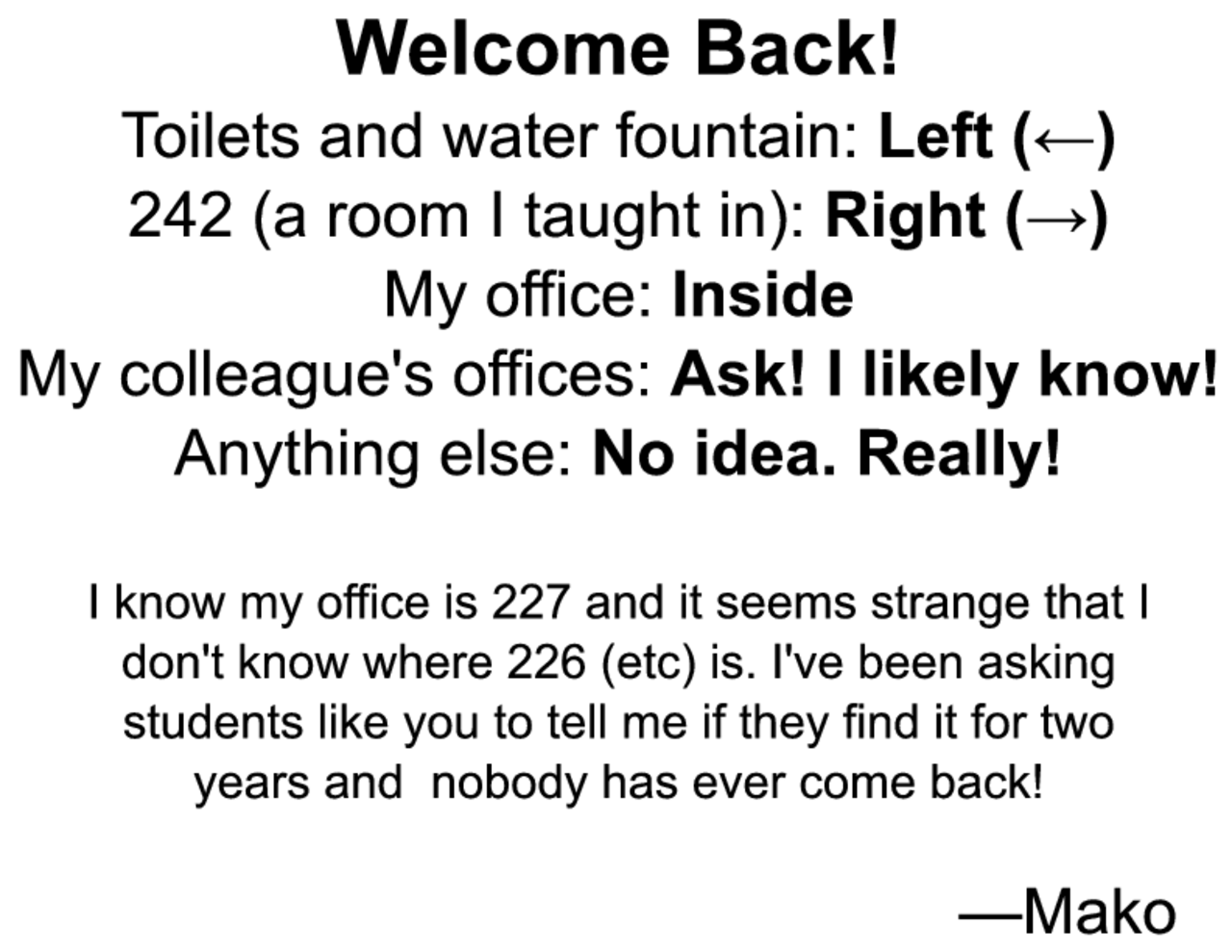
Benjamin Mako Hill: Welcome Back Poster

My office door is on the second floor in front the major staircase in my building. I work with my door open so that my colleagues and my students know when I m in. The only time I consider deviating from this policy is the first week of the quarter when I m faced with a stream of students, usually lost on their way to class and that, embarrassingly, I am usually unable to help. I made this poster so that these conversations can, in a way, continue even when I am not in the office. early_quarter_doors_sign
3 February 2016

Jonathan Dowland: Comparing Docker images

I haven't written much yet about what I've been up to at work. Right now, I'm making changes to the sources of a set of Docker images. The changes I'm making should not result in any changes to the actual images: it's just a re-organisation of the way in which they are built. I've been using the btrfs storage driver for Docker which makes comparing image filesystems very easy from the host machine, as all the image filesystems are subvolumes. I use a bash script like the following to make sure I haven't broken anything:
oldid="$1"; newid="$2";
id_in_canonical_form()  
    echo "$1"   grep -qE '^[a-f0-9] 64 $'
 
canonicalize_id()  
    docker inspect --format '  .Id  ' "$1"
 
id_in_canonical_form "$oldid"   oldid="$(canonicalize_id "$oldid")"
id_in_canonical_form "$newid"   newid="$(canonicalize_id "$newid")"
cd "/var/lib/docker/btrfs/subvolumes"
sumpath()  
    cd "$1" && find . -printf "%M %4U %4G %16s %h/%f\n"   sort
 
diff -ruN "$oldid" "newid"
diff -u <(sumpath "$oldid") <(sumpath "$newid")
Using -printf means I can ignore changes in the timestamps on files which is something I am not interested in. If it is available in your environment, Lars Wirzenius' tool Summain generates manifests that include a file checksum and could be very useful for this use-case.

Thomas Goirand: Moby

Just a quick reply to Rhonda about Moby. You can t introduce him without telling about Go, which is the title who made him famous, very early in the age of electronic music (November 1990, according to wikipedia). Many attempted to remix this song (and Moby himself), but nothing s as good as the original version.

2 February 2016

Dirk Eddelbuettel: Like peanut butter and jelly: x13binary and seasonal

This post was written by Dirk Eddelbuettel and Christoph Sax and will be posted on both author's respective blogs. The seasonal package by Christoph Sax brings a very featureful and expressive interface for working with seasonal data to the R environment. It uses the standard tool of the trade: X-13ARIMA-SEATS. This powerful program is provided by the statisticians of the US Census Bureau based on their earlier work (named X-11 and X-12-ARIMA) as well as the TRAMO/SEATS program by the Bank of Spain. X-13ARIMA-SEATS is probably the best known tool for de-seasonalization of timeseries, and used by statistical offices around the world. Sadly, it also has a steep learning curve. One interacts with a basic command-line tool which users have to download, install and properly reference (by environment variables or related means). Each model specification has to be prepared in a special 'spec' file that uses its own, cumbersome syntax. As seasonal provides all the required functionality to use X-13ARIMA-SEATS from R --- see the very nice seasonal demo site --- it still required the user to manually deal with the X-13ARIMA-SEATS installation. So we decided to do something about this. A pair of GitHub repositories provide both the underlying binary in a per-operating system form (see x13prebuilt) as well as a ready-to- use R package (see x13binary) which uses the former to provide binaries for R. And the latter is now on CRAN as package x13binary ready to be used on Windows, OS-X or Linux. And the seasonal package (in version 1.2.0 -- now on CRAN -- or later) automatically makes use of it. Installing seasaonal and x13binary in R is now as easy as:

install.packages("seasonal")
which opens the door for effortless deployment of powerful deasonalization. By default, the principal function of the package employs a number of automated techniques that work well in most circumstances. For example, the following code produces a seasonal adjustment of the latest data of US retail sales (by the Census Bureau) downloaded from Quandl:
library(seasonal) 
library(Quandl)   ## not needed for seasonal but has some niceties for Quandl data
rs <- Quandl(code="USCENSUS/BI_MARTS_44000_SM", type="ts")/1e3
m1 <- seas(rs)
plot(m1, main = "Retail Trade: U.S. Total Sales", ylab = "USD (in Billions)")
This tests for log-transformation, performs an automated ARIMA model search, applies outlier detection, tests and adjusts for trading day and easter effects, and invokes the SEATS method to perform seasonal adjustment. And this is how the adjusted series looks like:
Of course, you can access all available options of X-13ARIMA-SEATS as well. Here is an example where we adjust the latest data for Chinese exports (as tallied by the US FED), taking into account the different effects of Chinese New Year before, during and after the holiday:
xp <- Quandl(code="FRED/VALEXPCNM052N", type="ts")/1e9
m2 <- seas(window(xp, start = 2000),
          xreg = cbind(genhol(cny, start = -7, end = -1, center = "calendar"), 
                       genhol(cny, start = 0, end = 7, center = "calendar"), 
                       genhol(cny, start = 8, end = 21, center = "calendar")
          ),
          regression.aictest = c("td", "user"),
          regression.usertype = "holiday")
plot(m2, main = "Goods, Value of Exports for China", ylab = "USD (in Billions)")
which generates the following chart demonstrating a recent flattening in export activity measured in USD.
We hope this simple examples illustrates both how powerful a tool X-13ARIMA-SEATS is, but also just how easy it is to use X-13ARIMA-SEATS from R now that we provide the x13binary package automating its installation.

This post by Dirk Eddelbuettel originated on his Thinking inside the box blog. Please report excessive re-aggregation in third-party for-profit settings.

Russell Coker: Compatibility and a Linux Community Server

Compatibility/interoperability is a good thing. It s generally good for systems on the Internet to be capable of communicating with as many systems as possible. Unfortunately it s not always possible as new features sometimes break compatibility with older systems. Sometimes you have systems that are simply broken, for example all the systems with firewalls that block ICMP so that connections hang when the packet size gets too big. Sometimes to take advantage of new features you have to potentially trigger issues with broken systems. I recently added support for IPv6 to the Linux Users of Victoria server. I think that adding IPv6 support is a good thing due to the lack of IPv4 addresses even though there are hardly any systems that are unable to access IPv4. One of the benefits of this for club members is that it s a platform they can use for testing IPv6 connectivity with a friendly sysadmin to help them diagnose problems. I recently notified a member by email that the callback that their mail server used as an anti-spam measure didn t work with IPv6 and was causing mail to be incorrectly rejected. It s obviously a benefit for that user to have the problem with a small local server than with something like Gmail. In spite of the fact that at least one user had problems and others potentially had problems I think it s clear that adding IPv6 support was the correct thing to do. SSL Issues Ben wrote a good post about SSL security [1] which links to a test suite for SSL servers [2]. I tested the LUV web site and got A-. This blog post describes how to setup PFS (Perfect Forward Secrecy) [3], after following it s advice I got a score of B! From the comments on this blog post about RC4 etc [4] it seems that the only way to have PFS and not be vulnerable to other issues is to require TLS 1.2. So the issue is what systems can t use TLS 1.2. TLS 1.2 Support in Browsers This Wikipedia page has information on SSL support in various web browsers [5]. If we require TLS 1.2 we break support of the following browsers: The default Android browser before Android 5.0. Admittedly that browser always sucked badly and probably has lots of other security issues and there are alternate browsers. One problem is that many people who install better browsers on Android devices (such as Chrome) will still have their OS configured to use the default browser for URLs opened by other programs (EG email and IM). Chrome versions before 30 didn t support it. But version 30 was released in 2013 and Google does a good job of forcing upgrades. A Debian/Wheezy system I run is now displaying warnings from the google-chrome package saying that Wheezy is too old and won t be supported for long! Firefox before version 27 didn t support it (the Wikipedia page is unclear about versions 27-31). 27 was released in 2014. Debian/Wheezy has version 38, Debian/Squeeze has Iceweasel 3.5.16 which doesn t support it. I think it is reasonable to assume that anyone who s still using Squeeze is using it for a server given it s age and the fact that LTS is based on packages related to being a server. IE version 11 supports it and runs on Windows 7+ (all supported versions of Windows). IE 10 doesn t support it and runs on Windows 7 and Windows 8. Are the free upgrades from Windows 7 to Windows 10 going to solve this problem? Do we want to support Windows 7 systems that haven t been upgraded to the latest IE? Do we want to support versions of Windows that MS doesn t support? Windows mobile doesn t have enough users to care about. Opera supports it from version 17. This is noteworthy because Opera used to be good for devices running older versions of Android that aren t supported by Chrome. Safari supported it from iOS version 5, I think that s a solved problem given the way Apple makes it easy for users to upgrade and strongly encourages them to do so. Log Analysis For many servers the correct thing to do before even discussing the issue is to look at the logs and see how many people use the various browsers. One problem with that approach on a Linux community site is that the people who visit the site most often will be more likely to use recent Linux browsers but older Windows systems will be more common among people visiting the site for the first time. Another issue is that there isn t an easy way of determining who is a serious user, unlike for example a shopping site where one could search for log entries about sales. I did a quick search of the Apache logs and found many entries about browsers that purport to be IE6 and other versions of IE before 11. But most of those log entries were from other countries, while some people from other countries visit the club web site it s not very common. Most access from outside Australia would be from bots, and the bots probably fake their user agent. Should We Do It? Is breaking support for Debian/Squeeze, the built in Android browser on Android <5.0, and Windows 7 and 8 systems that haven t upgraded IE as a web browsing platform a reasonable trade-off for implementing the best SSL security features? For the LUV server as a stand-alone issue the answer would be no as the only really secret data there is accessed via ssh. For a general web infrastructure issue it seems that the answer might be yes. I think that it benefits the community to allow members to test against server configurations that will become more popular in the future. After implementing changes in the server I can advise club members (and general community members) about how to configure their servers for similar results. Does this outweigh the problems caused by some potential users of ancient systems? I m blogging about this because I think that the issues of configuration of community servers have a greater scope than my local LUG. I welcome comments about these issues, as well as about the SSL compatibility issues.

1 February 2016

Rapha&#235;l Hertzog: My Free Software Activities in January 2016

My monthly report covers a large part of what I have been doing in the free software world. I write it for my donators (thanks to them!) but also for the wider Debian community because it can give ideas to newcomers and it s one of the best ways to find volunteers to work with me on projects that matter to me. Debian LTS I did not ask for any paid hours this month and won t be requesting paid hours for the next 5 months as I have a big project to handle with a deadline in June. That said I still did a few LTS related tasks: Distro Tracker Due to many nights spent on playing Splatoon (I m at level 33, rank B+, anyone else playing it?), I did not do much work on Distro Tracker. After having received the bug report #809211, I investigated the reasons why SQLite was no longer working satisfactorily in Django 1.9 and I opened the upstream ticket 26063 and I had a long discussion with two upstream developers to find out the best fix. The next point release (1.9.2) will fix that annoying regression. I also merged a couple of contributions (two patches from Christophe Siraut, one adding descriptions to keywords, cf #754413, one making it more obvious that chevrons in action items are actionable to show more data, a patch from Balasankar C in #810226 fixing a bad URL in an action item). I fixed a small bug in the unsubscribe command of the mail bot, it was not properly recognizing source packages. I updated the task notifying of new upstream versions to use the data generated by UDD (instead of the data generated by Christoph Berg s mole-based implementation which was suffering from a few bugs). Debian Packaging Testing experimental sbuild. While following the work of Johannes Schauer on sbuild, I installed the version from experimental to support his work and give him some feedback. In the process I uncovered #810248. Python sponsorship. I reviewed and uploaded many packages for Daniel Stender who keeps doing great work maintaining prospector and all its recursive dependencies: pylint-common, python-requirements-detector, sphinx-argparse, pylint-django, prospector. He also prepared an upload of python-bcrypt which I requested last month for Django. Django packaging. I uploaded Django 1.8.8 to jessie-backports.
My stable updates for Django 1.7.11 was not handled before the release of Debian 8.3 even though it was filed more than 1.5 months before. Misc stuff. My stable update for debian-handbook has been accepted fairly shortly after my last monthly report (thank you Adam!) so I uploaded the package once acked by a release manager. I also sponsor a backports upload of zim prepared by Joerg Desch. Kali related work Kernel work. The switch to Linux 4.3 in Kali resulted in a few bug reports that I investigated with the help of #debian-kernel and where I reported my findings back so that the Debian kernel could also benefit from the fixes I uploaded to Kali: first we included a patch for a regression in the vmwgfx video driver used by VMWare virtual machines (which broke the gdm login screen), then we fixed the input-modules udeb to fix support of some Logitech keyboards in debian-installer (see #796096). Misc work. I made a non-maintainer upload of python-maxminddb to fix #805689 which had been removed from stretch and that we needed in Kali. I also had to NMU libmaxminddb since it was no longer available on armel and we actually support armel in Kali. During that NMU, it occurred to me that dh-exec could offer a feature of optional install , that is installing a file that exists but not failing if it doesn t exist. I filed this as #811064 and it stirred up quite some debate. Thanks See you next month for a new summary of my activities.

No comment Liked this article? Click here. My blog is Flattr-enabled.

Mike Gabriel: My FLOSS activities in January 2016

In January 2016 I was finally able to work on various FLOSS topics again (after two months of heavily focussed local customer work): Upload of MATE 1.12 to Debian testing/unstable At the beginning of the new year, I finalized the bundle upload of MATE 1.12 to Debian unstable [1]. All uploaded packages are available in Debian testing (stretch) and Ubuntu xenial by now. MATE 1.12 will also be the version shipped in Ubuntu MATE 16.04 LTS. Additionally, I finally uploaded caja-dropbox to Debian unstable (non-free), thanks to Vangelis Mouhtsis and Martin Wimpress for doing first steps preparations. The package has already left Debian's NEW queue, but unfortunately has been removed from Debian testing (stretch) again due to build failures in one of its dependencies. Debian LTS work In January 2016 I did my first round of Debian LTS front desk work [2]. Before actually starting with my front desk duty, I worked myself through the documentation and found it difficult to understand the output of the lts-cve-triage.py script. So, I proposed various improvments to the output of that script (all committed by now). During the second week of January then, I triaged the following packages regarding known/open CVE issues: read more

Next.

Previous.