Search Results: "bod"

12 March 2010

Guido G nther: Letting GTK+ applications blend nicely into KDE4

In case somebody wants to run KDE together with some GTK+ based applications (like Iceweasel or Icedove) having a consistent style as well as look and feel between KDE and GTK+ applications is a nice thing to have. QtCurve together with xsettings-kde and gtk-qt-engine makes this easily possible:
aptitude install gtk-qt-engine kde-config-gtk-style qtcurve xsettings-kde
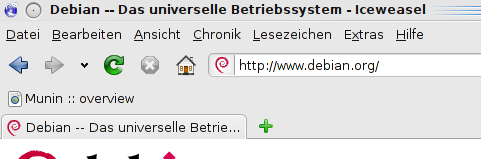
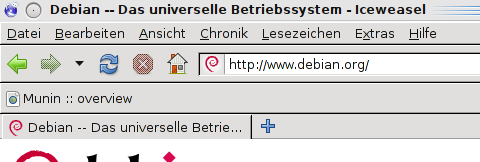
Then adjust the following settings: Log off and right back in. Now your GTK+ applications should blend nicely into the QtCurve KDE look. xsettings-kde additionally bridges KDE settings like double click speed and icon theme via xsettings to GTK+ applications. Iceweasel without QtCurve Iceweasel with QtCure Now back to using gnome-shell...

10 March 2010

Filippo Giunchedi: welcome to ikiwiki

This was long due, I switched from pyblosxom to the marvelous ikiwiki and gave a general revamp to my website by tweaking ikiwiki's default templates. note: the template still needs a general cleanup, don't look at it as it is not pretty (nor are the CSSes) With some luck and mod_rewrite karma nobody's feed readers nor planets will be flooded. Comments are powered by disqus.

Biella Coleman: A Cultural Alibi of Sorts

There is an interesting conversation over at about the nature of peer production, and crowd based production over at PBS. Thankfully folks right off the bat noted that the types of activities they are addressing that range from 4chan to open source are so freaken distinct that perhaps it is not all that useful to use one moniker for them. The comments I am most fascinated by are danah s who notes:
We assume that the collective voice will be populist and, more importantly, that it will reflect the diversity of the populous. Yet, as we ve seen time and time again, certain values and attitudes and voices are over-represented in crowd-sourced activities. Who is looking out for those who aren t represented? In what ways are we reinforcing structural inequalities? What are the implications of this?
And then Clay s response:
So, to re-ask your question in a non-rhetorical way, under what
circumstances would we want to make the population of Deviant Art,
say, less white, or Linux less male, and if we wanted to do so, what
would need to happen?
What I find interesting about this discussion (and will be talking about this topic here, next week) is there not enough recognition of two related things: 1) the efforts are there (more on this soon) 2) that perhaps hacking and F/OSS in particular are not fully accessible to all and everyone because they are full-fledged, full-bodied, cultural worlds and all cultural worlds are to some degree not fully accessible and transparent for there are built on particularities, often invisible and unarticulated, forms of value. That is, just as some norms and values of Indo-Guyanese to take one random example, are not of my world, so too is hacking partially inaccessible for the fact that it is culturally configured. But I am starting to suspect that the culture-ness of these domains are often overlooked because they are overwhelmingly white, male, and chock full of computers (and so economically lucrative). All three, I suspect are (incorrectly) seen as lacking culture, as domains of rationality. (I stand rightly corrected and also forget this very fact, though I know it well from all the Brazil/Latin America Debconfs, as this diversity gets a bit lost from a pure US-European perspective, which I was assuming). Other historical factors have also produced certain distortions that don t allow us to see (easily at least) these worlds as culture-full. First is the fact that so many folks outside of this world lobbed onto F/OSS for being radical (and this is partially right in so far as its challenge to intellectual property can be seen as radical). But the portrayal or mere suggestion of these worlds as uber-democratic and populist, made people expect these groups to behave as radical egalitarian collectives. For the most part, they don t and yet never portrayed their own politics and forms of organization as such (openness comes in the form of code and technical merit). But this vision stuck and when some folks realized that larger projects, for example are very organized (which many people addressed only very late), have hierarchies (which are flexible and also allow them to function, which is I think is a good thing), and are not as diverse, there was deep disappointment that they did not conform to the sense that there was something extremely radical going on as opposed to a cultural group really into producing free software. But if I am offering a cultural alibi of sorts in which barriers to participation are to some degree a function of culture, one of the great things about the norms, values, ideas that compose culture is that there are dynamic and changing. They are alive and historical. They are pushed and pulled upon by insiders and outsiders based on wider social values. And there is an answer to these questions about diversity for there has been a dramatic, noticeable, and noteworthy push within this world, one that really started to coalesce I would say in the last year or so, to address these issues and it ranges from Python s mammoth efforts at addressing diversity (and I have been told that there was a great speech on the topic at Pycon recently), the geek feminism wiki, and smaller but increasingly common efforts such as Libre Planet s women s caucus and their funding of women to participate. So while I do think that culture goes at least part of the way to explain why these worlds are not fully open for culture limits this very domain has grown dissatisfied with its representational make-up and are leading some efforts for cultural change.

8 March 2010

Russell Coker: Storage vs RAM Size

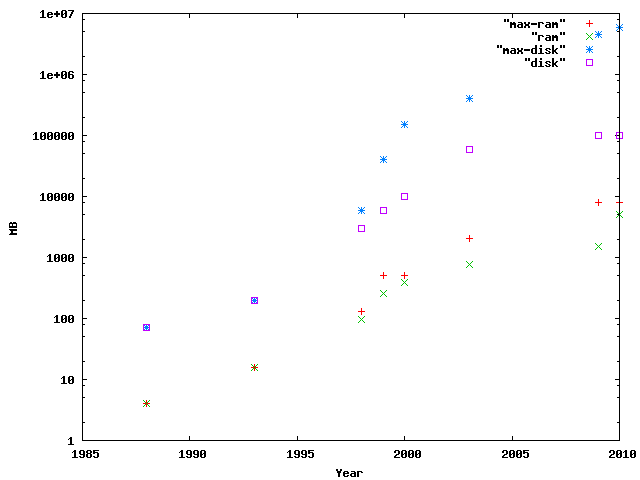
In a comment on my post Shared Objects and Big Applications about memlockd [1] mic said that they use memlockd to lock the entire root filesystem in RAM. Here is a table showing my history of desktop computers with the amounts of RAM, disk capacity, and CPU power available. All systems better than a 386-33 are laptops a laptop has been my primary desktop system for the last 12 years. The columns for the maximum RAM and disk are the amounts that I could reasonably afford if I used a desktop PC instead of a laptop and used the best available technology of the day I m basing disk capacity on having four hard drives (the maximum that can be installed in a typical PC without extra power cables and drive controller cards) and running RAID-5. For the machines before 2000 I base the maximum disk capacity on not using RAID as Linux software RAID used to not be that good (lack of online rebuild for starters) and hardware RAID options have always been too expensive or too lame for my use.
Year CPU RAM Disk Maximum RAM Maximum Disk
1988 286-12 4M 70M 4M 70M
1993 386-33 16M 200M 16M 200M
1998 Pentium-M 233 96M 3G 128M 6G
1999 Pentium-2 400 256M 6G 512M 40G
2000 Pentium-2 600 384M 10G 512M 150G
2003 Pentium-M 1700 768M 60G 2048M 400G
2009 Pentium-M 1700 1536M 100G 8192M 4500G
2010 Core 2 Duo T7500 2200 5120M 100G 8192M 6000G
graph of RAM/disk sizes from the above table The above graph shows how the modern RAM capacities have overtaken older disk capacities. So it seems that a viable option on modern systems is to load everything that you need to run into RAM. Locking it there will save spinning up the hard drive on a laptop. With a modern laptop it should be possible to lock most of the hard drive contents that are regularly used (IE the applications) into RAM and run with /home on a SD flash storage device. Then the hard drive would only need to be used if something uncommon was accessed or if something large (like a movie) was needed. It also shows that there is potential to run diskless workstations that copy the entire contents of their root filesystem when they boot so that they can run independently of the server and only access the server for /home. Note that the size of the RAM doesn t need to be larger than the disk capacity of older machines (some of the disk was used for swap, /home, etc). But when it is larger it makes it clear that the disk doesn t need to be accessed for routine storage needs. I generated the graph with GnuPlot [2], the configuration files I used are in the directory that contains the images and the command used was gnuplot command.txt . I find the GnuPlot documentation to be difficult to use so I hope that this example will be useful for other people who need to produce basic graphs I m not using 1% of the GnuPlot functionality.

7 March 2010

Gunnar Wolf: Authoral rights in the editorial world seminar

I must confess I don't remember who I got this invitation from. Anyway, if you are in the right geographic area, you might be interested. I will try to participate: This is a year-long seminar that will be held the second Thursday every month at Fonoteca Nacional (a place I have wanted to visit for a long time!), in Barrio de Santa Catarina, Coyoac n. Among the organizers they have Creative Commons Mexico. Free entrance (but limited space - so they ask interested people to confirm their presence by mail to bvallarta@conaculta.gob.mx). [update] I went with Pooka to the first session. We arrived almost 1hr late (due to me mistaking the schedule :-/ ) but it was interesting. Of course, quite biased towards the Google viewpoints, but interesting. We got the program for the next sessions So, mostly for myself to keep handy, here it goes:
Date Title Speakers
2010-03-11 Google and copyright Manuel Tamez, Hugo Contreras, Mar a Fernanda Mendoza
2010-04-08 Generalities about rights on intelectual property Jes s Parets, Guillermo Sol rzano, Jorge Mier y Concha
2010-05-13 Copyright's nature and competent authorites Carmen Arteaga, Luis Schmidt, C sar Callejas
2010-06-10 Moral and patrimonial rights Guillermo Pous, Eduardo de la Parra, Ram n Ob n
2010-07-08 Reproduction rights for audible material lvaro Hegewisch, scar Javier Solorio, Marco Antonio Morales, Jos Ram n C rdeno
2010-08-12 Licenses and patrimonial right transmission. Works for hire, works done under laboral relationship, or carried out in official service Dolores Franco, Jes s Mej a, Ra l Pastor
2010-09-09 Limits to explotation rights and literary plagiarism Carmen Arteaga, Juan Ram n Ob n, Jorge Mier y Concha, C sar Callejas
2010-10-14 Copyright in a digital setting Jes s Parets, Gast n Esquivel
2010-11-11 Law-regulated intelectual property rights Rosalba Elizalde, Salvador Ortega, Gast n Esquivel, Manrique Moheno
2010-12-09 International protection and collective gestive societies Horacio Rangel, Luis Schmidt, Jes s Mej a

Brice Goglin: Debian/X.org notes - Bug triaging while waiting for DRM 2.6.33

Almost nothing interesting happened recently in X.org in Debian. But interesting things are coming soon.
First, radeon KMS and DRI2 will enter unstable soon. xserver-xorg-video-radeon 1:6.12.191-1 is currently in experimental. People seem to be happy with it so far, and upstream is taking very good care of bug reports as usual. The next 2.6.32 kernel will contain DRM from 2.6.33. It first means that the radeon KMS driver not in staging anymore. Once this new kernel is uploaded, I'll put the new xserver-xorg-video-radeon in unstable (6.13.0 is expected soon, but 6.12.191 already looks good so far). DRM from 2.6.33 will also brings nouveau support. It means that we will build libdrm-nouveau and upload a new xserver-xorg-video-nouveau. However, it also means that we need somebody to maintain this. And nobody in the team has a nvidia board to test packages so... If you want nouveau in Debian, please help.
While waiting for all these, we have been triaging the BTS a bit. Kibi is helping a lot by triaging recent intel bugs (many regressions fixed in recent kernels). I spent some time during the week-end triaging some old bugs. I closed more than a hundred of them, and pinged another hundred. We still have more than 1100 bugs open. It is not so bad compared to 1500-2000 when nobody maintains X (aka often), but still way too much. Some of my bug closing might look a bit rude. But we had so many bug reports a couple years ago that are irrelevant today. Keeping them open would be meaningless. For instance, many input problems are obsolete since a lot of the input code was rewritten, we switched to input-hotplug, and then hal to udev. Another example is intel lockups (we had a lot of them after driver 2.2 arrived). But XAA and EXA were dropped in favor of UXA, DRI1 was dropped for DRI2, and KMS arrived. So it's useless to keep these obsolete and irrelevant bugs that cannot be debugged nowadays.
As usual, the Debian X team needs a lot of help. Again, if you want nouveau in Debian, please help.
(Permanent link)

5 March 2010

Ian Wienand: RFC3164 smells

From RFC3164, which is otherwise about syslog formats:
6. Security Considerations An odor may be considered to be a message that does not require any acknowledgement. People tend to avoid bad odors but are drawn to odors that they associate with good food. The acknowledgement of the receipt of the odor or scent is not required and indeed it may be the height of discretion to totally ignore some odors. On the other hand, it is usually considered good civility to acknowledge the prowess of the cook merely from the ambiance wafting from the kitchen. Similarly, various species have been found to utilize odors to attract mates. One species of moth uses this scent to find each other. However, it has been found that bolas spiders can mimic the odor of the female moths of this species. This scent will then attract male moths, which will follow it with the expectation of finding a mate. Instead, when they arrive at the source of the scent, they will be eaten [8]. This is a case of a false message being sent out with inimical intent. ... Along the lines of the analogy, computer event messages may be sent accidentally, erroneously and even maliciously.
This smells more like "I bet nobody ever really reads this RFC, let's put some stuff in the middle to see if they do!".

2 March 2010

Andreas Barth: How to (not) protect privacy

Protecting our privacy is important. For example, I wouldn't like if my mailing list subscriptions get known to anybody else (except the relevant listmasters of course as part of their job), for the simple reason that this is just my own decisions which lists I get mail from (and read, but that's not necessarily the same). This is an classical example of "personal information are handed out on a need-to-know-basis" (like to listmasters if necessary), and is also in line with european laws (I don't know the legal situation in other parts of the world enough). Now, publishing mailing list subscriptions hased sounds like an good idea to protect privacy. But if thinking twice, this just doesn't work. Most peoples subscription addresses could be known by other means or are even the addresses they use for sending mails (some systems even enforce this). So this is a huge privacy fail. Getting back to debian, and speaking the obvious out: The new interface to udd is just broken and wrong. Please remove all my adresses from being displayed, either in direct or hashed form, even in restricted mode. Thanks.

Matt Brubeck: The network is the human being

Nathanael Boehm wrote a nice essay last month called The Future of Employment?, about a disconnect between workers' and employers' views of social networks. (This post is based partly on my comment in the ensuing Hacker News thread.) Boehm wrote:
When I need help with a challenge at work or need to run some ideas past people I don t turn to my co-workers, I look to my network of colleagues beyond the walls of my workplace. Whilst my co-workers might be competent at their job they can t hope to compete with the hundreds of people I have access to through my social networks...
The late Sun Microsystems taught us that the network is the computer. It's true: we still use non-networked computers for specialized tasks, but nobody wants one on their desk it's just so useless compared to one that talks to the entire world. Boehm could have titled his essay The Network is the Employee. There are still tasks that people do in isolation, but the ability to contact a network of peers and experts makes the difference in my job, and many others. Alone together The lone computer programmer in a small business has thousands of colleagues on Stack Overflow, Reddit, and so on. It's a chaotic and messy way to find answers, but it's better than the days when your only choice was to call tech support or smack the box with your fist, whichever seemed more useful. I can't begin to list all the problems I've solved and things I've learned by Googling for others with relevant experiences, and getting help from a different expert for every problem. Decades before the web, computer geeks had virtual communities for on mailing lists, Usenet, and IRC. Now any job in the world has an online forum. Even the night clerk at the gas station has Not Always Right. Teaching has long been a solitary profession. Despite working in a crowded classroom, teachers are isolated; they rarely have colleagues observing or participating directly in their work. This has such an impact that teacher education sometimes includes training in meditation or reflection, to compensate for lack of external feedback. So I'm really curious what happens when teachers start to work together remotely the way programmers do. You will be assimilated Boehm's essay reminded me of a vague sci-fi-like idea I've been kicking around: the first group minds will evolve from the intersection of Mechanical Turk, virtual assistants, social networking, and augmented reality. Starting around the 1990s, it was possible to instantly "know" any fact that was published online. Since then, we've increased the amount of content online, our tools for searching it, and ways of connecting to the network. Today we have instant access to almost any published knowledge, anywhere. The number of people on the net has grown too, and the number of ways to find and talk to them. Most of us can contact dozens of friends at any given moment, plus friends-of-friends, co-workers, fellow members of communites like Hacker News or MetaFilter, and also complete strangers. Along with raw facts, we now have access to vast amounts of human judgement, experience, and skill. One result of this is the "virtual assistant," who provides a service that was once available only to high-powered executives. The new personal assistant can work remotely (often overseas), spread costs by serving many masters, and leverage the internet superpowers listed above. Today their services are targeted at small business owners and the Tim Ferriss crowd, but I'm sure someone soon will start marketing virtual personal assistance to all sorts of other creative workers, teachers, even stay-at-home parents. So, how long before I can simply touch a button to let a remote assistant see what I'm seeing in real-time and help me make transportation plans, translate foreign signs and speech, look up emails related to whatever I'm doing or thinking, or even advise me on what to say? Some of these queries will go to my circle of friends, others to the general public, and some to a personal assistant who is paid well to keep up with my specific needs. And that assistant of course will sub-contract out portions of each job as needed to computer programs, legions of cheap anonymous Turkers, or to his or her own network of assistants. At that point, I'm augmenting my own perception, memory, and judgement with a whole network of brains that I carry around ready to engage with any situation I meet. If nothing else, I hope someone writes a good sci-fi thriller story in which a rogue virtual assistant subtly manipulates the actions of unknowing clients, leading them to some unseen end.

28 February 2010

Russ Allbery: Review: Coders at Work

Review: Coders at Work, by Peter Seibel
Publisher: Apress
Copyright: 2009
ISBN: 1-4302-1948-3
Format: Trade paperback
Pages: 601
Coders at Work is a collection of edited interviews by Peter Seibel (probably best known previously for his book Practical Common Lisp) of an eclectic and excellent collection of fifteen programmers. It opens with an interview with Jamie Zawinski (one of the original Netscape developers) and closes with Donald Knuth. In between, the interview subjects range in programmer generations from Fran Allen (who started at IBM in 1957) and Bernie Cosell (one of the original ARPANET developers) to Brad Fitzpatrick (LiveJournal founder and original developer). Techniques and preferences also range widely, including two people involved in JavaScript development and standardization (Brendan Eich and Douglas Crockford), a functional programming language designer and developer (Simon Peyton Jones), language designers and standardizers such as Guy Steele, and people like Dan Ingalls who have a different experimental approach to programming than the normal application development focus. All of the interviewees are asked roughly the same basic questions, but each discussion goes in different directions. Seibel does an excellent job letting the interview subjects shape the discussion. Two things immediately stood out for me about this book. First, it's huge, and that's not padding. There are just over 600 pages of content here, much of it fascinating. The discussions Seibel has are broad-ranging, covering topics from the best way to learn programming to history and anecdotes of the field. There's some discussion of technique, but primarily at the level of basic approaches and mindset. One typical question is how each programmer organizes their approach to reading code that isn't familiar with them. Each interviewee is also asked for book recommendations, for their debugging techniques, for their opinions on proving code correct, and how they design code. The participants are so different in their backgrounds and approaches that these conversations go in fifteen different directions. This is one of the most compelling and engrossing non-fiction books I've read. Second, the selection of interview subjects, while full of well-known names in the field, is not the usual suspects. While I'm interested in the opinions of people like Larry Wall and Guido van Rossum, I've already heard quite a lot about how they think about programming. That's material that Coders at Work doesn't need to cover, and it doesn't. Many of the interview subjects here are people I'd heard of only vaguely or not at all prior to this book, often because they work in an area of programming that I'm not yet personally familiar with. Those who I had heard of, such as L. Peter Deutsch, I often knew in only one context (Ghostscript in that case) and was unfamiliar with the rest of their work. This gives the book a great exploratory feel and a lot of originality. There is so much good material here that it's hard to give a capsule review. This is a book I'm highly likely to re-read, taking more detailed notes. There's entertaining snarking from Jamie Zawinski and Brendan Eich, fascinating history of the field (including in gender balance) from Fran Allen, and an intriguing interview with Joe Armstrong (creator of Erlang), who seems to have a far different attitude towards languages and libraries than the other interviewees. Every interview is full of gems, bits of insight that I now want to research or play with. A couple of examples come to mind, just to provide a feel of the sort of insights I took out of the book. In the interview with Joshua Bloch, who does a lot of work on library APIs, he mentions that empathy is one of the most important skills for designing an API. You have to be able to put yourself in the shoes of the programmer who's going to use the API and understand how it will feel to them. This came up in the context of a discussion about different types of programmers, and how programmers can be good at different things; the one who can do low-level deep optimization may not have that sense of empathy. Another example: Bernie Cosell talked about how he did debugging, and how he got a reputation for being a fantastic debugger who was able to fix just about anything. He confessed that he often reached a portion of the code that he didn't understand, that seemed too complex and tricky for what it was attempting to accomplish, and rather than trace through it and try to understand it, he just rewrote it. And after rewriting, the bug was often gone. It wasn't really debugging, but at the same time it's close to the more recent concept of refactoring. Several of the interview subjects commented on a subjective feeling of complexity and how when it gets too high that's a warning sign that code may need to be rethought and rewritten. A third example: I was fascinated by the number of interviewees who said that they used printf, assert, and eyeballs to debug rather than using any more advanced debugging tools. The former Lisp developers would often bemoan the primitiveness of tools like gdb, but many of them found that print statements and thinking hard about the code were usually all that's needed. (There was also a lot of discussion about test suites and test-driven development.) The general consensus was that concurrency problems were the hardest to debug; they made up a disproportional number of the responses to Seibel's question about the hardest bug the programmer ever had to track down. I could go on giving similar examples at great length, but apart from the specific bits of wisdom, the strongest impact this book made on me was emotional. Coders at Work is full of people who love programming and love software, and that enthusiasm, both in general and for specific tools and ideas, comes through very clearly. I found it inspiring. I realized while reading this book, and I suspect I'm not alone among programmers in this, that I largely stopped learning how to program a few years back and have been reusing skills that I already have. Reading Coders at Work gave me a strong push towards finding ways to start learning, experimenting, and trying new techniques again. It also filled me with enthusiasm for the process of programming, which immediately helped my productivity on my own coding projects. This is obviously a book whose primary target audience is practicing programmers, and while it doesn't go too far into language theory, I was relying on remembered terms and structure from my master's degree for a few of the interviews. I think it's approachable for anyone who has a working background in programming and a few languages or a CS degree, but it might be a stretch for someone new to the field. But even someone without any programming knowledge at all would get a lot out of the anecdotes and snapshots of the history of software development. Coders at Work is also full of jumping-off points for some additional research on Google or additional reading in other recommended books. I only have one complaint, which I have to mention in passing: for such a large book full of interesting ideas and book recommendations, the index is wholly inadequate. I tried looking up five or six things in it, including the source of some of the book recommendations that are collected in an appendix, and I struck out every time. It's very hard to find something again in 600 pages, and more attention paid to the index would have been greatly appreciated. But, despite that, for people within the target audience, I cannot recommend this book too highly. Not only was it full of useful information, at the level of programming above the code details that's often the hardest to talk about, but it's consistently entertaining and emotionally invigorating and inspiring. It made the rounds of tech blogs when it was first released, to nearly universal approval, and I can only echo that. If you're a practicing programmer, I don't think you'll regret spending a few weeks reading and thinking about this book. Rating: 10 out of 10
26 February 2010

C.J. Adams-Collier: Connecting to MySQL with ODBC on Mono

We had a visitor on #mono today who needed help with his homework. It seems that Reggie is happy to have forgotten everything about using ODBC to connect to MySQL. I was curious and feeling helpful, so I figured it out. Install the MySQL ODBC driver $ sudo apt-get install libmyodbc You can also grab the package directly from MySQL Configure the MySQL ODBC driver ODBC looks in /etc/odbcinst.ini for driver configuration. In order to let it know about the MySQL ODBC libraries, append the following to your /etc/odbcinst.ini file:
[MySQL]
Description	= MySQL driver
Driver	= /usr/lib/odbc/libmyodbc.so
Setup		= /usr/lib/odbc/libodbcmyS.so
CPTimeout	=
CPReuse	=
Configure your DSN If you expect that you will be using this database connection often, you may want to create a short name for it, so you don t have to enter all of the parameters every time you want to connect. ODBC uses something called DSNs (Data Source Names, if I recall correctly) to make it easier on the user. If you want to create a DSN, append something like the following to your /etc/odbc.ini file:
[myodbc3]
Driver       = MySQL
Description  = MySQL ODBC 3.51 Driver DSN
Server       = mysql
Port         =
User         = testuser
Password     = password
Database     = test
Option       = 3
Socket       =
You will also need to update the ODBC Data Sources list near the top of the file to mention the new DSN:
[ODBC Data Sources]
myodbc3     = MySQL ODBC 3.51 Driver DSN
C ODBC connection example Here is some example code to get you connected:
using System;
using System.Data;
using System.Data.Odbc;
class ODBCTest  
  public static void Main(String[] args)  
    // Connection string using explicit parameters
    string ConStr = String.Format(
      "DRIVER= 0 ;SERVER= 1 ;DATABASE= 2 ;UID= 3 ;PWD= 4 ",
      " MySQL ","mysql","test","testuser","password" );
    // Connection string using DSN
//  string ConStr = String.Format("DRIVER= 0 ;DSN= 1 ",
//                                " MySQL ","myodbc3");                       
    //Create the connection object
    var OdbcCon = new OdbcConnection( ConStr );
    try  
      Console.Write("Opening connection... ");
      //open the database connection
      if (OdbcCon.State == ConnectionState.Closed)
        OdbcCon.Open();
      Console.WriteLine("connection opened!");
      catch (OdbcException Ex)  
      Console.WriteLine(Ex.Message);
      finally  
      //close the database connection
      OdbcCon.Close();


Dirk Eddelbuettel: R and Sudoku solvers: Plus ca change...

Christian Robert blogged about a particularly heavy-handed solution to last Sunday's Sudoku puzzle in Le Monde. That had my symapthy as I like evolutionary computing methods, and his chart is rather pretty. From there, this spread on to the REvolutions blogs where David Smith riffed on it, and showed the acual puzzle. That didn't stop things as Christian blogged once more about it, this time welcoming his post-doc Robin Ryder who posts a heavy analysis on all this that is a little much for me at this time of day. But what everybody seems to be forgetting is that R has had a Sudoku solver for years, thanks to the sudoku package by David Brahm and Greg Snow which was first posted four years ago. What comes around, goes around. With that, and about one minute of Emacs editing to get the Le Monde puzzle into the required ascii-art form, all we need to do is this:
R> library(sudoku)
R> s <- readSudoku("/tmp/sudoku.txt")
R> s
      [,1] [,2] [,3] [,4] [,5] [,6] [,7] [,8] [,9]
 [1,]    8    0    0    0    0    1    2    0    0
 [2,]    0    7    5    0    0    0    0    0    0
 [3,]    0    0    0    0    5    0    0    6    4
 [4,]    0    0    7    0    0    0    0    0    6
 [5,]    9    0    0    7    0    0    0    0    0
 [6,]    5    2    0    0    0    9    0    4    7
 [7,]    2    3    1    0    0    0    0    0    0
 [8,]    0    0    6    0    2    0    1    0    9
 [9,]    0    0    0    0    0    0    0    0    0
R> system.time(solveSudoku(s))
      [,1] [,2] [,3] [,4] [,5] [,6] [,7] [,8] [,9]
 [1,]    8    4    9    6    7    1    2    5    3
 [2,]    6    7    5    2    4    3    9    1    8
 [3,]    3    1    2    9    5    8    7    6    4
 [4,]    1    8    7    4    3    2    5    9    6
 [5,]    9    6    4    7    8    5    3    2    1
 [6,]    5    2    3    1    6    9    8    4    7
 [7,]    2    3    1    8    9    4    6    7    5
 [8,]    4    5    6    3    2    7    1    8    9
 [9,]    7    9    8    5    1    6    4    3    2
   user  system elapsed
  5.288   0.004   5.951
R>
That took all of five seconds while my computer was also compiling a particularly resource-hungry C++ package.... Just in case we needed another illustration that it is hard to navigate the riches and wonders that is CRAN...

21 February 2010

Michael Banck: 21 Feb 2010

Application Indicators: A Case of Canonical Upstream Involvement and its Problems I always thought Canonical could do a bit more to contribute to the GNOME project, so I was happy to see the work on application indicators proposed to GNOME. Application indicators are based on the (originally KDE-driven, I believe) proposed cross-desktop status notifier spec. The idea (as I understand it) is to have a consistent way of interacting with status notifiers and stop the confusing mix of panel applets and systray indicators. This is a very laudable goal as mentioned by Colin Walters:

"First, +5000 that this change is being driven by designers, and +1000 that new useful code is being written. There are definite problems being solved here."
The discussion that followed was very useful, including the comments by Canonical's usability expert Matthew Paul Thomas. Most of the discussion was about the question how this proposal and spec could be best integrated into GTK, the place where most people seemed to agree this belongs (rather than changing all apps to provide this, this should be a service provided by the platform) However, on the same day, Canonical employee Ted Gould proposed libappindicator as an external dependency. The following thread showed a couple of problems, both technical and otherwise: What I personally disliked is the way the Cody Russel and Ted Gould are papering over the above issues in the thread that followed. For examples, about point one, Ted Gould writes in the proposal:
Q: Shouldn't this be in GTK+?
A: Apparently not.
while he himself said on the same day, on the same mailing list: "Yes, I think GTK/glib is a good place" and nobody was against it (and in fact most people seemed to favor including this in GTK). To the question about why libappindicator is not licensed as usual under the LGPL, version 2.1 or later, Canonical employee Cody Russell even replied:
"Because seriously, everything should be this way. None of us should be saying "LGPL 2.1 or later". Ask a lawyer, even one from the FSF, how much sense it makes to license your software that way."
Not everybody has to love the FSF, but proposing code under mandated copyright assignments which a lot of people have opposed and at the same time insinuating that the FSF was not to be trusted on their next revision of the LGPL license seems rather bold to me. Finally, on the topic of copyright assignments, Ted said:
"Like Clutter for example ;) Seriously though, GNOME already is dependent on projects that require contributor agreements."
It is true that there are (or at least were) GNOME applications which require copyright assignments for contributions (evolution used to be an example, but the requirement was lifted), however, none of the platform modules require this to my knowledge (clutter is an external dependency as well). It seems most people in the GNOME community have the opinion that application indicators should be in GTK at least eventually, so having libappindicator as an external dependency with copyright assignments might work for now but will not be future proof. In summary, Most of the issues could be dealt with by reimplementing it for GTK when the time comes for this spec to be included, but this would mean (i) duplication of effort, (ii) possibly porting all applications twice and (iii) probably no upstream contribution by Canonical. Furthermore, I am amazed at how the Canonical people approach the community for something this delicate (their first major code drop, as far as I am aware). To be fair, neither Ted nor Cody posted the above using their company email addresses, but nevertheless the work is sponsored by Canonical, so their posts to desktop-devel-list could be seen as writing with their Canonical hat on. Canonical does not have an outstanding track record on contributing code to GNOME, and at least to me it seems this case is not doing much to improve things, either.

19 February 2010

Matthew Garrett: Pittsburgh

As I mentioned, I headed to Pittsburgh last week to give some talks at CMU and find out something about what they're doing there. Despite the dire weather that had closed the airport the day before, I had no trouble getting into town and was soon safely in a hotel room with a heater that seemed oddly enthusiastic about blasting cold air at me for ten seconds every fifteen minutes. Unfortunately, it seems that life wasn't as easy for everyone - ten minutes after I arrived, I got a phone call telling me that the city had asked CMU to cancel classes the next day.

This turned out to be much less of a problem than I'd expected - whether because of their enthusiasm to learn about ACPI or because they simply hadn't noticed the alert telling them about the cancellation, a decent body of students turned up the next morning. After a brief chat with Mark Stehlik, the assistant dean for undergraduate education, I headed off to the lecture hall. The fact that I can now just plug my laptop into a VGA cable and have my desktop automatically extend itself continues to amaze me, as does OpenOffice's seemingly unerring ability to get confused about which screen should have my content and which should be showing me the next slide. Nevertheless, facts were imparted and knowledge dropped on those assembled. I'm even reasonably sure that the contents were factually accurate, which is a shame because the most attractive part of teaching always struck me as being able to lie to students who will then happily regurgitate whatever you tell them because in case it turns up on the exam. Perhaps this is why I'm safer out of academia.

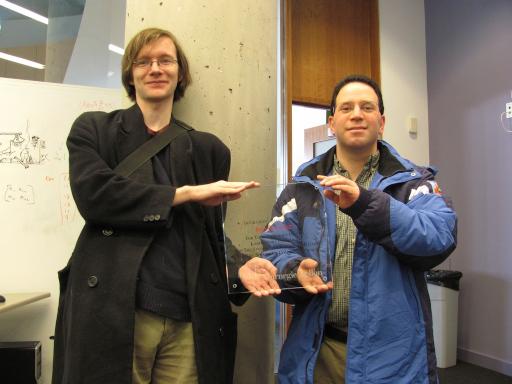
Lunch offered an opportunity to visit the Red Hat sponsored lab, which was pleasingly located somewhere other than a basement. The guy on the right of the picture is Greg Kesden, the director of undergraduate laboratories in CS there - it was wonderful to get an opportunity to see the machines getting used, and students seemed genuinely appreciative of the facility.

After lunch I spent a while talking to Satya about the Internet Suspend and Resume project. This is an impressive combination of virtualisation and migration, using a Fedora-based live image to bring up an OS on arbitrary hardware before downloading a machine image and launching it. The majority of the data is pulled in on demand, meaning that initial performance can be slow but ensuring that data is only downloaded if it's needed. When the user is finished, the delta between the original image and the new one can be pushed back to the server while remaining cached on the local machine in case the image is used again.

It's an interesting approach, combining the flexibility of thin clients with the advantages of having actually useful computing power at the local end. There's a few functional awkwardnesses, such as some VMs being unhappy if images are migrated between machines with different CPU features, and it obviously benefits from having significant bandwidth. But the idea of being able to combine the convenience of a floating session with the knowledge that you can still keep copies of your data on you is an attractive one, and I'd love a future where I can move my session between my laptop and a desktop.

After that there was some time to talk to Bill Scherlis and Philip Lehman about the software engineering courses that CMU run. Part of the minor in software engineering includes a course requirement to make a meaningful contribution to an existing software project, from design through to submission and upstream acceptance. I had the opportunity to talk to a couple of the students about this and the differences they found between working with the Mozilla and Chrome communities, which I'll try to write up at some point.

Finally I gave a presentation on Fedora and some of the issues that we face in providing a useful OS when patents and recalcitrant hardware vendors do their best to thwart us. Despite the ice outside and the significantly-below-freezing temperatures, enough people turned up that sorties had to be sent out to find extra chairs. It was great to see how interested people were in learning about what we do, although it's probably the case that the free pizza did help encourage people.

After that it was an early trip back to the airport, where I found that my plane was delayed and the only "restaurant" still open was McDonalds. Even so, I left with the feeling that it had been an interesting and educational visit. Many thanks to David Eckhardt, who runs the OS course I presented to and who looked after me all day - thanks too to Joshua Wise who picked me up when David was running late due to the ground being covered with blocks of ice.

Gunnar Wolf: Computer education parallelisms

I opened Slashdot's Looking back from the 1980s at computers in education article because I am quite convinced of the point some of the commenters argued before me, (and it's good to know others think as you do ;-) ) When I got close to computers, learning computing for children basically meant learning programming in a fun way. For years, my hobbies included Logo and BASIC. At age 7 (by 1983), typing TeX and using Emacs at the computer of the institute where my father worked, I started walking the path I took for my professional life. When I taught computing to high school students as my first paid job (which didn't last long, only a semester, as for an untrained 20 year old it is very hard to control a group of kids nearly his age), I tried to teach some basic BASIC programming (which was the best I knew then)... But no, both students and the school wanted me to focus on teaching MS Office applications. It seemed stupid for me 14 years ago, and it still seems stupid for me today. Anyway, on Slashdot, I came across this beautiful way to explain what computer education should mean:
"computing is no longer taught in schools (parents look quizzical), they are simply 'trained' (parents look like they vaguely get it). if this was sex instead of computing that was taught in schools, would you prefer that your kids have sex _education_ or sex _training_? (parents finally get it)".
By the way, if you are interested in reading a bit of paleofuturism, to feel the joy and excitement with which computer-aided education was seen 30 years ago, be sure to get the Classroom Computer News issue for September-October 1980, linked from the Slashdot article (and copied over here for your convenience, of course!)
AttachmentSize
Classroom Computer News vol. 1 no. 1, sep-oct 19803.54 MB

18 February 2010

Alexander Reichle-Schmehl: RC-Bug statistics for Squeeze, calendar week 7:

Note: Please see RC-Bug statistics for Squeeze, calendar week 7 for an explanation of the numbers.
Total:699+49
Affecting Squeeze:559+41
Squeeze-only:117+23
Unfixed bugs remaining in Squeeze:442+18
Of these 442 bugs...
... are pending36+4
... are patched:65+1
... are duplicates:47+-0
... are in Non-free or contrib:10+10
... are claimed by someone:14-3
... are fixed in the delayed queue:5-1
... are somehow marked as fixed:53+14
Or in other words:
Release critical bugs left in squeeze, when ignoring all these:
262 (+2 compared to previous week). With this release managers views, 472 (+48 compared to previous week) bugs remain to be fixed somehow before we can release. Some notes: So much for this week. Let's see, how the numbers evolve in the coming seven days...

15 February 2010

William Pitcock: Healthy Menu for Slim with Diet Software

sofwarediet285
Want a healthy diet, but difficulty determining diet have much less heart disease and diabetes, now do not need to be confused. The problem currently existing software can determine which food or menu with us. This tool was created Muhammad Burhanuddin SI students majoring in the College information systems Information Management and Computer Engineering (STIKOM). Pemuda Surabaya original was inspired by his desire to want to get the ideal body weight. He then sought a reference from a variety of books on diet and sehata the ideal body shape. From the book, he then designed a program for determining menu diet with computerized systems. Yes at first it was because I found it difficult to lose weight and see the number of experts in determining the diet for patients with certain diseases, he said on the red building STIKOM Surabaya, Jalan Kedung Baruk, Thursday (15/10/2009). During the decisive finishing diet program, she had difficulty in the verification phase of the rule which took one month of a total of four months of completion of the program is the final project. This 21 year young man said this program can ciptaanya to help digunakanahli nutrition diet suitable for the patient. At first nutritionist to determine the menu of resus a patient s blood type that has gone through laboratory tests. Then determine the disease
patients suffered until finally obtained the results of a diet, he said.

William Pitcock: Multiple Sclerosis Reconnaissance Fat Young Girl

abg-(abc.net.au)-dalam Multiple Sclerosis is a disease of the central nervous disorder that weakens the immune system. A study showed that obese adolescent girls affected by MS have opportunities in the future. During the 40-year study of 238,000 women found that adolescent girls suffer from obesity at the age of 18 years had twice the risk of MS affected than teens of that age have more slender bodies. Fatty tissue which accumulates as a teenager allegedly memproduki substances that affect the immune system that triggers the possibility of MS. However, body size during the children and adults are not found in relation to risk of MS. Researchers have made a study report in the journal Neurology. Researchers still need to take further evidence to confirm these findings. Researchers from the Harvard School of Public Health used data from the nurses about diet, lifestyle factors and health. During the study, 593 women are diagnosed with MS, a disease caused by loss of nerve fibers and myelin sheath in the brain and spinal cord that makes nerve damage. Researchers compared the risk of disease with body mass index (BMI) or weight to height ratio, in women aged 18 years. Studies show those who have weight BMI 30 or greater at the age of 18 years had twice the risk of MS. Our results indicate that body weight during adolescence is very important in determining the risk of MS, said Kassandra Munger ScD from Harvard School of Public Health in Boston, as quoted by BBC News, Monday (9/11/2009). There are many studies that support that adolescence is an important time for the development of the disease, so what we found was associated with it, he said. He added that obesity prevention early adolescence is an especially important step in reducing the risk of MS in the future. Previous research has found vitamin D levels are high can reduce the risk of MS and the researchers showed that obesity associated with low levels of vitamin D in the body.

William Pitcock: How to Fight Lazy For Sports

OLAHRAGA(getactivechallenge)-DALAM Everyone knows that exercise can heal the body. But why only a few people who routinely perform the activity? Ask yourself. The answer is, maybe you less motivated to do so. A survey ever conducted to find out why people rarely do sports. The survey involving 15,000 women from 25 countries showed that although nearly half of them know that exercise is very important for health, but less than 25 percent of it done. Why? More than two-thirds of respondents said that they would exercise more often if the gym was fun. So far, they consider it as a routine or demand to stay healthy so feel burdened. Although the facts say so, but it is unfortunate if people take sport as a less desirable activity. If you are not motivated to do the morning run, bike or fitness, try these few tips that may improve your mood for a workout without having to feel it as a demand or load. 1. Participate In A Club
Come in a club full of adventure and can arrange your sporting activity each week. Find information from friends or open the website that provides these facilities. 2. Involve Friends
If you are interested in joining a club, you can do sports with your friends or beloved. Sport activities together can evoke passion and spirit to not realize that you are really doing is exercise, not just recreation. 3. Try New Types
Trying something new will make you feel to have new experiences and unexpected. Make your muscles work with the new type of sport and do not usually very good for your body. 4. Make A Game
You would be very interested in an adventure or a game. Making sport like games is a good idea. Make activities as the game ran find treasure limited time, and you will feel more happy and challenged. 5. Back to Boyhood
Do you remember when as a child running around all day without feeling tired and bored? It feels good right? That s what you should do now. Create a day where you can be reunited with friends and do sports or play activities you usually do in childhood. Rollerblading in the park to play or jump rope can be very enjoyable. 6. Give Credits For Yourself
If you ve managed to do sports, try giving a gift to yourself. Watching the film series, enjoying a plate of spaghetti or relax at the spa can be temoat rewards you deserve for successfully achieving exercise goals. Most people who do not enjoy the sport has a very dense activity and also because they are not used to doing. But if once you find that it is a routine exercise that is enjoyable, you will begin to enjoy it. Without realizing it, you also have to do two things at once is fun, physical exercise and psychological. Good luck.

Next.

Previous.