Search Results: "ag"

10 June 2022

Lisandro Dami n Nicanor P rez Meyer: Qt 6 in Debian bullseye

As announced some time ago on Debian Backport s mailing list I will be backporting Qt 6 to Debian 11 Bullseye . This comprises the (so far) 29 source packages that compose Qt 6 and libassimp. The Qt Company wanted to let us Debian users also enjoy Qt 6 on Bullseye, so they contacted me (and by extension my employer ICS) to bring this forward. As said in the mail I sent to the backports list I m making the commitment to maintain the packages myself, but I m really happy the Qt Company asked me for this. You can download Qt 6 for Debian Bullseye s backports by following the instructions. Also a big kudos to IOhannes m zm lnig, the assimp maintainer, who promptly helped me to get it backported. Enjoy!

Sam Hartman: Flailing to Replace Jack with Pipewire for DJ Audio

I could definitely use some suggestions here, both in terms of things to try or effective places to ask questions about Pipewire audio. The docs are improving, but are still in early stages. Pipewire promises to combine the functionality of PulseAudio and Jack. That would be great for me. I use Jack for my DJ work, and it s somewhat complicated and fragile. However, so far my attempts to replace Jack have been unsuccessful, and I might need to even use PulseAudio instead of Pipewire to get the DJ stuff working correctly. The Setup In the simplest setup I have a DJ controller. It s both a MIDI device and a sound card. It has 4 channel audio, but it s not typical surround sound. Two channels are the main speakers, and two channels are the headphones. Conceptually it might be better to model the controller as two sinks: one for the speakers and one for the headphones. At a hardware level they need to be one device for several reasons, especially including using a common clock. It s really important than only the main mix go out channel 1-2 (the speakers). Random beeps or sound from other applications going out the main speakers is disruptive and unprofessional. However, because I m blind, I need that sound. I especially need the output of Orca (my screen reader) and Emacspeak (another screen reader). So I need that output to go to the headphones. Under Pulse/Jack The DJ card is the Jack primary sound device (system:playback_1 through system:playback_4). I then use themodule-jack-sink Pulse module to connect Pulse to Jack. That becomes the default sink for Pulse, and I link front-left from that sink to system:playback_3. So, I get the system sounds and screen reader mixed into the left channel of my headphones and nowhere else. Enter Pipewire Initially Pipewire sees the DJ card as a 4-channel sound card and assumes it s surround4.0 (so front and rear left and right). It helpfully expands my stereo signal so that everything goes to the front and rear. So, exactly what I don t want to have happen happens: all my system sounds go out the main speakers (channel 1-2). It was easy to override Wireplumber s ALSA configuration and assign different channel positions. I tried assigning something like a1,a2,fl,fr hoping that Pipewire wouldn t mix things into aux channels that weren t part of the typical surround set. No luck. It did correctly reflect the channels in things like pacmd list sinks so my Pipewire config was being applied. But the sound was still wrong. * I tried turning off channelmix.upmix. That didn t help; that appears to be more about mixing stereo into center, rear and LFE. The basic approach of getting a stream to conform to the output node s channels appears to be hurting me here. I d love any ideas about how I can get this to work. I m sure it s simple I m just missing the right mental model or knowledge of how to configure things. Pipewire Not Talking to Jack I thought I could at least use Pipewire the same way I use Pulse. Namely, I can run a real jackd and connect up Pipewire to that server. According to the wiki, Pipewire can be a Jack client. It s disabled by default, because you need to make sure that Wireplumber is using the real Jack libraries rather than the Pipewire replacements. That s the case on Debian, so I enabled the feature. A Jack device appeared in wpctl status as did a Jack sink. Using jack_lsp on that device showed it was talking to the Jack server and connected to system:playback_*. Unfortunately, it doesn t work. The sink does not show up in pacmd list sinks, and pipewire-pulse gives an error about it not being ready. If I select it as the default sink in wpctl set-default I get no sound at all, at least from Pulse applications. Versions of things This is all on debian, approximately testing/bookworm or newer for the relevant libraries.

comment count unavailable comments

Reproducible Builds (diffoscope): diffoscope 216 released

The diffoscope maintainers are pleased to announce the release of diffoscope version 216. This version includes the following changes:
* Print profile output if we were called with --profile and we receive a
  TERM signal.
* Emit a warning if/when we are handling a TERM signal.
* Clarify in the code in what situations the main "finally" block gets
  called, especially in relation to handling TERM signals.
* Clarify and tidy some unconditional control flow in diffoscope.profiling.
You find out more by visiting the project homepage.

9 June 2022

Enrico Zini: Updating cbqt for bullseye

Back in 2017 I did work to setup a cross-building toolchain for QT Creator, that takes advantage of Debian's packaging for all the dependency ecosystem. It ended with cbqt which is a little script that sets up a chroot to hold cross-build-dependencies, to avoid conflicting with packages in the host system, and sets up a qmake alternative to make use of them. Today I'm dusting off that work, to ensure it works on Debian bullseye. Resetting QT Creator To make things reproducible, I wanted to reset QT Creator's configuration. Besides purging and reinstalling the package, one needs to manually remove: Updating cbqt Easy start, change the distribution for the chroot:
-DIST_CODENAME = "stretch"
+DIST_CODENAME = "bullseye"
Adding LIBDIR Something else does not work:
Test$ qmake-armhf -makefile
Info: creating stash file  /Test/.qmake.stash
Test$ make
[...]
/usr/bin/arm-linux-gnueabihf-g++ -Wl,-O1 -Wl,-rpath-link, /armhf/lib/arm-linux-gnueabihf -Wl,-rpath-link, /armhf/usr/lib/arm-linux-gnueabihf -Wl,-rpath-link, /armhf/usr/lib/ -o Test main.o mainwindow.o moc_mainwindow.o    /armhf/usr/lib/arm-linux-gnueabihf/libQt5Widgets.so  /armhf/usr/lib/arm-linux-gnueabihf/libQt5Gui.so  /armhf/usr/lib/arm-linux-gnueabihf/libQt5Core.so -lGLESv2 -lpthread
/usr/lib/gcc-cross/arm-linux-gnueabihf/10/../../../../arm-linux-gnueabihf/bin/ld: cannot find -lGLESv2
collect2: error: ld returned 1 exit status
make: *** [Makefile:146: Test] Error 1
I figured that now I also need to set QMAKE_LIBDIR and not just QMAKE_RPATHLINKDIR:
--- a/cbqt
+++ b/cbqt
@@ -241,18 +241,21 @@ include(../common/linux.conf)
 include(../common/gcc-base-unix.conf)
 include(../common/g++-unix.conf)
+QMAKE_LIBDIR +=  chroot.abspath /lib/arm-linux-gnueabihf
+QMAKE_LIBDIR +=  chroot.abspath /usr/lib/arm-linux-gnueabihf
+QMAKE_LIBDIR +=  chroot.abspath /usr/lib/
 QMAKE_RPATHLINKDIR +=  chroot.abspath /lib/arm-linux-gnueabihf
 QMAKE_RPATHLINKDIR +=  chroot.abspath /usr/lib/arm-linux-gnueabihf
 QMAKE_RPATHLINKDIR +=  chroot.abspath /usr/lib/
Now it links again:
Test$ qmake-armhf -makefile
Test$ make
/usr/bin/arm-linux-gnueabihf-g++ -Wl,-O1 -Wl,-rpath-link, /armhf/lib/arm-linux-gnueabihf -Wl,-rpath-link, /armhf/usr/lib/arm-linux-gnueabihf -Wl,-rpath-link, /armhf/usr/lib/ -o Test main.o mainwindow.o moc_mainwindow.o   -L /armhf/lib/arm-linux-gnueabihf -L /armhf/usr/lib/arm-linux-gnueabihf -L /armhf/usr/lib/  /armhf/usr/lib/arm-linux-gnueabihf/libQt5Widgets.so  /armhf/usr/lib/arm-linux-gnueabihf/libQt5Gui.so  /armhf/usr/lib/arm-linux-gnueabihf/libQt5Core.so -lGLESv2 -lpthread
Making it work in Qt Creator Time to try it in Qt Creator, and sadly it fails:
 /armhf/usr/lib/arm-linux-gnueabihf/qt5/mkspecs/features/toolchain.prf:76: Variable QMAKE_CXX.COMPILER_MACROS is not defined.
QMAKE_CXX.COMPILER_MACROS is not defined I traced it to this bit in armhf/usr/lib/arm-linux-gnueabihf/qt5/mkspecs/features/toolchain.prf (nonrelevant bits deleted):
isEmpty($$ target_prefix .COMPILER_MACROS)  
    msvc  
        #  
      else: gcc ghs  
        vars = $$qtVariablesFromGCC($$QMAKE_CXX)
     
    for (v, vars)  
        #  
        $$ target_prefix .COMPILER_MACROS += $$v
     
    cache($$ target_prefix .COMPILER_MACROS, set stash)
  else  
    #  
 
It turns out that qmake is not able to realise that the compiler is gcc, so vars does not get set, nothing is set in COMPILER_MACROS, and qmake fails. Reproducing it on the command line When run manually, however, qmake-armhf worked, so it would be good to know how Qt Creator is actually running qmake. Since it frustratingly does not show what commands it runs, I'll have to strace it:
strace -e trace=execve --string-limit=123456 -o qtcreator.trace -f qtcreator
And there it is:
$ grep qmake- qtcreator.trace
1015841 execve("/usr/local/bin/qmake-armhf", ["/usr/local/bin/qmake-armhf", "-query"], 0x56096e923040 /* 54 vars */) = 0
1015865 execve("/usr/local/bin/qmake-armhf", ["/usr/local/bin/qmake-armhf", " /Test/Test.pro", "-spec", "arm-linux-gnueabihf", "CONFIG+=debug", "CONFIG+=qml_debug"], 0x7f5cb4023e20 /* 55 vars */) = 0
I run the command manually and indeed I reproduce the problem:
$ /usr/local/bin/qmake-armhf Test.pro -spec arm-linux-gnueabihf CONFIG+=debug CONFIG+=qml_debug
 /armhf/usr/lib/arm-linux-gnueabihf/qt5/mkspecs/features/toolchain.prf:76: Variable QMAKE_CXX.COMPILER_MACROS is not defined.
I try removing options until I find the one that breaks it and... now it's always broken! Even manually running qmake-armhf, like I did earlier, stopped working:
$ rm .qmake.stash
$ qmake-armhf -makefile
 /armhf/usr/lib/arm-linux-gnueabihf/qt5/mkspecs/features/toolchain.prf:76: Variable QMAKE_CXX.COMPILER_MACROS is not defined.
Debugging toolchain.prf I tried purging and reinstalling qtcreator, and recreating the chroot, but qmake-armhf is staying broken. I'll let that be, and try to debug toolchain.prf. By grepping gcc in the mkspecs directory, I managed to figure out that: Sadly, I failed to find reference documentation for QMAKE_COMPILER's syntax and behaviour. I also failed to find why qmake-armhf worked earlier, and I am also failing to restore the system to a situation where it works again. Maybe I dreamt that it worked? I had some manual change laying around from some previous fiddling with things? Anyway at least now I have the fix:
--- a/cbqt
+++ b/cbqt
@@ -248,7 +248,7 @@ QMAKE_RPATHLINKDIR +=  chroot.abspath /lib/arm-linux-gnueabihf
 QMAKE_RPATHLINKDIR +=  chroot.abspath /usr/lib/arm-linux-gnueabihf
 QMAKE_RPATHLINKDIR +=  chroot.abspath /usr/lib/
-QMAKE_COMPILER          =  chroot.arch_triplet -gcc
+QMAKE_COMPILER          = gcc  chroot.arch_triplet -gcc
 QMAKE_CC                = /usr/bin/ chroot.arch_triplet -gcc
Fixing a compiler mismatch warning In setting up the kit, Qt Creator also complained that the compiler from qmake did not match the one configured in the kit. That was easy to fix, by pointing at the host system cross-compiler in qmake.conf:
 QMAKE_COMPILER          =  chroot.arch_triplet -gcc
-QMAKE_CC                =  chroot.arch_triplet -gcc
+QMAKE_CC                = /usr/bin/ chroot.arch_triplet -gcc
 QMAKE_LINK_C            = $$QMAKE_CC
 QMAKE_LINK_C_SHLIB      = $$QMAKE_CC
-QMAKE_CXX               =  chroot.arch_triplet -g++
+QMAKE_CXX               = /usr/bin/ chroot.arch_triplet -g++
 QMAKE_LINK              = $$QMAKE_CXX
 QMAKE_LINK_SHLIB        = $$QMAKE_CXX
Updated setup instructions Create an armhf environment:
sudo cbqt ./armhf --create --verbose
Create a qmake wrapper that builds with this environment:
sudo ./cbqt ./armhf --qmake -o /usr/local/bin/qmake-armhf
Install the build-dependencies that you need:
# Note: :arch is added automatically to package names if no arch is explicitly specified
sudo ./cbqt ./armhf --install libqt5svg5-dev libmosquittopp-dev qtwebengine5-dev
Build with qmake Use qmake-armhf instead of qmake and it works perfectly:
qmake-armhf -makefile
make
Set up Qt Creator Configure a new Kit in Qt Creator:
  1. Tools/Options, then Kits, then Add
  2. Name: armhf (or anything you like)
  3. In the Qt Versions tab, click Add then set the path of the new Qt to /usr/local/bin/qmake-armhf. Click Apply.
  4. Back in the Kits, select the Qt version you just created in the Qt version field
  5. In Compilers, select the ARM versions of GCC. If they do not appear, install crossbuild-essential-armhf, then in the Compilers tab click Re-detect and then Apply to make them available for selection
  6. Dismiss the dialog with "OK": the new kit is ready
Now you can choose the default kit to build and run locally, and the armhf kit for remote cross-development. I tried looking at sdktool to automate this step, and it requires a nontrivial amount of work to do it reliably, so these manual instructions will have to do. Credits This has been done as part of my work with Truelite.

Jonathan Dowland: Fight Club OST

the record packaging
I often listen to soundtracks when I'm concentrating. The Fight Club soundtrack, by the Dust Brothers, is not one I turn to very often. I do love the way it was packaged for vinyl. The cover design references IKEA, but the clever thing is it has a mailer-style pull-cord to open it up. You can't open the packaging using it without literally tearing the package in half. There is a secret, alternative way to get in with less damage, but if you try it the packaging has a surprise for you. This Image album summarizes most of the packaging secrets. The records themselves are a pleasant mottled pink colour, reminiscent of the soap bars in the movie. They're labelled "Paper Street Soap Company".
close up of the pink record

8 June 2022

Laura Arjona Reina: Moving to a faster but smaller disk, encrypted setup

My work computer runs Debian 11 bullseye (the current stable release) in a mechanical 500GB disk, and I was provided with a new SDD disk but its size was 480 GB. So I had to shrink my partitions before copying the data to the new disk. It turned out to be a bit difficult because my main partition was encrypted. I write here how I did, maybe there are other simpler ways but I couldn t find them. References: I had three partitions in my old 500GB disk: /dev/sda1 is the EFI partition, /dev/sda2 the boot partition and /dev/sda3 the root partition (encrypted, with LVM, the standard way the Debian installer proposes when you choose a simple encrypted setup). First of all, I made a disk image with Clonezilla to an external USB disk, just in case I mess up things, to be able to return to a safe point and start again. Then I started my computer with a Debian 11 live USB with KDE Plasma desktop and Spanish localisation environment. I opened the KDE Partition manager and copied the non encrypted partitions (sda1, EFI and sda2, /boot) to the new disk. I shrinked the encrypted partition from the terminal with the following commands (I had enough free space so reduced my partition to a total of 300GB): Removed the swap partition and re-created it:
sudo lvremove /dev/larjona-pc-vg/swap_1
sudo pvresize --setphysicalvolumesize 380G /dev/mapper/cryptdisk
sudo pvchange -x y /dev/mapper/cryptdisk
sudo lvcreate -L 4G -n swap_1 larjona-pc-vg
sudo mkswap -L swap_1 /dev/larjona-pc-vg/swap_1
Display information about the physical volume in order to shrink it:
sudo pvs -v --segments --units s /dev/mapper/cryptdisk
sudo cryptsetup -b 838860800 resize cryptdisk
sudo cryptsetup status cryptdisk
sudo vgchange -a n vgroup
sudo vgchange -an
sudo cryptsetup luksClose cryptdisk
Then reduced the sda3 partition with the KDE partition manager (it took a while), and copy it to the new disk. Turned off the computer and unplugged the old disk. Started the computer with the Debian 11 Live USB again, UEFI boot. Now, to make my system boot:
sudo cryptsetup luksOpen /dev/sda3 crypdisk
sudo vgscan --mknodes
sudo vgchange -ay
sudo mount /dev/mapper/larjona--pc--vg-root /mnt
sudo mount /dev/sda2 /mnt/boot
sudo mount /dev/sda1 /mnt/boot/efi
mount --rbind /sys /media/linux/sys
mount -t efivarfs none /sys/firmware/efi/efivars
for i in /dev /dev/pts /proc /run; do sudo mount -B $i /mnt$i; done
sudo chroot /mnt
Then edited /mnt/etc/crypttab to reflect the name of the new encrypted partition, edited /mnt/etc/fstab to paste the UUIDs of the new partitions.
Then ran grub-install and reinstalled the kernels as noted in the reference, rebooted and logged in my Plasma desktop  (Well, the actual process was not so smooth but after several tries and errors and searching for help I managed to get the needed commands to make my system boot from the new disk).

6 June 2022

Reproducible Builds: Reproducible Builds in May 2022

Welcome to the May 2022 report from the Reproducible Builds project. In our reports we outline the most important things that we have been up to over the past month. As ever, if you are interested in contributing to the project, please visit our Contribute page on our website.

Repfix paper Zhilei Ren, Shiwei Sun, Jifeng Xuan, Xiaochen Li, Zhide Zhou and He Jiang have published an academic paper titled Automated Patching for Unreproducible Builds:
[..] fixing unreproducible build issues poses a set of challenges [..], among which we consider the localization granularity and the historical knowledge utilization as the most significant ones. To tackle these challenges, we propose a novel approach [called] RepFix that combines tracing-based fine-grained localization with history-based patch generation mechanisms.
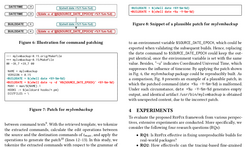
The paper (PDF, 3.5MB) uses the Debian mylvmbackup package as an example to show how RepFix can automatically generate patches to make software build reproducibly. As it happens, Reiner Herrmann submitted a patch for the mylvmbackup package which has remained unapplied by the Debian package maintainer for over seven years, thus this paper inadvertently underscores that achieving reproducible builds will require both technical and social solutions.

Python variables Johannes Schauer discovered a fascinating bug where simply naming your Python variable _m led to unreproducible .pyc files. In particular, the types module in Python 3.10 requires the following patch to make it reproducible:
--- a/Lib/types.py
+++ b/Lib/types.py
@@ -37,8 +37,8 @@ _ag = _ag()
 AsyncGeneratorType = type(_ag)
 
 class _C:
-    def _m(self): pass
-MethodType = type(_C()._m)
+    def _b(self): pass
+MethodType = type(_C()._b)
Simply renaming the dummy method from _m to _b was enough to workaround the problem. Johannes bug report first led to a number of improvements in diffoscope to aid in dissecting .pyc files, but upstream identified this as caused by an issue surrounding interned strings and is being tracked in CPython bug #78274.

New SPDX team to incorporate build metadata in Software Bill of Materials SPDX, the open standard for Software Bill of Materials (SBOM), is continuously developed by a number of teams and committees. However, SPDX has welcomed a new addition; a team dedicated to enhancing metadata about software builds, complementing reproducible builds in creating a more secure software supply chain. The SPDX Builds Team has been working throughout May to define the universal primitives shared by all build systems, including the who, what, where and how of builds:
  • Who: the identity of the person or organisation that controls the build infrastructure.
  • What: the inputs and outputs of a given build, combining metadata about the build s configuration with an SBOM describing source code and dependencies.
  • Where: the software packages making up the build system, from build orchestration tools such as Woodpecker CI and Tekton to language-specific tools.
  • How: the invocation of a build, linking metadata of a build to the identity of the person or automation tool that initiated it.
The SPDX Builds Team expects to have a usable data model by September, ready for inclusion in the SPDX 3.0 standard. The team welcomes new contributors, inviting those interested in joining to introduce themselves on the SPDX-Tech mailing list.

Talks at Debian Reunion Hamburg Some of the Reproducible Builds team (Holger Levsen, Mattia Rizzolo, Roland Clobus, Philip Rinn, etc.) met in real life at the Debian Reunion Hamburg (official homepage). There were several informal discussions amongst them, as well as two talks related to reproducible builds. First, Holger Levsen gave a talk on the status of Reproducible Builds for bullseye and bookworm and beyond (WebM, 210MB): Secondly, Roland Clobus gave a talk called Reproducible builds as applied to non-compiler output (WebM, 115MB):

Supply-chain security attacks This was another bumper month for supply-chain attacks in package repositories. Early in the month, Lance R. Vick noticed that the maintainer of the NPM foreach package let their personal email domain expire, so they bought it and now controls foreach on NPM and the 36,826 projects that depend on it . Shortly afterwards, Drew DeVault published a related blog post titled When will we learn? that offers a brief timeline of major incidents in this area and, not uncontroversially, suggests that the correct way to ship packages is with your distribution s package manager .

Bootstrapping Bootstrapping is a process for building software tools progressively from a primitive compiler tool and source language up to a full Linux development environment with GCC, etc. This is important given the amount of trust we put in existing compiler binaries. This month, a bootstrappable mini-kernel was announced. Called boot2now, it comprises a series of compilers in the form of bootable machine images.

Google s new Assured Open Source Software service Google Cloud (the division responsible for the Google Compute Engine) announced a new Assured Open Source Software service. Noting the considerable 650% year-over-year increase in cyberattacks aimed at open source suppliers, the new service claims to enable enterprise and public sector users of open source software to easily incorporate the same OSS packages that Google uses into their own developer workflows . The announcement goes on to enumerate that packages curated by the new service would be:
  • Regularly scanned, analyzed, and fuzz-tested for vulnerabilities.
  • Have corresponding enriched metadata incorporating Container/Artifact Analysis data.
  • Are built with Cloud Build including evidence of verifiable SLSA-compliance
  • Are verifiably signed by Google.
  • Are distributed from an Artifact Registry secured and protected by Google.
(Full announcement)

A retrospective on the Rust programming language Andrew bunnie Huang published a long blog post this month promising a critical retrospective on the Rust programming language. Amongst many acute observations about the evolution of the language s syntax (etc.), the post beings to critique the languages approach to supply chain security ( Rust Has A Limited View of Supply Chain Security ) and reproducibility ( You Can t Reproduce Someone Else s Rust Build ):
There s some bugs open with the Rust maintainers to address reproducible builds, but with the number of issues they have to deal with in the language, I am not optimistic that this problem will be resolved anytime soon. Assuming the only driver of the unreproducibility is the inclusion of OS paths in the binary, one fix to this would be to re-configure our build system to run in some sort of a chroot environment or a virtual machine that fixes the paths in a way that almost anyone else could reproduce. I say almost anyone else because this fix would be OS-dependent, so we d be able to get reproducible builds under, for example, Linux, but it would not help Windows users where chroot environments are not a thing.
(Full post)

Reproducible Builds IRC meeting The minutes and logs from our May 2022 IRC meeting have been published. In case you missed this one, our next IRC meeting will take place on Tuesday 28th June at 15:00 UTC on #reproducible-builds on the OFTC network.

A new tool to improve supply-chain security in Arch Linux kpcyrd published yet another interesting tool related to reproducibility. Writing about the tool in a recent blog post, kpcyrd mentions that although many PKGBUILDs provide authentication in the context of signed Git tags (i.e. the ability to verify the Git tag was signed by one of the two trusted keys ), they do not support pinning, ie. that upstream could create a new signed Git tag with an identical name, and arbitrarily change the source code without the [maintainer] noticing . Conversely, other PKGBUILDs support pinning but not authentication. The new tool, auth-tarball-from-git, fixes both problems, as nearly outlined in kpcyrd s original blog post.

diffoscope diffoscope is our in-depth and content-aware diff utility. Not only can it locate and diagnose reproducibility issues, it can provide human-readable diffs from many kinds of binary formats. This month, Chris Lamb prepared and uploaded versions 212, 213 and 214 to Debian unstable. Chris also made the following changes:
  • New features:
    • Add support for extracting vmlinuz Linux kernel images. [ ]
    • Support both python-argcomplete 1.x and 2.x. [ ]
    • Strip sticky etc. from x.deb: sticky Debian binary package [ ]. [ ]
    • Integrate test coverage with GitLab s concept of artifacts. [ ][ ][ ]
  • Bug fixes:
    • Don t mask differences in .zip or .jar central directory extra fields. [ ]
    • Don t show a binary comparison of .zip or .jar files if we have observed at least one nested difference. [ ]
  • Codebase improvements:
    • Substantially update comment for our calls to zipinfo and zipinfo -v. [ ]
    • Use assert_diff in test_zip over calling get_data with a separate assert. [ ]
    • Don t call re.compile and then call .sub on the result; just call re.sub directly. [ ]
    • Clarify the comment around the difference between --usage and --help. [ ]
  • Testsuite improvements:
    • Test --help and --usage. [ ]
    • Test that --help includes the file formats. [ ]
Vagrant Cascadian added an external tool reference xb-tool for GNU Guix [ ] as well as updated the diffoscope package in GNU Guix itself [ ][ ][ ].

Distribution work In Debian, 41 reviews of Debian packages were added, 85 were updated and 13 were removed this month adding to our knowledge about identified issues. A number of issue types have been updated, including adding a new nondeterministic_ordering_in_deprecated_items_collected_by_doxygen toolchain issue [ ] as well as ones for mono_mastersummary_xml_files_inherit_filesystem_ordering [ ], extended_attributes_in_jar_file_created_without_manifest [ ] and apxs_captures_build_path [ ]. Vagrant Cascadian performed a rough check of the reproducibility of core package sets in GNU Guix, and in openSUSE, Bernhard M. Wiedemann posted his usual monthly reproducible builds status report.

Upstream patches The Reproducible Builds project detects, dissects and attempts to fix as many currently-unreproducible packages as possible. We endeavour to send all of our patches upstream where appropriate. This month, we wrote a large number of such patches, including:

Reproducible builds website Chris Lamb updated the main Reproducible Builds website and documentation in a number of small ways, but also prepared and published an interview with Jan Nieuwenhuizen about Bootstrappable Builds, GNU Mes and GNU Guix. [ ][ ][ ][ ] In addition, Tim Jones added a link to the Talos Linux project [ ] and billchenchina fixed a dead link [ ].

Testing framework The Reproducible Builds project runs a significant testing framework at tests.reproducible-builds.org, to check packages and other artifacts for reproducibility. This month, the following changes were made:
  • Holger Levsen:
    • Add support for detecting running kernels that require attention. [ ]
    • Temporarily configure a host to support performing Debian builds for packages that lack .buildinfo files. [ ]
    • Update generated webpages to clarify wishes for feedback. [ ]
    • Update copyright years on various scripts. [ ]
  • Mattia Rizzolo:
    • Provide a facility so that Debian Live image generation can copy a file remotely. [ ][ ][ ][ ]
  • Roland Clobus:
    • Add initial support for testing generated images with OpenQA. [ ]
And finally, as usual, node maintenance was also performed by Holger Levsen [ ][ ].

Misc news On our mailing list this month:

Contact If you are interested in contributing to the Reproducible Builds project, please visit our Contribute page on our website. However, you can get in touch with us via:

Thorsten Alteholz: My Debian Activities in May 2022

FTP master This month I accepted 288 and rejected 45 packages. The overall number of packages that got accepted was 290. Debian LTS This was my ninety-fifth month that I did some work for the Debian LTS initiative, started by Raphael Hertzog at Freexian. This month my all in all workload has been 40h. During that time I did LTS and normal security uploads of: Further I continued working on libvirt and started to work on blender and ncurses. I also continued to work on security support for golang packages. Last but not least I did some days of frontdesk duties and took care of issues on security-master. Debian ELTS This month was the forty-seventh ELTS month. During my allocated time I uploaded: I also moved/refactored the current ELTS documentation to a new repository. Further I started to work on blender and ncurses in ELTS as well as in LTS. Last but not least I did some days of frontdesk duties. Debian Printing This month I uploaded new upstream versions or improved packaging of: The reason for the new upstream version of ipp-usb was a strange bug. Some HP printers claim to have fax support but fail to respond to corresponding IPP queries. I understand that nowadays sending a fax is no longer a main theme for quality assurance. But if one tries to advertise as much features as possible, all these features should basically work and not prevent the things a printer should normally do. The reason for the new upstream version of cups was a security issue. You now should have the latest version of cups installed (there have been updates in other Debian releases as well). Debian Astro This month I uploaded new upstream versions or improved packaging of: Other stuff This month I uploaded new packages:

5 June 2022

John Goerzen: Visiting Germany: Reflections on Schloss Charlottenburg

200 years ago, my ancestors migrated from Prussia to Ukraine. They left for many reasons, many of which boiled down to their strong pacifism in the midst of a highly militarized country. Last week, my wife, the boys, and I walked through the favorite palace of Friedrich Wilhelm III, the king of Prussia who was responsible for forcing my ancestors out Charlottenburg Palace in Berlin. Photos can t possibly convey the enormity and the riches of this place, even after being attacked during multiple wars (and used by Napoleon for a time). My ancestors would never have been able to get into to this place. We, on the other hand, walked right through the king s bedroom, audience room, and chapel. The chapel, incidentally, mixing church and state; a fine pipe organ along with a statue of an eagle holding the Prussian crown. I could pause and enjoy the beauty of the place; the oval rooms overlooking the acres of sculpted gardens outside and carefully tree-lined streets leading to the palace, the artwork no doubt worth many millions, the gold and silver place settings, the rare tapestries. And I could also reflect on the problems with such great wealth and power, and the many lives lost and refugees created by the wars the Prussian kings started. (First of several reflections on our wonderful recent trip to Germany with the boys)

3 June 2022

Petter Reinholdtsen: LinuxCNC translators life just got a bit easier

Back in oktober last year, when I started looking at the LinuxCNC system, I proposed to change the documentation build system make life easier for translators. The original system consisted of independently written documentation files for each language, with no automated way to track changes done in other translations and no help for the translators to know how much was left to translated. By using the po4a system to generate POT and PO files from the English documentation, this can be improved. A small team of LinuxCNC contributors got together and today our labour finally payed off. Since a few hours ago, it is now possible to translate the LinuxCNC documentation on Weblate, alongside the program itself. The effort to migrate the documentation to use po4a has been both slow and frustrating. I am very happy we finally made it. As usual, if you use Bitcoin and want to show your support of my activities, please send Bitcoin donations to my address 15oWEoG9dUPovwmUL9KWAnYRtNJEkP1u1b.

Raphaël Hertzog: Freexian s report about Debian Long Term Support, April 2022

A Debian LTS logo
Like each month, have a look at the work funded by Freexian s Debian LTS offering. Debian project funding Two projects are currently in the pipeline: Gradle enterprise and Tryton update. Progress is quite slow on the Gradle one, there are technical difficulties. The tryton one was stalled because the developer had not enough time but seems to progress smoothly in the last weeks. In April, we put aside 2635 EUR to fund Debian projects. We re looking forward to receive more projects from various Debian teams! Learn more about the rationale behind this initiative in this article. Debian LTS contributors In April, 11 contributors have been paid to work on Debian LTS, their reports are available: Evolution of the situation In April we released 30 DLAs and we were glad to welcome a new customer with Alter Way. The security tracker currently lists 72 packages with a known CVE and the dla-needed.txt file has 71 packages needing an update. It is worth pointing out that we are getting close to the end of the LTS period for Debian 9. After June 30th, no new security updates will be made available on security.debian.org. But Freexian and its team of paid Debian contributors will continue to maintain Debian 9 going forward for the customers of the Extended LTS offer. If you have Debian 9 servers to keep secure, it s time to subscribe! You might not have noticed, but Freexian formalized a mission statement where we explain that our purpose is to help improve Debian. For this, we want to fund work time for the Debian developers that recently joined Freexian as collaborators. The Extended LTS and the PHP LTS offers are built following a model that will help us to achieve this if we manage to have enough customers for those offers. So consider subscribing: you help your organization but you also help Debian! Thanks to our sponsors Sponsors that joined recently are in bold.

Fran ois Marier: Using Gandi DNS for Let's Encrypt certbot verification

I had some problems getting the Gandi certbot plugin to work in Debian bullseye since the documentation appears to be outdated. When running certbot renew --dry-run, I saw the following error message:
Plugin legacy name certbot-plugin-gandi:dns may be removed in a future version. Please use dns instead.
Thanks to an issue in another DNS plugin, I was able to easily update my configuration to the new naming convention.

Setup Get an API key from Gandi and then put it in /etc/letsencrypt/gandi.ini:
# live dns v5 api key
dns_api_key=ABCDEF
before make it only readable by root:
chown root:root /etc/letsencrypt/gandi.ini
chmod 600 /etc/letsencrypt/gandi.ini
Then install the required package:
apt install python3-certbot-dns-gandi

Getting an initial certificate To get an initial certificate using the Gandi plugin, simply use the following command:
certbot certonly -a dns --dns-credentials /etc/letsencrypt/gandi.ini -d example.fmarier.org

Setting up automatic renewal If you have automatic renewals enabled, you'll want to ensure your /etc/letsencrypt/renewal/example.fmarier.org.conf file looks like this:
# renew_before_expiry = 30 days
version = 1.12.0
archive_dir = /etc/letsencrypt/archive/example.fmarier.org
cert = /etc/letsencrypt/live/example.fmarier.org/cert.pem
privkey = /etc/letsencrypt/live/example.fmarier.org/privkey.pem
chain = /etc/letsencrypt/live/example.fmarier.org/chain.pem
fullchain = /etc/letsencrypt/live/example.fmarier.org/fullchain.pem
[renewalparams]
account = abcdef
authenticator = dns
server = https://acme-v02.api.letsencrypt.org/directory
dns_credentials = /etc/letsencrypt/gandi.ini

Reproducible Builds (diffoscope): diffoscope 215 released

The diffoscope maintainers are pleased to announce the release of diffoscope version 215. This version includes the following changes:
[ Chris Lamb ]
* Bug fixes:
  - Also catch IndexError (in addition to ValueError) when parsing .pyc
    files. (Closes: #1012258)
  - Strip "sticky" etc. from "x.deb: sticky Debian binary package [ ]".
    Thanks to David Pr vot for the report. (Closes: #1011635)
  - Correctly package diffoscope's scripts/ directory, fixing the extraction
    of vmlinuz kernel images. (Closes: reproducible-builds/diffoscope#305)
  - Correct the logic for supporting different versions of argcomplete in
    debian/rules.
* New features:
  - Support both PyPDF 1.x and 2.x.
* Codebase improvements:
  - Don't call re.compile and then call .sub on the result; just call
    re.sub directly.
  - Clarify the logic around the difference between --usage and --help.
* Testsuite improvements:
  - Integrate test coverage with GitLab's concept of artifacts.
  - Re-enable Gnumeric tests as its now available again.
  - Test --help and --usage, and additionally test that --help includes
    the programmatically-generated file format list as well.
[ Holger Levsen ]
* Bump Standards Version field in debian/control to 4.6.1.
You find out more by visiting the project homepage.

1 June 2022

Daniel Lange: Get Youtube Channel ID from username

Youtube has a really nice RSS feature that is extremely well hidden. If you postfix a Channel ID to

https://www.youtube.com/feeds/videos.xml?channel_id=<id goes here>
you get a really nice Atom 1.0 (~RSS) feed for your feedreader. Unfortunately the Channel ID is hard to find while you are navigating Youtube with usernames in the URL. E.g. https://www.youtube.com/c/TED is TED's channel, full of interesting and worth-to-watch content (and some assorted horse toppings, of course). But you have to read a lot of ugly HTML / JSON in that page to find and combine https://www.youtube.com/feeds/videos.xml?channel_id=UCAuUUnT6oDeKwE6v1NGQxug which is the related RSS feed. Jeff Keeling wrote a simple Youtube RSS Extractor that does well if you have a ../playlist?... or a .../channel/... URL but it will (currently) fail on user name channels or Youtube landing pages. So how do we get the Channel ID for a Youtube user we are interested to follow? Youtube has a great API but that is gated by API keys even for the most simple calls (that came only with v3 of the API but the previous version is depreciated since 2015)1:
dl@laptop:~$ curl 'https://www.googleapis.com/youtube/v3/channels?part=contentDetails&forUsername=DebConfVideos'

"error":
"code": 403,
"message": "The request is missing a valid API key.",
"errors": [

"message": "The request is missing a valid API key.",
"domain": "global",
"reason": "forbidden"

],
"status": "PERMISSION_DENIED"

Luckily we can throw the same (example) user name DebConfVideos at curl and grep:
dl@laptop:~$ curl -s "https://www.youtube.com/c/DebConfVideos/videos" grep -Po '"channelId":".+?"'
"channelId":"UC7SbfAPZf8SMvAxp8t51qtQ"
So https://www.youtube.com/feeds/videos.xml?channel_id=UC7SbfAPZf8SMvAxp8t51qtQ is the RSS feed for DebConfVideos. We can use individual Youtube video URLs as well. With the hack above, it'll work to find us the Chanel ID from a Youtube video URL: Working around the Youtube API restrictions to still make use of their RSS feed Now, some user pages may have multiple valid RSS feeds because they contain multiple channels. Remember the TED page from above? Well run:
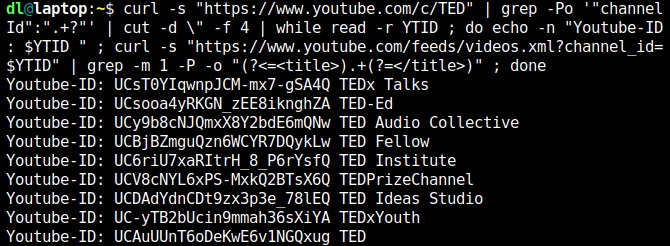
dl@laptop:~$ curl -s "https://www.youtube.com/c/TED" grep -Po '"channelId":".+?"' cut -d \" -f 4 while read -r YTID ; do echo -n "Youtube-ID: $YTID " ; curl -s "https://www.youtube.com/feeds/videos.xml?channel_id=$YTID" grep -m 1 -P -o "(?<=<title>).+(?=</title>)" ; done
This will iterate through the Channel IDs found and show you the titles. That way you can assess which one you want to add to your feedreader. screenshot of the above You probably want the last Channel ID listed above, the non-selective "TED" one. And that's the one from the example above. Update 02.06.2022: smpl wrote in and has the much better solution for the most frequent use cases:

You can also use get a feed directly with a username:
https://www.youtube.com/feeds/videos.xml?user=<username>
The one I use most is the one for playlists (if creators remember to
use them).
https://www.youtube.com/feeds/videos.xml?playlist_id=<playlist id>
For the common case you don't even need the channel ID that way. But it is also conveniently given in a <yt:channelId> tag (or the topmost <id> tag) within the Atom XML document. Thanks, smpl!

  1. Actually it is even more complicated as some channels, like our DebConfVideos example, will only get you an incomplete result, cf. this StackOverflow entry. I.e. the forUsername iterator may not even work and the "best practice" seems to be mucking around with the search call.

Russ Allbery: Review: The Seeress of Kell

Review: The Seeress of Kell, by David Eddings
Series: The Malloreon #5
Publisher: Del Rey
Copyright: May 1991
Printing: May 1992
ISBN: 0-345-37759-1
Format: Mass market
Pages: 374
The Seeress of Kell is the conclusion of the five-book Malloreon series and a direct sequel to Sorceress of Darshiva. You do not want to begin the series here (or, to be honest, at all). We have finally finished the relaxed tour of Mallorea, the second continent of Eddings's remarkably small two-continent world. The heroes have gathered all of their required companions and are headed for Kell, where the seeress Cyradis awaits. From there, they and the new Child of Dark must find their way to the Place Which Is No More for the final confrontation. By "find," I mean please remain seated with your hands, arms, feet, and legs inside the vehicle. The protagonists have about as much to do with the conclusion of this series as the passengers of a roller coaster have control over its steering. I am laughing at my younger self, who quite enjoyed this series (although as I recall found it a bit repetitive) and compared it favorably to the earlier Belgariad series. My memory kept telling me that the conclusion of the series was lots of fun. Reader, it was not. It was hilariously bad. Both of Eddings's first two series, but particularly this one, take place in a fantasy world full of true prophecy. The conceit of the Malloreon in particular (this is a minor spoiler for the early books, but not one that I think interferes with enjoyment) is that there are two competing prophecies that agree on most events but are in conflict over a critical outcome. True prophecy creates an agency problem: why have protagonists if everything they do is fixed in prophecy? The normal way to avoid that is to make the prophecy sufficiently confusing and the mechanism by which it comes true sufficiently subtle that everyone has to act as if there is no prophecy, thus reducing the role of the prophecy to foreshadowing and a game the author plays with the reader. What makes the Malloreon interesting (and I mean this sincerely) is that Eddings instead leans into the idea of a prophecy as an active agent leading the protagonists around by the nose. As a meta-story commentary on fantasy stories, this can be quite entertaining, and it helps that the prophecy appears as a likable character of sorts in the book. The trap that Eddings had mostly avoided before now is that this structure can make the choices of the protagonists entirely pointless. In The Seeress of Kell, he dives head-first into the trap and then pulls it shut behind him. The worst part is Ce'Nedra, who once again spends an entire book either carping at Garion in ways that are supposed to be endearing (but aren't) or being actively useless. The low point is when she is manipulated into betraying the heroes, costing them a significant advantage. We're then told that, rather than being a horrific disaster, this is her important and vital role in the story, and indeed the whole reason why she was in the story at all. The heroes were too far ahead of the villains and were in danger of causing the prophecy to fail. At that point, one might reasonably ask why one is bothering reading a novel instead of a summary of the invented history that Eddings is going to tell whether his characters cooperate or not. The whole middle section of the book is like this: nothing any of the characters do matters because everything is explicitly destined. That includes an extended series of interludes following the other main characters from the Belgariad, who are racing to catch up with the main party but who will turn out to have no role of significance whatsoever. I wouldn't mind this as much if the prophecy were more active in the story, given that it's the actual protagonist. But it mostly disappears. Instead, the characters blunder around doing whatever seems like a good idea at the time, while Cyradis acts like a bizarre sort of referee with a Calvinball rule set and every random action turns out to be the fulfillment of prophecy in the most ham-handed possible way. Zandramas, meanwhile, is trying to break the prophecy, which would have been a moderately interesting story hook if anyone (Eddings included) thought she were potentially capable of doing so. Since no one truly believes there's any peril, this turns into a series of pointless battles the reader has no reason to care about. All of this sets up what has been advertised since the start of the series as a decision between good and evil. Now, at the least minute, Eddings (through various character mouthpieces) tries to claim that the decision is not actually between good and evil, but is somehow beyond morality. No one believes this, including the narrator and the reader, making all of the philosophizing a tedious exercise in page-turning. To pull off a contention like that, the author has to lay some sort of foundation to allow the reader to see the supposed villain in multiple lights. Eddings does none of that, instead emphasizing how evil she is at every opportunity. On top of that, this supposed free choice on which the entire universe rests and for which all of history was pointed depends on someone with astonishing conflicts of interest. While the book is going on about how carefully the prophecy is ensuring that everyone is in the right place at the right time so that no side has an advantage, one side is accruing an absurdly powerful advantage. And the characters don't even seem to realize it! The less said about the climax, the better. Unsurprisingly, it was completely predictable. Also, while I am complaining, I could never get past how this entire series starts off with and revolves around an incredibly traumatic and ongoing event that has no impact whatsoever on the person to whom the trauma happens. Other people are intermittently upset or sad, but not only is that person not harmed, they act, at the end of this book, as if the entire series had never happened. There is one bright spot in this book, and ironically it's the one plot element that Eddings didn't make blatantly obvious in advance and therefore I don't want to spoil it. All I'll say is that one of the companions the heroes pick up along the way turns out to be my favorite character of the series, plays a significant role in the interpersonal dynamics between the heroes, and steals every scene that she's in by being more sensible than any of the other characters in the story. Her story, and backstory, is emotional and moving and is the best part of this book. Otherwise, not only is the plot a mess and the story structure a failure, but this is also Eddings at his most sexist and socially conservative. There is an extended epilogue after the plot resolution that serves primarily as a showcase of stereotypes: baffled men having their habits and preferences rewritten by their wives, cast-iron gender roles inside marriage, cringeworthy jokes, and of course loads and loads of children because that obviously should be everyone's happily ever after. All of this happens to the characters rather than being planned or actively desired, continuing the theme of prophecy and lack of agency, although of course they're all happy about it (shown mostly via grumbling). One could write an entire academic paper on the tension between this series and the concept of consent. There were bits of the Malloreon that I enjoyed, but they were generally in spite of the plot rather than because of it. I do like several of Eddings's characters, and in places I liked the lack of urgency and the sense of safety. But I think endings still have to deliver some twist or punch or, at the very least, some clear need for the protagonists to take an action other than stand in the right room at the right time. Eddings probably tried to supply that (I can make a few guesses about where), but it failed miserably for me, making this the worst book of the series. Unless like me you're revisiting this out of curiosity for your teenage reading habits (and even then, consider not), avoid. Rating: 3 out of 10

31 May 2022

Paul Wise: FLOSS Activities May 2022

Focus This month I didn't have any particular focus. I just worked on issues in my info bubble.

Changes

Issues

Review
  • Spam: reported 1 Debian bug reports and 41 Debian mailing list posts
  • Patches: reviewed gt patches
  • Debian packages: sponsored psi-notify
  • Debian wiki: RecentChanges for the month
  • Debian BTS usertags: changes for the month
  • Debian screenshots:
    • approved cppcheck-gui eta flpsed fluxbox p7zip-full pampi pyqso xboard
    • rejected p7zip (help output), openshot (photo of a physical library), clamav-daemon (movie cartoon character), aptitude (screenshot of random launchpad project), laditools (screenshot of tracker.d.o for src:hello), weboob-qt/chromium-browser/supercollider-vim ((NSFW) selfies), node-split (screenshot of screenshots site), libc6 (Chinese characters alongside a photo of man and bottle)

Administration
  • Debian servers: investigate etckeeper cron mail
  • Debian wiki: investigate account existence, approve accounts

Communication
  • Respond to queries from Debian users and contributors on the mailing lists and IRC

Sponsors The gensim and libpst work was sponsored. All other work was done on a volunteer basis.

Russell Coker: Links May 2022

dontkillmyapp.com is a web site about Android phone vendors who make their phones kill your apps when you don t want them to [1]. One of the many reasons why Pine and Purism offer the promise of better phones. This blog post about the Librem 5 camera is interesting [2]. Currently the Librem 5 camera isn t very usable for me as I just want to point and shoot, but it apparently works well for experts. Taking RAW photos is a good feature that I d like to have in all my camera phones. The Russian government being apparently unaware of the Streisand Effect has threatened Wikipedia for publishing facts about the war against Ukraine [3]. We all should publicise this as much as possible. The Wikipedia page is The 2022 Russian Invasion of Ukraine [4]. The Jerusalem Post has an interesting article about whether Mein Kampf should be published and studied in schools [5]. I don t agree with the conclusions about studying that book in schools, but I think that the analysis of the situation in that article is worth reading. One of the issues I have with teaching Mein Kampf and similar books is the quality of social studies teaching at the school I attended, I m pretty sure that teaching Mein Kampf in any way at that school would just turn out more neo-Nazis. Maybe better schools (IE not Christian private schools) could have productive classes about Mein Kampf Vanity Fair has an interesting article about the history of the private jet [6]. Current Affairs has an unusually informative article about why blockchain currencies should die in a fire [7]. The Nazi use of methamphetamine is well known, but Time has an insightful article about lesser known aspects of meth use [8]. How they considered meth as separate from the drugs they claimed were for the morally inferior is interesting. George Monbiot wrote an insightful article comparing the 2008 bank collapse to the current system of unstable food supplies [9]. JWZ wrote an insightful blog post about Following the Money regarding the push to reopen businesses even though the pandemic is far from over [10]. His conclusion is that commercial property owners are pushing the governments to give them more money. PsyPost has an interesting article on the correlation between watching Fox News and lacking knowledge of science and of society [11]. David Brin wrote an interesting paper about Disputation and how that can benefit society [12]. I think he goes too far in some of his claims, but he has interesting points. The overall idea of a Disputation arena for ideas is a really good one. I previously had a similar idea on a much smaller scale of having debates via Wiki [13].

Russ Allbery: Review: Maskerade

Review: Maskerade, by Terry Pratchett
Series: Discworld #18
Publisher: Harper
Copyright: 1995
Printing: February 2014
ISBN: 0-06-227552-6
Format: Mass market
Pages: 360
Maskerade is the 18th book of the Discworld series, but you probably could start here. You'd miss the introduction of Granny Weatherwax and Nanny Ogg, which might be a bit confusing, but I suspect you could pick it up as you went if you wanted. This is a sequel of sorts to Lords and Ladies, but not in a very immediate sense. Granny is getting distracted and less interested in day-to-day witching in Lancre. This is not good; Granny is incredibly powerful, and bored and distracted witches can go to dark places. Nanny is concerned. Granny needs something to do, and their coven needs a third. It's not been the same since they lost their maiden member. Nanny's solution to this problem is two-pronged. First, they'd had their eye on a local girl named Agnes, who had magic but who wasn't interested in being a witch. Perhaps it was time to recruit her anyway, even though she'd left Lancre for Ankh-Morpork. And second, Granny needs something to light a fire under her, something that will get her outraged and ready to engage with the world. Something like a cookbook of aphrodisiac recipes attributed to the Witch of Lancre. Agnes, meanwhile, is auditioning for the opera. She's a sensible person, cursed her whole life by having a wonderful personality, but a part of her deep inside wants to be called Perdita X. Dream and have a dramatic life. Having a wonderful personality can be very frustrating, but no one in Lancre took either that desire or her name seriously. Perhaps the opera is somewhere where she can find the life she's looking for, along with another opportunity to try on the Perdita name. One thing she can do is sing; that's where all of her magic went. The Ankh-Morpork opera is indeed dramatic. It's also losing an astounding amount of money for its new owner, who foolishly thought owning an opera would be a good retirement project after running a cheese business. And it's haunted by a ghost, a very tangible ghost who has started killing people. I think this is my favorite Discworld novel to date (although with a caveat about the ending that I'll get to in a moment). It's certainly the one that had me laughing out loud the most. Agnes (including her Perdita personality aspect) shot to the top of my list of favorite Discworld characters, in part because I found her sensible personality so utterly relatable. She is fascinated by drama, she wants to be in the middle of it and let her inner Perdita goth character revel in it, and yet she cannot help being practical and unflappable even when surrounded by people who use far too many exclamation points. It's one thing to want drama in the abstract; it's quite another to be heedlessly dramatic in the moment, when there's an obviously reasonable thing to do instead. Pratchett writes this wonderfully. The other half of the story follows Granny and Nanny, who are unstoppable forces of nature and a wonderful team. They have the sort of long-standing, unshakable adult friendship between very unlike people that's full of banter and minor irritations layered on top of a deep mutual understanding and respect. Once they decide to start investigating this supposed opera ghost, they divvy up the investigative work with hardly a word exchanged. Planning isn't necessary; they both know each other's strengths. We've gotten a lot of Granny's skills in previous books. Maskerade gives Nanny a chance to show off her skills, and it's a delight. She effortlessly becomes the sort of friendly grandmother who blends in so well that no one questions why she's there, and thus manages to be in the middle of every important event. Granny watches and thinks and theorizes; Nanny simply gets into the middle of everything and talks to everyone until people tell her what she wants to know. There's no real doubt that the two of them are going to get to the bottom of anything they want to get to the bottom of, but watching how they get there is a delight. I love how Pratchett handles that sort of magical power from a world-building perspective. Ankh-Morpork is the Big City, the center of political power in most of the Discworld books, and Granny and Nanny are from the boondocks. By convention, that means they should either be awed or confused by the city, or gain power in the city by transforming it in some way to match their area of power. This isn't how Pratchett writes witches at all. Their magic is in understanding people, and the people in Ankh-Morpork are just as much people as the people in Lancre. The differences of the city may warrant an occasional grumpy aside, but the witches are fully as capable of navigating the city as they are their home town. Maskerade is, of course, a parody of opera and musicals, with Phantom of the Opera playing the central role in much the same way that Macbeth did in Wyrd Sisters. Agnes ends up doing the singing for a beautiful, thin actress named Christine, who can't sing at all despite being an opera star, uses a truly astonishing excess of exclamation points, and strategically faints at the first sign of danger. (And, despite all of this, is still likable in that way that it's impossible to be really upset at a puppy.) She is the special chosen focus of the ghost, whose murderous taunting is a direct parody of the Phantom. That was a sufficiently obvious reference that even I picked up on it, despite being familiar with Phantom of the Opera only via the soundtrack. Apart from that, though, the references were lost on me, since I'm neither a musical nor an opera fan. That didn't hurt my enjoyment of the book in the slightest; in fact, I suspect it's part of why it's in my top tier of Discworld books. One of my complaints about Discworld to date is that Pratchett often overdoes the parody to the extent that it gets in the way of his own (excellent) characters and story. Maybe it's better to read Discworld novels where one doesn't recognize the material being parodied and thus doesn't keep getting distracted by references. It's probably worth mentioning that Agnes is a large woman and there are several jokes about her weight in Maskerade. I think they're the good sort of jokes, about how absurd human bodies can be, not the mean sort? Pratchett never implies her weight is any sort of moral failing or something she should change; quite the contrary, Nanny considers it a sign of solid Lancre genes. But there is some fat discrimination in the opera itself, since one of the things Pratchett is commenting on is the switch from full-bodied female opera singers to thin actresses matching an idealized beauty standard. Christine is the latter, but she can't sing, and the solution is for Agnes to sing for her from behind, something that was also done in real opera. I'm not a good judge of how well this plot line was handled; be aware, going in, if this may bother you. What did bother me was the ending, and more generally the degree to which Granny and Nanny felt comfortable making decisions about Agnes's life without consulting her or appearing to care what she thought of their conclusions. Pratchett seemed to be on their side, emphasizing how well they know people. But Agnes left Lancre and avoided the witches for a reason, and that reason is not honored in much the same way that Lancre refused to honor her desire to go by Perdita. This doesn't seem to be malicious, and Agnes herself is a little uncertain about her choice of identity, but it still rubbed me the wrong way. I felt like Agnes got steamrolled by both the other characters and by Pratchett, and it's the one thing about this book that I didn't like. Hopefully future Discworld books about these characters revisit Agnes's agency. Overall, though, this was great, and a huge improvement over Interesting Times. I'm excited for the next witches book. Followed in publication order by Feet of Clay, and later by Carpe Jugulum in the thematic sense. Rating: 8 out of 10

30 May 2022

Daniel Lange: Work-around for randomly dropping WiFi connections on ChromeOS

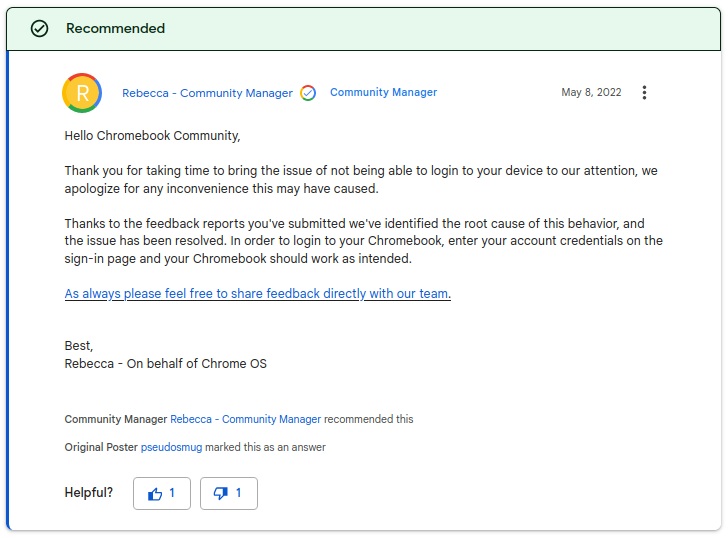
The company got me a Chromebook for times when I want to ignore email and not get dragged into code reviews but still be available on IRC and chat. Nifty devices at great price points. I really like them. Chromebook logo These things are meant to be very consumer-style end-user devices. You log in with your Google account and everything works. Until it doesn't. Just setting it up caused the first issue: I was always thrown back to a black screen and then another login-screen despite having successfully logged in initially to create the "owner" user of the Chromebook. No error message, not useful UI feedback. Just logging in again and again and again. The issue is ... not having a GMail account associated with my Google account. Duh! So add a GMail.com address as the primary to your Google account and the initial setup completes. Of course you cannot delete that GMail.com association again because the owner user is linked to the email and not the account. Well, you can delete it but then you cannot configure "owner" items of your Chromebook any more. Great job, Google. Not. Identity management 101 fail. Kudos to Anurag Chawake for blogging about the issue. The Google support forum thead claims this is solved now. But it didn't work for me, so this may be needing to trickle down through ChromeOS releases or be deployed on more Google infra. Or whatever. We can't tell from outside the Googleplex as - of course - "Rebecca" sheds no light on what the identified "root cause" was: Google Forum answer Once I was able to login to the new Chromebook all worked fine until I started to use ssh sessions. These always hung for 30 seconds to 10 minutes and then resumed with lots of packets lost in between and the last minute or so coming in from buffering in a burst. This was easy to see in ping as well. The connection essentially dropped dead while the WiFi icon was continuing to show full signal strength. The logs did not show anything useful. These are really hard to access on ChromeOS (JSON format and no useful UI on the Chromebook itself, Google provides a viewer on Google Apps Toolbox but that requires uploading the logs). Better than no logs at all but not really nice. The ChromeOS bug tracker and its Google corporate counterpart are also not useful at this time. For reference:
Google ... Device users randomly disconnect from Wi-Fi network
Chromium ... Device users randomly disconnect from Wi-Fi network
Google ... Constant connect and disconnect from WiFi source post-update
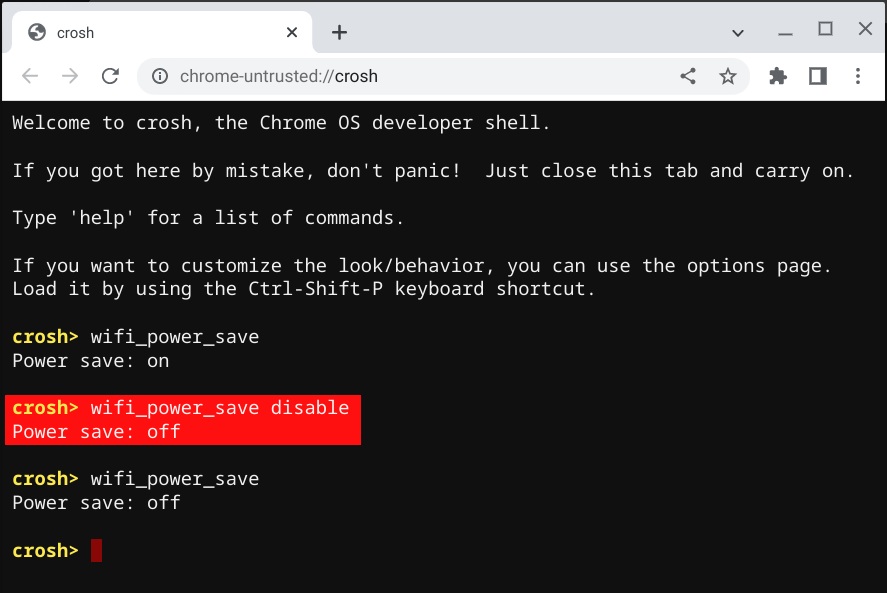
Chromium ... Constant connect and disconnect from WiFi source post-update Playing around with the device on the network showed that it reduced sending power beyond being able to reach the access point any more. This is why disconnecting and re-connecting the WiFi fixes the issue for a few minutes, typically. Still, there is a better way: In crosh (the ChromeOS shell available when pressing Alt+Ctrl+T) type:
wifi_power_save disable
Crosh session screenshot This unfortunately only lasts until the next reboot but it does persist over suspend cycles (aka closing the lid).


Bits from Debian: Debian welcomes its new Outreachy interns

Outreachy logo Debian continues participating in Outreachy, and we're excited to announce that Debian has selected two interns for the Outreachy May 2022 - August 2022 round. Israel Galadima and Michael Ikwuegbu will work on Improve yarn package manager integration with Debian, mentored by Akshay S Dinesh and Pirate Praveen.
Congratulations and welcome to Israel Galadima and Michael Ikwuegbu! From the official website: Outreachy provides three-month internships for people from groups traditionally underrepresented in tech. Interns work remotely with mentors from Free and Open Source Software (FOSS) communities on projects ranging from programming, user experience, documentation, illustration and graphical design, to data science. The Outreachy programme is possible in Debian thanks to the efforts of Debian developers and contributors who dedicate their free time to mentor students and outreach tasks, and the Software Freedom Conservancy's administrative support, as well as the continued support of Debian's donors, who provide funding for the internships. Join us and help extend Debian! You can follow the work of the Outreachy interns reading their blogs (they are syndicated in Planet Debian), and chat with us in the #debian-outreach IRC channel and mailing list.

Next.

Previous.