Search Results: "sf"

25 October 2010

Evgeni Golov: RC bugs 2010/42

gregoa writes he squashed only 5 bugs in two weeks, and I think he still deserves a huge kudos too, as he squashes them for a long time now :)
And while at it, kudos to everyone who does not post their stats to planet, actually find those bugs, etc etc. Thanks that we have such a community!Now to the usual list of (pseudo) squashed bugs:

Jaldhar Vyas: So You Think You Can Dance...ON MY GRAVE? (4DRL Challenge Day 1)

Kanzepharaz of the one thousand and eight spires. Kanzepharaz capital of the Empire of K'thorv and since the succesful end to the war that led to the annihilation of the Pleiadic Oligarchy in K'threl, the richest and most splendid city in the Middle World. Kanzepheraz whose real estate prices have soared e'en beyond the calculation of the rainbow abacus of Thobis Himself. Anathomelis, a princeling of the Imperial Clan needs a location for his new and expanded orgy dome. Yet the only available and affordable on a seventh rank civil allowance place left in the city of one thousand and eight spires is the tomb of Pharaz the First and Subsequent, lich-emperor of the Jerelite dynasty and his eldritch retainers. Before the construction-serfs can move in, the tomb must be cleared of its unshriven and non-rent-paying denizens. As His Principalities' chief swordbearer it has fallen to you to make the tomb of Pharaz safe for gentrification. Treasures and honors await you if you succeed. Aeons of torment in the Planes of Unlife await you if you fail. WILL YOU RISE TO THE CHALLENGE? rec.games.roguelike.development is having another challenge, this time to complete a roguelike game in four days. My previous attempt to write one in seven days was a failure but as I can build upon my previous work, I think I can make it this time. This time I did not waste lots of time thinking of a name. S.Y.T.Y.C.D...OMG? and The Real Housewives of Mordor were the only ones under serious consideration. With that crucial task out of the way, I spent the morning ripping code out of A.L.F. wherever possible. In the afternoon, I looked into dungeon generation. My previous experiments with this sort of thing were pretty convoluted but now I think I have a simpler algorithm which still provides a random yet plausible-looking map. It basically goes like this:
  1. Divide the map into a grid of sectors.As the S.Y.T.Y.C.D...OMG? map is 60 80, my sectors are 20 16 giving 3 5 grid.
  2. Mark each space on the map as impassable.
  3. In each sector, pick a random square as its "center" not too near the edge of the sector.
  4. Join each pair of centers first W -> E and then N -> S. with passable spaces. These will be the corridors and doing it this way ensures all sectors will be connected. Last time, my mistake was making rooms first and then corridors which is much more complicated to get right.
  5. For each sector, there is a 2/3 chance it contains a room. If there is, randomly a number of spaces to each side of the center square. These will be the dimensions of the room. Make all the spaces in the resulting rectangle passable.
  6. Randomly take a quarter chunk out of some rooms making them "L" shaped for a bit of variety. (at some point I can add round, polygonal or other shapes.)
  7. Create "walls" by making all the outer boundary spaces of the room impassable again. This also ensures rooms do not touch or overlap.
  8. If a wall meets a corridor, turn it into a "door." Doors don't do anything yet but eventually will be locked, trapped etc.
  9. Finally, place monsters, treasure, and items in the room.

22 October 2010

Sandro Tosi: Scribe (& thrift) for Debian Squeeze

Some time ago, I asked what are the common solutions for services remote logging. It was suggested scribe, an application log server developed at Facebook and later released as an open source project, and we finally managed to get this ready for Debian squeeze.

Scribe requires a couple of other tools to work: thrift, a framework for services development (born at Facebook too), and thrift-fb303, a piece of thrift used as a bassline layer for Facebook services.

Searching the web for some work-in-progress of a Debian packaging, I found the wonderful work done by SimpleGeo; since I have some changes to do (and also take the occasion to play a bit with github), I forked their repos in these ones: scribe, thrift and thrift-fb303.

I've prepared a repository with those 3 packages, if you would like to try scribe, give it a look. They are for squeeze because, well, after all I need it for work and since it requires Python 2.6, using squeeze was the easiest choice (backporting 2.6 to lenny could be a mess, even if there are packages out there) and so I could also see how the upgrade from lenny would be.

Let's now dive into the doc, and some examples too, to find out the several configuration options and decide what's best for us.

Wouter Verhelst: FSF Hardware endorsement criteria

The FSF has published criteria under which it would endorse hardware as being 'free hardware'. My guess on the number of companies that would be interested in this policy in its current form: 0 My reason for that is fairly simple:
Any product-related materials that mention the FSF endorsement must not also carry endorsements or badges related to proprietary software, such as "Works with Windows" or "Made for Mac" badges, because these would give an appearance of legitimacy to those products, and may make users think the product requires them. However, we don't object to clear factual statements informing the user that the product also works with specific proprietary operating systems.
In other words, "if you're going to be using our badge to say that your hardware is free, you must not be using the official badges that show it also works with other operating systems." Or, also: "if you want to make your product more attractive to the 10% of users who prefer free solutions, you must in the process make it less attractive to the 90% of users who don't (yet)." I don't think that's going to fly.

20 October 2010

Julian Andres Klode: The Three Levels of Package Management

In today s Linux distributions, there are usually two to three levels of package management. In this blog post, I will explain the three levels of package management. 1. Local (dpkg, rpm) The first level of package management is the local level. This level consists of package management tools that install and/or remove packages via package archives such as .deb or .rpm files and a database of the local s system state. 2. Connected (APT, YUM, Smart) The second level of package management is the connected level. In this level, tools are fetching packages and information about them from (remote) locations known as repositories or sources . A level 2 package manager is usually built on top of a level 1 package manager, for example, APT uses dpkg but there are also cases where one tool is both, such as opkg. 3. Abstract (PackageKit, Smart) A level 3 package manager is a tool that supports different level 1 package managers via one generic interface. It may be implemented on top of a level 2 package manager (PackageKit), or may be implemented directly in level 2 (Smart). Conclusion: Merge Level 2 and 3 Most level 2 package managers share a great deal of tasks, such as solving dependency problems. Merging level 2 package management and level 3 package management would enable us to reduce the number of dependency problem solvers and combine our efforts into a few package managers. Such an implementation would need to be written in C and support all common level 1 package managers in order to be successful. As some might have guessed, this is what I plan to do with the project codenamed APT2, although work is not progressing very fast. PS: Back from vacation I spent the more than the complete last week in (mostly rainy) Corfu, Greece and am now getting back to my usual development stuff. I have already processed my news & blogs backlog (1000+ messages) and will now start with my email backlog, so don t be angry if the answer to your email takes some time.
Filed under: APT2, General

18 October 2010

Raphaël Hertzog: Understanding Debian s release process

Currently, the main product of the Debian project is its stable release[1]. Those release come out approximately every 18-24 months. This article gives a short overview of the process leading to the next stable release. Creating a new distribution Immediately after a stable release, a new distribution is created in the Debian archive. Its initial content is a copy of the (just released) stable distribution. Its codename is decided by the release managers and there s a tradition of picking a character s name from the Toy Story movie. As an example, the wheezy distribution will be created once squeeze (aka Debian 6.0) is out. For simplicity there s a generic name to refer to the distribution used to prepare the next stable release: it s testing. In the Debian archive, testing is just a symbolic link pointing to the right directory (squeeze currently). Updating packages, working on release goals During most of the cycle, developers work on packaging new upstream versions and implementing release goals. They upload their packages in the unstable distribution. From there packages trickle to the testing distribution once they satisfy some quality checks: they must not have new release-critical bugs, they must have been built on all architectures that were previously supported, they must not break any dependency in testing, and they must have spent at least 10 days in unstable. This minimal period ensures the package has been tested and gives enough time to users to file bugs if the package is suffering from problems. If the problems are deemed release-critical, they will block the migration of the package to testing. During this part of the release cycle, the main work of the release team is ensuring that updated packages flow from unstable to testing. It can be a tricky task: package dependencies frequently tie packages together so that they can only migrate to testing together. If only one of the tied packages is not ready (for example if a new revision has been uploaded and has not spent 10 days in unstable yet), then none of them can migrate. Stabilizing, polishing, fixing release-critical issues The constant churn of new packages makes it very difficult to build a very polished release. That s why, at some point, release managers freeze the testing distribution: automatic updates are stopped and they vet every single update made to testing. They have strong requirements, the goal is to only allow updates fixing release critical bugs, or those which are low-risk and bring significant value to the user experience (like new translations, updated documentation, etc.). During freeze, some packages are also removed because the current upstream version can t be supported for the lifetime of the stable release. The freeze tends to slow down the pace of changes in unstable. Many maintainers opt to push new upstream versions in experimental instead so that if they need to update their packages in testing, they can still do it through unstable. This procedure is recommended by the release managers because it means that updates that they unblock have been tested as usual. It s not the case for updates uploaded directly to testing (through testing-proposed-updates). This behavior is rather annoying for the bleeding-edge users that use testing or unstable like a rolling release. Release time Once release managers are satisfied of the quality of the new distribution, some last minute work is needed, like generating the CD images. In the Debian archive, the release is made official by pointing the stable symbolic link to the new distribution (and the oldstable one to the previous distribution). Now it s party time, the cycle is over, and a new one can start. :-) [1] The Constantly Usable Testing project aims to make testing a first-class product like stable but with a very different update policy.
Follow me on Identi.ca, Twitter and Facebook.

Flattr this Share/Bookmark 3 comments Support my work

Benjamin Mako Hill: Redefining "Realistic"

When talking about free culture or free software, many people suggest that they would love to support free models, but that they don't see how to make it all work. Until they have an alternate model in front of them, they cannot bring themselves to argue for a more ethical alternative. I disagree with this approach. Instead, I say, "this is the world I want to live in and, even though I don't know exactly how to get to there from here, I'm going to refuse to settle for anything short of this ideal." Most people dismiss such thinking as "impractical" and "unrealistic." I think most people are being unimaginative. Robot jockeys are one recent illustrative reason, among many, that I feel comfortable taking this position. Some background is necessary for those that are unfamiliar with the example. A decade ago, several Gulf emirates used thousands of young boys from Sudan and South Asia as jockeys for camel racing. Human rights groups campaigned against the practice and suggested that these boys were at sometimes held as slaves and intentionally underfed to keep their weight low. Despite criticism, camel racers resisted moving away from young boys as jockeys. If they moved to heavier adults instead of young boys, they reasoned, the camels would be much slower. Of course, they were right. But they were being unimaginative in the alternatives they were considering. As the young jockeys became a increasingly unjustifiable public relations disaster for the states that supported it, law-makers in several Gulf states gave in to calls from UNICEF and others and created laws to outlaw the practice. Within three years of UAE passing strict laws against child jockeys, Swiss engineers, funded by racers desperate for an alternative, had created the first robotic camel jockey. Within several years these jockeys were lighter, cheaper, more responsive to the owner, and well on their way to being more effective than any young boy. When forced, by law and by an ethical prerogative, to come up with an alternative to young boys, racers created a solution that was superior, along nearly every axis, to the system they had fought to keep. Although the costs to society of proprietary software cannot be compared to slavery and abuse, the basic same pattern of solution-seeking can be seen in the example of free software. Early free software advocates suggested that most programmers would likely need to take a paycut. As it turned out, vibrant and successful economic models to support free software have supported a large and growing free software industry. But we have free software business models only because a small group of principled individuals refused to settle for what they knew, came up with creative ethical business models that "just might work," and put their own paychecks on the line to try them out. As open source has shown, some of these creative solutions offered models superior to what we had before. In the world of software development, free software redefined "practical" and "realistic." One can think of solving human problems as like searching for the highest point in hilly terrain in thick fog. It's easy to get stuck on the top of the first little hill you walk up (i.e., a local maximum) and then conclude you can never do better. If we refuse to compromise and force ourselves to leave that first little hill, chances are pretty good we'll find a "higher" peak. Of course, it is also possible that we will find the global maximum or the best possible solution to a given problem. In those cases, any change will mean a sacrifice. But when dealing with most most social and legal dilemmas, there are enough variables involved that this seems very unlikely. Indeed, most big problems can be thought of as having many interacting dimensions -- and only some of these will be ethical concerns. In other words, most social problems are more like the problem of child camel jockeys than they are like trying to transcend the laws of physics. Business models and laws for the regulation of technology and knowledge are extremely complicated human creations. Do we really think we cannot create ethical systems to compensate cultural creators that are at least as good as what we have now? If we never force ourselves to be "impractical" and "unrealistic", we will never find out.

17 October 2010

Neil Williams: Migrating debconf settings

I've been trying to work out how to handle (or whether to handle) the vestigial debconf values from emdebian-tools which was replaced in Debian some months ago. I tried to transfer the postrm script to libemdebian-tools-perl which itself is currently a transitional package. Turns out that when debconf tries to purge libemdebian-tools-perl, it doesn't purge the old emdebian-tools settings (it looks for libemdebian-tools-perl.templates instead of emdebian-tools.templates) - unless those were themselves setup by libemdebian-tools-perl. i.e. users with the original emdebian-tools setup will likely have debconf settings that are not purged by removing the package to which those settings should have migrated.

I have reconstructed a bare templates file locally and a simple script that can purge those values and it works on my system - I'm just not sure if this should be implemented in what is now merely a transitional package (libemdebian-tools-perl) which exists merely to support migrating to the current emdebian-crush package.

It's only three fields - single word values - and debconf settings are only a cache after all. Comments are still disabled on my blog but my email address isn't hard to find. If people really think it's worth writing code to "catch-up" with these redundant settings, I can do something after Squeeze. What I don't want to do is reintroduce debconf templates which are no longer used, merely to remove old settings left behind from the first migration.

So, lazyweb, what's the feeling? Is this worth doing anything about?

Gerfried Fuchs: Debian at openSUSE conference

Within the next few days there will be the openSUSE conference held in Nuremberg/Germany. The topic of the conference was set to Collaboration Across Borders and along that theme they invited other distributions to submit talks. Given my involvement with the Derivatives Frontdesk zack asked me whether I'd like to submit a talk proposal. I usually have a hard time to refuse such questions this will actually happen. My talk will be in the Distributions Track on Thursday afternoon, the topic is Debian The Project and its Resources. The resources that I will cover are those that can be very useful to other distributions too, and last Thursday I tested the talk at our local Debienna Meeting, gathered further ideas and feedback to cover in the talk. Thanks to you, guys! Unfortunately contrary to what we are used to in Debian (extraordinary thanks to the Video Team!!!) there will be no streaming or recording of the talks from what I was told, so you have either to hurry to be there, or be satisfied with the slides I'll put up after the talk. It's the best I can offer. See you around!

/debian permanent link Comments: 5 Flattr this

16 October 2010

Vincent Sanders: Coming to terms

Yesterday was not a great day. One of the family's cats died.
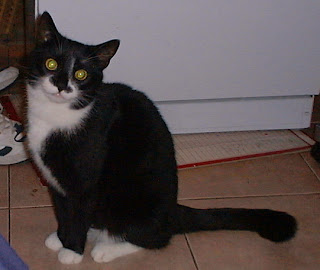
Molly just after she arrived 26th September 2000
Molly, for that was her name, came to us the week Melodie and I moved into our first house together. September 15th 2000, in the middle of the fuel protests which were raging at the time, we hired a van and moved in.

Most people would have considered that enough for one week! We happened to be in Halifax on the Sunday afternoon at the supermarket and decided to visit the RSPCA because somehow we decided what our new home needed was a cat.

On that day a decade ago we saw Molly and Lucy, a pair of cats who needed a new home as their previous owners had a baby who was allergic to them. I still recall them skulking at the back of their cage in the cattery, Lucy who was reluctant to come down of a perch to be petted and Molly looking generally unhappy. No-one else wanted this misfit pair because they were already both over 5 years old, the warden despairing of ever finding them a home.

Of course they were obviously the right animals for us! ;-) So by the end of the week we had taken them home. Molly immediately showed how things were going to be by shredding her way out of the RSPCA provided double walled cardboard carrier. To the day she died she detested being placed inside a carrier, funny that.
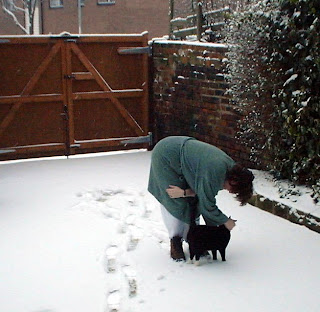
Melodie and Molly in the snow 28th December 2000
By the end of the year, when the snow came, the cats ruled the house and we were all happy together.

Little did we realise that soon in the summer of 2001 there would be another arrival to the family.
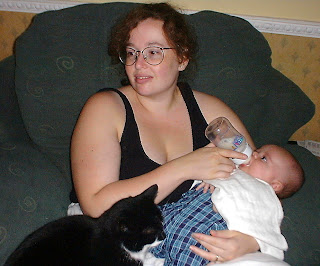
Molly with Melodie and Alex 2001
The arrival of our first child in June 2001 was a complete change in all our lives but we all managed to settle back into a routine. Although the banishment of the cats from upstairs remained a point of disagreement for a long time.

As Alex grew up the cats learned that feeding times for Alex could result in all manner of things falling from above. Soon Alex was mobile which resulted in different lessons on cats being sharp objects if not treated with respect. In February 2003 our family grew once more with the arrival of Joshua. The cats, now used to infants, took this in their stride.

Molly in Febuary 2004 hiding on a windowsill
While still about day to day the cats are not captured on camera so often form this point on.

Over the forthcoming months they ensured they were out of reach of the newborn and the precocious toddler.

By the time of Joshuas first birthday in 2004 Molly had taken to hiding "out of the way" as much as possible but remained as affectionate as ever.

Molly in a box March 2007
As the children grew up and life progressed Molly became ever more at home and developed the odd aggravating trait like taking clean washing off airers and dragging it out the window, through the cat flap and upstairs so she could sleep on it!

She still enjoyed participating in claiming boxes and defending them vigorously though!

The kids took on the job of feeding the cats which made their bond closer ensuring they were greeted by happy cats sitting lookout as they came home from school each day.

Molly continued to be a good companion and an infuriating self centred animal like all good cats.
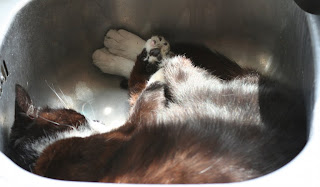
Molly asleep in the kitchen sink
Then on Tuesday evening our Neighbour knocked on our front door. They gave us the news that one of our cats had been run over and taken to the Vet. I immediately went to the back door and called and shook the treat box.

Lucy came running, but molly did not. We rang the vets who confirmed they had molly (we had them electronically tagged back in Halifax) and that they advised we did not come and see her until they had chance to asses her and deal with the shock.

As the days progressed her prognosis improved and then sank. She had a broken jaw, broken teeth, a dislocated hip, extensive bruising and something was definitely wrong with her kidney function.

Thursday evening the whole family went to see her and she purred and seemed happy to see us, she looked as bad as I feared though and somehow I knew there and then that this was probably goodbye. The children stroked her and petted her for a while and we left with an odd sadness, oh and to the sound of molly trying to gouge the veterinary nurse.

Yesterday she was due to have surgery to fix her jaw and hip...Alas when she was anaesthetised and x-rayed once more it became evident the hip was not just dislocated but her femur was fractured and there was additional damage. So just after midday came the call to ask what we wanted to do. The vet could attempt the repairs but due to her age and the other complications it was probably futile. So with heavy heart we agreed the best thing was not to revive her and she died a short time later.

I shall miss her morning greetings, her demands for attention, her sleeping in odd places and her companionship. I keep calling for her at meal times forgetting she will never come. I think Lucy is upset too, after spending their lives together her friend is gone and I cannot explain that to her.

So that is the end of Molly, a good cat.


14 October 2010

Axel Beckert: Thoughts on Gitorious and GitHub plus a useful git hook

When I took over the developement of xen-tools, I looked around for an appropriate git hosting. I especially had a look at GitHub and Gitorious. If you just regard the features, GitHub is definitely more targetted on single developers and Gitorious more towards projects: At GitHub, every repository has its URL under the URL of a user page which makes it nearly impossible to have user independent, official repositories for projects which have more than one official developer. At Gitorious, every hosted repository needs to belong to a project, even if it s only a published configuration. But a project can have more than one git repository. You only seem to be able to have personal repositories if you clone some existing Gitorious repository. So from a feature point of view, the xen-tools git repositories fit way better to Gitorious hosting while the git repositories with zshrc, conkerorrc and desktop configuration files defintely have a more fitting addresses on GitHub, in my case http://github.com/xtaran/$repository. On Gitorious, they are now together under a project called Axel s configuration files at http://gitorious.org/abe which contains git repositories of my on grml s .zshrc based .zshrc, my configuration for Conkeror and all the files necessary for my ratpoison/xmobar based netbook/laptop desktop. I though feel a little bad for giving the project the very short slug name abe instead of abe-config (as I did initially) since abe is IMHO not a proper project name for my configuration files and possibly other projects would have a more reasonable claim for that project name on Gitorious. But that way it suites more its purpose: Gather some of my git repositories which don t belong to a proper project. But there s another important point when comparing Gitorious and GitHub: Free Software needs free tools as Benjamin Mako Hill posted recently on Planet Debian. Despite my (probably well known) distrust against Google and therefore also Google Code, and despite knowing the history of SourceForge becoming non-free, I was not that much aware that GitHub s software is only partially open source and therefore also not free software while Gitorious is both as it s licensed under the GNU Affero General Public License (like StatusNet/identi.ca for example) which is basically GPLv3, but its ideas applied to hosted web applications scenario (where the GPL itself doesn t grasp), too. Initially I just had the xen-tools git repositories on Gitorious and all my small one-repository projects as copies of the repositories on my own git server on GitHub to get some more publicity for them and allow social cloning . After reading Mako s article, I decided to at least have repository clones on Gitorious of all repositories I mirror at GitHub, too. That way I force nobody to use the non-free tools on GitHub for social cloning one of my git repositories. And of course I have copies of my code somewhere on the net as backup. Or to say it with Linus Torvalds (slightly updated) words: Only wimps use tape backup: real men just upload their important stuff on git, and let the rest of the world clone it. ;-) But isn t that tedious to always push your code to three repositories? No, it isn t. I just push my code to git.noone.org where I have configured the according remotes and the following post-receive hook:
#!/bin/sh
                                                                     
read oldrev newrev refname
git push gitorious $ refname:t 
git push github $ refname:t 
The only other thing necessary is to use ssh-agent and SSH agent forwarding to at least the host you re pushing to.

Raphaël Hertzog: Correctly renaming a conffile in Debian package maintainer scripts

After having dealt with the removal of obsolete conffiles, I ll now explain what you should do when a configuration file managed by dpkg must be renamed. The problem Let s suppose that version 1.2 of the software stopped providing /etc/foo.conf. Instead it provides /etc/bar.conf because the configuration file got renamed. If you do nothing special, the new conffile will be installed with the default configuration, and the old one will stay around. Any customization made by the administrator are lost in the process (in fact they are not lost, they are still in foo.conf but they are unused). Of course, you could do mv /etc/foo.conf /etc/bar.conf in the pre-installation script. But that s not satisfactory: it will generate a spurious conffile prompt that the end-user will not understand. The solution In the preinst script, you have to verify if the old conffile has been modified by the administrator. If yes, you want to keep the file around. Otherwise you know you will be able to ditch it once the upgrade is over, and you rename it to /etc/foo.conf.dpkg-remove to remember this fact. In the postinst script, you remove /etc/foo.conf.dpkg-remove. If the old conffile (/etc/foo.conf) still exists, it s because it was modified by the administrator. You make a backup of the new conffile in /etc/bar.conf.dpkg-dist and rename the old one into /etc/bar.conf. In the postrm, when called to abort an upgrade, you move /etc/foo.conf.dpkg-remove back to its original name. In practice, use dpkg-maintscript-helper dpkg-maintscript-helper can automate all those tasks. You just have to put the following snippet in the maintainer scripts (postinst, postrm, preinst):
if dpkg-maintscript-helper supports mv_conffile 2>/dev/null; then
    dpkg-maintscript-helper mv_conffile /etc/foo.conf /etc/bar.conf 1.1-3 -- "$@"
fi
In this example, I assumed that version 1.1-3 was the last version of the package that contained /etc/foo.conf (i.e. the last version released before 1.2-1 was packaged). You can avoid the preliminary test if you pre-depend on dpkg (>= 1.15.7.2) or if enough time has passed to assume that everybody has a newer version anyway. You can learn all the details in dpkg-maintscript-helper s manual page. Found it useful? Be sure to not miss other packaging tips (or lessons), click here to subscribe to my free newsletter and get new articles by email (just check Send me blog updates ).
Flattr this Share/Bookmark No comment Support my work

Russell Coker: Links October 2010

Bruce Schneier wrote an insightful post about why designing products for wiretapping is a bad idea [1]. It seems that large parts of the Internet will be easy to tap (for both governments and criminals) in the near future unless something is done. The bad results of criminal use will outweigh any benefits of government use. Sam Watkins wrote an informative post about Android security [2]. Among other things any application can read all stored data including all photos, that s got to be a problem for anyone who photographs themself naked Rebecca Saxe gave an interesting TED talk about how brains make moral judgements [3]. Somehow she managed to speak about the Theory of Mind without mentioning Autism once. The Guardian has an amusing article by Cory Doctorow about security policies in banks [4]. He advocates promoting statistical literacy (or at least not promoting a lack of it) as a sound government policy. He also suggests allowing regulators to fine banks that get it wrong. Steven Johnson gave an interesting TED talk about Where Good Ideas Come From [5]. It s a bit slow at the start but gets good at the end. Adam Grosser gave an interesting TED talk about a fridge that was designed for use in Africa [6]. The core of the Absorption Refrigerator is designed to be heated in a pot of water in a cooking fire and it can then keep food cool for 12 hours. It s a pity that they couldn t design it to work on solar power to avoid the fuel use for the cooking fire. Josh Silver gave an interesting TED talk about liquid filled spectacles [7]. The glasses are shipped with a syringe filled with liquid at each side that is used to inflate the lenses to the desired refractive index. The wearer can just adjust the syringes until they get to the right magnification, as there are separate syringes the glasses work well with people who s eyes aren t identical (which is most people). Once the syringes are at the right spots the user can tighten some screws to prevent further transfer of liquid and cut the syringes off to give glasses that aren t overly heavy but which can t be adjusted any more, I guess that a natural extension to this would be to allow the syringes to be re-attached so that the user could adjust them every year to match declining vision. One thing that this wouldn t do is counter for Astigmatism (where the lens of the eye doesn t focus light to a point), but I guess they could make lenses to deal with a few common varieties of Astigmatism so that most people who have that problem can get a reasonable approximation. The current best effort is to make the glasses cost $19, which is 19 days salary for some of the poorest people in the world. Glasses in Australia cost up to $650 for a pair (or a more common cost of $200 or about $100 after Medicare) which would be about one day s salary. Eben Bayer gave an inspiring TED talk about one of the ways that mushrooms can save the planet [8]. He has designed molds that can be filled with Pasteurised organic waste (seed husks etc) and then seeded with fungal spores. The fungus then grows mycelium (thin fungal root fibers) through the organic waste making it into a solid structure which fits the shape of the mold. This is currently being used to replace poly-styrene foam for packaging and can apparently be used for making tiles that are fire retardant and sound proof for constructing buildings. The main benefits of the material are that it can be cheaply made without petrochemicals and that it is bio-degradable, I m not sure how the bio-degradable part would work with constructing buildings maybe they would just replace the panels every few years. Annie Lennox gave a TED talk about her Sing foundation to care for women and children who are affected by AIDS [9]. She describes the effect of AIDS in Africa as Genocide. Robert Ballard gave a very informative TED talk about exploring the oceans [10]. This was one of the most informative TED talks I ve seen and Robert is also one of the most enthusiastic speakers I ve seen, it s really worth watching! We really need more money spent on exploring the oceans. Jessa Gamble gave an interesting TED talk which suggests that the best thing to do is to go to bed at about sunset and then have a couple of hours of relaxing time during the middle of the night [11]. Apparently the subjects of body-block experiments who live for a month in a bunker without natural light or access to a clock get better sleep in this manner than they ever had in their life and feel fully awake for the first time. World Changing is a blog that has a lot of interesting articles about climate change and related issues [12]. It s worth a read. Cynthia Schneider gave an interesting TED talk about how reality competition TV is affecting reality [13]. Shows that are derived from the American Idol concept are driving a resurgence in some traditional forms of performance art while also promoting equality among other things it s apparent that winning is more important than misogyny. The Ritual of the Calling of an Engineer is an interesting concept [14]. I think it would be good to have something similar for Computer Science. Benjamin Mako Hill wrote an interesting and insightful essay about Piracy and Free Software [15].

11 October 2010

Jan Wagner: [bpo] new icinga 1.2 for lenny-backports-sloppy

Alexander Wirt was so kind to upload the latest icinga (1.2) release to unstable. This will be the next candidate for lenny-backports-sloppy.
If you can t wait, just grab the package from http://ftp.cyconet.org/debian/archive/bpo/icinga/1.2-1~bpo50+1/.
If you are using nagstamon and thinking about upgrading to icinga 1.2, I backported a working version from subversion r151, which you can grab from http://ftp.cyconet.org/debian/archive/bpo/nagstamon/0.9.4r151.1~bpo50+1/. P.S. If you like nagios and/or icinga related software, there is a Nagios Maintainers Group and we would like to invite you, if you want to improve or extend the nagios/icinga ecosystem in Debian.

9 October 2010

Sylvain Le Gall: OCaml cryptokit and Java PBEWithMD5AndDES

During one of my project I need to interact with Java cryptographic extension. Some data has been encrypted using PBEWithMD5AndDES. I need to access it from OCaml. I take a look at available cryptographic extension in the Debian project for OCaml: cryptgps and cryptokit. I choose cryptokit, because its author is well known: Xavier Leroy. This article was my starting point. Of course, I keep in mind that the reference is there and that there is a good article covering it. Here is the result in OCaml:
 let decrypt passphrase salt ?(iterationCount=41) str =
   let key, iv =
     let rec hash_aux iter str =
       if iter > 0 then
         (* Rehash string *)
         hash_aux
           (iter - 1)
           (hash_string
              (Hash.md5 ())
              str)
       else
         (* Key = first 8 bytes of the MD5 hash *)
         String.sub str 0 8,
         (* IV = last 8 bytes of the MD5 hash *)
         String.sub str 8 8
     in
       (* Hash n times combination of passphrase and salt,
           return key and iv 
         *)
       hash_aux
         iterationCount
         (passphrase ^ salt)
   in
     transform_string
        (Cipher.des
           ~pad:Padding.length
           ~iv:iv
           key
           Cipher.Decrypt)
       str
The only missing information was the pad algorithm to use (Padding.length). For this piece of information, I need to browse the RSA documentation and test a little bit. Rewriting PBEWithMD5andDES is quite straightforward with cryptokit and OCaml. It takes 25 lines with C# and OCaml (only counting LoC, no comment, no empty constructor or declaration in C#). I was thinking that this task will require 2 or 3 days, but it has been done in 4 hours... Many thanks to cryptokit ;-)

David Paleino: Simple Python and Vala XML parsers

As some of you might know, I'm an OpenStreetMaper. In the last month, during those bits of spare time I had, I wrote a set of python scripts which compute some statistics over an OSM dump. I do this by parsing the whole XML tree, and national dumps are pretty huge (italy.osm is ~4G nowadays, and is not as well-mapped as Germany!), so I needed a way to do this without creating a memory-hungry beast. With Python, I could succesfully do this:
#!/usr/bin/python
# -*- coding: utf-8 -*-
import xml.etree.cElementTree as etree
def parse(filename):
    source = open(filename)
    context = etree.iterparse(source, events=("start", "end"))
    context = iter(context)
    event, root = context.next()
    for event, elem in context:
        if event == "end":
            root.clear()
            continue
        print elem.tag
if __name__ == '__main__':
    import sys
    parse(sys.argv[1])
And here the results:
$ /usr/bin/time ./parsexml.py ~/osmstats/dumps/italy.osm.bz2.20100912.out 1>/dev/null
413.22user 6.15system 8:57.80elapsed 77%CPU (0avgtext+0avgdata 21200maxresident)k
7739552inputs+0outputs (10major+1470minor)pagefaults 0swaps
However, since some time, I wanted to learn Vala, so I tried to do this very same task with it. Here's the code:
using Xml;
class XmlParser  
    public void parse_file(string path)  
        var handler = SAXHandler();
        void* user_data = null;
        handler.startElement = start_element;
        handler.user_parse_file(user_data, path);
     
    public void start_element(string name, string[] attr)  
        stdout.printf("%s\n", name);
     
 
int main(string[] args)  
    Parser.init();
    var parser = new XmlParser();
    parser.parse_file(args[1]);
    Parser.cleanup();
    return 0;
 
You need to compile it with: valac --pkg libxml-2.0 xml.vala And here's the result:
$ /usr/bin/time ./xml ~/osmstats/dumps/italy.osm.bz2.20100912.out 1>/dev/null
122.01user 4.03system 3:14.61elapsed 64%CPU (0avgtext+0avgdata 6352maxresident)k
7738984inputs+0outputs (0major+461minor)pagefaults 0swaps
Both these codes are, however, CPU-hungry. But at least they don't swap :-) Needless to say that I'm planning to switch my scripts to Vala for 2.0.

8 October 2010

Russell Coker: Choosing an Android Phone

My phone contract ends in a few months, so I m looking at getting a new Android phone. I want a big Android phone (in both physical size and resolution) that has a physical keyboard, a digital compass, A-GPS and at least a 5MP camera with geo-tagging. I want to be able to read PDF files and run ssh sessions, so a big screen is required and a physical keyboard avoids wasting screen space for a soft-keyboard. My pockets will fit something about 10.5cm wide by 17cm high but I don t expect anyone to manufacture such a large phone. High resolution is a good thing too, it seems that the best available at the moment is 854*480 (with 800*480 being reasonably common). I want Wifi and all the 3G and GSM data transfer standards. It would be ideal to have a phone with the dual networking stack needed to do both voice and data at the same time. I m not interested in anything that runs a version of Android older than 2.2 as native tethering is important. An option to upgrade to post 2.2 would be a really good thing. Here are the nearest options I could find:
Phone Resolution Screen Size (inches) Camera Resolution Notes
Motorola Milestone 854*480 3.7 5MP
Motorola Droid 854*480 3.7 5MP
LG VS 740 800*480 3.2 3.2MP no GPS or compass
Lenovo LePhone 800*480 3.7 3MP no GPS or compass
It seems that Motorola makes the phones that best suit my needs, does anyone know of any better options?

7 October 2010

Debian News: Neuroimaging research in Debian

Debian 6.0 squeeze will be the first GNU/Linux distribution release ever to offer comprehensive support for magnetic resonance imaging (MRI) based neuroimaging research. It comes with up-to-date software for structural image analysis (e.g. ants), diffusion imaging and tractography (e.g. mrtrix), stimulus delivery (e.g. psychopy), MRI sequence development (e.g. odin), as well as a number of versatile data processing and analysis suites (e.g. nipype). Moreover, this release will have built-in support for all major neuroimaging data formats.

Please see the Debian Science and Debian Med task pages for a comprehensive list of included software and the NeuroDebian webpage for further information.

NeuroDebian at the Society for Neuroscience meeting 2010

The NeuroDebian team will run a Debian booth at the Society for Neuroscience meeting (SfN2010) that will take place November 13-17 in San Diego, USA. The annual meeting of the Society for Neuroscience is one of the largest neuroscience conferences in the world, with over 30,000 attendees. Researchers, clinicians, and leading experts discuss the latest findings about the brain, nervous system, and related disorders.

If you are a Debian enthusiast (developer, contributor, evangelist) and reside near San Diego (or have time and funds for travel/lounge), or already planing to attend SfN 2010, please help us to make the Debian booth at SfN shine. Please contact the NeuroDebian team at team@neuro.debian.net

If you are going to SfN2010, come talk to us at booth #3815.

Michael Hanke and Yaroslav Halchenko

6 October 2010

Russ Allbery: Review: Thinking in Java

Review: Thinking in Java, by Bruce Eckel
Publisher: Prentice Hall
Copyright: 2006
Printing: October 2009
ISBN: 0-13-187248-6
Format: Trade paperback
Pages: 1461
Thinking in Java has gone through multiple editions. This review is of the 4th edition, which is targetted at Java 5 (with some minor updates for Java 6, released as it was going to press). Prior to reading this book, I'd never written code from scratch in Java and had never learned anything about Java in a structured fashion. My CS degrees come before the era of ubiquitous Java; the most I'd ever done with the language was look over and make some minor fixes to code other people had written, using general programming knowledge. I choose this book as my introduction because I was looking for a ground-up introduction with good reviews and was avoiding books that contained a printed version of the Java library documentation. I can get that myself on-line. I kept a set of notes on my impressions of the Java language itself separately and will not get into that here. This is, instead, a review of Thinking in Java as a book and as a training tool for someone who wants to pick up the language. First off, this is a remarkably well-titled book, much more so than the typical programming language book. Eckel is not just teaching Java as one programming language among many. He tries hard to teach the reader to think in Java, with a lot of attention to idiomatic use of the language and natural ways to use its expressiveness. This is exactly what I was looking for I don't want to just write C or Perl in Java syntax and I was very satisfied with the result. The book is also very heavy on source code examples; this is much of the reason why it's 1,461 pages. Eckel illustrates everything with Java code, generally complete functioning short programs. Even exploratory musings and experiments are implemented as Java code. I don't think there's any significant thought in this book that isn't shown in both text and in explained Java code. Eckel has also clearly put significant effort into choosing good examples and designing his sample programs. I have some past (mild) experience with object-oriented design, and a lot of experience with higher-level system design, and I was satisfied and occasionally intrigued by the object structures and design tips that Eckel provides. He uses design pattern language heavily, but not in a confusing way, and he takes some time to explain typical design patterns and illustrate them repeatedly. This is a solid introduction to good object-oriented program design as well as an introduction to Java. One oddity of this book, though, is that Eckel introduces the language from the ground up, starting with syntax and basic types, and is very careful not to use any concepts before he introduces them. The result is a very thorough introduction to the Java language, but it means that it takes 900 pages (!) before Eckel introduces I/O and the possibility of writing a useful program based on just the information in the book. This is for entirely sound conceptual reasons: I/O in Java relies on lots of concepts, like exceptions and generics, that require extensive introduction and discussion. However, it does mean that through well more than half of a monumental tome the reader is learning the language through rather artificial programs. I have extensive prior programming background and a high tolerance for more abstract examples (I have a master's degree in software theory), so I could deal with this, but even with that background I was starting to feel like my head was getting too full and too crowded with concepts without being able to make them concrete. It probably would have helped to work through some of the exercises, but I dislike exercises that aren't grounded in some problem I personally want to solve. If you're someone who only learns languages through practical application, this approach to teaching the language may drive you nuts, and you may want to look for another book that compromises conceptual progression to get you started faster. Related to this, Thinking in Java is not about the standard library. It's about the language, and the vast majority of this book is focused directly on the language level: inheritance, information hiding, generics, exceptions, introspection, concurrency, annotations, serialization, and so forth. The only parts of the standard library that Eckel covers in depth are the container classes, I/O, and a somewhat odd and misplaced final chapter on Swing. There is nothing about databases, essentially nothing about web applications or containers, no network programming, and very little in the way of practical, applied problems. As you might guess from the combination of that limitation of scope and the length of this book, that means it is extremely comprehensive; I doubt there are many corners of the basic language semantics, including around generics, that Eckel leaves unexplored. This is exactly what I wanted (I know how to read library documentation myself and all language core libraries start looking mostly the same after you've programmed in five or six languages), but it's very different from the typical approach of a programming language book. Don't be surprised. This biggest problem with Thinking in Java from my perspective is that it defers many interesting topics to Eckel's web pages and to free companion books and material that is supposedly found there, to the point of advertising that on the cover. This is a good way to allow the reader to explore extra topics that are of specific interest while skipping others, provided that one actually delivers on that promise. However, Eckel's web site is dire. The first time I looked at it earlier this year I was unable to find most of the supplemental material the book promises is there, and now www.mindview.net doesn't resolve in DNS. I've found copies of some of that material hosted elsewhere in Google searches, but this is a rather frustrating experience if one was relying on that supplemental material to fill in the gaps. And the book is clearly written expecting people to go look at the web materials; Eckel refers to them probably a hundred times over the course of the book. Less of a serious problem, and more of a quirk, is the closing chapter on Swing. This chapter really doesn't fit much with the book. I suppose Eckel felt obligated to put in at least one chapter on some concrete applied topic (I personally would have preferred databases be that topic, but oh well), and it does serve a useful purpose in showing how concurrency, inner classes, inheritance, and introspection all work together in a significant Java library. But it's not presented as just an example, and it fits in oddly with the rest of the book. It also has an inexplicable middle section about Flash programming. I ended up mostly skimming this. But this isn't much of a flaw in the book; if one ignores 100 pages out of 1,450, that's not much of a loss. Eckel comes from a C++ background (he was a founding member of the C++ standardization committee), which shows up most prominantly in the generics chapter. It's a solid, thorough introduction to Java generics, but it also has an extensive exploration of all the problems with the Java erasure model and many, many examples of the things that one would find intuitive from C++ that don't work the same way in Java. If you come from a C++ background, this is quite possibly useful; if, like me, you don't care about C++, it's at best mildly interesting and gets a touch tedious. There are a few other places where Eckel pokes surprisingly sharp sticks at the Java designers, but taken in context I think this is a quirk of the book's conversational style (which is otherwise a feature). Eckel's love of Python is also somewhat entertaining (particularly the long advertisement for Python in the introductory chapters of a book on Java), but has little impact on the book. I think the largest drawback of it is that all the examples in this book are tested using a Python framework, which isn't so much a problem with them as a lost opportunity. They're annotated with metadata used by Eckel's Python test framework, and in a Java book I would have been much more interested in a good Java test framework built on top of something like JUnit. Oh well. Overall, this is a very solid book which, despite being enormous, does not feel pointlessly padded. It's thorough and exhaustive on its topic, but there's a point to nearly everything in here. It was also exactly the Java book I wanted: an introduction to the language, built on a firm foundation of object-oriented program design, with discussion and pointers on how to think idiomatically in the language and use it to its fullest potential, and without mindlessly reproducing the standard library documentation. If that's also what you're looking for in a Java book, I recommend it highly. Just know going in what sort of book you're getting, since its pacing and order of presentation may frustrate some learning styles. Rating: 8 out of 10

Debian News: Who is using Debian?

Here are the Debian users who have submitted a request to appear in our website so far in this year. Please welcome them into our Project! And here are some of their reasons to choose Debian:
We have chosen Debian over other alternatives; because of its reliability and easiness of maintenance.
The decision was based on the selection of additional expandable components, availability of distribution, a regular cycle for issuing amendments, stability and support solutions for a wide range of equipment for a dedicated server solutions.
Stability is important for us.
The main reason for choosing Debian over other distributions is the package management, security, number of available packages, ease-of-use, stability, amount of quality documentation, and cost.
We choose Debian to easen the burden of system administration. Also because Debian has very well maintaned packages and for high security.
Debian is powerful and keeping originality of Linux.
We find the software that comes with Debian very useful and easy to use since we are not specialists in computer matters.
Debian is the most powerful Linux distribution! The best choice for our jobs, our servers and our lifestyle.
We chose Debian because it is stable, simple and fast to install and to use, and because it is Free Software.
We are proud to say that we use Debian/GNU Linux on more than 90% of our servers and this simply because of it s stability, security and great packaging system.
Debian offered the perfect balance between security, stability and ease of administration.
We chose Debian for its rock-solid stability, ease of installation and configuration, and awesome ability to not only run on old, second-hand hardware, but to turn that hardware into powerful production machines perfect for our needs. We also like Debian s Social Contract. None of the other options were as successful in this implementation.
It is refreshing and enjoyable to have an operating system which gives users easy access.
Thanks very much for the hard work, Webmaster Team.

Next.

Previous.