Search Results: "ean"

17 September 2015

Julien Danjou: My interview in le Journal du Hacker

A few days ago, the French equivalent of Hacker News, called "Le Journal du Hacker", interviewed me about my work on OpenStack, my job at Red Hat and my self-published book The Hacker's Guide to Python. I've spent some time translating it into English so you can read it if you don't understand French! I hope you'll enjoy it.
Hi Julien, and thanks for participating in this interview for the Journal du Hacker. For our readers who don't know you, can you introduce you briefly?
You're welcome! My name is Julien, I'm 31 years old, and I live in Paris. I now have been developing free software for around fifteen years. I had the pleasure to work (among other things) on Debian, Emacs and awesome these last years, and more recently on OpenStack. Since a few months now, I work at Red Hat, as a Principal Software Engineer on OpenStack. I am in charge of doing upstream development for that cloud-computing platform, mainly around the Ceilometer, Aodh and Gnocchi projects.
Being myself a system architect, I follow your work in OpenStack since a while. It's uncommon to have the point of view of someone as implied as you are. Can you give us a summary of the state of the project, and then detail your activities in this project?
The OpenStack project has grown and changed a lot since I started 4 years ago. It started as a few projects providing the basics, like Nova (compute), Swift (object storage), Cinder (volume), Keystone (identity) or even Neutron (network) who are basis for a cloud-computing platform, and finally became composed of a lot more projects. For a while, the inclusion of projects was the subject of a strict review from the technical committee. But since a few months, the rules have been relaxed, and we see a lot more projects connected to cloud-computing joining us. As far as I'm concerned, I've started with a few others people the Ceilometer project in 2012, devoted to handling metrics of OpenStack platforms. Our goal is to be able to collect all the metrics and record them to analyze them later. We also have a module providing the ability to trigger actions on threshold crossing (alarm). The project grew in a monolithic way, and in a linear way for the number of contributors, during the first two years. I was the PTL (Project Technical Leader) for a year. This leader position asks for a lot of time for bureaucratic things and people management, so I decided to leave my spot in order to be able to spend more time solving the technical challenges that Ceilometer offered. I've started the Gnocchi project in 2014. The first stable version (1.0.0) was released a few months ago. It's a timeseries database offering a REST API and a strong ability to scale. It was a necessary development to solve the problems tied to the large amount of metrics created by a cloud-computing platform, where tens of thousands of virtual machines have to be metered as often as possible. This project works as a standalone deployment or with the rest of OpenStack. More recently, I've started Aodh, the result of moving out the code and features of Ceilometer related to threshold action triggering (alarming). That's the logical suite to what we started with Gnocchi. It means Ceilometer is to be split into independent modules that can work together with or without OpenStack. It seems to me that the features provided by Ceilometer, Aodh and Gnocchi can also be interesting for operators running more classical infrastructures. That's why I've pushed the projects into that direction, and also to have a more service-oriented architecture (SOA)
I'd like to stop for a moment on Ceilometer. I think that this solution was very expected, especially by the cloud-computing providers using OpenStack for billing resources sold to their customers. I remember reading a blog post where you were talking about the high-speed construction of this brick, and features that were not supposed to be there. Nowadays, with Gnocchi and Aodh, what is the quality of the brick Ceilometer and the programs it relies on?
Indeed, one of the first use-case for Ceilometer was tied to the ability to get metrics to feed a billing tool. That's now a reached goal since we have billing tools for OpenStack using Ceilometer, such as CloudKitty. However, other use-cases appeared rapidly, such as the ability to trigger alarms. This feature was necessary, for example, to implement the auto-scaling feature that Heat needed. At the time, for technical and political reasons, it was not possible to implement this feature in a new project, and the functionality ended up in Ceilometer, since it was using the metrics collected and stored by Ceilometer itself. Though, like I said, this feature is now in its own project, Aodh. The alarm feature is used since a few cycles in production, and the Aodh project brings new features on the table. It allows to trigger threshold actions and is one of the few solutions able to work at high scale with several thousands of alarms. It's impossible to make Nagios run with millions of instances to fetch metrics and triggers alarms. Ceilometer and Aodh can do that easily on a few tens of nodes automatically. On the other side, Ceilometer has been for a long time painted as slow and complicated to use, because its metrics storage system was by default using MongoDB. Clearly, the data structure model picked was not optimal for what the users were doing with the data. That's why I started Gnocchi last year, which is perfectly designed for this use case. It allows linear access time to metrics (O(1) complexity) and fast access time to the resources data via an index. Today, with 3 projects having their own perimeter of features defined and which can work together Ceilometer, Aodh and Gnocchi finally erased the biggest problems and defects of the initial project.
To end with OpenStack, one last question. You're a Python developer for a long time and a fervent user of software testing and test-driven development. Several of your blogs posts point how important their usage are. Can you tell us more about the usage of tests in OpenStack, and the test prerequisites to contribute to OpenStack?
I don't know any project that is as tested on every layer as OpenStack is. At the start of the project, there was a vague test coverage, made of a few unit tests. For each release, a bunch of new features were provided, and you had to keep your fingers crossed to have them working. That's already almost unacceptable. But the big issue was that there was also a lot of regressions, et things that were working were not anymore. It was often corner cases that developers forgot about that stopped working. Then the project decided to change its policy and started to refuse all patches new features or bug fix that would not implement a minimal set of unit tests, proving the patch would work. Quickly, regressions were history, and the number of bugs largely reduced months after months. Then came the functional tests, with the Tempest project, which runs a test battery on a complete OpenStack deployment. OpenStack now possesses a complete test infrastructure, with operators hired full-time to maintain them. The developers have to write the test, and the operators maintain an architecture based on Gerrit, Zuul, and Jenkins, which runs the test battery of each project for each patch sent. Indeed, for each version of a patch sent, a full OpenStack is deployed into a virtual machine, and a battery of thousands of unit and functional tests is run to check that no regressions are possible. To contribute to OpenStack, you need to know how to write a unit test the policy on functional tests is laxer. The tools used are standard Python tools, unittest for the framework and tox to run a virtual environment (venv) and run them. It's also possible to use DevStack to deploy an OpenStack platform on a virtual machine and run functional tests. However, since the project infrastructure also do that when a patch is submitted, it's not mandatory to do that yourself locally.
The tools and tests you write for OpenStack are written in Python, a language which is very popular today. You seem to like it more than you have to, since you wrote a book about it, The Hacker's Guide to Python, that I really enjoyed. Can you explain what brought you to Python, the main strong points you attribute to this language (quickly) and how you went from developer to author?
I stumbled upon Python by chance, around 2005. I don't remember how I hear about it, but I bought a first book to discover it and started toying with that language. At that time, I didn't find any project to contribute to or to start. My first project with Python was rebuildd for Debian in 2007, a bit later. I like Python for its simplicity, its object orientation rather clean, its easiness to be deployed and its rich open source ecosystem. Once you get the basics, it's very easy to evolve and to use it for anything, because the ecosystem makes it easy to find libraries to solve any kind of problem. I became an author by chance, writing blog posts from time to time about Python. I finally realized that after a few years studying Python internals (CPython), I learned a lot of things. While writing a post about the differences between method types in Python which is still one of the most read post on my blog I realized that a lot of things that seemed obvious to me where not for other developers. I wrote that initial post after thousands of hours spent doing code reviews on OpenStack. I, therefore, decided to note all the developers pain points and to write a book about that. A compilation of what years of experience taught me and taught to the other developers I decided to interview in the book.
I've been very interested by the publication of your book, for the subject itself, but also the process you chose. You self-published the book, which seems very relevant nowadays. Is that a choice from the start? Did you look for an editor? Can you tell use more about that?
I've been lucky to find out about others self-published authors, such as Nathan Barry who even wrote a book on that subject, called Authority. That's what convinced me it was possible and gave me hints for that project. I've started to write in August 2013, and I ran the firs interviews with other developers at that time. I started to write the table of contents and then filled the pages with what I knew and what I wanted to share. I manage to finish the book around January 2014. The proof-reading took more time than I expected, so the book was only released in March 2014. I wrote a complete report on that on my blog, where I explain the full process in detail, from writing to launching. I did not look for editors though I've been proposed some. The idea of self-publishing really convince me, so I decided to go on my own, and I have no regret. It's true that you have to wear two hats at the same time and handle a lot more things, but with a minimal audience and some help from the Internet, anything's possible! I've been reached by two editors since then, a Chinese and Korean one. I gave them rights to translate and publish the books in their countries, so you can buy the Chinese and Korean version of the first edition of the book out there. Seeing how successful it was, I decided to launch a second edition in Mai 2015, and it's likely that a third edition will be released in 2016.
Nowadays, you work for Red Hat, a company that represents the success of using Free Software as a commercial business model. This company fascinates a lot in our community. What can you say about your employer from your point of view?
It only has been a year since I joined Red Hat (when they bought eNovance), so my experience is quite recent. Though, Red Hat is really a special company on every level. It's hard to see from the outside how open it is, and how it works. It's really close to and it really looks like an open source project. For more details, you should read The Open Organization, a book wrote by Jim Whitehurst (CEO of Red Hat), which he just published. It describes perfectly how Red Hat works. To summarize, meritocracy and the lack of organization in silos is what makes Red Hat a strong organization and puts them as one of the most innovative company. In the end, I'm lucky enough to be autonomous for the project I work on with my team around OpenStack, and I can spend 100% working upstream and enhance the Python ecosystem.

Norbert Preining: Debian/TeX Live 2015.20150917-1

Usual regular update of the TeX Live packages. Now that Debian/unstable is back to full development speed thanks to the end of the bit gcc transition, probably this TeX Live update will be lost between the hundreds of others. Anyway a few interesting changes are still in there. Debian - TeX Live 2015 Most importantly the fix for unicode-math that was broken for a short time, and for the Japanese users it seems that the LaTeX3 packages have gained support for upTeX. Good to hear. Of course, these are not the only updates and newcomers, see the list below. Updated packages abc, acro, alegreya, animate, arabxetex, babel-bosnian, babel-french, babel-greek, babel-latin, babel-welsh, beamer-FUBerlin, bidi, bigfoot, blochsphere, bxjscls, chemformula, chemmacros, chet, classicthesis, crossrefware, csplain, ctable, ctanify, datetime2, datetime2-basque, detlev-cm, disser, doclicense, drm, dtxgen, dtxtut, dvips, ecclesiastic, eledmac, embrac, etex-pkg, etoc, factura, fbb, fithesis, font-change, fontname, glossaries, gothic, greek-fontenc, IEEEtran, l3build, l3experimental, l3kernel, l3packages, latexconfig, lettrine, luatexja, mathastext, mcf2graph, media9, metrix, mhequ, minted, moderntimeline, newtx, ocgx2, pagecolor, pdftex, pgf, pstricks, reledmac, resphilosophica, roboto, shdoc, siunitx, suftesi, tetex, tex4ht, texlive-scripts, tikz-bayesnet, translations, ucharcat, udesoftec, ulthese, unicode-math, ut-thesis, withargs, xint. New packages checklistings, cleanthesis, easyreview, fei, medstarbeamer, mfirstuc, nevelok, old-arrows, proofread, uassign, xebaposter. Enjoy.


16 September 2015

Russ Allbery: Review: The Goblin Emperor

Review: The Goblin Emperor, by Katherine Addison
Publisher: Tor
Copyright: April 2014
ISBN: 1-4299-4640-7
Format: Kindle
Pages: 446
Maia is the child of the current emperor of the Elflands, but not a favored one. He's the half-goblin son of a political marriage to a goblin princess, quickly orphaned away from the capital and kept in seclusion well out of the way of his father and court politics. And in the care of his cousin Setheris: cruel and abusive companionship. Then the airship Wisdom of Choharo crashes with no survivors, killing everyone in the line of succession. Except Maia. Maia is in no way prepared to be emperor, but the rules of succession are clear: he is now emperor. We all know from medieval history, both real and fantastic, that clear rules rarely got in the way of aggressive political maneuvering, but Maia's short-term survival is helped considerably by complex factions at play at court (of which he is almost wholly ignorant), and a certain lack of bloodthirstiness in elven politics. Rather than disposing of the unexpected heir, people instead start maneuvering to manipulate and control him. The current Lord Chancellor is the first, beginning his play in the message sent informing Maia of his father's death, and his cousin isn't far behind, but they're only the first two. Meanwhile, Maia, who had never been trained for any sort of court life, has to learn nearly everything about his new life: how to interact with servants, the rituals of court, his new duties, and all of the factions in play. One might expect that Maia would quickly be reduced to a pawn of one faction or another, but he has two secret weapons. One is that he is a legitimately nice person with a strongly developed sense of empathy. Early on, he lucks into some opportunities to show this and wins some popularity and some allies of his own, particularly among those people not used to being treated with respect. And two, he's had enough of his cousin controlling and abusing him. He's determined to make his own decisions and not take orders from someone else, and now has enough nominal power to possibly pull this off. The Goblin Emperor is a fantasy of political agency, and a story about political maneuvering, tricky decisions, navigating alliances, and learning politics. There isn't a lot of action here: most of the plot happens in conversation. The tension is high Maia's situation is precarious but it mostly involves second-guessing his decisions and actions, and hoping that his weaknesses and ignorance don't get him into too much trouble. That is an extremely tricky book to write. Addison had to walk a tightrope between letting Maia's new responsibilities come unrealistically easily, making him seem like a Chosen One with special plot powers, and having readers get too frustrated with realistically bad decisions and lose their desire to read about him. Addison walks that tightrope magnificently. I liked Maia throughout this book, and that's the strength of it. He never felt like the typical fantasy coming of age hero who is magically protected by the plot. He's just a genuine, honest person, reacting to his own past as best he can, making the best decisions he knows how to make. He makes mistakes, but Addison wisely avoids making those mistakes cringe-worthy or too obvious. Instead, they're like bad moves in a chess match: they create problems but also some opportunities, and they're realistically recoverable. And it's a delight to see Maia bring empathy and a disinterested outside perspective to the hothouse mess of court politics and come up with some very creative solutions. Obviously, the situation that allows Maia to succeed is artificial. This is a fantasy: Maia happens to be just the right person the empire needs, and that's clearly an authorial construction. It may be impossible to write a political story about a well-meaning, naive outsider that isn't a tragedy without a bit of cheating. But Addison hides the cheating well. Maia may be very lucky in the empire he inherits, but it feels coherent and believable. By the end of the book, Maia has dealt with everything from international diplomacy to the incredibly complex negotiations around further heirs to the empire. And (realistically) he doesn't stay lucky throughout the book: eventually, no matter how careful he tries to be, he angers some powerful people. I enjoyed every step along the way, and would have happily read more about Maia. In my personal ranking, this was second only to Ancillary Sword in the nominees for the 2015 Hugo, and I wouldn't disagree too strongly with someone who argued it was better. It's not a typical sort of fantasy, but it's one I enjoyed very much. Recommended. One warning: consider going to the back of the book and reading the glossary at the start. There may be some mild spoilers in there, but it also explains the title conventions in the empire, and some of those titles look very much like proper names. If, like me, you don't read this until the end of the book, you may find yourself horribly confused by several apparently similarly-named characters. Rating: 8 out of 10

14 September 2015

Lunar: Reproducible builds: week 20 in Stretch cycle

What happened in the reproducible builds effort this week: Media coverage Motherboard published an article on the project inspired by the talk at the Chaos Communication 15. Journalists sadly rarely pick their headlines. The sensationalist How Debian Is Trying to Shut Down the CIA got started a few rants here and there. One from OpenBSD developper Ted Unangst lead to a good email contact and some thorough comments. Toolchain fixes The modified version of gettext has been removed from the experimental toolchain. Fixing individual package seems a better approach for now. Chris Lamb sent two patches for abi-compliance-checker: one to drop the timestamp from generated HTML reports and another to make umask and timestamps deterministic in the abi tarball. Bugs submitted by Dhole lead to a discussion on the best way to adapt pod2man now that we have SOURCE_DATE_EPOCH specified. There is really a whole class of issues that are currently undiscovered waiting for tests running on a different date. This is likely to should happen soon. Chris Lamb uploaded a new version of debhelper in the reproducible repository, cherry-picking a fix for interactions between ddebs and udebs. Packages fixed The following packages became reproducible due to changes in their build dependencies: aspic, django-guardian, erlang-sqlite3, etcd, libnative-platform-java, mingw-ocaml, nose2, oar, obexftp, py3cairo, python-dugong, python-secretstorage, python-setuptools, qct, qdox, recutils, s3ql, wine. The following packages became reproducible after getting fixed: Some uploads fixed some reproducibility issues but not all of them: Patches submitted which have not made their way to the archive yet: reproducible.debian.net The configuration of all remote armhf and amd64 nodes in now finished. The remaining reproducibility tests running on the Jenkins host has been removed. armhf results and graphs are now visible in dashboard. We can now test the whole archive in 2-3 weeks using the current 12 amd64 jobs and 3 months using the current 6 armhf builders. We will be looking at improving the armhf sitation, maybe using more native systems or via arm64. (h01ger) The Jenkins UI is now more responsive since all jobs building packages have been moved to remote hosts. (h01ger) A new job has been added to collect information about build nodes to be included in the variation table. (h01ger) The currently scheduled page has been split for amd64 and armhf. They now give an overview (refreshed every minute, thanks to Chris Lamb) of the packages currently being tested. (h01ger) Several cleanup and bugfixes have been made, especially in the remote building and maintenance scripts. They should now be more robust against network problems. The automatic scheduler is now also run closer to when schroots and pbuilders are updated. (h01ger, mapreri) Package reviews 16 reviews have been removed, 54 added and 55 updated this week. Santiago Vila renamed lc_messages_randomness with the more descriptive different_pot_creation_date_in_gettext_mo_files. New issues added this week: timestamps_in_reports_generated_by_abi_compliance_checker, umask_and_timestamp_variation_in_tgz_generated_by_abi_compliance_checker, and timestamps_added_by_blast2. 23 new FTBFS bugs have been filled by Chris Lamb, and Niko Tyni. Misc. Red Hat developper Mike McLean had a talk at Flock 2015 about reproducible builds in Koji. Slides and video recording are available. Koji is the build infrastructure used by Fedora, Red Hat and other distributions. It already keeps track of the environment used for a given build, so the required changes for handling the environment are smaller than the ones in Debian. Fedora is still missing a team effort to fix non-determinism in the package builds, but it is great to see Fedora moving forward.

13 September 2015

Russ Allbery: Review: My Real Children

Review: My Real Children, by Jo Walton
Publisher: Tor
Copyright: May 2014
ISBN: 0-7653-3265-5
Format: Hardcover
Pages: 317
Patricia, the one form of her name that she's never used, is what the staff in the nursing home call her. "VC" is the frequent annotation on her daily chart: very confused. She's old, and forgetful, and trying very hard not to be her mother, and she remembers two lives. Not only remembers but lives: the nursing home isn't the same from day to day. They keep misplacing the lift, and the staff keep changing. But the memories are the strongest. She has two lives, two sets of children, all of whom she recognizes. When someone from one life visits, the other feels like a dream, but both of them persist. Two lives that divided at the most significant decision of her life. My Real Children is one of those books that fits in the broader speculative fiction genre as alternate history, but also has many of the virtues of mimetic fiction. It's the story of one woman's life, told, except for the opening frame, chronologically from start to finish. At the start, it's simple biography, telling Patty's story from childhood, through World War II, until the moment of her fateful decision in 1949. From there the narrative splits, and she lives two lives. And the world splits as well: in one, Kennedy was assassinated by a bomb; in another, the Cuban Missile Crisis escalated into something much worse. Much is still unchanged, including the general lives of people Patty knew well in one life and not in another, but the worlds keep diverging from each other and from ours. The exact nature of the divergence is not, however, a significant part of the book. This is not the type of alternate history that is obsessed with the point of change, or even the implications for the world. Rather, this novel is about one woman, one decision, and two very different paths through life. Different friends, different challenges, different careers... different hopes and dreams, and different children. But always the same person, the same sense of practicality, the same ethics. It's beautifully told, striking just the right balance of showing important moments in detail and passing quickly, but smoothly, over some years. And, as with Among Others, Walton strikes the perfect emotional balance, leaving some reactions understated, letting the reader bring their own reactions to the book, and filling it with small bits of telling, factual detail rather than internal monologues. This is also one of the most heart-wrenching books I've ever read. My Real Children is a whole life, and not an easy one, complete with the heartaches and betrayals, the good and bad decisions, care for elderly relatives, dementia, tragedy, and even abuse. And moments of shining joy or profound satisfaction, but made all the more poignant because they're fleeting. The reader knows, in a sense, how the story ends, which casts a shadow over the rest of the book. But, even without that shadow, life can be hard, or cruel, alongside the wonder and joy. And it ends, and the ending is not neat and clean and uplifting, although one can choose how one meets it. This is the story of a life, all of it, and how choices can divide that life, and how they can cast a long shadow over how one later defines oneself. This book hurts. A lot. Enough that I want to warn you in advance I was in tears through the last third of the book. But it hurts because it's so very real and deep, not via a blow-by-blow description of daily actions, but by striding unafraid into the deep complications of choice and consequence. It's also a profoundly feminist book, in a quiet and descriptive way. It shared the Tiptree award for 2015 and fully deserved it. Both of the protagonist's lives are struggles against expectations, around gender, sexuality, and the role of women in society. Those struggles take very different forms, but they share some deep similarities. Walton shows the impact from the bottom up: the effects on specific lives, specific people, specific situations. It's brilliantly done. One can't help but think of The Female Man given the telling of parallel lives, but this is a case study, whereas Russ's novel was a battle cry. It gets under your skin instead of in your face. (Use of subtlety on this topic is easier now, forty years of occasional progress past when Russ wrote her classic.) This is a much harder book to read than Among Others. It's less forgiving, less reassuring, less willing to provide a happy ending. Lives rarely have clean, happy endings; one has to construct them, by choosing the material to build the ending on. But it's a brilliant, profound book, in that way that stories about people in all their complexity can be. Be cautious about your mood when you read this, particularly if you've had the experience of caring for a dying relative, but it's a book I will remember for a very long time. Rating: 9 out of 10

Gregor Herrmann: RC bugs 2015/31-37

during the last weeks, I spent time mostly with RC bug prevention but I at least managed to also fix a couple of actual RC bugs:

Russ Allbery: Review: The Sea Thy Mistress

Review: The Sea Thy Mistress, by Elizabeth Bear
Series: Edda of Burdens #3
Publisher: Tor
Copyright: February 2011
ISBN: 0-7653-1884-9
Format: Hardcover
Pages: 334
The Sea Thy Mistress is the third book in the Edda of Burdens series, but the second book (By the Mountain Bound) was a prequel to the first, telling the story of an earlier world and the betrayal that ended it. This one is a direct sequel to All the Windwracked Stars, a complex and idea-rich book that I read more than six years ago. A challenging property of Bear's fiction is that it's short on explanation and doesn't hold your hand. This makes it lean, sharp, and effective if you're fully invested in it and can keep the context in your head. It becomes very hard to understand if you've mostly forgotten the plot of an earlier book. (Once again, I bemoan the death of the previous book synopsis in series fiction.) The Sea Thy Mistress is all about aftermath, loss, despair, unhealed wounds, old grudges, and complicated personal histories, and it relies very heavily on the reader being invested enough in the characters to care about all of those things. I wish I'd read this entire series closer together so that I could retain more of the state. The start of this story was therefore somewhat frustrating, as I scrambled to rebuild my memory of the first book and piece together the large cast. Thankfully, most of the characters are easy to care about. Aethelred reliably brought a smile to my face, and the opening scene of him finding a baby on the sea shore is a great piece of writing. Selene is back; she was one of my favorite characters in the first book. And Bear pulls off something I didn't think she could: the Grey Wolf is also back, for the third book, and he actually won me over. I think he grew up a bit; there's at least less whining and angst, and more effective action. It probably also helped that less of the story was told from his perspective. The Sea Thy Mistress is primarily the story of Cathoair and his son, Cathmar, and their encounter with a truly nasty threat: a goddess who has way more knowledge of how their world works than they do, and is out to destroy it. This review will necessarily be sketchy on details; most of them would partly spoil All the Windwracked Stars. (I suppose I'm spoiling it a bit anyway just by listing characters who are still around.) Cathmar is... not too irritating. He's young and stupid, and the first half of the book is a bit painful as he plays into the hands of the plot with much less information than the reader has available. But I was okay with him by the end of the book. Cathoair is a more complicated matter. I suspect whether you like this book will depend mostly on whether you can find some sympathy for his personal angst and self-destructive behavior, or at least tolerate him long enough to get to the ending. Quite a lot of this book consists of people behaving stupidly and horribly while those who love them stand by helplessly, unable to figure out how to break the cycle. If that sounds frustrating, you have the right impression. I really struggled with the first two-thirds of the book and started regretting reading it. But there is a payoff: one that's uncomfortable, raw, perilous, and sad, but also beautiful and honest and effective. Muire's role in this book may be minor, but it's very memorable. Despite the difficulties of the early book, I was very glad to have read it for the payoff. I'm not sure whether to recommend this or not, but I think it's worth reading if you enjoyed All the Windwracked Stars. If you do read it, though, try to read the whole series in close proximity. You'll want to remember the details between books. I'm now somewhat tempted to go back and re-read the whole series to experience it in context. Rating: 6 out of 10

12 September 2015

Ritesh Raj Sarraf: Google Take Action - Encryption

So I got an email yesterday from Google's Jess Hemerly, talking about how they care about encryption To quote a small snippet of the email:
We use locks to keep our homes and our possessions safe offline. But how can we protect our digital things, like photos on a smartphone or email traveling across the web? The answer is encryption.
To change, it has to start from home. That means, add encryption support to Gmail. Add encryption to Google Photos. To every service you provide. So that, if tomorrow, your service is compromised, you don't public our data. What all the service providers need to realize, is that it is not the tool that needs encryption, but the data. You could claim that newer Androids are safer because encryption is enabled by default. But the data that you are backing up on your cloud, is not encrypted. It only makes sense to have an end-to-end encryption, or rather, encryption at source. Had you just stacked the interface to have write() transparently call encrypt() for any and all data, there'd be no worry about privacy. But wait, then how'd you munch.

Categories:

Keywords:

Like:

11 September 2015

Matthias Klumpp: Deploying Limba packages: Ideas & current status

LimbaHubThe Limba project does not only have the goal to allow developers to deploy their applications directly on multiple Linux distributions while reducing duplication of shared resources, it should also make it easy for developers to build software for Limba. Limba is worth nothing without good tooling to make it fun to use. That s why I am working on that too, and I want to share some ideas of how things could work in future and which services I would like to have running. I will also show what is working today already (and that s quite something!). This time I look at things from a developer s perspective (since the last posts on Limba were more end-user centric). If you read on, you will also find a nice video of the developer workflow  1. Creating metadata and building the software To make building Limba packages as simple as possible, Limba reuses already existing metadata, like AppStream metadata to find information about the software you want to create your package for. To ensure upstreams can build their software in a clean environment, Limba makes using one as simple as possible: The limba-build CLI tool creates a clean chroot environment quickly by using an environment created by debootstrap (or a comparable tool suitable for the Linux distribution), and then using OverlayFS to have all changes to the environment done during the build process land in a separate directory. To define build instructions, limba-build uses the same YAML format TravisCI uses as well for continuous integration. So there is a chance this data is already present as well (if not, it s trivial to write). In case upstream projects don t want to use these tools, e.g. because they have well-working CI already, then all commands needed to build a Limba package can be called individually as well (ideally, building a Limba package is just one call to lipkgen). I am currently planning DeveloperIPK packages containing resources needed to develop against another Limba package. With that in place and integrated with the automatic build-environment creation, upstream developers can be sure the application they just built is built against the right libraries as present in the package they depend on. The build tool could even fetch the build-dependencies automatically from a central repository. 2. Uploading the software to a repository While everyone can set up their own Limba repository, and the limba-build repo command will help with that, there are lots of benefits in having a central place where upstream developers can upload their software to. I am currently developing a service like that, called LimbaHub . LimbaHub will contain different repositories distributors can make available to their users by default, e.g. there will be one with only free software, and one for proprietary software. It will also later allow upstreams to create private repositories, e.g. for beta-releases. 3. Security in LimbaHub Every Limba package is signed with they key of its creator anyway, so in order to get a package into LimbaHub, one needs to get their OpenPGP key accepted by the service first. Additionally, the Hub service works with a per-package permission system. This means I can e.g. allow the Mozilla release team members to upload a package with the component-ID org.mozilla.firefox.desktop or even allow those user(s) to own the whole org.mozilla.* namespace. This should prevent people hijacking other people s uploads accidentally or on purpose. 4. QA with LimbaHub LimbaHub should also act as guardian over ABI stability and general quality of the software. We could for example warn upstreams that they broke ABI without declaring that in the package information, or even reject the package then. We could validate .desktop files and AppStream metadata, or even check if a package was built using hardening flags. This should help both developers to improve their software as well as users who benefit from that effort. In case something really bad gets submitted to LimbaHub, we always have the ability to remove the package from the repositories as a last resort (which might trigger Limba to issue a warning for the user that he won t receive updates anymore). What works Limba, LimbaHub and the tools around it are developing nicely, so far no big issues have been encountered yet. That s why I made a video showing how Limba and LimbaHub work together at time: Still, there is a lot of room for improvement Limba has not yet received enough testing, and LimbaHub is merely a proof-of-concept at time. Also, lots of high-priority features are not yet implemented. LimbaHub and Limba need help! At time I am developing LimbaHub and Limba alone with only occasional contributions from others (which are amazing and highly welcomed!). So, if you like Python and Flask, and want to help developing LimbaHub, please contact me the LimbaHub software could benefit from a more experienced Python web developer than I am  (and maybe having a designer look over the frontend later makes sense as well). If you are not afraid of C and GLib, and like to chase bugs or play with building Limba packages, consider helping Limba development :-)

Daniel Pocock: Payment for shadow work

A significant court ruling yesterday means that companies in the EU have to pay employees for time spent traveling to and from work. If something seems too good to be true, it usually is. Once you get past the headline, you find that it only applies to workers who are going to appointments outside their workplace. Some companies have been careless about scheduling such appointments, sometimes leaving an employee more than 2 hours from his home at the end of the day and this new ruling may just force them to either try a little harder to schedule appointments with consideration for the employee or pay for the extra time if excessive travel sometimes occurs. The ruling may be good news for IT workers, road congestion and the environment. With companies now becoming more efficient in managing travel time, they may well need to improve the software they use for scheduling the employee's time. With certain types of employee potentially having a shorter journey after the last appointment, this means less road congestion and less pollution. Professionals who have to fly may also be taking note: if you work in Paris but have to fly to London one day for meetings, then your working time starts when you leave your home at 05:30 and finishes at 22:00 when you get home. Shadow work comes in many forms It is good to see society taking note of the hidden cost of shadow work. What about all those other nasty and inefficient practices that take time but you don't get paid for them? Have you ever wondered why some companies send bills and statements to you by email or post, but others expect you to waste 5 minutes of your time logging in to their web site to download the bill or statement? Should people be paid for this time too and would that force these companies to stop being so lazy? Some companies have been trying to avoid doing the right thing by arguing that email is not secure, but this just doesn't add up: the original PGP MIME specs for email encryption were published through the IETF process in 1996. Barclaycard recently began offering to send credit card statements using encrypted PDF, proving that many of the excuses given by other companies are just that: excuses. For developers For people who are interested in improving the way their organization sends communications to customers, a popular choice is the Apache Camel integration framework. I've deployed Camel for customer trade notification and other purposes at several large and well known firms in financial services. It has a rich set of features for transforming messages, including a PGP data format for encryption and it is able to send messages out using a vast number of connectivity options, including many of the basic ones like SMTP, SMPP (for SMS), XMPP/Jabber and message queues.

10 September 2015

Antoine Beaupr : Switched to bootstrap theme

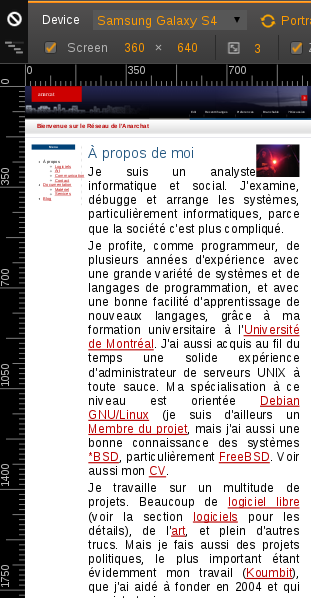
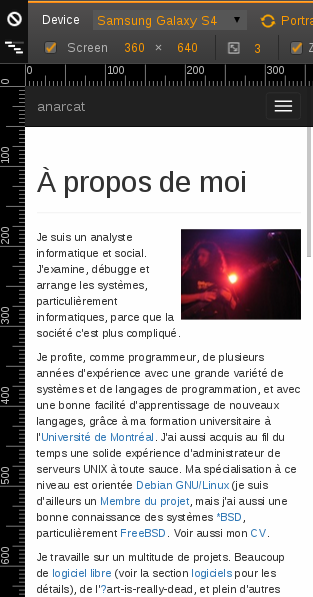
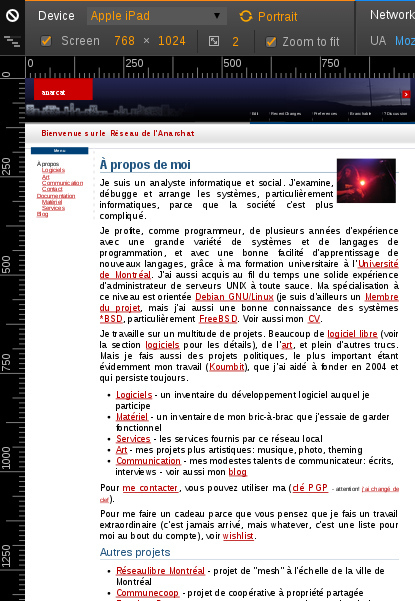
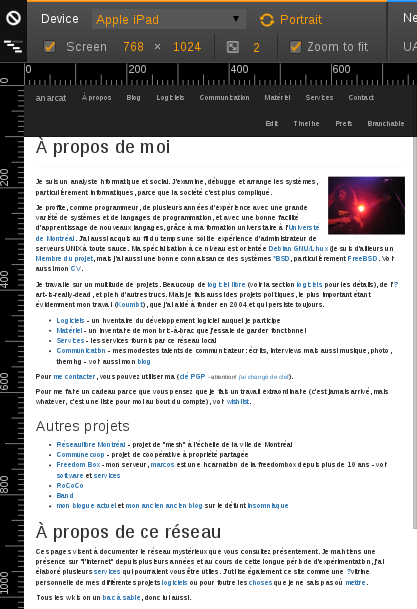
I finally gave up and drank the cool-aid of the Bootstrap theme. The main reason was that I noticed the site was basically unusable on any mobile device, including tablet computers like the iPad, which are unfortunately very, very common. Phones wouldn't render the site in a legible way either, unfortunately. The change is rather drastic, so I figured it was important to mention it here. I am not so satisfied pretty exctied with the result: the theme is very basic, if not absent. I actually like that purified form now, and it works across devices now much better. But I do feel I just made my blog look like everyone else that uses Bootstrap. We seem to enter an era where non-graphic designers (like me) are back to building web pages that all look the same, not very different, in a way, from the old days of plain HTML, like the default ikiwiki theme. I did some work to change the look at least minimally, but the top black navbar is really a killer giveaway this is a bootstrap theme. Bootstrap does a lot for the typography, at least when checking the presslabs checklist or the practical typography checklist, but I still had to change the main body width, which helped a lot I think. Anyways, the old Night City theme is still available for download and I could still flip it back on here if I need to.

What changed The new theme keeps the distractions away, but ironically, it's slower than the previous theme even though there are no images and basically no colors at all. On my tests, it now loads in about 3.42 seconds on the "Regular 2G (250Kbps)" simulation of Chromium with 72KB in 12 requests. Whereas my tests with the previous theme were taking 3.25 seconds with 43.5KB in 17 requests. This is due to the Bootstrap CSS, which takes a whopping 19KB itself, but especially because I now load JQuery, which takes a whopping 32.8KB! And that is probably gzip-compressed, as the original is more around 90KB. But at least the thing is readable on phones and tablets now. Compare:

Samsung S3, before Screenshot of a fake rendering on the Samsung Galaxy S3 in night city

Samsung S3, after Screenshot of a fake rendering on the Samsung Galaxy S3 in bootstrap I like this: much simpler, purer version on smaller devices. And we see what counts: the freaking text. Of course, on tablets, it doesn't fare as well: the top menu gets wrapped around...

Apple iPad, before Screenshot of a fake rendering on the iPad in night city

Apple iPad, after Screenshot of a fake rendering on the iPad in bootstrap Apparently, the fix would be for me to "customize the @grid-float-breakpoint variable" in LESS (which I thought was a pager, but seems to be a CSS preprocessor, graaah). Still, I think it's better that way, more readable, and less crufty.

How it was done After doing a thorough evaluation of all the Bootstrap ikiwiki themes I could find (there are more than 4 at least!), I figured I prefered the Jak Linux one. It seemed to be better implemented than the others, cleaner, and I liked the mean black border on top. Black is cool. Oh, and I liked the subtle footer as well. Subtle is cool. Unfortunately, that theme originally required a custom plugin to have a menu on top, which i thought was silly. So I patched it to make it work with the sidebar plugin, which turned out to be trivially simple: just dump the sidebar content, and make the sidebar page have explicit HTML tags in it that match Bootstrap's required classes. I also added the regular action links in the top navbar, but that does overload it quite a bit. I also did some code cleanups and various other small changes, all of which are available in my personnal git repo.

What doesn't work So of course, there are always problems. The first problem is the extra bandwidth usage. Not sure that can be fixed, other than switching to the upcoming Bootstrap 4, which is smaller than Bootstrap 3, bizarrely. The more annoying problems are weird alignment issues. If the screen gets two narrow without kicking some collapse rules in place (the iPad bug above), the navbar rows overflow and look ugly. Even more bizarre, in some cases the right navbar can just completely disappear, in fact, that's the only fix I could find: to assign the hidden-xs and hidden-sm classes to the navbar-right <UL> element. But then it just goes away, which is pretty darn stupid. Still - I assigned the classes to a few actions that seemed low priority, both in the theme and in the sidebar page. Similarly, the search form at the bottom of the page doesn't seem to want to fit in the footer properly. No idea why and I can't bother to figure that one out. I ended up merging this with the backlinks, tags and trails navigation items. Oh, and amazingly enough: comments are simply not rendered at all right now. Oops. I seemed to have picked the single bootstrap Ikiwiki theme that does *not* have comments rendering... Aaaargh. For now I just copy-pasted stuff from the [ramseydsilva][] theme and it looks pretty ugly, but at least it works. I ended up theming comments the same way i did for Night City, which looks pretty good, but is not in sync with the LESS stuff in Bootstrap. I also add to add back trails, backlinks and favicon... looks like the Jak theme wasn't made for a blog after all... but that's now fixed! :) Another improvement would be to change the font from the canonical Helvetica to something prettier, like suggested in Practical Typography, in the font recommendations section, or the presslabs checklist. So far I have settled on Mozilla's Fira font (which means, yes, one set of objects is actually loading from the CDN, sorry). Feedback welcome.

8 September 2015

Eriberto Mota: Debian: how to use blhc to solve hardening issues when packaging

Implementing the hardening When packaging in Debian, is very common to see the lintian messages 'hardening-no-relro' and 'hardening-no-fortify-functions' in some softwares written in C or C++. To solve these issues, we can use the 'blhc' tool (apt-get install blhc). Please, get the revision 1.11-9 of the icmpinfo package. You can get this revision from http://snapshot.debian.org or from http://eriberto.pro.br/debian/icmpinfo. As a shortcut, you can use the following command:
$ dget -u http://eriberto.pro.br/debian/icmpinfo/icmpinfo_1.11-9.dsc
The icmpinfo 1.11-9 is almost clean for lintian (in 2015-09-07, Standards-Version 3.9.6). The only problem is:
W: icmpinfo: hardening-no-relro usr/sbin/icmpinfo
To track the problem I will use blhc over the .build file:
$ blhc icmpinfo_1.11-9_amd64.build
LDFLAGS missing (-Wl,-z,relro): cc -g -O2 -fstack-protector-strong -Wformat -Werror=format-security -o icmpinfo recvping.o print.o err.o icmpinfo.o pid.o
Note that the problem is some missing options (-Wl,-z,relro) for LDFLAGS when building icmpinfo (for newbies, in GCC, -o is used to indicate the name to be used for the final binary after the compilation). If you are using the DebHelper compat 9 (debian/compat=9) and the DebHelper 9 (debhelper >= 9 in Build-Depends field in d/control), some variables as CFLAGS, LDFLAGS, CPPFLAGS and CXXFLAGS will be automatically passed during calls to dh_auto_* programs (yes, you should use the new and reduced d/rules format - see as example the debian/rules of the icmpinfo 1.11-9; if you still have doubts, $ man dh). Now, we need discover the reason why the LDFLAGS is being changed between its generation by the Debian build system and its utilization by the upstream's source code. So, we need to check the upstream Makefile. There is in Makefile (after a 'quilt push -a', to apply all current patches):
LDFLAGS= $(CFLAGS)
OBJECTS= recvping.o print.o err.o icmpinfo.o pid.o
TARGET = icmpinfo
$(TARGET): $(OBJECTS)
 $(CC) $(LDFLAGS) -o $@ $(OBJECTS) $(LDLIBS)
Hummm... The LDFLAGS content generated by Debian is being dropped by Makefile because it is saying that "LDFLAGS = CFLAGS content". This line is a problem because the upstream Makefile needs to take and use the CFLAGS and LDFLAGS independently. To fix the issue, you can use this patch:
--- icmpinfo-1.11.orig/Makefile
+++ icmpinfo-1.11/Makefile
@@ -20,13 +20,13 @@ VERS = 1.11
 
 RM = rm -f
 
-LDFLAGS= $(CFLAGS)
+#LDFLAGS= $(CFLAGS)
 
 OBJECTS= recvping.o print.o err.o icmpinfo.o pid.o
 TARGET = icmpinfo
 
 $(TARGET): $(OBJECTS)
- $(CC) $(LDFLAGS) -o $@ $(OBJECTS) $(LDLIBS)
+ $(CC) $(LDFLAGS) $(CFLAGS) -o $@ $(OBJECTS) $(LDLIBS)
 
 tgz: clean
 rm -f CHECKSUMS.asc
After a 'debuild' is a fact the problem is solved and the lintian is happy. See the blhc results:
$ blhc ../icmpinfo_1.11-9_amd64.build
$
Now, we can improve the hardening. To see the current status, we can use the 'blhc --all' command. See here:
blhc --all ../icmpinfo_1.11-9_amd64.build
CFLAGS missing (-fPIE): cc -g -O2 -fstack-protector-strong -Wformat -Werror=format-security -D_FORTIFY_SOURCE=2 -c -o recvping.o recvping.c
CFLAGS missing (-fPIE): cc -g -O2 -fstack-protector-strong -Wformat -Werror=format-security -D_FORTIFY_SOURCE=2 -c -o print.o print.c
CFLAGS missing (-fPIE): cc -g -O2 -fstack-protector-strong -Wformat -Werror=format-security -D_FORTIFY_SOURCE=2 -c -o err.o err.c
CFLAGS missing (-fPIE): cc -g -O2 -fstack-protector-strong -Wformat -Werror=format-security -D_FORTIFY_SOURCE=2 -c -o icmpinfo.o icmpinfo.c
CFLAGS missing (-fPIE): cc -g -O2 -fstack-protector-strong -Wformat -Werror=format-security -D_FORTIFY_SOURCE=2 -c -o pid.o pid.c
LDFLAGS missing (-fPIE -pie -Wl,-z,now): cc -Wl,-z,relro -g -O2 -fstack-protector-strong -Wformat -Werror=format-security -o icmpinfo recvping.o print.o err.o icmpinfo.o pid.o
Well, we know that CFLAGS and LDFLAGS are present. Now, we can force the DebHelper to pass some extra options to make hardening better. Generally, is only needed to add the following line to debian/rules:
export DEB_BUILD_MAINT_OPTIONS = hardening=+all
See the results (after a new debuild command):
$ blhc --all ../icmpinfo_1.11-9_amd64.build
$
More examples Let me to show other example. I will use the mac-robber 1.02-3 (however, I disabled the Makefile.patch in debian/patches/series). After a debuild, the following lintian messages are presented:
W: mac-robber: hardening-no-relro usr/bin/mac-robber
I: mac-robber: hardening-no-fortify-functions usr/bin/mac-robber
Using blhc:
$ blhc ../mac-robber_1.02-3_amd64.build 
CFLAGS missing (-g -O2 -fstack-protector-strong -Wformat -Werror=format-security): gcc -D_FILE_OFFSET_BITS=64 -o mac-robber mac-robber.c
CPPFLAGS missing (-D_FORTIFY_SOURCE=2): gcc -D_FILE_OFFSET_BITS=64 -o mac-robber mac-robber.c
LDFLAGS missing (-Wl,-z,relro): gcc -D_FILE_OFFSET_BITS=64 -o mac-robber mac-robber.c
We need to verify what is the problem in Makefile with CFLAGS, CPPFLAGS and LDFLAGS when generating the binary 'mac-robber' (just recalling, -o mac-robber in GCC command). See:
linux_notstatic: 
 $(CC) -D_FILE_OFFSET_BITS=64 -o mac-robber mac-robber.c
There are no references to CFLAGS, CPPFLAGS and LDFLAGS. To solve the problem, we need patch the Makefile to make this:
linux_notstatic: 
 $(CC) $(CFLAGS) $(LDFLAGS) $(CPPFLAGS) -D_FILE_OFFSET_BITS=64 -o mac-robber mac-robber.c
As last example, is possible that the Makefile is overriding the content sent by DebHelper when building. See this line from a hypothetical Makefile:
CFLAGS = -g -Wall
As you can see, the Makefile is redefining CFLAGS; consequently, it is discarding any previous content sent by DebHelper. To solve this issue, we can use the following patch:
-CFLAGS = -g -Wall
+CFLAGS += -g -Wall
So, the content received from DebHelper will be added to '-g -Wall'. Default parameters As curiosity, to see the basic parameters created by DebHelper as hardening, use the command:
$ dpkg-buildflags
To see the all parameters, use the command:
$ DEB_BUILD_MAINT_OPTIONS=hardening=+all dpkg-buildflags
More information More information about the hardening can be viewed at two places: https://wiki.debian.org/Hardening https://wiki.debian.org/HardeningWalkthrough I hope this help. Enjoy!

5 September 2015

Christoph Berg: 10 Years Debian Developer

I knew it was about this time of the year 10 years ago when my Debian account was created, but I couldn't remember the exact date until I looked it up earlier this evening: today :). Rene Engelhard had been my advocate, and Marc Brockschmidt my AM. Thanks guys! A lot of time has passed since then, and I've worked in various parts of the project. I became an application manager almost immediately, and quickly got into the NM front desk as well, revamping parts of the NM process which had become pretty bureaucratic (I think we are now, 10 years later, back where we should be, thanks to almost all of the paperwork being automated, thanks Enrico!). I've processed 37 NMs, most of them between 2005 and 2008, later I was only active as front desk and eventually Debian account manager. I've recently picked up AMing again, which I still find quite refreshing as the AM will always also learn new things. Quality Assurance was and is the other big field. Starting by doing QA uploads of orphaned packages, I attended some QA meetings around Germany, and picked up maintenance of the DDPO pages, which I still maintain. The link between QA and NM is the MIA team where I was active for some years until they kindly kicked me out because I was MIA there myself. I'm glad they are still using some of the scripts I was writing to automate some things. My favorite MUA is mutt, of which I became co-maintainer in 2007, and later maintainer. I'm still listed in the uploaders field, but admittedly I haven't really done anything there lately. Also in 2007 I started working at credativ, after having been a research assistant at the university, which meant making my Debian work professional. Of course it also meant more real work and less time for the hobby part, but I was still very active around that time. Later in 2010 I was marrying, and we got two kids, at which point family was of course much more important, so my Debian involvement dropped to a minimum. (Mostly lurking on IRC ;) Being a PostgreSQL consultant at work, it was natural to start looking into the packaging, so I started submitting patches to postgresql-common in 2011, and became a co-maintainer in 2012. Since then, I've mostly been working on PostgreSQL-related packages, of which far too many have my (co-)maintainer stamp on them. To link the Debian and PostgreSQL worlds together, we started an external repository (apt.postgresql.org) that contains packages for the PostgreSQL major releases that Debian doesn't ship. Most of my open source time at the moment is spent on getting all PostgreSQL packages in shape for Debian and this repository. According to minechangelogs, currently 844 changelog entries in Debian mention my name, or were authored by me. Scrolling back yields memories of packages that are long gone again from unstable, or I passed on to other maintainers. There are way too many people in Debian that I enjoy(ed) working with to list them here, and many of them are my friends. Debian is really the extended family on the internet. My last DebConf before this year had been in Mar del Plata - I had met some people at other conferences like FOSDEM, but meeting (almost) everyone again in Heidelberg was very nice. I even remembered all basic Mao rules :D. So, thanks to everyone out there for making Debian such a wonderful place to be!

Russell Coker: A Long Term Review of Android Devices

Xperia X10 My first Android device was The Sony Ericsson Xperia X10i [1]. One of the reasons I chose it was for the large 4 screen, nowadays the desirable phones (the ones that are marketed as premium products) are all bigger than that (the Galaxy S6 is 5.1 ) and even the slightly less expensive phones are bigger. At the moment Aldi is advertising an Android phone with a 4.5 screen for $129. But at the time there was nothing better in the price range that I was willing to pay. I devoted a lot of my first review to the default apps for SMS and Email. Shortly after that I realised that the default email app is never going to be adequate (I now use K9 mail) and the SMS app is barely adequate (but I mostly use instant messaging). I ve got used to the fact that most apps that ship with an Android device are worthless, the camera app and the app to make calls are the only built in apps I regularly use nowadays. In the bug list from my first review the major issue was lack of Wifi tethering which was fixed by an update to Android 2.3. Unfortunately Android 2.3 ran significantly more slowly which decreased the utility of the phone. The construction of the phone is very good. Over the last 2 years the 2 Xperia X10 phones I own have been on loan to various relatives, many of whom aren t really into technology and can t be expected to take good care of things. But they have not failed in any way. Apart from buying new batteries there has been no hardware failure in either phone. While 2 is a small sample size I haven t see any other Android device last nearly as long without problems. Unfortunately I have no reason to believe that Sony has continued to design devices as well. The Xperia X10 phones crash more often than most Android phones with spontaneous reboots being a daily occurrence. While that is worse than any other Android device I ve used it s not much worse. My second review of the Xperia X10 had a section about ways of reducing battery use [2]. Wow, I d forgotten how much that sucked! When I was last using the Xperia X10 the Life360 app that my wife and I use to track each other was taking 15% of the battery, on more recent phones the same app takes about 2%. The design of modern phones seems to be significantly more energy efficient for background tasks and the larger brighter displays use more energy instead. My father is using one of the Xperia phones now, when I give him a better phone to replace it I will have both as emergency Wifi access points. They aren t useful for much else nowadays. Samsung Galaxy S In my first review of the Galaxy S I criticised it for being thin, oddly shaped, and slippery [3]. After using it for a while I found the shape convenient as I could easily determine the bottom of the phone in my pocket and hold it the right way up before looking at it. This is a good feature for a phone that s small enough to rotate in my pocket the Samsung Galaxy Note series of phones is large enough to not rotate in a pocket. In retrospect I think that being slippery isn t a big deal as almost everyone buys a phone case anyway. But it would still be better for use on a desk if the bulge was at the top. I wrote about my Galaxy S failing [4]. Two of my relatives had problems with those phones too. Including a warranty replacement I ve seen 4 of those phones in use and only one worked reliably. The one that worked reliably is now being used by my mother, it s considerably faster than the Xperia X10 because it has more RAM and will probably remain in regular use until it breaks. CyanogenMod I tried using CyanogenMod [5]. The phone became defective 9 months later so even though CyanogenMod is great I don t think I got good value for the amount of time spent installing it. I haven t tried replacing the OS of an Android phone since then. I really wish that they would start manufacturing phones that can have the OS replaced as easily as a PC. Samsung Galaxy S3 and Wireless Charging The Galaxy S3 was the first phone I owned which competes with phones that are currently on sale [6]. A relative bought one at the same time as me and her phone is running well with no problems. But my S3 had some damage to it s USB port which means that the vast majority of USB cables don t charge it (only Samsung cables can be expected to work). After I bought the S3 I bought a Qi wireless phone charging device [7]. One of the reasons for buying that is so if a phone gets a broken USB port then I can still use it. It s ironic that the one phone that had a damaged USB port also failed to work correctly with the Qi card installed. The Qi charger is gathering dust. One significant benefit of the S3 (and most Samsung phones) is that it has a SD socket. I installed a 32G SD card in the S3 and now one of my relatives is happily using it as a media player. Nexus 4 I bought a Nexus 4 [8] for my wife as she needed a better phone but didn t feel like paying for a Galaxy S3. The Nexus 4 is a nice phone in many ways but the lack of storage is a serious problem. At the moment I m only keeping it to use with Google Cardboard, I will lend it to my parents soon. In retrospect I made a mistake buying the Nexus 4. If I had spent a little more money on another Galaxy S3 then I would have had a phone with a longer usage life as well as being able to swap accessories with my wife. The Nexus 4 seems reasonably solid, the back of the case (which is glass) broke on mine after a significant impact but the phone continues to work well. That s a tribute to the construction of the phone and also the Ringke Fusion case [9]. Generally the Nexus 4 is a good phone so I don t regret buying it. I just think that the Galaxy S3 was a better choice. Galaxy Note 2 I got a Samsung Galaxy Note 2 in mid 2013 [10]. In retrospect it was a mistake to buy the Galaxy S3, the Note series is better suited to my use. If I had known how good it is to have a larger phone I d have bought the original Galaxy Note when it was first released. Generally everything is good about the Note 2. While it only has 16G of storage (which isn t much by today s standards) it has an SD socket to allow expansion. It s currently being used by a relative as a small tablet. With a 32G SD card it can fit a lot of movies. Bluetooth Speakers I received Bluetooth speakers in late 2013 [11]. I was very impressed by them but ended up not using them for a while. After they gathered dust for about a year I started using them again recently. While nothing has changed regarding my review of the Hive speakers (which I still like a lot) it seems that my need for such things isn t as great as I thought. One thing that made me start using the Bluetooth speakers again is that my phone case blocks the sound from my latest phone and makes it worse than phone sound usually is. I bought Bluetooth speakers for some relatives as presents, the relatives seemed to appreciate them but I wonder how much they actually use them. Nexus 5 The Nexus 5 [12] is a nice phone. When I first reviewed it there were serious problems with overheating when playing Ingress. I haven t noticed such problems recently so I think that an update to Android might have made it more energy efficient. In that review I was very impressed by the FullHD screen and it made me want a Note 3, at the time I planned to get a Note 3 in the second half of 2014 (which I did). Galaxy Note 3 Almost a year ago I bought the Samsung Galaxy Note 3 [13]. I m quite happy with it at the moment but I don t have enough data for a long term review of it. The only thing to note so far is that in my first review I was unhappy with the USB 3 socket as that made it more difficult to connect a USB cable in the dark. I ve got used to the socket and I can now reliably plug it in at night with ease. I wrote about Rivers jeans being the only brand that can fit a Samsung Galaxy Note series phone in the pocket [14]. The pockets of my jeans have just started wearing out and I think that it s partly due to the fact that I bought a Armourdillo Hybrid case [15] for my Note 3. I ve had the jeans for over 3 years with no noticable wear apart from the pockets starting to wear out after 10 months of using the Armourdillo case. I don t think that the Armourdillo case is bad, but the fact that it has deep grooves and hard plastic causes it to rub more on material when I take the phone out of my pocket. As I check my phone very frequently this causes some serious wear. This isn t necessarily a problem given that a phone costs 20* more than a pair of jeans, if the case was actually needed to save the phone then it would be worth having some jeans wear out. But I don t think I need more protection than a gel case offers. Another problem is that the Armourdillo case is very difficult to remove. This isn t a problem if you don t need access to your phone, IE if you use a phone like the Nexus 5 that doesn t permit changing batteries or SD cards. But if you need to change batteries, SD cards, etc then it s really annoying. My wife seems quite happy with her Armoudillo case but I don t think it was a good choice for me. I m considering abandoning it and getting one of the cheap gel cases. The sound on the Note 3 is awful. I don t know how much of that is due to a limitation in the speaker and how much is due to the case. It s quite OK for phone calls but not much good for music. Tablets I m currently on my third tablet. One was too cheap and nasty so I returned it. Another was still cheap and I hardly ever used it. The third is a Galaxy Note 10 which works really well. I guess the lesson is to buy something worthwhile so you can use it. A tablet that s slower and has less storage than a phone probably isn t going to get used much. Phone Longevity I owned the Xperia X10 for 22 months before getting the Galaxy S3. As that included 9 months of using a Galaxy S I only had 13 months of use out of that phone before lending it to other people. The Galaxy S3 turned out to be a mistake as I replaced it in only 7 months. I had the Note 2 for 15 months before getting the Note 3. I have now had the Note 3 for 11 months and have no plans for a replacement any time soon this is the longest I ve owned an Android phone and been totally satisfied with it. Also I only need to use it for another 4 months to set a record for using an Android phone. The Xperia was free as part of a telco contract. The other phones were somewhere between $500 and $600 each when counting the accessories (case, battery, etc) that I bought with them. So in 4 years and 7 months I ve spent somewhere between $1500 and $1800 on phones plus the cost of the Xperia that was built in to the contract. The Xperia probably cost about the same so I ll assume that I spent $2000 on phones and accessories. This seems like a lot. However that averages out to about $1.20 per day (and hopefully a lot less if my Note 3 lasts another couple of years). I could justify $1.20 per day for either the amount of paid work I do on Android phones or the amount of recreational activities that I perform (the Galaxy S3 was largely purchased for Ingress). Conclusion I think that phone companies will be struggling to maintain sales of high end phones in the future. When I chose the Xperia X10 I knew I was making a compromise, the screen resolution was an obvious limitation on the use of the device (even though it was one of the best devices available). The storage in the Xperia was also a limitation. Now FullHD is the minimum resolution for any sort of high-end device and 32G of storage is small. I think that most people would struggle to observe any improvement over a Nexus 5 or Note 3 at this time. I think that this explains the massive advertising campaign for the Galaxy S6 that is going on at the moment. Samsung can t sell the S6 based on it being better than previous phones because there s not much that they can do to make it obviously better. So they try and sell it for the image.

4 September 2015

Scott Kitterman: Why we care about administrivia (some of it, anyway)

We have enough debate about are things required by policy in Debian that, in my opinion we sometimes lose track of why things are a good idea to begin with. I just had a conversation via GitHub with a potential upstream developer (I m looking into packaging something he developed) that reminded me about some of the reasons some of the non-code we try to ship are a good idea. This is a Python based project. References to MANIFEST.in (manifest) translate to extra files to put in the tarball and references to sdist mean the source tarball. UPSTREAM: Thanks for the pull request. Is there any place where I can find more information about this manifest file, and why it s important to have one? ME: There are two files (LICENSE and CHANGELOG) that it would be good to have in the sdist, each for their own reason:
We want LICENSE because since Debian distributes both source and binary we want a copy of the exact license for the code in our source distribution so the the requirements are clear and self-contained. I think this is a good general practice anyway.
We want CHANGELOG so we can ship it in the package documentation to enable users to see what has changed over time with the package. MANIFEST.in is just a way to add files to the sdist (it s the normal way in distutils). I m not that versed in setuptools myself, but I do know there are other ways to do it. What s important (at least from our point of view) isn t the MANIFEST.in file itself, but the added files it would add to the sdist. If the MANIFEST.in isn t shipped with the sdist, then a downstream distributor that modified the package might get a different result. I believe it s a good general practice to include all the components of a package build system when you ship it. That s probably way more information than you wanted

Julien Danjou: Data validation in Python with voluptuous

Continuing my post series on the tools I use these days in Python, this time I would like to talk about a library I really like, named voluptuous. It's no secret that most of the time, when a program receives data from the outside, it's a big deal to handle it. Indeed, most of the time your program has no guarantee that the stream is valid and that it contains what is expected. The robustness principle says you should be liberal in what you accept, though that is not always a good idea neither. Whatever policy you chose, you need to process those data and implement a policy that will work lax or not. That means that the program need to look into the data received, check that it finds everything it needs, complete what might be missing (e.g. set some default), transform some data, and maybe reject those data in the end.
Data validation The first step is to validate the data, which means checking all the fields are there and all the types are right or understandable (parseable). Voluptuous provides a single interface for all that called a Schema.
>>> from voluptuous import Schema
>>> s = Schema(
... 'q': str,
... 'per_page': int,
... 'page': int,
... )
>>> s( "q": "hello" )
'q': 'hello'
>>> s( "q": "hello", "page": "world" )
voluptuous.MultipleInvalid: expected int for dictionary value @ data['page']
>>> s( "q": "hello", "unknown": "key" )
voluptuous.MultipleInvalid: extra keys not allowed @ data['unknown']

The argument to voluptuous.Schema should be the data structure that you expect. Voluptuous accepts any kind of data structure, so it could also be a simple string or an array of dict of array of integer. You get it. Here it's a dict with a few keys that if present should be validated as certain types. By default, Voluptuous does not raise an error if some keys are missing. However, it is invalid to have extra keys in a dict by default. If you want to allow extra keys, it is possible to specify it.
>>> from voluptuous import Schema
>>> s = Schema( "foo": str , extra=True)
>>> s( "bar": 2 )
"bar": 2

It is also possible to make some keys mandatory.
>>> from voluptuous import Schema, Required
>>> s = Schema( Required("foo"): str )
>>> s( )
voluptuous.MultipleInvalid: required key not provided @ data['foo']

You can create custom data type very easily. Voluptuous data types are actually just functions that are called with one argument, the value, and that should either return the value or raise an Invalid or ValueError exception.
>>> from voluptuous import Schema, Invalid
>>> def StringWithLength5(value):
... if isinstance(value, str) and len(value) == 5:
... return value
... raise Invalid("Not a string with 5 chars")
...
>>> s = Schema(StringWithLength5)
>>> s("hello")
'hello'
>>> s("hello world")
voluptuous.MultipleInvalid: Not a string with 5 chars

Most of the time though, there is no need to create your own data types. Voluptuous provides logical operators that can, combined with a few others provided primitives such as voluptuous.Length or voluptuous.Range, create a large range of validation scheme.
>>> from voluptuous import Schema, Length, All
>>> s = Schema(All(str, Length(min=3, max=5)))
>>> s("hello")
"hello"
>>> s("hello world")
voluptuous.MultipleInvalid: length of value must be at most 5

The voluptuous documentation has a good set of examples that you can check to have a good overview of what you can do. Data transformation
What's important to remember, is that each data type that you use is a function that is called and returns a value, if the value is considered valid. That value returned is what is actually used and returned after the schema validation:
>>> import uuid
>>> from voluptuous import Schema
>>> def UUID(value):
... return uuid.UUID(value)
...
>>> s = Schema( "foo": UUID )
>>> data_converted = s( "foo": "uuid?" )
voluptuous.MultipleInvalid: not a valid value for dictionary value @ data['foo']
>>> data_converted = s( "foo": "8B7BA51C-DFF5-45DD-B28C-6911A2317D1D" )
>>> data_converted
'foo': UUID('8b7ba51c-dff5-45dd-b28c-6911a2317d1d')

By defining a custom UUID function that converts a value to a UUID, the schema converts the string passed in the data to a Python UUID object validating the format at the same time. Note a little trick here: it's not possible to use directly uuid.UUID in the schema, otherwise Voluptuous would check that the data is actually an instance of uuid.UUID:
>>> from voluptuous import Schema
>>> s = Schema( "foo": uuid.UUID )
>>> s( "foo": "8B7BA51C-DFF5-45DD-B28C-6911A2317D1D" )
voluptuous.MultipleInvalid: expected UUID for dictionary value @ data['foo']
>>> s( "foo": uuid.uuid4() )
'foo': UUID('60b6d6c4-e719-47a7-8e2e-b4a4a30631ed')

And that's not what is wanted here. That mechanism is really neat to transform, for example, strings to timestamps.
>>> import datetime
>>> from voluptuous import Schema
>>> def Timestamp(value):
... return datetime.datetime.strptime(value, "%Y-%m-%dT%H:%M:%S")
...
>>> s = Schema( "foo": Timestamp )
>>> s( "foo": '2015-03-03T12:12:12' )
'foo': datetime.datetime(2015, 3, 3, 12, 12, 12)
>>> s( "foo": '2015-03-03T12:12' )
voluptuous.MultipleInvalid: not a valid value for dictionary value @ data['foo']

Recursive schemas So far, Voluptuous has one limitation so far: the ability to have recursive schemas. The simplest way to circumvent it is by using another function as an indirection.
>>> from voluptuous import Schema, Any
>>> def _MySchema(value):
... return MySchema(value)
...
>>> from voluptuous import Any
>>> MySchema = Schema( "foo": Any("bar", _MySchema) )
>>> MySchema( "foo": "foo": "bar" )
'foo': 'foo': 'bar'
>>> MySchema( "foo": "foo": "baz" )
voluptuous.MultipleInvalid: not a valid value for dictionary value @ data['foo']['foo']

Usage in REST API
I started to use Voluptuous to validate data in a the REST API provided by Gnocchi. So far it has been a really good tool, and we've been able to create a complete REST API that is very easy to validate on the server side. I would definitely recommend it for that. It blends with any Web framework easily. One of the upside compared to solution like JSON Schema, is the ability to create or re-use your own custom data types while converting values at validation time. It is also very Pythonic, and extensible it's pretty great to use for all of that. It's also not tied to any serialization format. On the other hand, JSON Schema is language agnostic and is serializable itself as JSON. That makes it easy to be exported and provided to a consumer so it can understand the API and validate the data potentially on its side.

3 September 2015

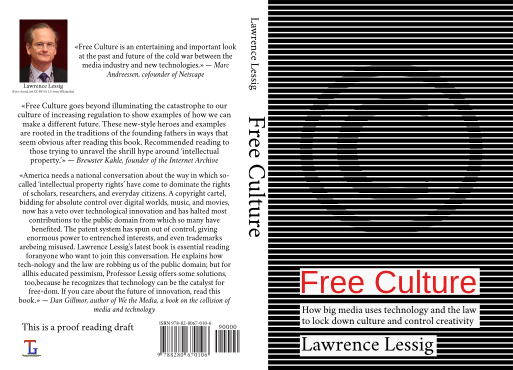
Petter Reinholdtsen: Book cover for the Free Culture book finally done

Creating a good looking book cover proved harder than I expected. I wanted to create a cover looking similar to the original cover of the Free Culture book we are translating to Norwegian, and I wanted it in vector format for high resolution printing. But my inkscape knowledge were not nearly good enough to pull that off. But thanks to the great inkscape community, I was able to wrap up the cover yesterday evening. I asked on the #inkscape IRC channel on Freenode for help and clues, and Marc Jeanmougin (Mc-) volunteered to try to recreate it based on the PDF of the cover from the HTML version. Not only did he create a SVG document with the original and his vector version side by side, he even provided an instruction video explaining how he did it. But the instruction video is not easy to follow for an untrained inkscape user. The video is a recording on how he did it, and he is obviously very experienced as the menu selections are very quick and he mentioned on IRC that he did use some keyboard shortcuts that can't be seen on the video, but it give a good idea about the inkscape operations to use to create the stripes with the embossed copyright sign in the center. I took his SVG file, copied the vector image and re-sized it to fit on the cover I was drawing. I am happy with the end result, and the current english version look like this: I am not quite sure about the text on the back, but guess it will do. I picked three quotes from the official site for the book, and hope it will work to trigger the interest of potential readers. The Norwegian cover will look the same, but with the texts and bar code replaced with the Norwegian version. The book is very close to being ready for publication, and I expect to upload the final draft to Lulu in the next few days and order a final proof reading copy to verify that everything look like it should before allowing everyone to order their own copy of Free Culture, in English or Norwegian Bokm l. I'm waiting to give the the productive proof readers a chance to complete their work.

2 September 2015

Luca Falavigna: Resource control with systemd

I m receiving more requests for upload accounts to the Deb-o-Matic servers lately (yay!), but that means the resources need to be monitored and shared between the build daemons to prevent server lockups. My servers are running systemd, so I decided to give systemd.resource-control a try. My goal was to assign lower CPU shares to the build processes (debomatic itself, sbuild, and all the related tools), in order to avoid blocking other important system services from being spawned when necessary. I created a new slice, and set a lower CPU share weight:
$ cat /etc/systemd/system/debomatic.slice
[Slice]
CPUAccounting=true
CPUShares=512
$
Then, I assigned the slice to the service unit file controlling debomatic daemons by adding the Slice=debomatic.slice option under the Service directive. That was not enough, though, as some processes were assigned to the user slice instead, which groups all the processes spawned by users:
systemd-cgls This is probably because schroot spawns a login shell, and systemd considers it belonging to a different process group. So, I had to launch the command systemctl set-property user.slice CPUShares=512, so all processes belonging to the user.slice will receive the same share of the debomatic ones. I consider this a workaround, I m open to suggestions how to properly solve this issue :) I ll try to explore more options in the coming days, so I can improve my knowledge of systemd a little bit more :)

1 September 2015

Lunar: Reproducible builds: week 18 in Stretch cycle

What happened in the reproducible builds effort this week: Toolchain fixes
  • Bdale Garbee uploaded tar/1.28-1 which includes the --clamp-mtime option. Patch by Lunar.
Aur lien Jarno uploaded glibc/2.21-0experimental1 which will fix the issue were locales-all did not behave exactly like locales despite having it in the Provides field. Lunar rebased the pu/reproducible_builds branch for dpkg on top of the released 1.18.2. This made visible an issue with udebs and automatically generated debug packages. The summary from the meeting at DebConf15 between ftpmasters, dpkg mainatainers and reproducible builds folks has been posted to the revelant mailing lists. Packages fixed The following 70 packages became reproducible due to changes in their build dependencies: activemq-activeio, async-http-client, classworlds, clirr, compress-lzf, dbus-c++, felix-bundlerepository, felix-framework, felix-gogo-command, felix-gogo-runtime, felix-gogo-shell, felix-main, felix-shell-tui, felix-shell, findbugs-bcel, gco, gdebi, gecode, geronimo-ejb-3.2-spec, git-repair, gmetric4j, gs-collections, hawtbuf, hawtdispatch, jack-tools, jackson-dataformat-cbor, jackson-dataformat-yaml, jackson-module-jaxb-annotations, jmxetric, json-simple, kryo-serializers, lhapdf, libccrtp, libclaw, libcommoncpp2, libftdi1, libjboss-marshalling-java, libmimic, libphysfs, libxstream-java, limereg, maven-debian-helper, maven-filtering, maven-invoker, mochiweb, mongo-java-driver, mqtt-client, netty-3.9, openhft-chronicle-queue, openhft-compiler, openhft-lang, pavucontrol, plexus-ant-factory, plexus-archiver, plexus-bsh-factory, plexus-cdc, plexus-classworlds2, plexus-component-metadata, plexus-container-default, plexus-io, pytone, scolasync, sisu-ioc, snappy-java, spatial4j-0.4, tika, treeline, wss4j, xtalk, zshdb. The following packages became reproducible after getting fixed: Some uploads fixed some reproducibility issues but not all of them: Patches submitted which have not made their way to the archive yet:
  • #797027 on zyne by Chris Lamb: switch to pybuild to get rid of .pyc files.
  • #797180 on python-doit by Chris Lamb: sort output when creating completion script for bash and zsh.
  • #797211 on apt-dater by Chris Lamb: fix implementation of SOURCE_DATE_EPOCH.
  • #797215 on getdns by Chris Lamb: fix call to dpkg-parsechangelog in debian/rules.
  • #797254 on splint by Chris Lamb: support SOURCE_DATE_EPOCH for version string.
  • #797296 on shiro by Chris Lamb: remove username from build string.
  • #797408 on splitpatch by Reiner Herrmann: use SOURCE_DATE_EPOCH to set manpage date.
  • #797410 on eigenbase-farrago by Reiner Herrmann: sets the comment style to scm-safe which tells ResourceGen that no timestamps should be included.
  • #797415 on apparmor by Reiner Herrmann: sorting with the locale set to C. CAPABILITIES
  • #797419 on resiprocate by Reiner Herrmann: set the embedded hostname to a static value.
  • #797427 on jam by Reiner Herrmann: sorting with the locale set to C.
  • #797430 on ii-esu by Reiner Herrmann: sort source list using C locale.
  • #797431 on tatan by Reiner Herrmann: sort source list using C locale.
Chris Lamb also noticed that binaries shipped with libsilo-bin did not work. Documentation update Chris Lamb and Ximin Luo assembled a proper specification for SOURCE_DATE_EPOCH in the hope to convince more upstreams to adopt it. Thanks to Holger it is published under a non-Debian domain name. Lunar documented easiest way to solve issues with file ordering and timestamps in tarballs that came with tar/1.28-1. Some examples on how to use SOURCE_DATE_EPOCH have been improved to support systems without GNU date. reproducible.debian.net armhf is finally being tested, which also means the remote building of Debian packages finally works! This paves the way to perform the tests on even more architectures and doing variations on CPU and date. Some packages even produce the same binary Arch:all packages on different architectures (1, 2). (h01ger) Tests for FreeBSD are finally running. (h01ger) As it seems the gcc5 transition has cooled off, we schedule sid more often than testing again on amd64. (h01ger) disorderfs has been built and installed on all build nodes (amd64 and armhf). One issue related to permissions for root and unpriviliged users needs to be solved before disorderfs can be used on reproducible.debian.net. (h01ger) strip-nondeterminism Version 0.011-1 has been released on August 29th. The new version updates dh_strip_nondeterminism to match recent changes in debhelper. (Andrew Ayer) disorderfs disorderfs, the new FUSE filesystem to ease testing of filesystem-related variations, is now almost ready to be used. Version 0.2.0 adds support for extended attributes. Since then Andrew Ayer also added support to reverse directory entries instead of shuffling them, and arbitrary padding to the number of blocks used by files. Package reviews 142 reviews have been removed, 48 added and 259 updated this week. Santiago Vila renamed the not_using_dh_builddeb issue into varying_mtimes_in_data_tar_gz_or_control_tar_gz to align better with other tag names. New issue identified this week: random_order_in_python_doit_completion. 37 FTBFS issues have been reported by Chris West (Faux) and Chris Lamb. Misc. h01ger gave a talk at FrOSCon on August 23rd. Recordings are already online. These reports are being reviewed and enhanced every week by many people hanging out on #debian-reproducible. Huge thanks!

31 August 2015

Matthew Garrett: Working with the kernel keyring

The Linux kernel keyring is effectively a mechanism to allow shoving blobs of data into the kernel and then setting access controls on them. It's convenient for a couple of reasons: the first is that these blobs are available to the kernel itself (so it can use them for things like NFSv4 authentication or module signing keys), and the second is that once they're locked down there's no way for even root to modify them.

But there's a corner case that can be somewhat confusing here, and it's one that I managed to crash into multiple times when I was implementing some code that works with this. Keys can be "possessed" by a process, and have permissions that are granted to the possessor orthogonally to any permissions granted to the user or group that owns the key. This is important because it allows for the creation of keyrings that are only visible to specific processes - if my userspace keyring manager is using the kernel keyring as a backing store for decrypted material, I don't want any arbitrary process running as me to be able to obtain those keys[1]. As described in keyrings(7), keyrings exist at the session, process and thread levels of granularity.

This is absolutely fine in the normal case, but gets confusing when you start using sudo. sudo by default doesn't create a new login session - when you're working with sudo, you're still working with key posession that's tied to the original user. This makes sense when you consider that you often want applications you run with sudo to have access to the keys that you own, but it becomes a pain when you're trying to work with keys that need to be accessible to a user no matter whether that user owns the login session or not.

I spent a while talking to David Howells about this and he explained the easiest way to handle this. If you do something like the following:
$ sudo keyctl add user testkey testdata @u
a new key will be created and added to UID 0's user keyring (indicated by @u). This is possible because the keyring defaults to 0x3f3f0000 permissions, giving both the possessor and the user read/write access to the keyring. But if you then try to do something like:
$ sudo keyctl setperm 678913344 0x3f3f0000
where 678913344 is the ID of the key we created in the previous command, you'll get permission denied. This is because the default permissions on a key are 0x3f010000, meaning that the possessor has permission to do anything to the key but the user only has permission to view its attributes. The cause of this confusion is that although we have permission to write to UID 0's keyring (because the permissions are 0x3f3f0000), we don't possess it - the only permissions we have for this key are the user ones, and the default state for user permissions on new keys only gives us permission to view the attributes, not change them.

But! There's a way around this. If we instead do:
$ sudo keyctl add user testkey testdata @s
then the key is added to the current session keyring (@s). Because the session keyring belongs to us, we possess any keys within it and so we have permission to modify the permissions further. We can then do:
$ sudo keyctl setperm 678913344 0x3f3f0000
and it works. Hurrah! Except that if we log in as root, we'll be part of another session and won't be able to see that key. Boo. So, after setting the permissions, we should:
$ sudo keyctl link 678913344 @u
which ties it to UID 0's user keyring. Someone who logs in as root will then be able to see the key, as will any processes running as root via sudo. But we probably also want to remove it from the unprivileged user's session keyring, because that's readable/writable by the unprivileged user - they'd be able to revoke the key from underneath us!
$ sudo keyctl unlink 678913344 @s
will achieve this, and now the key is configured appropriately - UID 0 can read, modify and delete the key, other users can't.

This is part of our ongoing work at CoreOS to make rkt more secure. Moving the signing keys into the kernel is the first step towards rkt no longer having to trust the local writable filesystem[2]. Once keys have been enrolled the keyring can be locked down - rkt will then refuse to run any images unless they're signed with one of these keys, and even root will be unable to alter them.

[1] (obviously it should also be impossible to ptrace() my userspace keyring manager)
[2] Part of our Secure Boot work has been the integration of dm-verity into CoreOS. Once deployed this will mean that the /usr partition is cryptographically verified by the kernel at runtime, making it impossible for anybody to modify it underneath the kernel. / remains writable in order to permit local configuration and to act as a data store, and right now rkt stores its trusted keys there.

comment count unavailable comments

Next.

Previous.