Search Results: "ah"

29 August 2008

Wouter Verhelst: Debconf8, and the m68k meeting in Kiel

As I start this blog post, I'm on the train between Amersfoort and Osnabr ck, on my way to Kiel, where there'll be a meeting of the m68k porters, kindly organized by m68k kernel maintainer Christian Steigies. I took the 8:40 train in Mechelen this morning, and if all goes well, I'll be arriving in Kiel at 17:22 tonight. Some train trip... but I certainly prefer that to any flight. Anyway. The days of Debconf were very nice. Debconf is a lot of things to me. Travel. Hacking. Mao, evolving into a drinking game. Beer. Attending talks. Giving talks. Meeting people. Face-to-face non-flaming. Gesturing for an extra knife at luunch. Hangover. Whiskey. Talking to the person next to you—over IRC. Getting killed before knowing what the rules of the assassins game are. Filing bugreports in person. Pictures. Kilts. Streaming video. Not being sick, hopefully. Name badges. Flying. Sleeping. Yes, sleeping. Most of all, though, this year, Debconf was just great. Thanks. You know who you are. After debconf, I flew to Buenos Aires, where I slept for one night in a Youth Hostel somewhere downtown. They were affordable, but the bed wasn't great—the mattress sorely needed replacement. Since I had a day in BA, and since there were apparently not enough people on the schedule, I'd agreed to hold a talk, and came up with the idea of a 'debian secrets' talk—about Debian-specific commands, such as dpkg-divert and update-alternatives etc—so that people could learn how to use their Debian system more efficiently. As I was sitting in Andreas' talk, who was right before me on the schedule, suddenly Dag walked up to me and said hi. This was unexpected; Dag is a fellow Belgian, who's involved with the CentOS project, and who maintains a positively huge RPM repository at his site—if you maintain an RPM-based system somewhere, you'll probably know about that site. So while I recognized him, I immediately wondered what he was doing there. Turned out he was invited to hold a talk at the Free Software event to which Debianday was attached (and which would not start for another day or two), and that when he saw my name on the schedule, he decided to attend. Fun. He learned a thing or two from my talk, and was talking later about writing some tools for RPM-based systems that would perform the same or similar functionality implemented by some of the Debian tools I talked about. Great. We had a picture together (in front of the DebConf banner—hah) that I still should upload, and then went out for lunch together with some other CentOS guys. The talk itself seems to have been well-received, and I'm glad about that; I only gave it because there was a need for more talks, not because I felt confident I was very knowledgeable about that subject. In fact, I did have to ask on the debconf-discuss mailinglist for some input (which I received) so that I could make sure the talk would actually be useful to people. That helped a lot, I guess. After that, we played some mao in the lobby of the DebianDay venue. While doing so, I overheard Dag talking about CentOS, advocating it to some of the people there, which I must say felt pretty weird on a Debian event. Not that there's anything wrong with it, of course. Except that Dag was supposed to be writing his talk slides. How did that work out, Dag? ;-) Eventually, I got in a cab to the EZE airport, and flew home. That wasn't fully without issue, but I did get there. And now, I've been, eh, overloaded. Still have to follow up on a question a customer asked me, but I've barely been home or at the office, just enough to sleep really. Should do something about that, I guess... Two days ago, I also managed to forget my camera somewhere. For 12 hours, I was worried, even though I had a pretty good idea of where it was; but since I'm getting quite good at taking pictures now, and since I really like doing so as well, I really didn't want to lose my camera. Fortunately, when I called this morning to the place where I thought I'd lost it, they told me it'd been found, and where to get it. In other words, it's safe, it's taken care of, Philip went to get it, and I just need to arrange to get it when I get back. Which is a relief. Let's not be so stupid anymore in the future... Finishing up now, a day later, and I'm at Christian's office, playing with his and my coldfire board. As it happens, it appears that Freescale has brought out a new BSP for these boards, so that's nice. Let's see whether we can get those to boot again...

28 August 2008

Kartik Mistry: foss.in/2008 event announcement


* If you have not read event announcement yet, Please go through this message. I have just applied (and granted) for leave for event. C ya at foss.in/2008!

27 August 2008

Pablo Lorenzzoni: Paul Graham and his start-up funding company

I first read about Y Combinator while browsing Paul Graham s website. I am a huge fan of his and have tried many times to bring him to Brazil for FISL (unsuccessfully so far). By that time I was updating a lecture of mine where I quote something from his Hackers and Painters essay and sudenly I noted an YC link on the left, and decided to click to learn what was that. Y Combinator is a venture capital firm to help start-ups. It was built on the concept that not much money is needed for first-stage start-ups ( from idea to company , as they call it). Quite a concept! I lost track of it until yesterday, when I read this blog post summarizing one of its events for start-ups. I found it amazing how far it came in such little time. They ve already funded about 100 start-ups, some of them really interesting. Of those presented in that post, Posterous is one I found most interesting. They create instant blogs just by sending emails to some address. There s no sign-up procedure Just send the email with any attachments and voil . There you have: a new blog. Many others are really interesting (PollEveryWhere, IDidWork, Frogmetrics, just to name a few), so I really suggest reading that post. I think Y Combinator is another great idea from Paul Graham, and I will be following it more closely, as a way to keep myself updated Who knows maybe I can get them to come to FISL to present that! ;-)

Adam Rosi-Kessel: Democratic Unity

A sure sign of the long road ahead of us to pull together in this election: Can’t we all just join forces? Technorati Tags: , ,

26 August 2008

Russell Coker: Killing Servers with Virtualisation and Swap

The Problem: A problem with virtual machines is the fact that one rogue DomU can destroy the performance of all the others by inappropriate resource use. CPU scheduling is designed to allow reasonable sharing of computational resources, it is unfortunately not well documented, the XenSource wiki currently doesn’t document the “credit” scheduler which is used in Debian/Etch and CentOS 5 [1]. One interesting fact is that CPU scheduling in Xen can have a significant effect on IO performance as demonstrated in the paper by Ludmila Cherkasova, Diwaker Gupta and Amin Vahdat [2]. But they only showed a factor of two performance difference (which while bad is not THAT bad). A more significant problem is managing virtual memory, when there is excessive paging performance can drop by a factor of 100 and even the most basic tasks become impossible. The design of Xen is that every DomU is allocated some physical RAM and has it’s own swap space. I have previously written about my experiments to optimise swap usage on Xen systems by using a tmpfs in the Dom0 [3]. The aim was to have every Xen DomU swap data out to a tmpfs so that if one DomU was paging heavily and the other DomUs were not paging then the paging might take place in the Dom0’s RAM and not hit disk. The experiments were not particularly successful but I would be interested in seeing further research in this area as there might be some potential to do some good. I have previously written about the issues related to swap space sizing on Linux [4]. My conclusion is that following the “twice RAM” myth will lead to systems becoming unusable due to excessive swapping in situations where they might otherwise be usable if the kernel killed some processes instead (naturally there are exceptions to my general rule due to different application memory use patterns - but I think that my general rule is a lot better than the “twice RAM” one). One thing that I didn’t consider at the time is the implications of this problem for Xen servers. If you have 10 physical machines and one starts paging excessively then you have one machine to reboot. If you have 10 Xen DomUs on a single host and one starts paging heavily then you end up with one machine that is unusable due to thrashing and nine machines that deliver very poor disk read performance - which might make them unusable too. Read performance can particularly suffer in a situation when one process or VM is writing heavily to disk due to the way that the disk queuing works, it’s not uncommon for an application to read dozens or hundreds of blocks from disk to satisfy a single trivial request from a user, if each of these block read requests has to wait for a large amount of data to be written out from the write-back cache then performance will suck badly (I have seen this in experiments on single disks and on Linux software RAID - but have not had the opportunity to do good tests on a hardware RAID array). Currently for Xen DomUs I am allocating swap spaces no larger than 512M, as anything larger than that is likely to cause excessive performance loss to the rest of the server if it is actually used. A Solution for Similar Problems: A well known optimisation technique of desktop systems is to use a separate disk for swap, in desktop machines people often use the old disk as swap after buying a new larger disk for main storage. The benefit of this is that swap use will not interfere with other disk use, for example the disk reads needed to run the “ps” and “kill” programs won’t be blocked by the memory hog that you want to kill. I believe that similar techniques can be applied to Xen servers and give even greater benefits. When a desktop machine starts paging excessively the user will eventually take a coffee break and let the machine recover, but when an Internet server such as a web server starts paging excessively the requests keep coming in and the number of active processes increases so it seems likely that using a different device for the swap will allow some processes to satisfy requests by reading data from disk while some other processes are waiting to be paged in. Applying it to Xen Servers: The first thing that needs to be considered for such a design is the importance of reliable swap. When it comes to low-end servers there is ongoing discussion about the relative merits of RAID-0 and RAID-1 for swap. The benefit of RAID-0 is performance (at least in perception - I can imagine some OS swapping algorithms that could potentially give better performance on RAID-1 and I am not aware of any research in this area). The benefit of RAID-1 is reliability. Now there are two issues in regard to reliability, one is continuity of service (EG being able to hot-swap a failed disk while the server is running), and the other is the absence of data loss. For some systems it may be acceptable to have a process SEGV (which I presume is the result if a page-in request fails) due to a dead disk (reserving the data loss protection of RAID for files). One issue related to this is the ability to regain control of a server after a problem. For example if the host OS of a machine had non-RAID swap then a disk failure could prevent a page-in of data related to sshd or some similar process and thus make it impossible to recover the machine without hardware access. But if the swap for a virtual machine was on a non-RAID disk and the host had RAID for it’s swap then the sysadmin could login to the host and reboot the DomU after creating a new swap space on a working disk. Now if you have a server with 8 or 12 disks (both of which seem to be reasonably common capacities of modern 2RU servers) and if you decide that RAID is not required for the swap space of DomUs then it would be possible to assign single disks for swap spaces for groups of virtual machines. So if one client had several virtual machines they could have them share the same single disk for the swap, so a thrashing server would only affect the performance of other VMs from the same client. One possible configuration would be a 12 disk server that has a four disk RAID-5 array for main storage and 8 single disks for swap. 8 CPU cores is common for a modern 2RU server, so it would be possible to lock 8 groups of DomUs so that they share CPUs and swap spaces. Another possibility would be to have four groups of DomUs where each group had a RAID-1 array for swap and two CPU cores. I am not sure of the aggregate performance impact of such a configuration, I suspect that a group of single disks would give better performance for swap than a single RAID array and that RAID-1 would outperform RAID-5. For a single DomU it seems most likely that using part of a large RAID array for swap space would give better performance. But the benefit in partitioning the server seems clear. An architecture where each DomU had it’s own dedicated disk for a swap space is something that I would consider a significant benefit if renting a Xen DomU. I would rather have the risk of down-time (which should be short with hot-swap disks and hardware monitoring) in the rare case of a disk failure than have bad performance regularly in the common situation of someone else’s DomU being overloaded. Failing that, having a separate RAID array for swap would be a significant benefit. If every process that isn’t being paged out could deliver full performance while one DomU was thrashing then it would be a significant benefit over the situation where any DomU can thrash and kill the file access performance of all other DomUs. A single RAID-1 array should handle all the swap space requirements for a small or medium size Xen server One thing that I have not tested is the operation of LVM when one disk goes bad. In the case of a disk with bad sectors it’s possible to move the LVs that are not affected to other disks and to remove the LV that was affected and re-create it after removing the bad disk. The case of a disk that is totally dead (IE the PV header can’t be read or written) might cause some additional complications.

24 August 2008

Michael Schutte: At least I didn t write spoon()

Do not at the same time, half an hour past midnight.
pid = os.fork()
pin, pout = os.pipe()
It just took me five minutes to figure out why these processes don t talk to each other. I m going to bed now.

Jonathan McDowell: DebConf8 writeup

I took a note of the various talks I attended at DebConf, with the aim of writing a few notes about each so that I could try to explain to my work mates exactly what I get out of going. However I think a lot of the benefit is about general face to face contact with fellow DDs and random conversations that happen. Having worked from home for over 3 years I'm finding it quite nice to be back in an office with people working on the same things as me; there are conversations that you will have over a quick cup of coffee or in the corridor that you wouldn't bother typing on IRC or email or picking up the phone for. Debian is a lot like a large organisation full of telecommuters and DebConf provides a vital opportunity for us to have those "minor" conversations that prove quite useful and to remind each other what we're actually like in person. I didn't end up writing a lot of notes during the talks so these are just snippets after the fact. If I'd been more organised I'd have done a write up on a daily basis rather than leaving it all until the week after. A lot of the below is fragmented thoughts, but the longer I leave it the less relevant it gets and the more chance I forget something. It'd have been up faster if I hadn't been fighting Movable Type to try and get some sort of headings. Sunday
Introduction, Marga The "Welcome to DebConf" bit. Marga got up and talked about how at DebConf4 (Brazil) she hadn't been a DD and now she was and how it had been a life changing event. She'd thought she was to blame for DebConf8 in Argentina, but trawling mail archives had shown it was originally Mart n's idea. She hadn't realised at the start quite how much work it would be. Steve's DPL talk, Steve McIntyre The DPL welcomes us to DebConf and talks about Debian's achievements, some of the results of his team survey (the teams largely say they need more manpower. Not really a huge surprise.). NM/User Survey BOF, Paul Wise Paul emailed debian-user, debian-newmaint and various other places (I think) asking about people's experiences as a Debian user or applicant to New Maint. His final results aren't yet published and I got the impression a disappointing number of our users had replied. The NM problems these days seem to be largely down to a lack of AMs, at least according to the stats on nm.debian.org. Meet SPI board - bdale, maulkin, jimmy, michael, others A chance to meet those of the SPI board who were present. The usual "If you're involved with Debian you should seriously consider joining SPI". Some discussion about the fact that although SPI was originally mostly Debian these days other projects are making more and more use of it - OFTC, PostgreSQL and Madwifi for example. Not a huge amount of new information for me. I've been an SPI member for some time and I think they perform a vital role for Debian. They've had issues in the past but it's really good to see them overcome and more projects on board. Monday
http://hp.com/go/debian, bdale Bdale talks about the history of Debian and HP. And makes the point that HP aren't doing any of this to be "nice"; their primary responsibility is to their shareholders. Not surprising, but it's good that even with that criteria at the fore front Debian ends up a good idea for a large multinational. Managing 666 packages, Mart n Ferrari Mostly centered around the pkg-perl experience and the tools/workflow they have to help manage things. Impressive web tool (DEHS) to help track packages with new upstreams, issues or pending uploads. Quality Assurance in Lenny + 1 I can't remember a lot of this, which is a bit bad. I remember a discussion about whether we should release with orphaned packages, or if they should be removed. The argument for not removing them seemed to revolve around a theory that if they weren't buggy then what was the harm, the argument for was that if they were unmaintained and not really used than how did we actually know they weren't buggy, and was it reasonable that they potentially held up library transitions etc? Bugs in large packages Don Armstrong and ways in which the BTS can help people with lots of bugs. This (thankfully) doesn't affect me, but it was interesting to hear Don talk about his work on the BTS and his various ideas. I was sorry I'd missed his talk on SOAP access to it; I shall have to find time to watch the video. Tuesday
Debian and Ubuntu, Mark Shuttleworth The usual interaction with Debian stuff, including how we interact with our upstreams. If a bug is raised with an Ubuntu package then it might well be appropriate to raise it with Debian and upstream as well, but each set of people should be able to use their own bug reporting systems rather than having to go to a foreign system. I don't think it was actually said, but I guess the idea is that launchpad is the thing that will do this gluing together. He also talked about Ubuntu as an "experiment" rather than a fork of Debian; something that has potentially different ideas about how to do things but that these ideas may lead to things that should be fed back into Debian. The point was made that even if you consider Ubuntu a fork they've forked 9 times now; it hasn't been a case of forking once and diverging wildly since thast point. I have a few thoughts on all the whole Debian/Ubuntu stuff which I should really try to form into something coherant and post. I think it's important to take Mark's talk in the context of bdale's "Shareholders come first" point. Derivatives round table Didn't stay for most of this. Ubuntu, Debian-EDU (which I hadn't realised was a derivative rather than a team within Debian, but apparently there are various things it was much easier for them just to patch now and try to work towards a generic solution later), someone from Extramadura and someone from the Munich government Linux stuff. I'm sure I've missed someone off. tdebs/i18n This was a useful BOF. It helped that we said no to the usual video team requirement that if you want to speak you had to wait for the microphone. This works fine for a normal talk, but really impedes the flow of conversation in something like a BOF. tdebs are something that have partly come from a need of Emdebian to reduce installed package size and partly from the desire of the i18n team to be able to update package translations without having to do a full binary NMU of a package. We had some of the FTP team, the release team, the i18n team and Emdebian there and I think some progress has been made. There'd been various conversations had before this meeting which I think helped people think about the issues and objections so that we had answers by the time we all sat down together - an excellent example of the use of DebConf. DebConf9 C ceres Various bits of discussion about next year's DebConf in Extramadura. Temperature is likely to be an issue for me as they reckon it could easily get up to 40C! I'll melt! Venue sounds good; some queries regarding late night hacklabs and net connections to same, but I'm sure the networking team will sort it all out as usual. ;) DebConf10 bids Venezela and New York were both pitching. Lots of people don't want to travel to the US or think they'll have problems doing so (I hadn't realised there was such an issue for people from South America). I suspect various people will have issues with Venezela as well; I heard expressions of doubt over their political stability expressed. However I'd be happy to go to either (and preferably both! DebConf10 + 12 perhaps?) Speaking of which, what ever happened to the Sarajevo bid? If they're reading, have you considered DebConf11? Wednesday
A day trip to an Argentinian ranch and lunch was an asido. Fantastic food and a pleasant afternoon spent sitting in the sun chatting to people. That evening was the formal, but thanks to having stayed up until after 4 on Tuesday I had to wimp out and go to bed fairly early. Not until I'd seen the DPL dance though. :) Thursday
Internationalization in Debian I forget most of this other than pretty graphs from Christian regarding what's translated and what other languages we might have; e.g. you can consider South America to be covered largely by Spanish and Portuguese, or you can consider it to not be covered very much at all by the local indigenous languages. dh-make-webapp: yeah right! Mainly what I took away from this was "It'll never happen thanks to the fact that every web app author uses a different system" and that more work needs to be done on the web apps best practices document. I don't really do web apps, but having them easily installable on my systems is a good thing so I hope some standardisation within Debian comes from this. Best practises in team-maintaining packages Various team members got up to talk about work flow in their teams. Not unsurprisingly different things seem to work for different people. Predictable PRNG in the Vulnerable Debian OpenSSL Package Lucian giving his Black Hat talk about the OpenSSL issues we faced earlier this year. Some queries about automated testing and that it should have found this, which originally I agreed with until I thought about it - you'd have to have run > 65536 tests and compared all the data to find this; something like the FIPS tests against a single run wouldn't have shown any issues. Lucian wanted feedback on ensuring he was presenting the Debian side of things acceptably as well. Keysigning Run by Don Armstrong. Nothing to really remark except I think key signing attendance is dropping off after things like the Helsinki experience. Also I've now managed to get my new RSA key signed by keys other than my own (and I'll try to get sorted out to sign keys myself soon). Friday
LessWatts Intel's drive towards reducing power usage. Odd to hear such things from someone who wasn't Matthew Garrett and I think I'd heard most of it before. Debian technical policy update Sorry Manoj, I should have been paying more attention. Debian Policy is something I think is important, but I'm not enough of a nitpicker to really feel I can contribute a whole lot. Virtualisation in Debian - Present and future This was depressing. What I took away was "We had 2 forms of virtualisation in etch (Xen + vserver) and we're supporting neither for Lenny". As someone running a Xen machine this is problematic. The host does have the hardware support that would allow kvm, but I'm worried about smooth migration (it's a colo box). There was some mention of Xenner, which isn't packaged for Debian. I took a look at doing so but there are some worrying items in the TODO list (like, oh, locking to enable reliable SMP) and I've spectacularly failed to get it compiling so far. I should have another go. Emdebian update Neil Williams about where Emdebian is and waved his Balloon3 about. Some interest from the Openmoko guys and discussion about why it might be better than OpenEmbedded. And equally what it couldn't do that OpenEmbedded can manage (mainly very small installs; a minimal Emdebian install is 24MB+ and with X that goes up to 75MB+ I believe). netconf I'd never actually seen Martin talk about netconf before. Am impressive flow of control diagram. It all sounds quite complex for little benefit at present, but if he pulls it off then I can see it being a much more flexible replacement for the likes of Network Manager. Saturday
Lenny - The Road To Release Neil played with putting the heads of the release team on random images. And tried to tell us all how to behave during the release process in terms of what should and shouldn't be uploaded etc. Most of it is just common sense, but apparently everything he talked about he'd experienced. Also pointed out we were supposed to release in 3 weeks and didn't even have the appropriate kernel in testing yet so it's probably not going to happen. Colour me surprised. Sustainable Computing Low power consumption/affordable computing. Interesting points about the OLPC being used in the middle of nowhere with no chance of an Internet connection being close by compared to neighbours in large cities where people can't necessarily afford top of the line computers or individual connections - in this sort of scenario mesh networking is really viable in terms of getting people connected up. Multi winner voting Manoj needs pretty diagrams, probably drawn by Martin Krafft. ;) Semi-interesting discussion about multi-winner voting (e.g. SPI board elections) and how the current Debian voting system is completely tied to Debian's infrastructure eg the LDAP setup. Manoj would like to make it more generic so it could be used by other groups as well as for different sorts of votes in Debian.

23 August 2008

Steve Langasek: A Portland, la ciudad de Mejores Aires

I'm back (for several days now) from Argentina and DebConf 8 to Portland. Too long a journey and too short a trip, as always. It was great to see everybody again as well as to meet a number of new folks from the local community. Here's hoping that DebConf 8 inspires more involvement in Debian from Argentina! It was my first time to this wonderful South American country, which made it even more melancholy to have to leave after such a short time and to be making this trip without Patty. Random observations about Argentina, for posterity: As always it was a pleasure to take part in another annual DebConf, an event which is such a positive force for rejuvenating the Debian community. And BTW, Biella, NYC is not the only US city entertaining a bid for DebConf 10.

21 August 2008

Wouter Verhelst: Solving sudoku puzzles in package dependency relations

Daniel, you are evil. But yeah, it does look to be quite some fun.

MJ Ray: Would Debian Lists Send Scunthorpe to Coventry?

I had a small chuckle at the delay to Debian Project news because the listserver filter treated it as if an event was on Free Ando Penis Land. Parties in Scunthorpe and Penistone may have a similar problem. At least it got through eventually. If only Yahoo was as responsive as debian listmasters… Incidentally, while trying a web search for “the Scunthorpe Problem”, I got an intermediate screen warning me that the results may contain “adult content” but none of the results looked like they were more than 18 years old.

20 August 2008

John Goerzen: From Dell, a Uniquely Terrible Experience

Ah, Dell. Seeming inventors of the tech support pit of bureaucratic indifferences, inventors of the flamingo pink Inspiron, perpetrators of fraud in New York...

I have, for over a year now, been on a crusade trying to get them to stop sending me their Dell Home and Home Office catalog to my mailbox. It has been a bundle of fun, let me tell you.

They have a nice-sounding privacy policy. It says you can opt out of all their mailings by filling out a form online. Yeah, good luck with that. First of all, there are different forms for different departments at Dell. I've filled out them all, multiple times. They do nothing whatsoever. Perhaps they use them as lists of known-good addresses to send new advertisements to, rather than lists of people to remove. Oh well.

Now, unfortunately I feel compelled to bore you with the saga so far, involving telephone hang-ups, broken privacy policies, and the like. But there is a silver lining at the end, in which I submitted a request to the postal service asking them to block Dell from sending me any more mail, and it appears that they are very likely to violate Federal Law any day now.

I have called them about it. Dealt with the old "let me transfer you to the correct department" then hang up on me ploy. Spoken to people that have promised up and down that I'll be off their list in 30-60 days. It's always 30-60 days, isn't it? Very convenient that I can't tell for 2 months whether or not they've processed my request.

I've tried their online chat. One of my attempts went like this:

Session Started with Agent (Sneha Ranga)

Agent (Sneha Ranga): "Due to circumstances that have affected Dell Communications I am temporarily unable to pull up any information. The down time is temporary. We apologize for the inconvenience, as we value your time as a customer. Please contact us back after an hour."

Session Ended


Ah Dell, only you could reach such a pinnacle of customer service. /kicking someone out of a chat room before they have a chance to say a word.

Finally, last fall, I blogged about the situation (that's the link above). Debbie from Dell red the post and emailed me. Great, I thought. She asked for my address information and catalog information and sent me a removal confirmation:


From: Debbie@Dell.com
Date: Thu, 18 Oct 2007 13:08:18 -0500
To: jgoerzen@complete.org
Subject: RE: Dell mailing list

Thank you, Mr. Goerzen, your request to have the below address
information removed from our marketing lists has been received:

[ my address here ]

We will process your request promptly. However, it may take several
weeks for some changes to take effect. If you are still receiving
catalogs after thirty (30) days feel free to email me. Sorry for any
inconvenience you may have experienced.

Thank you,
Debbie


So that was October. In December, I replied to that message, saying: "I received another mailing today, and it's been nearly 2 months since your initial message. If there's anything further you can do, I'd appreciate it." Debbie said, "I am very sorry Mr. Goerzen, I will resubmit your request." Guess how successful that was.

So in February, I manage to figure out a way to send in a support ticket without having a Dell system serial number. I wrote:

I keep getting your Dell Home and Home Office catalog. I have tried for months to get off your mailing list. I have called in, talked to people in multiple departments, who have promised to remove me from the list. I have contacted you online. NOTHING IS HELPING. This has gone on for MONTHS.

PLEASE NEVER SEND ME MAIL AGAIN, EVER, AND DO NOT RENT OR SHARE MY NAME.

My address is above.

The code on the mailing I received is: [ snipped ]


The form letter I got back said:

If you are currently receiving our catalog or mailings and would like to be removed, please visit the following web page and select the appropriate link under the "Opt-out of direct mail, phone or fax communications" heading: http://www.dell.com/OptOut


I replied, saying that form didn't work. Guess what I got back?

Thank you for signing up for Dell Email Subscriptions. Please save this email for your records.


Yes, that's right. Asking them to take me off their postal mailing lists got them to PUT ME ON their email lists. ARGH.

So they eventually manage to correctly take me off the email list, and of course promise to do the same with the postal list. This back in February.

I contacted them again in March and July, only to have a similar stupidity-laced run-in with clueless form-answer-laden Dell support reps. Each one claimed to have now, finally, and permanently removed me from the list. It never happened, and none of them lifted a finger to find out way, and no amount of begging could make them.

So, here's the good part.

Junkbusters has spent years educating people on how to get rid of unwanted mail, and documents getting a prohibitory order against the sender. It was originally designed for people that didn't want to receive obscene advertising mailings, but thanks to the happy fact that one non-adult-mailer challenged a prohibitory order all the way to the Supreme Court, you can now get prohibitory order against anyone. Yes, even Dell. (The supreme court's ruling even gave an example: you can prohibit a clothing catalog if you want.)

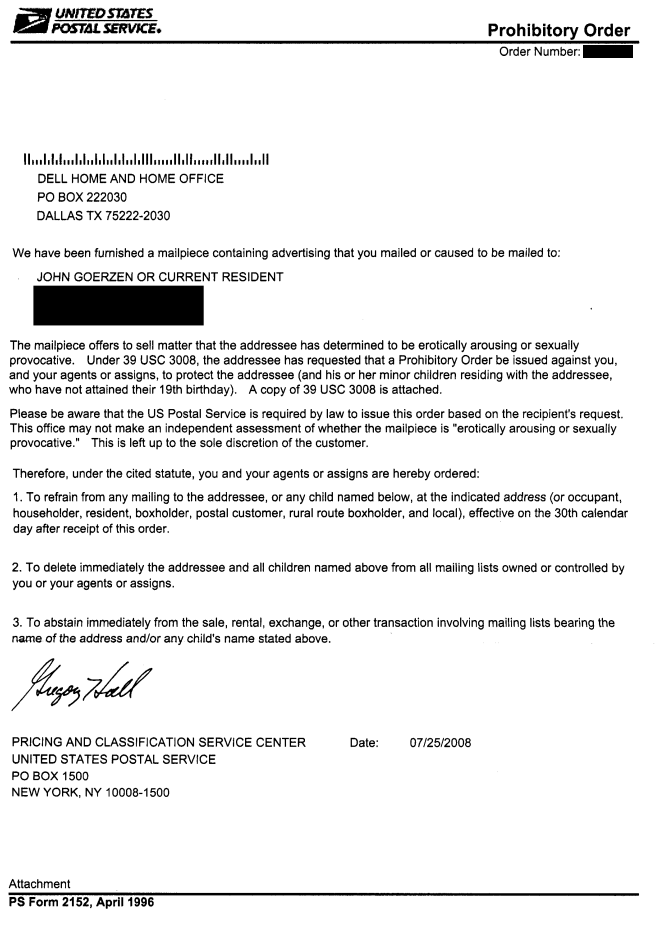
And last month, that's exactly what I did. The USPS sent me back a copy of the letter they sent to Dell, as well as a second page with instructions on reporting violations. Here's the letter they sent to Dell:

dell-usps

Somehow I get a chuckle over some Dell mail clerk trying to figure out how an 11-pound laptop is sexually provocative.

From August 25 on, it is a federal offense for Dell to send me another Home and Home Office catalog. This is a branch of criminal law, not civil law. That is, it's the maybe-go-to-jail branch of law.

How disappointed I was to receive yet another catalog from them today. If only they had waited 5 more days, I could have turned them in now.

Oh well. There's always next month's catalog. Let's just hope the clerk that received the USPS letter removed my name with a better system than everyone else at Dell uses, eh?

Sami Haahtinen: Setting up an OpenVPN tunnel

Recently I fixed my OpenVPN tunnel and figured out what was wrong with my bridge setup. Here is the complete setup that I have. Server I wanted to have as much of the configuration on the server as possible so that I could easily add more clients and wouldn't have a need to update client configuration when ever the server preferences change. Here is my OpenVPN server configuration:
mode server
tls-server
dev tap0
server-bridge 10.5.6.1 255.255.255.0 10.5.6.200 10.5.6.209
ifconfig-pool-persist /var/run/openvpn-ip.txt
keepalive 10 60
ping-timer-rem
persist-tun
push "route 10.5.6.0 255.255.255.0"
push "dhcp-option DNS 10.5.6.1"
ca /root/easy-rsa-2.0/keys/ca.crt
key /root/easy-rsa-2.0/keys/ressukka.net.key
cert /root/easy-rsa-2.0/keys/ressukka.net.crt
dh /root/easy-rsa-2.0/keys/dh1024.pem
client-to-client
up /etc/openvpn/ovpn-ressukka.sh

and the up script:
#!/bin/sh
# Bind the tunnel interface to the bridge
BRIDGE=br0
ifup $1
brctl addif $BRIDGE $1

There is nothing really special about that configuration. The server is in TLS mode configures a bridge. The keys are generated with easy-rsa by following a openvpn howto entry. The up script just binds the tap0 device to the network bridge after bringing up the device. Next I created the interface configuration by adding the following to /etc/network/interfaces:
iface br0 inet static  
 address 10.5.6.17  
 gateway 10.5.6.1  
 netmask 255.255.255.0  
 bridge-ports eth0

The trick here is to create a single bridge with just the eth0 device. We use the up script for openvpn to add the tunnel device to the bridge. Otherwise the bridge would never contain the proper devices. Client As for the client, you simply set the client to use the CA-certificate and Host key created with easy-rsa, set the hostname and tunnel type. Tunnel type is assumed to be a tun-device instead of tap, so in my case I needed to change it too. There is no need to tell the client anything else. Everything else will be negotiated through the tunnel. And since I use NetworkManager to set up my tunnels I didn't have a need to drop in to a shell even once at the client.

Sami Haahtinen: Dynamic network configuration

I've been meaning to write up on this for quite some time now, but always have something seemingly more important things to do. Most modern Linux distributions offer ways to manage network interfaces via some kind of abstraction. Usually this abstraction allows one to dynamically rename and add network interfaces. For Debian family management is done with ifupdown, while with RedHat family it's sysconfig. In addition there is NetworkManager which is a cross platform solution for dynamic network configuration (which eliminates the need to rename interfaces). Case Xenserver Usually this comes in rather handy, but on other occasions it can be a pain. A while I was helping out with an installation of a XenServer instance. This server had, for some reason, ethernet interfaces reversed in comparison to the other XenServers on the site. Luckily the service console has the network configuration in ifcfg scripts. We were easily able to reverse the interfaces by binding the interfaces to certain hardware addresses. The only problem is that the interface is renamed only when the interface is brought up. What's worse the interfaces were enumerated before the server would bring up all of the interfaces. Only eth0 was brought up for management purposes before enumerating. This means that the original eth0 was renamed to _tmp_xxxxxx. The (oh so elegant) solution was to create a script that does ifup eth1; ifdown eth1. Problem solved. Case tap0 I also experienced similar problems when I was setting up my OpenVPN tunnel. I wanted to use a bridged connection to my network, but for that I needed to create a br0 interface with tap0 as a member. It's easy enough to create ifupdown configuration to set up tap0. Hook that up to br0 and you are all set. The same problem will bite you here. The interface tap0 is actually created only when the tap0 is brought up and br0 members are added only if they are present. The solution? In my case, create a custom script that adds the device manually after it's been created properly. I was unable to find anything that works without using a custom script =( In retrospect Looking back at these cases, I should have known better. The problem was obvious and it took me way too long to figure out the cause for my problems. Then again, the utilities should be able to create a reasonable abstraction for themselves that they use to determine the actual status of the whole system. This way the trickery needed for setting up simple interface would be obsolete. You can't have it all, but you can always hope.

19 August 2008

Roland Mas: Netfilter-based port-knocking

When you have a server on the Internet, you get lots of "brute force" attacks on the SSH daemon, trying plausible logins with a variety of passwords. Even with good passwords, these attacks might eventually succeed (and they're annoying even when they don't), so you want to thwart them. One way is to use fail2ban, a script that monitors the failed connections, and sets up firewall rules (for instance) blocking further connections from the attacking IP addresses. It's good, but it fills your logs with messages about IPs getting banned and unbanned after a while. And you're still at risk that the multiple connections crash the SSH daemon, or trigger a bug in it, or whatever. A second layer of protection can be to block all SSH connection attempts except when they come from known IP addresses, but that doesn't work when you're away from home, and you're locked out. Been there, done that. So, some wise people have devised a trick called "port-knocking". It's similar to only opening the door to people who use a special knock (think "That's all, folks"): the firewall stays closed, but it opens a tiny targeted hole to some IP addresses for a limited length of time, based on a secret handshake. The window for attack is therefore very small, and the SSH daemon stays idle most of the time. And you can still log on your hosted server when you're attending conferences. There are a variety of implementations for this concept. Some could be web-based (you need to submit the right password to a web page), some could use other services or a dedicated daemon. But when I started investigating port-knocking, I wanted something simple, preferably with no dependencies on a daemon that would need to be exposed to the net and potentially crash. I found an article on the Debian Administration website, but I wasn't entirely satisfied with it. The principles appealed to me (netfilter-only, secret handshake in the form of opening connections to secret ports), though, so I evolved it into my own implementation, which I proudly present to you today. The goals of this implementation were: The bulk of the work therefore stays in the kernel's netfilter (that's for robustness and no user-land dependency), but the control interface is integrated with the usual firewalling script. Resistance to replay attacks is achieved by choosing hard-to-predict ports. So if someone snoops the wireless while I'm at a conference and catches my secret handshake, it'll only be valid for a short period of time, hopefully short enough to prevent dictionary attacks. The handshake is therefore calculated as a function of the current date and time, with an added secret seed. The following shell function calculates 5 port numbers within a given range (requires dc to be installed, for big-integer arithmetic):
calc_knock_ports ()  
    secret=$1
    bottomport=$2
    topport=$3
    nbports=$(( $topport - $bottomport + 1 ))
    hash=$(TZ=UTC date +%Y-%m-%d-%H-$secret   md5sum   awk ' print $1 '   tr a-z A-Z)
    num=$(echo 16i $hash f   dc)
    pk_port1=$(echo $num $nbports 0 ^ / $nbports % $bottomport + f   dc)
    pk_port2=$(echo $num $nbports 1 ^ / $nbports % $bottomport + f   dc)
    pk_port3=$(echo $num $nbports 2 ^ / $nbports % $bottomport + f   dc)
    pk_port4=$(echo $num $nbports 3 ^ / $nbports % $bottomport + f   dc)
    pk_port5=$(echo $num $nbports 4 ^ / $nbports % $bottomport + f   dc)
 
Okay. So this function calculates ports, now what? Now we're going to define a few chains by which netfilter will store states of IP addresses as they progress through the handshake:
setup_portknocking_tables ()  
    iptables -N portknock_into_phase1
    iptables -A portknock_into_phase1 -m recent --name PK_PHASE1 --set
    # iptables -A portknock_into_phase1 -j LOG --log-level notice --log-prefix "INTO PK_PHASE1: "
    iptables -N portknock_into_phase2
    iptables -A portknock_into_phase2 -m recent --name PK_PHASE1 --remove
    iptables -A portknock_into_phase2 -m recent --name PK_PHASE2 --set
    # iptables -A portknock_into_phase2 -j LOG --log-level notice --log-prefix "INTO PK_PHASE2: "
    iptables -N portknock_into_phase3
    iptables -A portknock_into_phase3 -m recent --name PK_PHASE2 --remove
    iptables -A portknock_into_phase3 -m recent --name PK_PHASE3 --set
    # iptables -A portknock_into_phase3 -j LOG --log-level notice --log-prefix "INTO PK_PHASE3: "                     
    iptables -N portknock_into_phase4
    iptables -A portknock_into_phase4 -m recent --name PK_PHASE3 --remove
    iptables -A portknock_into_phase4 -m recent --name PK_PHASE4 --set
    # iptables -A portknock_into_phase4 -j LOG --log-level notice --log-prefix "INTO PK_PHASE4: "
    iptables -N portknock_into_phase5
    iptables -A portknock_into_phase5 -m recent --name PK_PHASE4 --remove
    iptables -A portknock_into_phase5 -m recent --name PK_PHASE5 --set
    iptables -A portknock_into_phase5 -m recent --name PK_ESTABLISHED --set
    # iptables -A portknock_into_phase5 -j LOG --log-level notice --log-prefix "INTO PK_PHASE5: "
    iptables -N portknock_accept
    iptables -A portknock_accept -m limit -j LOG --log-level notice --log-prefix "ACCEPTED AFTER PORTKNOCKING: "
    # iptables -A portknock_accept -m recent --name PK_PHASE5 --remove
    iptables -A portknock_accept -j ACCEPT
    iptables -N portknocking
 
These chains use the recent module, which seems to be commonly available in standard kernels. You'll notice how, as one packet goes through these rules, its originating IP address moves from one set of "recent" addresses to the next. But no logic exists yet to make the packet actually go through these rules, so here comes the glue:
refresh_portknocking ()  
    calc_knock_ports f00b4r 10000 10999
    iptables -F portknocking
    iptables -A portknocking -p tcp --dport $pk_port1 -m state --state NEW                                                 -j portknock_into_phase1
    iptables -A portknocking -p tcp --dport $pk_port2 -m state --state NEW -m recent --rcheck --name PK_PHASE1 --seconds 5 -j portknock_into_phase2
    iptables -A portknocking -p tcp --dport $pk_port3 -m state --state NEW -m recent --rcheck --name PK_PHASE2 --seconds 5 -j portknock_into_phase3
    iptables -A portknocking -p tcp --dport $pk_port4 -m state --state NEW -m recent --rcheck --name PK_PHASE3 --seconds 5 -j portknock_into_phase4
    iptables -A portknocking -p tcp --dport $pk_port5 -m state --state NEW -m recent --rcheck --name PK_PHASE4 --seconds 5 -j portknock_into_phase5
    # echo clear > /proc/net/ipt_recent/PK_DONE
    echo clear > /proc/net/ipt_recent/PK_PHASE1
    echo clear > /proc/net/ipt_recent/PK_PHASE2
    echo clear > /proc/net/ipt_recent/PK_PHASE3
    echo clear > /proc/net/ipt_recent/PK_PHASE4
    echo clear > /proc/net/ipt_recent/PK_PHASE5
 
Right. This function adds rules to the portknocking chain. A packet injected into this ruleset will, depending on its destination port and whether its source IP address has already been seen, end up in one of the PK_PHASE* sets. All we have to do now is therefore to send some packets to this portknocking chain, and use the port-knocking sets to decide whether to accept incoming connections or not:
iptables -A INPUT -j portknocking
iptables -A INPUT -m recent --rcheck --seconds 5 --name PK_PHASE5 -m state --state NEW -p tcp --dport ssh -j portknock_accept
This example only mentions accepting incoming SSH connections, but it's in no way a limitation: a server of mine uses similar rules to DNAT certain ports to internal IP addresses. And there we have it for the server part: incoming SSH connections are usually ignored (well, handled by the rest of the firewall script, but let's assume that it drops these packets by default), but if one IP address knows the appropriate ports and sends a connection attempt to them in order, then it'll be able to open SSH connections for a little while after that. Of course, it's going to be boring if one has to send these packets by hand, but it can be easily automated by a script. Here's a ~/bin/portknock.sh I have:
#! /bin/sh
host=$1
port=$2
calc_knock_ports ()  
[...]
 
calc_knock_ports f00b4r 10000 10999
for i in $pk_port1 $pk_port2 $pk_port3 $pk_port4 $pk_port5 ; do
    nc -w 1 $host $i < /dev/null > /dev/null 2>&1
done
nc $host $port
It's designed to be called with two parameters, a host and a port, and it needs netcat in addition to dc. Why the last line, I hear you cry? Because then I can just add the following lines to my ~/.ssh/config:
Host blahblah
  IdentityFile foobar
  ProxyCommand /home/roland/bin/portknock.sh %h %p
...and SSH will automagically tunnel its network socket through the script, which will in turn happily tunnel that through netcat after completing the secret handshake. And when I type ssh myserver on my laptop, interesting stuff happens behind the scenes, and a special, just-for-me hole is opened in the server firewall, just for the few seconds I need to establish the SSH session (packets belonging to established TCP sockets are allowed by the firewall's connection tracking). Note: This article is deliberately short on details and ready-to-run scripts. Firstly because firewall scripts vary wildly so any script would have to be adapted anyway, but mostly because security is best handled with one's brain switched on. Fiddling with a firewall can easily open gaping holes or lock everyone out. So please make sure you understand what goes on before blindly pasting stuff into your own setup. Some of the lines that are commented out may also be of interest, and were left as an exercise for the reader. Other lines were not included, and are also left as a rather important exercise to the reader; note in particular how the netfilter rules as currently established do not mitigate the replay attacks...

17 August 2008

Kartik Mistry: Linux adoption is growing..


* Auto-rickshaw in Ahmedabad: Powered by pollution free Compressed Natural Gas (CNG) and Free Linux.

15 August 2008

DebConf 8 video: dh_make_webapp: yeah right!

Full event details

DebConf 8 video: dh_make_webapp: yeah right!

Full event details

MJ Ray: Gov.UK Consults on Forced ISP Snooping: Please Say NO

Argh! Our beloved leaders have just started a consultation on making it mandatory for internet service providers to keep email and web logs for a year and deliver them to local councils and police on request. Large ISPs have already been doing this, in order to make friendly-friendly with gov.uk, (do their customers know they are being watched?) but requiring it of all ISPs might put some small user co-operative hosting services out of business because it will drive up costs (need more disk to store that data and staff time to distribute it on request). Not what I expected from a Labour and Co-operative Party government. Fortunately, the Lib Dems and Tories are speaking sense like this:-
“Ministers have proven time and time again that they are not to be trusted with sensitive data, but they seem intent on pressing ahead with this snoopers’ charter. ” (Source: BBC)
However, I’m pretty sure when the EU-level parts of this were being discussed, the Lib Dems and the Tories agreed with it. Something I’ll ask Neil Parish MEP when asking him about the progress of the promised reply to my three strikes by the backdoor questions. You can see why I’m sceptical about the “but it doesn’t mean what it appears to say” assurances, can’t you? They were worthless last time, and the time before that, and the time before that (yes, I’ve been doing this so long that I supported ST@ND). The consultation closes after this year’s Parliament and the Internet conference, which could also be an interesting place to ask questions about it. And it’s another consultation I should ask the Phone Co-op (aff) about. Please reply to the consultation and give a loud “NO” - if you have particularly good reasons, please let me know in a comment. I’ve no argument against policing, but a year’s logs? Local councils? There are too many holes in this to let it pass unchallenged. Thanks.

14 August 2008

Uwe Hermann: Physical memory attacks via Firewire/DMA - Part 1: Overview and Mitigation

This is part 1 of a series on articles about the Firewire security issues mentioned below. For many years now, attacks via Firewire / i.LINK / IEEE 1394 have been a known security issue. Basically, if you gain physical access to a PC or laptop which has Firewire ports (or PCMCIA/Cardbus/ExpressCard, more on that later) you can All of this is done by exploiting a "feature" of the Firewire spec (OHCI-1394) (PDF), namely that it allows read/write access to physical memory (via DMA) for external Firewire devices. Worse, as this is DMA, the CPU/OS will not even know what's going on. Even worse, this works regardless of whether you have locked your screen with a password-protected screensaver, or xlock, or vlock, or whatever. As long as the system is running, you're vulnerable. In this article, I intend to give a fairly complete overview of the available papers published on this issue, tools for testing the attacks, as well as mitigation techniques for various OSes. If I'm missing some important papers or tools, please post a comment! Papers, Attacks, and Tools Over the years a number of presentations and papers have been released with information about these Firewire issues. Maximilian Dornseif et. al. The first publication that I know of was done by Maximilian Dornseif, Michael Becher, and Christian Klein. They gave a number of talks on various security conferences on this topic: They also released a number of tools, Firewire libraries for Mac OS X and Linux, as well as small demo scripts which use those libs: Adam Boileau In 2006 Adam Boileau (a.k.a. Metlstorm) gave a talk called Hit by a Bus: Physical Access Attacks with Firewire (PDF) at Ruxcon 2006. In 2008 he then released a set of tools: Peter Panholzer As of early 2008 Peter Panholzer from sec-consult.com published a two-page whitepaper which says they were able to run a winlockpwn-like attack on Windows Vista via Firewire. There's not much information in the PDF unfortunately, and no tools were released, as far as I know. David R. Piegdon The most recent toolset and papers I know of are from David R. Piegdon (a.k.a. IosTrace), who gave a number of talks in 2007/2008 about the issue, and also released a toolset called SEAT1394. I'll go into much more detail on how the tools are used and what they can do in another follow-up article. Mitigation There are ways to eliminate or at least mitigate these attack vectors. The simplest and most secure way is to not have any Firewire ports installed (don't put Firewire PCI/PCIe cards in your PC, don't use Firewire PCMCIA/Cardbus/ExpressCard cards). Now, if you have a laptop with built-in Firewire ports, you have a problem, of course. In that case you could still physically destroy the port (by opening the laptop and cutting/desoldering stuff, or by putting glue/epoxy in the port in order to prevent any Firewire cables being attached). These are slightly drastic (but effective!) measures. Note: Even if you don't have any Firewire ports, you're not automatically safe and secure. If your laptop has a PCMCIA/Cardbus/ExpressCard slot, an attacker can simply insert a PCMCIA Firewire card (for instance) in that slot. Chances are, that your OS will automatically load the driver for that card and also the Firewire drivers you'll need if you want to use the card for attaching Firewire devices. Game over. Your "secure" laptop is now vulnerable... If you cannot (or don't want to) remove/destroy/disable your Firewire ports, the next best thing is to ensure that nobody except yourself ever gets physical access to your PC/laptop. This is hard to do for a PC, and almost impossible for a laptop, mind you. Finally, there are some software measures you can use to prevent at least physical DMA access for Firewire devices: Mitigation: Linux Pretty much every Linux system with the "old" Firewire drivers loaded (kernel module ohci1394 et. al.) is vulnerable to these issues. Newer kernels now also ship with a new Firewire stack called "juju" (kernel module firewire_ohci et. al.) which may or may not have the same issues (not fully tested by me so far, will report back later). Per default, all recent kernels, e.g. 2.6.26, are vulnerable, but see below. Under Linux, simply using a kernel which doesn't have any Firewire support (neither built-in, nor as a module) is the most secure option. If you must have Firewire support you can load the ohci1394 module with the phys_dma=0 parameter to at least disable physical DMA support:
  $ modprobe ohci1394 phys_dma=0
I have personally tested this on some boxes and I can confirm that it renders the currently published tools useless. As for the new "juju" Firewire stack, I'm not so sure. A few quick tests showed that the currently available tools don't work with the new stack, but you shouldn't feel too secure! AFAIK the new stack does support (or will support soon) physical DMA for Firewire, so it's probably just a matter of adapting the tools a bit (I'll do some testing/research on this later, as time permits). Mitigation: Mac OS On Mac OS you might also be able to completely remove Firewire support from the kernel (but I don't know if/how that can be done, not sure if you can easily recompile Mac OS kernels, and/or if you even have buildable source code and toolchains for that). However, you can at least remove the Firewire support in the default Mac OS installation by unloading AppleFWOHCI.kext:
  $ sudo kextunload /System/Library/Extensions/IOFireWireFamily.kext/Contents/PlugIns/AppleFWOHCI.kext
Thanks to a Daniel Reutter for letting me abuse his MacBook via Firewire and for finding the above kextunload command line. We have successfully tested that after unloading AppleFWOHCI.kext the current tools won't work anymore. The tests were done on a Mac OS X Tiger (I think) with all recent security updates applied. Please leave a comment if you can test other versions of Mac OS X... Mitigation: Windows As for Windows, well, I guess you're screwed. While Windows XP does implement sort of "protection" in that it only allows physical DMA access via Firewire to devices which "deserve it", e.g. iPods (or any other Firewire mass storage device, I guess) this can be easily defeated by having your attack PC/laptop pretend to be an iPod (see the romtool Python script by Adam Boileau). The only remaining option I know of (short of removing/destroying Firewire ports or preventing physical access alltogether) is to disable the Firewire ports/drivers in the device manager (untested by me so far). If you do that, remember to also disable all PCMCIA/Cardbus/ExpressCard controllers, of course (see above). So far I've tested Windows XP SP2/SP3 successfully with Adam Boileau's tools. I haven't yet been able to test Windows 95/98/Vista, if you can verify one of them, please leave a comment. Mitigation: OpenBSD/FreeBSD/NetBSD/OpenSolaris/... On OpenBSD you're likely not vulnerable as OpenBSD doesn't have any Firewire drivers at all, as far as I know ;-) As for FreeBSD, NetBSD, OpenSolaris, and other OSes I don't have any information. I might be able to test one or two of them in the nearer future, but please leave a comment if you have some information about whether they are vulnerable and/or how you can secure your system... Conclusion That's it for now. I hope you now have a good overview of these issues and how to protect. I can only urge you to take this problem seriously! Three or four minutes of leaving your laptop unattended are fully sufficient for an attacker to get a full forensic image of all your RAM contents for later analysis. This is at least as critical as the Cold Boot attacks, if not worse. I will follow-up with more articles about some more interesting details on these Firewire issues, how to use the above tools, and I'll report on some of the stuff I was able to find in RAM dumps gathered via Firewire...

13 August 2008

David Welton: Job search sites, Java and Ruby

I occasionally like to fool around with statistics gathered from the Internet. Sometimes, to produce something like langpop.com, which, even if it's unscientific, I feel is useful, and more or less reflects my gut feeling about which way the wind is blowing. Other times, it's fun just to grab some numbers, add them up, and not worry too much if they really have any validity or meaning. In this case, I suspect there's something to them. What do you think? The technique: take different job search sites, like monster.com, craigslist, and so on, search them for various languages (with Yahoo's search API), count the hits, and then look at the ratios. For instance, Java jobs to Ruby jobs, with the idea that, painting with very broad brush strokes, the Java jobs are going to be more "enterprisy", and the Ruby jobs hipper, cooler, and maybe gone six months from now as the economy tanks and funding dries up. Rough techniques notwithstanding, there do seem to be two distinct groups of sites, one with lower rations, the other with higher ratios (more Ruby jobs compared to Java jobs). For fun, I also included Python and Erlang, although there are very few Erlang jobs out there. Ruby/Java ratios Of course, it's also true that the bigger sites, like dice.com, had more jobs total. Indeed, dice.com has more hits for Erlang than CrunchBoard does for Java! Totals

Next.

Previous.