Search Results: "agi"

11 April 2012

Guido G nther: Bits from the 5th Debian Groupware Meeting

This went out to d-d-a already but I figured that this might be of interest here too: The fifth Debian Groupware Meeting was held in the LinuxHotel, Essen, Germany. Eight persons attended which is an all time high! This is a short summary of what happened during the weekend:

10 April 2012

Bernd Zeimetz: working on spacewalk support for and in debian

With the latest release of Spacewalk PostgreSQL seems to be supported properly - finally. Also there are efforts to support Debian as a client system. So I'm thinking about using the upcoming BugSquashingParty in Salzburg to in the hope that you (yes, you!) are joining me! Please let me know if you are interested to work on Spacewalk related packages, even if you are not able to come to Salzburg.

9 April 2012

M nica Ram rez Arceda: From non-DD to DD

Two weeks ago I became a Debian Developer. I must say this made me very very happy! In fact, I still can't believe it But what makes me really happy is to continue collaborating in this great community. When you change your status from non-DD to DD, you must do some changes in your configurations. I've written a recipe about this called Non-DD to DD steps, maybe it can be useful for future incoming DDs. If someone detects an error, please tell me, I'll be glad of fixing it. Besides this, I don't want to finish this post without thanking publicly everybody that has given me a helping hand. First of all I want to thank ana, my tireless mentor and main sponsor, and mentors list as well as mentors IRC channel, for being always there. Also, I want to thank hauke, who uploaded my first little contribution and encouraged me a lot, francesca, with who I had the pleasure to work a little bit on past IRC trainig sessions, all people who have encouraged me (including greoga, rmayorga, asheesh, jordi, anibal and Debian Women Team), hyperair for helping me on packaging, lucas for clarifying my doubts about QA massive bugs filing, all members of OpenStreetMap Team for their help, lfaraone, my AM, and finally but not less important I thank all people I met in Debconf11 that make me find out that Debian is greater than I thought (agi, frequena, gunnar, vicho, tincho, sanvila, enrico and more!). I'm sure I'm forgetting someone yes, you! But I'm sure you'll forgive me, you know, memory is not my best quality ;-) Thanks!!!

Gunnar Wolf: Xilitla

On this Semana Santa (holy/major week), Regina and I took a little vacation: We went ~400Km North, to the magical Xilitla, in the Eastern part of San Luis Potos state. To get there, we went by the Sierra Gorda de Quer taro route: A beautiful but quite hard to drive road, crossing desert, forest and jungle through a very steep mountain ridge. What does hard to drive mean? It means that for ~200Km we had a speed average of 40-50Km/h. The road is in very good conditions, and traffic was quite light. And although our plans were to come back via the other ridge road (crossing Hidalgo state instead of Quer taro), we were persuaded to go the long way instead: We came back via San Luis Potos city, making ~700Km instead of ~400, but I'll concede it was a much easier drive. But although I take the road as an important part of the vacation, and although it was a very quick vacation, what is it we went to see there? Xilitla is a town at the beginning of the huasteca potosina region, with really exuberant vegetation, that captured Sir Edward James' heart back in the 1940s. Sir Edward, a noble Englishman, was good friends with several surrealist artists, and became one himself. After moving to Xilitla and buying an impressive chunk of jungle, in the 1960s he started building a surrealist garden in the middle of the jungle, which he continued to work on until his death, in 1984. We took some pictures, but of course, they pay very little tribute to the magic and beauty of the place. And going to the huasteca means going to places of nature, of many crystaline rivers. Yes, only three days (two of them spent getting there and back) are far too little to enjoy it. But even so, we went to the birth of river Huichihuay n (~45 minutes North of Xilitla) and to the Los Micos waterfalls (~20 minutes West of Ciudad Valles). Very nice places to visit, among so many others. We should go back to the huasteca soon! I uploaded many of the pictures here. They will not be syndicated on the planets that follow my blog on RSS (or for individuals following RSS, FWIW), but you will find them following the relevant links. And of course: I pay for a very cheap package on my hosting provider. Drupal often answers with an error page when the server is (even mildly) overloaded. So, feel free to hit reload if something appears unavailable.

6 April 2012

Raphaël Hertzog: People Behind Debian: Francesca Ciceri, Member of the Debian Press & Publicity Teams

Francesca Ciceri, photo by Andrew McMillan, CC-BY-SA 2.0

I met Francesca in Debconf 11 in Banja Luka. If I recall correctly, it s Enrico Zini who introduced me to her, because she was the madamezou (her IRC nickname) who started to get involved in the publicity team. Since then and despite having a bachelor thesis to complete she got way more involved and even gained official responsibilities in the project. Before starting with the interview, I wanted to mention that Francesca is drafting a diversity statement for Debian I was expecting the discussions to go nowhere but she listened to all objections and managed to improve the text and build a consensus around it. Thank you for this and keep up the good work, Francesca! Rapha l: Who are you? Francesca: My name is Francesca, I m 30 and I studied Social Sciences. Currently I live in Italy but I m planning to go abroad (not a lot of jobs here for geeky social scientists). Apart for Debian and FLOSS world in general, I have unrestrained passions for chocolate; zombie movies; sci-fi; zombie books; knitting sewing crafting and DIY in general; zombie videogames; bicycles; pulling apart objects to look inside them; splatter B movies, David Foster Wallace s books, playing trumpet, and did I already mentioned zombies? Days are too short for all this stuff, but I try to do my best. Raphael: How did you start contributing to Debian? Francesca: Some years ago I was stuck in bed for literally some months, due to a grave series of migraine attacks. I wasn t able to do anything: no social life, no books or television. So, I decided to turn on the laptop and do something constructive with it: I was already a Debian user and it seemed quite logical to me to try to give back to the community. I am not a coder and I ve not studied Computer Science, so my first step was to join an Italian Debian on-line community (Debianizzati) and help with tutorials, users support, wiki management. In a couple of months I learnt many things: helping other users with their problems forces you to do lots of research! My first contributions to the Debian project were mostly translations of the main website. Translators are the perfect typos spotters: they work so precisely on the text to be translated that they finish to do a great QA job. This is how I ve started to contribute to the Debian website: with very simple things, fixing typos or wrong links or misplaced wml tags. I still remember my first commit to the website: the idea was to undercase some tags, but it ended up that I misplaced some of them and in addition I fixed them only in the English page and not on the translations as well. When after a couple of minutes, K re Thor Olsen a long time contributor of the team and now webmaster reverted my commit, I felt so stupid and full of shame. But, to my great surprise, no one treated me like an idiot for that error: Gerfried Fuchs, one of the guru of the team, replies me in a really helpful and polite way explaining what I did wrong and how to do things correctly. I think this episode was a turning point in my Debian life: there s this idea that Debian Developers are just a bunch of arrogant assholes and maybe it was true in the past, but for my experience they are not. Well, at least the ones I met and work with ;) .
To my great surprise, no one treated me like an idiot for that error.
Since then, I joined the WWW team and helped them apply the shiny new design provided by Kalle S derman. A lot of work was done during the week immediately before the release of the new website. Oh that was a week! We worked night and day to have the new design ready for February 6th, and it was fantastic when we finally published it, simultaneously with the release of Squeeze. At the same time, I started to contribute more actively to the Debian Publicity team, not only translating news but also writing them. It can sound scary for a non native English speaker to write something from scratch in English, but you have to keep in mind that your text will be reviewed by native speakers before being published. And we have some fantastic reviewers in the English localisation team: particularly Justin B Rye, who is tireless in his effort and more recently Moray Allan. I think I m particularly lucky to work with all these people: there s a special mood in both Publicity and WWW team, which makes you feel happy to do things and at the same time pushes you to do more just because it s fun to work with them sharing jokes, ideas, rants, patches and hugs. Rapha l: I believe that you have been trough the new member process very quickly. You re now a Non-Uploading Debian Developer. How was the experience and what does this mean to you? Francesca: Becoming a Debian Developer was not so obvious for me, because I didn t need to be a DD for the work I do in Debian. For instance, I don t maintain packages, so I had no reasons to want to become a DD in order to have uploading rights. For a while I didn t really feel the necessity of being a DD. Luckily, some people started to pester me about it, asking me to apply for the NM process. I remember Martin Zobel-Helas doing this for an entire week every single day, and Gerfried Fuchs doing it as well. Suddenly, I realized that people I worked with felt that I deserved the DD status and that I simply had thought I didn t. As a non coder and a woman, there probably was a bit of impostor syndrome involved. Having people encouraging me, gave me more confidence and the desire to finally become a DD. And so I did. The process for non uploading DD is identical to the one to become an uploading DD, with one exception: in the second part of the process (named Tasks and Skills) instead of questions about how to create and maintain packages, there are questions about the non packaging work you usually do in Debian. The general resolution which created the possibility to become a non uploading DD gave us a chance to recognize the great effort of Debian contributors who work in various area (translations, documentation, artworks, etc.) that were not always considered as important as packaging efforts. And this is great because if you are a regular contributor, if you love Debian and you are committed to the project, there are no reasons to not be an official member of it. With regards to this, I like the metaphor used by Meike Reichle in her recent talk about the Debian Women Project (video recording here):
a Debian Developer status is a lot like a citizenship in a country that you re living in. If you live in a country and you don t have citizenship, you can find a job, buy a house, have a family [...] but if this country at any point in time decides to go into a direction that you don t like, there s nothing you can do about it. You are not in the position to make any change or to make any effect on that country: you just live there, but there s no way that you can excercise influence on the people who run this country.
Rapha l: You recently joined the Debian Press Team. What does it involve and how are you managing this new responsibility? Francesca: The Press Team is basically the armed wing of the Publicity Team: it handles announcements that need to be kept private until the release, moderate the debian-announce and debian-news mailing list and maintain contacts with press people from outside the project. The real job, so, is done within the Publicity Team. The most important part of our work is to write announcements and the newsletter: while the newsletter is published bi-weekly, the announcements need to be write in a shorter timeframe. Localization is really important in spreading Debian word, so we work closely with translators: both announcements and DPN are usually translated in four or five different languages. The publicity work could be stressful, as we have strict deadlines, we need to take quick decisions and often do last-minute changes. Personally, I like it: I work better under pressure. But I know that is sometimes difficult for contributors to accept that we can t debate endlessly on details, we have just to go on and do our best in a given timeframe.
The publicity work could be stressful, as we have strict deadlines, [ ]. Personally, I like it.
Raphael: You re one of the main editor behind the Debian Project News. What s the role and scope of this newsletter? Francesca: Debian Project News is our beloved newsletter, direct successor of the Debian Weekly News founded by Joey Hess in 1999 and later kept alive by Martin Schulze. In 2007, Debian Weekly News was discontinued but in 2008 the project was revived by Alexander Reichle Schmehl. The idea behind DPN is to provide our users an overview of what is happening inside and outside the project. As the core team of editors is formed by three people, the main problem is to be able to collect enough news from various sources: in this sense we are always glad when someone points us to interesting blogposts, mails and articles. DPN is also a good chance for non coders to contribute to Debian: propose news, write paragraphs and review the draft before the publication are quite easy tasks but very useful. English native speakers can do a proofread (as no one of the main editors is a native speaker) while others can always translate DPN in their native language. People who want to help us can take a look at our wiki page.
DPN is also a good chance for non coders to contribute to Debian.
Just yesterday I realized that since January we don t miss or delay an issue: so I d like to thank the fantastic team of editors, reviewers and translators who made it possible. The team is now working on another way of spreading Debian s message: a long-time project is finally becoming real. Stay tuned, surprise arriving! Raphael: You re trying to organize IRC training sessions but that doesn t seem to take off in Debian, while it s quite common in the Ubuntu community. How do you explain that? Francesca: I m not sure about it: both Debian users and contributors seemed to appreciate this initiative in the past. I was quite surprised by the amount of Debian members present during the various sessions and by the amount of interesting questions asked by the users. So the only reason I can think about is that I need to put more enthusiasm in convincing the teams to do it: they need more encouragement (or to be pestered more!). I, for myself, think that IRC training sessions are a great way to promote our work, to share our best practice, to talk about our project to a wider audience. And I ll sure try to organize more of them. Help, suggestions, ideas are really welcome! Raphael: If you could spend all your time on Debian, what would you work on? Francesca: There is a project I d like to give more love, but I always end up without the time to do it: the debian-community.org project. Back in 2007, Holger Levsen founded it with the aim of reducing the gap between Debian contributors and Debian users, giving all an opportunity to contribute, share ideas and more. The project was discontinued and I d really like to revive it: in these years various things have changed, but I think that the core idea of having a node to connect existing local communities is still good and doable. In Debian we don t have the wide and well articulated local infrastructure present in other distributions (Ubuntu, particularly, but also Fedora): even if I don t like too centralized structures, I think that a better connection between the project and local groups of users and on-line communities would be a step forward for the project. Being part of the Events Team, I m aware of how much we need to improve our communication with local groups. An example is the events organization: sometimes, Publicity and Events teams even don t know about regional Debian related events (like booth at conferences, workshops, talks, install parties, etc) and this is a shame because we could offer a lot of help in organizing and promoting local events. What we lack is better communication. And debian-community.org project could give us exactly this. Could be a cluster of local groups, a platform for events organization and even a useful resource for newbies who want to find a local group near them. I started some effort in this sense, sending a proposal about it, working on a census of Debian local groups. Any help is appreciated! I m really curious to see how many Debian communities (from all around the world and the web) are out there, and I d love to have members from these communities better connected with the Debian Project. Raphael: What s the biggest problem of Debian? Probably the bikeshedding feticism of almost all of us. It s the other side of the coin of Debian s commitment to technical excellence and our perfectionism, but sometimes it leads just to endless discussions about details, and it is a blocker for various initiatives. In Debian, you have to be really patient and in a way stubborn to push some changes. This is frustrating sometimes. On the other hand, I really appreciate how people take some times to think to each proposals, give some feedback and discuss about it: the process could be annoying, indeed, but the result is often an improvement of the initial proposal. Raphael: Is there someone in Debian that you admire for their contributions? Most of my teammates are simply brilliant and adorable and hard-working. But I have to admit that I particularly admire David Pr vot: beside being a webmaster he does a lot of things, from French translations to DPN editing. All his contributions have a great quality and he s able to push you always further in doing things and doing them better. He is a good example of how I d like to be as contributor: smart, tireless, friendly.
Thank you to Francesca for the time spent answering my questions. I hope you enjoyed reading her answers as I did. Note that older interviews are indexed on wiki.debian.org/PeopleBehindDebian.

Subscribe to my newsletter to get my monthly summary of the Debian/Ubuntu news and to not miss further interviews. You can also follow along on Identi.ca, Google+, Twitter and Facebook.

3 comments Liked this article? Click here. My blog is Flattr-enabled.

Vasudev Kamath: Packaging Falcon Programming Language for Debian

Falcon is a programming language which is not yet packaged for Debian. I saw that the ITP#460591 is owned by my Debian mentor and good friend Kartik Mistry. So I jumped in to help him finish this package. Ok enough of introduction now directly to point. We thought its better to base the Debian package on upstream Git repository itself so we can do snapshot release like Go Language package is doing. So in this post I'm going to give steps we used to do this and also guidelines on future packaging of Falcon.
    1. First step we need to clone the upstream Falcon's git repo. Then duplicate *master* branch into *upstream* branch.
      git clone http://git.falconpl.org/falcon.git
      git checkout -b upstream
      
    
    2. Now by staying on *upstream* branch we made it track the upstream's git repo using following commands
       git remote add upstream-falcon http://git.falconpl.org/falcon.git
       git branch --set-upstream upstream-falcon
       
    
    3. We made the master branch point to origin which is our collab-maint git repository.
       git checkout master
       git remote set-url origin git.debian.org:/git/collab-maint/falconpl.git
       
    
    4. Next is creating the pristine-tar branch so that it will be easy for us to build using *git-buildpackage* tools. We just took snapshot of upstream's head and created a tarball and then used *pristine-tar* utility to commit it. Then we tagged upstream version
       git checkout upstream
       git archive --format=tar HEAD   gzip -9 > ../falconpl_0.9.6.8-git20120403.orig.tar.gz
       git tag upstream/0.9.6.8-git20120403
       pristine-tar commit ../falconpl_0.9.6.8-git20120403.orig.tar.gz
       
    
    5. And finally we copied **debian** directory from Ubuntu's falconpl package into our master branch and modified the debian changelog to match our new snapshot version. To release a new version all we need to do is follow step 4 and then additionally merge the upstream with master
So our repo is now in proper shape to be built using git-buildpackage. But we are left with many things to clean and fix. So things which are currently pending are
  1. Make copyright file in Debian copyright format 1.0
  2. Separate out each module falcon builds into separate package. Looks like Ubuntu doesn't install any of modules
  3. Last but not the least upload it to Debian ( Kartik's task :-) )
Even though I'm packaging Falcon for Debian I'm not a Falcon programmer so if there are any Falcon programmer reading this post and want to help you are always welcome :-).

5 April 2012

Dominique Dumont: My activities during Perl/QA hackathon in Paris

Hello Last week-end, I ve participated Perl/QA hackathon in Paris. Here s a short summary of the main activities during this week-end. I was not in the best of shape due to a nasty (biological) bug that wore me down before the hackathon. First of all, I discussed with rjbs about the bunch of debian patches I ve written for Software::License. These patches (and hacks) are used in Debian to provide licenses summaries in Debian::Dpkg::Copyright model to help write Debian copyright files. License management is boring but necessary. cme and Software::License help in making this task slightly less boring. Ricardo kindly suggested some modifications and agreed to include my patches. I implemented these modifications directly during the hackathon. The other tasks during this week-end were (not necessarily in that order): Many thanks to FreeSide who sponsored my travel, to the hackathons organisers and to all the participants for their welcome. All the best

MJ Ray: Debian Project Leader Election 2012

Voting is open in the Debian Project Leader Elections 2012 So now I need to figure out who to vote for. This year I didn t take part in the discussions (all my spare time was bought, basically). The platforms are linked from the Debian Project Leader Elections 2012 page above and the key discussions were: Thanks to everyone who asked these great questions. So, what do you think?

4 April 2012

Pietro Abate: mancoosi tools in debian testing

Finally the dose3 libraries and tools landed in testing this weekend. We solved a couple of bugs already and it seems nobody complained too loudly. If you used the edos tools in the past you might be interested to check out our new tools in the package dose-extra. Actually @mancoosi we will be delighted to ear about you experience with our tools and how to make them better and more useful. Please drop me a line ! The next major release of dose will be multi-arch aware and provide performance improvements and other minor features. If you missed it, and you are now curious, I delivered a talk at fosdem regarding our tools: A big thanks to ralf of course for packaging everything !

3 April 2012

Axel Beckert: Tools for CLI Road Warriors: Hidden Terminals

Some networks have no connection to the outside except that they allow surfing through an HTTP(S) proxy. Sometimes you are happy and the HTTPS port (443) is unrestricted. The following server-side tools allow you to exploit these weaknesses and get you a shell on your server. sslh sslh is an SSH/SSL multiplexor. If a client connects to sslh, it checks if the clients speaks the SSH or the SSL protocol and then passes the connection to the according real port of SSL or some SSL enabled service, e.g. an HTTPS, OpenVPN, Tinc or XMPP server. That way it s possible to connect to one of these services and SSH on the same port. The usual scenario where this daemon is useful are firewalls which block SSH, force HTTP to go through a proxy, but allow HTTPS connections without restriction. In that case you let sslh listen on the HTTPS port (443) and to move the real HTTPS server (e.g. Apache) to listen on either a different port number (e.g. 442, 444 or 8443) or on another IP address, e.g. on localhost, port 443. On an Debian or Ubuntu based Apache HTTPS server, you just have to do the following to run Apache on port 442 and sslh on port 443 instead:
  1. apt-get install sslh as root.
  2. Edit /etc/default/sslh, change RUN=no to RUN=yes and --ssl 127.0.0.1:443 to --ssl 127.0.0.1:442.
  3. Edit /etc/apache2/ports.conf and all files in /etc/apache2/sites-available/ which contain a reference to port 443 (which is only /etc/apache2/sites-available/default-ssl.conf in the default configuration) and change all occurrences of 443 to 442.
  4. service apache2 restart
  5. service sslh start
Now you should be able to ssh to your server on port 443 (ssh -p 443 your.server.example.org) while still being able to surf to https://your.server.example.org/. sslh works as threaded or as preforking daemon, or via inetd. It also honors tcpwrapper configurations for sshd in /etc/hosts.allow and /etc/hosts.deny. sslh is available as port or package at least in Gentoo, in FreeBSD, in Debian and in Ubuntu. AjaxTerm A completely different approach takes AjaxTerm. It provides a terminal inside a web browser with login and ssh being its server-side backend. Properly safe-guarded by HTTPS plus maybe HTTP based authentication this can be an interesting emergency alternative to the more common but also more often blocked remote login mechanisms. AjaxTerm is available as package at least in Debian and in Ubuntu.

Happily I never were forced to use either of them myself. :-)

2 April 2012

Niels Thykier: Kudos to Jakub Adam, Miguel Landaeta and James Page

Credit where it is due and I believe it is due for Jakub Adam for packaging eclipse packages. If you use any of the eclipse packages provided the apt repositories for Wheezy or sid, it is very likely you have Jakub Adam to thank for it. I also believe that Miguel Landaeta and James Page deserve praise for their work. Miguel is to thank for the removal of libservlet2.4-java and updating its reverse dependencies not in that order ;-) . James Page, on the other hand, has been introducing and updating a lot of packages, noticeably the jenkins packages. Thank you and keep up the good work.

1 April 2012

Raphaël Hertzog: My Debian Activities in March 2012

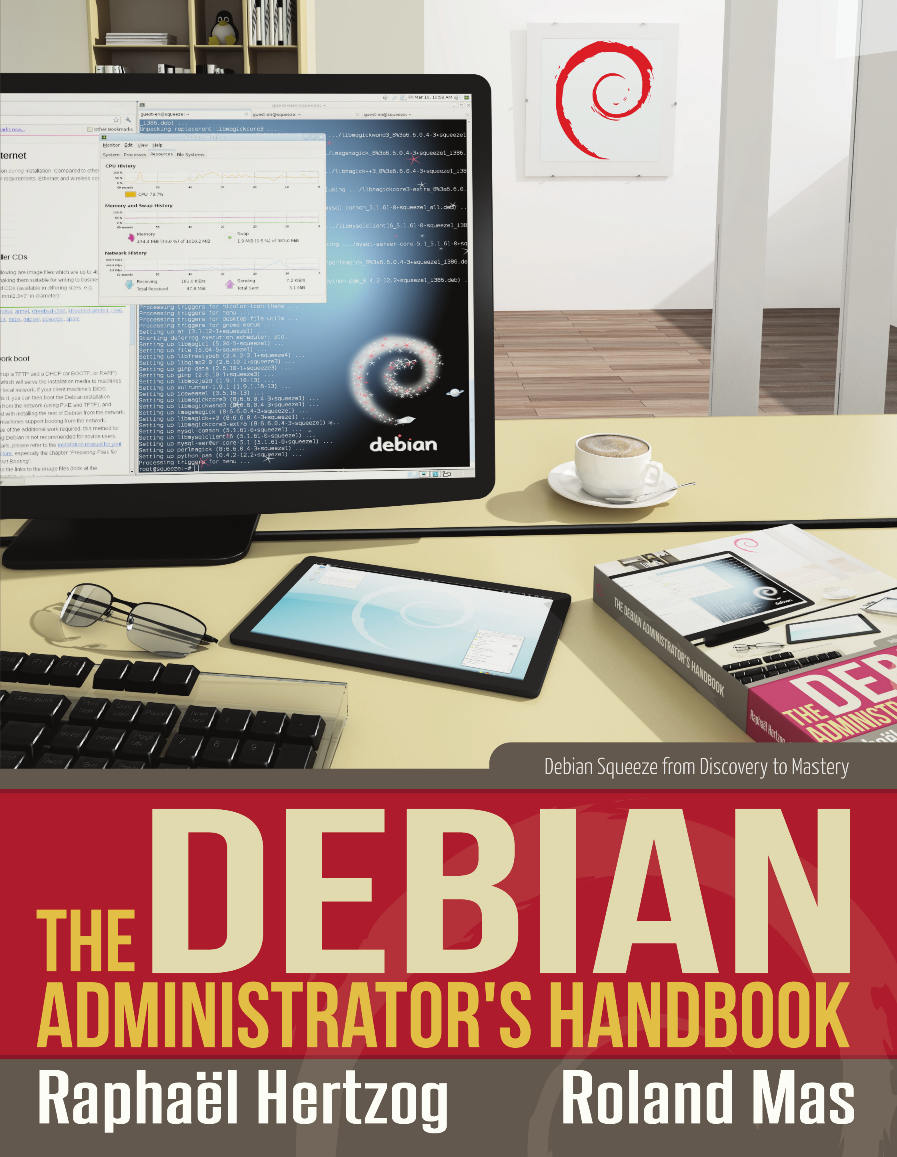
This is my monthly summary of my Debian related activities. If you re among the people who made a donation to support my work (227.83 , thanks everybody!), then you can learn how I spent your money. Otherwise it s just an interesting status update on my various projects. Dpkg Thanks to Guillem, dpkg with multiarch support is now available in Debian sid. The road has been bumpy, and it has again been delayed multiple times even after Guillem announced it on debian-devel-announce. Finally, the upload happened on March 19th. I did not appreciate his announce because it was not coordinated at all, and had I been involved from the start, we could have drafted it in a way that sounded less scary for people. In the end, I provided a script so that people can verify whether they were affected by one of the potential problems that Guillem pointed out. While real, most of them are rather unlikely for typical multiarch usage. Bernhard R. Link submitted a patch to add a new status command to dpkg-buildflags. This command would print all the information required to understand which flags are activated and why. It would typically be called during the build process by debian/rules to keep a trace of the build flags configuration. The goal is to help debugging and also to make it possible to extract that information automatically from build logs. I reviewed his patch and we made several iterations, it s mostly ready to be merged but there s one detail where Bernhard and I disagree and I solicited Guillem s opinion to try to take a decision. Unfortunately neither Guillem nor anyone else chimed in. On request of Alexander Wirt, I uploaded a new backport of dpkg where I dropped the DEB_HOST_MULTIARCH variable from dpkg-architecture to ensure multi-arch is never accidentally enabled in other backports. One last thing that I did not mention publicly at all yet, is that I contacted Lennart Poettering to suggest an improvement to the /etc/os-release file that he s trying to standardize across distributions. It occurred to me that this file could also replace our /etc/dpkg/origins/default file (and not only /etc/debian_version) provided that it could store ancestry information. After some discussions, he documented new official fields for that file (ID_LIKE, HOME_URL, SUPPORT_URL, BUG_REPORT_URL). Next step for me is to improve dpkg-vendor to support this file (as a fallback or as default, I don t know yet). Packaging I packaged quilt 0.60 (we re now down to 9 Debian-specific patches, from a whopping 26 in version 0.48!) and zim 0.55. In prevision of the next upstream version of Publican, I asked the Perl team to package a few Perl modules that Publican now requires. Less than two weeks after, all of them were in Debian Unstable. Congrats and many thanks to the Perl team (and Salvatore Bonaccorso in particular, which I happen to know because we were on the same plane during last Debconf!). On a side note, being the maintainer of nautilus-dropbox became progressively less fun over the last months, in particular because the upstream authors tried to override some of the (IMO correct) packaging decisions that I made and got in touch with Ubuntu community managers to try to have their way. Last but not least, I keep getting duplicates of a bug that is not in my package but in the official package and that Dropbox did not respond to my query. Book update The translation is finished and we re now reviewing the whole book. It takes a bit more time than expected because we re trying to harmonize the style and because it s difficult to coordinate the work of several volunteer reviewers. The book cover is now almost finalized (click on it to view it in higher definitions): We also made some progress on the interior design for the paperback. Unfortunately, I have nothing to show you yet. But it will be very nice and made with just a LaTeX stylesheet tailored for use with dblatex. The liberation fundraising slowed down with only 41 new supporters this month but it made a nice bump anyway thanks to a generous donation of 1000 EUR by Offensive security, the company behind Backtrack Linux. They will soon communicate on this, hopefully it will boost the operation. It would be really nice if we managed to raise the remaining 3000 EUR in the few weeks left until the official release of the book! The work on my book dominated the month and explains my relative inactivity on other fronts. I worked much more than usual, and my wife keeps telling me that I look tired and that I should go in bed earlier but I see the end of the tunnel: if everything goes well, the book should be released in a few weeks and I will be able to switch back to a saner lifestyle. Thanks See you next month for a new summary of my activities.
One comment Liked this article? Click here. My blog is Flattr-enabled.

Kai Wasserb ch: kvpm in Debian now

Just a short announcement: kvpm (short for "KDE volume and partition manager") is now a part of Debian's unstable distribution, Sid, and should enter testing (Wheezy) soon. The big thank you for this goes to Benjamin, upstream author of kvpm who has become also the Debian Maintainer of his software! The story behind packaging kvpm started with Benjamin writing an e-mail to pkg-kde-extras, in which he asked for inclusion of kvpm into Debian. After an initial answer by myself about filing a RFP bug, in case he wouldn't like to package kvpm himself, a discussion in private ensued. There I explained that Debian is a do-ocracy, where things get packaged if some maintainer uses something herself or if the requesting party does the work. Benjamin took up the challenge and packaged kvpm, I helped only with feedback and finally sponsoring the upload. Why do I tell this story? Because I hope it encourages other people to do the same as Benjamin did: package the software they'd like to see become a part of Debian. We, the Debian Developers around the world, are more than happy to assist you. Just ask us (e.g. by e-mail or through IRC (#debian-mentors)).

Russ Allbery: Review: Agile Project Management with Scrum

Review: Agile Project Management with Scrum, by Ken Schwaber
Publisher: Microsoft
Copyright: 2004
ISBN: 0-7356-1993-X
Format: Trade paperback
Pages: 153
Ken Schwaber is one of the two original developers of Scrum and one of the signatories to the Agile Manifesto. Agile Project Management with Scrum is an introduction to Scrum by him that feels aimed primarily at business people (project managers, executives, line managers) rather than at technical people. There's very little about agile software development in general; the emphasis is on business process, team organization, and how the Scrum process looks to the rest of the organization. After an introductory chapter laying out the basics of Scrum, the remainder of the book is primarily case studies. Schwaber presents some principle and then discuss an anonymized case study that illustrates the principle. Each major Scrum role (ScrumMaster, Product Owner, and Team Member) gets their own chapter, interspersed with chapters on planning, reporting, and scaling. Finally, there are some concluding appendices laying out the rules of Scrum in more detail, adding a brief (and very disappointing) discussion of fixed-term, fixed-price contracts, and providing some other supplemental information. This is only the second regular book that I've read about Scrum, but my reading has been a bit out of order. We've been using Scrum for various projects for about a year and a half, I've played both team member and product owner roles, and we've been thinking hard about how to integrate Scrum more into the way we do development. My impression of this book is that it's intended as more of an introduction for people who aren't yet comfortable with Scrum or who are still struggling to make the pieces fit together. I'm therefore possibly not the target audience. Much of this book is a rehash of things someone who has studied Scrum will already know. I'm of two minds about the case study presentation style of this book. On one hand, it does help to make the points Schwaber discusses more concrete, and it's difficult to talk about business process in any other way. They're also more interesting and engaging than Schwaber's straight rule descriptions. But I had difficulty digging into most of the ones here. They're very simple and a little shallow, and I had trouble applying many of them to practical situations I might be in. I would have liked somewhat more detailed stories with more analysis and possible alternatives within the situation, rather than simple illustrations of how Scrum solves the problem that Schwaber had just said it would solve. What I did like about this book is that it provides the background and theory of Scrum as empirical process control much more clearly than any material I'd previously read. Schwaber is good at explaining what empirical process control is and why it's a superior approach, and he gave me new vocabulary and basic concepts to use to talk about Scrum. I also liked the high-level look from a management perspective without getting into the details of story points and velocity estimation (Schwaber doesn't use them at all in this book, relying instead on traditional "days of work" estimates). Much of my previous experience with Scrum was tightly focused on its advantages for estimation and responsiveness to changes, and it's nice to see some of the other advantages of Scrum (developer job satisfaction, improved focus, incremental deployment) highlighted more. Another part of this book I appreciated was the discussion of sprint length. Schwaber doesn't go into the possible alternatives, largely assuming that a month is the best interval, but the discussion of the impact and implications of a month sprint length helped me see the advantages of longer sprints. (To date, we've been doing either one week or two week sprints.) I came away with the feeling that a hybrid model where longer sprints are used for business purposes and then subdivided into shorter sprints for developer coordination might be particularly effective, although that's not an idea that Schwaber presents. This is not a particularly compelling read, particularly if, like me, you're not a huge fan of genericized case studies. Schwaber's writing is clear, but wooden and occasionally awkward, and the book is often dry. But it talks about Scrum from a management angle instead of a developer angle, which is an additional perspective that I found valuable. Possibly worth taking a look if you want more detail about Scrum from a high-level management perspective, although I don't think you're missing a lot by not reading it. Rating: 6 out of 10

29 March 2012

Pablo Lorenzzoni: Using Gmail anti-spam with mutt

OK, this is not another post on how to use Mutt and Gmail. This is just to comment on a feature I found in Mutt that was not obvious, and that helped me to stop running my own anti-spam tool. So, for a number of reasons, my company stop filtering spams. I was setting up dspam to take over that job when I decided that it was just too much pain for a single account. Besides, although I am spammed a lot, I would never possibly be more efficient than Gmail anti-spam, given the load of emails their users classify everyday. I am not migrating my old emails over to Gmail, though. And I am pretty comfortable with my current email work-flow I am simply not going to use a webmail (even one as powerful as Gmail). OK, I am using GNOME 3 after being a Fluxbox and Bluetile user, but everything has a limit But how to keep the best of both worlds? And, more important, how to do that with minimum disruption of what I already have (my own IMAP server and Mutt managing my account there as spoolfile)? The answer is a little known trick using the mailboxes directive in .muttrc. This directive accepts a fully-qualified imap mailbox address. So I just added something like:

mailboxes 'imaps://gmail-user:gmail-password@imap.gmail.com:993/[Gmail]/Spam'
and added some shortcuts to save email from my inbox to that mailbox (the same as train-as-spam) and to rescue email from it (the same as train-as-ham):
macro index <F3> ";Wo;Wn;simaps://gmail-user:gmail-password@imap.gmail.com:993/[Gmail]/Spam\n" "Train as SPAM"
macro index <F4> ";Wo;Wn;simaps://gmail-user:gmail-password@imap.gmail.com:993/INBOX\n" "Train as HAM"
and that was it. In my IMAP machine I got a fetchmail downloading emails from Gmail s INBOX so I can get trained-as-ham and new emails (all emails arrive first in my Gmail account) into my IMAP server. All my sieve rules are in place and nothing changed in my email work-flow. It s been working flawlessly for a week now. The only drawbacks are (1) Gmail knowing everything that arrives to me (not a big deal, since unencrypted emails aren t private anyway), and (2) not getting the spam-count once Mutt is run: I have to change into that mailbox to log-in to Gmail. Update: Mar 30, 2012 @ 18:15: I just found out that drawback number (2) above can be fixed by adding the following to .muttrc:
unset imap_passive

27 March 2012

Timo Jyrinki: On brands, marketing and technical details

I have a few thoughts based on the yet another round of debate where marketing clashes with free software advocation and technical details. Nothing new in the debate itself, but I'm adding a couple of insights.

Marketing is not highly respected by many technical people, and neither by the people wanting more advocating than the messing up with facts and feelings that the marketing does. I'm all for advocating free software, but it's currently not something you can use for marketing to win big markets. If we advance to a world where free software is as wanted as the green values today are, it can be used in marketing as well similar to all the ecological (according to the market department at least) products today, but alas the benefits of free software are not yet as universally known. Since it doesn't say much that touches the masses, advocating has a negative marketing effect since it takes space away from the potentially "hitting" marketing moves, in those cases where you target the big masses in the first place. "Open" this and that has some marketing power in it nowadays, but it's a mess of different meanings that probably doesn't advance libre software freedoms as such. Wikipedia has probably been the biggest contributor to advancing general knowledge of software and culture libre. Disclaimer: I'm not a proper marketing person, some more professional might have better insights in this area. If I'd be a proper marketing person, I'd decorate this blog post with fancy pictures so that more people would actually read it.

Some of the marketing can be done without sacrificing any of the advocation. The fabulous Fedora campaigns, graphics, slogans and materials are a great example of those and do an important job, even though Fedora isn't reaching the big masses with it (and Fedora isn't targeted for OEMs to ship to millions either). But they do hopefully reach a lot of level people on the grassroots level. I hope as a Debian Developer that more people valuing the freedoms of free software would help also Debian as a project to reach more of its advocation potential and developers from the more proprietary world. But I'm happy that at least some free software projects have nowadays true graphical and marketing talent. Even though not as widely known, freedoms of the software users including for example privacy aspects are a potential good marketing tool toward a portion of the developer pool.

Let's not forget that Android conquered the mobile market without using the brand power of Linux. The 30+ million people who know Linux a bit deeper than just "I've heard it" already run a Linux distribution like Ubuntu, but we need hotter brands than a project name of a kernel to reach the bigger masses. Call it Ubuntu, Fedora, or something, but no matter do what it needs to ship it to millions. AFAIK mostly Ubuntu and SUSE are shipping currently via desktop/notebook OEMs, and more Ubuntu than SUSE. Others aren't concentrating on the market, which is a very difficult one. Ubuntu is doing a lot more mass population advocating for free software than Android has ever done. Note for example the time any user tries to play a video for the first time in a non-free format - Ubuntu will tell the user about the problems related to those formats and asking a permission to install a free software player for those (or buy licensed codecs), and the Ubuntu Help texts describe a lot of details about restricted formats, DRM et cetera. Not to mention what happens if the person actually wanders into the community, discovering Debian, other free software projects, free software licenses and so on. Meanwhile Android users never notice anything being wrong while watching H.264 videos or watching DRM Flash videos. Granted, like Boot2Gecko debate shows, it may be a partially similar situation on shipping desktop Linux variants as well, in order to actually ship them via partners.

Anyway, the best example of brands is MeeGo. Even the LWN editor does not get into dissecting the meaning of MeeGo on Nokia N9, because "there has been no real agreement on that in the past", but just uses the brand name as is. That is the power of brands. Technical people debate that it's not really MeeGo, it's maemo GNU/Linux with a special permission from Linux Foundation to use the MeeGo brand name, and then counter-argument with that the MeeGo is an API and maemo matches the MeeGo 1.2 API which is actually just Qt 4.7 API. And actually, as proven by the LWN example, it's not even "technical people". For most of technical people Nokia N9 is MeeGo as well. Only the people who have actually worked on it plus the couple of other people migrated from maemo and MeeGo.com communities to Mer project understand the legacy, history and the complete difference between the Maemo Harmattan platform and what MeeGo.com was. Yet at the same time like all GNU/FreeDesktop.org/Linux distributions, they are 95% same code, just all the infrastructure and packaging and polishing and history is different.

For 99.9% of people who know what MeeGo is, MeeGo is the cool Nokia smartphone, one of its kind and not sold in some of the major western markets, and/or the colorful sweet characters of meego.com shown at one time on a couple of netbooks. That is the brand, and the technical details do not matter even to the technical people unless they actually get into working on the projects directly.

To most people, the Linux brand is a mess of a lot of things, while other brands have the possibility at least to have a more differentiating and unique appearance.

24 March 2012

Dirk Eddelbuettel: Initial release 0.1.0 of package RcppSMC

Hm, I realized that I announced this on Google+ (via Rcpp) as well as on Twitter, on the r-packages list, wrote a new and simple web page for it, but had not put it on my blog. So here is some catching up. Sequential Monte Carlo / Particle Filter is a (to quote the Wikipedia page I just linked to) sophisticated model estimation technique based on simulation. They are related to both Kalman Filters, and Markov Chain Monte Carlo methods. Adam Johansen has a rather nice set of C++ classes documentated in his 2009 paper in the Journal of Statistical Software (JSS). I started to play with these classes and realized that, once again, this would make perfect sense in an R extension built with the Rcpp package by Romain and myself (and in JSS too). So I put a first prototype onto R-Forge and emailed Adam who, to my pleasant surprise, was quite interested. And a couple of emails, and commits later, we are happy to present a very first release 0.1.0. I wrote a few words on a RcppSMC page on my website where you can find a few more details. But in short, we already have example functions demonstrating the backend classes by reproducing examples from
Johansen (2009)
and his example 5.1 via pfLineartBS() for a linear bootstrap example;
Doucet, Briers and Senecal (2006)
and their (optimal) block-sampling particle filter for a linear Gaussian model (serving as an illustration as the setup does of course have an analytical solution) via the function blockpfGaussianOpt()
Gordon, Salmond and Smith (1993)
and their ubiqitous nonlinear state space model via the function pfNonlinBS().
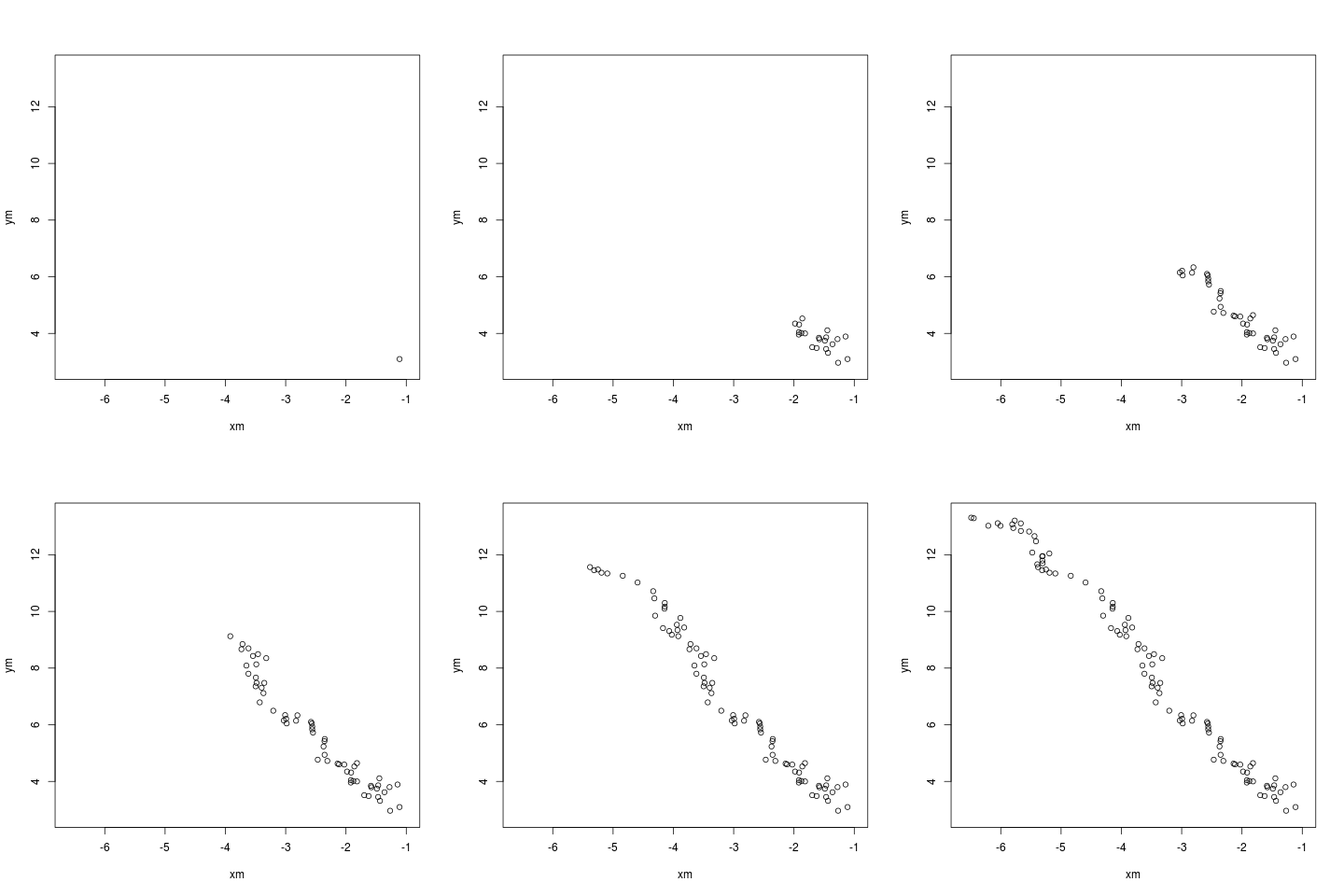
And to illustrate just why Rcpp is so cool for this, here is a little animation of a callback from the C++ code when doing the filtering on Adam's example 5.1. By passing a simple plotting function, written in R, to the C++ code, we can get a plot updated on every iteration. Here I cheated a little and used our old plot function with fixed ranges, the package now uses a more general function: Example of RcppSMC callback to R plot when estimation example 5.1 from Johansen (2009) The animation is of course due to ImageMagick glueing one hundred files into a single animated gif. More information about RcppSMC is on its page, and we intend to add more examples and extensions over time.

Alessio Treglia: LADI Tools: first stable release is out!

During the last month I worked as upstream maintainer of LADI Tools and now I m happy to introduce the first stable release! So, to answer the usual question What s new? , here is a short description of the changes introduced (taken from the NEWS file included in the release tarball): Laditools 1.0 Lady O Apart from wladi and g15ladi, most of ladi* tools have been renamed: Moreover, a new component has joined the LADI Tools suite: ladi-player. LADI Player is a convenient, graphical VLC-style application providing an all-in-one control interface to start, stop and monitor JACK as well as the session handler. It also provides basic controls for managing studios. Goodbye PyGTK! All the code was ported to GTK+ 3 and the new GObject Introspection mechanism. Code refactoring and cleanup The code has been reorganized in order to allow the use of Python objects by 3rd party applications. To start writing code using the classes provided by laditools, simply do the following: from laditools import * Two-in-one solution for LADI System Tray Formerly laditray was an implementation of GtkStatusIcon to put a nice right-clickable icon into the system tray to allow users access JACK controls easy way. It s been mostly rewritten and now it shows an AppIndicator icon (if the library is available), or fall back to the Freedesktop.org s old-fashioned System Tray Protocol Spec-compliant icon. Project s new homepage The project s homepage is now hosted by Launchpad.net, the code is hosted by repo.or.cz and it s available here for browsing.
Please use the following links to contact the development team: New up-to-date packages will hit both Debian and Ubuntu soon!

23 March 2012

Rapha&#235;l Hertzog: People behind Debian: J rg Jaspert, FTPmaster, Debian Account Manager, and more

Photo by Wouter Verhelst

J rg is a very active contributor within Debian, and has been for a long time. This explains why he holds so many roles (FTPmaster and Debian Account Manager being the 2 most important ones) Better known as Ganneff (his IRC nick), he s not exactly the typical hacker. He has no beard and used to drink milk instead of beers. :-) Check out his interview to learn more about some of the numerous ways one can get involved in Debian, managing its infrastructure and without having to be a packager. Raphael: Who are you? J rg: My name is J rg Jaspert and I m 35 years old working for a small company doing system administration and consulting work for our customers. I m married for a little while now and sometime soon a little Ganneff will be crawling out of my wife. (Whoever didn t think of the movie Alien now is just boring). Raphael: How did you start contributing to Debian? J rg: I started using Debian somewhere around 2000, 2001. Before that I had the misfortune to try SuSE and RedHat, both with a user experience that let me fully understand why people think Linux is unusable. (Due to my work I m in the unfortunate situation to have to use RedHat on two machines. Funny how they are still utter crap and worse than bad toys). And all of this lets get a Linux running here came up because I was trying to find a replacement for my beloved OS/2 installation, which I had for some years. So after I got Debian installed, good old Potato, I got myself active on our mailing lists, starting with the German user one. A bit later I replied to a question if someone can help as staff for a Debian booth somewhere. It was the most boring event I ever visited (very nice orga, unfortunately no visitors), but I got a few important things there: The software I packaged, found me a sponsor and voila, maintainer I was. Some more packages got added and at some point my sponsor turned out to be my advocate. The NM process run around 2 months, and mid April 2002 I got THE MAIL. Raphael: Some Debian developers believe that you have too many responsibilities within Debian (DAM, FTPMaster, Debconf, Partners, Planet Debian, Mirrors, ). Do you agree that it can be problematic, and if yes, are you trying to scale down? J rg: It s DebConf, tssk. And yes, I do have some extra groups and roles. And you even only list some, leaving out all I do outside Debian. But simply counting number of roles is a plain stupid way to go. Way more interesting is how much work is behind a role and how many other people are involved. And looking at those you listed I don t see any I am a SPOF. Let s look at those you listed: DAM: Here I did start out assisting James to get the huge backload down which had accumulated over time. Nowadays I am merely the one with the longest term as DAM. Christoph Berg joined in April 2008 and Enrico Zini followed during October 2010, both very active. Especially Enrico, lately with the redesign of the NM webpages. FTPMaster: The basic outline of the FTPMaster history is similar to the DAM one. I joined as an assistant, after the oh-so-famous Vancouver meeting in 2004. Together with Jeroen, we both then got the backload down which had accumulated there. He did most of the removals while I had a fun time cleaning up NEW. And we both prepared patches for the codebase. And in 2007, as the last action as DPL, Sam made me FTPMaster. Since then I haven t been alone either. In fact we have much more rotation in the team than ever before, which is a good thing. Today we are 3 FTPMasters, 4 FTP Assistants and 1 Trainee. Though we always like new blood and would welcome more volunteers. DebConf: I am very far outside the central DebConf team. I am not even a delegate here. Currently I am merely an admin, though there are 4 others with the same rights on the DebConf machines. I ve not taken any extra jobs this year, nor will I. Probably for next year again, but not 2012. Planet: I am one of three again, but then Planet is mostly running itself. Debian developers can just edit the config, cron is doing the work, not much needed here. Occasional cleanups, every now and then a mail to answer, done. In short: No real workload attached. Mirrors: My main part here is the ftpsync scriptset. Which is a small part of the actual work. The majority of it, like checking mirrors, getting them to fix errors, etc. is done by Simon Paillard (and since some time, Raphael Geissert is active there too, you might have heard about his http.debian.net). Having said that, there is stuff I could have handled better or probably faster. There always is. Right now I have 2 outstanding things I want to do a (last) cleanup on and then give away. Raphael: You got married last year. I know by experience that entertaining a relationship and/or a family takes time. How do you manage to combine this with your Debian involvement? J rg: Oh well, I first met my wife at the International Conference on OpenSource 2009 in Taiwan. So OpenSource, Debian and me being some tiny wheel in the system wasn t entirely news to her. And in the time since then she learned that there is much more behind when you are in a community like Debian, instead of just doing it for work. Even better that she met Debian people multiple times already, and knows with who I am quarreling Also, she is currently attending a language school having lots of homework in the evening. Gives me time for Debian stuff. :) How that turns out with the baby I have no idea yet. I do want to train it to like pressing the M key, so little-Ganneff can deal with NEW all on its own (M being Manual reject), but it might take a day or twenty before it gets so far. :) Raphael: Thanks to the continuous work of many new volunteers, the NEW queue is no longer a bottleneck. What are the next challenges for the FTPmaster team? J rg: Bad link, try this one. :) Also, no longer sounds like its recent. It s not, it s just that people usually recognize the negative only and not the positive parts. Well, there are a few challenges actually. The first one, even if it sounds simple, is an ongoing one: We need Debian Developers willing to do the work that is hidden behind those simple graphs. Yes, we are currently having a great FTP Team doing a splendid work in keeping that queue reasonably small this is a/THE sisyphean task per excellence. There will always be something waiting for NEW, even if you just cleaned the queue, you turn around and there is something else back in already. Spreading this workload to more people helps not burning one out. So if one or more of the readers is interested, we always like new volunteers. You simply need to be an uploading DD and have a bit of free time. For the rest we do have training procedures in place. Another one is getting the multi-archive stuff done. The goal is to end up with ONE host for all our archives. One dak installation. But separate overrides, trees, mirrors, policies and people (think RMs, backports team, security team). While this is halfway easy to think of in terms of merging backports into main it gets an interesting side note when you think of merging security into main . The security archive does have information that is limited to few people before public release of a security announce, and so we must make sure our database isn t leaking information. Or our filesystem layer handling. Or logs. Etc. Especially as the database is synced in (near) realtime to a DD accessible machine. And the filesystem data too, just a little less often. There is also a discussion about a good way to setup a PPA for Debian service. We do have a very far developed proposal here how it should work, and I really should do the finishing touches and get it to the public. Might even get a GSoC project on it. So far for some short to middle term goals. If you want to go really long term, I do think that we should get to the point where we get rid of the classical view of a source package being one (or more) tarballs plus the Debian changes. Where a new version requires the full upload of one or more of those parts of the source package. I don t know exactly where it should end up. Sure, stuff like one central DVCS, maintainers push there, the archive generates the source tarballs and prepares the mirrors do sound good for a quick glance. But there are lots of trouble and pitfalls and probably some dragons hidden here. Raphael: The Debian repositories are managed by DAK (Debian Archive Kit) which is not packaged. Thus Debian users pick tools like reprepro to manage their package repositories. Is that how things should be? J rg: Oh, Mark Hymers wants to do a package again. More power to him if he does, though yes, DAK is not exactly a quick-and-easy thing to install. But nowadays it is a trillion times easier than the past thanks to Mark s work people can now follow the instructions, scripts and whatever they find inside the setup directory. Still, it really depends on the archive size you are managing. A complex tool like dak does not make sense for someone who wants to publish one or a dozen of his own packages somewhere. Thats just like doing a finger amputation with a chainsaw it certainly works and is fun for the one with the chainsaw but you probably end up a little overdoing it. I myself am using dpkg-scan[packages sources] from a shell script but also mini-dinstall in places (never got friend with reprepro when I looked at it). Works, and for the few dozen packages those places manage it is more than enough. Also, using dak forces you into some ways of behaviour that are just what Debian wants but might not be what a user wants. Like inability to overwrite an existing file. One of the reasons why mentors.debian.net won t work with dak. Or the use of a postgres database. Or that of gpg. Sure, if you end up having more than just a dozen packages, if you have many suites and also movement between them, then dak is sure a thing to look at. And how should things be : however the user and admins of that certain install of reprepro, mini-dinstall, dak, whatever want it. This is not one-tool-for-all land :) Raphael: What is the role of Debian Account Managers (DAM)? Do you believe that DAMs have a responsibility to shape Debian by defining limits in terms of who can join and what can be done within Debian? J rg: Quote from https://lists.debian.org/debian-devel-announce/2010/10/msg00010.html:
The Debian Account Managers (DAM) are responsible for maintaining the list of members of the Debian Project, also known as Debian Developers. DAMs are authoritative in deciding who is a member of the Debian Project and can take subsequent actions such as approving and expelling Project members.
Now, aside from this quote, my OWN PERSONAL OPINION, without wearing anything even vaguely resembling a DAM hat: DAM is the one post that is entitled to decide who is a member or not. Usually that is in the way of joining (or not), which is simple enough. But every now and then this also means acting on a request to do something about whatever behaviour of a Debian Project member. I hate that (and i think one can easily replace I with WE there). But it s our job. We usually aren t quick about it. And we don t act on our own initiative when we do, we always have (numerous) other DDs complain/appeal/talk/whatever to us first. The expulsion procedure , luckily not invoked that often, does guarantee a slow process and lots of input from others. Are we the best for it? Probably not, we are just some people out of a thousand who happen to have a very similar hobby Debian. We aren t trained in dealing with the situations that can come up. But we are THE role inside Debian that is empowered to make such decisions, so naturally it ends up with us. Raphael: You did a lot of things for Debian over the years. What did bring you the most joy? Are there things that you re still bitter about? J rg: The most joy? Hrm, without being involved in Debian and SPI I would never have met my wife.
Or my current job. Or a GR against me. Not many running around with that badge, though I m still missing my own personal Serious problems with Mr. Jaspert thread. Bad you all.
Or visited so many places. Think of all the DebConfs, QA meetings, BSPs and whatever events.
Or met so many people.
Or learned so many things I would never even have come near without being DD. Raphael: Is there someone in Debian that you admire for their contributions? J rg: Yes.
Thank you to J rg for the time spent answering my questions. I hope you enjoyed reading his answers as I did. Note that older interviews are indexed on wiki.debian.org/PeopleBehindDebian.

Subscribe to my newsletter to get my monthly summary of the Debian/Ubuntu news and to not miss further interviews. You can also follow along on Identi.ca, Google+, Twitter and Facebook.

One comment Liked this article? Click here. My blog is Flattr-enabled.

20 March 2012

Russell Coker: An Introduction to Android

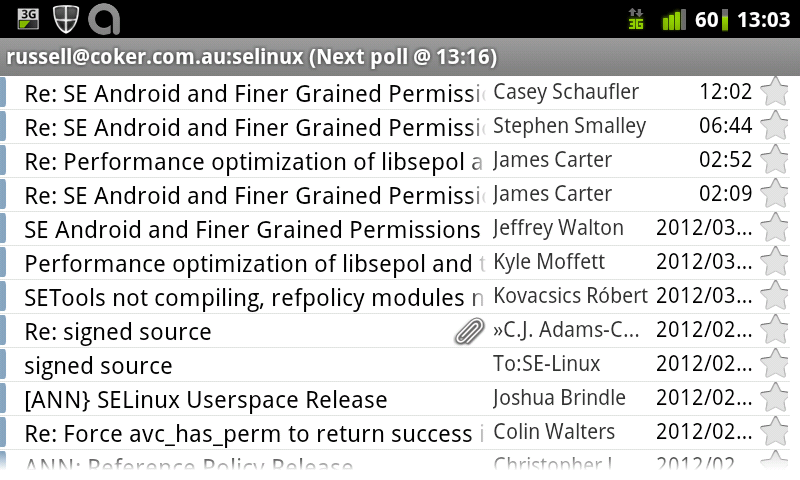
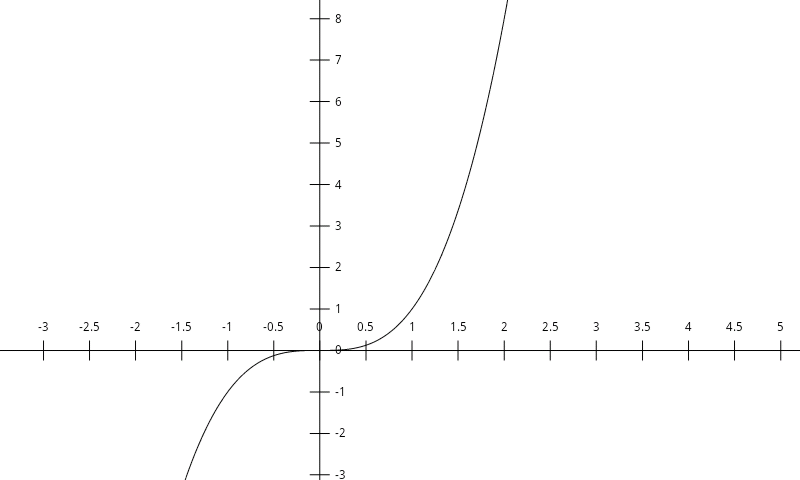
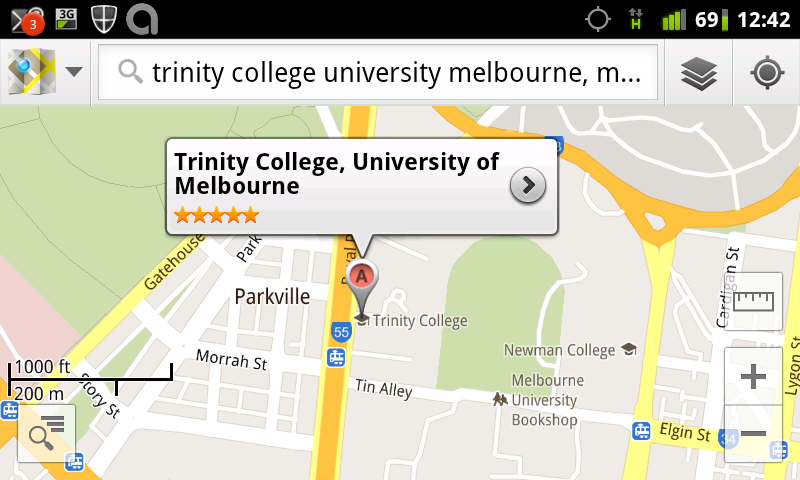
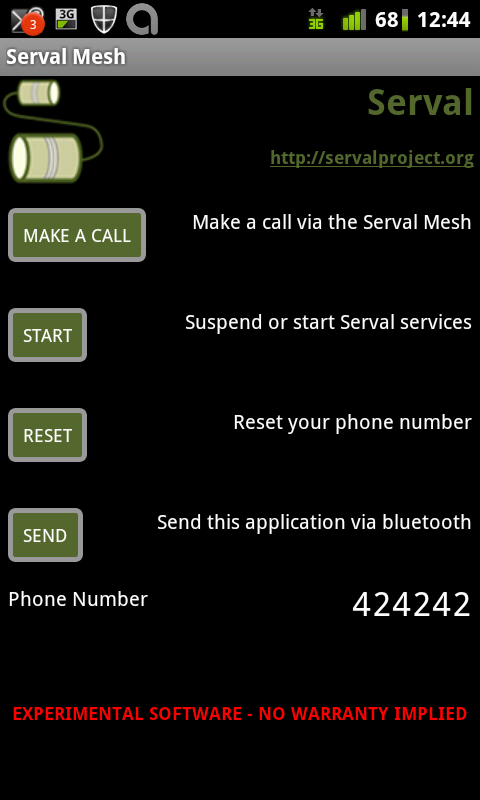
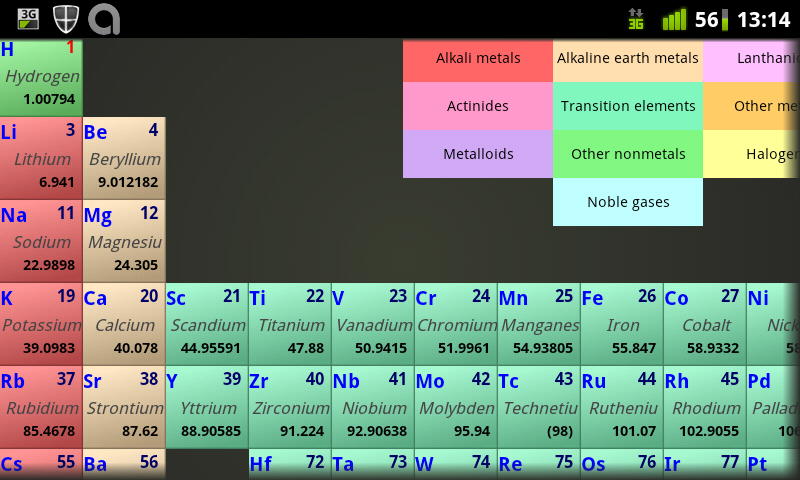
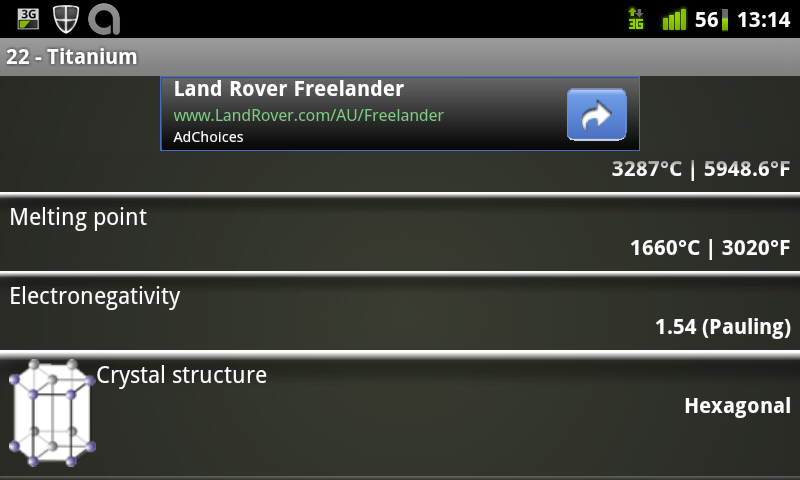
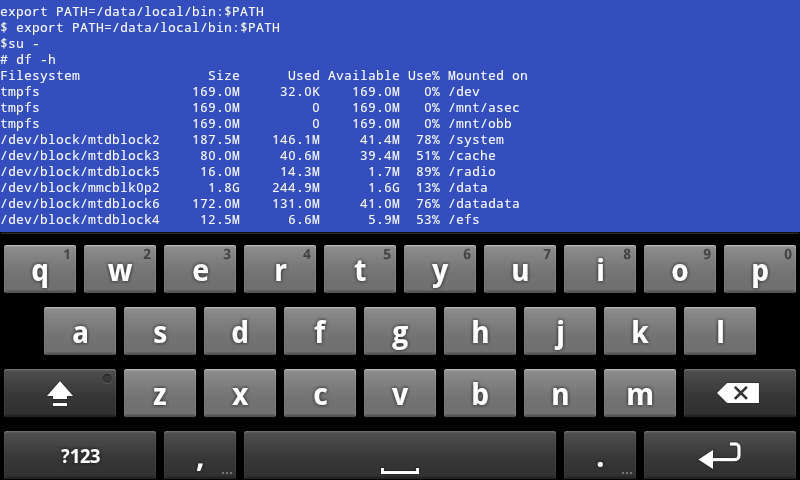
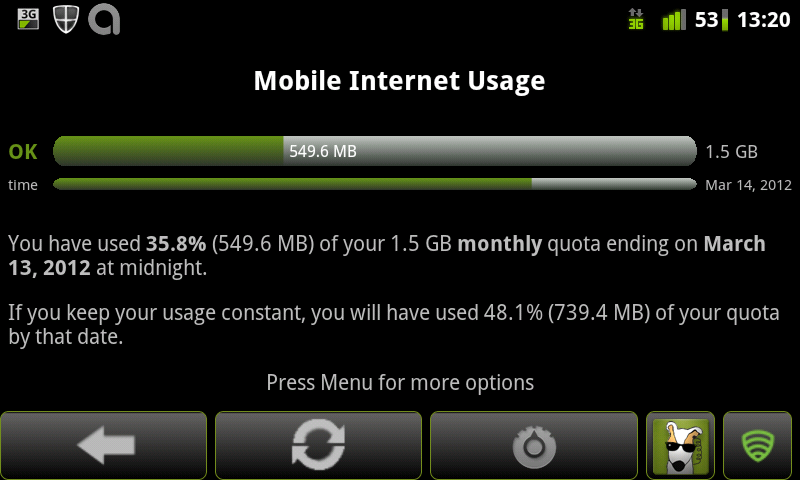
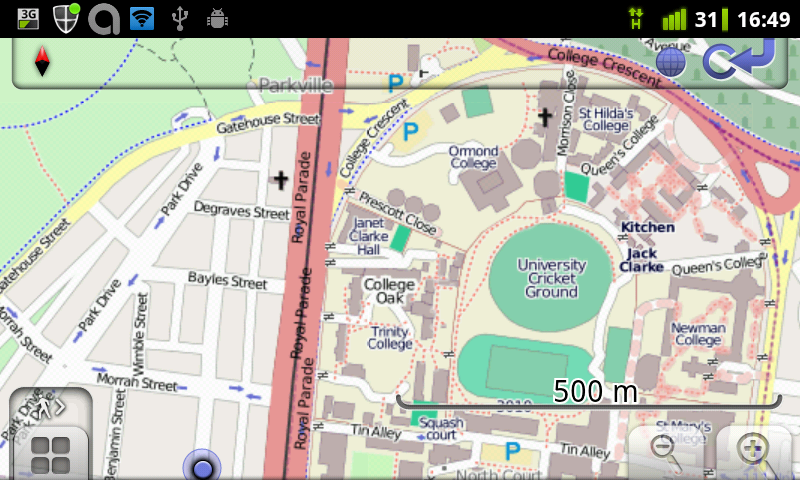
I gave a brief introductory talk about Android at this month s LUV meeting. Here are the slides with a brief description. All the screen-shots were made on a Samsung Galaxy S running Cyanogenmod version 7.1 [1] (Android version 2.3.7). With that build of Cyanogenmod you can press the power button for about 1.5 seconds to get a menu which gives an option to take a screen shot. The aim of the talk was to give an overview of what Android can do. I also gave some random commentary about Android such as explaining why it doesn t make a good phone. Most of the pictures in this post have links to the Android applications in question. Essential and Important Apps picture of root shell access running df I started by explaining why having root access to your system is really important, including the issue of backing up an Android phone [2]. Cyanogenmod includes a terminal program which allows you to run su - . Running a shell as root isn t generally that useful, what you really want is to be able to run programs such as Titanium Backup which can only work properly if given root access. When you run an OS that allows root access you can run su - at a terminal prompt and you can also have an application use a GUI to request root access. I recommend rooting and modding an Android phone immediately after buying it. However that takes some time which is somewhat equivalent to money and is a significant hidden cost to purchasing an Android phone. picture of 3g watchdog bandwidth monitor The business models of telephone companies seem to involve hidding users for unexpected fees and extra fees for excess bandwidth can be really expensive. 3G Watchdog is one app that can monitor bandwidth and disable data transfers if too much is used. Onavo is an alternative that allows tracking data use on a per-application basis, but it only runs on Android 2.3.x while 3G Watchdog works on Android 2.1. Official EBay app searching for Samsung Android phones EBay has an official app which is handy for searching for items. So far I ve only used it to get price estimates and have used a PC for buying. K9 viewing my SE Linux mailing list email K9 seems to be the best MUA for Android. The MUA that ships with Android 2.1 isn t nearly as good and K9 is good enough that I didn t even bother testing the MUA from Cyanogenmod. The above picture shows a list of mail in my SE Linux folder. graph by opticron grapher The Opticron Grapher is a good graphing calculator. I won t claim it s the best because I didn t seriously test such programs, but for the basic tests I ve done it has worked well. Google map of LUV location The Google Maps client comes with every Android system, the above shows the location of the LUV meeting. Open Street Map location of the LUV meeting Osmand is an Android client for the Open Street Map project. Here is the web site for the Open Street Map project [3]. One significant advantage of OSM over the Google Maps is that OSM is free, the data is all contributed by users like Wikipedia. Another significant advantage is that you can download as much data as you need to your phone, for example the entire dataset for Australia is about 200M. Storing 200M of data on your phone is no big deal when you consider the availability of phones with more than 16G of storage and the ability to use a map when offline is a real benefit. So far I ve used Osmand while waiting for a train at an underground station and I plan to use it to track my progress the next time I m on a cruise. serval mesh networking and VOIP Serval is a mesh networking application for Android that supports VOIP phone calls and distributing messages and files. It s designed to be used in disaster areas, but there are lots of other potential uses of the technology. The Serval Project blog has an article about the presentation they gave at LCA 2012 [4]. periodic table
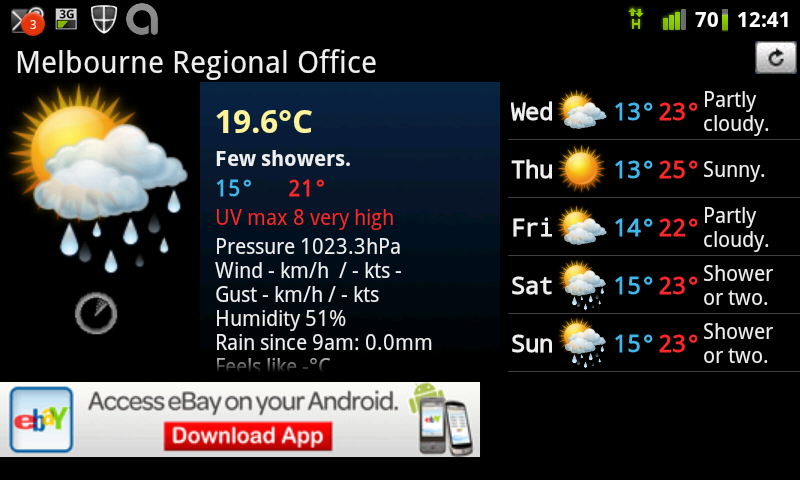
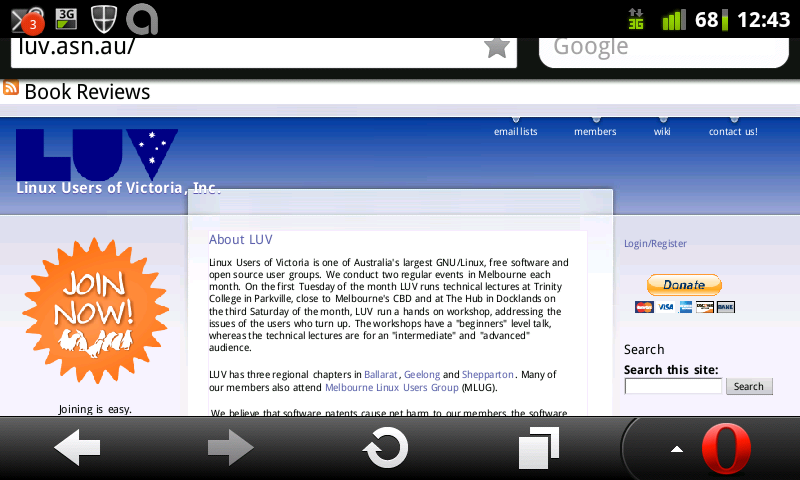
details about Titanium Periodic Droid is my favorite Periodic Table viewing program. tomfusion Au Weather forecast app The Tomfusion AU Weather forecast app seemed to be better than the one from the BoM last time I checked. It s probably the best weather app for Australia. screen-shot of LUV web site
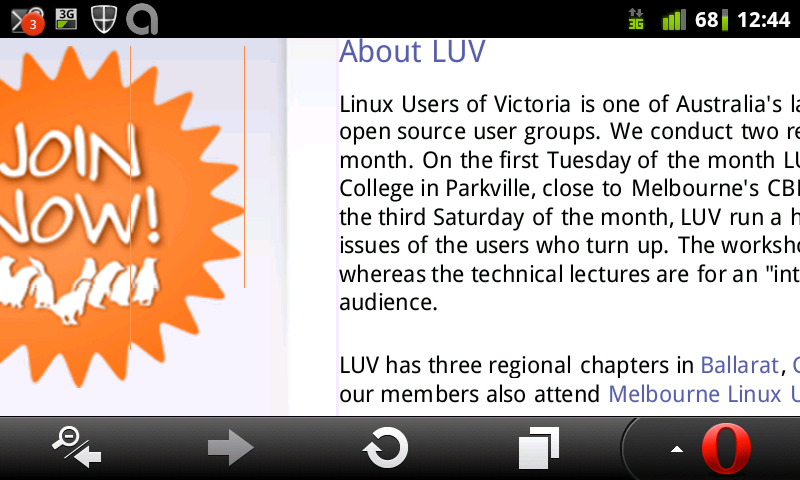
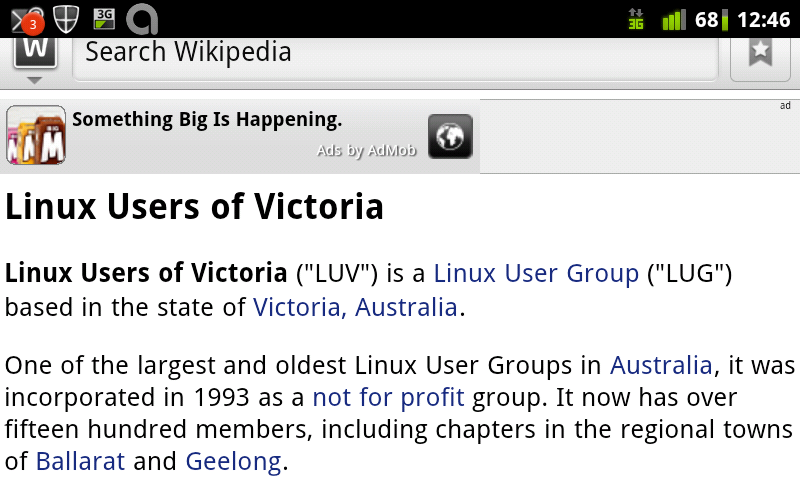
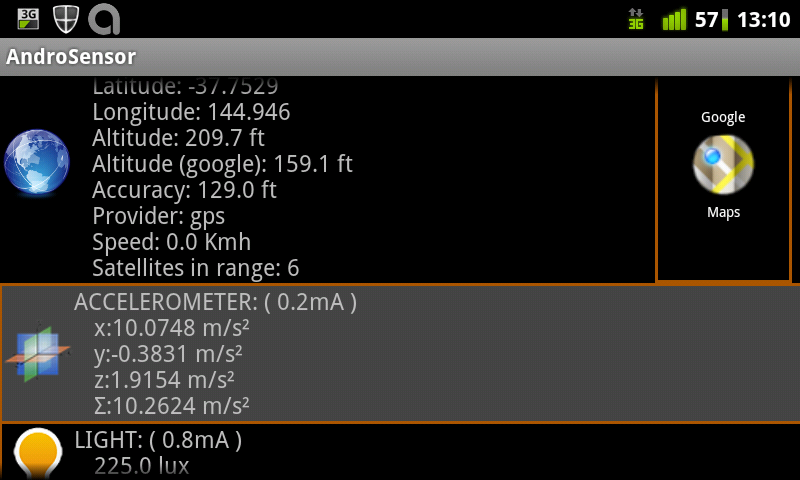
LUV web site zoomed in The Opera Mini browser is often faster than other browsers because it uses a compressing proxy run by Opera. It s not so good for privacy though LUV page on Wikipedia I have been using Wapedia for browsing Wikipedia. Since giving the talk I discovered the Official Wikipedia browser from the Wikimedia foundation [5] which is a better fit for my needs and I ve uninstalled Wapedia. As an aside modern phones have 16G of storage or more and could easily have a copy of the entire English text of Wikipedia on internal storage. It would be good if someone like Jason King (who is known for work on stand-alone DVD images for Wikipedia) was to write an Android program to do this. Handy Apps Androsensor showing GPS, accelleration, and light intensity
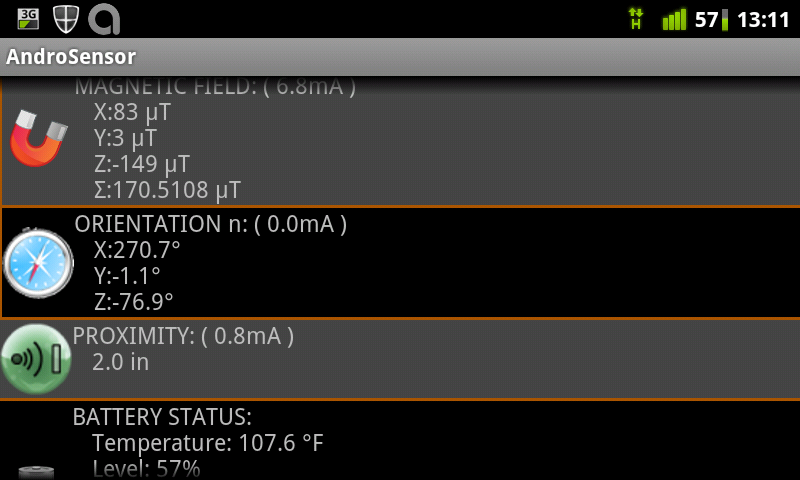
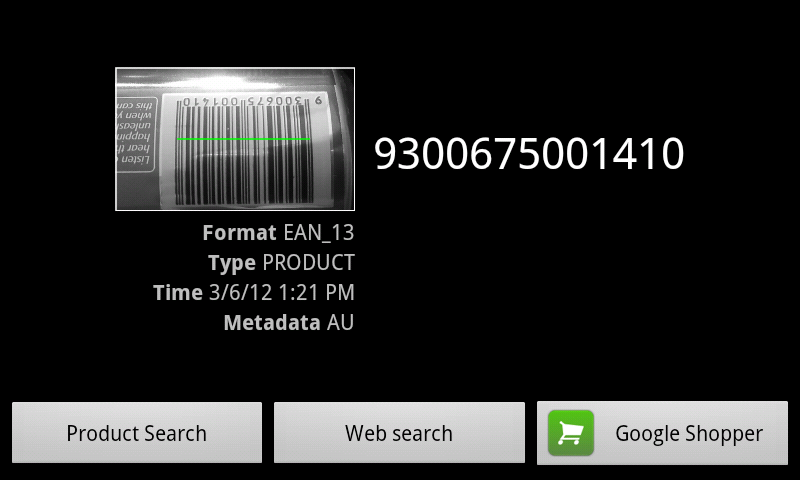
Androsensor showing magnetic field, orientation, and battery Androsensor is a program to display output from most (all?) of the sensors on your phone. The results aren t as accurate as one would hope, for example Earth s gravity is 9.81m/s^2 not the 10.26m/s^2 my phone registered. But they are a useful indication. picture of Coke can, scanning the barcode
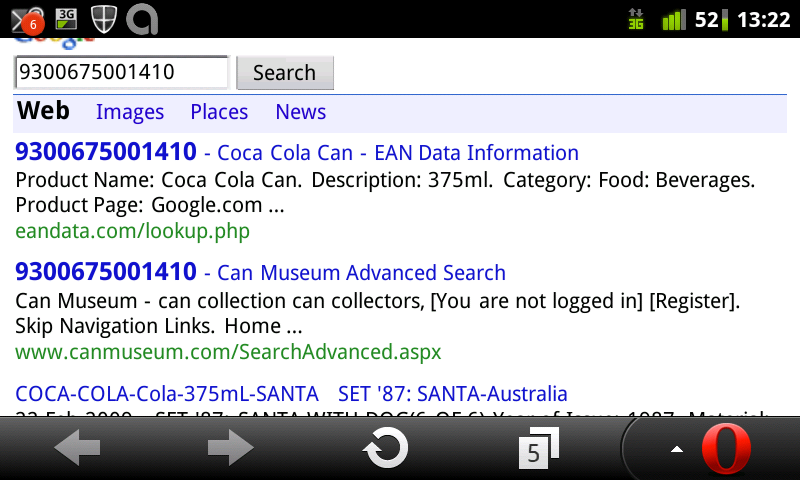
Google search on Coke can barcode
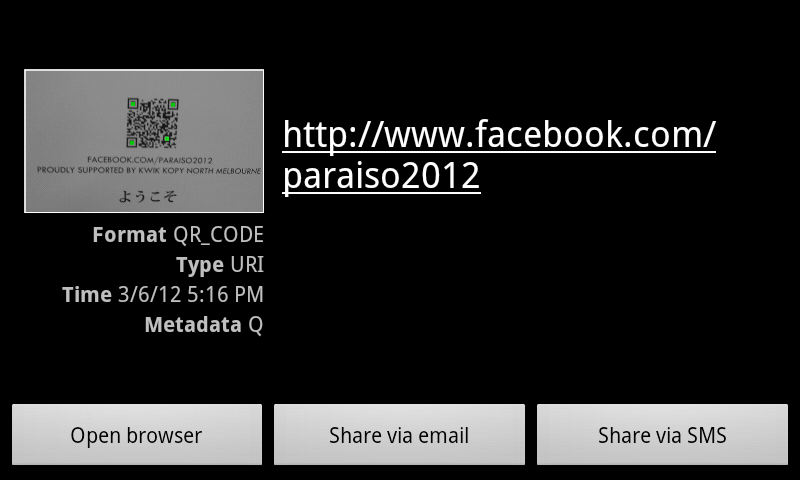
QR Code lookup of Facebook page The Zxing Barcode scanner is one of many programs that will scan barcodes with the camera in an Android phone. It can launch a Google search on a product code or open a URL from a
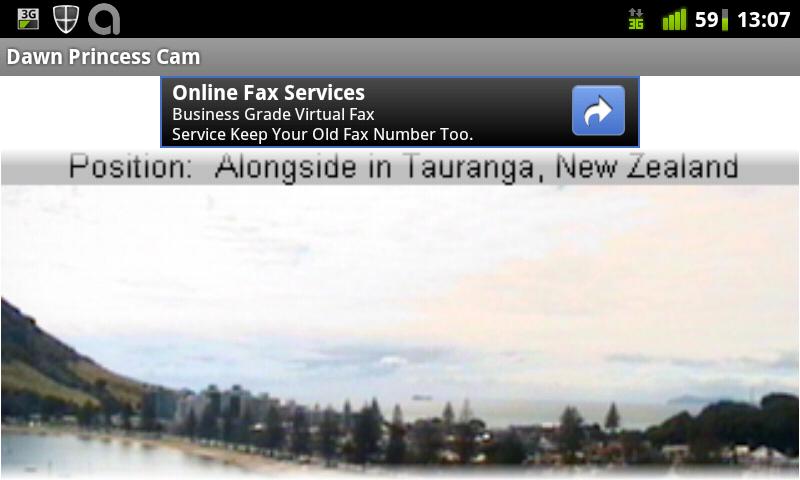
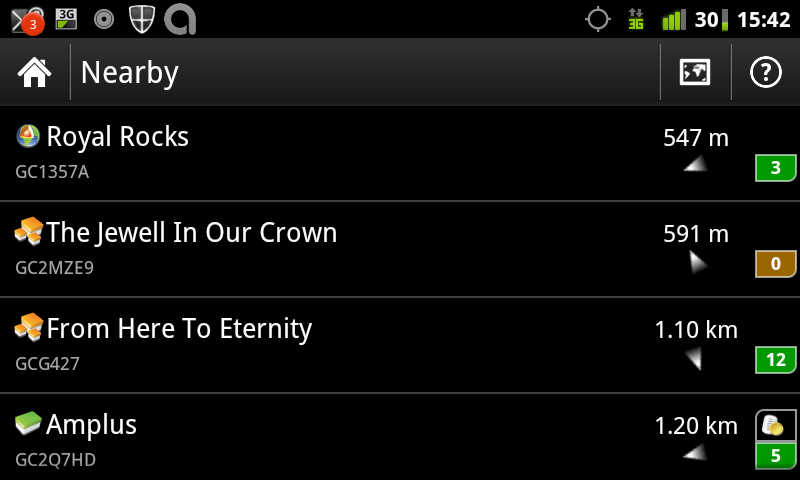
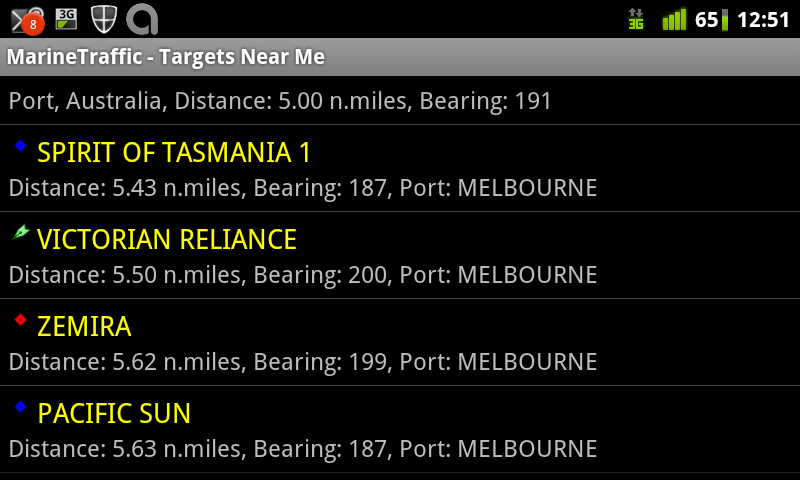
QR Code. The above pictures show it scanning a Coke can (the can and other background was displayed on the full screen before the screen capture program activated), doing a Google search on the can barcode, and looking up a QR code that was on an advertisment outside the LUV venue. picture from the bridge of the Dawn Princess in Tauranga NZ Cruise Cams allows you to download pictures from cruise ships. Some cruise ships have several cameras on different parts of the ship uploading pictures regularly so that people around the world can see what s happening. list of geo-caches near the park where I prepared most of my notes The c:geo opensource program allows you to get information on Geocaches and see a compass or map showing the location. This program has been getting an increasing number of features to do everything you might want to do related to Geocaching. The above picture shows some caches that are close to where I made the screen-shot, in a park a couple of Km from the meeting location. picture of Google Sky Map in the direction of Andromeda The Google Sky map uses augmented reality techniques to display stars in the direction that your phone is pointing along with their names and the names of the constellations. Marine Traffic showing ships near me
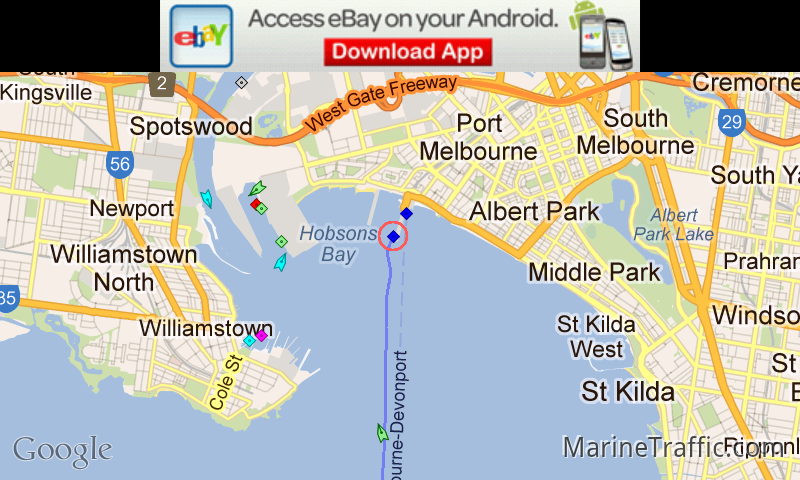
Marine Traffic showing the Pacific Sun highlighted on a Google Map
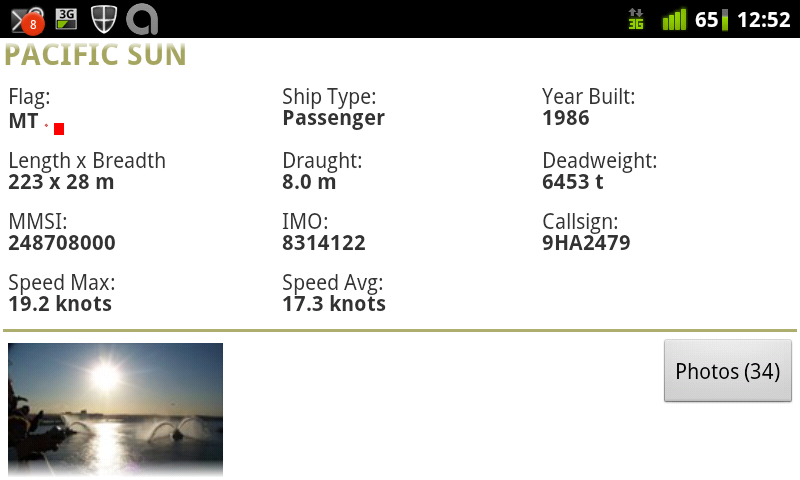
Marine Traffic showing details of the Pacific Sun
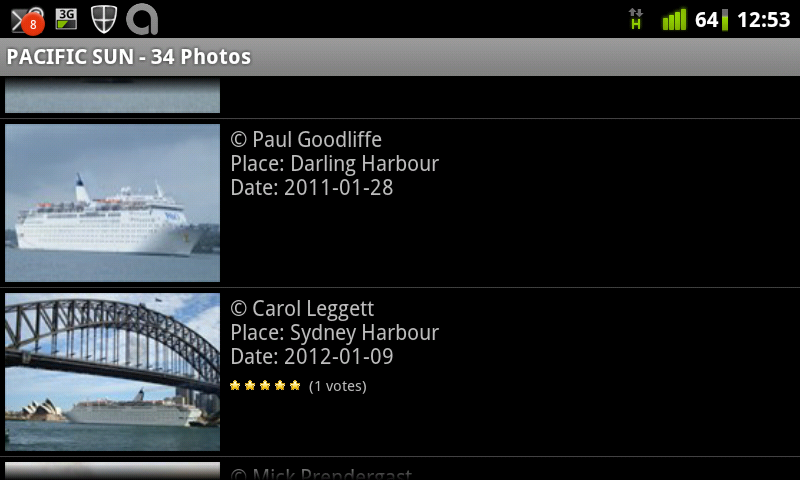
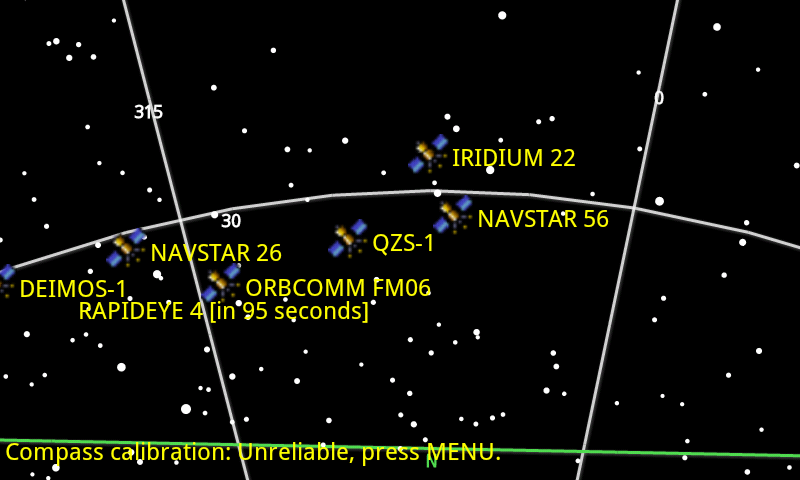
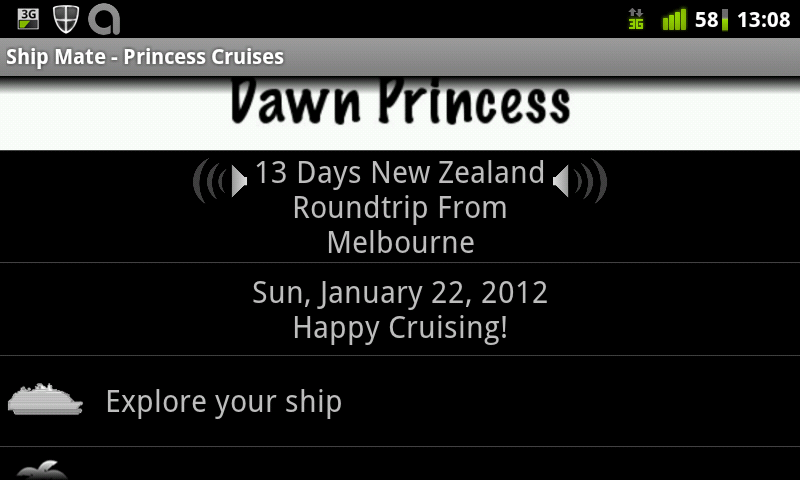
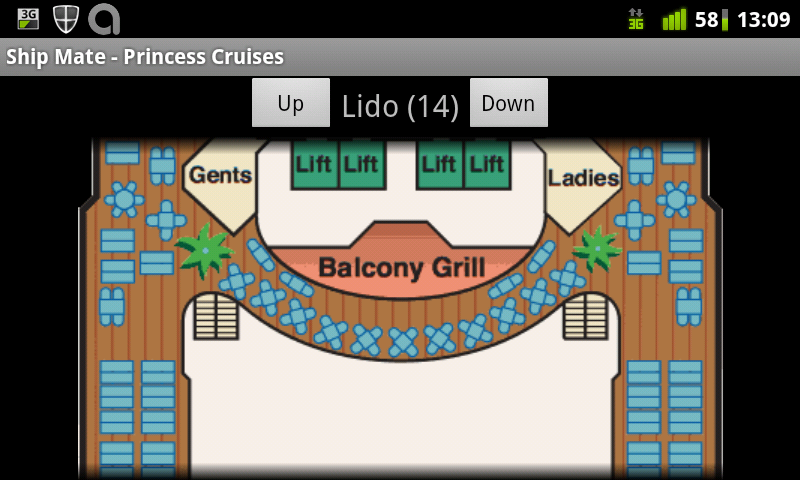
Photos of the Pacific sun taken by fans and shown by Marine Traffic The Marine Traffic program shows the locations of ships as well as lots of information about them. The above pictures show me discovering that the Pacific Sun was nearby, viewing it s location on Google Maps, seeing the details, and then viewing fan pictures. The developer s web site allows viewing all the same data without an Android phone [6]. Anyone can join the project by buying an Automatic Identification System (AIS) receiver and configuring a PC to take data from AIS and send it to the MarineTraffic.com servers. As an aside they seem to be missing coverage in western Victoria, so it would be good if someone near Apollo Bay or Warrnambool could install an AIS receiver and help out. Satellite map from Satellite AR Satellite AR uses augmented reality to show the location of satellites and other things in spare. Unfortunately the screen capture process turned off the camera as I had a sign advertising fast food positioned in an amusing location in the background. Shipmate overview of Dawn Princess
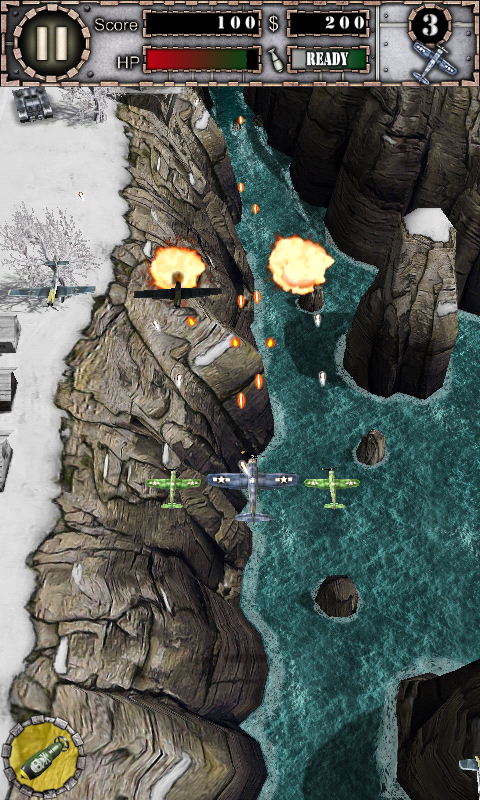
Shipmate map of Dawn Princess Shipmate publishes a set of programs giving information on cruise ships, they have one program for each cruise line. Above is the program for the Princess cruise line, the above pictures give information on the Dawn Princess. Unfortunately the program wasn t usable without net access when I tried to use it on a cruise ship. Games Air Attack HD game, clone of 1942 Air Attack HD is an entertaining game that demonstrates the capability of Android phones to run action games. Like many Android games it has a free version and paid versions if you want more. picture of Angry Birds Angry Birds is one of the most well known games for touch-screen devices. It has also spawned a huge line of merchandise. Labyrinth Lite
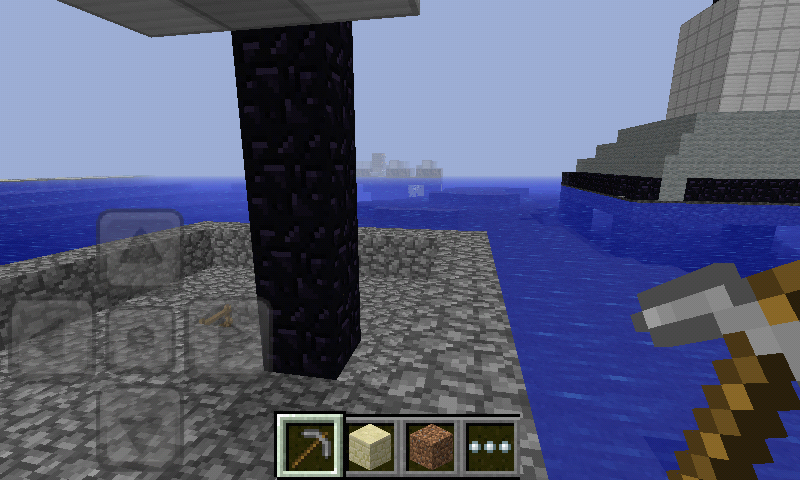
Labyrinth Lite from a different angle Labyrinth Lite is one of the many Android games based on the old mechanical game where you tilt a toy to roll a ball-bearing through a maze. It s free and is better than most of the free games in that genre. Minecraft Pocket Edtion Minecraft Pocket Edition allows you to play Minecraft on your phone. The demo version doesn t allow saving the game, you have to buy the game for about $5 if you want to do that. It also lacked the full features of the game last time I checked, it didn t have monsters. Paradise Island overview
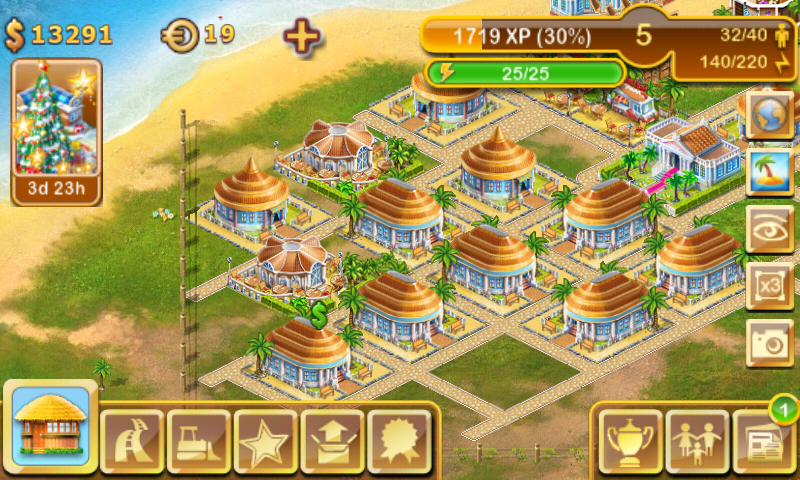
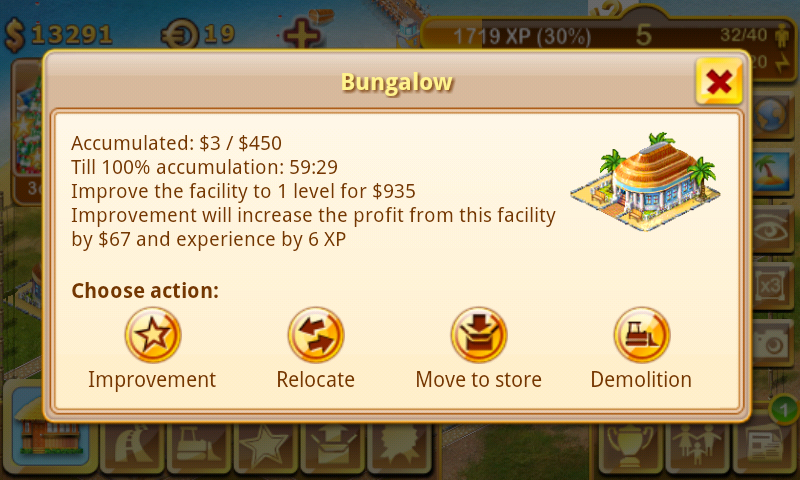
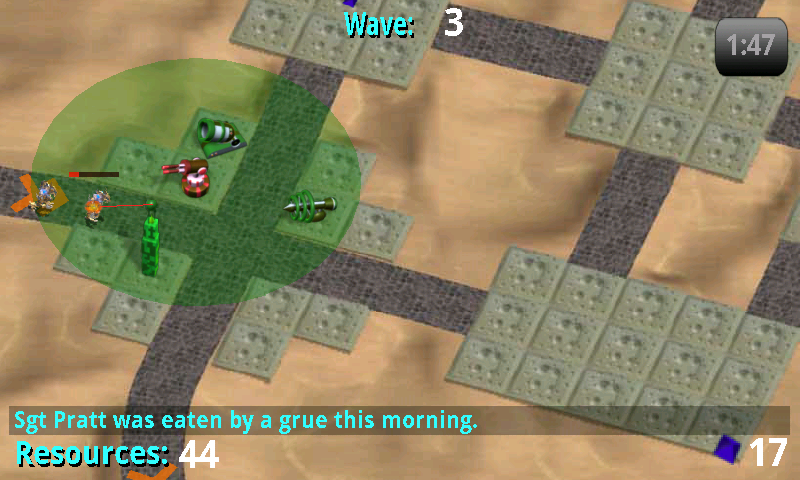
Paradise Island details of Bungalow Paradise Island is one of many business simulation games for Android. It s more playable than most and has very detailed graphics, but the down-side is that it s a memory hog and will crash if you don t have enough RAM. It s one of the games that are free to download but encourage you to pay money to level up, for some players it s probably a very expensive game. Tower Raiders 2, Pratt was eaten by a Grue Tower Raiders 2 is one of the better tower defense games for Android. Related posts:
  1. Choosing an Android Phone My phone contract ends in a few months, so I m...
  2. Galaxy S vs Xperia X10 and Android Network Access Galaxy S Review I ve just been given an indefinite loan...
  3. Standardising Android Don Marti wrote an amusing post about the lack of...

Next.

Previous.