Search Results: "xam"

29 March 2025

Dirk Eddelbuettel: tinythemes 0.0.3 at CRAN: Nags

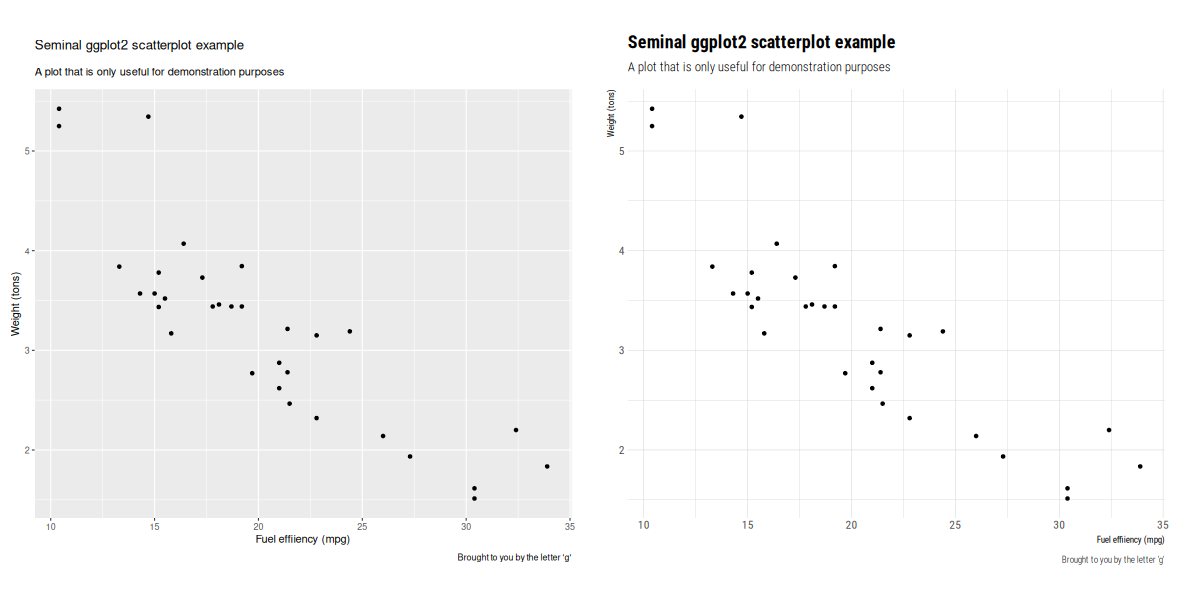
tinythemes demo A second maintenance release of our still young-ish package tinythemes arrived on CRAN today. tinythemes provides the theme_ipsum_rc() function from hrbrthemes by Bob Rudis in a zero (added) dependency way. A simple example is (also available as a demo inside the package) contrasts the default style (on the left) with the one added by this package (on the right): This version responds solely to things CRAN now nags about. As these are all package quality improvement we generally oblige happily (and generally fix in the respective package repo when we notice). I am currently on a quest to get most/all of my nags down so new releases are sometimes the way to go even when not under a deadline gun (as with other releases this week). The full set of changes since the last release (a little over a year ago) follows.

Changes in tinythemes version 0.0.3 (2025-03-29)
  • Updated a badge URL in README.md
  • Updated manual pages with proper anchor links
  • Rewrote one example without pipe to not require minimum R version

Courtesy of my CRANberries, there is a diffstat report relative to previous release. More detailed information is on the repo where comments and suggestions are welcome.

This post by Dirk Eddelbuettel originated on his Thinking inside the box blog. If you like this or other open-source work I do, you can sponsor me at GitHub.

Petter Reinholdtsen: Theora 1.2.0 released

Following the 1.2.0beta1 release two weeks ago, a final 1.2.0 release of theora was wrapped up today. This new release is tagged in the Xiph gitlab theora instance and you can fetch it from the Theora home page as soon as someone with access find time to update the web pages. In the mean time (automatically removed after 14 days) the release tarball is also available as a git build artifact from CI build of the release tag. The list of changes since The 1.2.0beta release from the CHANGES file in the tarball look like this:
libtheora 1.2.0 (2025 March 29)
  • Bumped minor SONAME versions as oc_comment_unpack() implementation changed.
  • Added example wrapper script encoder_example_ffmpeg (#1601 #2336).
  • Improve comment handling on platforms where malloc(0) return NULL (#2304).
  • Added pragma in example code to quiet clang op precedenca warnings.
  • Adjusted encoder_example help text.
  • Adjusted README, CHANGES, pkg-config and spec files to better reflect current release (#2331 #2328).
  • Corrected english typos in source and build system.
  • Switched http links to https in doc and comments where relevant. Did not touch RFC drafts.
As usual, if you use Bitcoin and want to show your support of my activities, please send Bitcoin donations to my address 15oWEoG9dUPovwmUL9KWAnYRtNJEkP1u1b.

28 March 2025

Dirk Eddelbuettel: tint 0.1.5 on CRAN: Maintenance

A new version 0.1.5 of the tint package arrived at CRAN today. tint provides a style not unlike Tufte for use in html and pdf documents created from markdown. The github repo shows several examples in its README, more as usual in the package documentation. This is the first release in one and a half years and contains only routine maintenance. As CRAN now bags about missing anchors in the common \code \link use, I added these today. Otherwise the usual mix of updates to continuous integration, to badges and URLs and other small packaging details but nothing user-facing.

Changes in tint version 0.1.5 (2025-03-27)
  • Standard package maintenance for continuous integration, URL updates, and packaging conventions
  • Correct two minor nags in the Rd file

Courtesy of my CRANberries, there is a diffstat report relative to previous release. More information is on the tint page. For questions or comments use the issue tracker off the GitHub repo.

This post by Dirk Eddelbuettel originated on his Thinking inside the box blog. If you like this or other open-source work I do, you can sponsor me at GitHub.

26 March 2025

Dirk Eddelbuettel: RcppRedis 0.2.5 on CRAN: Fix Bashism in Configure, Maintenance

A new minor release 0.2.5 of our RcppRedis package arrived on CRAN today. RcppRedis is one of several packages connecting R to the fabulous Redis in-memory datastructure store (and much more). RcppRedis does not pretend to be feature complete, but it may do some things faster than the other interfaces, and also offers an optional coupling with MessagePack binary (de)serialization via RcppMsgPack. The package has been deployed in production as a risk / monitoring tool on a trading floor for several years. It also supports pub/sub dissemination of streaming market data as per this earlier example. Given the changes around Redis, it is worth stressing that the package works just as well with valkey and uses only hiredis which remains proper open source. This update is again somewhat mechanical as a few maintenance things bubbled up in since the last release in the summer of 2023. As with other packages, continuous integration was updated a few times as were URLs and badges, and we update the use of our RApiSerialize. And, just as we did today and yesterday with littler, RQuantLib and RDieHarder, this addresses a nag from CRAN about implicit bash dependency in configure.ac (which we fixed in January as for the other packages but are under deadline now). Last but not least the newly-added extension of forbidden symbols in static libraries revealed that yes indeed I had forgotten to set -DNDEBUG when building the embedded hiredis in fallback mode and I now also converted its four uses of sprintf to snprintf so we are clean there too. The detailed changes list follows.

Changes in version 0.2.5 (2025-03-26)
  • The continuous integration setup was updated several times
  • Badges and URLs in README.md have been updated
  • An updated interface from RApiSerialize is now used, and a versioned dependency on version 0.1.4 or later has been added
  • The DESCRIPTION file now uses Authors@R
  • Two possible bashisms have been converted in configure.ac
  • The (fallback if needed) build of libhiredis.a now sets -DNDEBUG, four uses of sprintf converted to snprintf

Courtesy of my CRANberries, there is also a diffstat report for this this release. More information is on the RcppRedis page and at the repository and its issue tracker.

This post by Dirk Eddelbuettel originated on his Thinking inside the box blog. If you like this or other open-source work I do, you can sponsor me at GitHub.

25 March 2025

Dirk Eddelbuettel: littler 0.3.21 on CRAN: Lots Moar Features!

max-heap image The twentysecond release of littler as a CRAN package landed on CRAN just now, following in the now nineteen year history (!!) as a (initially non-CRAN) package started by Jeff in 2006, and joined by me a few weeks later. littler is the first command-line interface for R as it predates Rscript. It allows for piping as well for shebang scripting via #!, uses command-line arguments more consistently and still starts faster. It also always loaded the methods package which Rscript only began to do in recent years. littler lives on Linux and Unix, has its difficulties on macOS due to some-braindeadedness there (who ever thought case-insensitive filesystems as a default were a good idea?) and simply does not exist on Windows (yet the build system could be extended see RInside for an existence proof, and volunteers are welcome!). See the FAQ vignette on how to add it to your PATH. A few examples are highlighted at the Github repo:, as well as in the examples vignette. This release, the first is almost exactly one year, brings enhancements to six scripts as well as three new ones. The new ones crup.r offers CRan UPloads from the command-line, deadliners.r lists CRAN package by CRAN deadline, and wb.r uploads to win-builder (replacing an older shell script of mine). Among the updated ones, kitten.r now creates more complete DESCRIPTION files in the packages it makes, and several scripts support additional options. A number of changes were made to packaging as well, some of which were contributed by Jon and Michael which is of course always greatly appreciated. The trigger for the release was, just like for RQuantLib earlier today, a CRAN nag on bashisms half of which actually false here it was in a comment only. Oh well. The full change description follows.

Changes in littler version 0.3.21 (2025-03-24)
  • Changes in examples scripts
    • Usage text for ciw.r is improved, new options were added (Dirk)
    • The noble release is supported by r2u.r (Dirk)
    • The installRub.r script has additional options (Dirk)
    • The ttlt.r script has a new load_package argument (Dirk)
    • A new script deadliners.r showing CRAN packages 'under deadline' has been added, and then refined (Dirk)
    • The kitten.r script can now use whoami and argument githubuser on the different *kitten helpers it calls (Dirk)
    • A new script wb.r can upload to win-builder (Dirk)
    • A new script crup.r can upload a CRAN submission (Dirk)
    • In rcc.r, the return from rcmdcheck is now explicitly printed (Dirk)
    • In r2u.r the dry-run option is passed to the build command (Dirk)
  • Changes in package
    • Regular updates to badges, continuous integration, DESCRIPTION and configure.ac (Dirk)
    • Errant osVersion return value are handled more robustly (Michael Chirico in #121)
    • The current run-time path is available via variable LITTLER_SCRIPT_PATH (Jon Clayden in #122)
    • The cleanup script remove macOS debug symbols (Jon Clayden in #123)

My CRANberries service provides a comparison to the previous release. Full details for the littler release are provided as usual at the ChangeLog page, and also on the package docs website. The code is available via the GitHub repo, from tarballs and now of course also from its CRAN page and via install.packages("littler"). Binary packages are available directly in Debian as well as (in a day or two) Ubuntu binaries at CRAN thanks to the tireless Michael Rutter. Comments and suggestions are welcome at the GitHub repo.

This post by Dirk Eddelbuettel originated on his Thinking inside the box blog. If you like this or other open-source work I do, you can sponsor me at GitHub.

Otto Kek l inen: Debian Salsa CI in Google Summer of Code 2025

Featured image of post Debian Salsa CI in Google Summer of Code 2025Are you a student aspiring to participate in the Google Summer of Code 2025? Would you like to improve the continuous integration pipeline used at salsa.debian.org, the Debian GitLab instance, to help improve the quality of tens of thousands of software packages in Debian? This summer 2025, I and Emmanuel Arias will be participating as mentors in the GSoC program. We are available to mentor students who propose and develop improvements to the Salsa CI pipeline, as we are members of the Debian team that maintains it. A post by Santiago Ruano Rinc n in the GitLab blog explains what Salsa CI is and its short history since inception in 2018. At the time of the article in fall 2023 there were 9000+ source packages in Debian using Salsa CI. Now in 2025 there are over 27,000 source packages in Debian using it, and since summer 2024 some Ubuntu developers have started using it for enhanced quality assurance of packaging changes before uploading new package revisions to Ubuntu. Personally, I have been using Salsa CI since its inception, and contributing as a team member since 2019. See my blog post about GitLab CI for MariaDB in Debian for a description of an advanced and extensive use case. Helping Salsa CI is a great way to make a global impact, as it will help avoid regressions and improve the quality of Debian packages. The benefits reach far beyond just Debian, as it will also help hundreds of Debian derivatives, such as Ubuntu, Linux Mint, Tails, Purism PureOS, Pop!_OS, Zorin OS, Raspberry Pi OS, a large portion of Docker containers, and even the Windows Subsystem for Linux.

Improving Salsa CI: more features, robustness, speed While Salsa CI with contributions from 71 people is already quite mature and capable, there are many ideas floating around about how it could be further extended. For example, Salsa CI issue #147 describes various static analyzers and linters that may be generally useful. Issue #411 proposes using libfaketime to run autopkgtest on arbitrary future dates to test for failures caused by date assumptions, such as the Y2038 issue. There are also ideas about making Salsa CI more robust and code easier to reuse by refactoring some of the yaml scripts into independent scripts in #230, which could make it easier to run Salsa CI locally as suggested in #169. There are also ideas about improving the Salsa CI s own CI to avoid regressions from pipeline changes in #318. The CI system is also better when it s faster, and some speed improvement ideas have been noted in #412. Improvements don t have to be limited to changes in the pipeline itself. A useful project would also be to update more Debian packages to use Salsa CI, and ensure they adopt it in an optimal way as noted in #416. It would also be nice to have a dashboard with statistics about all public Salsa CI pipeline runs as suggested in #413. These and more ideas can be found in the issue list by filtering for tags Newcomer, Nice-To-Have or Accepting MRs. A Google Summer of Code proposal does not have to be limited to these existing ideas. Participants are also welcome to propose completely novel ideas!

Good time to also learn Debian packaging Anyone working with Debian team should also take the opportunity to learn Debian packaging, and contribute to the packaging or maintenance of 1-2 packages in parallel to improving the Salsa CI. All Salsa CI team members are also Debian Developers who can mentor and sponsor uploads to Debian. Maintaining a few packages is a great way to eat your own cooking and experience Salsa CI from the user perspective, and likely to make you better at Salsa CI development.

Apply now! The contributor applications opened yesterday on March 24, so to participate act now! If you are an eligible student and want to attend, head over to summerofcode.withgoogle.com to learn more. There are over a thousand participating organizations, with Debian, GitLab and MariaDB being some examples. Within these organizations there may be multiple subteams and projects to choose from. The full list of participating Debian projects can be found in the Debian wiki. If you are interested in GSoC for Salsa CI specifically, feel free to
  1. Reach out to me and Emmanuel by email at otto@ and eamanu@ (debian.org).
  2. Sign up at salsa.debian.org for an account (note it takes a few days due to manual vetting and approval process)
  3. Read the project README, STRUCTURE and CONTRIBUTING to get a developer s overview
  4. Participate in issue discussions at https://salsa.debian.org/salsa-ci-team/pipeline/-/issues/
Note that you don t have to wait for GSoC to officially start to contribute. In fact, it may be useful to start immediately by submitting a Merge Request to do some small contribution, just to learn the process and to get more familiar with how everything works, and the team maintaining Salsa CI. Looking forward to seeing new contributors!

24 March 2025

Jonathan McDowell: Who pays the cost of progress in software?

I am told, by friends who have spent time at Google, about the reason Google Reader finally disappeared. Apparently it had become a 20% Project for those who still cared about it internally, and there was some major change happening to one of it upstream dependencies that was either going to cause a significant amount of work rearchitecting Reader to cope, or create additional ongoing maintenance burden. It was no longer viable to support it as a side project, so it had to go. This was a consequence of an internal culture at Google where service owners are able to make changes that can break downstream users, and the downstream users are the ones who have to adapt. My experience at Meta goes the other way. If you own a service or other dependency and you want to make a change that will break things for the users, it s on you to do the migration, or at the very least provide significant assistance to those who own the code. You don t just get to drop your new release and expect others to clean up; doing that tends to lead to changes being reverted. The culture flows the other way; if you break it, you fix it (nothing is someone else s problem). There are pluses and minuses to both approaches. Users having to drive the changes to things they own stops them from blocking progress. Service/code owners having to drive the changes avoids the situation where a wildly used component drops a new release that causes a lot of high priority work for folk in order to adapt. I started thinking about this in the context of Debian a while back, and a few incidents since have resulted in my feeling that we re closer to the Google model than the Meta model. Anyone can upload a new version of their package to unstable, and that might end up breaking all the users of it. It s not quite as extreme as rolling out a new service, because it s unstable that gets affected (the clue is in the name, I really wish more people would realise that), but it can still result in release critical bugs for lots other Debian contributors. A good example of this are toolchain changes. Major updates to GCC and friends regularly result in FTBFS issues in lots of packages. Now in this instance the maintainer is usually diligent about a heads up before the default changes, but it s still a whole bunch of work for other maintainers to adapt (see the list of FTBFS bugs for GCC 15 for instance - these are important, but not serious yet). Worse is when a dependency changes and hasn t managed to catch everyone who might be affected, so by the time it s discovered it s release critical, because at least one package no longer builds in unstable. Commercial organisations try to avoid this with a decent CI/CD setup that either vendors all dependencies, or tracks changes to them and tries rebuilds before allowing things to land. This is one of the instances where a monorepo can really shine; if everything you need is in there, it s easier to track the interconnections between different components. Debian doesn t have a CI/CD system that runs for every upload, allowing us to track exact causes of regressions. Instead we have Lucas, who does a tremendous job of running archive wide rebuilds to make sure we can still build everything. Unfortunately that means I am often unfairly grumpy at him; my heart sinks when I see a bug come in with his name attached, because it often means one of my packages has a new RC bug where I m going to have to figure out what changed elsewhere to cause it. However he s just (very usefully) surfacing an issue someone else created, rather than actually being the cause of the problem. I don t know if I have a point to this post. I think it s probably that I wish folk in Free Software would try and be mindful of the incompatible changes they might introducing, and the toil they create for other volunteer developers, often not directly visible to the person making the change. The approach done by the Debian toolchain maintainers strikes me as a good balance; they do a bunch of work up front to try and flag all the places that might need to make changes, far enough in advance of the breaking change actually landing. However they don t then allow a tardy developer to block progress.

Simon Josefsson: Reproducible Software Releases

Around a year ago I discussed two concerns with software release archives (tarball artifacts) that could be improved to increase confidence in the supply-chain security of software releases. Repeating the goals for simplicity: While implementing these ideas for a small project was accomplished within weeks see my announcement of Libntlm version 1.8 adressing this in complex projects uncovered concerns with tools that had to be addressed, and things stalled for many months pending that work. I had the notion that these two goals were easy and shouldn t be hard to accomplish. I still believe that, but have had to realize that improving tooling to support these goals takes time. It seems clear that these concepts are not universally agreed on and implemented generally. I m now happy to recap some of the work that led to releases of libtasn1 v4.20.0, inetutils v2.6, libidn2 v2.3.8, libidn v1.43. These releases all achieve these goals. I am working on a bunch of more projects to support these ideas too. What have the obstacles so far been to make this happen? It may help others who are in the same process of addressing these concerns to have a high-level introduction to the issues I encountered. Source code for projects above are available and anyone can look at the solutions to learn how the problems are addressed. First let s look at the problems we need to solve to make git-archive style tarballs usable:

Version Handling To build usable binaries from a minimal tarballs, it need to know which version number it is. Traditionally this information was stored inside configure.ac in git. However I use gnulib s git-version-gen to infer the version number from the git tag or git commit instead. The git tag information is not available in a git-archive tarball. My solution to this was to make use of the export-subst feature of the .gitattributes file. I store the file .tarball-version-git in git containing the magic cookie like this:
$Format:%(describe)$
With this, git-archive will replace with a useful version identifier on export, see the libtasn1 patch to achieve this. To make use of this information, the git-version-gen script was enhanced to read this information, see the gnulib patch. This is invoked by ./configure to figure out which version number the package is for.

Translations We want translations to be included in the minimal source tarball for it to be buildable. Traditionally these files are retrieved by the maintainer from the Translation project when running ./bootstrap, however there are two problems with this. The first one is that there is no strong authentication or versioning information on this data, the tools just download and place whatever wget downloaded into your source tree (printf-style injection attack anyone?). We could improve this (e.g., publish GnuPG signed translations messages with clear versioning), however I did not work on that further. The reason is that I want to support offline builds of packages. Downloading random things from the Internet during builds does not work when building a Debian package, for example. The translation project could solve this by making a monthly tarball with their translations available, for distributors to pick up and provide as a separate package that could be used as a build dependency. However that is not how these tools and projects are designed. Instead I reverted back to storing translations in git, something that I did for most projects back when I was using CVS 20 years ago. Hooking this into ./bootstrap and gettext workflow can be tricky (ideas for improvement most welcome!), but I used a simple approach to store all directly downloaded po/*.po files directly as po/*.po.in and make the ./bootstrap tool move them in place, see the libidn2 commit followed by the actual make update-po commit with all the translations where one essential step is:
# Prime po/*.po from fall-back copy stored in git.
for poin in po/*.po.in; do
    po=$(echo $poin   sed 's/.in//')
    test -f $po   cp -v $poin $po
done
ls po/*.po   sed 's .*/ ; s \.po$ ' > po/LINGUAS

Fetching vendor files like gnulib Most build dependencies are in the shape of You need a C compiler . However some come in the shape of source-code files intended to be vendored , and gnulib is a huge repository of such files. The latter is a problem when building from a minimal git archive. It is possible to consider translation files as a class of vendor files, since they need to be copied verbatim into the project build directory for things to work. The same goes for *.m4 macros from the GNU Autoconf Archive. However I m not confident that the solution for all vendor files must be the same. For translation files and for Autoconf Archive macros, I have decided to put these files into git and merge them manually occasionally. For gnulib files, in some projects like OATH Toolkit I also store all gnulib files in git which effectively resolve this concern. (Incidentally, the reason for doing so was originally that running ./bootstrap took forever since there is five gnulib instances used, which is no longer the case since gnulib-tool was rewritten in Python.) For most projects, however, I rely on ./bootstrap to fetch a gnulib git clone when building. I like this model, however it doesn t work offline. One way to resolve this is to make the gnulib git repository available for offline use, and I ve made some effort to make this happen via a Gnulib Git Bundle and have explained how to implement this approach for Debian packaging. I don t think that is sufficient as a generic solution though, it is mostly applicable to building old releases that uses old gnulib files. It won t work when building from CI/CD pipelines, for example, where I have settled to use a crude way of fetching and unpacking a particular gnulib snapshot, see this Libntlm patch. This is much faster than working with git submodules and cloning gnulib during ./bootstrap. Essentially this is doing:
GNULIB_REVISION=$(. bootstrap.conf >&2; echo $GNULIB_REVISION)
wget -nv https://gitlab.com/libidn/gnulib-mirror/-/archive/$GNULIB_REVISION/gnulib-mirror-$GNULIB_REVISION.tar.gz
gzip -cd gnulib-mirror-$GNULIB_REVISION.tar.gz   tar xf -
rm -fv gnulib-mirror-$GNULIB_REVISION.tar.gz
export GNULIB_SRCDIR=$PWD/gnulib-mirror-$GNULIB_REVISION
./bootstrap --no-git
./configure
make

Test the git-archive tarball This goes without saying, but if you don t test that building from a git-archive style tarball works, you are likely to regress at some point. Use CI/CD techniques to continuously test that a minimal git-archive tarball leads to a usable build.

Mission Accomplished So that wasn t hard, was it? You should now be able to publish a minimal git-archive tarball and users should be able to build your project from it. I recommend naming these archives as PROJECT-vX.Y.Z-src.tar.gz replacing PROJECT with your project name and X.Y.Z with your version number. The archive should have only one sub-directory named PROJECT-vX.Y.Z/ containing all the source-code files. This differentiate it against traditional PROJECT-X.Y.Z.tar.gz tarballs in that it embeds the git tag (which typically starts with v) and contains a wildcard-friendly -src substring. Alas there is no consistency around this naming pattern, and GitLab, GitHub, Codeberg etc all seem to use their own slightly incompatible variant. Let s go on to see what is needed to achieve reproducible make dist source tarballs. This is the release artifact that most users use, and they often contain lots of generated files and vendor files. These files are included to make it easy to build for the user. What are the challenges to make these reproducible?

Build dependencies causing different generated content The first part is to realize that if you use tool X with version A to generate a file that goes into the tarball, version B of that tool may produce different outputs. This is a generic concern and it cannot be solved. We want our build tools to evolve and produce better outputs over time. What can be addressed is to avoid needless differences. For example, many tools store timestamps and versioning information in the generated files. This causes needless differences, which makes audits harder. I have worked on some of these, like Autoconf Archive timestamps but solving all of these examples will take a long time, and some upstream are reluctant to incorporate these changes. My approach meanwhile is to build things using similar environments, and compare the outputs for differences. I ve found that the various closely related forks of GNU/Linux distributions are useful for this. Trisquel 11 is based on Ubuntu 22.04, and building my projects using both and comparing the differences only give me the relevant differences to improve. This can be extended to compare AlmaLinux with RockyLinux (for both versions 8 and 9), Devuan 5 against Debian 12, PureOS 10 with Debian 11, and so on.

Timestamps Sometimes tools store timestamps in files in a way that is harder to fix. Two notable examples of this are *.po translation files and Texinfo manuals. For translation files, I have resolved this by making sure the files use a predictable POT-Creation-Date timestamp, and I set it to the modification timestamps of the NEWS file in the repository (which I set to the git commit of the latest commit elsewhere) like this:
dist-hook: po-CreationDate-to-mtime-NEWS
.PHONY: po-CreationDate-to-mtime-NEWS
po-CreationDate-to-mtime-NEWS: mtime-NEWS-to-git-HEAD
  $(AM_V_GEN)for p in $(distdir)/po/*.po $(distdir)/po/$(PACKAGE).pot; do \
    if test -f "$$p"; then \
      $(SED) -e 's,POT-Creation-Date: .*\\n",POT-Creation-Date: '"$$(env LC_ALL=C TZ=UTC0 stat --format=%y $(srcdir)/NEWS   cut -c1-16,31-)"'\\n",' < $$p > $$p.tmp && \
      if cmp $$p $$p.tmp > /dev/null; then \
        rm -f $$p.tmp; \
      else \
        mv $$p.tmp $$p; \
      fi \
    fi \
  done
Similarily, I set a predictable modification time of the texinfo source file like this:
dist-hook: mtime-NEWS-to-git-HEAD
.PHONY: mtime-NEWS-to-git-HEAD
mtime-NEWS-to-git-HEAD:
  $(AM_V_GEN)if test -e $(srcdir)/.git \
                && command -v git > /dev/null; then \
    touch -m -t "$$(git log -1 --format=%cd \
      --date=format-local:%Y%m%d%H%M.%S)" $(srcdir)/NEWS; \
  fi
However I ve realized that this needs to happen earlier and probably has to be run during ./configure time, because the doc/version.texi file is generated on first build before running make dist and for some reason the file is not rebuilt at release time. The Automake texinfo integration is a bit inflexible about providing hooks to extend the dependency tracking. The method to address these differences isn t really important, and they change over time depending on preferences. What is important is that the differences are eliminated.

ChangeLog Traditionally ChangeLog files were manually prepared, and still is for some projects. I maintain git2cl but recently I ve settled with gnulib s gitlog-to-changelog because doing so avoids another build dependency (although the output formatting is different and arguable worse for my git commit style). So the ChangeLog files are generated from git history. This means a shallow clone will not produce the same ChangeLog file depending on how deep it was cloned. For Libntlm I simply disabled use of generated ChangeLog because I wanted to support an even more extreme form of reproducibility: I wanted to be able to reproduce the full make dist source archives from a minimal git-archive source archive. However for other projects I ve settled with a middle ground. I realized that for git describe to produce reproducible outputs, the shallow clone needs to include the last release tag. So it felt acceptable to assume that the clone is not minimal, but instead has some but not all of the history. I settled with the following recipe to produce ChangeLog's covering all changes since the last release.
dist-hook: gen-ChangeLog
.PHONY: gen-ChangeLog
gen-ChangeLog:
  $(AM_V_GEN)if test -e $(srcdir)/.git; then			\
    LC_ALL=en_US.UTF-8 TZ=UTC0					\
    $(top_srcdir)/build-aux/gitlog-to-changelog			\
       --srcdir=$(srcdir) --					\
       v$(PREV_VERSION)~.. > $(distdir)/cl-t &&			\
         printf '\n\nSee the source repo for older entries\n'	\
         >> $(distdir)/cl-t &&					\
         rm -f $(distdir)/ChangeLog &&				\
         mv $(distdir)/cl-t $(distdir)/ChangeLog;  		\
  fi
I m undecided about the usefulness of generated ChangeLog files within make dist archives. Before we have stable and secure archival of git repositories widely implemented, I can see some utility of this in case we lose all copies of the upstream git repositories. I can sympathize with the concept of ChangeLog files died when we started to generate them from git logs: the files no longer serve any purpose, and we can ask people to go look at the git log instead of reading these generated non-source files.

Long-term reproducible trusted build environment Distributions comes and goes, and old releases of them goes out of support and often stops working. Which build environment should I chose to build the official release archives? To my knowledge only Guix offers a reliable way to re-create an older build environment (guix gime-machine) that have bootstrappable properties for additional confidence. However I had two difficult problems here. The first one was that I needed Guix container images that were usable in GitLab CI/CD Pipelines, and this side-tracked me for a while. The second one delayed my effort for many months, and I was inclined to give up. Libidn distribute a C# implementation. Some of the C# source code files included in the release tarball are generated. By what? You guess it, by a C# program, with the source code included in the distribution. This means nobody could reproduce the source tarball of Libidn without trusting someone elses C# compiler binaries, which were built from binaries of earlier releases, chaining back into something that nobody ever attempts to build any more and likely fail to build due to bit-rot. I had two basic choices, either remove the C# implementation from Libidn (which may be a good idea for other reasons, since the C and C# are unrelated implementations) or build the source tarball on some binary-only distribution like Trisquel. Neither felt appealing to me, but a late christmas gift of a reproducible Mono came to Guix that resolve this.

Embedded images in Texinfo manual For Libidn one section of the manual has an image illustrating some concepts. The PNG, PDF and EPS outputs were generated via fig2dev from a *.fig file (hello 1985!) that I had stored in git. Over time, I had also started to store the generated outputs because of build issues. At some point, it was possible to post-process the PDF outputs with grep to remove some timestamps, however with compression this is no longer possible and actually the grep command I used resulted in a 0-byte output file. So my embedded binaries in git was no longer reproducible. I first set out to fix this by post-processing things properly, however I then realized that the *.fig file is not really easy to work with in a modern world. I wanted to create an image from some text-file description of the image. Eventually, via the Guix manual on guix graph, I came to re-discover the graphviz language and tool called dot (hello 1993!). All well then? Oh no, the PDF output embeds timestamps. Binary editing of PDF s no longer work through simple grep, remember? I was back where I started, and after some (soul- and web-) searching I discovered that Ghostscript (hello 1988!) pdfmarks could be used to modify things here. Cooperating with automake s texinfo rules related to make dist proved once again a worthy challenge, and eventually I ended up with a Makefile.am snippet to build images that could be condensed into:
info_TEXINFOS = libidn.texi
libidn_TEXINFOS += libidn-components.png
imagesdir = $(infodir)
images_DATA = libidn-components.png
EXTRA_DIST += components.dot
DISTCLEANFILES = \
  libidn-components.eps libidn-components.png libidn-components.pdf
libidn-components.eps: $(srcdir)/components.dot
  $(AM_V_GEN)$(DOT) -Nfontsize=9 -Teps < $< > $@.tmp
  $(AM_V_at)! grep %%CreationDate $@.tmp
  $(AM_V_at)mv $@.tmp $@
libidn-components.pdf: $(srcdir)/components.dot
  $(AM_V_GEN)$(DOT) -Nfontsize=9 -Tpdf < $< > $@.tmp
# A simple sed on CreationDate is no longer possible due to compression.
# 'exiftool -CreateDate' is alternative to 'gs', but adds ~4kb to file.
# Ghostscript add <1kb.  Why can't 'dot' avoid setting CreationDate?
  $(AM_V_at)printf '[ /ModDate ()\n  /CreationDate ()\n  /DOCINFO pdfmark\n' > pdfmarks
  $(AM_V_at)$(GS) -q -dBATCH -dNOPAUSE -sDEVICE=pdfwrite -sOutputFile=$@.tmp2 $@.tmp pdfmarks
  $(AM_V_at)rm -f $@.tmp pdfmarks
  $(AM_V_at)mv $@.tmp2 $@
libidn-components.png: $(srcdir)/components.dot
  $(AM_V_GEN)$(DOT) -Nfontsize=9 -Tpng < $< > $@.tmp
  $(AM_V_at)mv $@.tmp $@
pdf-recursive: libidn-components.pdf
dvi-recursive: libidn-components.eps
ps-recursive: libidn-components.eps
info-recursive: $(top_srcdir)/.version libidn-components.png
Surely this can be improved, but I m not yet certain in what way is the best one forward. I like having a text representation as the source of the image. I m sad that the new image size is ~48kb compared to the old image size of ~1kb. I tried using exiftool -CreateDate as an alternative to GhostScript, but using it to remove the timestamp added ~4kb to the file size and naturally I was appalled by this ignorance of impending doom.

Test reproducibility of tarball Again, you need to continuously test the properties you desire. This means building your project twice using different environments and comparing the results. I ve settled with a small GitLab CI/CD pipeline job that perform bit-by-bit comparison of generated make dist archives. It also perform bit-by-bit comparison of generated git-archive artifacts. See the Libidn2 .gitlab-ci.yml 0-compare job which essentially is:
0-compare:
  image: alpine:latest
  stage: repro
  needs: [ B-AlmaLinux8, B-AlmaLinux9, B-RockyLinux8, B-RockyLinux9, B-Trisquel11, B-Ubuntu2204, B-PureOS10, B-Debian11, B-Devuan5, B-Debian12, B-gcc, B-clang, B-Guix, R-Guix, R-Debian12, R-Ubuntu2404, S-Trisquel10, S-Ubuntu2004 ]
  script:
  - cd out
  - sha256sum */*.tar.* */*/*.tar.*   sort   grep    -- -src.tar.
  - sha256sum */*.tar.* */*/*.tar.*   sort   grep -v -- -src.tar.
  - sha256sum */*.tar.* */*/*.tar.*   sort   uniq -c -w64   sort -rn
  - sha256sum */*.tar.* */*/*.tar.*   grep    -- -src.tar.   sort   uniq -c -w64   grep -v '^      1 '
  - sha256sum */*.tar.* */*/*.tar.*   grep -v -- -src.tar.   sort   uniq -c -w64   grep -v '^      1 '
# Confirm modern git-archive tarball reproducibility
  - cmp b-almalinux8/src/*.tar.gz b-almalinux9/src/*.tar.gz
  - cmp b-almalinux8/src/*.tar.gz b-rockylinux8/src/*.tar.gz
  - cmp b-almalinux8/src/*.tar.gz b-rockylinux9/src/*.tar.gz
  - cmp b-almalinux8/src/*.tar.gz b-debian12/src/*.tar.gz
  - cmp b-almalinux8/src/*.tar.gz b-devuan5/src/*.tar.gz
  - cmp b-almalinux8/src/*.tar.gz r-guix/src/*.tar.gz
  - cmp b-almalinux8/src/*.tar.gz r-debian12/src/*.tar.gz
  - cmp b-almalinux8/src/*.tar.gz r-ubuntu2404/src/*v2.*.tar.gz
# Confirm old git-archive (export-subst but long git describe) tarball reproducibility
  - cmp b-trisquel11/src/*.tar.gz b-ubuntu2204/src/*.tar.gz
# Confirm really old git-archive (no export-subst) tarball reproducibility
  - cmp b-debian11/src/*.tar.gz b-pureos10/src/*.tar.gz
# Confirm 'make dist' generated tarball reproducibility
  - cmp b-almalinux8/*.tar.gz b-rockylinux8/*.tar.gz
  - cmp b-almalinux9/*.tar.gz b-rockylinux9/*.tar.gz
  - cmp b-pureos10/*.tar.gz b-debian11/*.tar.gz
  - cmp b-devuan5/*.tar.gz b-debian12/*.tar.gz
  - cmp b-trisquel11/*.tar.gz b-ubuntu2204/*.tar.gz
  - cmp b-guix/*.tar.gz r-guix/*.tar.gz
# Confirm 'make dist' from git-archive tarball reproducibility
  - cmp s-trisquel10/*.tar.gz s-ubuntu2004/*.tar.gz
Notice that I discovered that git archive outputs differ over time too, which is natural but a bit of a nuisance. The output of the job is illuminating in the way that all SHA256 checksums of generated tarballs are included, for example the libidn2 v2.3.8 job log:
$ sha256sum */*.tar.* */*/*.tar.*   sort   grep -v -- -src.tar.
368488b6cc8697a0a937b9eb307a014396dd17d3feba3881e6911d549732a293  b-trisquel11/libidn2-2.3.8.tar.gz
368488b6cc8697a0a937b9eb307a014396dd17d3feba3881e6911d549732a293  b-ubuntu2204/libidn2-2.3.8.tar.gz
59db2d045fdc5639c98592d236403daa24d33d7c8db0986686b2a3056dfe0ded  b-debian11/libidn2-2.3.8.tar.gz
59db2d045fdc5639c98592d236403daa24d33d7c8db0986686b2a3056dfe0ded  b-pureos10/libidn2-2.3.8.tar.gz
5bd521d5ecd75f4b0ab0fc6d95d444944ef44a84cad859c9fb01363d3ce48bb8  s-trisquel10/libidn2-2.3.8.tar.gz
5bd521d5ecd75f4b0ab0fc6d95d444944ef44a84cad859c9fb01363d3ce48bb8  s-ubuntu2004/libidn2-2.3.8.tar.gz
7f1dcdea3772a34b7a9f22d6ae6361cdcbe5513e3b6485d40100b8565c9b961a  b-almalinux8/libidn2-2.3.8.tar.gz
7f1dcdea3772a34b7a9f22d6ae6361cdcbe5513e3b6485d40100b8565c9b961a  b-rockylinux8/libidn2-2.3.8.tar.gz
8031278157ce43b5813f36cf8dd6baf0d9a7f88324ced796765dcd5cd96ccc06  b-clang/libidn2-2.3.8.tar.gz
8031278157ce43b5813f36cf8dd6baf0d9a7f88324ced796765dcd5cd96ccc06  b-debian12/libidn2-2.3.8.tar.gz
8031278157ce43b5813f36cf8dd6baf0d9a7f88324ced796765dcd5cd96ccc06  b-devuan5/libidn2-2.3.8.tar.gz
8031278157ce43b5813f36cf8dd6baf0d9a7f88324ced796765dcd5cd96ccc06  b-gcc/libidn2-2.3.8.tar.gz
8031278157ce43b5813f36cf8dd6baf0d9a7f88324ced796765dcd5cd96ccc06  r-debian12/libidn2-2.3.8.tar.gz
acf5cbb295e0693e4394a56c71600421059f9c9bf45ccf8a7e305c995630b32b  r-ubuntu2404/libidn2-2.3.8.tar.gz
cbdb75c38100e9267670b916f41878b6dbc35f9c6cbe60d50f458b40df64fcf1  b-almalinux9/libidn2-2.3.8.tar.gz
cbdb75c38100e9267670b916f41878b6dbc35f9c6cbe60d50f458b40df64fcf1  b-rockylinux9/libidn2-2.3.8.tar.gz
f557911bf6171621e1f72ff35f5b1825bb35b52ed45325dcdee931e5d3c0787a  b-guix/libidn2-2.3.8.tar.gz
f557911bf6171621e1f72ff35f5b1825bb35b52ed45325dcdee931e5d3c0787a  r-guix/libidn2-2.3.8.tar.gz
I m sure I have forgotten or suppressed some challenges (sprinkling LANG=C TZ=UTC0 helps) related to these goals, but my hope is that this discussion of solutions will inspire you to implement these concepts for your software project too. Please share your thoughts and additional insights in a comment below. Enjoy Happy Hacking in the course of practicing this!

22 March 2025

Antoine Beaupr : Losing the war for the free internet

Warning: this is a long ramble I wrote after an outage of my home internet. You'll get your regular scheduled programming shortly. I didn't realize this until relatively recently, but we're at war. Fascists and capitalists are trying to take over the world, and it's bringing utter chaos. We're more numerous than them, of course: this is only a handful of people screwing everyone else over, but they've accumulated so much wealth and media control that it's getting really, really hard to move around. Everything is surveilled: people are carrying tracking and recording devices in their pockets at all time, or they drive around in surveillance machines. Payments are all turning digital. There's cameras everywhere, including in cars. Personal data leaks are so common people kind of assume their personal address, email address, and other personal information has already been leaked. The internet itself is collapsing: most people are using the network only as a channel to reach a "small" set of "hyperscalers": mind-boggingly large datacenters that don't really operate like the old internet. Once you reach the local endpoint, you're not on the internet anymore. Netflix, Google, Facebook (Instagram, Whatsapp, Messenger), Apple, Amazon, Microsoft (Outlook, Hotmail, etc), all those things are not really the internet anymore. Those companies operate over the "internet" (as in the TCP/IP network), but they are not an "interconnected network" as much as their own, gigantic silos so much bigger than everything else that they essentially dictate how the network operates, regardless of standards. You access it over "the web" (as in "HTTP") but the fabric is not made of interconnected links that cross sites: all those sites are trying really hard to keep you captive on their platforms. Besides, you think you're writing an email to the state department, for example, but you're really writing to Microsoft Outlook. That app your university or border agency tells you to install, the backend is not hosted by those institutions, it's on Amazon. Heck, even Netflix is on Amazon. Meanwhile I've been operating my own mail server first under my bed (yes, really) and then in a cupboard or the basement for almost three decades now. And what for? So I can tell people I can? Maybe! I guess the reason I'm doing this is the same reason people are suddenly asking me about the (dead) mesh again. People are worried and scared that the world has been taken over, and they're right: we have gotten seriously screwed. It's the same reason I keep doing radio, minimally know how to grow food, ride a bike, build a shed, paddle a canoe, archive and document things, talk with people, host an assembly. Because, when push comes to shove, there's no one else who's going to do it for you, at least not the way that benefits the people. The Internet is one of humanity's greatest accomplishments. Obviously, oligarchs and fascists are trying to destroy it. I just didn't expect the tech bros to be flipping to that side so easily. I thought we were friends, but I guess we are, after all, enemies. That said, that old internet is still around. It's getting harder to host your own stuff at home, but it's not impossible. Mail is tricky because of reputation, but it's also tricky in the cloud (don't get fooled!), so it's not that much easier (or cheaper) there. So there's things you can do, if you're into tech. Share your wifi with your neighbours. Build a LAN. Throw a wire over to your neighbour too, it works better than wireless. Use Tor. Run a relay, a snowflake, a webtunnel. Host a web server. Build a site with a static site generator and throw it in the wind. Download and share torrents, and why not a tracker. Run an IRC server (or Matrix, if you want to federate and lose high availability). At least use Signal, not Whatsapp or Messenger. And yes, why not, run a mail server, join a mesh. Don't write new software, there's plenty of that around already. (Just kidding, you can write code, cypherpunk.) You can do many of those things just by setting up a FreedomBox. That is, after all, the internet: people doing their own thing for their own people. Otherwise, it's just like sitting in front of the television and watching the ads. Opium of the people, like the good old time. Let a billion droplets build the biggest multitude of clouds that will storm over this world and rip apart this fascist conspiracy. Disobey. Revolt. Build. We are more than them.

18 March 2025

Petter Reinholdtsen: New theora release 1.2.0beta1 after almost 15 years

When I a few days ago discovered that a security problem reported against the theora library last year was still not fixed, and because I was already up to speed on Xiph development, I decided it was time to wrap up a new theora release. This new release was tagged in the Xiph gitlab theora instance Saturday. You can fetch the new release from the Theora home page. The list of changes since The 1.2.0alpha1 release from the CHANGES file in the tarball look like this:
libteora 1.2.0beta1 (2025 March 15)
  • Bumped minor SONAME versions as methods changed constness of arguments.
  • Updated libogg dependency to version 1.3.4 for ogg_uint64_t.
  • Updated doxygen setup.
  • Updated autotools setup and support scripts (#1467 #1800 #1987 #2318 #2320).
  • Added support for RISC OS.
  • Fixed mingw build (#2141).
  • Improved ARM support.
  • Converted SCons setup to work with Python 3.
  • Introduced new configure options --enable-mem-constraint and --enable-gcc-sanitizers.
  • Fixed all known compiler warnings and errors from gcc and clang.
  • Improved examples for stability and correctness.
  • Variuos speed, bug fixes and code quality improvements.
  • Fixed build problem with Visual Studio (#2317).
  • Avoids undefined bit shift of signed numbers (#2321, #2322).
  • Avoids example encoder crash on bogus audio input (#2305).
  • Fixed musl linking issue with asm enabled (#2287).
  • Fixed some broken clamping in rate control (#2229).
  • Added NULL check _tc and _setup even for data packets (#2279).
  • Fixed mismatched oc_mb_fill_cmapping11 signature (#2068).
  • Updated the documentation for theora_encode_comment() (#726).
  • Adjusted build to Only link libcompat with dump_video (#1587).
  • Corrected an operator precedence error in the visualization code (#1751).
  • Fixed two spelling errors in the comments (#1804).
  • Avoid negative bit shift operation in huffdec.c (CVE-2024-56431).
  • Improved library documentation and specification text.
  • Adjusted library dependencies so libtheoraenc do not depend on libtheoradec.
  • Handle fallout from CVE-2017-14633 in libvorbis, check return value in encoder_example and transcoder_example.
There are a few bugs still being investigated, and my plan is to wrap up a final 1.2.0 release two weekends from now. As usual, if you use Bitcoin and want to show your support of my activities, please send Bitcoin donations to my address 15oWEoG9dUPovwmUL9KWAnYRtNJEkP1u1b.

Dima Kogan: Eigen macro specializations crashes

There's an issue in the Eigen linear algebra library where linking together objects compiled with different flags causes the resulting binary to crash. Some details are written-up in this mailing list thread. I just encountered a situation where a large application sometimes crashes for unknown reasons, and needed a method to determine whether this Eigen issue could be the cause. I ended up doing this by using the DWARF data to see if the linked binary contains the different incompatible flavors of malloc / free or not. I downloaded the small demo program showing the problem. I built it:
CCXXXFLAGS=-g make
Here if you run ./main, the bug is triggered, and a crash occurs. I looked at the debug info for the code in question:
for o (main lib.so)  
  echo "======== $o";
  readelf --debug-dump=decodedline $o \
    awk \
    '$1 ~ /^Memory.h/
      
       if(180 <= $2 && $2 <= 186)  
         have["malloc_glibc"]=1
        
       if(188 == $2)  
         have["malloc_handmade"]=1
        
       if(201 <= $2 && $2 <= 204)  
         have["free_glibc"]=1
        
       if(206 == $2)  
         have["free_handmade"]=1
        
      
     END
      
       for (var in have)  
         print(var);
        
      '
 
It says:
======== main
free_handmade
======== lib.so
malloc_glibc
free_glibc
Here I looked at main and lib.so (the build products from this little demo). In a real case you'd look at every shared library linked into the binary and the binary itself. On my machine /usr/include/eigen3/Eigen/src/Core/util/Memory.h looks like this, starting on line 174:
174 EIGEN_DEVICE_FUNC inline void* aligned_malloc(std::size_t size)
175  
176   check_that_malloc_is_allowed();
177 
178   void *result;
179   #if (EIGEN_DEFAULT_ALIGN_BYTES==0)   EIGEN_MALLOC_ALREADY_ALIGNED
180 
181     EIGEN_USING_STD(malloc)
182     result = malloc(size);
183 
184     #if EIGEN_DEFAULT_ALIGN_BYTES==16
185     eigen_assert((size<16   (std::size_t(result)%16)==0) && "System's malloc returned an unaligned pointer. Compile with EIGEN_MALLOC_ALREADY_ALIGNED=0 to fallback to handmade aligned memory allocator.");
186     #endif
187   #else
188     result = handmade_aligned_malloc(size);
189   #endif
190 
191   if(!result && size)
192     throw_std_bad_alloc();
193 
194   return result;
195  
196 
197 /** \internal Frees memory allocated with aligned_malloc. */
198 EIGEN_DEVICE_FUNC inline void aligned_free(void *ptr)
199  
200   #if (EIGEN_DEFAULT_ALIGN_BYTES==0)   EIGEN_MALLOC_ALREADY_ALIGNED
201 
202     EIGEN_USING_STD(free)
203     free(ptr);
204 
205   #else
206     handmade_aligned_free(ptr);
207   #endif
208  
The above awk script looks at the two malloc paths and the two free paths, and we can clearly see that it only ever calls malloc_glibc(), but has both flavors of free(). So this can crash. We want to see that the whole executable (shared libraries and all) should only have one type of malloc() and free(), and that would guarantee no crashing. There are a more functions in that header that should be instrumented (realloc() for instance) and the different alignment paths should be instrumented similarly (as described in the mailing list thread above), but here we see that this technique works.

17 March 2025

Dirk Eddelbuettel: RcppExamples 0.1.10: New factor Example, Other Updates

A new version 0.1.10 of the RcppExamples package is now on CRAN, and marks the first release in five and half years. RcppExamples provides a handful of short examples detailing by concrete working examples how to set up basic R data structures in C++. It also provides a simple example for packaging with Rcpp. The package provides (generally fairly) simple examples, more (and generally longer) examples are at the Rcpp Gallery. This releases brings a bi-directorial example of factor conversion, updates the Date example, removes the explicitly stated C++ compilation standard (which CRAN now nags about) and brings a number of small fixes and maintenance that accrued since the last release. The NEWS extract follows:

Changes in RcppExamples version 0.1.10 (2025-03-17)
  • Simplified DateExample by removing unused API code
  • Added a new FactorExample with conversion to and from character vectors
  • Updated and modernised continuous integrations multiple times
  • Updated a few documentation links
  • Updated build configuration
  • Updated README.md badges and URLs
  • No longer need to set a C++ compilation standard

Courtesy of my CRANberries, there is also a diffstat report for this release. For questions, suggestions, or issues please use the issue tracker at the GitHub repo.

This post by Dirk Eddelbuettel originated on his Thinking inside the box blog. If you like this or other open-source work I do, you can now sponsor me at GitHub.

Vincent Bernat: Offline PKI using 3 YubiKeys and an ARM single board computer

An offline PKI enhances security by physically isolating the certificate authority from network threats. A YubiKey is a low-cost solution to store a root certificate. You also need an air-gapped environment to operate the root CA.
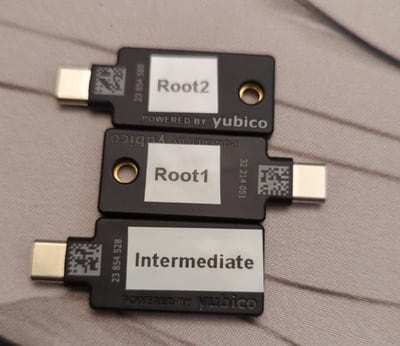
PKI relying on a set of 3 YubiKeys: 2 for the root CA and 1 for the intermediate CA.
Offline PKI backed up by 3 YubiKeys
This post describes an offline PKI system using the following components: It is possible to add more YubiKeys as a backup of the root CA if needed. This is not needed for the intermediate CA as you can generate a new one if the current one gets destroyed.

The software part offline-pki is a small Python application to manage an offline PKI. It relies on yubikey-manager to manage YubiKeys and cryptography for cryptographic operations not executed on the YubiKeys. The application has some opinionated design choices. Notably, the cryptography is hard-coded to use NIST P-384 elliptic curve. The first step is to reset all your YubiKeys:
$ offline-pki yubikey reset
This will reset the connected YubiKey. Are you sure? [y/N]: y
New PIN code:
Repeat for confirmation:
New PUK code:
Repeat for confirmation:
New management key ('.' to generate a random one):
WARNING[pki-yubikey] Using random management key: e8ffdce07a4e3bd5c0d803aa3948a9c36cfb86ed5a2d5cf533e97b088ae9e629
INFO[pki-yubikey]  0: Yubico YubiKey OTP+FIDO+CCID 00 00
INFO[pki-yubikey] SN: 23854514
INFO[yubikit.management] Device config written
INFO[yubikit.piv] PIV application data reset performed
INFO[yubikit.piv] Management key set
INFO[yubikit.piv] New PUK set
INFO[yubikit.piv] New PIN set
INFO[pki-yubikey] YubiKey reset successful!
Then, generate the root CA and create as many copies as you want:
$ offline-pki certificate root --permitted example.com
Management key for Root X:
Plug YubiKey "Root X"...
INFO[pki-yubikey]  0: Yubico YubiKey CCID 00 00
INFO[pki-yubikey] SN: 23854514
INFO[yubikit.piv] Data written to object slot 0x5fc10a
INFO[yubikit.piv] Certificate written to slot 9C (SIGNATURE), compression=True
INFO[yubikit.piv] Private key imported in slot 9C (SIGNATURE) of type ECCP384
Copy root certificate to another YubiKey? [y/N]: y
Plug YubiKey "Root X"...
INFO[pki-yubikey]  0: Yubico YubiKey CCID 00 00
INFO[pki-yubikey] SN: 23854514
INFO[yubikit.piv] Data written to object slot 0x5fc10a
INFO[yubikit.piv] Certificate written to slot 9C (SIGNATURE), compression=True
INFO[yubikit.piv] Private key imported in slot 9C (SIGNATURE) of type ECCP384
Copy root certificate to another YubiKey? [y/N]: n
You can inspect the result:
$ offline-pki yubikey info
INFO[pki-yubikey]  0: Yubico YubiKey CCID 00 00
INFO[pki-yubikey] SN: 23854514
INFO[pki-yubikey] Slot 9C (SIGNATURE):
INFO[pki-yubikey]   Private key type: ECCP384
INFO[pki-yubikey]   Public key:
INFO[pki-yubikey]     Algorithm:  secp384r1
INFO[pki-yubikey]     Issuer:     CN=Root CA
INFO[pki-yubikey]     Subject:    CN=Root CA
INFO[pki-yubikey]     Serial:     1
INFO[pki-yubikey]     Not before: 2024-07-05T18:17:19+00:00
INFO[pki-yubikey]     Not after:  2044-06-30T18:17:19+00:00
INFO[pki-yubikey]     PEM:
-----BEGIN CERTIFICATE-----
MIIBcjCB+aADAgECAgEBMAoGCCqGSM49BAMDMBIxEDAOBgNVBAMMB1Jvb3QgQ0Ew
HhcNMjQwNzA1MTgxNzE5WhcNNDQwNjMwMTgxNzE5WjASMRAwDgYDVQQDDAdSb290
IENBMHYwEAYHKoZIzj0CAQYFK4EEACIDYgAERg3Vir6cpEtB8Vgo5cAyBTkku/4w
kXvhWlYZysz7+YzTcxIInZV6mpw61o8W+XbxZV6H6+3YHsr/IeigkK04/HJPi6+i
zU5WJHeBJMqjj2No54Nsx6ep4OtNBMa/7T9foyMwITAPBgNVHRMBAf8EBTADAQH/
MA4GA1UdDwEB/wQEAwIBhjAKBggqhkjOPQQDAwNoADBlAjEAwYKy/L8leJyiZSnn
xrY8xv8wkB9HL2TEAI6fC7gNc2bsISKFwMkyAwg+mKFKN2w7AjBRCtZKg4DZ2iUo
6c0BTXC9a3/28V5aydZj6rvx0JqbF/Ln5+RQL6wFMLoPIvCIiCU=
-----END CERTIFICATE-----
Then, you can create an intermediate certificate with offline-pki yubikey intermediate and use it to sign certificates by providing a CSR to offline-pki certificate sign. Be careful and inspect the CSR before signing it, as only the subject name can be overridden. Check the documentation for more details. Get the available options using the --help flag.

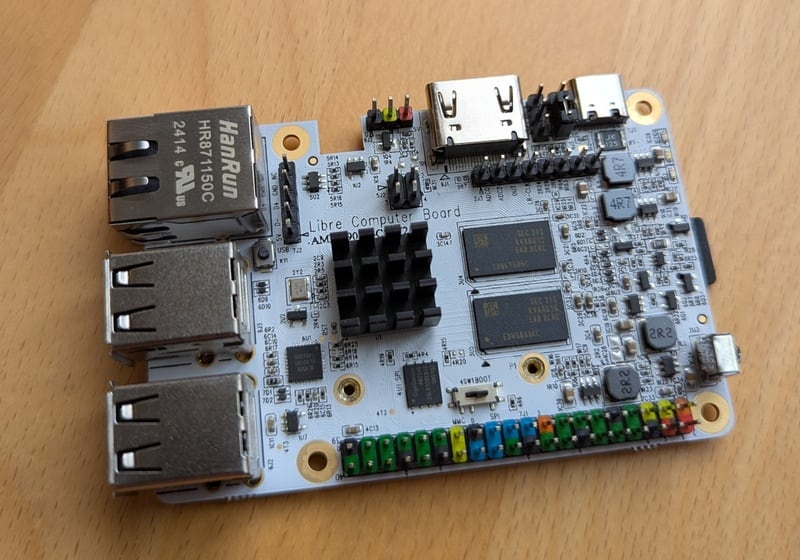
The hardware part To ensure the operations on the root and intermediate CAs are air-gapped, a cost-efficient solution is to use an ARM64 single board computer. The Libre Computer Sweet Potato SBC is a more open alternative to the well-known Raspberry Pi.1
Libre Computer Sweet Potato single board computer relying on the Amlogic S905X SOC
Libre Computer Sweet Potato SBC, powered by the AML-S905X SOC
I interact with it through an USB to TTL UART converter:
$ tio /dev/ttyUSB0
[16:40:44.546] tio v3.7
[16:40:44.546] Press ctrl-t q to quit
[16:40:44.555] Connected to /dev/ttyUSB0
GXL:BL1:9ac50e:bb16dc;FEAT:ADFC318C:0;POC:1;RCY:0;SPI:0;0.0;CHK:0;
TE: 36574
BL2 Built : 15:21:18, Aug 28 2019. gxl g1bf2b53 - luan.yuan@droid15-sz
set vcck to 1120 mv
set vddee to 1000 mv
Board ID = 4
CPU clk: 1200MHz
[ ]

The Nix glue To bring everything together, I am using Nix with a Flake providing:
  • a package for the offline-pki application, with shell completion,
  • a development shell, including an editable version of the offline-pki application,
  • a NixOS module to setup the offline PKI, resetting the system at each boot,
  • a QEMU image for testing, and
  • an SD card image to be used on the Sweet Potato or another ARM64 SBC.
# Execute the application locally
nix run github:vincentbernat/offline-pki -- --help
# Run the application inside a QEMU VM
nix run github:vincentbernat/offline-pki\#qemu
# Build a SD card for the Sweet Potato or for the Raspberry Pi
nix build --system aarch64-linux github:vincentbernat/offline-pki\#sdcard.potato
nix build --system aarch64-linux github:vincentbernat/offline-pki\#sdcard.generic
# Get a development shell with the application
nix develop github:vincentbernat/offline-pki

  1. The key for the root CA is not generated by the YubiKey. Using an air-gapped computer is all the more important. Put it in a safe with the YubiKeys when done!

14 March 2025

Dima Kogan: Getting precise timings out of RS-232 output

For uninteresting reasons I need very regular 58Hz pulses coming out of an RS-232 Tx line: the time between each pulse should be as close to 1/58s as possible. I produce each pulse by writing an \xFF byte to the device. The start bit is the only active-voltage bit being sent, and that produces my pulse. I wrote this obvious C program:
#include <stdio.h>
#include <stdlib.h>
#include <stdbool.h>
#include <sys/ioctl.h>
#include <unistd.h>
#include <fcntl.h>
#include <termios.h>
#include <stdint.h>
#include <sys/time.h>
static uint64_t gettimeofday_uint64()
 
    struct timeval tv;
    gettimeofday(&tv, NULL);
    return (uint64_t) tv.tv_sec * 1000000ULL + (uint64_t) tv.tv_usec;
 
int main(int argc, char* argv[])
 
    // open the serial device, and make it as raw as possible
    const char* device = "/dev/ttyS0";
    const speed_t baud = B9600;
    int fd = open(device, O_WRONLY O_NOCTTY);
    tcflush(fd, TCIOFLUSH);
    struct termios options =  .c_iflag = IGNBRK,
                              .c_cflag = CS8   CREAD   CLOCAL ;
    cfsetspeed(&options, baud);
    tcsetattr(fd, TCSANOW, &options);
    const uint64_t T_us = (uint64_t)(1e6 / 58.);
    const uint64_t t0 = gettimeofday_uint64();
    for(int i=0; ; i++)
     
        const uint64_t t_target = t0 + T_us*i;
        const uint64_t t1       = gettimeofday_uint64();
        if(t_target > t1)
            usleep(t_target - t1);
        write(fd, &((char) '\xff' ), 1);
     
    return 0;
 
This tries to make sure that each write() call happens at 58Hz. I need these pulses to be regular, so I need to also make sure that the time between each userspace write() and when the edge actually hits the line is as short as possible or, at least, stable. Potential reasons for timing errors:
  1. The usleep() doesn't wake up exactly when it should. This is subject to the Linux scheduler waking up the trigger process
  2. The write() almost certainly ends up scheduling a helper task to actually write the \xFF to the hardware. This helper task is also subject to the Linux scheduler waking it up.
  3. Whatever the hardware does. RS-232 doesn't give you any guarantees about byte-byte timings, so this could be an unfixable source of errors
The scheduler-related questions are observable without any extra hardware, so let's do that first. I run the ./trigger program, and look at diagnostics while that's running. I look at some device details:
# ls -lh /dev/ttyS0
crw-rw---- 1 root dialout 4, 64 Mar  6 18:11 /dev/ttyS0
# ls -lh /sys/dev/char/4:64/
total 0
-r--r--r-- 1 root root 4.0K Mar  6 16:51 close_delay
-r--r--r-- 1 root root 4.0K Mar  6 16:51 closing_wait
-rw-r--r-- 1 root root 4.0K Mar  6 16:51 console
-r--r--r-- 1 root root 4.0K Mar  6 16:51 custom_divisor
-r--r--r-- 1 root root 4.0K Mar  6 16:51 dev
lrwxrwxrwx 1 root root    0 Mar  6 16:51 device -> ../../../0000:00:16.3:0.0
-r--r--r-- 1 root root 4.0K Mar  6 16:51 flags
-r--r--r-- 1 root root 4.0K Mar  6 16:51 iomem_base
-r--r--r-- 1 root root 4.0K Mar  6 16:51 iomem_reg_shift
-r--r--r-- 1 root root 4.0K Mar  6 16:51 io_type
-r--r--r-- 1 root root 4.0K Mar  6 16:51 irq
-r--r--r-- 1 root root 4.0K Mar  6 16:51 line
-r--r--r-- 1 root root 4.0K Mar  6 16:51 port
drwxr-xr-x 2 root root    0 Mar  6 16:51 power
-rw-r--r-- 1 root root 4.0K Mar  6 16:51 rx_trig_bytes
lrwxrwxrwx 1 root root    0 Mar  6 16:51 subsystem -> ../../../../../../../class/tty
-r--r--r-- 1 root root 4.0K Mar  6 16:51 type
-r--r--r-- 1 root root 4.0K Mar  6 16:51 uartclk
-rw-r--r-- 1 root root 4.0K Mar  6 16:51 uevent
-r--r--r-- 1 root root 4.0K Mar  6 16:51 xmit_fifo_size
Unsurprisingly, this is a part of the tty subsystem. I don't want to spend the time to really figure out how this works, so let me look at all the tty kernel calls and also at all the kernel tasks scheduled by the trigger process, since I suspect that the actual hardware poke is happening in a helper task. I see this:
# bpftrace -e 'k:*tty* /comm=="trigger"/
                 printf("%d %d %s\n",pid,tid,probe);  
               t:sched:sched_wakeup /comm=="trigger"/
                 printf("switching to %s(%d); current backtrace:", args.comm, args.pid); print(kstack());   '
...
3397345 3397345 kprobe:tty_ioctl
3397345 3397345 kprobe:tty_check_change
3397345 3397345 kprobe:__tty_check_change
3397345 3397345 kprobe:tty_wait_until_sent
3397345 3397345 kprobe:tty_write
3397345 3397345 kprobe:file_tty_write.isra.0
3397345 3397345 kprobe:tty_ldisc_ref_wait
3397345 3397345 kprobe:n_tty_write
3397345 3397345 kprobe:tty_hung_up_p
switching to kworker/0:1(3400169); current backtrace:
        ttwu_do_activate+268
        ttwu_do_activate+268
        try_to_wake_up+605
        kick_pool+92
        __queue_work.part.0+582
        queue_work_on+101
        rpm_resume+1398
        __pm_runtime_resume+75
        __uart_start+85
        uart_write+150
        n_tty_write+1012
        file_tty_write.isra.0+373
        vfs_write+656
        ksys_write+109
        do_syscall_64+130
        entry_SYSCALL_64_after_hwframe+118
3397345 3397345 kprobe:tty_update_time
3397345 3397345 kprobe:tty_ldisc_deref
... repeated with each pulse ...
Looking at the sources I see that uart_write() calls __uart_start(), which schedules a task to call serial_port_runtime_resume() which eventually calls serial8250_tx_chars(), which calls some low-level functions to actually send the bits. I look at the time between two of those calls to quantify the scheduler latency:
pulserate=58
sudo zsh -c \
  '( echo "# dt_write_ns dt_task_latency_ns";
     bpftrace -q -e "k:vfs_write /comm==\"trigger\" && arg2==1/
                      \$t=nsecs(); if(@t0)   @dt_write = \$t-@t0;   @t0=\$t; 
                     k:serial8250_tx_chars /@dt_write/
                      \$t=nsecs(); printf(\"%d %d\\n\", @dt_write, \$t-@t0); "
   )' \
  vnl-filter                  \
    --stream -p dt_write_ms="dt_write_ns/1e6 - 1e3/$pulserate",dt_task_latency_ms=dt_task_latency_ns/1e6 \
  feedgnuplot  \
    --stream   \
    --lines    \
    --points   \
    --xlen 200 \
    --vnl      \
    --autolegend \
    --xlabel 'Pulse index' \
    --ylabel 'Latency (ms)'
Here I'm making a realtime plot showing The raw data as I tweak things lives here. Initially I see big latency spikes:
timings.scheduler.1.noise.svg
These can be fixed by adjusting the priority of the trigger task. This tells the scheduler to wake that task up first, even if something else is currently using the CPU. I do this:
sudo chrt -p 90  pidof trigger 
And I get better-looking latencies:
timings.scheduler.2.clean.svg
During some experiments (not in this dataset) I would see high helper-task timing instabilities as well. These could be fixed by prioritizing the helper task. In this kernel (6.12) the helper task is called kworker/N where N is the CPU index. I tie the trigger process to cpu 0, and priorities all the relevant helpers:
taskset -c 0 ./trigger 58
pgrep -f kworker/0   while   read pid     sudo chrt -p 90 $pid  
This fixes the helper-task latency spikes. OK, so it looks like on the software side we're good to within 0.1ms of the true period. This is in the ballpark of the precision I need; even this might be too high. It's possible to try to push the software to do better: one could look at the kernel sources a bit more, to do smarter things with priorities or to try an -rt kernel. But all this doesn't matter if the serial hardware adds unacceptable delays. Let's look. Let's look at it with a logic analyzer. I use a saleae logic analyzer with sigrok. The tool spits out the samples as it gets them, and an awk script finds the edges and reports the timings to give me a realtime plot.
samplerate=500000;
pulserate=58.;
sigrok-cli -c samplerate=$samplerate -O csv --continuous -C D1 \
  mawk -Winteractive  \
    "prev_logic==0 && \$0==1 \
       
       iedge = NR;
       if(prev_iedge)
        
         di = iedge -prev_iedge;
         dt = di/$samplerate;
         print(dt*1000);
        
       prev_iedge = iedge;
      
      
       prev_logic=\$0;
       "   feedgnuplot --stream --ylabel 'Period (ms)' --equation "1000./$pulserate title \"True $ pulserate Hz period\""
On the server I was using (physical RS-232 port, ancient 3.something kernel):
timings.hw.serial-server.svg
OK This is very discrete for some reason, and generally worse than 0.1ms. What about my laptop (physical RS-232 port, recent 6.12 kernel)?
timings.hw.serial-laptop.svg
Not discrete anymore, but not really any more precise. What about using a usb-serial converter? I expect this to be worse.
timings.hw.usbserial.svg
Yeah, looks worse. For my purposes, an accuracy of 0.1ms is marginal, and the hardware adds non-negligible errors. So I cut my losses, and use an external signal generator:
timings.hw.generator.svg
Yeah. That's better, so that's what I use.

10 March 2025

Joachim Breitner: Extrinsic termination proofs for well-founded recursion in Lean

A few months ago I explained that one reason why this blog has become more quiet is that all my work on Lean is covered elsewhere. This post is an exception, because it is an observation that is (arguably) interesting, but does not lead anywhere, so where else to put it than my own blog Want to share your thoughts about this? Please join the discussion on the Lean community zulip!

Background When defining a function recursively in Lean that has nested recursion, e.g. a recusive call that is in the argument to a higher-order function like List.map, then extra attention used to be necessary so that Lean can see that xs.map applies its argument only elements of the list xs. The usual idiom is to write xs.attach.map instead, where List.attach attaches to the list elements a proof that they are in that list. You can read more about this my Lean blog post on recursive definitions and our new shiny reference manual, look for Example Nested Recursion in Higher-order Functions . To make this step less tedious I taught Lean to automatically rewrite xs.map to xs.attach.map (where suitable) within the construction of well-founded recursion, so that nested recursion just works (issue #5471). We already do such a rewriting to change if c then else to the dependent if h : c then else , but the attach-introduction is much more ambitious (the rewrites are not definitionally equal, there are higher-order arguments etc.) Rewriting the terms in a way that we can still prove the connection later when creating the equational lemmas is hairy at best. Also, we want the whole machinery to be extensible by the user, setting up their own higher order functions to add more facts to the context of the termination proof. I implemented it like this (PR #6744) and it ships with 4.18.0, but in the course of this work I thought about a quite different and maybe better way to do this, and well-founded recursion in general:

A simpler fix Recall that to use WellFounded.fix
WellFounded.fix : (hwf : WellFounded r) (F : (x :  )   ((y :  )   r y x   C y)   C x) (x :  ) : C x
we have to rewrite the functorial of the recursive function, which naturally has type
F : ((y :  )    C y)   ((x :  )   C x)
to the one above, where all recursive calls take the termination proof r y x. This is a fairly hairy operation, mangling the type of matcher s motives and whatnot. Things are simpler for recursive definitions using the new partial_fixpoint machinery, where we use Lean.Order.fix
Lean.Order.fix : [CCPO  ] (F :      ) (hmono : monotone F) :  
so the functorial s type is unmodified (here will be ((x : ) C x)), and everything else is in the propositional side-condition montone F. For this predicate we have a syntax-guided compositional tactic, and it s easily extensible, e.g. by
theorem monotone_mapM (f :         m  ) (xs : List  ) (hmono : monotone f) :
    monotone (fun x => xs.mapM (f x)) 
Once given, we don t care about the content of that proof. In particular proving the unfolding theorem only deals with the unmodified F that closely matches the function definition as written by the user. Much simpler!

Isabelle has it easier Isabelle also supports well-founded recursion, and has great support for nested recursion. And it s much simpler! There, all you have to do to make nested recursion work is to define a congruence lemma of the form, for List.map something like our List.map_congr_left
List.map_congr_left : (h :   a   l, f a = g a) :
    List.map f l = List.map g l
This is because in Isabelle, too, the termination proofs is a side-condition that essentially states the functorial F calls its argument f only on smaller arguments .

Can we have it easy, too? I had wished we could do the same in Lean for a while, but that form of congruence lemma just isn t strong enough for us. But maybe there is a way to do it, using an existential to give a witness that F can alternatively implemented using the more restrictive argument. The following callsOn P F predicate can express that F calls its higher-order argument only on arguments that satisfy the predicate P:
section setup
variable   : Sort u 
variable   :     Sort v 
variable   : Sort w 
def callsOn (P :     Prop) (F : (  y,   y)    ) :=
    (F': (  y, P y     y)    ),   f, F' (fun y _ => f y) = F f
variable (R :         Prop)
variable (F : (  y,   y)   (  x,   x))
local infix:50 "   " => R
def recursesVia : Prop :=   x, callsOn (    x) (fun f => F f x)
noncomputable def fix (wf : WellFounded R) (h : recursesVia R F) : (  x,   x) :=
  wf.fix (fun x => (h x).choose)
def fix_eq (wf : WellFounded R) h x :
    fix R F wf h x = F (fix R F wf h) x := by
  unfold fix
  rw [wf.fix_eq]
  apply (h x).choose_spec
This allows nice compositional lemmas to discharge callsOn predicates:
theorem callsOn_base (y :  ) (hy : P y) :
    callsOn P (fun (f :   x,   x) => f y) := by
  exists fun f => f y hy
  intros; rfl
@[simp]
theorem callsOn_const (x :  ) :
    callsOn P (fun (_ :   x,   x) => x) :=
   fun _ => x, fun _ => rfl 
theorem callsOn_app
      : Sort uu    : Sort ww 
    (F  :  (  y,   y)        ) -- can this also support dependent types?
    (F  :  (  y,   y)    )
    (h  : callsOn P F )
    (h  : callsOn P F ) :
    callsOn P (fun f => F  f (F  f)) := by
  obtain  F ', h  := h 
  obtain  F ', h  := h 
  exists (fun f => F ' f (F ' f))
  intros; simp_all
theorem callsOn_lam
      : Sort uu 
    (F :     (  y,   y)    ) -- can this also support dependent types?
    (h :   x, callsOn P (F x)) :
    callsOn P (fun f x => F x f) := by
  exists (fun f x => (h x).choose f)
  intro f
  ext x
  apply (h x).choose_spec
theorem callsOn_app2
      : Sort uu    : Sort ww 
    (g :          )
    (F  :  (  y,   y)    ) -- can this also support dependent types?
    (F  :  (  y,   y)    )
    (h  : callsOn P F )
    (h  : callsOn P F ) :
    callsOn P (fun f => g (F  f) (F  f)) := by
  apply_rules [callsOn_app, callsOn_const]
With this setup, we can have the following, possibly user-defined, lemma expressing that List.map calls its arguments only on elements of the list:
theorem callsOn_map (  : Type uu) (  : Type ww)
    (P :     Prop) (F : (  y,   y)        ) (xs : List  )
    (h :   x, x   xs   callsOn P (fun f => F f x)) :
    callsOn P (fun f => xs.map (fun x => F f x)) := by
  suffices callsOn P (fun f => xs.attach.map (fun  x, h  => F f x)) by
    simpa
  apply callsOn_app
    apply callsOn_app
      apply callsOn_const
      apply callsOn_lam
      intro  x', hx' 
      dsimp
      exact (h x' hx')
    apply callsOn_const
end setup
So here is the (manual) construction of a nested map for trees:
section examples
structure Tree (  : Type u) where
  val :  
  cs : List (Tree  )
-- essentially
-- def Tree.map (f :      ) : Tree     Tree   :=
--   fun t =>  f t.val, t.cs.map Tree.map )
noncomputable def Tree.map (f :      ) : Tree     Tree   :=
  fix (sizeOf   < sizeOf  ) (fun map t =>  f t.val, t.cs.map map )
    (InvImage.wf (sizeOf  ) WellFoundedRelation.wf) <  by
  intro  v, cs 
  dsimp only
  apply callsOn_app2
    apply callsOn_const
    apply callsOn_map
    intro t' ht'
    apply callsOn_base
    -- ht' : t'   cs -- !
    --   sizeOf t' < sizeOf   val := v, cs := cs  
    decreasing_trivial
end examples
This makes me happy! All details of the construction are now contained in a proof that can proceed by a syntax-driven tactic and that s easily and (likely robustly) extensible by the user. It also means that we can share a lot of code paths (e.g. everything related to equational theorems) between well-founded recursion and partial_fixpoint. I wonder if this construction is really as powerful as our current one, or if there are certain (likely dependently typed) functions where this doesn t fit, but the above is dependent, so it looks good. With this construction, functions defined by well-founded recursion will reduce even worse in the kernel, I assume. This may be a good thing.

The cake is a lie What unfortunately kills this idea, though, is the generation of the functional induction principles, which I believe is not (easily) possible with this construction: The functional induction principle is proved by massaging F to return a proof, but since the extra assumptions (e.g. for ite or List.map) only exist in the termination proof, they are not available in F. Oh wey, how anticlimactic.

PS: Path dependencies Curiously, if we didn t have functional induction at this point yet, then very likely I d change Lean to use this construction, and then we d either not get functional induction, or it would be implemented very differently, maybe a more syntactic approach that would re-prove termination. I guess that s called path dependence.

9 March 2025

Dirk Eddelbuettel: RcppNLoptExample 0.0.2: Minor Updates

An update to our package RcppNLoptExample arrived on CRAN earlier today marking the first update since the intial release more than four year ago. The nloptr package, created by Jelmer Ypma, has long been providing an excellent R interface to NLopt, a very comprehensive library for nonlinear optimization. In particular, Jelmer carefully exposed the API entry points such that other R packages can rely on NLopt without having to explicitly link to it (as one can rely on R providing sufficient function calling and registration to make this possible by referring back to nloptr which naturally has the linking information and resolution). This package demonstrates this in a simple-to-use Rcpp example package that can serve as a stanza. More recent NLopt versions appear to have changed behaviour a little so that an example we relied upon in simple unit test now converges to a marginally different numerical value, so we adjusted a convergence treshold. Other than that we did a number of the usual small updates to package metadata, to the README.md file, and to continuous integration. The (very short) NEWS entry follows:

Changes in version 0.0.2 (2025-03-09)
  • Updated tolerance in simple test as newer upstream nlopt change behaviour ever so slightly leading to an other spurious failure
  • Numerous small and standard updates to DESCRIPTION, README.md, badges, and continuous integration setup

Courtesy of my CRANberries, there is also a diffstat report for this release. For questions, suggestions, or issues please use the issue tracker at the GitHub repo.

This post by Dirk Eddelbuettel originated on his Thinking inside the box blog. If you like this or other open-source work I do, you can now sponsor me at GitHub.

Niels Thykier: Improving Debian packaging in Kate

The other day, I noted that the emacs integration with debputy stopped working. After debugging for a while, I realized that emacs no longer sent the didOpen notification that is expected of it, which confused debputy. At this point, I was already several hours into the debugging and I noted there was some discussions on debian-devel about emacs and byte compilation not working. So I figured I would shelve the emacs problem for now. But I needed an LSP capable editor and with my vi skills leaving much to be desired, I skipped out on vim-youcompleteme. Instead, I pulled out kate, which I had not been using for years. It had LSP support, so it would fine, right? Well, no. Turns out that debputy LSP support had some assumptions that worked for emacs but not kate. Plus once you start down the rabbit hole, you stumble on things you missed previously.
Getting started First order of business was to tell kate about debputy. Conveniently, kate has a configuration tab for adding language servers in a JSON format right next to the tab where you can see its configuration for built-in LSP (also in JSON format9. So a quick bit of copy-paste magic and that was done. Yesterday, I opened an MR against upstream to have the configuration added (https://invent.kde.org/utilities/kate/-/merge_requests/1748) and they already merged it. Today, I then filed a wishlist against kate in Debian to have the Debian maintainers cherry-pick it, so it works out of the box for Trixie (https://bugs.debian.org/1099876). So far so good.
Inlay hint woes Since July (2024), debputy has support for Inlay hints. They are basically small bits of text that the LSP server can ask the editor to inject into the text to provide hints to the reader. Typically, you see them used to provide typing hints, where the editor or the underlying LSP server has figured out the type of a variable or expression that you did not explicitly type. Another common use case is to inject the parameter name for positional arguments when calling a function, so the user do not have to count the position to figure out which value is passed as which parameter. In debputy, I have been using the Inlay hints to show inherited fields in debian/control. As an example, if you have a definition like:
Source: foo-src
Section: devel
Priority: optional
Package: foo-bin
Architecture: any
Then foo-bin inherits the Section and Priority field since it does not supply its own. Previously, debputy would that by injecting the fields themselves and their value just below the Package field as if you had typed them out directly. The editor always renders Inlay hints distinctly from regular text, so there was no risk of confusion and it made the text look like a valid debian/control file end to end. The result looked something like:
Source: foo-src
Section: devel
Priority: optional
Package: foo-bin
Section: devel
Priority: optional
Architecture: any
With the second instances of Section and Priority being rendered differently than its surrendering (usually faded or colorlessly). Unfortunately, kate did not like injecting Inlay hints with a newline in them, which was needed for this trick. Reading into the LSP specs, it says nothing about multi-line Inlay hints being a thing and I figured I would see this problem again with other editors if I left it be. I ended up changing the Inlay hints to be placed at the end of the Package field and then included surrounding () for better visuals. So now, it looks like:
Source: foo-src
Section: devel
Priority: optional
Package: foo-bin  (Section: devel)  (Priority: optional)
Architecture: any
Unfortunately, it is no longer 1:1 with the underlying syntax which I liked about the previous one. But it works in more editors and is still explicit. I also removed the Inlay hint for the Homepage field. It takes too much space and I have yet to meet someone missing it in the binary stanza. If you have any better ideas for how to render it, feel free to reach out to me.
Spurious completion and hover As I was debugging the Inlay hints, I wanted to do a quick restart of debputy after each fix. Then I would trigger a small change to the document to ensure kate would request an update from debputy to render the Inlay hints with the new code. The full outgoing payloads are sent via the logs to the client, so it was really about minimizing which LSP requests are sent to debputy. Notably, two cases would flood the log:
  • Completion requests. These are triggered by typing anything at all and since I wanted to a change, I could not avoid this. So here it was about making sure there would be nothing to complete, so the result was a small as possible.
  • Hover doc requests. These are triggered by mouse hovering over field, so this was mostly about ensuring my mouse movement did not linger over any field on the way between restarting the LSP server and scrolling the log in kate.
In my infinite wisdom, I chose to make a comment line where I would do the change. I figured it would neuter the completion requests completely and it should not matter if my cursor landed on the comment as there would be no hover docs for comments either. Unfortunately for me, debputy would ignore the fact that it was on a comment line. Instead, it would find the next field after the comment line and try to complete based on that. Normally you do not see this, because the editor correctly identifies that none of the completion suggestions start with a \#, so they are all discarded. But it was pretty annoying for the debugging, so now debputy has been told to explicitly stop these requests early on comment lines.
Hover docs for packages I added a feature in debputy where you can hover over package names in your relationship fields (such as Depends) and debputy will render a small snippet about it based on data from your local APT cache. This doc is then handed to the editor and tagged as markdown provided the editor supports markdown rendering. Both emacs and kate support markdown. However, not all markdown renderings are equal. Notably, emacs's rendering does not reformat the text into paragraphs. In a sense, emacs rendering works a bit like <pre>...</pre> except it does a bit of fancy rendering inside the <pre>...</pre>. On the other hand, kate seems to convert the markdown to HTML and then throw the result into an HTML render engine. Here it is important to remember that not all newlines are equal in markdown. A Foo<newline>Bar is treated as one "paragraph" (<p>...</p>) and the HTML render happily renders this as single line Foo Bar provided there is sufficient width to do so. A couple of extra newlines made wonders for the kate rendering, but I have a feeling this is not going to be the last time the hover docs will need some tweaking for prettification. Feel free to reach out if you spot a weirdly rendered hover doc somewhere.
Making quickfixes available in kate Quickfixes are treated as generic code actions in the LSP specs. Each code action has a "type" (kind in the LSP lingo), which enables the editor to group the actions accordingly or filter by certain types of code actions. The design in the specs leads to the following flow:
  1. The LSP server provides the editor with diagnostics (there are multiple ways to trigger this, so we will keep this part simple).
  2. The editor renders them to the user and the user chooses to interact with one of them.
  3. The interaction makes the editor asks the LSP server, which code actions are available at that location (optionally with filter to only see quickfixes).
  4. The LSP server looks at the provided range and is expected to return the relevant quickfixes here.
This flow is really annoying from a LSP server writer point of view. When you do the diagnostics (in step 1), you tend to already know what the possible quickfixes would be. The LSP spec authors realized this at some point, so there are two features the editor provides to simplify this.
  1. In the editor request for code actions, the editor is expected to provide the diagnostics that they received from the server. Side note: I cannot quite tell if this is optional or required from the spec.
  2. The editor can provide support for remembering a data member in each diagnostic. The server can then store arbitrary information in that member, which they will see again in the code actions request. Again, provided that the editor supports this optional feature.
All the quickfix logic in debputy so far has hinged on both of these two features. As life would have it, kate provides neither of them. Which meant I had to teach debputy to keep track of its diagnostics on its own. The plus side is that makes it easier to support "pull diagnostics" down the line, since it requires a similar feature. Additionally, it also means that quickfixes are now available in more editors. For consistency, debputy logic is now always used rather than relying on the editor support when present. The downside is that I had to spend hours coming up with and debugging a way to find the diagnostics that overlap with the range provided by the editor. The most difficult part was keeping the logic straight and getting the runes correct for it.
Making the quickfixes actually work With all of that, kate would show the quickfixes for diagnostics from debputy and you could use them too. However, they would always apply twice with suboptimal outcome as a result. The LSP spec has multiple ways of defining what need to be changed in response to activating a code action. In debputy, all edits are currently done via the WorkspaceEdit type. It has two ways of defining the changes. Either via changes or documentChanges with documentChanges being the preferred one if both parties support this. I originally read that as I was allowed to provide both and the editor would pick the one it preferred. However, after seeing kate blindly use both when they are present, I reviewed the spec and it does say "The edit should either provide changes or documentChanges", so I think that one is on me. None of the changes in debputy currently require documentChanges, so I went with just using changes for now despite it not being preferred. I cannot figure out the logic of whether an editor supports documentChanges. As I read the notes for this part of the spec, my understanding is that kate does not announce its support for documentChanges but it clearly uses them when present. Therefore, I decided to keep it simple for now until I have time to dig deeper.
Remaining limitations with kate There is one remaining limitation with kate that I have not yet solved. The kate program uses KSyntaxHighlighting for its language detection, which in turn is the basis for which LSP server is assigned to a given document. This engine does not seem to support as complex detection logic as I hoped from it. Concretely, it either works on matching on an extension / a basename (same field for both cases) or mime type. This combined with our habit in Debian to use extension less files like debian/control vs. debian/tests/control or debian/rules or debian/upstream/metadata makes things awkward a best. Concretely, the syntax engine cannot tell debian/control from debian/tests/control as they use the same basename. Fortunately, the syntax is close enough to work for both and debputy is set to use filename based lookups, so this case works well enough. However, for debian/rules and debian/upstream/metadata, my understanding is that if I assign these in the syntax engine as Debian files, these rules will also trigger for any file named foo.rules or bar.metadata. That seems a bit too broad for me, so I have opted out of that for now. The down side is that these files will not work out of the box with kate for now. The current LSP configuration in kate does not recognize makefiles or YAML either. Ideally, we would assign custom languages for the affected Debian files, so we do not steal the ID from other language servers. Notably, kate has a built-in language server for YAML and debputy does nothing for a generic YAML document. However, adding YAML as a supported language for debputy would cause conflict and regressions for users that are already happy with their generic YAML language server from kate. So there are certainly still work to be done. If you are good with KSyntaxHighlighting and know how to solve some of this, I hope you will help me out.
Changes unrelated to kate While I was working on debputy, I also added some other features that I want to mention.
  1. The debputy lint command will now show related context to diagnostic in its terminal report when such information is available and is from the same file as the diagnostic itself (cross file cases are rendered without related information). The related information is typically used to highlight a source of a conflict. As an example, if you use the same field twice in a stanza of debian/control, then debputy will add a diagnostic to the second occurrence. The related information for that diagnostic would provide the position of the first occurrence. This should make it easier to find the source of the conflict in the cases where debputy provides it. Let me know if you are missing it for certain diagnostics.

  2. The diagnostics analysis of debian/control will now identify and flag simple duplicated relations (complex ones like OR relations are ignored for now). Thanks to Matthias Geiger for suggesting the feature and Otto Kek l inen for reporting a false positive that is now fixed.

Closing I am glad I tested with kate to weed out most of these issues in time before the freeze. The Debian freeze will start within a week from now. Since debputy is a part of the toolchain packages it will be frozen from there except for important bug fixes.

8 March 2025

Gunnar Wolf: The author has been doctored.

Almost exactly four years after I started with this project, yesterday I presented my PhD defense. My thesis was what I ve been presenting advances of all around since 2022: A certificate-poisoning-resistant protocol for the synchronization of Web of Trust networks Lots of paperwork is still on the road for me. But at least in the immediate future, I can finally use this keyring my friend Ra l G mez 3D-printed for me:

7 March 2025

Dirk Eddelbuettel: RcppSimdJson 0.1.13 on CRAN: Compiler Nag, New Upsteam

A new release 0.1.13 of the RcppSimdJson package is now on CRAN. RcppSimdJson wraps the fantastic and genuinely impressive simdjson library by Daniel Lemire and collaborators. Via very clever algorithmic engineering to obtain largely branch-free code, coupled with modern C++ and newer compiler instructions, it results in parsing gigabytes of JSON parsed per second which is quite mindboggling. The best-case performance is faster than CPU speed as use of parallel SIMD instructions and careful branch avoidance can lead to less than one cpu cycle per byte parsed; see the video of the talk by Daniel Lemire at QCon. This release was tickled by another CRAN request: just like yesterday s RcppDate release, it responds to the esoteric whitespace in literal operator depreceation warning. Turns out that upstream simdjson had this fixed a few months ago as the node bindings package ran into it. Other changes include a bit of earlier polish by Daniel, another CRAN mandated update, CI improvements, and a move of two demos to examples/ to avoid having to add half a dozen packages to Suggests: for no real usage gain in the package. The short NEWS entry for this release follows.

Changes in version 0.1.13 (2025-03-07)
  • A call to std::string::erase is now guarded (Daniel)
  • The package now uses Authors@R as mandated by CRAN (Dirk)
  • simdjson was upgraded to version 3.12.2 (Dirk)
  • Continuous integration updated to more compilers and simpler setup
  • Two demos are now in inst/examples to not inflate Suggests

Courtesy of my CRANberries, there is also a diffstat report for this release. For questions, suggestions, or issues please use the issue tracker at the GitHub repo.

This post by Dirk Eddelbuettel originated on his Thinking inside the box blog. If you like this or other open-source work I do, you can now sponsor me at GitHub.

6 March 2025

Antoine Beaupr : Nix Notes

Meta In case you haven't noticed, I'm trying to post and one of the things that entails is to just dump over the fence a bunch of draft notes. In this specific case, I had a set of rough notes about NixOS and particularly Nix, the package manager. In this case, you can see the very birth of an article, what it looks like before it becomes the questionable prose it is now, by looking at the Git history of this file, particularly its birth. I have a couple of those left, and it would be pretty easy to publish them as is, but I feel I'd be doing others (and myself! I write for my own documentation too after all) a disservice by not going the extra mile on those. So here's the long version of my experiment with Nix.

Nix A couple friends are real fans of Nix. Just like I work with Puppet a lot, they deploy and maintain servers (if not fleets of servers) with NixOS and its declarative package management system. Essentially, they use it as a configuration management system, which is pretty awesome. That, however, is a bit too high of a bar for me. I rarely try new operating systems these days: I'm a Debian developer and it takes most of my time to keep that functional. I'm not going to go around messing with other systems as I know that would inevitably get me dragged down into contributing into yet another free software project. I'm mature now and know where to draw the line. Right? So I'm just testing Nix, the package manager, on Debian, because I learned from my friend that nixpkgs is the largest package repository out there, a mind-boggling 100,000 at the time of writing (with 88% of packages up to date), compared to around 40,000 in Debian (or 72,000 if you count binary packages, with 72% up to date). I naively thought Debian was the largest, perhaps competing with Arch, and I was wrong: Arch is larger than Debian too. What brought me there is I wanted to run Harper, a fast spell-checker written in Rust. The logic behind using Nix instead of just downloading the source and running it myself is that I delegate the work of supply-chain integrity checking to a distributor, a bit like you trust Debian developers like myself to package things in a sane way. I know this widens the attack surface to a third party of course, but the rationale is that I shift cryptographic verification to another stack than just "TLS + GitHub" (although that is somewhat still involved) that's linked with my current chain (Debian packages). I have since then stopped using Harper for various reasons and also wrapped up my Nix experiment, but felt it worthwhile to jot down some observations on the project.

Hot take Overall, Nix is hard to get into, with a complicated learning curve. I have found the documentation to be a bit confusing, since there are many ways to do certain things. I particularly tripped on "flakes" and, frankly, incomprehensible error reporting. It didn't help that I tried to run nixpkgs on Debian which is technically possible, but you can tell that I'm not supposed to be doing this. My friend who reviewed this article expressed surprised at how easy this was, but then he only saw the finished result, not me tearing my hair out to make this actually work.

Nix on Debian primer So here's how I got started. First I installed the nix binary package:
apt install nix-bin
Then I had to add myself to the right group and logout/log back in to get the rights to deploy Nix packages:
adduser anarcat nix-users
That wasn't easy to find, but is mentioned in the README.Debian file shipped with the Debian package. Then, I didn't write this down, but the README.Debian file above mentions it, so I think I added a "channel" like this:
nix-channel --add https://nixos.org/channels/nixpkgs-unstable nixpkgs
nix-channel --update
And I likely installed the Harper package with:
nix-env --install harper
At this point, harper was installed in a ... profile? Not sure. I had to add ~/.nix-profile/bin (a symlink to /nix/store/sympqw0zyybxqzz6fzhv03lyivqqrq92-harper-0.10.0/bin) to my $PATH environment for this to actually work.

Side notes on documentation Those last two commands (nix-channel and nix-env) were hard to figure out, which is kind of amazing because you'd think a tutorial on Nix would feature something like this prominently. But three different tutorials failed to bring me up to that basic setup, even the README.Debian didn't spell that out clearly. The tutorials all show me how to develop packages for Nix, not plainly how to install Nix software. This is presumably because "I'm doing it wrong": you shouldn't just "install a package", you should setup an environment declaratively and tell it what you want to do. But here's the thing: I didn't want to "do the right thing". I just wanted to install Harper, and documentation failed to bring me to that basic "hello world" stage. Here's what one of the tutorials suggests as a first step, for example:
curl -L https://nixos.org/nix/install   sh
nix-shell --packages cowsay lolcat
nix-collect-garbage
... which, when you follow through, leaves you with almost precisely nothing left installed (apart from Nix itself, setup with a nasty "curl pipe bash". So while that works in testing Nix, you're not much better off than when you started.

Rolling back everything Now that I have stopped using Harper, I don't need Nix anymore, which I'm sure my Nix friends will be sad to read about. Don't worry, I have notes now, and can try again! But still, I wanted to clear things out, so I did this, as root:
deluser anarcat nix-users
apt purge nix-bin
rm -rf /nix ~/.nix*
I think this cleared things out, but I'm not actually sure.

Side note on Nix drama This blurb wouldn't be complete without a mention that the Nix community has been somewhat tainted by the behavior of its founder. I won't bother you too much with this; LWN covered it well in 2024, and made a followup article about spinoffs and forks that's worth reading as well. I did want to say that everyone I have been in contact with in the Nix community was absolutely fantastic. So I am really sad that the behavior of a single individual can pollute a community in such a way. As a leader, if you have all but one responsability, it's to behave properly for people around you. It's actually really, really hard to do that, because yes, it means you need to act differently than others and no, you just don't get to be upset at others like you would normally do with friends, because you're in a position of authority. It's a lesson I'm still learning myself, to be fair. But at least I don't work with arms manufacturers or, if I would, I would be sure as hell to accept the nick (or nix?) on the chin when people would get upset, and try to make amends. So long live the Nix people! I hope the community recovers from that dark moment, so far it seems like it will. And thanks for helping me test Harper!

Next.

Previous.