Search Results: "tb"

5 April 2025

Russell Coker: More About the HP ML110 Gen9 and z640

In May 2021 I bought a ML110 Gen9 to use as a deskside workstation [1]. I started writing this post in April 2022 when it had been my main workstation for almost a year. While this post was in a draft state in Feb 2023 I upgraded it to an 18 core E5-2696 v3 CPU [2]. It s now March 2025 and I have replaced it. Hardware Issues My previous state with this was not having adequate cooling to allow it to boot and not having a PCIe power cable for a video card. As an experiment I connected the CPU fan to the PCIe fan power and discovered that all power and monitoring wires for the CPU and PCIe fans are identical. This allowed me to buy a CPU fan which was cheaper ($26.09 including postage) and easier to obtain than a PCIe fan (presumably due to CPU fans being more commonly used and manufactured in larger quantities). I had to be creative in attaching the CPU fan as it s cable wasn t long enough to reach the usual location for a PCIe fan. The PCIe fan also required a baffle to direct the air to the right place which annoyingly HP apparently doesn t ship with the low end servers, so I made one from a Corn Flakes packet and duct tape. The Wikipedia page listing AMD GPUs lists many newer ones that draw less than 80W and don t need a PCIe power cable. I ordered a Radeon RX560 4G video card which cost $246.75. It only uses 8 lanes of PCIe but that s enough for me, the only 3D game I play is Warzone 2100 which works well at 4K resolution on that card. It would be really annoying if I had to just spend $246.75 to get the system working, but I had another system in need of a better video card which had a PCIe power cable so the effective cost was small. I think of it as upgrading 2 systems for $123 each. The operation of the PCIe video card was a little different than non-server systems. The built in VGA card displayed the hardware status at the start and then kept displaying that after the system had transitioned to PCIe video. This could be handy in some situations if you know what it s doing but was confusing initially. Booting One insidious problem is that when booting in legacy mode the boot process takes an unreasonably long time and often hangs, the UEFI implementation on this system seems much more reliable and also supports booting from NVMe. Even with UEFI the boot process on this system was slow. Also the early stage of the power on process involves fans being off and the power light flickering which leads you to think that it s not booting and needs to have the power button pressed again which turns it off. The Dell power on sequence of turning most LEDs on and instantly running the fans at high speed leaves no room for misunderstanding. This is also something that companies making electric cars could address. When turning on a machine you should never be left wondering if it is actually on. Noise This was always a noisy system. When I upgraded the CPU from an 8 core with 85W typical TDP to an 18 core with 145W typical TDP it became even louder. Then over time as dust accumulated inside the machine it became louder still until it was annoyingly loud outside the room when all 18 cores were busy. Replacement I recently blogged about options for getting 8K video to work on Linux [3]. This requires PCIe power which the z640s have (all the ones I have seen have it I don t know if all that HP made have it) and which the cheaper models in the ML-110 line don t have. Since then I have ordered an Intel Arc card which apparently has 190W TDP. There are adaptors to provide PCIe power from SATA or SAS power which I could have used, but having a E5-2696 v3 CPU that draws 145W [4] and a GPU that draws 190W [4] in a system with a 350W PSU doesn t seem viable. I replaced it with one of the HP z640 workstations I got in 2023 [5]. The current configuration of the z640 has 3*32G RDIMMs compared to the ML110 having 8*32G, going from 256G to 96G is a significant decrease but most tasks run well enough like that. A limitation of the z640 is that when run with a single CPU it only has 4 DIMM slots which gives a maximum of 512G if you get 128G LRDIMMs, but as all DDR4 DIMMs larger than 32G are unreasonably expensive at this time the practical limit is 128G (which costs about $120AU). In this case I have 96G because the system I m using has a motherboard problem which makes the fourth DIMM slot unusable. Currently my desire to get more than 96G of RAM is less than my desire to avoid swapping CPUs. At this time I m not certain that I will make my main workstation the one that talks to an 8K display. But I really want to keep my options open and there are other benefits. The z640 boots faster. It supports PCIe bifurcation (with a recent BIOS) so I now have 4 NVMe devices in a single PCIe slot. It is very quiet, the difference is shocking. I initially found it disconcertingly quiet. The biggest problem with the z640 is having only 4 DIMM sockets and the particular one I m using has a problem limiting it to 3. Another problem with the z640 when compared to the ML110 Gen9 is that it runs the RAM at 2133 while the ML110 runs it at 2400, that s a significant performance reduction. But the benefits outweigh the disadvantages. Conclusion I have no regrets about buying the ML-110. It was the only DDR4 ECC system that was in the price range I wanted at the time. If I knew that the z640 systems would run so quietly then I might have replaced it earlier. But it was only late last year that 32G DIMMs became affordable, before then I had 8*16G DIMMs to give 128G because I had some issues of programs running out of memory when I had less.

4 April 2025

Gunnar Wolf: Naming things revisited

How long has it been since you last saw a conversation over different blogs syndicated at the same planet? Well, it s one of the good memories of the early 2010s. And there is an opportunity to re-engage! I came across Evgeni s post naming things is hard in Planet Debian. So, what names have I given my computers? I have had many since the mid-1990s I also had several during the decade before that, but before Linux, my computers didn t hve a formal name. Naming my computers something nice Linux gave me. I have forgotten many. Some of the names I have used:

Guido G nther: Booting an Android custom kernel on a Pixel 3a for QMI debugging

As you might know I'm not much of an Android user (let alone developer) but in order to figure out how something low level works you sometimes need to peek at how vendor kernels handles this. For that it is often useful to add additional debugging. One such case is QMI communication going on in Qualcomm SOCs. Joel Selvaraj wrote some nice tooling for this. To make use of this a rooted device and a small kernel patch is needed and what would be a no-brainer with Linux Mobile took me a moment to get it to work on Android. Here's the steps I took on a Pixel 3a to first root the device via Magisk, then build the patched kernel and put that into a boot.img to boot it. Flashing the factory image If you still have Android on the device you can skip this step. You can get Android 12 from developers.google.com. I've downloaded sargo-sp2a.220505.008-factory-071e368a.zip. Then put the device into Fastboot mode (Power + Vol-Down), connect it to your PC via USB, unzip/unpack the archive and reflash the phone:
unpack sargo-sp2a.220505.008-factory-071e368a.zip
./flash-all.sh
This wipes your device! I had to run it twice since it would time out on the first run. Note that this unpacked zip contains another zip (image-sargo-sp2a.220505.008.zip) which will become useful below. Enabling USB debugging Now boot Android and enable Developer mode by going to Settings About then touching Build Number (at the very bottom) 7 times. Go back one level, then go to System Developer Options and enable "USB Debugging". Obtaining boot.img There are several ways to get boot.img. If you just flashed Android above then you can fetch boot.img from the already mentioned image-sargo-sp2a.220505.008.zip:
unzip image-sargo-sp2a.220505.008.zip boot.img
If you want to fetch the exact boot.img from your device you can use TWRP (see the very end of this post). Becoming root with Magisk Being able to su via adb will later be useful to fetch kernel logs. For that we first download Magisk as APK. At the time of writing v28.1 is current. Once downloaded we upload the APK and the boot.img from the previous step onto the phone (which needs to have Android booted):
adb push Magisk-v28.1.apk /sdcard/Download
adb push boot.img /sdcard/Download
In Android open the Files app, navigate to /sdcard/Download and install the Magisk APK by opening the APK. We now want to patch boot.img to get su via adb to work (so we can run dmesg). This happens by hitting Install in the Magisk app, then "Select a file to patch". You then select the boot.img we just uploaded. The installation process will create a magisk_patched-<random>.img in /sdcard/Download. We can pull that file via adb back to our PC:
adb pull /sdcard/Download/magisk_patched-28100_3ucVs.img
Then reboot the phone into fastboot (adb reboot bootloader) and flash it (this is optional see below):
fastboot flash boot magisk_patched-28100_3ucVs.img
Now boot the phone again, open the Magisk app, go to SuperUser at the bottom and enable Shell. If you now connect to your phone via adb again and now su should work:
adb shell
su
As noted above if you want to keep your Android installation pristine you don't even need to flash this Magisk enabled boot.img. I've flashed it so I have su access for other operations too. If you don't want to flash it you can still test boot it via:
fastboot boot magisk_patched-28100_3ucVs.img
and then perform the same adb shell su check as above. Building the custom kernel For our QMI debugging to work we need to patch the kernel a bit and place that in boot.img too. So let's build the kernel first. For that we install the necessary tools (which are thankfully packaged in Debian) and fetch the Android kernel sources:
sudo apt install repo android-platform-tools-base kmod ccache build-essential mkbootimg
mkdir aosp-kernel && cd aosp-kernel
repo init -u https://android.googlesource.com/kernel/manifest -b android-msm-bonito-4.9-android12L
repo sync
With that we can apply Joel's kernel patches and also compile in the touch controller driver so we don't need to worry if the modules in the initramfs match the kernel. The kernel sources are in private/msm-google. I've just applied the diffs on top with patch and modified the defconfig and committed the changes. The resulting tree is here. We then build the kernel:
PATH=/usr/sbin:$PATH ./build_bonito.sh
The resulting kernel is at ./out/android-msm-pixel-4.9/private/msm-google/arch/arm64/boot/Image.lz4-dtb. In order to boot that kernel I found it to be the simplest to just replace the kernel in the Magisk patched boot.img as we have that already. In case you have already deleted that for any reason we can always fetch the current boot.img from the phone via TWRP (see below). Preparing a new boot.img To replace the kernel in our Magisk enabled magisk_patched-28100_3ucVs.img from above with the just built kernel we can use mkbootimgfor that. I basically copied the steps we're using when building the boot.img on the Linux Mobile side:
ARGS=$(unpack_bootimg --format mkbootimg --out tmp --boot_img magisk_patched-28100_3ucVs.img)
CLEAN_PARAMS="$(echo "$ ARGS "   sed -e "s/ --cmdline '.*'//" -e "s/ --board '.*'//")"
cp android-kernel/out/android-msm-pixel-4.9/private/msm-google/arch/arm64/boot/Image.lz4-dtb tmp/kernel
mkbootimg -o "boot.patched.img" $ CLEAN_PARAMS  --cmdline "$ ARGS "
This will give you a boot.patched.img with the just built kernel. Boot the new kernel via fastboot We can now boot the new boot.patched.img. No need to flash that onto the device for that:
fastboot boot boot.patched.img
Fetching the kernel logs With that we can fetch the kernel logs with the debug output via adb:
adb shell su -c 'dmesg -t' > dmesg_dump.xml
or already filtering out the QMI commands:
adb shell su -c 'dmesg -t'    grep "@QMI@"   sed -e "s/@QMI@//g" &> sargo_qmi_dump.xml
That's it. You can apply this method for testing out other kernel patches as well. If you want to apply the above to other devices you basically need to make sure you patch the right kernel sources, the other steps should be very similar. In case you just need a rooted boot.img for sargo you can find a patched one here. If this procedure can be improved / streamlined somehow please let me know. Appendix: Fetching boot.img from the phone If, for some reason you lost boot.img somewhere on the way you can always use TWRP to fetch the boot.img currently in use on your phone. First get TWRP for the Pixel 3a. You can boot that directly by putting your device into fastboot mode, then running:
fastboot boot twrp-3.7.1_12-1-sargo.img
Within TWRP select Backup Boot and backup the file. You can then use adb shell to locate the backup in /sdcard/TWRP/BACKUPS/ and pull it:
adb pull /sdcard/TWRP/BACKUPS/97GAY10PWS/2025-04-02--09-24-24_SP2A220505008/boot.emmc.win
You now have the device's boot.img on your PC and can e.g. replace the kernel or make modifications to the initramfs.

1 April 2025

Colin Watson: Free software activity in March 2025

Most of my Debian contributions this month were sponsored by Freexian. You can also support my work directly via Liberapay. OpenSSH Changes in dropbear 2025.87 broke OpenSSH s regression tests. I cherry-picked the fix. I reviewed and merged patches from Luca Boccassi to send and accept the COLORTERM and NO_COLOR environment variables. Python team Following up on last month, I fixed some more uscan errors: I upgraded these packages to new upstream versions: In bookworm-backports, I updated python-django to 3:4.2.19-1. Although Debian s upgrade to python-click 8.2.0 was reverted for the time being, I fixed a number of related problems anyway since we re going to have to deal with it eventually: dh-python dropped its dependency on python3-setuptools in 6.20250306, which was long overdue, but it had quite a bit of fallout; in most cases this was simply a question of adding build-dependencies on python3-setuptools, but in a few cases there was a missing build-dependency on python3-typing-extensions which had previously been pulled in as a dependency of python3-setuptools. I fixed these bugs resulting from this: We agreed to remove python-pytest-flake8. In support of this, I removed unnecessary build-dependencies from pytest-pylint, python-proton-core, python-pyzipper, python-tatsu, python-tatsu-lts, and python-tinycss, and filed #1101178 on eccodes-python and #1101179 on rpmlint. There was a dnspython autopkgtest regression on s390x. I independently tracked that down to a pylsqpack bug and came up with a reduced test case before realizing that Pranav P had already been working on it; we then worked together on it and I uploaded their patch to Debian. I fixed various other build/test failures: I enabled more tests in python-moto and contributed a supporting fix upstream. I sponsored Maximilian Engelhardt to reintroduce zope.sqlalchemy. I fixed various odds and ends of bugs: I contributed a small documentation improvement to pybuild-autopkgtest(1). Rust team I upgraded rust-asn1 to 0.20.0. Science team I finally gave in and joined the Debian Science Team this month, since it often has a lot of overlap with the Python team, and Freexian maintains several packages under it. I fixed a uscan error in hdf5-blosc (maintained by Freexian), and upgraded it to a new upstream version. I fixed python-vispy: missing dependency on numpy abi. Other bits and pieces I fixed debconf should automatically be noninteractive if input is /dev/null. I fixed a build failure with GCC 15 in yubihsm-shell (maintained by Freexian). Prompted by a CI failure in debusine, I submitted a large batch of spelling fixes and some improved static analysis to incus (#1777, #1778) and distrobuilder. After regaining access to the repository, I fixed telegnome: missing app icon in About dialogue and made a new 0.3.7 release.

Michael Ablassmeier: qmpbackup 0.46 - add image fleecing

I ve released qmpbackup 0.46 which now utilizes the image fleecing technique for backup. Usually, during backup, Qemu will use a so called copy-before-write filter so that data for new guest writes is sent to the backup target first, the guest write blocks until this operation is finished. If the backup target is flaky, or becomes unavailable during backup operation, this could lead to high I/O wait times or even complete VM lockups. To fix this, a so called fleecing image is introduced during backup being used as temporary cache for write operations by the guest. This image can be placed on the same storage as the virtual machine disks, so is independent from the backup target performance. The documentation on which steps are required to get this going, using the Qemu QMP protocol is, lets say.. lacking.. The following examples show the general functionality, but should be enhanced to use transactions where possible. All commands are in qmp-shell command format. Lets start with a full backup:
# create a new bitmap
block-dirty-bitmap-add node=disk1 name=bitmap persistent=true
# add the fleece image to the virtual machine (same size as original disk required)
blockdev-add driver=qcow2 node-name=fleecie file= "driver":"file","filename":"/tmp/fleece.qcow2" 
# add the backup target file to the virtual machine
blockdev-add driver=qcow2 node-name=backup-target-file file= "driver":"file","filename":"/tmp/backup.qcow2" 
# enable the copy-before-writer for the first disk attached, utilizing the fleece image
blockdev-add driver=copy-before-write node-name=cbw file=disk1 target=fleecie
# "blockdev-replace": make the copy-before-writer filter the major device (use "query-block" to get path parameter value, qdev node)
qom-set path=/machine/unattached/device[20] property=drive value=cbw
# add the snapshot-access filter backing the copy-before-writer
blockdev-add driver=snapshot-access file=cbw node-name=snapshot-backup-source
# create a full backup
blockdev-backup device=snapshot-backup-source target=backup-target-file sync=full job-id=test
[ wait until block job finishes]
# remove the snapshot access filter from the virtual machine
blockdev-del node-name=snapshot-backup-source
# switch back to the regular disk
qom-set path=/machine/unattached/device[20] property=drive value=node-disk1
# remove the copy-before-writer
blockdev-del node-name=cbw
# remove the backup-target-file
blockdev-del node-name=backup-target-file
# detach the fleecing image
blockdev-del node-name=fleecie
After this process, the temporary fleecing image can be deleted/recreated. Now lets go for a incremental backup:
# add the fleecing and backup target image, like before
blockdev-add driver=qcow2 node-name=fleecie file= "driver":"file","filename":"/tmp/fleece.qcow2" 
blockdev-add driver=qcow2 node-name=backup-target-file file= "driver":"file","filename":"/tmp/backup-incremental.qcow2" 
# add the copy-before-write filter, but utilize the bitmap created during full backup
blockdev-add driver=copy-before-write node-name=cbw file=disk1 target=fleecie bitmap= "node":"disk1","name":"bitmap" 
# switch device to the copy-before-write filter
qom-set path=/machine/unattached/device[20] property=drive value=cbw
# add the snapshot-access filter
blockdev-add driver=snapshot-access file=cbw node-name=snapshot-backup-source
# merge the bitmap created during full backup to the snapshot-access device so
# the backup operation can access it. (you better use an transaction here)
block-dirty-bitmap-add node=snapshot-backup-source name=bitmap
block-dirty-bitmap-merge node=snapshot-backup-source target=bitmap bitmaps=[ "node":"disk1","name":"bitmap" ]
# create incremental backup (you better use an transaction here)
blockdev-backup device=snapshot-backup-source target=backup-target-file job-id=test sync=incremental bitmap=bitmap
 [ wait until backup has finished ]
 [ cleanup like before ]
# clear the dirty bitmap (you better use an transaction here)
block-dirty-bitmap-clear node=disk1 name=bitmap
Or, use a simple reproducer by directly passing qmp commands via stdio:
#!/usr/bin/bash
qemu-img create -f raw disk 1M
qemu-img create -f raw fleece 1M
qemu-img create -f raw backup 1M
qemu-system-x86_64 -drive node-name=disk,file=disk,format=file -qmp stdio -nographic -nodefaults <<EOF
 "execute": "qmp_capabilities" 
 "execute": "block-dirty-bitmap-add", "arguments":  "node": "disk", "name": "bitmap" 
 "execute": "blockdev-add", "arguments":  "node-name": "fleece", "driver": "file", "filename": "fleece" 
 "execute": "blockdev-add", "arguments":  "node-name": "backup", "driver": "file", "filename": "backup" 
 "execute": "blockdev-add", "arguments":  "node-name": "cbw", "driver": "copy-before-write", "file": "disk", "target": "fleece", "bitmap":  "node": "disk", "name": "bitmap" 
 "execute": "query-block" 
 "execute": "qom-set", "arguments":  "path": "/machine/unattached/device[4]", "property": "drive", "value": "cbw" 
 "execute": "blockdev-add", "arguments":  "node-name": "snapshot", "driver": "snapshot-access", "file": "cbw" 
 "execute": "block-dirty-bitmap-add", "arguments":  "node": "snapshot", "name": "tbitmap" 
 "execute": "block-dirty-bitmap-merge", "arguments":  "node": "snapshot", "target": "tbitmap", "bitmaps": [ "node": "disk", "name": "bitmap" ] 
[..]
 "execute": "quit" 
EOF

31 March 2025

Russell Coker: Links March 2025

Anarcat s review of Fish is interesting and shows some benefits I hadn t previously realised, I ll have to try it out [1]. Longnow has an insightful article about religion and magic mushrooms [2]. Brian Krebs wrote an informative artivle about DOGE and the many security problems that it has caused to the US government [3]. Techdirt has an insightful article about why they are forced to become a democracy blog after the attacks by Trump et al [4]. Antoine wrote an insightful blog post about the war for the Internet and how in many ways we are losing to fascists [5]. Interesting story about people working for free at Apple to develop a graphing calculator [6]. We need ways for FOSS people to associate to do such projects. Interesting YouTube video about a wiki for building a cheap road legal car [7]. Interesting video about powering spacecraft with Plutonion 238 and how they are running out [8]. Interesting information about the search for mh370 [9]. I previously hadn t been convinced that it was hijacked but I am now. The EFF has an interesting article about the Rayhunter, a tool to detect cellular spying that can run with cheap hardware [10].
  • [1] https://anarc.at/blog/2025-02-28-fish/
  • [2] https://longnow.org/ideas/is-god-a-mushroom/
  • [3] https://tinyurl.com/27wbb5ec
  • [4] https://tinyurl.com/2cvo42ro
  • [5] https://anarc.at/blog/2025-03-21-losing-war-internet/
  • [6] https://www.pacifict.com/story/
  • [7] https://www.youtube.com/watch?v=x8jdx-lf2Dw
  • [8] https://www.youtube.com/watch?v=geIhl_VE0IA
  • [9] https://www.youtube.com/watch?v=HIuXEU4H-XE
  • [10] https://tinyurl.com/28psvpx7
  • Russ Allbery: Review: Ghostdrift

    Review: Ghostdrift, by Suzanne Palmer
    Series: Finder Chronicles #4
    Publisher: DAW
    Copyright: May 2024
    ISBN: 0-7564-1888-7
    Format: Kindle
    Pages: 378
    Ghostdrift is a science fiction adventure and the fourth (and possibly final) book of the Finder Chronicles. You should definitely read this series in order and not start here, even though the plot of this book would stand alone. Following The Scavenger Door, in which he made enemies even more dramatically than he had in the previous books, Fergus Ferguson has retired to the beach on Coralla to become a tea master and take care of his cat. It's a relaxing, idyllic life and a much-needed total reset. Also, he's bored. The arrival of his alien friend Qai, in some kind of trouble and searching for him, is a complex balance between relief and disappointment. Bas Belos is one of the most notorious pirates of the Barrens. He has someone he wants Fergus to find: his twin sister, who disappeared ten years ago. Fergus has an unmatched reputation for finding things, so Belos kidnapped Qai's partner to coerce her into finding Fergus. It's not an auspicious beginning to a relationship, and Qai was ready to fight once they got her partner back, but Belos makes Fergus an offer of payment that, startlingly, is enough for him to take the job mostly voluntarily. Ghostdrift feels a bit like a return to Finder. Fergus is once again alone among strangers, on an assignment that he's mostly not discussing with others, piecing together clues and navigating tricky social dynamics. I missed his friends, particularly Ignatio, and while there are a few moments with AI ships, they play less of a role. But Fergus is so very good at what he does, and Palmer is so very good at writing it. This continues to be competence porn at its best. Belos's crew thinks Fergus is a pirate recruited from a prison colony, and he quietly sets out to win their trust with a careful balance of self-deprecation and unflappable skill, helped considerably by the hidden gift he acquired in Finder. The character development is subtle, but this feels like a Fergus who understands friendship and other people at a deeper and more satisfying level than the Fergus we first met three books ago. Palmer has a real talent for supporting characters and Ghostdrift is no exception. Belos's crew are criminals and murderers, and Palmer does remind the reader of that occasionally, but they're also humans with complex goals and relationships. Belos has earned their loyalty by being loyal and competent in a rough world where those attributes are rare. The morality of this story reminds me of infiltrating a gang: the existence of the gang is not a good thing, and the things they do are often indefensible, but they are an understandable reaction to a corrupt social system. The cops (in this case, the Alliance) are nearly as bad, as we've learned over the past couple of books, and considerably more insufferable. Fergus balances the ethical complexity in a way that I found satisfyingly nuanced, while quietly insisting on his own moral lines. There is a deep science fiction plot here, possibly the most complex of the series so far. The disappearance of Belos's sister is the tip of an iceberg that leads to novel astrophysics, dangerous aliens, mysterious ruins, and an extended period on a remote and wreck-strewn planet. I groaned a bit when the characters ended up on the planet, since treks across primitive alien terrain with jury-rigged technology are one of my least favorite science fiction tropes, but I need not have worried. Palmer knows what she's doing; the pace of the plot does slow a bit at first, but it quickly picks up again, adding enough new setting and plot complications that I never had a chance to be bored by alien plants. It helps that we get another batch of excellent supporting characters for Fergus to observe and win over. This series is such great science fiction. Each book becomes my new favorite, and Ghostdrift is no exception. The skeleton of its plot is a satisfying science fiction mystery with multiple competing factions, hints of fascinating galactic politics, complicated technological puzzles, and a sense of wonder that reminds me of reading Larry Niven's Known Space series. But the characters are so much better and more memorable than classic SF; compared to Fergus, Niven's Louis Wu barely exists and is readily forgotten as soon as the story is over. Fergus starts as a quiet problem-solver, but so much character depth unfolds over the course of this series. The ending of this book was delightfully consistent with everything we've learned about Fergus, but also the sort of ending that it's hard to imagine the Fergus from Finder knowing how to want. Ghostdrift, like each of the books in this series, reaches a satisfying stand-alone conclusion, but there is no reason within the story for this to be the last of the series. The author's acknowledgments, however, says that this the end. I admit to being disappointed, since I want to read more about Fergus and there are numerous loose ends that could be explored. More importantly, though, I hope Palmer will write more novels in any universe of her choosing so that I can buy and read them. This is fantastic stuff. This review comes too late for the Hugo nominating deadline, but I hope Palmer gets a Best Series nomination for the Finder Chronicles as a whole. She deserves it. Rating: 9 out of 10

    30 March 2025

    Utkarsh Gupta: FOSS Activites in March 2025

    Here s my 66th monthly but brief update about the activities I ve done in the F/L/OSS world.

    Debian
    This was my 75th month of actively contributing to Debian. I became a DM in late March 2019 and a DD on Christmas 19! \o/ There s a bunch of things I do, both, technical and non-technical. Here s what I did:
    • Updating Rails to v7.2.2.1 for Trixie.
    • Updating Redmine to v6.0.4 for Trixie.
    • Kickstarting the bursary team for DC25.
    • Mentoring for newcomers.
    • Moderation of -project mailing list.

    Ubuntu
    This was my 50th month of actively contributing to Ubuntu. Now that I joined Canonical to work on Ubuntu full-time, there s a bunch of things I do! \o/ I mostly worked on different things, I guess. I was too lazy to maintain a list of things I worked on so there s no concrete list atm. Maybe I ll get back to this section later or will start to list stuff from the fall, as I was doing before. :D

    Debian (E)LTS
    Debian Long Term Support (LTS) is a project to extend the lifetime of all Debian stable releases to (at least) 5 years. Debian LTS is not handled by the Debian security team, but by a separate group of volunteers and companies interested in making it a success. And Debian Extended LTS (ELTS) is its sister project, extending support to the stretch and jessie release (+2 years after LTS support). This was my 66th month as a Debian LTS and 53rd month as a Debian ELTS paid contributor.
    I worked for 15.00 hours for LTS and 7.50 hours for ELTS. I did the following things:
    • [ELTS] Worked on backporting patches for adminer.
    • [E/LTS] Working on the musl fixes for bullseye. Taking it forward from where it was left off by Chris.
      • Co-ordiating with Santiago to see how to best get the reproducer to test the update.
      • Plan is to reproduce it myself but then reach out to Adrian if that doesn t work out.
      • Also makes sense to upload to LTS first, let it settle there, and then look at ELTS.
    • [LTS] Attended the LTS meeting on IRC. Summary here.
    • [stable] Co-ordinated with the Security team to fix rails in bookworm via 2:6.1.7.10+dfsg-1~deb12u1.
      • Fixes: CVE-2023-28362, CVE-2023-38037, CVE-2024-26144, CVE-2024-28103, CVE-2024-41128, CVE-2024-47887, CVE-2024-47888, CVE-2024-47889, and CVE-2024-54133.
      • Released as DSA 5881-1.
    • [stable] Co-ordinated with the Security team to fix ruby-rack in bookworm via 2.2.13-1~deb12u1.
      • Fixes: CVE-2025-27610, CVE-2025-27111, and CVE-2025-25184.
      • Released as DSA 5886-1.
    • [stable] Partly co-ordinated with the Security team to fix ruby-saml in bookworm.

    Until next time.
    :wq for today.

    Russ Allbery: Review: Cascade Failure

    Review: Cascade Failure, by L.M. Sagas
    Series: Ambit's Run #1
    Publisher: Tor
    Copyright: 2024
    ISBN: 1-250-87126-3
    Format: Kindle
    Pages: 407
    Cascade Failure is a far-future science fiction adventure with a small helping of cyberpunk vibes. It is the first of a (so far) two-book series, and was the author's first novel. The Ambit is an old and small Guild ship, not much to look at, but it holds a couple of surprises. One is its captain, Eoan, who is an AI with a deep and insatiable curiosity that has driven them and their ship farther and farther out into the Spiral. The other is its surprisingly competent crew: a battle-scarred veteran named Saint who handles the fighting, and a talented engineer named Nash who does literally everything else. The novel opens with them taking on supplies at Aron Outpost. A supposed Guild deserter named Jalsen wanders into the ship looking for work. An AI ship with a found-family crew is normally my catnip, so I wanted to love this book. Alas, I did not. There were parts I liked. Nash is great: snarky, competent, and direct. Eoan is a bit distant and slightly more simplistic of a character than I was expecting, but I appreciated the way Sagas put them firmly in charge of the ship and departed from the conventional AI character presentation. Once the plot starts in earnest (more on that in a moment), we meet Anke, the computer hacker, whose charming anxiety reaction is a complete inability to stop talking and who adds some needed depth to the character interactions. There's plenty of action, a plot that makes at least some sense, and a few moments that almost achieved the emotional payoff the author was attempting. Unfortunately, most of the story focuses on Saint and Jal, and both of them are irritatingly dense cliches. The moment Jal wanders onto the Ambit in the first chapter, the reader is informed that Jal, Saint, and Eoan have a history. The crew of the Ambit spent a year looking for Jal and aren't letting go of him now that they've found him. Jal, on the other hand, clearly blames Saint for something and is not inclined to trust him. Okay, fine, a bit generic of a setup but the writing moved right along and I was curious enough. It then takes a full 180 pages before the reader finds out what the hell is going on with Saint and Jal. Predictably, it's a stupid misunderstanding that could have been cleared up with one conversation in the second chapter. Cascade Failure does not contain a romance (and to the extent that it hints at one, it's a sapphic romance), but I swear Saint and Jal are both the male protagonist from a certain type of stereotypical heterosexual romance novel. They're both the brooding man with the past, who is too hurt to trust anyone and assumes the worst because he's unable to use his words or ask an open question and then listen to the answer. The first half of this book is them being sullen at each other at great length while both of them feel miserable. Jal keeps doing weird and suspicious things to resolve a problem that would have been far more easily resolved by the rest of the crew if he would offer any explanation at all. It's not even suspenseful; we've read about this character enough times to know that he'll turn out to have a heart of gold and everything will be a misunderstanding. I found it tedious. Maybe people who like slow burn romances with this character type will have a less negative reaction. The real plot starts at about the time Saint and Jal finally get their shit sorted out. It turns out to have almost nothing to do with either of them. The environmental control systems of worlds are suddenly failing (hence the book title), and Anke, the late-arriving computer programmer and terraforming specialist, has a rather wild theory about what's happening. This leads to a lot of action, some decent twists, and a plot that felt very cyberpunk to me, although unfortunately it culminates in an absurdly-cliched action climax. This book is an action movie that desperately wants to make you feel all the feels, and it worked about as well as that typically works in action movies for me. Jaded cynicism and an inability to communicate are not the ways to get me to have an emotional reaction to a book, and Jal (once he finally starts talking) is so ridiculously earnest that it's like reading the adventures of a Labrador puppy. There was enough going on that it kept me reading, but not enough for the story to feel satisfying. I needed a twist, some depth, way more Nash and Anke and way less of the men, something. Everyone is going to compare this book to Firefly, but Firefly had better banter, created more complex character interactions due to the larger and more varied crew, and played the cynical mercenary for laughs instead of straight, all of which suited me better. This is not a bad book, particularly once it gets past the halfway point, but it's not that memorable either, at least for me. If you're looking for a space adventure with heavy action hero and military SF vibes that wants to be about Big Feelings but gets there in mostly obvious ways, you could do worse. If you're looking for a found-family starship crew story more like Becky Chambers, I think you'll find this one a bit too shallow and obvious. Not really recommended, although there's nothing that wrong with it and I'm sure other people's experience will differ. Followed by Gravity Lost, which I'm unlikely to read. Rating: 6 out of 10

    24 March 2025

    Jonathan McDowell: Who pays the cost of progress in software?

    I am told, by friends who have spent time at Google, about the reason Google Reader finally disappeared. Apparently it had become a 20% Project for those who still cared about it internally, and there was some major change happening to one of it upstream dependencies that was either going to cause a significant amount of work rearchitecting Reader to cope, or create additional ongoing maintenance burden. It was no longer viable to support it as a side project, so it had to go. This was a consequence of an internal culture at Google where service owners are able to make changes that can break downstream users, and the downstream users are the ones who have to adapt. My experience at Meta goes the other way. If you own a service or other dependency and you want to make a change that will break things for the users, it s on you to do the migration, or at the very least provide significant assistance to those who own the code. You don t just get to drop your new release and expect others to clean up; doing that tends to lead to changes being reverted. The culture flows the other way; if you break it, you fix it (nothing is someone else s problem). There are pluses and minuses to both approaches. Users having to drive the changes to things they own stops them from blocking progress. Service/code owners having to drive the changes avoids the situation where a wildly used component drops a new release that causes a lot of high priority work for folk in order to adapt. I started thinking about this in the context of Debian a while back, and a few incidents since have resulted in my feeling that we re closer to the Google model than the Meta model. Anyone can upload a new version of their package to unstable, and that might end up breaking all the users of it. It s not quite as extreme as rolling out a new service, because it s unstable that gets affected (the clue is in the name, I really wish more people would realise that), but it can still result in release critical bugs for lots other Debian contributors. A good example of this are toolchain changes. Major updates to GCC and friends regularly result in FTBFS issues in lots of packages. Now in this instance the maintainer is usually diligent about a heads up before the default changes, but it s still a whole bunch of work for other maintainers to adapt (see the list of FTBFS bugs for GCC 15 for instance - these are important, but not serious yet). Worse is when a dependency changes and hasn t managed to catch everyone who might be affected, so by the time it s discovered it s release critical, because at least one package no longer builds in unstable. Commercial organisations try to avoid this with a decent CI/CD setup that either vendors all dependencies, or tracks changes to them and tries rebuilds before allowing things to land. This is one of the instances where a monorepo can really shine; if everything you need is in there, it s easier to track the interconnections between different components. Debian doesn t have a CI/CD system that runs for every upload, allowing us to track exact causes of regressions. Instead we have Lucas, who does a tremendous job of running archive wide rebuilds to make sure we can still build everything. Unfortunately that means I am often unfairly grumpy at him; my heart sinks when I see a bug come in with his name attached, because it often means one of my packages has a new RC bug where I m going to have to figure out what changed elsewhere to cause it. However he s just (very usefully) surfacing an issue someone else created, rather than actually being the cause of the problem. I don t know if I have a point to this post. I think it s probably that I wish folk in Free Software would try and be mindful of the incompatible changes they might introducing, and the toil they create for other volunteer developers, often not directly visible to the person making the change. The approach done by the Debian toolchain maintainers strikes me as a good balance; they do a bunch of work up front to try and flag all the places that might need to make changes, far enough in advance of the breaking change actually landing. However they don t then allow a tardy developer to block progress.

    21 March 2025

    Reproducible Builds (diffoscope): diffoscope 291 released

    The diffoscope maintainers are pleased to announce the release of diffoscope version 291. This version includes the following changes:
    [ Chris Lamb ]
    * Make two required adjustments for the new version of the src:file package:
      - file(1) version 5.46 now emits "XHTML document" for .xhtml files, such as
        those found nested within our .epub tests. Therefore, match this string
        when detecting XML files. This was causing an FTBFS due to inconsistent
        indentation in diffoscope's output.
      - Require the new, upcoming, version of file(1) for a quine-related
        testcase after adjusting the expected output. Previous versions of
        file(1) had a duplicated "last modified, last modified" string for some
        Zip archives that has now been removed.
    * Add a missing subprocess import.
    * Bump Standards-Version to 4.7.2.
    
    You find out more by visiting the project homepage.

    19 March 2025

    Mark Brown: Seoul Trail revamp

    I regularly visit Seoul, and for the last couple of years I&aposve been doing segments from the Seoul Trail, a series of walks that add up to a 150km circuit around the outskirts of Seoul. If you like hiking I recommend it, it&aposs mostly through the hills and wooded areas surrounding the city or parks within the city and the bits I&aposve done thus far have mostly been very enjoyable. Everything is generally well signposted and easy to follow, with varying degrees of difficulty from completely flat paved roads to very hilly trails.The trail had been divided into eight segments but just after I last visited the trail was reorganised into 21 smaller ones. This was very sensible, the original segments mostly being about 10-20km and taking 3-6 hours (with the notable exception of section 8, which was 36km) which can be a bit much (especially that section 8, or section 1 which had about 1km of ascent in it overall). It does complicate matters if you&aposre trying to keep track of what you&aposve done already though so I&aposve put together a quick table:
    OriginalRevised
    11-3
    24-5
    36-8
    49-10
    511-12
    613-14
    715-16
    817-21
    This is all straightforward, the original segments had all been arranged to start and stop at metro stations (which I think explains the length of 8, the metro network is thin around Bukhansan what with it being an actual mountain) and the new segments are all straight subdivisions, but it&aposs handy to have it written down and I figured other people might find it useful.

    17 March 2025

    Vincent Bernat: Offline PKI using 3 YubiKeys and an ARM single board computer

    An offline PKI enhances security by physically isolating the certificate authority from network threats. A YubiKey is a low-cost solution to store a root certificate. You also need an air-gapped environment to operate the root CA.
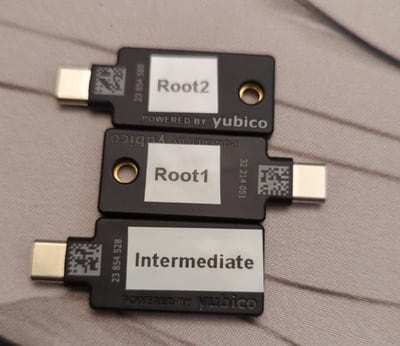
    PKI relying on a set of 3 YubiKeys: 2 for the root CA and 1 for the intermediate CA.
    Offline PKI backed up by 3 YubiKeys
    This post describes an offline PKI system using the following components: It is possible to add more YubiKeys as a backup of the root CA if needed. This is not needed for the intermediate CA as you can generate a new one if the current one gets destroyed.

    The software part offline-pki is a small Python application to manage an offline PKI. It relies on yubikey-manager to manage YubiKeys and cryptography for cryptographic operations not executed on the YubiKeys. The application has some opinionated design choices. Notably, the cryptography is hard-coded to use NIST P-384 elliptic curve. The first step is to reset all your YubiKeys:
    $ offline-pki yubikey reset
    This will reset the connected YubiKey. Are you sure? [y/N]: y
    New PIN code:
    Repeat for confirmation:
    New PUK code:
    Repeat for confirmation:
    New management key ('.' to generate a random one):
    WARNING[pki-yubikey] Using random management key: e8ffdce07a4e3bd5c0d803aa3948a9c36cfb86ed5a2d5cf533e97b088ae9e629
    INFO[pki-yubikey]  0: Yubico YubiKey OTP+FIDO+CCID 00 00
    INFO[pki-yubikey] SN: 23854514
    INFO[yubikit.management] Device config written
    INFO[yubikit.piv] PIV application data reset performed
    INFO[yubikit.piv] Management key set
    INFO[yubikit.piv] New PUK set
    INFO[yubikit.piv] New PIN set
    INFO[pki-yubikey] YubiKey reset successful!
    
    Then, generate the root CA and create as many copies as you want:
    $ offline-pki certificate root --permitted example.com
    Management key for Root X:
    Plug YubiKey "Root X"...
    INFO[pki-yubikey]  0: Yubico YubiKey CCID 00 00
    INFO[pki-yubikey] SN: 23854514
    INFO[yubikit.piv] Data written to object slot 0x5fc10a
    INFO[yubikit.piv] Certificate written to slot 9C (SIGNATURE), compression=True
    INFO[yubikit.piv] Private key imported in slot 9C (SIGNATURE) of type ECCP384
    Copy root certificate to another YubiKey? [y/N]: y
    Plug YubiKey "Root X"...
    INFO[pki-yubikey]  0: Yubico YubiKey CCID 00 00
    INFO[pki-yubikey] SN: 23854514
    INFO[yubikit.piv] Data written to object slot 0x5fc10a
    INFO[yubikit.piv] Certificate written to slot 9C (SIGNATURE), compression=True
    INFO[yubikit.piv] Private key imported in slot 9C (SIGNATURE) of type ECCP384
    Copy root certificate to another YubiKey? [y/N]: n
    
    You can inspect the result:
    $ offline-pki yubikey info
    INFO[pki-yubikey]  0: Yubico YubiKey CCID 00 00
    INFO[pki-yubikey] SN: 23854514
    INFO[pki-yubikey] Slot 9C (SIGNATURE):
    INFO[pki-yubikey]   Private key type: ECCP384
    INFO[pki-yubikey]   Public key:
    INFO[pki-yubikey]     Algorithm:  secp384r1
    INFO[pki-yubikey]     Issuer:     CN=Root CA
    INFO[pki-yubikey]     Subject:    CN=Root CA
    INFO[pki-yubikey]     Serial:     1
    INFO[pki-yubikey]     Not before: 2024-07-05T18:17:19+00:00
    INFO[pki-yubikey]     Not after:  2044-06-30T18:17:19+00:00
    INFO[pki-yubikey]     PEM:
    -----BEGIN CERTIFICATE-----
    MIIBcjCB+aADAgECAgEBMAoGCCqGSM49BAMDMBIxEDAOBgNVBAMMB1Jvb3QgQ0Ew
    HhcNMjQwNzA1MTgxNzE5WhcNNDQwNjMwMTgxNzE5WjASMRAwDgYDVQQDDAdSb290
    IENBMHYwEAYHKoZIzj0CAQYFK4EEACIDYgAERg3Vir6cpEtB8Vgo5cAyBTkku/4w
    kXvhWlYZysz7+YzTcxIInZV6mpw61o8W+XbxZV6H6+3YHsr/IeigkK04/HJPi6+i
    zU5WJHeBJMqjj2No54Nsx6ep4OtNBMa/7T9foyMwITAPBgNVHRMBAf8EBTADAQH/
    MA4GA1UdDwEB/wQEAwIBhjAKBggqhkjOPQQDAwNoADBlAjEAwYKy/L8leJyiZSnn
    xrY8xv8wkB9HL2TEAI6fC7gNc2bsISKFwMkyAwg+mKFKN2w7AjBRCtZKg4DZ2iUo
    6c0BTXC9a3/28V5aydZj6rvx0JqbF/Ln5+RQL6wFMLoPIvCIiCU=
    -----END CERTIFICATE-----
    
    Then, you can create an intermediate certificate with offline-pki yubikey intermediate and use it to sign certificates by providing a CSR to offline-pki certificate sign. Be careful and inspect the CSR before signing it, as only the subject name can be overridden. Check the documentation for more details. Get the available options using the --help flag.

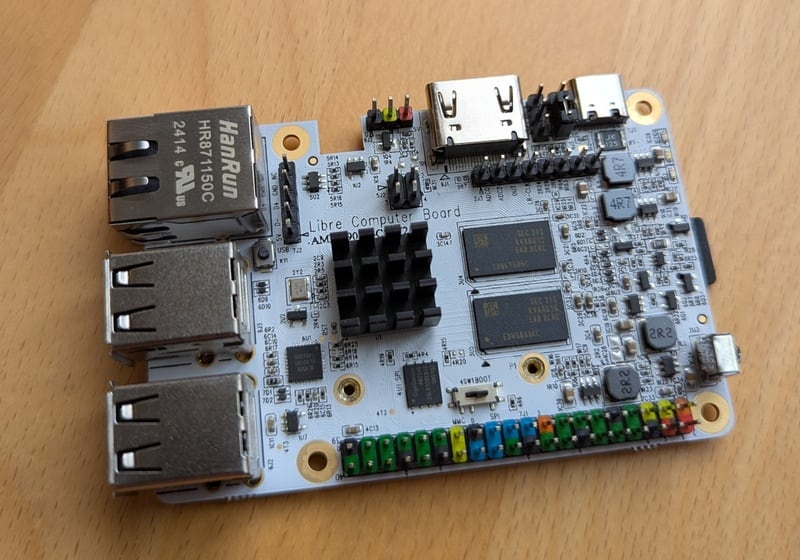
    The hardware part To ensure the operations on the root and intermediate CAs are air-gapped, a cost-efficient solution is to use an ARM64 single board computer. The Libre Computer Sweet Potato SBC is a more open alternative to the well-known Raspberry Pi.1
    Libre Computer Sweet Potato single board computer relying on the Amlogic S905X SOC
    Libre Computer Sweet Potato SBC, powered by the AML-S905X SOC
    I interact with it through an USB to TTL UART converter:
    $ tio /dev/ttyUSB0
    [16:40:44.546] tio v3.7
    [16:40:44.546] Press ctrl-t q to quit
    [16:40:44.555] Connected to /dev/ttyUSB0
    GXL:BL1:9ac50e:bb16dc;FEAT:ADFC318C:0;POC:1;RCY:0;SPI:0;0.0;CHK:0;
    TE: 36574
    BL2 Built : 15:21:18, Aug 28 2019. gxl g1bf2b53 - luan.yuan@droid15-sz
    set vcck to 1120 mv
    set vddee to 1000 mv
    Board ID = 4
    CPU clk: 1200MHz
    [ ]
    

    The Nix glue To bring everything together, I am using Nix with a Flake providing:
    • a package for the offline-pki application, with shell completion,
    • a development shell, including an editable version of the offline-pki application,
    • a NixOS module to setup the offline PKI, resetting the system at each boot,
    • a QEMU image for testing, and
    • an SD card image to be used on the Sweet Potato or another ARM64 SBC.
    # Execute the application locally
    nix run github:vincentbernat/offline-pki -- --help
    # Run the application inside a QEMU VM
    nix run github:vincentbernat/offline-pki\#qemu
    # Build a SD card for the Sweet Potato or for the Raspberry Pi
    nix build --system aarch64-linux github:vincentbernat/offline-pki\#sdcard.potato
    nix build --system aarch64-linux github:vincentbernat/offline-pki\#sdcard.generic
    # Get a development shell with the application
    nix develop github:vincentbernat/offline-pki
    

    1. The key for the root CA is not generated by the YubiKey. Using an air-gapped computer is all the more important. Put it in a safe with the YubiKeys when done!

    16 March 2025

    Russell Coker: Article Recommendations via FOSS

    Google tracking everything we read is bad, particularly since Google abandoned the don t be evil plan and are presumably open to being somewhat evil. The article recommendations on Chrome on Android are useful and I d like to be able to get the same quality of recommendations without Google knowing about everything I read. Ideally without anything other than the device I use knowing what interests me. A ML system to map between sources of news that are of interest should be easy to develop and run on end user devices. The model could be published and when given inputs of articles you like give an output of sites that contain other articles you like. Then an agent on the end user system could spider the sites in question and run a local model to determine which articles to present to the user. Mapping for hate following is possible for such a system (Google doesn t do that), the user could have 2 separate model runs for regular reading and hate-following and determine how much of each content to recommend. It could also give negative weight to entries that match the hate criteria. Some sites with articles (like Medium) give an estimate of reading time. An article recommendation system should have a fixed limit of articles (both in articles and in reading time) to support the I spend half an hour reading during lunch model not doom scrolling. For getting news using only FOSS it seems that the best option at the moment is to use the Lemmy FOSS social network which is like Reddit [1] to recommend articles etc. The Lemoa client for Lemmy uses GTK [2] but it s no longer maintained. The Lemonade client for Lemmy is written in Rust [3]. It would be good if one of those was packaged for Debian, preferably one that s maintained.

    11 March 2025

    Freexian Collaborators: Debian Contributions: Debian.Social administration, DebConf 25 preparations, Fixing Time-based test failure in Python requests package and more! (by Anupa Ann Joseph)

    Debian Contributions: 2025-02 Contributing to Debian is part of Freexian s mission. This article covers the latest achievements of Freexian and their collaborators. All of this is made possible by organizations subscribing to our Long Term Support contracts and consulting services.

    Debian.Social administration, by Stefano Rivera Over the last year, the Debian.social services outgrew the infrastructure that was supporting them. The matrix bridge in particular was hosted on a cloud instance backed by a large expensive storage volume. Debian.CH rented a new large physical server to host all these instances, earlier this year. Stefano set up Incus on the new physical machine and migrated all the old debian.social LXC Containers, libvirt VMs, and cloud instances into Incus-managed LXC containers. Stefano set up Prometheus monitoring and alerts for the new infrastructure and a Grafana dashboard. The current stack of debian.social services seem to comfortably fit on the new machine, with good room to grow.

    DebConf 25, by Santiago Ruano Rinc n and Stefano Rivera DebConf 25 preparations continue. The team is currently finalizing a budget. Stefano helped to review the current budget proposals and suggest approaches for balancing it. Stefano installed a Zammad instance to organize queries from attendees, for the registration and visa teams. Santiago continued discussions with possible caterers so we can have options for the different diet requirements and that could fit into the DebConf budget. Also, in collaboration with Anupa, Santiago pushed the first draft changes to document the venue information in the DebConf 25 website and how to get to Brest.

    Time-based test failure in requests, by Colin Watson Colin fixed a fun bug in the Python requests package. Santiago Vila has been running tests of what happens when Debian packages are built on a system in which time has been artificially set to somewhere around the end of the support period for the next Debian release, in order to make it easier to do things like issuing security updates for the lifetime of that release. In this case, the failure indicated an expired test certificate, and since the repository already helpfully included scripts to regenerate those certificates, it seemed natural to try regenerating them just before running tests. However, this failed for more obscure reasons and Colin spent some time investigating. This turned out to be because the test CA was missing the CA constraint and so recent versions of OpenSSL reject it; Colin sent a pull request to fix this.

    Priority list for outdated packages, by Santiago Ruano Rinc n Santiago started a discussion on debian-devel about packages that have a history of security issues and that are outdated regarding new upstream releases. The goal of the mentioned effort is to have a prioritized list of packages needing some work, from a security point of view. Moreover, the aim of publicly sharing the list of packages with the Debian Developers community is to make it easier to look at the packages maintained by teams, or even other maintainers where help could be welcome. Santiago is planning to take into account the feedback provided in debian-devel and to propose a tooling that could help to regularly bring collective awareness of these packages.

    Miscellaneous contributions
    • Carles worked on English to Catalan po-debconf translations: reviewed translations, created merge requests and followed up with developers for more than 30 packages using po-debconf-manager.
    • Carles helped users, fixed bugs and implemented downloading updated templates on po-debconf-manager.
    • Carles packaged a new upstream version of python-pyaarlo.
    • Carles improved reproducibility of qnetload (now reported as reproducible) and simplemonitor (followed up with upstream and pending update of Debian package).
    • Carles collaborated with debian-history package: fixed FTBFS from master branch, enabled salsa-ci and investigated reproducibility.
    • Emilio improved support for automatically marking CVEs as NOT-FOR-US in the security-tracker, closing #1073012.
    • Emilio updated xorg-server and xwayland in unstable, fixing the last round of security vulnerabilities.
    • Stefano prepared a few PyPy and cPython uploads, and started the python3.13-only transition.
    • Helmut Grohne sent patches for 24 cross build failures.
    • Helmut fixed two problems in the Debian /usr-merge analysis tool. In one instance, it would overmatch Debian bugs to issues and in another it would fail to recognize Pre-Depends as a conflict mechanism.
    • Helmut attempted making rebootstrap work for gcc-15 with limited success as very many packages FTBFS with gcc-15 due to using function declarations without arguments.
    • Helmut provided a change to the security-tracker that would pre-compute /data/json during database updates rather than on demand resulting in a reduced response time.
    • Colin uploaded OpenSSH security updates for testing/unstable, bookworm, bullseye, buster, and stretch.
    • Colin fixed upstream monitoring for 26 Python packages, and upgraded 54 packages (mostly Python-related, but also PuTTY) to new upstream versions.
    • Colin updated python-django in bookworm-backports to 4.2.18 (issuing BSA-121), and added new backports of python-django-dynamic-fixture and python-django-pgtrigger, all of which are dependencies of debusine.
    • Thorsten Alteholz finally managed to upload hplip to fix two release critical and some normal bugs. The next step in March would be to upload the latest version of hplip.
    • Faidon updated crun in unstable & trixie, resolving a long-standing request of enabling criu support and thus enabling podman with checkpoint/restore functionality (With gratitude to Salvatore Bonaccorso and Reinhard Tartler for the cooperation and collaboration).
    • Faidon uploaded a number of packages (librdkafka, libmaxminddb, python-maxminddb, lowdown, tox, tox-uv, pyproject-api, xiccd and gdnsd) bringing them up to date with new upstream releases, resolving various bugs.
    • Lucas Kanashiro uploaded some ruby packages involved in the Rails 7 transition with new upstream releases.
    • Lucas triaged a ruby3.1 bug (#1092595)) and prepared a fix for the next stable release update.
    • Lucas set up the needed wiki pages and updated the Debian Project status in the Outreachy portal, in order to send out a call for projects and mentors for the next round of Outreachy.
    • Anupa joined Santiago to prepare a list of companies to contact via LinkedIn for DebConf 25 sponsorship.
    • Anupa printed Debian stickers and sponsorship brochures, flyers for DebConf 25 to be distributed at FOSS ASIA summit 2025.
    • Anupa participated in the Debian publicity team meeting and discussed the upcoming events and tasks.
    • Rapha l packaged zim 0.76.1 and integrated an upstream patch for another regression that he reported.
    • Rapha l worked with the Debian System Administrators for tracker.debian.org to better cope with gmail s requirement for mails to be authenticated.

    9 March 2025

    Lisandro Dami n Nicanor P rez Meyer: Bah a Blanca floods - Mother nature says: no Nuremberg for you today

    Update 20250309 13:20-03:00 - How to help A friend of mine living in the USA sent me this link to help the flood victims: Support Bah a Blanca (Argentina) Flood Victims Original blog post These are not good news. In fact, much the contrary. Compared to the real issue, the fact that I'm not able to attend Embedded World at Nuremberg is, well, a detail. Or at least that's what I'm forcing myself to believe, as I REALLY wanted to be there. But mother nature said otherwise. Plaza Dr. Alberto Martinelli - Barrio Parque Las Ca itas Park "D. Alberto Martinelli", Las Ca itas, Bah a Blanca (Google Maps) Bah a Blanca , the city I live, has received a lot on rainfall. Really, a lot. Let me introduce the number like this: the previous highest recorded measurement was 170mm (6.69 inch)... in a month. Yesterday Friday 07 we had more than 400mm (15.75 inch) in 9 hours. But those are just numbers. Some things are better seen in images. I'll start with some soft ones. Streetk sink 1 Streetk sink 2 Sink in Fournier street near Cambaceres (Google Maps) I also happen to do figure skating in the same school of the 4 times world champions (where "world" means the whole world) Roller Dreams precision skating team - Instagram, from Club El Nacional. Our skating rink got severely damaged with the hail we had like 3 weeks ago (yes, we had hail too!!!). Now it's just impossible: Roller Dreams CEN skating rink The "real" thing Let's get to the heavy, heartbreaker part. I did go to downtown Bah a Blanca, but during night, so let me share some links, most of them in Spanish, but images are images: My alma matter, Universidad Nacional del Sur, lost its main library, great part of the Physics department and a lot of labs :-( A nearby town, General Cerri, had even worst luck. In Bah a Blanca, a city of 300k+ people, has around 400 evacuated people. General Cerri, a town of 3000? people, had at least 800. Bah a Blanca, devil's land Every place has its legends. We do too. This land was called "Huecuv Map ", something like "Devil's land" by the original inhabitants of the zone, due to its harsh climate: string winters and hot summers, couple with fierce wind. But back in 1855 the Cacique (chief) Jos Mar a Bulnes Yanquetruz had a peace agreement with commander Nicanor Otamendi. But a battle ensued, which Yanquetruz won. At this point history defers depending upon who tells it. Some say Yanquetruz was assigned a military grade as Captain of the indigenous auxiliary forces and provided a military suit, some say he stole it, some say this was a setup of another chief wanting to disrupt peace. But what is known is that Yanquetruz was killed, and his wife, the "machi" (sorceress), issued a curse over the land that would last 1000 years, and the curse was on the climate. Aftermath No, we are not there yet. This has just happened. The third violent climate occurrence in 15 months. The city needs to mourn and start healing itself. Time will say.

    6 March 2025

    Russell Coker: 8k Video Cards

    I previously blogged about getting an 8K TV [1]. Now I m working on getting 8K video out for a computer that talks to it. I borrowed an NVidia RTX A2000 card which according to it s specs can do 8K [2] with a mini-DisplayPort to HDMI cable rated at 8K but on both Windows and Linux the two highest resolutions on offer are 3840*2160 (regular 4K) and 4096*2160 which is strange and not useful. The various documents on the A2000 differ on whether it has DisplayPort version 1.4 or 1.4a. According to the DisplayPort Wikipedia page [3] both versions 1.4 and 1.4a have a maximum of HBR3 speed and the difference is what version of DSC (Display Stream Compression [4]) is in use. DSC apparently causes no noticeable loss of quality for movies or games but apparently can be bad for text. According to the DisplayPort Wikipedia page version 1.4 can do 8K uncompressed at 30Hz or 24Hz with high dynamic range. So this should be able to work. My theories as to why it doesn t work are: To get some more input on this issue I posted on Lemmy, here is the Lemmy post [5]. I signed up to lemmy.ml because it was the first one I found that seemed reasonable and was giving away free accounts, I haven t tried any others and can t review it but it seems to work well enough and it s free. It s described as A community of privacy and FOSS enthusiasts, run by Lemmy s developers which is positive, I recommend that everyone who s into FOSS create an account there or some other Lemmy server. My Lemmy post was about what video cards to buy. I was looking at the Gigabyte RX 6400 Eagle 4G as a cheap card from a local store that does 8K, it also does DisplayPort 1.4 so might have the same issues, also apparently FOSS drivers don t support 8K on HDMI because the people who manage HDMI specs are jerks. It s a $200 card at MSY and a bit less on ebay so it s an amount I can afford to risk on a product that might not do what I want, but it seems to have a high probability of getting the same result. The NVidia cards have the option of proprietary drivers which allow using HDMI and there are cards with DisplayPort 1.4 (which can do 8K@30Hz) and HDMI 2.1 (which can do 8K@50Hz). So HDMI is a better option for some cards just based on card output and has the additional benefit of not needing DisplayPort to HDMI conversion. The best option apparently is the Intel cards which do DisplayPort internally and convert to HDMI in hardware which avoids the issue of FOSS drivers for HDMI at 8K. The Intel Arc B580 has nice specs [6], HDMI 2.1a and DisplayPort 2.1 output, 12G of RAM, and being faster than the low end cards like the RX 6400. But the local computer store price is $470 and the ebay price is a bit over $400. If it turns out to not do what I need it still will be a long way from the worst way I ve wasted money on computer gear. But I m still hesitating about this. Any suggestions?

    5 March 2025

    Otto Kek l inen: Will decentralized social media soon go mainstream?

    Featured image of post Will decentralized social media soon go mainstream?In today s digital landscape, social media is more than just a communication tool it is the primary medium for global discourse. Heads of state, corporate leaders and cultural influencers now broadcast their statements directly to the world, shaping public opinion in real time. However, the dominance of a few centralized platforms X/Twitter, Facebook and YouTube raises critical concerns about control, censorship and the monopolization of information. Those who control these networks effectively wield significant power over public discourse. In response, a new wave of distributed social media platforms has emerged, each built on different decentralized protocols designed to provide greater autonomy, censorship resistance and user control. While Wikipedia maintains a comprehensive list of distributed social networking software and protocols, it does not cover recent blockchain-based systems, nor does it highlight which have the most potential for mainstream adoption. This post explores the leading decentralized social media platforms and the protocols they are based on: Mastodon (ActivityPub), Bluesky (AT Protocol), Warpcast (Farcaster), Hey (Lens) and Primal (Nostr).

    Comparison of architecture and mainstream adoption potential
    Protocol Identity System Example Storage model Cost for end users Potential
    Mastodon Tied to server domain @ottok@mastodon.social Federated instances Free (some instances charge) High
    Bluesky Portable (DID) ottoke.bsky.social Federated instances Free Moderate
    Farcaster ENS (Ethereum) @ottok Blockchain + off-chain Small gas fees Moderate
    Lens NFT-based (Polygon) @ottok Blockchain + off-chain Small gas fees Niche
    Nostr Cryptographic Keys npub16lc6uhqpg6dnqajylkhwuh3j7ynhcnje508tt4v6703w9kjlv9vqzz4z7f Federated instances Free (some instances charge) Niche

    1. Mastodon (ActivityPub) Screenshot of Mastodon Mastodon was created in 2016 by Eugen Rochko, a German software developer who sought to provide a decentralized and user-controlled alternative to Twitter. It was built on the ActivityPub protocol, now standardized by W3C Social Web Working Group, to allow users to join independent servers while still communicating across the broader Mastodon network. Mastodon operates on a federated model, where multiple independently run servers communicate via ActivityPub. Each server sets its own moderation policies, leading to a decentralized but fragmented experience. The servers can alternatively be called instances, relays or nodes, depending on what vocabulary a protocol has standardized on.
    • Identity: User identity is tied to the instance where they registered, represented as @username@instance.tld.
    • Storage: Data is stored on individual instances, which federate messages to other instances based on their configurations.
    • Cost: Free to use, but relies on instance operators willing to run the servers.
    The protocol defines multiple activities such as:
    • Creating a post
    • Liking
    • Sharing
    • Following
    • Commenting

    Example Message in ActivityPub (JSON-LD Format)
    json
     
     "@context": "https://www.w3.org/ns/activitystreams",
     "type": "Create",
     "actor": "https://mastodon.social/users/ottok",
     "object":  
     "type": "Note",
     "content": "Hello from #Mastodon!",
     "published": "2025-03-03T12:00:00Z",
     "to": ["https://www.w3.org/ns/activitystreams#Public"]
      
     
    Servers communicate across different platforms by publishing activities to their followers or forwarding activities between servers. Standard HTTPS is used between servers for communication, and the messages use JSON-LD for data representation. The WebFinger protocol is used for user discovery. There is however no neat way for home server discovery yet. This means that if you are browsing e.g. Fosstodon and want to follow a user and press Follow, a dialog will pop up asking you to enter your own home server (e.g. mastodon.social) to redirect you there for actually executing the Follow action on with your account. Mastodon is open source under the AGPL at github.com/mastodon/mastodon. Anyone can operate their own instance. It just requires to run your own server and some skills to maintain a Ruby on Rails app with a PostgreSQL database backend, and basic understanding of the protocol to configure federation with other ActivityPub instances.

    Popularity: Already established, but will it grow more? Mastodon has seen steady growth, especially after Twitter s acquisition in 2022, with some estimates stating it peaked at 10 million users across thousands of instances. However, its fragmented user experience and the complexity of choosing instances have hindered mainstream adoption. Still, it remains the most established decentralized alternative to Twitter. Note that Donald Trump s Truth Social is based on the Mastodon software but does not federate with the ActivityPub network. The ActivityPub protocol is the most widely used of its kind. One of the other most popular services is the Lemmy link sharing service, similar to Reddit. The larger ecosystem of ActivityPub is called Fediverse, and estimates put the total active user count around 6 million.

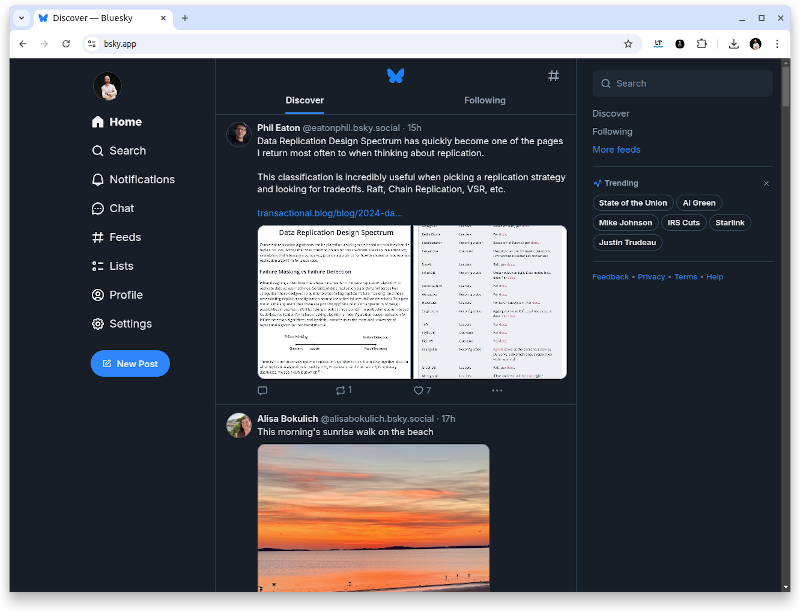
    2. Bluesky (AT Protocol) Screenshot of Bluesky Interestingly, Bluesky was conceived within Twitter in 2019 by Twitter founder Jack Dorsey. After being incubated as a Twitter-funded project, it spun off as an independent Public Benefit LLC in February 2022 and launched its public beta in February 2023. Bluesky runs on top of the Authenticated Transfer (AT) Protocol published at https://github.com/bluesky-social/atproto. The protocol enables portable identities and data ownership, meaning users can migrate between platforms while keeping their identity and content intact. In practice, however, there is only one popular server at the moment, which is Bluesky itself.
    • Identity: Usernames are domain-based (e.g., @user.bsky.social).
    • Storage: Content is theoretically federated among various servers.
    • Cost: Free to use, but relies on instance operators willing to run the servers.

    Example Message in AT Protocol (JSON Format)
    json
     
     "repo": "did:plc:ottoke.bsky.social",
     "collection": "app.bsky.feed.post",
     "record":  
     "$type": "app.bsky.feed.post",
     "text": "Hello from Bluesky!",
     "createdAt": "2025-03-03T12:00:00Z",
     "langs": ["en"]


    Popularity: Hybrid approach may have business benefits? Bluesky reported over 3 million users by 2024, probably getting traction due to its Twitter-like interface and Jack Dorsey s involvement. Its hybrid approach decentralized identity with centralized components could make it a strong candidate for mainstream adoption, assuming it can scale effectively.

    3. Warpcast (Farcaster Network) Farcaster was launched in 2021 by Dan Romero and Varun Srinivasan, both former crypto exchange Coinbase executives, to create a decentralized but user-friendly social network. Built on the Ethereum blockchain, it could potentially offer a very attack-resistant communication medium. However, in my own testing, Farcaster does not seem to fully leverage what Ethereum could offer. First of all, there is no diversity in programs implementing the protocol as at the moment there is only Warpcast. In Warpcast the signup requires an initial 5 USD fee that is not payable in ETH, and users need to create a new wallet address on the Ethereum layer 2 network Base instead of simply reusing their existing Ethereum wallet address or ENS name. Despite this, I can understand why Farcaster may have decided to start out like this. Having a single client program may be the best strategy initially. One of the decentralized chat protocol Matrix founders, Matthew Hodgson, shared in his FOSDEM 2025 talk that he slightly regrets focusing too much on developing the protocol instead of making sure the app to use it is attractive to end users. So it may be sensible to ensure Warpcast gets popular first, before attempting to make the Farcaster protocol widely used. As a protocol Farcaster s hybrid approach makes it more scalable than fully on-chain networks, giving it a higher chance of mainstream adoption if it integrates seamlessly with broader Web3 ecosystems.
    • Identity: ENS (Ethereum Name Service) domains are used as usernames.
    • Storage: Messages are stored in off-chain hubs, while identity is on-chain.
    • Cost: Users must pay gas fees for some operations but reading and posting messages is mostly free.

    Example Message in Farcaster (JSON Format)
    json
     
     "fid": 766579,
     "username": "ottok",
     "custodyAddress": "0x127853e48be3870172baa4215d63b6d815d18f21",
     "connectedWallet": "0x3ebe43aa3ae5b891ca1577d9c49563c0cee8da88",
     "text": "Hello from Farcaster!",
     "publishedAt": 1709424000,
     "replyTo": null,
     "embeds": []
     

    Popularity: Decentralized social media + decentralized payments a winning combo? Ethereum founder Vitalik Buterin (warpcast.com/vbuterin) and many core developers are active on the platform. Warpcast, the main client for Farcaster, has seen increasing adoption, especially among Ethereum developers and Web3 enthusiasts. I too have an profile at warpcast.com/ottok. However, the numbers are still very low and far from reaching network effects to really take off. Blockchain-based social media networks, particularly those built on Ethereum, are compelling because they leverage existing user wallets and persistent identities while enabling native payment functionality. When combined with decentralized content funding through micropayments, these blockchain-backed social networks could offer unique advantages that centralized platforms may find difficult to replicate, being decentralized both as a technical network and in a funding mechanism.

    4. Hey.xyz (Lens Network) The Lens Protocol was developed by decentralized finance (DeFi) team Aave and launched in May 2022 to provide a user-owned social media network. While initially built on Polygon, it has since launched its own Layer 2 network called the Lens Network in February 2024. Lens is currently the main competitor to Farcaster. Lens stores profile ownership and references on-chain, while content is stored on IPFS/Arweave, enabling composability with DeFi and NFTs.
    • Identity: Profile ownership is tied to NFTs on the Polygon blockchain.
    • Storage: Content is on-chain and integrates with IPFS/Arweave (like NFTs).
    • Cost: Users must pay gas fees for some operations but reading and posting messages is mostly free.

    Example Message in Lens (JSON Format)
    json
     
     "profileId": "@ottok",
     "contentURI": "ar://QmExampleHash",
     "collectModule": "0x23b9467334bEb345aAa6fd1545538F3d54436e96",
     "referenceModule": "0x0000000000000000000000000000000000000000",
     "timestamp": 1709558400
     

    Popularity: Probably not as social media site, but maybe as protocol? The social media side of Lens is mainly the Hey.xyz website, which seems to have fewer users than Warpcast, and is even further away from reaching critical mass for network effects. The Lens protocol however has a lot of advanced features and it may gain adoption as the building block for many Web3 apps.

    5. Primal.net (Nostr Network) Nostr (Notes and Other Stuff Transmitted by Relays) was conceptualized in 2020 by an anonymous developer known as fiatjaf. One of the primary design tenets was to be a censorship-resistant protocol and it is popular among Bitcoin enthusiasts, with Jack Dorsey being one of the public supporters. Unlike the Farcaster and Lens protocols, Nostr is not blockchain-based but just a network of relay servers for message distribution. If does however use public key cryptography for identities, similar to how wallets work in crypto.
    • Identity: Public-private key pairs define identity (with prefix npub...).
    • Storage: Content is federated among multiple servers, which in Nostr vocabulary are called relays.
    • Cost: No gas fees, but relies on relay operators willing to run the servers.

    Example Message in Nostr (JSON Format)
    json
     
     "id": "note1xyz...",
     "pubkey": "npub1...",
     "kind": 1,
     "content": "Hello from Nostr!",
     "created_at": 1709558400,
     "tags": [],
     "sig": "sig1..."
     

    Popularity: If Jack Dorsey and Bitcoiners promote it enough? Primal.net as a web app is pretty solid, but it does not stand out much. While Jack Dorsey has shown support by donating $1.5 million to the protocol development in December 2021, its success likely depends on broader adoption by the Bitcoin community.

    Will any of these replace X/Twitter? As usage patterns vary, the statistics are not fully comparable, but this overview of the situation in March 2025 gives a decent overview.
    Platform Total Accounts Active Users Growth Trend
    Mastodon ~10 million ~1 million Steady
    Bluesky ~33 million ~1 million Steady
    Nostr ~41 million ~20 thousand Steady
    Farcaster ~850 thousand ~50 thousand Flat
    Lens ~140 thousand ~20 thousand Flat
    Mastodon and Bluesky have already reached millions of users, while Lens and Farcaster are growing within crypto communities. It is however clear that none of these are anywhere close to how popular X/Twitter is. In particular, Mastodon had a huge influx of users in the fall of 2022 when Twitter was acquired, but to challenge the incumbents the growth would need to significantly accelerate. We can all accelerate this development by embracing decentralized social media now alongside existing dominant platforms. Who knows, given the right circumstances maybe X.com leadership decides to change the operating model and start federating contents to break out from a walled garden model. The likelyhood of such development would increase if decentralized networks get popular, and the encumbents feel they need to participate to not lose out.

    Past and future The idea of decentralized social media is not new. One early pioneer identi.ca launched in 2008, only two years after Twitter, using the OStatus protocol to promote decentralization. A few years later it evolved into pump.io with the ActivityPump protocol, and also forked into GNU Social that continued with OStatus. I remember when these happened, and that in 2010 also Diaspora launched with fairly large publicity. Surprisingly both of these still operate (I can still post both on identi.ca and diasp.org), but the activity fizzled out years ago. The protocol however survived partially and evolved into ActivityPub, which is now the backbone of the Fediverse. The evolution of decentralized social media over the next decade will likely parallel developments in democracy, freedom of speech and public discourse. While the early 2010s emphasized maximum independence and freedom, the late 2010s saw growing support for content moderation to combat misinformation. The AI era introduces new challenges, potentially requiring proof-of-humanity verification for content authenticity. Key factors that will determine success:
    • User experience and ease of onboarding
    • Network effects and critical mass of users
    • Integration with existing web3 infrastructure
    • Balance between decentralization and usability
    • Sustainable economic models for infrastructure
    This is clearly an area of development worth monitoring closely, as the next few years may determine which protocol becomes the de facto standard for decentralized social communication.

    4 March 2025

    Paul Tagliamonte: Reverse Engineering (another) Restaurant Pager system

    Some of you may remember that I recently felt a bit underwhelmed by the last pager I reverse engineered the Retekess TD-158, mostly due to how intuitive their design decions were. It was pretty easy to jump to conclusions because they had made some pretty good decisions on how to do things. I figured I d spin the wheel again and try a new pager system this time I went for a SU-68G-10 pager, since I recognized the form factor as another fairly common unit I ve seen around town. Off to Amazon I went, bought a set, and got to work trying to track down the FCC filings on this model. I eventually found what seemed to be the right make/model, and it, once again, indicated that this system should be operating in the 433 MHz ISM band likely using OOK modulation. So, figured I d start with the center of the band (again) at 433.92 MHz, take a capture, test my luck, and was greeted with a now very familiar sight. Same as the last goarounds, except the premable here is a 0 symbol followed by 6-ish symbol durations of no data, followed by 25 bits of a packet. Careful readers will observe 26 symbols above after the preamble I did too! The last 0 in the screenshot above is not actually a part of the packet rather, it s part of the next packet s preamble. Each packet is packed in pretty tight.

    By Hand Demodulation Going off the same premise as last time, I figured i d give it a manual demod and see what shakes out (again). This is now the third time i ve run this play, so check out either of my prior two posts for a better written description of what s going on here I ll skip all the details since i d just be copy-pasting from those posts into here. Long story short, I demodulated a call for pager 1, call for pager 10, and a power off command.
    What Bits
    Call 1 1101111111100100100000000
    Call 101101111111100100010100000
    Off 1101111111100111101101110
    A few things jump out at me here the first 14 bits are fixed (in my case, 11011111111001), which means some mix of preamble, system id, or other system-wide constant. Additionally, The last 9 bits also look like they are our pager the 1 and 10 pager numbers (LSB bit order) jump right out (100000000 and 010100000, respectively). That just leaves the two remaining bits which look to be the action 00 for a Call , and 11 for a Power off . I don t super love this since command has two bits rather than one, the base station ID seems really long, and a 9-bit Pager ID is just weird. Also, what is up with that power-off pager id? Weird. So, let s go and see what we can do to narrow down and confirm things by hand.

    Testing bit flips Rather than call it a day at that, I figure it s worth a bit of diligence to make sure it s all correct so I figured we should try sending packets to my pagers and see how they react to different messages after flipping bits in parts of the packet. I implemented a simple base station for the pagers using my Ettus B210mini, and threw together a simple OOK modulator and transmitter program which allows me to send specifically crafted test packets on frequency. Implementing the base station is pretty straightforward, because of the modulation of the signal (OOK), it s mostly a matter of setting a buffer to 1 and 0 for where the carrier signal is on or off timed to the sample rate, and sending that off to the radio. If you re interested in a more detailed writeup on the steps involved, there s a bit more in my christmas tree post. First off, I d like to check the base id. I want to know if all the bits in what I m calling the base id are truly part of the base station ID, or perhaps they have some other purpose (version, preamble?). I wound up following a three-step process for every base station id:
    • Starting with an unmodified call packet for the pager under test:
      • Flip the Nth bit, and transmit the call. See if the pager reacts.
      • Hold SET , and pair the pager with the new packet.
      • Transmit the call. See if the pager reacts.
      • After re-setting the ID, transmit the call with the physical base station, see if the pager reacts.
    • Starting with an unmodified off packet for the pager system
    • Flip the Nth bit, transmit the off, see if the pager reacts.
    What wound up happening is that changing any bit in the first 14 bits meant that the packet no longer worked with any pager until it was re-paired, at which point it begun to work again. This likely means the first 14 bits are part of the base station ID and not static between base stations, or some constant like a version or something. All bits appear to be used. I repeated the same process with the command bits, and found that only 11 and 00 caused the pagers to react for the pager ids i ve tried. I repeated this process one last time with the pager id bits this time, and found the last bit in the packet isn t part of the pager ID, and can be either a 1 or a 0 and still cause the pager to react as if it were a 0. This means that the last bit is unknown but it has no impact on either a power off or call, and all messages sent by my base station always have a 0 set. It s not clear if this is used by anything likely not since setting a bit there doesn t result in any change of behavior I can see yet.

    Final Packet Structure After playing around with flipping bits and testing, the final structure I was able to come up with based on behavior I was able to observe from transmitting hand-crafted packets and watching pagers buzz:
    base id
    command
    pager id
    ???

    Commands The command section bit comes in two flavors either a call or an off command.
    Type Id (2 bits) Description
    Call00Call the pager identified by the id in pager id
    Off11Request pagers power off, pager id is always 10110111
    As for the actual RF PHY characteristics, here s my best guesses at what s going on with them:
    What Description
    Center Frequency 433.92 MHz
    Modulation OOK
    Symbol Duration 1300us
    Bits 25
    Preamble 325us of carrier, followed by 8800us of no carrier
    I m not 100% on the timings, but they appear to be close enough to work reliabily. Same with the center frequency, it s roughly right but there may be a slight difference i m missing.

    Lingering Questions This was all generally pretty understandable another system that had some good decisions, and wasn t too bad to reverse engineer. This was a bit more fun to do, since there was a bit more ambiguity here, but still not crazy. At least this one was a bit more ambiguous that needed a bit of followup to confirm things, which made it a bit more fun. I am left with a few questions, though which I m kinda interested in understanding, but I ll likely need a lot more data and/or original source: Why is the command two bits here? This was a bit tough to understand because of the number of bits they have at their disposal given the one last bit at the end of the packet that doesn t seem to do anything, there s no reason this couldn t have been a 16 bit base station id, and an 8 bit pager id along with a single bit command (call or off). When sending an off why is power off that bit pattern? Other pager IDs don t seem to work with off , so it has some meaning, but I m not sure what that is. You press and hold 9 on the physical base station, but the code winds up coming out to 0xED, 237 or maybe -19 if it s signed. I can t quite figure out why it s this value. Are there other codes? Finally what s up with the last bit? Why is it 25 bits and not 24? It must take more work to process something that isn t 8 bit aligned and all for something that s not being used!

    2 March 2025

    Colin Watson: Free software activity in February 2025

    Most of my Debian contributions this month were sponsored by Freexian. You can also support my work directly via Liberapay. OpenSSH OpenSSH upstream released 9.9p2 with fixes for CVE-2025-26465 and CVE-2025-26466. I got a heads-up on this in advance from the Debian security team, and prepared updates for all of testing/unstable, bookworm (Debian 12), bullseye (Debian 11), buster (Debian 10, LTS), and stretch (Debian 9, ELTS). jessie (Debian 8) is also still in ELTS for a few more months, but wasn t affected by either vulnerability. Although I m not particularly active in the Perl team, I fixed a libnet-ssleay-perl build failure because it was blocking openssl from migrating to testing, which in turn was blocking the above openssh fixes. I also sent a minor sshd -T fix upstream, simplified a number of autopkgtests using the newish Restrictions: needs-sudo facility, and prepared for removing the obsolete slogin symlink. PuTTY I upgraded to the new upstream version 0.83. GCC 15 build failures I fixed build failures with GCC 15 in a few packages: Python team A lot of my Python team work is driven by its maintainer dashboard. Now that we ve finished the transition to Python 3.13 as the default version, and inspired by a recent debian-devel thread started by Santiago, I thought it might be worth spending a bit of time on the uscan error section. uscan is typically scraping upstream web sites to figure out whether new versions are available, and so it s easy for its configuration to become outdated or broken. Most of this work is pretty boring, but it can often reveal situations where we didn t even realize that a Debian package was out of date. I fixed these packages: I upgraded these packages to new upstream versions: In bookworm-backports, I updated python-django to 3:4.2.18-1 (issuing BSA-121) and added new backports of python-django-dynamic-fixture and python-django-pgtrigger, all of which are dependencies of debusine. I went through all the build failures related to python-click 8.2.0 (which was confusingly tagged but not fully released upstream and posted an analysis. I fixed or helped to fix various other build/test failures: I dropped support for the old setup.py ftest command from zope.testrunner upstream. I fixed various odds and ends of bugs: Installer team Following up on last month, I merged and uploaded Helmut s /usr-move fix.

    Next.

    Previous.