Search Results: "stone"

7 August 2014

Dirk Eddelbuettel: Rcpp now used by 250 CRAN packages

Rcpp growth
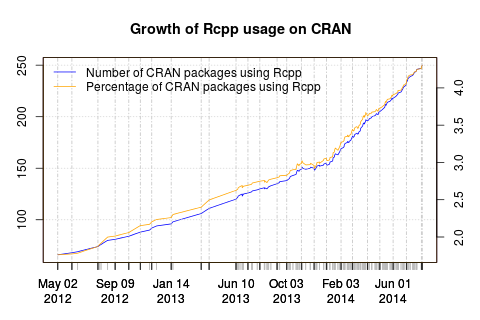
Rcpp reached a nice round milestone yesterday: 250 packages on CRAN now depend on it (as measured by Depends, Imports and LinkingTo declarations). The graph is on the left depicts the growth of Rcpp over time. Or at least since I started to write down some usage numbers: first informally, then via a script. Also displayed is the relative proportion of CRAN packages using it. Rcpp cleared the four per-cent hurdle just before useR! 2014 where I showed a similar graph (as two distinct graphs) in my invited talk. 250 is a pretty impressive, and rather humbling, number. From everybody behind Rcpp, I would like to say a heartfelt Thank You! to all the users and of course contributors.

This post by Dirk Eddelbuettel originated on his Thinking inside the box blog. Please report excessive re-aggregation in third-party for-profit settings.

4 August 2014

Russ Allbery: Review: Parasite

Review: Parasite, by Mira Grant
Series: Parasitology #1
Publisher: Orbit
Copyright: October 2013
ISBN: 0-316-21893-6
Format: Kindle
Pages: 504
It's 2027, and a company named Symbogen has revolutionized medicine and health. They manufacture a genetically-engineered parasite based on a tapeworm that can stabilize and protect the health of just about anyone. It can synthesize medication, fix chronic medical problems, and be adapted to different conditions. (Yes, I know biological systems don't work this way. That's not going to be the only suspension of disbelief problem.) This has made Symbogen one of the most powerful corporations in the country, aided by the skill at marketing and self-promotion shown by one of the founders. Sal, the protagonist of the novel, is one of Symbogen's most famous success stories. Sally was the victim of a horrible car crash that put her into an apparently irreversible coma. But as her family was debating whether to turn off life support, she woke up. She had no memory of her previous life at all, and had to relearn fine motor control, reading, and many other skills. She was essentially a new person. But she was alive; her symbiont had saved her. When the story proper starts, Sal is still a ward of her parents. She has generally adult skills despite still struggling with reading, but she still has occasional attacks and is under intensive monitoring by Symbogen. That means periodic mandatory appointments with Symbogen, which she hates, but she's otherwise started building a life for herself: a job in an animal shelter, an interest in exotic predatory plants, and, most notably, a boyfriend. There are things about her life she doesn't like, and she wants to be free of Symbogen, but she doesn't have a bad life. But then a mysterious illness begins sweeping through the population, causing people to go blank, apparently lose their minds, and then start attacking those near them. Some of you have doubtless already figured out the key plot revelation. It's not hard; even if you didn't from the summary, you will probably figure it out shortly into the book. And therein lies a large problem with this novel: it's hopelessly predictable. Creepy evil corporation that supposedly has your best interests at heart, check. Plucky mad scientist opposition who understands exactly what's going on, check. Well-meaning but heavy-handed government agents who try to get involved but mostly make everything worse, check. (Although it's unusual to have those agents as part of the protagonist's family, and I thought that added some additional depth.) Mostly clueless protagonist sucked into the plot and becoming critical to its resolution, check. Very few readers are going to be surprised by this story. This is not, by itself, a fatal flaw. Predictable story structures can carry satisfying variations, or introduce the reader to enjoyable characters. And I think Grant manages both here. Seanan McGuire, both as herself and under her Mira Grant pseudonym, tends to write damaged and struggling characters. Both her Newsflesh and October Daye series feature protagonists that have been hurt badly, but are coping and muddling through in their own ways. In Parasite, I think she takes a more daring and intriguing approach: a protagonist that other people in the story perceive as damaged and struggling, but who actually isn't. Sal is not a badly injured Sally, and she's quite a bit healthier than those around her think she is. Her thought processes don't work quite the same as those around her, but that's not because she's hurt. That's because she's a different person. This makes Parasite partly a novel about identity, about Sal claiming ownership of her own life. Grant drags this out longer than I wish she had, but I liked the idea. In Sal, she strikes a good balance between gratitude and genuine affection for her family and the need to become her own person unconstrained by other people's expectations. As with the Newsflesh series, Grant uses quotes and excerpts from interviews to fill in the world background: a few at the start of each chapter, and more around each part boundary. I like this technique, and Grant uses it well. By the end of the book, the Rolling Stone interview with the head of Symbogen has added a lot of insight into how Symbogen manages its public relations. Grant also throws in a few of her trademark dangerously off-beat characters: hyper-competent, wise-cracking, but eerily skewed. I loved those in Blackout and I loved Tansy and Dr. Cale here. (Adam was much less successful.) A whole book from Tansy's perspective wouldn't work, since she needs Sal as a straight woman, but I thought she stole every scene she was in. However, I agree wholeheartedly with Tansy on another point: Sal is remarkably, irritatingly dim about what is apparently intended to be the critical revelation of the book. I won't state it outright; given its significant presence in the final scene, apparently it is intended to be a spoiler. But I figured it out about 50 pages into the book. Grant telegraphs this revelation heavily, and Tansy considers it painfully obvious (with quite a bit of justification). But Sal doesn't figure it out for the entire book, ignores all the signs, and is apparently willfully blind. In a book written from the first-person perspective by an otherwise-reliable narrator, this is highly annoying. It significantly undermined my enjoyment of the book. I spent much of the novel ahead of the narrator in my understanding of the plot and waiting, in vain, for her to get on with it already. That unfortunately makes Parasite a mixed bag. I really liked many of the characters, and I think Grant did some interesting things with family dynamics and with claiming one's own identity. But this is undermined by a very predictable plot, the protagonist deciding to be dumber than a sack of hammers about a critical plot point, and some rather dubious world logic. (For example, why is Sal terrified of bad driving? It makes sense as a post-traumatic stress reaction... except it's a critical point to her characterization that she never went through that stress.) Sometimes I wanted to like this book and sometimes I wanted to shake it, and sometimes I felt both reactions at the same time. I like Grant's writing and characterization well enough that I will probably read the sequel, but this is more like the later books in the Newsflesh series than it is like the spectacular Feed. Worth reading, at least for me, but it could have been better. Rating: 7 out of 10

7 July 2014

Jan Wagner: Monitoring Plugins release ahead

It seems to be a great time for monitoring solutions. Some of you may have noticed that Icinga has released it's first stable version of the completely redeveloped Icinga 2. After several changes in the recent past, where the Team maintaining the Plugins used for several Monitoring solutions was busy moving everything to new infrastructure, they are now back on track. The recent development milestone is reached and a call for testing was also sent out. In the meanwhile I prepared the packaging for this bigger move. The packages are now moved to the source package monitoring-plugins, the whole packaging changes can be observed in the changelog. With this new release we have also some NEWS, which might be useful to check. Same counts for upstream NEWS. You can give the packages a go and grab them from my 'unstable' and 'wheezy-backports' repositories at http://ftp.cyconet.org/debian/. Right after the stable release, the packages will be uploaded into debian unstable, but might get delayed by the NEW queue due the new package names.

1 July 2014

Martin Pitt: deb, click, schroot, LXC, QEMU, phone, cloud: One autopkgtest to Rule Them All!

We currently use completely different methods and tools of building test beds and running tests for Debian vs. Click packages, for normal uploads vs. CI airline landings vs. upstream project merge proposal testing, and keep lots of knowledge about Click package test metadata external and not easily accessible/discoverable. Today I released autopkgtest 3.0 (and 3.0.1 with a few minor updates) which is a major milestone in unifying how we run package tests both locally and in production CI. The goals of this are: So, let s dive into the new features! New runner: adt-virt-ssh We want to run tests on real hardware such as a laptop of a particular brand with a particular graphics card, or an Ubuntu phone. We also want to restructure our current CI machinery to run tests on a real OpenStack cloud and gradually get rid of our hand-maintained QA lab with its test machines. While these use cases seem rather different, they both have in common that there is an already existing machine which is pretty much only accessible with ssh. Once you have an ssh connection, they look pretty much the same, you just need different initial setup (like fiddling with adb, calling nova boot, etc.) to prepare them. So the new adt-virt-ssh runner factorizes all the common bits such as communicating with adt-run, auto-detecting sudo availability, doing SSH connection sharing etc., and delegates the target specific bits to a setup script . E. g. we could specify --setup-script ssh-setup-nova or --setup-script ssh-setup-adb which would then get called with open at the appropriate time by adt-run; it calls the nova commands to create a VM, or run a few adb commands to install/start ssh and install the public key. Then autopkgtest does its thing, and eventually calls the script with cleanup again. The actual protocol is a bit more involved (see manpage), but that s the general idea. autopkgtest now ships readymade scripts for these two use cases. So you could e. g. run the libpng tests in a temporary cloud VM:
# if you don't have one, create it with "nova keypair-create"
$ nova keypair-list
[...]
  pitti   9f:31:cf:78:50:4f:42:04:7a:87:d7:2a:75:5e:46:56  
# find a suitable image
$ nova image-list 
[...]
  ca2e362c-62c9-4c0d-82a6-5d6a37fcb251   Ubuntu Server 14.04 LTS (amd64 20140607.1) - Partner Image                           ACTIVE    
$ nova flavor-list 
[...]
  100   standard.xsmall    1024        10     10                 1       1.0           N/A        
# now run the tests: please be patient, this takes a few mins!
$ adt-run libpng --setup-commands="apt-get update" --- ssh -s /usr/share/autopkgtest/ssh-setup/nova -- \
   -f standard.xsmall -i ca2e362c-62c9-4c0d-82a6-5d6a37fcb251 -k pitti
[...]
adt-run [16:23:16]: test build:  - - - - - - - - - - results - - - - - - - - - -
build                PASS
adt-run: @@@@@@@@@@@@@@@@@@@@@@@@@@@@@@@@@@@@@@@@ tests done.
Please see man adt-virt-ssh for details how to use it and how to write setup scripts. There is also a commented /usr/share/autopkgtest/ssh-setup/SKELETON template for writing your own for your use cases. You can also not use any setup script and just specify user and host name as options, but please remember that the ssh runner cannot clean up after itself, so never use this on important machines which you can t reset/reinstall! Test dependency installation without apt/root Ubuntu phones with system images have a read-only file system where you can t install test dependencies with apt. A similar case is using the null runner without root. When apt-get install is not available, autopkgtest now has a reduced fallback mode: it downloads the required test dependencies, unpacks them into a temporary directory, and runs the tests with $PATH, $PYTHONPATH, $GI_TYPELIB_PATH, etc. pointing to the unpacked temp dir. Of course this only works for packages which are relocatable in that way, i. e. libraries, Python modules, or command line tools; it will totally fail for things which look for config files, plugins etc. in hardcoded directory paths. But it s good enough for the purposes of Click package testing such as installing autopilot, libautopilot-qt etc. Click package support autopkgtest now recognizes click source directories and *.click package arguments, and introduces a new test metadata specification syntax in a click package manifest. This is similar in spirit and capabilities to DEP-8 debian/tests/control, except that it s using JSON:
    "x-test":  
        "unit": "tests/unittests",
        "smoke":  
            "path": "tests/smoketest",
            "depends": ["shunit2", "moreutils"],
            "restrictions": ["allow-stderr"]
         ,
        "another":  
            "command": "echo hello > /tmp/world.txt"
         
     
For convenience, there is also some magic to make running autopilot tests particularly simple. E. g. our existing click packages usually specify something like
    "x-test":  
        "autopilot": "ubuntu_calculator_app"
     
which is enough to do what I mean , i. e. implicitly add the autopilot test depends and run autopilot with the specified test module name. You can specify your own dependencies and/or commands, and restrictions etc., of course. So with this, and the previous support for non-apt test dependencies and the ssh runner, we can put all this together to run the tests for e. g. the Ubuntu calculator app on the phone:
$ bzr branch lp:ubuntu-calculator-app
# built straight from that branch; TODO: where is the official" download URL?
$ wget http://people.canonical.com/~pitti/tmp/com.ubuntu.calculator_1.3.283_all.click
$ adt-run ubuntu-calculator-app/ com.ubuntu.calculator_1.3.283_all.click --- \
      ssh -s /usr/share/autopkgtest/ssh-setup/adb
[..]
Traceback (most recent call last):
  File "/tmp/adt-run.KfY5bG/tree/tests/autopilot/ubuntu_calculator_app/tests/test_simple_page.py", line 93, in test_divide_with_infinity_length_result_number
    self._assert_result("0.33333333")
  File "/tmp/adt-run.KfY5bG/tree/tests/autopilot/ubuntu_calculator_app/tests/test_simple_page.py", line 63, in _assert_result
    self.main_view.get_result, Eventually(Equals(expected_result)))
  File "/usr/lib/python3/dist-packages/testtools/testcase.py", line 406, in assertThat
    raise mismatch_error
testtools.matchers._impl.MismatchError: After 10.0 seconds test failed: '0.33333333' != '0.3'
Ran 33 tests in 295.586s
FAILED (failures=1)
Note that the current adb ssh setup script deals with some things like applying the autopilot click AppArmor hooks and disabling screen dimming, but it does not do the first-time setup (connecting to network, doing the gesture intro) and unlocking the screen. These are still on the TODO list, but I need to find out how to do these properly. Help appreciated! Click app tests in schroot/containers But, that s not the only thing you can do! autopkgtest has all these other runners, so why not try and run them in a schroot or container? To emulate the environment of an Ubuntu Touch session I wrote a --setup-commands script:
adt-run --setup-commands /usr/share/autopkgtest/setup-commands/ubuntu-touch-session \
    ubuntu-calculator-app/ com.ubuntu.calculator_1.3.283_all.click --- schroot utopic
This will actually work in the sense of running (and succeeding) the autopilot tests, but it will fail due to a lot of libust[11345/11358]: Error: Error opening shm /lttng-ust-wait... warnings on stderr. I don t know what these mean, just that I also see them on the phone itself occasionally. I also wrote another setup-commands script which emulates read-only apt , so that you can test the unpack only fallback. So you could prepare a container with click and the App framework preinstalled (so that it doesn t always take ages to install them), starting from a standard adt-build-lxc container:
$ sudo lxc-clone -o adt-utopic -n click
$ sudo lxc-start -n click
  # run "sudo apt-get install click ubuntu-sdk-libs ubuntu-app-launch-tools" there
  # then "sudo powerdown"
# current apparmor profile doesn't allow remounting something read-only
$ echo "lxc.aa_profile = unconfined"   sudo tee -a /var/lib/lxc/click/config
Now that container has enough stuff preinstalled to be reasonably fast to set up, and the remaining test dependencies (mostly autopilot) work fine with the unpack/$*_PATH fallback:
$ adt-run --setup-commands /usr/share/autopkgtest/setup-commands/ubuntu-touch-session \
          --setup-commands /usr/share/autopkgtest/setup-commands/ro-apt \
          ubuntu-calculator-app/ com.ubuntu.calculator_1.3.283_all.click \
          --- lxc -es click
This will successfully run all the tests, and provided you have apt-cacher-ng installed, it only takes a few seconds to set up. This might be a nice thing to do on merge proposals, if you don t have an actual phone at hand, or don t want to clutter it up. autopkgtest 3.0.1 will be available in Utopic tomorrow (through autosyncs). If you can t wait to try it out, download it from my people.c.c page . Feedback appreciated!

28 June 2014

Wouter Verhelst: NBD

When I took over maintenance of the nbd userland utilities, I decided not to do a full rewrite, even though that might have been a good idea. I've managed to keep things running, but the code isn't very pretty. Unfortunately I've also made a few mistakes. Yes, I know. No, I can't say it won't happen again. Still, the "design", for lack of a better word, of the nbd-server code was problematic, to the extent that some needed performance improvements could not be done, or would require so much work that it would be better to just throw everything out and start over. The unfortunate result of this has been that those who did want to try to do something new with NBD did just that, rather than contributing back to the reference implementation. Over the years, I've sometimes tried to come up with ways to improve the way in which things work. Most of these efforts haven't gone very far, either because they turned out to be dead ends, or because I just didn't have the time to finish it, and that by the time I could finally work on the branch again, the main branch had diverged so much that the branch was so outdated that I would almost have to start over if I was ever going to make it useful again. The most recent of those efforts is the io_transaction branch. This branch has two main goals:
  1. Make nbd-server somewhat more modular, so that it would be possible to a different backend per export, if necessary
  2. Improve upon the way we handle select() and friends, so that the server can deal with requests more efficiently.
Today, I've reached the (fairly significant) milestone with that branch that on my machine, it seems to pass the "read" part of the test suite. What's more, the second part of the above two means it actually did so at a much higher speed than it does, on average, on the main branch. Of course, reading is only half of the story, and no, write doesn't seem to work yet. After that, there's also a lot of work still to be done if I want to get this branch "on par" with the main branch, feature-wise. But there's a light at the end of the tunnel. Finally.

26 June 2014

Russ Allbery: Review: A People's History of the Supreme Court

Review: A People's History of the Supreme Court, by Peter Irons
Publisher: Penguin
Copyright: 1999, 2006
Printing: 2006
ISBN: 0-14-303738-2
Format: Trade paperback
Pages: 553
I first encountered Peter Irons via his Teaching Company course, The History of the Supreme Court. I listened to that and enjoyed it, and would recommend it as an excellent overview. When I later ran across this book, I was excited: I usually prefer books to lectures on topics that can benefit from greater depth, and A People's History of the United States is one of my favorite history books. A book that talked about the Supreme Court from a similar bottom-up approach was appealing. Unfortunately, I think the title oversells this book. It is a history of the Supreme Court, and, as with Zinn's book, it carries its bias openly (if not as forcefully or compellingly as Zinn). It is a legal history concerned with individual rights, and Irons openly expresses his opinions of the merits of certain decisions. But it's not the full-throated cry for justice and for the voice of the general population that Zinn's book was, nor did I think it entirely delivered on the introductory promise to look at the people and situations underlying the case. It does provide more background and biographical sketch of the litigants in famous cases than some other histories, but those sketches are generally brief and focused on the background and relevant facts for the case. This is, in short, a history of the Supreme Court, with some attention paid to the people involved and open comfort with an authorial viewpoint, but without the eye-opening and convention-defying freshness of Zinn's refusal to point the camera at the usual suspects. It also largely duplicates Irons's course for the Teaching Company. That's only really a problem for those, like me, who listened to that course already and came to this book looking for additional material. If you haven't listened to the course, this is a reasonable medium in which to provide the same content, although you do miss the audio recordings of actual Supreme Court argument in some of the most famous cases. But after having listened or read both, I think I prefer the course. It felt a bit more focused; the book is not padded, but the additional material is also not horribly memorable. That said, as a history, I found this a solid book. Irons opens with a surprisingly detailed look at the constitutional convention and the debates over the wording of the US Constitution, focusing on those sections that will become the heart of later controversy. Some of them were known to be controversial at the time and were discussed and argued at great length, such as anything related to slavery and the role of a bill of rights. But others, including many sections at the heart of modern controversies, were barely considered. Despite being a bit off-topic for the book, I found this section very interesting and am now wanting to seek out a good, full history of the convention. Irons's history from there is primarily chronological, although he does shift the order slightly to group some major cases into themes. He doesn't quite provide the biographies of each Supreme Court justice that he discussed in the introduction, but he comes close, along with discussion of the surrounding politics of the nomination and the political climate in which they were sitting. There's a bit of an overview of the types of cases each court saw, although not as much as I would have liked. Most of the history is, as one might expect, focused on more detailed histories of the major cases. Here, I was sometimes left satisfied and sometimes left a bit annoyed. The discussion of the Japanese internment cases is excellent, as you might expect given Irons's personal role in getting them overturned. The discussion of the segregation cases is also excellent; in general, I found Section V the strongest part of this book. Irons also does a good job throughout in showing how clearly political the court was and has always been, and the degree to which many major decisions were pre-decided by politics rather than reasoned legal judgment. Where I think he fails, however, is that much of this book has little sense of narrative arc. This is admittedly difficult in a history of a body that takes on widely varying and almost random cases, but there are some clear narratives that run through judicial thinking, and I don't think Irons does a good enough job telling those stories for the readers. For example, I remembered the evolution of interpretation of the 14th Amendment from freedom of contract to the keystone of application of the Bill of Rights to the states as a compelling and coherent story from his course, and here it felt scattered and less clear. In general, I liked the earlier sections of this book better than the later, with Section V on the Warren court as the best and last strong section. Beyond that point in the history, it felt like Irons was running out of steam, and it was harder and harder to see an underlying structure to the book. He would describe a few cases, in a factual but somewhat dry manner, make a few comments on the merits of the decision that felt more superficial than earlier sections of the book, and then move on to another case that might be largely unrelated. Recent judicial history is fascinating, but I don't think this is the book for that. Irons is much stronger in the 19th and first half of the 20th centuries; beyond that, I prefer Jeffrey Toobin's The Nine, which also has far deeper and more interesting biographies of recent justices. This is not a bad history of the Supreme Court. If you're looking for one, I can recommend it. But if you're flexible about format, I recommend Irons's course more. I think it's less dry, better presented, and flows better, and I don't feel like you'll miss much in the transformation of this book into an 18 hour course. It's also remarkable to hear the actual voices of the lawyers and justices in some of the landmark cases of the middle of the 20th century. But if you specifically want a book, this does the job. Do also read The Nine, though. It's a good complement to Irons's straight history, showing much more of the inner workings, political maneuverings, and day-to-day struggles of the justices. Rating: 7 out of 10

23 June 2014

Francesca Ciceri: Adventures in Mozillaland #2

Time for an update from my internship at Mozilla, as part of the OPW. The last weeks have been a bit rough: I have my usual migraines to thank for that. It's not easy to work with them: you are either stoned by the meds, or cannot look at a monitor. And while you're trying to sleep your headaches away, the world keeps rolling. Silly world.
As Liz, my mentor, suggested I tried to stick with the little things and to do a bit of something everyday.
"Waiting for the miracle", you know.
So, here's what I've been up to: Triaging I probably failed my personal 5-bugs-a-day policy, in the last two weeks, but beside that I'm pretty satisfied of my progress: All in all, I realized that I really love triaging/verifying bugs: being not a developer nor a simple user, but a bit of both, gives me the right mindset - I think - to mediate between these two worlds. Community On the community front, I finally managed to meet - virtually - the Mozilla Italian community. The guys are great and beside running the forum to give user support, they do a whole lot of activities related to localization. They are also trying to encourage participation of Italian users and enthusiasts to Mozilla events: don't miss, for instance, the upcoming Marketplace Day when a couple of us will be available to help other Italian users with the day's activities. Read Daniele's post on the forum for more information in Italian. Documentation On the documentation front, I finally managed to get out the Bugdays FAQ, draft a guide on how to run different versions of Firefox and multiple profiles for triaging purposes on Linux and Windows - still have to finish this one, though -, and participate to a very interesting discussion on the current state of QMO - the entry point for QA contributors in Mozilla.
The site, in my opinion, needs some love and I'd very much like to help in that sense.
Check out the discussion, and give us some feedback about the website on the dev-quality mailing list! Lessons learned

19 June 2014

Ian Wienand: Non-stick tortilla technique

I have never had much success with tortilla making, generally finding the fragile masa would stick to everything and tear easily. However I was listening to the Cook's Illustrated podcast where they mentioned that cooking a pizza on a stone with silicone-paper makes no difference over doing it on the stone directly. For some reason I had just never thought of cooking it with the silicone-paper on; I'd always frustrated myself trying to separate the pressed tortilla in various ways. So here's my technique:
  1. Mix the masa as on the packet; 2 cups to 2-half cups water
  2. Leave for 20 minutes or so
  3. Use plastic-wrap on the top of the tortilla press
  4. Cut a silicone-paper square for the bottom
  5. Ball the masa and press
  6. Now the plastic-wrap will peel easily off the top of the uncooked tortilla
  7. Take the silcone-paper and put the tortilla down on the pan/hotplate
  8. Give a slight press with the spatula around the edges
  9. After about 20 seconds, the silicone-paper should peel off the tortilla fairly easily.
  10. repeat!
I've tried mixing in suet, oil and copha and none of them are worth the extra calories over just plain masa in my opinion and don't help with sticking anyway. Enjoy!

27 May 2014

Jon Dowland: Nine Inch Nails, Manchester, 2014

I spent the bank holiday weekend mostly in Manchester with my brother and a couple of friends, mostly to see Nine Inch Nails perform, but also to enjoy the pleasures of the city.

the Marble Arch's ceiling the Marble Arch's ceiling
We arrived on the Sunday and after checking in headed out to get some food. I'd booked us a table at the historic Marble Arch - the pub which gives its name to the parent company Marble Beers - and produce my most favourite ales. Whenever a Marble beer ends up as a guest at one of the Newcastle real ale pubs a friend of mine (who is much more on top of this stuff than I am) lets me know and we stop off for a few. Invariably there's a crowd of a dozen or so Manchester expats in bar when we do. I reserved our table over twitter, which is a bit of a novelty for me. My two friends are ale skeptics but - due to lack of choice - we all ended up sampling the Chocolate Marble and the Ginger 5.1, which went down a storm. They are possibly converts now. There was an Earl Grey IPA too, which was nice but a bit on the strong side for sessioning.
copyright   Jonathan Dowland 2014, http://creativecommons.org/licenses/by/4.0/ click for the animated version
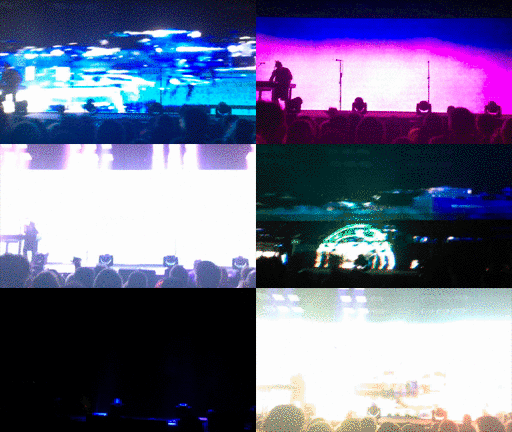
The gig was great - I prefer club gigs to arena gigs but the sound techs for NIN know what they are doing and the mix was great. The visuals were stunning too. Highlights for me were "The Great Destroyer" - in particular the extended, improvised 5 minute glitch-meltdown coda; the slow build of "Eraser" and "The Day The World Went Away" - played faithfully to the CD mix rather than the traditional extended live arrangement. I miss the former live arrangement, which includes a drawn out drum-backed finish, but this arrangement had a lot of force, with all four of the band bashing guitars into a pummelling wall of sound. I've heard that at least one person has taped the show and it turns out recordings have just recently surfaced for the two club gigs my brother and I attended back in 2005 and 2007 - meaning there are now widely available, high quality ROIO copies for every NIN gig I've ever been to. Afterwards we tried to find a decent club. Manchester is a lot larger than my native city and there's plenty of places to go, if you know where they are. We had originally planned to visit The Factory on Charles Street, but we didn't believe it was open on the Sunday. The Factory is Peter Hook's (formerly of Joy Division/New Order) club - occupying the former office spaces of Factory records. I've chanced in there once before as it's right across the road from the Lass O' Gowrie pub, which is the haunt of choice for HE/tech people whenever we're in Manchester for conferences.
cheesy cocktail names cheesy cocktail names
Instead we gravitated towards Dry Bar on Oldham street. By coincidence this place also has historic ties to Factory Records. However the doormen wouldn't let us in! Finally we landed at a place which had one name on the door and a different name on the inside (Jack's). Like the aformentioned Lass O' Gowrie and perhaps half of all pubs and clubs in Manchester, the place is decked out as a shrine to the former musical giants of the City, with framed pictures of Mark E Smith, the Ha ienda again, the Stone Roses in their boy-band-looks hay day, John Peel (champion of many of them) and of course Tony Wilson. I can't help but wonder whether people who live here get royally sick of that. This place served some delicious albeit clich -titled Cocktails and played a pretty good set - the obligatory Madchester throwback interlude was followed by a chunk of Northern Soul and a couple of early Rap classics. Setlist wise it was pretty much identical to that of Foundation in Newcastle, 12 years ago, no doubt because Foundation was cribbing heavily from the Ha ienda in the first place.
Record haul Record haul
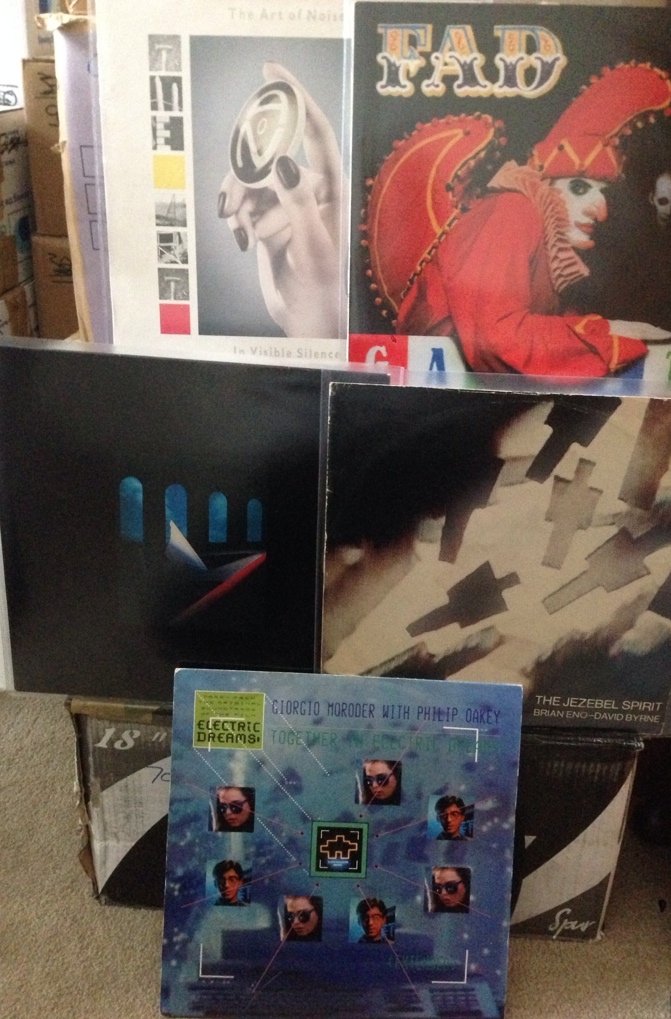
Monday was dedicated to exploring and shopping. Top of my list of places to go was my pilgrimage venue Vinyl Exchange. Whilst waiting for it to open we rolled around in Affleck's Palace, which turned out to have a small record stall within. After Vinyl Exchange we chanced across another record store right across the road - Picadilly Records - which happens to be larger and focuses more on new releases. It didn't take long before we found another small, DIY record shop, then another. We tried out the Fopp branch here - more Vinyl; then Urban Outfitters - more; then an Oxfam branch - even more. I actually got Vinyl snow blind at this point. I've been controlling myself admirably and only picked up a couple of bits and pieces. My best find was Fad Gadget's sophmore album "Incontinent".

Jon Dowland: 2012 In Review

2013 is nearly all finished up and so I thought I'd spend a little time writing up what was noteable in the last twelve months. When I did so I found an unfinished draft from the year before. It would be a shame for it to go to waste, so here it is. 2012 was an interesting year in many respects with personal highs and lows. Every year I see a lots of "round-up"-style blog posts on the web, titled things like "2012 in music", which attempt to summarize the highlights of the year in that particular context. Here's JWZ's effort, for example. Often they are prefixed with statements like "2012 was a strong year for music" or whatever. For me, 2012 was not a particularly great year. I discovered quite a lot of stuff that I love that was new to me, but not new in any other sense. In Music, there were a bunch of come-back albums that made the headlines. I picked up both of Orbital's Wonky and Brian Eno's Lux (debatably a comeback: his first ambient record since 1983, his first solo effort since 2005, but his fourth collaborative effort on Warp in the naughties). I've enjoyed them both, but I've already forgotten Wonky and I still haven't fully embraced Lux (and On Land has not been knocked from the top spot when I want to listen to ambience.) There was also Throbbing Gristle's (or X-TG) final effort, a semi/post-TG, partly posthumous double-album swan song effort which, even more than Lux, I still haven't fully digested. In all honesty I think it was eclipsed by the surprise one-off release of a live recording of a TG side project featuring Nik Void of Factory Floor: Carter Tutti Void's Transverse, which is excellent. Ostensibly a four-track release, there's a studio excerpt V4 studio (Slap 1) which is available from (at least) Amazon. There's also a much more obscure fifth "unreleased" track cruX which I managed to "buy" from one of the web shops for zero cost. The other big musical surprise for me last year was Beth Jeans Houghton and the Hooves of Destiny: Yours Truly, Cellophane Nose. I knew nothing of BJH, although it turns out I've heard some of her singles repeatedly on Radio 6, but her band's guitarist Ed Blazey and his partner lived in the flat below me briefly. In that time I managed to get to the pub with him just once, but he kindly gave me a copy of their album on 12" afterwards. It reminds me a bit of Goldfrapp circa "Seventh Tree": I really like it and I'm looking forward to whatever they do next. Reznor's How To Destroy Angels squeezed out An Omen EP which failed to set my world on fire as a coherent collection, despite a few strong songs individually. In movies, sadly once again I'd say most of the things I recall seeing would be "also rans". Prometheus was a disappointment, although I will probably rewatch it in 2D at least once. The final Batman was fun although not groundbreaking to me and it didn't surpass Ledger's efforts in The Dark Knight. Inception remains my favourite Nolan by a long shot. Looper is perhaps the stand-out, not least because it came from nowhere and I managed to avoid any hype. In games, I moaned about having moaning about too many games, most of which are much older than 2012. I started Borderlands 2 after enjoying Borderlands (disqualified on age grounds) but to this day haven't persued it much further. I mostly played the two similar meta-games: The Playstation Plus download free games in a fixed time period and the more sporadic but bountiful humble bundle whack-a-mole. More on these another time. In reading, as is typical I mostly read stuff that was not written in 2012. Of that which was, Charles Stross's The Apocalypse Codex was an improvement over The Fuller Memorandum which I did not enjoy much, but in general I'm finding I much prefer Stross's older work to his newer; David Byrne's How Music Works was my first (and currently last) Google Books ebook purchase, and I read it entirely on a Nexus 7. I thoroughly enjoyed the book but the experience has not made a convert of me away from paper. He leans heavily on his own experiences which is inevitable but fortunately they are wide and numerous. Iain Banks' Stonemouth was an enjoyable romp around a fictional Scottish town (one which, I am reliably informed, is incredibly realistical rendered). One of his "mainstream" novels, It avoided a particular plot pattern that I've grown to dread with Banks, much to my suprise (and pleasure). Finally, the stand-out pleasant surprise novel of the year was Pratchett and Baxter's The Long Earth. With a plot device not unlike Banks' Transition or Stross's Family Trade series, the pair managed to write a journey-book capturing the sense-of-wonder that these multiverse plots are good for. (Or perhaps I have a weakness for them). It's hard to find the lines between Baxter and Pratchett's writing, but the debatably-reincarnated Tibetan Monk-cum-Artificial Intelligence 'Lobsang' must surely be Pratchett's. Pratchett managed to squeeze out another non-Discworld novel (Dodger) as well as a long-overdue short story collection, although I haven't read either of them yet. On to 2013's write-up...

5 May 2014

Thomas Goirand: OpenStack Icehouse bugs all cleaned-up

I ve done some clean-up in the Debian BTS. The result can be seen in the QA graphs: The last remaining 6 bugs are only affecting OpenStack Essex (which is what Wheezy ships, and which unfortunately I have not enough time to support properly), and the last one is waiting for FTP masters approval after I added Python 3 support to oslo-config (OpenStack is slowly moving to Python3, and I ve tried to add support to Python3 in the packages as well each time it was possible). Also, the Icehouse packages have passed the tempest tests (a set of functional tests) which we run in our continuous integration system. As I was doing some triaging, it is possible that some bugs have been closed a bit quickly (like for example the Ceilometer FTBFS which I couldn t reproduce, even with sbuild and cowbuilder), so it is well possible that some more QA work will be needed later on. I m also expecting a new set of patches for supporting Ceph in Nova. I m sure there s issues which we will discover later on, however, it is nice to have this result right after the first Icehouse release of OpenStack. Next up: testing new components that I uploaded for this release: Trove (DB as a Service), Designate (DNS as a Service), Ironic (Metal as a Service, or cloud computing on bare-metal), and TripleO (OpenStack on OpenStack). I unfortunately know already that TripleO and Tuskar wont really work yet, and that it needs some patches to be sent upstream for it to support Debian correctly (let s work it out for Juno!). So please consider it as a technology preview only. Though Trove, Designate and Ironic are supposed to be in good enough shape, I didn t have the chance to test them more than just installing the packages and checking daemons are running and connected to the various components of OpenStack (eg: database, keystone and RabbitMQ). Please do test them and report bugs in the BTS. I d like to thanks Gustavo Panizzo & Thomas Bechtold who contributed to this release, and also the folks at eNovance (Emilien, Cyril, Seb ) who provided precious help with the CI and package quality. See you in the Juno Atlanta design summit next week (as hopefully, my plane ticket issue will be soon solved).

28 April 2014

Daniel Pocock: SMS logins: an illusion of security

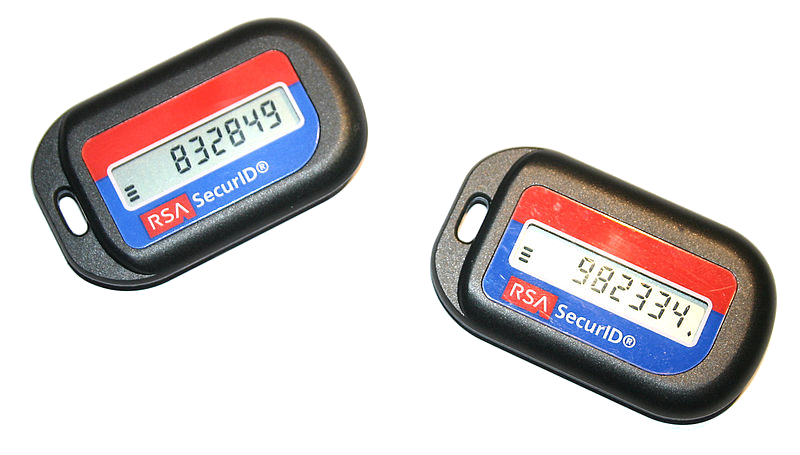
The IT security world is still reeling from the impact of the OpenSSL Heartbleed bug. Thanks to the bug, many experts have been reviewing other technologies to try and find similar risks. While Heartbleed was hidden away in the depths of the OpenSSL code base, another major security risk has been hiding in plain sight: SMS authentication for web site logins. Remarkably, a number of firms have started giving customers the ability to receive single-use passwords over SMS for logging into their secure web sites. Some have even insisted that customers can no longer log in without it, denying customers the right to make an important choice about their own security preferences. Unfortunately, SMS is no substitute to the one-time-passwords generated using proper authentication tokens or the use of other strong authentication schemes such as cryptographic smart cards. Even telephone companies themselves advise that SMS should not be used to secure financial transactions. Ocean's 11 in real life: exploiting the weakest link in the chain To deliver single-use SMS passwords, the SMS must travel through various networks from the firm's headquarters, to a wholesale SMS gateway, international SMS network and finally down the line of the local phone company. In comparison, properly certified token devices generate a code inside the device in the palm of your hand. The code only travels from the screen to your eyes. In a litany of frauds coming in all shapes and sizes, telephone networks have been exploited over and over again because they are almost always the weakest link in the chain. Using the mobile SMS network for authentication is not building on solid ground - some experts even feel it is downright stupidity. One of the most serious examples was the theft of $150,000,000 from a pension fund deposited with JP Morgan: it was described as a real-life case of Ocean's 11. The authentication was meant to be a phone call rather than an SMS: a phone company employee who was in on the scam duly ensured the call never reached the correct place. The insecurity of traditional telephone networks has been on display for all the world to see in the ongoing trial of News Corporation executives for phone hacking. If journalists from a tabloid newspaper can allegedly hack a dozen phones before their first cigarette of the day, is it really wise to use an insecure technology like SMS as the cornerstone of a security system for authorizing transactions? A fraud recently played out on many credit card holders in the UK exploited a low-tech feature of the phone system to trick people to believe they were safe by "calling back" to their bank. A plethora of new attack vectors The staggering reality of the situation is that attackers don't even have to directly hack their victim's phones to access SMS messages. As the Android API documentation demonstrates, SMS reception is notified to all apps in real-time. Apps can process the messages even when the phone is sleeping and the message is not read by the user. Just consider all the apps on a phone that have requested permission to read incoming messages. There was an uproar recently when a new version of the Facebook app started demanding permissions to read incoming SMS. The app can't be installed if the user doesn't agree to these new permissions. WhatsApp, another popular app that has SMS access rights, was recently exposed in a major security scandal which revealed they use a phone's IMEI number as the password. When people install an app like Tinder (which does not yet request SMS access) is the security of their bank account likely to be at the front of their mind? Even if Facebook intends no harm, they have opened the floodgates by further de-sensitizing users to the risks of giving apps un-necessary access to their data. These companies are looking for every piece of data that could give them an edge in their customer profiling and marketing programs. Having real-time access to your SMS is a powerful way for them to understand your activities and feelings at every moment in the day. To facilitate these data analysis techniques, replicating and archiving your messages into their cloud databases (whether you can see them there or not) is par for the course. The cloud, of course, has become a virtual smorgasboard for cyber-criminals, including both hackers and occasionally insiders wanting to peek at private data or harvest it en-masse. Social networking and communication sites are built on a philosophy of sharing data to create interaction and excitement. Unfortunately, this is orthogonal to the needs of security. In this context, the telephone network itself may no longer be the weakest link in the chain. The diligent attacker only needs to look for the cloud operator with an unplugged security hole and use their system as a stepping stone to read any SMS they want, when they want. Would you notice a stray SMS? Maybe you feel that you would notice a stray SMS carrying a login code for your bank account. Would you always be able to react faster than the criminal however? Thanks to social networks, or location data inadvertently leaked by other apps the attacker can easily work out whether you are on holiday, at the gym, at a party or sleeping or in some other situation where you are not likely to check messages immediately. If you receive a flood of SMS spam messages (deliberately sent by an attacker) in the middle of the night and you put your phone into silent mode and ignore it, you may well miss one message that was a login to your bank account. SMS technology was never designed for secure activities. The inconvenience of SMS While security is a headline issue these days, it is also worth reflecting on the inconvenience of SMS in some situations. Travel is at the top of the list: SMS doesn't work universally when abroad. These are usually the times when the only way to access the bank is through the web site. After dealing with the irritations of the hotel or airport wifi registration, do you really need more stress from your bank's systems too? For some networks, SMS can be delayed by hours or days, sometimes never arriving at all. Many people swap their SIM cards when travelling to avoid the excessive roaming charges and there is extra inconvenience in swapping SIM cards back again just to log in to a bank account. Worst of all, if you are tethering with a SIM card from the country you are visiting, then it is impossible for you to receive the SMS message from the bank on your regular SIM card while simultaneously maintaining the SSL connection to their web site over your new SIM card. Other problems like a flat battery, water damage or PIN permanently blocked by children playing with the phone can also leave you without access to your bank account for varying lengths of time. Is there any up-side to SMS authentication? The only potential benefit to SMS authentication is that it weeds out some of the most amateur attempts to compromise your bank account, but this is a false sense of security and it opens up new attack vectors through the cloud as we have just demonstrated. For all other purposes, it smells like a new form of security theater. A more likely reason why it has become popular amongst some firms is that many lenders want to ensure they have mobile phone numbers to contact customers when loan or credit card payments are missed. Making the mobile phone number mandatory for login ensures they almost always have the correct phone number for almost 100% of customers. It is not clear that this benefit justifies the failure to provide proper security and the inconvenience when travelling though. Opting out Next time you log in to a web site, if the firm does try to enrol you in an SMS authentication scheme, it may be a good idea to click the "No thanks" option. If you have already been registered into an SMS authentication scheme, fill out the online complaint form and inform the firm that you will only accept a proper authentication token or cryptographic smart card. These solutions are tried and tested and they are the correct tool for the job.


23 April 2014

Gergely Nagy: GSoC2014: syslog-ng accepted projects

The Google Summer of Code 2014 programme reached another milestone recently: the accepted proposals were published, and over a thousand students were selected by nearly two hundred mentoring organisations, among them the syslog-ng project. We will be working with four students this year (twice we worked with last year), with more mentors, on a wider selection of projects. It was a tough decision to select the proposals, we received some very strong work this year.We would like to express our gratitude to both Debian, for giving us an extra slot (so we could accept four students instead of three), and Google and Carol Smith in particular, for allowing it, and putting up with our fumbling during the process.The accepted projects and students are: Good luck to all students, we're looking forward to working with you throughout the summer! Happy hacking!

21 April 2014

Russ Allbery: Review: Hyperbole and a Half

Review: Hyperbole and a Half, by Allie Brosh
Publisher: Touchstone
Copyright: November 2013
ISBN: 1-4767-6459-X
Format: Graphic novel
Pages: 373
It's fundamentally pointless to write this review. Some number of you have already heard of Hyperbole and a Half. Most of that group already own this book and are only reading this review so that you can remember how much fun you had reading it. But, even better, you could just stop reading this review and go read the book again. Some of you who have heard of Hyperbole and a Half didn't know that Allie Brosh had published a book. If that's you, you're probably not reading this review any more, since you're now at your favorite book seller buying a copy of the book, rendering the review somewhat pointless. For those of you who have not heard of Hyperbole and a Half, there's no need to read a review, because it's a blog. So, rather than reading this review, you can just follow that link and read it for yourself. If you find yourself laughing uncontrollably (and occasionally crying) and going "where can I get more of this?", well, there's a book. Which you could have also found out from the blog itself. Like I said, not much point. If you read the blog and don't particularly care for it, well, I greatly respect your position. The diversity of taste in the human race is what leads to our wonderful variety of culture, philosophy, and art, and I appreciate your substantial contribution to that diversity. However, you should now make a mental note to never trust my humor recommendations, and you shouldn't let this review change your mind. But, since I'm here, I may as well write a review anyway. Hyperbole and a Half is, as mentioned, a blog by Allie Brosh. Most of the posts are quite long and substantial and in the form of cartoons mixed with text, usually (but not always) telling some sort of story. The cartoon style is what is often called "MS Paint," meaning that it looks like something drawn in Microsoft Paint with its most basic tools. (Other examples of this style are the Oatmeal and Homestuck, although Brosh stays consistently with a rawer art style than either of those.) It looks extremely simple, like child drawings (and early childhood inspires much of Brosh's material), but once one gets used to it, one realizes that Brosh gets amazing expressiveness and character out of the art style. As an aside, yes, I am wholeheartedly recommending a book that is full of material about young children. Brosh is that good. The subtitle of this book is "unfortunate situations, flawed coping mechanisms, mayhem, and other things that happened," and it's mostly based on (exaggerated) incidents that occurred in Brosh's life. Most of them are hilarious. Some of them are both hilarious and stunning psychological insights. She has an amazing knack for storytelling and for exaggerating just the right moments of the story, or summing up emotions in a wonderful turn of phrase or a picture. She's also amazingly good at telling embarrassing stories about herself in a way that makes you empathize rather than just cringe, and then come away feeling like you understand both her and yourself better. If you've wandered around the Internet much, you have probably run across the phrase "clean ALL the things!" and the corresponding picture. That's from Hyperbole and a Half (specifically, "This is Why I'll Never Be an Adult") and is included in this book (improved; see below). It's even better in context. But, beyond storytelling, the other thing Brosh is amazingly good at is capturing internal mental states and emotions in a way that the reader understands and those who have experienced the emotion immediately go "yes, THAT." The apex of this is her two-part post on depression, which is hands-down the best description of depression that I've ever read. That judgment has been echoed by multiple friends of mine with depression. And yes, both of those posts are included in the book as well, although you can also read them on the web. As you've probably noticed, this book is partly a collection of material that's freely available on the web. Unlike some web comics collections, it's not entirely a reprint collection; there are entirely new stories here (which for me was enough by itself to buy the book). Brosh's post on the book says that it's about 50% new material. But the ones that aren't original have been edited and improved, sometimes substantially. For example, I did a quick comparison of the book version with the web version of "This is Why I'll Never be an Adult" and found Brosh redrew all of the cartoons for the story. The book is also gorgeous, if you care about such things like I do: high quality paper, thick pages, vibrant colors, and a comfortable heft to the hardcover version. It's the sort of book that feels like it will survive for decades, which is good since I intend to re-read it for decades. Brosh has a lot of material on-line, so obviously only a small fraction made it into the book and there's more to discover on the blog. I can particularly recommend "The Alot is Better Than You at Everything" and "Boyfriend Doesn't Have Ebola. Probably.". The latter, which is mostly about creating a better pain scale, is my favorite from the blog that didn't make it into the book. And there are two more examples of the sort of thing that you'll getting here. So ends the probably pointless review. I absolutely adore Hyperbole and a Half. It is my favorite web comic, even surpassing XKCD, which is saying something. Even if there were no material, I would have bought this book in hardcover to support Brosh and to have a high-quality printing of the blog posts. The reworkings and improvements of the republished material and the brand new additions are just bonuses. But there's no need to take my word for it; the best possible advertisement for Brosh's work is on-line, from which you can easily determine if you'll enjoy this book as much as I did. Even the back cover and the inside flaps are awesome. Rating: 10 out of 10

15 April 2014

Petter Reinholdtsen: FreedomBox milestone - all packages now in Debian Sid

The Freedombox project is working on providing the software and hardware to make it easy for non-technical people to host their data and communication at home, and being able to communicate with their friends and family encrypted and away from prying eyes. It is still going strong, and today a major mile stone was reached. Today, the last of the packages currently used by the project to created the system images were accepted into Debian Unstable. It was the freedombox-setup package, which is used to configure the images during build and on the first boot. Now all one need to get going is the build code from the freedom-maker git repository and packages from Debian. And once the freedombox-setup package enter testing, we can build everything directly from Debian. :) Some key packages used by Freedombox are freedombox-setup, plinth, pagekite, tor, privoxy, owncloud and dnsmasq. There are plans to integrate more packages into the setup. User documentation is maintained on the Debian wiki. Please check out the manual and help us improve it. To test for yourself and create boot images with the FreedomBox setup, run this on a Debian machine using a user with sudo rights to become root:
sudo apt-get install git vmdebootstrap mercurial python-docutils \
  mktorrent extlinux virtualbox qemu-user-static binfmt-support \
  u-boot-tools
git clone http://anonscm.debian.org/git/freedombox/freedom-maker.git \
  freedom-maker
make -C freedom-maker dreamplug-image raspberry-image virtualbox-image
Root access is needed to run debootstrap and mount loopback devices. See the README in the freedom-maker git repo for more details on the build. If you do not want all three images, trim the make line. Note that the virtualbox-image target is not really virtualbox specific. It create a x86 image usable in kvm, qemu, vmware and any other x86 virtual machine environment. You might need the version of vmdebootstrap in Jessie to get the build working, as it include fixes for a race condition with kpartx. If you instead want to install using a Debian CD and the preseed method, boot a Debian Wheezy ISO and use this boot argument to load the preseed values:
url=http://www.reinholdtsen.name/freedombox/preseed-jessie.dat
I have not tested it myself the last few weeks, so I do not know if it still work. If you wonder how to help, one task you could look at is using systemd as the boot system. It will become the default for Linux in Jessie, so we need to make sure it is usable on the Freedombox. I did a simple test a few weeks ago, and noticed dnsmasq failed to start during boot when using systemd. I suspect there are other problems too. :) To detect problems, there is a test suite included, which can be run from the plinth web interface. Give it a go and let us know how it goes on the mailing list, and help us get the new release published. :) Please join us on IRC (#freedombox on irc.debian.org) and the mailing list if you want to help make this vision come true.

14 April 2014

Steve Kemp: Is lumail a stepping stone?

I'm pondering a rewrite of my console-based mail-client. While it is "popular" it is not popular. I suspect "console-based" is the killer. I like console, and I ssh to a remote server to use it, but having different front-ends would be neat. In the world of mailpipe, etc, is there room for a graphic console client? Possibly. The limiting factor would be the lack of POP3/IMAP. Reworking things such that there is a daemon to which a GUI, or a console client, could connect seems simple. The hard part would obviously be working the IPC and writing the GUI. Any toolkit selected would rule out 40% of the audience. In other news I'm stalling on replying to emails. Irony.

13 April 2014

Andreas Metzler: balance sheet snowboarding season 2013/14

Little snow, but above-average season. The macro weather situation was very stable this year, very high snowfall in Austria's south (eastern tyrol and carinthia), and long periods of warm and sunny weather with little precipitation on the northern side of the alps (i.e. us). This had me going snowboarding a lot, but almost exclusively in Dam ls since it is characterized by a) grassy terrain (no stones) and b) huge numbers of snow cannons. I started early (December 7) with another 6 days on piste in December. If there had been more snow the season would have been a long one, too. - Season's end depends on the timimg of easter (because of the holidays) which would have been late. However I again stopped rather early, last day was March 30. In addition to the days listed below I had an early season's opening at the glacier in Pitztal. I attended the pureboarding in November (21st to 23rd). Looking back at the season I am not quite satisfied with my progress, I just have not managed to implement and practise the technique I should have learned there. It is next to impossible when the slopes are full, and when they aren't one likes to give it a run. ;-) Here is the balance sheet:
2005/06 2006/07 2007/08 2008/09 2009/10 2010/11 2011/12 2012/13 2013/14
number of (partial) days251729373030252330
Dam ls1010510162310429
Diedamskopf154242313414191
Warth/Schr cken030413100
total meters of altitude12463474096219936226774202089203918228588203562274706
highscore10247m8321m12108m11272m11888m10976m13076m13885m12848m
# of runs309189503551462449516468597

1 April 2014

Andrew Pollock: [life] Day 63: Productive procrastination, pizza dough, podiatrist, positive

parenting and a haircut with a spot of painting How's that for some alliteration? Today was a really good day. And that's before I started drinking red wine. I got up this morning and successfully banged out a 10km run. It wasn't pretty, but I did it in under an hour, so I was happy. I got home, and after breakfast I pretty much flopped on the couch with my laptop and procrastinated instead of doing my taxes. But it was productive procrastination. I: I also (finally) got my taxes to a point where I'm ready to send them off to my US accountant and deal with the rest of it incrementally. So it was a productive day! I had a follow up appointment with my podiatrist in the afternoon to see how my orthotics were going. I biked to Kindergarten early, ditched the bike trailer, and then biked over to the podiatrist, and made it back to Kindergarten about 10 minutes before pick up time. Zoe was, unsurprisingly, fast asleep. I decided to try applying sunscreen to her while she was asleep as a way of killing two birds with one stone. I got as far as getting her legs done before she woke up and had a massive meltdown. Poor kid really doesn't deal well with being woken up. One of the teachers took pity on us and distracted Zoe by letting her cuddle one of the baby chicks, which snapped her out of it for the duration, but she had another meltdown once it was over. Another teacher gave her a cuddle for a bit, and she eventually calmed down enough for me to get sunscreen on her arms. I'd foolishly left the bike trailer separated from the bike, so I had to drag the trailer back to the bike, whilst carrying Zoe. Fortunately another teacher took sympathy on us and helped me with the trailer. Turns out trying to drag a single-wheeled trailer single-handed whilst carrying a toddler and having excess sunscreen on my hands is extremely difficult. We finally got the trailer on the bike, and Zoe in the trailer, and headed towards home. Zoe's ballerina pumps aren't great on the bike because the straps on the pedals cross the tops of her exposed feet and irritate her, so there were multiple meltdowns on the way home, culminating in needing to go to the toilet "right now" before we got home. I stopped at the health food shop on the way home, to see if they had a toilet we could use. Luckily I'm a customer and the naturopath let us use the toilet in the clinic. Zoe had another meltdown in there, announcing she "didn't like being woken up". Poor kid. It wasn't a good afternoon for her. I'm just glad I was in a sufficiently good mood to be able to deal with it all in a satisfactorily positive parenting way. We finally made it home, and I'd promised her we could have a big cuddle on the couch once we got home, so we did that and read a library book, and then it was time to head to the hairdressers for our haircuts. We started out on foot, and had made it one block from home, and she saw another kid on a scooter and announced she wanted to ride her scooter too. Initially tried saying we couldn't do it this time, because we'd be late, but she was on the verge of having another meltdown, so I capitulated, and we went back and grabbed it. I'm actually really glad I did, because she was as happy as Larry from that point on, and we were only a couple of minutes late at the hairdresser. We did her fringe trim first, and then she had a great play in the kid's corner while I got my haircut. She even cleaned up the corner better than she found it without argument. We then had plenty of time to scooter back home, so I decided to check out the 'OO'niverse Family Cafe, which is next door to the Hawthorne Cinemas. It's this thing I've never gotten around to checking out, and it was the second thing I was glad I did this afternoon. It's not a big place, and it was super quiet. There was just us and two twin Kindergarten-aged girls being babysat. Zoe had a banana milkshake and got a dolphin painted on her arm and a balloon dog made, and I had a coffee and we just chilled out for a bit while I chatted with the owner (who was babysitting the twins). By this stage Anshu was already at my place, and Sarah wasn't far off leaving work to pick up Zoe, so we made our way back home. Zoe had a great time playing with Anshu until Sarah arrived. So I was basically really happy that I managed to turn around a massively molten afternoon and give Zoe a really good afternoon instead. Anshu and I then proceeded to made a couple of really fantastic pizzas. I really love my Thermomix. I made the pizza dough earlier today, and tonight I made some pizza sauce, some pesto sauce and caramelized some onions in it, and we were still done with dinner by 8pm.

18 March 2014

Enrico Zini: on-responsibilities

On responsibilities I feel like in my Debian projects I have two roles: the person with the responsibility of making the project happen, and the person who does the work to make it happen. As the person responsible for the project, I need to keep track of vision, goals, milestones, status. To make announcements, find contributors, motivate them, deal with users and bug reports, maintain documentation, digest feedback. As the person who does the work to make it happen, I need quiet time, I need to study technology, design code, write unit tests, merge patches, code, code, code, ask around about deployment information, more code. I have a hard time doing both things at the same time: the first engages my social skills and extroversion, requires low-latency interaction, and acting when outside things happen. The second engages my technical skills and introversion, requires quiet uninterrupted periods of flow, and acting when inspiration strikes. I never managed to make good use of "gift bugs" or "minions": I often found the phrase "it's easier for me to do than to explain it" sadly relevant. Now I understand that it's not because of the objective difficulty of explaining or doing things, nor about the value of doing or of involving people. It's about switching from one kind of workflow to another. If I rephrase that as "it's easier for me to stay in flux and fix it, than to switch my entire attitude to ask for help". Of course this does not scale: we've all been saying it since I can remember. Looking at the situation from the point of view of those two roles, however, I now wonder if those two roles shouldn't really require two people. In other worlds they are: the project managers, taking responsibility for making the project happen, and the software designers, artists, and all other kind of artisans doing the work to make it happen. Of course I don't want the kind of project manager that shifts responsibilities to artisans, does nothing and takes the credit for the project: not in paid work, not in Debian. Project management is something else. I would be interested instead in having the kind of project manager that takes responsibility for the project, checks how the artisans are doing and communicates what is happening to the rest of the world, deals with the community, motivates more people to help, test, try, use, give feedback on things as they happen. A project manager / community manager. So that while I'm flux there is someone who tags bugs as "gift", mentors people to find code and documentation, and remembers to write an announcement if I implemented three cool things in a row and I'm already busy working on the fourth. So that I don't write cool ideas in my todo list where nobody can read them, but I can share them to a mailing list where someone picks up a relevant one and finds someone to make it happen while I'm busy refactoring old code that only I can understand. So that if I say "sorry, paid work calls, I won't be able to work on this project for a month", I'll be able to completely forget about that project for a whole month, without leaving the community out there to die. That's an interesting job for non-uploading DDs: please take over my projects. Let's share a vision, and team up to make it happen. Give me the freedom of being the craftsman I enjoy being, and take away from me those responsibilities that I've never asked for. The worst project managers are those that never asked to be one, but were promoted to it. Let's not repeat that mistake in Debian. A good part of the credits for this post go to Francesca Ciceri, for the discussions we had on our way back from MiniDebConf Barcelona 2014. P.S. I'm seeing how a non-uploading DD could be in the Maintainer field for one or more packages, with uploading DDs being, well, uploaders. Food for thought.

15 February 2014

Thomas Goirand: OpenStack 2013.2.2 uploaded

This is the 2nd point release of OpenStack Havana (this is the name of the current stable release of OpenStack). It was out on Thursday (US time), and I uploaded it on Friday (Chinese time). Unfortunately, I realized that the latest python-keystoneclient didn t support the token and endpoint command line options, effectively breaking Keystone itself, and all automated endpoint registration in all core packages. So after fixing Keystone and openstack-pkg-tools, I had to re-upload a 2nd Debian release. However, after this glitch, the packages passed successfully our CI testing suite: my friends at eNovance and I run the tempest functional test suite each time there s this kind of major update, so that we can validate the packages are working as expected. And all went well after the new keystone command line options were fixed in the postinst scripts. As a side note, I fail to see consistency on deprecating these interfaces. While we still have the old glance index thing in the Glance client (this is really old), keystoneclient just broke backward compatibility, when keystone is quite recent. So, it looks to me that it wasn t a great idea to just remove token and endpoint this way (though I can understand the need of consistency). Hopefully, this will all be fixed anyway, when we move to the unified python-openstackclient command lines instead of per-project clients. I realized today that the pkg-openstack team now maintains more than 100 packages. This of course includes general purpose Python modules, which probably will move to the Python module team if it one day supports Git (life is too short: I do not wish to learn such a deprecated technology as SVN). Though this is still a lot of packages, and some more are coming: as per the OpenStack TODO list wiki page, Ironic (a replacement for nova-baremetal), TripleO (OpenStack on OpenStack), Tuskar (contols where things are deployed with TripleO) and Designate (DNS as a Service) are already packaged, and I am waiting for the Icehouse (this is the name of the next stable release) beta3 to be out to upload them to Experimental. This is scheduled for the 6th of March. I believe I am currently nearly up-to-date with the current global-requirements.txt (eg: python dependencies of OpenStack), pending a few Python module upgrades, so hopefully, packaging OpenStack Icehouse beta3 will smooth.

Next.

Previous.