Search Results: "sten"

8 September 2024

Thorsten Alteholz: My Debian Activities in August 2024

FTP master This month I accepted 441 and rejected 15 packages. The overall number of packages that got accepted was 442. I am ashamed of some occurrences that happened this month and I apologize for this. Unfortunately I have no idea how to prevent this in the future without becoming a solo entertainer. Debian LTS This was my hundred-twenty-second month that I did some work for the Debian LTS initiative, started by Raphael Hertzog at Freexian. Unfortunately Bullseye was not handed over to LTS in August. So I only prepared new packages of asterisk, libvirt and tinyproxy and will upload them next month. Last but not least I did a week of FD this month. Debian ELTS This month was the seventy-third ELTS month. During my allocated time I uploaded or worked on: I also did a week of FD. Debian Printing This month I uploaded This work is generously funded by Freexian! Debian Astro This month I uploaded a new upstream or bugfix version of: Debian Mobcom The following packages have been prepared by the GSoC student Nathan: It was so much fun working with Nathan. Unfortunately GSoC is over now, but Nathan will continue working in Debian and become a Debian Maintainer. misc This month I uploaded new upstream or bugfix versions of: I also filed an RM bug against meep-openmpi. As Adrian made me ware, this package is no longer needed.

Antonio Terceiro: gotcha: using ccache in Debian package builds

Before I upload packages to Debian, I always do a full build from source under sbuild. This ensures that the package can build from source on a clean environment, implying that the set of build dependencies is complete. But when iterating on a non-trivial package locally, I will usually build the package directly on my Debian testing system, and I want to take advantage of ccache to cache native (C/C++) code compilation to speed things up. In Debian, the easiest way to enable ccache is to add /usr/lib/ccache to your $PATH. I do this by doing something similar to the following in my ~/.bashrc:
export PATH=/usr/lib/ccache:$PATH
I noticed, however, that my Debian package builds were not using the cache. When building the same small package manually using make, the cache was used, but not when the build was wrapped with dpkg-buildpackage. I tracked it down to the fact that in compatibility level 13+, debhelper will set $HOME to a temporary directory. For what's it worth, I think that's a good thing: you don't want package builds reaching for your home directory as that makes it harder to make builds reproducible, among other things. This behavior, however, breaks ccache. The default cache directory is $HOME/.ccache, but that only gets resolved when ccache is actually used. So we end up starting with an empty cache on each build, get a 100% cache miss rate, and still pay for the overhead of populating the cache. The fix is to explicitly set $CCACHE_DIR upfront, so that by the time $HOME gets overriden, it doesn't matter anymore for ccache. I did this in my ~/.bashrc:
export CCACHE_DIR=$HOME/.ccache
This way, $HOME will be expanded right there when the shell starts, and by the time ccache is called, it will use the persistent cache in my home directory even though $HOME will, at that point, refer to a temporary directory.

4 September 2024

Jonathan Dowland: loading (unintended consequences?)

For their 30th anniversary (ish; the Covid pandemic pushed the date out a bit) British electronic music duo Orbital released the compilation 30 something. The track list mostly looks like a best hits list, which given their prior compilation celebrating 20 years looks much the same would appear superfluous. However, they ve rearranged and re-recorded all their songs for 30, to reflect their live arrangements. The reworkings are sufficiently distinct from the original versions (in some cases I prefer them) and elevate the release. The couple of new tracks are also fun, and many of the remixes on the second disc are worth a listen too.

cover art from Orbital - 30 Something
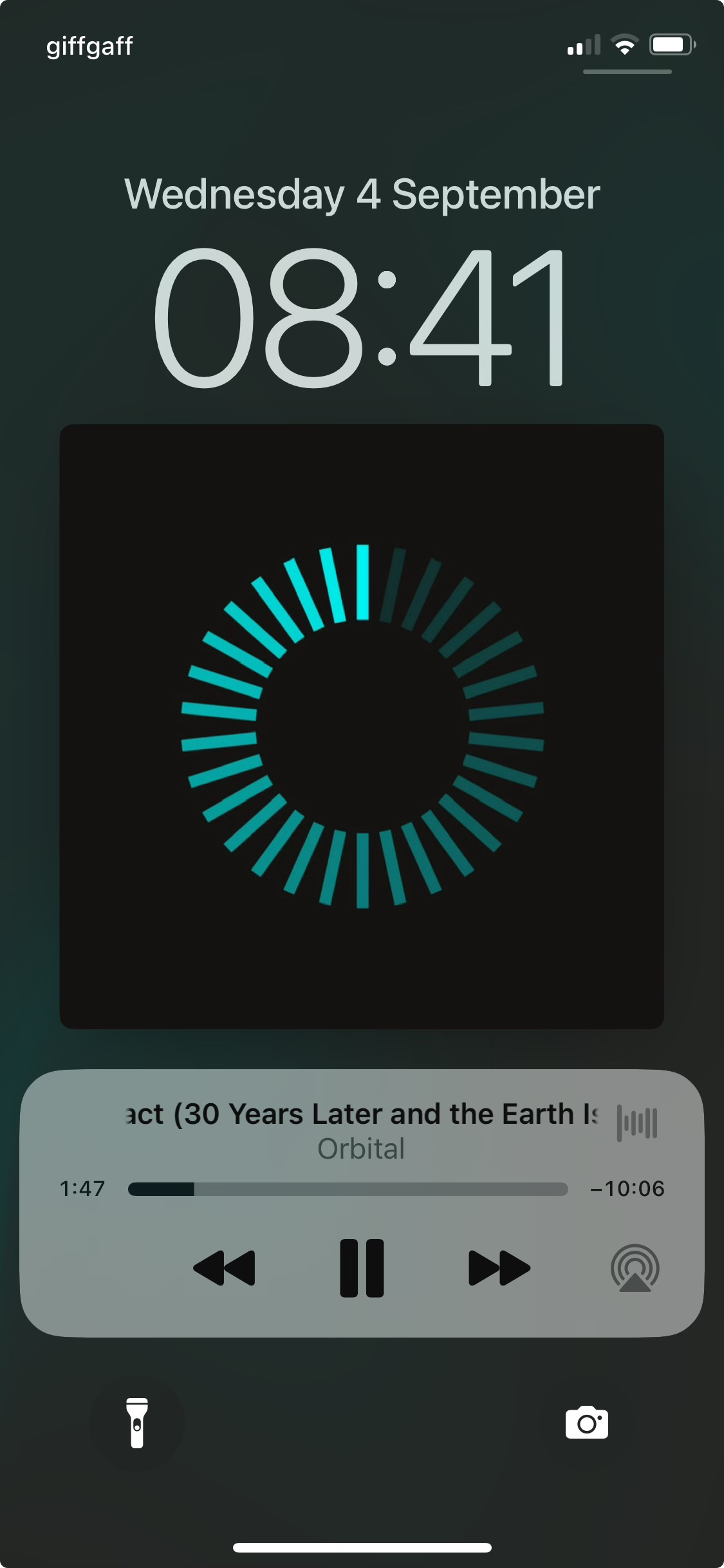
But what I actually sat down to write about was the cover artwork. They often have designs which riff on the notion of a circle (given their name) and the 30-something art (both for the album and single takes from it) adapts a loading spinner-like device from computing (I suppose it mostly closely resembles the spinner from macOS). A possibly unintended effect of the pattern occurs when you view it on a display which is adjusting its brightness, such as if you re listening to it on a phone, the screen is off, and you pick it up. The brightest part of the spinner is visible first, and the rest fade into visibility in sequence. The first time you see this is unexpected and very cool. (I've tried to recreate it in the picture below, but I don't think it's worked.) Although I've suffixed the titled of this post unintended consequences?, It's quite possible this was deliberate.
screenshot of the artwork displayed on my phone
I ve got the pattern on a t-shirt and my kids love to call out Daddy s loading! In my convalescence it s taken on a special sort of resonance because at times I ve felt I m in a holding state: waiting for an appointment to be made; waiting a polite interval before chasing an appointment; waiting for treatment to start after attending an appointment. Thankfully I m at the end of that now, I hope.

Samuel Henrique: DebConf24 was fun!: Security, curl, wcurl, Debian's quality

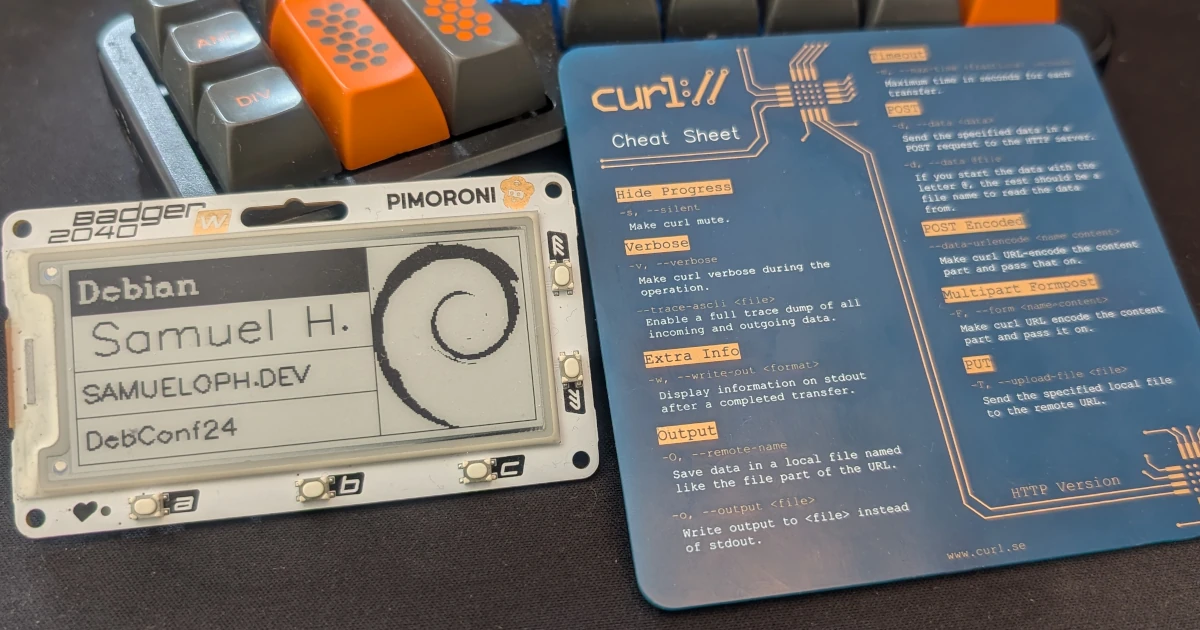
A picture of a badger2040w with Samuel's badge and the curl manpage PCB on the side

tl;dr DebConf24 was fun! A playlist of all of my talks, with subtitles (en, pt-br) and chapters is available on YouTube.

Overview DebConf24 was held in Busan, South Korea, between Sunday July 28th to Sunday August 4th 2024. As usual for DebConfs, I had a great time meeting my friends, but also met new people and got to learn a bit about the interesting things they're working on. I ended up getting too excited during the talk submission stage of the conference and as a result I presented 5 different activities (3 talks, 1 BoF and 1 lightning talk). Since I was too busy with the presentations, I did not have a lot of time to actually hang out with folks, or even to go out in the city, I guess I've learned my lesson for next time. The main purpose of this post is to write about all of the things I presented at the conference. I did want to list some of the interesting talks I've watched, but that I would not be able to be fair as I'm sure I would miss some. You can get the schedule and the recordings of any talks from the conference's website: https://debconf24.debconf.org/schedule/

wcurl Lightning Talk The most fun of my presentations, during the second-to-last day of the conference, I've asked for help from Sergio Durigan Junior <sergiodj> to setup an URL containing a whitespace and redirecting that to wcurl's manpage. I then did a little demo to showcase why me (and a lot others) struggle with downloading things with curl, and how wcurl solves that. https://www.youtube.com/watch?v=eM8M5qa4pPM

Fixing CVEs on Debian: Everything you probably know already I've always felt like DebConf was missing security-related talks, so I decided to do something about it and presented a few of the things I've learned when fixing CVEs for Debian. This is an area where we don't get a lot of new contributors, I'm trying to change that, and this talk can be used to introduce newcomers to it. https://www.youtube.com/watch?v=XzNVVILVyUM

The secret sauce of Debian Debian is not very vocal about all of the nice things it has regarding quality-assurance, testing, or CI, even though it's at the state-of-the-art for a lot of things. This talk is an initial step towards making people aware of the cool things happening behind the scenes. Ideally we should have it well-documented somewhere. https://www.youtube.com/watch?v=x_X2IBnpjic

"I use Debian BTW": fzf, tmux, zoxide and friends One of my earliest good memories of Debian was when it started coming with a colored PS1 by default, I still remember the feeling of relief whenever I jumped into a Debian server and didn't have to deal with a black and white PS1. There's still a lot of room for Debian to ship better defaults, and I think some of them can actually happen. This talk is a bit of a silly one where I'm just making people aware of the existence of a few Golang/Rust CLI tools, and also some dotfiles configurations that should probably be the default. https://www.youtube.com/watch?v=tfto3Seokn4

curl The curl project does such a great job with their security advisories that it will likely never receive the amount of praise it deserves, but I did my best at mentioning it throughout my CVEs talk. Maybe I will write more extensively about this someday, but in case I don't:
There's no other project which always consistently mentions the exact range of commits that are affected by a given CVE. Forget about whether the versions are EOL, curl doesn't have LTS releases, yet they do such a great job at clearly documenting their CVEs that I would take that over having LTS releases anytime (that's for curl at least, I acknowledge some types of projects have a different need for LTS releases). Not only that, but they are also always careful about explaining alternative mitigations such as configuration changes, build flags that defuse the exploitation, or parameters that you should not use.
Just like we tend to do every time we meet, me and the other Debian curl maintainers spent the first 2 or 3 days of the conference talking about how we wanted to eventually meet up to discuss the package. It was going to be informal, maybe during the Cheese and Wine party, but then I've realized we should make it part of the official schedule, which would also give us the recordings for later. And so the "curl maintainers BoF" happened, where we spoke about HTTP3, GnutTLS, wcurl and other things. https://www.youtube.com/watch?v=fL7hSypUTdM

wcurl Right after that BoF, Daniel Stenberg asked if we were interested in having wcurl adopted into curl, which we definitely were, so wcurl is now part of the curl project. Daniel was also kind enough to design a logo for the project, which makes me especially happy because I can stop with my own approach at a logo (which I had to redo every few days): A laptop with a curl and a GoHorse sticker, there's a 'w' handwritten with a marker on the right side of the curl sticker, making it 'wcurl' And here is the new logo: 'wcurl' written with the same font and colors as the curl logo, with the 'w' being green instead of blue, and a download icon at the end Much better, I would say :)

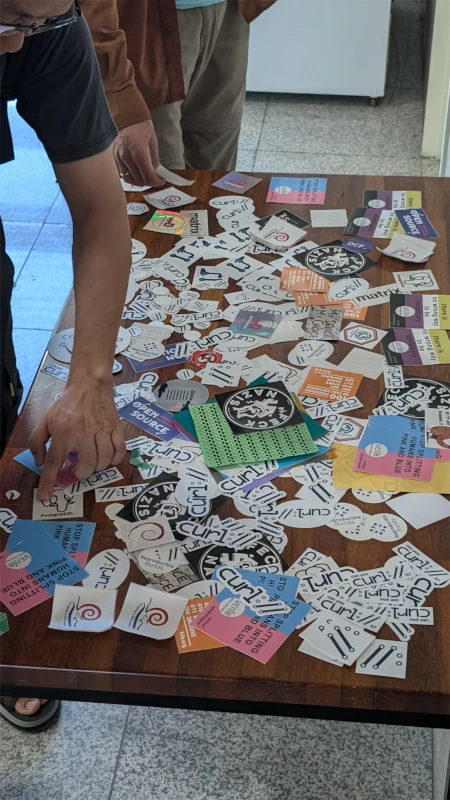
curl Swag DebConf24 was my chance at forwarding some curl swag items to the other curl maintainers, so both Sergio Durigan Junior <sergiodj> and Carlos Henrique Lima Melara <charles> got the curl-up t-shirt and the very cool curl PCB coaster, both gifted by Daniel Stenberg. Unfortunately I didn't have any of that for DebConf attendees, but I did drop loads of curl stickers at the stickers table, they were gone very quickly. A table full of different stickers, curl stickers can be seen over the whole table

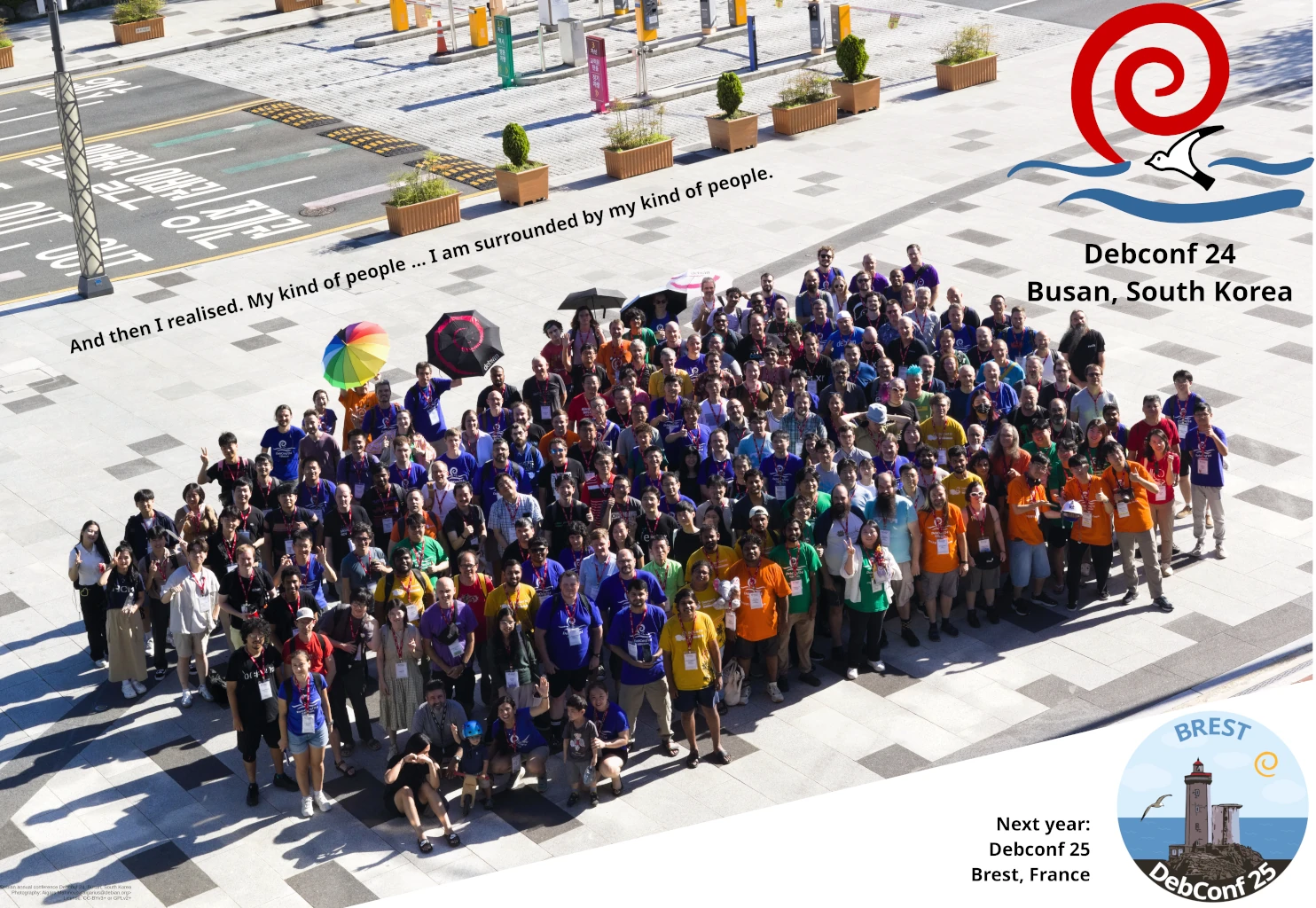
For the future I used to think the most humbling experience you could have as someone who presented a talk was to have to watch it yourself, you notice a lot of mistakes and you instantly think about things that should be done differently. It turns out the most humbling thing to do is actually to write subtitles for your talks, I noticed every single mistake, often multiple times. So after spending more than 30 hours writing the subtitles for both English and Brazilian Portuguese for my talks, I feel like it's going to be much easier to avoid committing the same mistakes again. After some time you stop feeling shame about those mistakes and you're just left with feelings of annoyance, and at that point it becomes easier to consciously avoid them. I am collecting a list of things I wish I had done differently on all of those talks, so if I end up presenting any one of them again, it will be an improved version. A picture from the top of a group of conference attendees, there's about 150 people in the picture

1 September 2024

Bits from Debian: Bits from the DPL

Dear Debian community, this are my bits from DPL for August. Happy Birthday Debian On 16th of August Debian celebrated its 31th birthday. Since I'm unable to write a better text than our great publicity team I'm simply linking to their article for those who might have missed it: https://bits.debian.org/2024/08/debian-turns-31.html Removing more packages from unstable Helmut Grohne argued for more aggressive package removal and sought consensus on a way forward. He provided six examples of processes where packages that are candidates for removal are consuming valuable person-power. I d like to add that the Bug of the Day initiative (see below) also frequently encounters long-unmaintained packages with popcon votes sometimes as low as zero, and often fewer than ten. Helmut's email included a list of packages that would meet the suggested removal criteria. There was some discussion about whether a popcon vote should be included in these criteria, with arguments both for and against it. Although I support including popcon, I acknowledge that Helmut has a valid point in suggesting it be left out. While I ve read several emails in agreement, Scott Kitterman made a valid point "I don't think we need more process. We just need someone to do the work of finding the packages and filing the bugs." I agree that this is crucial to ensure an automated process doesn t lead to unwanted removals. However, I don t see "someone" stepping up to file RM bugs against other maintainers' packages. As long as we have strict ownership of packages, many people are hesitant to touch a package, even for fixing it. Asking for its removal might be even less well-received. Therefore, if an automated procedure were to create RM bugs based on defined criteria, it could help reduce some of the social pressure. In this aspect the opinion of Niels Thykier is interesting: "As much as I want automation, I do not mind the prototype starting as a semi-automatic process if that is what it takes to get started." The urgency of the problem to remove packages was put by CharlesPlessy into the words: "So as of today, it is much less work to keep a package rotting than removing it." My observation when trying to fix the Bug of the Day exactly fits this statement. I would love for this discussion to lead to more aggressive removals that we can agree upon, whether they are automated, semi-automated, or managed by a person processing an automatically generated list (supported by an objective procedure). To use an analogy: I ve found that every image collection improves with aggressive pruning. Similarly, I m convinced that Debian will improve if we remove packages that no longer serve our users well. DEP14 / DEP18 There are two DEPs that affect our workflow for maintaining packages particularly for those who agree on using Git for Debian packages. DEP-14 recommends a standardized layout for Git packaging repositories, which benefits maintainers working across teams and makes it easier for newcomers to learn a consistent repository structure. DEP-14 stalled for various reasons. Sam Hartman suspected it might be because 'it doesn't bring sufficient value.' However, the assumption that git-buildpackage is incompatible with DEP-14 is incorrect, as confirmed by its author, Guido G nther. As one of the two key tools for Debian Git repositories (besides dgit) fully supports DEP-14, though the migration from the previous default is somewhat complex. Some investigation into mass-converting older formats to DEP-14 was conducted by the Perl team, as Gregor Hermann pointed out.. The discussion about DEP-14 resurfaced with the suggestion of DEP-18. Guido G nther proposed the title Encourage Continuous Integration and Merge Request-Based Collaboration for Debian Packages , which more accurately reflects the DEP's technical intent. Otto Kek l inen, who initiated DEP-18 (thank you, Otto), provided a good summary of the current status. He also assembled a very helpful overview of Git and GitLab usage in other Linux distros. More Salsa CI As a result of the DEP-18 discussion, Otto Kek l inen suggested implementing Salsa CI for our top popcon packages. I believe it would be a good idea to enable CI by default across Salsa whenever a new repository is created. Progress in Salsa migration In my campaign, I stated that I aim to reduce the number of packages maintained outside Salsa to below 2,000. As of March 28, 2024, the count was 2,368. Today, it stands at 2,187 (UDD query: SELECT DISTINCT count(*) FROM sources WHERE release = 'sid' and vcs_url not like '%salsa%' ;). After a third of my DPL term (OMG), we've made significant progress, reducing the amount in question (369 packages) by nearly half. I'm pleased with the support from the DDs who moved their packages to Salsa. Some packages were transferred as part of the Bug of the Day initiative (see below). Bug of the Day As announced in my 'Bits from the DPL' talk at DebConf, I started an initiative called Bug of the Day. The goal is to train newcomers in bug triaging by enabling them to tackle small, self-contained QA tasks. We have consistently identified target packages and resolved at least one bug per day, often addressing multiple bugs in a single package. In several cases, we followed the Package Salvaging procedure outlined in the Developers Reference. Most instances were either welcomed by the maintainer or did not elicit a response. Unfortunately, there was one exception where the recipient of the Package Salvage bug expressed significant dissatisfaction. The takeaway is to balance formal procedures with consideration for the recipient s perspective. I'm pleased to confirm that the Matrix channel has seen an increase in active contributors. This aligns with my hope that our efforts would attract individuals interested in QA work. I m particularly pleased that, within just one month, we have had help with both fixing bugs and improving the code that aids in bug selection. As I aim to introduce newcomers to various teams within Debian, I also take the opportunity to learn about each team's specific policies myself. I rely on team members' assistance to adapt to these policies. I find that gaining this practical insight into team dynamics is an effective way to understand the different teams within Debian as DPL. Another finding from this initiative, which aligns with my goal as DPL, is that many of the packages we addressed are already on Salsa but have not been uploaded, meaning their VCS fields are not published. This suggests that maintainers are generally open to managing their packages on Salsa. For packages that were not yet on Salsa, the move was generally welcomed. Publicity team wants you The publicity team has decided to resume regular meetings to coordinate their efforts. Given my high regard for their work, I plan to attend their meetings as frequently as possible, which I began doing with the first IRC meeting. During discussions with some team members, I learned that the team could use additional help. If anyone interested in supporting Debian with non-packaging tasks reads this, please consider introducing yourself to debian-publicity@lists.debian.org. Note that this is a publicly archived mailing list, so it's not the best place for sharing private information. Kind regards Andreas.

Colin Watson: Free software activity in August 2024

All but about four hours of my Debian contributions this month were sponsored by Freexian. (I ended up going a bit over my 20% billing limit this month.) You can also support my work directly via Liberapay. man-db and friends I released libpipeline 1.5.8 and man-db 2.13.0. Since autopkgtests are great for making sure we spot regressions caused by changes in dependencies, I added one to man-db that runs the upstream tests against the installed package. This required some preparatory work upstream, but otherwise was surprisingly easy to do. OpenSSH I fixed the various 9.8 regressions I mentioned last month: socket activation, libssh2, and Twisted. There were a few other regressions reported too: TCP wrappers support, openssh-server-udeb, and xinetd were all broken by changes related to the listener/per-session binary split, and I fixed all of those. Once all that had made it through to testing, I finally uploaded the first stage of my plan to split out GSS-API support: there are now openssh-client-gssapi and openssh-server-gssapi packages in unstable, and if you use either GSS-API authentication or key exchange then you should install the corresponding package in order for upgrades to trixie+1 to work correctly. I ll write a release note once this has reached testing. Multiple identical results from getaddrinfo I expect this is really a bug in a chroot creation script somewhere, but I haven t been able to track down what s causing it yet. My sbuild chroots, and apparently Lucas Nussbaum s as well, have an /etc/hosts that looks like this:
$ cat /var/lib/schroot/chroots/sid-amd64/etc/hosts
127.0.0.1       localhost
127.0.1.1       [...]
127.0.0.1       localhost ip6-localhost ip6-loopback
The last line clearly ought to be ::1 rather than 127.0.0.1; but things mostly work anyway, since most code doesn t really care which protocol it uses to talk to localhost. However, a few things try to set up test listeners by calling getaddrinfo("localhost", ...) and binding a socket for each result. This goes wrong if there are duplicates in the resulting list, and the test output is typically very confusing: it looks just like what you d see if a test isn t tearing down its resources correctly, which is a much more common thing for a test suite to get wrong, so it took me a while to spot the problem. I ran into this in both python-asyncssh (#1052788, upstream PR) and Ruby (ruby3.1/#1069399, ruby3.2/#1064685, ruby3.3/#1077462, upstream PR). The latter took a while since Ruby isn t one of my languages, but hey, I ve tackled much harder side quests. I NMUed ruby3.1 for this since it was showing up as a blocker for openssl testing migration, but haven t done the other active versions (yet, anyway). OpenSSL vs. cryptography I tend to care about openssl migrating to testing promptly, since openssh uploads have a habit of getting stuck on it otherwise. Debian s OpenSSL packaging recently split out some legacy code (cryptography that s no longer considered a good idea to use, but that s sometimes needed for compatibility) to an openssl-legacy-provider package, and added a Recommends on it. Most users install Recommends, but package build processes don t; and the Python cryptography package requires this code unless you set the CRYPTOGRAPHY_OPENSSL_NO_LEGACY=1 environment variable, which caused a bunch of packages that build-depend on it to fail to build. After playing whack-a-mole setting that environment variable in a few packages build process, I decided I didn t want to be caught in the middle here and filed an upstream issue to see if I could get Debian s OpenSSL team and cryptography s upstream talking to each other directly. There was some moderately spirited discussion and the issue remains open, but for the time being the OpenSSL team has effectively reverted the change so it s no longer a pressing problem. GCC 14 regressions Continuing from last month, I fixed build failures in pccts (NMU) and trn4. Python team I upgraded alembic, automat, gunicorn, incremental, referencing, pympler (fixing compatibility with Python >= 3.10), python-aiohttp, python-asyncssh (fixing CVE-2023-46445, CVE-2023-46446, and CVE-2023-48795), python-avro, python-multidict (fixing a build failure with GCC 14), python-tokenize-rt, python-zipp, pyupgrade, twisted (fixing CVE-2024-41671 and CVE-2024-41810), zope.exceptions, zope.interface, zope.proxy, zope.security, and zope.testrunner to new upstream versions. In the process, I added myself to Uploaders for zope.interface; I m reasonably comfortable with the Zope Toolkit and I seem to be gradually picking up much of its maintenance in Debian. A few of these required their own bits of yak-shaving: I improved some Multi-Arch: foreign tagging (python-importlib-metadata, python-typing-extensions, python-zipp). I fixed build failures in pipenv, python-stdlib-list, psycopg3, and sen, and fixed autopkgtest failures in autoimport (upstream PR), python-semantic-release and rstcheck. Upstream for zope.file (not in Debian) filed an issue about a test failure with Python 3.12, which I tracked down to a Python 3.12 compatibility PR in zope.security. I made python-nacl build reproducibly (upstream PR). I moved aliased files from / to /usr in timekpr-next (#1073722). Installer team I applied a patch from Ubuntu to make os-prober support building with the noudeb profile (#983325).

Russ Allbery: Review: Reasons Not to Worry

Review: Reasons Not to Worry, by Brigid Delaney
Publisher: Harper
Copyright: 2022
Printing: October 2023
ISBN: 0-06-331484-3
Format: Kindle
Pages: 295
Reasons Not to Worry is a self-help non-fiction book about stoicism, focusing specifically on quotes from Seneca, Epictetus, and Marcus Aurelius. Brigid Delaney is a long-time Guardian columnist who has written on a huge variety of topics, including (somewhat relevantly to this book) her personal experiences trying weird fads. Stoicism is having a moment among the sort of men who give people life advice in podcast form. Ryan Holiday, a former marketing executive, has made a career out of being the face of stoicism in everyone's podcast feed (and, of course, hosting his own). He is far from alone. If you pay attention to anyone in the male self-help space right now (Cal Newport, in my case), you have probably heard something vague about the "wisdom of the stoics." Given that the core of stoicism is easily interpreted as a strategy for overcoming your emotions with logic, this isn't surprising. Philosophies that lean heavily on college dorm room logic, discount emotion, and argue that society is full of obvious flaws that can be analyzed and debunked by one dude with some blog software and a free afternoon have been very popular in tech circles for the past ten to fifteen years, and have spread to some extent into popular culture. Intriguingly, though, stoicism is a system of virtue ethics, which means it is historically in opposition to consequentialist philosophies like utilitarianism, the ethical philosophy behind effective altruism and other related Silicon Valley fads. I am pretty exhausted with the whole genre of men talking to each other about how to live a better life Cal Newport by himself more than satisfies the amount of that I want to absorb but I was still mildly curious about stoicism. My education didn't provide me with a satisfying grounding in major historical philosophical movements, so I occasionally look around for good introductions. Stoicism also has some reputation as an anxiety-reduction technique, and I could use more of those. When I saw a Discord recommendation for Reasons Not to Worry that specifically mentioned its lack of bro perspective, I figured I'd give it a shot. Reasons Not to Worry is indeed not a bro book, although I would have preferred fewer appearances of the author's friend Andrew, whose opinions on stoicism I could not possibly care less about. What it is, though, is a shallow and credulous book that falls squarely in the middle of the lightweight self-help genre. Delaney is here to explain why stoicism is awesome and to convince you that a school of Greek and Roman philosophers knew exactly how you should think about your life today. If this sounds quasi-religious, well, I'll get to that. Delaney does provide a solid introduction to stoicism that I think is a bit more approachable than reading the relevant Wikipedia article. In her presentation, the core of stoicism is the practice of four virtues: wisdom, courage, moderation, and justice. The modern definition of "stoic" as someone who is impassive in the presence of pleasure or pain is somewhat misleading, but Delaney does emphasize a goal of ataraxia, or tranquility of mind. By making that the goal rather than joy or pleasure, stoicism tries to avoid the trap of the hedonic treadmill in favor of a more achievable persistent contentment. As an aside, some quick Internet research makes me doubt Delaney's summary here. Other material about stoicism I found focuses on apatheia and associates ataraxia with Epicureanism instead. But I won't start quibbling with Delaney's definitions; I'm not qualified and this review is already too long. The key to ataraxia, in Delaney's summary of stoicism, is to focus only on those parts of life we can control. She summarizes those as our character, how we treat others, and our actions and reactions. Everything else wealth, the esteem of our colleagues, good health, good fortune is at least partly outside of our control, and therefore we should enjoy it when we have it but try to be indifferent to whether it will last. Attempting to control things that are outside of our control is doomed to failure and will disturb our tranquility. Essentially all of this book is elaborations and variations on this theme, specialized to some specific area of life like social media, anxiety, or grief and written in the style of a breezy memoir. If you're familiar with modern psychological treatment frameworks like cognitive behavioral therapy or acceptance and commitment therapy, this summary of stoicism may sound familiar. (Apparently this is not an accident; the predecessor to CBT used stoicism as a philosophical basis.) Stoicism, like those treatment approaches, tries to refocus your attention on the things that you can improve and de-emphasizes the things outside of your control. This is a lot of the appeal, at least to me (and I think to Delaney as well). Hearing that definition, you may have some questions. Why those virtues specifically? They sound good, but all virtues sound good almost by definition. Is there any measure of your success in following those virtues outside your subjective feeling of ataraxia? Does the focus on only things you can control lead to ignoring problems only mostly outside of your control, where your actions would matter but only to a small degree? Doesn't this whole philosophy sound a little self-centered? What do non-stoic virtue ethics look like, and why do they differ from stoicism? What is the consequentialist critique of stoicism? This is where the shortcomings of this book become clear: Delaney is not very interested in questions like this. There are sections on some of those topics, particularly the relationship between stoicism and social justice, but her treatment is highly unsatisfying. She raises the question, talks about her doubts about stoicism's applicability, and then says that, after further thought, she decided stoicism is entirely consistent with social justice and the stoics were right after all. There is a little bit more explanation than that, but not much. Stoicism can apparently never be wrong; it can only be incompletely understood. Self-help books often fall short here, and I suspect this may be what the audience wants. Part of the appeal of the self-help genre is artificial certainty. Becoming a better manager, starting a business, becoming more productive, or working out an entire life philosophy are not problems amenable to a highly approachable and undemanding book. We all know that at some level, but the seductive allure of the self-help genre is the promise of simplifying complex problems down to a few approachable bullet points. Here is a life philosophy in a neatly packaged form, and if you just think deeply about its core principles, you will find they can be applied to any situation and any doubts you were harboring will turn out to be incorrect. I am all too familiar with this pattern because it's also how fundamentalist Christianity works. The second time Delaney talked about her doubts about the applicability of stoicism and then claimed a few pages later that those doubts disappeared with additional thought and discussion, my radar went off. This book was sounding less like a thoughtful examination of one specific philosophy out of many and more like the soothing adoption of religious certainty by a convert. I was therefore entirely unsurprised when Delaney all but says outright in the epilogue that she's adopted stoicism as her religion and approaches it with the same dedicated practice that she used to bring to Catholicism. I think this is where a lot of self-help books end up, although most of them don't admit it. There's nothing wrong with this, to be clear. It sounds like she was looking for a non-theistic religion, found one that she liked, and is excited to tell other people about it. But it's a profound mismatch with what I was looking for in an introduction to stoicism. I wanted context, history, and a frank discussion of the problems with adopting philosophy to everyday issues. I also wanted some acknowledgment that it is highly unlikely that a few men who lived 2000 years ago in a wildly different social context, and with drastically limited information about cultures other than their own, figured out a foolproof recipe for how to approach life. The subsequent two millennia of philosophical debates prove that stoicism didn't end the argument, and that a lot of other philosophers thought that stoicism got a few things wrong. You would never know that from this book. What I wanted is outside the scope of this sort of undemanding self-help book, though, and this is the problem that I keep having with philosophy. The books I happen across are either nigh-incomprehensibly dense and academic, or they're simplified into catechism. This was the latter. That's probably more the fault of my reading selection than it is the fault of the book, but it was still annoying. What I will say for this book, and what I suspect may be the most useful property of self-help books in general, is that it prompts you to think about basic stoic principles without getting in the way of your thoughts. It's like background music for the brain: nothing Delaney wrote was very thorny or engaging, but she kept quietly and persistently repeating the basic stoic formula and turning my thoughts back to it. Some of those thoughts may have been useful? As a source of prompts for me to ponder, Reasons Not to Worry was therefore somewhat successful. The concept of not trying to control things outside of my control is simple but valid, and it probably didn't hurt me to spend a week thinking about it. "It kind of works as an undemanding meditation aid" is not a good enough reason for me to recommend this book, but maybe that's what someone else is looking for. Rating: 5 out of 10

31 August 2024

Vincent Bernat: Fixing layout shifts caused by web fonts

In 2020, Google introduced Core Web Vitals metrics to measure some aspects of real-world user experience on the web. This blog has consistently achieved good scores for two of these metrics: Largest Contentful Paint and Interaction to Next Paint. However, optimizing the third metric, Cumulative Layout Shift, which measures unexpected layout changes, has been more challenging. Let s face it: optimizing for this metric is not really useful for a site like this one. But getting a better score is always a good distraction. To prevent the flash of invisible text when using web fonts, developers should set the font-display property to swap in @font-face rules. This method allows browsers to initially render text using a fallback font, then replace it with the web font after loading. While this improves the LCP score, it causes content reflow and layout shifts if the fallback and web fonts are not metrically compatible. These shifts negatively affect the CLS score. CSS provides properties to address this issue by overriding font metrics when using fallback fonts: size-adjust, ascent-override, descent-override, and line-gap-override. Two comprehensive articles explain each property and their computation methods in detail: Creating Perfect Font Fallbacks in CSS and Improved font fallbacks.

Interactive tuning tool Instead of computing each property from font average metrics, I put together a tool for interactively tuning fallback fonts.1

Instructions
  1. Load your custom font.
  2. Select a fallback font to tune.
  3. Adjust the size-adjust property to match the width of your custom font with the fallback font. With a proportional font, it is not possible to achieve a perfect match.
  4. Fine-tune the ascent-override property. Aim to align the final dot of the last paragraph while monitoring the font s baseline. For more precise adjustment, disable the option.
  5. Modify the descent-override property. The goal is to make the two boxes match. You may need to alternate between this and the previous property for optimal results.
  6. If necessary, adjust the line-gap-override property. This step is typically not required.
The process needs to be repeated for each fallback font. Some platforms may not include certain fonts. Notably, Android lacks most fonts found in other operating systems. It replaces Georgia with Noto Serif, which is not metrically-compatible.

Tool

This tool is not available from the Atom feed.

Results For the body text of this blog, I get the following CSS definition:
@font-face  
  font-family: Merriweather;
  font-style: normal;
  font-weight: 400;
  src: url("../fonts/merriweather.woff2") format("woff2");
  font-display: swap;
 
@font-face  
  font-family: "Fallback for Merriweather";
  src: local("Noto Serif"), local("Droid Serif");
  size-adjust: 98.3%;
  ascent-override: 99%;
  descent-override: 27%;
 
@font-face  
  font-family: "Fallback for Merriweather";
  src: local("Georgia");
  size-adjust: 106%;
  ascent-override: 90.4%;
  descent-override: 27.3%;
 
font-family: Merriweather, "Fallback for Merriweather", serif;
After a month, the CLS metric improved to 0:
Core Web Vitals scores for vincent.bernat.ch showing all 6 metrics as green. Notably the Cumulative Layout Shift is 0.
Recent Core Web Vitals scores for vincent.bernat.ch

About custom fonts Using safe web fonts or a modern font stack is often simpler. However, I prefer custom web fonts. Merriweather and Iosevka, which are used in this blog, enhance the reading experience. An alternative approach could be to use Georgia as a serif option. Unfortunately, most default monospace fonts are ugly. Furthermore, paragraphs that combine proportional and monospace fonts can create visual disruption. This occurs due to mismatched vertical metrics or weights. To address this issue, I adjust Iosevka s metrics and weight to align with Merriweather s characteristics.

  1. Similar tools already exist, like the Fallback Font Generator, but they were missing a few features, such as the ability to load the fallback font or to have decimals for the CSS properties. And no source code.

30 August 2024

Russ Allbery: Review: Thornhedge

Review: Thornhedge, by T. Kingfisher
Publisher: Tor
Copyright: 2023
ISBN: 1-250-24410-2
Format: Kindle
Pages: 116
Thornhedge is a fantasy novella by T. Kingfisher, the pen name that Ursula Vernon uses for her adult writing. It won the 2024 Hugo Award for best novella. No matter how much my brain wants to misspell the title, it is a story about a hedge, not a Neolithic earthwork.
The fairy was the greenish-tan color of mushroom stems and her skin bruised blue-black, like mushroom flesh. She had a broad, frog-like face and waterweed hair. She was neither beautiful nor made of malice, as many of the Fair Folk are said to be.
There is a princess asleep in a tower, surrounded by a wall of thorns. Toadling's job is to keep anyone from foolishly breaking in. At first, it was a constant struggle and all that she could manage, but with time, the flood of princes slowed to a trickle. A road was built and abandoned. People fled. There was a plague. With any luck, the tower was finally forgotten. Then a knight shows up. Not a very rich knight, nor a very successful knight. Just a polite and very persistent knight who wants to get into the tower that Toadling does not want him to get into. As you might have guessed, this is a Sleeping Beauty retelling. As you may have also guessed from the author, or from the cover text that says "not all curses should be broken," this version is a bit different. How and why it departs from the original is a surprise that slowly unfolds over the course of the story, in parallel to a delicate, cautious, and delightfully kind-hearted conversation between the knight and the fairy. If you have read a T. Kingfisher story before, particularly one of her fractured fairy tales, you know what to expect. Toadling is one of her typical well-meaning, earnest, slightly awkward protagonists who is just trying to do the right thing in a confusing world full of problems and dangers. She's constantly overwhelmed and yet she keeps going, because what else is there to do. Like a lot of Kingfisher's writing, it's a story about quiet courage from someone who doesn't consider herself courageous. One of the twists this time is that the knight is a character from a similar vein: doggedly unwilling to leave any problem alone, but equally determined to try to be kind. The two of them together make for a story with a gentle and rather melancholy tone. We do, eventually, learn the whole backstory of the tower, the wall of thorns, and Toadling. There is a god, a rather memorable one, who is frustratingly cryptic in the way that gods are. There are monsters who are more loving than most humans. There are humans who turn out to be surprisingly decent when it matters. And, like most of Kingfisher's writing, there is a constant awareness of how complicated the world is, how full it is of people who are just trying to get through each day, and how heavy of burdens people can shoulder when they don't see another way. This story pulled me right in. It is not horror, although there are a few odd bits like there always are in Kingfisher stories. Your largest risk as a reader is that it might make you cry if stories about earnest people doing their best in overwhelming situations hit you that way. My primary complaint is that there was nowhere near enough ending for me. After everything I learned about the characters, I wanted to spend some time with them outside of the bounds of the story. Kingfisher points the reader in a direction and then leaves the rest to your imagination, and I can see why she chose that story construction, but I wanted more catharsis than I got. That complaint aside, this is quintessential T. Kingfisher, and I am unsurprised that it won a Hugo. If you've read any of her other fractured fairy tales, or the 2023 Hugo winner for best novel, you know the sort of stories she tells, and you probably know whether you will like this. I am one of the people who like this. Rating: 8 out of 10

12 August 2024

Freexian Collaborators: Monthly report about Debian Long Term Support, July 2024 (by Roberto C. S nchez)

Like each month, have a look at the work funded by Freexian s Debian LTS offering.

Debian LTS contributors In July, 13 contributors have been paid to work on Debian LTS, their reports are available:
  • Bastien Roucari s did 20.0h (out of 20.0h assigned).
  • Chris Lamb did 18.0h (out of 18.0h assigned).
  • Daniel Leidert did 5.0h (out of 4.0h assigned and 6.0h from previous period), thus carrying over 5.0h to the next month.
  • Guilhem Moulin did 8.75h (out of 4.5h assigned and 15.5h from previous period), thus carrying over 11.25h to the next month.
  • Lee Garrett did 51.5h (out of 10.5h assigned and 43.0h from previous period), thus carrying over 2.0h to the next month.
  • Lucas Kanashiro did 5.0h (out of 5.0h assigned and 15.0h from previous period), thus carrying over 15.0h to the next month.
  • Markus Koschany did 40.0h (out of 40.0h assigned).
  • Ola Lundqvist did 4.0h (out of 10.0h assigned and 14.0h from previous period), thus carrying over 20.0h to the next month.
  • Roberto C. S nchez did 5.0h (out of 5.25h assigned and 6.75h from previous period), thus carrying over 7.0h to the next month.
  • Santiago Ruano Rinc n did 6.0h (out of 16.0h assigned), thus carrying over 10.0h to the next month.
  • Sean Whitton did 2.25h (out of 6.0h assigned), thus carrying over 3.75h to the next month.
  • Sylvain Beucler did 39.5h (out of 2.5h assigned and 51.0h from previous period), thus carrying over 14.0h to the next month.
  • Thorsten Alteholz did 11.0h (out of 11.0h assigned).

Evolution of the situation In July, we have released 1 DLA. August will be the month that Debian 11 makes the transition to LTS. Our contributors have already been hard at work with preparatorty tasks and also with making contributions to packages in Debian 11 in close collaboration with the Debian security team and package maintainers. As a result, users and sponsors should not observe any especially notable differences as the transition occurs. While only one DLA was released in July (as a result of the transitional state of Debian 11 bullseye ), there were some notable highlights. LTS contributor Guilhem Moulin prepared an update of libvirt for Debian 11 (in collaboration with the Old-Stable Release Managers and the Debian Security Team) to fix a number of outstanding CVEs which did not rise to the level of a DSA by the Debian Security Team. The update prepared by Guilhem will be included in Debian 11 as part of the final point release at the end of August, one of the final transition steps by the Release Managers as Debian 11 moves entirely to the LTS Team s responsibility. Notable work was also undertaken by contributors Lee Garrett (fixes on the ansible test suite and a bullseye update), Lucas Kanashiro (Rust toolchain, utilized by the clamav, firefox-esr, and thunderbird packages), and Sylvain Beucler (fixes on the ruby2.5/2.7 test suites and CI infrastructure), which will help improve the quality of updates produced during the next LTS cycle. June was the final month of LTS for Debian 10 (as announced on the debian-lts-announce mailing list). No additional Debian 10 security updates will be made available on security.debian.org. However, Freexian and its team of paid Debian contributors will continue to maintain Debian 10 going forward for customers of the Extended LTS offer. Subscribe right away if you still have Debian 10 systems which must be kept secure (and which cannot yet be upgraded).

Thanks to our sponsors Sponsors that joined recently are in bold.

Freexian Collaborators: Debian Contributions: autopkgtest/incus builds, live-patching, Salsa CI, Python 3.13 (by Stefano Rivera)

Debian Contributions: 2024-07 Contributing to Debian is part of Freexian s mission. This article covers the latest achievements of Freexian and their collaborators. All of this is made possible by organizations subscribing to our Long Term Support contracts and consulting services.

autopkgtest/Incus build streamlining, by Colin Watson Colin contributed a change to allow maintaining Incus container and VM images in parallel. Both of these are useful (containers are faster, but some tests need full machine isolation), and the build tools previously didn t handle that very well. This isn t yet in unstable, but once it is, keeping both flavours of unstable images up to date will be a simple matter of running this regularly:
RELEASE=sid autopkgtest-build-incus images:debian/trixie
RELEASE=sid autopkgtest-build-incus --vm images:debian/trixie

Linux live-patching, by Santiago Ruano Rinc n In collaboration with Emmanuel Arias, Santiago continued the work on the support for applying security fixes to the Linux kernel in Debian, without the need to reboot the machine. As mentioned in the previous month report, kpatch 0.9.9-1 (and 0.9.9-2 afterwards) was uploaded to unstable in July, closing the Intent to Salvage (ITS) bug. With this upload, the remaining RC bugs were solved, and kpatch was able to transition to Debian testing recently. Kpatch is expected to be an important component in the live-patching support, since it makes it easy to build a patch as a kernel module. Emmanuel and Santiago continued to work on the design for Linux live-patching and presented the current status in the DebConf24 presentation.

Salsa CI, by Santiago Ruano Rinc n To be able to add RISC-V support and to avoid using tools not packaged in Debian (See #331), the Salsa CI pipeline first needed to move away from kaniko to build the images used by the pipeline. Santiago created a merge request to use buildah instead, and it was merged last month. Santiago also prepared a couple of more MRs related to how the images are built: initial RISC-V support, that should be merged after improving how built images are tested. The switch to buildah introduced a regression in the work-in-progress MR that adds new build image so the build job can run sbuild. Santiago hopes to address this regression and continue with the sbuild-related MRs in August. Additionally, Santiago also contributed to the install docker-cli instead of docker.io in the piuparts image MR, and reviewed others such as reprotest: Add append-build-command option, fix failure at manual pipeline run when leaving RELEASE variable empty and Fix image not found error on image building stage.

Python 3.13 Betas, by Stefano Rivera As Python 3.13 is approaching the first release, Stefano has been uploading the beta releases to Debian unstable. Most of these have uncovered small bugs that needed to be investigated and fixed. Stefano also took the time to review the current patch set against cPython in Debian. Python 3.13 isn t marked as a supported Python release in Debian s Python tooling, yet, so nothing has been built against it, yet. Now that the Python 3.12 transition has completed, the next task will be to start trying to build Debian s Python module packages against Python 3.13, to estimate the work required to transition to 3.13 in unstable.

Miscellaneous contributions
  • Carles Pina updated the packages python-asyncclick, python-pyaarlo and prepared updates for python-ring-doorbell and simplemonitor.
  • Carles Pina updated (reviewing or translating) Catalan translations for adduser, apt-listchanges, debconf and shadow.
  • Colin merged OpenSSH 9.8, and prepared a corresponding release note for DSA support now being disabled. This version included some substantial changes to split the server into a listener binary and a per-session binary, and those required some corresponding changes in the GSS-API key exchange patch. Sorting out the details of this and getting it to work again took some time.
  • Colin upgraded 11 Python packages to new upstream versions, and modernized the build process and/or added non-superficial autopkgtests to several more.
  • Rapha l Hertzog tweaked tracker.debian.org s debci task to work around changes in the JSON output. He also improved tracker.debian.org s ability to detect bounces due to spam to avoid unsubscribing emails that are not broken, but that are better than Debian at rejecting spam.
  • Helmut Grohne monitored the /usr-move transition with few incidents. A notable one is that some systems have ended up with aliasing links that don t match the ones installed by base-files which could lead to an unpack error from dpkg. This is now prevented by having base-files.preinst error out.
  • Helmut investigated toolchain bootstrap failures with gcc-14 in rebootstrap but would only discover the cause in August.
  • Helmut sent a MR for the cross-exe-wrapper requested by Simon McVittie for gobject-introspection. It is a way of conditionally requesting qemu-user when emulation is required for execution during cross compilation.
  • Helmut sent three patches for cross build failures.
  • Thorsten Alteholz uploaded packages lprint and magicfilter to fix RC-bugs that appeared due to the introduction of gcc-14.
  • Santiago continued to work on activities related to the DebConf24 Content Team, including reviewing the schedule and handling updates on it.
  • Santiago worked on preparations for the DebConf25, to be held in Brest, France, next year. A video of the BoF presented during DebConf24 can be found here.
  • Stefano worked on preparations for DebConf24, and helped to run the event.

11 August 2024

Ravi Dwivedi: My Austrian Visa Refusal Story

Vienna - the capital of Austria - is one of the most visited cities in the world, popular for its rich history, gardens, and cafes, along with well-known artists like Beethoven, Mozart, G del, and Freud. It has also been consistently ranked as the most livable city in the world. For these reasons, I was elated when my friend Snehal invited me last year to visit Vienna for a few days. We included Christmas and New Year s Eve in my itinerary due to the city s popular Christmas markets and lively events. The festive season also ensured that Snehal had some days off for sightseeing. Indians require a visa to visit Austria. Since the travel dates were near, I rushed to book an appointment online with VFS Global in Delhi, and quickly arranged the required documents. However, at VFS, I found out that I had applied in the wrong appointment category (tourist), which depends on the purpose of the visit, and that my travel dates do not allow enough time for visa authorities to make a decision. Apparently, even if you plan to stay only for a part of the trip with the host, you need to apply under the category Visiting Friends and Family . Thus, I had to book another appointment under this category, and took the opportunity to shift my travel dates to allow at least 15 business days for the visa application to be processed, removing Christmas and New Year s Eve from my itinerary. The process went smoothly, and my visa application was submitted by VFS. For reference, here s a list of documents I submitted - The following charges were collected from me.
Service Description Amount (Indian Rupees)
Cash Handling Charge - SAC Code: (SAC:998599) 0
VFS Fee - India - SAC Code: (SAC:998599) 1,820
VISA Fee - India - SAC Code: 7,280
Convenience Fee - SAC Code: (SAC:998599) 182
Courier Service - SAC Code: (SAC:998599) 728
Courier Assurance - SAC Code: (SAC:998599) 182
Total 10,192
I later learned that the courier charges (728 INR) and the courier assurance charges (182 INR) mentioned above were optional. However, VFS didn t ask whether I wanted to include them. When the emabssy is done processing your application, it will send your passport back to VFS, from where you can either collect it yourself or get it couriered back home, which requires you to pay courier charges. However, courier assurance charges do not add any value as VFS cannot assure anything about courier and I suggest you get them removed. My visa application was submitted on the 21st of December 2023. A few days later, on the 29th of December 2023, I received an email from the Austrian embassy asking me to submit an additional document -
Subject: AUSTRIAN VISA APPLICATION - AMENDMENT REQUEST: Ravi Dwivedi VIS 4331 Dear Applicant, On 22.12.2023 your application for Visa C was registered at the Embassy. You are requested to kindly send the scanned copies of the following documents via email to the Embassy or submit the documents at the nearest VFS centre, for further processing of your application:
  • Kindly submit Electronic letter of guarantee EVE- Elektronische Verpflichtungserkl rung obtained from the Fremdenpolizeibeh rde of the sponsor s district in Austria. Once your host company/inviting company has obtained the EVE, please share the reference number (starting from DEL_____) received from the authorities, with the Embassy.
Kindly Note: It is in your own interest to fulfil the requirements as indicated above and submit the missing documents within 14 days of the receipt of this email. Otherwise a decision will be taken based on the documentation available. Sie werden in Ihrem Interesse ersucht, die gekennzeichneten M ngel so schnell wie m glich zu beheben bzw. fehlende Unterlagen umgehend nachzureichen, um die weitere Bearbeitung des Antrages zu erm glichen. Sollten Sie innerhalb 14 Tagen die gekennzeichneten M ngel nicht beheben bzw. die fehlenden Unterlagen nicht nachreichen, wird ber den vorliegenden Antrag ohne diese Unterlagen bzw. M ngelbehebung entschieden. Austrian Embassy New Delhi R.J/ Consular Section +91 11 2419 2700 EP-13, Chandragupta Marg, Chanakyapuri, New Delhi 110 021, India bmeia.gv.at/botschaft/new-delhi facebook.at/AustrianEmbassyNewDelhihttp://www.facebook.at/AustrianEmbassyNewDelhi twitter.com/MFA_Austriahttp://www.twitter.com/MFA_Austria [refocus1][Signatur_V+30]https://www.bmeia.gv.at/en/european-foreign-policy/foreign-trade/refocus-austria/[Logo_AT_IN_22px]
I misunderstood the required document (the EVE) to be a scanned copy of the letter of guarantee form signed by Snehal, and responded by attaching it. Upon researching, Snehal determined that the document is an electronic letter of guarantee, and is supposed to be obtained at a local police station in Vienna. He visited a police station the next day and had a hard time conversing due to the language barrier (German is the common language in Austria, whereas Snehal speaks English). That day was a weekend, so he took an appointment for Monday, but in the meantime the embassy had finished processing my visa. My visa was denied, and the refusal letter stated:
The Austrian embassy in Delhi examined your application; the visa has been refused. The decision is based on the following reason(s):
  • The information submitted regarding the justification for the purpose and conditions of the intended stay was not reliable.
  • There are reasonable doubts as to your intention to leave the territory of the Member States before the expiry of the visa.
Other remarks: You have been given an amendment request, which you have failed to fulfil, or have only fulfilled inadequately, within the deadline set. You are a first-time traveller. The social and economic roots with the home country are not evident. The return from Schengen territory does therefore not seem to be certain.
I could have reapplied after obtaining the EVE, but I didn t because I found the following line
The social and economic roots with the home country are not evident.
offensive for someone who was born and raised in India, got the impression that the absence of electronic guarantee letter was not the only reason behind the refusal, had already wasted 12,000 INR on this application, and my friend s stay in Austria was uncertain after January. In fact, my friend soon returned to India. To summarize -
  1. If you are visiting a host, then the category of appointment at VFS must be Visiting Friends and Family rather than Tourist .
  2. VFS charged me for courier assurance, which is an optional service. Make sure to get these removed from your bill.
  3. Neither my travel agent nor the VFS application center mentioned the EVE.
  4. While the required documents list from the VFS website does mention it in point 6, it leads to a dead link.
  5. Snehal informed me that a mere two months ago, his wife s visa was approved without an EVE. This hints at inconsistency in processing of applications, even those under identical categories.
Such incidents are a waste of time and money for applicants, and an embarrassment to VFS and the Austrian visa authorities. I suggest that the Austrian visa authorities fix that URL, and provide instructions for hosts to obtain the EVE. Credits to Snehal and Contrapunctus for editing, Badri for proofreading.

10 August 2024

Thorsten Alteholz: My Debian Activities in July 2024

FTP master This month I accepted 502 and rejected 40 packages. The overall number of packages that got accepted was 515. In case you want to upload dozens of packages, it would be nice to give some heads-up before. It is kind of a shock to see a full NEW queue in the morning, though it was much shorter in the evening before. Debian LTS This was my hundred-twenty-first month that I did some work for the Debian LTS initiative, started by Raphael Hertzog at Freexian. This month I finished the new version of tiff for Bullseye (and Bookworm). The upload will follow, when Bullseye has been handed over to the LTS team in August. Last but not least I attended the monthly LTS/ELTS meeting. Debian ELTS This month was the seventy-second ELTS month. During my allocated time I uploaded or worked on: For whatever reason, I had trouble with the CI again. The new tiff package wanted to run the autopkgtest of cups but never did it. So the corresponding ELA will appear only in August. I also continued to work on an update for libvirt. There really is a reason why some packages don t get much attention. Nevertheless someone has to take care of them. I also did a week of FD and attended the LTS/ELTS meeting. Debian Printing This month I uploaded This work is generously funded by Freexian! Debian Astro This month I uploaded a new upstream or bugfix version of: Debian IoT This month I uploaded new upstream or bugfix versions of: Debian Mobcom This month I uploaded The following packages have been prepared by the GSoC student Nathan: misc This month I uploaded new upstream or bugfix versions of:

8 August 2024

Jonathan Carter: DebConf24 Busan, South Korea

I m finishing typing up this blog entry hours before my last 13 hour leg back home, after I spent 2 weeks in Busan, South Korea for DebCamp24 and DebCamp24. I had a rough year and decided to take it easy this DebConf. So this is the first DebConf in a long time where I didn t give any talks. I mostly caught up on a bit of packaging, worked on DebConf video stuff, attended a few BoFs and talked to people. Overall it was a very good DebConf, which also turned out to be more productive than I expeced it would. In the welcome session on the first day of DebConf, Nicolas Dandrimont mentioned that a benefit of DebConf is that it provides a sort of caffeine for your Debian motivation. I could certainly feel that affect swell as the days went past, and it s nice to be excited about some ideas again that would otherwise be fading.

Recovering DPL It s a bit of a gear shift being DPL for 4 years, and DebConf Committee for nearly 5 years before that, and then being at DebConf while some issue arise (as it always does during a conference). At first I jump into high alert mode, but then I have to remind myself it s not your problem anymore and let others deal with it. It was nice spending a little in-person time with Andreas Tille, our new DPL, we did some more handover and discussed some current issues. I still have a few dozen emails in my DPL inbox that I need to collate and forward to Andreas, I hope to finish all that up by the end of August. During the Bits from the DPL talk, the usual question came up whether Andreas will consider running for DPL again, to which he just responded in a slide Maybe . I think it s a good idea for a DPL to do at least two terms if it all works out for everyone, since it takes a while to get up to speed on everything. Also, having been DPL for four years, I have a lot to say about it, and I think there s a lot we can fix in the role, or at least discuss it. If I had the bandwidth for it I would have scheduled a BoF for it, but I ll very likely do that for the next DebConf instead!

Video team I set up the standby loop for the video streaming setup. We call it loopy, it s a bunch of OBS scenes that provide announcements, shows sponsors, the schedule and some social content. I wrote about it back in 2020, but it s evolved quite a bit since then, so I m probably due to write another blog post with a bunch of updates on it. I hope to organise a video team sprint in Cape Town in the first half of next year, so I ll summarize everything before then.

It would ve been great if we could have some displays in social areas that could show talks, the loop and other content, but we were just too pressed for time for that. This year s DebConf had a very compressed timeline, and there was just too much that had to be done and that had to be figured out on the last minute. This put quite a lot of strain on the organisers, but I was glad to see how, for the most part, most attendees were very sympathetic to some rough edges (but I digress ). I added more of the OBS machine setup to the videoteam s ansible repository, so as of now it just needs an ansible setup and the OBS data and it s good to go. The loopy data is already in the videoteam git repository, so I could probably just add a git pull and create some symlinks in ansible and then that machine can be installed from 0% to 100% by just installing via debian-installer with our ansible hooks. This DebConf I volunteered quite a bit for actual video roles during the conference, something I didn t have much time for in recent DebConfs, and it s been fun, especially in a session or two where nearly none of the other volunteers showed up. Sometimes chaos is just fun :-)
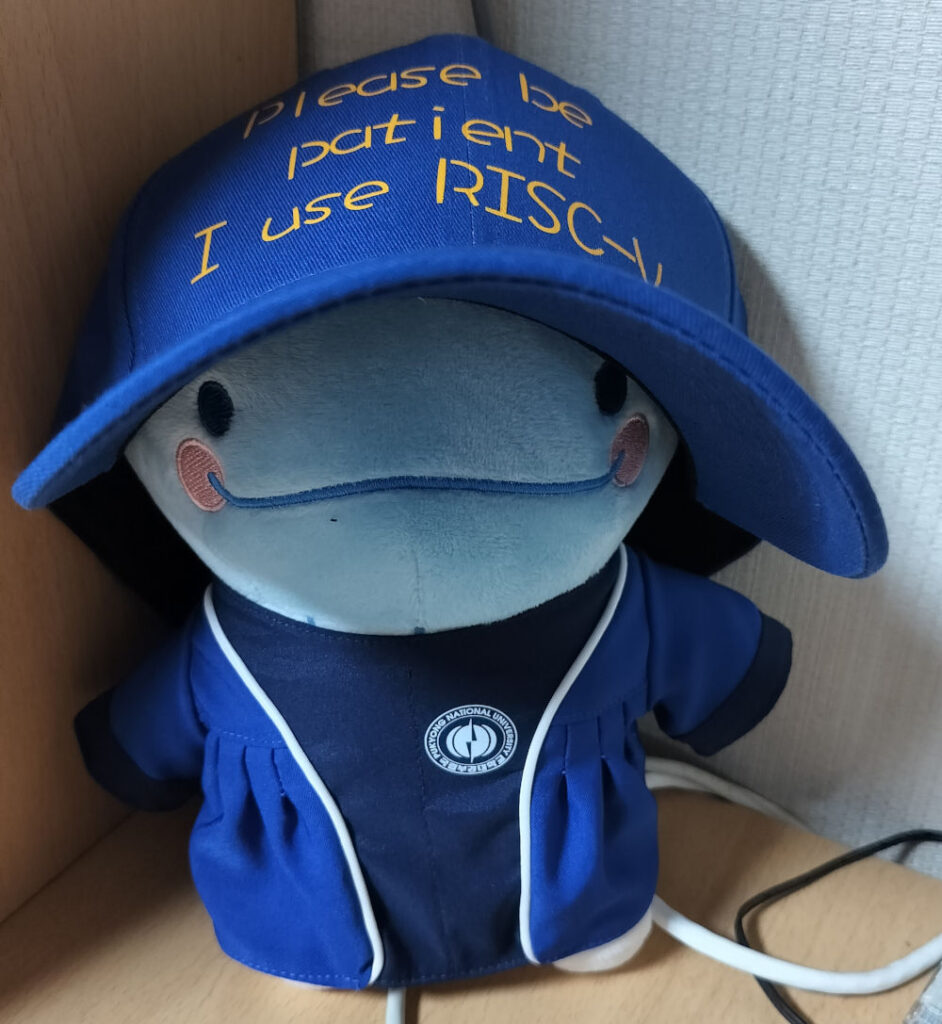
Baekyongee is the university mascot, who s visible throughout the university. So of course we included this four legged whale creature on the loop too!

Packaging I was hoping to do more packaging during DebCamp, but at least it was a non-zero amount:
  • Uploaded gdisk 1.0.10-2 to unstable (previously tested effects of adding dh-sequence-movetousr) (Closes: #1073679).
  • Worked a bit on bcachefs-tools (updating git to 1.9.4), but has a build failure that I need to look into (we might need a newer bindgen) update: I m probably going to ROM this package soon, it doesn t seem suitable for packaging in Debian.
  • Calamares: Tested a fix for encrypted installs, and uploaded it.
  • Calamares: Uploaded (3.3.8-1) to backports (at the time of writing it s still in backports-NEW).
  • Backport obs-gradient-source for bookworm.
  • Did some initial packaging on Cambalache, I ll upload to unstable once wlroots (0.18) hits unstable.
  • Pixelorama 1.0 I did some initial packaging for Pixelorama back when we did the MiniDebConf Gaming Edition, but it had a few stoppers back then. Version 1.0 seems to fix all of that, but it depends on Godot 4.2 and we re still on the 3 series in Debian, so I ll upload this once Godot 4.2 hits at least experimental. Godot software/games is otherwise quite easy to run, it s basically just source code / data that is installed and then run via godot-runner (godot3-runner package in Debian).

BoFs Python Team BoF Link to the etherpad / pad archive link and video can be found on the talk page: https://debconf24.debconf.org/talks/31-python-bof/ The session ended up being extended to a second part, since all the issues didn t fit into the first session. I was distracted by too many thing during the Python 3.12 transition (to the point where I thought that 3.11 was still new in Debian), so it was very useful listening to the retrospective of that transition. There was a discussion whether Python 3.13 could still make it to testing in time for freeze, and it seems that there is consensus that it can, although, likely with new experimental features like disabling the global interpreter lock and the just in time compiler disabled. I learned for the first time about the dead batteries project, PEP-0594, which removes ancient modules that have mostly been superseded, from the Python standard library. There was some talk about the process for changing team policy, and a policy discussion on whether we should require autopkgtests as a SHOULD or a MUST for migration to testing. As with many things, the devil is in the details and in my opinion you could go either way and achieve a similar result (the original MUST proposal allowed exceptions which imho made it the same as the SHOULD proposal). There s an idea to do some ongoing remote sprints, like having co-ordinated days for bug squashing / working on stuff together. This is a nice idea and probably a good way to energise the team and also to gain some interest from potential newcomers. Louis-Philipe V ronneau was added as a new team admin and there was some discussion on various Sphinx issues and which Lintian tags might be needed for Python 3.13. If you want to know more, you probably have to watch the videos / read the notes :)
    Debian.net BoF Link to the etherpad / pad archive link can be found on the talk page: https://debconf24.debconf.org/talks/37-debiannet-team-bof Debian Developers can set up services on subdomains on debian.net, but a big problem we ve had before was that developers were on their own for hosting those services. This meant that they either hosted it on their DSL/fiber connection at home, paid for the hosting themselves, or hosted it at different services which became an accounting nightmare to claim back the used funds. So, a few of us started the debian.net hosting project (sometimes we just call it debian.net, this is probably a bit of a bug) so that Debian has accounts with cloud providers, and as admins we can create instances there that gets billed directly to Debian. We had an initial rush of services, but requests have slowed down since (not really a bad thing, we don t want lots of spurious requests). Last year we did a census, to check which of the instances were still used, whether they received system updates and to ask whether they are performing backups. It went well and some issues were found along the way, so we ll be doing that again. We also gained two potential volunteers to help run things, which is great. Debian Social BoF Link to the etherpad / pad archive link can be found on the talk page: https://debconf24.debconf.org/talks/34-debiansocial-bof We discussed the services we run, you can view the current state of things at: https://wiki.debian.org/Teams/DebianSocial Pleroma has shown some cracks over the last year or so, and there are some forks that seem promising. At the same time, it might be worth while considering Mastodon too. So we ll do some comparison of features and maintenance and find a way forward. At the time when Pleroma was installed, it was way ahead in terms of moderation features. Pixelfed is doing well and chugging along nicely, we should probably promote it more. Peertube is working well, although we learned that we still don t have all the recent DebConf videos on there. A bunch of other issues should be fixed once we move it to a new machine that we plan to set up. We re removing writefreely and plume. Nice concepts, but it didn t get much traction yet, and no one who signed up for these actually used it, which is fine, some experimentation with services is good and sometimes they prove to be very popular and other times not. The WordPress multisite instance has some mild use, otherwise haven t had any issues. Matrix ended up to be much, much bigger than we thought, both in usage and in its requirements. It s very stateful and remembers discussions for as long as you let it, so it s Postgres database is continuously expanding, this will also be a lot easier to manage once we have this on the new host. Jitsi is also quite popular, but it could probably be on jitsi.debian.net instead (we created this on debian.social during the initial height of COVID-19 where we didn t have the debian.net hosting yet), although in practice it doesn t really matter where it lives. Most of our current challenges will be solved by moving everything to a new big machine that has a few public IPs available for some VMs, so we ll be doing that shortly. Debian Foundation Discussion BoF This was some brainstorming about the future structure of Debian, and what steps might be needed to get there. It s way too big a problem to take on in a BoF, but we made some progress in figuring out some smaller pieces of the larger puzzle. The DPL is going to get in touch with some legal advisors and our trusted organisations so that we can aim to formalise our relationships a bit more by the time it s DebConf again. I also introduced my intention to join the Debian Partners delegation. When I was DPL, I enjoyed talking with external organisations who wanted to help Debian, but helping external organisations help Debian turned out to be too much additional load on the usual DPL roles, so I m pursuing this with the Debian Partners team, more on that some other time. This session wasn t recorded, but if you feel like you missed something, don t worry, all intentions will be communicated and discussed with project members before anything moves forward. There was a strong agreement in the room though that we should push forward on this, and not reach another DebConf where we didn t make progress on formalising Debian s structure more.

    Social Conference Dinner
    Conference Dinner Photo from Santiago
    The conference dinner took place in the university gymnasium. I hope not many people do sports there in the summer, because it got HOT. There was also some interesting observations on the thermodynamics of the attempted cooling solutions, which was amusing. On the plus side, the food was great, the company was good, and the speeches were kept to a minimum, so it was a great conference dinner, even though it was probably cut a bit short due to the heat. Cheese and Wine Cheese and Wine happened on 1 August, which happens to be the date I became a DD at DebConf17 in Montr al seven years before, so this was a nice accidental celebration of my Debiversary :) Since I m running out of time, I ll add some more photos to this post some time after publishing it :P Group Photo As per DebConf tradition, Aigars took the group photo. You can find the high resolution version on Debian s GitLab instance.
    Debian annual conference Debconf 24, Busan, South Korea
    Photography: Aigars Mahinovs aigarius@debian.org
    License: CC-BYv3+ or GPLv2+
    Talking Ah yes, talking to people is a big part of DebConf, but I didn t keep track of it very well.
    • I mostly listened to Alper a bit about his ideas for his talk about debian installer.
    • I talked to Rhonda a bit about ActivityPub and MQTT and whether they could be useful for publicising Debian activity.
    • Listened to Gunnar and Julian have a discussion about GPG and APT which was interesting.
    • I learned that you can learn Hangul, the Korean alphabet, in about an hour or so (I wish I knew that in all my years of playing StarCraft II).
    • We had the usual continuous keysigning party. Besides it s intended function, this is always a good ice breaker and a way to for shy people to meet other shy people.
    • and many other fly-by discussions.

    Stuff that didn t happen this DebConf
    • loo.py A simple Python script that could eventually replace the obs-advanced-scene-switcher sequencer in OBS. It would also be extremely useful if we d ever replace OBS for loopy. I was hoping to have some time to hack on this, and try to recreate the current loopy in loo.py, but didn t have the time.
    • toetally This year videoteam had to scramble to get a bunch of resistors to assemble some tally light. Even when assembled, they were a bit troublesome. It would ve been nice to hack on toetally and get something ready for testing, but it mostly relies on having something like a rasbperry pi zero with an attached screen in order to work on further. I ll try to have something ready for the next mini conf though.
    • extrepo on debian live I think we should have extrepo installed by default on desktop systems, I meant to start a discussion on this, but perhaps it s just time I go ahead and do it and announce it.
    • Live stream to peertube server It would ve been nice to live stream DebConf to PeerTube, but the dependency tree to get this going got a bit too huge. Following our plans discussed in the Debian Social BoF, we should have this safely ready before the next MiniDebConf and should be able to test it there.
    • Desktop Egg there was this idea to get a stand-in theme for Debian testing/unstable until the artwork for the next release is finalized (Debian bug: #1038660), I have an idea that I meant to implement months ago, but too many things got in the way. It s based on Juliette Taka s Homeworld theme, and basically transforms the homeworld into an egg. Get it? Something that hasn t hatched yet? I also only recently noticed that we never used the actual homeworld graphics (featuring the world image) in the final bullseye release. lol.
    So, another DebConf and another new plush animal. Last but not least, thanks to PKNU for being such a generous and fantastic host to us! See you again at DebConf25 in Brest, France next year!

      2 August 2024

      Colin Watson: Free software activity in July 2024

      My Debian contributions this month were all sponsored by Freexian. You can also support my work directly via Liberapay. OpenSSH At the start of the month, I uploaded a quick fix (via Salvatore Bonaccorso) for a regression from CVE-2006-5051, found by Qualys; this was because I expected it to take me a bit longer to merge OpenSSH 9.8, which had the full fix. This turned out to be a good guess: it took me until the last day of the month to get the merge done. OpenSSH 9.8 included some substantial changes to split the server into a listener binary and a per-session binary, which required some corresponding changes in the GSS-API key exchange patch. At this point I was very grateful for the GSS-API integration test contributed by Andreas Hasenack a little while ago, because otherwise I might very easily not have noticed my mistake: this patch adds some entries to the key exchange algorithm proposal, and on the server side I d accidentally moved that to after the point where the proposal is sent to the client, which of course meant it didn t work at all. Even with a failing test, it took me quite a while to spot the problem, involving a lot of staring at strace output and comparing debug logs between versions. There are still some regressions to sort out, including a problem with socket activation, and problems in libssh2 and Twisted due to DSA now being disabled at compile-time. Speaking of DSA, I wrote a release note for this change, which is now merged. GCC 14 regressions I fixed a number of build failures with GCC 14, mostly in my older packages: grub (legacy), imaptool, kali, knews, and vigor. autopkgtest I contributed a change to allow maintaining Incus container and VM images in parallel. I use both of these regularly (containers are faster, but some tests need full machine isolation), and the build tools previously didn t handle that very well. I now have a script that just does this regularly to keep my images up to date (although for now I m running this with PATH pointing to autopkgtest from git, since my change hasn t been released yet):

      RELEASE=sid autopkgtest-build-incus images:debian/trixie
      RELEASE=sid autopkgtest-build-incus --vm images:debian/trixie
      
      Python team I fixed dnsdiag s uninstallability in unstable, and contributed the fix upstream. I reverted python-tenacity to an earlier version due to regressions in a number of OpenStack packages, including octavia and ironic. (This seems to be due to #486 upstream.) I fixed a build failure in python3-simpletal due to Python 3.12 removing the old imp module. I added non-superficial autopkgtests to a number of packages, including httmock, py-macaroon-bakery, python-libnacl, six, and storm. I switched a number of packages to build using PEP 517 rather than calling setup.py directly, including alembic, constantly, hyperlink, isort, khard, python-cpuinfo, and python3-onelogin-saml2. (Much of this was by working through the missing-prerequisite-for-pyproject-backend Lintian tag, but there s still lots to do.) I upgraded frozenlist, ipykernel, isort, langtable, python-exceptiongroup, python-launchpadlib, python-typeguard, pyupgrade, sqlparse, storm, and uncertainties to new upstream versions. In the process, I added myself to Uploaders for isort, since the previous primary uploader has retired. Other odds and ends I applied a suggestion by Chris Hofstaedtler to create /etc/subuid and /etc/subgid in base-passwd, since the login package is no longer essential. I fixed a wireless-tools regression due to iproute2 dropping its (/usr)/sbin/ip compatibility symlink. I applied a suggestion by Petter Reinholdtsen to add AppStream metainfo to pcmciautils.

      1 August 2024

      Guido G nther: Free Software Activities July 2024

      A short status update on what happened on my side last month. Looking at unified push support for Chatty prompted some libcmatrix fixes and Chatty improvements (benefiting other protocols like SMS/MMS as well). The Bluetooth status page in Phosh was a slightly larger change code wise as we also enhanced our common widgets for building status pages, simplifying the Wi-Fi status page and making future status pages simpler. But as usual investigating bugs, reviewing patches (thanks!) and keeping up with the changing world around us is what ate most of the time. Phosh A Wayland Shell for mobile devices Phoc A Wayland compositor for mobile devices libphosh-rs Phosh Rust bindings phosh-osk-stub A on screen keyboard for Phosh phosh-mobile-settings phosh-wallpapers Wallpapers, Sounds and other artwork git-buildpackage Suite to help with Debian packages in Git repositories Whatmaps Tool to find processes mapping shared objects Debian The universal operating system Mobian A Debian derivative for mobile devices Calls PSTN and SIP calls for GNOME Livi Minimalistic video player targeting mobile devices libcall-ui Common user interface parts for call handling in GNOME and Phosh. feedbackd DBus service for haptic/visual/audio feedback Chatty Messaging application for mobile and desktop libcmatrix A matrix client client library Eigenvalue A libcmatrix test client Help Development If you want to support my work see donations. This includes list of hardware we want to improve support for.

      31 July 2024

      Russ Allbery: Review: The Book That Wouldn't Burn

      Review: The Book That Wouldn't Burn, by Mark Lawrence
      Series: Library Trilogy #1
      Publisher: Ace
      Copyright: 2023
      ISBN: 0-593-43793-4
      Format: Kindle
      Pages: 561
      The Book That Wouldn't Burn is apparently high fantasy, but of the crunchy sort that could easily instead be science fiction. It is the first of a trilogy. Livira is a young girl, named after a weed, who lives in a tiny settlement in the Dust. She is the sort of endlessly curious and irrepressible girl who can be more annoying than delightful to adults who are barely keeping everyone alive. Her settlement is not the sort of place that's large enough to have a name; only their well keeps them alive in the desert and the ever-present dust. There is a city somewhere relatively near, which Livira dreams of seeing, but people from the settlement don't go there. When someone is spotted on the horizon approaching the settlement, it's the first time Livira has ever seen a stranger. It's also not a good sign. There's only one reason for someone to seek them out in the Dust: to take. Livira and the other children are, in short order, prisoners of the humanoid dog-like sabbers, being dragged off to an unknown fate. Evar lives in the library and has for his entire life. Specifically, he lives in a square room two miles to a side, with a ceiling so high that it may as well be a stone sky. He lived there with his family before he was lost in the Mechanism. Years later, the Mechanism spit him out alongside four other similarly-lost kids, all from the same library in different times. None of them had apparently aged, but everyone else was dead. Now, years later, they live a strange and claustrophobic life with way too much social contact between way too few people. Evar's siblings, as he considers them, were each in the Mechanism with a book. During their years in the Mechanism they absorbed that book until it became their focus and to some extent their personality. His brothers are an assassin, a psychologist, and a historian. His sister, the last to enter the Mechanism and a refugee from the sabber attack that killed everyone else, is a warrior. Evar... well, presumably he had a book, since that's how the Mechanism works. But he can't remember anything about it except the feeling that there was a woman. Evar lives in a library in the sense that it's a room full of books, but those books are not on shelves. They're stacked in piles and massive columns, with no organizational system that any of them could discern. There are four doors, all of which are closed and apparently impenetrable. In front of one of them is a hundred yards of char and burned book remnants, but that door is just as impenetrable as the others. There is a pool in the center of the room, crops surrounding it, and two creatures they call the Soldier and the Assistant. That is the entirety of Evar's world. As you might guess from the title, this book is about a library. Evar's perspective of the library is quite odd and unexplained until well into the book, and Livira's discovery of the library and subsequent explorations are central to her story, so I'm going to avoid going into too many details about its exact nature. What I will say is that I have read a lot of fantasy novels that are based around a library, but I don't think I've ever read one that was this satisfying. I think the world of The Book That Wouldn't Burn is fantasy, in that there are fundamental aspects of this world that don't seem amenable to an explanation consistent with our laws of physics. It is, however, the type of fantasy with discoverable rules. Even better, it's the type of fantasy where discovering the rules is central to the story, for both the characters and the readers, and the rules are worth the effort. This is a world-building tour de force: one of the most engrossing and deeply satisfying slow revelations that I have read in a long time. This book is well over 500 pages, the plot never flags, new bits of understanding were still slotting into place in the last chapter, and there are lots of things I am desperately curious about that Lawrence left for the rest of the series. If you like puzzling out the history and rules of an invented world and you have anything close to my taste in characters and setting, you are going to love this book. (Also, there is at least one C.S. Lewis homage that I will not spoil but that I thought was beautifully done and delightfully elaborated, and I am fairly sure there is a conversation happening between this book and Philip Pullman's His Dark Materials series that I didn't quite untangle but that I am intrigued by.) I do need to offer a disclaimer: Livira is precisely the type of character I love reading about. She's stubborn, curious, courageous, persistent, egalitarian, insatiable, and extremely sharp. I have a particular soft spot for exactly this protagonist, so adjust the weight of my opinion accordingly. But Lawrence also makes excellent use of her as a spotlight to illuminate the world-building. More than anything else in the world, Livira wants to understand, and there is so much here to understand. There is an explanation for nearly everything in this book, and those explanations usually both make sense and prompt more questions. This is such a tricky balance for the writer to pull off! A lot of world-building of this sort fails either by having the explanations not live up to the mysteries or by tying everything together so neatly that the stakes of the world collapse into a puzzle box. Lawrence avoids both failures. This world made sense to me but remained sufficiently messy to feel like humans were living in it. I also thought the pacing and timing were impeccable: I figured things out at roughly the same pace as the characters, and several twists and turns caught me entirely by surprise. I do have one minor complaint and one caveat. The minor complaint is that I thought one critical aspect of the ending was a little bit too neat and closed. It was the one time in the book where I thought Lawrence simplified his plot structure rather than complicated it, and I didn't like the effect it had on the character dynamics. There is, thankfully, the promise of significant new complications in the next book. The caveat is a bit harder to put my finger on, but a comparison to Alaya Dawn Johnson's The Library of Broken Worlds might help. That book was also about a library, featured a protagonist thrown into the deep end of complex world-building, and put discovery of the history and rules at the center of the story. I found the rules structure of The Book That Wouldn't Burn more satisfyingly complicated and layered, in a way that made puzzle pieces fit together in my head in a thoroughly enjoyable way. But Johnson's book is about very large questions of identity, history, sacrifice, and pain, and it's full of murky ambiguity and emotions that are only approached via metaphor and symbolism. Lawrence's book is far more accessible, but the emotional themes are shallower and more straightforward. There is a satisfying emotional through-line, and there are some larger issues at stake, but it won't challenge your sense of morality and justice the way that The Library of Broken Worlds might. I think which of those books one finds better will depend on what mood you're in and what reading experience you're looking for. Personally, I was looking for a scrappy, indomitable character who would channel her anger into overcoming every obstacle in the way of thoroughly understanding her world, and that's exactly what I got. This was my most enjoyable reading experience of the year to date and the best book I've read since Some Desperate Glory. Fantastic stuff, highly recommended. Followed by The Book That Broke the World, and the ending is a bit of a cliffhanger so you may want to have that on hand. Be warned that the third book in the series won't be published until 2025. Rating: 9 out of 10

      Matthew Palmer: Health Industry Company Sues to Prevent Certificate Revocation

      It s not often that a company is willing to make a sworn statement to a court about how its IT practices are incompatible with the needs of the Internet, but when they do it s popcorn time.
      The Combatants In the red corner, weighing in at nah, I m not going to do that schtick. The plaintiff in the case is Alegeus Technologies, LLC, a Delaware Corporation that, according to their filings, is a leading provider of a business-tobusiness, white-label funding and payment platform for healthcare carriers and third-party administrators to administer consumer-directed employee benefit programs . Not being subject to the US bonkers health care system, I have only a passing familiarity with the sorts of things they do, but presumably it involves moving a lot of money around, which is sometimes important. The defendant is DigiCert, a CA which, based on analysis I ve done previously, is the second-largest issuer of WebPKI certificates by volume.

      The History According to a recently opened Mozilla CA bug, DigiCert found an issue in their domain control validation workflow, that meant it may have been possible for a miscreant to have certificates issued to them that they weren t legitimately entitled to. Given that validating domain names is basically the YOU HAD ONE JOB! of a CA, this is a big deal. The CA/Browser Forum Baseline Requirements (BRs) (which all CAs are required to adhere to, by virtue of their being included in various browser and OS trust stores), say that revocation is required within 24 hours when [t]he CA obtains evidence that the validation of domain authorization or control for any Fully Qualified Domain Name or IP address in the Certificate should not be relied upon (section 4.9.1.1, point 5). DigiCert appears to have at least tried to do the right thing, by opening the above Mozilla bug giving some details of the problem, and notifying their customers that their certificates were going to be revoked. One may quibble about how fast they re doing it, but they re giving it a decent shot, at least. A complicating factor in all this is that, only a touch over a month ago, Google Chrome announced the removal of another CA, Entrust, from its own trust store program, citing a pattern of compliance failures, unmet improvement commitments, and the absence of tangible, measurable progress in response to publicly disclosed incident reports . Many of these compliance failures were failures to revoke certificates in a timely manner. One imagines that DigiCert would not like to gain a reputation for tardy revocation, particularly at the moment.

      The Legal Action Now we come to Alegeus Technologies. They ve opened a civil case whose first action is to request the issuance of a Temporary Restraining Order (TRO) that prevents DigiCert from revoking certificates issued to Alegeus (which the court has issued). This is a big deal, because TROs are legal instruments that, if not obeyed, constitute contempt of court (or something similar) and courts do not like people who disregard their instructions. That means that, in the short term, those certificates aren t getting revoked, despite the requirement imposed by root stores on DigiCert that the certificates must be revoked. DigiCert is in a real rock / hard place situation here: revoke and get punished by the courts, or don t revoke and potentially (though almost certainly not, in the circumstances) face removal from trust stores (which would kill, or at least massively hurt, their business). The reasons that Alegeus gives for requesting the restraining order is that [t]o Reissue and Reinstall the Security Certificates, Alegeus must work with and coordinate with its Clients, who are required to take steps to rectify the certificates. Alegeus has hundreds of such Clients. Alegeus is generally required by contract to give its clients much longer than 24 hours notice before executing such a change regarding certification. In the filing, Alegeus does acknowledge that DigiCert is a voluntary member of the Certification Authority Browser Forum (CABF), which has bylaws stating that certificates with an issue in their domain validation must be revoked within 24 hours. This is a misstatement of the facts, though. It is the BRs, not the CABF bylaws, that require revocation, and the BRs apply to all CAs that wish to be included in browser and OS trust stores, not just those that are members of the CABF. In any event, given that Alegeus was aware that DigiCert is required to revoke certificates within 24 hours, one wonders why Alegeus went ahead and signed agreements with their customers that required a lengthy notice period before changing certificates. What complicates the situation is that there is apparently a Master Services Agreement (MSA) that states that it constitutes the entire agreement between the parties and that MSA doesn t mention certificate revocation anywhere relevant. That means that it s not quite so cut-and-dried that DigiCert does, in fact, have the right to revoke those certificates. I d expect a lot of update to your Master Services Agreement emails to be going out from DigiCert (and other CAs) in the near future to clarify this point. Not being a lawyer, I can t imagine which way this case might go, but there s one thing we can be sure of: some lawyers are going to able to afford that trip to a tropical paradise this year.

      The Security Issues The requirement for revocation within 24 hours is an important security control in the WebPKI ecosystem. If a certificate is misissued to a malicious party, or is otherwise compromised, it needs to be marked as untrustworthy as soon as possible. While revocation is far from perfect, it is the best tool we have. In this court filing, Alegeus has claimed that they are unable to switch certificates with less than 24 hours notice (due to contractual SLAs ). This is a pretty big problem, because there are lots of reasons why a certificate might need to be switched out Very Quickly. As a practical example, someone with access to the private key for your SSL certificate might decide to use it in a blog post. Letting that sort of problem linger for an extended period of time might end up being a Pretty Big Problem of its own. An organisation that cannot respond within hours to a compromised certificate is playing chicken with their security.

      The Takeaways Contractual obligations that require you to notify anyone else of a certificate (or private key) changing are bonkers, and completely antithetical to the needs of the WebPKI. If you have to have them, you re going to want to start transitioning to a private PKI, wherein you can do whatever you darn well please with revocation (or not). As these sorts of problems keep happening, trust stores (and hence CAs) are going to crack down on this sort of thing, so you may as well move sooner rather than later. If you are an organisation that uses WebPKI certificates, you ve got to be able to deal with any kind of certificate revocation event within hours, not days. This basically boils down to automated issuance and lifecycle management, because having someone manually request and install certificates is terrible on many levels. There isn t currently a completed standard for notifying subscribers if their certificates need premature renewal (say, due to needing to be revoked), but the ACME Renewal Information Extension is currently being developed to fill that need. Ask your CA if they re tracking this standards development, and when they intend to have the extension available for use. (Pro-tip: if they say we ll start doing development when the RFC is published , run for the hills; that s not how responsible organisations work on the Internet).

      The Givings If you ve found this helpful, consider shouting me a refreshing beverage. Reading through legal filings is thirsty work!

      30 July 2024

      Lukas M rdian: Creating a Netplan enabled system through Debian-Installer

      With the work that has been done in the debian-installer/netcfg merge-proposal !9 it is possible to install a standard Debian system, using the normal Debian-Installer (d-i) mini.iso images, that will come pre-installed with Netplan and all network configuration structured in /etc/netplan/. In this write-up, I d like to run you through a list of commands for experiencing the Netplan enabled installation process first-hand. Let s start with preparing a working directory and installing the software dependencies for our virtualized Debian system:
      $ mkdir d-i_tmp && cd d-i_tmp
      $ apt install ovmf qemu-utils qemu-system-x86
      Now let s download the official (daily) mini.iso, linux kernel image and initrd.gz containing the Netplan enablement changes:
      $ wget https://d-i.debian.org/daily-images/amd64/daily/netboot/gtk/mini.iso
      $ wget https://d-i.debian.org/daily-images/amd64/daily/netboot/gtk/debian-installer/amd64/initrd.gz
      $ wget https://d-i.debian.org/daily-images/amd64/daily/netboot/gtk/debian-installer/amd64/linux
      Next we ll prepare a VM, by copying the EFI firmware files, preparing some persistent EFIVARs file, to boot from FS0:\EFI\debian\grubx64.efi, and create a virtual disk for our machine:
      $ cp /usr/share/OVMF/OVMF_CODE_4M.fd .
      $ cp /usr/share/OVMF/OVMF_VARS_4M.fd .
      $ qemu-img create -f qcow2 ./data.qcow2 20G
      Finally, let s launch the debian-installer using a preseed.cfg file, that will automatically install Netplan (netplan-generator) for us in the target system. A minimal preseed file could look like this:
      # Install minimal Netplan generator binary
      d-i preseed/late_command string in-target apt-get -y install netplan-generator
      For this demo, we re installing the full netplan.io package (incl. the interactive Python CLI), as well as the netplan-generator package and systemd-resolved, to show the full Netplan experience. You can choose the preseed file from a set of different variants to test the different configurations: We re using the linux kernel and initrd.gz here to be able to pass the preseed URL as a parameter to the kernel s cmdline directly. Launching this VM should bring up the official debian-installer in its netboot/gtk form:
      $ export U=https://people.ubuntu.com/~slyon/d-i/netplan-preseed+full.cfg
      $ qemu-system-x86_64 \
      	-M q35 -enable-kvm -cpu host -smp 4 -m 2G \
      	-drive if=pflash,format=raw,unit=0,file=OVMF_CODE_4M.fd,readonly=on \
      	-drive if=pflash,format=raw,unit=1,file=OVMF_VARS_4M.fd,readonly=off \
      	-device qemu-xhci -device usb-kbd -device usb-mouse \
      	-vga none -device virtio-gpu-pci \
      	-net nic,model=virtio -net user \
      	-kernel ./linux -initrd ./initrd.gz -append "url=$U" \
      	-hda ./data.qcow2 -cdrom ./mini.iso;
      Now you can click through the normal Debian-Installer process, using mostly default settings. Optionally, you could play around with the networking settings, to see how those get translated to /etc/netplan/ in the target system.
      After you confirmed your partitioning changes, the base system gets installed. I suggest not to select any additional components, like desktop environments, to speed up the process.
      During the final step of the installation (finish-install.d/55netcfg-copy-config) d-i will detect that Netplan was installed in the target system (due to the preseed file provided) and opt to write its network configuration to /etc/netplan/ instead of /etc/network/interfaces or /etc/NetworkManager/system-connections/.
      Done! After the installation finished, you can reboot into your virgin Debian Sid/Trixie system. To do that, quit the current Qemu process, by pressing Ctrl+C and make sure to copy over the EFIVARS.fd file that was modified by grub during the installation, so Qemu can find the new system. Then reboot into the new system, not using the mini.iso image any more:
      $ cp ./OVMF_VARS_4M.fd ./EFIVARS.fd
      $ qemu-system-x86_64 \
              -M q35 -enable-kvm -cpu host -smp 4 -m 2G \
              -drive if=pflash,format=raw,unit=0,file=OVMF_CODE_4M.fd,readonly=on \
              -drive if=pflash,format=raw,unit=1,file=EFIVARS.fd,readonly=off \
              -device qemu-xhci -device usb-kbd -device usb-mouse \
              -vga none -device virtio-gpu-pci \
              -net nic,model=virtio -net user \
              -drive file=./data.qcow2,if=none,format=qcow2,id=disk0 \
              -device virtio-blk-pci,drive=disk0,bootindex=1
              -serial mon:stdio
      Finally, you can play around with your Netplan enabled Debian system! As you will find, /etc/network/interfaces exists but is empty, it could still be used (optionally/additionally). Netplan was configured in /etc/netplan/ according to the settings given during the d-i installation process.
      In our case, we also installed the Netplan CLI, so we can play around with some of its features, like netplan status:
      Thank you for following along the Netplan enabled Debian installation process and happy hacking! If you want to learn more, find us at GitHub:netplan.

      28 July 2024

      Scarlett Gately Moore: KDE Snaps, Kubuntu, Debian updates and Oh no, not again..

      This week our family suffered another loss with my brother in-law. We will miss him dearly. On our way down to Phoenix to console our nephew that just lost his dad our car blew up. Last week we were in a roll over accident that totaled our truck and left me with a broken arm. We are now in great need of a new vehicle. Please consider donating to this fund: https://gofund.me/033eb25d . Kubuntu is out of money and I am between work packages with the project . We are 50 miles away from the closest town for supplies, essentials such as water requires a vehicle. I have had bad years before ( covid ) in which I lost my beloved job at Blue Systems. I made a vow to myself to never let my personal life affect my work again. I have so far kept that promise to myself and without further ado I present to you my work. Kubuntu: Debian: KDE Snaps: Please note: for the most part the Qt6 snaps are in edge except the few in the project that are heavily tested. Please help test the edge snaps so I can promote them. WIP Snaps or MR s made Please note that 95% of the snaps are free-time work. The project covers 5. I am going as fast as I can between Kubuntu/Debian and the project commitments. Not to mention I have only one arm! My GSOC student is also helping which you can read all about here: https://soumyadghosh.github.io/website/interns/gsoc-2024/gsoc-week-3-week-7/ There is still much work to do in Kubuntu to be Plasma 6 ready for Oracular and they are out of funds. I will still continue my work regardless, but please consider donating until we can procure a consistent flow of funding : https://kubuntu.org/donate/ Thank you for reading and have a blessed day!

      Next.

      Previous.