Most of my Debian contributions this month were
sponsored by Freexian.
You can also support my work directly via
Liberapay.
OpenSSH
OpenSSH upstream released
9.9p2 with fixes for
CVE-2025-26465 and CVE-2025-26466. I got a heads-up on this in advance from
the Debian security team, and prepared updates for all of testing/unstable,
bookworm (Debian 12), bullseye (Debian 11), buster (Debian 10, LTS), and
stretch (Debian 9, ELTS). jessie (Debian 8) is also still in ELTS for a few
more months, but wasn t affected by either vulnerability.
Although I m not particularly active in the Perl team, I fixed a
libnet-ssleay-perl build failure because
it was blocking openssl from migrating to testing, which in turn was
blocking the above openssh fixes.
I also sent a minor sshd -T
fix upstream, simplified
a number of autopkgtests using the newish Restrictions:
needs-sudo facility, and prepared for
removing the obsolete slogin symlink.
PuTTY
I upgraded to the new upstream version
0.83.
GCC 15 build failures
I fixed build failures with GCC
15 in a few packages:
Python team
A lot of my Python team work is driven by its maintainer
dashboard.
Now that we ve finished the transition to Python 3.13 as the default
version, and inspired by a recent debian-devel thread started by
Santiago, I
thought it might be worth spending a bit of time on the uscan error
section. uscan is typically
scraping upstream web sites to figure out whether new versions are
available, and so it s easy for its configuration to become outdated or
broken. Most of this work is pretty boring, but it can often reveal
situations where we didn t even realize that a Debian package was out of
date. I fixed these packages:
cssutils (this in particular was very out of date due to a new and active
upstream maintainer since 2021)
In bookworm-backports, I updated python-django to 3:4.2.18-1 (issuing
BSA-121)
and added new backports of python-django-dynamic-fixture and
python-django-pgtrigger, all of which are dependencies of
debusine.
I went through all the build failures related to python-click 8.2.0 (which
was confusingly tagged but not fully released
upstream and posted an
analysis.
I fixed or helped to fix various other build/test failures:
A Little Vice is a stand-alone self-published
magical girl novel. It
is the author's first novel.
C is a high school student and frequent near-victim of monster attacks.
Due to the nefarious work of Avaritia Wolf and her allies, his high school
is constantly attacked by Beasts, who are magical corruptions of some
internal desire taken to absurd extremes. Standing in their way are the
Angelic Saints: magical girls who transform into Saint Castitas, Saint
Diligentia, and Saint Temperantia and fight the monsters. The monsters for
some reason seem disposed to pick C as their victim for hostage-taking,
mind control, use as a human shield, and other rather traumatic
activities. He's always rescued by the Saints before any great harm is
done, but in some ways this makes the situation worse.
It is obvious to C that the Saints are his three friends Inessa, Ida, and
Temperance, even though no one else seems able to figure this out despite
the blatant clues. Inessa has been his best friend since childhood when
she was awkward and needed his support. Now, she and his other friends
have become literal heroes, beautiful and powerful and capable, constantly
protecting the school and innocent people, and C is little more than a
helpless burden to be rescued. More than anything else, he wishes he could
be an Angelic Saint like them, but of course the whole idea is impossible.
Boys don't get to be magical girls.
(I'm using he/him pronouns for C in this review because C uses them for
himself for most of the book.)
This is a difficult book to review because it is deeply focused on
portraying a specific internal emotional battle in all of its
sometimes-ugly complexity, and to some extent it prioritizes that
portrayal over conventional story-telling. You have probably already
guessed that this is a transgender coming-out story Elkin's choice of
the magical girl genre was done with deep understanding of its role in
transgender narratives but more than that, it is a transgender
coming-out story of a very specific and closely-observed type. C knows who
he wishes he was, but he is certain that this transformation is absolutely
impossible. He is very deep in a cycle of self-loathing for wanting
something so manifestly absurd and insulting to people who have the
virtues that C does not.
A Little Vice is told in the first person from C's perspective, and
most of this book is a relentless observation of C's anxiety and shame
spiral and reflexive deflection of any possibility of a way out. This is
very well-written: Elkin knows the reader is going to disagree with C's
internalized disgust and hopelessness, knows the reader desperately wants
C to break out of that mindset, and clearly signals in a myriad of adroit
ways that Elkin is on the reader's side and does not agree with C's
analysis. C's friends are sympathetic, good-hearted people, and while
sometimes oblivious, it is obvious to the reader that they're also on the
reader's side and would help C in a heartbeat if they saw an opening. But
much of the point of the book is that it's not that easy, that breaking
out of the internal anxiety spiral is nearly impossible, and that C is
very good at rejecting help, both because he cannot imagine what form it
could take but also because he is certain that he does not deserve it.
In other words, much of the reading experience of this book involves
watching C torture and insult himself. It's all the more effective because
it isn't gratuitous. C's internal monologue sounds exactly like how an
anxiety spiral feels, complete with the sort of half-effective coping
mechanisms, deflections, and emotional suppression one develops to blunt
that type of emotional turmoil.
I normally hate this kind of book. I am a happy ending and competence porn
reader by default. The world is full of enough pain that I don't turn to
fiction to read about more pain. It says a lot about how well-constructed
this book is that I stuck with it. Elkin is going somewhere with the
story, C gets moments of joy and delight along the way to keep the reader
from bogging down completely, and the best parts of the book feel like a
prolonged musical crescendo with suspended chords. There is a
climax coming, but Elkin is going to make you wait for it for far longer
than you want to.
The main element that protects A Little Vice from being too grim is
that it is a genre novel that is very playful about both magical girls and
superhero tropes in general. I've already alluded to one of those
elements: Elkin plays with the Mask Principle (the inability of people to
see through entirely obvious secret identities) in knowing and
entertaining ways. But there are also villains, and that leads me to the
absolutely delightful Avaritia Wolf, who for me was the best character in
this book.
The Angelic Saints are not the only possible approach to magical girl
powers in this universe. There are villains who can perform a similar
transformation, except they embrace a vice rather than a virtue. Avaritia
Wolf embraces the vice of greed. They (Avaritia's pronouns change over the
course of the book) also have a secret identity, which I suspect will be
blindingly obvious to most readers but which I'll avoid mentioning since
it's still arguably a spoiler.
The primary plot arc of this book is an attempt to recruit C to the side
of the villains. The Beasts are drawn to him because he has magical
potential, and the villains are less picky about gender. This initially
involves some creepy and disturbing mind control, but it also brings C
into contact with Avaritia and Avaritia's very specific understanding of
greed. As far as Avaritia is concerned, greed means wanting whatever they
want, for whatever reason they feel like wanting it, and there is
absolutely no reason why that shouldn't include being greedy for their
friends to be happy. Or doing whatever they can to make their friends
happy, whether or not that looks like villainy.
Elkin does two things with this plot that I thought were remarkably
skillful. The first is that she directly examines and then undermines the
"easy" transgender magical girl ending. In a world of transformation
magic, someone who wants to be a girl could simply turn into a girl and
thus apparently resolve the conflict in a way that makes everyone happy. I
think there is an important place for that story (I am a vigorous defender
of escapist fantasy and happy endings), but that is not the story that
Elkin is telling. I won't go into the details of why and how the story
complicates and undermines this easy ending, but it's a lot of why this
book feels both painful and honest to a specific, and very not easy,
transgender experience, even though it takes place in an utterly
unrealistic world.
But the second, which is more happy and joyful, is that Avaritia gleefully
uses a wholehearted embrace of every implication of the vice of greed to
bulldoze the binary morality of the story and question the classification
of human emotions into virtues and vices. They are not a hero, or even all
that good; they have some serious flaws and a very anarchic attitude
towards society. But Avaritia provides the compelling, infectious thrill
of the character who looks at the social construction of morality that is
constraining the story and decides that it's all bullshit and refuses to
comply. This is almost the exact opposite of C's default emotional
position at the start of the book, and watching the two characters play
off of each other in a complex friendship is an absolute delight.
The ending of this book is complicated, messy, and incomplete. It is the
sort of ending that I think could be incredibly powerful if it hits
precisely the right chords with the reader, but if you're not that reader,
it can also be a little heartbreaking because Elkin refuses to provide an
easy resolution. The ending also drops some threads that I wish Elkin
hadn't dropped; there are some characters who I thought deserved a
resolution that they don't get. But this is one of those books where the
author knows exactly what story they're trying to tell and tells it
whether or not that fits what the reader wants. Those books are often not
easy reading, but I think there's something special about them.
This is not the novel for people who want detailed world-building that
puts a solid explanation under events. I thought Elkin did a great job
playing with the conventions of an episodic anime, including starting the
book on Episode 12 to imply C's backstory with monster attacks and hinting
at a parallel light anime story by providing TV-trailer-style plot
summaries and teasers at the start and end of each chapter. There is a
fascinating interplay between the story in which the Angelic Saints are
the protagonists, which the reader can partly extrapolate, and the novel
about C that one is actually reading. But the details of the
world-building are kept at the anime plot level: There's an arch-villain,
a World Tree, and a bit of backstory, but none of it makes that much sense
or turns into a coherent set of rules. This is a psychological novel; the
background and rules exist to support C's story.
If you do want that psychological novel... well, I'm not sure whether to
recommend this book or not. I admire the construction of this book a great
deal, but I don't think appealing to the broadest possible audience was
the goal. C's anxiety spiral is very repetitive, because anxiety spirals
are very repetitive, and you have to be willing to read for the grace
notes on the doom loop if you're going to enjoy this book. The
sentence-by-sentence writing quality is fine but nothing remarkable, and
is a bit shy of the average traditionally-published novel. The main appeal
of A Little Vice is in the deep and unflinching portrayal of a
specific emotional journey. I think this book is going to work if you're
sufficiently invested in that journey that you are willing to read the
brutal and repetitive parts. If you're not, there's a chance you will
bounce off this hard.
I was invested, and I'm glad I read this, but caveat emptor. You
may want to try a sample first.
One final note: If you're deep in the book world, you may wonder, like I
did, if the title is a reference to Hanya Yanagihara's (in)famous A
Little Life. I do not know for certain I have not read that book
because I am not interested in being emotionally brutalized but if it
is, I don't think there is much similarity. Both books are to some extent
about four friends, but I couldn't find any other obvious connections from
some Wikipedia reading, and A Little Vice, despite C's emotional
turmoil, seems to be considerably more upbeat.
Content notes: Emotionally abusive parent, some thoughts of self-harm,
mind control, body dysmorphia, and a lot (a lot) of shame and
self-loathing.
Rating: 7 out of 10
Introduction
This is just a note-taking about how to upgrading Mozc package for up-coming trixie ready (with many restrictions) last year.
Maybe Mozc 2.29.5160.102+dfsg-1.3 will be shipped for Debian 13 (trixie).
FTBFS with Mozc 2.28.4715.102+dfsg-2.2
In May 2024, I've found that Mozc was removed from testing, and still in FTBFS.
#1068186 - mozc: FTBFS with abseil 20230802: ../../base/init_mozc.cc:90:29: error: absl::debian5::flags_internal::ArgvListAction has not been declared - Debian Bug report logs
That FTBFS was fixed in the Mozc upstream, but not applied for a while.
Not only upstream patch, but also additional linkage patch was required to fix it.
Mozc is the de-fact standard input method editor for Japanese.
Most of Japanese uses it by default on linux desktop.
(Even though frontend input method framework is different, the background engine is Mozc in most cases -
uim-mozc for task-japanese-desktop, ibus-mozc for task-japanese-gnome-desktop in Debian)
There is a case that Mozc was re-built locally with integrated external dictionary
to improve quantity of vocabulary. If FTBFS keep ongoing, it means that it blocks such a usage.
So I've sent patches to fix it and they were merged.
Motivation to update Mozc
With fixing #1068186, I've also found Mozc version is not synced to upstream for a long time.
At that time, Mozc in unstable was version 2.28.4715.102+dfsg, but upstream already released 2.30.5544.102.
It seems that Mozc's maintainer was too busy and can't afford to update it, so I've tried to do it.
The blockers for updating Mozc
But, it was not so easy task to do so.
If you want to package latest Mozc, there were many blockers.
Newer Mozc requires Bazel to build, but there is no Bazel package to fit it (There is bazel-bootstrap 4.x, but it's old. v6.x or newer one is required.)
Newer abseil and protobuf were required
Renderer was changed to Qt. GTK renderer was removed
Revise existing patchsets (e.g. for UIM, for Fcitx)
It was not all.
Road to latest Mozc
First, I knew the existence of debian-bazel, so I've posted about bazel-packaging progress.
Any updates about bazel packaging effort?
Sadly there was no response from it.
Thus, it was not realistic to adopt Bazel as build tool chain.
In other words, we need to keep GYP patch and maintain it.
And as another topic, upstream changed renderer from GTK+ to Qt.
Here are the major topics about each release of Mozc.
The internal renderer change are too big, and before GYP deprecation
in 2.29.5544.102, GYP support was already removed gradually.
As a result, target to 2.29.5160.102 was the practical approach to make it forward.
Revisit existing patchsets for 2.28.4715.102+dfsg
Second, need to revisit existing patchset to triage them.
UIM patch was maintained in third-party repository,
and directory structure was quite different from Mozc.
It seems that maintenance activity was too low, so it was not enough that picking changes
from macuim. It was required to fix FTBFS additionally.
Fcitx patch was also maintained in fcitx/mozc.
But it tracks only master branch, so it was hard to pick patchset for specific version of Mozc.
Finally, I could manage to refresh patchset for 2.29.5160.102.
OT: Hardware breakage
There was another blocker to do this task.
I've hit the situation that g++ cause SEGV during building Mozc randomly.
First, I wonder why it fails, but digging further more, finally I've found that
memory module was corrupted. Thus I've lost 32GB memory modules. :-<
Unexpected behaviour in uim-mozc
When uploaded Mozc 2.29.5160.102+dfsg-1 to experimental,
I've found that there is a case that uim-mozc behaves weird.
The candidate words were shown with flickering.
But it was not regression in this upload.
uim-mozc with Wayland cause that problem.
Thus GNOME and derivatives might not be affected because ibus-mozc will be used.
Mozc 2.29.5160.102+dfsg-1
As the patchset was matured, then uploaded 2.29.5160.102+dfsg-1 with --delayed 15 option.
$ dput --delayed 15 mozc_2.29.5160.102+dfsg-1_source.changes
Uploading mozc using ftp to ftp-master (host: ftp.upload.debian.org; directory: /pub/UploadQueue/DELAYED/15-day)
running allowed-distribution: check whether a local profile permits uploads to the target distribution
running protected-distribution: warn before uploading to distributions where a special policy applies
running checksum: verify checksums before uploading
running suite-mismatch: check the target distribution for common errors
running gpg: check GnuPG signatures before the upload
 signfile dsc mozc_2.29.5160.102+dfsg-1.dsc 719EB2D93DBE9C4D21FBA064F7FB75C566ED20E3
 fixup_buildinfo mozc_2.29.5160.102+dfsg-1.dsc mozc_2.29.5160.102+dfsg-1_amd64.buildinfo
 signfile buildinfo mozc_2.29.5160.102+dfsg-1_amd64.buildinfo 719EB2D93DBE9C4D21FBA064F7FB75C566ED20E3
 fixup_changes dsc mozc_2.29.5160.102+dfsg-1.dsc mozc_2.29.5160.102+dfsg-1_source.changes
 fixup_changes buildinfo mozc_2.29.5160.102+dfsg-1_amd64.buildinfo mozc_2.29.5160.102+dfsg-1_source.changes
 signfile changes mozc_2.29.5160.102+dfsg-1_source.changes 719EB2D93DBE9C4D21FBA064F7FB75C566ED20E3
Successfully signed dsc, buildinfo, changes files
Uploading mozc_2.29.5160.102+dfsg-1.dsc
Uploading mozc_2.29.5160.102+dfsg-1.debian.tar.xz
Uploading mozc_2.29.5160.102+dfsg-1_amd64.buildinfo
Uploading mozc_2.29.5160.102+dfsg-1_source.changes
Mozc 2.29.5160.102+dfsg-1 was landed to unstable at 2024-12-20.
Additional bug fixes
Additionally, the following bugs were also fixed.
These bugs were fixed in 2.29.5160.102+dfsg-1.1
And more, I've found that even though missing pristine-tar branch commit, salsa CI succeeds.
I've sent MR for this issue and already merged into.
Note that protobuf 3.25.4 on experimental depends on older absl
20230802, so it must be rebuilt against absl 20240722.0.
And more, we need to consider how to migrate from GTK renderer to
Qt renderer in the future.
I can t remember exactly the joke I was making at the time in my
work s slack instance (I m sure it wasn t particularly
funny, though; and not even worth re-reading the thread to work out), but it
wound up with me writing a UEFI binary for the punchline. Not to spoil the
ending but it worked - no pesky kernel, no messing around with userland . I
guess the only part of this you really need to know for the setup here is that
it was a Severance joke,
which is some fantastic TV. If you haven t seen it, this post will seem perhaps
weirder than it actually is. I promise I haven t joined any new cults. For
those who have seen it, the payoff to my joke is that I wanted my machine to
boot directly to an image of
Kier Eagan.
As for how to do it I figured I d give the uefi
crate a shot, and see how it is to use,
since this is a low stakes way of trying it out. In general, this isn t the
sort of thing I d usually post about except this wound up being easier and
way cleaner than I thought it would be. That alone is worth sharing, in the
hopes someome comes across this in the future and feels like they, too, can
write something fun targeting the UEFI.
First thing s first gotta create a rust project (I ll leave that part to you
depending on your life choices), and to add the uefi crate to your
Cargo.toml. You can either use cargo add or add a line like this by hand:
uefi = version = "0.33", features = ["panic_handler", "alloc", "global_allocator"]
We also need to teach cargo about how to go about building for the UEFI target,
so we need to create a rust-toolchain.toml with one (or both) of the UEFI
targets we re interested in:
Unfortunately, I wasn t able to use the
image crate,
since it won t build against the uefi target. This looks like it s
because rustc had no way to compile the required floating point operations
within the image crate without hardware floating point instructions
specifically. Rust tends to punt a lot of that to libm usually, so this isnt
entirely shocking given we re nostd for a non-hardfloat target.
So-called softening requires a software floating point implementation that
the compiler can use to polyfill (feels weird to use the term polyfill here,
but I guess it s spiritually right?) the lack of hardware floating point
operations, which rust hasn t implemented for this target yet. As a result, I
changed tactics, and figured I d use ImageMagick to pre-compute the pixels
from a jpg, rather than doing it at runtime. A bit of a bummer, since I need
to do more out of band pre-processing and hardcoding, and updating the image
kinda sucks as a result but it s entirely manageable.
This will take our input file (kier.jpg), resize it to get as close to the
desired resolution as possible while maintaining aspect ration, then convert it
from a jpg to a flat array of 4 byte RGBA pixels. Critically, it s also
important to remember that the size of the kier.full.jpg file may not actually
be the requested size it will not change the aspect ratio, so be sure to
make a careful note of the resulting size of the kier.full.jpg file.
Last step with the image is to compile it into our Rust bianary, since we
don t want to struggle with trying to read this off disk, which is thankfully
real easy to do.
Remember to use the width and height from the final kier.full.jpg file as the
values for KIER_WIDTH and KIER_HEIGHT. KIER_PIXEL_SIZE is 4, since we
have 4 byte wide values for each pixel as a result of our conversion step into
RGBA. We ll only use RGB, and if we ever drop the alpha channel, we can drop
that down to 3. I don t entirely know why I kept alpha around, but I figured it
was fine. My kier.full.jpg image winds up shorter than the requested height
(which is also qemu s default resolution for me) which means we ll get a
semi-annoying black band under the image when we go to run it but it ll
work.
Anyway, now that we have our image as bytes, we can get down to work, and
write the rest of the code to handle moving bytes around from in-memory
as a flat block if pixels, and request that they be displayed using the
UEFI GOP. We ll just need to hack up a container
for the image pixels and teach it how to blit to the display.
/// RGB Image to move around. This isn't the same as an
/// image::RgbImage , but we can associate the size of
/// the image along with the flat buffer of pixels.
structRgbImage/// Size of the image as a tuple, as the
/// (width, height)
size: (usize, usize),
/// raw pixels we'll send to the display.
inner: Vec<BltPixel>,
impl RgbImage
/// Create a new RgbImage .
fnnew(width: usize, height: usize) -> Self
RgbImage
size: (width, height),
inner: vec![BltPixel::new(0, 0, 0); width * height],
/// Take our pixels and request that the UEFI GOP
/// display them for us.
fnwrite(&self, gop: &mut GraphicsOutput) -> Result
gop.blt(BltOp::BufferToVideo
buffer: &self.inner,
src: BltRegion::Full,
dest: (0, 0),
dims: self.size,
)
impl Index<(usize, usize)>for RgbImage
typeOutput= BltPixel;
fnindex(&self, idx: (usize, usize)) -> &BltPixellet (x, y) = idx;
&self.inner[y * self.size.0+ x]
impl IndexMut<(usize, usize)>for RgbImage
fnindex_mut(&mut self, idx: (usize, usize)) -> &mut BltPixel
let (x, y) = idx;
&mut self.inner[y * self.size.0+ x]
We also need to do some basic setup to get a handle to the UEFI
GOP via the UEFI crate (using
uefi::boot::get_handle_for_protocol
and
uefi::boot::open_protocol_exclusive
for the GraphicsOutput
protocol), so that we have the object we need to pass to RgbImage in order
for it to write the pixels to the display. The only trick here is that the
display on the booted system can really be any resolution so we need to do
some capping to ensure that we don t write more pixels than the display can
handle. Writing fewer than the display s maximum seems fine, though.
fnpraise() -> Result
let gop_handle = boot::get_handle_for_protocol::<GraphicsOutput>()?;
letmut gop = boot::open_protocol_exclusive::<GraphicsOutput>(gop_handle)?;
// Get the (width, height) that is the minimum of
// our image and the display we're using.
let (width, height) = gop.current_mode_info().resolution();
let (width, height) = (width.min(KIER_WIDTH), height.min(KIER_HEIGHT));
letmut buffer = RgbImage::new(width, height);
for y in0..height
for x in0..width
let idx_r = ((y * KIER_WIDTH) + x) * KIER_PIXEL_SIZE;
let pixel =&mut buffer[(x, y)];
pixel.red = KIER[idx_r];
pixel.green = KIER[idx_r +1];
pixel.blue = KIER[idx_r +2];
buffer.write(&mut gop)?;
Ok(())
Not so bad! A bit tedious we could solve some of this by turning
KIER into an RgbImage at compile-time using some clever Cow and
const tricks and implement blitting a sub-image of the image but this
will do for now. This is a joke, after all, let s not go nuts. All that s
left with our code is for us to write our main function and try and boot
the thing!
#[entry]fnmain() -> Status
uefi::helpers::init().unwrap();
praise().unwrap();
boot::stall(100_000_000);
Status::SUCCESS
If you re following along at home and so interested, the final source is over at
gist.github.com.
We can go ahead and build it using cargo (as is our tradition) by targeting
the UEFI platform.
Testing the UEFI Blob
While I can definitely get my machine to boot these blobs to test, I figured
I d save myself some time by using QEMU to test without a full boot.
If you ve not done this sort of thing before, we ll need two packages,
qemu and ovmf. It s a bit different than most invocations of qemu you
may see out there so I figured it d be worth writing this down, too.
$ doas apt install qemu-system-x86 ovmf
qemu has a nice feature where it ll create us an EFI partition as a drive and
attach it to the VM off a local directory so let s construct an EFI
partition file structure, and drop our binary into the conventional location.
If you haven t done this before, and are only interested in running this in a
VM, don t worry too much about it, a lot of it is convention and this layout
should work for you.
With all this in place, we can kick off qemu, booting it in UEFI mode using
the ovmf firmware, attaching our EFI partition directory as a drive to
our VM to boot off of.
If all goes well, soon you ll be met with the all knowing gaze of
Chosen One, Kier Eagan. The thing that really impressed me about all
this is this program worked first try it all went so boringly
normal. Truly, kudos to the uefi crate maintainers, it s incredibly
well done.
Booting a live system
Sure, we could stop here, but anyone can open up an app window and see a
picture of Kier Eagan, so I knew I needed to finish the job and boot a real
machine up with this. In order to do that, we need to format a USB stick.
BE SURE /dev/sda IS CORRECT IF YOU RE COPY AND PASTING. All my drives
are NVMe, so BE CAREFUL if you use SATA, it may very well be your
hard drive! Please do not destroy your computer over this.
$ doas fdisk /dev/sda
Welcome to fdisk (util-linux 2.40.4).
Changes will remain in memory only, until you decide to write them.
Be careful before using the write command.
Command (m for help): n
Partition type
p primary (0 primary, 0 extended, 4 free)
e extended (container for logical partitions)
Select (default p): p
Partition number (1-4, default 1):
First sector (2048-4014079, default 2048):
Last sector, +/-sectors or +/-size K,M,G,T,P  (2048-4014079, default 4014079):
Created a new partition 1 of type 'Linux' and of size 1.9 GiB.
Command (m for help): t
Selected partition 1
Hex code or alias (type L to list all): ef
Changed type of partition 'Linux' to 'EFI (FAT-12/16/32)'.
Command (m for help): w
The partition table has been altered.
Calling ioctl() to re-read partition table.
Syncing disks.
Once that looks good (depending on your flavor of udev you may or
may not need to unplug and replug your USB stick), we can go ahead
and format our new EFI partition (BE CAREFUL THAT /dev/sda IS YOUR
USB STICK) and write our EFI directory to it.
$ doas mkfs.fat /dev/sda1
$ doas mount /dev/sda1 /mnt
$ cp -r esp/efi /mnt
$ find /mnt
/mnt
/mnt/efi
/mnt/efi/boot
/mnt/efi/boot/bootx64.efi
Of course, naturally, devotion to Kier shouldn t mean backdooring your system.
Disabling Secure Boot runs counter to the Core Principals, such as Probity, and
not doing this would surely run counter to Verve, Wit and Vision. This bit does
require that you ve taken the step to enroll a
MOK and know how
to use it, right about now is when we can use sbsign to sign our UEFI binary
we want to boot from to continue enforcing Secure Boot. The details for how
this command should be run specifically is likely something you ll need to work
out depending on how you ve decided to manage your MOK.
I figured I d leave a signed copy of boot2kier at
/boot/efi/EFI/BOOT/KIER.efi on my Dell XPS 13, with Secure Boot enabled
and enforcing, just took a matter of going into my BIOS to add the right
boot option, which was no sweat. I m sure there is a way to do it using
efibootmgr, but I wasn t smart enough to do that quickly. I let er rip,
and it booted up and worked great!
It was a bit hard to get a video of my laptop, though but lucky for me, I
have a Minisforum Z83-F sitting around (which, until a few weeks ago was running
the annual http server to control my christmas tree
) so I grabbed it out of the christmas bin, wired it up to a video capture
card I have sitting around, and figured I d grab a video of me booting a
physical device off the boot2kier USB stick.
Attentive readers will notice the image of Kier is smaller then the qemu booted
system which just means our real machine has a larger GOP display
resolution than qemu, which makes sense! We could write some fancy resize code
(sounds annoying), center the image (can t be assed but should be the easy way
out here) or resize the original image (pretty hardware specific workaround).
Additionally, you can make out the image being written to the display before us
(the Minisforum logo) behind Kier, which is really cool stuff. If we were real
fancy we could write blank pixels to the display before blitting Kier, but,
again, I don t think I care to do that much work.
But now I must away
If I wanted to keep this joke going, I d likely try and find a copy of the
original
video when Helly 100%s her file
and boot into that or maybe play a terrible midi PC speaker rendition of
Kier, Chosen One, Kier after
rendering the image. I, unfortunately, don t have any friends involved with
production (yet?), so I reckon all that s out for now. I ll likely stop playing
with this the joke was done and I m only writing this post because of how
great everything was along the way.
All in all, this reminds me so much of building a homebrew kernel to boot a
system into but like, good, though, and it s a nice reminder of both how
fun this stuff can be, and how far we ve come. UEFI protocols are light-years
better than how we did it in the dark ages, and the tooling for this is SO
much more mature. Booting a custom UEFI binary is miles ahead of trying to
boot your own kernel, and I can t believe how good the uefi crate is
specifically.
Praise Kier! Kudos, to everyone involved in making this so delightful .
It is a while since I posted a summary of the free software and
open culture activities and projects I have worked on. Here is a
quick summary of the major ones from last year.
I guess the biggest project of the year has been migrating orphaned
packages in Debian without a version control system to have a git
repository on salsa.debian.org. When I started in April around 450
the orphaned packages needed git. I've since migrated around 250 of
the packages to a salsa git repository, and around 40 packages were
left when I took a break. Not sure who did the around 160 conversions
I was not involved in, but I am very glad I got some help on the
project. I stopped partly because some of the remaining packages
needed more disk space to build than I have available on my
development machine, and partly because some had a strange build setup
I could not figure out. I had a time budget of 20 minutes per
package, if the package proved problematic and likely to take longer,
I moved to another package. Might continue later, if I manage to free
up some disk space.
Another rather big project was the translation to Norwegian Bokm l
and publishing of the first book ever published by a S mi woman, the
M ter
vi liv eller d d? book by Elsa Laula, with a PD0 and CC-BY
license. I released it during the summer, and to my surprise it has
already sold several copies. As I suck at marketing, I did not expect
to sell any.
A smaller, but more long term project (for more than 10 years now),
and related to orphaned packages in Debian, is my project to ensure a
simple way to install hardware related packages in Debian when the
relevant hardware is present in a machine. It made a fairly big
advance forward last year, partly because I have been poking and
begging package maintainers and upstream developers to include
AppStream metadata XML in their packages. I've also released a few
new versions of the isenkram system with some robustness improvements.
Today 127 packages in Debian provide such information, allowing
isenkram-lookup to propose them. Will keep pushing until the
around 35 package names currently hard coded in the isenkram package
are down to zero, so only information provided by individual packages
are used for this feature.
As part of the work on AppStream, I have sponsored several packages
into Debian where the maintainer wanted to fix the issue but lacked
direct upload rights. I've also sponsored a few other packages, when
approached by the maintainer.
I would also like to mention two hardware related packages in
particular where I have been involved, the megactl and mfi-util
packages. Both work with the hardware RAID systems in several Dell
PowerEdge servers, and the first one is already available in Debian
(and of course, proposed by isenkram when used on the appropriate Dell
server), the other is waiting for NEW processing since this autumn. I
manage several such Dell servers and would like the tools needed to
monitor and configure these RAID controllers to be available from
within Debian out of the box.
Vaguely related to hardware support in Debian, I have also been
trying to find ways to help out the Debian ROCm team, to improve the
support in Debian for my artificial idiocy (AI) compute node. So far
only uploaded one package, helped test the initial packaging of
llama.cpp and tried to figure out how to get good speech recognition
like Whisper into Debian.
I am still involved in the LinuxCNC project, and organised a
developer gathering in Norway last summer. A new one is planned the
summer of 2025. I've also helped evaluate patches and uploaded new
versions of LinuxCNC into Debian.
After a 10 years long break, we managed to get a new and improved
upstream version of lsdvd released just before Christmas. As
I use it regularly to maintain my DVD archive, I was very happy to
finally get out a version supporting DVDDiscID useful for uniquely
identifying DVDs. I am dreaming of a Internet service mapping DVD IDs
to IMDB movie IDs, to make life as a DVD collector easier.
My involvement in Norwegian archive standardisation and the free
software implementation of the vendor neutral Noark 5 API continued
for the entire year. I've been pushing patches into both the API and
the test code for the API, participated in several editorial meetings
regarding the Noark 5 Tjenestegrensesnitt specification, submitted
several proposals for improvements for the same. We also organised a
small seminar for Noark 5 interested people, and is organising a new
seminar in a month.
Part of the year was spent working on and coordinating a Norwegian
Bokm l translation of the marvellous children's book
Ada and
Zangemann , which focus on the right to repair and control your own
property, and the value of controlling the software on the devices you
own. The translation is mostly complete, and is now waiting for a
transformation of the project and manuscript to use Docbook XML
instead of a home made semi-text based format. Great progress is
being made and the new book build process is almost complete.
I have also been looking at how to companies in Norway can use free
software to report their accounting summaries to the Norwegian
government. Several new regulations make it very hard for companies
to do use free software for accounting, and I would like to change
this. Found a few drafts for opening up the reporting process, and
have read up on some of the specifications, but nothing much is
working yet.
These were just the top of the iceberg, but I guess this blog post
is long enough now. If you would like to help with any of these
projects, please get in touch, either directly on the project mailing
lists and forums, or with me via email, IRC or Signal. :)
As usual, if you use Bitcoin and want to show your support of my
activities, please send Bitcoin donations to my address
15oWEoG9dUPovwmUL9KWAnYRtNJEkP1u1b.
The Scavenger Door is a science fiction adventure and the third
book of the Finder Chronicles. While each of the books of this series
stand alone reasonably well, I would still read the series in order. Each
book has some spoilers for the previous book.
Fergus is back on Earth following the events of Driving the Deep, at loose ends and annoying his relatives. To
get him out of their hair, his cousin sends him into the Scottish hills to
find a friend's missing flock of sheep. Fergus finds things
professionally, but usually not livestock. It's an easy enough job,
though; the lead sheep was wearing a tracker and he just has to get close
enough to pick it up. The unexpected twist is also finding a metal
fragment buried in a hillside that has some strange resonance with the
unwanted gift that Fergus got in Finder.
Fergus's alien friend Ignatio is so alarmed by the metal fragment that he
turns up in person in Fergus's cousin's bar in Scotland. Before he
arrives, Fergus gets a mysteriously infuriating warning visit from alien
acquaintances he does not consider friends. He has, as usual, stepped into
something dangerous and complicated, and now somehow it's become his
problem.
So, first, we get lots of Ignatio, who is an enthusiastic large ball of
green fuzz with five limbs who mostly speaks English but does so from an
odd angle. This makes me happy because I love Ignatio and his tendency to
take things just a bit too literally.
SANTO'S, the sign read. Under it, in smaller letters, was CURIOSITIES
AND INCONVENIENCES FOR COMMENDABLE SUMS.
"Inconveniences sound just like my thing," Fergus said. "You
two want to wait in the car while I check it out?"
"Oh, no, I am not missing this," Isla said, and got out of the podcar.
"I am uncertain," Ignatio said. "I would like some curiouses, but not
any inconveniences. Please proceed while I decide, and if there is
also murdering or calamity or raisins, you will yell right away, yes?"
Also, if your story setup requires a partly-understood alien artifact that
the protagonist can get some explanations for but not have the mystery
neatly solved for them, Ignatio's explanations are perfect.
"It is a door. A doorbell. A... peephole? A key. A control light. A
signal. A stop-and-go sign. A road. A bridge. A beacon. A call. A map.
A channel. A way," Ignatio said. "It is a problem to explain. To say a
doorkey is best, and also wrong. If put together, a path may be
opened."
"And then?"
"And then the bad things on the other side, who we were trying to lock
away, will be free to travel through."
Second, the thing about Palmer's writing that continues to impress me is
her ability to take a standard science fiction plot, one whose variations
I've read probably dozens of times before, and still make it utterly
engrossing. This book is literally a fetch quest. There are a bunch of
scattered fragments, Fergus has to find them and keep them from being
assembled, various other people are after the same fragments, and Fergus
either has to get there first or get the fragments back from them. If you
haven't read this book before, you've played the video game or watched the
movie. The threat is basically a Stargate SG-1 plot. And yet, this
was so much fun.
The characters are great. This book leans less on found family than the
last one and a bit more on actual family. When I started reading this
series, Fergus felt a bit bland in the way that adventure protagonists
sometimes can, but he's fleshed out nicely as the series goes along. He's
not someone who tends to indulge in big emotions, but now the reader can
tell that's because he's the kind of person who finds things to do in
order to keep from dwelling on things he doesn't want to think about. He's
unflappable in a quietly competent way while still having a backstory and
emotional baggage and a rich inner life that the reader sees in glancing
fragments.
We get more of Fergus's backstory, particularly around Mars, but I like
that it's told in anecdotes and small pieces. The last thing Fergus wants
to do is wallow in his past trauma, so he doesn't and finds something to
do instead. There's just enough detail around the edges to deepen his
character without turning the book into a story about Fergus's emotions
and childhood. It's a tricky balancing act that Palmer handles well.
There are also more sentient ships, and I am so in favor of more sentient
ships.
"When I am adding a new skill, I import diagnostic and environmental
information specific to my platform and topology, segregate the skill
subroutines to a dedicated, protected logical space, run incremental
testing on integration under all projected scenarios and variables,
and then when I am persuaded the code is benevolent, an asset, and
provides the functionality I was seeking, I roll it into my primary
processing units," Whiro said. "You cannot do any of that,
because if I may speak in purely objective terms you may incorrectly
interpret as personal, you are made of squishy, unreliable
goo."
We get the normal pieces of a well-done fetch quest: wildly varying
locations, some great local characters (the US-based trauma surgeons on
vacation in Australia were my favorites), and believable antagonists.
There are two other groups looking for the fragments, and while one of
them is the standard villain in this sort of story, the other is an
apocalyptic cult whose members Fergus mostly feels sorry for and who add
just the right amount of surreality to the story. The more we find out
about them, the more believable they are, and the more they make this
world feel like realistic messy chaos instead of the obvious (and boring)
good versus evil patterns that a lot of adventure plots collapse into.
There are things about this book that I feel like I should be criticizing,
but I just can't. Fetch quests are usually synonymous with lazy plotting,
and yet it worked for me. The way Fergus gets dumped into the middle of
this problem starts out feeling as arbitrary and unmotivated as some video
game fetch quest stories, but by the end of the book it starts to make
sense. The story could arguably be described as episodic and cliched, and
yet I was thoroughly invested. There are a few pacing problems at the very
end, but I was too invested to care that much. This feels like a book
that's better than the sum of its parts.
Most of the story is future-Earth adventure with some heist elements. The
ending goes in a rather different direction but stays at the center of the
classic science fiction genre. The Scavenger Door reaches a
satisfying conclusion, but there are a ton of unanswered questions that
will send me on to the fourth (and reportedly final) novel in the series
shortly.
This is great stuff. It's not going to win literary awards, but if you're
in the mood for some classic science fiction with fun aliens and neat
ideas, but also benefiting from the massive improvements in
characterization the genre has seen in the past forty years, this series
is perfect. Highly recommended.
Followed by Ghostdrift.
Rating: 9 out of 10
It s been quite the week of radio related nonsense for me, where I ve been
channelling my time and brainspace for radio into activity on air and system
refinements, not working on Debian.
POTA, Antennas and why do my toys not work?
Having had my interest piqued by
Ian at mastodon.radio, I
looked online and spotted a couple of parks within stumbling distance of my
house, that s good news! It looks like the list has been refactored and
expanded
since I last looked at it, so there are now more entities to activate and
explore.
My concerns about antennas noted last
week rumbled on. There was a
second strand to this concern too, my end fed 64:1 (or 49:1?!) transformer from
MM0OPX sits in my mind as not having worked very well in
Spain last year, and I want to get to the bottom of why. As with most things in
my life, it s probably a me problem.
I came up with a cunning plan - firstly, buy a new
mast to
replace the one I broke a few weeks back on Cat
Law.
Secondly, buy a couple of new connectors and some heatshrink to reterminate my
cable that I m sure is broken.
Spending more money on a problem never hurt anyone, right?
Come Wednesday, the new toys arrived and I figured combining everything into one
convenient night time walk and radio was a good plan.
So I walk out to the nearest park with my LoRa APRS
doofer going and see what
happens:
After circling a bit to find somewhere suitable (there appear to be construction
works in the park!) I set up my gear in 2C with frost on the ground, called CQ,
spotted and got nothing on either the end fed half wave or the cheap vertical.
As it was too late for 20m, I tried 40 and a bit of 80 using the inbuilt tuner,
but wasn t heard by stations I called or when calling independently.
I packed everything up and lora-doofered my way home, mildly deflated.
Try it at home
It still didn t sit with me that the end fed wasn t working, so come Friday night I
set it up in the back garden/woods behind the house to try and diagnose why it
wasn t working.
Up it went, I worked some Irish stations pretty effortlessly, and down
everything came. No complaints - the only things I did differently was have the
feedpoint a little higher and check my power, limiting it to 10W. The G90 can do
20W, I wonder if running at that was saturating the core in the 64:1.
At some point in the evening I stepped in some dog s shit too, and spent some
time cleaning my boots outside to avoid further tramping the smell through the
house.
Win some, lose some.
Take it to the Hills
On Friday, some of the other GM-ES Sota-ists had been out for an activity
day.
On account of me being busy in work, I couldn t go outside to play, but I
figured a weekend of activity was on the books.
Saturday - A day above the clouds
On Saturday I took myself up Tap O Noth, a
favourite of mine for some reason, and Lord Arthur s Hill.
Before I hit the hills, I took myself to the
hackerspace and printed myself a K6ARK
Winder and a guy
ring for the mast, cut string, tied
it together and wound the string on to the winder.
I also took time to buzz out my wonky coax and it showed great continuity. Hmm,
that can be continued later. I didn t quite get to crimping the radial network
of the Aliexpress whip with a 12mm stud crimp, that can also be put on the TODO
list.
Tap O Noth
Once finally out, the weather was a bit cloudy with passing snow showers, but in
between the showers I was above the clouds and the air was clear:
After a mild struggle on 2m, I set up the end fed the first hill and got to
work from the old hill fort:
The end fed worked flawlessly. Exactly as promised, switching between 7MHz, 14MHz, 21MHz
and 28MHz without a tuner was perfect, I chased hills on all the bands, and had a
great time. Apart from 40m, where there was absolutely no space due to a
contest. That wasn t such a fun time!
My fingers were bitterly cold, so on went the big gloves for the descent and I
felt like I was warm by the time I made it back to the car.
It worked so well, in fact, I took the 1/4 wave cheap vertical out my bag and
decided to brave it on the next activation.
Lord Arthur s Hill
GM5ALX has posted a .gpx to sotlas which is
shorter than the other ascent, but much sharper - I figured this would be a fun
new way to try up the hill!
It takes you right through the heart of the Littlewood Park estate, and I felt a
bit uncomfortable walking straight past the estate cottages, especially when
there were vehicles moving and active work happening. Presumably this is where
Lord Arthur lived, at the foot of his hill.
I cut through the woods to the west of the cottages, disturbing some deer and
many, many pheasants, but I met the path fairly quickly. From there it was a 2km
walk, 300m vertical ascent. Short and sharp!
At the top, I was treated to a view of the hill I had activated only an hour or
so before, which is a view that always makes me smile:
To get some height for the feedpoint, I wrapped the coax around my winder a
couple of turns and trapped it with the elastic while draping the coax over the
trig. This bought me some more height and I felt clever because of it. Maybe a
pole would be easier?
From here, I worked inter-G on 40m and had a wee pile up, eventually working 15
or so European stations on 20m. Pleased with that!
I had been considering a third hill, but home was the call in the failing light.
Back to the car I walked to find my key didn t have any battery, so out came the
Audi App and I used the Internet of Things to unlock my car. The modern world is
bizarre.
Sunday - Cloudy Head // Head in the Clouds
Sunday started off migraney, so I stayed within the confines of my house until I
felt safe driving! After some back and forth in my cloudy head, I opted for the
easier option of Ladylea Hill as I wasn t
feeling up for major physical exertion.
It was a long drive, after which I felt more wonky, but I hit the path
eventually - I run to Hibby Standard Time, a few hours to a few days behind the
rest of GM/ES. I was ready to bail if my head didn t improve, but it turns out,
fresh cold air, silence and bloodflow helped.
Ladylea Hill was incredibly quiet, a feature I really appreciated. It feels
incredibly remote, with a long winding drive down Glenbuchat, which still has
ice on the surface of the lochs and standing water.
A brooding summit crowned with grey cloud in fantastic scenery that only revealed itself
upon the clouds blowing through:
I set up at the cairn and picked up 30 contacts overall, split between 40m and
20m, with some inter-g on 40 and a couple of continental surprises. 20 had
longer skip today, so I saw Spain, Finland, Slovenia, Poland.
On teardown, I managed to snap the top segment of my brand new mast with my
cold, clumsy fingers, but thankfully sotabeams stock replacements. More money at
the problem, again.
Back to the car, no app needed, and homeward bound as the light faded.
At the end of the weekend, I find myself finally over 100 activator points and
over 400 chaser points. Somehow I ve collected more points this year already
than last year, the winter bonuses really do stack up!
Addendum - OSMAnd & Open Street Map
I ve been using OSMAnd on my iPhone quite extensively
recently, I think offline mapping is super important if you re going out to get
mildly lost in the hills. On more than one occasion, I have confidently set off
in the wrong direction in the mist, and maps have saved my bacon!
As you can download .gpx files, it s great to have them on the device and
available for guidance in case you get lost, coupled with an offline map. Plus,
as I drive around I love to have the dark red of a hill I ve walked appear on
the map in my car dash or in my hand:
This weekend I discovered it s possible to have height maps for nice 3d
maps and contours marked on the map - you just need to download some
additions for the maps. This is a really nice feature, it makes maps more
pretty and more useful when you re in the middle of nowhere.
Open Street Map also has designators for SOTA summits
here
and similar for POTA
here
GM5ALX has set to adding the summits around Scotland
here.
While the benefits aren t immediately obvious, it allows developers of mapping
applications access to more data at no extra cost, really. It helps add depth to
an already rich set of information, and allows us as radio amateurs to do more
interesting things with maps and not be shackled to Apple/Google.
Because it s open data, we can also fix things we find wrong as users. I like to
fix road surfaces after I ve been cycling as that will feed forward to route
planning through Komoot and data on my wahoo too, which can be modified with
osm maps.
In the future, it s possible to have an OSMAnd plugin highlighting local SOTA
summits or mimicking features of sotl.as but offline.
It s cool to be able to put open technologies to use like this in the field and
really is the convergence point of all my favourite things!
This is going to be a controversial statement because some people are
absolute nerds about this, but, I need to say it.
Qalculate is the best calculator that has ever been made.
I am not going to try to convince you of this, I just wanted to put
out my bias out there before writing down those notes. I am a total
fan.
This page will collect my notes of cool hacks I do with
Qalculate. Most examples are copy-pasted from the command-line
interface (qalc(1)), but I typically use the graphical interface as
it's slightly better at displaying complex formulas. Discoverability
is obviously also better for the cornucopia of features this fantastic
application ships.
Qalc commandline primer
On Debian, Qalculate's CLI interface can be installed with:
apt install qalc
Then you start it with the qalc command, and end up on a prompt:
anarcat@angela:~$ qalc
>
Then it's a normal calculator:
anarcat@angela:~$ qalc
> 1+1
  1 + 1 = 2
> 1/7
  1 / 7   0.1429
> pi
  pi   3.142
>
There's a bunch of variables to control display, approximation, and so
on:
> set precision 6
> 1/7
  1 / 7   0.142857
> set precision 20
> pi
  pi   3.1415926535897932385
When I need more, I typically browse around the menus. One big issue I
have with Qalculate is there are a lot of menus and features. I had
to fiddle quite a bit to figure out that set precision command
above. I might add more examples here as I find them.
Bandwidth estimates
I often use the data units to estimate bandwidths. For example, here's
what 1 megabit per second is over a month ("about 300 GiB"):
> 1 megabit/s * 30 day to gibibyte
  (1 megabit/second)   (30 days)   301.7 GiB
Or, "how long will it take to download X", in this case, 1GiB over a
100 mbps link:
> 1GiB/(100 megabit/s)
  (1 gibibyte) / (100 megabits/second)   1 min + 25.90 s
Password entropy
To calculate how much entropy (in bits) a given password structure,
you count the number of possibilities in each entry (say, [a-z] is
26 possibilities, "one word in a 8k dictionary" is 8000), extract the
base-2 logarithm, multiplied by the number of entries.
For example, an alphabetic 14-character password is:
> log2(26*2)*14
  log (26   2)   14   79.81
... 80 bits of entropy. To get the equivalent in a Diceware
password with a 8000 word dictionary, you would need:
> log2(8k)*x = 80
  (log (8   000)   x) = 80
  x   6.170
... about 6 words, which gives you:
> log2(8k)*6
  log (8   1000)   6   77.79
78 bits of entropy.
Exchange rates
You can convert between currencies!
Other conversions
Here are other neat conversions extracted from my history
> teaspoon to ml
  teaspoon = 5 mL
> tablespoon to ml
  tablespoon = 15 mL
> 1 cup to ml
  1 cup   236.6 mL
> 6 L/100km to mpg
  (6 liters) / (100 kilometers)   39.20 mpg
> 100 kph to mph
  100 kph   62.14 mph
> (108km - 72km) / 110km/h
  ((108 kilometers)   (72 kilometers)) / (110 kilometers/hour)
  19 min + 38.18 s
Completion time estimates
This is a more involved example I often do.
Background
Say you have started a long running copy job and you don't have the
luxury of having a pipe you can insert pv(1) into to get a nice
progress bar. For example, rsync or cp -R can have that problem
(but not tar!).
(Yes, you can use --info=progress2 in rsync, but that estimate is
incremental and therefore inaccurate unless you disable the
incremental mode with --no-inc-recursive, but then you pay a huge
up-front wait cost while the entire directory gets crawled.)
Extracting a process start time
First step is to gather data. Find the process start time. If you were
unfortunate enough to forget to run date --iso-8601=seconds before
starting, you can get a similar timestamp with stat(1) on the
process tree in /proc with:
So our start time is 2025-02-07 15:50:25, we shave off the
nanoseconds there, they're below our precision noise floor.
If you're not dealing with an actual UNIX process, you need to figure
out a start time: this can be a SQL query, a network request,
whatever, exercise for the reader.
Saving a variable
This is optional, but for the sake of demonstration, let's save this
as a variable:
Estimating data size
Next, estimate your data size. That will vary wildly with the job
you're running: this can be anything: number of files, documents being
processed, rows to be destroyed in a database, whatever. In this case,
rsync tells me how many bytes it has transferred so far:
Strip off the weird dots in there, because that will confuse
qalculate, which will count this as:
2.968252503968 bytes 2.968 B
Or, essentially, three bytes. We actually transferred almost 3TB here:
2968252503968 bytes 2.968 TB
So let's use that. If you had the misfortune of making rsync silent,
but were lucky enough to transfer entire partitions, you can use df
(without -h! we want to be more precise here), in my case:
Filesystem              1K-blocks       Used  Available Use% Mounted on
/dev/mapper/vg_hdd-srv 7512681384 7258298036  179205040  98% /srv
tank/srv               7667173248 2870444032 4796729216  38% /srv-zfs
(Otherwise, of course, you use du -sh $DIRECTORY.)
Digression over bytes
Those are 1 K bytes which is actually (and rather unfortunately)
Ki, or "kibibytes" (1024 bytes), not "kilobytes" (1000 bytes). Ugh.
> 2870444032 KiB
  2870444032 kibibytes   2.939 TB
> 2870444032 kB
  2870444032 kilobytes   2.870 TB
At this scale, those details matter quite a bit, we're talking about a
69GB (64GiB) difference here:
Anyways. Let's take 2968252503968 bytes as our current progress.
Our entire dataset is 7258298064 KiB, as seen above.
Solving a cross-multiplication
We have 3 out of four variables for our equation here, so we can
already solve:
> (now-start)/x = (2996538438607 bytes)/(7258298064 KiB) to h
  ((actual   start) / x) = ((2996538438607 bytes) / (7258298064
  kibibytes))
  x   59.24 h
The entire transfer will take about 60 hours to complete! Note that's
not the time left, that is the total time.
To break this down step by step, we could calculate how long it has
taken so far:
> now-start
  now   start   23 h + 53 min + 6.762 s
> now-start to s
  now   start   85987 s
> uptime
  uptime = 5 d + 6 h + 34 min + 12.11 s
> golden
  golden   1.618
> exact
  golden = ( (5) + 1) / 2
Computing dates
In any case, yay! We know the transfer is going to take roughly 60
hours total, and we've already spent around 24h of that, so, we have
36h left.
But I did that all in my head, we can ask more of Qalc yet!
Let's make another variable, for that total estimated time:
> total=(now-start)/x = (2996538438607 bytes)/(7258298064 KiB)
  save(((now   start) / x) = ((2996538438607 bytes) / (7258298064
  kibibytes)); total; Temporary; ; 1)
  2 d + 11 h + 14 min + 38.22 s
And we can plug that into another formula with our start time to
figure out when we'll be done!
> start+total
  start + total   "2025-02-10T03:28:52"
> start+total-now
  start + total   now   1 d + 11 h + 34 min + 48.52 s
> start+total-now to h
  start + total   now   35 h + 34 min + 32.01 s
That transfer has ~1d left, or 35h24m32s, and should complete around 4
in the morning on February 10th.
But that's icing on top. I typically only do the
cross-multiplication and calculate the remaining time in my
head.
I mostly did the last bit to show Qalculate could compute dates and
time differences, as long as you use ISO timestamps. Although it can
also convert to and from UNIX timestamps, it cannot parse arbitrary
date strings (yet?).
Other functionality
Qalculate can:
Plot graphs;
Use RPN input;
Do all sorts of algebraic, calculus, matrix, statistics,
trigonometry functions (and more!);
... and so much more!
I have a hard time finding things it cannot do. When I get there, I
typically need to resort to programming code in Python, use a
spreadsheet, and others will turn to more complete engines like
Maple, Mathematica or R.
But for daily use, Qalculate is just fantastic.
And it's pink! Use it!
Debian LTS
This was my hundred-twenty-seventh month that I did some work for the Debian LTS initiative, started by Raphael Hertzog at Freexian. During my allocated time I uploaded or worked on:
[DLA 4014-1] gnuchess security update to fix one CVE related to arbitrary code execution via crafted PGN (Portable Game Notation) data.
[DLA 4015-1] rsync update to fix five CVEs related leaking information from the server or writing files outside of the client s intended destination.
[DLA 4015-2] rsync update to fix an upstream regression.
[DLA 4039-1] ffmpeg update to fix three CVEs related to possible integer overflows, double-free on
errors and out-of-bounds access.
As new CVEs for ffmpeg appeared, I started to work again for an update of this package
Last but not least I did a week of FD this month and attended the monthly LTS/ELTS meeting.
Debian ELTS
This month was the seventy-eighth ELTS month. During my allocated time I uploaded or worked on:
[ELA-1290-1] rsync update to fix five CVEs in Buster, Stretch and Jessie related leaking information from the server or writing files outside of the client s intended destination.
[ELA-1290-2] rsync update to fix an upstream regression.
[ELA-1313-1] ffmpeg update to fix six CVEs in Buster related to possible integer overflows, double-free on errors and out-of-bounds access.
[ELA-1314-1] ffmpeg update to fix six CVEs in Stretch related to possible integer overflows, double-free on errors and out-of-bounds access.
As new CVEs for ffmpeg appeared, I started to work again for an update of this package
Last but not least I did a week of FD this month and attended the monthly LTS/ELTS meeting.
Debian Printing
This month I uploaded new packages or new upstream or bugfix versions of:
brlaser new upstream release (in new upstream repository)
This work is generously funded by Freexian!
Debian Matomo
This month I uploaded new packages or new upstream or bugfix versions of:
Patrick, our Outreachy intern for the Debian Astro project, is doing very well and deals with task after task. He is working on automatic updates of the indi 3rd-party drivers and maybe the results of his work will already be part of Trixie.
Debian IoT
Unfortunately I didn t found any time to work on this topic.
Debian Mobcom
This month I uploaded new packages or new upstream or bugfix versions of:
DeepSeek R1, the new entrant to the Large Language Model wars has created quite a splash over the last few weeks. Its entrance into a space dominated by the Big Corps, while pursuing asymmetric and novel strategies has been a refreshing eye-opener.GPT AI improvement was starting to show signs of slowing down, and has been observed to be reaching a point of diminishing returns as it runs out of data and compute required to train, fine-tune increasingly large models. This has turned the focus towards building "reasoning" models that are post-trained through reinforcement learning, techniques such as inference-time and test-time scaling and search algorithms to make the models appear to think and reason better. OpenAI&aposs o1-series models were the first to achieve this successfully with its inference-time scaling and Chain-of-Thought reasoning.
Intelligence as an emergent property of Reinforcement Learning (RL)Reinforcement Learning (RL) has been successfully used in the past by Google&aposs DeepMind team to build highly intelligent and specialized systems where intelligence is observed as an emergent property through rewards-based training approach that yielded achievements like AlphaGo (see my post on it here - AlphaGo: a journey to machine intuition).DeepMind went on to build a series of Alpha* projects that achieved many notable feats using RL:
AlphaGo, defeated the world champion Lee Seedol in the game of Go
AlphaZero, a generalized system that learned to play games such as Chess, Shogi and Go without human input
AlphaStar, achieved high performance in the complex real-time strategy game StarCraft II.
AlphaFold, a tool for predicting protein structures which significantly advanced computational biology.
AlphaCode, a model designed to generate computer programs, performing competitively in coding challenges.
AlphaDev, a system developed to discover novel algorithms, notably optimizing sorting algorithms beyond human-derived methods.
All of these systems achieved mastery in its own area through self-training/self-play and by optimizing and maximizing the cumulative reward over time by interacting with its environment where intelligence was observed as an emergent property of the system.The RL feedback loopRL mimics the process through which a baby would learn to walk, through trial, error and first principles.
R1 model training pipelineAt a technical level, DeepSeek-R1 leverages a combination of Reinforcement Learning (RL) and Supervised Fine-Tuning (SFT) for its training pipeline:DeepSeek-R1 Model Training PipelineUsing RL and DeepSeek-v3, an interim reasoning model was built, called DeepSeek-R1-Zero, purely based on RL without relying on SFT, which demonstrated superior reasoning capabilities that matched the performance of OpenAI&aposs o1 in certain benchmarks such as AIME 2024.The model was however affected by poor readability and language-mixing and is only an interim-reasoning model built on RL principles and self-evolution.DeepSeek-R1-Zero was then used to generate SFT data, which was combined with supervised data from DeepSeek-v3 to re-train the DeepSeek-v3-Base model.The new DeepSeek-v3-Base model then underwent additional RL with prompts and scenarios to come up with the DeepSeek-R1 model.The R1-model was then used to distill a number of smaller open source models such as Llama-8b, Qwen-7b, 14b which outperformed bigger models by a large margin, effectively making the smaller models more accessible and usable.
Key contributions of DeepSeek-R1
RL without the need for SFT for emergent reasoning capabilities
R1 was the first open research project to validate the efficacy of RL directly on the base model without relying on SFT as a first step, which resulted in the model developing advanced reasoning capabilities purely through self-reflection and self-verification.Although, it did degrade in its language capabilities during the process, its Chain-of-Thought (CoT) capabilities for solving complex problems was later used for further RL on the DeepSeek-v3-Base model which became R1. This is a significant contribution back to the research community.The below analysis of DeepSeek-R1-Zero and OpenAI o1-0912 shows that it is viable to attain robust reasoning capabilities purely through RL alone, which can be further augmented with other techniques to deliver even better reasoning performance.Source: https://github.com/deepseek-ai/DeepSeek-R1Its quite interesting, that the application of RL gives rise to seemingly human capabilities of "reflection", and arriving at "aha" moments, causing it to pause, ponder and focus on a specific aspect of the problem, resulting in emergent capabilities to problem-solve as humans do.
Model distillation
DeepSeek-R1 also demonstrated that larger models can be distilled into smaller models which makes advanced capabilities accessible to resource-constrained environments, such as your laptop. While its not possible to run a 671b model on a stock laptop, you can still run a distilled 14b model that is distilled from the larger model which still performs better than most publicly available models out there. This enables intelligence to be brought closer to the edge, to allow faster inference at the point of experience (such as on a smartphone, or on a Raspberry Pi), which paves way for more use cases and possibilities for innovation.Source: https://github.com/deepseek-ai/DeepSeek-R1Distilled models are very different to R1, which is a massive model with a completely different model architecture than the distilled variants, and so are not directly comparable in terms of capability, but are instead built to be more smaller and efficient for more constrained environments. This technique of being able to distill a larger model&aposs capabilities down to a smaller model for portability, accessibility, speed, and cost will bring about a lot of possibilities for applying artificial intelligence in places where it would have otherwise not been possible. This is another key contribution of this technology from DeepSeek, which I believe has even further potential for democratization and accessibility of AI.
Why is this moment so significant?DeepSeek-R1 was a pivotal contribution in many ways.
The contributions to the state-of-the-art and the open research helps move the field forward where everybody benefits, not just a few highly funded AI labs building the next billion dollar model.
Open-sourcing and making the model freely available follows an asymmetric strategy to the prevailing closed nature of much of the model-sphere of the larger players. DeepSeek should be commended for making their contributions free and open.
It reminds us that its not just a one-horse race, and it incentivizes competition, which has already resulted in OpenAI o3-mini a cost-effective reasoning model which now shows the Chain-of-Thought reasoning. Competition is a good thing.
We stand at the cusp of an explosion of small-models that are hyper-specialized, and optimized for a specific use case that can be trained and deployed cheaply for solving problems at the edge. It raises a lot of exciting possibilities and is why DeepSeek-R1 is one of the most pivotal moments of tech history.
As people around the world understand how LLMs behave, more and more people
wonder as to why these models hallucinate, and what can be done about to
reduce it. This provocatively named article by Michael Townsen Hicks, James
Humphries and Joe Slater bring is an excellent primer to better understanding
how LLMs work and what to expect from them.
As humans carrying out our relations using our language as the main tool, we are
easily at awe with the apparent ease with which ChatGPT (the first widely
available, and to this day probably the best known, LLM-based automated
chatbot) simulates human-like understanding and how it helps us to easily
carry out even daunting data aggregation tasks. It is common that people ask
ChatGPT for an answer and, if it gets part of the answer wrong, they justify it
by stating that it s just a hallucination. Townsen et al. invite us to switch
from that characterization to a more correct one: LLMs are bullshitting. This
term is formally presented by Frankfurt [1]. To Bullshit is not the same as to
lie, because lying requires to know (and want to cover) the truth. A
bullshitter not necessarily knows the truth, they just have to provide a
compelling description, regardless of what is really aligned with truth.
After introducing Frankfurt s ideas, the authors explain the fundamental ideas
behind LLM-based chatbots such as ChatGPT; a Generative Pre-trained Transformer
(GPT) s have as their only goal to produce human-like text, and it is carried
out mainly by presenting output that matches the input s high-dimensional
abstract vector representation, and probabilistically outputs the next token
(word) iteratively with the text produced so far. Clearly, a GPT s ask is not to
seek truth or to convey useful information they are built to provide a
normal-seeming response to the prompts provided by their user. Core data are not
queried to find optimal solutions for the user s requests, but are generated on
the requested topic, attempting to mimic the style of document set it was
trained with.
Erroneous data emitted by a LLM is, thus, not equiparable with what a person
could hallucinate with, but appears because the model has no understanding of
truth; in a way, this is very fitting with the current state of the world, a
time often termed as the age of post-truth [2]. Requesting an LLM to provide
truth in its answers is basically impossible, given the difference between
intelligence and consciousness: Following Harari s definitions [3], LLM
systems, or any AI-based system, can be seen as intelligent, as they have the
ability to attain goals in various, flexible ways, but they cannot be seen as
conscious, as they have no ability to experience subjectivity. This is, the
LLM is, by definition, bullshitting its way towards an answer: their goal is
to provide an answer, not to interpret the world in a trustworthy way.
The authors close their article with a plea for literature on the topic to adopt
the more correct bullshit term instead of the vacuous, anthropomorphizing
hallucination . Of course, being the word already loaded with a negative
meaning, it is an unlikely request.
This is a great article that mixes together Computer Science and Philosophy, and
can shed some light on a topic that is hard to grasp for many users.
[1] Frankfurt, Harry (2005). On Bullshit. Princeton University Press.
[2] Zoglauer, Thomas (2023). Constructed truths: truth and knowledge in a
post-truth world. Springer.
[3] Harari, Yuval Noah (2023. Nexus: A Brief History of Information Networks
From the Stone Age to AI. Random House.
My journey in CS has always been driven by curiosity, determination, and a deep love for understanding software solutions at its tiniest, most complex levels.
Taking ALX Africa Software Engineer track after High school was where it all started for me. During the 1-year intensive bootcamp, I delved into the intricacies of Linux programming and low-level programming with C, which solidified my foundational knowledge. This experience not only enhanced my technical skills but also taught me the importance of adaptability and self-directed learning. I discovered how to approach challenges with curiosity, igniting a passion for exploring software solutions in their most intricate forms. Each module pushed me to think critically and creatively, transforming my understanding of technology and its capabilities.
Let s just say that I have always been drawn to asking, How does this happen?" And I just go on and on until I find an answer eventually and sometimes I don t but that s okay. That curiosity, combined with a deep commitment to learning, has guided my journey.
Debian Webmaster
My drive has led me to get involved in open-source contributions, where I can put my knowledge to the test while helping my community. Engaging with real-world experts and learning from my mistakes has been invaluable. One of the highlights of this journey was joining the Debian Webmasters team as an intern through Outreachy. Here, I have the honor of working on redesigning and migrating the old Debian webpages to make them more user-friendly. This experience not only allows me to apply my skills in a practical setting but also deepens my understanding of collaborative software development.
Building My Skills: The Foundation of My Experience
Throughout my academic and professional journey, I have taken on many roles that have shaped my skills and prepared me for what s ahead I believe. I am definitely not a one-trick pony, and maybe not completely a jack of all trade either but I am a bit diverse I d like to think.
Here are the key roles that have defined my journey so far:
Volunteer Developer at Yoris Africa (June 2022 - August 2023)
I began my career by volunteering at Yoris, where I collaborated with a talented team to design and build the frontend for a mobile app. My contributions extended beyond just the frontend; I also worked on backend solutions and microservices, gaining hands-on experience in full-stack development. This role was instrumental in shaping my understanding of software architecture, allowing me to contribute meaningfully to projects while learning from experienced developers in a dynamic environment.
Freelance Academics Software Developer (September 2023 - October 2024)
I freelanced as an academic software developer, where I pitched and developed software solutions for universities in my community. One of my most notable projects was creating a Computer-Based Testing (CBT) software for a medical school, which featured a unique questionnaire and scoring system tailored to their specific needs. This experience not only allowed me to apply my technical skills in a real-world setting but also deepened my understanding of educational software requirements and user experience, ultimately enhancing the learning process for students.
Open Source Intern at Debian Webmaster Team (November 2024 -)
Perhaps the most transformative experience has been my role as an intern at Debian Webmasters. This opportunity allowed me to delve into the fascinating world of open source. As an intern, I have the chance to work on a project where we are redesigning and migrating the Debian webpages to utilize a new and faster technology: Go templates with Hugo.
For a detailed look at the work and progress I made during my internship, as well as information on this project and how to get involved, you can check out the wiki.
My ultimate goal with this role is to build a vibrant community for Debian in Africa and, if given the chance, to host a debian-cd mirror for faster installations in my region.
You can connect with me through LinkedIn, or X (formerly Twitter), or reach out via email.
The Sky Road is the fourth book in the Fall Revolution series, but
it represents an alternate future that diverges after (or during?) the
events of The Sky Fraction. You probably
want to read that book first, but I'm not sure reading
The Stone Canal or
The Cassini Division adds anything to
this book other than frustration. Much more on that in a moment.
Clovis colha Gree is a aspiring doctoral student in history with a summer
job as a welder. He works on the platform for the project, which the
reader either slowly discovers from the book or quickly discovers from the
cover is a rocket to get to orbit. As the story opens, he meets (or, as he
describes it) is targeted by a woman named Merrial, a tinker who works on
the guidance system. The early chapters provide only a few hints about
Clovis's world: a statue of the Deliverer on a horse that forms the
backdrop of their meeting, the casual carrying of weapons, hints that
tinkers are socially unacceptable, and some division between the white
logic and the black logic in programming.
Also, because this is a Ken MacLeod novel, everyone is obsessed with
smoking and tobacco the way that the protagonists of erotica are obsessed
with sex.
Clovis's story is one thread of this novel. The other, told in the
alternating chapters, is the story of Myra Godwin-Davidova, chair of the
governing Council of People's Commissars of the International Scientific
and Technical Workers' Republic, a micronation embedded in post-Soviet
Kazakhstan. Series readers will remember Myra's former lover, David Reid,
as the villain of The Stone Canal and the head of the corporation
Mutual Protection, which is using slave labor (sort of) to support a
resurgent space movement and its attempt to take control of a balkanized
Earth. The ISTWR is in decline and a minor power by all standards except
one: They still have nuclear weapons.
So, first, we need to talk about the series divergence.
I know from reading about this book on-line that The Sky Road is an
alternate future that does not follow the events of The Stone Canal
and The Cassini Division. I do not know this from the text of the
book, which is completely silent about even being part of a series.
More annoyingly, while the divergence in the Earth's future compared to
The Cassini Division is obvious, I don't know what the
Jonbar
hinge is. Everything I can find on-line about this book is maddeningly
coy. Wikipedia claims the divergence happens at the end of The Sky
Fraction. Other reviews and the Wikipedia talk page claim it happens in
the middle of The Stone Canal. I do have a guess, but it's an
unsatisfying one and I'm not sure how to test its correctness. I suppose I
shouldn't care and instead take each of the books on their own terms, but
this is the type of thing that my brain obsesses over, and I find it
intensely irritating that MacLeod didn't explain it in the books
themselves. It's the sort of authorial trick that makes me feel dumb, and
books that gratuitously make me feel dumb are less enjoyable to read.
The second annoyance I have with this book is also only partly its fault.
This series, and this book in particular, is frequently mentioned as good
political science fiction that explores different ways of structuring
human society. This was true of some of the earlier books in a
surprisingly superficial way. Here, I would call it hogwash.
This book, or at least the Myra portion of it, is full of people doing
politics in a tactical sense, but like the previous books of this series,
that politics is mostly embedded in personal grudges and prior romantic
relationships. Everyone involved is essentially an authoritarian whose
ability to act as they wish is only contested by other authoritarians and
is largely unconstrained by such things as persuasion, discussions,
elections, or even theory. Myra and most of the people she meets are
profoundly cynical and almost contemptuous of any true discussion of
political systems. This is the trappings and mechanisms of politics
without the intellectual debate or attempt at consensus, turning it into a
zero-sum game won by whoever can threaten the others more effectively.
Given the glowing reviews I've seen in relatively political SF circles,
presumably I am missing something that other people see in MacLeod's
approach. Perhaps this level of pettiness and cynicism is an accurate
depiction of what it's like inside left-wing political movements. (What an
appalling condemnation of left-wing political movements, if so.) But many
of the on-line reviews lead me to instead conclude that people's
understanding of "political fiction" is stunted and superficial. For
example, there is almost nothing Marxist about this book it contains
essentially no economic or class analysis whatsoever but MacLeod uses a
lot of Marxist terminology and sets half the book in an explicitly
communist state, and this seems to be enough for large portions of the
on-line commentariat to conclude that it's full of dangerous, radical
ideas. I find this sadly hilarious given that MacLeod's societies tend, if
anything, towards a low-grade libertarianism that would be at home in a
Robert Heinlein novel. Apparently political labels are all that's needed
to make political fiction; substance is optional.
So much for the politics. What's left in Clovis's sections is a classic
science fiction adventure in which the protagonist has a radically
different perspective from the reader and the fun lies in figuring out the
world-building through the skewed perspective of the characters. This was
somewhat enjoyable, but would have been more fun if Clovis had any
discernible personality. Sadly he instead seems to be an empty receptacle
for the prejudices and perspective of his society, which involve a lot of
quasi-religious taboos and an essentially magical view of the world.
Merrial is a more interesting character, although as always in this series
the romance made absolutely no sense to me and seemed to be conjured by
authorial fiat and weirdly instant sexual attraction.
Myra's portion of the story was the part I cared more about and was more
invested in, aided by the fact that she's attempting to do something more
interesting than launch a crewed space vehicle for no obvious reason. She
at least faces some true moral challenges with no obviously correct
response. It's all a bit depressing, though, and I found Myra's
unwillingness to ground her decisions in a more comprehensive moral
framework disappointing. If you're going to make a protagonist the ruler
of a communist state, even an ironic one, I'd like to hear some real
political philosophy, some theory of sociology and economics that she used
to justify her decisions. The bits that rise above personal animosity and
vibes were, I think, said better in The Cassini Division.
This series was disappointing, and I can't say I'm glad to have read it.
There is some small pleasure in finishing a set of award-winning genre
books so that I can have a meaningful conversation about them, but the
awards failed to find me better books to read than I would have found on
my own. These aren't bad books, but the amount of enjoyment I got out of
them didn't feel worth the frustration. Not recommended, I'm afraid.
Rating: 6 out of 10
Dark Matters is the fourth book in the science fiction semi-romance
Class 5 series. There are spoilers for all of the previous books, and
although enough is explained that you could make sense of the story
starting here, I wouldn't recommend it. As with the other books in the
series, it follows new protagonists, but the previous protagonists make an
appearance.
You will be unsurprised to hear that the Tecran kidnapped yet
another Earth woman. The repetitiveness of the setup would be more
annoying if the book took itself too seriously, but it doesn't, and so I
mostly find it entertaining. I thought Diener was going to dodge the
obvious series structure, but now I am wondering if we're going to end up
with one woman per Class 5 ship after all.
Lucy is not on a ship, however, Tecran or otherwise. She is a captive in a
military research facility on the Tecran home world. The Tecran are in
very deep trouble given the events of the previous book and have decided
that Lucy's existence is a liability. Only the intervention of some
sympathetic Tecran scientists she partly befriended during her captivity
lets her escape the facility before it's destroyed. Now she's alone, on an
alien world, being hunted by the military.
It's not entirely the fault of this book that it didn't tell the story
that I wanted to read. The setup for Dark Matters implies this book
will see the arrival of consequences for the Tecran's blatant violations
of the Sentient Beings Agreement. I was looking forward to a more
political novel about how such consequences could be administered. This is
the sort of problem that we struggle with in our politics: Collective
punishment isn't acceptable, but there have to be consequences sufficient
to ensure that a state doesn't repeat the outlawed behavior, and yet
attempting to deliver those consequences feels like occupation and can set
off worse social ruptures and even atrocities. I wasn't expecting that
deep of political analysis of what is, after all, a lighthearted SF
adventure series, but Diener has been willing to touch on hard problems.
The ethics of violence has been an ongoing theme of the series.
Alas for me, this is not what we get. The arriving cavalry, in the form of
a Class 5 and the inevitable Grih hunk to serve as the love interest du
jour, quickly become more interested in helping Lucy elude pursuers (or
escape captors) than in the delicate political situation. The conflict
between the local population is a significant story element, but only as
backdrop. Instead, this reads like a thriller or an action movie, complete
with alien predators and a cinematic set piece finale.
The political conflict between the Tecran and the United Council does
reach a conclusion of sorts, but it's not that satisfying. Perhaps some of
the political fallout will happen in future books, but here Diener
simplifies the morality of the story in the climax and dodges out of the
tricky ethical and social challenge of how to punish a sovereign nation.
One of the things I like about this series is that it takes moral
indignation seriously, but now that Diener has raised the (correct)
complication that people have strong motivations to find excuses for the
actions of their own side, I hope she can find a believable political
resolution that isn't simple brute force.
This entry in the series wasn't bad, but it didn't grab me. Lucy was fine
as a protagonist; her ability to manipulate the Tecran into making
mistakes fits the longer time she's had to study them and keeps her
distinct from the other protagonists. But the small bit of politics we do
see is unsatisfying and conveniently simplistic, and this book mostly
degenerates into generic action sequences. Bane, the Class 5 ship featured
in this story, is great when he's active, and I continue to be entertained
by the obsession the Class 5 ships have with Earth women, but he's
sidelined for too much of the story. I felt like Diener focused on the
least interesting part of the story setup.
If you've read this far, there's nothing wrong with this entry. You'll
probably want to keep reading. But it felt like a missed opportunity.
Followed in publication order by Dark Ambitions, a novella that
returns to Rose to tell a side story. The next novel is Dark Class,
in which we'll presumably see the last kidnapped Earth woman.
Rating: 6 out of 10
The opening of the Royalmount shopping center nearly doubled the traffic
of the De La Savane station.
The Montreal subway continues to grow, but has not yet recovered from the
pandemic. Berri-UQAM station (the largest one) is still below 1 million
entries per quarter compared to its pre-pandemic record.
By clicking on a subway station, you'll be redirected to a graph of the
station's foot traffic.
 Most of my Debian contributions this month were
sponsored by Freexian.
You can also support my work directly via
Liberapay.
OpenSSH
OpenSSH upstream released
9.9p2 with fixes for
CVE-2025-26465 and CVE-2025-26466. I got a heads-up on this in advance from
the Debian security team, and prepared updates for all of testing/unstable,
bookworm (Debian 12), bullseye (Debian 11), buster (Debian 10, LTS), and
stretch (Debian 9, ELTS). jessie (Debian 8) is also still in ELTS for a few
more months, but wasn t affected by either vulnerability.
Although I m not particularly active in the Perl team, I fixed a
libnet-ssleay-perl build failure because
it was blocking openssl from migrating to testing, which in turn was
blocking the above openssh fixes.
I also sent a minor

 I can t remember exactly the joke I was making at the time in my
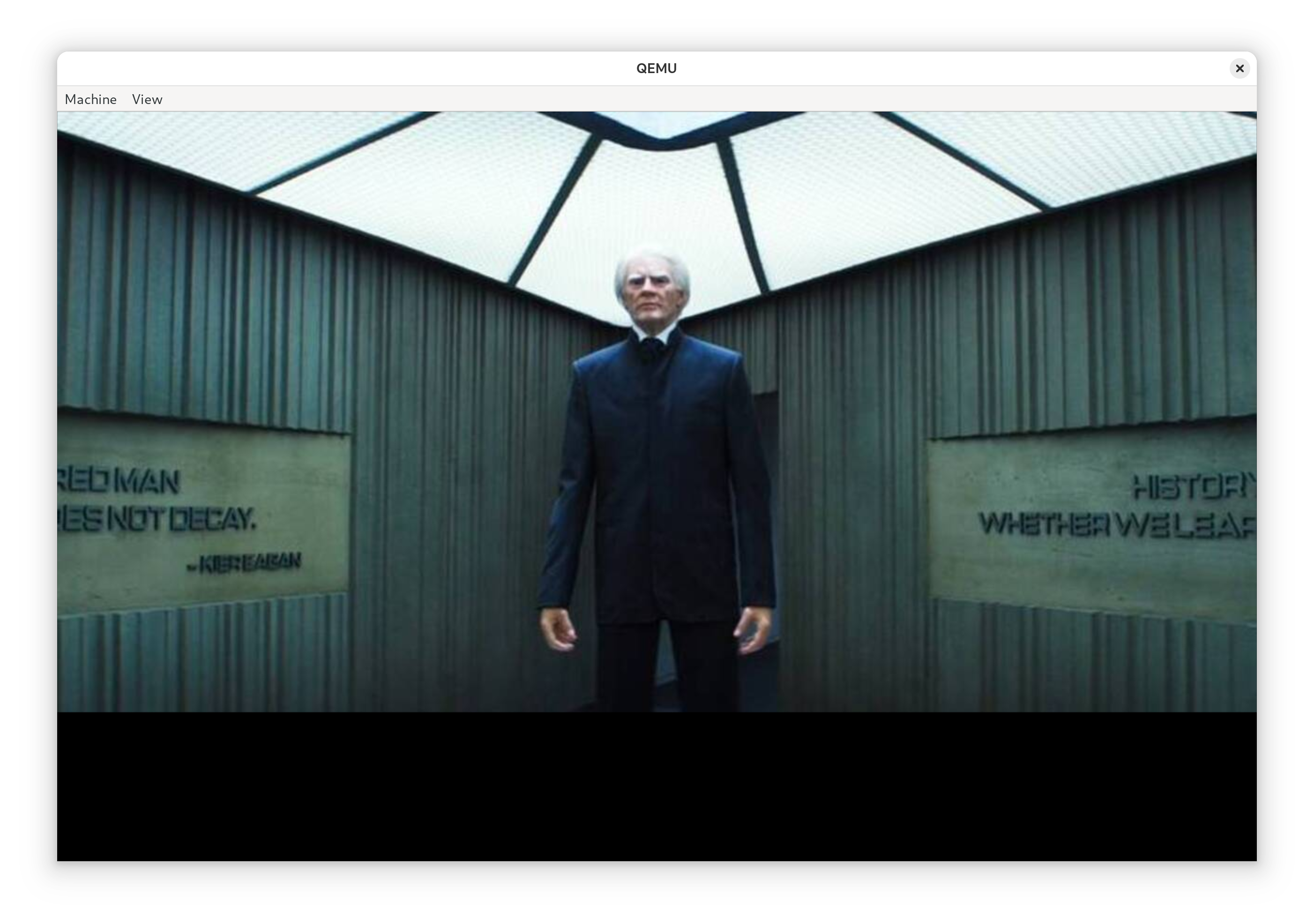
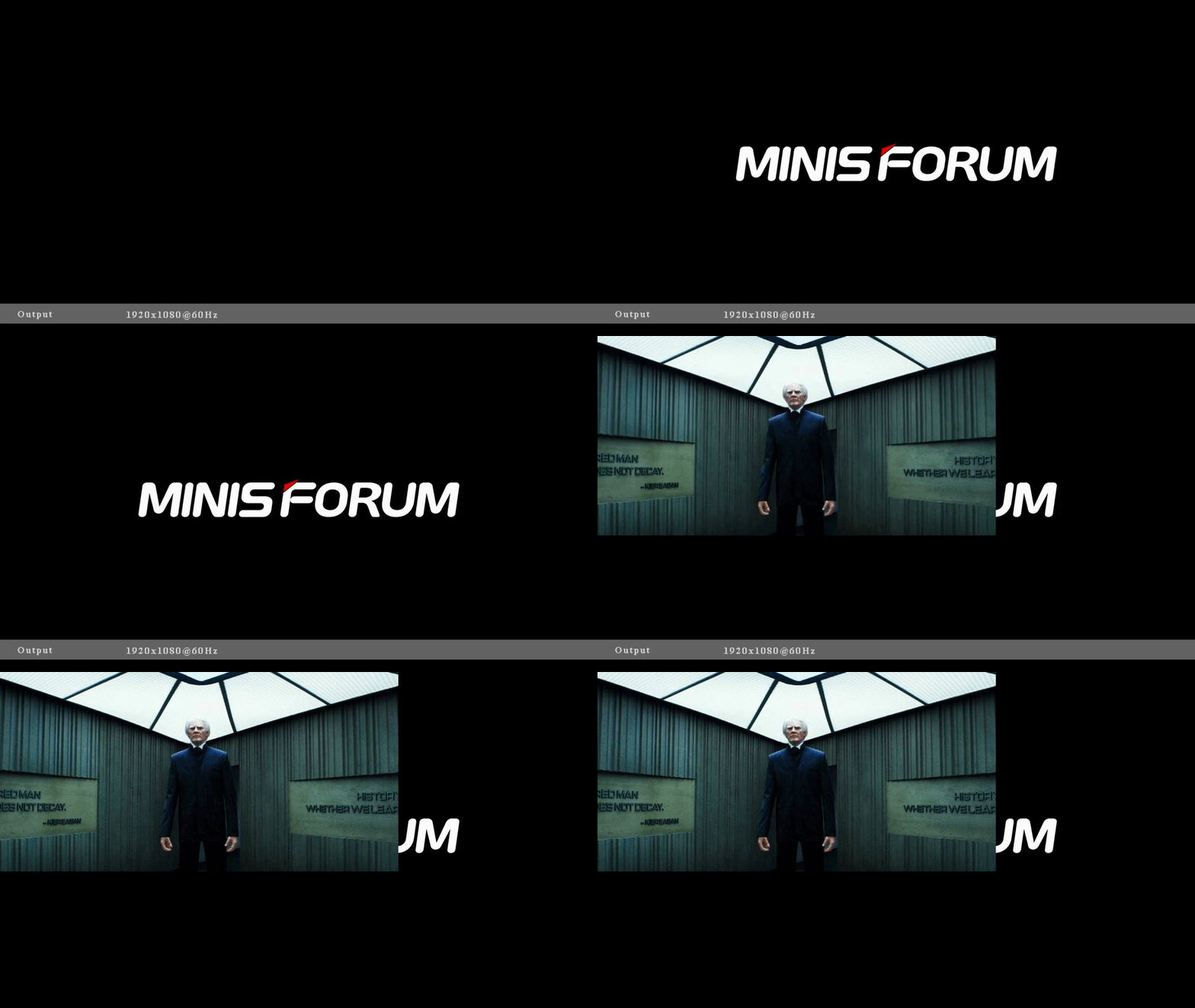
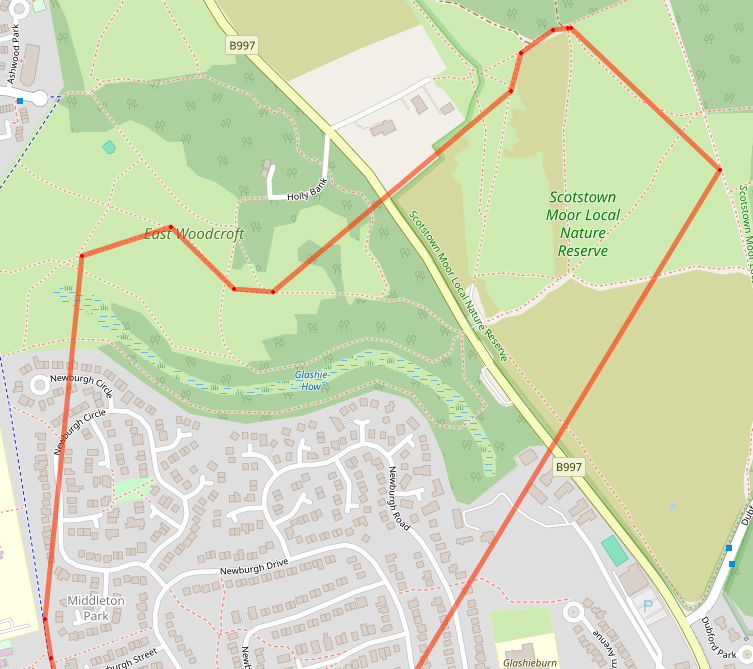 After circling a bit to find somewhere suitable (there appear to be construction
works in the park!) I set up my gear in 2C with frost on the ground, called CQ,
spotted and got nothing on either the end fed half wave or the cheap vertical.
As it was too late for 20m, I tried 40 and a bit of 80 using the inbuilt tuner,
but wasn t heard by stations I called or when calling independently.
I packed everything up and lora-doofered my way home, mildly deflated.
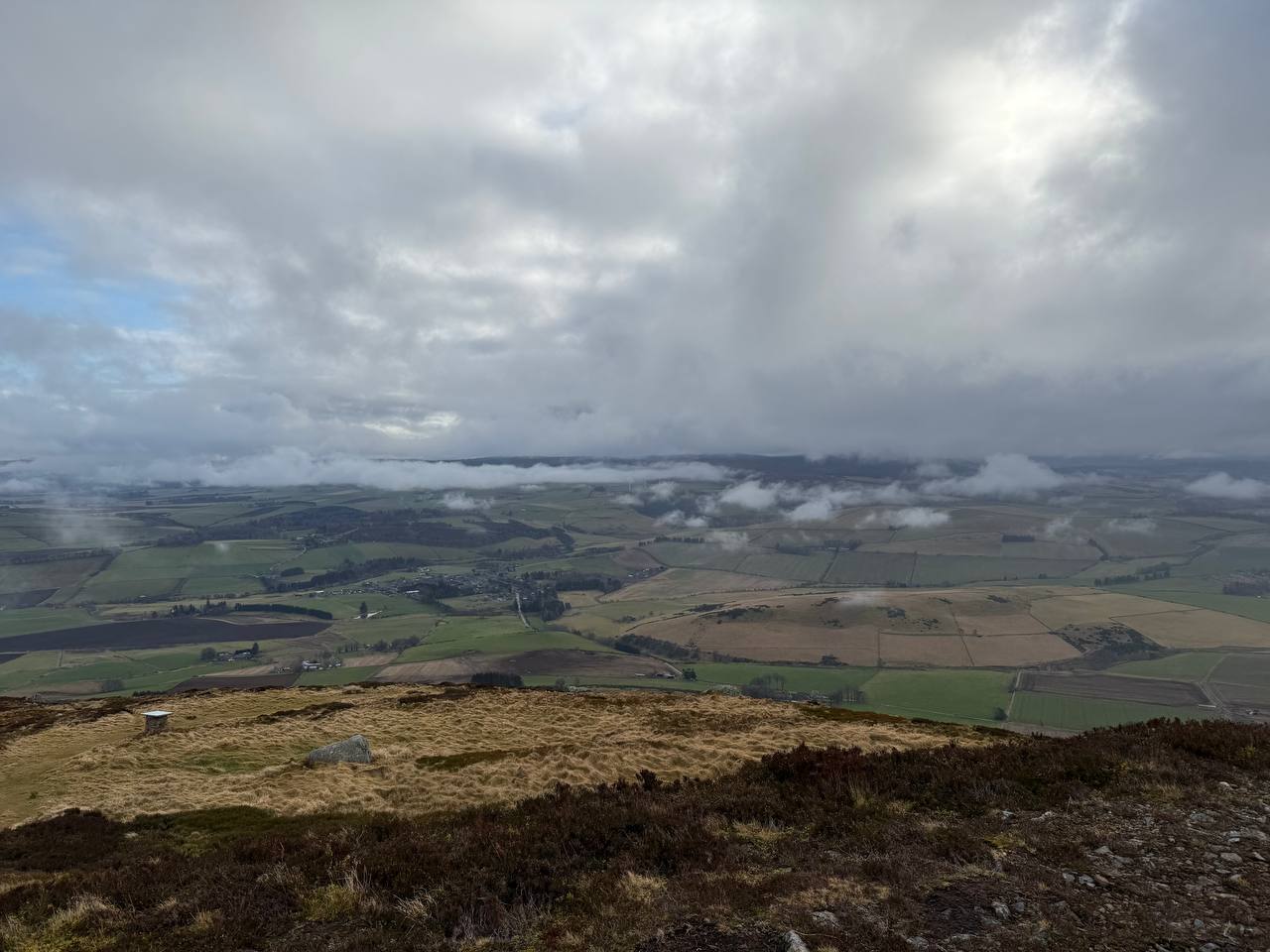 After a mild struggle on 2m, I set up the end fed the first hill and got to
work from the old hill fort:
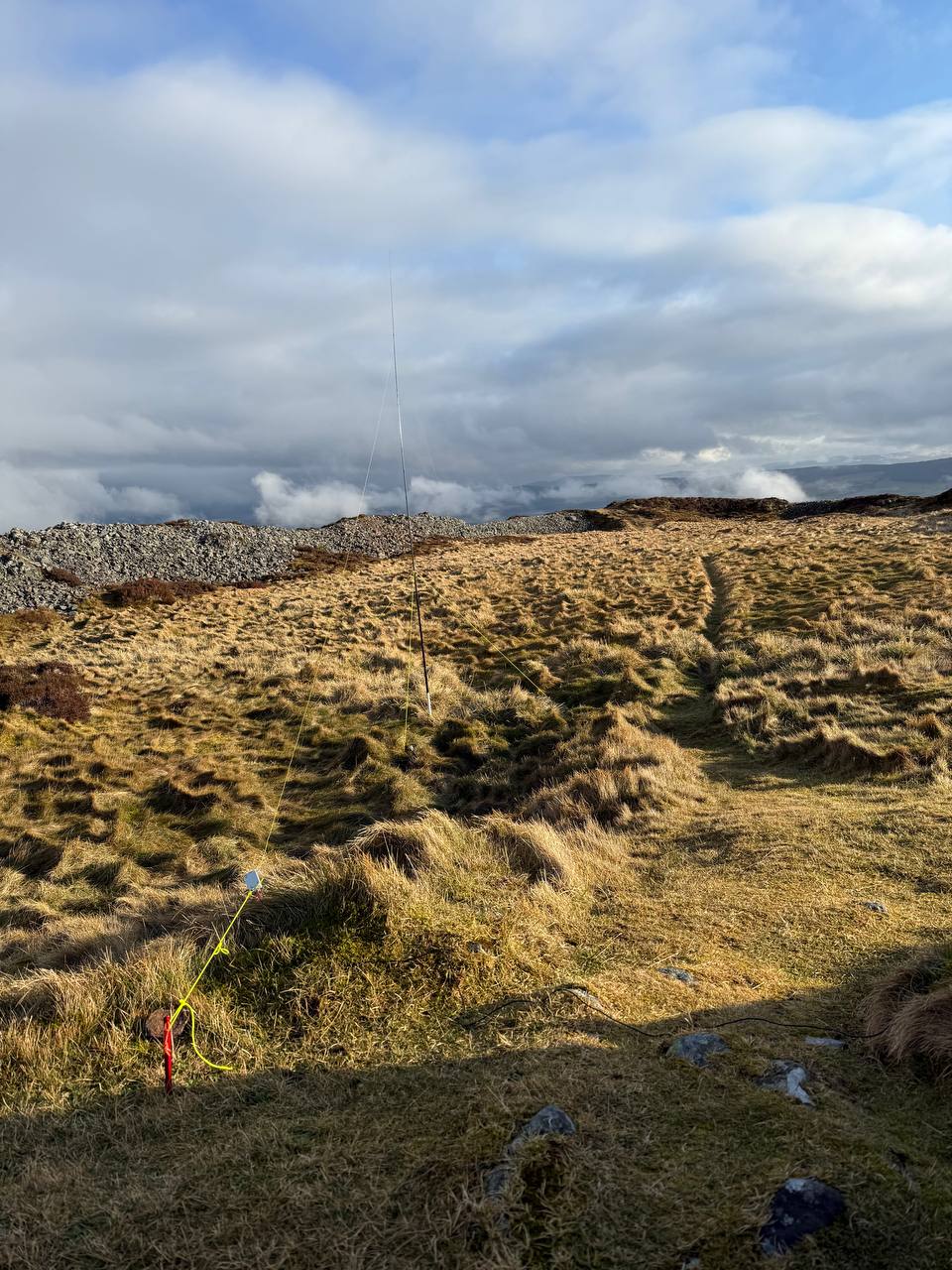 The end fed worked flawlessly. Exactly as promised, switching between 7MHz, 14MHz, 21MHz
and 28MHz without a tuner was perfect, I chased hills on all the bands, and had a
great time. Apart from 40m, where there was absolutely no space due to a
contest. That wasn t such a fun time!
My fingers were bitterly cold, so on went the big gloves for the descent and I
felt like I was warm by the time I made it back to the car.
It worked so well, in fact, I took the 1/4 wave cheap vertical out my bag and
decided to brave it on the next activation.
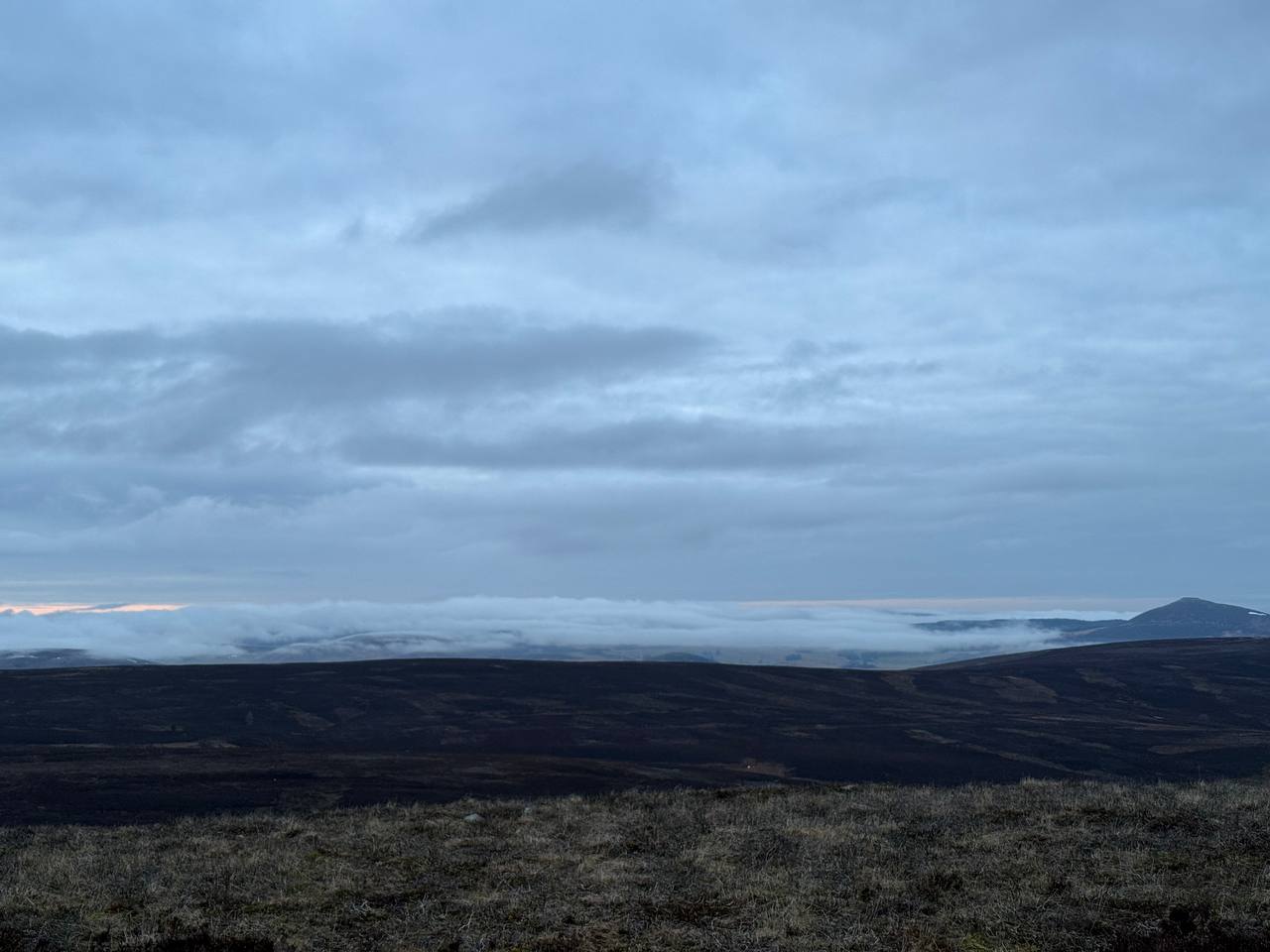 To get some height for the feedpoint, I wrapped the coax around my winder a
couple of turns and trapped it with the elastic while draping the coax over the
trig. This bought me some more height and I felt clever because of it. Maybe a
pole would be easier?
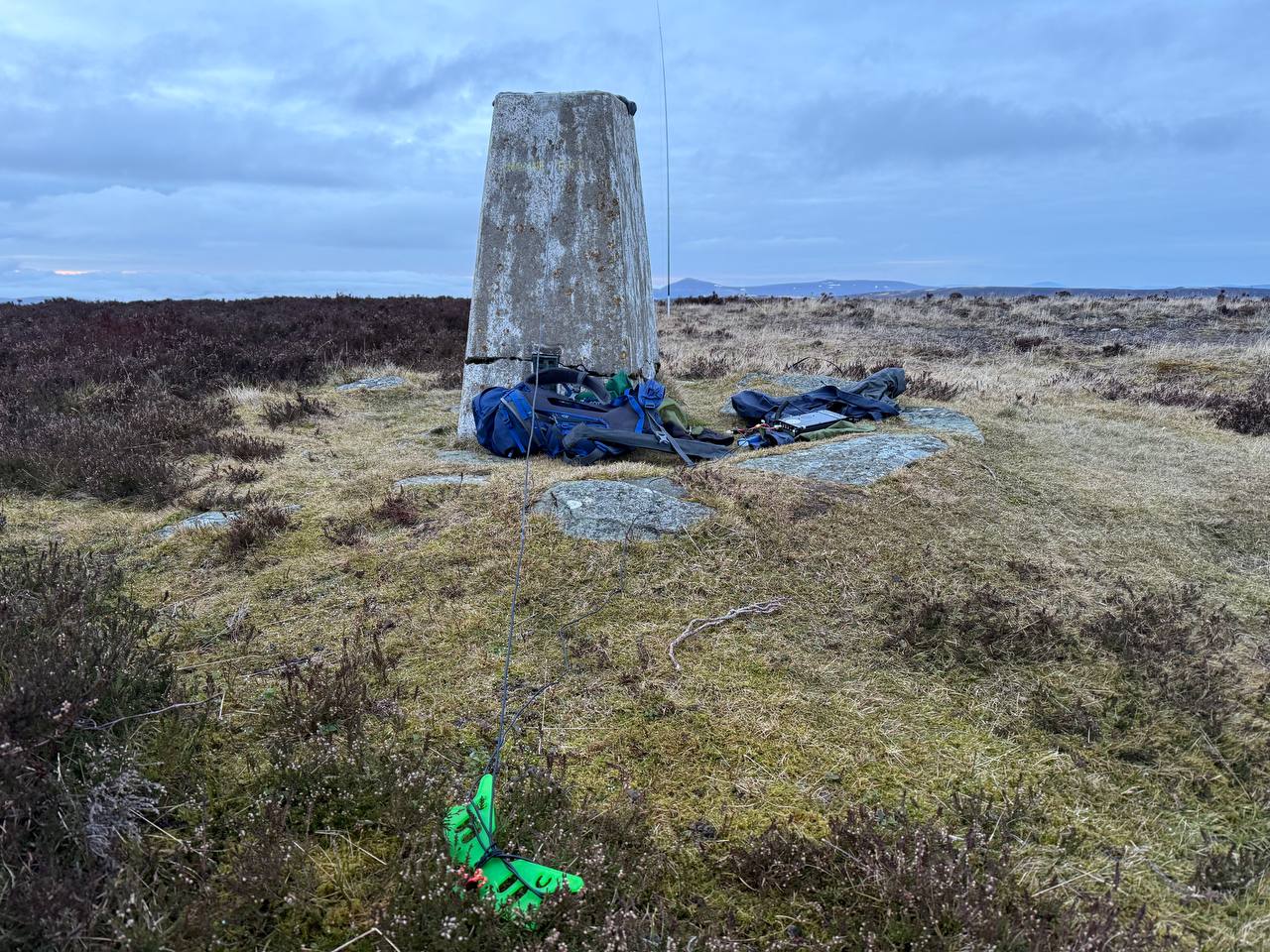 From here, I worked inter-G on 40m and had a wee pile up, eventually working 15
or so European stations on 20m. Pleased with that!
I had been considering a third hill, but home was the call in the failing light.
Back to the car I walked to find my key didn t have any battery, so out came the
Audi App and I used the Internet of Things to unlock my car. The modern world is
bizarre.
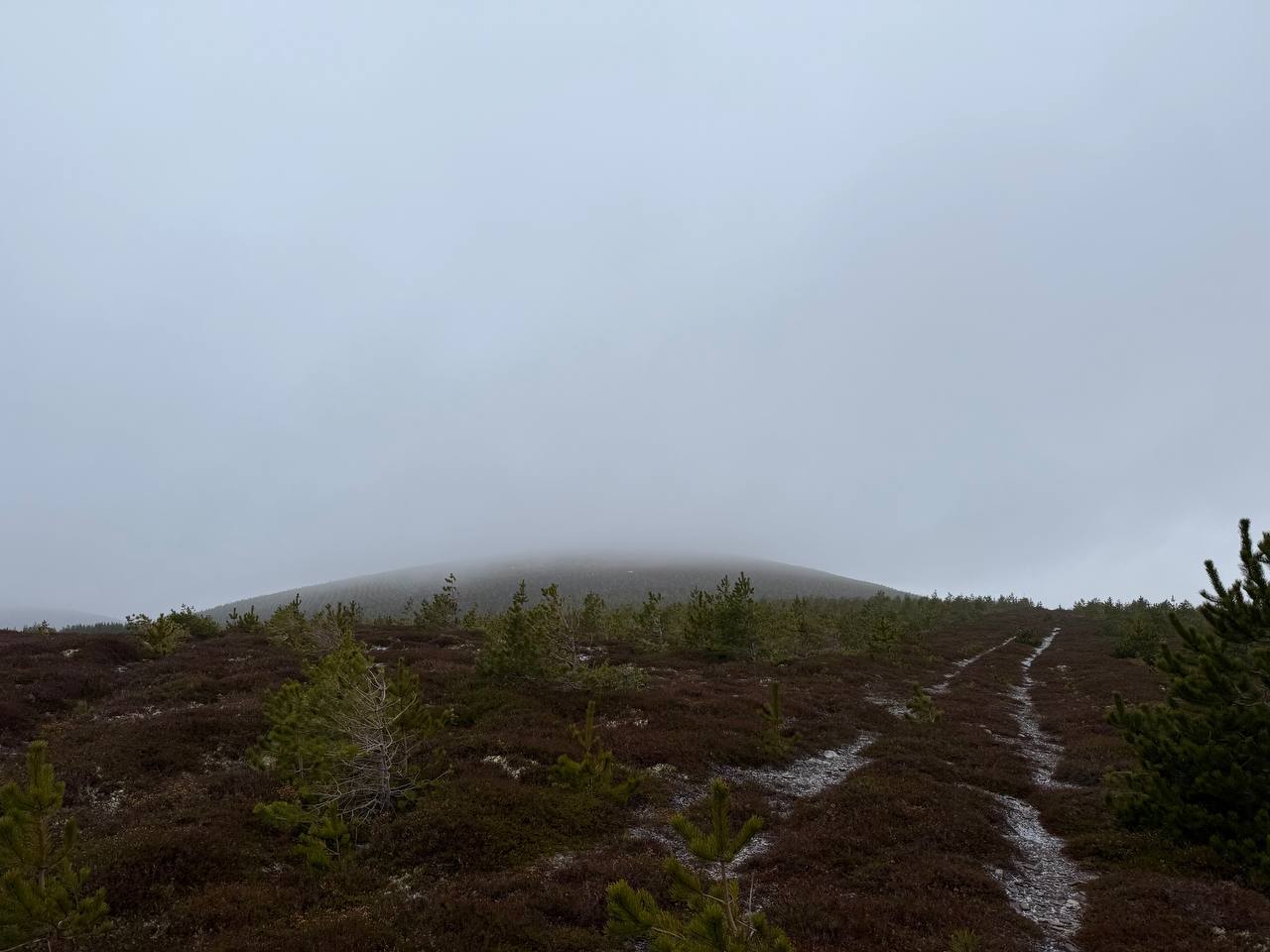
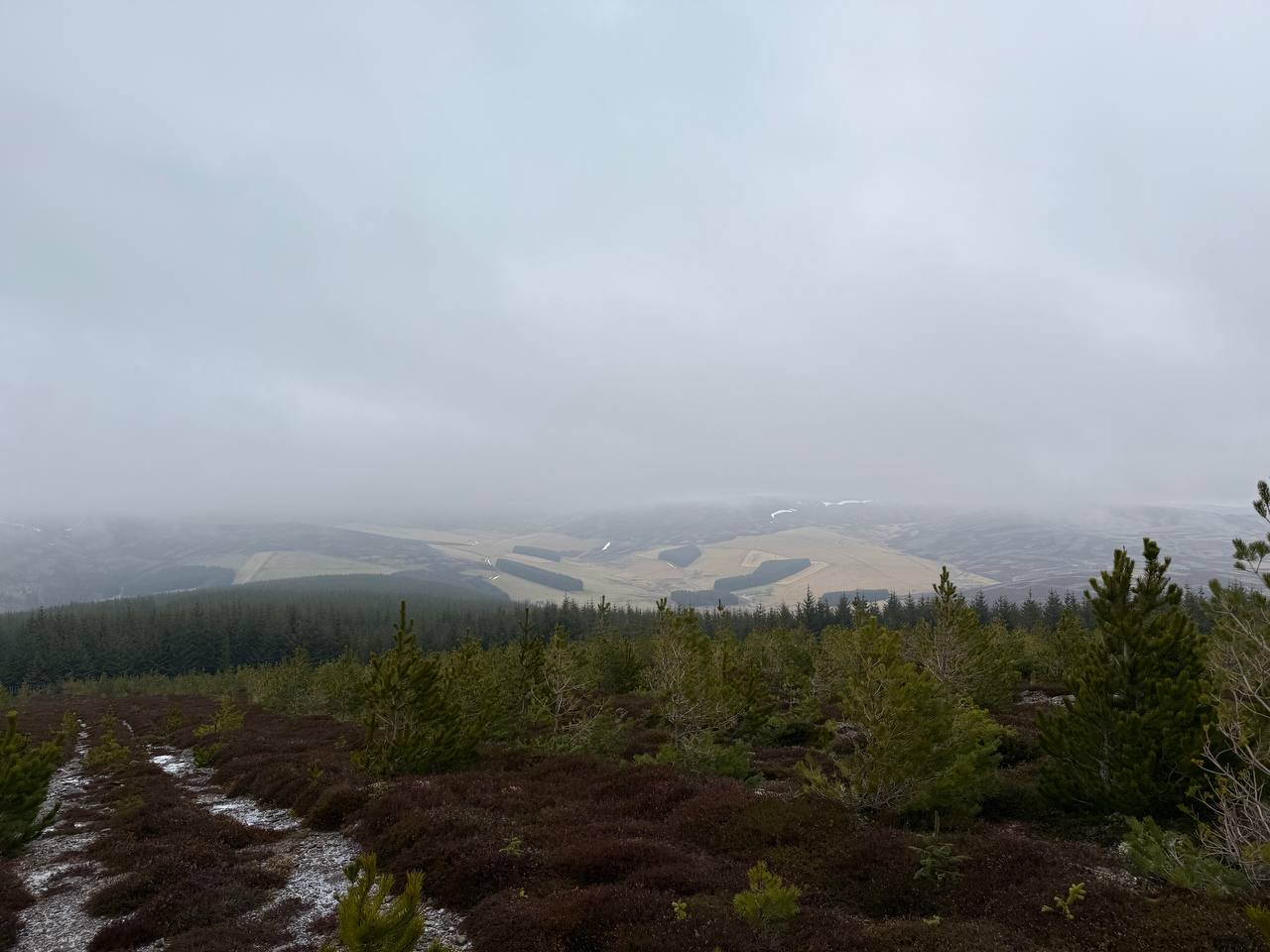 I set up at the cairn and picked up 30 contacts overall, split between 40m and
20m, with some inter-g on 40 and a couple of continental surprises. 20 had
longer skip today, so I saw Spain, Finland, Slovenia, Poland.
On teardown, I managed to snap the top segment of my brand new mast with my
cold, clumsy fingers, but thankfully sotabeams stock replacements. More money at
the problem, again.
Back to the car, no app needed, and homeward bound as the light faded.
At the end of the weekend, I find myself finally over 100 activator points and
over 400 chaser points. Somehow I ve collected more points this year already
than last year, the winter bonuses really do stack up!
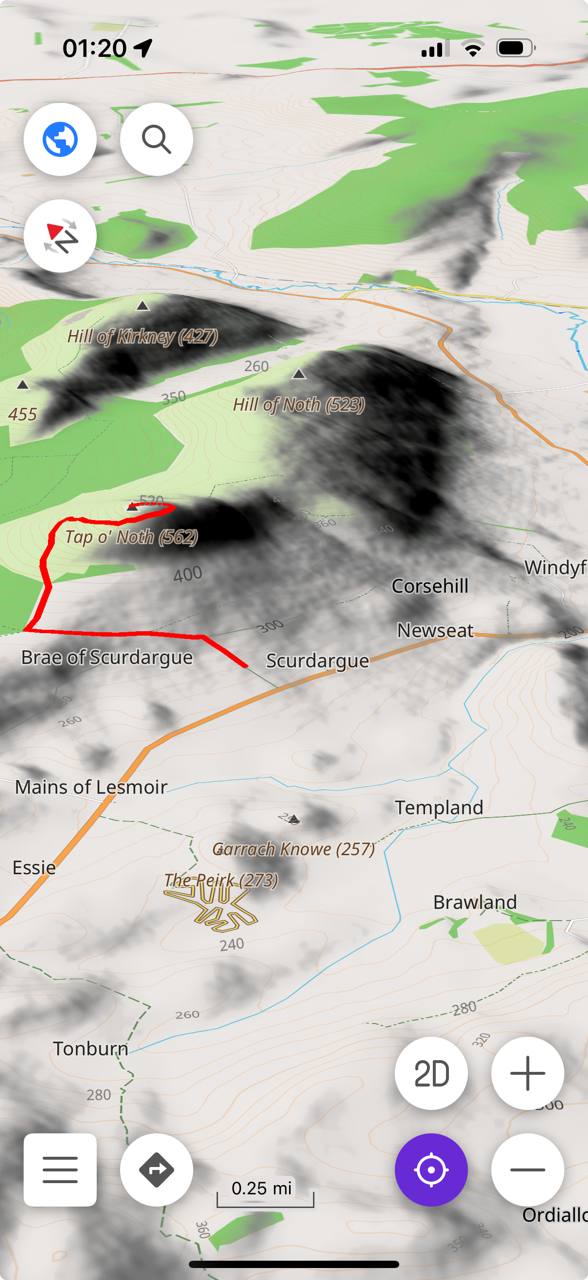 This weekend I discovered it s possible to have height maps for nice 3d
maps and contours marked on the map - you just need to download some
additions for the maps. This is a really nice feature, it makes maps more
pretty and more useful when you re in the middle of nowhere.
 DeepSeek R1, the new entrant to the Large Language Model wars has created quite a splash over the last few weeks. Its entrance into a space dominated by the Big Corps, while pursuing asymmetric and novel strategies has been a refreshing eye-opener.GPT AI improvement was starting to show signs of slowing down, and has been observed to be reaching a point of diminishing returns as it runs out of data and compute required to train, fine-tune increasingly large models. This has turned the focus towards building "reasoning" models that are post-trained through reinforcement learning, techniques such as inference-time and test-time scaling and search algorithms to make the models appear to think and reason better. OpenAI&aposs o1-series models were the first to achieve this successfully with its inference-time scaling and Chain-of-Thought reasoning.
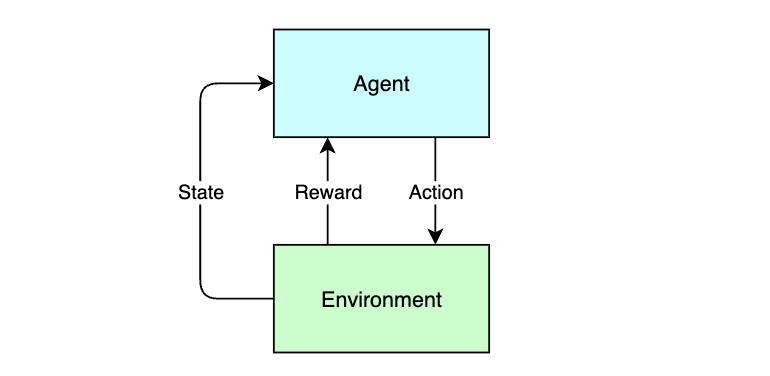
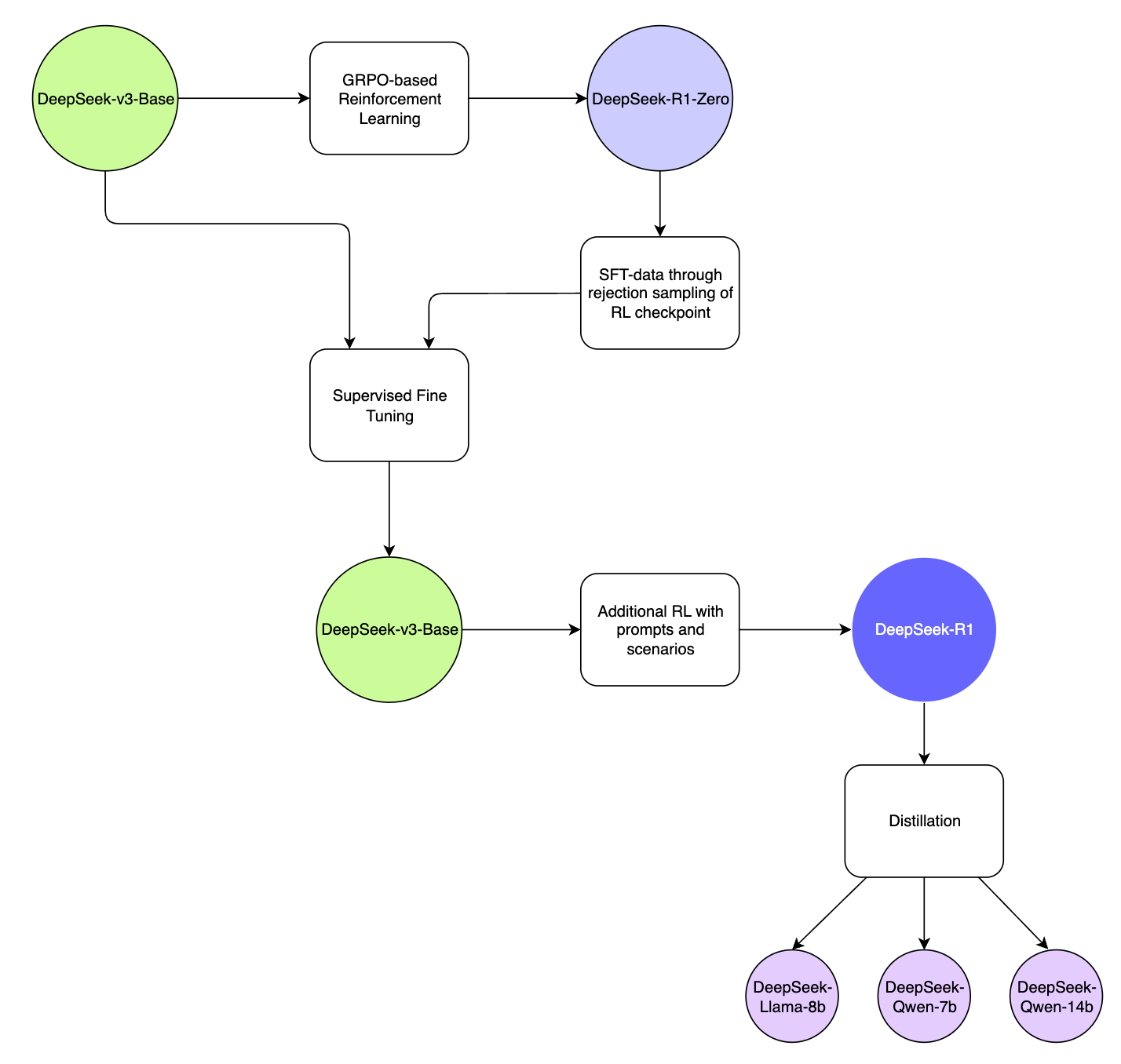
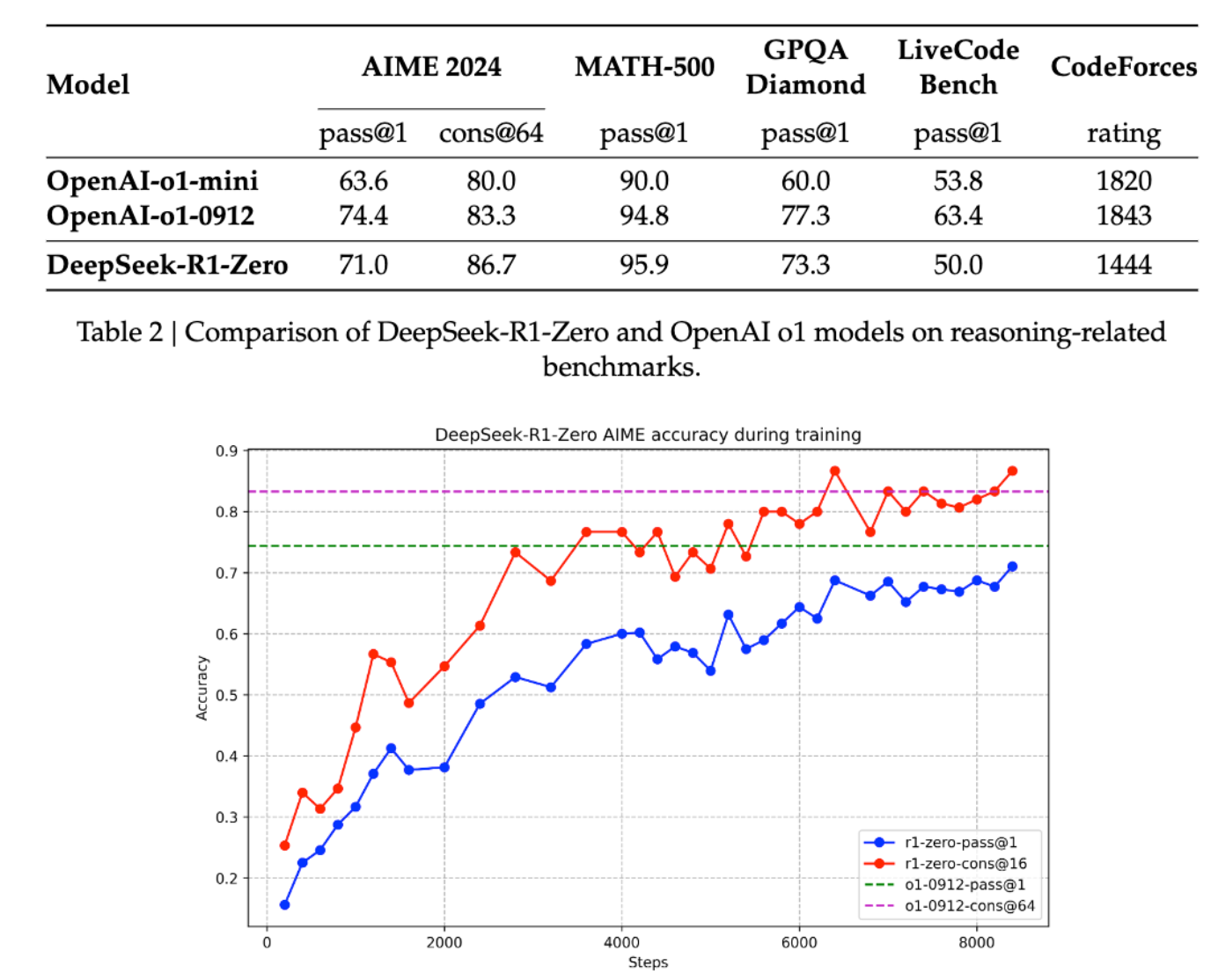
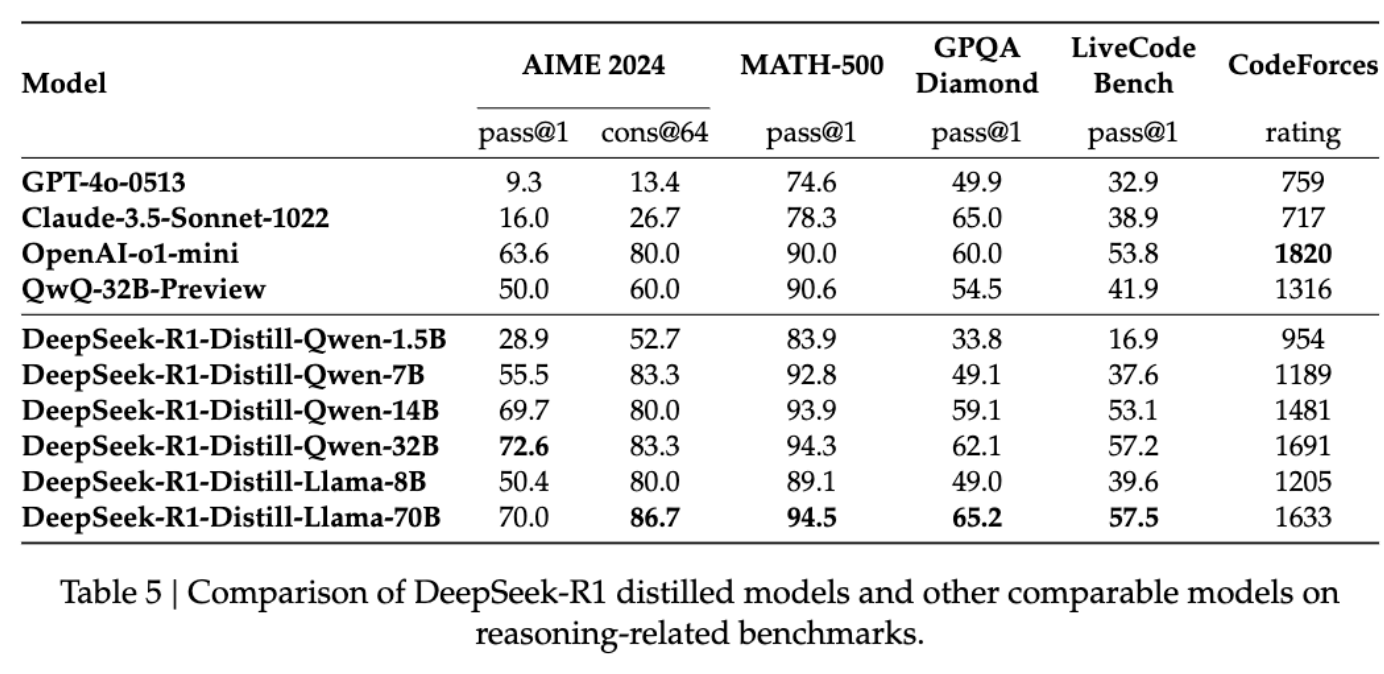
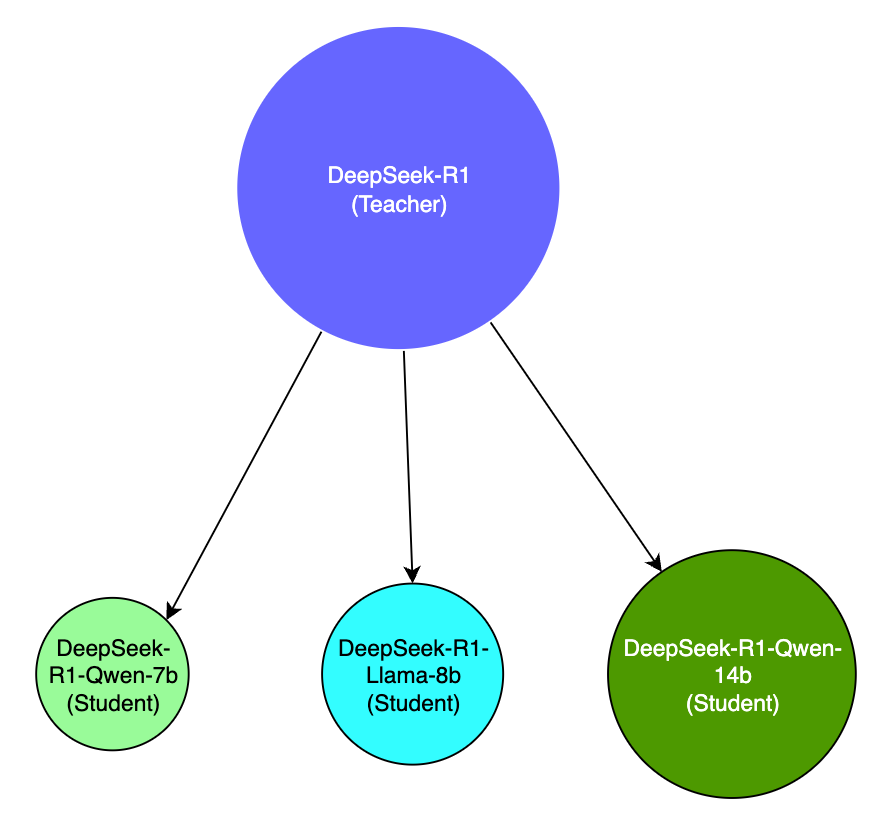

 Another year of data from Soci t de Transport de Montr al, Montreal's
transit agency!
A few highlights this year: