Search Results: "pere"

8 March 2014

Lisandro Damián Nicanor Pérez Meyer: Does your app use Qt4? You better start porting it to Qt5

As you might know, Qt 4 is now in bug-fixes-only maintenance mode. This means that only bug fixes are allowed to be pushed to Qt 4's repository, but no new features.

On the other hand, Qt 5 is already here. Porting existing apps from Qt 4 to Qt 5 is actually easier than it was to port Qt 3 stuff to Qt 4. Take a look at this Qt project's wiki page for more info. Also pay attention at the links at the bottom of it under "Recommended Reading".

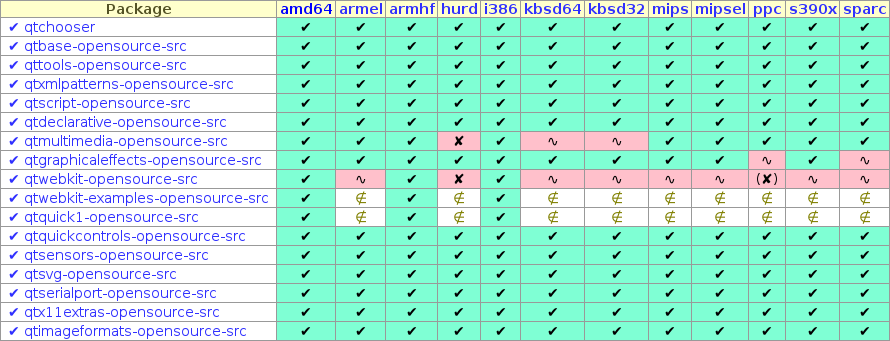
Some time ago I blogged about the 5.2.0 status in Debian experimental. We currently have it in testing with a much better status:


And we also have 5.2.1 in experimental with an even better status:

Note: qttools is FTBFS in armhf just because of some symbols changes, it will be fixed on the next upload.
Don't be afraid of getting it from experimental! Take a look at this blog post to know how to compile with Qt 5 in Debian.

BonusI have also uploaded Qt Creator built against Qt 5 to experimental. I plan to push it to unstable with Qt 5.2.1.

22 February 2014

Petter Reinholdtsen: New home and release 1.0 for netgroup and innetgr (aka ng-utils)

Many years ago, I wrote a GPL licensed version of the netgroup and innetgr tools, because I needed them in Skolelinux. I called the project ng-utils, and it has served me well. I placed the project under the Hungry Programmer umbrella, and it was maintained in our CVS repository. But many years ago, the CVS repository was dropped (lost, not migrated to new hardware, not sure), and the project have lacked a proper home since then. Last summer, I had a look at the package and made a new release fixing a irritating crash bug, but was unable to store the changes in a proper source control system. I applied for a project on Alioth, but did not have time to follow up on it. Until today. :) After many hours of cleaning and migration, the ng-utils project now have a new home, and a git repository with the highlight of the history of the project. I published all release tarballs and imported them into the git repository. As the project is really stable and not expected to gain new features any time soon, I decided to make a new release and call it 1.0. Visit the new project home on https://alioth.debian.org/projects/ng-utils/ if you want to check it out. The new version is also uploaded into Debian Unstable.

6 February 2014

Johannes Schauer: botch updates

My last update about ongoing development of botch, the bootstrap/build ordering tool chain, was three months ago with the announcement of bootstrap.debian.net. Since then a number of things happened, so I thought an update was due.

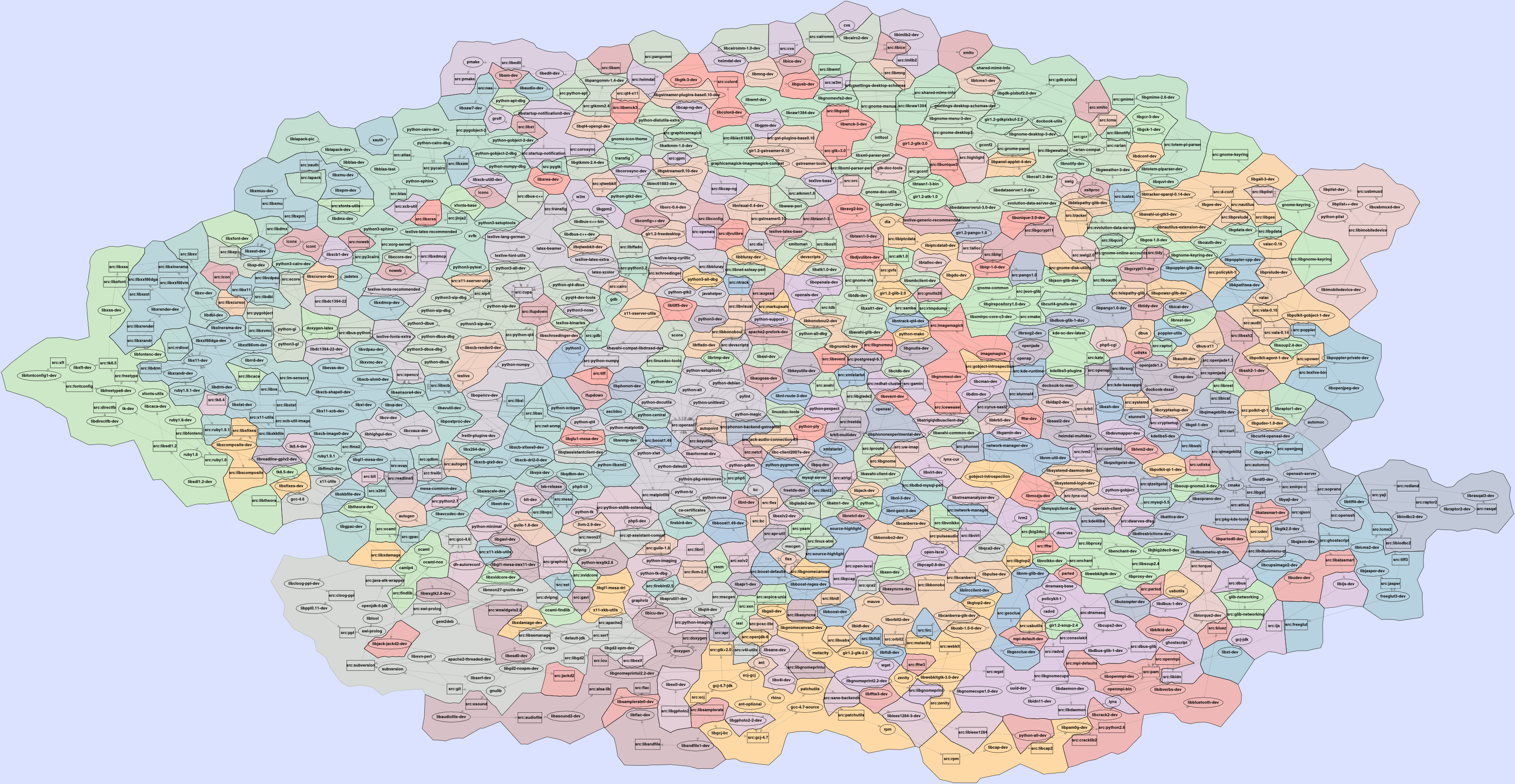
New graphs for port metrics By default, a dependency graph is created by arbitrarily choosing an installation set for binary package installation or source package compilation. Installation set vertices and source vertices are connected according to this arbitrary selection. Niels Thykier approached me at Debconf13 about the possibility of using this graph to create a metric which would be able to tell for each source package, how many other source packages would become uncompilable or how many binary packages would become uninstallable, if that source package was removed from the archive. This could help deciding about the importance of packages. More about this can be found at the thread on debian-devel. For botch, this meant that two new graph graphs can now be generated. Instead of picking an arbitrary installation set for compiling a source package or installing a binary package, botch can now create a minimum graph which is created by letting dose3 calculate strong dependencies and a maximum graph by using the dependency closure.

Build profile syntax in dpkg With dpkg 1.17.2 we now have experimental build profile support in unstable. The syntax which ended up being added was:
Build-Depends: large (>= 1.0), small <!profile.stage1>
But until packages with that syntax can hit the archive, a few more tools need to understand the syntax. The patch we have for sbuild is very simple because sbuild relies on libdpkg for dependency parsing. We have a patch for apt too, but we have to rebase it for the current apt version and have to adapt it so that it works exactly like the functionality dpkg implements. But before we can do that we have to decide how to handle mixed positive and negative qualifiers or whether to remove this feature altogether because it causes too much confusion. The relevant thread on debian-dpkg starts here.

Update to latest dose3 git Botch heavily depends on libdose3 and unfortunately requires features which are only available in the current git HEAD. The latest version packaged in Debian is 3.1.3 from October 2012. Unfortunately the current dose3 git HEAD also relies on unreleased features from libcudf. On top of that, the GraphML output of the latest ocamlgraph version (1.8.3) is also broken and only fixed in the git. For now everything is set up as git submodules but this is the major blocker preventing any packaging of botch as a Debian package. Hopefully new releases will be done soon for all involved components.

Writing and reading GraphML Botch is a collection of several utilities which are connected together in a shell script. The advantage of this is, that one does not need to understand or hack the OCaml code to use botch for different purposes. In theory it also allows to insert 3rd party tools into a pipe to further modify the data. Until recently this ability was seriously hampered by the fact that many botch tools communicated with each other through marshaled OCaml binary files which prevent everything which is not written in OCaml from modifying them. The data that was passed around like this were the dependency graphs and I initially implemented it like that because I didnt want to write a GraphML parser. I now ended up writing an xmlm based GraphML parser so as of now, botch only reads and writes ASCII text files in XML (for the graphs) and in rfc822 packages format (for Packages and Sources files) which can both easily be modified by 3rd party tools. The ./tools directory contains many Python scripts using the networkx module to modify GraphML and the apt_pkg module to modify rfc822 files.

Splitting of tools To further increase the ability to modify program execution without having to know OCaml, I split up some big tools into multiple smaller ones. Some of the smaller tools are now even written in Python which is probably much more hackable for the general crowd. I converted those tools to Python which did not need any dose3 functionality and which were simple enough so that writing them didnt take much time. I could convert more tools but that might introduce bugs and takes time which I currently dont have much of (who does?).

Gzip instead of bz2 Since around January 14, snapshot.debian.org doesnt offer bzip2 compressed Packages and Sources files anymore but uses xz instead. This is awesome for must purposes but unfortunately I had to discover that there exist no OCaml bindings for libxz. Thus, botch is now using gzip instead of bz2 until either myself or anybody else finds some time to write a libxz OCaml binding.

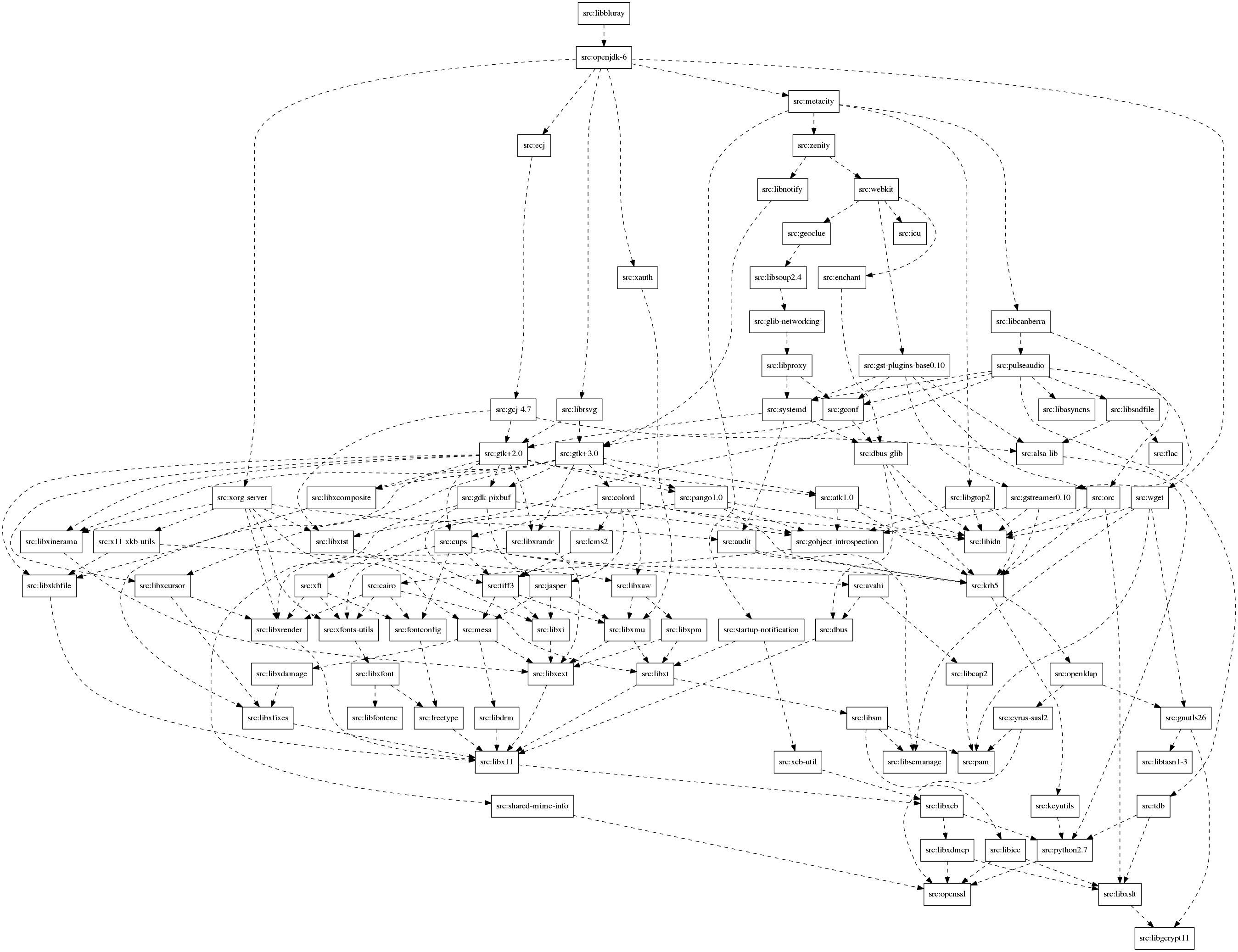
Self hosting Fedora Paul Wise made me aware of Harald Hoyer's attempts to bootstrap Fedora. I reproduced his steps for the Debian dependency graph and it turns out that they are a little bit bigger. I'm exchanging emails with Harald Hoyer because it might not be too hard to use botch for rpm based distributions as well because dose3 supports rpm. The article also made me aware of the tred tool which is part of graphviz and allows to calculate the transitive reduction of a graph. This can help making horrible situations much better.

Dose3 bugs I planned to generate such simplified graphs for the neighborhood of each source package on bootstrap.debian.net but then binutils stopped building binutils-gold and instead provided binutils-gold while libc6-dev breaks binutils-gold (<< 2.20.1-11). This unfortunately triggered a dose3 bug and thus bootstrap.debian.net will not generate any new results until this is fixed in dose3. Another dose3 bug affects packages which Conflicts/Replaces/Provides:bar while bar is fully virtual and are Multi-Arch:same. Binaries of different architecture with this property can currently not be co-installed with dose3. Unfortunately linux-libc-dev has this property and thus botch cannot be used to analyze cross builds until that bug is fixed in dose3. I hope I get some free time soon to be able to look at these dose3 issues myself.

More documentation Since I started to like the current set of tools and how they work together I ended up writing over 2600 words of documentation in the past few days. You can start setting up and running botch by reading the first steps and get more detailed information by reading about the 28 tools that botch makes use of as of now. All existing articles, thesis and talks are linked from the wiki home.

3 February 2014

Petter Reinholdtsen: Testing sysvinit from experimental in Debian Hurd

A few days ago I decided to try to help the Hurd people to get their changes into sysvinit, to allow them to use the normal sysvinit boot system instead of their old one. This follow up on the great Google Summer of Code work done last summer by Justus Winter to get Debian on Hurd working more like Debian on Linux. To get started, I downloaded a prebuilt hard disk image from http://ftp.debian-ports.org/debian-cd/hurd-i386/current/debian-hurd.img.tar.gz, and started it using virt-manager. The first think I had to do after logging in (root without any password) was to get the network operational. I followed the instructions on the Debian GNU/Hurd ports page and ran these commands as root to get the machine to accept a IP address from the kvm internal DHCP server:
settrans -fgap /dev/netdde /hurd/netdde 
kill $(ps -ef awk '/[p]finet/   print $2 ')
kill $(ps -ef awk '/[d]evnode/   print $2 ')
dhclient /dev/eth0
After this, the machine had internet connectivity, and I could upgrade it and install the sysvinit packages from experimental and enable it as the default boot system in Hurd. But before I did that, I set a password on the root user, as ssh is running on the machine it for ssh login to work a password need to be set. Also, note that a bug somewhere in openssh on Hurd block compression from working. Remember to turn that off on the client side. Run these commands as root to upgrade and test the new sysvinit stuff:
cat > /etc/apt/sources.list.d/experimental.list <<EOF
deb http://http.debian.net/debian/ experimental main
EOF
apt-get update
apt-get dist-upgrade
apt-get install -t experimental initscripts sysv-rc sysvinit \
    sysvinit-core sysvinit-utils 
update-alternatives --config runsystem
To reboot after switching boot system, you have to use reboot-hurd instead of just reboot, as there is not yet a sysvinit process able to receive the signals from the normal 'reboot' command. After switching to sysvinit as the boot system, upgrading every package and rebooting, the network come up with DHCP after boot as it should, and the settrans/pkill hack mentioned at the start is no longer needed. But for some strange reason, there are no longer any login prompt in the virtual console, so I logged in using ssh instead. Note that there are some race conditions in Hurd making the boot fail some times. No idea what the cause is, but hope the Hurd porters figure it out. At least Justus said on IRC (#debian-hurd on irc.debian.org) that they are aware of the problem. A way to reduce the impact is to upgrade to the Hurd packages built by Justus by adding this repository to the machine:
cat > /etc/apt/sources.list.d/hurd-ci.list <<EOF
deb http://darnassus.sceen.net/~teythoon/hurd-ci/ sid main
EOF
At the moment the prebuilt virtual machine get some packages from http://ftp.debian-ports.org/debian, because some of the packages in unstable do not yet include the required patches that are lingering in BTS. This is the completely list of "unofficial" packages installed:
# aptitude search '?narrow(?version(CURRENT),?origin(Debian Ports))'
i   emacs                   - GNU Emacs editor (metapackage)
i   gdb                     - GNU Debugger
i   hurd-recommended        - Miscellaneous translators
i   isc-dhcp-client         - ISC DHCP client
i   isc-dhcp-common         - common files used by all the isc-dhcp* packages
i   libc-bin                - Embedded GNU C Library: Binaries
i   libc-dev-bin            - Embedded GNU C Library: Development binaries
i   libc0.3                 - Embedded GNU C Library: Shared libraries
i A libc0.3-dbg             - Embedded GNU C Library: detached debugging symbols
i   libc0.3-dev             - Embedded GNU C Library: Development Libraries and Hea
i   multiarch-support       - Transitional package to ensure multiarch compatibilit
i A x11-common              - X Window System (X.Org) infrastructure
i   xorg                    - X.Org X Window System
i A xserver-xorg            - X.Org X server
i A xserver-xorg-input-all  - X.Org X server -- input driver metapackage
#
All in all, testing hurd has been an interesting experience. :) X.org did not work out of the box and I never took the time to follow the porters instructions to fix it. This time I was interested in the command line stuff.

29 January 2014

Petter Reinholdtsen: A fist full of non-anonymous Bitcoins

Bitcoin is a incredible use of peer to peer communication and encryption, allowing direct and immediate money transfer without any central control. It is sometimes claimed to be ideal for illegal activity, which I believe is quite a long way from the truth. At least I would not conduct illegal money transfers using a system where the details of every transaction are kept forever. This point is investigated in USENIX ;login: from December 2013, in the article "A Fistful of Bitcoins - Characterizing Payments Among Men with No Names" by Sarah Meiklejohn, Marjori Pomarole,Grant Jordan, Kirill Levchenko, Damon McCoy, Geoffrey M. Voelker, and Stefan Savage. They analyse the transaction log in the Bitcoin system, using it to find addresses belong to individuals and organisations and follow the flow of money from both Bitcoin theft and trades on Silk Road to where the money end up. This is how they wrap up their article:
"To demonstrate the usefulness of this type of analysis, we turned our attention to criminal activity. In the Bitcoin economy, criminal activity can appear in a number of forms, such as dealing drugs on Silk Road or simply stealing someone else s bitcoins. We followed the flow of bitcoins out of Silk Road (in particular, from one notorious address) and from a number of highly publicized thefts to see whether we could track the bitcoins to known services. Although some of the thieves attempted to use sophisticated mixing techniques (or possibly mix services) to obscure the flow of bitcoins, for the most part tracking the bitcoins was quite straightforward, and we ultimately saw large quantities of bitcoins flow to a variety of exchanges directly from the point of theft (or the withdrawal from Silk Road). As acknowledged above, following stolen bitcoins to the point at which they are deposited into an exchange does not in itself identify the thief; however, it does enable further de-anonymization in the case in which certain agencies can determine (through, for example, subpoena power) the real-world owner of the account into which the stolen bitcoins were deposited. Because such exchanges seem to serve as chokepoints into and out of the Bitcoin economy (i.e., there are few alternative ways to cash out), we conclude that using Bitcoin for money laundering or other illicit purposes does not (at least at present) seem to be particularly attractive."
These researches are not the first to analyse the Bitcoin transaction log. The 2011 paper "An Analysis of Anonymity in the Bitcoin System" by Fergal Reid and Martin Harrigan is summarized like this:
"Anonymity in Bitcoin, a peer-to-peer electronic currency system, is a complicated issue. Within the system, users are identified by public-keys only. An attacker wishing to de-anonymize its users will attempt to construct the one-to-many mapping between users and public-keys and associate information external to the system with the users. Bitcoin tries to prevent this attack by storing the mapping of a user to his or her public-keys on that user's node only and by allowing each user to generate as many public-keys as required. In this chapter we consider the topological structure of two networks derived from Bitcoin's public transaction history. We show that the two networks have a non-trivial topological structure, provide complementary views of the Bitcoin system and have implications for anonymity. We combine these structures with external information and techniques such as context discovery and flow analysis to investigate an alleged theft of Bitcoins, which, at the time of the theft, had a market value of approximately half a million U.S. dollars."
I hope these references can help kill the urban myth that Bitcoin is anonymous. It isn't really a good fit for illegal activites. Use cash if you need to stay anonymous, at least until regular DNA sampling of notes and coins become the norm. :) As usual, if you use Bitcoin and want to show your support of my activities, please send Bitcoin donations to my address 15oWEoG9dUPovwmUL9KWAnYRtNJEkP1u1b.

27 January 2014

Jo Shields: Dear Debian Developers, lrn2gpg

For some strange reason, I ve been receiving a lot of GPG-signed mail from Debian Developers and Maintainers lately. In response to each of these mails, I need to send a GPG-encrypted reply. The rate at which I m able to send replies has been significantly hampered by the poor state in which many DD/DM s maintain their GPG keys. Here are a few common mistakes, so you can consider correcting them. Ensure you have a UID for the email address(es) you use When I send an encrypted mail, I need to be sure that the recipient is legit. This means any decent mail client should refuse to send an encrypted message to foo@bar.com unless that email address is known somehow to GPG. In many cases, someone with a valid key for foo@bar.com would send their signed mail from foobar@gmail.com without that being a valid UID. In some cases, foo@bar.com isn t even a valid email address anymore (i.e. the bar.com mail server says no such mailbox). You should have a UID for each address you use. Signatures are per-UID You may well have a valid UID for foo@debian.org, foo@bar.com, and foobar@gmail.com but the PGP trust model doesn t automatically trust every UID as much as its peers. Each individual UID needs to be trusted (i.e. signed/uploaded) by others. What if you added billg@microsoft.com as a UID should that automatically be trusted? Clearly not. Just because you have foo@debian.org doesn t mean it s trusted for encryption without some signatures. Make sure you actually have an encrypting subkey GPG sucks, and as a result, it reports Skipping unusable pubkey when the issue is a lack of valid encrypting subkeys. If you have revoked all encrypting subkeys, or allowed them to expire, then I cannot send you encrypted mail. Exact naming matters Bob Bobbertson <foo@bar.com> and B b B bb rts n <foo@bar.com> are different people. Check your mail client s From: setting, to ensure it matches your UID. If not, fix one of them. Check your webmail plugin isn t shit Some people use third party plugins to integrate GPG into their webmail client (e.g. Hotmail or GMail). Make sure this actually works. Don t use Enigmail Enigmail is a popular plugin to integrate GPG into Mozilla Thunderbird. It doesn t work, in most cases. Almost every single BADSIG in my inbox is due to Enigmail. Thunderbird will insert spurious line wraps and escape characters into your mail after signing, resulting in invalid signatures. It s mostly okay if you never quote mail, and restrict messages to about 70 characters. I know plenty of Debian Developers don t care about GPG other than for package signing but please, for the sanity of the rest of us, take an occasional moment to care a little. I should note that the worst offenders for keys which don t just work were Developers with 1024D keys the best behaved were Maintainers of all stripes.

20 January 2014

Enrico Zini: terminal-emulators

Quest for a terminal emulator The requirements I need a terminal emulator. This is a checklist of the features that I need: My experience is that getting all of this to work is not being as easy as it seems, so I'm creating this page to track progress. gnome-terminal I've been happily using this for years, and it did everything I needed, until some months ago it started to open new tabs in the terminal's working directory instead of the last tab's working directory. This is a big point of frustration for me. It also started opening https urls with Firefox, although the preferred browser was Chromium. There seemed to be no way to control it: I looked for firefox or iceweasel in all gconf and dconf settings and found nothing. The browser issue was fixed by accident when I used Xfce4's settings application to change the browser from Chromium to Firefox and then back to Chromium. update, thanks to Mathieu Parent, Josh Triplett, Peter De Wachter, Julien Cristau, and Charles Plessy: It is also possible to restore the "new tab opened inside the same directory of the last tab I was in" behaviour, by enabling "run command as a login shell" so that /etc/profile.d/vte.sh is run (thanks Mathieu Parent for the link). That in turn spawned extra cleanup work in my .bashrc/.bash_profile/.profile setup, which has been randomly evolving since even before my first Debian "buzz" system. I found that it was setting PROMPT_COMMAND to something else to set the terminal title, conflicting with what vte.sh wants to do. With regards to loading /etc/profile.d/vte.sh by default, Peter De Watcher sent pointers to relevant bugs: here, here, and here. An alternative strategy is to work using the prompt rather than PROMPT_COMMAND; an example is in Josh Triplett's .bashrc from git://joshtriplett.org/git/home. Josh Triplett also said:
To fix the browser launched for URLs, you either need to use a desktop environment following GNOME's mechanism for setting the default browser, or edit ~/.local/share/applications/mimeapps.list and make sure x-scheme-handler/http, x-scheme-handler/https, and x-scheme-handler/ftp are set to your preferred browser's desktop file basename under [Added Associations].
All my issues with gnome-terminal are now gone and I'm only too happy to go back to it. rxvt-unicode-256color urxvt took some work. This is where I got with configuration:
URxvt.font: xft:Monospace-10:antialias=true
URxvt.foreground: #aaaaaa
URxvt.background: black
URxvt.scrollBar_right: true
URxvt.cursorBlink: true
URxvt.perl-ext-common: default,matcher,tabbedex
URxvt.url-launcher: /usr/bin/x-www-browser
URxvt.matcher.button: 1
URxvt.perl-lib: /home/enrico/.urxvt/perl
URxvt.color0: black
URxvt.color1: #aa0000
URxvt.color2: #00aa00umask
URxvt.color3: #aa5500
URxvt.color4: #0000aa
URxvt.color5: #aa00aa
URxvt.color6: #00aaaa
URxvt.color7: #aaaaaa
URxvt.color8: #555555
URxvt.color9: #ff5555
URxvt.color10: #55ff55
URxvt.color11: #ffff55
URxvt.color12: #5555ff
URxvt.color13: #ff55ff
URxvt.color14: #55ffff
URxvt.color15: #ffffff
I got all of the tab behaviour that I need by "customizing" the tab script (yuck github :( ). Missing sakura Configuration is in .config/sakura/sakura.conf and these bits help:
colorset1_fore=rgb(170,170,170)
colorset1_back=rgb(0,0,0)
colorset1_opacity=99
colorset2_fore=rgb(0,0,0)
colorset2_back=rgb(254,254,254)
colorset2_opacity=99
font=Monospace 10
show_always_first_tab=No
scrollbar=false
fullscreen_key=F11
palette=linux
Missing lxterminal Configuration is in .config/lxterminal/lxterminal.conf and this is relevant to me:
[general]
fontname=DejaVu Sans Mono 10
fgcolor=#aaaaaaaaaaaa
disallowbold=false
cursorblinks=true
tabpos=top
hidescrollbar=false
hidemenubar=true
hideclosebutton=true
disablef10=true
disablealt=true
Also, to open a url directly you control+click it. Missing terminator Configuration is in .config/terminator/config and this is relevant to me:
[global_config]
  use_custom_url_handler = True
  custom_url_handler = x-www-browser
  inactive_color_offset = 1.0
[keybindings]
  close_term = None
  close_window = None
  copy = None
  cycle_next = None
  cycle_prev = None
  go_down = None
  go_next = None
  go_prev = None
  go_up = None
  group_all = None
  group_tab = None
  hide_window = None
  move_tab_left = None
  move_tab_right = None
  new_tab = None
  new_terminator = None
  new_window = None
  next_tab = None
  paste = None
  prev_tab = None
  reset_clear = None
  reset = None
  resize_down = None
  resize_left = None
  resize_right = None
  resize_up = None
  rotate_ccw = None
  rotate_cw = None
  scaled_zoom = None
  search = None
  split_horiz = None
  split_vert = None
  switch_to_tab_1 = <Alt>F1
  switch_to_tab_2 = <Alt>F2
  switch_to_tab_3 = <Alt>F3
  switch_to_tab_4 = <Alt>F4
  switch_to_tab_5 = <Alt>F5
  switch_to_tab_6 = <Alt>F6
  switch_to_tab_7 = <Alt>F7
  switch_to_tab_8 = <Alt>F8
  switch_to_tab_9 = <Alt>F9
  switch_to_tab_10 = <Alt>F10
  toggle_scrollbar = None
  toggle_zoom = None
  ungroup_all = None
  ungroup_tab = None
[profiles]
  <span class="createlink">default</span>
    palette = "#000000:#aa0000:#00aa00:#aa5500:#0000aa:#aa00aa:#00aaaa:#aaaaaa:#555555:#ff5555:#55ff55:#ffff55:#5555ff:#ff55ff:#55ffff:#ffffff"
    copy_on_selection = True
    icon_bell = False
    background_image = None
    show_titlebar = False
Missing update: Richard Hartmann pointed out that terminator's upstream maintainer now changed after the old one didn't have time any more, and it should have a release with a ton of improvements anytime soon. xfce4-terminal Configuration is in .config/xfce4/terminal, and this is relevant to me: terminalrc:
[Configuration]
FontName=Monospace 10
MiscAlwaysShowTabs=FALSE
MiscBell=FALSE
MiscBordersDefault=TRUE
MiscCursorBlinks=FALSE
MiscCursorShape=TERMINAL_CURSOR_SHAPE_BLOCK
MiscDefaultGeometry=80x24
MiscInheritGeometry=FALSE
MiscMenubarDefault=FALSE
MiscMouseAutohide=FALSE
MiscToolbarDefault=FALSE
MiscConfirmClose=TRUE
MiscCycleTabs=TRUE
MiscTabCloseButtons=TRUE
MiscTabCloseMiddleClick=TRUE
MiscTabPosition=GTK_POS_TOP
MiscHighlightUrls=TRUE
ShortcutsNoMenukey=TRUE
ShortcutsNoMnemonics=TRUE
ColorForeground=#aaaaaaaaaaaa
accels.scm:
(gtk_accel_path "<Actions>/terminal-window/goto-tab-1" "<Alt>F1")
(gtk_accel_path "<Actions>/terminal-window/goto-tab-2" "<Alt>F2")
(gtk_accel_path "<Actions>/terminal-window/goto-tab-3" "<Alt>F3")
(gtk_accel_path "<Actions>/terminal-window/goto-tab-4" "<Alt>F4")
(gtk_accel_path "<Actions>/terminal-window/goto-tab-5" "<Alt>F5")
(gtk_accel_path "<Actions>/terminal-window/goto-tab-6" "<Alt>F6")
(gtk_accel_path "<Actions>/terminal-window/goto-tab-7" "<Alt>F7")
(gtk_accel_path "<Actions>/terminal-window/goto-tab-8" "<Alt>F8")
(gtk_accel_path "<Actions>/terminal-window/goto-tab-9" "<Alt>F9")
(gtk_accel_path "<Actions>/terminal-window/goto-tab-10" "<Alt>F10")
(gtk_accel_path "<Actions>/terminal-window/goto-tab-11" "<Alt>F11")
(gtk_accel_path "<Actions>/terminal-window/goto-tab-12" "<Alt>F12")
update: Yves-Alexis Perez points out that to disable the F1 for help in the terminal, you need to remove the accelerator. I tried this and this and didn't have success, but I confess I did not dig too much into it. Although xfce4-terminal -e does not work as I expect, xfce4-terminal registers a wrapper for x-terminal-emulator that does the right thing with respect to -e (also thanks Yves-Alexis Perez). Missing roxterm Configuration is in .config/roxterm.sourceforge.net/ split in several files corresponding to profiles. This is a reasonable starting point for me: Profiles/Default:
[roxterm profile]
colour_scheme=Default
disable_menu_access=1
disable_menu_shortcuts=1
disable_tab_menu_shortcuts=0
tab_close_btn=0
hide_menubar=1
always_show_tabs=0
Colours/Default:
[roxterm colour scheme]
0=#000000000000
1=#aaaa00000000
2=#0000aaaa0000
3=#aaaa55550000
4=#00000000aaaa
5=#aaaa0000aaaa
6=#0000aaaaaaaa
7=#aaaaaaaaaaaa
8=#555555555555
9=#ffff55555555
10=#5555ffff5555
11=#ffffffff5555
12=#55555555ffff
13=#ffff5555ffff
14=#5555ffffffff
15=#ffffffffffff
palette_size=16
foreground=#aaaaaaaaaaaa
background=#000000000000
cursor=#cccccccccccc
bold=
dim=
Shortcuts/Default:
[roxterm shortcuts scheme]
File/New Window=
File/New Tab=
File/Close Window=
File/Close Tab=
Tabs/Previous Tab=
Tabs/Next Tab=
Edit/Copy=
Edit/Paste=
View/Zoom In=<Control>plus
View/Zoom Out=<Control>minus
View/Normal Size=<Control>0
View/Full Screen=F11
View/Scroll Up One Line=
View/Scroll Down One Line=
Help/Help=
Edit/Copy & Paste=
Search/Find...=
Search/Find Next=
Search/Find Previous=
File/New Window With Profile/Default=
File/New Tab With Profile/Default=
Tabs/Select_Tab_0=<Alt>F1
Tabs/Select_Tab_1=<Alt>F2
Tabs/Select_Tab_2=<Alt>F3
Tabs/Select_Tab_3=<Alt>F4
Tabs/Select_Tab_4=<Alt>F5
Tabs/Select_Tab_5=<Alt>F6
Tabs/Select_Tab_6=<Alt>F7
Tabs/Select_Tab_7=<Alt>F8
Tabs/Select_Tab_8=<Alt>F9
Tabs/Select_Tab_9=<Alt>F9
Tabs/Select_Tab_10=<Alt>F10
Tabs/Select_Tab_11=<Alt>F11
Tabs/Select_Tab_12=<Alt>F12
Global:
[roxterm options]
edit_shortcuts=0
prefer_dark_theme=1
colour_scheme=Default
warn_close=1
Missing Nothing of my initial requirements seems to be missing, really, so I'm sticking to it for a while to see what happens. The first itch to scratch is that when the menubar is hidden, the popup menu becomes the entire menubar contents, which does not fit the general use case to have a contextual menu with the most common shortcuts. I'll just declare it useless and get myself used to some new hotkey for starting a new terminal. update: after fixing my issues with gnome-terminal I've switched back to gnome-terminal: its interface feels less clunky as I'm already used to it. Other references Guillem Jover made a similar analysis in 2009, it can be found here. Thomas Koch mentioned that termit should be able to do all I need, and is scriptable in Lua. I like the sound of that, and it's definitely one I should look next time I find myself shopping for terminal emulators.

14 January 2014

Petter Reinholdtsen: New chrpath release 0.16

Coverity is a nice tool to find problems in C, C++ and Java code using static source code analysis. It can detect a lot of different problems, and is very useful to find memory and locking bugs in the error handling part of the source. The company behind it provide check of free software projects as a community service, and many hundred free software projects are already checked. A few days ago I decided to have a closer look at the Coverity system, and discovered that the gnash and ipmitool projects I am involved with was already registered. But these are fairly big, and I would also like to have a small and easy project to check, and decided to request checking of the chrpath project. It was added to the checker and discovered seven potential defects. Six of these were real, mostly resource "leak" when the program detected an error. Nothing serious, as the resources would be released a fraction of a second later when the program exited because of the error, but it is nice to do it right in case the source of the program some time in the future end up in a library. Having fixed all defects and added a mailing list for the chrpath developers, I decided it was time to publish a new release. These are the release notes: New in 0.16 released 2014-01-14: You can download the new version 0.16 from alioth. Please let us know via the Alioth project if something is wrong with the new release. The test suite did not discover any old errors, so if you find a new one, please also include a test suite check.

6 January 2014

Vincent Sanders: NetSurf Developer Workshop Redux

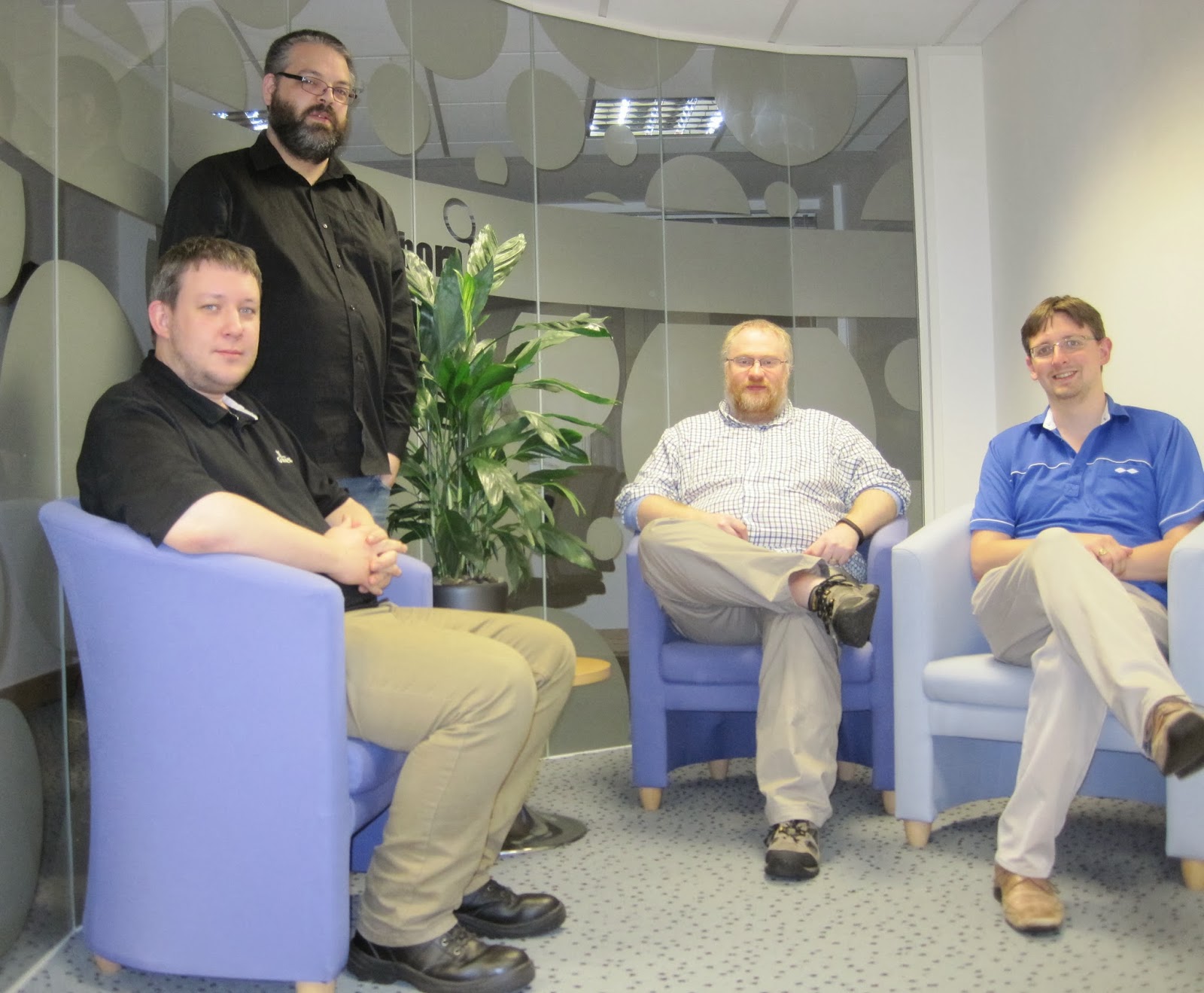
The NetSurf Developers bringing you alternative LOLcat viewing software since 2002Once again the NetSurf developers congregated in Cambridge at the Collabora offices where we were made welcome in a nice environment for the event.

Five developers managed to attend from around the UK Rob Kendrick, Vincent Sanders, Daniel Silverstone, John-Mark Bell and Michael Drake. We also had Chris Young and Fran ois Revol providing some bug fixes remotely.

This was the first time we had all met since the previous event towards the end of 2012 and we took full advantage of this to discuss a pretty extensive agenda in addition to the practical programming tasks.

From Friday lunchtime through to Sunday evening we managed 30 hours of work consisting of over 70 commits to over 100 files.

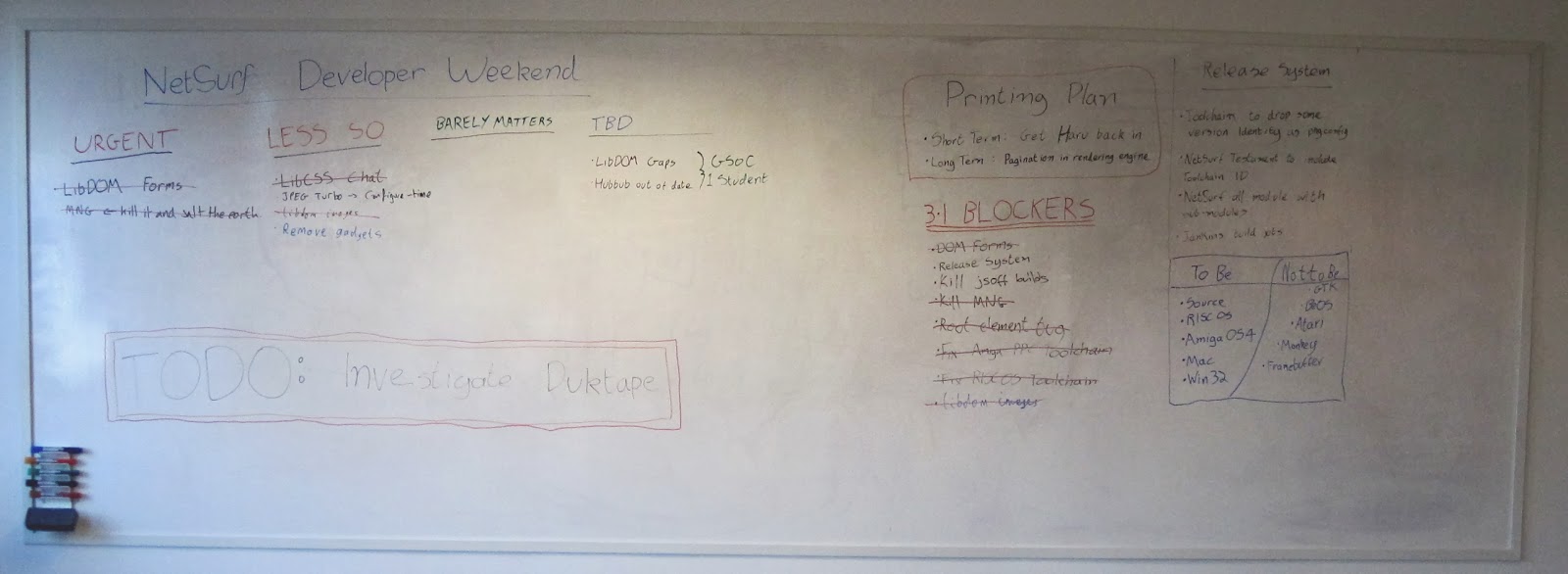
The whiteboard of our notes

Our main focus was working towards a 3.1 release which is scheduled for early April. Along with the source the release will have binary builds for RISC OS, AmigaOS, Windows and Mac OS X (x86 and ppc). Although the NetSurf project will not be directly releasing binaries for the GTK and Framebuffer frontends we will be ensuring the Debian packages are updated which is our prefered method of distribution for those targets.

We analysed the 3.0 release and formulated an improved process for the future. The 3.1 release will be generated automatically by the CI system ensuring constant results and removing the problems we encountered previously.

A set of release blocking issues was derived which we used as a task list during the workshop.The majority of these were completed including:
DOM based forms
Web forms are a feature Netsurf has supported for a long time and their implementation has not kept up with the rest of the browser. This is a long standing problem area which has resulted in numerous strange bugs with form submission. With this change the form system has been reworked to correctly operate directly from the DOM resulting in the squashing of a large number of bugs and a much improved user experience.

DOM based image loading
Up to now image fetching was performed only during the rendering of a page. With this change when the image link is placed into the DOM during the page parse it is scheduled to be fetched, this should give an improved user experience as images should be available earlier in a pages render.

Removal of MNG support
NetSurf has supported MNG since the 1.0 release, indeed the MNG library used to provide the PNG support too though we have long ago transitioned to libPNG. Alas the web has moved on and MNG has been largely forgotten, the libMNG library that performs the image decoding is old and generally unsupported specifically lacking security updates.

The build issues with libMNG (lack of pkg-config, reliance on libcms1 etc.) were causing maintenance issues in code nobody was actually using (there were crash bugs discovered during its removal!). Because of these issues it was decided to join the vast majority of browsers and remove support for this format.
The developers also addressed several issues with toolchain construction and a number of annoying usability bugs.

Plans for how to improve printing support we made. Initially we intend to fix the existing haru based pdf generation using this to print via pdf and in future have correct css styled page paginated printing render output.

The perennial issue of javascript was discussed however, while efforts to improve the existing support are ongoing, our usage of the spidermonkey library continues to raise various challenges including platform support and API changes between versions.

Due to these issues it has been suggested that we might add support for using the duktape JS engine instead, initial results are promising but given the size of the task of implementing an additional javascript engine binding further investigation is necessary before making a commitment.

Amongst the other discussions the group has also agreed that we will once again apply to be a GSoC organisation for a single student with some very focused projects:
  • Improving our HTML5 parser (hubbub)
  • Improving the DOM library implementing missing functionality.
While neither of these projects are as fashionable as some of our previous proposals they are well defined enough that as a group we believe we could offer enough support to the student to make their experience a pleasurable one and get the resulting code reviewed and merged promptly.

This event was very successful with a great deal achieved, the project is much more likely to be in a good shape to release 3.1 by April now and the meeting has given the developers a much welcomed boost.

I would like to extend the groups thanks to Robert McQueen for letting us use the Collabora offices, Dor e Carrier for organising all the administrative things and to Vivek Dasmohapatra for coming out on his Sunday afternoon to let us back in after locking ourselves out.


5 January 2014

Lisandro Dami&aacute;n Nicanor P&eacute;rez Meyer: Qt 5.2.0 in Debian experimental, now available for more archs

Qt 5.2.0 is already available in experimental until we get a transition slot, but don't be afraid to test it. With this release we had major improvements. With 5.1.1 currently in sid we have the following buildd chart:

Qt 5.1.1 in Debian Sid
Now with 5.2.0 in Debian experimental we have:

Qt 5.2.0 in Debian experimental

As you can see Qt has compiled in more archs, thanks to the effort of the Debian's porters and from the Qt/KDE team.

Note that Qt JS Backend has dissapeared: it's functionality (the javascript engine) is now in Qt Declarative itself. It has been ported away from Google's v8 to a Qt-based engine, allowing it to build in more archs among other features.

You can also note that we still have quite some FTBFS, mostly coming from Qt Webkit. Feel free to send patches ;-)

25 December 2013

Petter Reinholdtsen: Debian Edu interview: Dominik George

The Debian Edu / Skolelinux project consist of both newcomers and old timers, and this time I was able to get an interview with a newcomer in the project who showed up on the IRC channel a few weeks ago to let us know about his successful installation of Debian Edu Wheezy in his School. Say hello to Dominik George. Who are you, and how do you spend your days? I am a 23 year-old student from Germany who has spent half of his life with open source. In "real life", I am, as already mentioned, a student in the fields of Computer Science, Electrical Engineering, Information Technologies and Anglistics. Due to my (only partially voluntary) huge engagement in the open source world, these things are a bit vacant right now however. I also have been working as a project teacher at a Gymasnium (public school) for various years now. I took up that work some time around 2005 when still attending that school myself and have continued it until today. I also had been running the (kind of very advanced) network of that school together with a team of very interested and talented students in the age of 11 to 15 years, who took the chance to learn a lot about open source and networking before I left the school to help building another school's informational education concept from scratch. That said, one might see me as a kind of "glue" between school kids and the elderly of teachers as well as between the open source ecosystem and the (even more complex) educational ecosystem. When I am not busy with open source or education, I like Geocaching and cycling. How did you get in contact with the Skolelinux / Debian Edu project? I think that happened some time around 2009 when I first attended FrOSCon and visited the project booth. I think I wasn't too interested back then because I used to have an attitude of disliking software that does too much stuff on its own. Maybe I was too inexperienced to realise the upsides of an "out-of-the-box" solution ;). The first time I actively talked to Skolelinux people was at OpenRheinRuhr 2011 when the BiscuIT project, a home-grewn software used by my school for various really cool things from timetables and class contact lists to lunch ordering, student ID card printing and project elections first got to a stage where it could have been published. I asked the Skolelinux guys running the booth if the project were interested in it and gave a small demonstration, but there wasn't any real feedback and the guys seemed rather uninterested. After I left the school where I developed the software, it got mostly lost, but I am now reimplementing it for my new school. I have reusability and compatibility in mind, and I hop there will be a new basis for contributing it to the Skolelinux project ;)! What do you see as the advantages of Skolelinux / Debian Edu? The most important advantage seems to be that it "just works". After overcoming some minor (but still very annoying) glitches in the installer, I got a fully functional, working school network, without the month-long hassle I experienced when setting all that up from scratch in earlier years. And above that, it rocked - I didn't have any real hardware at hand, because the school was just founded and has no money whatsoever, so I installed a combined server (main server, terminal services and workstation) in a VM on my personal notebook, bridging the LTSP network interface to the ethernet port, and then PXE-booted the Windows notebooks that were lying around from it. I could use 8 clients without any performance issues, by using a tiny little VM on a tiny little notebook. I think that's enough to say that it rocks! Secondly, there are marketing reasons. Life's bad, and so no politician will ever permit a setup described as "Debian, an universal operating system, with some really cool educational tools" while they will be jsut fine with "Skolelinux, a single-purpose solution for your school network", even if both turn out to be the very same thing (yes, this is unfair towards the Skolelinux project, and must not be taken too seriously - you get the idea, anyway). What do you see as the disadvantages of Skolelinux / Debian Edu? I have not been involved with Skolelinux long enough to really answer this question in a fair way. Thus, please allow me to put it in other words: "What do you expect from Skolelinux to keep liking it?" I can list a few points about that: I'm really sorry I cannot say much more about that :(! Which free software do you use daily? First of all, all software I use is free and open. I have abandoned all non-free software (except for firmware on my darned phone) this year. I run Debian GNU/Linux on all PC systems I use. On that, I mostly run text tools. I use mksh as shell, jupp as very advanced text editor (I even got the developer to help me write a script/macro based full-featured student management software with the two), mcabber for XMPP and irssi for IRC. For that overly coloured world called the WWW, I use Iceweasel (Firefox). Oh, and mutt for e-mail. However, while I am personally aware of the fact that text tools are more efficient and powerful than anything else, I also use (or at least operate) some tools that are suitable to bring open source to kids. One of these things is Jappix, which I already introduced to some kids even before they got aware of Facebook, making them see for themselves that they do not need Facebook now ;). Which strategy do you believe is the right one to use to get schools to use free software? Well, that's a two-sided thing. One side is what I believe, and one side is what I have experienced. I believe that the right strategy is showing them the benefits. But that won't work out as long as the acceptance of free alternatives grows globally. What I mean is that if all the kids are almost forced to use Windows, Facebook, Skype, you name it at home, they will not see why they would want to use alternatives at school. I have seen students take seat in front of a fully-functional, modern Debian desktop that could do anything their Windows at home could do, and they jsut refused to use it because "Linux sucks". It is something that makes the council of our city spend around 600000 to buy software - not including hardware, mind you - for operating school networks, and for installing a system that, as has been proved, does not work. For those of you readers who are good at maths, have you already found out how many lives could have been saved with that money if we had instead used it to bring education to parts of the world that need it? I have, and found it to be nothing less dramatic than plain criminal. That said, the only feasible way appears to be the bottom up method. We have to bring free software to kids and parents. I have founded an association named Teckids here in Germany that does just that. We organise several events for kids and adolescents in the area of free and open source software, for example the FrogLabs, which share staff with Teckids and are the youth programme of the Free and Open Source Software Conference (FrOSCon). We do a lot more than most other conferences - this year, we first offered the FrogLabs as a holiday camp for kids aged 10 to 16. It was a huge success, with approx. 30 kids taking part and learning with and about free software through a whole weekend. All of us had a lot of fun, and the results were really exciting. Apart from that, we are preparing a campaign that is supposed to bring the message of free alternatives to stuff kids use every day to them and their parents, e.g. the use of Jabber / Jappix instead of Facebook and Skype. To make that possible, we are planning to get together a team of clever kids who understand very well what their peers need and can bring it across to them. So we will have a peer-driven network of adolescents who teach each other and collect feedback from the community of minors. We then take that feedback and our own experience to work closely with open source projects, such as Skolelinux or Jappix, at improving their software in a way that makes it more and more attractive for the target group. At least I hope that we will have good cooperation with Skolelinux in the future ;)! So in conclusion, what I believe is that, if it weren't for the world being so bad, it should be very clear to the political decision makers that the only way to go nowadays is free software for various reasons, but I have learnt that the only way that seems to work is bottom up.

18 December 2013

Daniel Kahn Gillmor: automatically have uscan check signatures

If you maintain software in debian, one of your regular maintenance tasks is checking for new upstream versions, reviewing them, and preparing them for debian if appropriate. One of those steps is often to verify the cryptographic signature on the upstream source archive. At the moment, most maintainers do the cryptographic check manually, or maybe even don't bother to do it at all. For the common case of detached OpenPGP signatures, though, uscan can now do it for you automatically (as of devscripts version 2.13.3). You just need to tell uscan what keys you expect upstream to be signing with, and how to find the detached signature. So, for example, Damien Miller recently announced his new key that he will be using to sign OpenSSH releases (his new key has OpenPGP fingerprint 59C2 118E D206 D927 E667 EBE3 D3E5 F56B 6D92 0D30 -- you can verify it has been cross-signed by his older key, and his older key has been revoked with the indication that it was superceded by this one). Having done a reasonable verification of Damien's key, if i was the openssh package maintainer, i'd do the following:
cd ~/src/openssh/
gpg --export '59C2 118E D206 D927 E667  EBE3 D3E5 F56B 6D92 0D30' >> debian/upstream-signing-key.pgp
And then upon noticing that the signature files are named with a simple .asc suffix on the upstream distribution site, we can use the following pgpsigurlmangle option in debian/watch:
version=3
opts=pgpsigurlmangle=s/$/.asc/ ftp://ftp.openbsd.org/pub/OpenBSD/OpenSSH/portable/openssh-(.*)\.tar\.gz 
I've filed this specific example as debian bug #732441. If you notice a package with upstream signatures that aren't currently being checked by uscan (or if you are upstream, you sign your packages, and you want your debian maintainer to verify them), you can file similar bugs. Or, if you maintain a package for debian, you can just fix up your package so that this check is there on the next upload. If you maintain a package whose upstream doesn't sign their releases, ask them why not -- wouldn't upstream prefer that their downstream users can verify that each release wasn't tampered with? Of course, none of these checks take the the place of the real work of a debian package maintainer: reviewing the code and the changelogs, thinking about what changes have happened, and how they fit into the broader distribution. But it helps to automate one of the basic safeguards we should all be using. Let's eliminate the possibility that the file was tampered with at the upstream distribution mirror or while in transit over the network. That way, the maintainer's time and energy can be spent where they're more needed.Tags: crypto, devscripts, openpgp, package maintenance, signatures, uscan

6 December 2013

Petter Reinholdtsen: Debian Edu interview: Klaus Knopper

It has been a while since I managed to publish the last interview, but the Debian Edu / Skolelinux community is still going strong, and yesterday we even had a new school administrator show up on #debian-edu to share his success story with installing Debian Edu at their school. This time I have been able to get some helpful comments from the creator of Knoppix, Klaus Knopper, who was involved in a Skolelinux project in Germany a few years ago. Who are you, and how do you spend your days? I am Klaus Knopper. I have a master degree in electrical engineering, and is currently professor in information management at the university of applied sciences Kaiserslautern / Germany and freelance Open Source software developer and consultant. All of this is pretty much of the work I spend my days with. Apart from teaching, I'm also conducting some more or less experimental projects like the Knoppix GNU/Linux live system (Debian-based like Skolelinux), ADRIANE (a blind-friendly talking desktop system) and LINBO (Linux-based network boot console, a fast remote install and repair system supporting various operating systems). How did you get in contact with the Skolelinux / Debian Edu project? The credit for this have to go to Kurt Gramlich, who is the German coordinator for Skolelinux. We were looking for an all-in-one open source community-supported distribution for schools, and Kurt introduced us to Skolelinux for this purpose. What do you see as the advantages of Skolelinux / Debian Edu? What do you see as the disadvantages of Skolelinux / Debian Edu? For these reasons and experience from our project, I would now rather consider using plain Debian for schools next time, until Skolelinux is more closely integrated into Debian and becomes upgradeable without reinstallation. Which free software do you use daily? GNU/Linux with LXDE desktop, bash for interactive dialog and programming, texlive for documentation and correspondence, occasionally LibreOffice for document format conversion. Various programming languages for teaching. Which strategy do you believe is the right one to use to get schools to use free software? Strong arguments are

30 November 2013

Petter Reinholdtsen: Dugnadsnett for alle, a wireless community network in Oslo, take shape

If you want the ability to electronically communicate directly with your neighbors and friends using a network controlled by your peers in stead of centrally controlled by a few corporations, or would like to experiment with interesting network technology, the Dugnasnett for alle i Oslo might be project for you. 39 mesh nodes are currently being planned, in the freshly started initiative from NUUG and Hackeriet to create a wireless community network. The work is inspired by Freifunk, Athens Wireless Metropolitan Network, Roofnet and other successful mesh networks around the globe. Two days ago we held a workshop to try to get people started on setting up their own mesh node, and there we decided to create a new mailing list dugnadsnett (at) nuug.no and IRC channel #dugnadsnett.no to coordinate the work. See also the NUUG blog post announcing the mailing list and IRC channel.

24 November 2013

Petter Reinholdtsen: New chrpath release 0.15

After many years break from the package and a vain hope that development would be continued by someone else, I finally pulled my acts together this morning and wrapped up a new release of chrpath, the command line tool to modify the rpath and runpath of already compiled ELF programs. The update was triggered by the persistence of Isha Vishnoi at IBM, which needed a new config.guess file to get support for the ppc64le architecture (powerpc 64-bit Little Endian) he is working on. I checked the Debian, Ubuntu and Fedora packages for interesting patches (failed to find the source from OpenSUSE and Mandriva packages), and found quite a few nice fixes. These are the release notes: New in 0.15 released 2013-11-24: You can download the new version 0.15 from alioth. Please let us know via the Alioth project if something is wrong with the new release. The test suite did not discover any old errors, so if you find a new one, please also include a testsuite check.

21 November 2013

Petter Reinholdtsen: All drones should be radio marked with what they do and who they belong to

Drones, flying robots, are getting more and more popular. The most know ones are the killer drones used by some government to murder people they do not like without giving them the chance of a fair trial, but the technology have many good uses too, from mapping and forest maintenance to photography and search and rescue. I am sure it is just a question of time before "bad drones" are in the hands of private enterprises and not only state criminals but petty criminals too. The drone technology is very useful and very dangerous. To have some control over the use of drones, I agree with Daniel Suarez in his TED talk "The kill decision shouldn't belong to a robot", where he suggested this little gem to keep the good while limiting the bad use of drones:
Each robot and drone should have a cryptographically signed I.D. burned in at the factory that can be used to track its movement through public spaces. We have license plates on cars, tail numbers on aircraft. This is no different. And every citizen should be able to download an app that shows the population of drones and autonomous vehicles moving through public spaces around them, both right now and historically. And civic leaders should deploy sensors and civic drones to detect rogue drones, and instead of sending killer drones of their own up to shoot them down, they should notify humans to their presence. And in certain very high-security areas, perhaps civic drones would snare them and drag them off to a bomb disposal facility. But notice, this is more an immune system than a weapons system. It would allow us to avail ourselves of the use of autonomous vehicles and drones while still preserving our open, civil society.
The key is that every citizen should be able to read the radio beacons sent from the drones in the area, to be able to check both the government and others use of drones. For such control to be effective, everyone must be able to do it. What should such beacon contain? At least formal owner, purpose, contact information and GPS location. Probably also the origin and target position of the current flight. And perhaps some registration number to be able to look up the drone in a central database tracking their movement. Robots should not have privacy. It is people who need privacy.

13 November 2013

Petter Reinholdtsen: Lets make a wireless community network in Oslo!

Today NUUG and Hackeriet announced our plans to join forces and create a wireless community network in Oslo. The workshop to help people get started will take place Thursday 2013-11-28, but we already are collecting the geolocation of people joining forces to make this happen. We have 9 locations plotted on the map, but we will need more before we have a connected mesh spread across Oslo. If this sound interesting to you, please join us at the workshop. If you are too impatient to wait 15 days, please join us on the IRC channel #nuug on irc.freenode.net right away. :)

10 November 2013

Petter Reinholdtsen: Running TP-Link MR3040 as a batman-adv mesh node using openwrt

Continuing my research into mesh networking, I was recommended to use TP-Link 3040 and 3600 access points as mesh nodes, and the pair I bought arrived on Friday. Here are my notes on how to set up the MR3040 as a mesh node using OpenWrt. I started by following the instructions on the OpenWRT wiki for TL-MR3040, and downloaded the recommended firmware image (openwrt-ar71xx-generic-tl-mr3040-v2-squashfs-factory.bin) and uploaded it into the original web interface. The flashing went fine, and the machine was available via telnet on the ethernet port. After logging in and setting the root password, ssh was available and I could start to set it up as a batman-adv mesh node. I started off by reading the instructions from Wireless Africa, which had quite a lot of useful information, but eventually I followed the recipe from the Open Mesh wiki for using batman-adv on OpenWrt. A small snag was the fact that the opkg install kmod-batman-adv command did not work as it should. The batman-adv kernel module would fail to load because its dependency crc16 was not already loaded. I reported the bug to the openwrt project and hope it will be fixed soon. But the problem only seem to affect initial testing of batman-adv, as configuration seem to work when booting from scratch. The setup is done using files in /etc/config/. I did not bridge the Ethernet and mesh interfaces this time, to be able to hook up the box on my local network and log into it for configuration updates. The following files were changed and look like this after modifying them: /etc/config/network
config interface 'loopback'
        option ifname 'lo'
        option proto 'static'
        option ipaddr '127.0.0.1'
        option netmask '255.0.0.0'
config globals 'globals'
        option ula_prefix 'fdbf:4c12:3fed::/48'
config interface 'lan'
        option ifname 'eth0'
        option type 'bridge'
        option proto 'dhcp'
        option ipaddr '192.168.1.1'
        option netmask '255.255.255.0'
        option hostname 'tl-mr3040'
        option ip6assign '60'
config interface 'mesh'
        option ifname 'adhoc0'
        option mtu '1528'
        option proto 'batadv'
        option mesh 'bat0'
/etc/config/wireless
config wifi-device 'radio0'
        option type 'mac80211'
        option channel '11'
        option hwmode '11ng'
        option path 'platform/ar933x_wmac'
        option htmode 'HT20'
        list ht_capab 'SHORT-GI-20'
        list ht_capab 'SHORT-GI-40'
        list ht_capab 'RX-STBC1'
        list ht_capab 'DSSS_CCK-40'
        option disabled '0'
config wifi-iface 'wmesh'
        option device 'radio0'
        option ifname 'adhoc0'
        option network 'mesh'
        option encryption 'none'
        option mode 'adhoc'
        option bssid '02:BA:00:00:00:01'
        option ssid 'meshfx@hackeriet'
/etc/config/batman-adv
config 'mesh' 'bat0'
        option interfaces 'adhoc0'
        option 'aggregated_ogms'
        option 'ap_isolation'
        option 'bonding'
        option 'fragmentation'
        option 'gw_bandwidth'
        option 'gw_mode'
        option 'gw_sel_class'
        option 'log_level'
        option 'orig_interval'
        option 'vis_mode'
        option 'bridge_loop_avoidance'
        option 'distributed_arp_table'
        option 'network_coding'
        option 'hop_penalty'
# yet another batX instance
# config 'mesh' 'bat5'
#       option 'interfaces' 'second_mesh'
The mesh node is now operational. I have yet to test its range, but I hope it is good. I have not yet tested the TP-Link 3600 box still wrapped up in plastic.

Thomas Goirand: Symplifying sysv-rc init.d scripts

Peter Reinholdtsen posted an article on planet.debian.org about symplifying init scripts. I don t think that s a good idea. I tried to do that, and then scrapped all my code, because I ve found OpenRC that was doing what I wrote, in a much better way. We shouldn t reivent the wheel, OpenRC is there already!

2 November 2013

Petter Reinholdtsen: Debian init.d boot script example for rsyslog

If one of the points of switching to a new init system in Debian is to get rid of huge init.d scripts, I doubt we need to switch away from sysvinit and init.d scripts at all. Here is an example init.d script, ie a rewrite of /etc/init.d/rsyslog:
#!/lib/init/init-d-script
### BEGIN INIT INFO
# Provides:          rsyslog
# Required-Start:    $remote_fs $time
# Required-Stop:     umountnfs $time
# X-Stop-After:      sendsigs
# Default-Start:     2 3 4 5
# Default-Stop:      0 1 6
# Short-Description: enhanced syslogd
# Description:       Rsyslog is an enhanced multi-threaded syslogd.
#                    It is quite compatible to stock sysklogd and can be 
#                    used as a drop-in replacement.
### END INIT INFO
DESC="enhanced syslogd"
DAEMON=/usr/sbin/rsyslogd
Pretty minimalistic to me... For the record, the original sysv-rc script was 137 lines, and the above is just 15 lines, most of it meta info/comments. How to do this, you ask? Well, one create a new script /lib/init/init-d-script looking something like this:
#!/bin/sh
# Define LSB log_* functions.
# Depend on lsb-base (>= 3.2-14) to ensure that this file is present
# and status_of_proc is working.
. /lib/lsb/init-functions
#
# Function that starts the daemon/service
#
do_start()
 
	# Return
	#   0 if daemon has been started
	#   1 if daemon was already running
	#   2 if daemon could not be started
	start-stop-daemon --start --quiet --pidfile $PIDFILE --exec $DAEMON --test > /dev/null \
		  return 1
	start-stop-daemon --start --quiet --pidfile $PIDFILE --exec $DAEMON -- \
		$DAEMON_ARGS \
		  return 2
	# Add code here, if necessary, that waits for the process to be ready
	# to handle requests from services started subsequently which depend
	# on this one.  As a last resort, sleep for some time.
 
#
# Function that stops the daemon/service
#
do_stop()
 
	# Return
	#   0 if daemon has been stopped
	#   1 if daemon was already stopped
	#   2 if daemon could not be stopped
	#   other if a failure occurred
	start-stop-daemon --stop --quiet --retry=TERM/30/KILL/5 --pidfile $PIDFILE --name $NAME
	RETVAL="$?"
	[ "$RETVAL" = 2 ] && return 2
	# Wait for children to finish too if this is a daemon that forks
	# and if the daemon is only ever run from this initscript.
	# If the above conditions are not satisfied then add some other code
	# that waits for the process to drop all resources that could be
	# needed by services started subsequently.  A last resort is to
	# sleep for some time.
	start-stop-daemon --stop --quiet --oknodo --retry=0/30/KILL/5 --exec $DAEMON
	[ "$?" = 2 ] && return 2
	# Many daemons don't delete their pidfiles when they exit.
	rm -f $PIDFILE
	return "$RETVAL"
 
#
# Function that sends a SIGHUP to the daemon/service
#
do_reload()  
	#
	# If the daemon can reload its configuration without
	# restarting (for example, when it is sent a SIGHUP),
	# then implement that here.
	#
	start-stop-daemon --stop --signal 1 --quiet --pidfile $PIDFILE --name $NAME
	return 0
 
SCRIPTNAME=$1
scriptbasename="$(basename $1)"
echo "SN: $scriptbasename"
if [ "$scriptbasename" != "init-d-library" ] ; then
    script="$1"
    shift
    . $script
else
    exit 0
fi
NAME=$(basename $DAEMON)
PIDFILE=/var/run/$NAME.pid
# Exit if the package is not installed
#[ -x "$DAEMON" ]   exit 0
# Read configuration variable file if it is present
[ -r /etc/default/$NAME ] && . /etc/default/$NAME
# Load the VERBOSE setting and other rcS variables
. /lib/init/vars.sh
case "$1" in
  start)
	[ "$VERBOSE" != no ] && log_daemon_msg "Starting $DESC" "$NAME"
	do_start
	case "$?" in
		0 1) [ "$VERBOSE" != no ] && log_end_msg 0 ;;
		2) [ "$VERBOSE" != no ] && log_end_msg 1 ;;
	esac
	;;
  stop)
	[ "$VERBOSE" != no ] && log_daemon_msg "Stopping $DESC" "$NAME"
	do_stop
	case "$?" in
		0 1) [ "$VERBOSE" != no ] && log_end_msg 0 ;;
		2) [ "$VERBOSE" != no ] && log_end_msg 1 ;;
	esac
	;;
  status)
	status_of_proc "$DAEMON" "$NAME" && exit 0   exit $?
	;;
  #reload force-reload)
	#
	# If do_reload() is not implemented then leave this commented out
	# and leave 'force-reload' as an alias for 'restart'.
	#
	#log_daemon_msg "Reloading $DESC" "$NAME"
	#do_reload
	#log_end_msg $?
	#;;
  restart force-reload)
	#
	# If the "reload" option is implemented then remove the
	# 'force-reload' alias
	#
	log_daemon_msg "Restarting $DESC" "$NAME"
	do_stop
	case "$?" in
	  0 1)
		do_start
		case "$?" in
			0) log_end_msg 0 ;;
			1) log_end_msg 1 ;; # Old process is still running
			*) log_end_msg 1 ;; # Failed to start
		esac
		;;
	  *)
		# Failed to stop
		log_end_msg 1
		;;
	esac
	;;
  *)
	echo "Usage: $SCRIPTNAME  start stop status restart force-reload " >&2
	exit 3
	;;
esac
:
It is based on /etc/init.d/skeleton, and could be improved quite a lot. I did not really polish the approach, so it might not always work out of the box, but you get the idea. I did not try very hard to optimize it nor make it more robust either. A better argument for switching init system in Debian than reducing the size of init scripts (which is a good thing to do anyway), is to get boot system that is able to handle the kernel events sensibly and robustly, and do not depend on the boot to run sequentially. The boot and the kernel have not behaved sequentially in years.

Next.

Previous.