Quick note to share that rbenchmark
is back on CRAN! The rbenchmark
package makes it easy to benchmark (and compare) simple R
expressions.
This package has been on CRAN for many years. At one point
fourteen years ago it appeared to be rudderless so I offered help but
things realigned. Now it was just tossed off CRAN, taking a number of packages
depending on it with it (as shown in this CRANberries
skeet listing a set of removed packages) so I offered again to help,
and CRAN agreed. So here we
are.
So far I just made a number of small editing changes, added CI
support, and enable dbsr-universe coverage . I do not expect to change
the package materially. So far the package has no NEWS file either so
maybe glance at the ChangeLog
at the git
repo.
This post by Dirk Eddelbuettel originated on his Thinking inside the box blog. If you like this or other open-source work I do, you can sponsor me at GitHub. You can also sponsor my Tour de Shore 2026 ride in support of the Maywood Fine Arts Center.
GO111MODULE=off, which practically implies a
very old compatibility version that enables a number of insecure settings. Most
Linux distributions use the default GO111MODULE=on and therefore consult a
go.mod file that often declares a sensible version. While doing so is the way
for Debian longer term, getting there involves major changes so we also sought
a more short term workaround. We developed a
patch to the Go compiler
that would enable it to pick up a compatibility version from the environment.
Tobias uploaded it to unstable. The next step is
communicating the declared compatibility version
from go.mod to the compiler via the new variable. Then, rebuilding the archive
resolves the immediate symptoms. This does not save us from having to perform
the larger transition to GO111MODULE=on, but this shortcut can be backported
to trixie.
Build-Depends of glib during the toolchain bootstrap. It
implicitly depends on build-essential, which happens to depend on libc6-dev.
This poses a cycle. It applies even for cross building, because it is
interpreted for the host architecture and that there is no way of satisfying
this dependency during the toolchain bootstrap.
Given discussions at MiniDebConf Hamburg
with Jochen Sprickerhof and others, a seemingly stupid idea evolved: Let s
delete build-essential. What looks insane on the surface might deserve a
second look. Given how we moved away from C, C++ and autotools, what is in
build-essential no longer is required by much of the archive. With the rise of
debputy, debian/rules no longer has to be a makefile. While the task would
be huge, those packages relevant to architecture bootstrap could explicitly
support building without the implied dependency making their dependencies
explicit. In a number of cases, this amounts to issuing a dependency on
g++-for-host. This dependency requires the use of architecture-prefixed tools.
Therefore, Helmut wrote a debhelper change
that makes it always pass build tools to various build systems. This also
enables more packages to honour environment variables such as CC and CXX.
wheel format, and some discussion of the new
abi3t shared library format for free-threaded python.
In preparation for the event, Stefano did a complete review of the current patch
stack.
Stefano s primary goal was to get some of Debian s patches merged during the
sprints, and results were mixed. Some trivial patches
(e.g. GH-150098, made progress
and merged, but the most consequential patch Debian is carrying
is still blocked. Stefano will
continue to try to drive progress on this.
debvm and guess_concurrency both featuring improved
reproducibility and documentation.gcc-defaults. Additionally, he poked at existing gcc patches giving answers,
rebasing or closing them.debci to configure a global
notice (which is being used in Debian CI to point to the system status pages).gem2deb (Ruby packaging helper) and in ruby-byebug, both
already fixed in unstable.python-pip, pystemmer, snowball-data,
snowball (making up a mini, uncoordinated snowball transition),
python-authlib, python-discovery, python-installer, python-mitogen,
python-pipx, python-cachecontrol, platformdirs, and python-virtualenv.dh-python, culminating in the
7.20260524 upload.hplip. He also
uploaded a new upstream version of epson-inkjet-printer-escpr. Last but not
least with the help of other contributors he could fix bugs in lprng.clang-extract package for debian. clang-extract is one of the
building blocks that will help to extract specific functions from large C code,
so only relevant code can be patched, without recompiling the whole original
basecode.For almost two decades, the PackageKit package management abstraction layer has shipped with pkcon as its command-line client. pkcon does its job, but it was always kind of a testing front-end for the PackageKit daemon rather than a tool designed for everyday use. The focus has instead been on the GUI tools, automatic system updates, GUI application managers and other front-ends. Its command names mirror the D-Bus API almost one-to-one (get-details, get-updates, get-depends), output is very plain, and there is no machine-readable mode for scripting. Most importantly though, there has been no development on it at all for almost a decade, so pkcon was stuck in its rudimentary state from that era.
Since a lot of changes will be coming to PackageKit, and testing the daemon and working with it from the command-line was not very pleasant anymore in 2025/2026, I decided to modernize the tool as part of my work as fellow for the Sovereign Tech Agency last year. pkgcli is the new command-line client for PackageKit. It is built from the ground up to be pleasant to use interactively and easy to drive from scripts.
Of course, instead of introducing a new tool, I could have just expanded pkcon instead. The problem with that approach is that the pkcon utility has been around for so long and its command-line API had ossified so much, that rather than changing it and potentially breaking a lot of scripts relying on its quirks, I decided to introduce a new tool instead. pkcon can still be optionally compiled for people who need it in their scripts and workflows.
The goals for pkgcli, and the features it now has are:
show, search, list-updates, what-provides, instead of get-details and friends.NO_COLOR and degrading gracefully).--json flag emits JSONL instead of fully human-readable output when possible, to make it easier to use the tool for scripting purposes.pkgctl?
Originally, this tool was called pkgctl, to match other common cross-distro tool names. However, that name was already taken by an Arch-specific distro development tool. When this issue was raised, we decided to just rename our tool to pkgcli with the next release, to avoid the name clash on Arch Linux.
Here are some examples on how to use the new tool (some of which include the abridged output pkgcli prints).
Search for anything containing the string editor in name or description, then look at the details of one result:
$ pkgcli search editor
Querying [ ] 100%
ace-of-penguins 1.5~rc2-7.amd64 [debian-testing-main]
acorn-fdisk 3.0.6-14.amd64 [debian-testing-main]
ardour 1:9.2.0+ds-1.amd64 [debian-testing-main]
audacity 3.7.7+dfsg-1.amd64 [manual:debian-testing-main]
audacity-data 3.7.7+dfsg-1.all [auto:debian-testing-main]
augeas-tools 1.14.1-1.1.amd64 [debian-testing-main]
emacs 1:30.2+1-3.all [debian-testing-main]
gedit 48.1-9+b1.amd64 [debian-testing-main]
gedit-common 48.1-9.all [debian-testing-main]
gedit-dev 48.1-9+b1.amd64 [debian-testing-main]
[...]
$ pkgcli show nano
Package: nano
Version: 9.0-1
Summary: small, friendly text editor inspired by Pico
Description: GNU nano is an easy-to-use text editor originally designed as
a replacement for Pico, the ncurses-based editor from the non-free mailer
package Pine.
[...]
URL: https://www.nano-editor.org/
Group: publishing
Installed Size: 2.9 MB
Download Size: 646.0 KB
Search only within package names rather than descriptions:
$ pkgcli search name python3
Check for updates. refresh updates the metadata, then list-updates reports what s available:
$ pkgcli refresh && pkgcli list-updates
Loading cache [ ] 100%
cme 1.048-1.all [debian-testing-main]
gir1.2-gdm-1.0 50.1-2.amd64 [debian-testing-main]
imagemagick 8:7.1.2.24+dfsg1-1.amd64 [debian-testing-main]
imagemagick-7-common 8:7.1.2.24+dfsg1-1.all [debian-testing-main]
imagemagick-7.q16 8:7.1.2.24+dfsg1-1.amd64 [debian-testing-main]
libdlrestrictions1 0.22.0.amd64 [debian-testing-main]
libfftw3-bin 3.3.11-1.amd64 [debian-testing-main]
libfftw3-dev 3.3.11-1.amd64 [debian-testing-main]
Explore relationships between packages:
$ pkgcli list-depends inkscape # list what inkscape depends on
$ pkgcli list-requiring libappstream5 # list what requires libappstream5
Find the package that provides a capability, here the AV1 GStreamer decoder:
$ pkgcli what-provides "gstreamer1(decoder-video/x-av1)"
gstreamer1.0-plugins-bad 1.28.3-1.amd64 [auto:debian-testing-main]
You can also have JSON output for most commands! Attach --json to any query and pipe the result straight into jq. Each line is a self-contained JSON object:
$ pkgcli --json list-updates jq -r '.name'
cme
gir1.2-gdm-1.0
imagemagick
imagemagick-7-common
imagemagick-7.q16
libdlrestrictions1
libfftw3-bin
libfftw3-dev
libfftw3-double3
pkgcli is built by default alongside the rest of PackageKit since PackageKit 1.3.4. If your distribution ships a recent enough PackageKit, it should already be on your PATH. You can read its man page man pkgcli for more information. Feedback, bug reports, and patches are very welcome.
Today we went to see a theater play in UNAM s Cultural Center, very near
our home. No, not inside any of the theaters in the square just between
Sala Nezahualc yotl, Foro Sor Juana and Sala Carlos
Ch vez.. So, yes, not only we had fun,
but we had fun for free!
UNAM s El Carro de
Comedias is an
itinerant theater company that often presents in this same spot (but you
can see the stage is foldable, and they do have presentations elsewhere, of
this same play even). I went with my family, and we enjoyed a very fun
adaptation of this great play (written by teenager Alfred Jarry in
1894). One of those plays that could be inspired any day by current
geopolitical events
I know most of the people that happen to stumble upon my blog are not in
Mexico City. But if you happen to be here, do consider going to their
function. Check their
schedule;
being it an itinerating show, they can also be found at other places, but
they are scheduled at the same place we saw them, every Saturday and Sunday
until June 28, 11:00AM. They mentioned they will likely continue during
August, but AFAICT it is not confirmed (or, at least, announced) yet.
Some pics, shot randomly by me throughout the play:
In the process of preparing a major Ubuntu Touch release (v24.04-2.0, coming soon...) we will also update Ayatana Indicators in Ubuntu Touch.
Last week various new features have been added to some of the indicators (toggle switch to keep the display switched on permanently, blue tooth pairing agent, redesign of the keyboard indicator, etc.) and those changes require translation updates.
If you can, please visit [1] this weekend and help translating Ayatana Indicators into your native language. Thanks so much!!!
light+lovepast module (part of future?) to use the xrange function.
Python 2 used to have separate xrange and range functions, where
range returned a list in memory while xrange generated an
iterator. Because this seL4 script is iterating over a large range of
values, it s important the list is not generated in-memory. But
Python 3 removed the xrange function and just has range return an
object, so it s trivial to avoid the module import.
Having thought carefully some more about the specific line, there s
surely an off-by-one error in it - range iterates over 0 to n-1, so
this line shouldn t be subtracting one if it s looking to test all
32-bit values:
for i in range(2**32-1):include/api/types.h shows that ticks_t is always a uint64_t, so
if this were a proof by exhaustion it should run to 2**64 (though that
would take infeasibly long).
As discussed in issue
#1352, lots of people have
been running this code with the wrong divisor anyway. But because the
bit shift path is only used on 32-bit platforms, it s not clear to me
that there s even any point in specifying CLK_SHIFT/MAGIC on platforms
which are 64-bit only (e.g. the tx2 port).
And to follow this rabbit hole to the very end, in comments on PR
#1435
and issue #1509 it s clear
that the future of this code is to remove it, as it s 1. unnecessarily
clever (on 64-bit platforms the equivalent code just uses a division,
so performance can t be that important), and 2. the entire concept of
converting to microseconds breaks the seL4 principle of not
abstracting away details of the hardware.
So this has left me unclear on whether my small patch was a good thing
or not, but I certainly learnt something about this corner of seL4
timer handling. And I ve ordered a copy of Hacker s Delight on the
recommendation of a code comment.
319. This version includes the following changes:
[ Jochen Sprickerhof ]
* Improve header detection for Sphinx documentation projects.
Some of you might have noticed that the recent (or rather: previous) version of libayatana-appindicator (v0.5.94) notified users and developers of the library being deprecated.
This short post is to notify you, that with today's libayatana-appindicator v0.6.0 release [1] this deprecation warning has now been removed again. Another new feature (added to AppIndicator without ABI breakage) is tooltip support. The new package version has just been uploaded to Debian experimental. Please test if your application (if it gets linked against libayatana-appindicator) continues to work flawlessly. Thanks!
libayatana-appindicator will receive continued support until GTK-3 becomes end-of-life (because libayatana-appindicator has a baked-in GTK-3 dependency which should not be ported to GTK-4 imho). That said, in the future, GTK-3 applications can continue using libayatana-appindicator for sending AppIndicator-like icons and menus over DBus to KStatusNotifierItem-based system tray renderers.
If you are looking for an AppIndicator implementation for GTK-4 applications (or other), I'd like to encourage you to help making libayatana-appindicator-glib [2] a new standard (can be used in GTK and Qt applications alike, implementation is using pure Glib-2.0). Currently, there is only one renderer (ayatana-indicator-application), so more work needs to be done on the renderers' side. (One of the next work items here is to get AppIndicator-Glib support working in Lomiri's desktop/windowed mode).
[1] https://github.com/AyatanaIndicators/libayatana-appindicator/releases/ta...
My Debian contributions this month were all sponsored by Freexian.
You can also support my work directly via Liberapay or GitHub Sponsors.
OpenSSH
I backported various security fixes from 10.3 to trixie, bookworm, bullseye, buster, and stretch. For trixie, I also backported several IPQoS fixes to line up with upstream s traffic management settings and drop a rather hacky Debian-specific patch; this needed a quick follow-up fix.
I upgraded trixie-backports to 10.3.
I fixed openssh uses pidof but does not depend on procps.
PuTTY
I upgraded from 0.83 to 0.84.
Python packaging
New upstream versions:
nodoc build profile as well)As the Internet routing table contains more than 1 million routes, Akvorado needs to scale to tens of millions of routes. This has been aIn the next modification, the LLM puts device instead of equipment. This is correct as equipment is an uncountable noun. I know that, but I still fall into this trap.long timelong-standing challenge, but I expect this issue is now fixed by using RIB sharding, a methodto splitthat splits the routing database into several parts to enable concurrent updates.
When Akvorado does not find a route from a specific device, it falls back to a route sent by anotherI ask the LLM to use descriptive verbs and it complies by replacing a multi-word predicate with a lexically rich verb:equipmentdevice.
The benchmarks demonstrate itIt also fixes grammar errors. In the next excerpt, a list of routes is a singular expression. Moreover, stored is a state and I should not use into as it expresses a change.has better performance thanoutperforms otherpackages, bothpackages for lookups, insertions, and memory usage.
The list of routes for each prefixAs a last example, consider the following snippet. The require verb accepts a noun or an object followed by a to-infinitive. I can t use it with just a to-infinitive.areis not stored directlyintoin the prefix tree.
An alternative would be to have one prefix tree for each peer but it would requireAs someone who didn t grow up speaking English, I struggle with these grammar rules despite reading a lot of English material.3 French is more complex to get started but more systematic. English is full of irregularities.to configureconfiguring all routers to export their routes.

[ ] Good writing consists of mastering the fundamentals (vocabulary, grammar, the elements of style) and then filling the third level of your toolbox with the right instruments. Stephen King, On Writing
Note Unlike other recent articles, I did not use an LLM to edit this post: an unnamed person kindly accepted to proofread it. I translated it to French without using an LLM either.
Update (2026-06) See the story associated to this post on Lobsters, as well as the article How developers react to AI-scented blog posts by Cynthia Dunlop, one of the coauthor of Writing for Developers.
Official announcement
European Voxit community strengthens digital sovereignty: shared codebase completed.
Read the official announcement at:
The RISC-V CPU architecture has been gaining a lot of popularity since it launched in 2014, and now that the industry is standardizing on the RVA23 level that includes vector support as a mandatory extension, we are likely to see a lot more edge- and IoT devices with the ability to run local LLMs at reasonable speed, and most importantly at very compelling prices.
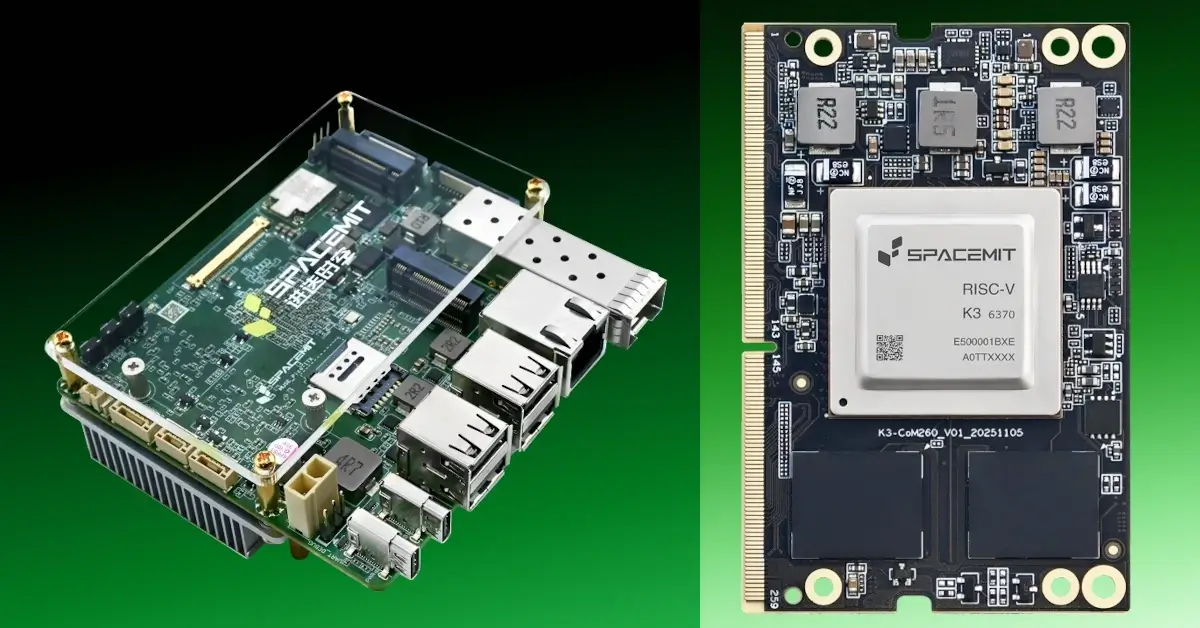
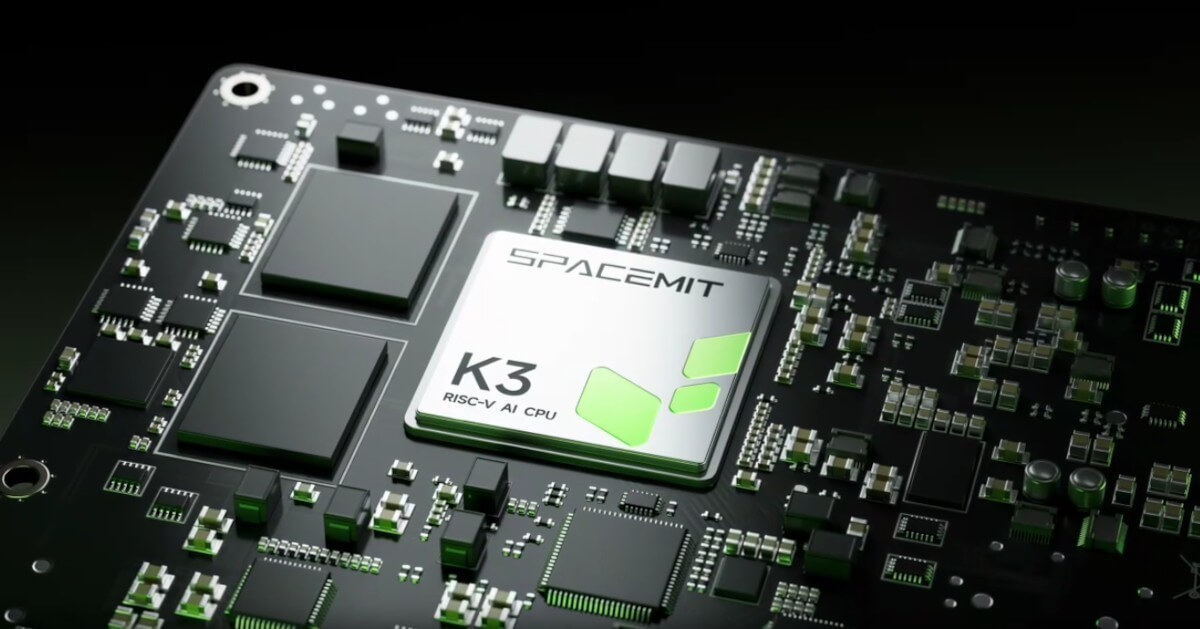
SpacemiT is a Chinese RISC-V CPU manufacturer that launched on May 11th, 2026, their long-anticipated next-gen RISC-V AI chip K3. It is among the earliest RISC-V CPUs that adhere to the RVA23 standard and performance-wise it is quite capable, providing 130 KDMIPS general computing power, 60 TOPS on INT4 which translates to about 15 tokens per second when running a 30 billion parameter large language model.
The aspect that really makes it stand out is:
A new minor release 0.4.27 of RQuantLib,
the first in over a year, arrived on CRAN a couple of minutes ago, has
just now been uploaded to Debian,
and is being built for r2u as well.
QuantLib is a rather
comprehensice free/open-source library for quantitative
finance. RQuantLib
connects (some parts of) it to the R environment and language, and has
been part of CRAN for nearly
twenty-three years (!!) as it was one of the first packages I uploaded
to CRAN.
This release of RQuantLib
brings an update to the interface for all equity options, vanilla and
exotics as well as implied volatilities. We now support the option
maturity via either an actual maturity date, or the (fractional
business-day years) numeric. This uses a clever little Rcpp trick I should discuss in a
separate blog post. We also re-ran compileAttributes() to
re-create the RcppExports.cpp file now using a slightly
improved way of calling Rf_error for an ongoing Rcpp transition, and did some more
standard maintenance. The details from the NEWS file follow as
usual.
Courtesy of my CRANberries, there is also a diffstat report for the this release. As always, more detailed information is on the RQuantLib page. Questions, comments etc should go to the rquantlib-devel mailing list. Issue tickets can be filed at the GitHub repo.Changes in RQuantLib version 0.4.27 (2026-06-07)
- All equity option functions can now take either a (fractional) time span to expiry or a given date, and accept a daycounter setter.
- Two very old schedule helpers had a superfluous
try/catchremoved.- The continuous integration setup received a minor update.
- The
RcppExports.cppfile was updated to aid aRcpptransition.
This post by Dirk Eddelbuettel originated on his Thinking inside the box blog. If you like this or other open-source work I do, you can now sponsor me at GitHub.
I finally carved out some time today to prepare and release debsecan-mcp v0.1.2 to PyPI. During this release, I

integrated PyPI's trusted publisher mechanism, which authenticates directly via
GitHub Actions and eliminates the need for manual uploads or static API tokens.
2144316 root 20 0 0 0 0 I 26.6 0.0 0:36.76 kworker/u88:20-btrfs-endio-write 2221470 root 20 0 0 0 0 I 23.7 0.0 0:01.85 kworker/u88:12-gfx 2221436 root 20 0 0 0 0 I 15.1 0.0 0:07.48 kworker/u88:8-btrfs-compressed-write 2166191 root 20 0 0 0 0 I 12.8 0.0 0:15.80 kworker/u88:23-btrfs-compressed-write 2126387 root 20 0 0 0 0 I 10.2 0.0 1:29.11 kworker/u88:4-events_unboundI had been running BTRFS with the mount option compress=zstd:15 which caused much of the performance problems when building. It was also a random performance issue which I think happened due to the BTRFS 30 second write-back sometimes taking more than 30 seconds during the build process which then caused a second write-back. I did tests on ZSTD compression levels 5, 8, 10, and 15. 15 was never good and often really bad. 10 was not unbearable but consistently slower. 8 was sometimes as fast as 5 and sometimes quite a bit slower. I didn t test levels below 5 because I need to have some compression and it seemed that the benefits of reducing compression were dropping off below 8. I found that the BTRFS compression delay is not counted in system time for the process. I think it s the fsync() system calls in the semodule and dpkg-deb programs that cause the delays related to BTRFS compression waiting for kernel threads. BOINC I have all my systems other than laptops running BOINC in the background so that CPU power is used for scientific research when I don t have any personal use for it [5]. I believe that it s immoral to waste CPU power when it could be used for research. In the below table which has test results from building the package with and without BOINC, and with different ZSTD compression levels in BTRFS all the worst entries were from when BOINC was running apart from one where ZSTD level 15 compression was used. The really poor performance with ZSTD level 15 was an outlier, but it wasn t an uncommon outlier so I left it in. Running BOINC in the background configured to use all CPU cores caused a significant increase in user CPU time (the time a CPU core spent actually running the program). My initial thought was that it s partly related to turbo boost . The Intel ARK page for the CPU in the Z420 shows that it s main clock speed is 2.0GHz with a 2.5GHz turbo boost [6]. The turbo boost is apparently largely based on temperature and apparently limited to one core, so if the other CPU cores are all being used then the CPU will probably be too hot to have the turbo boost and if it happens it might not happen for my compile processes. The ARK page for the E5-2699 v4 (which is a similar CPU to the E5-2696 v4 that I m using but is officially documented by Intel) [7] shows that it has a base clock speed of 2.2GHz and a turbo boost speed of 3.6 GHz. 322 vs 244 seconds of user CPU time means running 32% slower which can plausibly be explained by the lack of a 64% turbo boost with a bit of help from the 55MB L3 cache being thrashed. Turbo boost would only be a noticeable issue for building packages like the SE Linux policy packages which doesn t take much advantage of multi-core CPUs. For a build process to average at best 362% CPU use there has to be large parts of the process that are limited to one or two cores which can potentially give a benefit from turbo-boost. When building the Warzone 2100 packages most of the build time is running basis-universal which is a multi-threaded program to compress GPU texture data. This usually causes a load average of 300+ on the Z640 or 600+ on the Z840. But the build time is still increased by more than 50% on both the Z640 and the Z840 when BOINC is running in the background, which seems to be an indication that it s not related to turbo boost. I verified that BOINC is running at IDLE schedule priority with the following command:
# chrt -p $(pidof -s einstein_O4MD_2.01_x86_64-pc-linux-gnu) pid 2974874's current scheduling policy: SCHED_IDLE pid 2974874's current scheduling priority: 0In theory this means that BOINC won t affect foreground processes. Hyper Threading on the W-2125 The best claims I ve seen about HT are 15% to 30% performance boost. The best I ve actually seen in the past is about 18%. Seeing a 10% benefit for building Warzone 2100 is at the low end of the range I expected. 8 virtual cores is not many for a build process that causes a load average of 600+ when running on a system with 44 real cores. I was surprised to see a 6% performance benefit in hyper-threading for building the SE Linux policy as I didn t think there was enough use of threading or multiple processes to allow that. Many build scripts use a number of processes that match the number of apparent CPU cores. While make -j 88 might give a theoretical performance benefit on a 44 core system it will also take a lot of RAM and any paging will outweigh the benefits of hyper-threading. On a system with only 4 real cores there s less potential for using too much RAM and as security isn t so important on that system I will leave it on. Comparing the CPUs The best results of the Z640 and Z4G4 are only 50% faster than the best results of the Z420. The Z420 has a E5-2620 CPU which is far from the fastest CPU available for that system the E5-2687W has 8 cores and rates 10,021/1,669 on passmark [8] which is far better than the 5,331/1,114 the E5-2620. The E5-2687W is the fastest CPU that HP lists as supported by the Z420 and it supports DDR3-1666 RAM as opposed to the DDR3-1333 that is the fastest that the E5-2620 supports. With suitable hardware upgrades the Z420 would probably only take about 20% longer to do builds of the SE Linux policy and other packages that can t take advantage of more than 8 CPU cores. The Z4G4 system has 4 RAM channels which means that you should get some performance benefits from having 4 DIMMs, my system currently has 2 and I haven t yet managed to get more DDR4-2666 DIMMs. But I d still expected a W-2125 CPU with 2*DDR4-2666 DIMMs outperform any E5-26xx CPU with 4*DDR4-DDR-2400 DIMMs for tasks that average less than 4 CPU cores. In retrospect I would have been better off getting a HP Z820 (two socket server with DDR3 RAM) than the first DDR4 systems I got. It seems that for reasonable size builds a two socket system comes close to twice the speed of a single socket system. I did briefly own a HP ML350 two CPU system with DDR3 RAM but it was too noisy for my intended use as a deskside workstation so I sold it. Things to Investigate I plan to do more investigation on BTRFS compression, how to get the best compression without excessive delays and how to recognise when delays are happening. I have some SSDs that have sustained write speeds as low as 15MB/s (Crucial P1 series) so for those I could probably have very high compression levels without slowing the system down. The fact that BIONC slows things down so much seems to be a bug. When processes are running with the IDLE scheduling class there shouldn t be such significant delays. Is it due to cache thrashing? How can I best get BOINC suitably throttled when I m sitting at my workstation, I don t want BOINC connecting to the local X server (which it repeatedly tries to do). Do I need to tune my kernel for better handling of IDLE scheduling? When I get more DIMMs in the Z4G4 I need to do more tests to see if it gives an overall performance boost. Also the Z4G4 system has a BIOS option for sub NUMA which basically means treating the different RAM channels on a single CPU as NUMA zones, I enabled that option which does nothing presumably because I only have 2 DIMMs, the results when I have 4 DIMMs will be interesting. I will also do some NUMA tests on the Z840 to see what benefits it gives. I have a selection of RAM speeds that will work in the Z4G4, if I have enough spare time I ll test what difference that makes for CPU bound tasks that matter to me. For package building fsync() is not helpful, if the system crashes before it s done then I will just do the build again. For a build cluster it is probably a good feature and probably doesn t affect aggregate performance when multiple packages are built at the same time, but for the single user case probably not. I will investigate libeatmydata for package building [9]. Conclusion The progress in CPUs seems to have slowed down a lot recently. The main benefits seem to be in more CPU cores and for newer sockets with more RAM channels. The CPUs that do have improvements in single core performance are the i9 series (which mostly doesn t come with motherboards supporting ECC) and AMD CPUs (which is rare in enterprise class hardware). Maybe I should get a server with an i9 or AMD CPU for tasks that need a fast turn around with a small number of cores. That would probably outperform any CPU designed for large core counts for things like building the policy and setting up test VMs (which depends on package installation speed that is single core bottlenecked). The W-21xx CPUs seem to offer little benefit over the E5-26xxv4 CPUs and not a lot of benefit over E5-26xx CPUs (with DDR3). Even the W-22xx CPUs look like they aren t going to offer a lot as they are only an incremental improvement over the W-21xx series. I had considered making the Z4G4 my main desktop workstation after the high end W CPUs become affordable, but it looks like that won t be worth it until such CPUs drop from the current ebay price of $900 to $100. I think I ll keep waiting for a decent socket LGA3647 or DDR5 based server [10] for my next significant upgrade. Tables Building SE Linux Refpolicy
| System | BOINC | Compression | CPU Time | Elapsed | CPU% |
|---|---|---|---|---|---|
| Z640 | no | 8 | 248.82user 55.58system | 1:23.88elapsed | 362%CPU |
| Z4G4 | no | 5 | 245.15user 34.63system | 1:24.93elapsed | 329%CPU |
| Z640 | no | 5 | 244.75user 34.87system | 1:25.98elapsed | 325%CPU |
| Z4G4 | no | 10 | 245.21user 35.64system | 1:29.63elapsed | 313%CPU |
| Z640 | no | 8 | 248.71user 55.90system | 1:33.01elapsed | 327%CPU |
| Z640 | no | 10 | 250.90user 55.78system | 1:42.12elapsed | 300%CPU |
| Z640 | yes | 8 | 298.19user 69.30system | 1:59.77elapsed | 306%CPU |
| Z640 | yes | 10 | 300.58user 68.90system | 2:01.53elapsed | 304%CPU |
| Z420 | no | 5 | 359.01user 44.95system | 2:07.33elapsed | 317%CPU |
| Z640 | yes | 5 | 322.40user 71.82system | 2:34.66elapsed | 254%CPU |
| Z420 | yes | 5 | 372.03user 42.95system | 2:42.15elapsed | 255%CPU |
| Z640 | yes | 15 | 299.26user 67.18system | 2:59.77elapsed | 203%CPU |
| Z640 | no | 15 | 250.05user 54.60system | 3:07.61elapsed | 162%CPU |
| System | BOINC | Compression | CPU Time | Elapsed | CPU% |
|---|---|---|---|---|---|
| Z840 | no | 10 | 6549.21user 89.46system | 4:18.90elapsed | 2564%CPU |
| Z840 | no | 5 | 6533.81user 90.50system | 4:19.24elapsed | 2555%CPU |
| Z640 | no | 5 | 7040.87user 183.12system | 7:13.50elapsed | 1666%CPU |
| Z840 | yes | 5 | 8039.52user 169.62system | 8:02.86elapsed | 1700%CPU |
| Z640 | yes | 5 | 7486.44user 205.03system | 11:09.97elapsed | 1148%CPU |
| Z4G4 | no | 5 | 7891.32user 74.45system | 17:48.03elapsed | 745%CPU |
| Z4G4 | no | 10 | 7942.10user 77.43system | 17:58.72elapsed | 743%CPU |
| Build | HT | Compression | CPU Time | Elapsed | CPU% |
|---|---|---|---|---|---|
| Warzone | yes | 5 | 7891.32user 74.45system | 17:48.03elapsed | 745%CPU |
| Warzone | yes | 10 | 7942.10user 77.43system | 17:58.72elapsed | 743%CPU |
| Warzone | no | 5 | 4492.45user 59.09system | 19:59.01elapsed | 379%CPU |
| Warzone | no | 10 | 4497.28user 59.46system | 20:07.15elapsed | 377%CPU |
| Refpolicy | yes | 5 | 245.15user 34.63system | 1:24.93elapsed | 329%CPU |
| Refpolicy | yes | 10 | 245.21user 35.64system | 1:29.63elapsed | 313%CPU |
| Refpolicy | no | 5 | 180.84user 29.74system | 1:32.30elapsed | 228%CPU |
| Refpolicy | no | 10 | 180.29user 30.07system | 1:35.01elapsed | 221%CPU |
entities app, which will soon hopefully replace the legacy
apis_entities & apis_metainfo modules. Version 0.64 moved some logic from
the legacy modules the entities module.
We made some progress in defining the endpoints for the
PFP
API.
Welcome to the May 2026 report from the Reproducible Builds project. These reports outline what we ve been up to over the past month, highlighting items of news from elsewhere in the increasingly-important area of software supply-chain security. As ever, if you are interested in contributing to the Reproducible Builds project, please see the Contribute page on our website. In this month s report, we cover:
In a huge change in Debian s reproducibility policy, the Debian Release Team announced that:
we ve decided it s time to say that Debian must ship reproducible packages. Since yesterday, we have enabled our migration software to block migration of new packages that can t be reproduced [on reproduce.debian.net] or existing packages in testing that regress in reproducibility.That is to say, if newly-uploaded packages are not reproducible, they won t be considered candidates for inclusion in the next stable release of Debian codenamed forky. (Some exceptions may be granted.) This news generated a number of articles and comments in various news outlets:
.deb files in the official Debian archive itself. This small-sounding distinction is actually essential, as this is the only means through which the reproducible builds technique can determine whether build systems are compromised are not.
A video (32m37s) of the talk is available, as are Holger s slides.
Andr Arko and Amean Asad published a paper this month on Kettle, a build system that produces cryptographically verifiable provenance for software built inside Trusted Execution Environments :
A Kettle build records the source commit, dependency set, toolchain, build environment and output artifact digests in a provenance document produced inside a measured confidential VM. The SHA-256 digest of that document is committed to the TEE platform s attestation report-data field, so the hardware-signed attestation report is itself the signature on the provenance, with the signing identity chaining to the TEE manufacturer s root of trust rather than to the build infrastructure operator. Because the CVM image is itself reproducible, its launch measurement is public and stable, which lets a build requester pre-attest the CVM before submitting any input and optionally deliver source over a TLS channel terminated inside it, so the build runs end-to-end confidentially without the host ever seeing source code in plaintext.A PDF of the paper is available online.
rebuilderd, our server designed for monitoring the official package repositories of Linux distributions and attempt to reproduce the observed results there; it powers, amongst other things, reproduce.debian.net.
A new version, 0.27.0, was released this month, with the following headline changes:
.udeb supportThe new rebuilderd package is currently available in theextra-testingrepository. Note the Arch Linux package is upgraded fromv0.25.0fromv0.27.0; please be patient with the database migrations on first restart, and make yourself familiar with the breaking changes in v0.26.0 too.
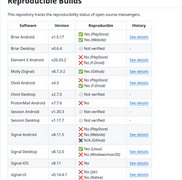
GitHub developer BarbossHack is maintaining an repository/page on GitHub to track reproducibility status of open source messengers .
In Debian this month, the loong64 architecture was added to reproduce.debian.net. This is a 64-bit Reduced Instruction Set Computer (RISC) instruction set architecture developed by Loongson.
Vagrant Cascadian performed Non-Maintainer Uploads (NMUs) in Debian for several packages with outstanding patches over a year old. These included rocdbgapi, onevpl-intel-gpu, python-pytest-shell-utilities, python-mt-940 and pympress.
On tests.reproducible-builds.org, Vagrant Cascadian fixed the huge spike in build failures by adding passwd to the base tarballs, and re-enabled building gcc and binutils packages with PGO (Profile Guided Optimization) and LTO (Link Time Optimization) to avoid giving a false sense of reproducibility.
Inconsistencies on the reproducibility of the condor package were brought up on the Debian reproducible-builds mailing list. Following a hunch, Vagrant Cascadian eventually identified the issue was related to embedded kernel versions which was then fixed upstream and fixed in Debian as well.
Lastly, 40 reviews of Debian packages were added, 68 were updated and 75 were removed this month adding to our knowledge about identified issues. A number of issue types were updated, such as the addition of a new sphinx_reading_durations toolchain issue [ ], a golang_mango_generates_manpages_with_build_date issue [ ] and a random_offset_id_in_cython_linetrace [ ]. In addition, the timestamps_in_qhc issue was refocused to timestamps_in_qhc [ ].
In Fedora, Jelle van der Waa submitted a request for an official Fedora rebuilderd package which was reviewed by Neal Gompa.
Lastly, Bernhard M. Wiedemann posted another openSUSE monthly update for their reproducibility work there.
grep package as being reproducible whilst their own is not. Although the root cause of the issue is that various translations are fetched from a remote location during bootstrap , cen argues that:
Perhaps rebuilderd needs a feature whereGOODpackages are also periodically rebuilt in exponential back-off style and compared against current upstream build and also our lastGOODbuild. This would confirm whether a package is reproducible if built in a short time window but also help uncover longer time window issues that are currently hidden.
dkimpy.fortran-stdlib.powerline.pycayennelpp.pycorrfit.sphinx-needs.ruby-otr-activerecord.git-pw.golang-github-akavel-rsrc.pampi.libreoffice-dictionaries.vnu.golang-github-shirou-gopsutil.javacc5.rssguard.golang-github-containerd-accelerated-container-image.docker-credential-gcr.xpenguins.cairocffi.meshy.bingo.golang-github-cyclonedx-cyclonedx-go.nfstest.
+ (plus sign) to the GNU Autotools example on the SOURCE_DATE_EPOCH documentation page. [ ]#reproducible-builds on irc.oftc.net.
rb-general@lists.reproducible-builds.org
It's been ten years since I configured mount on demand backups to reduce
the risk of my backups being zapped by mistake. Way back then I wanted to go
one step further and use dedicated mount namespaces for backup jobs, but
systemd didn't provide the necessary support (and still doesn't, despite the
promisingly-named JoinsNameSpaceOf= configuration option.)
I recently updated my setup to achieve this by hand. All backup jobs now have
an extra pre-start instruction ExecStartPre=mkbackupns which runs a shell
script to either set up a persistent mount namespace, or exit quietly if it
already exists.
#!/bin/bash
set -euo pipefail
nsdir=/var/namespaces
nsfile=$nsdir/backup
nsfilex="$(echo $nsfile sed 's#/#\\/#'g)"
private_propagation()
findmnt -o+PROPAGATION "$nsdir" grep -q private
nsfs_is_mounted()
test "nsfs" = "$(awk "/$nsfilex/ print \$3 " /proc/mounts)"
if ! nsfs_is_mounted; then
if ! private_propagation; then
mkdir -p "$nsdir"
mount --bind --make-private "$nsdir" "$nsdir"
fi
touch "$nsfile"
unshare --mount="$nsfile" true
nsenter --mount=/var/namespaces/backup mount /dev/phobos_backup/backup /backup
fi
I should note that I don't have the backup filesystem described in /etc/fstab
to reduce the risk of it being mounted errantly in the main namespace.
The other change is to prefix an invocation of nsenter for every backup
job command. E.g.:
ExecStart=/usr/bin/nsenter \
--mount=/var/namespaces/backup \
borgmatic -v 1 prune create
next steps
My backup scheme has lasted a decade with few tweaks
(I moved it to Borg in 2020) which I am very grateful for. I want reliable,
boring and robust.
Persistent mount namespaces are a lot less convoluted if you have a persistent
process to associate them with. I didn't, but a subsequent improvement I am
making is introducing one, so I will likely simplify the above accordingly.
Next.