Search Results: "oku"

18 October 2012

M nica Ram rez Arceda: Hackafou: C mo empezar a colaborar en Debian

Last Saturday (13/10/2012), I gave a talk about Debian in Hackafou, the Hackmeeting 2012. The talk was titled C mo empezar a colaborar en Debian ( How to start to collaborate in Debian ) and I think all the attendants enjoyed it very much :) Here you have all the produced material (slides and audio), both in Spanish: Talk: C mo empezar a colaborar en Debian You'll find a README inside the slides tar file with a summary of what I talked about during each slide. This is because slides are very visual, with almost no text. I hope you like it!

12 October 2012

Matthew Garrett: Further UEFI bootloader work

I've been continuing to work on Shim this week, and it's now getting pretty close to feature complete. The biggest change has been migrating the MokList variable from a custom format to the one used by the UEFI spec databases, which means it's easier for the kernel to import the MOK entries and use them for validating module signatures.

The other benefit of this format is that it supports hashes as well as certificates, and so I've added support for enrolling hashes through the MokManager UI. This means that distributions can now ship with a signed copy of Shim without having to sign any other components of their distribution. When the user attempts to boot off the media they'll be faced with a menu and a countdown. If the countdown reaches 0, the system will simply fall back to the next entry in the bootlist. If they hit a key, they can choose to enrol a hash. The user then navigates the filesystem explorer, chooses the bootloader, confirms that they want to enrol it and then exits. Shim then verifies the bootloader against the hash and boots successfully.

The big advantage of this over the Linux Foundation approach is that once a hash has been enrolled the need for physical end-user presence is removed - ie, if you enrol the hash, you don't need to hit a key every time you boot. This is still slightly sub-optimal in that if you update your bootloader you'll need to enrol a new hash, but that can be partially automated by calling MokUtil in the postinst - the user then simply needs to confirm that they want to enrol the hash, rather than having to choose it manually. Completely transparent updates are going to require a signed bootloader and an enrolled signing key.

A couple of people have asked whether we're planning on implementing the Linux Foundation approach of simply asking the user whether they want to boot an unsigned file. We've considered it, but at the moment are leaning towards "no" - it's simply too easy to use to trick naive users into running untrusted code. Users are trained to click through pretty much any security prompt that they see, and if an attacker replaces a legitimate bootloader with one that asks them to press "y" to make their computer work, they'll press "y". If that bootloader then launches a trojaned Windows bootloader that launches a trojaned Windows kernel, that's kind of a problem. This could be somewhat mitigated by limiting this feature to removable media, and we're seriously considering that, but there are still some risks associated. We might just end up writing the code but disabling it at build time, and then anyone who wants to distribute with that policy can do so at their own risk.

Meanwhile, Peter Jones is working on tidying up the code we're using for the actual signing and will be publishing that once the last couple of kinks are worked out. We're using hardware cryptography, so even if someone compromises the build systems they won't be able to obtain the private key that we use. However, should something disastrous and unanticipated happen, we do have a plan in place for migrating to new keys with minimal user impact. We'll document the code and infrastructure we're using in order to make it as easy as possible for other distributions to implement equivalent functionality.

As I've mentioned before, our goal is to make it as easy as possible for distributions to implement whatever level of Secure Boot policy they want without having to engage with Microsoft themselves. Shim allows distributions to ship an OS that has no signed binaries at all, or alternatively to ship an OS that uses filesystem-level cryptography to ensure that even userspace is completely signed. I'm expecting to see a range of options available, and I hope that the majority of users will find something to suit their needs.

comment count unavailable comments

26 September 2012

NOKUBI Takatsugu: Debian Packaging dojo

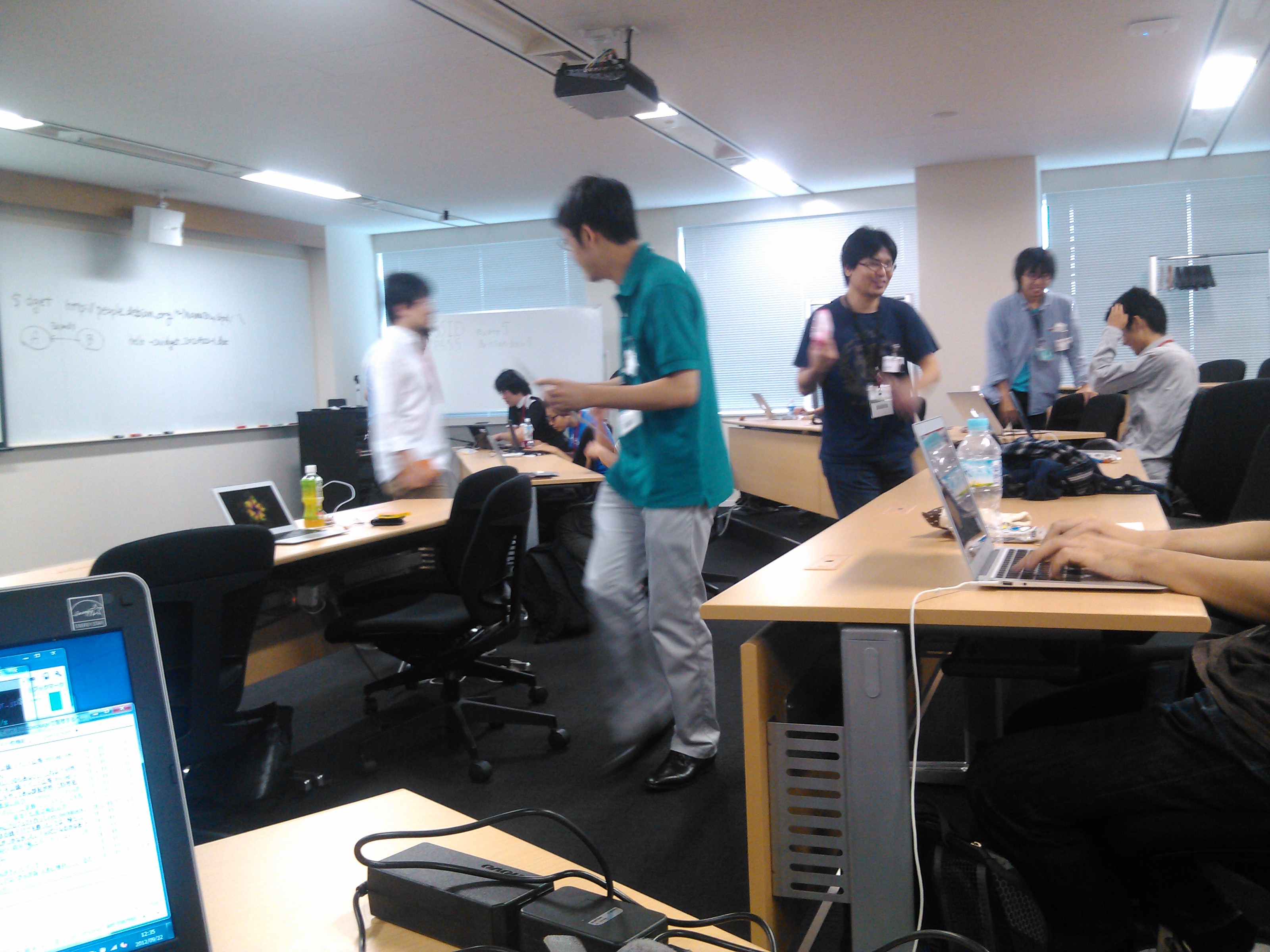
I attended Debian Packaging Dojo at 22 Aug. Dojo ( ) means a training hall for karate, judo, and/or kendo in Japanese. The event is a training for Debian packaging. Attendants were about 15 people. I could learn modern packaging methods. The place is Rakuten Tower in Shinagawa, thank you Rakuten company and Taku YASUI <tach at debian.org>.

17 September 2012

M nica Ram rez Arceda: Debconf12: Debian QA, una puerta de entrada al proyecto Debian

I wanted to write this post a lot of days ago, but it's better late than never :-) Last July, I had the pleasure to be at Debconf12, in Managua. On Debian Day, I gave a talk about getting involved in Debian through Debian QA Team. I hope everybody who was there enjoyed the talk! The talk was in Spanish and here you have all the produced material (slides and video): Talk: Debian QA, una puerta de entrada al proyecto Debian.

9 September 2012

Gregor Herrmann: RC bugs 2012/36

highlight of the week: I "wrote" (i.e. copypasted) my first patch in haskell some days ago :) apart from that, nothing exciting:

20 August 2012

NOKUBI Takatsugu: FSIJ join to Software Freedom Day

We, FSIJ join to Software Freedom Day 2012. Japanese Wiki page had publishd by Nobuhiro Iwamatsu, a developer of Debian Project. I prepared to broadcast the event by 100% Free Software, I can get many suggestion by the last article comments, thank you. The following is my recipie:
ffmpeg -s 320 240 -f video4linux2 -i /dev/video0 -b 128k \
-f alsa -ac 2 -i hw:0,0 -acodec vorbis -vcodec libtheora -r 25 -f ogg -\
oggfwd host.example 8000 passwd /test.ogv

10 August 2012

NOKUBI Takatsugu: How do I broadcast video streaming with Free Software?

I, as a member of FSIJ, consider to broadcast a Software Freedome Day in Japan. In the past, I can do it with gstreamer and icecast2 in The 5th International GPLv3 Conference. Howerver, gstreamer command is very complex and the Interface had changed, so I can t re-do it by my old script. Usteram is easy to use, but it is not Free Software. I could find such packages in Debian repos: I ll try to use them and to find the good tool.

31 July 2012

NOKUBI Takatsugu: Unknown deliver machine in a hospital

Unknown machine video (mp4) It seems the machine delivering some medicine.

NOKUBI Takatsugu: Unknown deliver machine in a hospital

It seems the machine delivering some medicine.

27 July 2012

NOKUBI Takatsugu: OpenBlocks A6 work with FreeBSD

Hiroki Sato, a member of FreeBSD core team, reported to work FreeBSD on OpenBlocks A6, a ARM based machine with Debian. Here is the boot message. And NetBSD also works.

NOKUBI Takatsugu: RetroBSD on PIC32

Shozo TAKEOKA had described to work RetroBSD on PIC32 1chip micro computer in 14th JNUG BOF. The board is Chipkit MAX32 with SD card socket. He bought it 5,900 JPY. More detail is http://ameblo.jp/takeoka/entry-11308169137.html (Japanese). RetroBSD is based on 2.2 BSD (!), and work without MMU. So it can work only one process in their ram, other processes are in swap space. It was really funny presentation.

26 July 2012

NOKUBI Takatsugu: Japan NetBSD Users Group annual meeting

In July 7, I attended to Japan NetBSD Users Group (JNUG) 14th annual meeting and BoF. There ware many technical sessions, and key-signing party. So I can connect between Debian developers and NetBSD developers with the web of trust.

NOKUBI Takatsugu: Some Debian events in Japan recently

In June 23, Grand Unification Debian seminar had held in Kyoto University. The participiants were about 70 people. And in July 21, The 90th Tokyo area Debian seminar had held in Ogikubo, Tokyo. It holds every month, so the participiants are not so many, but there ware about 15 people. There were good experience to me, especially key-signing party was good. But I forgot to bring my new 4096R key CurrentlyI use 1024D key and it is not so strtong, so I consider to switch the new key.

NOKUBI Takatsugu: Hello, again.

I had an old English blog with bloxsum, but it is hard to maintainance so I created a new site with wordpress.

12 June 2012

C.J. Adams-Collier: pki via IPv4 is back online

It turns out I didn t have IP forwarding turned on in my shorewall config and so DNAT wasn t working. Oops. You should be able to get to the HKP, ntp, RADIUS and kerberos servers now via IPv4. IPv6 was working before now. Sorry for the outage! http://pki.colliertech.org:11371/pks/lookup?op=vindex&search=0x8E562765BA27A83C

5 June 2012

Lars Wirzenius: errno lookups on the command line

I've had a little command line tool called errno for many years now. It's a short Python script, and lets me look up Unix errno names and values given values or names.
$ errno 2
ENOENT 2 No such file or directory
$ errno EEXIST
EEXIST 17 File exists
$
This is occasionally very useful when reading logs from various programs. I thought it might be useful for others as well, so I decided to rewrite it in C so I can offer it to become part of moreutils. It is now in the master branch of moreutils. Today I added a couple of options: --list lists all the errno values, and --search does a full text (case insensitive) search of all descriptions. I also added a script that lets you do the search in all installed locales. (These changes are waiting for Joey to merge them. Meanwhile, they're at gitorious.)
$ errno-all onnistu   sort -u
EDEADLOCK 0 Onnistui
ENOMEM 12 Muistin varaaminen ei onnistu
ENOTSUP 0 Onnistui
EWOULDBLOCK 0 Onnistui
$ 
(That's Finnish.) Hopefully others will find this useful as well.

3 June 2012

Micha Lenk: AB-Transfers 0.0.3.0 in Debian

I just uploaded the online banking application AB-Transfers to Debian. This is not a finance management application like Gnucash or KMyMoney (i.e. it is not able to keep track of your incomes and expenses). Instead it is mainly intended as a companion that you can use for online transactions that these applications don't support yet. If you were using QBankmanager in the past for this purpose, please take a look at AB-Transfers and consider switching to it. As QBankmanager seems to be abandoned by the upstream author, I consider AB-Transfers the better choice for a pure online transaction application.

19 May 2012

Thorsten Glaser: MirBSD goes webservice manpages and WTF

While wtf(1) always has been a bit central to MirBSD, and the acronym database has been accessible by CVSweb, what we never had was a DAU compatible (and shellsnippets compatible) lookup. This has now changed: the above link to the acronyms file is a persistent link to its latest version (well, latest when the website was last recompiled), tooltips may very well follow soon, and we ve got an online WTF lookup service.
Contributions to the acronym database are welcome, of course; just eMail them to tg mirbsd org. Not to stop there, our online HTML manpage search is also new, shiny, and should replace the !mbsdman DuckDuckGo hash-bang shortly. (Both of these services offer a DDG search as fallback. Note that DDG is an external service included herein by linking, under their request to spread it, and not affiliated with The MirOS Project. They do, however, donate some advertising money to Debian.)
For all those who didn t know: only manpages for software in the MirOS BSD base system and for the MirPorts Framework package tools are listed, not for third-party applications installable using ports or, recently, pkgsrc . Still, if you want to have a peek at a modern classic BSD s documentation, you re welcome. (Not to mention content like re_format(7) and style(9) and that some of our documentation is much more legible than others.) And because writing all that perl(1) made me ill, not to mention I don t even know that language, I ve hacked a bit more in the mir make(1) and mksh(1) parts of the MirWebsite, finally implementing pointing out where in the navigation sidebar the visitor currently is. We also have exciting mksh porting news involving RT trying a larger number of ancient platforms than I dare count, me fixing bugs in Linux klibc and diving into other things, learning more about why I consider me lucky for hacking a BSD operating system sorry, I want to keep this short as it s mostly an announcement. The MirWebsite source code is, of course, also available. Improvements welcome. Except for these three CGIs, our website is fully statically precompiled, and that s a good thing. Please help in making the CGIs secure.

13 May 2012

Petter Reinholdtsen: Debian Edu interview: J rgen Leibner

It has been a few busy weeks for me, but I am finally back to publish another interview with the people behind Debian Edu and Skolelinux. This time it is one of our German developers, who have helped out over the years to make sure both a lot of major but also a lot of the minor details get right before release. Who are you, and how do you spend your days? My name is J rgen Leibner, I'm 49 years old and living in Bielefeld, a town in northern Germany. I worked nearly 20 years as certified engineer in the department for plant design and layout of an international company for machinery and equipment. Since 2011 I'm a certified technical writer (tekom e.V.) and doing technical documentations for a steam turbine manufacturer. From April this year I will manage the department of technical documentation at a manufacturer of automation and assembly line engineering. My first contact with linux was around 1993. Since that time I used it at work and at home repeatedly but not exclusively as I do now at home since 2006. How did you get in contact with the Skolelinux/Debian Edu project? Once a day in the early year of 2001 when I wanted to fetch my daughter from primary school, there was a teacher sitting in the middle of 20 old computers trying to boot them and he failed. I helped him to get them booting. That was seen by the school director and she asked me if I would like to manage that the school gets all that old computers in use. I answered: "Yes". Some weeks later every of the 10 classrooms had one computer running Windows98. I began to collect old computers and equipment as gifts and installed the first computer room with a peer-to-peer network. I did my work at school without being payed in my spare time and with a lot of fun. About one year later the school was connected to Internet and a local area network was installed in the school building. That was the time to have a server and I knew it must be a Linux server to be able to fulfil all the wishes of the teachers and being able to do this in a transparent and economic way, without extra costs for things like licence and software. So I searched for a school server system running under Linux and I found a couple of people nearby who founded 'skolelinux.de'. It was the Skolelinux prerelease 32 I first tried out for being used at the school. I managed the IT of that school until the municipal authority took over the IT management and centralised the services for all schools in Bielefeld in December of 2006. What do you see as the advantages of Skolelinux/Debian Edu? When I'm looking back to the beginning, there were other advantages for me as today. In the past there were advantages like: Today some of the advantages has been lost, changed or new ones came up in this way: What do you see as the disadvantages of Skolelinux/Debian Edu? Which free software do you use daily? I use Debian stable on my home server and on my little desktop computer. On my laptop I use Debian testing/sid. The applications I use on my laptop and my desktop are Open/Libre-office, Iceweasel, KMail, DigiKam, Amarok, Dolphin, okular and all the other programs I need from the KDE environment. On console I use newsbeuter, mutt, screen, irssi and all the other famous and useful tools. My home server provides mail services with exim, dovecot, roundcube and mutt over ssh on the console, file services with samba, NFS, rsync, web services with apache, moinmoin-wiki, multimedia services with gallery2 and mediatomb and database services with MySQL for me and the whole family. I probably forgot something. Which strategy do you believe is the right one to use to get schools to use free software? I believe, we should provide concepts for IT companies to integrate Debian Edu into their product portfolio with use cases for different countries and areas all over the world.

24 April 2012

M nica Ram rez Arceda: Debian talk at Institut usias March

Last Friday (2012-04-20) I gave a talk about Debian at Institut usias March. This talk was inside Jornades t cniques d'FP 2012, a conference organized by different schools around Catalonia. I tried to explain to about 60 students the essence of Debian Project I hope they enjoyed the talk! To prepare the slides, I played a little bit with impress.js. I don't think I'm a great artist but I enjoyed using this nice tool. Here you have the slides I used for the talk: Talk: Debian. El sistema operatiu lliure creat per la comunitat. They are in Catalan but, although you don't understand this language, I encourage you to go until the last slide stars always have something to tell you ;)

Next.

Previous.