Search Results: "nate"

17 July 2025

Arnaud Rebillout: Acquire-By-Hash for APT packages repositories, and the lack of it in Kali Linux

This is a lenghty blog post. It features a long introduction that explains how apt update acquires various files from a package repository, what is Acquire-By-Hash, and how it all works for Kali Linux: a Debian-based distro that doesn't support Acquire-By-Hash, and which is distributed via a network of mirrors and a redirector. In a second part, I explore some "Hash Sum Mismatch" errors that we can hit with Kali Linux, errors that would not happen if only Acquire-By-Hash was supported. If anything, this blog post supports the case for adding Acquire-By-Hash support in reprepro, as requested at https://bugs.debian.org/820660. All of this could have just remained some personal notes for myself, but I got carried away and turned it into a blog post, dunno why... Hopefully others will find it interesting, but you really need to like troubleshooting stories, packed with details, and poorly written at that. You've been warned! Introducing Acquire-By-Hash Acquire-By-Hash is a feature of APT package repositories, that might or might not be supported by your favorite Debian-based distribution. A repository that supports it says so, in the Release file, by setting the field Acquire-By-Hash: yes. It's easy to check. Debian and Ubuntu both support it:
$ wget -qO- http://deb.debian.org/debian/dists/sid/Release   grep -i ^Acquire-By-Hash:
Acquire-By-Hash: yes
$ wget -qO- http://archive.ubuntu.com/ubuntu/dists/devel/Release   grep -i ^Acquire-By-Hash:
Acquire-By-Hash: yes
What about other Debian derivatives?
$ wget -qO- http://http.kali.org/kali/dists/kali-rolling/Release   grep -i ^Acquire-By-Hash:   echo not supported
not supported
$ wget -qO- https://archive.raspberrypi.com/debian/dists/trixie/Release   grep -i ^Acquire-By-Hash:   echo not supported
not supported
$ wget -qO- http://packages.linuxmint.com/dists/faye/Release   grep -i ^Acquire-By-Hash:   echo not supported
not supported
$ wget -qO- https://apt.pop-os.org/release/dists/noble/Release   grep -i ^Acquire-By-Hash:   echo not supported
not supported
Huhu, Acquire-By-Hash is not ubiquitous. But wait, what is Acquire-By-Hash to start with? To answer that, we have to take a step back and cover some basics first. The HTTP requests performed by 'apt update' What happens when one runs apt update? APT first requests the Release file from the repository(ies) configured in the APT sources. This file is a starting point, it contains a list of other files (sometimes called "Index files") that are available in the repository, along with their hashes. After fetching the Release file, APT proceeds to request those Index files. To give you an idea, there are many kinds of Index files, among which: There's an excellent Wiki page that details the structure of a Debian package repository, it's there: https://wiki.debian.org/DebianRepository/Format. Note that APT doesn't necessarily download ALL of those Index files. For simplicity, we'll limit ourselves to the minimal scenario, where apt update downloads only the Packages files. Let's try to make it more visual: here's a representation of a apt update transaction, assuming that all the components of the repository are enabled:
apt update -> Release -> Packages (main/amd64)
                      -> Packages (contrib/amd64)
                      -> Packages (non-free/amd64)
                      -> Packages (non-free-firmware/amd64)
Meaning that, in a first step, APT downloads the Release file, reads its content, and then in a second step it downloads the Index files in parallel. You can actually see that happen with a command such as apt -q -o Debug::Acquire::http=true update 2>&1 grep ^GET. For Kali Linux you'll see something pretty similar to what I described above. Try it!
$ podman run --rm kali-rolling apt -q -o Debug::Acquire::http=true update 2>&1   grep ^GET
GET /kali/dists/kali-rolling/InRelease HTTP/1.1    # <- returns a redirect, that is why the file is requested twice
GET /kali/dists/kali-rolling/InRelease HTTP/1.1
GET /kali/dists/kali-rolling/non-free/binary-amd64/Packages.gz HTTP/1.1
GET /kali/dists/kali-rolling/main/binary-amd64/Packages.gz HTTP/1.1
GET /kali/dists/kali-rolling/non-free-firmware/binary-amd64/Packages.gz HTTP/1.1
GET /kali/dists/kali-rolling/contrib/binary-amd64/Packages.gz HTTP/1.1
However, and it's now becoming interesting, for Debian or Ubuntu you won't see the same kind of URLs:
$ podman run --rm debian:sid apt -q -o Debug::Acquire::http=true update 2>&1   grep ^GET
GET /debian/dists/sid/InRelease HTTP/1.1
GET /debian/dists/sid/main/binary-amd64/by-hash/SHA256/22709f0ce67e5e0a33a6e6e64d96a83805903a3376e042c83d64886bb555a9c3 HTTP/1.1
APT doesn't download a file named Packages, instead it fetches a file named after a hash. Why? This is due to the field Acquire-By-Hash: yes that is present in the Debian's Release file. What does Acquire-By-Hash mean for 'apt update' The idea with Acquire-By-Hash is that the Index files are named after their hash on the repository, so if the MD5 sum of main/binary-amd64/Packages is 77b2c1539f816832e2d762adb20a2bb1, then the file will be stored at main/binary-amd64/by-hash/MD5Sum/77b2c1539f816832e2d762adb20a2bb1. The path main/binary-amd64/Packages still exists (it's the "Canonical Location" of this particular Index file), but APT won't use it, instead it downloads the file located in the by-hash/ directory. Why does it matter? This has to do with repository updates, and allowing the package repository to be updated atomically, without interruption of service, and without risk of failure client-side. It's important to understand that the Release file and the Index files are part of a whole, a set of files that go altogether, given that Index files are validated by their hash (as listed in the Release file) after download by APT. If those files are simply named "Release" and "Packages", it means they are not immutable: when the repository is updated, all of those files are updated "in place". And it causes problems. A typical failure mode for the client, during a repository update, is that: 1) APT requests the Release file, then 2) the repository is updated and finally 3) APT requests the Packages files, but their checksum don't match, causing apt update to fail. There are variations of this error, but you get the idea: updating a set of files "in place" is problematic. The Acquire-By-Hash mechanism was introduced exactly to solve this problem: now the Index files have a unique, immutable name. When the repository is updated, at first new Index files are added in the by-hash/ directory, and only after the Release file is updated. Old Index files in by-hash/ are retained for a while, so there's a grace period during which both the old and the new Release files are valid and working: the Index files that they refer to are available in the repo. As a result: no interruption of service, no failure client-side during repository updates. This is explained in more details at https://www.chiark.greenend.org.uk/~cjwatson/blog/no-more-hash-sum-mismatch-errors.html, which is the blog post from Colin Watson that came out at the time Acquire-By-Hash was introduced in... 2016. This is still an excellent read in 2025. So you might be wondering why I'm rambling about a problem that's been solved 10 years ago, but then as I've shown in the introduction, the problem is not solved for everyone. Support for Acquire-By-Hash server side is not for granted, and unfortunately it never landed in reprepro, as one can see at https://bugs.debian.org/820660. reprepro is a popular tool for creating APT package repositories. In particular, at Kali Linux we use reprepro, and that's why there's no Acquire-By-Hash: yes in the Kali Release file. As one can guess, it leads to subtle issues during those moments when the repository is updated. However... we're not ready to talk about that yet! There's still another topic that we need to cover: this window of time during which a repository is being updated, and during which apt update might fail. The window for Hash Sum Mismatches, and the APT trick that saves the day Pay attention! In this section, we're now talking about packages repositories that do NOT support Acquire-By-Hash, such as the Kali Linux repository. As I've said above, it's only when the repository is being updated that there is a "Hash Sum Mismatch Window", ie. a moment when apt update might fail for some unlucky clients, due to invalid Index files. Surely, it's a very very short window of time, right? I mean, it can't take that long to update files on a server, especially when you know that a repository is usually updated via rsync, and rsync goes to great length to update files the most atomically as it can (with the option --delay=updates). So if apt update fails for me, I've been very unlucky, but I can just retry in a few seconds and it should be fixed, isn't it? The answer is: it's not that simple. So far I pictured the "package repository" as a single server, for simplicity. But it's not always what it is. For Kali Linux, by default users have http.kali.org configured in their APT sources, and it is a redirector, ie. a web server that redirects requests to mirrors that are nearby the client. Some context that matters for what comes next: the Kali repository is synced with ~70 mirrors all around the world, 4 times a day. What happens if your apt update requests are redirected to 2 mirrors close-by, and one was just synced, while the other is still syncing (or even worse, failed to sync entirely)? You'll get a mix of old and new Index files. Hash Sum Mismatch! As you can see, with this setup the "Hash Sum Mismatch Window" becomes much longer than a few seconds: as long as nearby mirrors are syncing the window is opened. You could have a fast and a slow mirror next to you, and they can be out of sync with each other for several minutes every time the repository is updated, for example. For Kali Linux in particular, there's a "detail" in our network of mirrors that, as a side-effect, almost guarantees that this window lasts several minutes at least. This is because the pool of mirrors includes kali.download which is in fact the Cloudflare CDN, and from the redirector point of view, it's seen as a "super mirror" that is present in every country. So when APT fires a bunch of requests against http.kali.org, it's likely that some of them will be redirected to the Kali CDN, and others will be redirected to a mirror nearby you. So far so good, but there's another point of detail to be aware of: the Kali CDN is synced first, before the other mirrors. Another thing: usually the mirrors that are the farthest from the Tier-0 mirror are the longest to sync. Packing all of that together: if you live somewhere in Asia, it's not uncommon for your "Hash Sum Mismatch Window" to be as long as 30 minutes, between the moment the Kali CDN is synced, and the moment your nearby mirrors catch up and are finally in sync as well. Having said all of that, and assuming you're still reading (anyone here?), you might be wondering... Does that mean that apt update is broken 4 times a day, for around 30 minutes, for every Kali user out there? How can they bear with that? Answer is: no, of course not, it's not broken like that. It works despite all of that, and this is thanks to yet another detail that we didn't go into yet. This detail lies in APT itself. APT is in fact "redirector aware", in a sense. When it fetches a Release file, and if ever the request is redirected, it then fires the subsequent requests against the server where it was initially redirected. So you are guaranteed that the Release file and the Index files are retrieved from the same mirror! Which brings back our "Hash Sum Mismatch Window" to the window for a single server, ie. something like a few seconds at worst, hopefully. And that's what makes it work for Kali, literally. Without this trick, everything would fall apart. For reference, this feature was implemented in APT back in... 2016! A busy year it seems! Here's the link to the commit: use the same redirection mirror for all index files. To finish, a dump from the console. You can see this behaviour play out easily, again with APT debugging turned on. Below we can see that only the first request hits the Kali redirector:
$ podman run --rm kali-rolling apt -q -o Debug::Acquire::http=true update 2>&1   grep -e ^Answer -e ^HTTP
Answer for: http://http.kali.org/kali/dists/kali-rolling/InRelease
HTTP/1.1 302 Found
Answer for: http://mirror.freedif.org/kali/dists/kali-rolling/InRelease
HTTP/1.1 200 OK
Answer for: http://mirror.freedif.org/kali/dists/kali-rolling/non-free-firmware/binary-amd64/Packages.gz
HTTP/1.1 200 OK
Answer for: http://mirror.freedif.org/kali/dists/kali-rolling/contrib/binary-amd64/Packages.gz
HTTP/1.1 200 OK
Answer for: http://mirror.freedif.org/kali/dists/kali-rolling/main/binary-amd64/Packages.gz
HTTP/1.1 200 OK
Answer for: http://mirror.freedif.org/kali/dists/kali-rolling/non-free/binary-amd64/Packages.gz
HTTP/1.1 200 OK
Interlude Believe it or not, we're done with the introduction! At this point, we have a good understanding of what apt update does (in terms of HTTP requests), we know that Release files and Index files are part of a whole, and we know that a repository can be updated atomically thanks to the Acquire-By-Hash feature, so that users don't experience interruption of service or failures of any sort, even with a rolling repository that is updated several times a day, like Debian sid. We've also learnt that, despite the fact that Acquire-By-Hash landed almost 10 years ago, some distributions like Kali Linux are still doing without it... and yet it works! But the reason why it works is more complicated to grasp, especially when you add a network of mirrors and a redirector to the picture. Moreover, it doesn't work as flawlessly as with the Acquire-By-Hash feature: we still expect some short (seconds at worst) "Hash Sum Mismatch Windows" for those unlucky users that run apt update at the wrong moment. This was a long intro, but that really sets the stage for what comes next: the edge cases. Some situations in which we can hit some Hash Sum Mismatch errors with Kali. Error cases that I've collected and investigated over the time... If anything, it supports the case that Acquire-By-Hash is really something that should be implemented in reprepro. More on that in the conclusion, but for now, let's look at those edge cases. Edge Case 1: the caching proxy If you put a caching proxy (such as approx, my APT caching proxy of choice) between yourself and the actual packages repository, then obviously it's the caching proxy that performs the HTTP requests, and therefore APT will never know about the redirections returned by the server, if any. So the APT trick of downloading all the Index files from the same server in case of redirect doesn't work anymore. It was rather easy to confirm that by building a Kali package during a mirror sync, and watch if fail at the "Update chroot" step:
$ sudo rm /var/cache/approx/kali/dists/ -fr
$ gbp buildpackage --git-builder=sbuild
+------------------------------------------------------------------------------+
  Update chroot                                Wed, 11 Jun 2025 10:33:32 +0000  
+------------------------------------------------------------------------------+
Get:1 http://http.kali.org/kali kali-dev InRelease [41.4 kB]
Get:2 http://http.kali.org/kali kali-dev/contrib Sources [81.6 kB]
Get:3 http://http.kali.org/kali kali-dev/main Sources [17.3 MB]
Get:4 http://http.kali.org/kali kali-dev/non-free Sources [122 kB]
Get:5 http://http.kali.org/kali kali-dev/non-free-firmware Sources [8297 B]
Get:6 http://http.kali.org/kali kali-dev/non-free amd64 Packages [197 kB]
Get:7 http://http.kali.org/kali kali-dev/non-free-firmware amd64 Packages [10.6 kB]
Get:8 http://http.kali.org/kali kali-dev/contrib amd64 Packages [120 kB]
Get:9 http://http.kali.org/kali kali-dev/main amd64 Packages [21.0 MB]
Err:9 http://http.kali.org/kali kali-dev/main amd64 Packages
  File has unexpected size (20984689 != 20984861). Mirror sync in progress? [IP: ::1 9999]
  Hashes of expected file:
   - Filesize:20984861 [weak]
   - SHA256:6cbbee5838849ffb24a800bdcd1477e2f4adf5838a844f3838b8b66b7493879e
   - SHA1:a5c7e557a506013bd0cf938ab575fc084ed57dba [weak]
   - MD5Sum:1433ce57419414ffb348fca14ca1b00f [weak]
  Release file created at: Wed, 11 Jun 2025 07:15:10 +0000
Fetched 17.9 MB in 9s (1893 kB/s)
Reading package lists...
E: Failed to fetch http://http.kali.org/kali/dists/kali-dev/main/binary-amd64/Packages.gz  File has unexpected size (20984689 != 20984861). Mirror sync in progress? [IP: ::1 9999]
   Hashes of expected file:
    - Filesize:20984861 [weak]
    - SHA256:6cbbee5838849ffb24a800bdcd1477e2f4adf5838a844f3838b8b66b7493879e
    - SHA1:a5c7e557a506013bd0cf938ab575fc084ed57dba [weak]
    - MD5Sum:1433ce57419414ffb348fca14ca1b00f [weak]
   Release file created at: Wed, 11 Jun 2025 07:15:10 +0000
E: Some index files failed to download. They have been ignored, or old ones used instead.
E: apt-get update failed
The obvious workaround is to NOT use the redirector in the approx configuration. Either use a mirror close by, or the Kali CDN:
$ grep kali /etc/approx/approx.conf 
#kali http://http.kali.org/kali <- do not use the redirector!
kali  http://kali.download/kali
Edge Case 2: debootstrap struggles What if one tries to debootstrap Kali while mirrors are being synced? It can give you some ugly logs, but it might not be fatal:
$ sudo debootstrap kali-dev kali-dev http://http.kali.org/kali
[...]
I: Target architecture can be executed
I: Retrieving InRelease 
I: Checking Release signature
I: Valid Release signature (key id 827C8569F2518CC677FECA1AED65462EC8D5E4C5)
I: Retrieving Packages 
I: Validating Packages 
W: Retrying failed download of http://http.kali.org/kali/dists/kali-dev/main/binary-amd64/Packages.gz
I: Retrieving Packages 
I: Validating Packages 
W: Retrying failed download of http://http.kali.org/kali/dists/kali-dev/main/binary-amd64/Packages.gz
I: Retrieving Packages 
I: Validating Packages 
W: Retrying failed download of http://http.kali.org/kali/dists/kali-dev/main/binary-amd64/Packages.gz
I: Retrieving Packages 
I: Validating Packages 
W: Retrying failed download of http://http.kali.org/kali/dists/kali-dev/main/binary-amd64/Packages.gz
I: Retrieving Packages 
I: Validating Packages 
I: Resolving dependencies of required packages...
I: Resolving dependencies of base packages...
I: Checking component main on http://http.kali.org/kali...
I: Retrieving adduser 3.152
[...]
To understand this one, we have to go and look at the debootstrap source code. How does debootstrap fetch the Release file and the Index files? It uses wget, and it retries up to 10 times in case of failure. It's not as sophisticated as APT: it doesn't detect when the Release file is served via a redirect. As a consequence, what happens above can be explained as such:
  1. debootstrap requests the Release file, gets redirected to a mirror, and retrieves it from there
  2. then it requests the Packages file, gets redirected to another mirror that is not in sync with the first one, and retrieves it from there
  3. validation fails, since the checksum is not as expected
  4. try again and again
Since debootstrap retries up to 10 times, at some point it's lucky enough to get redirected to the same mirror as the one from where it got its Release file from, and this time it gets the right Packages file, with the expected checksum. So ultimately it succeeds. Edge Case 3: post-debootstrap failure I like this one, because it gets us to yet another detail that we didn't talk about yet. So, what happens after we successfully debootstraped Kali? We have only the main component enabled, and only the Index file for this component have been retrieved. It looks like that:
$ sudo debootstrap kali-dev kali-dev http://http.kali.org/kali
[...]
I: Base system installed successfully.
$ cat kali-dev/etc/apt/sources.list
deb http://http.kali.org/kali kali-dev main
$ ls -l kali-dev/var/lib/apt/lists/
total 80468
-rw-r--r-- 1 root root    41445 Jun 19 07:02 http.kali.org_kali_dists_kali-dev_InRelease
-rw-r--r-- 1 root root 82299122 Jun 19 07:01 http.kali.org_kali_dists_kali-dev_main_binary-amd64_Packages
-rw-r--r-- 1 root root    40562 Jun 19 11:54 http.kali.org_kali_dists_kali-dev_Release
-rw-r--r-- 1 root root      833 Jun 19 11:54 http.kali.org_kali_dists_kali-dev_Release.gpg
drwxr-xr-x 2 root root     4096 Jun 19 11:54 partial
So far so good. Next step would be to complete the sources.list with other components, then run apt update: APT will download the missing Index files. But if you're unlucky, that might fail:
$ sudo sed -i 's/main$/main contrib non-free non-free-firmware/' kali-dev/etc/apt/sources.list
$ cat kali-dev/etc/apt/sources.list
deb http://http.kali.org/kali kali-dev main contrib non-free non-free-firmware
$ sudo chroot kali-dev apt update
Hit:1 http://http.kali.org/kali kali-dev InRelease
Get:2 http://kali.download/kali kali-dev/contrib amd64 Packages [121 kB]
Get:4 http://mirror.sg.gs/kali kali-dev/non-free-firmware amd64 Packages [10.6 kB]
Get:3 http://mirror.freedif.org/kali kali-dev/non-free amd64 Packages [198 kB]
Err:3 http://mirror.freedif.org/kali kali-dev/non-free amd64 Packages
  File has unexpected size (10442 != 10584). Mirror sync in progress? [IP: 66.96.199.63 80]
  Hashes of expected file:
   - Filesize:10584 [weak]
   - SHA256:71a83d895f3488d8ebf63ccd3216923a7196f06f088461f8770cee3645376abb
   - SHA1:c4ff126b151f5150d6a8464bc6ed3c768627a197 [weak]
   - MD5Sum:a49f46a85febb275346c51ba0aa8c110 [weak]
  Release file created at: Fri, 23 May 2025 06:48:41 +0000
Fetched 336 kB in 4s (77.5 kB/s)  
Reading package lists... Done
E: Failed to fetch http://mirror.freedif.org/kali/dists/kali-dev/non-free/binary-amd64/Packages.gz  File has unexpected size (10442 != 10584). Mirror sync in progress? [IP: 66.96.199.63 80]
   Hashes of expected file:
    - Filesize:10584 [weak]
    - SHA256:71a83d895f3488d8ebf63ccd3216923a7196f06f088461f8770cee3645376abb
    - SHA1:c4ff126b151f5150d6a8464bc6ed3c768627a197 [weak]
    - MD5Sum:a49f46a85febb275346c51ba0aa8c110 [weak]
   Release file created at: Fri, 23 May 2025 06:48:41 +0000
E: Some index files failed to download. They have been ignored, or old ones used instead.
What happened here? Again, we need APT debugging options to have a hint:
$ sudo chroot kali-dev apt -q -o Debug::Acquire::http=true update 2>&1   grep -e ^Answer -e ^HTTP
Answer for: http://http.kali.org/kali/dists/kali-dev/InRelease
HTTP/1.1 304 Not Modified
Answer for: http://http.kali.org/kali/dists/kali-dev/contrib/binary-amd64/Packages.gz
HTTP/1.1 302 Found
Answer for: http://http.kali.org/kali/dists/kali-dev/non-free/binary-amd64/Packages.gz
HTTP/1.1 302 Found
Answer for: http://http.kali.org/kali/dists/kali-dev/non-free-firmware/binary-amd64/Packages.gz
HTTP/1.1 302 Found
Answer for: http://kali.download/kali/dists/kali-dev/contrib/binary-amd64/Packages.gz
HTTP/1.1 200 OK
Answer for: http://mirror.sg.gs/kali/dists/kali-dev/non-free-firmware/binary-amd64/Packages.gz
HTTP/1.1 200 OK
Answer for: http://mirror.freedif.org/kali/dists/kali-dev/non-free/binary-amd64/Packages.gz
HTTP/1.1 200 OK
As we can see above, for the Release file we get a 304 (aka. "Not Modified") from the redirector. Why is that? This is due to If-Modified-Since also known as RFC-7232. APT supports this feature when it retrieves the Release file, it basically says to the server "Give me the Release file, but only if it's newer than what I already have". If the file on the server is not newer than that, it answers with a 304, which basically says to the client "You have the latest version already". So APT doesn't get a new Release file, it uses the Release file that is already present locally in /var/lib/apt/lists/, and then it proceeeds to download the missing Index files. And as we can see above: it then hits the redirector for each requests, and might be redirected to different mirrors for each Index file. So the important bit here is: the APT "trick" of downloading all the Index files from the same mirror only works if the Release file is served via a redirect. If it's not, like in this case, then APT hits the redirector for each files it needs to download, and it's subject to the "Hash Sum Mismatch" error again. In practice, for the casual user running apt update every now and then, it's not an issue. If they have the latest Release file, no extra requests are done, because they also have the latest Index files, from a previous apt update transaction. So APT doesn't re-download those Index files. The only reason why they'd have the latest Release file, and would miss some Index files, would be that they added new components to their APT sources, like we just did above. Not so common, and then they'd need to run apt update at a unlucky moment. I don't think many users are affected in practice. Note that this issue is rather new for Kali Linux. The redirector running on http.kali.org is mirrorbits, and support for If-Modified-Since just landed in the latest release, version 0.6. This feature was added by no one else than me, a great example of the expression "shooting oneself in the foot". An obvious workaround here is to empty /var/lib/apt/lists/ in the chroot after debootstrap completed. Or we could disable support for If-Modified-Since entirely for Kali's instance of mirrorbits. Summary and Conclusion The Hash Sum Mismatch failures above are caused by a combination of things: At the same time: All in all, it seems that all those issues would go away if only Acquire-By-Hash was supported in the Kali packages repository. Now is not a bad moment to try to land this feature in reprepro. After development halted in 2019, there's now a new upstream, and patches are being merged again. But it won't be easy: reprepro is a C codebase of around 50k lines of code, and it will take time and effort for the newcomer to get acquainted with the codebase, to the point of being able to implement a significant feature like this one. As an alternative, aptly is another popular tool to manage APT package repositories. And it seems to support Acquire-By-Hash already. Another alternative: I was told that debusine has (experimental) support for package repositories, and that Acquire-By-Hash is supported as well. Options are on the table, and I hope that Kali will eventually get support for Acquire-By-Hash, one way or another. To finish, due credits: this blog post exists thanks to my employer OffSec. Thanks for reading!

16 July 2025

David Bremner: Hibernate on the pocket reform 7/n

Context

Building upstream-ish kernel
  • Roughly following the "bisecting upstream linux" section of reform-debian-packages/README.md
$ git clone https://gitlab.collabora.com/hardware-enablement/rockchip-3588/linux.git collabora
$ cd collabora && git git switch -c rockchip-devel origin/rockchip-devel
  • The next step is to apply the the non-collabora patches from reform-debian-packages/linux/patches6.15/rk3588-mnt-reform2
  • Unfortunately these are missing the proper metadata to work with git-am

Sidequest: Fix patches
  • 1000-v3-pci_dw_rockchip_add_system_pm_support.patch doesn't apply, even with added metadata. Start again upstream.
  • Thanks to joshc for the suggestion of the b4 tool.
      b4 am 1744940759-23823-1-git-send-email-shawn.lin@rock-chips.com
    
    This creates a .mbx file ready for git am (roughly equivalent to fetching the /raw version from lore, with some extra checks).
  • Brute force finding a base for the patch:
git rev-list --no-merges --since 2025-01-01 refs/heads/rockchip-devel   \
    while read ref
    do
        echo trying $ref
        git checkout $ref
        git apply --check v3_20250418_shawn_lin_pci_dw_rockchip_add_system_pm_support.mbx && echo SUCCESS && break
    done
  • 122 steps later this yields 9dff55ebaef7 (bisect would be better if we knew a "good" commit).
$ git branch -D tmp ; git switch -c tmp 9dff55ebaef7
$ git am v3_20250418_shawn_lin_pci_dw_rockchip_add_system_pm_support.mbx
$ git rebase -i rockchip-devel
This fails with 3 conflicts. The first is easy, as the one non-comment line just moves around. The other two involve a new function rockchip_pcie_unmask_dll_indicator used to reduce code duplication, and in all 3 cases I just took the version of the code from Shawn's patch. EDIT This rebase turns out to miss (at least) changes in the names of the PCI* constants. By amusing(?) coincidence, as I was discovering that, the patch was being rebased by someone more competent at collabora, and is now in the rockchip-devel branch. previous episode next episode

15 July 2025

Dirk Eddelbuettel: anytime 0.3.12 on CRAN: Minor Bugfix and Maintenance

A maintenance release 0.3.132 of the anytime package arrived on CRAN today. The package is fairly feature-complete, and code and functionality remain mature and stable. anytime is a very focused package aiming to do just one thing really well: to convert anything in integer, numeric, character, factor, ordered, input format to either POSIXct (when called as anytime) or Date objects (when called as anydate) and to do so without requiring a format string as well as accomodating different formats in one input vector. See the anytime page, or the GitHub repo for a few examples, and the beautiful documentation site for all documentation. This release covers a corner case reported in a GitHub issue: the (nonsensical but possible) input of zero-length (floating point or integer) vectors was not dealt with properly which lead to an error. We now return the requested type (POSIXct or Date, depending on the call) also with length zero. Two minor maintenance tasks were also addressed since the last release six months ago. The short list of changes follows.

Changes in anytime version 0.3.12 (2025-07-14)
  • Continuous integration now uses r-ci action with embedded bootstrap
  • The versioned depends on Rcpp now requires 1.0.8 or newer to support use of the updated header file structure
  • The corner-case of an empty (numeric or integer) vector argument is now addressed, new tests have been added (#135)))

Courtesy of my CRANberries, there is also a diffstat report of changes relative to the previous release. The issue tracker tracker off the GitHub repo can be use for questions and comments. More information about the package is at the package page, the GitHub repo and the documentation site.

This post by Dirk Eddelbuettel originated on his Thinking inside the box blog. If you like this or other open-source work I do, you can now sponsor me at GitHub.

14 July 2025

David Bremner: Hibernate on the pocket reform 6/n

Context

Another kernel patch?
  • Confused about prerequisites, I wrote
  • A reply from Niklas Cassel suggested I look at https://lore.kernel.org/linux-pci/1744940759-23823-1-git-send-email-shawn.lin@rock-chips.com/
  • EDIT It turns out that this patch is already shipped as part of the mnt research kernel. It will need rebasing for 6.16.x.

Applying the prerequisites
  • Niklas also point me to https://lore.kernel.org/linux-pci/20250508-pcie-reset-slot-v4-0-7050093e2b50@linaro.org/
  • Since the new patch doesn't apply to linux master either, I guess I need to apply that series. But part of it is already applied, fun.
  • I'm not claiming this is the best way...
# index 31090770fffcc94e15 from the first patch in the series
$ git log --raw --all --find-object=31090770fffcc94e15
# The applied version of the first patch is  b06d125e6280603a34d9064cd9c12748ca2edb04 
$ git switch -c base b06d125e6280603a34d9064cd9c12748ca2edb04^
$ mbox-extract-patch < ~/Downloads/PATCH-v4-1-5-PCI-ERR-Remove-misleading-TODO-regarding-kernel-panic.mbox   git am
$ git rebase -i master  # two applied patches skipped
$ git switch master && git merge base
  • mbox-extract-patch is from package mailscripts.
  • git am -3 ~/tmp/PATCH-v3-PCI-dw-rockchip-Add-support-for-slot-reset-on-link-down-event.txt
  • Currently can't get the "Add system PM support" patch to apply, will test the others first.
  • Except that a test build tells me I need to rebase all of my patches against 6.15.x, rather the the current 6.16~rcX
previous episode next episode

12 July 2025

Freexian Collaborators: Debian Contributions: unschroot, DebConf 25 preparations and more! (by Anupa Ann Joseph)

Debian Contributions: 2025-06 Contributing to Debian is part of Freexian s mission. This article covers the latest achievements of Freexian and their collaborators. All of this is made possible by organizations subscribing to our Long Term Support contracts and consulting services.

unschroot, by Helmut Grohne Quite a while back, the sbuild maintainers added the unshare backend to enable better isolation of builds, but in doing so sbuild now effectively bundles a container runtime. unschroot is an attempt to separate containment from sbuild by implementing the same features and more in a schroot-compatible way. Last year, vague feature parity was achieved, but going beyond required changing the model from keeping state in the filesystem to keeping Linux namespaces as session state. A proof of concept is now available. While it still has sharp corners, it enables building packages on a squashfs with an overlayfs or id-mapped bind mounting of your ccache neither of which is possible with sbuild s unshare backend. There shall be a DebConf25 presentation about this work.

DebConf 25, by Stefano Rivera, Santiago Ruano Rinc n and Lucas Kanashiro DebConf 25 is now under way in Brest, France. Santiago is part of the local team running the event, and Stefano Rivera is part of the DebConf committee, supporting the event, as well as the video team. Both have spent considerable time in the last month, getting things ready for DebConf. Lucas Kanashiro built the schedule for DebConf 25. Also followed-up on multiple requests from speakers and stakeholders.

Miscellaneous contributions
  • Carles did general maintenance on simplemonitor, qnetload and qdacco packages; provided simplemonitor upstream feedback on new feature.
  • Carles s updates about po-debconf-manager: prepared for DebCamp/DebConf, used it for reviewing and merging different packages. Also fixed multispeech po-debconf templates.
  • Colin Watson found a crash in pterm (PuTTY s terminal emulator) when running in a Wayland session, and backported the resulting upstream fix to trixie.
  • Colin responded to an upstream groff bug report about URLs being dropped from PDF output in some cases on Debian, and backported the fix to trixie.
  • Helmut dealt with issues related to /usr-move. Most prominently Christian Hofstaedler reported an upgrade failure. /usr-move is a contributing factor here as that s what caused systemd to upgrade a number of Breaks and Replaces to Conflicts. dumat needed some help with dropping mips64el from testing and Theodore Ts o forwarded a fuse2fs upgrade failure.
  • Helmut sent patches for 25 cross build failures.
  • Helmut debugged rebootstrap failures and worked around build failures related to gcc-15 when they had patches and sent ones otherwise.
  • Thorsten Alteholz uploaded cups to fix a FTBFS-bug. This bug was introduced by a change in systemd, which bumped the maximum number of open files. This resulted in a longer test duration that triggered a timeout so that the build failed. Thorsten also uploaded mtink and lprng, which got new translation files.
  • Lucas Kanashiro followed-up on multiple unblock requests for ruby packages due to reproducible builds fixes. All of them were accepted into trixie.
  • Lucas Kanashiro discussed license issues with upstream involving Redis 8 new license and the possibility of backporting patches to old versions with a different license. Outcome is that upstream is adding a new paragraph to their license to allow the backport for security fixes.
  • Lucas Kanashiro fixed multiple CVEs reported against valkey in unstable and trixie.
  • Lucas Kanashiro gave a Debian packaging course of 8 hours for students at a free software development course at the University of Sao Paulo.
  • Lucas Kanashiro fixed a couple of cross building issues in the ruby ecosystem with Helmut s help.
  • Lucas Kanashiro is working on a debci fix for #1107645 (ongoing).
  • Stefano Rivera updated python-mitogen to the latest beta releases with upstream support for Ansible 12.
  • Stefano Rivera spent some time winding up DebConf 24 books.
  • Stefano Rivera fixed packages that were blocking cPython 3.13.5 from migrating to trixie, and filed an unblock request.
  • Stefano Rivera investigated a regression in cPython 3.13 that was breaking OpenStack Nova. There is a patch in progress for cPython, but it is not ready for use, yet.
  • Santiago reviewed different MRs in Salsa CI. For example, the MR !605 proposed by Aquila that aims to introduce a new debdiff job, as well as the autopkgtest MR !33 to extend the support to architectures other than amd64. Also reviewed MR !611 by Aayush Raj that fixes the autopkgtest images cleanup. And the MR !614, prepared by Charles, to change the suffix name used to bump the version used in the pipeline.
  • Anupa procured supplies needed for the DebConf ID tag for the DebConf registration team and co-ordinated its transport to the venue.
  • Anupa joined Nattie to complete the registration team tasks.

11 July 2025

Jamie McClelland: Avoiding Apache Max Request Workers Errors

Wow, I hate this error:
AH00484: server reached MaxRequestWorkers setting, consider raising the MaxRequestWorkers setting
For starters, it means I have to relearn how MaxRequestWorkers functions in Apache:
For threaded and hybrid servers (e.g. event or worker), MaxRequestWorkers restricts the total number of threads that will be available to serve clients. For hybrid MPMs, the default value is 16 (ServerLimit) multiplied by the value of 25 (ThreadsPerChild). Therefore, to increase MaxRequestWorkers to a value that requires more than 16 processes, you must also raise ServerLimit.
Ok remind me what ServerLimit refers to?
For the prefork MPM, this directive sets the maximum configured value for MaxRequestWorkers for the lifetime of the Apache httpd process. For the worker and event MPMs, this directive in combination with ThreadLimit sets the maximum configured value for MaxRequestWorkers for the lifetime of the Apache httpd process. For the event MPM, this directive also defines how many old server processes may keep running and finish processing open connections. Any attempts to change this directive during a restart will be ignored, but MaxRequestWorkers can be modified during a restart. Special care must be taken when using this directive. If ServerLimit is set to a value much higher than necessary, extra, unused shared memory will be allocated. If both ServerLimit and MaxRequestWorkers are set to values higher than the system can handle, Apache httpd may not start or the system may become unstable. With the prefork MPM, use this directive only if you need to set MaxRequestWorkers higher than 256 (default). Do not set the value of this directive any higher than what you might want to set MaxRequestWorkers to. With worker, use this directive only if your MaxRequestWorkers and ThreadsPerChild settings require more than 16 server processes (default). Do not set the value of this directive any higher than the number of server processes required by what you may want for MaxRequestWorkers and ThreadsPerChild. With event, increase this directive if the process number defined by your MaxRequestWorkers and ThreadsPerChild settings, plus the number of gracefully shutting down processes, is more than 16 server processes (default).
Got it? In other words, you can consider raising the MaxRequestWorkers setting all you want, but you can t just change that setting, you have to read about several other compliated settings, do some math, and spend a lot of time wondering if you are going to remember what you just did and how to undo it if you blow up your server. On the plus side, typically, nobody should increase this limit - because if the server runs out of connections, it usually means something else is wrong. In our case, on a shared web server running Apache2 and PHP-FPM, it s usually because a single web site has gone out of control. But wait! How can that happen, we are using PHP-FPM s max_children setting to prevent a single PHP web site from taking down the server? After years of struggling with this problem I have finally made some headway. Our PHP pool configuration typically looks like this:
user = site342999writer
group = site342999writer
listen = /run/php/8.1-site342999.sock
listen.owner = www-data
listen.group = www-data
pm = ondemand
pm.max_children = 12
pm.max_requests = 500
php_admin_value[memory_limit] = 256M
And we invoke PHP-FPM via this apache snippet:
<FilesMatch \.php$>
        SetHandler "proxy:unix:/var/run/php/8.1-site342999.sock fcgi://localhost"
</FilesMatch>
With these settings in place, what happens when we use up all 12 max_children? According to the docs:
By default, mod_proxy will allow and retain the maximum number of connections that could be used simultaneously by that web server child process. Use the max parameter to reduce the number from the default. The pool of connections is maintained per web server child process, and max and other settings are not coordinated among all child processes, except when only one child process is allowed by configuration or MPM design.
The max parameter seems to default to the ThreadsPerChild, so it seems that the default here is to allow any web site to consume ThreadsPerChild (25) x ServerLimit (16), which is also the max number of over all connections. Not great. To make matter worse, there is another setting available which is mysteriously called acquire:
If set, this will be the maximum time to wait for a free connection in the connection pool, in milliseconds. If there are no free connections in the pool, the Apache httpd will return SERVER_BUSY status to the client.
By default this is not set which seems to suggest Apache will just hang on to connections forever until a free PHP process becomes available (or some other time out happens). So, let s try something different:
 <Proxy "fcgi://localhost">
    ProxySet acquire=1 max=12
  </proxy>
This snippet is the way you can configure the proxy configuration we setup in the SetHandler statement above. It s documented on the Apache mod_proxy page. Now we limit the maximum pool size per process to half of what is available for the entire server and we tell Apache to immediately throw a 503 error if we have exceeded our maximum number of connecitons. Now, if a site is overwhelmed with traffic, instead of maxing out the available Apache connections while leaving user with constantly spinning browsers, the users will get 503 ed and the server will be able to server other sites.

David Bremner: Hibernate on the pocket reform 5/n

Context

A Kernel Patch
  • The follow patch looks potentially relevant:
https://patchwork.kernel.org/project/linux-rockchip/patch/20250509-b4-pci_dwc_reset_support-v3-1-37e96b4692e7@wdc.com/
  • git clone https://github.com/torvalds/linux.git (Is there a better place? kernel.org is pretty opaque)
  • are the pre-reqs in mnt kernel? The patch header contains
    base-commit: 08733088b566b58283f0f12fb73f5db6a9a9de30
    change-id: 20250430-b4-pci_dwc_reset_support-d720dbafb7ea
    prerequisite-change-id: 20250404-pcie-reset-slot-730bfa71a202:v4
    prerequisite-patch-id: 2dad85eb26838d89569b12c19d70f392fa592667
    prerequisite-patch-id: 6238a682bd8e9476e5911b7a59263c3fc618d63e
    prerequisite-patch-id: 37cab00bc255a62b1e8396a48a3afba5e1751abd
    prerequisite-patch-id: ff711f65cf9926374646b76cd38bdd823d576764
    prerequisite-patch-id: 1654cca919d024b9a9190b28e90f722975c797e8
  • First check and see what is upstream. I had to remember how to use git-patch-id and also how to split a long regex disjunction into multiple lines.
git log --patch --no-merges v6.13..   \
  git patch-id --stable   \
  grep -F -e 2dad85eb26838d89569b12c19d70f392fa592667 \
    -e 6238a682bd8e9476e5911b7a59263c3fc618d63e \
    -e 37cab00bc255a62b1e8396a48a3afba5e1751abd \
    -e ff711f65cf9926374646b76cd38bdd823d576764 \
    -e 1654cca919d024b9a9190b28e90f722975c797e8
yields
37cab00bc255a62b1e8396a48a3afba5e1751abd d1c696dba120624256ab335ab8247f535b872309
2dad85eb26838d89569b12c19d70f392fa592667 b06d125e6280603a34d9064cd9c12748ca2edb04
The two commits that are actually found, are only in tag 'v6.16~rc1'
  • The discussion on LKML mentions pci/slot-reset. Where does that branch live?
git remote add pci https://git.kernel.org/pub/scm/linux/kernel/git/pci/pci.git
git fetch pci
git for-each-ref refs/remotes/pci --format "%(refname)"   \
    while read branch
    do
        echo "checking $branch"
        git log --patch --no-merges --since 2025-01-01 $branch   \
            git patch-id --stable   \
            grep -F -e 2dad85eb26838d89569b12c19d70f392fa592667 \
                 -e 6238a682bd8e9476e5911b7a59263c3fc618d63e \
                 -e 37cab00bc255a62b1e8396a48a3afba5e1751abd \
                 -e ff711f65cf9926374646b76cd38bdd823d576764 \
                 -e 1654cca919d024b9a9190b28e90f722975c797e8
    done
This did not find any more commits, but I did learn how to use git-for-each-ref, so I guess not a total loss. previous episode next episode

10 July 2025

David Bremner: Hibernate on the pocket reform 4/n

Context

Log from (failed) platform test After some fun I got the serial console working and re-ran the platform test. After a bit of reading the serial console, I realized that rmmod dwc3 was causing more problems than it solved, in particularly reliable hard lockup on one of the CPUs. My revised test script is
set -x
echo platform >  /sys/power/pm_test
echo reboot > /sys/power/disk
sleep 2
rmmod mt76x2u
sleep 2
echo disk >  /sys/power/state
sleep 2
modprobe mt76x2u
The current problem seems to be pcie not resuming properly.
[   65.306842] usbcore: deregistering interface driver mt76x2u
[   65.343606] wlx000a5205eb2d: deauthenticating from 20:05:b7:00:2d:89 by local choice (Reason: 3=DEAUTH_LEAVING)
[   67.995239] PM: hibernation: hibernation entry
[   68.048103] Filesystems sync: 0.022 seconds
[   68.049005] Freezing user space processes
[   68.051075] Freezing user space processes completed (elapsed 0.001 seconds)
[   68.051760] OOM killer disabled.
[   68.052597] PM: hibernation: Basic memory bitmaps created
[   68.053108] PM: hibernation: Preallocating image memory
[   69.719040] PM: hibernation: Allocated 366708 pages for snapshot
[   69.719650] PM: hibernation: Allocated 1466832 kbytes in 1.66 seconds (883.63 MB/s)
[   69.720370] Freezing remaining freezable tasks
[   69.723558] Freezing remaining freezable tasks completed (elapsed 0.002 seconds)
[   69.728002] rk_gmac-dwmac fe1b0000.ethernet end0: Link is Down
[   69.992324] rockchip-dw-pcie a40c00000.pcie: Failed to receive PME_TO_Ack
[   69.993405] PM: hibernation: debug: Waiting for 5 seconds.
[   76.059484] rockchip-dw-pcie a40c00000.pcie: Phy link never came up
[   76.060043] rockchip-dw-pcie a40c00000.pcie: fail to resume
[   76.060546] rockchip-dw-pcie a40c00000.pcie: PM: dpm_run_callback(): genpd_restore_noirq returns -110
[   76.061363] rockchip-dw-pcie a40c00000.pcie: PM: failed to restore noirq: error -110
previous episode next episode

Tianon Gravi: Yubi Whati? (YubiKeys, ECDSA, and X.509)

Off-and-on over the last several weeks, I've been spending time trying to learn/understand YubiKeys better, especially from the perspective of ECDSA and signing. I had a good mental model for how "slots" work (canonically referenced by their hexadecimal names such as 9C), but found that it had a gap related to "objects"; while closing that, I was annoyed that the main reference table for this gap lives primarily in either a PDF or inside several implementations, so I figured I should create the reference I want to see in the world, but that it would also be useful to write down some of my understanding for my own (and maybe others') future reference. So, to that end, I'm going to start with a bit ( ) of background information, with the heavy caveat that this only applies to "PIV" ("FIPS 201") usage of YubiKeys, and that I only actually care about ECDSA, although I've been reassured that it's the same for at least RSA (anything outside this is firmly Here Be Not Tianon; "gl hf dd"). (Incidentally, learning all this helped me actually appreciate the simplicity of cloud-based KMS solutions, which was an unexpected side effect. ) At a really high level, ECDSA is like many other (asymmetric) cryptographic solutions you've got a public key and a private key, the private key can be used to "sign" data (tiny amounts of data, in fact, like P-256 can only reasonably sign 256 bits of data, which is where cryptographic hashes like SHA256 come in as secure analogues for larger data in small bit sizes), and the public key can then be used to verify that the data was indeed signed by the private key, and only someone with the private key could've done so. There's some complex math and RNGs involved, but none of that's actually relevant to this post, so find that information elsewhere. Unfortunately, this is where things go off the rails: PIV is X.509 ("x509") heavy, and there's no X.509 in the na ve view of my use case. In a YubiKey (or any other PIV-signing-supporting smart card? do they actually have competitors in this specific niche? ), a given "slot" can hold one single private key. There are ~24 slots which can hold a private key and be used for signing, although "Slot 9c" is officially designated as the "Digital Signature" slot and is encouraged for signing purposes. One of the biggest gotchas is that with pure-PIV (and older YubiKey firmware ) the public key for a given slot is only available at the time the key is generated, and the whole point of the device in the first place is that the private key is never, ever available from it (all cryptographic operations happen inside the device), so if you don't save that public key when you first ask the device to generate a private key in a particular slot, the public key is lost forever (asterisk).
$ # generate a new ECDSA P-256 key in "slot 9c" ("Digital Signature")
$ # WARNING: THIS WILL GLEEFULLY WIPE SLOT 9C WITHOUT PROMPTING
$ yubico-piv-tool --slot 9c --algorithm ECCP256 --action generate
-----BEGIN PUBLIC KEY-----
MFkwEwYHKoZIzj0CAQYIKoZIzj0DAQcDQgAEtGoWRGyjjUlJFXpu8BL6Rnx8jjKR
5+Mzl2Vepgor+k7N9q7ppOtSMWefjFVR0SEPmXqXINNsCi6LpLtNEigIRg==
-----END PUBLIC KEY-----
Successfully generated a new private key.
$ # this is the only time/place we (officially) get this public key
With that background, now let's get to the second aspect of "slots" and how X.509 fits. For every aforementioned slot, there is a corresponding "object" (read: place to store arbitrary data) which is corresponding only by convention. For all these "key" slots the (again, by convention) corresponding "object" is explicitly supposed to be an X.509 certificate (see also the PDF reference linked above). It turns out this is a useful and topical place to store that public key we need to keep handy! It's also an interesting place to shove additional details about what the key in a given slot is being used for, if that's your thing. Converting the raw public key into a (likely self-signed) X.509 certificate is an exercise for the reader, but if you want to follow the conventions, you need some way to convert a given "slot" to the corresponding "object", and that is the lookup table I wish existed in more forms. So, without further ado, here is the anti-climax:
Slot Object Description
0x9A 0x5FC105 X.509 Certificate for PIV Authentication
0x9E 0x5FC101 X.509 Certificate for Card Authentication
0x9C 0x5FC10A X.509 Certificate for Digital Signature
0x9D 0x5FC10B X.509 Certificate for Key Management
0x82 0x5FC10D Retired X.509 Certificate for Key Management 1
0x83 0x5FC10E Retired X.509 Certificate for Key Management 2
0x84 0x5FC10F Retired X.509 Certificate for Key Management 3
0x85 0x5FC110 Retired X.509 Certificate for Key Management 4
0x86 0x5FC111 Retired X.509 Certificate for Key Management 5
0x87 0x5FC112 Retired X.509 Certificate for Key Management 6
0x88 0x5FC113 Retired X.509 Certificate for Key Management 7
0x89 0x5FC114 Retired X.509 Certificate for Key Management 8
0x8A 0x5FC115 Retired X.509 Certificate for Key Management 9
0x8B 0x5FC116 Retired X.509 Certificate for Key Management 10
0x8C 0x5FC117 Retired X.509 Certificate for Key Management 11
0x8D 0x5FC118 Retired X.509 Certificate for Key Management 12
0x8E 0x5FC119 Retired X.509 Certificate for Key Management 13
0x8F 0x5FC11A Retired X.509 Certificate for Key Management 14
0x90 0x5FC11B Retired X.509 Certificate for Key Management 15
0x91 0x5FC11C Retired X.509 Certificate for Key Management 16
0x92 0x5FC11D Retired X.509 Certificate for Key Management 17
0x93 0x5FC11E Retired X.509 Certificate for Key Management 18
0x94 0x5FC11F Retired X.509 Certificate for Key Management 19
0x95 0x5FC120 Retired X.509 Certificate for Key Management 20
See also "piv-objects.json" for a machine-readable copy of this data. (Major thanks to paultag and jon gzip johnson for helping me learn and generally putting up with me, but especially dealing with my live-stream-of-thoughts while I stumble through the dark. )

8 July 2025

Scarlett Gately Moore: KDE Applications snaps 25.04.3 released, plus new snaps and fixes!

I have released 25.04.3 I have upgraded the QT6 content snap to 6.9! Fixed a bug in kde-neon* extensions with cmake prefix path. New snaps!
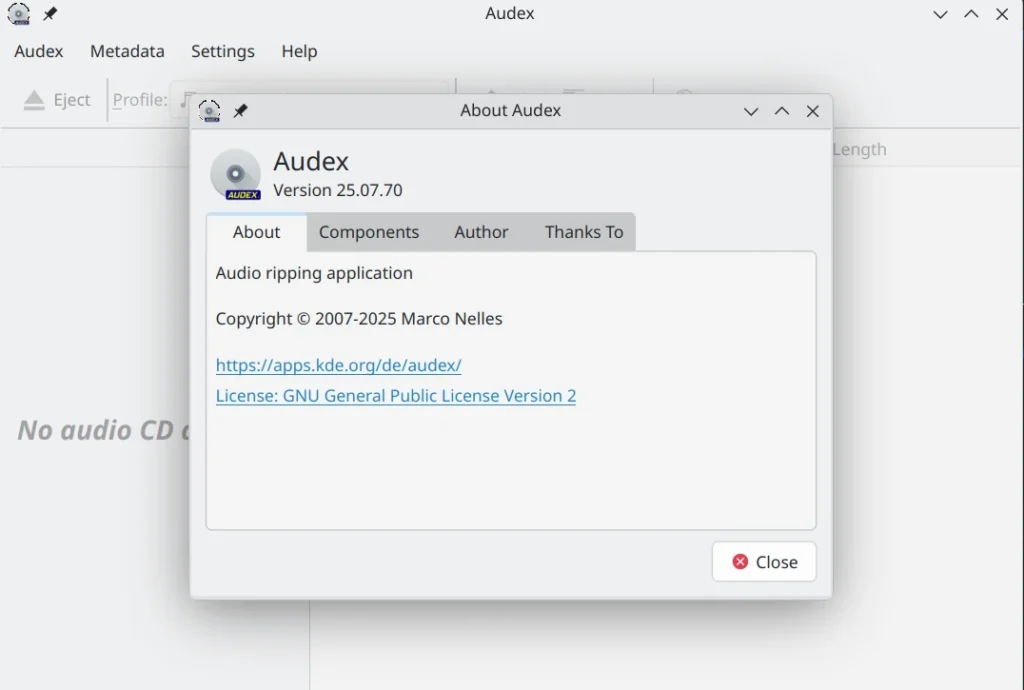
Audex: A CD ripping application.
GCompris An excellent childrens education application
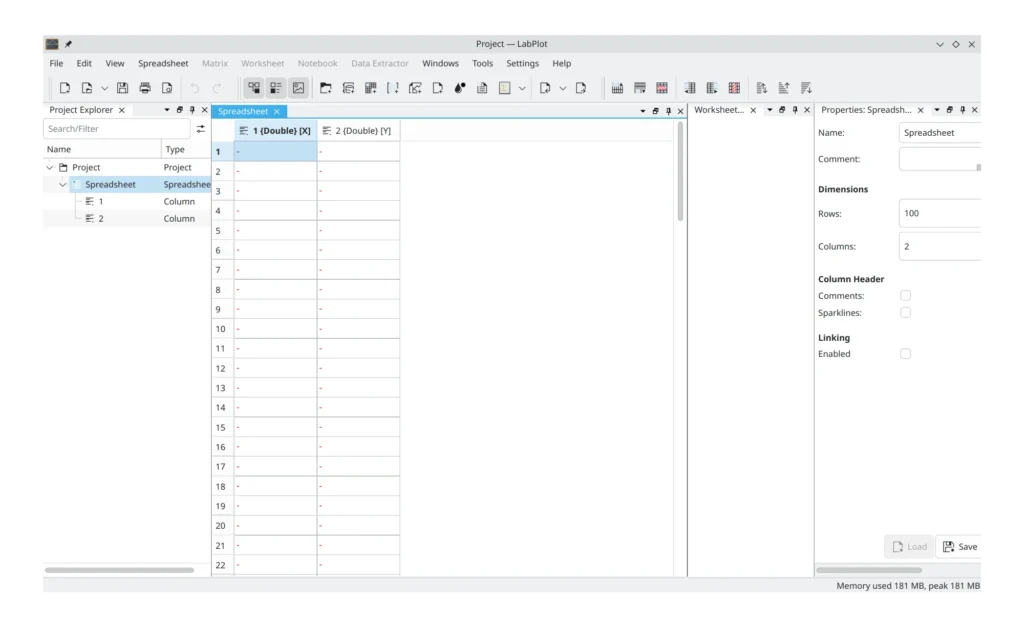
Labplot Scientific plotting
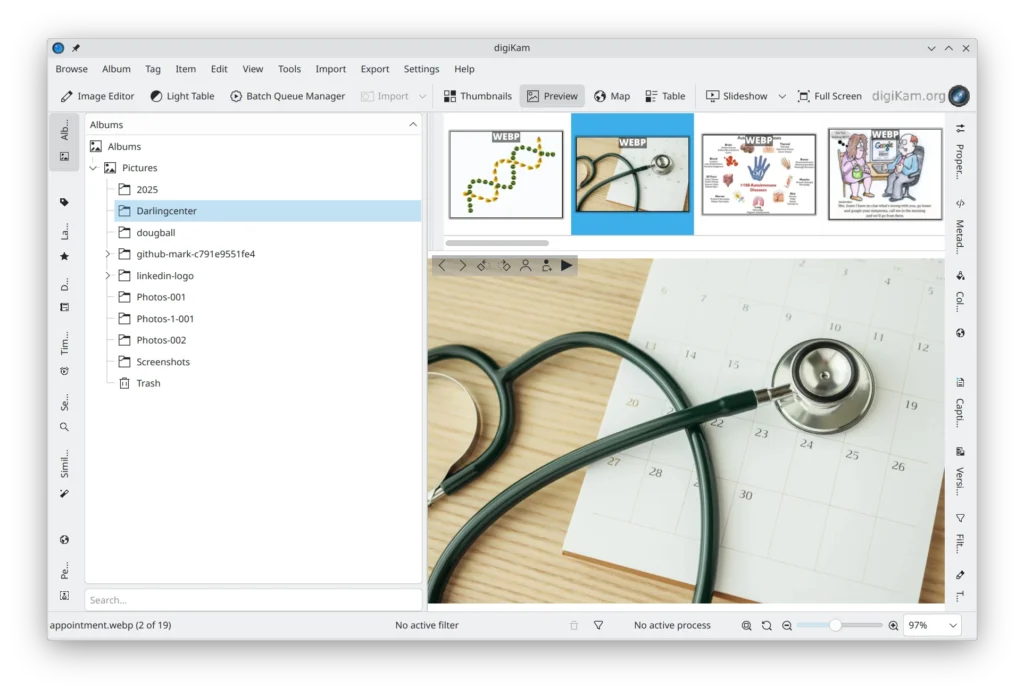
Digikam 8.7.0 with exiftool bug fixed https://bugs.kde.org/show_bug.cgi?id=501424
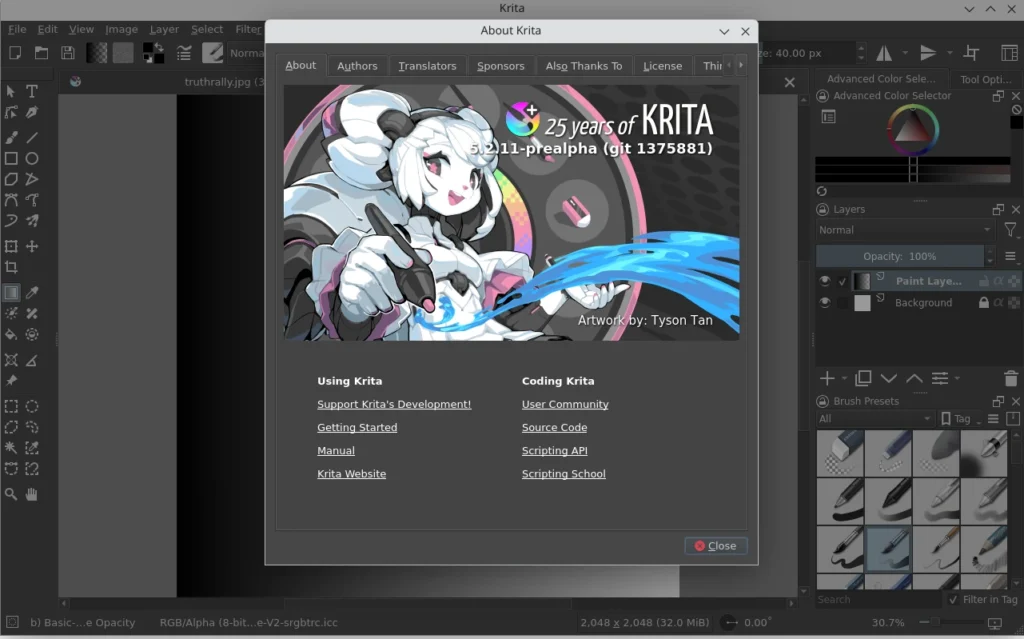
Krita 5.2.11 Excellent Graphic art platform ( compares to Photoshop ) kgraphviewer Graphiz .dot file viewer I am happy to report my arm is mostly functional! Unfortunately, maintaining all these snaps is an enormous amount of work, with time I don t have! Please consider a donation for the time I should be spending job hunting / getting a website business off the ground. Thank you for your consideration!

David Bremner: Hibernate on the pocket reform 3/n

Context

Serial console hardware
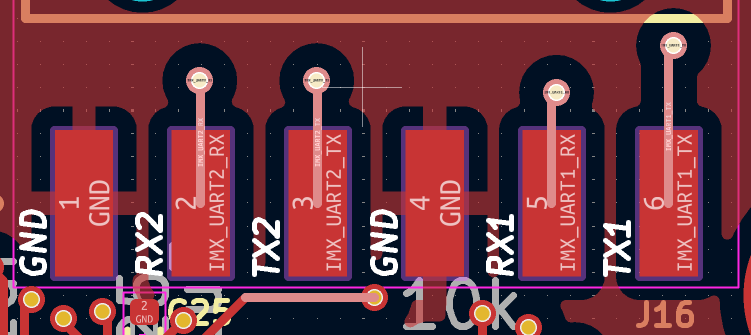
  • Manual is unclear about name of connector (J16 in schematics, J17 in manual).
  • Also numbering of pins is not given afaict.
  • Clone https://source.mnt.re/reform/pocket-reform.git
  • Look at pocket-reform-motherboard.kicad_pcb
  • From the PCB I can confirm J16 and pins numbered left (sysctl) to right.
  • attach "dtech" prolific PL2303 based serial to usb cable per serial console section of PR manual
  • lsusb shows ID 067b:23a3 Prolific Technology, Inc. ATEN Serial Bridge
  • install tio
  • add my user to group dialout
  • newgrp dialout
  • tio /dev/ttyUSB0 -b 1500000
  • A closer look at the PCB in kicad makes me realize the pin labels in the manual are wrong. 4 = GND, 5 = UART1_RX, 6= UART1_TX. With that change I have U-boot output on boot.

Serial console software With some help from minute on ircs://irc.libera.chat:6697/#mnt-reform, I got the kernel boot arguments right to have not just u-boot output but linux kernel output on the serial console. In consfigurator notation
(on-change
      (file:has-content "/etc/flash-kernel/ubootenv.d/00reform2_serial_console"
        "setenv bootargs \"$ bootargs  console=ttyS2,1500000 keep_bootcon\"")
    (cmd:single "flash-kernel"))
The filename should sort before "00reform2_ubootenv" so that the existing "console=tty1" still ends up at the end. previous episode next episode

7 July 2025

Thorsten Alteholz: My Debian Activities in June 2025

Debian LTS This was my hundred-thirty-second month that I did some work for the Debian LTS initiative, started by Raphael Hertzog at Freexian. During my allocated time I uploaded or worked on: This month I also did a week of FD duties and attended the monthly LTS/ELTS meeting. Debian ELTS This month was the eighty-third ELTS month. During my allocated time I uploaded or worked on: This month I also did a week of FD duties and attended the monthly LTS/ELTS meeting. Debian Printing This month I uploaded bugfix versions of: Thanks a lot again to the Release Team who quickly handled all my unblock bugs! This work is generously funded by Freexian! Debian Astro This month I uploaded bugfix versions of: Debian Mobcom Unfortunately I didn t found any time to work on this topic. misc This month I uploaded bugfix versions of: Unfortunately I stumbled over a discussion about RFPs. One part of those involved wanted to automatically close older RFPs, the other part just wanted to keep them. But nobody suggested to really take care of those RFPs. Why is it easier to spend time on talking about something instead of solving the real problem? Anyway, I had a look at those open RFPs. Some of them can be just closed because they haven t been closed when uploading the corresponding package. For some others the corresponding software has not seen any upstream activity for several years and depends on older software no longer in Debian (like Python 2). Such bugs can be just closed. Some requested software only works together with long gone technology (for example the open Twitter API). Such bugs can be just closed. Last but not least, even the old RFPs contain nice software, that is still maintained upstream and useful. One example is ta-lib that I uploaded in June. So, please, let s put our money where out mouths are. My diary of closed RFP bugs is on people.d.o. If only ten people follow suit, all bugs can be closed within a year. FTP master It is still this time of the year when just a few packages arrive in NEW: it is Hard Freeze. So please don t hold it against me that I enjoy the sun more than processing packages in NEW. This month I accepted 104 and rejected 13 packages. The overall number of packages that got accepted was 105.

5 July 2025

Taavi V n nen: Tracking my train travel by parsing tickets in emails

Rumour has it that I might be a bit of a train nerd. At least I want to collect various nerdy data about my travels. Historically that data has lived in manual form in several places,1 but over the past year and a half I've been working on a toy project to collect most of that information into a custom tool. That toy project2 uses various sources to get information about trains to fill up its database: for example, in Finland Fintraffic, the organization responsible for railway traffic management, publishes very comprehensive open data about almost everything that's moving on the Finnish railway network. Unfortunately, I cannot be on all of the trains.3 Thus I need to tell the system details about my journeys. The obvious solution is to make a form that lets me save that data. Which I did, but I got very quickly bored of filling out that form, and as regular readers of this blog know, there is no reason to settle for a simple but boring solution when the alternative is to make something that is ridiculously overengineered.

Parsing data out of my train tickets Finnish long-distance trains generally require train-specific seat reservations, which means VR (the train company) knows which trains I am on. We just need to find a way to extract that information in some machine-readable format. So my plan for the ridiculously overengineered solution was to parse the booking emails to get the details I need. Now, VR ticket emails include the data I want in a couple of different formats: they're included as text in the HTML email body, they're in the embedded calendar invite, as text in the included PDF ticket, and encoded in the Aztec Code in the included PDF ticket. I chose to parse the last option with the hopes of building something that could be ported to parse other operators' tickets with relative ease.
Example Aztec code
Example Aztec code
After a bit of digging (thank you to the KDE Itinerary people for documenting this!) I stumbled upon an European Union Agency for Railways PDF titled ELECTRONIC SEAT/BERTH RESERVATION AND ELECTRONIC PRODUCTION OF TRANSPORT DOCUMENTS - TRANSPORT DOCUMENTS (RCT2 STANDARD) which, in its Appendix C.1, describes how the information is encoded in the code.4 (As a side note, various sources call these codes SSB version 1 codes, although that term isn't used in this specification. So maybe there are more specifications about the format that I haven't discovered yet!) I then wrote a parser in Go for the binary data embedded in these codes. So far it works, although I wouldn't be surprised if there are some edge cases that it doesn't handle. In particular, the spec specifies a custom lookup table for converting between text and binary data, and that only has support for characters 0-9 and A-Z. But Finnish railway station codes can also use and .. maybe I need to buy a ticket to a station with one of those.

Extracting barcodes out of emails A parser just for the binary format isn't enough here if the intended source input is the emails that VR sends upon making a booking. Time to write a single-purpose email server! In short, the logic in the server, again written in Go and with the help of go-smtp and go-message, is:
  • Accept any mail with a reasonable body size
  • Process through all body parts
  • For all PDF parts, extract all images
  • For all images, run them through ZXing
  • For all decoded barcodes, try to parse them with my new ticket parsing library I mentioned earlier
  • If any tickets are found, send the data from them and any metadata to the main backend, which will save them to a database
The custom mail server exposes an LMTP interface over TCP for my internet-facing mail servers to forward to. I chose LMTP for this because it seemed like a better fit in theory than normal (E)SMTP. I've since discovered that curl doesn't support LMTP which makes development much harder, and in practice there's no benefit of LMTP here as all mails are being sent to the backend in a single request regardless of the number of recipients, so maybe I'll migrate it to regular SMTP at some point.

Side quest time The last missing part is automatically forwarding the ticket mails to the new service. I've routed a dedicated subdomain to the new service, and the backend is configured to allocate addresses like i2v44g2pygkcth64stjgyuqz@somedomain.example for each user. That's great if we wanted to manually forward mails to the service, but we can go one step above that. I created a dedicated email alias in my mail server config that routes both to my regular mailbox and the service address. That way I can update my VR account to use the alias and have mails automatically processed while still receiving backup copies of the tickets (and any other important mail that VR might send me). Unfortunately that last part turns out something that's easier said than done. Logging in on the website, I'm greeted by this text stating I need to contact customer service by phone to change the address associated with my account.5 After a bit of digging, I noticed that the mobile app suggests filling out a feedback form in order to change the address. So I filled that, and after a day or two I got a "confirm you want to change your email" mail. Success!

  1. Including (but not limited to): a page of this website, the notes app on my phone, and an uMap map.
  2. Which I'm not directly naming here because I still think it needs a lot more work before being presentable, but if you're really interested it's not that hard to find out.
  3. Someone should invent human cloning so that we can fix this.
  4. People who know much more about railway ticketing than I do were surprised when I told them this format is still in use somewhere. So, uh, sorry if you were expecting a nice universal worldwide standard!
  5. In case you have not guessed yet, I do not like making phone calls.

2 July 2025

Dirk Eddelbuettel: RcppArmadillo 14.6.0-1 on CRAN: New Upstream Minor Release

armadillo image Armadillo is a powerful and expressive C++ template library for linear algebra and scientific computing. It aims towards a good balance between speed and ease of use, has a syntax deliberately close to Matlab, and is useful for algorithm development directly in C++, or quick conversion of research code into production environments. RcppArmadillo integrates this library with the R environment and language and is widely used by (currently) 1241 other packages on CRAN, downloaded 40.4 million times (per the partial logs from the cloud mirrors of CRAN), and the CSDA paper (preprint / vignette) by Conrad and myself has been cited 634 times according to Google Scholar. Conrad released a minor version 4.6.0 yesterday which offers new accessors for non-finite values. And despite being in Beautiful British Columbia on vacation, I had wrapped up two rounds of reverse dependency checks preparing his 4.6.0 release, and shipped this to CRAN this morning where it passed with flying colours and no human intervention even with over 1200 reverse dependencies. The changes since the last CRAN release are summarised below.

Changes in RcppArmadillo version 14.6.0-1 (2025-07-02)
  • Upgraded to Armadillo release 14.6.0 (Caffe Mocha)
    • Added balance() to transform matrices so that column and row norms are roughly the same
    • Added omit_nan() and omit_nonfinite() to extract elements while omitting NaN and non-finite values
    • Added find_nonnan() for finding indices of non-NaN elements
    • Added standalone replace() function
  • The fastLm() help page now mentions that options to solve() can control its behavior.

Courtesy of my CRANberries, there is a diffstat report relative to previous release. More detailed information is on the RcppArmadillo page. Questions, comments etc should go to the rcpp-devel mailing list off the Rcpp R-Forge page.

This post by Dirk Eddelbuettel originated on his Thinking inside the box blog. If you like this or other open-source work I do, you can sponsor me at GitHub.

Dirk Eddelbuettel: Rcpp 1.1.0 on CRAN: C++11 now Minimum, Regular Semi-Annual Update

rcpp logo With a friendly Canadian hand wave from vacation in Beautiful British Columbia, and speaking on behalf of the Rcpp Core Team, I am excited to shared that the (regularly scheduled bi-annual) update to Rcpp just brought version 1.1.0 to CRAN. Debian builds haven been prepared and uploaded, Windows and macOS builds should appear at CRAN in the next few days, as will builds in different Linux distribution and of course r2u should catch up tomorrow as well. The key highlight of this release is the switch to C++11 as minimum standard. R itself did so in release 4.0.0 more than half a decade ago; if someone is really tied to an older version of R and an equally old compiler then using an older Rcpp with it has to be acceptable. Our own tests (using continuous integration at GitHub) still go back all the way to R 3.5.* and work fine (with a new-enough compiler). In the previous release post, we commented that we had only reverse dependency (falsely) come up in the tests by CRAN, this time there was none among the well over 3000 packages using Rcpp at CRAN. Which really is quite amazing, and possibly also a testament to our rigorous continued testing of our development and snapshot releases on the key branch. This release continues with the six-months January-July cycle started with release 1.0.5 in July 2020. As just mentioned, we do of course make interim snapshot dev or rc releases available. While we not longer regularly update the Rcpp drat repo, the r-universe page and repo now really fill this role admirably (and with many more builds besides just source). We continue to strongly encourage their use and testing I run my systems with these versions which tend to work just as well, and are of course also fully tested against all reverse-dependencies. Rcpp has long established itself as the most popular way of enhancing R with C or C++ code. Right now, 3038 packages on CRAN depend on Rcpp for making analytical code go faster and further. On CRAN, 13.6% of all packages depend (directly) on Rcpp, and 61.3% of all compiled packages do. From the cloud mirror of CRAN (which is but a subset of all CRAN downloads), Rcpp has been downloaded 100.8 million times. The two published papers (also included in the package as preprint vignettes) have, respectively, 2023 (JSS, 2011) and 380 (TAS, 2018) citations, while the the book (Springer useR!, 2013) has another 695. As mentioned, this release switches to C++11 as the minimum standard. The diffstat display in the CRANberries comparison to the previous release shows how several (generated) sources files with C++98 boilerplate have now been removed; we also flattened a number of if/else sections we no longer need to cater to older compilers (see below for details). We also managed more accommodation for the demands of tighter use of the C API of R by removing DATAPTR and CLOENV use. A number of other changes are detailed below. The full list below details all changes, their respective PRs and, if applicable, issue tickets. Big thanks from all of us to all contributors!

Changes in Rcpp release version 1.1.0 (2025-07-01)
  • Changes in Rcpp API:
    • C++11 is now the required minimal C++ standard
    • The std::string_view type is now covered by wrap() (Lev Kandel in #1356 as discussed in #1357)
    • A last remaining DATAPTR use has been converted to DATAPTR_RO (Dirk in #1359)
    • Under R 4.5.0 or later, R_ClosureEnv is used instead of CLOENV (Dirk in #1361 fixing #1360)
    • Use of lsInternal switched to lsInternal3 (Dirk in #1362)
    • Removed compiler detection macro in a header cleanup setting C++11 as the minunum (Dirk in #1364 closing #1363)
    • Variadic templates are now used onconditionally given C++11 (Dirk in #1367 closing #1366)
    • Remove RCPP_USING_CXX11 as a #define as C++11 is now a given (Dirk in #1369)
    • Additional cleanup for __cplusplus checks (I aki in #1371 fixing #1370)
    • Unordered set construction no longer needs a macro for the pre-C++11 case (I aki in #1372)
    • Lambdas are supported in a Rcpp Sugar functions (I aki in #1373)
    • The Date(time)Vector classes now have default ctor (Dirk in #1385 closing #1384)
    • Fixed an issue where Rcpp::Language would duplicate its arguments (Kevin in #1388, fixing #1386)
  • Changes in Rcpp Attributes:
    • The C++26 standard now has plugin support (Dirk in #1381 closing #1380)
  • Changes in Rcpp Documentation:
    • Several typos were correct in the NEWS file (Ben Bolker in #1354)
    • The Rcpp Libraries vignette mentions PACKAGE_types.h to declare types used in RcppExports.cpp (Dirk in #1355)
    • The vignettes bibliography file was updated to current package versions, and now uses doi references (Dirk in #1389)
  • Changes in Rcpp Deployment:
    • Rcpp.package.skeleton() creates URL and BugReports if given a GitHub username (Dirk in #1358)
    • R 4.4.* has been added to the CI matrix (Dirk in #1376)
    • Tests involving NA propagation are skipped under linux-arm64 as they are under macos-arm (Dirk in #1379 closing #1378)

Thanks to my CRANberries, you can also look at a diff to the previous release Questions, comments etc should go to the rcpp-devel mailing list off the R-Forge page. Bugs reports are welcome at the GitHub issue tracker as well (where one can also search among open or closed issues).

This post by Dirk Eddelbuettel originated on his Thinking inside the box blog. If you like this or other open-source work I do, you can sponsor me at GitHub.

1 July 2025

David Bremner: Hibernate on the pocket reform 2/n

Context

Testing continued
  • following a suggestion of gordon1, unload the mediatek module first. The following seems to work, either from the console or under sway
echo devices >  /sys/power/pm_test
echo reboot > /sys/power/disk
rmmod mt76x2u
echo disk >  /sys/power/state
modprobe mt76x2u
  • It even works via ssh (on wired ethernet) if you are a bit more patient for it to come back.
  • replacing "reboot" with "shutdown" doesn't seem to affect test mode.
  • replacing "devices" with "platform" (or "processors") leads to unhappiness.
    • under sway, the screen goes blank, and it does not resume
    • same on console
previous episode next episode

30 June 2025

David Bremner: Hibernate on the pocket reform 1/n

Configuration
  • script: https://docs.kernel.org/power/basic-pm-debugging.html
  • kernel is 6.15.4-1~exp1+reform20250628T170930Z

State of things
  • normal reboot works
  • Either from the console, or from sway, the intial test of reboot mode hibernate fails. In both cases it looks very similar to halting.
    • the screen is dark (but not completely black)
    • the keyboard is still illuminated
    • the system-controller still seems to work, althought I need to power off before I can power on again, and any "hibernation state" seems lost.

Running tests
  • this is 1a from above
  • freezer test passes
  • devices test from console
    • console comes back (including input)
    • networking (both wired and wifi) seems wedged.
    • console is full of messages from mt76x2u about vendor request 06 and 07 failing. This seems related to https://github.com/morrownr/7612u/issues/17
    • at some point the console becomes non-responsive, except for the aforementioned messages from the wifi module.
  • devices test under sway
    • display comes back
    • keyboard/mouse seem disconnected
    • network down / disconnected?
next episode

24 June 2025

Dirk Eddelbuettel: RcppRedis 0.2.6 on CRAN: Extensions

A new minor release 0.2.6 of our RcppRedis package arrived on CRAN today. RcppRedis is one of several packages connecting R to the fabulous Redis in-memory datastructure store (and much more). It works equally well with the newer fork Valkey. RcppRedis does not pretend to be feature complete, but it may do some things faster than the other interfaces, and also offers an optional coupling with MessagePack binary (de)serialization via RcppMsgPack. The package has been deployed in production as a risk / monitoring tool on a trading floor for several years. It also supports pub/sub dissemination of streaming market data as per this earlier example. This update brings new functions del, lrem, and lmove (for the matching Redis / Valkey commands) which may be helpful in using Redis (or Valkey) as a job queue. We also extended the publish accessor by supporting text (i.e. string) mode along with raw or rds (the prior default which always serialized R objects) just how listen already worked with these three cases. The change makes it possible to publish from R to subscribers not running R as they cannot rely on the R deserealizer. An example is provided by almm, a live market monitor, which we introduced in this blog post. Apart from that the continuous integration script received another mechanical update. The detailed changes list follows.

Changes in version 0.2.6 (2025-06-24)
  • The commands DEL, LREM and LMOVE have been added
  • The continuous integration setup was updated once more
  • The pub/sub publisher now supports a type argument similar to the listener, this allows string message publishing for non-R subscribers

Courtesy of my CRANberries, there is also a diffstat report for this this release. More information is on the RcppRedis page and at the repository and its issue tracker.

This post by Dirk Eddelbuettel originated on his Thinking inside the box blog. If you like this or other open-source work I do, you can sponsor me at GitHub.

23 June 2025

Russell Coker: PFAs

For some time I ve been noticing news reports about PFAs [1]. I hadn t thought much about that issue, I grew up when leaded petrol was standard, when almost all thermometers had mercury, when all small batteries had mercury, and I had generally considered that I had already had so many nasty chemicals in my body that as long as I don t eat bottom feeding seafood often I didn t have much to worry about. I already had a higher risk of a large number of medical issues than I d like due to decisions made before I was born and there s not much to do about it given that there are regulations restricting the emissions of lead, mercury etc. I just watched a Veritasium video about Teflon and the PFA poisoning related to it s production [2]. This made me realise that it s more of a problem than I realised and it s a problem that s getting worse. PFA levels in the parts-per-trillion range in the environment can cause parts-per-billion in the body which increases the risks of several cancers and causes other health problems. Fortunately there is some work being done on water filtering, you can get filters for a home level now and they are working on filters that can work at a sufficient scale for a city water plant. There is a map showing PFAs in the environment in Australia which shows some sites with concerning levels that are near residential areas [3]. One of the major causes for that in Australia is fire retardant foam Australia has never had much if any Teflon manufacturing AFAIK. Also they noted that donating blood regularly can decrease levels of PFAs in the bloodstream. So presumably people who have medical conditions that require receiving donated blood regularly will have really high levels.

21 June 2025

Ravi Dwivedi: Getting Brunei visa

In December 2024, my friend Badri and I were planning a trip to Southeast Asia. At this point, we were planning to visit Singapore, Malaysia and Vietnam. My Singapore visa had already been approved, and Malaysia was visa-free for us. For Vietnam, we had to apply for an e-visa online. We considered adding Brunei to our itinerary. I saw some videos of the Brunei visa process and got the impression that we needed to go to the Brunei embassy in Kuching, Malaysia in person. However, when I happened to search for Brunei on Organic Maps1, I stumbled upon the Brunei Embassy in Delhi. It seemed to be somewhere in Hauz Khas. As I was going to Delhi to collect my Singapore visa the next day, I figured I d also visit the Brunei Embassy to get information about the visa process. The next day I went to the location displayed by Organic Maps. It was next to the embassy of Madagascar, and a sign on the road divider confirmed that I was at the right place. That said, it actually looked like someone s apartment. I entered and asked for directions to the Brunei embassy, but the people inside did not seem to understand my query. After some back and forth, I realized that the embassy wasn t there. I now searched for the Brunei embassy on the Internet, and this time I got an address in Vasant Vihar. It seemed like the embassy had been moved from Hauz Khas to Vasant Vihar. Going by the timings mentioned on the web page, the embassy was closing in an hour. I took a Metro from Hauz Khas to Vasant Vihar. After deboarding at the Vasant Vihar metro station, I took an auto to reach the embassy. The address listed on the webpage got me into the correct block. However, the embassy was still nowhere to be seen. I asked around, but security guards in that area pointed me to the Burundi embassy instead. After some more looking around, I did end up finding the embassy. I spoke to the security guards at the gate and told them that I would like to know the visa process. They dialled a number and asked that person to tell me the visa process. I spoke to a lady on the phone. She listed the documents required for the visa process and mentioned that the timings for visa application were from 9 o clock to 11 o clock in the morning. She also informed me that the visa fees was 1000. I also asked about the process Badri, who lives far away in Tamil Nadu and cannot report at the embassy physically. She told me that I can submit a visa application on his behalf, along with an authorization letter. Having found the embassy in Delhi was a huge relief. The other plan - going to Kuching, Malaysia - was a bit uncertain, and we didn t know how much time it would take. Getting our passport submitted at an embassy in a foreign country was also not ideal. A few days later, Badri sent me all the documents required for his visa. I went to the embassy and submitted both the applications. The lady who collected our visa submissions asked me for our flight reservations from Delhi to Brunei, whereas ours were (keeping with our itinerary) from Kuala Lampur. She said that she might contact me later if it was required. For reference, here is the list of documents we submitted - I then asked about the procedure to collect the passports and visa results. Usually, embassies will tell you that they will contact you when they have decided on your applications. However, here I was informed that if they don t contact me within 5 days, I can come and collect our passports and visa result between 13:30-14:30 hours on the fifth day. That was strange :) I did visit the embassy to collect our visa results on the fifth day. However, the lady scolded me for not bringing the receipt she gave me. I was afraid that I might have to go all the way back home and bring the receipt to get our passports. The travel date was close, and it would take some time for Badri to receive his passport via courier as well. Fortunately, she gave me our passports (with the visa attached) and asked me to share a scanned copy of the receipt via email after I get home. We were elated that our visas were approved. Now we could focus on booking our flights. If you are going to Brunei, remember to fill their arrival card from the website within 48 hours of your arrival! Thanks to Badri and Contrapunctus for reviewing the draft before publishing the article.

  1. Nowadays, I prefer using Comaps instead of Organic Maps and recommend you do the same. Organic Maps had some issues with its governance and the community issues weren t being addressed.

Next.

Previous.