Search Results: "ms"

23 March 2026

Marco d'Itri: systemd has not implemented age verification

This needs to be clear: systemd is under attack by a trolling campaign orchestrated by fascist elements. Nobody is forced to like or use systemd, but anybody who wants to pick a side should know the facts. Recently, the free software Nazi bar crowd styling themselves as "concerned citizens" has tried to start a moral panic by saying that systemd is implementing age verification checks or that somehow it will require providing personally identifiable information. This is a lie: the facts are simply that the systemd users database has gained an optional "date of birth" field, which the desktop environments may use or not as they deem appropriate. Of course there is no "identity verification" or requirements to provide any data, which in any case would not be shared beyond authorized local applications. While the multiple recent bills proposing that general purpose operating systems implement age verification mechanisms are often concerning, both from a social and technical point of view, this is not the topic being discussed here. They are often suboptimal, but for a long time I have been opposing attempts to implement parental control at the network level and argued that it should be managed locally, by parents on their own machines: I cannot see why I should outright reject an attempt to implement the infrastructure to do that. If we want to keep age-appropriate controls out of the hands of centralized authorities, the alternative is giving families the means to manage it themselves: this is what this field enables. Whether desktop environments use it for parental controls, for birthday reminders, or for nothing at all, is their users' decision. By the way, the original UNIX users database has allowed storing PII in the GECOS field since it was invented in the '70s. Similar fields are also specified by many popular LDAP schemes: adding such an optional field is consistent with the UNIX tradition. And while we are at it, let's also refute the other smear campaign started by the same people: the systemd project is not accepting "AI slop". What happened is that a documentation file for the benefit of coding agents was added to the repository. To be clear: agents still cannot submit merge requests. The file itself remarks that all contributions must be reviewed in detail by humans, and this is basically the same policy used by the Linux kernel.

Benjamin Mako Hill: How taboo shapes knowledge production on Wikipedia

Note: I have not published blog posts about my academic papers over the past few years. To ensure that my blog contains a more comprehensive record of my published papers and to surface them for folks who missed them, I will periodically (re) publish blog posts about some older published projects. This post draws material from a previously published post by Kaylea Champion on the Community Data Science Blog.

Taboo subjects such as sexuality and mental health are as important to discuss as they are difficult to raise in conversation. Although many people turn to online resources for information on taboo subjects, censorship and low-quality information are common in search results. In two papers I recently published at CSCW both led by Kaylea Champion we presented a series of analyses showing how taboo shapes the process of collaborative knowledge building on English Wikipedia.

The first study is a quantitative analysis showing that articles on taboo subjects are much more popular and are the subject of more vandalism than articles on non-taboo topics. In surprising news, we also found that they were edited more often and were of higher quality!

Short video of Kaylea s presentation of the work given at Wikimania in August 2023.

The first challenge we faced in conducting this work was identifying taboo articles. Kaylea had a brilliant idea for a new computational approach to doing so without relying on our individual intuitions about what qualifies as taboo (something we understood would be highly specific to our own culture, class, etc). Her approach was to make use of an insight from linguistics: people develop euphemisms as ways to talk about taboos (i.e., think about all the euphemisms we ve devised for death, or sex, or menstruation, or mental health).

We used this insight to build a new machine-learning classifier based on English Wiktionary definitions. If a sense of a word was tagged as euphemistic, we treated the words in the definition as indicators of taboo. The end result was a series of words and phrases that most powerfully differentiate taboo from non-taboo. We then did a simple match between those words and phrases and the titles of Wikipedia articles. The topics were taboo enough that we were a little uncomfortable discussing them in our meetings! We built a comparison sample of articles whose titles are words that, like our taboo articles, appear in Wiktionary definitions. In the first paper, we used this new dataset to test a series of hypotheses about how taboo shapes collaborative production in Wikipedia. Our initial hypotheses were based on the idea that taboo information is often in high demand but that Wikipedians might be reluctant to associate their names (or usernames) with taboo topics. The result, we argued, would be articles that were in high demand but of low quality. We found that taboo articles are thriving on Wikipedia! In summary, we found that in comparison to non-taboo articles:

Image of the estimated qualiy of articles of the four articles in the second mixed-methods paper. Extreme dips reflect periods of frequent vandalism.
Kaylea attempted to understand these somewhat confusing results by designing a fantastic mixed-methods analysis that sought to unpack some of the nuance missing in the quantitative analysis by delving deep into the life histories of four articles on English Wikipedia: two on taboo topics related to women s anatomy (Clitoris and Menstration) and two nontaboo articles chosen for comparison (Cell membrance and Philip Pullman). Although the findings from the analysis can be difficult to summarize succinctly (as with many qualitative studies), we showed how the taboo example articles success was hard-won amid real challenges and attacks. The paper describes how challenges were overcome through resilient leadership, often provided by a single dedicated individual. The paper provides a template for how taboo can be and frequently is overcome by dedicated Wikipedians in ways that provide useful knowledge resources in real demand. For more details, visualizations, statistics, and more, we hope you ll take a look at our papers, both linked below.

The full citation for the papers are: (1) Champion, Kaylea, and Benjamin Mako Hill. 2023. Taboo and Collaborative Knowledge Production: Evidence from Wikipedia. Proceedings of the ACM on Human-Computer Interaction 7 (CSCW2): 299:1-299:25. https://doi.org/10.1145/3610090. (2) Champion, Kaylea, and Benjamin Mako Hill. 2024. Life Histories of Taboo Knowledge Artifacts. Proceedings of the ACM: Human-Computer Interaction 8 (CSCW2): 505:1-505:32. https://doi.org/10.1145/3687044.

We have also released replication materials for the paper, including all the data and code used to conduct the analyses.

This blog post and the paper it describes are collaborative work by Kaylea Champion and Benjamin Mako Hill.

22 March 2026

Vincent Bernat: Calculate 1/(40rods/hogshead) to L/100km from your Zsh prompt

I often need a quick calculation or a unit conversion. Rather than reaching for a separate tool, a few lines of Zsh configuration turn = into a calculator. Typing = 660km / (2/3)c * 2 -> ms gives me 6.60457 ms1 without leaving my terminal, thanks to the Zsh line editor.

The equal alias The main idea looks simple: define = as an alias to a calculator command. I prefer Numbat, a scientific calculator that supports unit conversions. Qalculate is a close second.2 If neither is available, we fall back to Zsh s built-in zcalc module. As the alias built-in uses = as a separator for name and value, we need to alter the aliases associative array:
if (( $+commands[numbat] )); then
  aliases[=]='numbat -e'
elif (( $+commands[qalc] )); then
  aliases[=]='qalc'
else
  autoload -Uz zcalc
  aliases[=]='zcalc -f -e'
fi
With this in place, = 847/11 becomes numbat -e 847/11.

The quoting problem The first problem surfaces quickly. Typing = 5 * 3 fails: Zsh expands the * character as a glob pattern before passing it to the calculator. The same issue applies to other characters that Zsh treats specially, such as > or . You must quote the expression:
$ = '5 * 3'
15
We fix this by hooking into the Zsh line editor to quote the expression before executing it.

Automatic quoting with ZLE Zsh calls the line-finish widget before submitting a command. We hook a function that detects the = prefix and quotes the expression:
_vbe_calc_quote()  
  case $BUFFER in
    "="*)
      typeset -g _vbe_calc_expr=$BUFFER # not used yet
      BUFFER="= $ (q-)$ $ BUFFER#= #  "
      ;;
  esac
 
add-zle-hook-widget line-finish _vbe_calc_quote
When you type = 5 * 3 and press , _vbe_calc_quote strips the = prefix, quotes the remainder with the (q-) parameter expansion flag, and rewrites the buffer to = '5 * 3' before Zsh submits the command. As a bonus, you can save a few keystrokes with =5*3! You can now compute math expressions and convert units directly from your shell. Zsh automatically quotes your expressions:
$ = '1 + 2'
3
$ = 'pi/3 + pi  > cos'
-0.5
$ = '17 USD -> EUR'
14.7122  
$ = '180*500mg -> g'
90 g
$ = '5 gigabytes / (2 minutes + 17 seconds) -> megabits/s'
291.971 Mbit/s
$ = 'now() -> tz("Asia/Tokyo")'
2026-03-22 22:00:03 JST (UTC +09), Asia/Tokyo
$ = '1 / (40 rods / hogshead) -> L / 100km'
118548   0.01 l/km
 That's the way I like it!  says Grampa Simpson
The metric system is the tool of the devil! My car gets forty rods to the hogshead, and that's the way I like it! Grampa Simpson, A Star Is Burns

Storing unquoted history As is, Zsh records the quoted expression in history. You must unquote it before submitting it again. Otherwise, the ZLE widget quotes it a second time. Bart Schaefer provided a solution to store the original version:
_vbe_calc_history()  
  return $ +_vbe_calc_expr 
 
add-zsh-hook zshaddhistory _vbe_calc_history
_vbe_calc_preexec()  
  (( $ +_vbe_calc_expr  )) && print -s $_vbe_calc_expr
  unset _vbe_calc_expr
  return 0
 
add-zsh-hook preexec _vbe_calc_preexec
The zshaddhistory hook returns 1 if we are evaluating an expression, telling Zsh not to record the command. The preexec hook then adds the original, unquoted command with print -s.
The complete code is available in my zshrc. A common alternative is the noglob precommand modifier. If you stick with to instead of -> for unit conversion, it covers 90% of use cases. For a related Zsh line editor trick, see how I use auto-expanding aliases to fix common typos.

  1. This is the fastest a packet can travel back and forth between Paris and Marseille over optical fiber.
  2. Qalculate is less understanding with units. For example, it parses Mbps as megabarn per picosecond:
    $ numbat -e '5 MB/s -> Mbps'
    40 Mbps
    $ qalc 5 MB/s to Mbps
    5 megabytes/second = 0.000005 B/ps
    

21 March 2026

Jonathan Dowland: Ladytron

I saw Ladytron perform in Digital, Newcastle last night. The last time I saw them was, I think, at the same venue, 18 years ago. Time flies!
Photo of the trio performing on stage
Back in the day (perhaps their heyday, perhaps not!) Ladytron ploughed a particular sonic furrow and did it very well. Going into the gig I had set my expectations that, should they play just these hits, I'd have a good time. The gig exceeded my expectations. The setlist very much did not lean into their best-known period: the more recent few albums were very well represented and to me this felt very confident. The lead singer, Helen Marnie, demonstrated some excellent range, particularly on some of the new songs. Daniel Hunt did a lot of backing vocals and they were really complementary to Helen's: underscoring but not overpowering. I enjoyed nerding out watching Mira Ayoro's excellent wrangling of her Korg MS-20. One highlight was an encore performance of Light & Magic, which was arguably the "alternate version" as available on the expanded versions of that album or the Remixed and Rare companion. I thought I'd try to put together a 5-track playlist for a friend who attended the gig but isn't super familiar with them. As usual this is hard. I'm going to avoid the obvious hits, try to represent their whole career and try to ensure the current trio each get a vocal turn in the selection. They actually released their latest album, Paradises, yesterday as well. One track from it is in the list below. I'm Not Scared by Ladytron Kingdom Undersea by Ladytron Blue Jeans by Ladytron He took her to a movie by Ladytron Transparent Days by Ladytron (If you can't see anything, the bandcamp embeds have been stripped out by whatever you are viewing this with)

Ravi Dwivedi: Vietnam Trip

Before reaching Vietnam Continuing from the last post, Badri and I took a flight from the Brunei International Airport to Kuala Lumpur on the 12th of December 2024. We reached Kuala Lumpur in the evening. After arriving at the airport, we went through immigration. In a previous post, I mentioned that we had put our stuff in lockers at the TBS bus terminal in Kuala Lumpur. Therefore, we had to go there. The locker was automated and required us to enter the PIN we had set. Upon entering the PIN, the locker wasn t getting unlocked. After trying this for 10-15 minutes without any luck, we tried getting some help as there the lockers weren t under supervision. So, I roamed around and found a staff member, reporting that our lockers weren t getting unlocked. They called the person who was in-charge of the lockers. He came to us in a few minutes and used their admin access to open the locker. We were supposed to pay for using the lockers by putting the banknotes inside through a slot. However, as the machine wasn t working, we gave the amount for the use of our locker service to that person instead. We soon went back to the KL airport to catch our morning flight to Ho Chi Minh City in Vietnam. At the flight counter, we were afraid we would have to pay extra as our luggage surpassed the allowed weight limit. This one was also a budget airline AirAsia and our tickets didn t include a check-in bag. Generally, passengers from countries requiring a visa to visit Vietnam (such as India) require going to the airline and showing their visa to get the boarding pass. However, when we went to the AirAsia counter at the Kuala Lumpur airport, they didn t weigh our bags and asked us to get our boarding passes from an automated kiosk. So, we got our boarding passes printed and proceeded to the airport security. While clearing the airport security, a lotion I bought from Singapore was confiscated because it was 200 mL, exceeding the limit of 100 mL per bottle. Had that 200 mL liquid been in two different bottles of 100 mL each, I would have been allowed to take it in my carry-on bag, but a single 200 mL bottle wasn t! I was allowed to keep it in the check-in bag, but I didn t have it included in my ticket. Huh, airports and their weird rules :( The lotion was an expensive one, so having it thrown away did ruin my mood.

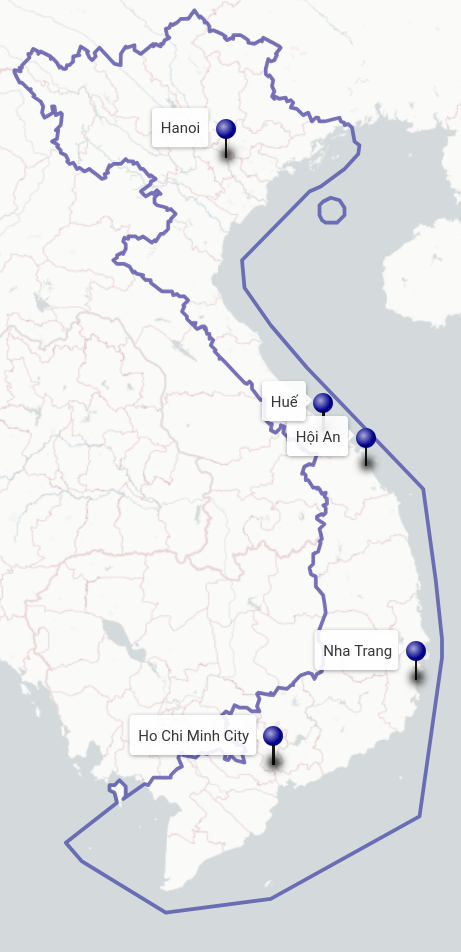
Overview We started our Vietnam trip from Ho Chi Minh City in the south on the 13th of December 2024 and finished it in Hanoi in the north on the 20th of December. We traveled from Ho Chi Minh City to Hanoi mostly by train, except for a hundred or so kilometers by bus, in chunks. On the way, we visited Nha Trang, Hoi An, and Hue. The distance between Ho Chi Minh City and Hanoi is 1700 km. For your reference, here are those places labeled on Vietnam s map.
Vietnam map with Ho Chi Minh City, Nha Trang, Hoi An, Hue and Hanoi labeled. A map of Vietnam with points of places we went to labeled. CARTO MAPTILER OPENSTREETMAP

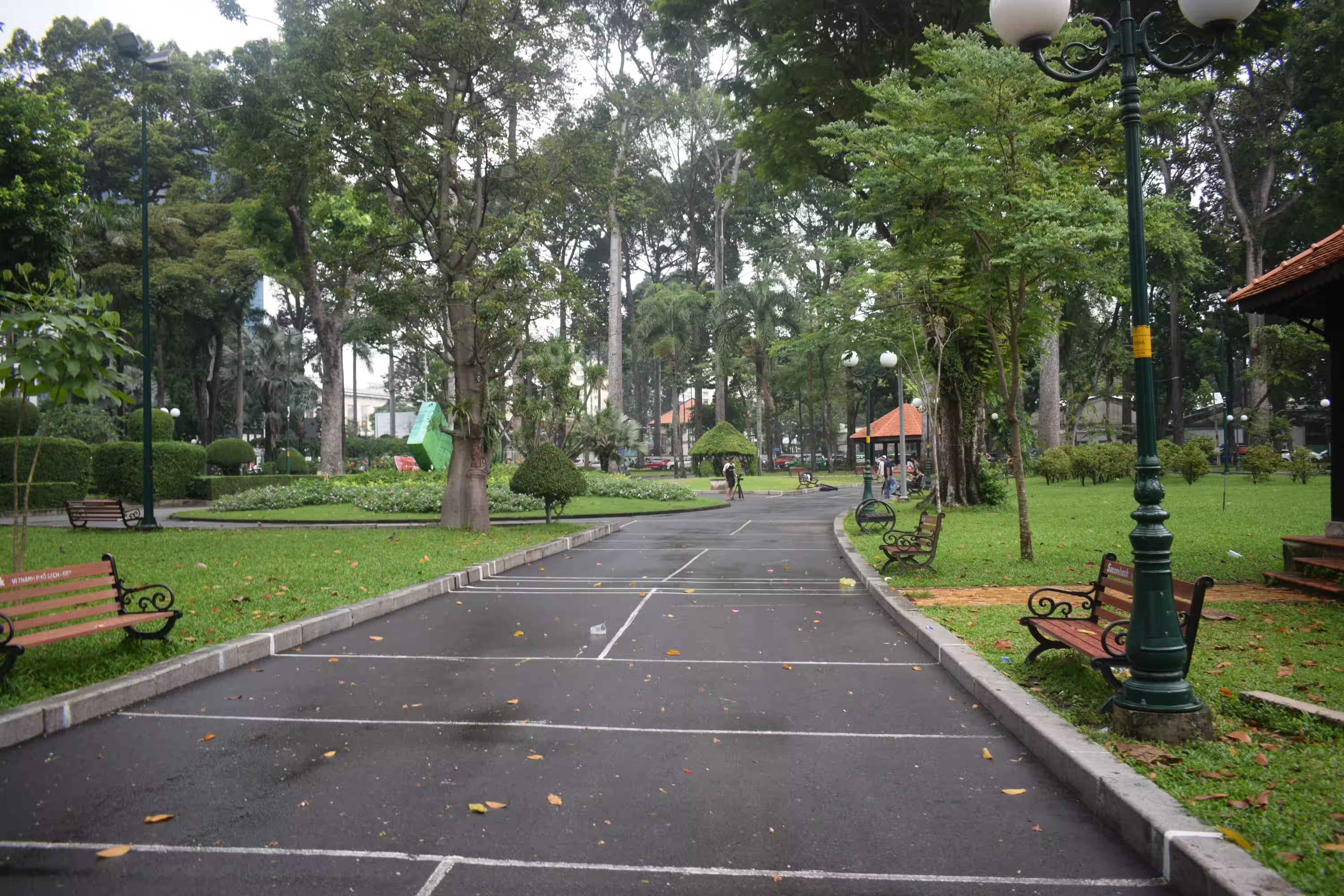
Ho Chi Minh City We landed in Ho Chi Minh City early morning on the 13th of December 2024. I was tired and sleepy as I hadn t gotten a good night s sleep. After going through immigration, we went to a currency exchange counter to get Vietnamese Dong. Unlike other countries on this trip, money exchange counters in Vietnam didn t accept Indian rupees. Therefore, we exchanged euros to get Vietnamese dong at the airport. After getting out of the airport, we took a bus to the city center. It was 15,000 dongs approximately 50 Indian rupees. Our plan was to meet Badri s friend and stay the night at his apartment. So we went to a caf nearby and bought a coffee for each of us for 75,000 dongs. We went upstairs and sat for a while. The Wi-Fi password was mentioned on our bill. During the trip, I found out about the caf culture of Vietnam. They have their own coffee brands (such as Highlands Coffee), and you can sit down at any of the caf s for work or wait for the rain to stop. It rained a lot while we were there, so we did use these caf s for that purpose. Badri s friend met us there, and we roamed around the area a bit, which included roaming inside a beautiful park. Then Badri s friend took us to a restaurant. Because I do not eat meat, he took us to a vegan restaurant. Having been to four Southeast Asian countries at this point (excluding Vietnam), I was under the impression that there wouldn t be a lot of things for my diet in Vietnam.
A picture of the park we roamed around in Ho Chi Minh City. A picture of the park we roamed around in Ho Chi Minh City. Photo by Ravi Dwivedi, released under CC-BY-SA 4.0.
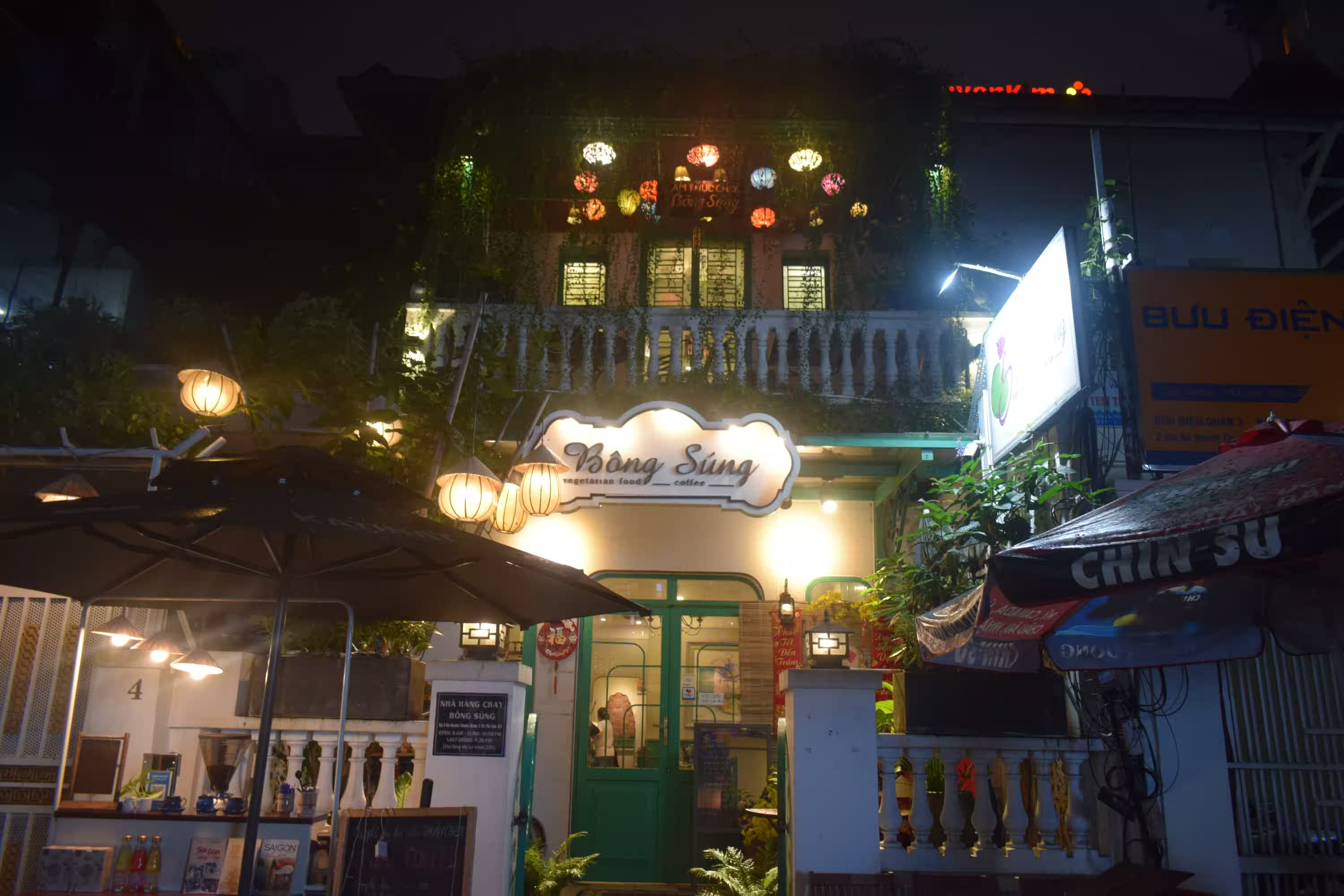
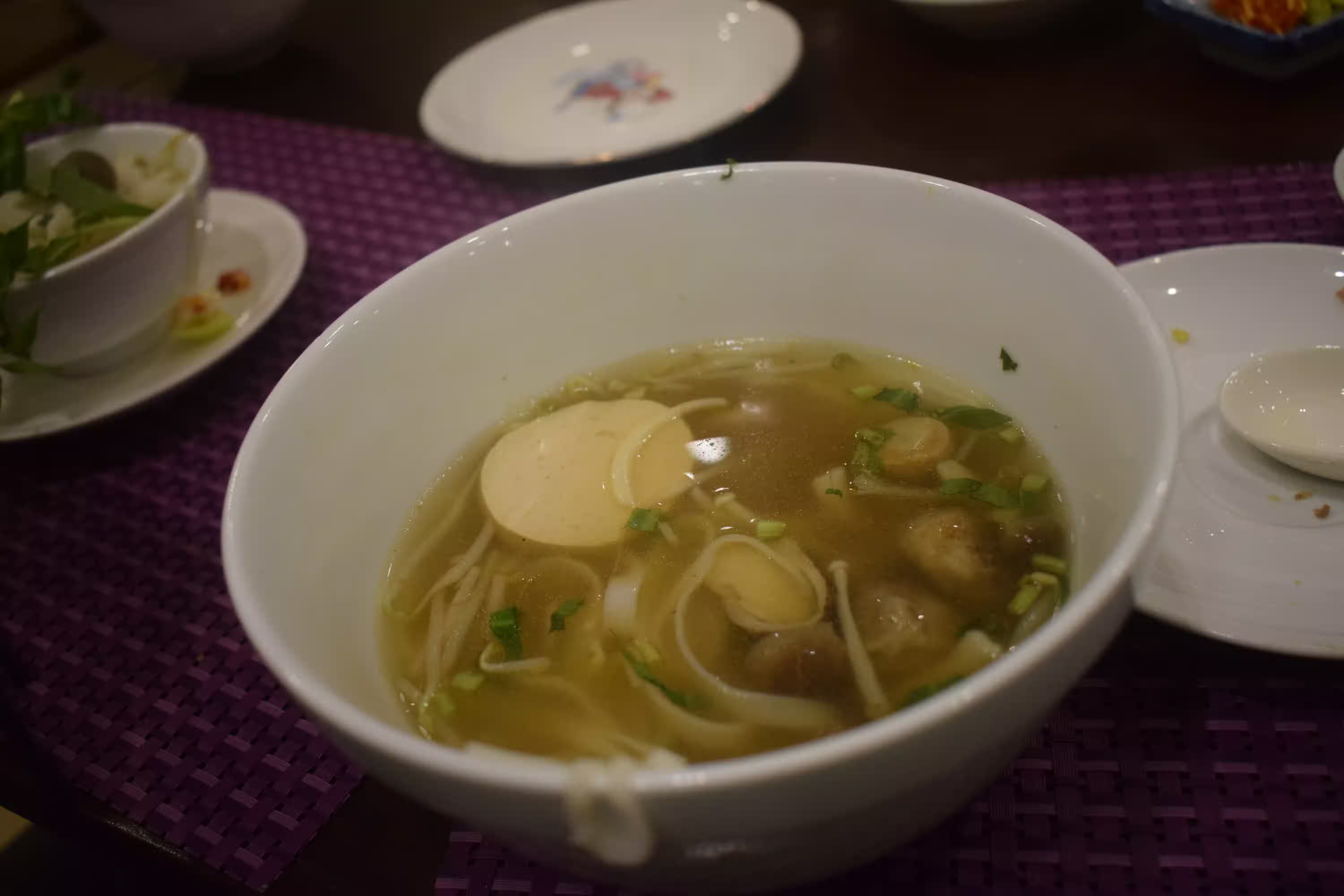
However, I was pleasantly surprised at the restaurant. I found all the dishes to be tasty, especially their signature noodles called Pho. I liked another dish so much that I tracked down the restaurant again with Badri using the geotagged image of the bill I had taken earler to have it again. As a tip for vegans coming to Vietnam, the places having the letters Chay (without any accented letters) in their name are vegan only.
A building This is the restaurant Badri s friend took us to. Photo by Ravi Dwivedi, released under CC-BY-SA 4.0.
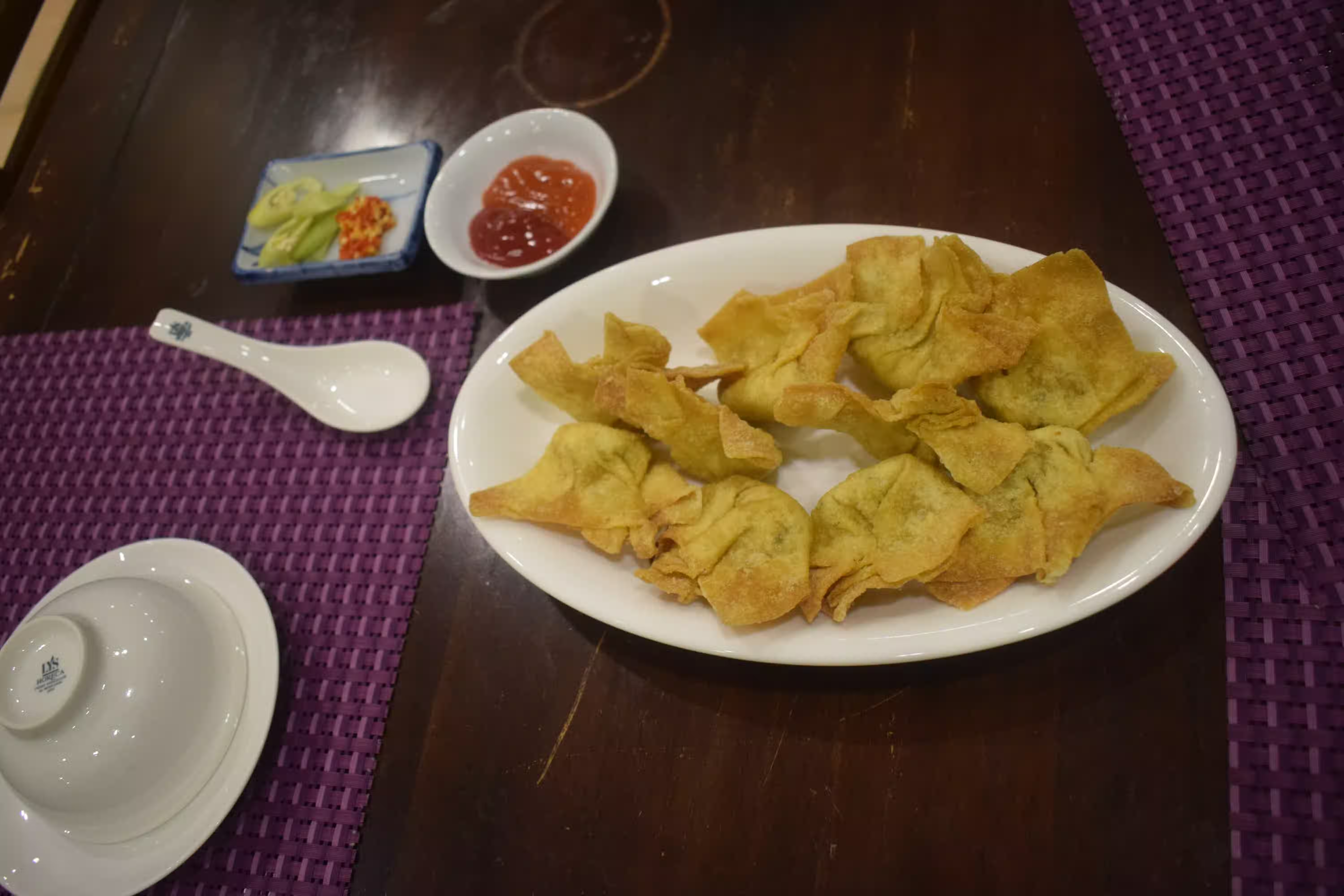
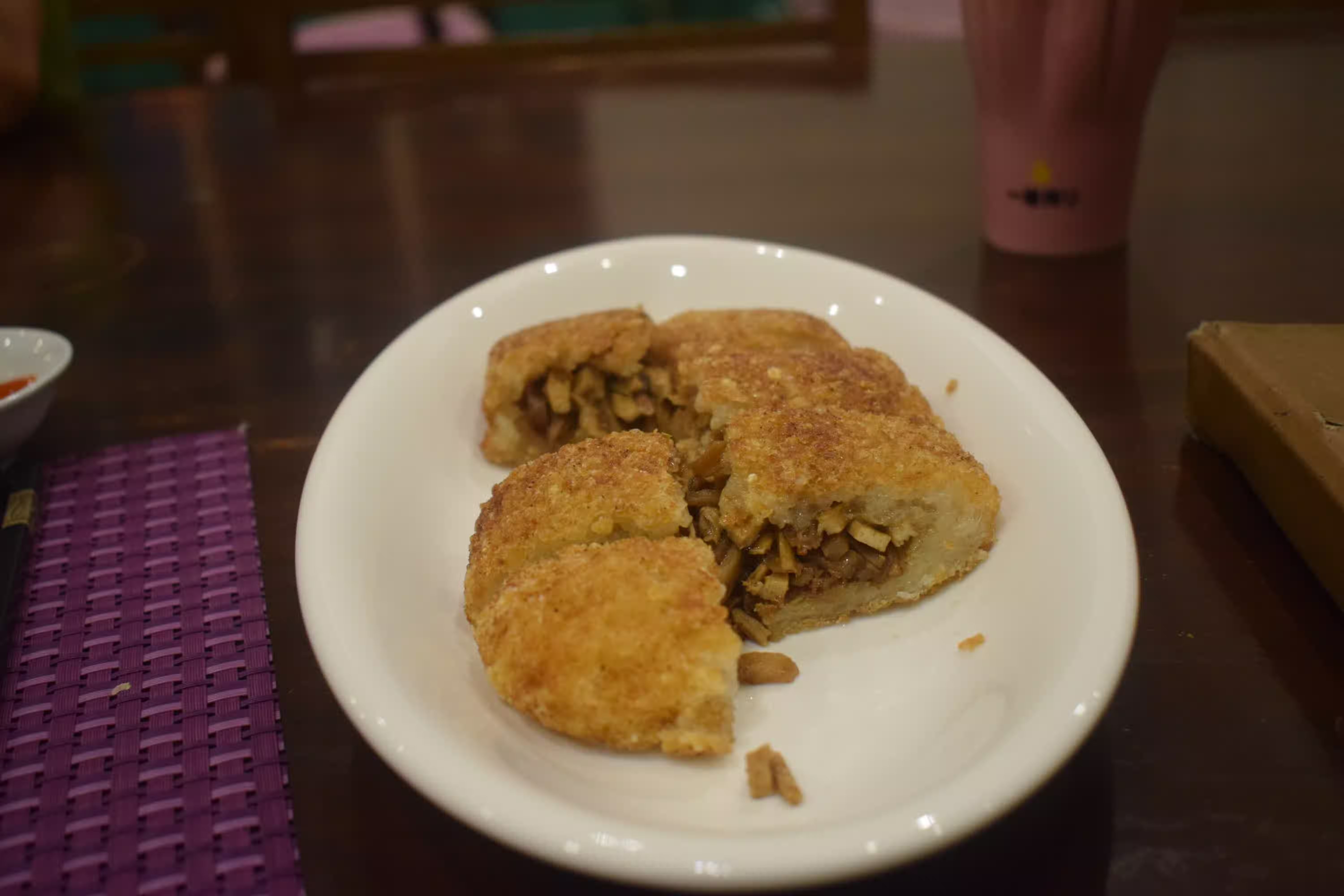
An item in the restaurant One of the dishes we had in the restaurant. This one was especially tasty. Photo by Ravi Dwivedi, released under CC-BY-SA 4.0.
One of the dishes we had in the restaurant. Photo by Ravi Dwivedi, released under CC-BY-SA 4.0. One of the dishes we had in the restaurant. Photo by Ravi Dwivedi, released under CC-BY-SA 4.0.
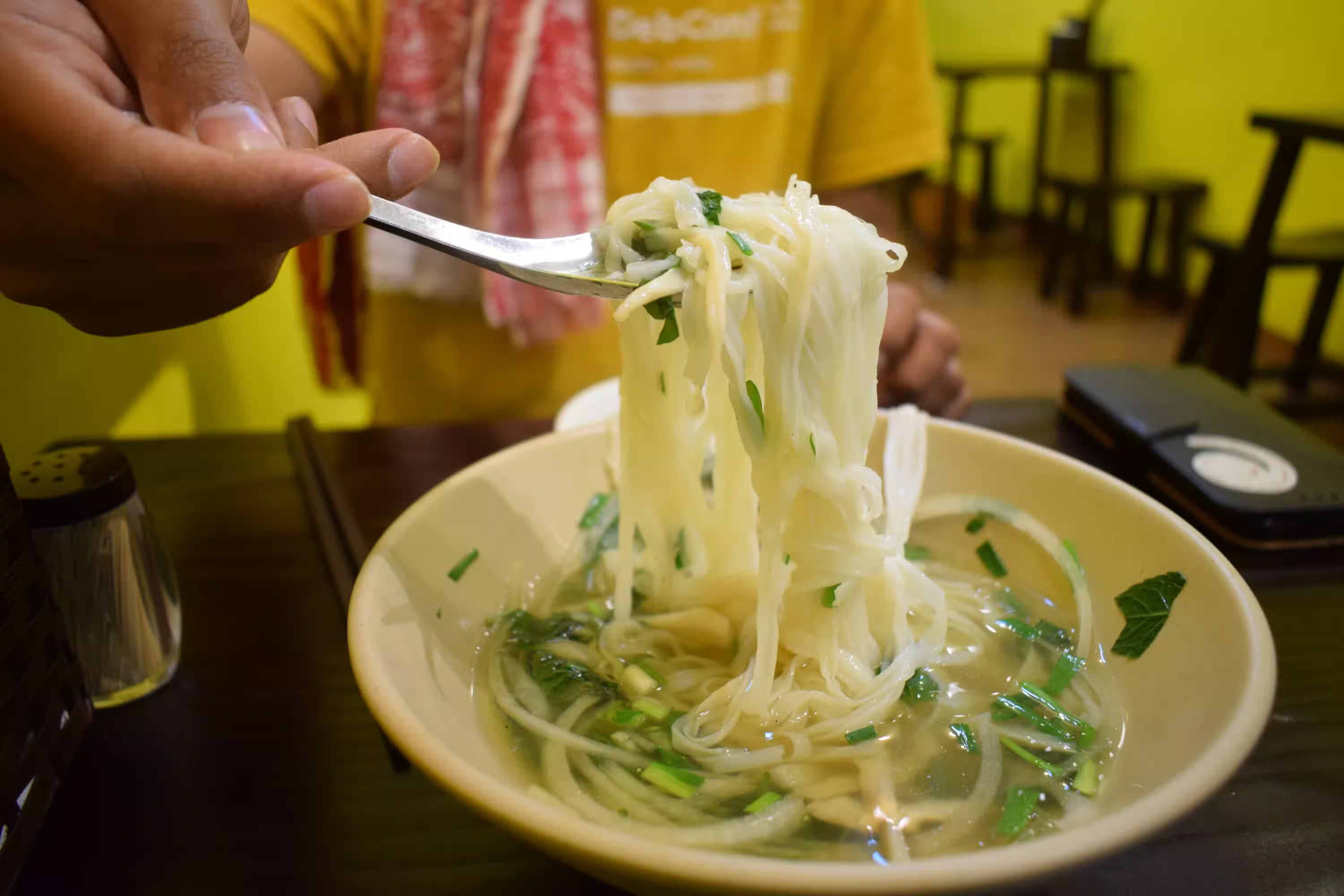
Noodles in a bowl dipped in soup These noodles are called Pho and are very popular in Vietnam. Photo by Ravi Dwivedi, released under CC-BY-SA 4.0.
In the night, we went to a supermarket where I got myself some oranges and guavas. Then, we went to a Japanese restaurant where I didn t have anything, as there was no vegetarian option available for me. Then we took a free bus to the place to Badri s friend s apartment. The construction company that built the apartment also runs this free bus service from their residential area to different parts of the city as a way of promoting their apartments. Anyone can take the bus, not just residents. The next day, we took the free bus back to the city center and checked in to a hostel for a night. We took two beds in dormitories, which were 88,000 dongs (270 rupees) for each bed for a night. In Vietnam, if you can spend around 300 rupees per night, you can get a bed in a decent hostel.

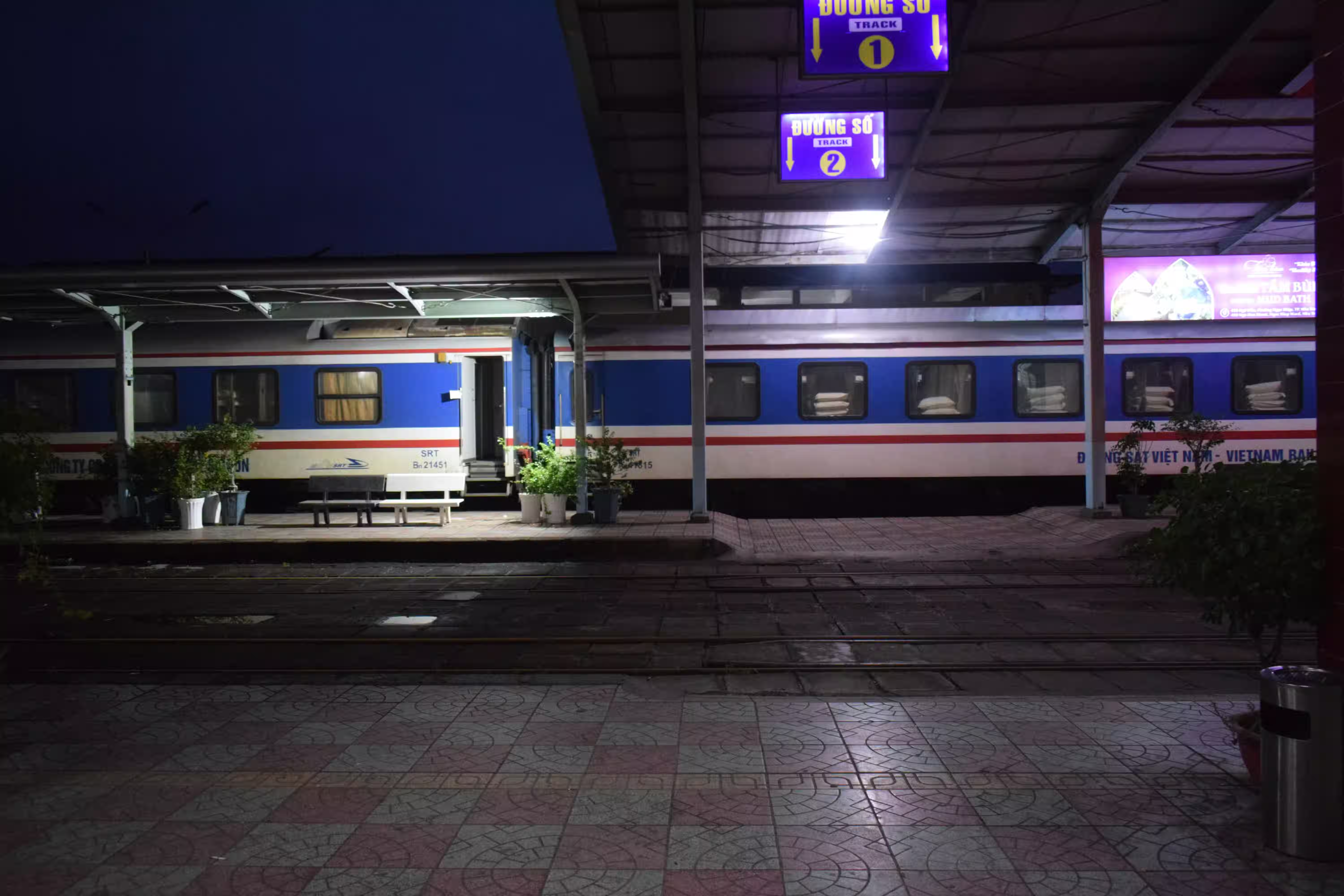
Train from Ho Chi Minh City to Nha Trang On the night of the 15th of December 2024, we boarded a train from Ho Chi Minh City to Nha Trang. The ticket for each of us was 519,000 dongs (1600 Indian rupees). The train name was SNT2. When we reached the Ho Chi Minh City train station, we noticed that the station was rather small by Indian standards. After entering the train station, we went inside to the first platform, where the tickets were checked by a staff member. Ho Chi Minh City was the originating station for our train, so our train was already standing at the station. We had to cross the railway tracks on foot to reach the platform our train was on. Then we located our coach, where a ticket inspector was standing at the gate. He let us in after checking our tickets. In all these instances, we just had to show our digital boarding pass which we had received by email. Unlike Indian trains, the train didn t have side berths. Additionally, I liked the fact that it had a dedicated space to put our bags in, which was very convenient. The train departed from Ho Chi Minh City at 21:05 and arrived in Nha Trang at 05:30 in the morning.
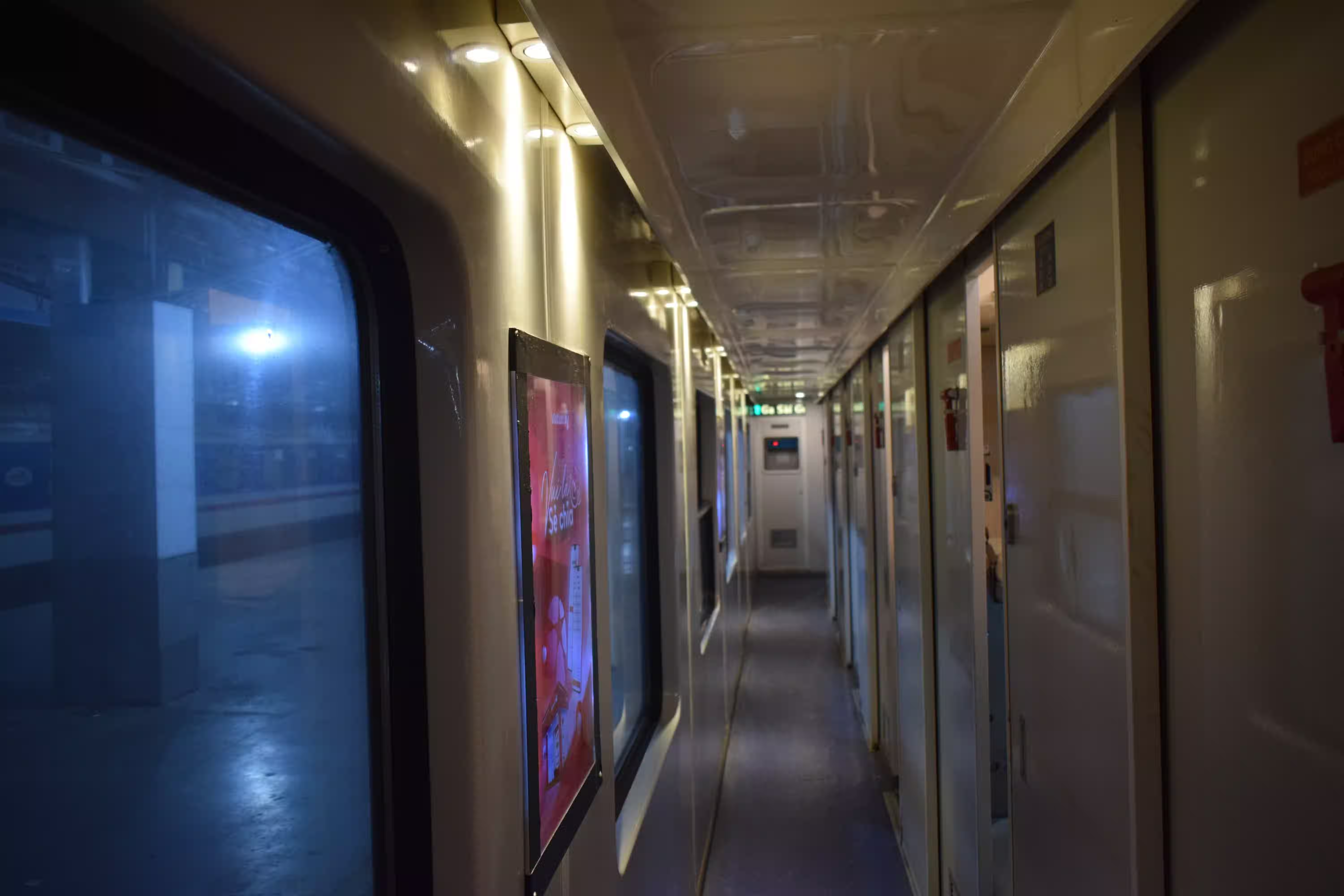
Interior of our train coach. Trains in Vietnam don’t have side berths, unlike India. Photo by Ravi Dwivedi, released under CC-BY-SA 4.0. Interior of our train coach. Trains in Vietnam don t have side berths, unlike India. Photo by Ravi Dwivedi, released under CC-BY-SA 4.0.
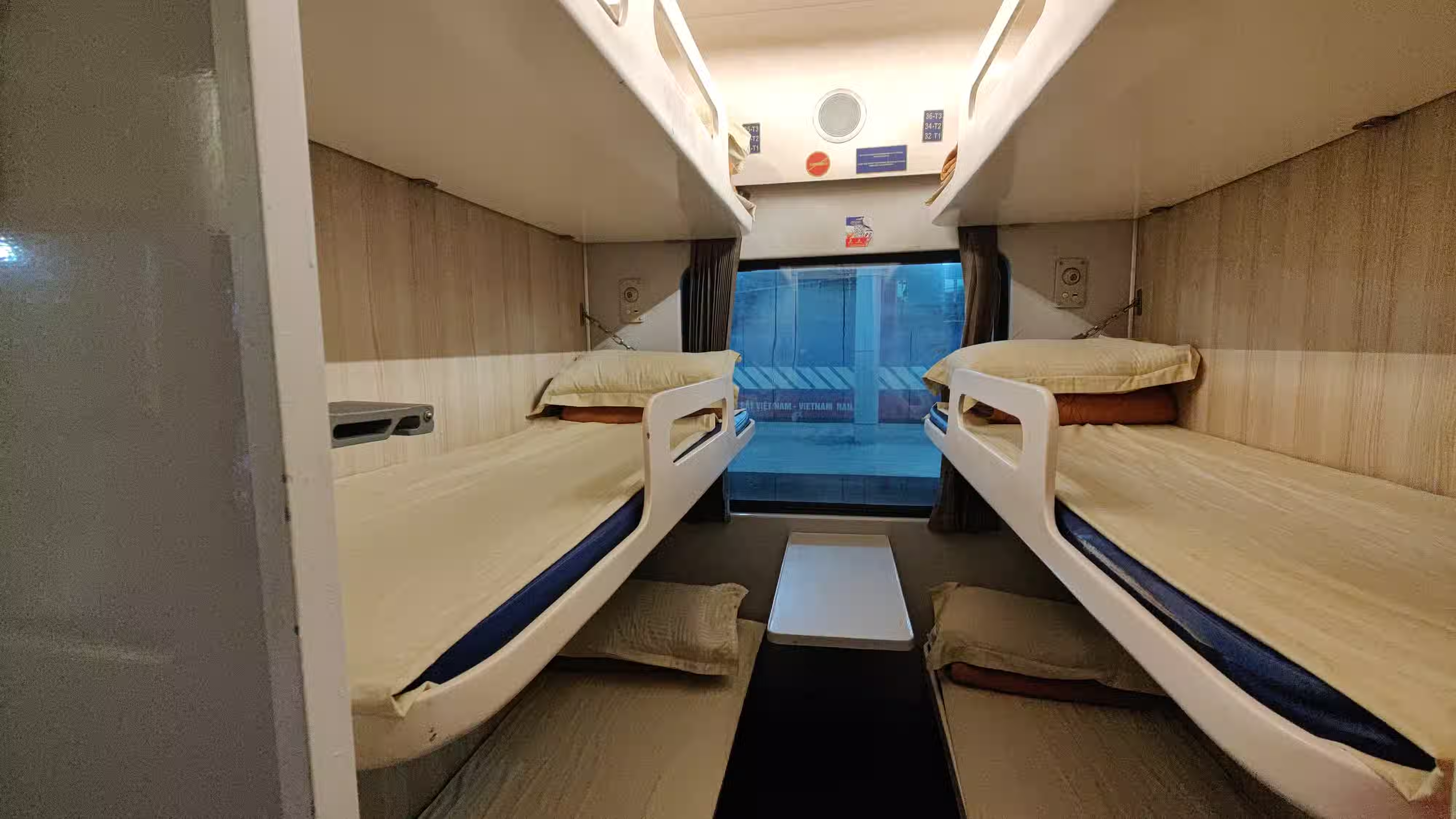
A picture of the berths from our coach. It had three tiers, similar to a 3 AC coach in Indian trains. Photo by Ravi Dwivedi, released under CC-BY-SA 4.0. A picture of the berths from our coach. It had three tiers, similar to a 3 AC coach in Indian trains. Photo by Ravi Dwivedi, released under CC-BY-SA 4.0.
The train had a cabin to put the bags in. Photo by Ravi Dwivedi, released under CC-BY-SA 4.0. The train had a cabin to put the bags in. Photo by Ravi Dwivedi, released under CC-BY-SA 4.0.
Nha Trang train station. Photo by Ravi Dwivedi, released under CC-BY-SA 4.0. Nha Trang train station. Photo by Ravi Dwivedi, released under CC-BY-SA 4.0.

Nha Trang Nha Trang is a coastal place, and we planned to go to a beach. We figured out that the bus to the airport goes can drop us near the beach. Therefore, we went to the bus station to get to the airport bus. The bus station was walking distance from the railway station. So, we decided to walk. On the way, we stopped at a small shop for a coffee. The shop also gave a complimentary cup of green tea along with the coffee. I found out later that it is common for local shops to give a cup of complimentary green tea in Vietnam.
A cup of coffee and a cup of green tea. I got a complimentary cup of green tea along with coffee in Nha Trang. In this trip, Badri and I found out that this is customary at local places in Vietnam. Photo by Ravi Dwivedi, released under CC-BY-SA 4.0.
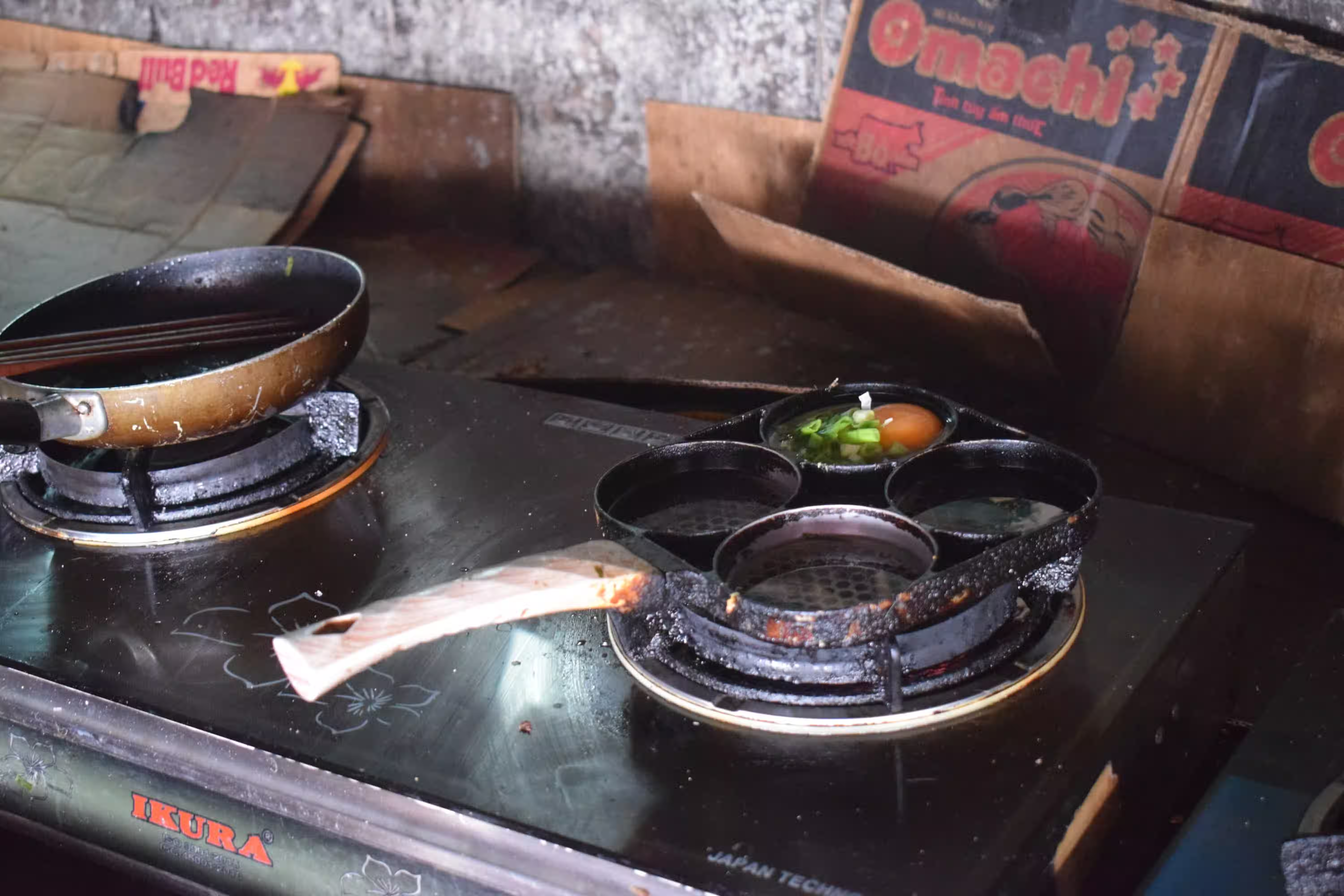
Soon we reached the bus station and took a bus to the beach. It was 65,000 dongs ( 200). After getting down from the bus, I had coconut water and some eggs at a small local place.
Eggs on a pan. Eggs being cooked on a pan for my order. Photo by Ravi Dwivedi, released under CC-BY-SA 4.0.
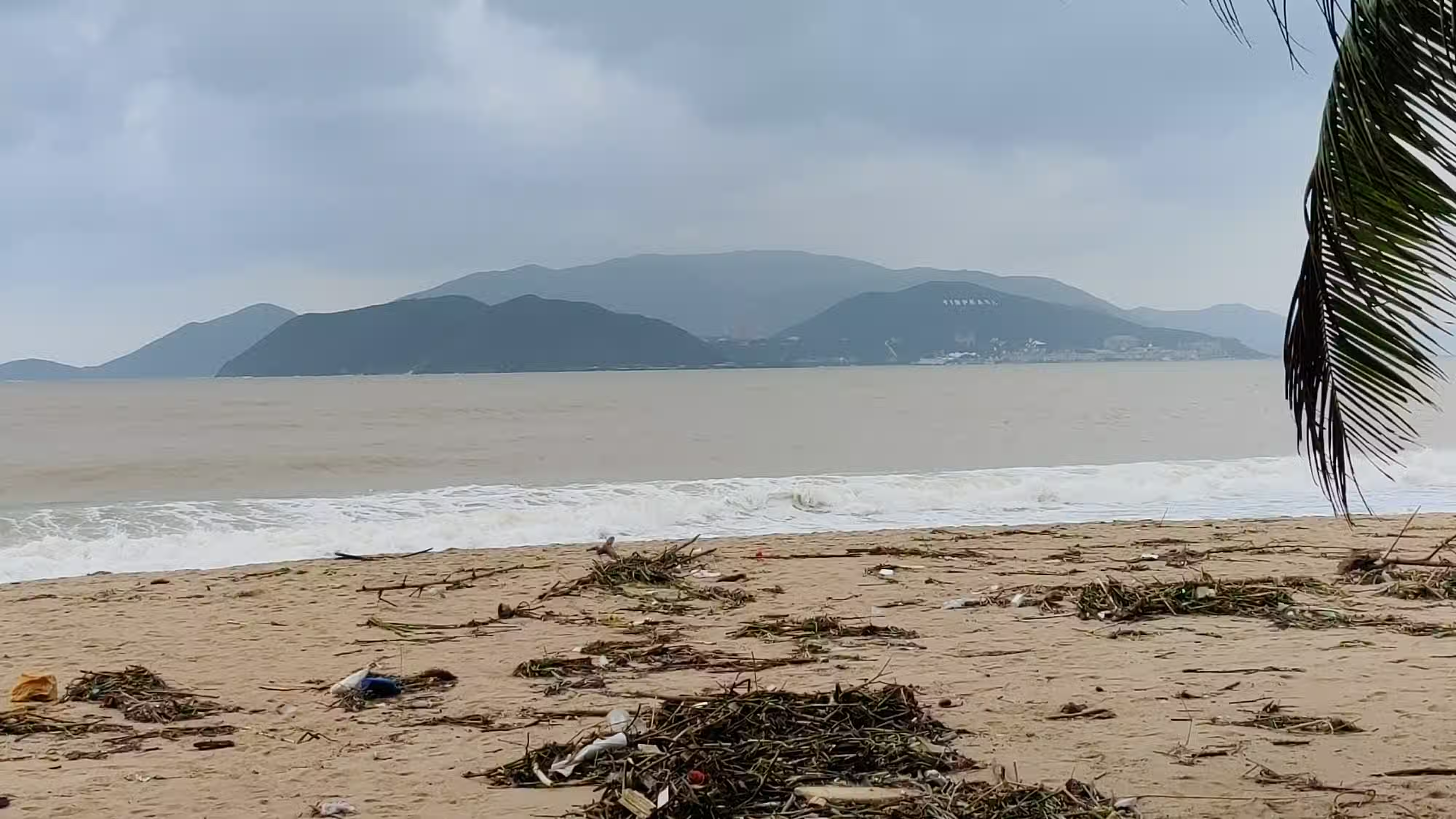
Then we went to the beach, but nobody else was there. We spent some time there and went back to the place where the bus dropped us as it started raining. We couldn t find a bus for some time. A taxi driver approached us and agreed to take us to the city center for 200,000 dongs ( 650). For reference, the place where he dropped us was 35 km from the place we took the taxi. Taxi fares in Vietnam were also cheap!
The beach we went to in Nha Trang. Photo by Ravi Dwivedi, released under CC-BY-SA 4.0. The beach we went to in Nha Trang. Photo by Ravi Dwivedi, released under CC-BY-SA 4.0.
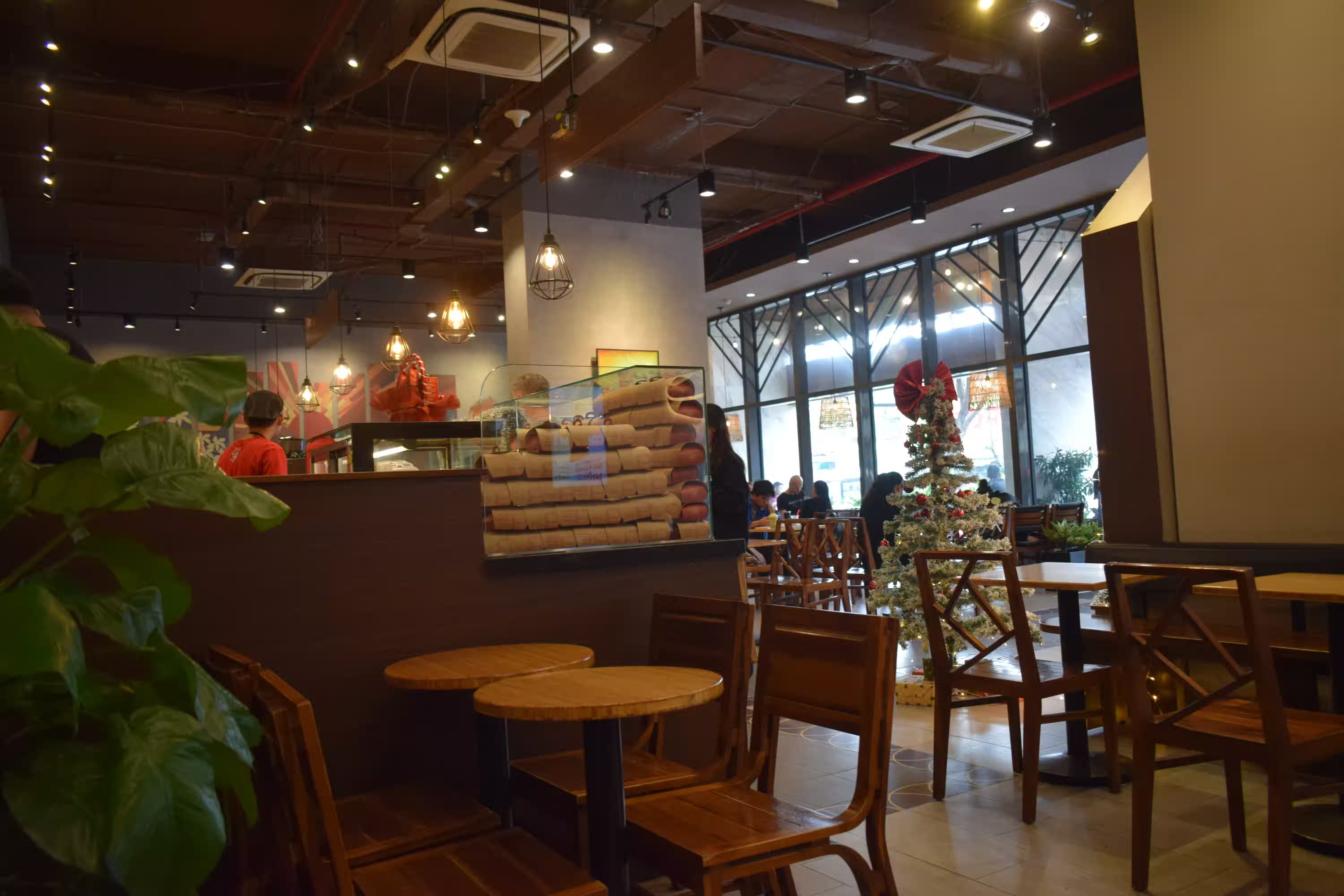
Nha Trang was a beautiful place, and so we roamed around for a while. Then we stopped at a Highlands Coffee branch for a while. Since Christmas was coming up, the caf had a Christmas tree, and I liked the Christmas vibes. They were playing Mariah Carey s All I Want for Christmas Is You.
This one was shot in the city center. In this trip, Badri and I found out that this is customary at local places in Vietnam. Photo by Ravi Dwivedi, released under CC-BY-SA 4.0. This one was shot in the city center. In this trip, Badri and I found out that this is customary at local places in Vietnam. Photo by Ravi Dwivedi, released under CC-BY-SA 4.0.
Inside a Highlands Coffee cafe in Nha Trang. Photo by Ravi Dwivedi, released under CC-BY-SA 4.0. Inside a Highlands Coffee cafe in Nha Trang. Photo by Ravi Dwivedi, released under CC-BY-SA 4.0.
A coffee I got from Highlands Coffee in Nha Trang. Photo by Ravi Dwivedi, released under CC-BY-SA 4.0. A coffee I got from Highlands Coffee in Nha Trang. Photo by Ravi Dwivedi, released under CC-BY-SA 4.0.
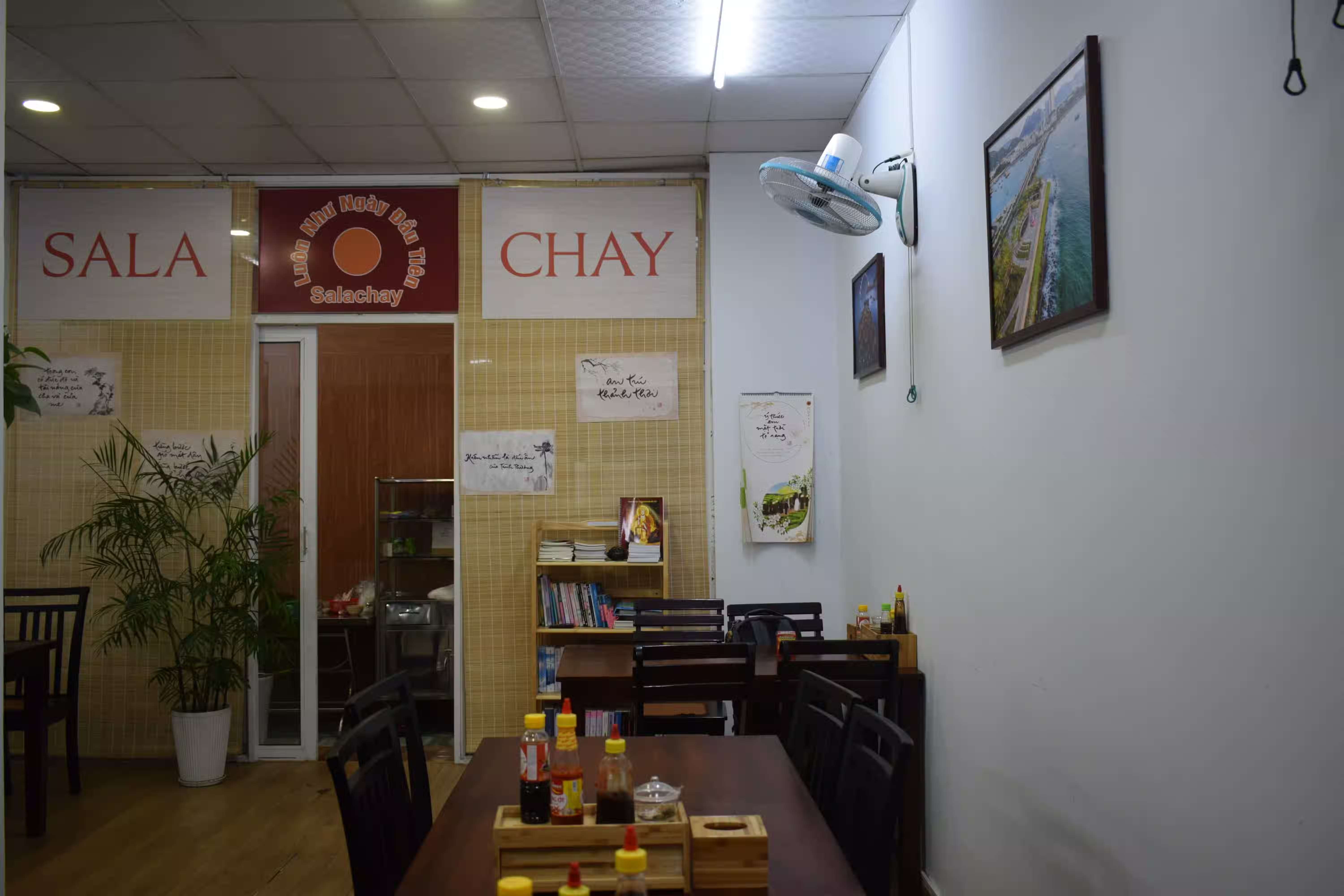
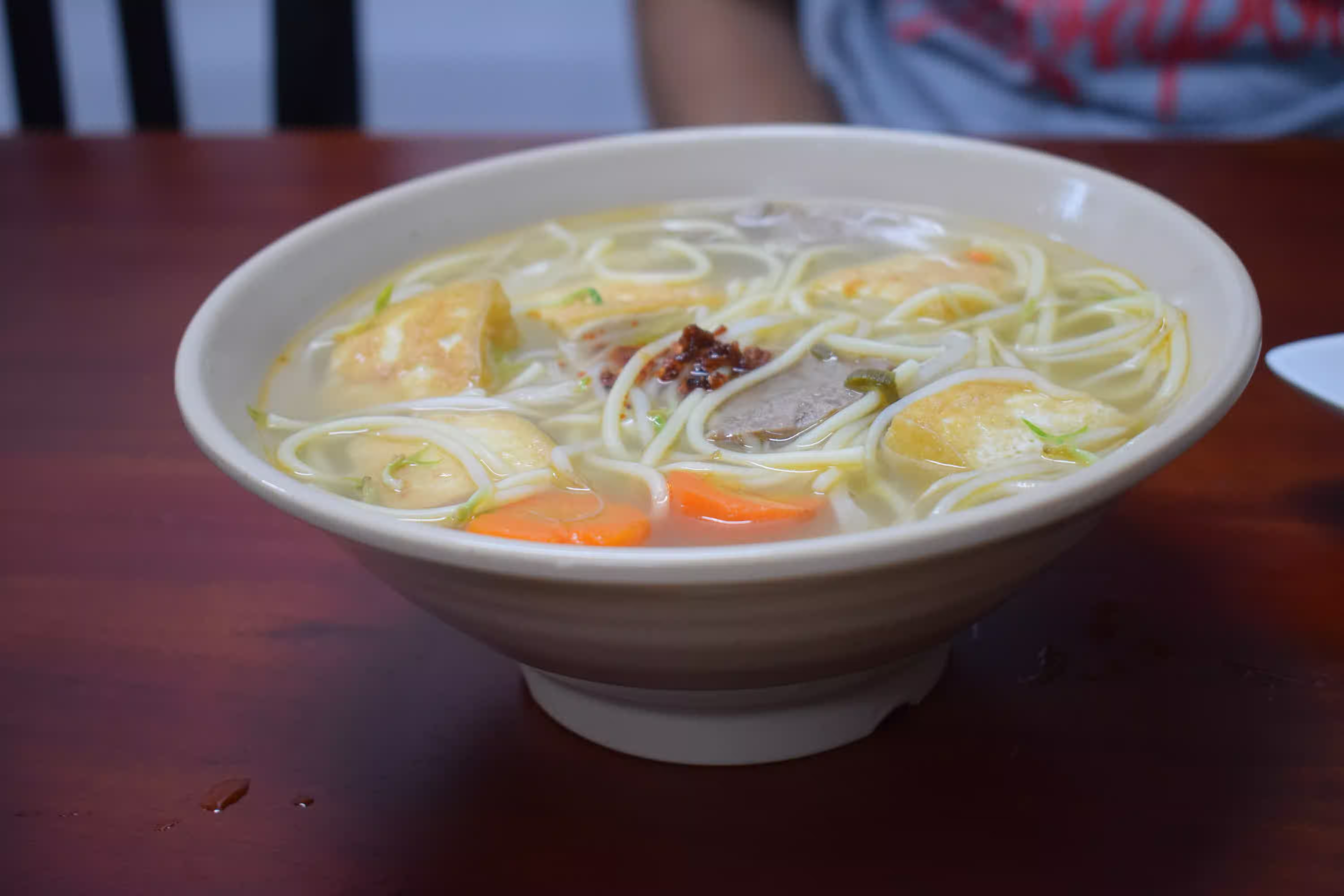
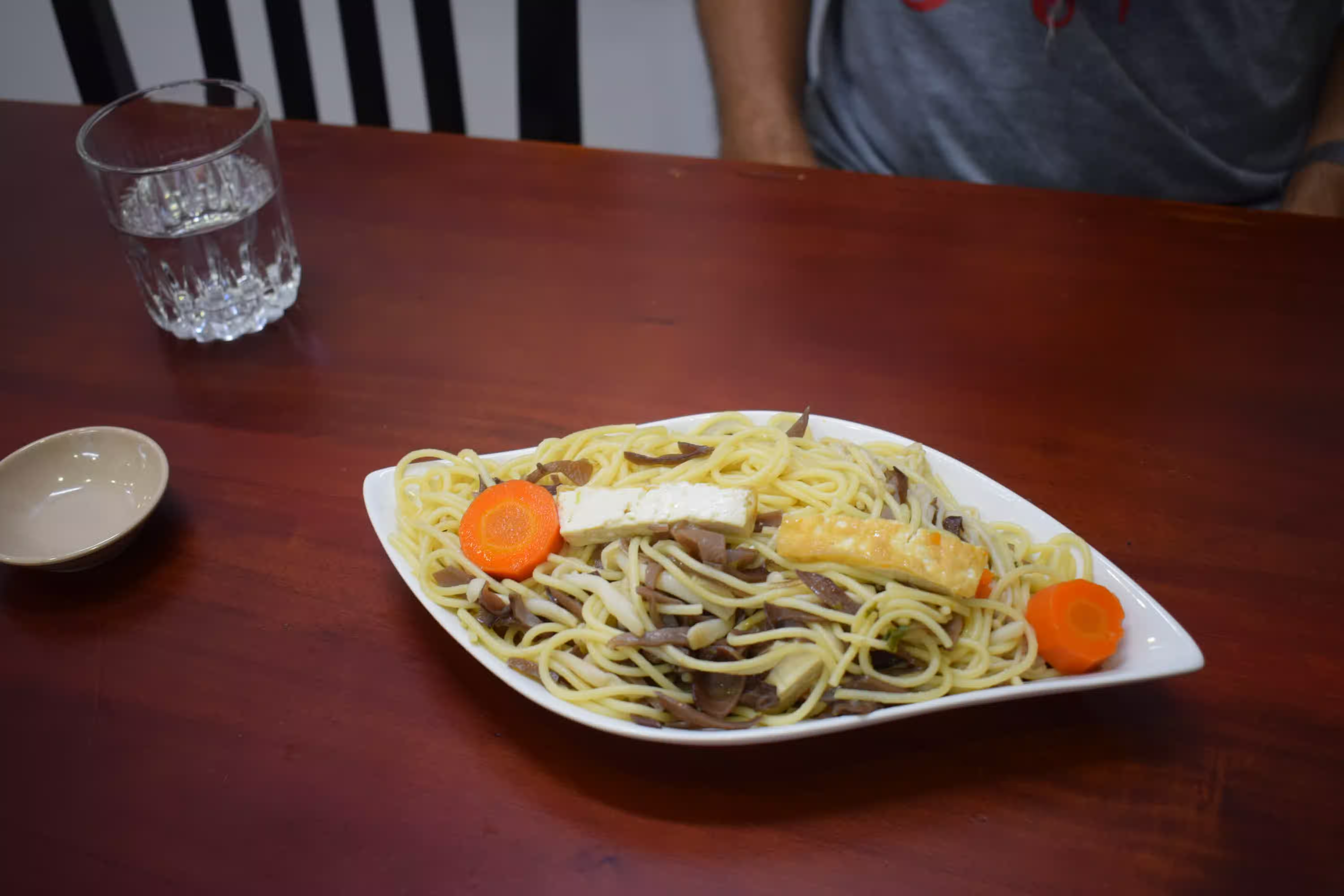
During the evening, we went to a local place to eat. The place mentioned Chay in its name, and you know what it means it was a vegan place. There was a man there and no other customers. I don t remember the names of the dishes we ordered, but it was a bowl of soupy noodles and a bowl of dry noodles. They were very tasty. To top that off, the meal was a total of 55,000 dongs ( 180) for both of us. The host was welcoming and friendly. We had a nice conversation with the host. In Vietnam, restaurants give chopsticks to eat noodles. While Badri was good at using them, I wasn t. So, the host of this restaurant helped me in using chopsticks. Although my technique was not perfect and I take a bit of time, I could now eat solely with chopsticks.
The restaurant we went to in Nha Trang. The word Chay in the name means it was a vegan restaurant. Photo by Ravi Dwivedi, released under CC-BY-SA 4.0. The restaurant we went to in Nha Trang. The word Chay in the name means it was a vegan restaurant. Photo by Ravi Dwivedi, released under CC-BY-SA 4.0.
Soupy noodles we got at that restaurant. Photo by Ravi Dwivedi, released under CC-BY-SA 4.0. Soupy noodles we got at that restaurant. Photo by Ravi Dwivedi, released under CC-BY-SA 4.0.
Dry noodles we got at that restaurant. Photo by Ravi Dwivedi, released under CC-BY-SA 4.0. Dry noodles we got at that restaurant. Photo by Ravi Dwivedi, released under CC-BY-SA 4.0.
Our plan was to take a night bus to Hoi An, and we were hoping to find a bus stand. However, we couldn t find one. Asking around about the pickup location of the Hoi An bus led us to many different locations. Finally, we ended up at a bus booking agency s office where we found out that there were no tickets available for Hoi An. At this point, we gave up on booking the bus and searched for trains instead. As we didn t have a local SIM, we asked the agency to let us connect to their Wi-Fi so that we could look for trains. They were kind enough to let us do that. It also seemed like they were going to close the office in like 10 minutes. Unfortunately, all the sleeper berths were booked from Nha Trang till Hoi An on the next train with only seating berths being available. It takes around 10 hours, so I wasn t comfortable traveling on seating berths. Here I came up with the idea to look for sleeper berths from an intermediate stop. Fortunately, there were sleeper berths available from the next stop, Ninh H a. Therefore, we booked a seating berth from Nha Trang to Ninh H a and a sleeper berth from Ninh H a to Tr Ki u (the nearest railway station from Hoi An). The train name was SE6, and it was a total of 500,000 dongs per person ( 1600 per person). So, we went to the Nha Trang railway station and boarded the train. We had to spend 40 minutes seated for the train to reach the next stop before we could go to our sleeper berths. Badri had some friendly co-passengers on that trip who gave him Saigon beer and some crispy papad-like thing. They offered me as well, but I thought it was non-veg, so I declined it.

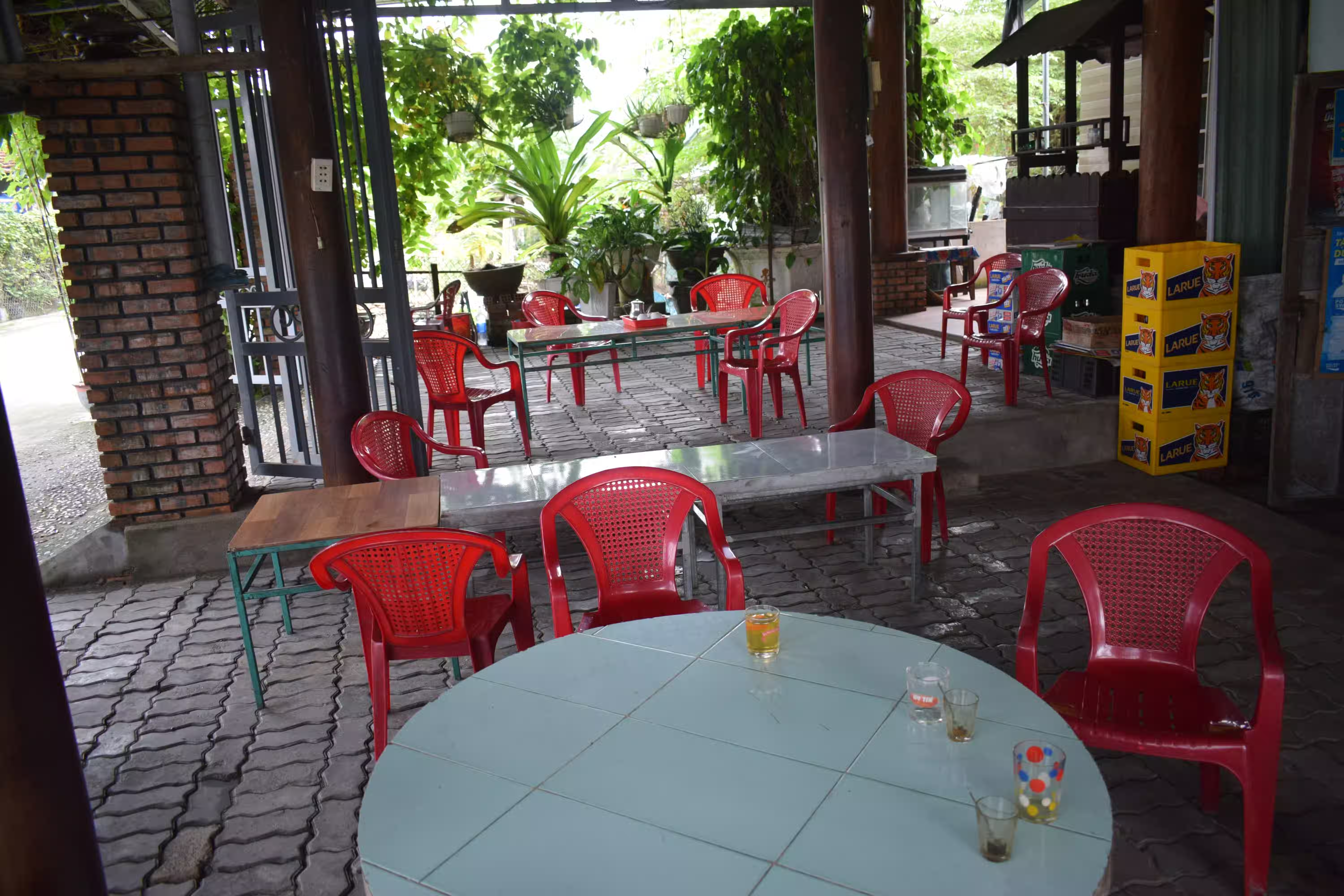
Hoi An On the morning of 17th December 2024, we got down at the Tr Ki u station at around 09:30. Our hostel was in Hoi An, which was around 22 km from the station. There was no public transport to get there. Instead, there was a taxi driver at the train platform. We told him the name of our hostel, and he quoted 270,000 dongs (around 850). We said it was too expensive for us, so he agreed to bargain at 250,000 dongs. At this point, we told him that we could give him no more than 200,000 dongs, but he didn t agree. Badri tried a trick. He asked the driver to show us prices in the Grab app (a popular taxi booking app in Southeast Asia). Unfortunately, the Grab app showed 258,000 dongs, which was more than the fare the driver agreed to. So we walked away as if we had so many options (we didn t!) to reach the hostel. We got out of the station and stopped at a small shop outside to have some coffee. As is customary in Vietnam, we got a complimentary green tea here as well.
This was the place we had our coffee in Tra Kieu. Photo by Ravi Dwivedi, released under CC-BY-SA 4.0. This was the place we had our coffee in Tra Kieu. Photo by Ravi Dwivedi, released under CC-BY-SA 4.0.
That taxi driver also joined us and sat in that shop. He started talking with the locals in the shop in the local language. The taxi driver was insistent on taking us to Hoi An for 250,000 dongs. At this point, Badri told the taxi driver (by the use of translation software) that we usually use public transport during our trips, and we aren t used to paying high prices to get around. So, he can drop us somewhere in Hoi An for 200,000 dongs as we don t mind walking a bit to reach our hotel. After reading this, the taxi driver agreed to take us to our hostel for 200,000 dongs ( 660). He also had me take a picture with Badri after this. I think such a bargain tactic would not work in India.
Photo of Badri with taxi driver. Photo by Ravi Dwivedi, released under CC-BY-SA 4.0. Photo of Badri with taxi driver. Photo by Ravi Dwivedi, released under CC-BY-SA 4.0.
The nice thing we noticed in Vietnam is, once bargaining is done and the deal is settled, people don t try to bargain more or keep on talking about the subject. Before the deal, the driver was being somewhat insistent and argumentative, but after the deal was done, it was as if no argument had happened at all.
A picture of Tra Kieu area near the train station we got down at. Photo by Ravi Dwivedi, released under CC-BY-SA 4.0. A picture of Tra Kieu area near the train station we got down at. Photo by Ravi Dwivedi, released under CC-BY-SA 4.0.
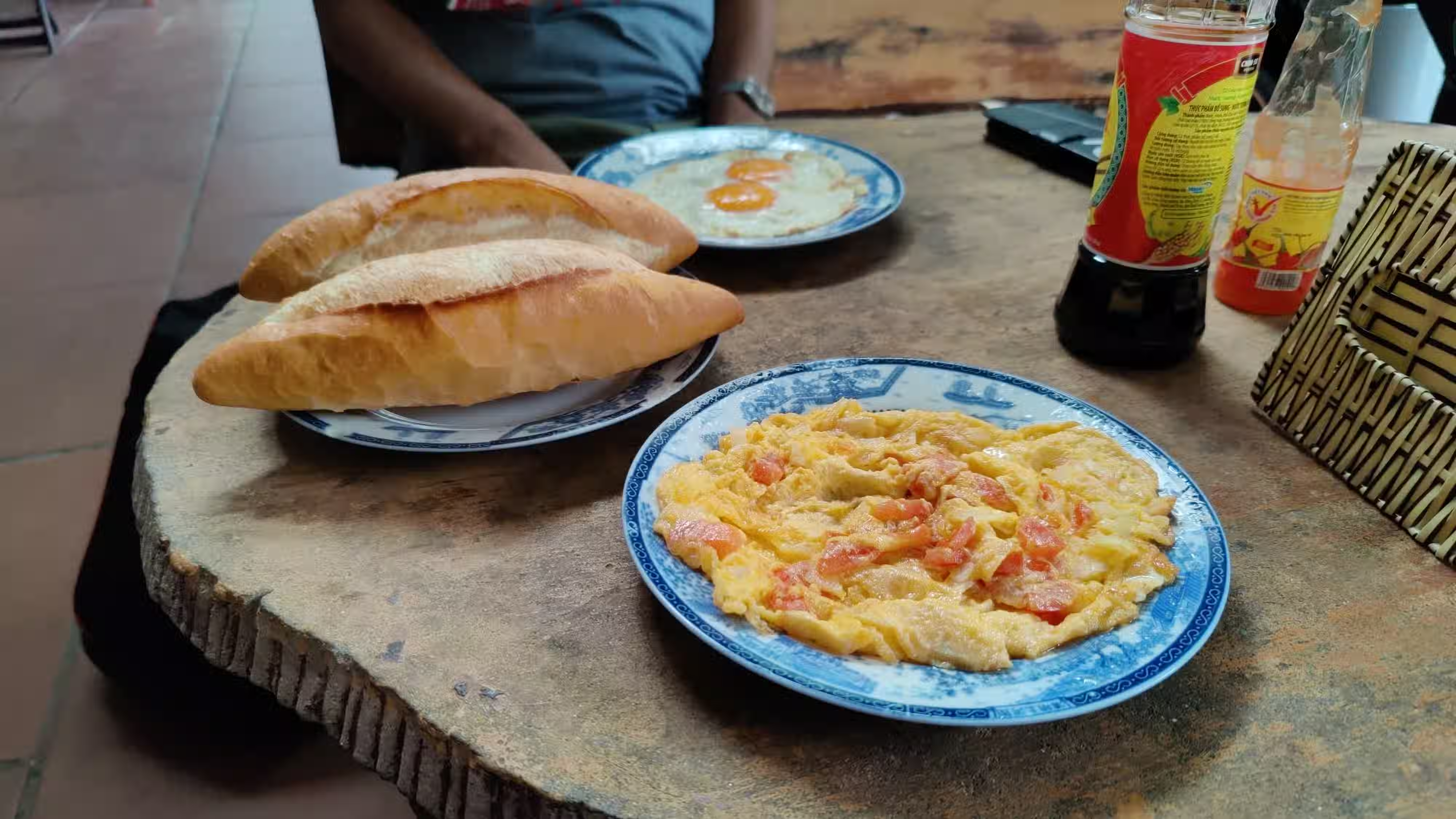
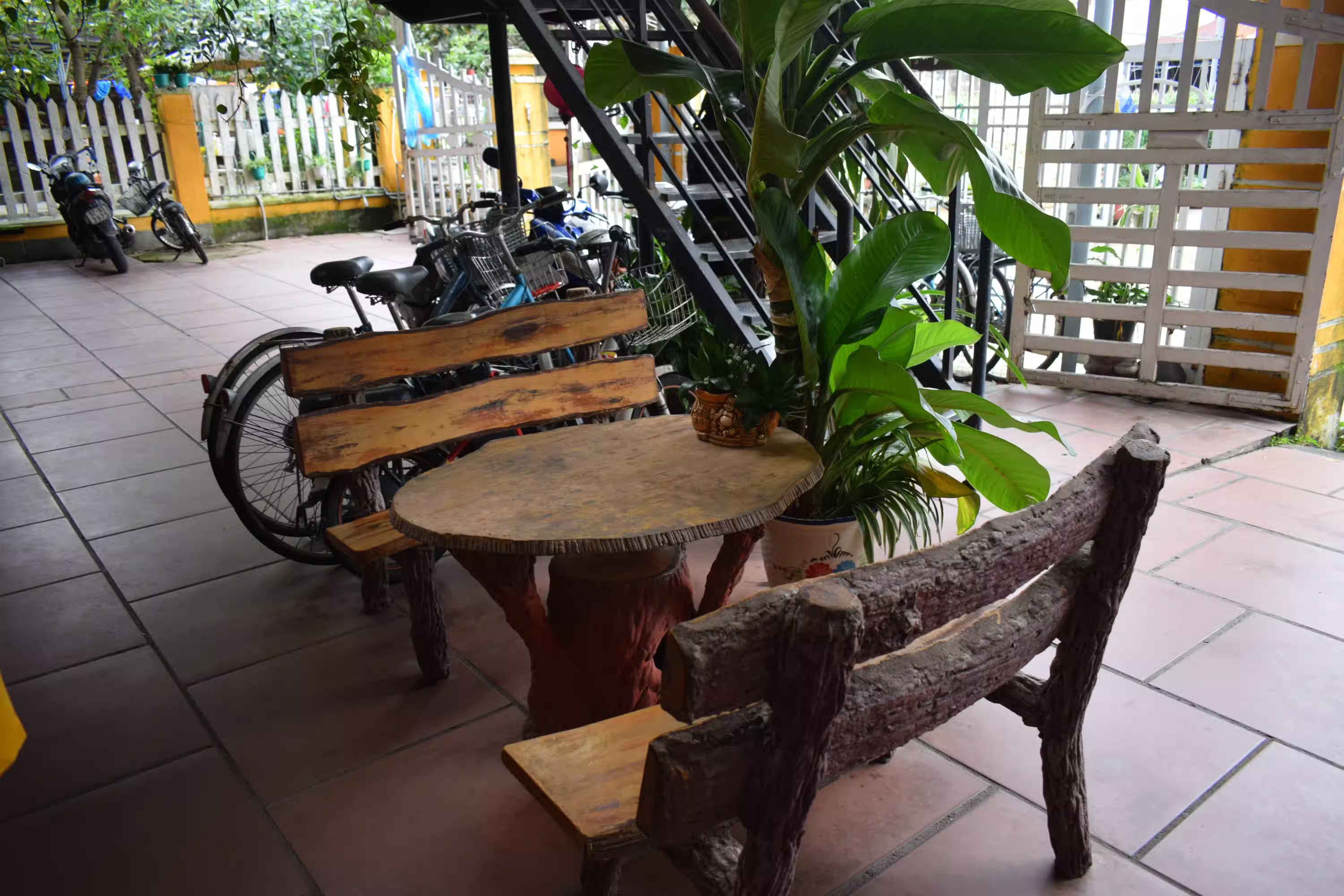
We were treated to some beautiful scenery on the way to our hostel. Soon we reached our place and completed all the formalities for checking-in. During the time our room was being prepared for check-in, we had an egg sandwich with coffee in the hotel. I found the egg sandwich very tasty. The bread looked like the French baguette. The hostel was 240 per night for each of us. The name of the hostel was Bana Spa. We liked staying here and we can recommend it if you find yourself there. It is operated by a family.
Our breakfast in Hoi An. Photo by Ravi Dwivedi, released under CC-BY-SA 4.0. Our breakfast in Hoi An. Photo by Ravi Dwivedi, released under CC-BY-SA 4.0.
A photo of the hostel we stayed in Hoi An. Photo by Ravi Dwivedi, released under CC-BY-SA 4.0. A photo of the hostel we stayed in Hoi An. Photo by Ravi Dwivedi, released under CC-BY-SA 4.0.
We also rented a bicycle for each of us 25,000 dongs per day ( 80) and explored the old town during the evening. Hoi An is popular for Vietnamese silk. Tourists come here to buy fabric and get it done by the tailor. The buildings here looked old, and they were painted in yellow with a gabled roof.
Typical yellow house with gabled roof in Hoi An old town. Photo by Ravi Dwivedi, released under CC-BY-SA 4.0. Typical yellow house with gabled roof in Hoi An old town. Photo by Ravi Dwivedi, released under CC-BY-SA 4.0.
Here, I also had egg coffee for the first time, and I liked it. Egg coffee is a delicacy of Hanoi, but you can get it in other parts of Vietnam. If you find yourself in Vietnam, then I recommend you try egg coffee. We also bought some cool T-shirts and other souvenirs, such as a Vietnamese hat, from here.
Egg coffee I had in Hoi An. Photo by Ravi Dwivedi, released under CC-BY-SA 4.0. Egg coffee I had in Hoi An. Photo by Ravi Dwivedi, released under CC-BY-SA 4.0.

Hue The next day the 18th of December 2024 we went to Hue by bus. As we could not take a bus on our own in Nha Trang, we asked the hostel to book it for us this time. We booked it a day before, and they told us to be ready by 07:00 in the morning. At 07:00, a minibus arrived, which took us to a bus agency s office. There we waited for a few minutes and got into the bus to Hue. The bus had sleeper seats, so I took the opportunity to catch some sleep. The ride was comfortable, so I am assuming the roads were good. In a couple of hours, we reached Hue. Again, we went to Highlands Coffee to have some coffee, charge our phones, and use the internet, not to mention using the bathrooms. During the afternoon, we went to a local restaurant named Qu n Chay Thanh Li u. It was a vegan restaurant (remember the thing I mentioned earlier about Chay being in the name?). On the way, we had a steamed dumpling shaped like a momo called banh bao from a street vendor. It wasn t very good, but I found it worthwhile.
Bahn Bao in Hue. Photo by Ravi Dwivedi, released under CC-BY-SA 4.0. Bahn Bao in Hue. Photo by Ravi Dwivedi, released under CC-BY-SA 4.0.
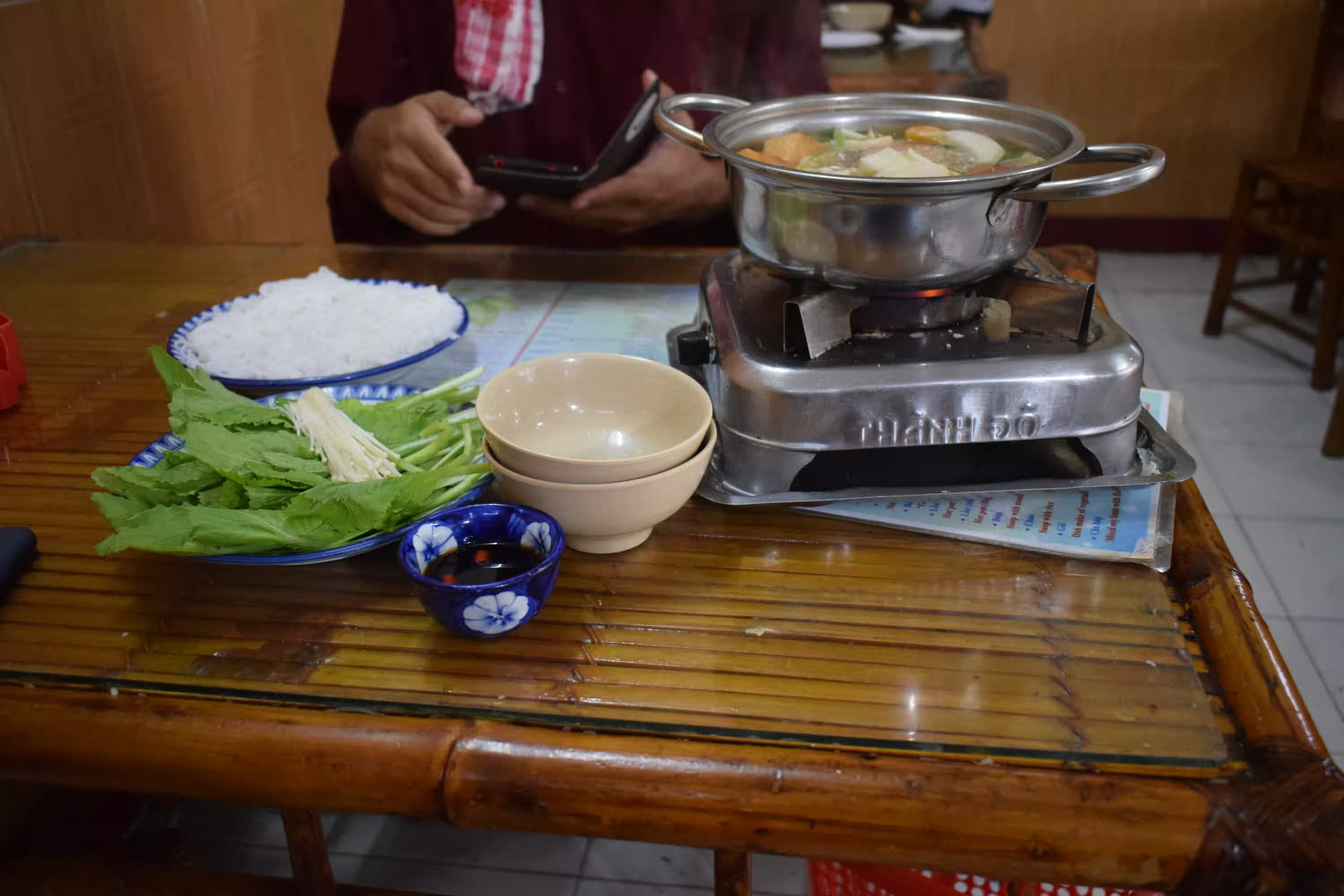
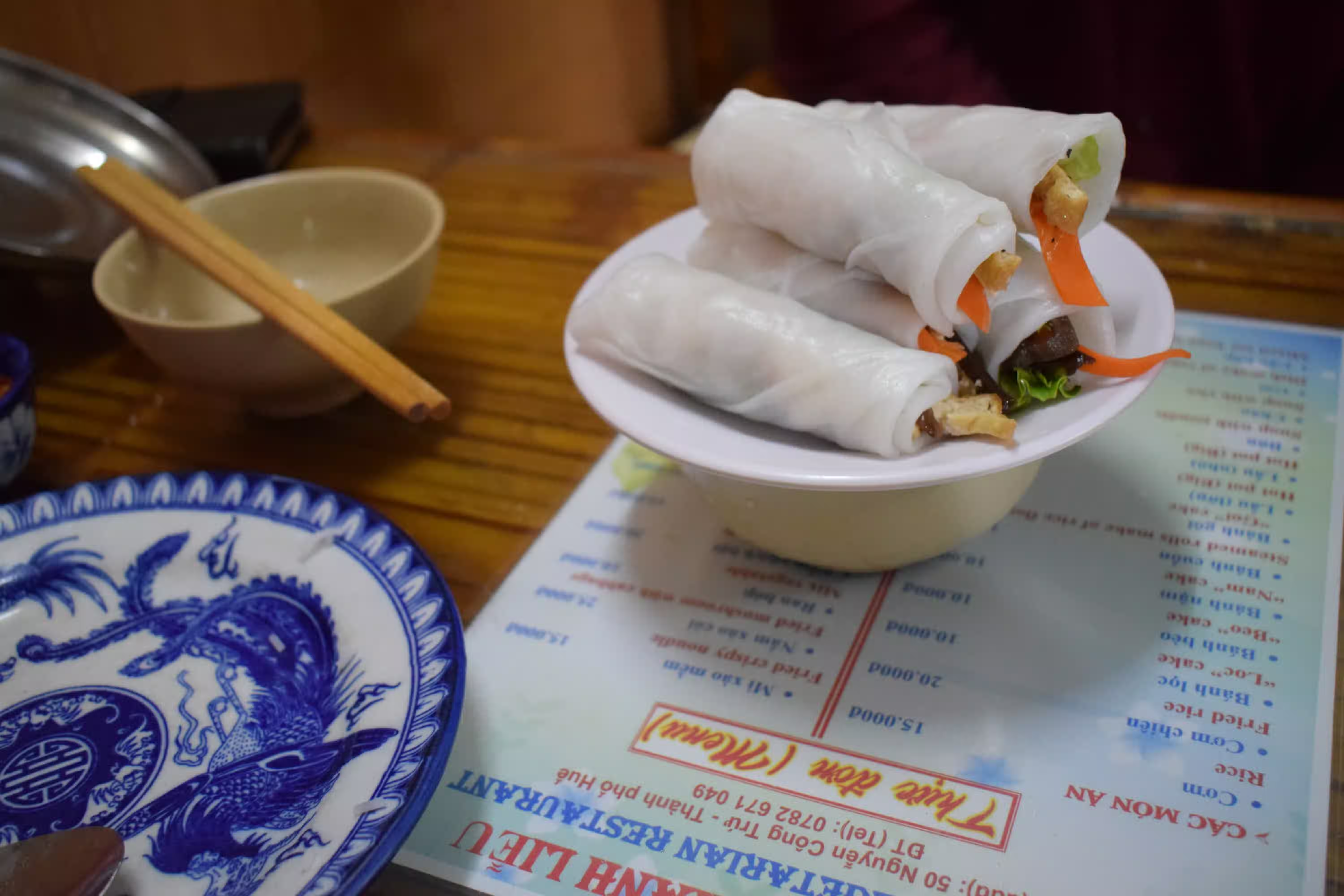
At the restaurant, we ordered a hot pot. First, they brought noodles and a gas stove. Then came the stock and our gas stove was turned on. The stock was kept simmering on the stove. Then, we had it bit by bit with the noodles. A big hot pot at this place costs 50,000 dongs ( 170). Then we had b nh cu n. These were steamed rolls made of rice flour for 10,000 dongs ( 33).
Hot Pot. Photo by Ravi Dwivedi, released under CC-BY-SA 4.0. Hot Pot. Photo by Ravi Dwivedi, released under CC-BY-SA 4.0.
Added soup to the noodles. Photo by Ravi Dwivedi, released under CC-BY-SA 4.0. Added soup to the noodles. Photo by Ravi Dwivedi, released under CC-BY-SA 4.0.
Steamed rolls made of rice flour. Photo by Ravi Dwivedi, released under CC-BY-SA 4.0. Steamed rolls made of rice flour. Photo by Ravi Dwivedi, released under CC-BY-SA 4.0.
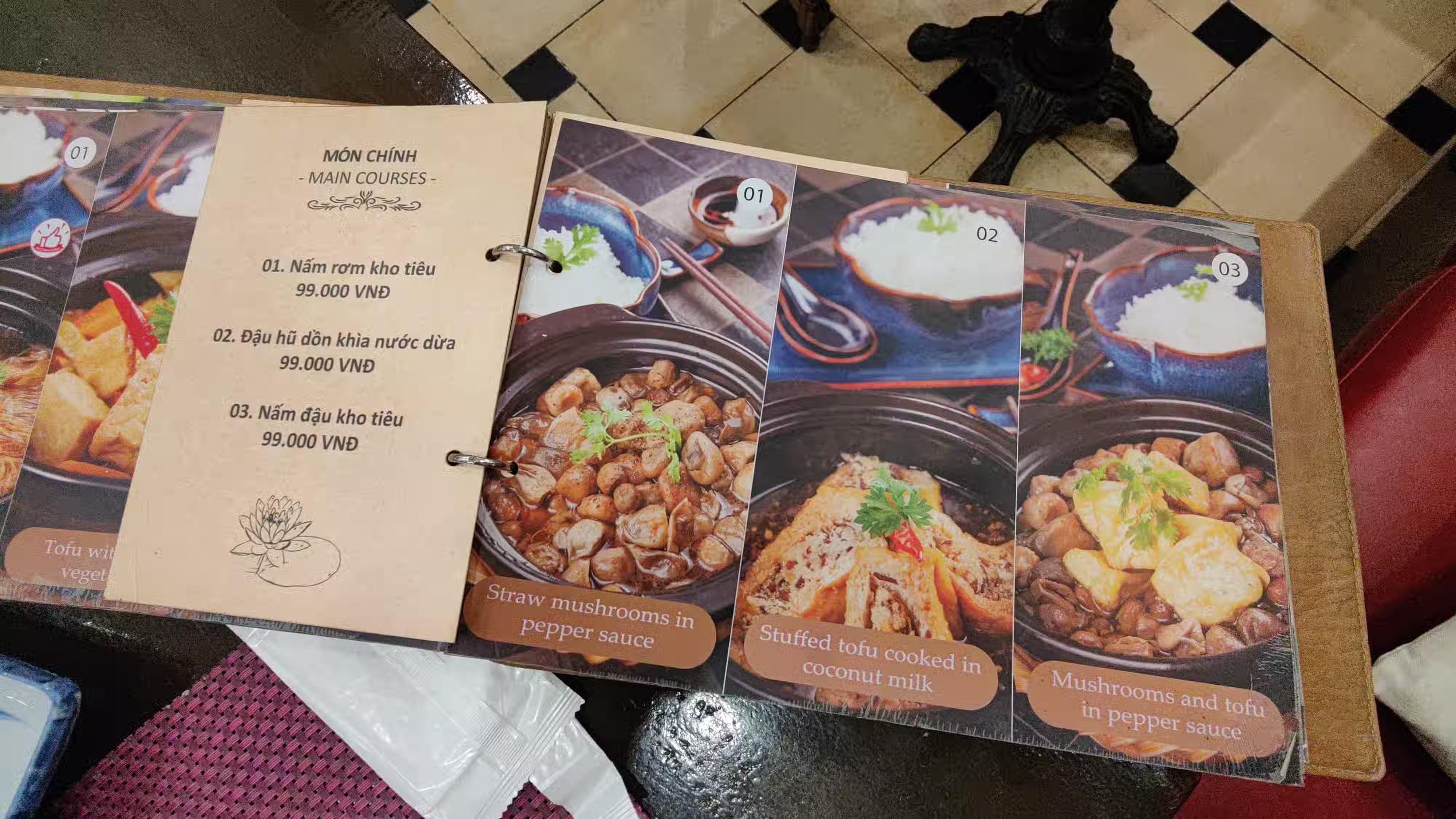
Restaurants in Vietnam usually add photos of the meals in their menu or write a description in English. So, even though the dish names were Vietnamese, we had no problems in ordering food there. In addition, all the places we went to provided free Wi-Fi. They either mention the Wi-Fi password on the bill, on the menu or paste it on the wall. This made our trip smoother without getting a local SIM.
Menu from a restaurant in Ho Chi Minh City with detailed description of the food. Photo by Ravi Dwivedi, released under CC-BY-SA 4.0. Menu from a restaurant in Ho Chi Minh City with detailed description of the food. Photo by Ravi Dwivedi, released under CC-BY-SA 4.0.
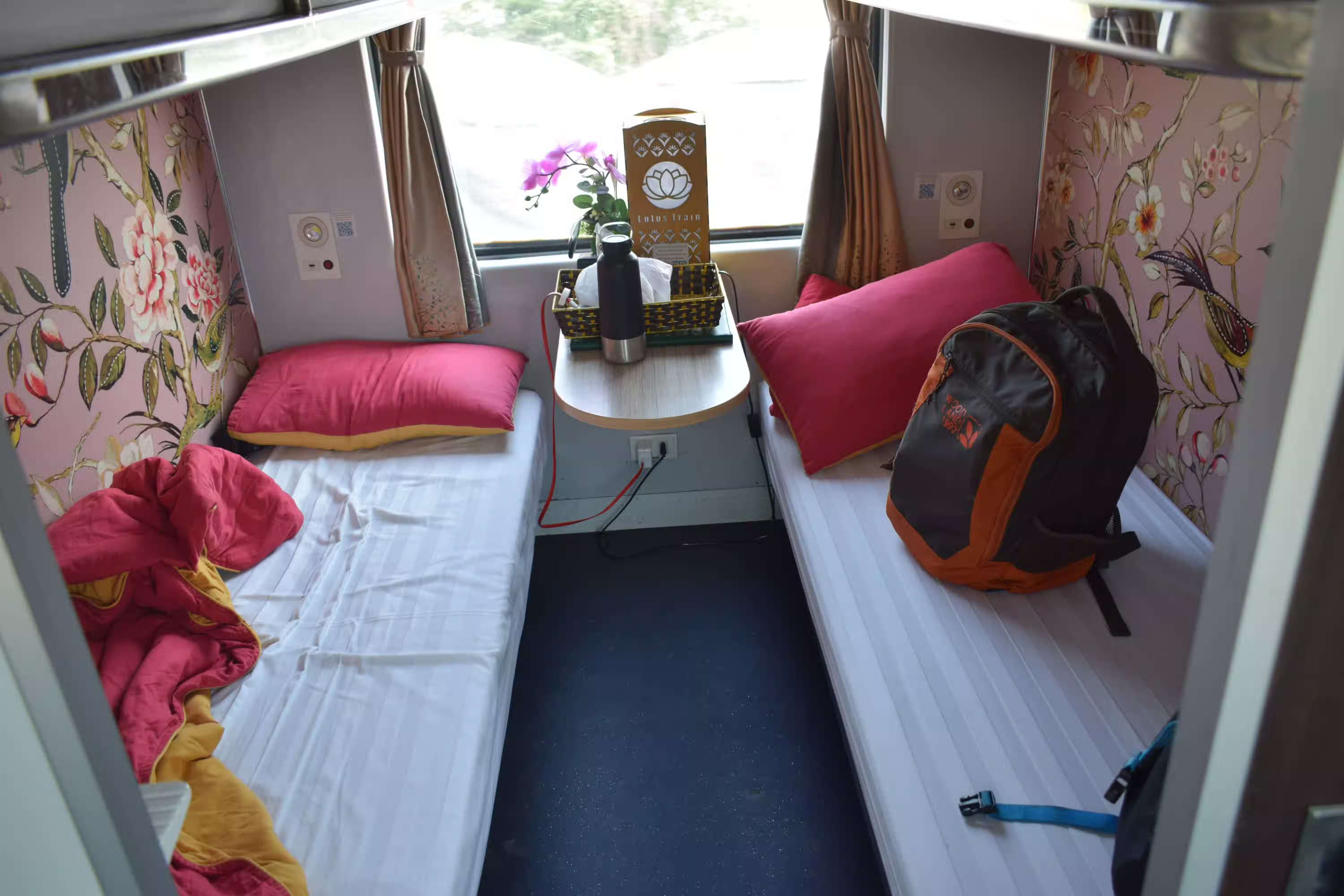
Then we slowly walked towards the railway station, as we had a night train to Hanoi. We had egg coffee in a cafe. Near the railway station, we had a b nh m (egg sandwich). As for sightseeing, we had plans to visit a couple of places in Hue, but we ended up spending all our time inside sheltered spaces due to heavy rain. We had booked the train SE20 for Hanoi, which had a departure time of 20:41 from Hue. This one was 948,000 dongs ( 3100) for myself and 870,000 dongs ( 2900) for Badri. My ticket was pricier than Badri s because I got a lower berth. Our train was late by half an hour, so we waited in the common area of the station. After the train arrived, we got inside and took our seats. The cabin had four berths two upper and two lower, similar to India s First AC class. The ticket inspector came to us and offered us the whole cabin (two additional berths) for 300,000 dongs ( 1,000), which we declined. However, this hinted at the other two seats not being reserved. Eventually, we had the whole cabin to ourselves, as nobody else showed up for the other two berths. It was a 14-hour journey, and I got a good sleep.
Our berths in the train. Photo by Ravi Dwivedi, released under CC-BY-SA 4.0. Our berths in the train. Photo by Ravi Dwivedi, released under CC-BY-SA 4.0.

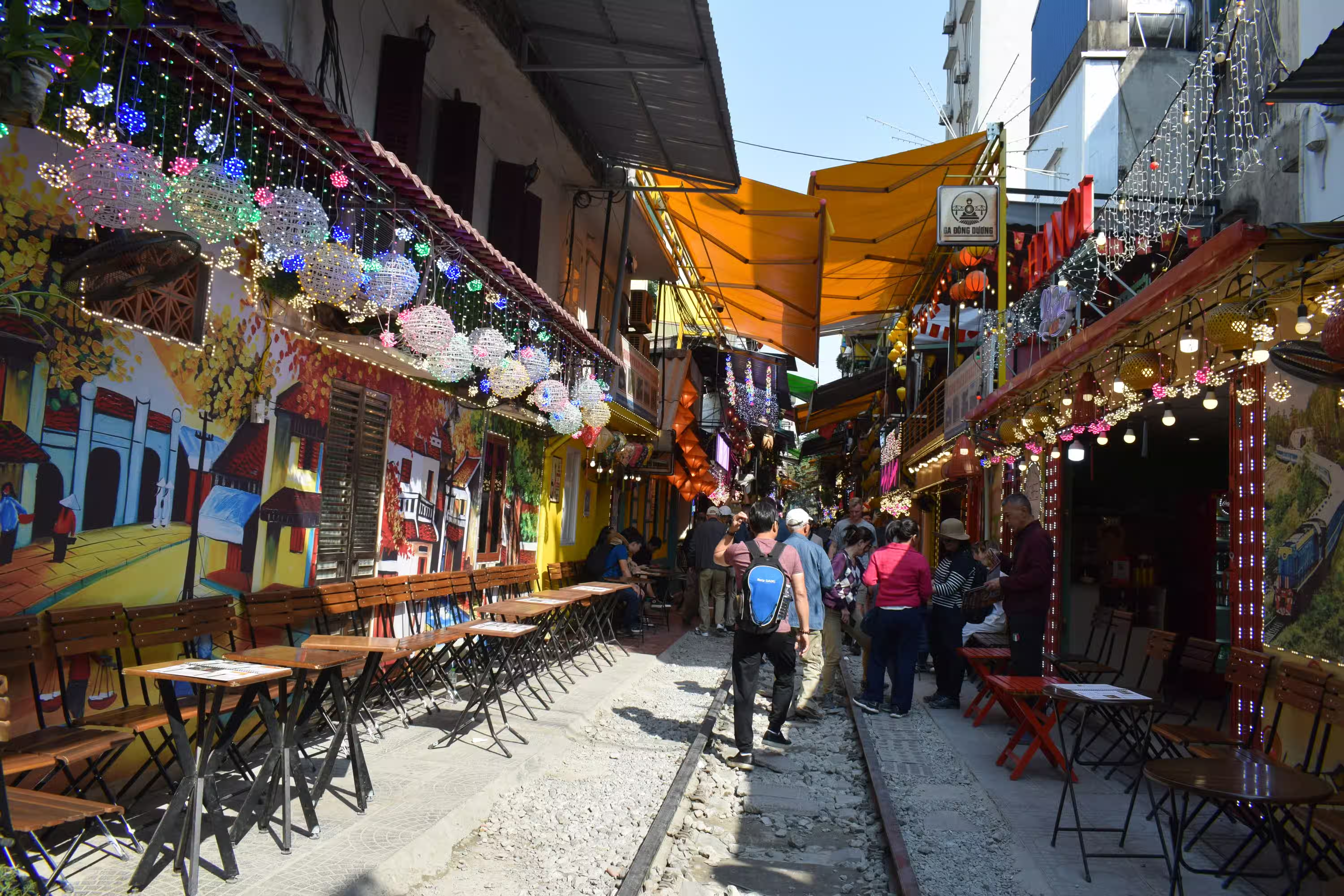
Hanoi On the morning of the 19th of December 2024, we reached Vietnam s capital, Hanoi. We had booked a private hotel room for 800. It was 1 km from the Hanoi Airport. However, it was pretty far from the railway station. So, we roamed around in the city and went to the hotel in the evening. First, we walked to a place and had egg coffee with egg sandwiches. Then we went to Hanoi Train Street, which was walking distance from the train station. After clicking some pictures at the train street, we went to a museum nearby. Upon reaching there, we found out that it was closed.
Egg coffee in Hanoi. Photo by Ravi Dwivedi, released under CC-BY-SA 4.0. Egg coffee in Hanoi. Photo by Ravi Dwivedi, released under CC-BY-SA 4.0.
Hanoi train street is a tourist attraction in Hanoi. Photo by Ravi Dwivedi, released under CC-BY-SA 4.0. Hanoi train street is a tourist attraction in Hanoi. Photo by Ravi Dwivedi, released under CC-BY-SA 4.0.
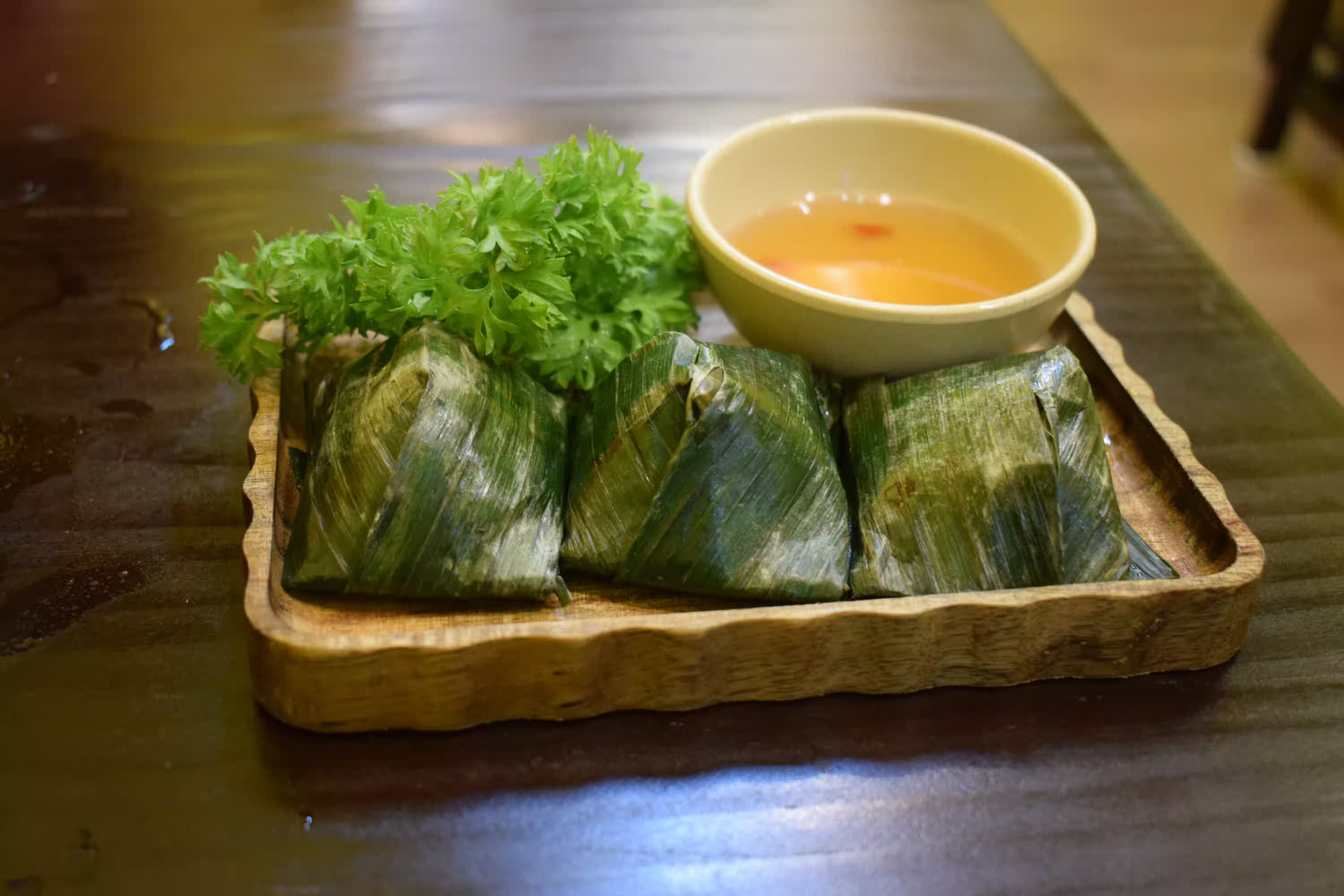
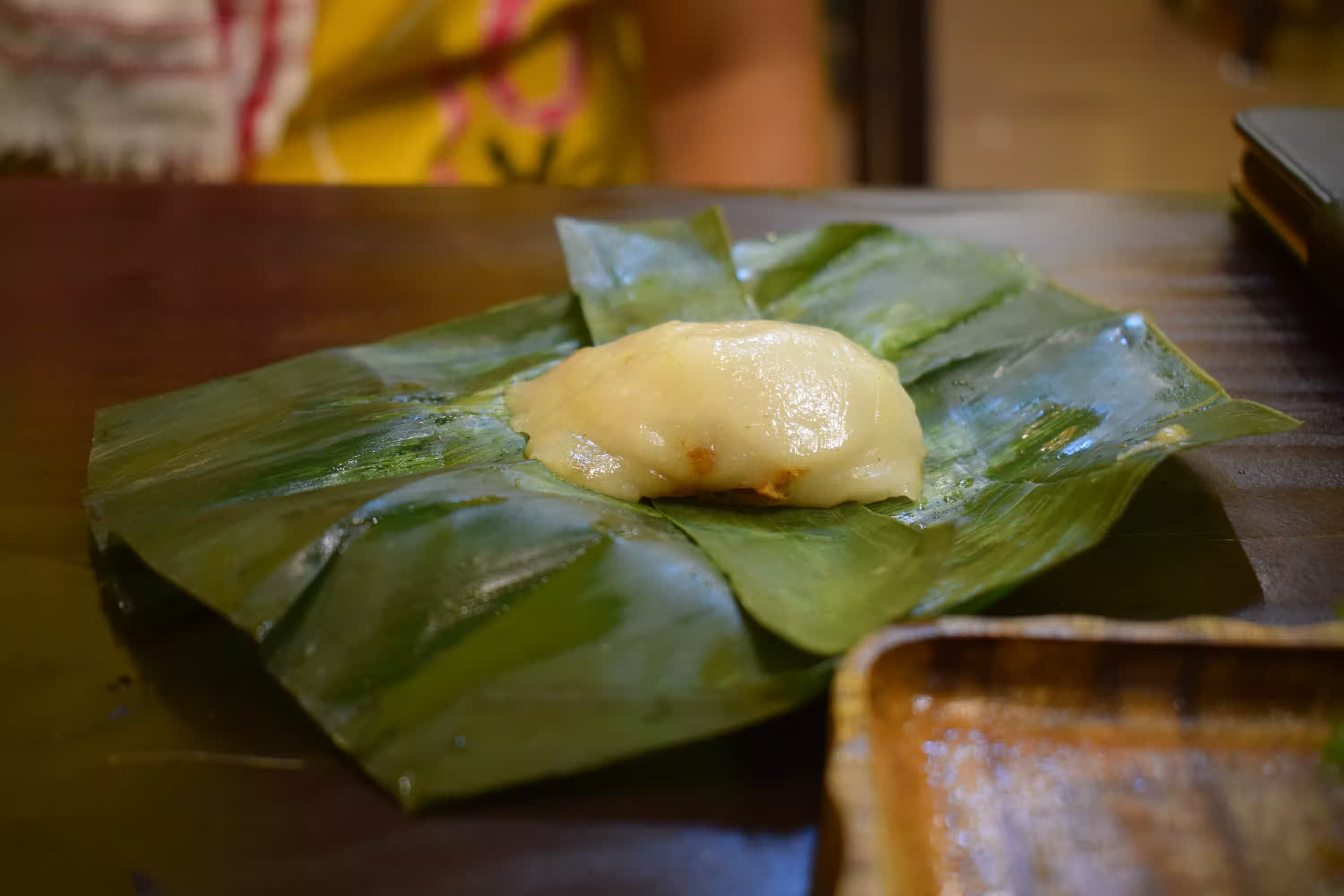
Then we went shopping for jackets, as Hanoi was cold compared to other parts of Vietnam we had been to, and since many of them are manufactured in Vietnam, we thought they would be cheaper. I liked some jackets, but they were not my size. Eventually, we didn t buy anything at the clothes shop. In the evening, I bought a Vietnamese-styled phin coffee filter and coffee powder from Highlands Coffee. We spent a lot of time in their cafes, so it made sense to buy some souvenirs from there. Badri bought a few coffee filters for his family at Trung Nguyen, where I also bought another filter. We had dinner at a local place where we had pho and banh it. Bahn it was served packed in banana leaves and it was made of sticky rice.
A picture of pho we had in Hanoi. Photo by Ravi Dwivedi, released under CC-BY-SA 4.0. A picture of pho we had in Hanoi. Photo by Ravi Dwivedi, released under CC-BY-SA 4.0.
Bahn it is served packed in banana leaves. Photo by Ravi Dwivedi, released under CC-BY-SA 4.0. Bahn it is served packed in banana leaves. Photo by Ravi Dwivedi, released under CC-BY-SA 4.0.
Bahn it. Photo by Ravi Dwivedi, released under CC-BY-SA 4.0. Bahn it. Photo by Ravi Dwivedi, released under CC-BY-SA 4.0.
Next, we went to Hanoi railway station to catch a bus to the airport since our hotel was 1 km from the airport. The locals there helped us take the bus. It took like an hour to get to the airport. We saw on OpenStreetMap that we can take a bus from there to the hotel, but we could not find it. So we walked to our hotel instead. It was a decent hotel room for 800 for a night. We went outside to explore the area and had egg sandwiches and egg coffee at a local place. Again, we were given a complimentary green tea. We went to this place like three times. We had practically become regulars by the time we left. The next day 20th of December 2024 we took a bus to the airport and boarded our flight to Delhi. Credits: Thanks Badri, Kishy and Richard for proofreading.

C.J. Collier: The WWW::Mechanize::Chrome Saga: A Comprehensive Narrative of PR #104

The
WWW::Mechanize::Chrome Saga: A Comprehensive Narrative of PR #104 This document synthesizes the extensive work performed from March
13th to March 20th, 2026, to harden, stabilize, and refactor the
WWW::Mechanize::Chrome library and its test suite. This
effort involved deep dives into asynchronous programming,
platform-specific bug hunting, and strategic architectural
decisions.

Part I:
The Quest for Cross-Platform Stability (March 13 16) The initial phase of work focused on achieving a green test suite
across a variety of Linux distributions and preparing for a new release.
This involved significant hardening of the library to account for
different browser versions, OS-level security restrictions, and
filesystem differences.

Key Milestones &
Engineering Decisions:
  • Fedora & RHEL-family Success: A major effort
    was undertaken to achieve a 100% pass rate on modern Fedora 43 and
    CentOS Stream 10. This required several key engineering decisions to
    handle modern browser behavior:
    • Decision: Implement Asynchronous DOM Serialization
      Fallback. Synchronous fallbacks in an async context are
      dangerous. To prevent Resource was not cached errors during
      saveResources, we implemented a fully asynchronous fallback
      in _saveResourceTree. By chaining
      _cached_document with DOM.getOuterHTML
      messages, we can reconstruct document content without blocking the event
      loop, even if Chromium has evicted the resource from its cache. This
      also proved resilient against Fedora s security policies, which often
      block file:// access.
    • Decision: Truncate Filenames for Cross-Platform
      Safety. To avoid File name too long errors,
      especially on Windows where the MAX_PATH limit is 260
      characters, filenameFromUrl was hardened. The filename
      truncation was reduced to a more conservative 150
      characters, leaving ample headroom for deeply nested CI
      temporary directories. Logic was also added to preserve file extensions
      during truncation and to sanitize backslashes from URI paths.
    • Decision: Expand Browser Discovery Paths. To
      support RHEL-based systems out-of-the-box, the
      default_executable_names was expanded to include
      headless_shell and search paths were updated to include
      /usr/lib64/chromium-browser/.
    • Decision: Mitigate Race Conditions with Stabilization Waits
      and Resilient Fetching. On fast systems,
      DOM.documentUpdated events could invalidate
      nodeIds immediately after navigation, causing XPath queries
      to fail with Could not find node with given id . A small stabilization
      sleep(0.25s) was added after page loads to ensure the DOM
      is settled. Furthermore, the asynchronous DOM fetching loop was hardened
      to gracefully handle these errors by catching protocol errors and
      returning an empty string for any node that was invalidated during
      serialization, ensuring the overall process could complete.
  • Windows Hardening:
    • Decision: Adopt Platform-Aware Watchdogs. The test
      suite s reliance on ualarm was a blocker for Windows, where
      it is not implemented. The t::helper::set_watchdog function
      was refactored to use standard alarm() (seconds) on Windows
      and ualarm (microseconds) on Unix-like systems, enabling
      consistent test-level timeout enforcement.
  • Version 0.77 Release:
    • Decision: Adopt SOP for Version Synchronization.
      The project maintains duplicate version strings across 24+ files. A
      Standard Operating Procedure was adopted to use a batch-replacement tool
      to update all sub-modules in lib/ and to always run
      make clean and perl Makefile.PL to ensure
      META.json and META.yml reflect the new
      version. After achieving stability on Linux, the project version was
      bumped to 0.77.
  • Infrastructure & Strategic Work:
    • The ad2 Windows Server 2025 instance was restored and
      optimized, with Active Directory demoted and disk I/O performance
      improved.
    • A strategic proposal for the Heterogeneous Directory
      Replication Protocol (HDRP) was drafted and published.

Part II: The
Great Async Refactor (March 17 18) Despite success on Linux, tests on the slow ad2 Windows
host were still plagued by intermittent, indefinite hangs. This
triggered a fundamental architectural shift to move the library s core
from a mix of synchronous and asynchronous code to a fully non-blocking
internal API.

Key Milestones &
Engineering Decisions:
  • Decision: Expose a _future API.
    Instead of hardcoding timeouts in the library, the core strategy was to
    refactor all blocking methods (xpath, field,
    get, etc.) into thin wrappers around new non-blocking
    ..._future counterparts. This moved timeout management to
    the test harness, allowing for flexible and explicit handling of
    stalls.
    # Example library implementation
    sub xpath($self, $query, %options)  
        return $self->xpath_future($query, %options)->get;
     
    
    sub xpath_future($self, $query, %options)  
        # Async implementation using $self->target->send_message(...)
     
  • Decision: Centralize Test Hardening in a Helper.
    A dedicated test library, t/lib/t/helper.pm, was created to
    contain all stabilization logic. Safe wrappers (safe_get,
    safe_xpath) were implemented there, using
    Future->wait_any to race asynchronous operations against
    a timeout, preventing tests from hanging.
    # Example test helper implementation
    sub safe_xpath  
        my ($mech, $query, %options) = @_;
        my $timeout = delete $options timeout    5;
        my $call_f = $mech->xpath_future($query, %options);
        my $timeout_f = $mech->sleep_future($timeout)->then(sub   Future->fail("Timeout")  );
        return Future->wait_any($call_f, $timeout_f)->get;
     
  • Decision: Refactor Node Attribute Cache.
    Investigations into flaky checkbox tests (t/50-tick.t)
    revealed that WWW::Mechanize::Chrome::Node was storing
    attributes as a flat list ([key, val, key, val]), which was
    inefficient for lookups and individual updates. The cache was refactored
    to definitively use a HashRef, providing O(1) lookups
    and enabling atomic dual-updates where both the browser property (via
    JS) and the internal library attribute are synchronized
    simultaneously.
  • Decision: Implement Self-Cancelling Socket
    Watchdog. On Windows, traditional watchdog processes often
    failed to detect parent termination, leading to 60-second hangs after
    successful tests. We implemented a new socket-based watchdog in
    t::helper that listens on an ephemeral port; the background
    process terminates immediately when the parent socket closes,
    eliminating these cumulative delays.
  • Decision: Deep Recursive Refactoring & Form
    Selection. To make the API truly non-blocking, the entire
    internal call stack had to be refactored. For example, making
    get_set_value_future non-blocking required first making its
    dependency, _field_by_name, asynchronous. This culminated
    in refactoring the entire form selection API (form_name,
    form_id, etc.) to use the new asynchronous
    _future lookups, which was a key step in mitigating the
    Windows deadlocks.
  • Decision: Fix Critical Regressions & Memory
    Cycles.
    • Evaluation Normalization: Implemented a
      _process_eval_result helper to centralize the parsing of
      results from Runtime.evaluate. This ensures consistent
      handling of return values and exceptions between synchronous
      (eval_in_page) and asynchronous (eval_future)
      calls.
    • Memory Cycle Mitigation: A significant memory
      leak was discovered where closures attached to CDP event futures (like
      for asynchronous body retrieval) would capture strong references to
      $self and the $response object, creating a
      circular reference. The established rule is to now always use
      Scalar::Util::weaken on both $self and any
      other relevant objects before they are used inside a
      ->then block that is stored on an object.
    • Context Propagation (wantarray): A
      major regression was discovered where Perl s wantarray
      context, which distinguishes between scalar and list context, was lost
      inside asynchronous Future->then blocks. This caused
      methods like xpath to return incorrect results (e.g., a
      count instead of a list of nodes). The solution was to adopt the Async
      Context Pattern : capture wantarray in the synchronous
      wrapper, pass it as an option to the _future method, and
      then use that captured value inside the future s final resolution
      block.
      # Synchronous Wrapper
      sub xpath($self, $query, %options)  
          $options  wantarray   = wantarray; # 1. Capture
          return $self->xpath_future($query, %options)->get; # 2. Pass
       
      
      # Asynchronous Implementation
      sub xpath_future($self, $query, %options)  
          my $wantarray = delete $options  wantarray  ; # 3. Retrieve
          # ... async logic ...
          return $doc->then(sub  
              if ($wantarray)   # 4. Respect
                  return Future->done(@results);
                else  
                  return Future->done($results[0]);
               
           );
       
    • Asynchronous Body Retrieval & Robust Content
      Fallbacks: Fixed a bug where decoded_content()
      would return empty strings by ensuring it awaited a
      __body_future. This was implemented by storing the
      retrieval future directly on the response object
      ($response-> __body_future ). To make this more robust,
      a tiered strategy was implemented: first try to get the content from the
      network response, but if that fails (e.g., for about:blank
      or due to cache eviction), fall back to a JavaScript
      XMLSerializer to get the live DOM content.
    • Signature Hardening: Fixed Too few arguments
      errors when using modern Perl signatures with
      Future->then. Callbacks were updated to use optional
      parameters (sub($result = undef) ... ) to gracefully
      handle futures that resolve with no value.
    • XHTML Split-Brain Bug: Resolved a
      long-standing Chromium bug (40130141) where content provided via
      setDocumentContent is parsed differently than content
      loaded from a URL. A workaround was implemented: for XHTML documents,
      WMC now uses a JavaScript-based XPath evaluation
      (document.evaluate) against the live DOM, bypassing the
      broken CDP search mechanism.

Derived Architectural Rules
& SOPs:
  • Rule: Always provide _future variants.
    Every library method that interacts with the browser via CDP must have a
    non-blocking asynchronous counterpart.
  • Rule: Centralize stabilization in the test layer.
    All timeout and retry logic should reside in the test harness
    (t/lib/t/helper.pm), not in the core library.
  • Rule: Explicitly propagate wantarray
    context. Synchronous wrappers must capture the caller s context
    and pass it down the Future chain to ensure correct
    scalar/list behavior.
  • Rule: The entire call chain must be asynchronous.
    To enable non-blocking timeouts, even a single hidden blocking call in
    an otherwise asynchronous method will cause a stall.
  • SOP: Reduce Library Noise. Diagnostic messages
    (warn, note, diag) should be
    removed from library code before commits. All such messages should be
    converted to use the internal $self->log('debug', ...)
    mechanism, ensuring a clean TAP output for CI systems.

Part III: The
MutationObserver Saga (March 19) With most of the library refactored to be asynchronous, one stubborn
test, t/65-is_visible.t, continued to fail with timeouts.
This led to an ambitious, but ultimately unsuccessful, attempt to
replace the wait_until_visible polling logic with a more
modern MutationObserver.

Key Milestones & Challenges:
  • The Theory: The goal was to replace an inefficient
    repeat sleep loop with an event-driven
    MutationObserver in JavaScript that would notify Perl
    immediately when an element s visibility changed.
  • Implementation & Cascade Failure: The
    implementation proved incredibly difficult and introduced a series of
    new, hard-to-diagnose bugs:
    1. An incorrect function signature for
      callFunctionOn_future.
    2. A critical unit mismatch, passing seconds from Perl to JavaScript s
      setTimeout, which expected milliseconds.
    3. A fundamental hang where the MutationObserver s
      JavaScript Promise would never resolve, even after the
      underlying DOM element changed.
  • Debugging Maze: Multiple attempts to fix the
    checkVisibility JavaScript logic inside the observer
    callback, including making it more robust by adding DOM tree traversal
    and extensive console.log tracing, failed to resolve the
    hang. This highlighted the opacity and difficulty of debugging complex,
    cross-language asynchronous interactions, especially when dealing with
    low-level browser APIs.

Procedural Learning:
Granular Edits The effort was plagued by procedural missteps in using automated
file-editing tools. Initial attempts to replace large code blocks in a
single operation led to accidental code loss and match failures.
  • Decision: Adopt Delete, then Add Workflow.
    Following forceful user correction, a new SOP was established for all
    future modifications:
    1. Isolate: Break the file into small, manageable
      chunks (e.g., 250 lines).
    2. Delete: Perform a delete operation by replacing
      the old code block with an empty string.
    3. Add: Perform an add operation by inserting the
      new code into the empty space.
    4. Verify: Verifying each atomic step before
      proceeding. This granular process, while slower, ensured surgical
      precision and regained technical control over the large
      Chrome.pm module.
The consistent failure of the MutationObserver approach
eventually led to the decision to abandon it in favor of stabilizing the
original, more transparent implementation.

Part IV:
Reversion and Final Stabilization (March 20) After exhausting all reasonable attempts to fix the
MutationObserver, a strategic decision was made to revert
to the simpler, more transparent polling implementation and fix it
correctly. This proved to be the correct path to a stable solution.

Key Milestones &
Engineering Decisions:
  • Decision: Perform Strategic Reversion. The
    MutationObserver implementation, when integrated via
    callFunctionOn_future with awaitPromise,
    proved fundamentally unstable. Its JavaScript promise would consistently
    fail to resolve, causing indefinite hangs. A decision was made to
    revert all MutationObserver code from
    WWW::Mechanize::Chrome.pm and restore the original
    repeat sleep polling mechanism. A stable,
    understandable solution was prioritized over an elegant but broken
    one.
  • Decision: Correct Timeout Delegation in the
    Harness. The root cause of the original timeout failure was
    identified as a race condition in the t/lib/t/helper.pm
    test harness. The safe_wait_until_* wrappers were
    implementing their own timeout (via wait_any and
    sleep_future) that raced against the underlying polling
    function s internal timeout. This led to intermittent failures on slow
    machines. The helpers were refactored to delegate all timeout
    management to the library s polling functions, ensuring a
    single, authoritative timer controlled the operation.
  • Decision: Optimize Polling Performance. At the
    user s request, the polling interval was reduced from 300ms to
    150ms. This modest performance improvement reduced the
    test suite s wallclock execution time by over a second while maintaining
    stability.
  • Decision: Tune Test Watchdogs. The global watchdog
    timeout was adjusted to 12 seconds, specifically calculated as 1.5x the
    observed real execution time of the optimized test. This provides a
    data-driven safety margin for CI.

Part
V: The Last Bug A Platform-Specific Memory Leak (March 20) With all other tests passing, a single memory leak failure in
t/78-memleak.t persisted, but only on the Windows
ad2 environment. This required a different approach than
the timeout fixes.

Key Milestones:
  • The Bug: A strong reference cycle involving the
    on_dialog event listener was not being broken on Windows,
    despite multiple attempts to fix it. Fixes that worked on Linux (such as
    calling on_dialog(undef) in DESTROY) were not
    sufficient on the Windows host.
  • The Diagnosis: The issue was determined to be a
    deep, platform-specific interaction between Perl s garbage collector,
    the IO::Async event loop implementation on Windows, and the
    Test::Memory::Cycle module. The cycle report was identical
    on both platforms, but the cleanup behavior was different.
  • Failed Attempts: A series of increasingly
    aggressive fixes were attempted to break the cycle, including:
    1. Moving the on_dialog(undef) call from
      close() to DESTROY().
    2. Explicitly deleteing the listener and callback
      properties from the object hash in DESTROY.
    3. Swapping between $self->remove_listener and
      $self->target->unlisten in a mistaken attempt to find
      the correct un-registration method.
  • Pragmatic Solution: After exhausting all reasonable
    code-level fixes without a resolution on Windows, the user opted to mark
    the failing test as a known issue for that specific platform.
  • Final Fix: The single failing test in
    t/78-memleak.t was wrapped in a conditional
    TODO block that only executes on Windows
    (if ($^O =~ /MSWin32/i)), formally acknowledging the bug
    without blocking the build. This allows the test suite to pass in CI
    environments while flagging the issue for future, deeper
    investigation.

Part VI: CI Hardening (March
20) A final failure in the GitHub Actions CI environment revealed one
last configuration flaw.

Key Milestones:
  • The Bug: The CI was running
    prove --nocount --jobs 3 -I local/ -bl xt t directly. This
    command was missing the crucial -It/lib include path, which
    is necessary for test files to locate the t::helper module.
    This resulted in nearly all tests failing with
    Can't locate t/helper.pm in @INC.
  • The Investigation: An analysis of
    Makefile.PL revealed a custom MY::test block
    specifically designed to inject the -It/lib flag into the
    make test command. This confirmed that
    make test is the correct, canonical way to run the test
    suite for this project.
  • The Fix: The
    .github/workflows/linux.yml file was modified to replace
    the direct prove call with make test in the
    Run Tests step. This ensures the CI environment runs the
    tests in the exact same way as a local developer, with all necessary
    include paths correctly configured by the project s build system.

Final Outcome After this long and arduous journey, the
WWW::Mechanize::Chrome test suite is now stable and
passing on all targeted platforms, with known
platform-specific issues clearly documented in the code. The project is
in a vastly more robust and reliable state.

19 March 2026

Otto Kek l inen: Automated security validation: How 7,000+ tests shaped MariaDB's new AppArmor profile

Featured image of post Automated security validation: How 7,000+ tests shaped MariaDB's new AppArmor profileLinux kernel security modules provide a good additional layer of security around individual programs by restricting what they are allowed to do, and at best block and detect zero-day security vulnerabilities as soon as anyone tries to exploit them, long before they are widely known and reported. However, the challenge is how to create these security profiles without accidentally also blocking legitimate actions. For MariaDB in Debian and Ubuntu, a new AppArmor profile was recently created by leveraging the extensive test suite with 7000+ tests, giving good confidence that AppArmor is unlikely to yield false positive alerts with it. AppArmor is a Mandatory Access Control (MAC) system, meaning that each process controlled by AppArmor has a sort of an allowlist called profile that defines all capabilities and file paths a program can access. If a program tries to do something not covered by the rules in its AppArmor profile, the action will be denied on the Linux kernel level and a warning logged in the system journal. This additional security layer is valuable because even if a malicious user found a security vulnerability some day in the future, the AppArmor profile severely restricts the ability to exploit it and gain access to the operating system. AppArmor was originally developed by Novell for use in SUSE Linux, but nowadays the main driver is Canonical and AppArmor is extensively used in Ubuntu and Debian, and many of their derivatives (e.g. Linux Mint, Pop!_OS, Zorin OS) and in Arch. AppArmor s benefit compared to the main alternative SELinux (used mainly in the RedHat/Fedora ecosystem) is that AppArmor is easier to manage. AppArmor continues to be actively developed, with new major version 5.0 expected to arrive soon. I also have some personal history contributing some notification handler scripts in Python and I also created the website that AppArmor.net still runs.

Regular review of denials in the system log required Any system administrator using Debian/Ubuntu needs to know how to check for AppArmor denials. The point of using AppArmor is kind of moot if nobody is checking the denials. When AppArmor blocks an action, it logs the event to the system audit or kernel logs. Understanding these logs is crucial for troubleshooting custom configurations or identifying potential security incidents. To view recent denials, check /var/log/audit/audit.log or run journalctl -ke --grep=apparmor. A typical denial entry for MariaDB will look like this (split across multiple lines for legibility):
msg=audit(1700000000.123:456): apparmor="DENIED" operation="open"
profile="/usr/sbin/mariadbd" name="/custom/data/path/test.ibd" pid=1234
comm="mariadbd" requested_mask="r" denied_mask="r" fsuid=1000 ouid=0
How to interpret this output:
  • msg=audit( ): The audit timestamp and event serial number.
  • apparmor= DENIED : Indicates AppArmor blocked the action.
  • operation: The action being attempted (e.g., open, mknod, file_mmap, file_perm).
  • profile: The specific AppArmor profile that triggered the denial (in this case the /usr/sbin/mariadbd profile).
  • name: The file path or resource that was blocked. In the example above, a custom data path was denied access because it wasn t defined in the profile s allowed abstractions.
  • comm: The command name that triggered the denial (here mariadbd).
  • requested_mask / denied_mask: Shows the permissions requested (e.g., r for read, w for write).
  • pid: The process ID.
  • fsuid: The user ID of the process attempting the action.
  • ouid: The owner user ID of the target file.
If an action seems legit and should not be denied, the sysadmin needs to update the existing rules at /etc/apparmor.d/ or drop a local customization file in at /etc/apparmor.d/local/. If the denied action looks malicious, the sysadmin should start a security investigation and if needed report a suspected zero-day vulnerability to the upstream software vendor (e.g. Ubuntu customers to Canonical, or MariaDB customers to MariaDB).

AppArmor in MariaDB - not a novel thing, and not easy to implement well Based on old bug reports, there was an AppArmor profile already back in 2011, but it was removed in MariaDB 5.1.56 due to backlash from users running into various issues. A new profile was created in 2015, but kept opt-in only due to the risk of side effects. It likely had very few users and saw minimal maintenance, getting only a handful of updates in the past 10 years. The primary challenge in using mandatory access control systems with MariaDB lies in the sheer breadth of MariaDB s operational footprint with diverse storage engines and plugins. Also the code base in MariaDB assumes that system calls to Linux always work which they do under normal circumstances and do not handle errors well if AppArmor suddenly denies a system call. MariaDB is also a large and complex piece of software to run and operate, and it can be very challenging for system administrators to root-cause that a misbehavior in their system was due to AppArmor blocking a single syscall. Ironically, AppArmor is most beneficial exactly due to the same reasons for MariaDB. The larger and more complex a software is, the larger are the odds of a security vulnerability arising between the various components. And AppArmor profile helps reduce this complexity down to a single access list. Over the years there has been users requesting to get the AppArmor profile back, such as Debian Bug#875890 since 2017. The need was raised recently again by the Ubuntu security team during the MariaDB Ubuntu main inclusion review in 2025, which prompted a renewed effort by Debian/Ubuntu developers, mainly myself and Aquila Macedo, with upstream MariaDB assistance from Daniel Black.

A fresh approach: leverage the MariaDB test suite for automated testing and the open source community for reviews The key to creating a robust AppArmor profile is the ability to know in detail what is expected and normal behavior of the system. One could in theory read all of the source code in MariaDB, but with over two million lines, it is of course not feasible in practice. However, MariaDB does have a very extensive 7000+ test suite, and running it should trigger most code paths in MariaDB. Utilizing the test suite was key in creating the new AppArmor profile for MariaDB: we installed MariaDB on a Ubuntu system, enabled AppArmor in complain mode and iterated on the allowlist by running the full mariadb-test-run with all MariaDB plugins and features enabled until we had a comprehensive yet clean list of rules. To be extra diligent, we also reworked the autopkgtest for MariaDB in Debian and Ubuntu CI systems to run with the AppArmor profile enabled and to print all AppArmor notices at the end of the run, making it easy to detect now and in the future if the MariaDB test suite triggers any AppArmor denials. If any test fails, the release would not get promoted further, protecting users from regressions. While developing and triggering manual test runs we used the maximal achievable test suite with 7177 tests. The test is however so extensive it takes over two hours to run, and it also has some brittle tests, so the standard test run in Debian and Ubuntu autopkgtest is limited just to MariaDB s main suite with about 1000 tests. Having some tests fail while testing the AppArmor profile was not a problem, because we didn t need all the tests to pass we merely needed them to run as many code paths as possible to see if they run any system calls not accounted for in the AppArmor profile. Note that extending the profile was not just mechanical copying of log messages to the profile. For example, even though a couple of tests involve running the dash shell, we decided to not allow it, as it opens too much of a path for a potential exploit to access the operating system. The result of this effort is a modernized, robust profile that is now production-ready. Those interested in the exact technical details can read the Debian Bug#1130272 and the Merge Request discussions at salsa.debian.org, which hosts the Debian packaging source code.

Now available in Debian unstable, soon Ubuntu feedback welcome! Even though the file is just 200 lines long, the work to craft it spanned several weeks. To minimize risk we also did a gradual rollout by releasing the first new profile version in complain mode, so AppArmor only logs would-be-denials without blocking anything. The AppArmor profile was switched to enforce mode only in the very latest MariaDB revision 1:11.8.6-4 in Debian, and a NEWS item issued to help increase user awareness of this change. It is also slated for the upcoming Ubuntu 26.04 Resolute Raccoon release next month, providing out-of-the-box hardening for the wider ecosystem. While automated testing is extensive, it cannot simulate everything. Most notably various complicated replication topologies and all Galera setups are likely not covered. Thus, I am calling on the community to deploy this profile and monitor for any audit denials in the kernel logs. If you encounter unexpected behavior or legitimate denials, please submit a bug report via the Debian Bug Tracking System. To ensure you are running the latest MariaDB version, run apt install --update --yes mariadb-server. To view the latest profile rules, run cat /etc/apparmor.d/mariadbd and to see if it is enforced review the output of aa-status. To quickly check if there were any AppArmor denials, simply run journalctl -k grep -i apparmor grep -i mariadb.

Systemd hardening also adopted as security features keep evolving For those interested in MariaDB security hardening, note that also new systemd hardening options were rolled out in Debian/Ubuntu recently. Note that Debian and Ubuntu are mainly volunteer-driven open source developer communities, and if you find this topic interesting and you think you have the necessary skills, feel free to submit your improvement ideas as Merge Requests at salsa.debian.org/mariadb-team. If your improvement suggestions are not Debian/Ubuntu specific, please submit them directly to upstream at GitHub.com/MariaDB.

18 March 2026

Dirk Eddelbuettel: tidyCpp 0.0.11 on CRAN: Microfix

And yet another maintenance release of the tidyCpp package arrived on CRAN this morning, just days after previous release which itself came a mere week and a half after its predecessor. It has been built for r2u as well. The package offers a clean C++ layer (as well as one small C++ helper class) on top of the C API for R which aims to make use of this robust (if awkward) C API a little easier and more consistent. See the vignette for motivating examples. This release restores the small CSS file used by the vignette which we, in a last-second decision, omitted from the previous release. Oddly, it only failed under the oldrel i.e. the R from now nearly two years ago. But it was still an unenforced error, and this upload corrects it. Changes are summarized in the NEWS entry that follows.

Changes in tidyCpp version 0.0.11 (2026-03-17)
  • Keep a CSS file in the package to allow vignette build on r-oldrel too

Thanks to my CRANberries, there is also a diffstat report for this release. For questions, suggestions, or issues please use the issue tracker at the GitHub repo.

This post by Dirk Eddelbuettel originated on his Thinking inside the box blog. If you like this or other open-source work I do, you can now sponsor me at GitHub.

Taavi V n nen: Wikimedia Hackathon Northwestern Europe 2026

Wikimedia Nederland organised a new type of event this year, the Wikimedia Hackathon Northwestern Europe 2026, which was held last weekend in Arnhem, the Netherlands. And I'm very happy they did, since unlike last years, I will unfortunately be missing from the "main" Wikimedia Hackathon (which is happening in Milan at the start of May). I continue to believe the primary reason for these events existing is the ability to connect with old and new friends in person. That being said, I did get a bit of technical tinkering done during the weekend as well. These include a dark mode fix to MediaWiki's notification interface, fixes to some visual bugs in MediaWiki's two-factor authentication and OAuth functionality. I did also get an older patch of mine about disabling Composer's new auditing functionality merged. And, as usual, I spent a bunch of time helping various people use with the various infrastructure pieces I'm familiar with (or at least had to suddenly get familiar with) and approved a bunch of OAuth consumers and other requests. We also managed to continue the tradition from the past two Wikimedia Hackathons of nominating more people to receive +2 access to mediawiki/*. That request is still open as of writing, as those have to run for at least a week, but looks very likely to pass at this point. Overall, the event was very well-organized: the venue was great, except that the number of stairs was described in a rather misleading way, food was great, and the atmosphere was amazing. The pressure that you must Just Get Things Done to justify your attendance that the main hackathon seems to have recently gained was clearly missing here which was great. Also, I will clearly need to bring more Finnish chocolate next time. The timing of Friday and Saturday works great for us with other things (like university for me) during the week, as it takes full advantage of the weekend but still only eats workdays from a single calendar week. My main gripe with the logistics was the focus on a single sketchy non-free messaging platform for all event-related communications with the IRC bridge used on the main hackathon channel notably missing.
ps. Like Lucas, I do have Opinions about so many proudly mentioning they've used "vibe coding" tools during the introduction and showcase. Those opinions are best left for an another time, but I do want to note that all of my work and mistakes have still been lovingly handcrafted.

17 March 2026

Dirk Eddelbuettel: RcppArmadillo 15.2.4-1 on CRAN: Upstream Update

armadillo image Armadillo is a powerful and expressive C++ template library for linear algebra and scientific computing. It aims towards a good balance between speed and ease of use, has a syntax deliberately close to Matlab, and is useful for algorithm development directly in C++, or quick conversion of research code into production environments. RcppArmadillo integrates this library with the R environment and language and is widely used by (currently) 1235 other packages on CRAN, downloaded 44.9 million times (per the partial logs from the cloud mirrors of CRAN), and the CSDA paper (preprint / vignette) by Conrad and myself has been cited 672 times according to Google Scholar. This versions updates to the 15.2.4 upstream Armadillo release from yesterday. The package has already been updated for Debian, and for r2u. This release, which we as usual checked against the reverse-dependencies, brings minor changes over the RcppArmadillo release 15.2.3 made in December (and described here) by addressing some corner-case ASAN/UBSAN reports (which Conrad, true to his style of course labels as false positive just how he initially responded that he would never add a fix based on such a false report; as always it is best to just watch what does as he is rather good at it, and, written comments notwithstanding, quite responsive) as well as speed-ups for empty sparse matrices. I made one more follow-up refinement on the OpenMP setup which should now just work on all suitable platforms. The detailed changes since the last release follow.

Changes in RcppArmadillo version 15.2.4-1 (2026-03-17)
  • Upgraded to Armadillo release 15.2.4 (Medium Roast Deluxe)
    • Workarounds for bugs in GCC and Clang sanitisers (ASAN false positives)
    • Faster handling of blank sparse matrices
  • Refined OpenMP setup (Dirk in #500)

Courtesy of my CRANberries, there is a diffstat report relative to previous release. More detailed information is on the RcppArmadillo page. Questions, comments etc should go to the rcpp-devel mailing list off the Rcpp R-Forge page.

This post by Dirk Eddelbuettel originated on his Thinking inside the box blog. If you like this or other open-source work I do, you can sponsor me at GitHub.

16 March 2026

Russ Allbery: Review: The Martian Contingency

Review: The Martian Contingency, by Mary Robinette Kowal
Series: Lady Astronaut #4
Publisher: Tor
Copyright: 2025
ISBN: 1-250-23703-3
Format: Kindle
Pages: 390
The Martian Contingency is the fourth book of the mostly-realistic science fiction alternate history series that began with the novelette "The Lady Astronaut of Mars" and the novel The Calculating Stars. It returns to Elma York as the main character, covering her second trip to Mars after the events of The Fated Sky. It's helpful to remember the events of the previous two books to follow some of the plot. Elma is back on Mars, this time as second in command. The immediate goal of the second Mars mission is to open more domes and land additional crew currently in orbit, creating the first permanent human settlement on Mars. The long-term goal is to set up Mars as a refuge in case the greenhouse effect caused by the meteor strike in The Calculating Stars continues to spiral out of control. Elma is anxious and not looking forward to being partly in charge, particularly since her position is partly due to her fame with the public (and connection with the American president). She'd rather just be a pilot. But she'll do what the mission needs from her, and at least this time her husband is with her on Mars. As one might expect from earlier installments of this series, The Martian Contingency starts with the details and rhythms of life in a dangerous, highly technical, and mission-driven scientific environment: hard science fiction of the type most closely modeled on NASA and real space missions. Given that this is aimed at permanent Mars colonies that would theoretically have to be independent of Earth, it requires a huge amount of suspension of disbelief for the premise, but Kowal at least tries for verisimilitude in the small details. I am not an expert in early space program technology (Kowal's alternate history diverges into a greatly accelerated space program in the 1950s and, for example, uses female mathematicians for most calculations), so I don't know how successful this is, but it feels crunchy and believable. As with the previous books, though, this is not just a day in the life of an astronaut. There's something wrong, something that happened during the first Mars expedition while Elma was in orbit and left odd physical clues, and no one is willing to talk about it. Elma is just starting to poke around before the politics at home go off the rails (again), exacerbated by a cringe-worthy social error by Elma herself, and she once again has to navigate egregious sexism and political meddling in a highly dangerous environment a long way from home. It is a little surprising that I like this series as much as I do. I don't particularly care for pseudo-realistic science fiction, although I admit there is something deeply satisfying about reading about people following checklists properly. The idea of permanent Mars colonies as an escape from a doomed Earth is unbelievable and deeply silly, but Kowal locked herself into that alternate future with "The Lady Astronaut of Mars," which is still set in the future of all of the books so far. A primary conflict in each of the books comes from the egregious sexism and racism of a culture based on 1950s American attitudes towards both, and the amount of progress Elma can make against either is limited, contingent, and constantly compromised. And yet. At its best, this series is excellent competence porn, both in the spirit of the Apollo 13 movie and for the navigation of social and political obstacles and idiocy. Elma is highly competent in a believable and sympathetic way, with strengths, weaknesses, and an ongoing struggle with anxiety. There is something rewarding in watching people solve problems and eventually triumph by being professional, careful, principled, and creative. It's enough to make a good book, even if I am not that interested in the setting and technology. As with the rest of the series, this will not be for everyone. You have to be up for reading about a lot of truly awful sexism and racism without the payoff of a complete triumph. This is a system that Elma navigates, not overthrows, and that's not going to be enough for some readers. You also have to accept the premise of a Mars colony, which in an otherwise hard science fiction novel is a bit much despite Kowal's attempts to acknowledge some of the difficulties. But if you don't mind that drawbacks, this series continues to be an opportunity to read about people being quietly and professionally competent. This is not my favorite entry, mostly because Elma makes a rather humiliating mistake that's central to the plot and has a lot of after-effects (and therefore a lot of time in the spotlight), and because there is rather a lot of discussion of sexuality that felt childish to me. The intent was to try to capture the way people in the 1950s talked about sex, and perhaps Kowal was successful in that, but I didn't enjoy the experience. But I still found myself pulled into the plot and happily rooting for the characters, even though a reader of "The Lady Astronaut of Mars" has a pretty good idea of how everything will turn out. If you liked the series so far, recommended, although I doubt it will be the favorite entry for most readers. If you did not like the earlier books of the series, this one will not change your mind. Content notes: Way, way too much detailed discussion of an injury to a fingernail than I wanted to read, as well as some other rather explicit description of physical injury. Reproductive health care through the lens of the 1950s, so, uh, yeah. A whole lot of sexism, racism, and other forms of discrimination that is mostly worked around rather than confronted. Rating: 7 out of 10

Dimitri John Ledkov: Security-only OpenSSL tarball releases for CVE-2026-2673

On Friday May the 13th OpenSSL project has published advisory details for CVE-2026-2673. The CVE is treated as non-important by the project. The patches are only provided as commits on the stable branches. No git tag, no precise fixed version, and no source tarballs provided.The patches that were merged to openssl-3.5 and openssl-3.6 branches were not based on top of the last stable point release and did not split code changes & documentation updates. It means that cherry-picking the commits referenced in the advisory will always lead to conflicts requiring manual resolution. It is not clear if support is provided for snapshot builds off the openssl-3.5 and openssl-3.6 branches. As the builds from the stable branches declare themselves as dev builds of the next unreleased point release. For example, in contrast to projects such as vim and glibc, with every commit to stable branches explicitly recommended for distributors to ship and is supported.I have requested OpenSSL upstream in the past for the security fixes to branch off the last point release, commit code changes separate from the NEWS.md / CHANGES.md updates, and then merge that into the stable branches. This way the advisory that recommends cherry-picking individual commits, would actually apply conflict free - at no additional maintenance burden to the OpenSSL project and everyone who has to cherry-pick these updates. There is a wide support voiced for such strategy by the OpenSSL distributors and the OpenSSL Corporation. But this is not something that OpenSSL Project is yet choosing to provide.To avoid duplication of work, I am starting to provide stable OpenSSL re-releases of the last upstream tagged stable point release with security only patches split into code-change only; documentation update; version update to create security only source tarball releases that are easy to build; easy to identify by the security scanners; and which cherry-pick changes without conflicts. The first two releases are published on GitHub as immutable releases with attestations:
If there are any other branches, CVEs, point releases that would be useful for similar style releases, do open discussion on the GitHub Project.

If you find these releases useful, do star the project and download these releases. If this project gets popular, I hope that OpenSSL upstream will reconsider their releases strategy for all security releases. If you have support contracts with OpenSSL - please request OpenSSL corporation to release tagged releases and versioned tarballs.

Freexian Collaborators: Monthly report about Debian Long Term Support, February 2026 (by Thorsten Alteholz)

The Debian LTS Team, funded by [Freexian s Debian LTS offering] (https://www.freexian.com/lts/debian/), is pleased to report its activities for February.

Activity summary During the month of February, 20 contributors have been paid to work on Debian LTS (links to individual contributor reports are located below). The team released 35 DLAs fixing 527 CVEs. We also welcomed Arnaud Rebillout to the team and had to say farewell to Roberto, who left the team after more than nine years as part of it. The team continued preparing security updates in its usual rhythm. Beyond the updates targeting Debian 11 ( bullseye ), which is the current release under LTS, the team also proposed updates for more recent releases (Debian 12 ( bookworm ) and Debian 13 ( trixie )), including Debian unstable. Notable security updates:
  • Guilhem Moulin prepared DLA 4492-1 for gnutls28 to fix vulnerabilities which may lead to Denial of Service.
  • Utkarsh Gupta prepared DLA 4464-1 for xrdp, to fix a a vulnerability that could allow remote attackers to execute arbitrary code on the target system.
  • Emilio Pozuelo Monfort prepared DLA-4465-1 to replace ClamAV 1.0 with ClamAV 1.4. This latter is the current LTS version supported by upstream.
  • Markus Koschany prepared DLA 4468-1 for tomcat9, to fix a vulnerability that can be used to bypass security constraints.
  • Santiago Ruano Rinc n prepared DLA 4471-1 to update package debian-security-support, the Debian security coverage checker.
  • Bastien Roucari s prepared DLA 4473-1 for zabbix, to fix a potential remote code execution vulnerability.
  • Paride Legovini prepared DLA 4478-1 for tcpflow, to fix a vulnerability that might result in DoS and potentially code execution.
  • Thorsten Alteholz prepared DLA 4477-1 for munge, to fix a vulnerability which may allow local users to leak the MUNGE cryptographic key and forge arbitrary credentials.
  • Ben Hutchings prepared DLA 4475-1 and DLA 4476-1 for Linux kernel updates.
  • Chris Lamb prepared DLA 4482-1 for ceph, to fix SSL certificate checking in the Python bindings.
  • Andreas Henriksson prepared DLA 4491-1 to fix vulnerabilities in glib2.0, which could result in denial of service, memory corruption or potentially arbitrary code execution.
Contributions from outside the LTS Team:
  • The update of nova was prepared by the maintainer, Thomas Goirand. The corresponding DLA 4486-1 was published by Carlos Henrique Lima Melara.
  • The updates of thunderbird were prepared by the maintainer Christoph Goehre. The corresponding DLA 4466-1 and DLA 4495-1 was published by Emilio Pozuelo Monfort.
The LTS Team has also contributed with updates to the latest Debian releases:
  • Jochen prepared a point update of wireshark for bookworm (#1127945).
  • Jochen prepared point updates of erlang for trixie (#1127606) and bookworm (#1127607).
  • Bastien helped preparing DSA 6160-1 for netty and uploaded a fixed package to unstable.
  • Bastien prepared a point update of zabbix for trixie (#1127437).
  • Tobias prepared a point update of modsecurity-crs for bookworm (#1128655).
  • Tobias prepared a point update of busybox for bookworm (#1129503).
  • Tobias helped preparing DSA 6138-1 for libpng1.6.
  • Daniel prepared point updates of python-authlib for trixie (#1129477) and bookworm (#1129246).
  • Ben uploaded several Linux kernel packages to trixie-backports and bookworm-backports.
  • Ben prepared point updates of wireless-regdb for trixie and bookworm.
Other than the work related to updates, Sylvain made several improvements to the documentation and tooling used by the team. Some milestones in the lifecycle of two Debian releases are just around the corner. The support of Debian 12 will be handed over to the LTS team on June 11th 2026. After August 31st, support for Debian 11 will move from Debian LTS to ELTS managed by Freexian.

Individual Debian LTS contributor reports

Thanks to our sponsors Sponsors that joined recently are in bold.

15 March 2026

Christian Kastner: Radxa Orion O6 - finally an arm64 board I'm happy with

The Radxa Orion O6 seems to be the arm64 device I've always wanted. Finally! Because it supports UEFI boot, Debian can be installed with the vanilla installation media. Neither custom images, nor additional firmware, nor any other tricks were required on my end. In fact, the entire process was indistinguishable from the amd64 installations I've been accustomed to for two decades: just plug in a USB flash drive, boot, and install. The system's specs are pretty neat. The CPU is ARMv9.2, though without SME, which would have been useful for debugging packages that use it in some way. It's also rich in interfaces, including a Gen4 PCIe x16 slot (with 8 lanes), which enables me to run tests utilizing GPUs. The BIOS version the board came with had a bug where WiFi was permanently disabled, but this has been fixed in the meantime. The only odd thing was the socket for the RTC battery: the CR1220 it requires seems to be rather niche: none of the hardware stores I visited carried it, so I had to order one online. I installed Debian trixie to a NVMe drive, and for 6 months now, it has been running flawlessly. I've been using this board as a development and debugging system for arm64 optimizations, in particular for ggml's feature-specific arm64 backends which are hard to debug on our porterboxes. However, the host will soon transition to a general CI worker for AI/ML related packages, similar to the ROCm CI we've built for testing packages utilizing AMD GPUs. I'll post more about this new CI soon. Purchase of this board was funded by the Debian Project, and was thus enabled through your donations.

Dirk Eddelbuettel: tidyCpp 0.0.10 on CRAN: Even More Maintenance

Yet another maintenance release of the tidyCpp package arrived on CRAN this morning, a mere week and a half after the previous release. It has been built for r2u as well. The package offers a clean C++ layer (as well as one small C++ helper class) on top of the C API for R which aims to make use of this robust (if awkward) C API a little easier and more consistent. See the vignette for motivating examples. This release, just like the preceding one less than two weeks ago, had its hand forced by an overnight change in R-devel. The breakage this created has since been reverted in R-devel but as the writing is on the wall are now removing the definition involving these accessors preemptively. We were also missing version checks for two newly added alternates. Changes are summarized in the NEWS entry that follows.

Changes in tidyCpp version 0.0.10 (2026-03-15)
  • Hide five accessors as underlying macros removed from Rinternals
  • Preemptively hide another accessor
  • Ensure two definitions are conditional on R 4.5.0 or later

Thanks to my CRANberries, there is also a diffstat report for this release. For questions, suggestions, or issues please use the issue tracker at the GitHub repo.

This post by Dirk Eddelbuettel originated on his Thinking inside the box blog. If you like this or other open-source work I do, you can now sponsor me at GitHub.

Russell Coker: The Difference Between Email and Instant Messaging

Introduction With various forms of IM becoming so prevalent and a lot of communication that used to be via email happening via IM I ve been thinking about the differences between Email and IM. I think it s worth comparing them not for the purpose of convincing people to use one or the other (most people will use whatever is necessary to communicate with the people who are important to them) but for the purpose of considering ways to improve them and use them more effectively. Also I don t think that users of various electronic communications systems have had a free choice in what to use for at least 25 years and possibly much longer depending on how you define a free choice. What you use is determined by who you want to communicate with and by what systems are available in your region. So there s no possibility of an analysis of this issue giving a result of let s all change what we use as almost everyone lacks the ability to make a choice. What the Difference is Not The name Instant Messaging implies that it is fast, and probably faster than other options. This isn t necessarily the case, when using a federated IM system such as Matrix or Jabber there can be delays while the servers communicate with each other. Email used to be a slow communication method, in the times of UUCP and Fidonet email there could be multiple days of delay in sending email. In recent times it s expected that email is quite fast, many web sites have options for authenticating an email address which have to be done within 5 minutes so the common expectation seems to be that all email is delivered to the end user in less than 5 minutes. When an organisation has a mail server on site (which is a common configuration choice for a small company) the mail delivery can be faster than common IM implementations. The Wikipedia page about Instant Messaging [1] links to the Wikipedia page about Real Time Computing [2] which is incorrect. Most IM systems are obviously designed for minimum average delays at best. For most software it s not a bad thing to design for the highest performance on average and just let users exercise patience when they get an unusual corner case that takes much longer than expected. If an IM message takes a few minutes to arrive then that s life on the Internet which was the catchphrase of an Australian Internet entrepreneur in the 90s that infuriated some of his customers. Protocol and Data Format Differences Data Formats Email data contains the sender, one or more recipients, some other metadata (time, subject, etc), and the message body. The recipients are typically an arbitrary list of addresses which can only be validated by the destination mail servers. The sender addresses weren t validated in any way and are now only minimally validated as part of anti-spam measures. IM data is sent through predefined connections called rooms or channels. When an IM message is sent to a room it can tag one or more members of the room to indicate that they may receive a special notification of the message. In many implementations it s possible to tag a user who isn t in the room which may result in them being invited to the room. But in IM there is no possibility to add a user to the CC list for part of a discussion and then just stop CCing messages to them later on in the discussion. Protocols Internet email is a well established system with an extensive user base. Adding new mandatory features to the protocols isn t viable because many old systems won t be updated any time soon. So while it is possible to send mail that s SSL encrypted and has a variety of authentication mechanisms that isn t something that can be mandatory for all email. Most mail servers are configured to use the SSL option if it s available but send in cleartext otherwise, so a hostile party could launch a Man In the Middle (MITM) attack and pretend to be the mail server in question but without SSL support. Modern IM protocols tend to be based on encryption, even XMPP (Jabber) which is quite an old IM protocol can easily be configured to only support encrypted messaging and it s reasonable to expect that all other servers that will talk to you will at least support SSL. Even for an IM system that is run by a single company the fact that communication with the servers is encrypted by SSL makes it safer than most email. A security model of this can only be read by you, me, and the staff at an American corporation isn t the worst type of Internet security. The Internet mail infrastructure makes no attempt to send mail in order and the design of the Simple Mail Transfer Protocol (SMTP) means that a network problem after a message has been sent but before the recipient has confirmed receipt will mean that the message is duplicated and this is not considered to be a problem. The IM protocols are designed to support reliable ordered transfer of messages and Matrix (the most recently designed IM protocol) has cryptographic connections between users. Forgery For most email systems there is no common implementation that prevents forging email. For Internet email transferred via SMTP it s possible to use technologies like SPF and DKIM/DMARC to make recipients aware of attempts at forgery, but many recipient systems will still allow email that fails such checks to be delivered. The default configuration tends to be permitting everything and all of the measures to prevent forgery require extra configuration work and often trade-offs as some users desire features that go against security. The default configuration of most mail servers doesn t even prevent trivial forgeries of email from the domain(s) owned by that server. For evidence check the SPF records of some domains that you communicate with and see if they end with -all (to block email from bad sources), ~all (to allow email from bad sources through after possibly logging an error), ?all (to be neutral on mail from unknown sources, or just lack a SPF record entirely. The below shows that of the the top four mail servers in the world only outlook.com has a policy to reject mail from bad sources.
# dig -t txt _spf.google.com grep spf1
_spf.google.com.	300	IN	TXT	"v=spf1 ip4:74.125.0.0/16 ip4:209.85.128.0/17 ip6:2001:4860:4864::/56 ip6:2404:6800:4864::/56 ip6:2607:f8b0:4000::/36 ip6:2800:3f0:4000::/36 ip6:2a00:1450:4000::/36 ip6:2c0f:fb50:4000::/36 ~all"
# dig -t txt outlook.com grep spf1
outlook.com.		126	IN	TXT	"v=spf1 include:spf2.outlook.com -all"
# dig -t txt _spf.mail.yahoo.com grep spf1
_spf.mail.yahoo.com.	1800	IN	TXT	"v=spf1 ptr:yahoo.com ptr:yahoo.net ip4:34.2.71.64/26 ip4:34.2.75.0/26 ip4:34.2.84.64/26 ip4:34.2.85.64/26 ip4:34.2.64.0/22 ip4:34.2.68.0/23 ip4:34.2.70.0/23 ip4:34.2.72.0/22 ip4:34.2.78.0/23 ip4:34.2.80.0/23 ip4:34.2.82.0/23 ip4:34.2.84.0/24 ip4:34.2.86.0" "/23 ip4:34.2.88.0/23 ip4:34.2.90.0/23 ip4:34.2.92.0/23 ip4:34.2.85.0/24 ip4:34.2.94.0/23 ?all"
# dig -t txt icloud.com grep spf1
icloud.com.		3586	IN	TXT	"v=spf1 ip4:17.41.0.0/16 ip4:17.58.0.0/16 ip4:17.142.0.0/15 ip4:17.57.155.0/24 ip4:17.57.156.0/24 ip4:144.178.36.0/24 ip4:144.178.38.0/24 ip4:112.19.199.64/29 ip4:112.19.242.64/29 ip4:222.73.195.64/29 ip4:157.255.1.64/29" " ip4:106.39.212.64/29 ip4:123.126.78.64/29 ip4:183.240.219.64/29 ip4:39.156.163.64/29 ip4:57.103.64.0/18" " ip6:2a01:b747:3000:200::/56 ip6:2a01:b747:3001:200::/56 ip6:2a01:b747:3002:200::/56 ip6:2a01:b747:3003:200::/56 ip6:2a01:b747:3004:200::/56 ip6:2a01:b747:3005:200::/56 ip6:2a01:b747:3006:200::/56 ~all"
In most IM systems there is a strong connection between people who communicate. If I send you two direct messages they will appear in the same room, and if someone else tries forging messages from me (EG by replacing the c and e letters in my address with Cyrillic letters that look like them or by mis-spelling my name) a separate room will be created and it will be obvious that something unexpected is happening. Protecting against the same attacks in email requires the user carefully reading the message, given that it s not uncommon for someone to start a message to me with Hi Russel (being unable to correctly copy my name from the To: field of the message they are writing) it s obvious that any security measure relying on such careful reading will fail. The IM protections against casual forgery also apply to rooms with multiple users, a new user can join a room for the purpose of spamming but they can t send a casual message impersonating a member of the room. A user can join a Matrix room I m in with the name Russell from another server but the potential for confusion will be minimised by a message notifying everyone that another Russell has joined the room and the list of users will show two Russells. For email the protections against forgery when sending to a list server are no different than those when sending to an individual directly which means very weak protections. Authenticating the conversation context once as done with IM is easier and more reliable than authenticating each message independently. Is Email Sucking the Main Technical Difference? It seems that the problems with forgery, spam, and general confusion when using email are a large part of the difference between email and IM. But in terms of technical issues the fact that email has significantly more users (if only because you need an email account to sign up for an IM system) is a major difference. Internet email is currently a universal system (apart from when it breaks from spam) and it has historically been used to gateway to other email systems like Fidonet, Uucp, and others. The lack of tight connection between parties that exchange messages in email makes it easier to bridge between protocols but harder to authenticate communication. Most of the problems with Internet email are not problems for everyone at all times, they are technical trade-offs that work well for some situations and for some times. Unfortunately many of those trade-offs are for things that worked well 25+ years ago. The GUI From a user perspective there doesn t have to be a great difference between email and IM. Email is usually delivered quickly enough to be in the same range as IM. The differences in layout between IM client software and email client software is cosmetic, someone could write an email client that organises messages in the same way as Slack or another popular IM system such that the less technical users wouldn t necessarily know the difference. The significant difference in the GUI for email and IM software was a design choice. Conversation Organisation The most significant difference in the operation of email and IM at the transport level is the establishment of connections in IM. Another difference is the fact that there are no standards implemented for the common IM implementations to interoperate which is an issue of big corporations creating IM systems and deliberately making them incompatible. The methods for managing email need to be improved. Having an inbox that s an unsorted mess of mail isn t useful if you want to track one discussion, breaking it out into different sub folders for common senders (similar to IM folders for DMs) as a standard feature without having to setup rules for each sender would be nice. Someone could design an email program with multiple layouts, one being the traditional form (which seems to be copied from Eudora [3]) and one with the inbox (or other folders) split up into conversations. There are email clients that support managing email threads which can be handy in some situations but often isn t the best option for quickly responding to messages that arrived recently. Archiving Most IM systems have no method for selectively archiving messages, there s a request open for a bookmark function in Matrix and there s nothing stopping a user from manually copying a message. But there s nothing like the convenient ability to move email to an archive folder in most IM systems. Without good archiving IM is a transient medium. This is OK for conversations but not good for determining the solutions to technical problems unless there is a Wiki or other result which can be used without relying on archives. Composing Messages In a modern email client when sending a message it prompts you for things that it considers complete, so if you don t enter a Subject or have the word attached in the message body but no file is attached to the message then it will prompt you to confirm that you aren t making a mistake. In an IM client the default is usually that pressing ENTER sends the message so every paragraph is a new message. IM clients are programmed to encourage lots of short messages while email clients are programmed to encourage more complete messages. Social Issues Quality The way people think about IM and email is very different, as one example there was never a need for a site like nohello.net for email. The idea that it s acceptable to use even lower quality writing in IM than people tend to use in email seems to be a major difference between the communication systems. It can be a good thing to have a chatty environment with messages that are regarded as transient for socialising, but that doesn t seem ideal for business use. Ownership Email is generally regarded as being comparable to physical letters. It is illegal and widely considered to be socially wrong to steal a letter from someone s letterbox if you regret sending it. In email the only unsend function I m aware of is that in Microsoft software which is documented to only work within the same organisation, and that only works if the recipient hasn t read the message. The message is considered to be owned by the recipient. But for IM it s a widely supported and socially acceptable function to delete or edit messages that have been sent. The message is regarded as permanently the property of the sender. What Should We Do? Community Creators When creating a community (and I use this in the broadest sense including companies) you should consider what types of communication will work well. When I started the Flounder group [4] I made a deliberate decision that non-free communication systems go against the aim of the group, I started it with a mailing list and then created a Matrix room which became very popular. Now the list hardly gets any use. It seems that most of the communication in the group is fairly informal and works better with IM. Does it make sense to use both? Should IM systems be supplemented with other systems that facilitate more detail such as a Wiki or a Lemmy room/instance [5] to cover the lack of long form communication? I have created a Lemmy room for Flounder but it hasn t got much interest so far. It seems that almost no-one makes a strategic decision about such issues. Software Developers It would be good to have the same options for archiving IM as there are for email. Also some options to encourage quality in IM communication similar to the way email clients want confirmation before sending messages without a subject or that might be missing an attachment. It would also be good to have better options for managing conversations in email. The Inbox as currently used is good for some things but a button to switch between that and a conversation view would be good. There are email clients that allow selecting message sort order and aggregation (kmail has a good selection of options) but they are designed for choosing a single setup that you like not between multiple views based on the task you are doing. It would be good to have links between different communication systems, if users had the option of putting their email address in their IM profile it would make things much easier. Having entirely separate systems for email and IM isn t good for users. Users The overall communications infrastructure could be improved if more people made tactical decisions about where and how to communicate. Keep the long messages to email and the chatty things to IM. Also for IM just do the communication not start with hello . To discourage wasting time I generally don t reply to messages that just say hello unless it s the first ever IM from someone. Conclusion A large part of the inefficiencies in electronic communication are due to platforms and usage patterns evolving with little strategic thought. The only apparent strategic thought is coming from corporations that provide IM services and have customer lock in at the core of their strategies. Free software developers have done great work in developing software to solve tactical problems but the strategies of large scale communications aren t being addressed. Email is loosely coupled and universal while IM is tightly coupled, authenticated, and often siloed. This makes email a good option for initial contact but a risk for ongoing discussions. There is no great solution to these issues as they are largely a problem due to the installed user base. But I think we can mitigate things with some GUI design changes and strategic planning of communication.

Vasudev Kamath: Using Gemini CLI to Configure the Hyprland Window Manager

What led to this experiment? Well, for one, Well, for one, there was a thought shared by Andrej Karpathy regarding the shift towards "Agentic" workflows.

"The future of software is not just 'tools', but 'agents' that can navigate complex tasks on your behalf."

Andrej Karpathy

Recently, I spoke with Ritesh, who mentioned his success using the Gemini CLI to debug an idle power drain issue on his laptop. I wanted to experiment with this myself, and I had the perfect use case: configuring the Hyprland Window Manager on my aging laptop. The machine is nearly eight years old with 12GB of RAM (upgraded from the original 4GB). I found that GNOME and KDE were becoming overkill, often leading to system freezes when running multiple AI-powered IDEs like Antigravity and VS Code with Co-pilot. Coincidentally, I noticed my Jio number had a "Google One 2TB" and "Google AI Premium" plan available to claim. I claimed it, and now here I am, experimenting with the Gemini CLI.
Getting Started First, you need to install geminicli. It is an open-source project, and currently, the easiest way to install it is via the Node Package Manager (npm):
npm install -g @google/gemini-cli
Next, we need to create a context for Gemini a set of instructions for it to follow throughout the project. This is managed via a GEMINI.md file. I went to Google Gemini, explained my requirements, and asked it to generate one for me. My requirements were:
  1. A minimalist but fully functional session, comparable to my existing GNOME setup.
  2. Basic functionalities including wallpaper, screen locks, and a status bar with system icons.
  3. Swapping Control and Caps Lock (a must for Emacs users).
  4. Mandatory permission prompts for privileged operations; otherwise, it can work freely within a specified directory.
  5. Persistent memory/artifacts for the session.
  6. Permission to inspect my current session to understand the existing hardware and software configuration.
The goal was to reduce bloat and reclaim memory for heavy applications like Antigravity and VS Code. Gemini provided the following GEMINI.md file:
# Role: Hyprland Configuration Specialist (Minimalist & High-Performance)
You are a Linux Systems Engineer specializing in migrating users from heavy
Desktop Environments to minimalist, tiling-based Wayland sessions on Debian.
Your goal is to maximize available RAM for heavy applications while maintaining
essential desktop features.
## 1. Environment & Persona
- **Target OS:** Debian (Linux)
- **Target WM:** Hyprland
- **Hardware:** ThinkPad E470 (i5-7th Gen, 12GB RAM)
- **User Profile:** Emacs user, prioritizes "anti-gravity" (zero bloat).
- **Tone:** Technical, concise, and security-conscious.
## 2. Core Functional Requirements
- **Status Bar:**  waybar  (with CPU, RAM, Network, and Battery icons).
- **Wallpaper:**  swww  or  hyprpaper .
- **Screen Lock:**  hyprlock  +  hypridle .
- **Input Mapping:** Swap Control and Caps Lock ( kb_options = ctrl:nocaps ).
## 3. Operational Constraints
- **Permission First:** Ask before using  sudo  or writing outside the work directory.
- **Inspection:** Use  hyprctl ,  lsmod , or  gsettings  for compatibility checks.
- **Artifact Management:** Update  MEMORY.md  after every major step.
Gemini also recommended creating a MEMORY.md file to track progress. Interestingly, Gemini remembered that I had previously shared dmidecode output, so it already knew my exact laptop specs. (Though it did include a note about me being a "daily rice eater" I assume it meant Linux 'ricing,' though I actually use Debian Unstable, not Stable!). The AI suggested starting with this prompt:
Read MEMORY.md and GEMINI.md. Based on my hardware, give me a shell script to inspect my current GNOME environment so we can start replicating the session basics.
How Did It Go? I initialized a git repository for these files and instructed the Gemini CLI to update GEMINI.md and commit changes after every major step so I could track the progress. The workflow looked like this:
  1. Inspection: It created a script to extract my GNOME settings.
  2. Configuration: Once I provided the output, it began configuring Hyprland.
  3. Utilities: It generated an installation script for all required Wayland utilities.
  4. Validation: All changes were staged in a hypr-config-draft folder. I had Gemini verify them using hyprland --verify-config before moving them to ~/.config/hypr.
Most things worked immediately, but I hit a snag with the wallpaper. Even after generating the config, hyprpaper failed to display anything. The AI got stuck in a loop trying to debug it. I eventually spawned a second Gemini CLI instance to review the code and logs. The debug log showed: 'DEBUG ]: Monitor eDP-1 has no target: no wp will be created'. It turns out the configuration format was outdated. By feeding the Hyprpaper Wiki into the AI, it finally corrected the config, and the wallpaper appeared. After that, it successfully fixed an ssh-agent issue and configured a clipboard manager with custom keybindings.
Learnings I have used window managers for a long time because my hardware was rarely top-of-the-line. However, I had moved back to KDE/GNOME with the arrival of Wayland because most of my preferred WMs were X11-based. Manually configuring a window manager is a painful, time-consuming process involving endless wiki-trawling and trial-and-error. What usually takes weeks took only a few hours with the Gemini CLI. AI isn't perfect I still had to step in and guide it when it hit a wall but the efficiency gain is undeniable. If you're interested in the configuration or the history of the session, you can find the repository here. I still have a few pending items in MEMORY.md, but I'll tackle those next time!

13 March 2026

Jonathan Dowland: debian swirl font glyph

When I wrote about the redhat logo in a shell prompt, a commenter said it would be nice to achieve something similar for Debian, and suggested " " (U+1F365 FISH CAKE WITH SWIRL DESIGN) which, in some renderings, looks to have a red swirl on top. This is not bad, but I thought we could do better. On Apple systems, the character " " (U+F8FF) displays as the corporate Apple logo. That particular unicode code point is reserved: systems are free to use it for something private and internal, but other systems won't use it for the same thing. So if an Apple user tries to send a document with that character in it to someone else, they won't see the Apple unless they are also viewing it on an Apple computer. (Some folks use it for Klingon). Here's a font that maps the Debian swirl to the same code point. It's covered by the Debian logo license terms. Nerd Font maps the Debian swirl logo to codepoints e77d, f306, ebc5 and f08da (all of which are also in the Private Use Area). I've gone ahead and mapped it to all those points but the last one (simply because I couldn't find it in FontForge.) Note that, unless your recipients have this font, or the Nerd Font, or similar set up, they aren't going to see the swirl. But enjoy it for private use. Getting your system to actually use the font is, I'm afraid, left as an exercise for the reader (but feel free to leave comments) Thanks to mirabilos for chatting to me about this back in 2019. It's taken me that long to get this blog post out of draft!

Hellen Chemtai: One week later after the Outreachy internship: Managing Work-Life Balance

Hello world. I have been doing a lot after my internship with Outreachy. We are still working on some tasks :

  1. I am working on running locales for my native language in live images.
  2. I am also working on points to add to talk proposals for a Debian conference.

As I am moving around constantly, there are problems I had encountered when changing my networks. I had to connect my virtual machine to different networks and the network would not reflect within the machine. From terminal I edited the virtual machine XML settings:

su -
// input password
sudo virsh edit <machine_name> #its openqa for me
// Look for the interface within devices and replace this:
<interface type=&aposnetwork&apos>
<source network=&aposdefault&apos/>
#some other code in here
</interface>
// With just this then restart your machine:
<interface type=&aposuser&apos>
<model type=&aposvirtio&apos/>
</interface>

Hopefully the above will help someone out there. I am still working on a lot of tasks regarding the conference, so much to do and so little time. I am hoping I won t get any burnout during this period. I won t be updating much further till the conference. Have a nice time

12 March 2026

Reproducible Builds: Reproducible Builds in February 2026

Welcome to the February 2026 report from the Reproducible Builds project! These reports outline what we ve been up to over the past month, highlighting items of news from elsewhere in the increasingly-important area of software supply-chain security. As ever, if you are interested in contributing to the Reproducible Builds project, please see the Contribute page on our website.

  1. reproduce.debian.net
  2. Tool development
  3. Distribution work
  4. Miscellaneous news
  5. Upstream patches
  6. Documentation updates
  7. Four new academic papers

reproduce.debian.net The last year has seen the introduction, development and deployment of reproduce.debian.net. In technical terms, this is an instance of rebuilderd, our server designed monitor the official package repositories of Linux distributions and attempt to reproduce the observed results there. This month, however, Holger Levsen added suite-based navigation (eg. Debian trixie vs forky) to the service (in addition to the already existing architecture based navigation) which can be observed on, for instance, the Debian trixie-backports or trixie-security pages.

Tool development diffoscope is our in-depth and content-aware diff utility that can locate and diagnose reproducibility issues. This month, Chris Lamb made a number of changes, including preparing and uploading versions, 312 and 313 to Debian. In particular, Chris updated the post-release deployment pipeline to ensure that the pipeline does not fail if the automatic deployment to PyPI fails [ ]. In addition, Vagrant Cascadian updated an external reference for the 7z tool for GNU Guix. [ ]. Vagrant Cascadian also updated diffoscope in GNU Guix to version 312 and 313.

Distribution work In Debian this month:
  • 26 reviews of Debian packages were added, 5 were updated and 19 were removed this month adding to our extensive knowledge about identified issues.
  • A new debsbom package was uploaded to unstable. According to the package description, this package generates SBOMs (Software Bill of Materials) for distributions based on Debian in the two standard formats, SPDX and CycloneDX. The generated SBOM includes all installed binary packages and also contains Debian Source packages.
  • In addition, a sbom-toolkit package was uploaded, which provides a collection of scripts for generating SBOM. This is the tooling used in Apertis to generate the Licenses SBOM and the Build Dependency SBOM. It also includes dh-setup-copyright, a Debhelper addon to generate SBOMs from DWARF debug information, which are extracted from DWARF debug information by running dwarf2sources on every ELF binaries in the package and saving the output.
Lastly, Bernhard M. Wiedemann posted another openSUSE monthly update for their work there.

Miscellaneous news

Upstream patches The Reproducible Builds project detects, dissects and attempts to fix as many currently-unreproducible packages as possible. We endeavour to send all of our patches upstream where appropriate. This month, we wrote a large number of such patches, including:

Documentation updates Once again, there were a number of improvements made to our website this month including:

Four new academic papers Julien Malka and Arnout Engelen published a paper titled Lila: Decentralized Build Reproducibility Monitoring for the Functional Package Management Model:
[While] recent studies have shown that high reproducibility rates are achievable at scale demonstrated by the Nix ecosystem achieving over 90% reproducibility on more than 80,000 packages the problem of effective reproducibility monitoring remains largely unsolved. In this work, we address the reproducibility monitoring challenge by introducing Lila, a decentralized system for reproducibility assessment tailored to the functional package management model. Lila enables distributed reporting of build results and aggregation into a reproducibility database [ ].
A PDF of their paper is available online.
Javier Ron and Martin Monperrus of KTH Royal Institute of Technology, Sweden, also published a paper, titled Verifiable Provenance of Software Artifacts with Zero-Knowledge Compilation:
Verifying that a compiled binary originates from its claimed source code is a fundamental security requirement, called source code provenance. Achieving verifiable source code provenance in practice remains challenging. The most popular technique, called reproducible builds, requires difficult matching and reexecution of build toolchains and environments. We propose a novel approach to verifiable provenance based on compiling software with zero-knowledge virtual machines (zkVMs). By executing a compiler within a zkVM, our system produces both the compiled output and a cryptographic proof attesting that the compilation was performed on the claimed source code with the claimed compiler. [ ]
A PDF of the paper is available online.
Oreofe Solarin of Department of Computer and Data Sciences, Case Western Reserve University, Cleveland, Ohio, USA, published It s Not Just Timestamps: A Study on Docker Reproducibility:
Reproducible container builds promise a simple integrity check for software supply chains: rebuild an image from its Dockerfile and compare hashes. We built a Docker measurement pipeline and apply it to a stratified sample of 2,000 GitHub repositories that contained a Dockerfile. We found that only 56% produce any buildable image, and just 2.7% of those are bitwise reproducible without any infrastructure configurations. After modifying infrastructure configurations, we raise bitwise reproducibility by 18.6%, but 78.7% of buildable Dockerfiles remain non-reproducible.
A PDF of Oreofe s paper is available online.
Lastly, Jens Dietrich and Behnaz Hassanshahi published On the Variability of Source Code in Maven Package Rebuilds:
[In] this paper we test the assumption that the same source code is being used [by] alternative builds. To study this, we compare the sources released with packages on Maven Central, with the sources associated with independently built packages from Google s Assured Open Source and Oracle s Build-from-Source projects. [ ]
A PDF of their paper is available online.

Finally, if you are interested in contributing to the Reproducible Builds project, please visit our Contribute page on our website. However, you can get in touch with us via:

Next.

Previous.