Search Results: "matthew"

20 January 2013

Matthew Garrett: Upcoming conferences

Unfortunately I'm not going to make it to LCA this year, but there's still plenty of UEFI coverage - Dong Wei, Vice President of the UEFI forum, will be giving an introduction to UEFI, and James Bottomley, who's been working on the Linux Foundation's UEFI bootloader solution, will be talking about Secure Boot.

For those of you on this side of the Pacific (or who just can't get enough of listening to my melodious voice), I'll be keynoting the Southern California Linux Expo next month. This will be a discussion of the more social aspects of our work on Secure Boot over the past year and a half - an epic tail of astonishment, terror, politics, confusion and hard won victories, and the remaining issues that are yet unsolved. Clearly not to be missed. If California's too far for you, then come March I'll be at the North East Linux Fest. I'll be talking about how to make sure that your Linux distribution works with Secure Boot, and, assuming I've got the code finished by then, a little about how to break it.

comment count unavailable comments

17 January 2013

Matthew Garrett: Experiences with depression

I've been lucky in life. I've known several people who've killed themselves, but I've been friendly with them rather than friends with them. Their deaths have saddened me, but haven't left giant gaping holes that I have trouble imagining filling. I've also been lucky in that I'm not especially predisposed towards depression, and even luckier that the one serious episode I had ended well. That luck means I'm not qualified to speak authoritatively on the topic, but this seems like a good time to share. Most of 2002 wasn't great for me. Many of my friends had graduated and moved away. My PhD, which was what I'd spent the past few years of my life working towards, was going horribly wrong. The girl I liked didn't like me. Lots of individual small things that didn't fundamentally matter, but which build up into overall feelings of isolation and failure at life. I was spending an increasing number of days not leaving bed and not talking to people. It wasn't that I couldn't have fun - socialising was still pleasurable, and I didn't actively avoid people, but it was always tempered with the knowledge that this was temporary and I'd be returning to the unhappiness afterwards. I couldn't see any sequence of events that would turn my life around and restore my happiness. This was how life was, and this was how life was going to be. I'd irrevocably fucked up, and this was my future. Looking back, what strikes me is how reasonable this seemed. I could point at specific things that were making me unhappy, and nobody could argue that it was unreasonable to be unhappy about them. There wasn't any point in speaking to people about it, because what would they be able to do except agree that I was justifiably unhappy? I thought about suicide. Not seriously, because overall life still seemed worthwhile, but I could conceive of a level of further unhappiness that would make it seem like the best choice. I don't think it would ever have occured to me to speak to someone about it first. It seemed like it would be the same argument - I'm justifiably unhappy, I already feel like I'm letting my friends down, what could they do other than tell me that my feelings are wrong or make me feel even more guilty? So, when I saw exhortions for people to speak to someone if they felt suicidal, it seemed like they were talking to people who hadn't thought this through as well as me. It felt like I'd thought this all through carefully and rationally and come to a completely logical decision. If changes in circumstances and further consideration made it seem like suicide was the better choice, that would be because it was the better choice. Maybe other people weren't thinking about this as logically as I was. Maybe they'd have their minds changed by speaking to a friend or a professional. I wouldn't. Of course, with hindsight I was rationalising the way I already felt rather than making entirely rational decisions. I could have rationalised myself to death even though there were (in my case) straightforward ways to make my life better. In any case, I've no idea how close I ever got to that point. Things were at their worst in August - by September I had a new job and new house, and things just got better from there. In the end, the friends I was convinced could do nothing for me ended up giving me the opportunity to find gainful employment and made sure I had somewhere to live. Without them, things might have been different. As it was, I spent less than nine months depressed and it was still the most hellish experience of my life. The thought of returning to that state is terrifying. I was lucky. I might not be again. There's no terribly good moral here. If I'd known more about depression beforehand, I might have been able to identify what was happening to me and seek professional help. Other than that, I didn't learn anything about how to avoid or deal with depression. The experience didn't make me a better person. I've no advice for people in the same situation. The only thing I gained from it all was the realisation that if I'd felt any worse and knew that this was what I faced for the rest of my life, death might not have been the worst choice I had. Depression is a huge social problem and we deal with it badly. We refuse to talk about it, and when we do talk about it we mostly limit ourselves to platitudes about how things will get better or placing the blame on depressed people for not wanting to talk to those around them. Sometimes it doesn't get better. Sometimes talking to those around you will make things worse. People need to be aware of what the effects of depression are and get better at identifying it in others, rather than assuming that they'll be able to ask for help themselves. Society as a whole needs to be better at ensuring that professional support is there for people who need it. And, unless we can make massive improvements in our understanding of the causes of depression and effective mechanisms for countering it, we need to accept that it will cost us friends. Let's redirect the anger we feel at their choice to avoid a lifetime of misery into anger at the society that still hasn't done everything it can to help them.

comment count unavailable comments

3 January 2013

Matthew Palmer: Everything's Better With Cats

The ancient Egyptians were a pretty cool bunch, but their worship of cats really added something to their civilisation (double bonus: their word for cat was mau ). The Internet itself, while undeniably a fantastic resource, reached new heights with the introduction of LOLCats. If you are cat-poor, you can swap your shabby tat for a tabby cat, while if you ve gone a bit overboard you can sell your excess cats to cat converters. However, cats have found minimal employment in systems administration. Until now. As the day job have been early adopters of btrfs, everyone at work has been very interested in the reported hash DoS of btrfs. It has been a topic of considerable discussion around the office. However, it can be a tough topic to explain to people less well versed in the arcana of computer science. Not to be deterred, Barney, our tech writer, took the standard explanation, added some cats, and came up with an explanation of the btrfs hash DoS that your parents can understand. The density of cat-related puns is impressive. (Incidentally, if you don t need cats to understand btrfs hash DoS attacks, and live in the Sydney area, you might be interested in working for Anchor as a sysadmin).

31 December 2012

Russ Allbery: Term::ANSIColor 4.01

It was too much to hope for that all that testing would catch everything in a 4.00 release, but it's ironic that the main bug was a bug in one of the test cases! BlueT - Matthew Lien - found that one of the tests malfunctioned when Test::Warn was not installed. Since I was cutting a new release anyway, I also improved the README somewhat and added POD documentation to the example script. You can get the latest version from the Term::ANSIColor distribution page.

29 December 2012

Matthew Garrett: No, Linux won't be easy to run on a Microsoft Surface

The Microsoft Surface is a fairly attractive bit of tablet hardware, and as a result people have shown interest in running Linux on it. The immediate problem is that (like many ARM devices) it has a locked-down firmware that will only run signed binaries - unlike many other ARM devices, this is implemented using an existing standard (UEFI Secure Boot). Microsoft provide a signing service for UEFI binaries, so it's tempting to think that getting around this restriction would be as simple as taking an existing Linux bootloader, signing it and then booting. Unfortunately Microsoft's signing service signs binaries using a different key (the "Microsoft Windows UEFI Driver Publisher" key) to the one used to sign Windows, and the Surface doesn't carry that key. Booting Linux on these devices would involve finding a flaw in the firmware and using that to run arbitrary code.

Could this also be a problem on x86? In theory - Microsoft don't require that vendors carry the driver publisher key, and so a system could be Windows 8 certified and still not carry it. It's unlikely to occur in practice, though, since any third party expansion hardware will then fail on that device. As a result, anything with PCIe or Expresscard slots is effectively certain to have this key. If anyone finds any counterexamples, please let me know.

comment count unavailable comments

28 December 2012

Matthew Garrett: Booting signed versions of Linux on Windows 8 machines

Some people have complained that they can't install Linux on new machines because their firmware won't let them choose a boot device. This is part of Windows 8's fast boot support - the keyboard may not be initialised until after the OS has started. To deal with this, insert the install media and reboot your computer. Wait for Windows 8 to start. While holding down shift, click on the power icon and click on restart. When the menu appears, click "Use a device" and then click your install media. If it's listed more than once, choose the one that says "UEFI" in front of it. Your system will now restart and boot off the install media.

comment count unavailable comments

Matthew Garrett: Secure Boot distribution support

It's after Christmas, and some number of people doubtless ended up with Windows 8 PCs and may want to install Linux on them. If you'd like to do that without fiddling with firmware settings, here are your options.

comment count unavailable comments

1 December 2012

Matthew Garrett: Secure Boot bootloader for distributions available now

I'm pleased to say that a usable version of shim is now available for download. As I discussed here, this is intended for distributions that want to support secure boot but don't want to deal with Microsoft. To use it, rename shim.efi to bootx64.efi and put it in /EFI/BOOT on your UEFI install media. Drop MokManager.efi in there as well. Finally, make sure your bootloader binary is called grubx64.efi and put it in the same directory.

Now generate a certificate and put the public half as a binary DER file somewhere on your install media. On boot, the end-user will be prompted with a 10-second countdown and a menu. Choose "Enroll key from disk" and then browse the filesystem to select the key and follow the enrolment prompts. Any bootloader signed with that key will then be trusted by shim, so you probably want to make sure that your grubx64.efi image is signed with it.

If you want, you're then free to impose any level of additional signing restrictions - it's entirely possible to use this signing as the basis of a complete chain of trust, including kernel lockdowns and signed module loading. However, since the end-user has explicitly indicated that they trust your code, you're under no obligation to do so. You should make it clear to your users what level of trust they'll be able to place in their system after installing your key, if only to allow them to make an informed decision about whether they want to or not.

This binary does not contain any built-in distribution certificates. It does contain a certificate that was generated at build time and used to sign MokManager - you'll need to accept my assurance that the private key was deleted immediately after the build was completed. Other than that, it will only trust any keys that are either present in the system db or installed by the end user.

A couple of final notes: As of 17:00 EST today, I am officially (rather than merely effectively) no longer employed by Red Hat, and this binary is being provided by me rather than them, so don't ask them questions about it. Special thanks to everyone at Suse who came up with the MOK concept and did most of the implementation work - without them, this would have been impossible. Thanks also to Peter Jones for his work on debugging and writing a signing tool, and everyone else at Red Hat who contributed valuable review feedback.

comment count unavailable comments

18 November 2012

Mike Hommey: Debian EFI mode boot on a Macbook Pro, without rEFIt

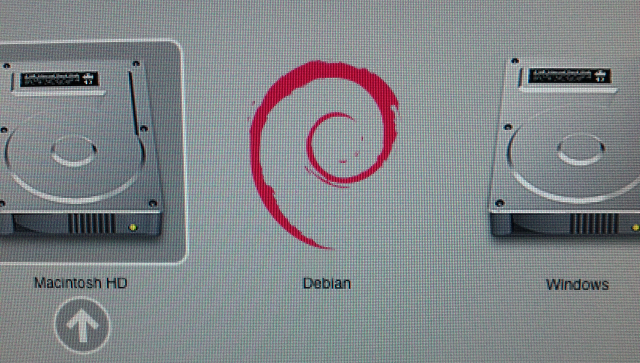
Diego s post got me to switch from grub-pc to grub-efi to boot Debian on my Macbook Pro. But I wanted to go further: getting rid of rEFIt. rEFIt is a pretty useful piece of software, but it s essentially dead. There is the rEFInd fork, which keeps it up-to-date, but it doesn t really help with FileVault. Moreover, the boot sequence for a Linux distro with rEFIt/rEFInd looks like: Apple EFI firmware rEFIt/rEFInd GRUB Linux kernel. Each intermediate step adding its own timeout, so rEFIt/rEFInd can be seen as not-so-useful intermediate step. Thankfully, Matthew Garrett did all the research to allow to directly boot GRUB from the Apple EFI firmware. Unfortunately, his blog post didn t have much actual detail on how to do it. So here it is, for a Debian system: Now, the Apple Boot Manager, shown when holding down the option key when booting the Macbook Pro, looks like this:
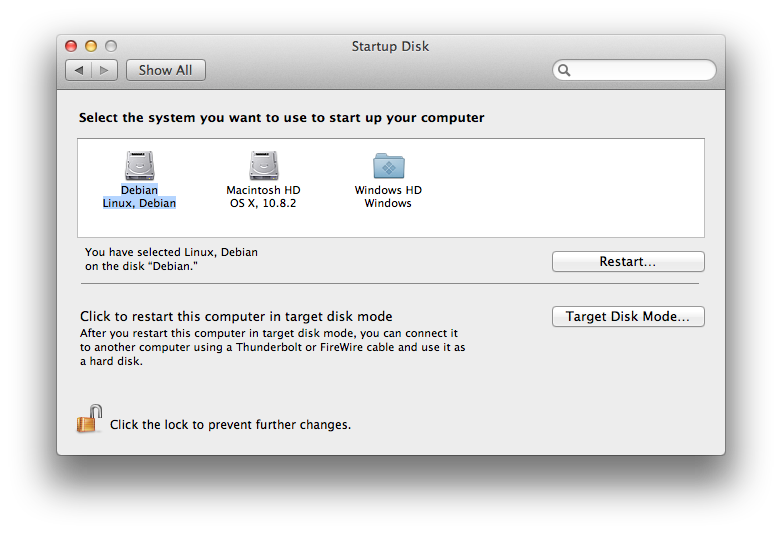
And the Startup disk preferences dialog under OSX, like this:

15 November 2012

Matthew Garrett: More in the series of bizarre UEFI bugs

A (well, now former) coworker let me know about a problem he was having with a Lenovo Thinkcentre M92p. It booted Fedora UEFI install media fine, but after an apparently successful installation refused to boot. UEFI installs on Windows worked perfectly. Secure Boot was quickly ruled out, but this could still have been a number of things. The most interesting observation was that the Fedora boot option didn't appear in the firmware boot menu at all, but Windows did. We spent a little while comparing the variable contents, gradually ruling out potential issues - Linux was writing an entry that had an extra 6 bytes in a structure, for instance[1], and a sufficiently paranoid firmware implementation may have been tripping up on that. Fixing that didn't help, though. Finally we tried just taking the Windows entry and changing the descriptive string. And it broke.

Every UEFI boot entry has a descriptive string. This is used by the firmware when it's presenting a menu to users - instead of "Hard drive 0" and "USB drive 3", the firmware can list "Windows Boot Manager" and "Fedora Linux". There's no reason at all for the firmware to be parsing these strings. But the evidence seemed pretty strong - given two identical boot entries, one saying "Windows Boot Manager" and one not, only the first would work. At this point I downloaded a copy of the firmware and started poking at it. Turns out that yes, actually, there is a function that compares the descriptive string against "Windows Boot Manager" and appears to return an error if it doesn't match. What's stranger is that it also checks for "Red Hat Enterprise Linux" and lets that one work as well.

This is, obviously, bizarre. A vendor appears to have actually written additional code to check whether an OS claims to be Windows before it'll let it boot. Someone then presumably tested booting RHEL on it and discovered that it didn't work. Rather than take out that check, they then addded another check to let RHEL boot as well. We haven't yet verified whether this is an absolute string match or whether a prefix of "Red Hat Enterprise Linux" is sufficient, and further examination of the code may reveal further workarounds. For now, if you want to run Fedora[2] on these systems you're probably best off changing the firmware to perform a legacy boot.

[1] src/include/efi.h: uint8_t padding[6]; /* Emperically needed */, says the efibootmgr source code. Unhelpful.
[2] Or Ubuntu, or Suse, or

comment count unavailable comments

13 November 2012

Matthew Garrett: VMware are as bad as Microsoft

Everything here applies to this as well. Thanks, VMware. In Microsoft's case it turned out that nothing was using that value and it could be replaced without breaking things. With luck that's true here as well.

comment count unavailable comments

9 November 2012

Matthew Garrett: Last day at Red Hat

After four and a half years at Red Hat, I'm about to take the three weeks of holiday I've built up and am then heading off to Nebula at the beginning of December. I'm still planning on being active in UEFI and Secure Boot development, and don't expect anything to change in terms of my Fedora involvement. It's been a fun time here, so just imagine that I'm writing something about exciting future challenges while I go back to saying goodbye to people.

comment count unavailable comments

7 November 2012

Russell Coker: Rape Apology and LCA 2011

After a lecture at LCA 2011 included some inappropriate slides there was a long discussion on several mailing lists about the issues related to this. In February 2011 I wrote a blog post debunking some of the bogus arguments in question [1]. Of course the matter didn t end there, at LCA 2012 I was drawn into a few debates IRL about the issues, as long as there are more than a few men who want such porny pictures used in LCA talks the issue can t be properly resolved. The most serious aspect of the discussion in question is that of rape apology, the bad ideas that were presented have a real impact on the way people behave, merely making public statements saying that something is OK is going to increase the incidence of it happening. The Geek Feminism Wiki has a good page summarising the issue [2]. The Finally Feminism 101 post about Rape Culture is also worth reading in this context [3]. Recently Valeria Aurora wrote a post for the Ada Initiaive blog about the rape apology issue and how the community needs to act to prevent such behavior [4]. This inspired Matthew Garrett to write about the issue and state the position that In the absence of an apology and explanation from Ted, I ll be interacting with him to the bare minimum that I m compelled to as a result of my job [5]. I agree with Matthew s article, everything he writes is logical and I believe that it is all for the benefit of the FOSS community as a whole. I think that most guys have quietly defriended guys who are rape-positive in the past (for example when I was 12 I refused to play D&D with boys who were raping NPCs). But blogging about it, explaining the problem, and giving the offender the possibility to reform is a good idea and it s something that should be done more often. Sam Varghese has written about the issue for ITWire [6]. He has taken the wrong approach to this, he specifically claims that Matthew Garrett has kicked off what could be a damaging episode . I think that Matthew s approach is necessary and the situation demands it. If Matthew had been on holidays and I had read the TAI post earlier then I would probably have written a blog post which Sam could have described in a similar manner. So I don t think that Matthew kicked anything off (I think that someone had to do it). I also don t think that this has to be damaging it depends on how everyone reacts. On her personal blog Valerie says When I first read Ts o s comments, I couldn t sleep for two nights. I wanted to throw up every time I thought about it. I was furious and frightened at the same time. Every time I think about this, even now, I literally have nightmares. I can t bear the thought of working with him even over email, much less attending the same conferences [7]. I don t think that any of us who are seriously involved in the FOSS community have a way of avoiding this issue, allowing Valerie and other women who have the same understanding of the situation to go through that without any support is not a neutral action. I think we need to consider whether someone who gives other delegates and speakers nightmares should be welcome to attend a conference. Valerie s post makes sense to me and I can understand why she doesn t want to associated with Ted, my understanding of the issue isn t important or even required, I merely note this because I m sure that there are lots of readers who will ignore anything that a woman might say. ITWire has a follow-up article with Ted s response, Ted fails to address all the issues and seems to think that the people who disagree with him merely don t appreciate his nuance [8]. The thing is that the issue of the incidence of rape was raised in discussion to consider the probability that rape survivors would have been in the audience for the Mark Pesce talk in question. None of Ted s claims indicate that rape could be rare enough that a crowd of 500+ random people could be expected not to have multiple rape survivors so his comments weren t even relevant to the discussion. Ted seems unwilling to try to understand the position of all the people who disagree with him.

30 October 2012

Matthew Garrett: A detailed technical description of Shim

Shim is the first stage bootloader we've been implementing for supporting Secure Boot. It's called Shim because it serves as an object to fit the gap between the Microsoft trust root and our own trust root. As originally envisaged it would do nothing other than load and execute appropriately signed binaries, but it's got a little more complicated than that now. It is, however, basically feature complete at this point - I don't expect it to grow significantly further.

(For those of you following along at home, the Shim source code I'm talking about is here)

First, it checks whether the user has disabled local signature verification in check_mok_sb(). This is done by reading the MokSBState UEFI variable and verifying that it has the correct variable attributes, ensuring that it was created in the trusted boot services environment. If so, and if it's set appropriately, signature verification is disabled for the rest of Shim. Shim then pauses for a couple of seconds while displaying a message indicating that it's running in insecure mode.

Next, Shim checks whether the user has set any variables that indicate that a Mok request has been made in check_mok_request(). If so, it launches MokManager. The mechanism by which this is done is described later.

Shim then copies the Mok key database into a runtime variable, which makes it accessible to the kernel (mirror_mok_list()). The kernel can then use the Mok keys when performing module signature verification. Next, as the last step before launching the next stage bootloader, Shim installs a UEFI protocol that permits other applications to call back into Shim. We're now ready to branch off from Shim into the actual bootloader.

To do this, Shim has to do a few things. First, we need to get the bootloader off disk. This involves finding Shim's path, which we can do by opening the loaded image protocol on Shim's image handle, turning that into a string, walking backwards along it until we find a directory separator, stripping the filename and appending the path to the second stage bootloader. This is then turned back into a binary device path, all of this happening in generate_path(). The binary is then read off disk in load_image(), using the simple filesystem protocol. We open the device, open a reference to the file, check how large the file is, allocate a buffer to hold the file and then read it off disk into that buffer. Everything so far has been fairly straightforward, but now things get more complicated.

handle_image() is the real meat of Shim. First it has to examine the header data in read_header(), copying the relevant bits into a context structure that will be used later. Some basic sanity checks on the binary are also performed here. If we're running in secure mode (ie, Secure Boot is enabled and we haven't been toggled into insecure mode) we then need to verify that the binary matches the signature and hasn't been blacklisted.

verify_buffer() has to implement the Microsoft Authenticode specification, which details which sections of the binary have to be hashed and in which order. The actual hashing is done in generate_hash(), which calls into the crypto code to add each binary section to the hashed data. The comments in generate_hash() describe what's going on there clearly enough. The crypto code itself is a copy of the crypto library extracted from the Tiano source tree. It's a relatively thin layer on top of OpenSSL, so the code's been fairly well tested.

Once we have the hash, we need to verify the signature. First, we ensure that the Mok database hasn't been modified from the OS (verify_mok()). Next, we check whether the binary's hash or signature have been blacklisted (check_blacklist()). This is done for each of the SHA1 and SHA256 hashes of the binary (the two hashes implemented in Tiano) and the certificate. If any of these match an entry in the dbx variable or a built-in blacklist, Shim will refuse to run them. Next, we simply do the same for the whitelist. If the binary's hash is either in the db variable or the Mok list, or if it's signed with a certificate that chains back to an entry in either db or the Mok list, we'll run it. Finally, the signature is checked against any built-in keys. Certificate verification is carried out with the AuthenticodeVerify() function, which again comes from Tiano's crypto library and is mostly implemented in OpenSSL.

If the binary passed signature validation we return to handle_image() and now load the binary's sections into their desired addresses. That buffer is handed to relocate_coff() which runs through the binary's relocation entries and fixes them up. There's one last subtlety, which is that because we've been fixing this up by hand, the image handle still refers to the shim binary. We fix the ImageBase and ImageSize values in the loaded image protocol to match the newly relocated binary, which is vital because otherwise grub is unable to find its built in modules. Finally, we jump into the binary's entry point. What the binary does next is up to it - if it's a bootloader, there's a good chance that it'll simply launch an OS and we'll never return. If it does return, we restore ImageBase and ImageSize, uninstall the protocol we installed and exit ourselves. If Shim exits (either because the second stage bootloader wasn't present, didn't verify, or exited) then control will simply pass on to the next boot option in the UEFI priority list. If there's nothing else, the platform will do something platform defined.

And that's how Shim works.

comment count unavailable comments

Matthew Garrett: An overview of our Secure Boot implementation

I've written rather a lot about how we're implementing our Secure Boot support, but there's been a range of subtle changes over time. Here's an overview of how it all fits together.Secure Boot and signingSecure Boot is part of the UEFI specification. When enabled, systems will refuse to boot any UEFI executables (such as an OS bootloader) unless they've been signed by a trusted key. The only trusted key effectively guaranteed to be present is Microsoft's, and Microsoft will sign binaries if you have access to the Windows hardware dev center. You gain access to this by purchasing a certificate from Verisign that verifies your identity and then use that to create a developer account at the Sysdev website. Once you've agreed to the legal contracts, you can submit a UEFI executable and Microsoft will then send you back a signed one. The signature is added to the end of the binary, so it's trivial to verify that your executable hasn't otherwise been modified in the process.
Avoiding signing round tripsWe didn't want to have to get binaries re-signed every time we updated our bootloader or kernel, so we came up with a compromise approach. We implemented a shim bootloader (cunningly called "Shim") which is signed by Microsoft and includes a copy of a public key that's under our control. Shim will launch any binary signed with either a key installed in the system firmware or the public key built into it. This allows us to build and sign all other binaries ourselves.
Preventing Secure Boot circumventionSecure Boot is intended to prevent scenarios where untrusted code can be run before an OS kernel. Locking down the boot environment avoids the simple case of using a modified bootloader, and requiring that the kernel also be signed avoids simply booting arbitrary attack code that looks roughly like a kernel but does nothing to prevent the more complex case of using a running kernel to launch another kernel. To do that we've had to restrict the behaviour of the kernel in Secure Boot environments. Direct hardware access from userspace has been blocked, and modules must be signed by a key the kernel trusts.
Providing user control over trustMicrosoft requires that it be possible to modify the key database on all Windows-certified x86 systems, but the UI to do so may be inconsistent and awkward. Suse developed a plan to avoid this, involving adding an additional key database to the system. The user enrols a key from the running OS and enters a password. On the next reboot, shim detects that a key is awaiting enrolment and drops to a prompt. If the user does nothing or just hits enter, the system continues to boot. If the user chooses to enrol a new key, the user is asked to re-enter the password in order to confirm that they're the same user that initiated the original request. If successful, the key is then copied into a boot services variable which cannot be directly modified from the OS. Anything signed with the user's key will then be trusted.
Providing user control over signature verificationSome users (such as kernel developers) may be hampered by Secure Boot - forcing them to sign every new kernel they build is time consuming and unhelpful. Windows-certified x86 hardware will be required to provide an option to disable Secure Boot, but again that UI may be inconsistent. We've added an option where a user can generate a request to disable signature validation, again requiring a password. On next boot the user must explicitly choose the "Toggle signature validation" menu item and will then be requested to enter three randomly chosen characters from their password. After confirmation, signature validation in Shim will then be disabled.
Supporting other distributionsNot all distributions will want (or be able) to sign via Microsoft. They'll be able to take any other signed version of Shim and put it on their boot media. If their second stage bootloader is signed by a key that Shim doesn't trust, Shim will pop up a menu permitting the user to choose to enrol a new key off the install media. The user can select this, navigate a file browser and select the key. After confirmation, the key will be added to Shim's trusted key list. The user can then install the distribution.
Third party modulesThere's two approaches here. The first is for the third party to provide a module key that the user can install into Shim's database. The kernel will import this at boot time and trust any modules signed with it. The second is for the third party to provide a key signed by Microsoft. David Howells has come up with with the idea of utilising this approach of embedding a public key in a pe binary, with the kernel then having support for importing this key, noticing that it's signed by a trusted key and adding it to the kernel keyring.
How about ARM?We're not planning on supporting Secure Boot on ARM, for two reasons. The first is that Microsoft require that it be impossible to disable Secure Boot on ARM, and we don't want to support systems unless it's guaranteed that the user will be able to run what they want. The second is that there's no strong expectation that the signing key used for signing third party UEFI binaries will be present on ARM systems.
What are other distributions doing?As far as I know, Suse and Fedora will be shipping the same code. Ubuntu is shipping an older version of Shim but should pick up the local key management code in the next release. The only significant difference is that Ubuntu doesn't require that kernel modules be signed.

comment count unavailable comments

Matthew Garrett: Getting started with UEFI development

It's not difficult to write a UEFI application under Linux. You'll need three things:


So, let's write a trivial UEFI application. Here's one from the gnu-efi source tree:
#include <efi.h>
#include <efilib.h>
EFI_STATUS
efi_main (EFI_HANDLE image, EFI_SYSTEM_TABLE *systab)
 
        SIMPLE_TEXT_OUTPUT_INTERFACE *conout;
        conout = systab->ConOut;
        InitializeLib(image, systab);
        uefi_call_wrapper(conout->OutputString, 2, conout, L"Hello World!\n\r");
        return EFI_SUCCESS;
 
The includes are fairly obvious. efi.h gives you UEFI functions defined by the specification, and efilib.h gives you functions provided by gnu-efi. The runtime will call efi_main() rather than main(), so that's our main function. It returns an EFI_STATUS which will in turn be returned to whatever executed the binary. The EFI_HANDLE image is a pointer to the firmware's context for this application, which is used in certain calls. The EFI_SYSTEM_TABLE *systab is a pointer to the UEFI system table, which in turn points to various other tables.

So far so simple. Now things get interesting. The heart of the UEFI programming model is a set of protocols that provide interfaces. Each of these interfaces is typically a table of function pointers. In this case, we're going to use the simple text protocol to print some text. First, we get a pointer to the simple text output table. This is always referenced from the system table, so we can simply assign it. InitializeLib() just initialises some internal gnu-efi functions - it's not technically required if we're purely calling native UEFI functions as we are here, but it's good style since forgetting it results in weird crashes.

Anyway. We now have conout, a pointer to a SIMPLE_TEXT_OUTPUT_INTERFACE structure. This is described in section 11.4 of the UEFI spec, but looks like this:
typedef struct _EFI_SIMPLE_TEXT_OUTPUT_PROTOCOL  
    EFI_TEXT_RESET Reset;
    EFI_TEXT_STRING OutputString;
    EFI_TEXT_TEST_STRING TestString;
    EFI_TEXT_QUERY_MODE QueryMode;
    EFI_TEXT_SET_MODE SetMode;
    EFI_TEXT_SET_ATTRIBUTE SetAttribute;
    EFI_TEXT_CLEAR_SCREEN ClearScreen;
    EFI_TEXT_SET_CURSOR_POSITION SetCursorPosition;
    EFI_TEXT_ENABLE_CURSOR EnableCursor;
    SIMPLE_TEXT_OUTPUT_MODE *Mode;
  EFI_SIMPLE_TEXT_OUTPUT_PROTOCOL;
The majority of these are functions - the only exception is the SIMPLE_TEXT_OUTPUT_MODE pointer, which points to the current mode. In an ideal world you'd be able to just call these directly, but sadly UEFI and Linux calling conventions are different and we need some thunking. That's where the uefi_call_function() call comes in. This takes a UEFI function as its first argument (in this case, conout->OutputString), the number of arguments (2, in this case) and then the arguments. Checking the spec for OutputString, we see this:
typedef
EFI_STATUS
(EFIAPI *EFI_TEXT_STRING) (
    IN EFI_SIMPLE_TEXT_OUTPUT_PROTOCOL *This,
    IN CHAR16 *String
);
The first argument is a pointer to the specific instance of the simple text output protocol. This permits multiple instances of the same protocol to exist on a single machine, without having to duplicate all of the code. The second argument is simply a UCS-2 string. Our conout pointer is a pointer to the protocol, so we pass that as the first argument. For the second argument, we pass L"Hello World!\n", with the L indicating that this is a wide string rather than a simple 8-bit string. uefi_call_function() then rearranges these arguments into the appropriate calling convention and calls the UEFI function. The firmware then prints "Hello World!" on the screen. Success.

(Warning: uefi_call_function() does no type checking on its arguments, so if you pass in a struct instead of a pointer it'll build without complaint and then give you a bizarre error at runtime)

Finally, we clean up by simply returning EFI_SUCCESS. Nothing more for us to worry about. That's the simple case. What about a more complicated one? Let's do something with that EFI_HANDLE that got passed into efi_main().
#include <efi.h>
#include <efilib.h>
EFI_STATUS
efi_main (EFI_HANDLE image, EFI_SYSTEM_TABLE *systab)
 
        EFI_LOADED_IMAGE *loaded_image = NULL;
        EFI_GUID loaded_image_protocol = LOADED_IMAGE_PROTOCOL;
        EFI_STATUS status;
        InitializeLib(image, systab);
        status = uefi_call_wrapper(systab->BootServices->HandleProtocol,
                                3,
                                image, 
                                &loaded_image_protocol, 
                                (void **) &loaded_image);
        if (EFI_ERROR(status))  
                Print(L"handleprotocol: %r\n", status);
         
        Print(L"Image base        : %lx\n", loaded_image->ImageBase);
        Print(L"Image size        : %lx\n", loaded_image->ImageSize);
        Print(L"Image file        : %s\n", DevicePathToStr(loaded_image->FilePath));
        return EFI_SUCCESS;
 
UEFI handles can have multiple protocols attached to them. A handle may represent a piece of physical hardware, or (as in this case) it can represent a software object. In this case we're going to get a pointer to the loaded image protocol that's associated with the binary we're running. To do this we call the HandleProtocol() function from the Boot Services table. Boot services are documented in section 6 of the UEFI specification and are the interface to the majority of UEFI functionality. HandleProtocol takes an image and a protocol identifier, and hands back a pointer to the protocol. UEFI protocol identifiers are all GUIDs and defined in the specification. If you call HandleProtocol on a handle that doesn't implement the protocol you request, you'll simply get an error back in the status argument. No big deal.

The loaded image protocol is fairly different to the simple text output protocol in that it's almost entirely data rather than function pointers. In this case we're printing the address that our executable was loaded at and the size of our relocated executable. Finally, we print the path of the file. UEFI device paths are documented in section 9.2 of the UEFI specification. They're a binary representation of a file path, which may include the path of the device that the file is on. DevicePathToStr is a gnu-efi helper function that converts the objects it understands into a textual representation. It doesn't cover the full set of specified UEFI device types, so in some corner cases it may print "Unknown()".

That covers how to use protocols attached to the image handle. How about protocols that are attached to other handles? In that case we can do something like this:
#include <efi.h>
#include <efilib.h>
EFI_STATUS
efi_main (EFI_HANDLE image_handle, EFI_SYSTEM_TABLE *systab)
 
        EFI_STATUS status;
        EFI_GRAPHICS_OUTPUT_PROTOCOL *gop;
        EFI_GUID gop_guid = EFI_GRAPHICS_OUTPUT_PROTOCOL_GUID;
        InitializeLib(image_handle, systab);
        status = uefi_call_wrapper(systab->BootServices->LocateProtocol,
                                   3,
                                   &gop_guid,
                                   NULL,
                                   &gop);
        Print(L"Framebuffer base is at %lx\n", gop->Mode->FrameBufferBase);
        return EFI_SUCCESS;
 
This will find the first (where first is an arbitrary platform ordering) instance of a protocol and return a pointer to it. If there may be multiple instances of a protocol (as there often are with the graphics output protocol) you should use LocateHandleBuffer() instead. This returns an array of handles that implement the protocol you asked for - you can then use HandleProtocol() to give you the instance on the specific handle. There's various helpers in gnu-efi like LibLocateHandle() that make these boilerplate tasks easier. You can find the full list in /usr/include/efi/efilib.h.

That's a very brief outline of how to use basic UEFI functionality. The spec documents the full set of UEFI functions available to you, including things like direct block access, filesystems and networking. The process is much the same in all cases - you locate the handle that you want to interact with, open the protocol that's installed on it and then make calls using that protocol.Building these examplesBuilding these examples is made awkward due to UEFI wanting PE-COFF binaries and Linux toolchains building ELF binaries. You'll want a makefile something like this:
ARCH            = $(shell uname -m   sed s,i[3456789]86,ia32,)
LIB_PATH        = /usr/lib64
EFI_INCLUDE     = /usr/include/efi
EFI_INCLUDES    = -nostdinc -I$(EFI_INCLUDE) -I$(EFI_INCLUDE)/$(ARCH) -I$(EFI_INCLUDE)/protocol
EFI_PATH        = /usr/lib64/gnuefi
EFI_CRT_OBJS    = $(EFI_PATH)/crt0-efi-$(ARCH).o
EFI_LDS         = $(EFI_PATH)/elf_$(ARCH)_efi.lds
CFLAGS          = -fno-stack-protector -fpic -fshort-wchar -mno-red-zone $(EFI_INCLUDES)
ifeq ($(ARCH),x86_64)
        CFLAGS  += -DEFI_FUNCTION_WRAPPER
endif
LDFLAGS         = -nostdlib -znocombreloc -T $(EFI_LDS) -shared -Bsymbolic -L$(EFI_PATH) -L$(LIB_PATH) \
                  $(EFI_CRT_OBJS) -lefi -lgnuefi
TARGET  = test.efi
OBJS    = test.o
SOURCES = test.c
all: $(TARGET)
test.so: $(OBJS)
       $(LD) -o $@ $(LDFLAGS) $^ $(EFI_LIBS)
%.efi: %.so
        objcopy -j .text -j .sdata -j .data \
                -j .dynamic -j .dynsym  -j .rel \
                -j .rela -j .reloc -j .eh_frame \
                --target=efi-app-$(ARCH) $^ $@
There's rather a lot going on here, but the important stuff is the CFLAGS line and everything after that. First, we need to disable the stack protection code - there's nothing in the EFI runtime for it to call into, so we'll build a binary with unresolved symbols otherwise. Second, we need to build position independent code, since UEFI may relocate us anywhere. short-wchar is needed to indicate that strings like L"Hi!" should be 16 bits per character, rather than gcc's default of 32 bits per character. no-red-zone tells the compiler not to assume that there's 256 bytes of stack available to it. Without this, the firmware may modify stack that the binary was depending on.

The linker arguments are less interesting. We simply tell it not to link against the standard libraries, not to merge relocation sections, and to link in the gnu-efi runtime code. Nothing very exciting. What's more interesting is that we build a shared library. The reasoning here is that we want to perform all our linking, but we don't want to build an executable - the Linux executable runtime code would be completely pointless in a UEFI binary. Once we have our .so file, we use objcopy to pull out the various sections and rebuild them into a PE-COFF binary that UEFI will execute.

comment count unavailable comments

29 October 2012

Matthew Garrett: Ted Ts'o is a rape apologist and why this matters

(This post contains some discussion of rape and sexual assault but does not go into any specifics)

There was a brief controversy at Linux.conf.au back in 2011. The final keynote speaker gave a compelling presentation on online privacy, including some slides containing sexualised imagery. This was against the terms of the conference policies, and resulted in an apology from the conference organisers and the speaker. The situation was unfortunate but well handled, and that should have been the end of it.

Afterwards, there was some pushback on the conference mailing list. Concerns were raised about the policy being overly restrictive and the potential for it to be used to stifle speech that influential groups disagreed with. I don't agree with these arguments, but discussion of why policies have been implemented is completely natural and provides an opportunity for a community to determine what its expected standards are.

And then Ted Ts'o effectively called rape victims liars[1]. At first I assumed that this was just some sort of horrific failure to understand the implications of what he was saying, so I emailed him to check. The reply I got drew a pretty clear distinction between the case of a drunk college student raping another drunk college student in their room and the case of knifepoint rape in a dark park. You know, the difference between accidental rape and rape rape. The difference between the one any of us might have done and the one that only bad people do. Legitimate rape and the "rape" that those feminists talk about. The distinction that lets rapists convince themselves that they didn't really rape anyone because they weren't holding a knife at the time.

Ted Ts'o argues that only a small percentage of rape really counts as what people think of as rape. Ted Ts'o is a rape apologist.

There's an ongoing scandal in the UK at the moment. A well known DJ, Jimmy Savile, died last year. He grew up in a working class family, but through hard work and natural talent was one of the most significant figures in promoting pop music in the UK in the 50s and 60s, and worked in various parts of the BBC for the best part of 30 years. He spent significant amounts of time raising money for charity, and it's estimated that he raised over 40 million for various causes. Since his death, around 300 people have accused him of sexually abusing them. The BBC is desperately trying to explain why it cancelled an expose shortly before it aired. Multiple people who worked there at the time claim that everyone knew he was involved in indecent activities, but saying anything would risk both their career and the charities that depended on his fundraising. Nobody said anything, and he was allegedly free to continue his abuse.

Ted Ts'o is a significant figure in the Linux kernel community. He has expressed abhorrent beliefs that damage that community. Condemnation was limited to a mailing list with limited readership, meaning, effectively, that nobody said anything. Last week the Ada Initiative published a blog post pointing out the damage that did, and I realised that my effective silence was not only helping to alienate 50% of the population from involving themselves with Linux, it was also implicitly supporting my community leadership. I was giving the impression that I was basically fine with our community leaders telling people that it wasn't really rape if you were both drunk enough. I was increasing the chances of members of our community being sexually assaulted. Silence is endorsement. Saying nothing is not ok.

In the absence of an apology and explanation from Ted, I'll be interacting with him to the bare minimum that I'm compelled to as a result of my job. I won't be attending any Linux Foundation events he's involved in organising. If I'm running any events, I won't be inviting him. At a time when we're finally making progress in making our community more open and supportive, we don't need leaders who undermine that work. Support organisations who encourage that progress, not the people who help drag us back.

Footnotes

[1]The original archive has vanished. I've put up a copy of the relevant thread here. Throughout, Ted states that he's actually arguing against the idea that women need to be frightened of sexual assault, and not against the definition of rape. Except saying things like This one does a pretty good job of taking apart the Koss / Ms. Magazine study, which is the source for the "1 in 4" number. For example, it points out that over half of those cases were ones where undergraduates were plied with alcohol, and did not otherwise involve using physical force or other forms of coercion is difficult to read in any way other than "Half of the people you're counting as having been raped haven't really been raped", and favourably referring to an article that asserts that the rate of false rape reports is probably close to 50% is pretty strong support for the idea that many rape victims are liars.

(Update 2012/10/30: Adam Williamson suggests in this comment that this mail is a better example of Ted's behaviour - there's some explicit victim blaming and a lot of "Is that rape" questioning with the obvious implication that the answer should be "no". Ted Ts'o is a victim blaming rape apologist.)

(Update 2012/11/05: It's been suggested that I haven't been sufficiently clear about which of Ted's statements justify my claims. So, here we go.

In this mail, Ted links to and endorses this article. He explicitly links to it because of its treatment of rape statistics. Quoting directly from that article:
the rate of false reports is at least 9 percent and probably closer to 50 percent
Ted explicitly endorses an article that claims that a significant percentage of reported rapes are false. The study that generated that figure is held in poor regard by other researchers in the field - Australian police figures indicate that 2.1% of rape accusations were classified as false. Ted asserts that he was trying to argue against poor use of statistics, so it's a fair assumption that he agrees with the alternative statistics that he's citing. Ted believes that many rape victims are making false accusations. Ted believes that many rape victims are liars.

Again in this mail, Ted argues against a claimed figure that 1 in 4 women have been sexually assaulted. One of his arguments is that Also found in the Koss study, although not widely reported, was the statistic that of the women whom she classified as being raped (although 73% refused to self-classify the event as rape), 46% of them had subsequent sex with the reported assailant. Ted disagrees with a statistic because some rape victims subsequently have sex with the reported assailant. This means that Ted believes that this indicates that they were not really raped. Ted is a rape apologist.)

comment count unavailable comments

28 October 2012

Steve Langasek: SecureBoot in Ubuntu 12.10

The 12.10 release is the first version of Ubuntu that supports Secure Boot out of the box. In what is largely an accident of release timing, from what I can tell (and please correct me if I'm wrong), this actually makes Ubuntu 12.10 the first general release of any OS to support Secure Boot. (Windows 8 of course is also now available; and I'm sure Matthew Garrett, who has been a welcome collaborator throughout this process, has everything in good order for the upcoming Fedora 18 release.) That's certainly something of a bittersweet achievement. I'm proud of the work we've done to ensure Ubuntu will continue to work out of the box on the consumer hardware of the future; in spite of the predictable accusations on the blogowebs that we've sold out, I sleep well at night knowing that this was the pragmatic decision to make, maximizing users' freedom to use their hardware. All the same, I worry about what the landscape is going to look like in a few years' time. The Ubuntu first-stage EFI bootloader is signed by Microsoft, but the key that is used for signing is one that's recommended by Microsoft, not one that's required by the Windows 8 certification requirements. Will all hardware include this key in practice? The Windows 8 requirements also say that every machine must allow the user to disable Secure Boot. Will manufacturers get this right, and will users be able to make use of it in the event the manufacture didn't include the Microsoft-recommended key? Only time will tell. But I do think the Linux community is going to have to remain engaged on this for some time to come, and possibly hold OEMs' feet to the fire for shipping hardware that will only work with Windows 8. But that's for the future. For now, we have a technical solution in 12.10 that solves the parts of the problem that we can solve. This first release gives us preliminary support for booting on Secure Boot, but there's more work to be done to provide a full solution that's sustainable over the long term. We'll be discussing some of that this week at UDS in Copenhagen. And as part of our committment to enabling new hardware on the current LTS release, we will be backporting this work for inclusion in 12.04.2. It remains to be decided how Debian will approach the Secure Boot question. At DebConf 12, many people seemed to consider it a foregone conclusion that Debian would never agree to include binaries in main signed by third-party keys. I don't think that should be a given; I think allowing third-party signatures in main for hardware compatibility is consistent with Debian's principles, and refusing to make Debian compatible with this hardware out of the box does nothing to advance user freedom. I hope to see frank discussion post-wheezy about keeping Debian relevant on consumer hardware of the future.

26 October 2012

Matthew Palmer: The e-mail PDA

I ve been a wannabe GTD afficionado for some years. I ve wanted to do it, but managing lists has always been something that has too much friction, overhead, or whatever. Finally, though, I think I might have found a way to manage lists that works. My use-case isn t unique, although I will concede I m perhaps being more dogmatic than most. I want something that: My previous attempt was a tool I called tagnote it was a vim-outliner file full of hierarchically organised outliner entries, with tags inlined. It was a neat idea, but it wasn t smooth to add/browse/delete items, and didn t work with my phone at all (trying to use vim for any length of time on a bottom-of-the-range Android phone would kill me). The current iteration, as the title of this post suggests, is a list manager that entirely uses e-mail. It really is a perfect symbiosis: So what have I got, exactly? It s fairly straightforward: That last point is the one I m really happy I achieved. I ve always been a fan of hide it until you need it , but my previous system didn t let me do that. Now, though, I have a separate list called tickler, and all the items in there have an X-Tickle header, which specifies the date I want to see them. Each night a cronjob runs through the tickler and moves anything for today into the INBOX. An X-Tickle-Repeat header lets me have things that repeat over and over again. So in short, using entirely open-source tools and a couple of hours of my time doing things I enjoy anyway (shell scripts! woo!), I ve now got a list manager that doesn t get in my way more than it absolutely has to. We ll see how long I last this time before I feel the urge to improve my lists again.

17 October 2012

Matthew Garrett: Disabling Secure Boot signature validation

One of the benefits of the Shim approach of bridging trust between the Microsoft key and our own keys is that we can define whatever trust policy we want. Some of the feedback we've received has indicated that people really do want the ability to disable signature validation without having to go through the firmware. The problem is in ensuring that this can't be done either accidentally or via trivial social engineering.

We've come up with one possible solution for this. A tool run at the OS level generates a random password and hashes it. This hash is appended to the desired secure boot state and stored in an EFI variable. On reboot, Shim notices that this variable is set and drops to a menu. The user then selects "Change signature enforcement" and types the same password again. The system is then rebooted and Shim now skips the signature validation.

This approach avoids automated attacks - if malware sets this variable, the user will have no idea which password is required. Any social engineering attack would involve a roughly equivalent number of steps to disabling Secure Boot in the firmware UI, so it's not really any more attractive than just doing that. We're fairly confident that this meets everyone's expectations of security, but also guarantees that people who want to run arbitrary kernels and bootloaders can do so.

comment count unavailable comments

Next.

Previous.