Search Results: "matrix"

28 November 2010

Dirk Eddelbuettel: Rcpp 0.8.9

A new release 0.8.9 of Rcpp is now available at CRAN and has just been uploaded to Debian. As always, sources are also available from my local directory here. This release comes a few weeks after the preceding 0.8.8 release and continues with a number of enhancements mostly to what we call Rcpp modules, our even-easier C++/R integration which follow some ideas from Boost.Python. Our corresponding Rcpp-modules vignette has been updated too. The NEWS entry follows below:
0.8.9   2010-11-27
    o   Many improvements were made to in 'Rcpp modules':
        - exposing multiple constructors
        - overloaded methods
        - self-documentation of classes, methods, constructors, fields and 
          functions.
        - new R function "populate" to facilitate working with modules in 
          packages. 
        - formal argument specification of functions.
        - updated support for Rcpp.package.skeleton.
        - constructors can now take many more arguments.
        
    o   The 'Rcpp-modules' vignette was updated as well and describe many
        of the new features
    o   New template class Rcpp::SubMatrix<rtype> and support syntax in Matrix
        to extract a submatrix: 
        
           NumericMatrix x = ... ;
        
           // extract the first three columns
           SubMatrix<realsxp> y = x( _ , Range(0,2) ) ; 
        
           // extract the first three rows
           SubMatrix<realsxp> y = x( Range(0,2), _ ) ; 
        
           // extract the top 3x3 sub matrix
           SubMatrix<realsxp> y = x( Range(0,2), Range(0,2) ) ; 
    o   Reference Classes no longer require a default constructor for
        subclasses of C++ classes    
    o   Consistently revert to using backticks rather than shell expansion
        to compute library file location when building packages against Rcpp
        on the default platforms; this has been applied to internal test
        packages as well as CRAN/BioC packages using Rcpp
Thanks to CRANberries, there is also a diff to the previous release 0.8.8: As always, even fuller details are on the Rcpp Changelog page and the Rcpp page which also leads to the downloads, the browseable doxygen docs and zip files of doxygen output for the standard formats. A local directory has source and documentation too. Questions, comments etc should go to the rcpp-devel mailing list off the R-Forge page

12 November 2010

Dirk Eddelbuettel: RcppArmadillo 0.2.9

The new version 0.2.9 of RcppArmadillo has been uploaded to CRAN. The only change is an update of the included Armadillo template library to version 0.9.92 which Conrad released this week. RcppArmadillo makes it easy to write highly efficient and highly readable C++ code for linear algebra (based on Armadillo) in R extensions (using Rcpp for the interface). The short NEWS file extract follows, also containing Conrad's entry for 0.9.92::
0.2.9   2010-11-11
    o   Upgraded to Armadillo 0.9.92 "Wall Street Gangster":
         * Fixes for compilation issues under the Intel C++ compiler
         * Added matrix norms
More information is on the RcppArmadillo page. Questions, comments etc should go to the rcpp-devel mailing list off the R-Forge page.

3 November 2010

Dirk Eddelbuettel: Rcpp 0.8.8

A bug-fix release 0.8.8 of Rcpp is now available. It is awaiting processing at CRAN, and will be uploaded to Debian once processed at CRAN. In the meantime, sources are available from my local directory here. This release follows on the heels of 0.8.7, but contains fixes for a few small things Romain and I had noticed over the last two weeks since releasing 0.8.7 and contains only a small number of new tweaks. The NEWS entry follows below:
0.8.8   2010-11-01
    o   New syntactic shortcut to extract rows and columns of a Matrix. 
        x(i,_) extracts the i-th row and x(_,i) extracts the i-th column. 
    
    o   Matrix indexing is more efficient. However, faster indexing is
        disabled if g++ 4.5.0 or later is used.
    o   A few new Rcpp operators such as cumsum, operator=(sugar)
    o   Variety of bug fixes:
        - column indexing was incorrect in some cases
        - compilation using clang/llvm (thanks to Karl Millar for the patch)
        - instantation order of Module corrected
        - POSIXct, POSIXt now correctly ordered for R 2.12.0 
As always, even fuller details are on the Rcpp Changelog page and the Rcpp page which also leads to the downloads, the browseable doxygen docs and zip files of doxygen output for the standard formats. A local directory has source and documentation too. Questions, comments etc should go to the rcpp-devel mailing list off the R-Forge page

4 October 2010

Dirk Eddelbuettel: More BLAS, BLASter, BLAStest: Updates on gcbd

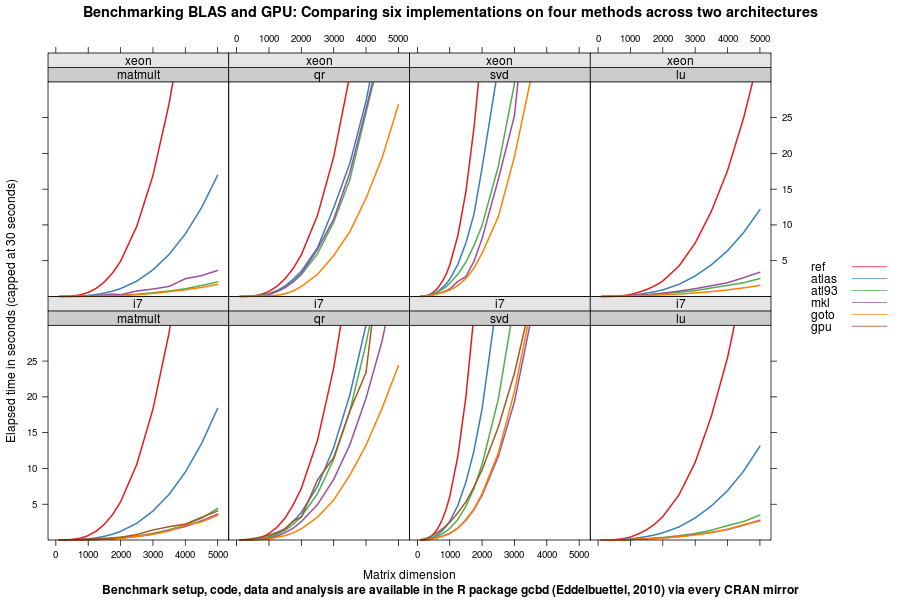
Following up on my initial post announcing gcbd, here is a brief note on a new version. The initial post announced version 0.2.2 which was the first CRAN version of gcbd. I updated to 0.2.3 when I made the aforementioned first blog post about gcbd with the lattice plot of the BLAS and GPU benchmark results across six different implementations (from reference BLAS to two Atlas versions, Goto, MKL and a GPU-based one). There is now a new version 0.2.4 of gcbd on CRAN. I revised the paper ever so slightly based on some more feedback, and focussed the results sections by concentrating on just the log-axes lattice blot and the corresponding lattice plot of raw results---where the y-axis is capped at 30 seconds: GPU/CPU Benchmark Results in levels This chart--in levels rather than using logarithmic axes is done here--nicely illustrates just how large the performance difference can be for for matrix multiplication and LU decomposition. QR and SVD are closer but accelerated BLAS libraries still win. GPUs can be compelling for some tasks and large sizes. More discussion is still available in the paper which is also included in the gcbd package for R.

16 September 2010

Dirk Eddelbuettel: BLAS, BLASter, BLAStest: Some benchmark results, and a benchmarking framework

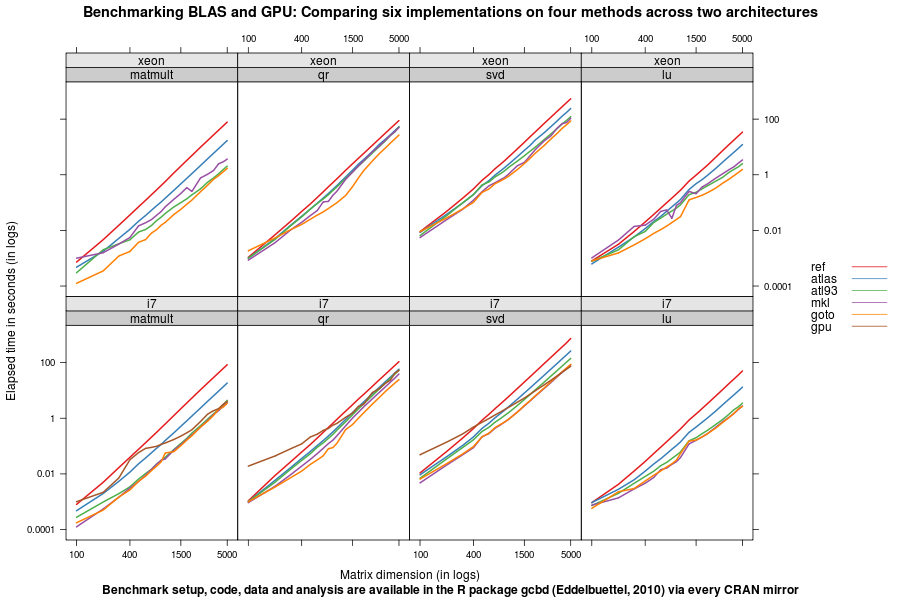
Usage of accelerated BLAS libraries seems to shrouded in some mystery, judging from somewhat regularly recurring requests for help on lists such as r-sig-hpc (gmane version), the R list dedicated to High-Performance Computing. Yet it doesn't have to be; installation can be really simple (on appropriate systems). Another issue that I felt needed addressing was a comparison between the different alternatives available, quite possibly including GPU computing. So a few weeks ago I sat down and wrote a small package to run, collect, analyse and visualize some benchmarks. That package, called gcbd (more about the name below) is now on CRAN as of this morning. The package both facilitates the data collection for the paper it also contains (in the vignette form common among R packages) and provides code to analyse the data---which is also included as a SQLite database. All this is done in the Debian and Ubuntu context by transparently installing and removing suitable packages providing BLAS implementations: that we can fully automate data collection over several competing implementations via a single script (which is also included). Contributions of benchmark results is encouraged---that is the idea of the package. The paper itself describes the background and technical details before presenting the results. The benchmark compares the basic reference BLAS, Atlas (both single- and multithreaded), Goto, Intel MKL and a GPU-based approach. This blog post is not the place to recap all results, so please do see the paper for more details. But one summary chart regrouping the main results fits well here: GPU/CPU Benchmark Results This chart, in a log/log form, shows how reference BLAS lags everything, how multithreaded newer Atlas improves over the standard Atlas package currently still the default in both distros, how the Intel MKL (available via Ubuntu) is fairly good but how Goto wins almost everything. GPU computing is compelling for really large sizes (at double precision) and too costly at small ones. It also illustrates variability and different computational cost across the methods tested: svd is more expensive than level-3 matrix multiplication, and the different implementations are less spread apart. More details are in the paper; code, data etc are in the package gcbd. The larger context is to do something like this benchmarking exercise, but across distributions, operating systems and possibly also GPU cards. Mark and I started to talk about this during and after R/Finance earlier this year and have some ideas. Time permitting, that work should be happening in the GPU/CPU Benchmarks (gdb) project, and that's why this got called gcbd as a simpler GPU/CPU Benchmarks on Debian Systems study.

13 September 2010

Dirk Eddelbuettel: RcppArmadillo 0.2.6

Now that Rcpp got updated to 0.8.6, we have an updated RcppArmadillo release containing mostly updates to Conrad's Armadillo version 0.9.70 as well as some more templated sugar magic. RcppArmadillo makes it easy to write highly efficient and highly readable C++ code for linear algebra (based on Armadillo) in R extensions (using Rcpp for the interface). The short NEWS file extract follows:
0.2.6   2010-09-12
    o   Upgraded to Armadillo 0.9.70 "Subtropical Winter Safari"
    
    o   arma::Mat, arma::Row and arma::Col get constructor that take vector
        or matrix sugar expressions. See the unit test "test.armadillo.sugar.ctor" 
        and "test.armadillo.sugar.matrix.ctor" for examples.
More information is on the RcppArmadillo page. Questions, comments etc should go to the rcpp-devel mailing list off the R-Forge page.

29 July 2010

Dirk Eddelbuettel: RcppArmadillo 0.2.4

A new release of RcppArmadillo is now on CRAN. RcppArmadillo makes it easy to write highly efficient and highly readable C++ code for linear algebra (based on Armadillo) in R extensions (using Rcpp for the interface). This release upgrades the included Armadillo version to 0.9.52 (see here for Conrad's high-level changes). We had to make two minor tweaks. In the fastLm() help page example we switched from inv() to pinv()</tt)> The short NEWS file extract follows:
0.2.4   2010-07-27
    o   Upgraded to Armadillo 0.9.52 'Monkey Wrench'
    o   src/fastLm.cpp: Switch from inv() to pinv() as inv() now tests for
        singular matrices and warns and returns an empty matrix which stops
        the example fastLm() implementation on the manual page -- and while
        this is generally reasonably it makes sense here to continue which
        the Moore-Penrose pseudo-inverse allows us to do this
More information is on the RcppArmadillo page. Questions, comments etc should go to the rcpp-devel mailing list off the R-Forge page.

16 July 2010

Dirk Eddelbuettel: Rcpp 0.8.4

Romain and I wrapped up release 0.8.4 of Rcpp last Friday. However, given the time of year, it only appeared on CRAN this morning, and then only after some prodding as CRAN processing is more or less closed this week and probably next. This release builds upon release 0.8.3. Highlights include changes to the sugar framework for highly expressive C++ constructs which gained new vector function as well as a first set of matrix function. As well, unit tests have been reorganised in such a way that we end up with a lot fewer compilations (but of several files at once) which reaps significant speed gains. Date calculation now use the same mktime() function R itself uses (and which comes from Arthur Olson's tzone library). The NEWS entry follows below:
0.8.4   2010-07-09
    o   new sugar vector functions: rep, rep_len, rep_each, rev, head, tail,
        diag
        
    o   sugar has been extended to matrices: The Matrix class now extends the 
        Matrix_Base template that implements CRTP. Currently sugar functions 
        for matrices are: outer, col, row, lower_tri, upper_tri, diag
    o   The unit tests have been reorganised into fewer files with one call
        each to cxxfunction() (covering multiple tests) resulting in a
        significant speedup
    o   The Date class now uses the same mktime() replacement that R uses
        (based on original code from the timezone library by Arthur Olson)
        permitting wide dates ranges on all operating systems
    o   The FastLM example has been updated, a new benchmark based on the
        historical Longley data set has been added
    o   RcppStringVector now uses std::vector<std::string> internally
    
    o   setting the .Data slot of S4 objects did not work properly
As always, even fuller details are in Rcpp Changelog page and the Rcpp page which also leads to the downloads, the browseable doxygen docs and zip files of doxygen output for the standard formats. A local directory has source and documentation too. Questions, comments etc should go to the rcpp-devel mailing list off the R-Forge page

20 June 2010

Craig Small: Helping Free Software: Translations

Well the latest version of PSmisc is almost finished, so I pushed the tar archive up to the spot for the translators, waiting for the updates before it gets released.

It reminded me that perhaps a lot of people don't know how their programs get translated. Perhaps there are some that could even contribute. The nice thing about the translation systems is that you don't need to know programming to help.

PSmisc uses the translation project as its method. The program itself uses gettext for the translation part which makes a single text file called a POT file. A translator takes this text file and makes a po file, such as it.po for the Italian translation and then translates, which basically means editing the file, reading each first line of a set and writing the translation on the second line.

For the programmer, once it is setup it is pretty simple to use, just mark your translatable lines and follow some simple rules, mainly about not embedding too much in a string. I've used this system for years for quite a few of my programs and there is little added work for me.

Unfortunately, translating is hard work and should be a long-term commitment. Having a look at the translation project's Translation Matrix and you can see that some languages do suffer, though there are some very good results there too. Particular kudos goes to the Vietnamese group which I think is just Clytie who does a marvellous job and is often the first translation file I get.

For the Debian project, there are many places where translations can occur. There doesn't seem to be a centralised place for this, but some of the places they use translation work are:

<script defer="defer" src="http://static.zemanta.com/readside/loader.js" type="text/javascript"></script>

10 June 2010

Dirk Eddelbuettel: RcppArmadillo 0.2.2

Following the Rcpp 0.8.1 release we made yesterday, we released RcppArmadillo release 0.2.2 this morning. RcppArmadillo uses Rcpp (and some 'glue' code) to provide a transparent interface from R to Conrad Sanderson's impressive Armadillo library for linear algebra. This release works well with the most recent inline release 0.3.5. One can now employ inlined R code as we generalized how/which headers are included and how library / linking information is added thanks a plugin mechanism. This is the first RcppArmadillo version to provide such a plugin, We also updated the included Armadillo headers to its most recent release 0.9.10, added some more operators and provide a utility function RcppArmadillo:::CxxFlags() to provide include directory information on the fly. An example of the direct inline approach for the fastLm function:
library(inline)
library(RcppArmadillo)
src <- '
	Rcpp::NumericVector yr(ys);			// creates Rcpp vector from SEXP
	Rcpp::NumericMatrix Xr(Xs);			// creates Rcpp matrix from SEXP
	int n = Xr.nrow(), k = Xr.ncol();

	arma::mat X(Xr.begin(), n, k, false);   	// reuses memory and avoids extra copy
	arma::colvec y(yr.begin(), yr.size(), false);

	arma::colvec coef = arma::solve(X, y);      	// fit model y ~ X
	arma::colvec res = y - X*coef;			// residuals

	double s2 = std::inner_product(res.begin(), res.end(), res.begin(), double())/(n - k);
							// std.errors of coefficients
	arma::colvec std_err = arma::sqrt(s2 * arma::diagvec( arma::inv(arma::trans(X)*X) ));

	return Rcpp::List::create(Rcpp::Named("coefficients") = coef,
				  Rcpp::Named("stderr")       = std_err,
				  Rcpp::Named("df")           = n - k
				  );
'
fun <- cxxfunction(signature(ys="numeric", Xs="numeric"), src, plugin="RcppArmadillo")
This creates a compiled function fun which, by using Armadillo, regresses a vector ys on a matrix Xs (just how the fastLmPure() function in the package does) --- yet is constructed on the fly using cxxfunction from inline. More information is on the RcppArmadillo page. Questions, comments etc should go to the rcpp-devel mailing list off the R-Forge page.

27 May 2010

Matt Zimmerman: Rethinking the Ubuntu Developer Summit

This is a repost from the ubuntu-devel mailing list, where there is probably some discussion happening by now. After each UDS, the organizers evaluate the event and consider how it could be further improved in the future. As a result of this process, the format of UDS has evolved considerably, as it has grown from a smallish informal gathering to a highly structured matrix of hundreds of 45-to-60-minute sessions with sophisticated audiovisual facilities. If you participated in UDS 10.10 (locally or online), you have hopefully already completed the online survey, which is an important part of this evaluation process. A survey can t tell the whole story, though, so I would also like to start a more free-form discussion here among Ubuntu developers as well. I have some thoughts I d like to share, and I m interested in your perspectives as well. Purpose The core purpose of UDS has always been to help Ubuntu developers to explore, refine and share their plans for the subsequent release. It has expanded over the years to include all kinds of contributors, not only developers, but the principle remains the same. We arrive at UDS with goals, desires and ideas, and leave with a plan of action which guides our work for the rest of the cycle. The status quo UDS looks like this: This screenshot is only 1600 1200, so there are another 5 columns off the right edge of the screen for a total of 18 rooms. With 7 time slots per day over 5 days, there are over 500 blocks in the schedule grid. 9 tracks are scattered over the grid. We produce hundreds of blueprints representing projects we would like to work on. It is an impressive achievement to pull this event together every six months, and the organizers work very hard at it. We accomplish a great deal at every UDS, and should feel good about that. We must also constantly evaluate how well it is working, and make adjustments to accommodate growth and change in the project. How did we get here? (this is all from memory, but it should be sufficiently accurate to have this discussion) In the beginning, before it was even called UDS, we worked from a rough agenda, adding items as they came up, and ticking them off as we finished talking about them. Ad hoc methods worked pretty well at this scale. As the event grew, and we held more and more discussions in parallel, it was hard to keep track of who was where, and we started to run into contention. Ubuntu and Launchpad were planning their upcoming work together at the same time. One group would be discussing topic A, and find that they needed the participation of person X, who was already involved in another discussion on topic B. The A group would either block, or go ahead without the benefit of person X, neither of which was seen to be very effective. By the end of the week, everyone was mentally and physically exhausted, and many were ill. As a result, we decided to adopt a schedule grid, and ensure that nobody was expected to be in two places at once. Our productivity depended on getting precisely the right people face to face to tackle the technical challenges we faced. This meant deciding in advance who should be present in each session, and laying out the schedule to satisfy these constraints. New sessions were being added all the time, so the UDS organizers would stay up late at night during the event, creating the schedule grid for the next day. In the morning, over breakfast, everyone would tell them about errors, and request revisions to the schedule. Revisions to the schedule were painful, because we had to re-check all of the constraints by hand. So, in the geek spirit, we developed a program which would read in the constraints and generate an error-free schedule. The UDS organizers ran this at the end of each day during the event, checked it over, and posted it. In the morning, over breakfast, everyone would tell them about constraints they hadn t been aware of, and request revisions to the schedule. Revisions to the schedule were painful, because a single changed constraint would completely rearrange the schedule. People found themselves running all over the place to different rooms throughout the day, as they were scheduled into many different meetings back-to-back. At around this point, UDS had become too big, and had too many constraints, to plan on the fly (unconference style). We resolved to plan more in advance, and agree on the scheduling constraints ahead of time. We divided the event into tracks, and placed each track in its own room. Most participants could stay in one place throughout the day, taking part in a series of related meetings except where they were specifically needed in an adjacent track. We created the schedule through a combination of manual and automatic methods, so that scheduling constraints could be checked quickly, but a human could decide how to resolve conflicts. There was time to review the schedule before the start of the event, to identify and fix problems. Revisions to the schedule during the event were fewer and less painful. We added keynote presentations, to provide opportunities to communicate important information to everyone, and ease back into meetings after lunch. Everyone was still exhausted and/or ill, and tiredness took its toll on the quality of discussion, particularly toward the end of the week. Concerns were raised that people weren t participating enough, and might stay on in the same room passively when they might be better able to contribute to a different session happening elsewhere. As a result, the schedule was randomly rearranged so that related sessions would not be held in the same room, and everyone would get up and move at the end of each hour. This brings us roughly to where things stand today. Problems with the status quo
  1. UDS is big and complex. Creating and maintaining the schedule is a lot of work in itself, and this large format requires a large venue, which in turn requires more planning and logistical work (not to mention cost). This is only worthwhile if we get proportionally more benefit out of the event itself.
  2. UDS produces many more blueprints than we need for a cycle. While some of these represent an explicit decision not to pursue a project, most of them are set aside simply because we can t fit them in. We have the capacity to implement over 100 blueprints per cycle, but we have *thousands* of blueprints registered today. We finished less than half of the blueprints we registered for 10.04. This means that we re spending a lot of time at UDS talking about things which can t get done that cycle (and may never get done).
  3. UDS is (still) exhausting. While we should work hard, and a level of intensity helps to energize us, I think it s a bit too much. Sessions later in the week are substantially more sluggish than early on, and don t get the full benefit of the minds we ve brought together. I believe that such an intense format does not suit the type of work being done at the event, which should be more creative and energetic.
  4. The format of UDS is optimized for short discussions (as many as we can fit into the grid). This is good for many technical decisions, but does not lend itself as well to generating new ideas, deeply exploring a topic, building broad consensus or tackling big picture issues facing the project. These deeper problems sometimes require more time. They also benefit tremendously from face-to-face interaction, so UDS is our best opportunity to work on them, and we should take advantage of it.
  5. UDS sessions aim for the minimum level of participation necessary, so that we can carry on many sessions in parallel: we ask, who do we need in order to discuss this topic? This is appropriate for many meetings. However, some would benefit greatly from broader participation, especially from multiple teams. We don t always know in advance where a transformative idea will come from, and having more points of view represented would be valuable for many UDS topics.
  6. UDS only happens once per cycle, but design and planning need to continue throughout the cycle. We can t design everything up front, and there is a lot of information we don t have at the beginning. We should aim to use our time at UDS to greatest effect, but also make time to continue this work during the development cycle. design a little, build a little, test a little, fly a little
Proposals
  1. Concentrate on the projects we can complete in the upcoming cycle. If we aren t going to have time to implement something until the next cycle, the blueprint can usually be deferred to the next cycle as well. By producing only moderately more blueprints than we need, we can reduce the complexity of the event, avoid waste, prepare better, and put most of our energy into the blueprints we intend to use in the near future.
  2. Group related sessions into clusters, and work on them together, with a similar group of people. By switching context less often, we can more easily stay engaged, get less fatigued, and make meaningful connections between related topics.
  3. Organize for cross-team participation, rather than dividing teams into tracks. A given session may relate to a Desktop Edition feature, but depends on contributions from more than just the Desktop Team. There is a lot of design going on at UDS outside of the Design track. By working together to achieve common goals, we can more easily anticipate problems, benefit from diverse points of view, and help each other more throughout the cycle.
  4. Build in opportunities to work on deeper problems, during longer blocks of time. As a platform, Ubuntu exists within a complex ecosystem, and we need to spend time together understanding where we are and where we are going. As a project, we have grown rapidly, and need to regularly evaluate how we are working and how we can improve. This means considering more than just blueprints, and sometimes taking more than an hour to cover a topic.

20 May 2010

Dirk Eddelbuettel: RcppArmadillo 0.2.0 (and 0.2.1)

With the Rcpp 0.8.0 release on Monday, Romain, Doug and I were able to follow-up with a new RcppArmadillo release. RcppArmadillo uses Rcpp (and a few dozen lines of 'glue') to provide a transparent interface from R to Conrad Sanderson's impressive Armadillo library for linear algebra. This new release offers a number of key improvements: While we had tested this quite rigourously, the combination of some last minute changes that were meant to be stylistic-only, some troubles with the tests and builds at CRAN that were not apparent in all our tests (hint: do not yet use dynamic help features referencing other packages even if you have a Depends: on them) and an upcoming travel deadline meant that we missed a gotcha on Windows---so release 0.2.1 had to follow a few hours after the short-lived 0.2.0. More information is on the RcppArmadillo page. Questions, comments etc should go to the rcpp-devel mailing list off the R-Forge page.

17 May 2010

Dirk Eddelbuettel: Rcpp 0.8.0

Romain and I are happy to announce the release of Rcpp version 0.8.0. It has been uploaded to CRAN. A Debian upload is delayed until the now-required inline package is accepted into Debian. The source package is also available from here. This release brings a number of changes that are detailed below. Of particular interest may be the much more robust treatment of exceptions, the new classes for data frames and formulae, and the availability of the new helper function cppfunction for use with inline. Also of note is the new support for the 'LinkingTo' directive with which packages using Rcpp will get automatic access to the header files. An announcement email went to the r-packages list (ETH Zuerich, Gmane); Romain also blogged about the release. The full NEWS entry for this release follows below:
0.8.0   2010-05-17
    o   All Rcpp headers have been moved to the inst/include directory,
	allowing use of 'LinkingTo: Rcpp'. But the Makevars and Makevars.win
	are still needed to link against the user library.
    o   Automatic exception forwarding has been withdrawn because of
	portability issues (as it did not work on the Windows platform).
	Exception forwarding is still possible but is now based on explicit
	code of the form:
	
	  try  
	    // user code
	    catch( std::exception& __ex__)  
	    forward_exception_to_r( __ex___ ) ;
	   
	
	Alternatively, the macro BEGIN_RCPP and END_RCPP can use used to enclose
	code so that it captures exceptions and forward them to R. 
	
	  BEGIN_RCPP
	  // user code
	  END_RCPP
	
    o   new __experimental__ macros 
	
	The macros RCPP_FUNCTION_0, ..., RCPP_FUNCTION_65 to help creating C++
	functions hiding some code repetition: 
	
	  RCPP_FUNCTION_2( int, foobar, int x, int y) 
	    return x + y ;
	   
	The first argument is the output type, the second argument is the 
	name of the function, and the other arguments are arguments of the C++ 
	function. Behind the scenes, the RCPP_FUNCTION_2 macro creates 
	an intermediate function compatible with the .Call interface and handles 
	exceptions
	
	Similarly, the macros RCPP_FUNCTION_VOID_0, ..., RCPP_FUNCTION_VOID_65 
	can be used when the C++ function to create returns void. The generated
	R function will return R_NilValue in this case.
	
	  RCPP_FUNCTION_VOID_2( foobar, std::string foo ) 
	    // do something with foo
	   
	  
	The macro RCPP_XP_FIELD_GET generates a .Call compatible function that
	can be used to access the value of a field of a class handled by an 
	external pointer. For example with a class like this: 
	
	  class Foo 
		public:
			int bar ;
	   
	
	  RCPP_XP_FIELD_GET( Foo_bar_get, Foo, bar ) ;
	  
	RCPP_XP_FIELD_GET will generate the .Call compatible function called
	Foo_bar_get that can be used to retrieved the value of bar.
	
	
	The macro RCPP_FIELD_SET generates a .Call compatible function that 
	can be used to set the value of a field. For example:
	
	  RCPP_XP_FIELD_SET( Foo_bar_set, Foo, bar ) ;
	
	generates the .Call compatible function called "Foo_bar_set" that 
	can be used to set the value of bar
	
	
	The macro RCPP_XP_FIELD generates both getter and setter. For example
	
	  RCPP_XP_FIELD( Foo_bar, Foo, bar )
	  
	generates the .Call compatible Foo_bar_get and Foo_bar_set using the 
	macros RCPP_XP_FIELD_GET and RCPP_XP_FIELD_SET previously described
	
	  
	The macros RCPP_XP_METHOD_0, ..., RCPP_XP_METHOD_65 faciliate 
	calling a method of an object that is stored in an external pointer. For 
	example: 
	
	  RCPP_XP_METHOD_0( foobar, std::vector<int> , size )
	
	creates the .Call compatible function called foobar that calls the
	size method of the std::vector<int> class. This uses the Rcpp::XPtr<
	std::vector<int> > class.
	
	The macros RCPP_XP_METHOD_CAST_0, ... is similar but the result of
	the method called is first passed to another function before being
	wrapped to a SEXP.  For example, if one wanted the result as a double
	
	   RCPP_XP_METHOD_CAST_0( foobar, std::vector<int> , size, double )
	
	The macros RCPP_XP_METHOD_VOID_0, ... are used when calling the
	method is only used for its side effect.
	
	  RCPP_XP_METHOD_VOID_1( foobar, std::vector<int>, push_back ) 
	
	Assuming xp is an external pointer to a std::vector<int>, this could
	be called like this :
	
	  .Call( "foobar", xp, 2L )
	
    o	Rcpp now depends on inline (>= 0.3.4)
	
    o   A new R function "cppfunction" was added which invokes cfunction from
	inline with focus on Rcpp usage (enforcing .Call, adding the Rcpp
	namespace, set up exception forwarding). cppfunction uses BEGIN_RCPP
	and END_RCPP macros to enclose the user code
    o	new class Rcpp::Formula to help building formulae in C++
    
    o   new class Rcpp::DataFrame to help building data frames in C++
	
    o   Rcpp.package.skeleton gains an argument "example_code" and can now be
	used with an empty list, so that only the skeleton is generated. It
	has also been reworked to show how to use LinkingTo: Rcpp
	
    o   wrap now supports containers of the following types: long, long double,
	unsigned long, short and unsigned short which are silently converted
	to the most acceptable R type.
	
    o	Revert to not double-quote protecting the path on Windows as this
	breaks backticks expansion used n Makevars.win etc
        
    o   Exceptions classes have been moved out of Rcpp classes,
	e.g. Rcpp::RObject::not_a_matrix is now Rcpp::not_a_matrix
As always, even fuller details are in Rcpp Changelog page and the Rcpp page which also leads to the downloads, the browseable doxygen docs and zip files of doxygen output for the standard formats. A local directory has source and documentation too. Questions, comments etc should go to the rcpp-devel mailing list off the R-Forge page

27 March 2010

Dirk Eddelbuettel: Rcpp 0.7.11

A new versions 0.7.11 of Rcpp is awaiting inclusion into CRAN and Debian. It is also available from here. This version fixes a somewhat serious bug uncovered by Doug Bates when working with vectors of strings. We also added a few new accessor functions as well as a new convenience function create that is particularly useful for creating (possibly named) list objects that are returned to R. Here is the full NEWS entry for this release:
0.7.11	2010-03-26
    o	Vector
 gains a set of templated factory methods "create" which
        takes up to 20 arguments and can create named or unnamed vectors.
        This greatly facilitates creating objects that are returned to R. 
    o	Matrix now has a diag() method to create diagonal matrices, and
        a new constructor using a single int to create square matrices
    o	Vector now has a new fill() method to propagate a single value
	
    o	Named is no more a class but a templated function. Both interfaces
        Named(.,.) and Named(.)=. are preserved, and extended to work also on 
        simple vectors (through Vector
::create) 
	
    o	Applied patch by Alistair Gee to make ColDatum more robust
    
    o	Fixed a bug in Vector that caused random behavior due to the lack of
        copy constructor in the Vector template
As always, even fuller details are in Rcpp Changelog page and the Rcpp page which also leads to the downloads, the browseable doxygen docs and zip files of doxygen output for the standard formats. A local directory has source and documentation too. Questions, comments etc should go to the rcpp-devel mailing list off the R-Forge page

12 March 2010

Dirk Eddelbuettel: RcppArmadillo 0.1.0

Besides the new RcppExamples, another new package RcppArmadillo got spun out of Rcpp with the recent release 0.7.8 of Rcpp. Romain and I already had an example of a simple but fast linear model fit using the (very clever) Armadillo C++ library by Conrad Sanderson. In fact, I had used this as a motivational example of why Rcpp rocks in a recent talk to the ACM chapter at U of Chicago which, thanks to David Smith at REvo, got some further exposure. Now this example is more refined as further glue got added. Given that both Armadillo and Rcpp make use of C++ templates, the actual amount of code in RcppArmadillo is not that large: just over 200 lines in a header file, and a little less for some testing accessor and example functions in a source file. And this makes for some really nice example code: the 'fast regression' example becomes this (where I simply removed two blocks with conditional on the Armadillo version):
#include <RcppArmadillo.h>
extern "C" SEXP fastLm(SEXP ys, SEXP Xs)  
    Rcpp::NumericVector yr(ys);			// creates Rcpp vector from SEXP
    Rcpp::NumericMatrix Xr(Xs);			// creates Rcpp matrix from SEXP
    int n = Xr.nrow(), k = Xr.ncol();
    arma::mat X(Xr.begin(), n, k, false);   	// reuses memory and avoids extra copy
    arma::colvec y(yr.begin(), yr.size(), false);
    arma::colvec coef = solve(X, y);            // fit model y ~ X
    arma::colvec resid = y - X*coef; 		// residuals
    double sig2 = arma::as_scalar( trans(resid)*resid/(n-k) );
    						// std.error of estimate
    arma::colvec stderrest = sqrt( sig2 * diagvec( arma::inv(arma::trans(X)*X)) );
    Rcpp::Pairlist res(Rcpp::Named( "coefficients", coef),
                       Rcpp::Named( "stderr", stderrest));
    return res;
 
No extra copies! Armadillo instantiates directly from the underlying R objects for the vector and matrix, solves the regression equations, computes the standard error of the estimates and returns the two vectors. Leaving us to write about eleven lines of code. Moreover, as Armadillo is well designed and uses template meta-programming to avoid extra copies (see these lecture notes for details), it is about as efficient as it can be (and will use Atlas or other BLAS where available). And, this is just one example. Rcpp should be suitable for other C++ libraries, and provides an easy to use seamless interface between C++ and R. However, we should note that (at about the last minute) we found out about some unit test failures in OS X as well as some issues in a Debian chroot -- cran2deb ran into some build issues on i386 and amd64 in the testing chroot even this 'it all works' swimmingly on our Debian, Ubuntu and Fedora build environments. A follow-up with fixes for either Rcpp and/or RcppArmadillo appears likely.

Update: The build issues seems to be with 64-bit systems and everything appears cool in 32-bit.

10 March 2010

Dirk Eddelbuettel: Rcpp 0.7.8

Version 0.7.8 of the Rcpp R / C++ interface classes is now on CRAN and in Debian. As of right now. Debian has already built packages for eight more architectures; and CRAN has built the Windows binary. Oh, and cran2deb had Debian packages for 'testing' before I was done with the blog entry. This is a minor feature release based on a over three weeks of changes that are summarised below in the extract from the NEWS file. Some noteworthy highlights are The full NEWS entry for this release follows:
0.7.8   2010-03-09
    o	All vector classes are now generated from the same template class
    	Rcpp::Vector<int rtype="RTYPE"> where RTYPE is one of LGLSXP, RAWSXP, STRSXP,
    	INTSXP, REALSXP, CPLXSXP, VECSXP and EXPRSXP. typedef are still 
    	available : IntegerVector, ... All vector classes gain methods 
    	inspired from the std::vector template : push_back, push_front, 
    	erase, insert
    	
    o	New template class Rcpp::Matrix<rtype> deriving from 
    	Rcpp::Vector<rtype>. These classes have the same functionality
    	as Vector but have a different set of constructors which checks
    	that the input SEXP is a matrix. Matrix<rtype> however does/can not
    	guarantee that the object will allways be a matrix. typedef 
    	are defined for convenience: Matrix<intsxp> is IntegerMatrix, etc...
    	
    o	New class Rcpp::Row<int rtype="RTYPE"> that represents a row of a matrix
    	of the same type. Row contains a reference to the underlying 
    	Vector and exposes a nested iterator type that allows use of 
    	STL algorithms on each element of a matrix row. The Vector class
    	gains a row(int) method that returns a Row instance. Usage 
    	examples are available in the runit.Row.R unit test file
    	
    o	New class Rcpp::Column<int rtype="RTYPE"> that represents a column of a 
    	matrix. (similar to Rcpp::Row<int rtype="RTYPE">). Usage examples are 
    	available in the runit.Column.R unit test file
    o	The Rcpp::as template function has been reworked to be more 
    	generic. It now handles more STL containers, such as deque and 
    	list, and the genericity can be used to implement as for more
    	types. The package RcppArmadillo has examples of this
    o   new template class Rcpp::fixed_call that can be used in STL algorithms
	such as std::generate.
    o	RcppExample et al have been moved to a new package RcppExamples;
        src/Makevars and src/Makevars.win simplified accordingly
    o	New class Rcpp::StringTransformer and helper function 
    	Rcpp::make_string_transformer that can be used to create a function
    	that transforms a string character by character. For example
    	Rcpp::make_string_transformer(tolower) transforms each character
    	using tolower. The RcppExamples package has an example of this.
        
    o	Improved src/Makevars.win thanks to Brian Ripley
    o	New examples for 'fast lm' using compiled code: 
        - using GNU GSL and a C interface
        - using Armadillo (http://arma.sf.net) and a C++ interface
        Armadillo is seen as faster for lack of extra copying
    o	A new package RcppArmadillo (to be released shortly) now serves 
        as a concrete example on how to extend Rcpp to work with a modern 
	C++ library such as the heavily-templated Armadillo library
    o	Added a new vignette 'Rcpp-introduction' based on a just-submitted 
        overview article on Rcpp
As always, even fuller details are in the ChangeLog on the Rcpp page which also leads to the downloads, the browseable doxygen docs and zip files of doxygen output for the standard formats. A local directory has source and documentation too. Questions, comments etc should go to the rcpp-devel mailing list off the R-Forge page

Update: Two links corrected.

3 February 2010

Enrico Zini: Cropping images with GDAL

Cropping images with GDAL I am working to get a better integration between Meteosatlib and GDAL. A nice aspect of GDAL is that it allows to create read/write drivers around two functions: Open and CreateCopy. Open opens a datset read only, and to implement that all you have to do is to implement read access to your data using the GDALDataset interface. To implement CreateCopy, all you have to do is to create a new file reading information from a GDALDataset; then call Open on it. This means that there is no need to support incremental updates, and that all the data required to create a new file is readily available. This simplifies matters a lot. GDAL provides some interesting image manipulation functions, that can work over just these two calls. The way it does it is by exploiting the concept of a virtual dataset, which wraps an existing dataset but changes some parameters on the fly. This means that you can wrap a read only dataset with a virtual dataset that transforms it somehow, and then pass the virtual dataset to CreateCopy to save the transformed image in a format of your choice. On top of that, for many transformations you do not need to create your own virtual datasets, but you can use the functions provided by the VRT GDAL driver. One can learn a lot on how to use VRTDataset by reading the source code for gdal_translate. By doing that I could come up with this code for cropping an image, which is an interesting VRTDataset example.
GDALDataset* crop(GDALDataset* poDS, int xoff, int yoff, int xsize, int ysize)
 
        VRTDataset *poVDS = (VRTDataset*)VRTCreate(xsize, ysize);
        // Copy dataset info
        const char* pszProjection = poDS->GetProjectionRef();
        if (pszProjection != NULL && strlen(pszProjection) > 0)
                poVDS->SetProjection(pszProjection);
        double adfGeoTransform[6];
        if (poDS->GetGeoTransform(adfGeoTransform) == CE_None)
         
                // Adapt the geotransform matrix to the subarea
                adfGeoTransform[0] += xoff * adfGeoTransform[1]
                        + yoff * adfGeoTransform[2];
                adfGeoTransform[3] += xoff * adfGeoTransform[4]
                        + yoff * adfGeoTransform[5];
                poVDS->SetGeoTransform(adfGeoTransform);
         
        poVDS->SetMetadata(poDS->GetMetadata());
        // Here I also copy metadata from my own domain
        char **papszMD;
        papszMD = poDS->GetMetadata(MD_DOMAIN_MSAT);
        if (papszMD != NULL)
                poVDS->SetMetadata(papszMD, MD_DOMAIN_MSAT);
        for (int i = 0; i < poDS->GetRasterCount(); ++i)
         
                GDALRasterBand* poSrcBand = poDS->GetRasterBand(i + 1);
                GDALDataType eBandType = poSrcBand->GetRasterDataType();
                poVDS->AddBand(eBandType, NULL);
                VRTSourcedRasterBand* poVRTBand = (VRTSourcedRasterBand*)poVDS->GetRasterBand(i + 1);
                poVRTBand->AddSimpleSource(poSrcBand,
                                xoff, yoff,
                                xsize, ysize,
                                0, 0, xsize, ysize);
                poVRTBand->CopyCommonInfoFrom(poSrcBand);
                // Again, I copy my own metadata
                papszMD = poSrcBand->GetMetadata(MD_DOMAIN_MSAT);
                if (papszMD != NULL)
                        poVRTBand->SetMetadata(papszMD, MD_DOMAIN_MSAT);
         
        return poVDS;
 
This function wraps a dataset with a virtual dataset that crops it. Just pass the resulting dataset to GDALCreateCopy to save it in the format that you need.

1 February 2010

Dirk Eddelbuettel: Rcpp 0.7.4

Yesterday, and about nine days after release 0.7.3 of Rcpp (a set of R / C++ interface classes), Romain and I released version 0.7.4. It has been uploaded to CRAN and Debian, and mirrors should already have new versions. As before, my local page is also available for downloads and some more details. The release once again combines a number of necessary fixes with numerous new features: Post-release, I also reworked the doxygen setup slightly so that all examples are now browseable, and the whole documentation is now searchable as well. Lastly, we had a remaining Windows build issue. Also, Brian Ripley and Uwe Ligges kindly sent us a small patch supporting the new Windows 64-bit builds using the new MinGW 64-bit compiler for Windows -- so release 0.7.5 may follow in due course. The NEWS file entry for release 0.7.4 is as follows:
0.7.4	2010-01-30
    o	matrix matrix-like indexing using operator() for all vector 
    	types : IntegerVector, NumericVector, RawVector, CharacterVector
    	LogicalVector, GenericVector and ExpressionVector. 
    o	new class Rcpp::Dimension to support creation of vectors with 
    	dimensions. All vector classes gain a constructor taking a 
    	Dimension reference.
    o	an intermediate template class "SimpleVector" has been added. All
    	simple vector classes are now generated from the SimpleVector 
    	template : IntegerVector, NumericVector, RawVector, CharacterVector
    	LogicalVector.
    o	an intermediate template class "SEXP_Vector" has been added to 
    	generate GenericVector and ExpressionVector.
    o	the clone template function was introduced to explicitely
    	clone an RObject by duplicating the SEXP it encapsulates.
    o	even smarter wrap programming using traits and template
        meta-programming using a private header to be include only
        RcppCommon.h
    o 	the as template is now smarter. The template now attempts to 
    	build an object of the requested template parameter T by using the
    	constructor for the type taking a SEXP. This allows third party code
    	to create a class Foo with a constructor Foo(SEXP) to have 
    	as<foo> for free.
    o	wrap becomes a template. For an object of type T, wrap<t> uses
    	implicit conversion to SEXP to first convert the object to a SEXP
    	and then uses the wrap(SEXP) function. This allows third party 
    	code creating a class Bar with an operator SEXP() to have 
    	wrap for free.
    o	all specializations of wrap :  wrap<double>, wrap< vector<double> >
    	use coercion to deal with missing values (NA) appropriately.
    o	configure has been withdrawn. C++0x features can now be activated
    	by setting the RCPP_CXX0X environment variable to "yes".
    o	new template r_cast<int> to facilitate conversion of one SEXP
    	type to another. This is mostly intended for internal use and 
    	is used on all vector classes
    o	Environment now takes advantage of the augmented smartness
    	of as and wrap templates. If as<foo> makes sense, one can 
    	directly extract a Foo from the environment. If wrap<bar> makes
    	sense then one can insert a Bar directly into the environment. 
    	Foo foo = env["x"] ;  /* as<foo> is used */
	Bar bar ;
	env["y"] = bar ;      /* wrap<foo> is used */    	
    o	Environment::assign becomes a template and also uses wrap to 
    	create a suitable SEXP
    o	Many more unit tests for the new features; also added unit tests
        for older API
As always, even fuller details are in the ChangeLog on the Rcpp page which also leads to the downloads, the browseable doxygen docs and zip files of doxygen output for the standard formats. Questions, comments etc should go to the rcpp-devel mailing list off the R-Forge page

30 September 2009

Dirk Eddelbuettel: RInside release 0.1.1, and a fresh example

Last week's 0.1.0 release of RInside, and the first to have been published on CRAN, still had some issues with builds and use on OS X. Thanks to testing and fixes by Jan de Leeuw, Jeff Horner and particularly Simon Urbanked, things are said to be better now with the new release 0.1.1 which went onto CRAN yesterday. So no new features, but fixes to the main Makefile as well as the Makefile for the examples directory, some minor fixes and editing for the examples. I also added a file THANKS to show some appreciation for the various patches and fixes I have been receiving -- they are appreciated! However, today I committed a new example to SVN archive at R-Forge. It is based on this thread on r-devel. Abhijit Bera tries to do this in C, but to me his questions provide rather clear motivation for showing how much simpler things can be via C++ and the Rcpp classes along with RInside. Using a small example, the task was to pass a weight vector to a portfolio solver from the Rmetrics package fPortfolio and to then access the computed solution. The original poster struggled with access from C to the S4 classes used by fPortfolio and could not set the weights. But when using RInside, we simply pass a C++ vector of weights down to R, solve the problem and pass a solution vector back using the handy evaluation of R expressions:
// -*- mode: C++; c-indent-level: 4; c-basic-offset: 4;  tab-width: 8; -*-
//
// Another simple example inspired by an r-devel mail by Abhijit Bera
//
// Copyright (C) 2009 Dirk Eddelbuettel and GPL'ed
#include "RInside.h"                    // for the embedded R via RInside
#include "Rcpp.h"                       // for the R / Cpp interface used for transfer
#include <iomanip>
int main(int argc, char *argv[])  
    try  
        RInside R(argc, argv);          // create an embedded R instance
        SEXP ans;
        std::string txt = "suppressMessages(library(fPortfolio))";
        if (R.parseEvalQ(txt))          // load library, no return value
            throw std::runtime_error("R cannot evaluate '" + txt + "'");
        txt = "lppData <- 100 * LPP2005.RET[, 1:6]; "
	  "ewSpec <- portfolioSpec(); "
	  "nAssets <- ncol(lppData); ";
        if (R.parseEval(txt, ans))      // prepare problem
            throw std::runtime_error("R cannot evaluate '" + txt + "'");
	const double dvec[6] =   0.1, 0.1, 0.1, 0.1, 0.3, 0.3  ; // choose any weights you want
	const std::vector<double> w(dvec, &dvec[6]);
	R.assign( w, "weightsvec");	// assign STL vector to R's 'weightsvec' variable
	txt = "setWeights(ewSpec) <- weightsvec";
        if (R.parseEvalQ(txt))		// evaluate assignment
            throw std::runtime_error("R cannot evaluate '" + txt + "'");
	txt = "ewPortfolio <- feasiblePortfolio(data = lppData, spec = ewSpec, constraints = \"LongOnly\"); "
	  "print(ewPortfolio); "
	  "vec <- getCovRiskBudgets(ewPortfolio@portfolio)";
        if (R.parseEval(txt, ans))      // assign covRiskBudget weights to ans
            throw std::runtime_error("R cannot evaluate '" + txt + "'");
	RcppVector<double> V(ans);      // convert SEXP variable to an RcppMatrix
	R.parseEval("names(vec)", ans);	// assign columns names to ans
	RcppStringVector names(ans);
	for (int i=0; i<names.size(); i++)  
	  std::cout << std::setw(16) << names(i) << "\t"
		    << std::setw(11) << V(i) << "\n";
         
      catch(std::exception& ex)  
        std::cerr << "Exception caught: " << ex.what() << std::endl;
      catch(...)  
        std::cerr << "Unknown exception caught" << std::endl;
     
    exit(0);
 

22 September 2009

Robert Collins: Python unittest API : Time to fix it


So, for ages now I ve been saying that unittest is, at its core, pretty sound. I incited a talk to this effect. I have a vision; I dream of a python testing library that:
  1. Is in the python core
  2. Is simple
  3. Is extensible
  4. Has tests take care of testing
  5. Has results take care of reporting
  6. Aids communication from test to test reader
Hopefully those are pretty modest and agreeable things to want. However we don t have this: nose is lovely but not in the core [and is a moderately complex API]. py.test is also not in the core, and has previously tripped my too-much-magic alerts. I must admit to not having checked if this is fixed yet. unittest itself is in the core but has some cruft which we should clean up, but more importantly is not extensible enough, which leads to extensions such as the zope testrunner having to muddy the waters between testing and reporting. The point Aids communication from test to test reader is worth expanding on: automated testing is something that doesn t need observation until the unexpected happens. At that point some poor schmuck such as you or I ends up trying to guess what went wrong. The more data that we gather and communicate about the event, the greater the chance it can be corrected without needing a repeat run under a debugger, or worse, single stepping through the code. There is a problem with assertFoo methods in unittest, something that I m not going to cram into this blog post. I will say, if you find the tendency of such methods to crawl to the base class frustrating, that you should look at hamcrest it and similar things have been very successful in the Java unit testing world; we can learn from them. Going back to my vision, we need to make unittest more powerfully extensible to allow projects like nose to do all the cool things they want to while still being unittest compatible. I don t mean that nose can t run unittest tests; I mean that unittest can t run nose tests: nose has had to expand the contract, not simply add implementations that do more. To that end I have a number of bugs which I need to file. Solving them piecemeal will create a fractured API particularly if this is done over more than one release. So I am planning on prototyping in other projects, discussing like mad on the testing-in-python list, and when it all starts to come together writing up a PEP. The bugs I have are:
  1. streams nicely: countTestCases must die/be made optional. This function is inherently incompatible with generative tests or anything beyond the simplest lightweight environments
  2. no way to wrap code around a single test. This would permit profiling, debugging, tracing, and I m sure other things more cleanly. (At the moment, one must turn on the profiler in startTestCase, and turn it off in stopTestCase. This is much more awkward than simply being in the call stack). Some care will be needed here, particularly for generative tests.
  3. code that isn t part of the implementation in the core needs to be able to work with the reporting code; allowing an optionally wider API permits extensions to be debuggable. This needs thought: do we allow direct access to TestResults? Do we come up with some added level of indirection and events ? I don t know.
  4. More data than just the backtrace needs to be included when an outcome is reporter. I ve started a discussion on the testing in python list about this. I m proposing that we use a dict of named content objects, and use the HTTP content-type abstraction to make the content objects introspectable and reliably handleable without tying the unittest object protocol to any given wire format loose coupling is good!
  5. The way we signal outcomes between TestCase and TestResult the addFailure etc methods is concerning: there are many grades of outcome that users of the framework may usefully wish to represent; in fact there are more than we probably want to put in the core. Finding a way to decouple the intent of a particular outcome from how its signalled would allow users more control while still being able to use the core framework. One particular issue in this area is that its possible with the current API to have a single test object succeed multiple times. Or fail (addFailure) then succeed (addSuccess). This causes no end of confusion, as test counts can mismatch failure counts, and so on.
I ve got some ideas about these bugs, but I m approaching a kiloword already, and I hope this post has enough to provoke some serious thought about how we can fix these 5 bugs, compatibly, and end up with a significantly better unittest module. We ll have been sucessful if projects like Trial, nose and the zope testrunner are able to remove all their code that duplicates standard library functionality or otherwise worksaround these bugs, and can instead focus on adding the specific test support needed by their environments (in the Trial and zope cases), or on UI and plug-n-play (for nose).

Next.

Previous.