Search Results: "mak"

19 January 2026

Isoken Ibizugbe: Mid-Point Project Progress

Halfway There

Hurray!  I have officially reached the 6-week mark, the halfway point of my Outreachy internship. The time has flown by incredibly fast, yet it feels short because there is still so much exciting work to do.

I remember starting this journey feeling overwhelmed, trying to gain momentum. Today, I feel much more confident. I began with the apps_startstop task during the contribution period, writing manual test steps and creating preparation Perl scripts for the desktop environments. Since then, I ve transitioned into full automation and taken a liking to reading openQA upstream documentation when I have issues or for reference.

In all of this, I ve committed over 30 hours a week to the project. This dedicated time has allowed me to look in-depth into the Debian ecosystem and automated quality assurance.

The Original Roadmap vs. Reality

Reviewing my 12-week goal, which included extending automated tests for live image testing, installer testing, and documentation, I am happy to report that I am right on track. My work on desktop apps tests has directly improved the quality of both the Live Images and the netinst (network installer) ISOs.

Accomplishments

I have successfully extended the apps_startstop tests for two Desktop Environments (DEs): Cinnamon and LXQt. These tests ensure that common and DE specific apps launch and close correctly across different environments.

  • Merged Milestone: My Cinnamon tests have been officially merged into the upstream repository! [MR !84]
  • LXQt & Adaptability: I am in the final stages of the LXQt tests. Interestingly, I had to update these tests mid-way through because of a version update in the DE. This required me to update the needles (image references) to match the new UI, a great lesson in software maintenance.

Solving for Synergy

One of my favorite challenges was suggested by my mentor, Roland: synergizing the tests to reduce redundancy. I observed that some applications (like Firefox and LibreOffice) behave identically across different desktops. Instead of duplicating Perl scripts/code for every single DE, I used symbolic links. This allows the use of the same Perl script and possibly the same needles, making the test suite lighter and much easier to maintain.

The Contributor Guide

During the contribution phase, I noticed how rigid the documentation and coding style requirements are. While this ensures high standards and uniformity, it can be intimidating for newcomers and time-consuming for reviewers.

To help, I created a contributor guide [MR !97]. This guide addresses the project s writing style. My goal is to reduce the back-and-forth during reviews, making the process more efficient for everyone and helping new contributors.

Looking Forward

For the second half of the internship, I plan to:

  1. Assist others: Help new contributors extend apps start-stop tests to even more desktop environments.
  2. Explore new coverage: Move beyond start-stop tests into deeper functional testing.

This journey has been an amazing experience of learning and connecting with the wider open-source community, especially Debian Women and the Linux QA team.

I am deeply grateful to my mentors, Tassia Camoes Araujo, Roland Clobus, and Philip Hands, for their constant guidance and for believing in my ability to take on this project.

Here s to the next 6 weeks

Hellen Chemtai: Internship Highlights at Outreachy: My Journey with Debian OpenQA

Highlights

Hello world  . I am an intern here at Outreachy working with Debian OpenQA Image testing team. The work consists of testing Images with OpenQA. The internship has reached midpoint and here are some of the highlights that I have had so far.

  1. The mentors : Roland Clobus, Tassia Camoes and Philip Hands are very good mentors. I like the constant communication and the help I get while working on the project. I enjoy working with this team.
  2. The community : The contributors, mentors and the greater SUSE OpenQA community are constantly in communication. I learn a lot from these meetings.
  3. The women network : The women of Debian meet and network . The meetings are interactive and we are encouraged to interact.
  4. The project : We are making progress one step at a time. Isoken Ibizugbe is my fellow intern working on start-stop tests. I am working on live installers tests.

Communication

I have learned a lot during my internship. I have always been on the silent path of life with little communication. I once told myself being a developer would hide me behind a computer to avoid socializing. Being in open source especially this internship has helped me out with communication and networking. The team work in the project has helped me a lot

  1. My mentors encourage communication. Giving project updates and stating when we get stuck.
  2. My mentors have scheduled weekly meetings to communicate about the project
  3. We are constantly invited to the SUSE meetings by mentors or by Sam Thursfield who is part of the team.
  4. Female contributors are encouraged to join Debian women monthly meetings for networking

Lessons so far

I have had challenges , solved problems and learned new skills all this while

  1. I have learned Perl, OpenQA configuration, needle editing and improved my Linux and Git skills
  2. I have known how various Images are installed , booted and run through live viewing of tests
  3. I have solved many test errors and learned to work with applications that are needed in the OS installations. e.g. rufus
  4. I have learned how virtual machines work and how to solve errors in regards to them

So far so good. I am grateful to be a contributor towards the project and hope to continue learning.

Russell Coker: Furilabs FLX1s

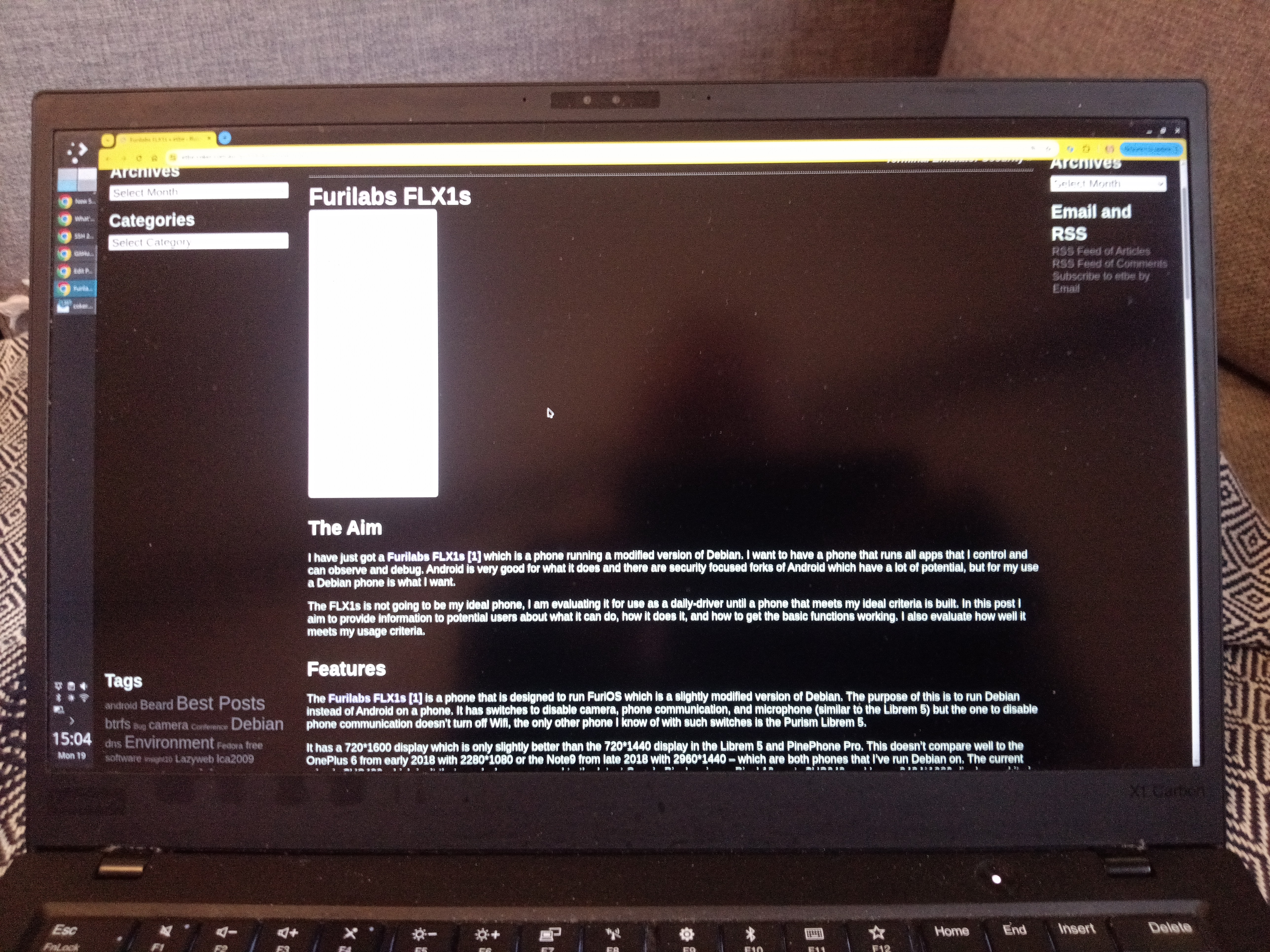
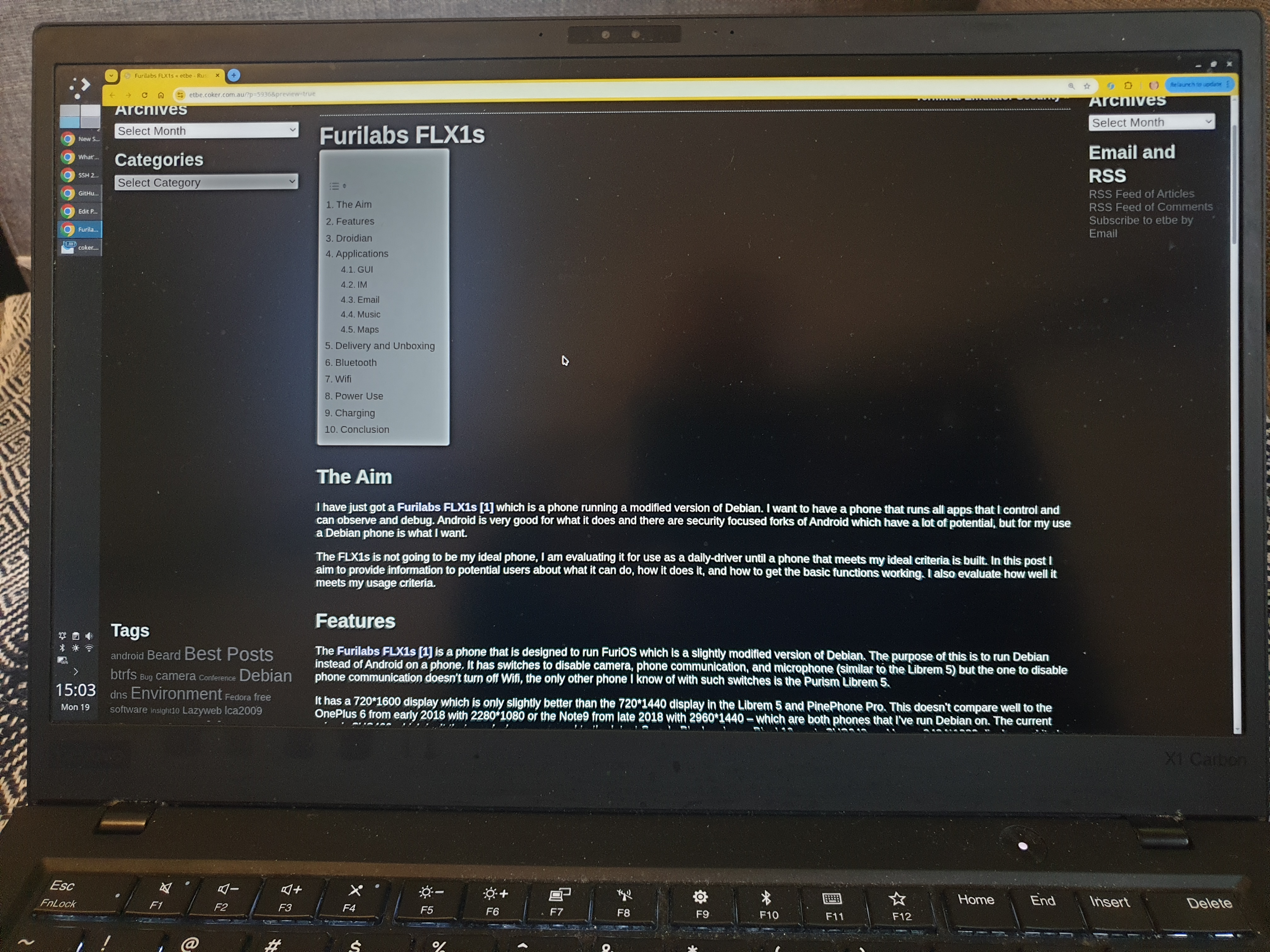
The Aim I have just got a Furilabs FLX1s [1] which is a phone running a modified version of Debian. I want to have a phone that runs all apps that I control and can observe and debug. Android is very good for what it does and there are security focused forks of Android which have a lot of potential, but for my use a Debian phone is what I want. The FLX1s is not going to be my ideal phone, I am evaluating it for use as a daily-driver until a phone that meets my ideal criteria is built. In this post I aim to provide information to potential users about what it can do, how it does it, and how to get the basic functions working. I also evaluate how well it meets my usage criteria. I am not anywhere near an average user. I don t think an average user would ever even see one unless a more technical relative showed one to them. So while this phone could be used by an average user I am not evaluating it on that basis. But of course the features of the GUI that make a phone usable for an average user will allow a developer to rapidly get past the beginning stages and into more complex stuff. Features The Furilabs FLX1s [1] is a phone that is designed to run FuriOS which is a slightly modified version of Debian. The purpose of this is to run Debian instead of Android on a phone. It has switches to disable camera, phone communication, and microphone (similar to the Librem 5) but the one to disable phone communication doesn t turn off Wifi, the only other phone I know of with such switches is the Purism Librem 5. It has a 720*1600 display which is only slightly better than the 720*1440 display in the Librem 5 and PinePhone Pro. This doesn t compare well to the OnePlus 6 from early 2018 with 2280*1080 or the Note9 from late 2018 with 2960*1440 which are both phones that I ve run Debian on. The current price is $US499 which isn t that good when compared to the latest Google Pixel series, a Pixel 10 costs $US649 and has a 2424*1080 display and it also has 12G of RAM while the FLX1s only has 8G. Another annoying thing is how rounded the corners are, it seems that round corners that cut off the content are a standard practice nowadays, in my collection of phones the latest one I found with hard right angles on the display was a Huawei Mate 10 Pro which was released in 2017. The corners are rounder than the Note 9, this annoys me because the screen is not high resolution by today s standards so losing the corners matters. The default installation is Phosh (the GNOME shell for phones) and it is very well configured. Based on my experience with older phone users I think I could give a phone with this configuration to a relative in the 70+ age range who has minimal computer knowledge and they would be happy with it. Additionally I could set it up to allow ssh login and instead of going through the phone support thing of trying to describe every GUI setting to click on based on a web page describing menus for the version of Android they are running I could just ssh in and run diff on the .config directory to find out what they changed. Furilabs have done a very good job of setting up the default configuration, while Debian developers deserve a lot of credit for packaging the apps the Furilabs people have chosen a good set of default apps to install to get it going and appear to have made some noteworthy changes to some of them. Droidian The OS is based on Android drivers (using the same techniques as Droidian [2]) and the storage device has the huge number of partitions you expect from Android as well as a 110G Ext4 filesystem for the main OS. The first issue with the Droidian approach of using an Android kernel and containers for user space code to deal with drivers is that it doesn t work that well. There are 3 D state processes (uninterrupteable sleep which usually means a kernel bug if the process remains in that state) after booting and doing nothing special. My tests running Droidian on the Note 9 also had D state processes, in this case they are D state kernel threads (I can t remember if the Note 9 had regular processes or kernel threads stuck in D state). It is possible for a system to have full functionality in spite of some kernel threads in D state but generally it s a symptom of things not working as well as you would hope. The design of Droidian is inherently fragile. You use a kernel and user space code from Android and then use Debian for the rest. You can t do everything the Android way (with the full OS updates etc) and you also can t do everything the Debian way. The TOW Boot functionality in the PinePhone Pro is really handy for recovery [3], it allows the internal storage to be accessed as a USB mass storage device. The full Android setup with ADB has some OK options for recovery, but part Android and part Debian has less options. While it probably is technically possible to do the same things in regard to OS repair and reinstall the fact that it s different from most other devices means that fixes can t be done in the same way. Applications GUI The system uses Phosh and Phoc, the GNOME system for handheld devices. It s a very different UI from Android, I prefer Android but it is usable with Phosh. IM Chatty works well for Jabber (XMPP) in my tests. It supports Matrix which I didn t test because I don t desire the same program doing Matrix and Jabber and because Matrix is a heavy protocol which establishes new security keys for each login so I don t want to keep logging in on new applications. Chatty also does SMS but I couldn t test that without the SIM caddy. I use Nheko for Matrix which has worked very well for me on desktops and laptops running Debian. Email I am currently using Geary for email. It works reasonably well but is lacking proper management of folders, so I can t just subscribe to the important email on my phone so that bandwidth isn t wasted on less important email (there is a GNOME gitlab issue about this see the Debian Wiki page about Mobile apps [4]). Music Music playing isn t a noteworthy thing for a desktop or laptop, but a good music player is important for phone use. The Lollypop music player generally does everything you expect along with support for all the encoding formats including FLAC0 a major limitation of most Android music players seems to be lack of support for some of the common encoding formats. Lollypop has it s controls for pause/play and going forward and backward one track on the lock screen. Maps The installed map program is gnome-maps which works reasonably well. It gets directions via the Graphhopper API [5]. One thing we really need is a FOSS replacement for Graphhopper in GNOME Maps. Delivery and Unboxing I received my FLX1s on the 13th of Jan [1]. I had paid for it on the 16th of Oct but hadn t received the email with the confirmation link so the order had been put on hold. But after I contacted support about that on the 5th of Jan they rapidly got it to me which was good. They also gave me a free case and screen protector to apologise, I don t usually use screen protectors but in this case it might be useful as the edges of the case don t even extend 0.5mm above the screen. So if it falls face down the case won t help much. When I got it there was an open space at the bottom where the caddy for SIMs is supposed to be. So I couldn t immediately test VoLTE functionality. The contact form on their web site wasn t working when I tried to report that and the email for support was bouncing. Bluetooth As a test of Bluetooth I connected it to my Nissan LEAF which worked well for playing music and I connected it to several Bluetooth headphones. My Thinkpad running Debian/Trixie doesn t connect to the LEAF and to headphones which have worked on previous laptops running Debian and Ubuntu. A friend s laptop running Debian/Trixie also wouldn t connect to the LEAF so I suspect a bug in Trixie, I need to spend more time investigating this. Wifi Currently 5GHz wifi doesn t work, this is a software bug that the Furilabs people are working on. 2.4GHz wifi works fine. I haven t tested running a hotspot due to being unable to get 4G working as they haven t yet shipped me the SIM caddy. Docking This phone doesn t support DP Alt-mode or Thunderbolt docking so it can t drive an external monitor. This is disappointing, Samsung phones and tablets have supported such things since long before USB-C was invented. Samsung DeX is quite handy for Android devices and that type feature is much more useful on a device running Debian than on an Android device. Camera The camera works reasonably well on the FLX1s. Until recently for the Librem 5 the camera didn t work and the camera on my PinePhone Pro currently doesn t work. Here are samples of the regular camera and the selfie camera on the FLX1s and the Note 9. I think this shows that the camera is pretty decent. The selfie looks better and the front camera is worse for the relatively close photo of a laptop screen taking photos of computer screens is an important part of my work but I can probably work around that. I wasn t assessing this camera t find out if it s great, just to find out if I have the sorts of problems I had before and it just worked. The Samsung Galaxy Note series of phones has always had decent specs including good cameras. Even though the Note 9 is old comparing to it is a respectable performance. The lighting was poor for all photos. FLX1s
Note 9
Power Use In 93 minutes having the PinePhone Pro, Librem 5, and FLX1s online with open ssh sessions from my workstation the PinePhone Pro went from 100% battery to 26%, the Librem 5 went from 95% to 69%, and the FLX1s went from 100% to 99%. The battery discharge rate of them was reported as 3.0W, 2.6W, and 0.39W respectively. Based on having a 16.7Wh battery 93 minutes of use should have been close to 4% battery use, but in any case all measurements make it clear that the FLX1s will have a much longer battery life. Including the measurement of just putting my fingers on the phones and feeling the temperature (FLX1s felt cool and the others felt hot). The PinePhone Pro and the Librem 5 have an optional Caffeine mode which I enabled for this test, without that enabled the phone goes into a sleep state and disconnects from Wifi. So those phones would use much less power with caffeine mode enabled, but they also couldn t get fast response to notifications etc. I found the option to enable a Caffeine mode switch on the FLX1s but the power use was reported as being the same both with and without it. Charging One problem I found with my phone is that in every case it takes 22 seconds to negotiate power. Even when using straight USB charging (no BC or PD) it doesn t draw any current for 22 seconds. When I connect it it will stay at 5V and varying between 0W and 0.1W (current rounded off to zero) for 22 seconds or so and then start charging. After the 22 second display the phone will make the tick sound indicating that it s charging and the power meter will measure that it s drawing some current. I added the table from my previous post about phone charging speed [6] with an extra row for the FLX1s. For charging from my PC USB ports the results were the worst ever, the port that does BC did not work at all it was looping trying to negotiate after a 22 second negotiation delay the port would turn off. The non-BC port gave only 2.4W which matches the 2.5W given by the spec for a High-power device which is what that port is designed to give. In a discussion on the Purism forum about the Librem5 charging speed one of their engineers told me that the reason why their phone would draw 2A from that port was because the cable was identifying itself as a USB-C port not a High-power device port. But for some reason out of the 7 phones I tested the FLX1s and the One Plus 6 are the only ones to limit themselves to what the port is apparently supposed to do. Also the One Plus 6 charges slowly on every power supply so I don t know if it is obeying the spec or just sucking. On a cheap AliExpress charger the FLX1s gets 5.9V and on a USB battery it gets 5.8V. Out of all 42 combinations of device and charger I tested these were the only ones to involve more than 5.1V but less than 9V. I welcome comments suggesting an explanation. The case that I received has a hole for the USB-C connector that isn t wide enough for the plastic surrounds on most of my USB-C cables (including the Dell dock). Also to make a connection requires a fairly deep insertion (deeper than the One Plus 6 or the Note 9). So without adjustment I have to take the case off to charge it. It s no big deal to adjust the hole (I have done it with other cases) but it s an annoyance.
Phone Top z640 Bottom Z640 Monitor Ali Charger Dell Dock Battery Best Worst
FLX1s FAIL 5.0V 0.49A 2.4W 4.8V 1.9A 9.0W 5.9V 1.8A 11W 4.8V 2.1A 10W 5.8V 2.1A 12W 5.8V 2.1A 12W 5.0V 0.49A 2.4W
Note9 4.8V 1.0A 5.2W 4.8V 1.6A 7.5W 4.9V 2.0A 9.5W 5.1V 1.9A 9.7W 4.8V 2.1A 10W 5.1V 2.1A 10W 5.1V 2.1A 10W 4.8V 1.0A 5.2W
Pixel 7 pro 4.9V 0.80A 4.2W 4.8V 1.2A 5.9W 9.1V 1.3A 12W 9.1V 1.2A 11W 4.9V 1.8A 8.7W 9.0V 1.3A 12W 9.1V 1.3A 12W 4.9V 0.80A 4.2W
Pixel 8 4.7V 1.2A 5.4W 4.7V 1.5A 7.2W 8.9V 2.1A 19W 9.1V 2.7A 24W 4.8V 2.3A 11.0W 9.1V 2.6A 24W 9.1V 2.7A 24W 4.7V 1.2A 5.4W
PPP 4.7V 1.2A 6.0W 4.8V 1.3A 6.8W 4.9V 1.4A 6.6W 5.0V 1.2A 5.8W 4.9V 1.4A 5.9W 5.1V 1.2A 6.3W 4.8V 1.3A 6.8W 5.0V 1.2A 5.8W
Librem 5 4.4V 1.5A 6.7W 4.6V 2.0A 9.2W 4.8V 2.4A 11.2W 12V 0.48A 5.8W 5.0V 0.56A 2.7W 5.1V 2.0A 10W 4.8V 2.4A 11.2W 5.0V 0.56A 2.7W
OnePlus6 5.0V 0.51A 2.5W 5.0V 0.50A 2.5W 5.0V 0.81A 4.0W 5.0V 0.75A 3.7W 5.0V 0.77A 3.7W 5.0V 0.77A 3.9W 5.0V 0.81A 4.0W 5.0V 0.50A 2.5W
Best 4.4V 1.5A 6.7W 4.6V 2.0A 9.2W 8.9V 2.1A 19W 9.1V 2.7A 24W 4.8V 2.3A 11.0W 9.1V 2.6A 24W
Conclusion The Furilabs support people are friendly and enthusiastic but my customer experience wasn t ideal. It was good that they could quickly respond to my missing order status and the missing SIM caddy (which I still haven t received but believe is in the mail) but it would be better if such things just didn t happen. The phone is quite user friendly and could be used by a novice. I paid $US577 for the FLX1s which is $AU863 by today s exchange rates. For comparison I could get a refurbished Pixel 9 Pro Fold for $891 from Kogan (the major Australian mail-order company for technology) or a refurbished Pixel 9 Pro XL for $842. The Pixel 9 series has security support until 2031 which is probably longer than you can expect a phone to be used without being broken. So a phone with a much higher resolution screen that s only one generation behind the latest high end phones and is refurbished will cost less. For a brand new phone a Pixel 8 Pro which has security updates until 2030 costs $874 and a Pixel 9A which has security updates until 2032 costs $861. Doing what the Furilabs people have done is not a small project. It s a significant amount of work and the prices of their products need to cover that. I m not saying that the prices are bad, just that economies of scale and the large quantity of older stock makes the older Google products quite good value for money. The new Pixel phones of the latest models are unreasonably expensive. The Pixel 10 is selling new from Google for $AU1,149 which I consider a ridiculous price that I would not pay given the market for used phones etc. If I had a choice of $1,149 or a feature phone I d pay $1,149. But the FLX1s for $863 is a much better option for me. If all I had to choose from was a new Pixel 10 or a FLX1s for my parents I d get them the FLX1s. For a FOSS developer a FLX1s could be a mobile test and development system which could be lent to a relative when their main phone breaks and the replacement is on order. It seems to be fit for use as a commodity phone. Note that I give this review on the assumption that SMS and VoLTE will just work, I haven t tested them yet. The UI on the FLX1s is functional and easy enough for a new user while allowing an advanced user to do the things they desire. I prefer the Android style and the Plasma Mobile style is closer to Android than Phosh is, but changing it is something I can do later. Generally I think that the differences between UIs matter more when on a desktop environment that could be used for more complex tasks than on a phone which limits what can be done by the size of the screen. I am comparing the FLX1s to Android phones on the basis of what technology is available. But most people who would consider buying this phone will compare it to the PinePhone Pro and the Librem 5 as they have similar uses. The FLX1s beats both those phones handily in terms of battery life and of having everything just work. But it has the most non free software of the three and the people who want the $2000 Librem 5 that s entirely made in the US won t want the FLX1s. This isn t the destination for Debian based phones, but it s a good step on the way to it and I don t think I ll regret this purchase.

16 January 2026

Kentaro Hayashi: Budgie Desktop 10.10 is out, but not for me yet :(

Introduction I'm one of a Budgie Desktop user since 2020. (Budgie Desktop 10.5 or so) Recently Budgie Desktop 10.10 had been available from Debian experimental. I've tried it and realized that not for me yet.

What is the requirement for desktop environment
  • Screen sharing with specifying the specific window/application for web meeting
  • Sharing keyboard input smoothly with deskflow
  • Switch focus with mouse movement
  • and ...

Is Budgie Desktop 10.10 suitable? Short answer: No, not yet. It seems that Budgie Desktop 10.10 (wayland) lost the functionality - screen sharing with specifying the specific window/application for web meeting. Of course, you can share your screen itself. It also can't sharing keyboard input smoothly with deskflow. Both of them seems that they are supported in GNOME? or KDE?. In contrast to Budgie Desktop 10.9 (X11), Budgie Desktop 10.10 seems missing effective wayland + xdg-desktop-portal support for them yet. It might be supported in the future release, but it might be 11.x.

Alternatives? Budgie Desktop 10.x will come into maintenance mode, so they will not be fixed in 10.x releases (guess). buddiesofbudgie.org Switching DE might be an option - GNOME or KDE. but I don't have much the energy to make the transition for now. I decided to take the conservative option and go back to 10.9. Note that if you upgrade to Budgie Desktop 10.10, it is hard to downgrade to Budgie Desktop 10.9 because python3-gi, python3-gi-cairo dependency blocks budgie-desktop. See https://bugs.debian.org/cgi-bin/bugreport.cgi?bug=1120138 for details. #1120138 - budgie-extras: Several applets are incompatible with pygobject 3.54/libpeas 1.36.0-8 - Debian Bug report logs As a dirty hack, you can modify python3-gi dependency and install it as your own risk for downgrading.

Conclusion It was still too early to adopt Budgie Desktop (wayland) for me. I'll stay with Budgie Desktop 10.9 for a while. That said, it's unclear how long Budgie Desktop 10.9 will remain unstable and usable. There might be a case that sticking to Budgie Desktop 10.9 might be problematic when other packages are updated. When that happens, I'd like to reconsider this issue again.

14 January 2026

Gunnar Wolf: The Innovation Engine Government-funded Academic Research

This post is an unpublished review for The Innovation Engine Government-funded Academic Research
David Patterson does not need an introduction. Being the brain behind many of the inventions that shaped the computing industry (repeatedly) over the past 40 years, when he put forward an opinion article in Communications of the ACM targeting the current day political waves in the USA, I could not avoid choosing it to write this review. Patterson worked for a a public university (University of California at Berkeley) between 1976 and 2016, and in this article he argues how government-funded academic research (GoFAR) allows for faster, more effective and freer development than private sector-funded research would, putting his own career milestones as an example of how public money that went to his research has easily been amplified by a factor of 10,000:1 for the country s economy, and 1,000:1 particularly for the government. Patterson illustrates this quoting five of the home-run research projects he started and pursued with government funding, eventually spinning them off as successful startups: Patterson identifies principles for the projects he has led, that are specially compatible with the ways research works at universitary systems: Multidisciplinary teams, demonstrative usable artifacts, seven- to ten-year impact horizons, five-year sunset clauses (to create urgency and to lower opportunity costs), physical proximity of collaborators, and leadership followed on team success rather than individual recognition. While it could be argued that it s easy to point at Patterson s work as a success example while he is by far not the average academic, the points he makes on how GoFAR research has been fundamental for the advance of science and technology, but also of biology, medicine, and several other fields are very clear.

13 January 2026

Freexian Collaborators: Debian Contributions: dh-python development, Python 3.14 and Ruby 3.4 transitions, Surviving scraper traffic in Debian CI and more! (by Anupa Ann Joseph)

Debian Contributions: 2025-12 Contributing to Debian is part of Freexian s mission. This article covers the latest achievements of Freexian and their collaborators. All of this is made possible by organizations subscribing to our Long Term Support contracts and consulting services.

dh-python development, by Stefano Rivera In Debian we build our Python packages with the help of a debhelper-compatible tool, dh-python. Before starting the 3.14 transition (that would rebuild many packages) we landed some updates to dh-python to fix bugs and add features. This started a month of attention on dh-python, iterating through several bug fixes, and a couple of unfortunate regressions. dh-python is used by almost all packages containing Python (over 5000). Most of these are very simple, but some are complex and use dh-python in unexpected ways. It s hard to avoid almost any change (including obvious bug fixes) from causing some unexpected knock-on behaviour. There is a fair amount of complexity in dh-python, and some rather clever code, which can make it tricky to work on. All of this means that good QA is important. Stefano spent some time adding type annotations and specialized types to make it easier to see what the code is doing and catch mistakes. This has already made work on dh-python easier. Now that Debusine has built-in repositories and debdiff support, Stefano could quickly test the effects of changes on many other packages. After each big change, he could upload dh-python to a repository, rebuild e.g. 50 Python packages with it, and see what differences appeared in the output. Reviewing the diffs is still a manual process, but can be improved. Stefano did a small test on what it would take to replace direct setuptools setup.py calls with PEP-517 (pyproject-style) builds. There is more work to do here.

Python 3.14 transition, by Stefano Rivera (et al.) In December the transition to add Python 3.14 as a supported version started in Debian unstable. To do this, we update the list of supported versions in python3-defaults, and then start rebuilding modules with C extensions from the leaves inwards. This had already been tested in a PPA and Ubuntu, so many of the biggest blocking compatibility issues with 3.14 had already been found and fixed. But there are always new issues to discover. Thanks to a number of people in the Debian Python team, we got through the first bit of the transition fairly quickly. There are still a number of open bugs that need attention and many failed tests blocking migration to testing. Python 3.14.1 released just after we started the transition, and very soon after, a follow-up 3.14.2 release came out to address a regression. We ran into another regression in Python 3.14.2.

Ruby 3.4 transition, by Lucas Kanashiro (et al.) The Debian Ruby team just started the preparation to move the default Ruby interpreter version to 3.4. At the moment, ruby3.4 source package is already available in experimental, also ruby-defaults added support to Ruby 3.4. Lucas rebuilt all reverse dependencies against this new version of the interpreter and published the results here. Lucas also reached out to some stakeholders to coordinate the work. Next steps are: 1) announcing the results to the whole team and asking for help to fix packages failing to build against the new interpreter; 2) file bugs against packages FTBFSing against Ruby 3.4 which are not fixed yet; 3) once we have a low number of build failures against Ruby 3.4, ask the Debian Release team to start the transition in unstable.

Surviving scraper traffic in Debian CI, by Antonio Terceiro Like most of the open web, Debian Continuous Integration has been struggling for a while to keep up with the insatiable hunger from data scrapers everywhere. Solving this involved a lot of trial and error; the final result seems to be stable, and consists of two parts. First, all Debian CI data pages, except the direct links to test log files (such as those provided by the Release Team s testing migration excuses), now require users to be authenticated before being accessed. This means that the Debian CI data is no longer publicly browseable, which is a bit sad. However, this is where we are now. Additionally, there is now a fail2ban powered firewall-level access limitation for clients that display an abusive access pattern. This went through several iterations, with some of them unfortunately blocking legitimate Debian contributors, but the current state seems to strike a good balance between blocking scrapers and not blocking real users. Please get in touch with the team on the #debci OFTC channel if you are affected by this.

A hybrid dependency solver for crossqa.debian.net, by Helmut Grohne crossqa.debian.net continuously cross builds packages from the Debian archive. Like Debian s native build infrastructure, it uses dose-builddebcheck to determine whether a package s dependencies can be satisfied before attempting a build. About one third of Debian s packages fail this check, so understanding the reasons is key to improving cross building. Unfortunately, dose-builddebcheck stops after reporting the first problem and does not display additional ones. To address this, a greedy solver implemented in Python now examines each build-dependency individually and can report multiple causes. dose-builddebcheck is still used as a fall-back when the greedy solver does not identify any problems. The report for bazel-bootstrap is a lengthy example.

rebootstrap, by Helmut Grohne Due to the changes suggested by Loongson earlier, rebootstrap now adds debhelper to its final installability test and builds a few more packages required for installing it. It also now uses a variant of build-essential that has been marked Multi-Arch: same (see foundational work from last year). This in turn made the use of a non-default GCC version more difficult and required more work to make it work for gcc-16 from experimental. Ongoing archive changes temporarily regressed building fribidi and dash. libselinux and groff have received patches for architecture specific changes and libverto has been NMUed to remove the glib2.0 dependency.

Miscellaneous contributions
  • Stefano did some administrative work on debian.social and debian.net instances and Debian reimbursements.
  • Stefano did routine updates of python-authlib, python-mitogen, xdot.
  • Stefano spent several hours discussing Debian s Python package layout with the PyPA upstream community. Debian has ended up with a very different on-disk installed Python layout than other distributions, and this continues to cause some frustration in many communities that have to have special workarounds to handle it. This ended up impacting cross builds as Helmut discovered.
  • Rapha l set up Debusine workflows for the various backports repositories on debusine.debian.net.
  • Zulip is not yet in Debian (RFP in #800052), but Rapha l helped on the French translation as he is experimenting with that discussion platform.
  • Antonio performed several routine Salsa maintenance tasks, including fixing salsa-nm-sync, the service that synchronizes project members data from LDAP to Salsa, which had been broken since salsa.debian.org was upgraded to trixie .
  • Antonio deployed a new amd64 worker host for Debian CI.
  • Antonio did several DebConf technical and administrative bits, including but adding support for custom check-in/check-out dates in the MiniDebConf registration module, publishing a call for bids for DebConf27.
  • Carles reviewed and submitted 14 Catalan translations using po-debconf-manager.
  • Carles improved po-debconf-manager: added delete-package command, show-information now uses properly formatted output (YAML), it now attaches the translation on the bug reports for which a merge request has been opened too long.
  • Carles investigated why some packages appeared in po-debconf-manager but not in the Debian l10n list. Turns out that some packages had debian/po/templates.pot (appearing in po-debconf-manager) but not the POTFILES.in file as expected. Created a script to find out which packages were in this or similar situation and reported bugs.
  • Carles tested and documented how to set up voices (mbrola and festival) if using Orca speech synthesizer. Commented a few issues and possible improvements in the debian-accessibility list.
  • Helmut sent patches for 48 cross build failures and initiated discussions on how to deal with two non-trivial matters. Besides Python mentioned above, CMake introduced a cmake_pkg_config builtin which is not aware of the host architecture. He also forwarded a Meson patch upstream.
  • Thorsten uploaded a new upstream version of cups to fix a nasty bug that was introduced by the latest security update.
  • Along with many other Python 3.14 fixes, Colin fixed a tricky segfault in python-confluent-kafka after a helpful debugging hint from upstream.
  • Colin upstreamed an improved version of an OpenSSH patch we ve been carrying since 2008 to fix misleading verbose output from scp.
  • Colin used Debusine to coordinate transitions for astroid and pygments, and wrote up the astroid case on his blog.
  • Emilio helped with various transitions, and provided a build fix for opencv for the ffmpeg 8 transition.
  • Emilio tested the GNOME updates for trixie proposed updates (gnome-shell, mutter, glib2.0).
  • Santiago helped to review the status of how to test different build profiles in parallel on the same pipeline, using the test-build-profiles job. This means, for example, to simultaneously test build profiles such as nocheck and nodoc for the same git tree. Finally, Santiago provided MR !685 to fix the documentation.
  • Anupa prepared a bits post for Outreachy interns announcement along with T ssia Cam es Ara jo and worked on publicity team tasks.

12 January 2026

Daniel Kahn Gillmor: AI as a Compression Problem

A recent article in The Atlantic makes the case that very large language models effectively contain much of the works they're trained on. This article is an attempt to popularize the insights in the recent academic paper Extracting books from production language models from Ahmed et al. The authors of the paper demonstrate convincingly that well-known copyrighted textual material can be extracted from the chatbot interfaces of popular commercial LLM services. The Atlantic article cites a podcast quote about the Stable Diffusion AI image-generator model, saying "We took 100,000 gigabytes of images and compressed it to a two-gigabyte file that can re-create any of those and iterations of those". By analogy, this suggests we might think of LLMs (which work on text, not the images handled by Stable Diffusion) as a form of lossy textual compression. The entire text of Moby Dick, the canonical Big American Novel is merely 1.2MiB uncompressed (and less than 0.4MiB losslessly compressed with bzip2 -9). It's not surprising to imagine that a model with hundreds of billions of parameters might contain copies of these works. Warning: The next paragraph contains fuzzy math with no real concrete engineering practice behind it! Consider a hypothetical model with 100 billion parameters, where each parameter is stored as a 16-bit floating point value. The model weights would take 200 GB of storage. If you were to fill the parameter space only with losslessly compressed copies of books like Moby Dick, you could still fit half a million books, more than anyone can read in a lifetime. And lossy compression is typically orders of magnitude less in size than lossless compression, so we're talking about millions of works effectively encoded, with the acceptance of some artifacts being injected in the output. I first encountered this "compression" view of AI nearly three years ago, in Ted Chiang's insightful ChatGPT is a Blurry JPEG of the Web. I was suprised that The Atlantic article didn't cite Chiang's piece. If you haven't read Ted Chiang, i strongly recommend his work, and this piece is a great place to start. Chiang aside, the more recent writing that focuses on the idea of compressed works being "contained" in the model weights seems to be used by people interested in wielding some sort of copyright claims against the AI companies that maintain or provide access to these models. There are many many problems with AI today, but attacking AI companies based on copyright concerns seems similar to going after Al Capone for tax evasion. We should be much more concerned with the effect these projects have on cultural homogeneity, mental health, labor rights, privacy, and social control than whether they're violating copyright in some specific instance.

11 January 2026

Dirk Eddelbuettel: RApiDatetime 0.0.10 on CRAN: Maintenance

A new maintenance release of our RApiDatetime package is now on CRAN, coming just about two years after the previous maintenance release. RApiDatetime provides a number of entry points for C-level functions of the R API for Date and Datetime calculations. The functions asPOSIXlt and asPOSIXct convert between long and compact datetime representation, formatPOSIXlt and Rstrptime convert to and from character strings, and POSIXlt2D and D2POSIXlt convert between Date and POSIXlt datetime. Lastly, asDatePOSIXct converts to a date type. All these functions are rather useful, but were not previously exported by R for C-level use by other packages. Which this package aims to change. This release avoids use of and which are now outlawed under R-devel, and makes a number of other smaller maintenance updates. Just like the previous release, we are at OS_type: unix meaning there will not be any Windows builds at CRAN. If you would like that to change, and ideally can work in the Windows portion, do not hesitate to get in touch. Details of the release follow based on the NEWS file.

Changes in RApiDatetime version 0.0.10 (2026-01-11)
  • Minor maintenance for continuous integration files, README.md
  • Switch to Authors@R in DESCRIPTION
  • Use Rf_setAttrib with R 4.5.0 or later

Courtesy of my CRANberries, there is also a diffstat report for this release.

This post by Dirk Eddelbuettel originated on his Thinking inside the box blog. If you like this or other open-source work I do, you can sponsor me at GitHub.

Otto Kek l inen: Stop using MySQL in 2026, it is not true open source

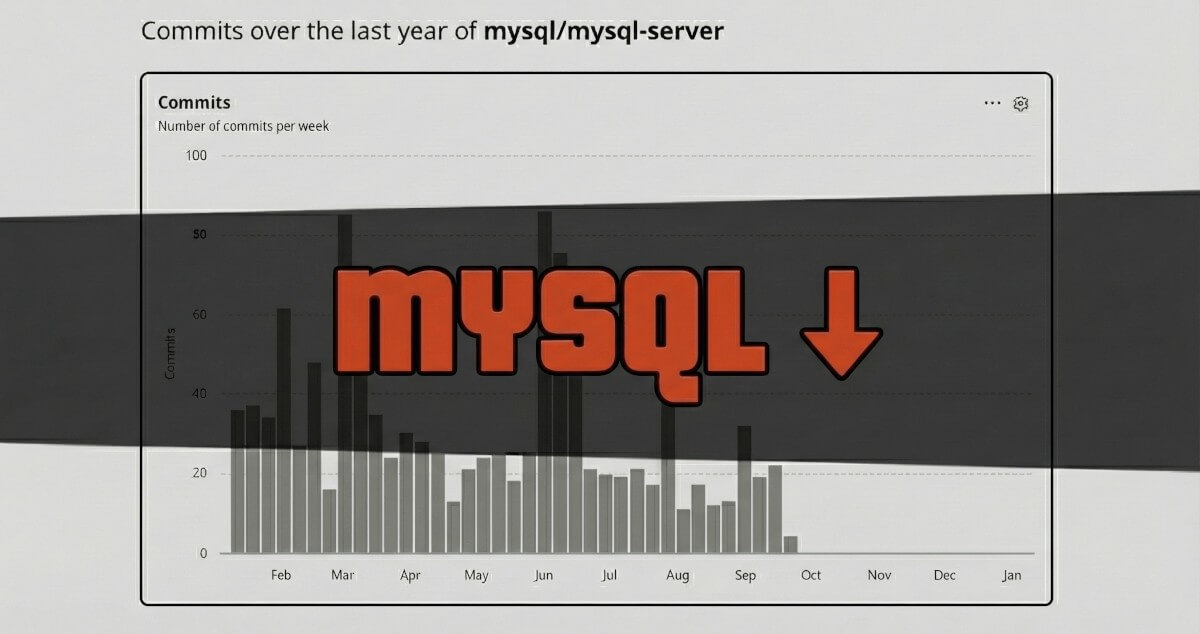
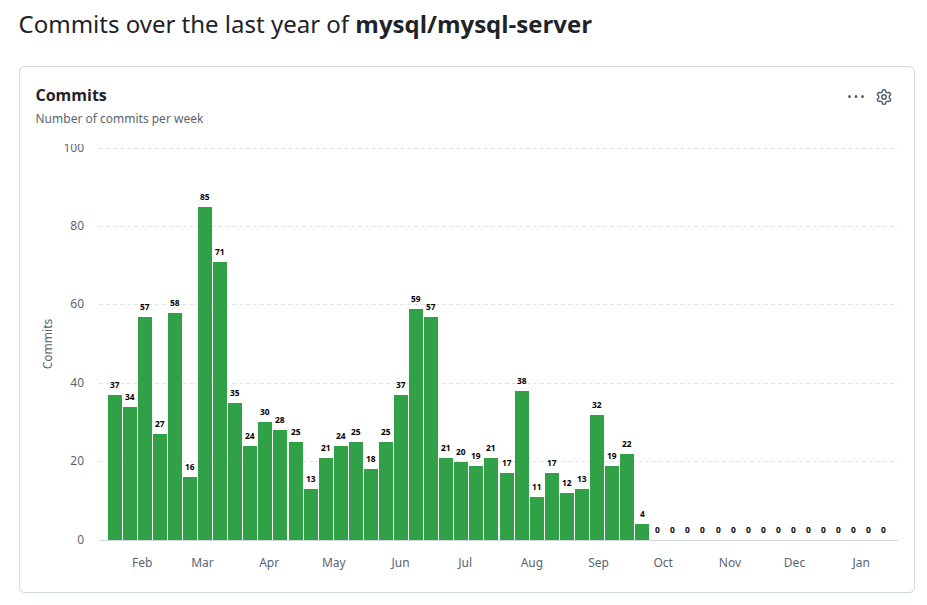
Featured image of post Stop using MySQL in 2026, it is not true open sourceIf you care about supporting open source software, and still use MySQL in 2026, you should switch to MariaDB like so many others have already done. The number of git commits on github.com/mysql/mysql-server has been significantly declining in 2025. The screenshot below shows the state of git commits as of writing this in January 2026, and the picture should be alarming to anyone who cares about software being open source. MySQL GitHub commit activity decreasing drastically
This is not surprising Oracle should not be trusted as the steward for open source projects When Oracle acquired Sun Microsystems and MySQL along with it back in 2009, the European Commission almost blocked the deal due to concerns that Oracle s goal was just to stifle competition. The deal went through as Oracle made a commitment to keep MySQL going and not kill it, but (to nobody s surprise) Oracle has not been a good steward of MySQL as an open source project and the community around it has been withering away for years now. All development is done behind closed doors. The publicly visible bug tracker is not the real one Oracle staff actually uses for MySQL development, and the few people who try to contribute to MySQL just see their Pull Requests and patch submissions marked as received with mostly no feedback and then those changes may or may not be in the next MySQL release, often rewritten, and with only Oracle staff in the git author/committer fields. The real author only gets a small mention in a blog post. When I was the engineering manager for the core team working on RDS MySQL and RDS MariaDB at Amazon Web Services, I oversaw my engineers contributions to both MySQL and MariaDB (the latter being a fork of MySQL by the original MySQL author, Michael Widenius). All the software developers in my org disliked submitting code to MySQL due to how bad the reception by Oracle was to their contributions. MariaDB is the stark opposite with all development taking place in real-time on github.com/mariadb/server, anyone being able to submit a Pull Request and get a review, all bugs being openly discussed at jira.mariadb.org and so forth, just like one would expect from a true open source project. MySQL is open source only by license (GPL v2), but not as a project.

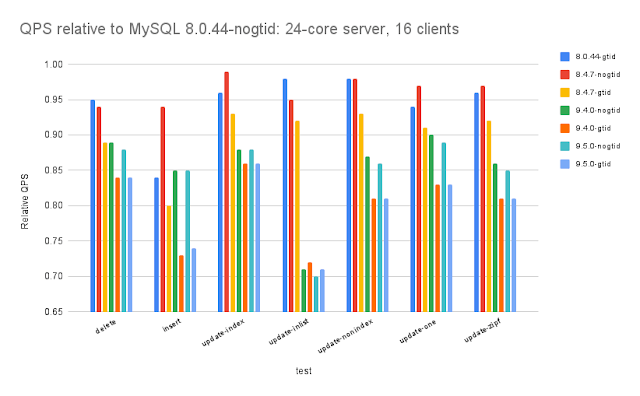
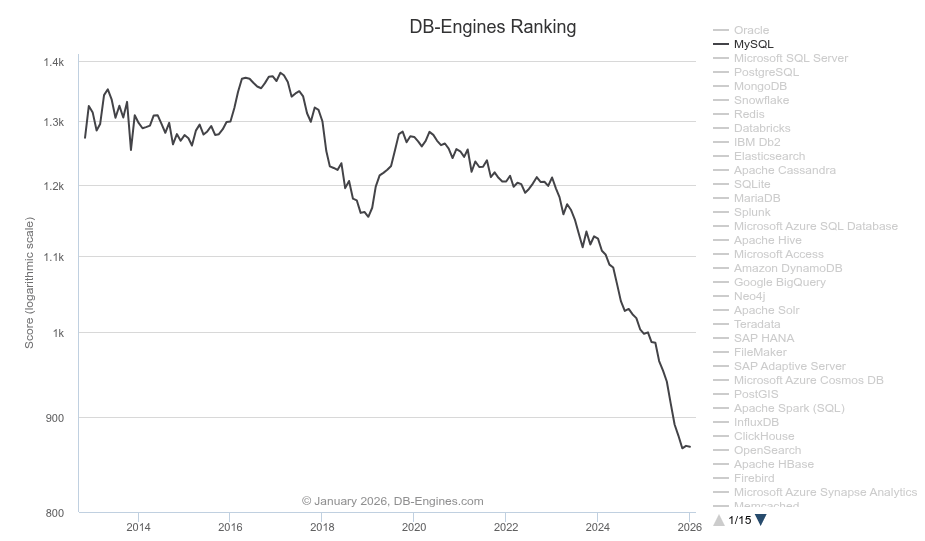
MySQL s technical decline in recent years Despite not being a good open source steward, Oracle should be given credit that it did keep the MySQL organization alive and allowed it to exist fairly independently and continue developing and releasing new MySQL versions well over a decade after the acquisition. I have no insight into how many customers they had, but I assume the MySQL business was fairly profitable and financially useful to Oracle, at least as long as it didn t gain too many features to threaten Oracle s own main database business. I don t know why, perhaps because too many talented people had left the organization, but it seems that from a technical point of view MySQL clearly started to deteriorate from 2022 onward. When MySQL 8.0.29 was released with the default ALTER TABLE method switched to run in-place, it had a lot of corner cases that didn t work, causing the database to crash and data to corrupt for many users. The issue wasn t fully fixed until a year later in MySQL 8.0.32. To many users annoyance Oracle announced the 8.0 series as evergreen and introduced features and changes in the minor releases, instead of just doing bugfixes and security fixes like users historically had learnt to expect from these x.y.Z maintenance releases. There was no new major MySQL version for six years. After MySQL 8.0 in 2018 it wasn t until 2023 when MySQL 8.1 was released, and it was just a short-term preview release. The first actual new major release MySQL 8.4 LTS was released in 2024. Even though it was a new major release, many users got disappointed as it had barely any new features. Many also reported degraded performance with newer MySQL versions, for example the benchmark by famous MySQL performance expert Mark Callaghan below shows that on write-heavy workloads MySQL 9.5 throughput is typically 15% less than in 8.0. Benchmark showing new MySQL versions being slower than the old Due to newer MySQL versions deprecating many features, a lot of users also complained about significant struggles regarding both MySQL 5.7->8.0 and 8.0->8.4 upgrades. With few new features and heavy focus on code base cleanup and feature deprecation, it became obvious to many that Oracle had decided to just keep MySQL barely alive, and put all new relevant features (e.g. vector search) into Heatwave, Oracle s closed-source and cloud-only service for MySQL customers. As it was evident that Oracle isn t investing in MySQL, Percona s Peter Zaitsev wrote Is Oracle Finally Killing MySQL in June 2024. At this time MySQL s popularity as ranked by DB-Engines had also started to tank hard, a trend that likely accelerates in 2026. MySQL dropping significantly in DB-Engines ranking In September 2025 news reported that Oracle was reducing its workforce and that the MySQL staff was getting heavily reduced. Obviously this does not bode well for MySQL s future, and Peter Zaitsev posted already in November stats showing that the latest MySQL maintenance release contained fewer bug fixes than before.
Open source is more than ideology: it has very real effects on software security and sovereignty Some say they don t care if MySQL is truly open source or not, or that they don t care if it has a future in coming years, as long as it still works now. I am afraid people thinking so are taking a huge risk. The database is often the most critical part of a software application stack, and any flaw or problem in operations, let alone a security issue, will have immediate consequences, and not caring will eventually get people fired or sued. In open source problems are discussed openly, and the bigger the problem, the more people and companies will contribute to fixing it. Open source as a development methodology is similar to the scientific method with free flow of ideas that are constantly contested and only the ones with the most compelling evidence win. Not being open means more obscurity, more risk and more just trust us bro attitude. This open vs. closed is very visible for example in how Oracle handles security issues. We can see that in 2025 alone MySQL published 123 CVEs about security issues, while MariaDB had 8. There were 117 CVEs that only affected MySQL and not MariaDB in 2025. I haven t read them all, but typically the CVEs hardly contain any real details. As an example, the most recent one CVE-2025-53067 states Easily exploitable vulnerability allows high privileged attacker with network access via multiple protocols to compromise MySQL Server. There is no information a security researcher or auditor could use to verify if any original issue actually existed, or if it was fixed, or if the fix was sufficient and fully mitigating the issue or not. MySQL users just have to take the word of Oracle that it is all good now. Handling security issues like this is in stark contrast to other open source projects, where all security issues and their code fixes are open for full scrutiny after the initial embargo is over and CVE made public. There is also various forms of enshittification going on one would not see in a true open source project, and everything about MySQL as a software, documentation and website is pushing users to stop using the open source version and move to the closed MySQL versions, and in particular to Heatwave, which is not only closed-source but also results in Oracle fully controlling customer s databases contents. Of course, some could say this is how Oracle makes money and is able to provide a better product. But stories on Reddit and elsewhere suggest that what is going on is more like Oracle milking hard the last remaining MySQL customers who are forced to pay more and more for getting less and less.

There are options and migrating is easy, just do it A large part of MySQL users switched to MariaDB already in the mid-2010s, in particular everyone who had cared deeply about their database software staying truly open source. That included large installations such as Wikipedia, and Linux distributions such as Fedora and Debian. Because it s open source and there is no centralized machine collecting statistics, nobody knows what the exact market shares look like. There are however some application specific stats, such as that 57% of WordPress sites around the world run MariaDB, while the share for MySQL is 42%. For anyone running a classic LAMP stack application such as WordPress, Drupal, Mediawiki, Nextcloud, or Magento, switching the old MySQL database to MariaDB is be straightforward. As MariaDB is a fork of MySQL and mostly backwards compatible with it, swapping out MySQL for MariaDB can be done without changing any of the existing connectors or database clients, as they will continue to work with MariaDB as if it was MySQL. For those running custom applications and who have the freedom to make changes to how and what database is used, there are tens of mature and well-functioning open source databases to choose from, with PostgreSQL being the most popular general database. If your application was built from the start for MySQL, switching to PostgreSQL may however require a lot of work, and the MySQL/MariaDB architecture and storage engine InnoDB may still offer an edge in e.g. online services where high performance, scalability and solid replication features are of highest priority. For a quick and easy migration MariaDB is probably the best option. Switching from MySQL to the Percona Server is also very easy, as it closely tracks all changes in MySQL and deviates from it only by a small number of improvements done by Percona. However, also precisely because of it being basically just a customized version of the MySQL Server, it s not a viable long-term solution for those trying to fully ditch the dependency on Oracle. There are also several open source databases that have no common ancestry with MySQL, but strive to be MySQL-compatible. Thus most apps built for MySQL can simply switch to using them without needing SQL statements to be rewritten. One such database is TiDB, which has been designed from scratch specifically for highly scalable and large systems, and is so good that even Amazon s latest database solution DSQL was built borrowing many ideas from TiDB. However, TiDB only really shines with larger distributed setups, so for the vast majority of regular small- and mid-scale applications currently using MySQL, the most practical solution is probably to just switch to MariaDB, which on most Linux distributions can simply be installed by running apt/dnf/brew install mariadb-server. Whatever you end up choosing, as long as it is not Oracle, you will be better off.

10 January 2026

Dirk Eddelbuettel: Rcpp 1.1.1 on CRAN: Many Improvements in Semi-Annual Update

rcpp logo Team Rcpp is thrilled to share that an exciting new version 1.1.1 of Rcpp is now on CRAN (and also uploaded to Debian and already built for r2u). Having switchted to C++11 as the minimum standard in the previous 1.1.0 release, this version takes full advantage of it and removes a lot of conditional code catering to older standards that no longer need to be supported. Consequently, the source tarball shrinks by 39% from 3.11 mb to 1.88 mb. That is a big deal. (Size peaked with Rcpp 1.0.12 two years ago at 3.43 mb; relative to its size we are down 45% !!) Removing unused code also makes maintenance easier, and quickens both compilation and installation in general. This release continues as usual with the six-months January-July cycle started with release 1.0.5 in July 2020. Interim snapshots are always available via the r-universe page and repo. We continue to strongly encourage the use of these development released and their testing we tend to run our systems with them too. Rcpp has long established itself as the most popular way of enhancing R with C or C++ code. Right now, 3020 packages on CRAN depend on Rcpp for making analytical code go faster and further. On CRAN, 13.1% of all packages depend (directly) on Rcpp, and 60.9% of all compiled packages do. From the cloud mirror of CRAN (which is but a subset of all CRAN downloads), Rcpp has been downloaded 109.8 million times. The two published papers (also included in the package as preprint vignettes) have, respectively, 2151 (JSS, 2011) and 405 (TAS, 2018) citations, while the the book (Springer useR!, 2013) has another 715. This time, I am not attempting to summarize the different changes. The full list follows below and details all these changes, their respective PRs and, if applicable, issue tickets. Big thanks from all of us to all contributors!

Changes in Rcpp release version 1.1.1 (2026-01-08)
  • Changes in Rcpp API:
    • An unused old R function for a compiler version check has been removed after checking no known package uses it (Dirk in #1395)
    • A narrowing warning is avoided via a cast (Dirk in #1398)
    • Demangling checks have been simplified (I aki in #1401 addressing #1400)
    • The treatment of signed zeros is now improved in the Sugar code (I aki in #1404)
    • Preparations for phasing out use of Rf_error have been made (I aki in #1407)
    • The long-deprecated function loadRcppModules() has been removed (Dirk in #1416 closing #1415)
    • Some non-API includes from R were refactored to accommodate R-devel changes (I aki in #1418 addressing #1417)
    • An accessor to Rf_rnbeta has been removed (Dirk in #1419 also addressing #1420)
    • Code accessing non-API Rf_findVarInFrame now uses R_getVarEx (Dirk in #1423 fixing #1421)
    • Code conditional on the R version now expects at least R 3.5.0; older code has been removed (Dirk in #1426 fixing #1425)
    • The non-API ATTRIB entry point to the R API is no longer used (Dirk in #1430 addressing #1429)
    • The unwind-protect mechanism is now used unconditionally (Dirk in #1437 closing #1436)
  • Changes in Rcpp Attributes:
    • The OpenMP plugin has been generalized for different macOS compiler installations (Kevin in #1414)
  • Changes in Rcpp Documentation:
    • Vignettes are now processed via a new "asis" processor adopted from R.rsp (Dirk in #1394 fixing #1393)
    • R is now cited via its DOI (Dirk)
    • A (very) stale help page has been removed (Dirk in #1428 fixing #1427)
    • The main README.md was updated emphasizing r-universe in favor of the local drat repos (Dirk in #1431)
  • Changes in Rcpp Deployment:
    • A temporary change in R-devel concerning NA part in complex variables was accommodated, and then reverted (Dirk in #1399 fixing #1397)
    • The macOS CI runners now use macos-14 (Dirk in #1405)
    • A message is shown if R.h is included before Rcpp headers as this can lead to errors (Dirk in #1411 closing #1410)
    • Old helper functions use message() to signal they are not used, deprecation and removal to follow (Dirk in #1413 closing #1412)
    • Three tests were being silenced following #1413 (Dirk in #1422)
    • The heuristic whether to run all available tests was refined (Dirk in #1434 addressing #1433)
    • Coverage has been tweaked via additional #nocov tags (Dirk in #1435)
  • Non-release Changes:
    • Two interim non-releases 1.1.0.8.1 and .2 were made in order to unblock CRAN due to changes in R-devel rather than Rcpp

Thanks to my CRANberries, you can also look at a diff to the previous interim release along with pre-releaseds 1.1.0.8, 1.1.0.8.1 and 1.1.0.8.2 that were needed because R-devel all of a sudden decided to move fast and break things. Not our doing. Questions, comments etc should go to the GitHub discussion section list]rcppdevellist off the R-Forge page. Bugs reports are welcome at the GitHub issue tracker as well. Both sections can be searched as well.

This post by Dirk Eddelbuettel originated on his Thinking inside the box blog. If you like this or other open-source work I do, you can sponsor me at GitHub.

9 January 2026

Simon Josefsson: Debian Taco Towards a GitSecDevOps Debian

One of my holiday projects was to understand and gain more trust in how Debian binaries are built, and as the holidays are coming to an end, I d like to introduce a new research project called Debian Taco. I apparently need more holidays, because there are still more work to be done here, so at the end I ll summarize some pending work. Debian Taco, or TacOS, is a GitSecDevOps rebuild of Debian GNU/Linux. The Debian Taco project publish rebuilt binary packages, package repository metadata (InRelease, Packages, etc), container images, cloud images and live images. All packages are built from pristine source packages in the Debian archive. Debian Taco does not modify any Debian source code nor add or remove any packages found in Debian. No servers are involved! Everything is built in GitLab pipelines and results are published through modern GitDevOps mechanism like GitLab Pages and S3 object storage. You can fork the individual projects below on GitLab.com and you will have your own Debian-derived OS available for tweaking. (Of course, at some level, servers are always involved, so this claim is a bit of hyperbole.)

Goals The goal of TacOS is to be bit-by-bit identical with official Debian GNU/Linux, and until that has been completed, publish diffoscope output with differences. The idea is to further categorize all artifact differences into one of the following categories: 1) An obvious bug in Debian. For example, if a package does not build reproducible. 2) An obvious bug in TacOS. For example, if our build environment does not manage to build a package. 3) Something else. This would be input for further research and consideration. This category also include things where it isn t obvious if it is a bug in Debian or in TacOS. Known examples: 3A) Packages in TacOS are rebuilt the latest available source code, not the (potentially) older package that were used to build the Debian packages. This could lead to differences in the packages. These differences may be useful to analyze to identify supply-chain attacks. See some discussion about idempotent rebuilds. Our packages are all built from source code, unless we have not yet managed to build something. In the latter situation, Debian Taco falls back and uses the official Debian artifact. This allows an incremental publication of Debian Taco that still is 100% complete without requiring that everything is rebuilt instantly. The goal is that everything should be rebuilt, and until that has been completed, publish a list of artifacts that we use verbatim from Debian.

Debian Taco Archive The Debian Taco Archive project generate and publish the package archive (dists/tacos-trixie/InRelease, dists/tacos-trixie/main/binary-amd64/Packages.gz, pool/* etc), similar to what is published at https://deb.debian.org/debian/. The output of the Debian Taco Archive is available from https://debdistutils.gitlab.io/tacos/archive/.

Debian Taco Container Images The Debian Taco Container Images project provide container images of Debian Taco for trixie, forky and sid on the amd64, arm64, ppc64el and riscv64 architectures. These images allow quick and simple use of Debian Taco interactively, but makes it easy to deploy for container orchestration frameworks.

Debian Taco Cloud Images The Debian Taco Cloud Images project provide cloud images of Debian Taco for trixie, forky and sid on the amd64, arm64, ppc64el and riscv64 architectures. Launch and install Debian Taco for your cloud environment!

Debian Taco Live Images The Debian Taco Live Images project provide live images of Debian Taco for trixie, forky and sid on the amd64 and arm64 architectures. These images allows running Debian Taco on physical hardware (or virtual machines), and even installation for permanent use.

Debian Taco Build Images and Packages Packages are built using debdistbuild, which was introduced in a blog about Build Debian in a GitLab Pipeline. The first step is to prepare build images, which is done by the Debian Taco Build Images project. They are similar to the Debian Taco containers but have build-essential and debdistbuild installed on them. Debdistbuild is launched in a per-architecture per-suite CI/CD project. Currently only trixie-amd64 is available. That project has built some essential early packages like base-files, debian-archive-keyring and hostname. They are stored in Git LFS backed by a S3 object storage. These packages were all built reproducibly. So this means Debian Taco is still 100% bit-by-bit identical to Debian, except for the renaming. I ve yet to launch a more massive wide-scale package rebuild until some outstanding issues have been resolved. I earlier rebuilt around 7000 packages from Trixie on amd64, so I know that the method easily scales.

Remaining work Where is the diffoscope package outputs and list of package differences? For another holiday! Clearly this is an important remaining work item. Another important outstanding issue is how to orchestrate launching the build of all packages. Clearly a list of packages is needed, and some trigger mechanism to understand when new packages are added to Debian. One goal was to build packages from the tag2upload browse.dgit.debian.org archive, before checking the Debian Archive. This ought to be really simple to implement, but other matters came first.

GitLab or Codeberg? Everything is written using basic POSIX /bin/sh shell scripts. Debian Taco uses the GitLab CI/CD Pipeline mechanism together with a Hetzner S3 object storage to serve packages. The scripts have only weak reliance on GitLab-specific principles, and were designed with the intention to support other platforms. I believe reliance on a particular CI/CD platform is a limitation, so I d like to explore shipping Debian Taco through a Forgejo-based architecture, possibly via Codeberg as soon as I manage to deploy reliable Forgejo runners. The important aspects that are required are: 1) Pipelines that can build and publish web sites similar to GitLab Pages. Codeberg has a pipeline mechanism. I ve successfully used Codeberg Pages to publish the OATH Toolkit homepage homepage. Glueing this together seems feasible. 2) Container Registry. It seems Forgejo supports a Container Registry but I ve not worked with it at Codeberg to understand if there are any limitations. 3) Package Registry. The Deban Taco live images are uploaded into a package registry, because they are too big for being served through GitLab Pages. It may be converted to using a Pages mechanism, or possibly through Release Artifacts if multi-GB artifacts are supported on other platforms. I hope to continue this work and explaining more details in a series of posts, stay tuned!

Russell Coker: LEAF ZE1 After 6 Months

About 6 months ago I got a Nissan LEAF ZE1 (2019 model) [1]. Generally it s going well and I m happy with most things about it. One issue is that as there isn t a lot of weight in the front with the batteries in the centre of the car the front wheels slip easily when accelerating. It s a minor thing but a good reason for wanting AWD in an electric car. When I got the car I got two charging devices, the one to charge from a regular 240V 10A power point (often referred to as a granny charger ) and a cable with a special EV charging connector on each end. The cable with an EV connector on each end is designed for charging that s faster than the granny charger but not as fast as the rapid chargers which have the cable connected to the supply so the cable temperature can be monitored and/or controlled. That cable can be used if you get a fast charger setup at your home (which I never plan to do) and apparently at some small hotels and other places with home-style EV charging. I m considering just selling that cable on ebay as I don t think I have any need to personally own a cable other than the granny charger . The key fob for the LEAF has a battery installed, it s either CR2032 or CR2025 mine has CR2025. Some reports on the Internet suggest that you can stuff a CR2032 battery in anyway but that didn t work for me as the thickness of the battery stopped some of the contacts from making a good connection. I think I could have got it going by putting some metal in between but the batteries aren t expensive enough to make it worth the effort and risk. It would be nice if I could use batteries from my stockpile of CR2032 batteries that came from old PCs but I can afford to spend a few dollars on it. My driveway is short and if I left the charger out it would be visible from the street and at risk of being stolen. I m thinking of chaining the charger to a tree and having some sort of waterproof enclosure for it so I don t have to go to the effort of taking it out of the boot every time I use it. Then I could also configure the car to only charge during the peak sunlight hours when the solar power my home feeds into the grid has a negative price (we have so much solar power that it s causing grid problems). The cruise control is a pain to use, so much so that I haven t yet got it to work usefully ever. The features look good in the documentation but in practice it s not as good as the Kia one I ve used previously where I could just press one button to turn it on, another button to set the current speed as the cruise control speed, and then just have it work. The electronic compass built in to the dash turned out to be surprisingly useful. I regret not gluing a compass to the dash of previous cars. One example is when I start google navigation for a journey and it says go South on street X and I need to know which direction is South so I don t start in the wrong direction. Another example is when I know that I m North of a major road that I need to take to get to my destination so I just need to go roughly South and that is enough to get me to a road I recognise. In the past when there is a bird in the way I don t do anything different, I keep driving at the same speed and rely on the bird to see me and move out of the way. Birds have faster reactions than humans and have evolved to move at the speeds cars travel on all roads other than freeways, also birds that are on roads are usually ones that have an eye in each side of their head so they can t not see my car approaching. For decades this has worked, but recently a bird just stood on the road and got squashed. So I guess that I should honk when there s birds on the road. Generally everything about the car is fine and I m happy to keep driving it.

8 January 2026

Reproducible Builds: Reproducible Builds in December 2025

Welcome to the December 2025 from the Reproducible Builds project! Our monthly reports outline what we ve been up to over the past month, highlighting items of news from elsewhere in the increasingly-important area of software supply-chain security. As ever, if you are interested in contributing to the Reproducible Builds project, please see the Contribute page on our website.

  1. New orig-check service to validate Debian upstream tarballs
  2. Distribution work
  3. disorderfs updated to FUSE 3
  4. Mailing list updates
  5. Three new academic papers published
  6. Website updates
  7. Upstream patches

New orig-check service to validate Debian upstream tarballs This month, Debian Developer Lucas Nussbaum announced the orig-check service, which attempts to automatically reproduce the generation upstream tarballs (ie. the original source component of a Debian source package), comparing that to the upstream tarball actually shipped with Debian. As of the time of writing, it is possible for a Debian developer to upload a source archive that does not actually correspond to upstream s version. Whilst this is not inherently malicious (it typically indicates some tooling/process issue), the very possibility that a maintainer s version may differ potentially permits a maintainer to make (malicious) changes that would be misattributed to upstream. This service therefore nicely complements the whatsrc.org service, which was reported in our reports for both April and August. The orig-check is dedicated to Lunar, who sadly passed away a year ago.

Distribution work In Arch Linux this month, Robin Candau and Mark Hegreberg worked at making the Arch Linux WSL image bit-for-bit reproducible. Robin also shared some implementation details and future related work on our mailing list. Continuing a series reported in these reports for March, April and July 2025 (etc.), Simon Josefsson has published another interesting article this month, itself a followup to a post Simon published in December 2024 regarding GNU Guix Container Images that are hosted on GitLab. In Debian this month, Micha Lenk posted to the debian-backports-announce mailing list with the news that the Backports archive will now discard binaries generated and uploaded by maintainers: The benefit is that all binary packages [will] get built by the Debian buildds before we distribute them within the archive. Felix Moessbauer of Siemens then filed a bug in the Debian bug tracker to signal their intention to package debsbom, a software bill of materials (SBOM) generator for distributions based on Debian. This generated a discussion on the bug inquiring about the output format as well as a question about how these SBOMs might be distributed. Holger Levsen merged a number of significant changes written by Alper Nebi Yasak to the Debian Installer in order to improve its reproducibility. As noted in Alper s merge request, These are the reproducibility fixes I looked into before bookworm release, but was a bit afraid to send as it s just before the release, because the things like the xorriso conversion changes the content of the files to try to make them reproducible. In addition, 76 reviews of Debian packages were added, 8 were updated and 27 were removed this month adding to our knowledge about identified issues. A new different_package_content_when_built_with_nocheck issue type was added by Holger Levsen. [ ] Arnout Engelen posted to our mailing list reporting that they successfully reproduced the NixOS minimal installation ISO for the 25.11 release without relying on a pre-compiled package archive, with more details on their blog. Lastly, Bernhard M. Wiedemann posted another openSUSE monthly update for his work there.

disorderfs updated to FUSE 3 disorderfs is our FUSE-based filesystem that deliberately introduces non-determinism into system calls to reliably flush out reproducibility issues. This month, however, Roland Clobus upgraded disorderfs* from FUSE 2 to FUSE 3 after its package automatically got removed from Debian testing. Some tests in Debian currently require disorderfs to make the Debian live images reproducible, although disorderfs is not a Debian-specific tool.

Mailing list updates On our mailing list this month:
  • Luca Di Maio announced stampdalf, a filesystem timestamp preservation tool that wraps arbitrary commands and ensures filesystem timestamp reproducibility :
    stampdalf allows you to run any command that modifies files in a directory tree, then automatically resets all timestamps back to their original values. Any new files created during command execution are set to [the UNIX epoch] or a custom timestamp via SOURCE_DATE_EPOCH.
    The project s GitHub page helpfully reveals that the project is pronounced: stamp-dalf (stamp like time-stamp, dalf like Gandalf the wizard) as it s a wizard of time and stamps .)
  • Lastly, Reproducible Builds developer cen1 posted to our list announcing that early/experimental/alpha support for FreeBSD was added to rebuilderd. In their post, cen1 reports that the initial builds are in progress and look quite decent . cen1 also interestingly notes that since the upstream is currently not technically reproducible I had to relax the bit-for-bit identical requirement of rebuilderd [ ] I consider the pkg to be reproducible if the tar is content-identical (via diffoscope), ignoring timestamps and some of the manifest files. .

Three new academic papers published Yogya Gamage and Benoit Baudry of Universit de Montr al, Canada together with Deepika Tiwari and Martin Monperrus of KTH Royal Institute of Technology, Sweden published a paper on The Design Space of Lockfiles Across Package Managers:
Most package managers also generate a lockfile, which records the exact set of resolved dependency versions. Lockfiles are used to reduce build times; to verify the integrity of resolved packages; and to support build reproducibility across environments and time. Despite these beneficial features, developers often struggle with their maintenance, usage, and interpretation. In this study, we unveil the major challenges related to lockfiles, such that future researchers and engineers can address them. [ ]
A PDF of their paper is available online. Benoit Baudry also posted an announcement to our mailing list, which generated a number of replies.
Betul Gokkaya, Leonardo Aniello and Basel Halak of the University of Southampton then published a paper on the A taxonomy of attacks, mitigations and risk assessment strategies within the software supply chain:
While existing studies primarily focus on software supply chain attacks prevention and detection methods, there is a need for a broad overview of attacks and comprehensive risk assessment for software supply chain security. This study conducts a systematic literature review to fill this gap. By analyzing 96 papers published between 2015-2023, we identified 19 distinct SSC attacks, including 6 novel attacks highlighted in recent studies. Additionally, we developed 25 specific security controls and established a precisely mapped taxonomy that transparently links each control to one or more specific attacks. [ ]
A PDF of the paper is available online via the article s canonical page.
Aman Sharma and Martin Monperrus of the KTH Royal Institute of Technology, Sweden along with Benoit Baudry of Universit de Montr al, Canada published a paper this month on Causes and Canonicalization of Unreproducible Builds in Java. The abstract of the paper is as follows:
[Achieving] reproducibility at scale remains difficult, especially in Java, due to a range of non-deterministic factors and caveats in the build process. In this work, we focus on reproducibility in Java-based software, archetypal of enterprise applications. We introduce a conceptual framework for reproducible builds, we analyze a large dataset from Reproducible Central, and we develop a novel taxonomy of six root causes of unreproducibility. [ ]
A PDF of the paper is available online.

Website updates Once again, there were a number of improvements made to our website this month including:

Upstream patches The Reproducible Builds project detects, dissects and attempts to fix as many currently-unreproducible packages as possible. We endeavour to send all of our patches upstream where appropriate. This month, we wrote a large number of such patches, including:

Finally, if you are interested in contributing to the Reproducible Builds project, please visit our Contribute page on our website. However, you can get in touch with us via:

Dirk Eddelbuettel: RcppCCTZ 0.2.14 on CRAN: New Upstream, Small Edits

A new release 0.2.14 of RcppCCTZ is now on CRAN, in Debian and built for r2u. RcppCCTZ uses Rcpp to bring CCTZ to R. CCTZ is a C++ library for translating between absolute and civil times using the rules of a time zone. In fact, it is two libraries. One for dealing with civil time: human-readable dates and times, and one for converting between between absolute and civil times via time zones. And while CCTZ is made by Google(rs), it is not an official Google product. The RcppCCTZ page has a few usage examples and details. This package was the first CRAN package to use CCTZ; by now several others packages (four the last time we counted) include its sources too. Not ideal, but beyond our control. This version updates to a new upstream release, and brings some small local edits. CRAN and R-devel were stumbled over us still mentioning C++11 in SystemRequirements (yes, this package is old enough for that to have mattered once). As that is a false positive the package compiles well under any recent standard we removed the mention. The key changes since the last CRAN release are summarised below.

Changes in version 0.2.14 (2026-01-08)
  • Synchronized with upstream CCTZ (Dirk in #46).
  • Explicitly enumerate files to be compiled in src/Makevars* (Dirk in #47)

Courtesy of my CRANberries, there is a diffstat report relative to to the previous version. More details are at the RcppCCTZ page; code, issue tickets etc at the GitHub repository.

This post by Dirk Eddelbuettel originated on his Thinking inside the box blog. If you like this or other open-source work I do, you can sponsor me at GitHub.

Dima Kogan: Meshroom packaged for Debian

Like the title says, I just packaged Meshroom (and all the adjacent dependencies) for Debian! This is a fancy photogrammetry toolkit that uses modern software development methods. "Modern" meaning that it has a multitude of dependencies that come from lots of disparate places, which make it impossible for a mere mortal to build the thing. The Linux "installer" is 13GB and probably is some sort of container, or something. But now, if you have a Debian/sid box with the non-free repos enabled, you can
sudo apt install meshroom
And then you can generate and 3D-print a life-size, geometrically-accurate statue of your cat. The colmap package does a similar thing, and has been in Debian for a while. I think it can't do as many things, but it's good to have both tools easily available. These packages are all in contrib, because they depend on a number of non-free things, most notably CUDA. This is currently in Debian/sid, but should be picked up by the downstream distros as they're released. The next noteworthy one is Ubuntu 26.04. Testing and feedback welcome.

7 January 2026

Gunnar Wolf: Artificial Intelligence Play or break the deck

This post is an unpublished review for Artificial Intelligence Play or break the deck
As a little disclaimer, I usually review books or articles written in English, and although I will offer this review to Computing Reviews as usual, it is likely it will not be published. The title of this book in Spanish is Inteligencia artificial: jugar o romper la baraja. I was pointed at this book, published last October by Margarita Padilla Garc a, a well known Free Software activist from Spain who has long worked on analyzing (and shaping) aspects of socio-technological change. As other books published by Traficantes de sue os, this book is published as Open Access, under a CC BY-NC license, and can be downloaded in full. I started casually looking at this book, with too long a backlog of material to read, but soon realized I could just not put it down: it completely captured me. This book presents several aspects of Artificial Intelligence (AI), written for a general, non-technical audience. Many books with a similar target have been published, but this one is quite unique; first of all, it is written in a personal, non-formal tone. Contrary to what s usual in my reading, the author made the explicit decision not to fill the book with references to her sources ( because searching on Internet, it s very easy to find things ), making the book easier to read linearly a decision I somewhat regret, but recognize helps develop the author s style. The book has seven sections, dealing with different aspects of AI. They are the Visions (historical framing of the development of AI); Spectacular (why do we feel AI to be so disrupting, digging particularly into game engines and search space); Strategies , explaining how multilayer neural networks work and linking the various branches of historic AI together, arriving at Natural Language Processing; On the inside , tackling technical details such as algorithms, the importance of training data, bias, discrimination; On the outside , presenting several example AI implementations with socio-ethical implications; Philosophy , presenting the works of Marx, Heidegger and Simondon in their relation with AI, work, justice, ownership; and Doing , presenting aspects of social activism in relation to AI. Each part ends with yet another personal note: Margarita Padilla includes a letter to one of her friends related to said part. Totalling 272 pages (A5, or roughly half-letter, format), this is a rather small book. I read it probably over a week. So, while this book does not provide lots of new information to me, the way how it was written, made it a very pleasing experience, and it will surely influence the way I understand or explain several concepts in this domain.

Ravi Dwivedi: Why my Riseup account got suspended (and reinstated)

Disclaimer: The goal of this post is not to attack Riseup. In fact, I love Riseup and support their work.

Story Riseup is an email provider, known for its privacy-friendly email service. The service requires an invite from an existing Riseup email user to get an account. I created my account on Riseup in the year 2020, of course with the help of a friend who invited me. Since then, I have used the email address only occasionally, although it is logged into my Thunderbird all the time. Fast-forward to the 4th of January 2026, when Thunderbird suddenly told me that it could not log in to my Riseup account. When I tried logging in using their webmail, it said invalid password . Finally, I tried logging in to my account on their website, and was told that
Log in for that account is temporary suspended while we perform maintenance. Please try again later.
At this point, I suspected that the Riseup service itself was facing some issues. I asked a friend who had an account there if the service was up, and they said that it was. The issue seemed to be specific only to my account. I contacted Riseup support and informed them of the issue. They responded the next day (the 5th of January) saying:
The my-username-redacted account was found inviting another account that violated our terms of use. As a security measure we suspend all related accounts to ToS violations.
(Before we continue, I would like to take a moment and reflect upon how nice it was to receive response from a human rather than an AI bot a trend that is unfortunately becoming the norm nowadays.) I didn t know who violated their ToS, so I asked which account violated their terms. Riseup told me:
username-redacted@riseup.net attempted to create aliases that could be abused to impersonate riseup itself.
I asked a friend whom I invited a month before the incident, and they confirmed that the username belonged to them. When I asked what they did, they told me they tried creating aliases such as floatup and risedown. I also asked Riseup which aliases violated their terms, but their support didn t answer this. I explained to the Riseup support that the impersonation wasn t intentional, that the user hadn t sent any emails, and that I had been a user for more than 5 years and had donated to them in the past. Furthermore, I suggested that they should block the creation of such aliases if they think the aliases violate their terms, like how email providers typically don t allow users to create admin@ or abuse@ email addresses. After I explained myself, Riseup reinstated my account. Update on the 10th of January 2025: My friend told me that the alias that violated Riseup s terms was cloudadmin and his account was reinstated on the 7th of January.

Issues with suspension I have the following issues regarding the way the suspension took place
  • There was no way of challenging the suspension before the action was taken
  • The action taken against me was disproportionate. Remember that I didn t violate any terms. It was allegedly done by a user I invited. They could just block the aliases while continuing the discussion in parallel.
  • I was locked out of my account with no way of saving my emails and without any chance to migrate. What if that email address was being used for important stuff such as bank access or train tickets? I know people who use Riseup email for such purposes.
  • The violation wasn t even proven. I wasn t told which alias violated the terms and how could that be used to impersonate Riseup itself
When I brought up the issue of me getting locked out of my account without a way of downloading my emails or migrating my account, Riseup support responded by saying:
You must understand that we react [by] protecting our service, and therefore we cannot provide notice messages on the affected accounts. We need to act preventing any potential damage to the service that might affect the rest of the users, and that measure is not excessive (think on how abusers/spammers/scammers/etc could trick us and attempt any action before their account is suspended).
This didn t address my concerns, so let s move on to the next section.

Room for improvement Here s how I think Riseup s ban policy could be changed while still protecting against spammers and other bad actors:
  • Even if Riseup can t provide notice to blocked accounts, perhaps they can scale back limitations on the inviting account which wasn t even involved for example, by temporarily disabling invites from that account until the issue is resolved.
  • In this case, the person didn t impersonate Riseup, so Riseup could have just blocked the aliases and let the user know about it, rather than banning the account outright.
  • Riseup should give blocked users access to their existing emails so they have a chance to migrate them to a different provider. (Riseup could disable SMTP and maybe incoming emails but keep IMAP access open). I know people who use Riseup for important things such as bank or train tickets, and a sudden block like this is not a good idea.
  • Riseup should factor in the account profile in making these decisions. I had an account on their service for 5 years and I had only created around 5 invites. (I don t remember the exact number and there s no way to retrieve this information.) This is not exactly an attacker profile. I feel long-term users like this deserve an explanation for a ban.
I understand Riseup is a community-run service and does not have unlimited resources like big corporations or commercial email providers do. Their actions felt disproportionate to me because I don t know what issues they face behind the scenes. I hope someone can help to improve the policies, or at least shed light on why they are the way they are. Signing off now. Meet you in the next one! Thanks to Badri and Contrapunctus for reviewing this blog post

5 January 2026

Isoken Ibizugbe: Thinking About My Audience

Thinking about who I am addressing is a challenge, but it is an important one. As I write, I realize I m speaking to three distinct groups: my friends and family who are new to the world of tech, newcomers eager to join programs like Outreachy, and the technical experts who maintain and sustain the projects I work on.

What is FOSS anyway? To my friends and family: Free and Open Source Software (FOSS) refers to software that anyone can freely use, modify, and share. Think of it as a community garden, instead of one company owning the food, people from all over the world contribute, improve, and maintain it so everyone can benefit from it for free.

To the Aspiring Contributors Contributing to an open source project isn t just about writing code. It could involve going over a ton of documentation and understanding a specific coding style. You have to set up your environment and learn to treat documentation as a source of truth, even if it s something you help modify and improve later. Where I come from, this world is fairly unknown, and it seemed quite scary at first. However, I ve learned that asking questions and communicating are your best tools. Don t be afraid to do your part by investigating and reading, but remember that the community is there to help you grow.

Why Quality Matters For the past few weeks, I ve seen the importance of checking software quality before a release. Imagine you download a new desktop environment, try to open the calculator or the clock, and it crashes or refuses to start. How annoying is that? Or worse, you download software and can t even install it successfully. My work on creating tests for Debian using openQA is aimed at preventing these experiences. We simulate real user actions to make sure that when someone clicks Open, the application actually works.

Closing Thoughts In general, FOSS has empowered people to access and build technology freely. Whether you are here to use the software or you have the expertise to modify and explore it, there is a place for you in this community. I m writing this for you, whichever audience you belong to, to show that complex systems become less intimidating when you begin by asking questions.

Vincent Bernat: Using eBPF to load-balance traffic across UDP sockets with Go

Akvorado collects sFlow and IPFIX flows over UDP. Because UDP does not retransmit lost packets, it needs to process them quickly. Akvorado runs several workers listening to the same port. The kernel should load-balance received packets fairly between these workers. However, this does not work as expected. A couple of workers exhibit high packet loss:
$ curl -s 127.0.0.1:8080/api/v0/inlet/metrics \
>   sed -n s/akvorado_inlet_flow_input_udp_in_dropped//p
packets_total listener="0.0.0.0:2055",worker="0"  0
packets_total listener="0.0.0.0:2055",worker="1"  0
packets_total listener="0.0.0.0:2055",worker="2"  0
packets_total listener="0.0.0.0:2055",worker="3"  1.614933572278264e+15
packets_total listener="0.0.0.0:2055",worker="4"  0
packets_total listener="0.0.0.0:2055",worker="5"  0
packets_total listener="0.0.0.0:2055",worker="6"  9.59964121598348e+14
packets_total listener="0.0.0.0:2055",worker="7"  0
eBPF can help by implementing an alternate balancing algorithm.

Options for load-balancing There are three methods to load-balance UDP packets across workers:
  1. One worker receives the packets and dispatches them to the other workers.
  2. All workers share the same socket.
  3. Each worker has its own socket, listening to the same port, with the SO_REUSEPORT socket option.

SO_REUSEPORT option Tom Hebert added the SO_REUSEPORT socket option in Linux 3.9. The cover letter for his patch series explains why this new option is better than the two existing ones from a performance point of view:
SO_REUSEPORT allows multiple listener sockets to be bound to the same port. [ ] Received packets are distributed to multiple sockets bound to the same port using a 4-tuple hash. The motivating case for SO_RESUSEPORT in TCP would be something like a web server binding to port 80 running with multiple threads, where each thread might have it s own listener socket. This could be done as an alternative to other models:
  1. have one listener thread which dispatches completed connections to workers, or
  2. accept on a single listener socket from multiple threads.
In case #1, the listener thread can easily become the bottleneck with high connection turn-over rate. In case #2, the proportion of connections accepted per thread tends to be uneven under high connection load. [ ] We have seen the disproportion to be as high as 3:1 ratio between thread accepting most connections and the one accepting the fewest. With SO_REUSEPORT the distribution is uniform. The motivating case for SO_REUSEPORT in UDP would be something like a DNS server. An alternative would be to receive on the same socket from multiple threads. As in the case of TCP, the load across these threads tends to be disproportionate and we also see a lot of contection on the socket lock.
Akvorado uses the SO_REUSEPORT option to dispatch the packets across the workers. However, because the distribution uses a 4-tuple hash, a single socket handles all the flows from one exporter.

SO_ATTACH_REUSEPORT_EBPF option In Linux 4.5, Craig Gallek added the SO_ATTACH_REUSEPORT_EBPF option to attach an eBPF program to select the target UDP socket. In Linux 4.6, he extended it to support TCP. The socket(7) manual page documents this mechanism:1
The BPF program must return an index between 0 and N-1 representing the socket which should receive the packet (where N is the number of sockets in the group). If the BPF program returns an invalid index, socket selection will fall back to the plain SO_REUSEPORT mechanism.
In Linux 4.19, Martin KaFai Lau added the BPF_PROG_TYPE_SK_REUSEPORT program type. Such an eBPF program selects the socket from a BPF_MAP_TYPE_REUSEPORT_ARRAY map instead. This new approach is more reliable when switching target sockets from one instance to another for example, when upgrading, a new instance can add its sockets and remove the old ones.

Load-balancing with eBPF and Go Altering the load-balancing algorithm for a group of sockets requires two steps:
  1. write and compile an eBPF program in C,2 and
  2. load it and attach it in Go.

eBPF program in C A simple load-balancing algorithm is to randomly choose the destination socket. The kernel provides the bpf_get_prandom_u32() helper function to get a pseudo-random number.
volatile const __u32 num_sockets; //  
struct  
    __uint(type, BPF_MAP_TYPE_REUSEPORT_SOCKARRAY);
    __type(key, __u32);
    __type(value, __u64);
    __uint(max_entries, 256);
  socket_map SEC(".maps"); //  
SEC("sk_reuseport")
int reuseport_balance_prog(struct sk_reuseport_md *reuse_md)
 
    __u32 index = bpf_get_prandom_u32() % num_sockets; //  
    bpf_sk_select_reuseport(reuse_md, &socket_map, &index, 0); //  
    return SK_PASS; //  
 
char _license[] SEC("license") = "GPL";
In , we declare a volatile constant for the number of sockets in the group. We will initialize this constant before loading the eBPF program into the kernel. In , we define the socket map. We will populate it with the socket file descriptors. In , we randomly select the index of the target socket.3 In , we invoke the bpf_sk_select_reuseport() helper to record our decision. Finally, in , we accept the packet.

Header files If you compile the C source with clang, you get errors due to missing headers. The recommended way to solve this is to generate a vmlinux.h file with bpftool:
$ bpftool btf dump file /sys/kernel/btf/vmlinux format c > vmlinux.h
Then, include the following headers:4
#include "vmlinux.h"
#include <bpf/bpf_helpers.h>
For my 6.17 kernel, the generated vmlinux.h is quite big: 2.7 MiB. Moreover, bpf/bpf_helpers.h is shipped with libbpf. This adds another dependency for users. As the eBPF program is quite small, I prefer to put the strict minimum in vmlinux.h by cherry-picking the definitions I need.

Compilation The eBPF Library for Go ships bpf2go, a tool to compile eBPF programs and to generate some scaffolding code. We create a gen.go file with the following content:
package main
//go:generate go tool bpf2go -tags linux reuseport reuseport_kern.c
After running go generate ./..., we can inspect the resulting objects with readelf and llvm-objdump:
$ readelf -S reuseport_bpfeb.o
There are 14 section headers, starting at offset 0x840:
  [Nr] Name              Type             Address           Offset
[ ]
  [ 3] sk_reuseport      PROGBITS         0000000000000000  00000040
  [ 6] .maps             PROGBITS         0000000000000000  000000c8
  [ 7] license           PROGBITS         0000000000000000  000000e8
[ ]
$ llvm-objdump -S reuseport_bpfeb.o
reuseport_bpfeb.o:  file format elf64-bpf
Disassembly of section sk_reuseport:
0000000000000000 <reuseport_balance_prog>:
;  
       0:   bf 61 00 00 00 00 00 00     r6 = r1
;     __u32 index = bpf_get_prandom_u32() % num_sockets;
       1:   85 00 00 00 00 00 00 07     call 0x7
[ ]

Usage from Go Let s set up 10 workers listening to the same port.5 Each socket enables the SO_REUSEPORT option before binding:6
var (
    err error
    fds []uintptr
    conns []*net.UDPConn
)
workers := 10
listenAddr := "127.0.0.1:0"
listenConfig := net.ListenConfig 
    Control: func(_, _ string, c syscall.RawConn) error  
        c.Control(func(fd uintptr)  
            err = unix.SetsockoptInt(int(fd), unix.SOL_SOCKET, unix.SO_REUSEPORT, 1)
            fds = append(fds, fd)
         )
        return err
     ,
 
for range workers  
    pconn, err := listenConfig.ListenPacket(t.Context(), "udp", listenAddr)
    if err != nil  
        t.Fatalf("ListenPacket() error:\n%+v", err)
     
    udpConn := pconn.(*net.UDPConn)
    listenAddr = udpConn.LocalAddr().String()
    conns = append(conns, udpConn)
 
The second step is to load the eBPF program, initialize the num_sockets variable, populate the socket map, and attach the program to the first socket.7
// Load the eBPF collection.
spec, err := loadReuseport()
if err != nil  
    t.Fatalf("loadVariables() error:\n%+v", err)
 
// Set "num_sockets" global variable to the number of file descriptors we will register
if err := spec.Variables["num_sockets"].Set(uint32(len(fds))); err != nil  
    t.Fatalf("NumSockets.Set() error:\n%+v", err)
 
// Load the map and the program into the kernel.
var objs reuseportObjects
if err := spec.LoadAndAssign(&objs, nil); err != nil  
    t.Fatalf("loadReuseportObjects() error:\n%+v", err)
 
t.Cleanup(func()   objs.Close()  )
// Assign the file descriptors to the socket map.
for worker, fd := range fds  
    if err := objs.reuseportMaps.SocketMap.Put(uint32(worker), uint64(fd)); err != nil  
        t.Fatalf("SocketMap.Put() error:\n%+v", err)
     
 
// Attach the eBPF program to the first socket.
socketFD := int(fds[0])
progFD := objs.reuseportPrograms.ReuseportBalanceProg.FD()
if err := unix.SetsockoptInt(socketFD, unix.SOL_SOCKET, unix.SO_ATTACH_REUSEPORT_EBPF, progFD); err != nil  
    t.Fatalf("SetsockoptInt() error:\n%+v", err)
 
We are now ready to process incoming packets. Each worker is a Go routine incrementing a counter for each received packet:8
var wg sync.WaitGroup
receivedPackets := make([]int, workers)
for worker := range workers  
    conn := conns[worker]
    packets := &receivedPackets[worker]
    wg.Go(func()  
        payload := make([]byte, 9000)
        for  
            if _, err := conn.Read(payload); err != nil  
                if errors.Is(err, net.ErrClosed)  
                    return
                 
                t.Logf("Read() error:\n%+v", err)
             
            *packets++
         
     )
 
Let s send 1000 packets:
sentPackets := 1000
conn, err := net.Dial("udp", conns[0].LocalAddr().String())
if err != nil  
    t.Fatalf("Dial() error:\n%+v", err)
 
defer conn.Close()
for range sentPackets  
    if _, err := conn.Write([]byte("hello world!")); err != nil  
        t.Fatalf("Write() error:\n%+v", err)
     
 
If we print the content of the receivedPackets array, we can check the balancing works as expected, with each worker getting about 100 packets:
=== RUN   TestUDPWorkerBalancing
    balancing_test.go:84: receivedPackets[0] = 107
    balancing_test.go:84: receivedPackets[1] = 92
    balancing_test.go:84: receivedPackets[2] = 99
    balancing_test.go:84: receivedPackets[3] = 105
    balancing_test.go:84: receivedPackets[4] = 107
    balancing_test.go:84: receivedPackets[5] = 96
    balancing_test.go:84: receivedPackets[6] = 102
    balancing_test.go:84: receivedPackets[7] = 105
    balancing_test.go:84: receivedPackets[8] = 99
    balancing_test.go:84: receivedPackets[9] = 88
    balancing_test.go:91: receivedPackets = 1000
    balancing_test.go:92: sentPackets     = 1000

Graceful restart You can also use SO_ATTACH_REUSEPORT_EBPF to gracefully restart an application. A new instance of the application binds to the same address and prepare its own version of the socket map. Once it attaches the eBPF program to the first socket, the kernel steers incoming packets to this new instance. The old instance needs to drain the already received packets before shutting down. To check we are not losing any packet, we spawn a Go routine to send as many packets as possible:
sentPackets := 0
notSentPackets := 0
done := make(chan bool)
conn, err := net.Dial("udp", conns1[0].LocalAddr().String())
if err != nil  
    t.Fatalf("Dial() error:\n%+v", err)
 
defer conn.Close()
go func()  
    for  
        if _, err := conn.Write([]byte("hello world!")); err != nil  
            notSentPackets++
          else  
            sentPackets++
         
        select  
        case <-done:
            return
        default:
         
     
 ()
Then, while the Go routine runs, we start the second set of workers. Once they are running, they start receiving packets. If we gracefully stop the initial set of workers, not a single packet is lost!9
=== RUN   TestGracefulRestart
    graceful_test.go:135: receivedPackets1[0] = 165
    graceful_test.go:135: receivedPackets1[1] = 195
    graceful_test.go:135: receivedPackets1[2] = 194
    graceful_test.go:135: receivedPackets1[3] = 190
    graceful_test.go:135: receivedPackets1[4] = 213
    graceful_test.go:135: receivedPackets1[5] = 187
    graceful_test.go:135: receivedPackets1[6] = 170
    graceful_test.go:135: receivedPackets1[7] = 190
    graceful_test.go:135: receivedPackets1[8] = 194
    graceful_test.go:135: receivedPackets1[9] = 155
    graceful_test.go:139: receivedPackets2[0] = 1631
    graceful_test.go:139: receivedPackets2[1] = 1582
    graceful_test.go:139: receivedPackets2[2] = 1594
    graceful_test.go:139: receivedPackets2[3] = 1611
    graceful_test.go:139: receivedPackets2[4] = 1571
    graceful_test.go:139: receivedPackets2[5] = 1660
    graceful_test.go:139: receivedPackets2[6] = 1587
    graceful_test.go:139: receivedPackets2[7] = 1605
    graceful_test.go:139: receivedPackets2[8] = 1631
    graceful_test.go:139: receivedPackets2[9] = 1689
    graceful_test.go:147: receivedPackets = 18014
    graceful_test.go:148: sentPackets     = 18014
Unfortunately, gracefully shutting down a UDP socket is not trivial in Go.10 Previously, we were terminating workers by closing their sockets. However, if we close them too soon, the application loses packets that were assigned to them but not yet processed. Before stopping, a worker needs to call conn.Read() until there are no more packets. A solution is to set a deadline for conn.Read() and check if we should stop the Go routine when the deadline is exceeded:
payload := make([]byte, 9000)
for  
    conn.SetReadDeadline(time.Now().Add(50 * time.Millisecond))
    if _, err := conn.Read(payload); err != nil  
        if errors.Is(err, os.ErrDeadlineExceeded)  
            select  
            case <-done:
                return
            default:
                continue
             
         
        t.Logf("Read() error:\n%+v", err)
     
    *packets++
 
With TCP, this aspect is simpler: after enabling the net.ipv4.tcp_migrate_req sysctl, the kernel automatically migrates waiting connections to a random socket in the same group. Alternatively, eBPF can also control this migration. Both features are available since Linux 5.14.

Addendum After implementing this strategy in Akvorado, all workers now drop packets!
$ curl -s 127.0.0.1:8080/api/v0/inlet/metrics \
>   sed -n s/akvorado_inlet_flow_input_udp_in_dropped//p
packets_total listener="0.0.0.0:2055",worker="0"  838673
packets_total listener="0.0.0.0:2055",worker="1"  843675
packets_total listener="0.0.0.0:2055",worker="2"  837922
packets_total listener="0.0.0.0:2055",worker="3"  841443
packets_total listener="0.0.0.0:2055",worker="4"  840668
packets_total listener="0.0.0.0:2055",worker="5"  850274
packets_total listener="0.0.0.0:2055",worker="6"  835488
packets_total listener="0.0.0.0:2055",worker="7"  834479
The root cause is the default limit of 32 records for Kafka batch sizes. This limit is too low because the brokers have a large overhead when handling each batch: they need to ensure they persist correctly before acknowledging them. Increasing the limit to 4096 records fixes this issue. While load-balancing incoming flows with eBPF remains useful, it did not solve the main issue. At least the even distribution of dropped packets helped identify the real bottleneck.

  1. The current version of the manual page is incomplete and does not cover the evolution introduced in Linux 4.19. There is a pending patch about this.
  2. Rust is another option. However, the program we use is so trivial that it does not make sense to use Rust.
  3. As bpf_get_prandom_u32() returns a pseudo-random 32-bit unsigned value, this method exhibits a very slight bias towards the first indexes. This is unlikely to be worth fixing.
  4. Some examples include <linux/bpf.h> instead of "vmlinux.h". This makes your eBPF program dependent on the installed kernel headers.
  5. listenAddr is initially set to 127.0.0.1:0 to allocate a random port. After the first iteration, it is updated with the allocated port.
  6. This is the setupSockets() function in fixtures_test.go.
  7. This is the setupEBPF() function in fixtures_test.go.
  8. The complete code is in balancing_test.go
  9. The complete code is in graceful_test.go
  10. In C, we would poll() both the socket and a pipe used to signal for shutdown. When the second condition is triggered, we drain the socket by executing a series of non-blocking read() until we get EWOULDBLOCK.

Jonathan McDowell: Free Software Activities for 2025

Given we ve entered a new year it s time for my annual recap of my Free Software activities for the previous calendar year. For previous years see 2019, 2020, 2021, 2022, 2023 + 2024.

Conferences My first conference of the year was FOSDEM. I d submitted a talk proposal about system attestation in production environments for the attestation devroom, but they had a lot of good submissions and mine was a bit more this is how we do it rather than here s some neat Free Software that does it . I m still trying to work out how to make some of the bits we do more open, but the problem is a lot of the neat stuff is about taking internal knowledge about what should be running and making sure that s the case, and what you end up with if you abstract that is a toolkit that still needs a lot of work to get something useful. I d more luck at DebConf25 where I gave a talk (Don t fear the TPM) trying to explain how TPMs could be useful in a Debian context. Naturally the comments section descended into a discussion about UEFI Secure Boot, which is a separate, if related, thing. DebConf also featured the usual catch up with fellow team members, hanging out with folk I hadn t seen in ages, and generally feeling a bit more invigorated about Debian. Other conferences I considered, but couldn t justify, were All Systems Go! and the Linux Plumbers Conference. I ve no doubt both would have had a bunch of interesting and relevant talks + discussions, but not enough this year. I m going to have to miss FOSDEM this year, due to travel later in the month, and I m uncertain if I m going to make DebConf (for a variety of reasons). That means I don t have a Free Software conference planned for 2026. Ironically FOSSY moving away from Portland makes it a less appealing option (I have Portland friends it would be good to visit). Other than potential Debian MiniConfs, anything else European I should consider?

Debian I continue to try and keep RetroArch in shape, with 1.22.2+dfsg-1 (and, shortly after, 1.22.2+dfsg-2 - git-buildpackage in trixie seems more strict about Build-Depends existing in the outside environment, and I keep forgetting I need Build-Depends-Arch and Build-Depends-Indep to be pretty much the same with a minimal Build-Depends that just has enough for the clean target) getting uploaded in December, and 1.20.0+dfsg-1, 1.20+dfsg-2 + 1.20+dfsg-3 all being uploaded earlier in the year. retroarch-assets had 1.20.0+dfsg-1 uploaded back in April. I need to find some time to get 1.22.0 packaged. libretro-snes9x got updated to 1.63+dfsg-1. sdcc saw 4.5.0+dfsg-1, 4.5.0+dfsg-2, 4.5.0+dfsg-3 (I love major GCC upgrades) and 4.5.0-dfsg-4 uploads. There s an outstanding bug around a LaTeX error building the manual, but this turns out to be a bug in the 2.5 RC for LyX. Huge credit to Tobias Quathamer for engaging with this, and Pavel Sanda + J rgen Spitzm ller from the LyX upstream for figuring out the issue + a fix. Pulseview saw 0.4.2-4 uploaded to fix issues with the GCC 15 + CMake upgrades. I should probably chase the sigrok upstream about new releases; I think there are a bunch of devices that have gained support in git without seeing a tagged release yet. I did an Electronics Team upload for gputils 1.5.2-2 to fix compilation with GCC 15. While I don t do a lot with storage devices these days if I can help it I still pay a little bit of attention to sg3-utils. That resulted in 1.48-2 and 1.48-3 uploads in 2025. libcli got a 1.10.7-3 upload to deal with the libcrypt-dev split out. Finally I got more up-to-date versions of libtorrent (0.15.7-1) and rtorrent (also 0.15.7-1) uploaded to experimental. There s a ppc64el build failure in libtorrent, but having asked on debian-powerpc this looks like a flaky test/code and I should probably go ahead and upload to unstable. I sponsored some uploads for Michel Lind - the initial uploads of plymouth-theme-hot-dog, and the separated out pykdumpfile package. Recognising the fact I wasn t contributing in a useful fashion to the Data Protection Team I set about trying to resign in an orderly fashion - see Andreas call for volunteers that went out in the last week. Shout out to Enrico for pointing out in the past that we should gracefully step down from things we re not actually managing to do, to avoid the perception it s all fine and no one else needs to step up. Took me too long to act on it. The Debian keyring team continues to operate smoothly, maintaining our monthly release cadence with a 3 month rotation ensuring all team members stay familiar with the process, and ensure their setups are still operational (especially important after Debian releases). I handled the 2025.03.23, 2025.06.24, 2025.06.27, 2025.09.18, 2025.12.08 + 2025.12.26 pushes.

Linux TPM related fixes were the theme of my kernel contributions in 2025, all within a work context. Some were just cleanups, but several fixed real issues that were causing us issues. I ve also tried to be more proactive about reviewing diffs in the TPM subsystem; it feels like a useful way to contribute, as well as making me more actively pay attention to what s going on there.

Personal projects I did some work on onak, my OpenPGP keyserver. That resulted in a 0.6.4 release, mainly driven by fixes for building with more recent CMake + GCC versions in Debian. I ve got a set of changes that should add RFC9580 (v6) support, but there s not a lot of test keys out there at present for making sure I m handling things properly. Equally there s a plan to remove Berkeley DB from Debian, which I m completely down with, but that means I need a new primary backend. I ve got a draft of LMDB support to replace that, but I need to go back and confirm I ve got all the important bits implemented before publishing it and committing to a DB layout. I d also like to add sqlite support as an option, but that needs some thought about trying to take proper advantage of its features, rather than just treating it as a key-value store. (I know everyone likes to hate on OpenPGP these days, but I continue to be interested by the whole web-of-trust piece of it, which nothing else I m aware of offers.) That about wraps up 2025. Nothing particularly earth shaking in there, more a case of continuing to tread water on the various things I m involved. I highly doubt 2026 will be much different, but I think that s ok. I scratch my own itches, and if that helps out other folk too then that s lovely, but not the primary goal.

Next.

Previous.