Search Results: "js"

14 December 2021

Timo Jyrinki: Working and warming up cats

How to disable internal keyboard/touchpad when a cat arrives
I m using an external keyboard (1) and mouse (2), but the laptop lid is usually still open for better cooling. That means the internal keyboard (3) and touchpad (4) made of comfortable materials are open to be used by a cat searching for warmth (7), in the obvious every time case that a normal non-heated nest (6) is not enough.
The problem is, everything goes chaotic at that point in the default configuration. The solution is to have quick shortcuts in my Dash to Dock (8) to both disable (10) and enable (9) keyboard and touchpad at a very rapid pace.It is to be noted that I m not disabling the touch screen (5) by default, because most of the time the cat is not leaning on it there is also the added benefit that if one forgets about the internal keyboard and touchpad disabling and detaches the laptop from the USB-C monitor (11), there s the possibility of using the touch screen and on-screen keyboard to type in the password and tap on the keyboard/touchpad enabling shortcut button again. If also touch screen was disabled, the only way would be to go back to an external keyboard or reboot.So here are the scripts. First, the disabling script (pardon my copy-paste use of certain string manipulation tools):
dconf write /org/gnome/desktop/peripherals/touchpad/send-events "'disabled'"
sudo killall evtest
sudo evtest --grab $(sudo libinput list-devices grep -A 1 "AT Translated Set 2 keyboard" tail -n 1 sed 's/.*\/dev/\/dev/') &
sudo evtest --grab $(sudo libinput list-devices grep -A 1 "Dell WMI" tail -n 1 sed 's/.*\/dev/\/dev/') &
sudo evtest --grab $(sudo libinput list-devices grep -A 1 "Power" grep Kernel tail -n 1 sed 's/.*\/dev/\/dev/') &
sudo evtest --grab $(sudo libinput list-devices grep -A 1 "Power" grep Kernel head -n 1 sed 's/.*\/dev/\/dev/') &
sudo evtest --grab $(sudo libinput list-devices grep -A 1 "Sleep" grep Kernel tail -n 1 sed 's/.*\/dev/\/dev/') &
sudo evtest --grab $(sudo libinput list-devices grep -A 1 "HID" grep Kernel head -n 1 sed 's/.*\/dev/\/dev/') &
sudo evtest --grab $(sudo libinput list-devices grep -A 1 "HID" tail -n 1 sed 's/.*\/dev/\/dev/') &
#sudo evtest --grab $(sudo libinput list-devices grep -A 1 "ELAN" tail -n 1 sed 's/.*\/dev/\/dev/') # Touch screen
And the associated ~/.local/share/applications/disable-internal-input.desktop:
[Desktop Entry]
Version=1.0
Name=Disable internal input
GenericName=Disable internal input
Exec=/bin/bash -c /home/timo/Asiakirjat/helpers/disable-internal-input.sh
Icon=yast-keyboard
Type=Application
Terminal=false
Categories=Utility;Development;
Here s the enabling script:
dconf write /org/gnome/desktop/peripherals/touchpad/send-events "'enabled'"
sudo killall evtest
and the desktop file:
[Desktop Entry]
Version=1.0
Name=Enable internal input
GenericName=Enable internal input
Exec=/bin/bash -c /home/timo/Asiakirjat/helpers/enable-internal-input.sh
Icon=/home/timo/.local/share/icons/hicolor/scalable/apps/yast-keyboard-enable.png
Type=Application
Terminal=false
Categories=Utility;Development;
With these, if I sense a cat or am just proactive enough, I press Super+9. If I m about to detach my laptop from the monitor, I press Super+8. If I forget the latter (usually this is the case) and haven t yet locked the screen, I just tap the enabling icon on the touch screen.

5 December 2021

Reproducible Builds: Reproducible Builds in November 2021

Welcome to the November 2021 report from the Reproducible Builds project. As a quick recap, whilst anyone may inspect the source code of free software for malicious flaws, almost all software is distributed to end users as pre-compiled binaries. The motivation behind the reproducible builds effort is therefore to ensure no flaws have been introduced during this compilation process by promising identical results are always generated from a given source, thus allowing multiple third-parties to come to a consensus on whether a build was compromised. If you are interested in contributing to our project, please visit our Contribute page on our website.
On November 6th, Vagrant Cascadian presented at this year s edition of the SeaGL conference, giving a talk titled Debugging Reproducible Builds One Day at a Time:
I ll explore how I go about identifying issues to work on, learn more about the specific issues, recreate the problem locally, isolate the potential causes, dissect the problem into identifiable parts, and adapt the packaging and/or source code to fix the issues.
A video recording of the talk is available on archive.org.
Fedora Magazine published a post written by Zbigniew J drzejewski-Szmek about how to Use Diffoscope in packager workflows, specifically around ensuring that new versions of a package do not introduce breaking changes:
In the role of a packager, updating packages is a recurring task. For some projects, a packager is involved in upstream maintenance, or well written release notes make it easy to figure out what changed between the releases. This isn t always the case, for instance with some small project maintained by one or two people somewhere on GitHub, and it can be useful to verify what exactly changed. Diffoscope can help determine the changes between package releases. [ ]

kpcyrd announced the release of rebuilderd version 0.16.3 on our mailing list this month, adding support for builds to generate multiple artifacts at once.
Lastly, we held another IRC meeting on November 30th. As mentioned in previous reports, due to the global events throughout 2020 etc. there will be no in-person summit event this year.

diffoscope diffoscope is our in-depth and content-aware diff utility. Not only can it locate and diagnose reproducibility issues, it can provide human-readable diffs from many kinds of binary formats. This month, Chris Lamb made the following changes, including preparing and uploading versions 190, 191, 192, 193 and 194 to Debian:
  • New features:
    • Continue loading a .changes file even if the referenced files do not exist, but include a comment in the returned diff. [ ]
    • Log the reason if we cannot load a Debian .changes file. [ ]
  • Bug fixes:
    • Detect XML files as XML files if file(1) claims if they are XML files or if they are named .xml. (#999438)
    • Don t duplicate file lists at each directory level. (#989192)
    • Don t raise a traceback when comparing nested directories with non-directories. [ ]
    • Re-enable test_android_manifest. [ ]
    • Don t reject Debian .changes files if they contain non-printable characters. [ ]
  • Codebase improvements:
    • Avoid aliasing variables if we aren t going to use them. [ ]
    • Use isinstance over type. [ ]
    • Drop a number of unused imports. [ ]
    • Update a bunch of %-style string interpolations into f-strings or str.format. [ ]
    • When pretty-printing JSON, mark the difference as being reformatted, additionally avoiding including the full path. [ ]
    • Import itertools top-level module directly. [ ]
Chris Lamb also made an update to the command-line client to trydiffoscope, a web-based version of the diffoscope in-depth and content-aware diff utility, specifically only waiting for 2 minutes for try.diffoscope.org to respond in tests. (#998360) In addition Brandon Maier corrected an issue where parts of large diffs were missing from the output [ ], Zbigniew J drzejewski-Szmek fixed some logic in the assert_diff_startswith method [ ] and Mattia Rizzolo updated the packaging metadata to denote that we support both Python 3.9 and 3.10 [ ] as well as a number of warning-related changes[ ][ ]. Vagrant Cascadian also updated the diffoscope package in GNU Guix [ ][ ].

Distribution work In Debian, Roland Clobus updated the wiki page documenting Debian reproducible Live images to mention some new bug reports and also posted an in-depth status update to our mailing list. In addition, 90 reviews of Debian packages were added, 18 were updated and 23 were removed this month adding to our knowledge about identified issues. Chris Lamb identified a new toolchain issue, absolute_path_in_cmake_file_generated_by_meson.
Work has begun on classifying reproducibility issues in packages within the Arch Linux distribution. Similar to the analogous effort within Debian (outlined above), package information is listed in a human-readable packages.yml YAML file and a sibling README.md file shows how to classify packages too. Finally, Bernhard M. Wiedemann posted his monthly reproducible builds status report for openSUSE and Vagrant Cascadian updated a link on our website to link to the GNU Guix reproducibility testing overview [ ].

Software development The Reproducible Builds project detects, dissects and attempts to fix as many currently-unreproducible packages as possible. We endeavour to send all of our patches upstream where appropriate. This month, we wrote a large number of such patches, including: Elsewhere, in software development, Jonas Witschel updated strip-nondeterminism, our tool to remove specific non-deterministic results from a completed build so that it did not fail on JAR archives containing invalid members with a .jar extension [ ]. This change was later uploaded to Debian by Chris Lamb. reprotest is the Reproducible Build s project end-user tool to build the same source code twice in widely different environments and checking whether the binaries produced by the builds have any differences. This month, Mattia Rizzolo overhauled the Debian packaging [ ][ ][ ] and fixed a bug surrounding suffixes in the Debian package version [ ], whilst Stefano Rivera fixed an issue where the package tests were broken after the removal of diffoscope from the package s strict dependencies [ ].

Testing framework The Reproducible Builds project runs a testing framework at tests.reproducible-builds.org, to check packages and other artifacts for reproducibility. This month, the following changes were made:
  • Holger Levsen:
    • Document the progress in setting up snapshot.reproducible-builds.org. [ ]
    • Add the packages required for debian-snapshot. [ ]
    • Make the dstat package available on all Debian based systems. [ ]
    • Mark virt32b-armhf and virt64b-armhf as down. [ ]
  • Jochen Sprickerhof:
    • Add SSH authentication key and enable access to the osuosl168-amd64 node. [ ][ ]
  • Mattia Rizzolo:
    • Revert reproducible Debian: mark virt(32 64)b-armhf as down - restored. [ ]
  • Roland Clobus (Debian live image generation):
    • Rename sid internally to unstable until an issue in the snapshot system is resolved. [ ]
    • Extend testing to include Debian bookworm too.. [ ]
    • Automatically create the Jenkins view to display jobs related to building the Live images. [ ]
  • Vagrant Cascadian:
    • Add a Debian package set group for the packages and tools maintained by the Reproducible Builds maintainers themselves. [ ]


If you are interested in contributing to the Reproducible Builds project, please visit our Contribute page on our website. However, you can get in touch with us via:

3 December 2021

Evgeni Golov: Dependency confusion in the Ansible Galaxy CLI

I hope you enjoyed my last post about Ansible Galaxy Namespaces. In there I noted that I originally looked for something completely different and the namespace takeover was rather accidental. Well, originally I was looking at how the different Ansible content hosting services and their client (ansible-galaxy) behave in regard to clashes in naming of the hosted content. "Ansible content hosting services"?! There are currently three main ways for users to obtain Ansible content:
  • Ansible Galaxy - the original, community oriented, free hosting platform
  • Automation Hub - the place for Red Hat certified and supported content, available only with a Red Hat subscription, hosted by Red Hat
  • Ansible Automation Platform - the on-premise version of Automation Hub, syncs content from there and allows customers to upload own content
Now the question I was curious about was: how would the tooling behave if different sources would offer identically named content? This was inspired by Alex Birsan: Dependency Confusion: How I Hacked Into Apple, Microsoft and Dozens of Other Companies and zofrex: Bundler is Still Vulnerable to Dependency Confusion Attacks (CVE - 2020 - 36327), who showed that the tooling for Python, Node.js and Ruby can be tricked into fetching content from "the wrong source", thus allowing an attacker to inject malicious code into a deployment. For the rest of this article, it's not important that there are different implementations of the hosting services, only that users can configure and use multiple sources at the same time. The problem is that, if the user configures their server_list to contain multiple Galaxy-compatible servers, like Ansible Galaxy and Automation Hub, and then asks to install a collection, the Ansible Galaxy CLI will ask every server in the list, until one returns a successful result. The exact order seems to differ between versions, but this doesn't really matter for the issue at hand. Imagine someone wants to install the redhat.satellite collection from Automation Hub (using ansible-galaxy collection install redhat.satellite). Now if their configuration defines Galaxy as the first, and Automation Hub as the second server, Galaxy is always asked whether it has redhat.satellite and only if the answer is negative, Automation Hub is asked. Today there is no redhat namespace on Galaxy, but there is a redhat user on GitHub, so The canonical answer to this issue is to use a requirements.yml file and setting the source parameter. This parameter allows you to express "regardless which sources are configured, please fetch this collection from here". That's is nice, but I think this not being the default syntax (contrary to what e.g. Bundler does) is a bad approach. Users might overlook the security implications, as the shorter syntax without the source just "magically" works. However, I think this is not even the main problem here. The documentation says: Once a collection is found, any of its requirements are only searched within the same Galaxy instance as the parent collection. The install process will not search for a collection requirement in a different Galaxy instance. But as it turns out, the source behavior was changed and now only applies to the exact collection it is set for, not for any dependencies this collection might have. For the sake of the example, imagine two collections: evgeni.test1 and evgeni.test2, where test2 declares a dependency on test1 in its galaxy.yml. Actually, no need to imagine, both collections are available in version 1.0.0 from galaxy.ansible.com and test1 version 2.0.0 is available from galaxy-dev.ansible.com. Now, given our recent reading of the docs, we craft the following requirements.yml:
collections:
- name: evgeni.test2
  version: '*'
  source: https://galaxy.ansible.com
In a perfect world, following the documentation, this would mean that both collections are fetched from galaxy.ansible.com, right? However, this is not what ansible-galaxy does. It will fetch evgeni.test2 from the specified source, determine it has a dependency on evgeni.test1 and fetch that from the "first" available source from the configuration. Take for example the following ansible.cfg:
[galaxy]
server_list = test_galaxy, release_galaxy, test_galaxy
[galaxy_server.release_galaxy]
url=https://galaxy.ansible.com/
[galaxy_server.test_galaxy]
url=https://galaxy-dev.ansible.com/
And try to install collections, using the above requirements.yml:
% ansible-galaxy collection install -r requirements.yml -vvv                 
ansible-galaxy 2.9.27
  config file = /home/evgeni/Devel/ansible-wtf/collections/ansible.cfg
  configured module search path = ['/home/evgeni/.ansible/plugins/modules', '/usr/share/ansible/plugins/modules']
  ansible python module location = /usr/lib/python3.10/site-packages/ansible
  executable location = /usr/bin/ansible-galaxy
  python version = 3.10.0 (default, Oct  4 2021, 00:00:00) [GCC 11.2.1 20210728 (Red Hat 11.2.1-1)]
Using /home/evgeni/Devel/ansible-wtf/collections/ansible.cfg as config file
Reading requirement file at '/home/evgeni/Devel/ansible-wtf/collections/requirements.yml'
Found installed collection theforeman.foreman:3.0.0 at '/home/evgeni/.ansible/collections/ansible_collections/theforeman/foreman'
Process install dependency map
Processing requirement collection 'evgeni.test2'
Collection 'evgeni.test2' obtained from server explicit_requirement_evgeni.test2 https://galaxy.ansible.com/api/
Opened /home/evgeni/.ansible/galaxy_token
Processing requirement collection 'evgeni.test1' - as dependency of evgeni.test2
Collection 'evgeni.test1' obtained from server test_galaxy https://galaxy-dev.ansible.com/api
Starting collection install process
Installing 'evgeni.test2:1.0.0' to '/home/evgeni/.ansible/collections/ansible_collections/evgeni/test2'
Downloading https://galaxy.ansible.com/download/evgeni-test2-1.0.0.tar.gz to /home/evgeni/.ansible/tmp/ansible-local-133/tmp9uqyjgki
Installing 'evgeni.test1:2.0.0' to '/home/evgeni/.ansible/collections/ansible_collections/evgeni/test1'
Downloading https://galaxy-dev.ansible.com/download/evgeni-test1-2.0.0.tar.gz to /home/evgeni/.ansible/tmp/ansible-local-133/tmp9uqyjgki
As you can see, evgeni.test1 is fetched from galaxy-dev.ansible.com, instead of galaxy.ansible.com. Now, if those servers instead would be Galaxy and Automation Hub, and somebody managed to snag the redhat namespace on Galaxy, I would be now getting the wrong stuff Another problematic setup would be with Galaxy and on-prem Ansible Automation Platform, as you can have any namespace on the later and these most certainly can clash with namespaces on public Galaxy. I have reported this behavior to Ansible Security on 2021-08-26, giving a 90 days disclosure deadline, which expired on 2021-11-24. So far, the response was that this is working as designed, to allow cross-source dependencies (e.g. a private collection referring to one on Galaxy) and there is an issue to update the docs to match the code. If users want to explicitly pin sources, they are supposed to name all dependencies and their sources in requirements.yml. Alternatively they obviously can configure only one source in the configuration and always mirror all dependencies. I am not happy with this and I think this is terrible UX, explicitly inviting people to make mistakes.

2 December 2021

Jonathan McDowell: Building a desktop to improve my work/life balance

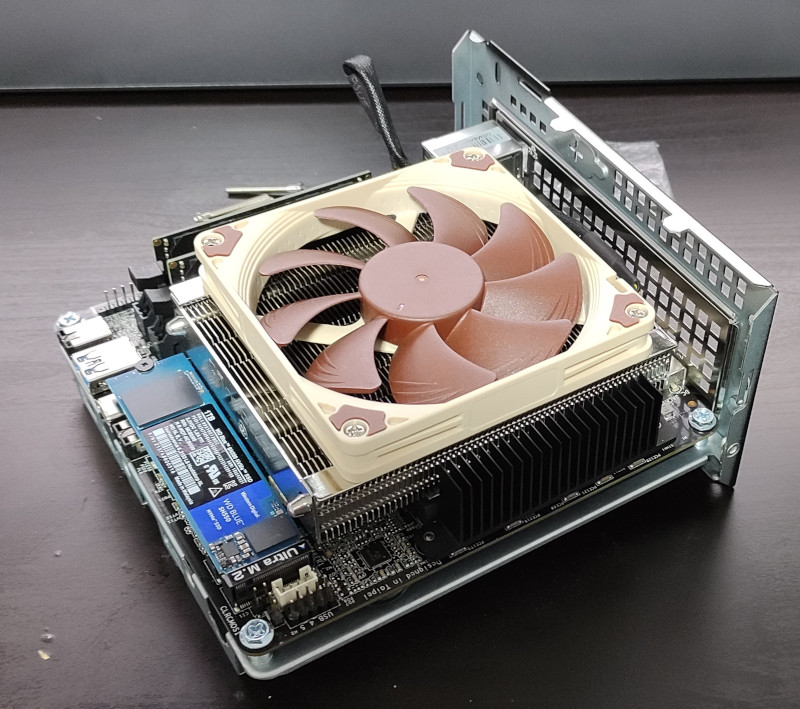
ASRock DeskMini X300 It s been over 20 months since the first COVID lockdown kicked in here in Northern Ireland and I started working from home. Even when the strict lockdown was lifted the advice here has continued to be If you can work from home you should work from home . I ve been into the office here and there (for new starts given you need to hand over a laptop and sort out some login details it s generally easier to do so in person, and I ve had a couple of whiteboard sessions that needed the high bandwidth face to face communication), but day to day is all from home. Early on I commented that work had taken over my study. This has largely continued to be true. I set my work laptop on the stand on a Monday morning and it sits there until Friday evening, when it gets switched for the personal laptop. I have a lovely LG 34UM88 21:9 Ultrawide monitor, and my laptops are small and light so I much prefer to use them docked. Also my general working pattern is to have a lot of external connections up and running (build machine, test devices, log host) which means a suspend/resume cycle disrupts things. So I like to minimise moving things about. I spent a little bit of time trying to find a dual laptop stand so I could have both machines setup and switch between them easily, but I didn t find anything that didn t seem to be geared up for DJs with a mixer + laptop combo taking up quite a bit of desk space rather than stacking laptops vertically. Eventually I realised that the right move was probably a desktop machine. Now, I haven t had a desktop machine since before I moved to the US, realising at the time that having everything on my laptop was much more convenient. I decided I didn t want something too big and noisy. Cheap GPUs seem hard to get hold of these days - I m not a gamer so all I need is something that can drive a ~ 4K monitor reliably enough. Looking around the AMD Ryzen 7 5700G seemed to be a decent CPU with one of the better integrated GPUs. I spent some time looking for a reasonable Mini-ITX case + motherboard and then I happened upon the ASRock DeskMini X300. This turns out to be perfect; I ve no need for a PCIe slot or anything more than an m.2 SSD. I paired it with a Noctua NH-L9a-AM4 heatsink + fan (same as I use in the house server), 32GB DDR4 and a 1TB WD SN550 NVMe SSD. Total cost just under 650 inc VAT + delivery (and that s a story for another post). A desktop solves the problem of fitting both machines on the desk at once, but there s still the question of smoothly switching between them. I read Evgeni Golov s article on a simple KVM switch for 30. My monitor has multiple inputs, so that s sorted. I did have a cheap USB2 switch (all I need for the keyboard/trackball) but it turned out to be pretty unreliable at the host detecting the USB change. I bought a UGREEN USB 3.0 Sharing Switch Box instead and it s turned out to be pretty reliable. The problem is that the LG 32UM88 turns out to have a poor DDC implementation, so while I can flip the keyboard easily with the UGREEN box I also have to manually select the monitor input. Which is a bit annoying, but not terrible. The important question is whether this has helped. I built all this at the end of October, so I ve had a month to play with it. Turns out I should have done it at some point last year. At the end of the day instead of either sitting at work for a bit longer, or completely avoiding the study, I m able to lock the work machine and flick to my personal setup. Even sitting in the same seat that disconnect , and the knowledge I won t see work Slack messages or emails come in and feeling I should respond, really helps. It also means I have access to my personal setup during the week without incurring a hit at the start of the working day when I have to set things up again. So it s much easier to just dip in to some personal tech stuff in the evening than it was previously. Also from the point of view I don t need to setup the personal config, I can pick up where I left off. All of which is really nice. It s also got me thinking about other minor improvements I should make to my home working environment to try and improve things. One obvious thing now the winter is here again is to improve my lighting; I have a good overhead LED panel but it s terribly positioned for video calls, being just behind me. So I think I m looking some sort of strip light I can have behind the large monitor to give a decent degree of backlight (possibly bouncing off the white wall). Lots of cheap options I m not convinced about, and I ve had a few ridiculously priced options from photographer friends; suggestions welcome.

21 November 2021

Antoine Beaupr : mbsync vs OfflineIMAP

After recovering from my latest email crash (previously, previously), I had to figure out which tool I should be using. I had many options but I figured I would start with a popular one (mbsync). But I also evaluated OfflineIMAP which was resurrected from the Python 2 apocalypse, and because I had used it before, for a long time. Read on for the details.

Benchmark setup All programs were tested against a Dovecot 1:2.3.13+dfsg1-2 server, running Debian bullseye. The client is a Purism 13v4 laptop with a Samsung SSD 970 EVO 1TB NVMe drive. The server is a custom build with a AMD Ryzen 5 2600 CPU, and a RAID-1 array made of two NVMe drives (Intel SSDPEKNW010T8 and WDC WDS100T2B0C). The mail spool I am testing against has almost 400k messages and takes 13GB of disk space:
$ notmuch count --exclude=false
372758
$ du -sh --exclude xapian Maildir
13G Maildir
The baseline we are comparing against is SMD (syncmaildir) which performs the sync in about 7-8 seconds locally (3.5 seconds for each push/pull command) and about 10-12 seconds remotely. Anything close to that or better is good enough. I do not have recent numbers for a SMD full sync baseline, but the setup documentation mentions 20 minutes for a full sync. That was a few years ago, and the spool has obviously grown since then, so that is not a reliable baseline. A baseline for a full sync might be also set with rsync, which copies files at nearly 40MB/s, or 317Mb/s!
anarcat@angela:tmp(main)$ time rsync -a --info=progress2 --exclude xapian  shell.anarc.at:Maildir/ Maildir/
 12,647,814,731 100%   37.85MB/s    0:05:18 (xfr#394981, to-chk=0/395815)    
72.38user 106.10system 5:19.59elapsed 55%CPU (0avgtext+0avgdata 15988maxresident)k
8816inputs+26305112outputs (0major+50953minor)pagefaults 0swaps
That is 5 minutes to transfer the entire spool. Incremental syncs are obviously pretty fast too:
anarcat@angela:tmp(main)$ time rsync -a --info=progress2 --exclude xapian  shell.anarc.at:Maildir/ Maildir/
              0   0%    0.00kB/s    0:00:00 (xfr#0, to-chk=0/395815)    
1.42user 0.81system 0:03.31elapsed 67%CPU (0avgtext+0avgdata 14100maxresident)k
120inputs+0outputs (3major+12709minor)pagefaults 0swaps
As an extra curiosity, here's the performance with tar, pretty similar with rsync, minus incremental which I cannot be bothered to figure out right now:
anarcat@angela:tmp(main)$ time ssh shell.anarc.at tar --exclude xapian -cf - Maildir/   pv -s 13G   tar xf - 
56.68user 58.86system 5:17.08elapsed 36%CPU (0avgtext+0avgdata 8764maxresident)k
0inputs+0outputs (0major+7266minor)pagefaults 0swaps
12,1GiO 0:05:17 [39,0MiB/s] [===================================================================> ] 92%
Interesting that rsync manages to almost beat a plain tar on file transfer, I'm actually surprised by how well it performs here, considering there are many little files to transfer. (But then again, this maybe is exactly where rsync shines: while tar needs to glue all those little files together, rsync can just directly talk to the other side and tell it to do live changes. Something to look at in another article maybe?) Since both ends are NVMe drives, those should easily saturate a gigabit link. And in fact, a backup of the server mail spool achieves much faster transfer rate on disks:
anarcat@marcos:~$ tar fc - Maildir   pv -s 13G > Maildir.tar
15,0GiO 0:01:57 [ 131MiB/s] [===================================] 115%
That's 131Mibyyte per second, vastly faster than the gigabit link. The client has similar performance:
anarcat@angela:~(main)$ tar fc - Maildir   pv -s 17G > Maildir.tar
16,2GiO 0:02:22 [ 116MiB/s] [==================================] 95%
So those disks should be able to saturate a gigabit link, and they are not the bottleneck on fast links. Which begs the question of what is blocking performance of a similar transfer over the gigabit link, but that's another question altogether, because no sync program ever reaches the above performance anyways. Finally, note that when I migrated to SMD, I wrote a small performance comparison that could be interesting here. It show SMD to be faster than OfflineIMAP, but not as much as we see here. In fact, it looks like OfflineIMAP slowed down significantly since then (May 2018), but this could be due to my larger mail spool as well.

mbsync The isync (AKA mbsync) project is written in C and supports syncing Maildir and IMAP folders, with possibly multiple replicas. I haven't tested this but I suspect it might be possible to sync between two IMAP servers as well. It supports partial mirorrs, message flags, full folder support, and "trash" functionality.

Complex configuration file I started with this .mbsyncrc configuration file:
SyncState *
Sync New ReNew Flags
IMAPAccount anarcat
Host imap.anarc.at
User anarcat
PassCmd "pass imap.anarc.at"
SSLType IMAPS
CertificateFile /etc/ssl/certs/ca-certificates.crt
IMAPStore anarcat-remote
Account anarcat
MaildirStore anarcat-local
# Maildir/top/sub/sub
#SubFolders Verbatim
# Maildir/.top.sub.sub
SubFolders Maildir++
# Maildir/top/.sub/.sub
# SubFolders legacy
# The trailing "/" is important
#Path ~/Maildir-mbsync/
Inbox ~/Maildir-mbsync/
Channel anarcat
# AKA Far, convert when all clients are 1.4+
Master :anarcat-remote:
# AKA Near
Slave :anarcat-local:
# Exclude everything under the internal [Gmail] folder, except the interesting folders
#Patterns * ![Gmail]* "[Gmail]/Sent Mail" "[Gmail]/Starred" "[Gmail]/All Mail"
# Or include everything
Patterns *
# Automatically create missing mailboxes, both locally and on the server
#Create Both
Create slave
# Sync the movement of messages between folders and deletions, add after making sure the sync works
#Expunge Both
Long gone are the days where I would spend a long time reading a manual page to figure out the meaning of every option. If that's your thing, you might like this one. But I'm more of a "EXAMPLES section" kind of person now, and I somehow couldn't find a sample file on the website. I started from the Arch wiki one but it's actually not great because it's made for Gmail (which is not a usual Dovecot server). So a sample config file in the manpage would be a great addition. Thankfully, the Debian packages ships one in /usr/share/doc/isync/examples/mbsyncrc.sample but I only found that after I wrote my configuration. It was still useful and I recommend people take a look if they want to understand the syntax. Also, that syntax is a little overly complicated. For example, Far needs colons, like:
Far :anarcat-remote:
Why? That seems just too complicated. I also found that sections are not clearly identified: IMAPAccount and Channel mark section beginnings, for example, which is not at all obvious until you learn about mbsync's internals. There are also weird ordering issues: the SyncState option needs to be before IMAPAccount, presumably because it's global. Using a more standard format like .INI or TOML could improve that situation.

Stellar performance A transfer of the entire mail spool takes 56 minutes and 6 seconds, which is impressive. It's not quite "line rate": the resulting mail spool was 12GB (which is a problem, see below), which turns out to be about 29Mbit/s and therefore not maxing the gigabit link, and an order of magnitude slower than rsync. The incremental runs are roughly 2 seconds, which is even more impressive, as that's actually faster than rsync:
===> multitime results
1: mbsync -a
            Mean        Std.Dev.    Min         Median      Max
real        2.015       0.052       1.930       2.029       2.105       
user        0.660       0.040       0.592       0.661       0.722       
sys         0.338       0.033       0.268       0.341       0.387    
Those tests were performed with isync 1.3.0-2.2 on Debian bullseye. Tests with a newer isync release originally failed because of a corrupted message that triggered bug 999804 (see below). Running 1.4.3 under valgrind works around the bug, but adds a 50% performance cost, the full sync running in 1h35m. Once the upstream patch is applied, performance with 1.4.3 is fairly similar, considering that the new sync included the register folder with 4000 messages:
120.74user 213.19system 59:47.69elapsed 9%CPU (0avgtext+0avgdata 105420maxresident)k
29128inputs+28284376outputs (0major+45711minor)pagefaults 0swaps
That is ~13GB in ~60 minutes, which gives us 28.3Mbps. Incrementals are also pretty similar to 1.3.x, again considering the double-connect cost:
===> multitime results
1: mbsync -a
            Mean        Std.Dev.    Min         Median      Max
real        2.500       0.087       2.340       2.491       2.629       
user        0.718       0.037       0.679       0.711       0.793       
sys         0.322       0.024       0.284       0.320       0.365
Those tests were all done on a Gigabit link, but what happens on a slower link? My server uplink is slow: 25 Mbps down, 6 Mbps up. There mbsync is worse than the SMD baseline:
===> multitime results
1: mbsync -a
Mean        Std.Dev.    Min         Median      Max
real        31.531      0.724       30.764      31.271      33.100      
user        1.858       0.125       1.721       1.818       2.131       
sys         0.610       0.063       0.506       0.600       0.695       
That's 30 seconds for a sync, which is an order of magnitude slower than SMD.

Great user interface Compared to OfflineIMAP and (ahem) SMD, the mbsync UI is kind of neat:
anarcat@angela:~(main)$ mbsync -a
Notice: Master/Slave are deprecated; use Far/Near instead.
C: 1/2  B: 204/205  F: +0/0 *0/0 #0/0  N: +1/200 *0/0 #0/0
(Note that nice switch away from slavery-related terms too.) The display is minimal, and yet informative. It's not obvious what does mean at first glance, but the manpage is useful at least for clarifying that:
This represents the cumulative progress over channels, boxes, and messages affected on the far and near side, respectively. The message counts represent added messages, messages with updated flags, and trashed messages, respectively. No attempt is made to calculate the totals in advance, so they grow over time as more information is gathered. (Emphasis mine).
In other words:
  • C 2/2: channels done/total (2 done out of 2)
  • B 204/205: mailboxes done/total (204 out of 205)
  • F: changes on the far side
  • N: +10/200 *0/0 #0/0: changes on the "near" side:
    • +10/200: 10 out of 200 messages downloaded
    • *0/0: no flag changed
    • #0/0: no message deleted
You get used to it, in a good way. It does not, unfortunately, show up when you run it in systemd, which is a bit annoying as I like to see a summary mail traffic in the logs.

Interoperability issue In my notmuch setup, I have bound key S to "mark spam", which basically assigns the tag spam to the message and removes a bunch of others. Then I have a notmuch-purge script which moves that message to the spam folder, for training purposes. It basically does this:
notmuch search --output=files --format=text0 "$search_spam" \
      xargs -r -0 mv -t "$HOME/Maildir/$ PREFIX junk/cur/"
This method, which worked fine in SMD (and also OfflineIMAP) created this error on sync:
Maildir error: duplicate UID 37578.
And indeed, there are now two messages with that UID in the mailbox:
anarcat@angela:~(main)$ find Maildir/.junk/ -name '*U=37578*'
Maildir/.junk/cur/1637427889.134334_2.angela,U=37578:2,S
Maildir/.junk/cur/1637348602.2492889_221804.angela,U=37578:2,S
This is actually a known limitation or, as mbsync(1) calls it, a "RECOMMENDATION":
When using the more efficient default UID mapping scheme, it is important that the MUA renames files when moving them between Maildir fold ers. Mutt always does that, while mu4e needs to be configured to do it:
(setq mu4e-change-filenames-when-moving t)
So it seems I would need to fix my script. It's unclear how the paths should be renamed, which is unfortunate, because I would need to change my script to adapt to mbsync, but I can't tell how just from reading the above. (A manual fix is actually to rename the file to remove the U= field: mbsync will generate a new one and then sync correctly.) Fortunately, someone else already fixed that issue: afew, a notmuch tagging script (much puns, such hurt), has a move mode that can rename files correctly, specifically designed to deal with mbsync. I had already been told about afew, but it's one more reason to standardize my notmuch hooks on that project, it looks like. Update: I have tried to use afew and found it has significant performance issues. It also has a completely different paradigm to what I am used to: it assumes all incoming mail has a new and lays its own tags on top of that (inbox, sent, etc). It can only move files from one folder at a time (see this bug) which breaks my spam training workflow. In general, I sync my tags into folders (e.g. ham, spam, sent) and message flags (e.g. inbox is F, unread is "not S", etc), and afew is not well suited for this (although there are hacks that try to fix this). I have worked hard to make my tagging scripts idempotent, and it's something afew doesn't currently have. Still, it would be better to have that code in Python than bash, so maybe I should consider my options here.

Stability issues The newer release in Debian bookworm (currently at 1.4.3) has stability issues on full sync. I filed bug 999804 in Debian about this, which lead to a thread on the upstream mailing list. I have found at least three distinct crashes that could be double-free bugs "which might be exploitable in the worst case", not a reassuring prospect. The thing is: mbsync is really fast, but the downside of that is that it's written in C, and with that comes a whole set of security issues. The Debian security tracker has only three CVEs on isync, but the above issues show there could be many more. Reading the source code certainly did not make me very comfortable with trusting it with untrusted data. I considered sandboxing it with systemd (below) but having systemd run as a --user process makes that difficult. I also considered using an apparmor profile but that is not trivial because we need to allow SSH and only some parts of it... Thankfully, upstream has been diligent at addressing the issues I have found. They provided a patch within a few days which did fix the sync issues. Update: upstream actually took the issue very seriously. They not only got CVE-2021-44143 assigned for my bug report, they also audited the code and found several more issues collectively identified as CVE-2021-3657, which actually also affect 1.3 (ie. Debian 11/bullseye/stable). Somehow my corpus doesn't trigger that issue, but it was still considered serious enough to warrant a CVE. So one the one hand: excellent response from upstream; but on the other hand: how many more of those could there be in there?

Automation with systemd The Arch wiki has instructions on how to setup mbsync as a systemd service. It suggests using the --verbose (-V) flag which is a little intense here, as it outputs 1444 lines of messages. I have used the following .service file:
[Unit]
Description=Mailbox synchronization service
ConditionHost=!marcos
Wants=network-online.target
After=network-online.target
Before=notmuch-new.service
[Service]
Type=oneshot
ExecStart=/usr/bin/mbsync -a
Nice=10
IOSchedulingClass=idle
NoNewPrivileges=true
[Install]
WantedBy=default.target
And the following .timer:
[Unit]
Description=Mailbox synchronization timer
ConditionHost=!marcos
[Timer]
OnBootSec=2m
OnUnitActiveSec=5m
Unit=mbsync.service
[Install]
WantedBy=timers.target
Note that we trigger notmuch through systemd, with the Before and also by adding mbsync.service to the notmuch-new.service file:
[Unit]
Description=notmuch new
After=mbsync.service
[Service]
Type=oneshot
Nice=10
ExecStart=/usr/bin/notmuch new
[Install]
WantedBy=mbsync.service
An improvement over polling repeatedly with a .timer would be to wake up only on IMAP notify, but neither imapnotify nor goimapnotify seem to be packaged in Debian. It would also not cover for the "sent folder" use case, where we need to wake up on local changes.

Password-less setup The sample file suggests this should work:
IMAPStore remote
Tunnel "ssh -q host.remote.com /usr/sbin/imapd"
Add BatchMode, restrict to IdentitiesOnly, provide a password-less key just for this, add compression (-C), find the Dovecot imap binary, and you get this:
IMAPAccount anarcat-tunnel
Tunnel "ssh -o BatchMode=yes -o IdentitiesOnly=yes -i ~/.ssh/id_ed25519_mbsync -o HostKeyAlias=shell.anarc.at -C anarcat@imap.anarc.at /usr/lib/dovecot/imap"
And it actually seems to work:
$ mbsync -a
Notice: Master/Slave are deprecated; use Far/Near instead.
C: 0/2  B: 0/1  F: +0/0 *0/0 #0/0  N: +0/0 *0/0 #0/0imap(anarcat): Error: net_connect_unix(/run/dovecot/stats-writer) failed: Permission denied
C: 2/2  B: 205/205  F: +0/0 *0/0 #0/0  N: +1/1 *3/3 #0/0imap(anarcat)<1611280><90uUOuyElmEQlhgAFjQyWQ>: Info: Logged out in=10808 out=15396642 deleted=0 expunged=0 trashed=0 hdr_count=0 hdr_bytes=0 body_count=1 body_bytes=8087
It's a bit noisy, however. dovecot/imap doesn't have a "usage" to speak of, but even the source code doesn't hint at a way to disable that Error message, so that's unfortunate. That socket is owned by root:dovecot so presumably Dovecot runs the imap process as $user:dovecot, which we can't do here. Oh well? Interestingly, the SSH setup is not faster than IMAP. With IMAP:
===> multitime results
1: mbsync -a
            Mean        Std.Dev.    Min         Median      Max
real        2.367       0.065       2.220       2.376       2.458       
user        0.793       0.047       0.731       0.776       0.871       
sys         0.426       0.040       0.364       0.434       0.476
With SSH:
===> multitime results
1: mbsync -a
            Mean        Std.Dev.    Min         Median      Max
real        2.515       0.088       2.274       2.532       2.594       
user        0.753       0.043       0.645       0.766       0.804       
sys         0.328       0.045       0.212       0.340       0.393
Basically: 200ms slower. Tolerable.

Migrating from SMD The above was how I migrated to mbsync on my first workstation. The work on the second one was more streamlined, especially since the corruption on mailboxes was fixed:
  1. install isync, with the patch:
    dpkg -i isync_1.4.3-1.1~_amd64.deb
    
  2. copy all files over from previous workstation to avoid a full resync (optional):
    rsync -a --info=progress2 angela:Maildir/ Maildir-mbsync/
    
  3. rename all files to match new hostname (optional):
    find Maildir-mbsync/ -type f -name '*.angela,*' -print0    rename -0 's/\.angela,/\.curie,/'
    
  4. trash the notmuch database (optional):
    rm -rf Maildir-mbsync/.notmuch/xapian/
    
  5. disable all smd and notmuch services:
    systemctl --user --now disable smd-pull.service smd-pull.timer smd-push.service smd-push.timer notmuch-new.service notmuch-new.timer
    
  6. do one last sync with smd:
    smd-pull --show-tags ; smd-push --show-tags ; notmuch new ; notmuch-sync-flagged -v
    
  7. backup notmuch on the client and server:
    notmuch dump   pv > notmuch.dump
    
  8. backup the maildir on the client and server:
    cp -al Maildir Maildir-bak
    
  9. create the SSH key:
    ssh-keygen -t ed25519 -f .ssh/id_ed25519_mbsync
    cat .ssh/id_ed25519_mbsync.pub
    
  10. add to .ssh/authorized_keys on the server, like this: command="/usr/lib/dovecot/imap",restrict ssh-ed25519 AAAAC...
  11. move old files aside, if present:
    mv Maildir Maildir-smd
    
  12. move new files in place (CRITICAL SECTION BEGINS!):
    mv Maildir-mbsync Maildir
    
  13. run a test sync, only pulling changes: mbsync --create-near --remove-none --expunge-none --noop anarcat-register
  14. if that works well, try with all mailboxes: mbsync --create-near --remove-none --expunge-none --noop -a
  15. if that works well, try again with a full sync: mbsync register mbsync -a
  16. reindex and restore the notmuch database, this should take ~25 minutes:
    notmuch new
    pv notmuch.dump   notmuch restore
    
  17. enable the systemd services and retire the smd-* services: systemctl --user enable mbsync.timer notmuch-new.service systemctl --user start mbsync.timer rm ~/.config/systemd/user/smd* systemctl daemon-reload
During the migration, notmuch helpfully told me the full list of those lost messages:
[...]
Warning: cannot apply tags to missing message: CAN6gO7_QgCaiDFvpG3AXHi6fW12qaN286+2a7ERQ2CQtzjSEPw@mail.gmail.com
Warning: cannot apply tags to missing message: CAPTU9Wmp0yAmaxO+qo8CegzRQZhCP853TWQ_Ne-YF94MDUZ+Dw@mail.gmail.com
Warning: cannot apply tags to missing message: F5086003-2917-4659-B7D2-66C62FCD4128@gmail.com
[...]
Warning: cannot apply tags to missing message: mailman.2.1316793601.53477.sage-members@mailman.sage.org
Warning: cannot apply tags to missing message: mailman.7.1317646801.26891.outages-discussion@outages.org
Warning: cannot apply tags to missing message: notmuch-sha1-000458df6e48d4857187a000d643ac971deeef47
Warning: cannot apply tags to missing message: notmuch-sha1-0079d8e0c3340e6f88c66f4c49fca758ea71d06d
Warning: cannot apply tags to missing message: notmuch-sha1-0194baa4cfb6d39bc9e4d8c049adaccaa777467d
Warning: cannot apply tags to missing message: notmuch-sha1-02aede494fc3f9e9f060cfd7c044d6d724ad287c
Warning: cannot apply tags to missing message: notmuch-sha1-06606c625d3b3445420e737afd9a245ae66e5562
Warning: cannot apply tags to missing message: notmuch-sha1-0747b020f7551415b9bf5059c58e0a637ba53b13
[...]
As detailed in the crash report, all of those were actually innocuous and could be ignored. Also note that we completely trash the notmuch database because it's actually faster to reindex from scratch than let notmuch slowly figure out that all mails are new and all the old mails are gone. The fresh indexing took:
nov 19 15:08:54 angela notmuch[2521117]: Processed 384679 total files in 23m 41s (270 files/sec.).
nov 19 15:08:54 angela notmuch[2521117]: Added 372610 new messages to the database.
While a reindexing on top of an existing database was going twice as slow, at about 120 files/sec.

Current config file Putting it all together, I ended up with the following configuration file:
SyncState *
Sync All
# IMAP side, AKA "Far"
IMAPAccount anarcat-imap
Host imap.anarc.at
User anarcat
PassCmd "pass imap.anarc.at"
SSLType IMAPS
CertificateFile /etc/ssl/certs/ca-certificates.crt
IMAPAccount anarcat-tunnel
Tunnel "ssh -o BatchMode=yes -o IdentitiesOnly=yes -i ~/.ssh/id_ed25519_mbsync -o HostKeyAlias=shell.anarc.at -C anarcat@imap.anarc.at /usr/lib/dovecot/imap"
IMAPStore anarcat-remote
Account anarcat-tunnel
# Maildir side, AKA "Near"
MaildirStore anarcat-local
# Maildir/top/sub/sub
#SubFolders Verbatim
# Maildir/.top.sub.sub
SubFolders Maildir++
# Maildir/top/.sub/.sub
# SubFolders legacy
# The trailing "/" is important
#Path ~/Maildir-mbsync/
Inbox ~/Maildir/
# what binds Maildir and IMAP
Channel anarcat
Far :anarcat-remote:
Near :anarcat-local:
# Exclude everything under the internal [Gmail] folder, except the interesting folders
#Patterns * ![Gmail]* "[Gmail]/Sent Mail" "[Gmail]/Starred" "[Gmail]/All Mail"
# Or include everything
#Patterns *
Patterns * !register  !.register
# Automatically create missing mailboxes, both locally and on the server
Create Both
#Create Near
# Sync the movement of messages between folders and deletions, add after making sure the sync works
Expunge Both
# Propagate mailbox deletion
Remove both
IMAPAccount anarcat-register-imap
Host imap.anarc.at
User register
PassCmd "pass imap.anarc.at-register"
SSLType IMAPS
CertificateFile /etc/ssl/certs/ca-certificates.crt
IMAPAccount anarcat-register-tunnel
Tunnel "ssh -o BatchMode=yes -o IdentitiesOnly=yes -i ~/.ssh/id_ed25519_mbsync -o HostKeyAlias=shell.anarc.at -C register@imap.anarc.at /usr/lib/dovecot/imap"
IMAPStore anarcat-register-remote
Account anarcat-register-tunnel
MaildirStore anarcat-register-local
SubFolders Maildir++
Inbox ~/Maildir/.register/
Channel anarcat-register
Far :anarcat-register-remote:
Near :anarcat-register-local:
Create Both
Expunge Both
Remove both
Note that it may be out of sync with my live (and private) configuration file, as I do not publish my "dotfiles" repository publicly for security reasons.

OfflineIMAP I've used OfflineIMAP for a long time before switching to SMD. I don't exactly remember why or when I started using it, but I do remember it became painfully slow as I started using notmuch, and would sometimes crash mysteriously. It's been a while, so my memory is hazy on that. It also kind of died in a fire when Python 2 stop being maintained. The main author moved on to a different project, imapfw which could serve as a framework to build IMAP clients, but never seemed to implement all of the OfflineIMAP features and certainly not configuration file compatibility. Thankfully, a new team of volunteers ported OfflineIMAP to Python 3 and we can now test that new version to see if it is an improvement over mbsync.

Crash on full sync The first thing that happened on a full sync is this crash:
Copy message from RemoteAnarcat:junk:
 ERROR: Copying message 30624 [acc: Anarcat]
  decoding with 'X-EUC-TW' codec failed (AttributeError: 'memoryview' object has no attribute 'decode')
Thread 'Copy message from RemoteAnarcat:junk' terminated with exception:
Traceback (most recent call last):
  File "/usr/share/offlineimap3/offlineimap/imaputil.py", line 406, in utf7m_decode
    for c in binary.decode():
AttributeError: 'memoryview' object has no attribute 'decode'
The above exception was the direct cause of the following exception:
Traceback (most recent call last):
  File "/usr/share/offlineimap3/offlineimap/threadutil.py", line 146, in run
    Thread.run(self)
  File "/usr/lib/python3.9/threading.py", line 892, in run
    self._target(*self._args, **self._kwargs)
  File "/usr/share/offlineimap3/offlineimap/folder/Base.py", line 802, in copymessageto
    message = self.getmessage(uid)
  File "/usr/share/offlineimap3/offlineimap/folder/IMAP.py", line 342, in getmessage
    data = self._fetch_from_imap(str(uid), self.retrycount)
  File "/usr/share/offlineimap3/offlineimap/folder/IMAP.py", line 908, in _fetch_from_imap
    ndata1 = self.parser['8bit-RFC'].parsebytes(data[0][1])
  File "/usr/lib/python3.9/email/parser.py", line 123, in parsebytes
    return self.parser.parsestr(text, headersonly)
  File "/usr/lib/python3.9/email/parser.py", line 67, in parsestr
    return self.parse(StringIO(text), headersonly=headersonly)
  File "/usr/lib/python3.9/email/parser.py", line 56, in parse
    feedparser.feed(data)
  File "/usr/lib/python3.9/email/feedparser.py", line 176, in feed
    self._call_parse()
  File "/usr/lib/python3.9/email/feedparser.py", line 180, in _call_parse
    self._parse()
  File "/usr/lib/python3.9/email/feedparser.py", line 385, in _parsegen
    for retval in self._parsegen():
  File "/usr/lib/python3.9/email/feedparser.py", line 298, in _parsegen
    for retval in self._parsegen():
  File "/usr/lib/python3.9/email/feedparser.py", line 385, in _parsegen
    for retval in self._parsegen():
  File "/usr/lib/python3.9/email/feedparser.py", line 256, in _parsegen
    if self._cur.get_content_type() == 'message/delivery-status':
  File "/usr/lib/python3.9/email/message.py", line 578, in get_content_type
    value = self.get('content-type', missing)
  File "/usr/lib/python3.9/email/message.py", line 471, in get
    return self.policy.header_fetch_parse(k, v)
  File "/usr/lib/python3.9/email/policy.py", line 163, in header_fetch_parse
    return self.header_factory(name, value)
  File "/usr/lib/python3.9/email/headerregistry.py", line 601, in __call__
    return self[name](name, value)
  File "/usr/lib/python3.9/email/headerregistry.py", line 196, in __new__
    cls.parse(value, kwds)
  File "/usr/lib/python3.9/email/headerregistry.py", line 445, in parse
    kwds['parse_tree'] = parse_tree = cls.value_parser(value)
  File "/usr/lib/python3.9/email/_header_value_parser.py", line 2675, in parse_content_type_header
    ctype.append(parse_mime_parameters(value[1:]))
  File "/usr/lib/python3.9/email/_header_value_parser.py", line 2569, in parse_mime_parameters
    token, value = get_parameter(value)
  File "/usr/lib/python3.9/email/_header_value_parser.py", line 2492, in get_parameter
    token, value = get_value(value)
  File "/usr/lib/python3.9/email/_header_value_parser.py", line 2403, in get_value
    token, value = get_quoted_string(value)
  File "/usr/lib/python3.9/email/_header_value_parser.py", line 1294, in get_quoted_string
    token, value = get_bare_quoted_string(value)
  File "/usr/lib/python3.9/email/_header_value_parser.py", line 1223, in get_bare_quoted_string
    token, value = get_encoded_word(value)
  File "/usr/lib/python3.9/email/_header_value_parser.py", line 1064, in get_encoded_word
    text, charset, lang, defects = _ew.decode('=?' + tok + '?=')
  File "/usr/lib/python3.9/email/_encoded_words.py", line 181, in decode
    string = bstring.decode(charset)
AttributeError: decoding with 'X-EUC-TW' codec failed (AttributeError: 'memoryview' object has no attribute 'decode')
Last 1 debug messages logged for Copy message from RemoteAnarcat:junk prior to exception:
thread: Register new thread 'Copy message from RemoteAnarcat:junk' (account 'Anarcat')
ERROR: Exceptions occurred during the run!
ERROR: Copying message 30624 [acc: Anarcat]
  decoding with 'X-EUC-TW' codec failed (AttributeError: 'memoryview' object has no attribute 'decode')
Traceback:
  File "/usr/share/offlineimap3/offlineimap/folder/Base.py", line 802, in copymessageto
    message = self.getmessage(uid)
  File "/usr/share/offlineimap3/offlineimap/folder/IMAP.py", line 342, in getmessage
    data = self._fetch_from_imap(str(uid), self.retrycount)
  File "/usr/share/offlineimap3/offlineimap/folder/IMAP.py", line 908, in _fetch_from_imap
    ndata1 = self.parser['8bit-RFC'].parsebytes(data[0][1])
  File "/usr/lib/python3.9/email/parser.py", line 123, in parsebytes
    return self.parser.parsestr(text, headersonly)
  File "/usr/lib/python3.9/email/parser.py", line 67, in parsestr
    return self.parse(StringIO(text), headersonly=headersonly)
  File "/usr/lib/python3.9/email/parser.py", line 56, in parse
    feedparser.feed(data)
  File "/usr/lib/python3.9/email/feedparser.py", line 176, in feed
    self._call_parse()
  File "/usr/lib/python3.9/email/feedparser.py", line 180, in _call_parse
    self._parse()
  File "/usr/lib/python3.9/email/feedparser.py", line 385, in _parsegen
    for retval in self._parsegen():
  File "/usr/lib/python3.9/email/feedparser.py", line 298, in _parsegen
    for retval in self._parsegen():
  File "/usr/lib/python3.9/email/feedparser.py", line 385, in _parsegen
    for retval in self._parsegen():
  File "/usr/lib/python3.9/email/feedparser.py", line 256, in _parsegen
    if self._cur.get_content_type() == 'message/delivery-status':
  File "/usr/lib/python3.9/email/message.py", line 578, in get_content_type
    value = self.get('content-type', missing)
  File "/usr/lib/python3.9/email/message.py", line 471, in get
    return self.policy.header_fetch_parse(k, v)
  File "/usr/lib/python3.9/email/policy.py", line 163, in header_fetch_parse
    return self.header_factory(name, value)
  File "/usr/lib/python3.9/email/headerregistry.py", line 601, in __call__
    return self[name](name, value)
  File "/usr/lib/python3.9/email/headerregistry.py", line 196, in __new__
    cls.parse(value, kwds)
  File "/usr/lib/python3.9/email/headerregistry.py", line 445, in parse
    kwds['parse_tree'] = parse_tree = cls.value_parser(value)
  File "/usr/lib/python3.9/email/_header_value_parser.py", line 2675, in parse_content_type_header
    ctype.append(parse_mime_parameters(value[1:]))
  File "/usr/lib/python3.9/email/_header_value_parser.py", line 2569, in parse_mime_parameters
    token, value = get_parameter(value)
  File "/usr/lib/python3.9/email/_header_value_parser.py", line 2492, in get_parameter
    token, value = get_value(value)
  File "/usr/lib/python3.9/email/_header_value_parser.py", line 2403, in get_value
    token, value = get_quoted_string(value)
  File "/usr/lib/python3.9/email/_header_value_parser.py", line 1294, in get_quoted_string
    token, value = get_bare_quoted_string(value)
  File "/usr/lib/python3.9/email/_header_value_parser.py", line 1223, in get_bare_quoted_string
    token, value = get_encoded_word(value)
  File "/usr/lib/python3.9/email/_header_value_parser.py", line 1064, in get_encoded_word
    text, charset, lang, defects = _ew.decode('=?' + tok + '?=')
  File "/usr/lib/python3.9/email/_encoded_words.py", line 181, in decode
    string = bstring.decode(charset)
Folder junk [acc: Anarcat]:
 Copy message UID 30626 (29008/49310) RemoteAnarcat:junk -> LocalAnarcat:junk
Command exited with non-zero status 100
5252.91user 535.86system 3:21:00elapsed 47%CPU (0avgtext+0avgdata 846304maxresident)k
96344inputs+26563792outputs (1189major+2155815minor)pagefaults 0swaps
That only transferred about 8GB of mail, which gives us a transfer rate of 5.3Mbit/s, more than 5 times slower than mbsync. This bug is possibly limited to the bullseye version of offlineimap3 (the lovely 0.0~git20210225.1e7ef9e+dfsg-4), while the current sid version (the equally gorgeous 0.0~git20211018.e64c254+dfsg-1) seems unaffected.

Tolerable performance The new release still crashes, except it does so at the very end, which is an improvement, since the mails do get transferred:
 *** Finished account 'Anarcat' in 511:12
ERROR: Exceptions occurred during the run!
ERROR: Exception parsing message with ID (<20190619152034.BFB8810E07A@marcos.anarc.at>) from imaplib (response type: bytes).
 AttributeError: decoding with 'X-EUC-TW' codec failed (AttributeError: 'memoryview' object has no attribute 'decode')
Traceback:
  File "/usr/share/offlineimap3/offlineimap/folder/Base.py", line 810, in copymessageto
    message = self.getmessage(uid)
  File "/usr/share/offlineimap3/offlineimap/folder/IMAP.py", line 343, in getmessage
    data = self._fetch_from_imap(str(uid), self.retrycount)
  File "/usr/share/offlineimap3/offlineimap/folder/IMAP.py", line 910, in _fetch_from_imap
    raise OfflineImapError(
ERROR: Exception parsing message with ID (<40A270DB.9090609@alternatives.ca>) from imaplib (response type: bytes).
 AttributeError: decoding with 'x-mac-roman' codec failed (AttributeError: 'memoryview' object has no attribute 'decode')
Traceback:
  File "/usr/share/offlineimap3/offlineimap/folder/Base.py", line 810, in copymessageto
    message = self.getmessage(uid)
  File "/usr/share/offlineimap3/offlineimap/folder/IMAP.py", line 343, in getmessage
    data = self._fetch_from_imap(str(uid), self.retrycount)
  File "/usr/share/offlineimap3/offlineimap/folder/IMAP.py", line 910, in _fetch_from_imap
    raise OfflineImapError(
ERROR: IMAP server 'RemoteAnarcat' does not have a message with UID '32686'
Traceback:
  File "/usr/share/offlineimap3/offlineimap/folder/Base.py", line 810, in copymessageto
    message = self.getmessage(uid)
  File "/usr/share/offlineimap3/offlineimap/folder/IMAP.py", line 343, in getmessage
    data = self._fetch_from_imap(str(uid), self.retrycount)
  File "/usr/share/offlineimap3/offlineimap/folder/IMAP.py", line 889, in _fetch_from_imap
    raise OfflineImapError(reason, severity)
Command exited with non-zero status 1
8273.52user 983.80system 8:31:12elapsed 30%CPU (0avgtext+0avgdata 841936maxresident)k
56376inputs+43247608outputs (811major+4972914minor)pagefaults 0swaps
"offlineimap  -o " took 8 hours 31 mins 15 secs
This is 8h31m for transferring 12G, which is around 3.1Mbit/s. That is nine times slower than mbsync, almost an order of magnitude! Now that we have a full sync, we can test incremental synchronization. That is also much slower:
===> multitime results
1: sh -c "offlineimap -o   true"
            Mean        Std.Dev.    Min         Median      Max
real        24.639      0.513       23.946      24.526      25.708      
user        23.912      0.473       23.404      23.795      24.947      
sys         1.743       0.105       1.607       1.729       2.002
That is also an order of magnitude slower than mbsync, and significantly slower than what you'd expect from a sync process. ~30 seconds is long enough to make me impatient and distracted; 3 seconds, less so: I can wait and see the results almost immediately.

Integrity check That said: this is still on a gigabit link. It's technically possible that OfflineIMAP performs better than mbsync over a slow link, but I Haven't tested that theory. The OfflineIMAP mail spool is missing quite a few messages as well:
anarcat@angela:~(main)$ find Maildir-offlineimap -type f -type f -a \! -name '.*'   wc -l 
381463
anarcat@angela:~(main)$ find Maildir -type f -type f -a \! -name '.*'   wc -l 
385247
... although that's probably all either new messages or the register folder, so OfflineIMAP might actually be in a better position there. But digging in more, it seems like the actual per-folder diff is fairly similar to mbsync: a few messages missing here and there. Considering OfflineIMAP's instability and poor performance, I have not looked any deeper in those discrepancies.

Other projects to evaluate Those are all the options I have considered, in alphabetical order
  • doveadm-sync: requires dovecot on both ends, can tunnel over SSH, may have performance issues in incremental sync, written in C
  • fdm: fetchmail replacement, IMAP/POP3/stdin/Maildir/mbox,NNTP support, SOCKS support (for Tor), complex rules for delivering to specific mailboxes, adding headers, piping to commands, etc. discarded because no (real) support for keeping mail on the server, and written in C
  • getmail: fetchmail replacement, IMAP/POP3 support, supports incremental runs, classification rules, Python
  • interimap: syncs two IMAP servers, apparently faster than doveadm and offlineimap, but requires running an IMAP server locally, Perl
  • isync/mbsync: TLS client certs and SSH tunnels, fast, incremental, IMAP/POP/Maildir support, multiple mailbox, trash and recursion support, and generally has good words from multiple Debian and notmuch people (Arch tutorial), written in C, review above
  • mail-sync: notify support, happens over any piped transport (e.g. ssh), diff/patch system, requires binary on both ends, mentions UUCP in the manpage, mentions rsmtp which is a nice name for rsendmail. not evaluated because it seems awfully complex to setup, Haskell
  • nncp: treat the local spool as another mail server, not really compatible with my "multiple clients" setup, Golang
  • offlineimap3: requires IMAP, used the py2 version in the past, might just still work, first sync painful (IIRC), ways to tunnel over SSH, review above, Python
Most projects were not evaluated due to lack of time.

Conclusion I'm now using mbsync to sync my mail. I'm a little disappointed by the synchronisation times over the slow link, but I guess that's on par for the course if we use IMAP. We are bound by the network speed much more than with custom protocols. I'm also worried about the C implementation and the crashes I have witnessed, but I am encouraged by the fast upstream response. Time will tell if I will stick with that setup. I'm certainly curious about the promises of interimap and mail-sync, but I have ran out of time on this project.

19 November 2021

Reproducible Builds (diffoscope): diffoscope 193 released

The diffoscope maintainers are pleased to announce the release of diffoscope version 193. This version includes the following changes:
[ Chris Lamb ]
* Don't duplicate file lists at each directory level.
  (Closes: #989192, reproducible-builds/diffoscope#263)
* When pretty-printing JSON, mark the difference as such, additionally
  avoiding including the full path.
  (Closes: reproducible-builds/diffoscope#205)
* Codebase improvements:
  - Update a bunch of %-style string interpolations into f-strings or
    str.format.
  - Import itertools top-level directly.
  - Drop some unused imports.
  - Use isinstance(...) over type(...) ==
  - Avoid aliasing variables if we aren't going to use them.
[ Brandon Maier ]
* Fix missing diff output on large diffs.
[ Mattia Rizzolo ]
* Ignore a Python warning coming from a dependent library (triggered by
  supporting Python 3.10)
* Document that support both Python 3.9 and 3.10.
You find out more by visiting the project homepage.

6 November 2021

Reproducible Builds: Reproducible Builds in October 2021

Welcome to the October 2021 report from the Reproducible Builds project!
This month Samanta Navarro posted to the oss-security security mailing on a novel category of exploit in the .tar archive format, where a single .tar file contains different contents depending on the tar utility being used. Naturally, this has consequences for reproducible builds as Samanta goes onto reply:

Arch Linux uses libarchive (bsdtar) in its build environment. The default tar program installed is GNU tar. It is possible to create a source distribution which leads to different files seen by the build environment than compared to a careful reviewer and other Linux distributions.
Samanta notes that addressing the tar utilities themselves will not be a sufficient fix:
I have submitted bug reports and patches to some projects but eventually I had to conclude that the problem itself cannot be fixed by these implementations alone. The best choice for these tools would be to only allow archives which are fully compatible to standards but this in turn would render a lot of archives broken.
Reproducible builds, with its twin ideas of reaching consensus on the build outputs as well as precisely recording and describing the build environment, would help address this problem at a higher level.
Codethink announced that they had achieved ISO-26262 ASIL D Tool Certification, a way of determining specific safety standards for software. Codethink used open source tooling to achieve this, but they also leverage:
Reproducibility, repeatability and traceability of builds, drawing heavily on best-practices championed by the Reproducible Builds project.

Elsewhere on the internet, according to a comment on Hacker News, Microsoft are now comparing NPM Javascript packages with their original source repositories:
I got a PR in my repository a few days ago leading back to a team trying to make it easier for packages to be reproducible from source.

Lastly, Martin Monperrus started an interesting thread on our mailing list about Github, specifically that their autogenerated release tarballs are not deterministic . The thread generated a significant number of replies that are worth reading.

Events and presentations

Community news On our mailing list this month:
There were quite a few changes to the Reproducible Builds website and documentation this month as well, including Feng Chai updating some links on our publications page [ ] and marco updated our project metadata around the Bitcoin Core building guide [ ].
Lastly, we ran another productive meeting on IRC during October. A full set of notes from the meeting is available to view.

Distribution work Qubes was heavily featured in the latest edition of Linux Weekly News, and a significant section was dedicated to discussing reproducibility. For example, it was mentioned that the Qubes project has been working on incorporating reproducible builds into its continuous integration (CI) infrastructure . But the LWN article goes on to describe that:
The current goal is to be able to build the Qubes OS Debian templates solely from packages that can be built reproducibly. Templates in Qubes OS are VM images that can be used to start an application qube quickly based on the template. The qube will have read-only access to the root filesystem of the template, so that the same root filesystem can be shared with multiple application qubes. There are official templates for several variants of both Fedora and Debian, as well as community maintained templates for several other distributions.
You can view the whole article on LWN, and Fr d ric also published a lengthy summary about their work on reproducible builds in Qubes as well for those wishing to learn more.
In Debian this month, 133 reviews of Debian packages were added, 81 were updated and 24 were removed this month, adding to Debian s ever-growing knowledge about identified issues. A number of issues were categorised and added by Chris Lamb and Vagrant Cascadian too [ ][ ][ ]. In addition, work on alternative snapshot service has made progress by Fr d ric Pierret and Holger Levsen this month, including moving from the existing host (snapshot.notset.fr) to snapshot.reproducible-builds.org (more info) thanks to OSUOSL for the machine and hosting and Debian for the disks.
Finally, Bernhard M. Wiedemann posted his monthly reproducible builds status report.

diffoscope diffoscope is our in-depth and content-aware diff utility. Not only can it locate and diagnose reproducibility issues, it can provide human-readable diffs from many kinds of binary formats. This month, Chris Lamb made the following changes, including preparing and uploading versions 186, 187, 188 and 189 to Debian
  • New features:
    • Add support for Python Sphinx inventory files (usually named objects.inv on-disk). [ ]
    • Add support for comparing .pyc files. Thanks to Sergei Trofimovich for the inspiration. [ ]
    • Try some alternative suffixes (e.g. .py) to support distributions that strip or retain them. [ ][ ]
  • Bug fixes:
    • Fix Python decompilation tests under Python 3.10+ [ ] and for Python 3.7 [ ].
    • Don t raise a traceback if we cannot unmarshal Python bytecode. This is in order to support Python 3.7 failing to load .pyc files generated with newer versions of Python. [ ]
    • Skip Python bytecode testing where we do not have an expected diff. [ ]
  • Codebase improvements:
    • Use our file_version_is_lt utility instead of accepting both versions of uImage expected diff. [ ]
    • Split out a custom call to assert_diff for a .startswith equivalent. [ ]
    • Use skipif instead of manual conditionals in some tests. [ ]
In addition, Jelle van der Waa added external tool references for Arch Linux for ocamlobjinfo, openssl and ffmpeg [ ][ ][ ] and added Arch Linux as a Continuous Integration (CI) test target. [ ] and Vagrant Cascadian updated the testsuite to skip Python bytecode comparisons when file(1) is older than 5.39. [ ] as well as added external tool references for the Guix distribution for dumppdf and ppudump. [ ][ ]. Vagrant Cascadian also updated the diffoscope package in GNU Guix [ ][ ]. Lastly, Guangyuan Yang updated the FreeBSD package name on the website [ ], Mattia Rizzolo made a change to override a new Lintian warning due to the new test files [ ], Roland Clobus added support to detect and log if the GNU_BUILD_ID field in an ELF binary been modified [ ], Sandro J ckel updated a number of helpful links on the website [ ] and Sergei Trofimovich made the uImage test output support file() version 5.41 [ ].

reprotest reprotest is the Reproducible Build s project end-user tool to build same source code twice in widely differing environments, checking the binaries produced by the builds for any differences. This month, reprotest version 0.7.18 was uploaded to Debian unstable by Holger Levsen, which also included a change by Holger to clarify that Python 3.9 is used nowadays [ ], but it also included two changes by Vasyl Gello to implement realistic CPU architecture shuffling [ ] and to log the selected variations when the verbosity is configured at a sufficiently high level [ ]. Finally, Vagrant Cascadian updated reprotest to version 0.7.18 in GNU Guix.

Upstream patches The Reproducible Builds project detects, dissects and attempts to fix unreproducible packages. We try to send all of our patches upstream where appropriate. We authored a large number of such patches this month, including:

Testing framework The Reproducible Builds project runs a testing framework at tests.reproducible-builds.org, to check packages and other artifacts for reproducibility. This month, the following changes were made:
  • Holger Levsen:
    • Debian-related changes:
      • Incorporate a fix from bremner into builtin-pho related to binary-NMUs. [ ]
      • Keep bullseye environments around longer, in an attempt to fix a Jenkins issue. [ ]
      • Improve the documentation of buildinfos.debian.net. [ ]
      • Improve documentation for the builtin-pho setup. [ ][ ]
    • OpenWrt-related changes:
      • Also use -j1 for better debugging. [ ]
      • Document that that Python 3.x is now used. [ ]
      • Enable further debugging for the toolchain build. [ ]
    • New snapshot.reproducible-builds.org service:
      • Actually add new node. [ ][ ]
      • Install xfsprogs on snapshot.reproducible-builds.org. [ ]
      • Create account for fpierret on new node. [ ]
      • Run node_health_check job on new node too. [ ]
  • Mattia Rizzolo:
    • Debian-related changes:
      • Handle schroot errors when invoking diffoscope instead of masking them. [ ][ ]
      • Declare and define some variables separately to avoid masking the subshell return code. [ ]
      • Fix variable name. [ ]
      • Improve log reporting. [ ]
      • Execute apt-get update with the -q argument to get more decent logs. [ ]
      • Set the Debian HTTP mirror and proxy for snapshot.reproducible-builds.org. [ ]
      • Install the libarchive-tools package (instead of bsdtar) when updating Jenkins nodes. [ ]
    • Be stricter about errors when starting the node agent [ ] and don t overwrite NODE_NAME so that we can expect Jenkins to properly set for us [ ].
    • Explicitly warn if the NODE_NAME is not a fully-qualified domain name (FQDN). [ ]
    • Document whether a node runs in the future. [ ]
    • Disable postgresql_autodoc as it not available in bullseye. [ ]
    • Don t be so eager when deleting schroot internals, call to schroot -e to terminate the schroots instead. [ ]
    • Only consider schroot underlays for deletion that are over a month old. [ ][ ]
    • Only try to unmount /proc if it s actually mounted. [ ]
    • Move the db_backup task to its own Jenkins job. [ ]
Lastly, Vasyl Gello added usage information to the reproducible_build.sh script [ ].

Contributing If you are interested in contributing to the Reproducible Builds project, please visit our Contribute page on our website. However, you can get in touch with us via:

22 October 2021

Enrico Zini: Scanning for imports in Python scripts

I had to package a nontrivial Python codebase, and I needed to put dependencies in setup.py. I could do git grep -h import sort -u, then review the output by hand, but I lacked the motivation for it. Much better to take a stab at solving the general problem The result is at https://github.com/spanezz/python-devel-tools. One fun part is scanning a directory tree, using ast to find import statements scattered around the code:
class Scanner:
    def __init__(self):
        self.names: Set[str] = set()
    def scan_dir(self, root: str):
        for dirpath, dirnames, filenames, dir_fd in os.fwalk(root):
            for fn in filenames:
                if fn.endswith(".py"):
                    with dirfd_open(fn, dir_fd=dir_fd) as fd:
                        self.scan_file(fd, os.path.join(dirpath, fn))
                st = os.stat(fn, dir_fd=dir_fd)
                if st.st_mode & (stat.S_IXUSR   stat.S_IXGRP   stat.S_IXOTH):
                    with dirfd_open(fn, dir_fd=dir_fd) as fd:
                        try:
                            lead = fd.readline()
                        except UnicodeDecodeError:
                            continue
                        if re_python_shebang.match(lead):
                            fd.seek(0)
                            self.scan_file(fd, os.path.join(dirpath, fn))
    def scan_file(self, fd: TextIO, pathname: str):
        log.info("Reading file %s", pathname)
        try:
            tree = ast.parse(fd.read(), pathname)
        except SyntaxError as e:
            log.warning("%s: file cannot be parsed", pathname, exc_info=e)
            return
        self.scan_tree(tree)
    def scan_tree(self, tree: ast.AST):
        for stm in tree.body:
            if isinstance(stm, ast.Import):
                for alias in stm.names:
                    if not isinstance(alias.name, str):
                        print("NAME", repr(alias.name), stm)
                    self.names.add(alias.name)
            elif isinstance(stm, ast.ImportFrom):
                if stm.module is not None:
                    self.names.add(stm.module)
            elif hasattr(stm, "body"):
                self.scan_tree(stm)
Another fun part is grouping the imported module names by where in sys.path they have been found:
    scanner = Scanner()
    scanner.scan_dir(args.dir)
    sys.path.append(args.dir)
    by_sys_path: Dict[str, List[str]] = collections.defaultdict(list)
    for name in sorted(scanner.names):
        spec = importlib.util.find_spec(name)
        if spec is None or spec.origin is None:
            by_sys_path[""].append(name)
        else:
            for sp in sys.path:
                if spec.origin.startswith(sp):
                    by_sys_path[sp].append(name)
                    break
            else:
                by_sys_path[spec.origin].append(name)
    for sys_path, names in sorted(by_sys_path.items()):
        print(f" sys_path or 'unidentified' :")
        for name in names:
            print(f"   name ")
An example. It's kind of nice how it can at least tell apart stdlib modules so one doesn't need to read through those:
$ ./scan-imports  /himblick
unidentified:
  changemonitor
  chroot
  cmdline
  mediadir
  player
  server
  settings
  static
  syncer
  utils
 /himblick:
  himblib.cmdline
  himblib.host_setup
  himblib.player
  himblib.sd
/usr/lib/python3.9:
  __future__
  argparse
  asyncio
  collections
  configparser
  contextlib
  datetime
  io
  json
  logging
  mimetypes
  os
  pathlib
  re
  secrets
  shlex
  shutil
  signal
  subprocess
  tempfile
  textwrap
  typing
/usr/lib/python3/dist-packages:
  asyncssh
  parted
  progressbar
  pyinotify
  setuptools
  tornado
  tornado.escape
  tornado.httpserver
  tornado.ioloop
  tornado.netutil
  tornado.web
  tornado.websocket
  yaml
built-in:
  sys
  time
Maybe such a tool already exists and works much better than this? From a quick search I didn't find it, and it was fun to (re)invent it. Updates: Jakub Wilk pointed out to an old python-modules script that finds Debian dependencies. The AST scanning code should be refactored to use ast.NodeVisitor.

6 October 2021

Reproducible Builds: Reproducible Builds in September 2021

The goal behind reproducible builds is to ensure that no deliberate flaws have been introduced during compilation processes via promising or mandating that identical results are always generated from a given source. This allowing multiple third-parties to come to an agreement on whether a build was compromised or not by a system of distributed consensus. In these reports we outline the most important things that have been happening in the world of reproducible builds in the past month:
First mentioned in our March 2021 report, Martin Heinz published two blog posts on sigstore, a project that endeavours to offer software signing as a public good, [the] software-signing equivalent to Let s Encrypt . The two posts, the first entitled Sigstore: A Solution to Software Supply Chain Security outlines more about the project and justifies its existence:
Software signing is not a new problem, so there must be some solution already, right? Yes, but signing software and maintaining keys is very difficult especially for non-security folks and UX of existing tools such as PGP leave much to be desired. That s why we need something like sigstore - an easy to use software/toolset for signing software artifacts.
The second post (titled Signing Software The Easy Way with Sigstore and Cosign) goes into some technical details of getting started.
There was an interesting thread in the /r/Signal subreddit that started from the observation that Signal s apk doesn t match with the source code:
Some time ago I checked Signal s reproducibility and it failed. I asked others to test in case I did something wrong, but nobody made any reports. Since then I tried to test the Google Play Store version of the apk against one I compiled myself, and that doesn t match either.

BitcoinBinary.org was announced this month, which aims to be a repository of Reproducible Build Proofs for Bitcoin Projects :
Most users are not capable of building from source code themselves, but we can at least get them able enough to check signatures and shasums. When reputable people who can tell everyone they were able to reproduce the project s build, others at least have a secondary source of validation.

Distribution work Fr d ric Pierret announced a new testing service at beta.tests.reproducible-builds.org, showing actual rebuilds of binaries distributed by both the Debian and Qubes distributions. In Debian specifically, however, 51 reviews of Debian packages were added, 31 were updated and 31 were removed this month to our database of classified issues. As part of this, Chris Lamb refreshed a number of notes, including the build_path_in_record_file_generated_by_pybuild_flit_plugin issue. Elsewhere in Debian, Roland Clobus posted his Fourth status update about reproducible live-build ISO images in Jenkins to our mailing list, which mentions (amongst other things) that:
  • All major configurations are still built regularly using live-build and bullseye.
  • All major configurations are reproducible now; Jenkins is green.
    • I ve worked around the issue for the Cinnamon image.
    • The patch was accepted and released within a few hours.
  • My main focus for the last month was on the live-build tool itself.
Related to this, there was continuing discussion on how to embed/encode the build metadata for the Debian live images which were being worked on by Roland Clobus.
Ariadne Conill published another detailed blog post related to various security initiatives within the Alpine Linux distribution. After summarising some conventional security work being done (eg. with sudo and the release of OpenSSH version 3.0), Ariadne included another section on reproducible builds: The main blocker [was] determining what to do about storing the build metadata so that a build environment can be recreated precisely . Finally, Bernhard M. Wiedemann posted his monthly reproducible builds status report.

Community news On our website this month, Bernhard M. Wiedemann fixed some broken links [ ] and Holger Levsen made a number of changes to the Who is Involved? page [ ][ ][ ]. On our mailing list, Magnus Ihse Bursie started a thread with the subject Reproducible builds on Java, which begins as follows:
I m working for Oracle in the Build Group for OpenJDK which is primary responsible for creating a built artifact of the OpenJDK source code. [ ] For the last few years, we have worked on a low-effort, background-style project to make the build of OpenJDK itself building reproducible. We ve come far, but there are still issues I d like to address. [ ]

diffoscope diffoscope is our in-depth and content-aware diff utility. Not only can it locate and diagnose reproducibility issues, it can provide human-readable diffs from many kinds of binary formats. This month, Chris Lamb prepared and uploaded versions 183, 184 and 185 as well as performed significant triaging of merge requests and other issues in addition to making the following changes:
  • New features:
    • Support a newer format version of the R language s .rds files. [ ]
    • Update tests for OCaml 4.12. [ ]
    • Add a missing format_class import. [ ]
  • Bug fixes:
    • Don t call close_archive when garbage collecting Archive instances, unless open_archive definitely returned successfully. This prevents, for example, an AttributeError where PGPContainer s cleanup routines were rightfully assuming that its temporary directory had actually been created. [ ]
    • Fix (and test) the comparison of R language s .rdb files after refactoring temporary directory handling. [ ]
    • Ensure that RPM archives exists in the Debian package description, regardless of whether python3-rpm is installed or not at build time. [ ]
  • Codebase improvements:
    • Use our assert_diff routine in tests/comparators/test_rdata.py. [ ]
    • Move diffoscope.versions to diffoscope.tests.utils.versions. [ ]
    • Reformat a number of modules with Black. [ ][ ]
However, the following changes were also made:
  • Mattia Rizzolo:
    • Fix an autopkgtest caused by the androguard module not being in the (expected) python3-androguard Debian package. [ ]
    • Appease a shellcheck warning in debian/tests/control.sh. [ ]
    • Ignore a warning from h5py in our tests that doesn t concern us. [ ]
    • Drop a trailing .1 from the Standards-Version field as it s required. [ ]
  • Zbigniew J drzejewski-Szmek:
    • Stop using the deprecated distutils.spawn.find_executable utility. [ ][ ][ ][ ][ ]
    • Adjust an LLVM-related test for LLVM version 13. [ ]
    • Update invocations of llvm-objdump. [ ]
    • Adjust a test with a one-byte text file for file version 5.40. [ ]
And, finally, Benjamin Peterson added a --diff-context option to control unified diff context size [ ] and Jean-Romain Garnier fixed the Macho comparator for architectures other than x86-64 [ ].

Upstream patches The Reproducible Builds project detects, dissects and attempts to fix as many currently-unreproducible packages as possible. We endeavour to send all of our patches upstream where appropriate. This month, we wrote a large number of such patches, including:

Testing framework The Reproducible Builds project runs a testing framework at tests.reproducible-builds.org, to check packages and other artifacts for reproducibility. This month, the following changes were made:
  • Holger Levsen:
    • Drop my package rebuilder prototype as it s not useful anymore. [ ]
    • Schedule old packages in Debian bookworm. [ ]
    • Stop scheduling packages for Debian buster. [ ][ ]
    • Don t include PostgreSQL debug output in package lists. [ ]
    • Detect Python library mismatches during build in the node health check. [ ]
    • Update a note on updating the FreeBSD system. [ ]
  • Mattia Rizzolo:
    • Silence a warning from Git. [ ]
    • Update a setting to reflect that Debian bookworm is the new testing. [ ]
    • Upgrade the PostgreSQL database to version 13. [ ]
  • Roland Clobus (Debian live image generation):
    • Workaround non-reproducible config files in the libxml-sax-perl package. [ ]
    • Use the new DNS for the snapshot service. [ ]
  • Vagrant Cascadian:
    • Also note that the armhf architecture also systematically varies by the kernel. [ ]

Contributing If you are interested in contributing to the Reproducible Builds project, please visit our Contribute page on our website. However, you can get in touch with us via:

28 September 2021

Jonathan McDowell: Adding Zigbee to my home automation

SonOff Zigbee Door Sensor My home automation setup has been fairly static recently; it does what we need and generally works fine. One area I think could be better is controlling it; we have access Home Assistant on our phones, and the Alexa downstairs can control things, but there are no smart assistants upstairs and sometimes it would be nice to just push a button to turn on the light rather than having to get my phone out. Thanks to the fact the UK generally doesn t have neutral wire in wall switches that means looking at something battery powered. Which means wifi based devices are a poor choice, and it s necessary to look at something lower power like Zigbee or Z-Wave. Zigbee seems like the better choice; it s a more open standard and there are generally more devices easily available from what I ve seen (e.g. Philips Hue and IKEA TR DFRI). So I bought a couple of Xiaomi Mi Smart Home Wireless Switches, and a CC2530 module and then ignored it for the best part of a year. Finally I got around to flashing the Z-Stack firmware that Koen Kanters kindly provides. (Insert rant about hardware manufacturers that require pay-for tool chains. The CC2530 is even worse because it s 8051 based, so SDCC should be able to compile for it, but the TI Zigbee libraries are only available in a format suitable for IAR s embedded workbench.) Flashing the CC2530 is a bit of faff. I ended up using the CCLib fork by Stephan Hadinger which supports the ESP8266. The nice thing about the CC2530 module is it has 2.54mm pitch pins so nice and easy to jumper up. It then needs a USB/serial dongle to connect it up to a suitable machine, where I ran Zigbee2MQTT. This scares me a bit, because it s a bunch of node.js pulling in a chunk of stuff off npm. On the flip side, it Just Works and I was able to pair the Xiaomi button with the device and see MQTT messages that I could then use with Home Assistant. So of course I tore down that setup and went and ordered a CC2531 (the variant with USB as part of the chip). The idea here was my test setup was upstairs with my laptop, and I wanted something hooked up in a more permanent fashion. Once the CC2531 arrived I got distracted writing support for the Desk Viking to support CCLib (and modified it a bit for Python3 and some speed ups). I flashed the dongle up with the Z-Stack Home 1.2 (default) firmware, and plugged it into the house server. At this point I more closely investigated what Home Assistant had to offer in terms of Zigbee integration. It turns out the ZHA integration has support for the ZNP protocol that the TI devices speak (I m reasonably sure it didn t when I first looked some time ago), so that seemed like a better option than adding the MQTT layer in the middle. I hit some complexity passing the dongle (which turns up as /dev/ttyACM0) through to the Home Assistant container. First I needed an override file in /etc/systemd/nspawn/hass.nspawn:
[Files]
Bind=/dev/ttyACM0:/dev/zigbee
[Network]
VirtualEthernet=true
(I m not clear why the VirtualEthernet needed to exist; without it networking broke entirely but I couldn t see why it worked with no override file.) A udev rule on the host to change the ownership of the device file so the root user and dialout group in the container could see it was also necessary, so into /etc/udev/rules.d/70-persistent-serial.rules went:
# Zigbee for HASS
SUBSYSTEM=="tty", ATTRS idVendor =="0451", ATTRS idProduct =="16a8", SYMLINK+="zigbee", \
	MODE="660", OWNER="1321926676", GROUP="1321926676"
In the container itself I had to switch PrivateDevices=true to PrivateDevices=false in the home-assistant.service file (which took me a while to figure out; yay for locking things down and then needing to use those locked down things). Finally I added the hass user to the dialout group. At that point I was able to go and add the integration with Home Assistant, and add the button as a new device. Excellent. I did find I needed a newer version of Home Assistant to get support for the button, however. I was still on 2021.1.5 due to upstream dropping support for Python 3.7 and not being prepared to upgrade to Debian 11 until it was actually released, so the version of zha-quirks didn t have the correct info. Upgrading to Home Assistant 2021.8.7 sorted that out. There was another slight problem. Range. Really I want to use the button upstairs. The server is downstairs, and most of my internal walls are brick. The solution turned out to be a TR DFRI socket, which replaced the existing ESP8266 wifi socket controlling the stair lights. That was close enough to the server to have a decent signal, and it acts as a Zigbee router so provides a strong enough signal for devices upstairs. The normal approach seems to be to have a lot of Zigbee light bulbs, but I have mostly kept overhead lights as uncontrolled - we don t use them day to day and it provides a nice fallback if the home automation has issues. Of course installing Zigbee for a single button would seem to be a bit pointless. So I ordered up a Sonoff door sensor to put on the front door (much smaller than expected - those white boxes on the door are it in the picture above). And I have a 4 gang wireless switch ordered to go on the landing wall upstairs. Now I ve got a Zigbee setup there are a few more things I m thinking of adding, where wifi isn t an option due to the need for battery operation (monitoring the external gas meter springs to mind). The CC2530 probably isn t suitable for my needs, as I ll need to write some custom code to handle the bits I want, but there do seem to be some ARM based devices which might well prove suitable

25 September 2021

Junichi Uekawa: Wrote a HTML ping-like something.

Wrote a HTML ping-like something. Uses fetch to fetch a page and measures time until 404 returns to js. Here's my http ping. The challenge was writing code to calculate standard deviation in multiple languages and making sure it matched, d'oh.

14 September 2021

Sven Hoexter: PV - Monitoring Envertech Microinverter via envertecportal.com

Some time ago I looked briefly at an Envertech data logger for small scale photovoltaic setups. Turned out that PV inverter are kinda unreliable, and you really have to monitor them to notice downtimes and defects. Since my pal shot for a quick win I've cobbled together another Python script to query the portal at www.envertecportal.com, and report back if the generated power is down to 0. The script is currently run on a vserver via cron and reports back via the system MTA. So yeah, you need to have something like that already at hand. Script and Configuration You've to provide your PV systems location with latitude and longitude so the script can calculate (via python3-suntime) the sunrise and sunset times. At the location we deal with we expect to generate some power at least from sunrise + 1h to sunet - 1h. That is tunable via the configuration option toleranceSeconds. Retrieving the stationId is a bit ugly because it's not provided via any API, instead it's rendered serverside into the website. So I just logged in on the portal and picked it up by looking into the page source. www.envertecportal.com API I guess this is some classic in the IoT land, but neither the documentation provided on the portal frontpage as docx, nor the API docs at port 8090 are complete and correct. The few bits I gathered via the Firefox Web Developer Tools are:
  1. Login https://www.envertecportal.com/apiaccount/login - POST, sent userName and pwd containing your login name and password. The response JSON is very explicit if your login was not successful and why.
  2. Store the session cookie called ASP.NET_SessionId for use on all subsequent requests.
  3. Retrieve station info https://www.envertecportal.com/ApiStations/getStationInfo - POST, sent ASP.NET_SessionId and stationId with the ID of the station. Returns a JSON with an object named Data. The field Power contains the currently generated power as a float with two digits (e.g. 0.01).
  4. Logout https://www.envertecportal.com/apiAccount/Logout - POST, sent ASP.NET_SessionId.
Some Surprises There were a few surprises, maybe they help others dealing with an Envertech setup.
  1. The portal truncates passwords at 16 chars.
  2. The "Forget Password?" function mails you back the password in plain text (that's how I learned about 1.).
  3. The login API endpoint reporting the exact reason why the login failed is somewhat out of fashion. Though this one is probably not a credential stuffing target because there is no money to make, so don't care.
  4. The data logger reports the data to www.envertecportal.com at port 10013.
  5. There is some checksuming done on the reported data, but the system is not replay safe. So you can sent it any valid data string at a later time and get wrong data recorded.
  6. People at forum.fhem.de decoded some values but could not figure out the checksuming so far.

13 September 2021

Joachim Breitner: A Candid explainer: Language integration

This is the forth post in a series about the interface description language Candid. Now for something completely different: How does Candid interact with the various host languages, i.e. the actual programming languages that you write your services and clients in? There are two facets to that question:
  1. How is the Candid interface represented inside the language? Some languages with rich type systems can express all relevant information about a Candid method or service within its own type system, and then the concrete serialization/deserialization code can be derived from that type (e.g. using type classes in Haskell, Traits in Rust, or built into the compiler in Motoko). Other languages have a less rich type system (e.g. C), no type-driven generic programming or are simply dynamically typed. In these cases, the Candid type has to be either transformed into specific code for that service by some external tool (e.g. JavaScript and TypeScript) or the Candid description has to be parsed and interpreted at runtime. Either approach will give rise to a type mapping between the Candid types and the host language types. Developers will likely have to know which types correspond to which, which is why the Candid manual s section on types explicitly lists that.
  2. How is the Candid interface description produced and consumed? This is maybe the even more important question; what comes first: The code written in the host language, or the Candid description. There are multiple ways to tackle this, all of which have their merits, so I let s look at some typical approaches.

Generating candid from the host language In many case you don t care too much about the interface of your service, and you just want to write the functionality, and get the interface definition for free. This is what you get when you write Motoko services, where the compiler calculates the Candid interface based on the Motoko types of your actor methods, and the build tool (dfx) puts that Candid file where it needs to go. You can thus develop services without ever writing or even looking at Candid type definitions. The Candid library for Rust supports that mode as well, although you have to add some macros to your program to use it. A downside of this model is that you have only indirect control over the generated Candid. Since it is type-driven, whenever there is more than one sensible Candid type for a given host language type, the translation tool has to make a choice, and if that does not suit you, that can be a problem. In the case of Motoko we were able to co-design it with Candid, and their type systems are similar enough that this works well in practice. We have a specification of Candid-Motoko-type-mappings, and the type export from from Motoko to Candid is almost surjective. (Almost, because of Candid s float32 type, which Motoko simply does not have, and because of service types with methods names that are not valid Motoko identifiers.)

Checking host language against Candid The above works well when you (as the service developer) get to define the service s interface as you go. But sometimes you want to develop a service that adheres to a given Candid interface. For example, in order to respond to HTTP requests in an Internet Computer service, you should provide a method http_request that implements this interface (simplified):
type HeaderField = record   text; text;  ;
type HttpRequest = record  
  method: text;
  url: text;
  headers: vec HeaderField;
  body: blob;
 ;
type HttpResponse = record  
  status_code: nat16;
  headers: vec HeaderField;
  body: blob;
 ;
service :  
  http_request: (request: HttpRequest) -> (HttpResponse) query;
 
Here, a suitable mode of operation is to generate the Candid description of the service that you built, and then compare it against this expected interface with a tool that implements the Candid subtyping relation. This would then complain if what you wrote was not compatible with the above interface. The didc check tool that comes with the Rust library can do that. If your service has to implement multiple such pre-defined interfaces, its actual interface will end up being a subtype of each of these interfaces.

Importing Candid If you already have a Candid file, in particular if you are writing a client that wants to talk to an existing service, you can also import that Candid file into your language. This is a very common mode of operation for such interface descriptions languages (e.g. Protobuf). The details depend a lot on the host language, though:
  • In Motoko, you can import typed actor references: Just write import C "canister:foo" where foo is the name of another canister in your project, and your build tool (dfx) will pass the Candid interface of foo to the Motoko compiler, which then translates that Candid service type into a Motoko actor type for you to use. The mapping from Candid types to Motoko types is specified in IDL-Motoko.md as well, via the function i( ). The vision was always that you can import a reference to any canister on the Internet Computer this way (import C "ic:7e6iv-biaaa-aaaaf-aaada-cai"), and the build tool would fetch the interface automatically, but that has not been implemented yet, partly because of disagreement about how canisters expose their interface (see below). The Motoko compiler is ready, though, as described in its build tool interface specification. What is still missing in Motoko is a way to import a Candid type alone (without a concrete canister reference), to use the types somewhere (in function arguments, or to assert the type of the full canister).
  • The Rust library does not support importing Candid, as far as I know. If you write a service client in Rust, you have to know which Rust types map to the right Candid types, and manually get that right.
  • For JavaScript and TypeScript, the didc tool that comes with the Rust library can take a Candid file and produce JS resp. TS code that gives you an object representing the service with properly typed methods that you can easily interact with.
  • With the Haskell Candid library you can import Candid inline or from a file, and it uses metaprogramming (Template Haskell) to generate suitable Haskell types for you, which you can encode/decode at. This is for example used in the test suite of the Internet Identity, which executes that service in a simulated Internet Computer environment.

Generic and dynamic use Finally, it s worth mentioning that Candid can be used generically and dynamically:
  • Since Canisters can indicate their interface, a website like ic.rocks that enumerates Canisters can read that interface, and provide a fully automatically generated UI for them. For example, you can not only see the Candid interface of the Internet Identity canister at https://ic.rocks/principal/rdmx6-jaaaa-aaaaa-aaadq-cai, but actually interact with it!
  • Similarly, during development of a service, it is very useful to be able to interact with it before you have written your actual front-end. The Candid UI tool provides that functionality, and can be used during local development or on-chain. It is also integrated into the Internet Computer playground.
  • Command line tools like dfx allow you to make calls to services, even without having their actual Candid interface description around. However, such dynamic use was never part of the original design of Candid, so it is a bit rough around the edges the textual format is a bit unwieldy, you need to get the types right, and field name in the responses may be missing.
Do you want to know why field names are missing then? Then check out the next and final post of this series, where I discuss a number of Candid s quirks.

12 September 2021

Vincent Bernat: Short feedback on Cisco pyATS and Genie Parser

Cisco pyATS is a framework for network automation and testing. It includes, among other things, an open-source multi-vendor set of parsers and models, Genie Parser. It features 2700 parsers for various commands over many network OS. On the paper, this seems a great tool!
>>> from genie.conf.base import Device
>>> device = Device("router", os="iosxr")
>>> # Hack to parse outputs without connecting to a device
>>> device.custom.setdefault("abstraction",  )["order"] = ["os", "platform"]
>>> cmd = "show route ipv4 unicast"
>>> output = """
... Tue Oct 29 21:29:10.924 UTC
...
... O    10.13.110.0/24 [110/2] via 10.12.110.1, 5d23h, GigabitEthernet0/0/0/0.110
... """
>>> device.parse(cmd, output=output)
 'vrf':  'default':  'address_family':  'ipv4':  'routes':  '10.13.110.0/24':  'route': '10.13.110.0/24',
       'active': True,
       'route_preference': 110,
       'metric': 2,
       'source_protocol': 'ospf',
       'source_protocol_codes': 'O',
       'next_hop':  'next_hop_list':  1:  'index': 1,
          'next_hop': '10.12.110.1',
          'outgoing_interface': 'GigabitEthernet0/0/0/0.110',
          'updated': '5d23h' 
First deception: pyATS is closed-source with some exceptions. This is quite annoying if you run into some issues outside Genie Parser. For example, although pyATS is using the ssh command, it cannot leverage my ssh_config file: pyATS resolves hostnames before providing them to ssh. There is no plan to open source pyATS. Then, Genie Parser has two problems:
  1. The data models used are dependent on the vendor and OS, despite the documentation saying otherwise. For example, the data model used for IPv4 interfaces is different between NX-OS and IOS-XR.
  2. The parsers rely on line-by-line regular expressions to extract data and some Python code as glue. This is fragile and may break silently.
To illustrate the second point, let s assume the output of show ipv4 vrf all interface is:
  Loopback10 is Up, ipv4 protocol is Up
    Vrf is default (vrfid 0x60000000)
    Internet protocol processing disabled
  Loopback30 is Up, ipv4 protocol is Down [VRF in FWD reference]
    Vrf is ran (vrfid 0x0)
    Internet address is 203.0.113.17/32
    MTU is 1500 (1500 is available to IP)
    Helper address is not set
    Directed broadcast forwarding is disabled
    Outgoing access list is not set
    Inbound  common access list is not set, access list is not set
    Proxy ARP is disabled
    ICMP redirects are never sent
    ICMP unreachables are always sent
    ICMP mask replies are never sent
    Table Id is 0x0
Because the regular expression to parse an interface name does not expect the extra data after the interface state, Genie Parser ignores the line starting the definition of Loopback30 and parses the output to this structure:1
 
  "Loopback10":  
    "int_status": "up",
    "oper_status": "up",
    "vrf": "ran",
    "vrf_id": "0x0",
    "ipv4":  
      "203.0.113.17/32":  
        "ip": "203.0.113.17",
        "prefix_length": "32"
       ,
      "mtu": 1500,
      "mtu_available": 1500,
      "broadcast_forwarding": "disabled",
      "proxy_arp": "disabled",
      "icmp_redirects": "never sent",
      "icmp_unreachables": "always sent",
      "icmp_replies": "never sent",
      "table_id": "0x0"


While this bug is simple to fix, this is an uphill battle. Any existing or future slight variation in the output of a command could trigger another similar undetected bug, despite the extended test coverage. I have reported and fixed several other silent parsing errors: #516, #529, and #530. A more robust alternative would have been to use TextFSM and to trigger a warning when some output is not recognized, like Batfish, a configuration analysis tool, does. In the future, we should rely on YANG for data extraction, but it is currently not widely supported. SNMP is still a valid possibility but much information is not accessible through this protocol. In the meantime, I would advise you to only use Genie Parser with caution.

  1. As an exercise, the astute reader is asked to write the code to extract the IPv4 from this structure.

10 September 2021

Enrico Zini: A nightmare of confcalls and microphones

I had this nightmare where I had a very, very important confcall. I joined with Chrome. Chrome said Failed to access your microphone - Cannot use microphone for an unknown reason. Could not start audio source. I joined with Firefox. Firefox chose Monitor of Built-in Audio Analog Stereo as a microphone, and did not let me change it. Not in the browser, not in pavucontrol. I joined with the browser on my phone, and the webpage said This meeting needs to use your microphone and camera. Select *Allow* when your browser asks for permissions. But the question never came. I could hear people talking. I had very important things to say. I tried typing them in the chat window, but they weren't seeing it. The meeting ended. I was on the verge of tears.
Tell me, Mr. Anderson, what good is a phone call when you are unable to speak?
Since this nightmare happened for real, including the bit about tears in the end, let's see that it doesn't happen again. I should now have three working systems, which hopefully won't all break again all at the same time. Fixing Chrome I can reproduce this reliably, on Bullseye's standard Chromium 90.0.4430.212-1, just launched on an empty profile, no extensions. The webpage has camera and microphone allowed. Chrome doesn't show up in the recording tab of pulseaudio. Nothing on Chrome's stdout/stderr. JavaScript console has:
Logger.js:154 2021-09-10Txx:xx:xx.xxxZ [features/base/tracks] Failed to create local tracks
Array(2)
DOMException: Could not start audio source
I found the answer here:
I had the similar problem once with chromium. i could solve it by switching in preferences->microphone-> from "default" to "intern analog stereo".
Opening the little popup next to the microphone/mute button allows choosing other microphones, which work. Only "Same as system (Default)" does not work. Fixing Firefox I have firefox-esr 78.13.0esr-1~deb11u1. In Jitsi, microphone selection is disabled on the toolbar and in the settings menu. In pavucontrol, changing the recording device for Firefox has no effect. If for some reason the wrong microphone got chosen, those are not ways of fixing it. What I found works is to click on the camera permission icon, remove microphone permission, then reload the page. At that point Firefox will ask for permission again, and that microphone selection seems to work. Relevant bugs: on Jitsi and on Firefox. Since this is well known (once you find the relevant issues), I'd have appreciated Jitsi at least showing a link to an explanation of workarounds on Firefox, instead of just disabling microphone selection. Fixing Jitsi on the phone side I really don't want to preemptively give camera and microphone permissions to my phone browser. I noticed that there's the Jitsi app on F-Droid and much as I hate to use an app when a website would work, at least in this case it's a way to keep the permission sets separate, so I installed that. Fixing pavucontrol? I tried to find out why I can't change input device for FireFox on pavucontrol. I only managed to find an Ask Ubuntu question with no answer and a Unix StackExchange question with no answer.

9 September 2021

Dirk Eddelbuettel: RcppSMC 0.2.5 on CRAN: Build Update

A week after the 0.2.5 release bringing the recent Google Summer of Code for RcppSMC to CRAN, we have a minor bug-fix release consistently, essentially, of one line. Everybody s favourite OS and toolchain did not know what to make of pow(), and I seemingly failed to test there, so shame on me. But now all is good thanks to proper use of std::pow(). RcppSMC provides Rcpp-based bindings to R for the Sequential Monte Carlo Template Classes (SMCTC) by Adam Johansen described in his JSS article. Sequential Monte Carlo is also referred to as Particle Filter in some contexts. The package now features the Google Summer of Code work by Leah South in 2017, and by Ilya Zarubin in 2021. This release is summarized below.

Changes in RcppSMC version 0.2.5 (2021-09-09)
  • Compilation under Solaris is aided via std::pow use (Dirk in #65 fixing #64)

Courtesy of my CRANberries, there is a diffstat report for this release. More information is on the RcppSMC page. Issues and bugreports should go to the GitHub issue tracker. If you like this or other open-source work I do, you can now sponsor me at GitHub.

This post by Dirk Eddelbuettel originated on his Thinking inside the box blog. Please report excessive re-aggregation in third-party for-profit settings.

8 September 2021

Dirk Eddelbuettel: RcppSimdJson 0.1.6 on CRAN: New Upstream 1.0.0 !!

The RcppSimdJson team is happy to share that a new version 0.1.6 arrived on CRAN earlier today. Its release coincides with release 1.0.0 of simdjson itself, which is included in this release too! RcppSimdJson wraps the fantastic and genuinely impressive simdjson library by Daniel Lemire and collaborators. Via very clever algorithmic engineering to obtain largely branch-free code, coupled with modern C++ and newer compiler instructions, it results in parsing gigabytes of JSON parsed per second which is quite mindboggling. The best-case performance is faster than CPU speed as use of parallel SIMD instructions and careful branch avoidance can lead to less than one cpu cycle per byte parsed; see the video of the talk by Daniel Lemire at QCon (also voted best talk). This version brings the new upstream release, thanks to a comprehensive pull request by Daniel Lemire. The short NEWS entry follows.

Changes in version 0.1.6 (2021-09-07)
  • The C++17 dependency was stated more clearly in the DESCRIPTION file (Dirk)
  • The simdjson version was updated to release 1.0.0 (Daniel Lemire in #70)

We should point out that the package still has a dependency on C++17 even though simdjson no longer does. Some of our earlier wrapping code uses it, this could be changed. If you, dear reader, would like to work on this please get in touch. Courtesy of my CRANberries, there is also a diffstat report for this release. For questions, suggestions, or issues please use the issue tracker at the GitHub repo. If you like this or other open-source work I do, you can now sponsor me at GitHub.

This post by Dirk Eddelbuettel originated on his Thinking inside the box blog. Please report excessive re-aggregation in third-party for-profit settings.

6 September 2021

Jelmer Vernooij: Web Hooks for the Janitor

The Debian Janitor is an automated system that commits fixes for (minor) issues in Debian packages that can be fixed by software. It gradually started proposing merges in early December. The first set of changes sent out ran lintian-brush on sid packages maintained in Git. This post is part of a series about the progress of the Janitor. As covered in my post from last week, the Janitor now regularly tries to import new upstream git snapshots or upstream releases into packages in Sid.

Moving parts There are about 30,000 packages in sid, and it usually takes a couple of weeks for the janitor to cycle through all of them. Generally speaking, there are up to three moving targets for each package:
  • The packaging repository; vcswatch regularly scans this for changes, and notifies the janitor when a repository has changed. For salsa repositories it is instantly notified through a web hook
  • The upstream release tarballs; the QA watch service regularly polls these, and the janitor scans for changes in the UDD tables with watch data (used for fresh-releases)
  • The upstream repository; there is no service in Debian that watches this at the moment (used for fresh-snapshots)
When the janitor notices that one of these three targets has changed, it prioritizes processing of a package - this means that a push to a packaging repository on salsa usually leads to a build being kicked off within 10 minutes. New upstream releases are usually noticed by QA watch within a day or so and then lead to a build. Now commits in upstream repositories don t get noticed today. Note that there are no guarantees; the scheduler tries to be clever and not e.g. rebuild the same package over and over again if it s constantly changing and takes a long time to build. Packages without priority are processed with a scoring system that takes into account perceived value (based on e.g. popcon), cost (based on wall-time duration of previous builds) and likelihood of success (whether recent builds were successful, and how frequently the repositories involved change).
webhooks for upstream repositories At the moment there is no service in Debian (yet - perhaps this is something that vcswatch or a sibling service could also do?) that scans upstream repositories for changes. However, if you maintain an upstream package, you can use a webhook to notify the janitor that commits have been made to your repository, and it will create a new package in fresh-snapshots. Webhooks from the following hosting site software are currently supported: You can simply use the URL https://janitor.debian.net/ as the target for hooks. There is no need to specify a secret, and the hook can either use a JSON or form encoding payload. The endpoint should tell you whether it understood a webhook request, and whether it took any action. It s fine to submit webhooks for repositories that the janitor does not (yet) know about.
GitHub For GitHub, you can do so in the Webhooks section of the Settings tab. Fill the form as shown below and click on Add webhook:
GitLab On GitLab instances, you can find the Webhooks tab under the Settings menu for each repository (under the gear symbol). Fill the form in as shown below and click Add Webhook:
Launchpad For Launchpad, go to the repository (for Git) web view and click Manage Webhooks. From there, you can add a new webhook; fill the form in as shown below and click Add Webhook:

3 September 2021

Dirk Eddelbuettel: RcppSMC 0.2.4 on CRAN: Even More GSoC !!

A brand new release 0.2.4 of the RcppSMC package arrived on CRAN earlier today, with a dual delay for CRAN closing for a well-earned break, and then being overwhelmed when reopening. Other than that the processing was again versy smooth. RcppSMC provides Rcpp-based bindings to R for the Sequential Monte Carlo Template Classes (SMCTC) by Adam Johansen described in his JSS article. Sequential Monte Carlo is also referred to as Particle Filter in some contexts. The package started when I put some Rcpp bindings together based on Adam s paper and library. It grew when Adam and I supervised Leah South during the 2017 iteration of the Google Summer of Code. And now it grew again as we have Adam, Leah and myself looking over the shoulders of Ilya Zarubin who did very fine work during the 2021 iteration of the Google Summer of Code that just concluded! So we are now GSoC squared! This release is effectively all work by Ilya and summarized below.

Changes in RcppSMC version 0.2.4 (2021-09-01)
  • Multiple Sequential Monte Carlo extensions (Ilya Zarubin as part of Google Summer of Code 2021)
    • Provide informative user output (convergence diagnostics) for PMMH example #50 (Ilya in #50 and #52 addressing #25, bullet point 5)
    • Support for tracking of ancestral lines for base sampler class (Ilya in #56)
    • Support for conditional SMC via derived conditionalSampler class (Ilya in #60)
  • Add URL and BugReports to DESCRIPTION (Dirk in #53)

Courtesy of my CRANberries, there is a diffstat report for this release. More information is on the RcppSMC page. Issues and bugreports should go to the GitHub issue tracker. If you like this or other open-source work I do, you can now sponsor me at GitHub.

This post by Dirk Eddelbuettel originated on his Thinking inside the box blog. Please report excessive re-aggregation in third-party for-profit settings.

1 September 2021

Utkarsh Gupta: FOSS Activites in August 2021

Here s my (twenty-third) monthly but brief update about the activities I ve done in the F/L/OSS world.

Debian
This was my 32nd month of actively contributing to Debian. I became a DM in late March 2019 and a DD on Christmas 19! \o/ Tough month but I mostly spent on it churning through the immense backlog. But that somewhat backfired and I have even more backlog than ever. :D Anyway, I did the following stuff in Debian:

Uploads and bug fixes:
  • ruby3.0 (3.0.0-2) - Upload to unstable! \o/

Other $things:
  • Mentoring for newcomers.
  • Moderation of -project mailing list.

Ubuntu
This was my 7th month of actively contributing to Ubuntu. Now that I ve joined Canonical to work on Ubuntu full-time, there s a bunch of things I do! \o/ I mostly worked on different things, I guess. But mostly on packaging keylime and some Google Agents upload(s) and SRU(s). Also did a lot of reviewing, et al. I was too lazy to maintain a list of things I worked on so there s no concrete list atm. Maybe I ll get back to this section later or will start to list stuff from next month onward, as I ve been doing before. :D

Debian (E)LTS
Debian Long Term Support (LTS) is a project to extend the lifetime of all Debian stable releases to (at least) 5 years. Debian LTS is not handled by the Debian security team, but by a separate group of volunteers and companies interested in making it a success. And Debian Extended LTS (ELTS) is its sister project, extending support to the Jessie release (+2 years after LTS support). This was my twenty-third month as a Debian LTS and eleventh month as a Debian ELTS paid contributor.
I was assigned 23.75 hours for LTS and 40.00 hours for ELTS and worked on the following things:
(however, I only worked for 23.75h on ELTS work, thereby, carrying the rest to next month)

LTS CVE Fixes and Announcements:

ELTS CVE Fixes and Announcements:

Other (E)LTS Work:
  • Front-desk duty from 26-07 until 01-08 and from 30-08 until 05-09 for both LTS and ELTS.
  • Triaged haproxy, ntfs-3g, and cyrus-imapd, and exiv2, ffmpeg, git, gpac, inetutils, mc, modsecurity-crs, node-object-path, php-pear, systemd-cron, node-tar, ruby2.3, gst-plugins-bad0.10, jsoup, libxstream-java, qemu, tomcat7, ruby2.1, prototypejs, pillow, cpio, and qtbase-opensource-src, and amd64-microcode.
  • Mark CVE-2021-39240/haproxy as not-affected for stretch and jessie.
  • Mark CVE-2021-39241/haproxy as not-affected for stretch and jessie.
  • Mark CVE-2021-39242/haproxy as not-affected for stretch and jessie.
  • Mark CVE-2021-33582/cyrus-imapd as no-dsa for stretch.
  • Mark CVE-2020-18771/exiv2 as no-dsa for exiv2 for stretch.
  • Mark CVE-2020-18899/exiv2 as no-dsa for exiv2 for stretch.
  • Mark CVE-2021-38171/ffmpeg as postponed for stretch.
  • Mark CVE-2021-40330/git as no-dsa for stretch and jessie.
  • Mark CVE-2020-19481/gpac as ignored for stretch.
  • Mark CVE-2021-40491/inetutils as no-dsa for stretch.
  • Mark CVE-2021-36370/mc as no-dsa for stretch and jessie.
  • Mark CVE-2021-35368/modsecurity-crs as no-dsa for stretch.
  • Mark CVE-2021-23434/node-object-path as end-of-life for stretch.
  • Mark CVE-2021-32610/php-pear as no-dsa for stretch.
  • Mark CVE-2017-9525/systemd-cron as no-dsa for stretch.
  • Mark CVE-2021-37701/node-tar as end-of-life for stretch.
  • Mark CVE-2021-37712/node-tar as end-of-life in stretch.
  • Mark CVE-2021-3750/qemu as postponsed for jessie.
  • Mark CVE-2021-27511/prototypejs as postponsed for jessie.
  • Mark CVE-2021-23437/pillow as postponed for stretch and jessie.
  • Auto EOL ed gpac, cacti, openscad, cgal, cyrus-imapd-2.4, libsolv, mosquitto, atomicparsley, gtkpod, node-tar, libapache2-mod-auth-openidc, neutron, inetutils and linux for jessie.
  • Drop cpio from ela-needed; open issues don t warrant an ELA.
  • Attended monthly Debian LTS meeting.
  • Answered questions (& discussions) on IRC (#debian-lts and #debian-elts).
  • General and other discussions on LTS private and public mailing list.

Until next time.
:wq for today.

Next.

Previous.