Search Results: "jan"

1 January 2022

Junichi Uekawa: Welcome to 2022.

Welcome to 2022. Hopefully I will be writing more code this year.

31 December 2021

Russell Coker: Links December 2021

Wired magazine has many short documentary films on YouTube, this one about How Photography is Affecting Our Brains is particularly good [1]. Matt Blaze wrote an informative blog post about Faraday cages for phones [2]. It seems that the commercial shielded bags are all pretty good while doing it yourself with aluminium foil may get similar results or may get much worse results with no obvious difference in the quality of the wrapping. Aluminium foil doesn t protect that well and doesn t protect consistently. A metal biscuit tin performed quite well and consistently, so that s a cheap option for reducing signals. Umair Haque wrote an insightful article about the single word that describes most of the problems the world faces right now [3]. Forbes has an informative article about the early days of the Ford company when they doubled wages, it proves that they didn t do so to enable workders to afford cars but to avoid staff turnover (which is expensive) [4]. Also the Ford company had a fascistic approach to employees, controlling what they were allowed to do in their spare time if they wanted the bonus payment. The wages weren t doubled, there was a bonus payment that would double the salary if the employee was eligible for the bonus. One thing that Forbes gets wrong is that they claim that it was only having higher pay than other companies that provided a benefit and that a higher minimum wage wouldn t, the problem with that idea is that a higher minimum wage would discourage people from having multiple jobs and allow more families to not have the mother working (a condition for a man to get the Ford bonus was for his wife to not work). The WSJ has an interesting article about Intel s datacenter for running all the different configurations of CPUs that they have supported over the last 10 years for security tests [5]. My Thinkpad (which is less than 10yo) is vulnerable to one of the SPECTRE family of exploits as Intel hasn t released microcode to fix it, getting fixed microcode out for all the systems from major vendors like Lenovo would be a good idea if they want to improve their security. NPR has an interesting article about the correlation between support for Trump in counties of the US with lack of vaccination and Covid19 deaths [6]. No surprises, but it s good to see the graphs. Cory Doctorow wrote an interesting article on the lack of slack in the current American education system [7]. It s not that bad in Australia but we are unfortunately moving in the American direction. Teen Vogue has an insightful article about the problems with the focus on resilience [8], while resilience is good we should make it a higher priority to avoid putting people in situations where they need to be resiliant than on encouraging resilience.

29 December 2021

Russ Allbery: Review: A Spindle Splintered

Review: A Spindle Splintered, by Alix E. Harrow
Series: Fractured Fables #1
Publisher: Tordotcom
Copyright: 2021
ISBN: 1-250-76536-6
Format: Kindle
Pages: 121
Zinnia Gray lives in rural Ohio and is obsessed with Sleeping Beauty, even though the fairy tale objectively sucks. That has a lot to do with having Generalized Roseville Malady, an always-fatal progressive amyloidosis caused by teratogenic industrial waste. No one with GRM has ever lived to turn twenty-two. A Spindle Splintered opens on Zinnia's twenty-first birthday. For her birthday, her best (and only) friend Charm (Charmaine Baldwin) throws her a party at the tower. There aren't a lot of towers in Ohio; this one is a guard tower at an abandoned state penitentiary occasionally used by the local teenagers, which is not quite the image one would get from fairy tales. But Charm fills it with roses, guests wearing cheap fairy wings, beer, and even an honest-to-god spinning wheel. At the end of the night, Zinnia decides to prick her finger on the spindle on a whim. Much to both of their surprise, that's enough to trigger some form of magic in Zinnia's otherwise entirely mundane world. She doesn't fall asleep for a thousand years, but she does get dumped into an actual fairy-tale tower near an actual princess, just in time to prevent her from pricking her finger. This is, as advertised on the tin, a fractured fairy tale, but it's one that barely introduces the Sleeping Beauty story before driving it entirely off the rails. It's also a fractured fairy tale in which the protagonist knows exactly what sort of story she's in, given that she graduated early from high school and has a college degree in folk studies. (Dying girl rule #1: move fast.) And it's one in which the fairy tale universe still has cell reception, if not chargers, which means you can text your best friend sarcastic commentary on your multiversal travels. Also, cell phone pictures of the impossibly beautiful princess. I should mention up-front that I have not watched Spider-Man: Into the Spider-Verse (yes, I know, I'm sure it's wonderful, I just don't watch things, basically ever), which is a quite explicit inspiration for this story. I'm therefore not sure how obvious the story would be to people familiar with that movie. Even with my familiarity with the general genre of fractured fairy tales, nothing plot-wise here was all that surprising. What carries this story is the characters and the emotional core, particularly Zinnia's complex and sardonic feelings about dying and the note-perfect friendship between Zinnia and Charm.
"You know it wasn't originally a spinning wheel in the story?" I offer, because alcohol transforms me into a chatty Wikipedia page.
A Spindle Splintered is told from Zinnia's first-person perspective, and Zinnia is great. My favorite thing about Harrow's writing is the fierce and complex emotions of her characters. The overall tone is lighter than The Once and Future Witches or The Ten Thousand Doors of January, but Harrow doesn't shy away from showing the reader Zinnia's internal thought process about her illness (and her eye-rolling bemusement at some of the earlier emotional stages she went through).
Dying girl rule #3 is no romance, because my entire life is one long trolley problem and I don't want to put any more bodies on the tracks. (I've spent enough time in therapy to know that this isn't "a healthy attitude towards attachment," but I personally feel that accepting my own imminent mortality is enough work without also having a healthy attitude about it.)
There's a content warning for parents here, since Harrow spends some time on the reaction of Zinnia's parents and the complicated dance between hope, despair, smothering, and freedom that she and they had to go through. There were no easy answers and all balances were fragile, but Zinnia always finds her feet. For me, Harrow's character writing is like emotional martial arts: rolling with punches, taking falls, clear-eyed about the setbacks, but always finding a new point of stability to punch back at the world. Zinnia adds just enough teenage irreverence and impatience to blunt the hardest emotional hits. I really enjoy reading it. The one caution I will make about that part of the story is that the focus is on Zinnia's projected lifespan and not on her illness specifically. Harrow uses it as setup to dig into how she and her parents would react to that knowledge (and I thought those parts were done well), but it's told from the perspective of "what would you do if you knew your date of death," not from the perspective of someone living with a disability. It is to some extent disability as plot device, and like the fairy tale that it's based on, it's deeply invested in the "find a cure" approach to the problem. I'm not disabled and am not the person to ask about how well a story handles disability, but I suspect this one may leave something to be desired. I thought the opening of this story is great. Zinnia is a great first-person protagonist and the opening few chapters are overflowing with snark and acerbic commentary. Dumping Zinnia into another world but having text messaging still work is genius, and I kind of wish Harrow had made that even more central to the book. The rest of the story was good but not as good, and the ending was somewhat predictable and a bit of a deus ex machina. But the characters carried it throughout, and I will happily read more of this. Recommended, with the caveat about disability and the content warning for parents. Followed by A Mirror Mended, which I have already pre-ordered. Rating: 8 out of 10

23 December 2021

Mike Gabriel: MATE 1.26 has finally landed in Debian testing

For those, who haven't realized, yet: MATE 1.26 has now been uploaded to Debian and should be available in Debian testing to all happy testers. During December, me and the whole family, we had been infected with Covid-19. All of us have recovered well, by now. In fact, I was very happy about a proper fever which I haven't had in years. (Fever is a well-known form of cancer prevention / prophylaxis). Drinking a lot (of warm water!), not eating for five days, and additionally following some health practices from the natural healing context supported the recovery process really well. The MATE 1.26 DEB package preparations had been done while sitting in bed with my hot water bottle in the back and a pot of honeyed thyme tea next to me on the window sill. Things were getting too boring while being sick, so the monotonous wrapping up of +/- 40 desktop environment DEB packages was a welcome change then (and not too complex for the reduced brain activity of mine, either). Hope, that MATE 1.26 in Debian works well for many Debian users. I also plan to bring MATE 1.26 to bullseye-backports soon (second half of January, probably). light+love
Mike (aka sunweaver at debian.org)

20 December 2021

Craig Small: WordPress 5.8.2 Debian packages

After a bit of a delay, WordPress version 5.8.2 packages should be available now. This is a minor update from 5.8.1 which fixes two bugs but not the security bug. The security bug is due to WordPress shipping its own CA store, which is a list of certificates it trusts to sign for websites. Debian WordPress has used the system certificate store which uses /etc/ssl/certs/ca-certificates.crt for years so is not impacted by this change. That CA file is generated by update-ca-certificates and is part of the ca-certificates package. We have also had another go of tamping down the nagging WordPress does about updates, as you cannot use the automatic updates through WordPress but via the usual Debian system. I see we are not fully there as WordPress has a site health page that doesn t like things turned off. The two bugs fixed in 5.8.2 I ve not personally hit, but they might help someone out there. In any case, an update is always good. Next stop 5.9 The next planned release is in late January 2022. I m sure there will be a new default theme, but they are planning on making big changes around the blocks and styles to make it easier to customise the look.

3 December 2021

Petter Reinholdtsen: A Brazilian Portuguese translation of the book Made with Creative Commons

A few days ago, a productive translator started working on a new translation of the Made with Creative Commons book for Brazilian Portuguese. The translation take place on the Weblate web based translation system. Once the translation is complete and proof read, we can publish it on paper as well as in PDF, ePub and HTML format. The translation is already 16% complete, and if more people get involved I am conviced it can very quickly reach 100%. If you are interested in helping out with this or other translations of the Made with Creative Commons book, start translating on Weblate. There are partial translations available in Azerbaijani, Bengali, Brazilian Portuguese, Dutch, French, German, Greek, Polish, Simplified Chinese, Swedish, Thai and Ukrainian. The git repository for the book contain all source files needed to build the book for yourself. HTML editions to help with proof reading is also available. As usual, if you use Bitcoin and want to show your support of my activities, please send Bitcoin donations to my address 15oWEoG9dUPovwmUL9KWAnYRtNJEkP1u1b.

28 November 2021

Russ Allbery: Review: Soul Music

Review: Soul Music, by Terry Pratchett
Series: Discworld #16
Publisher: Harper
Copyright: January 1995
Printing: November 2013
ISBN: 0-06-223741-1
Format: Mass market
Pages: 420
Soul Music is the sixteenth Discworld novel and something of a plot sequel to Reaper Man (although more of a sequel to the earlier Mort). I would not start reading the Discworld books here. Susan is a student in the Quirm College for Young Ladies with an uncanny habit of turning invisible. Well, not invisible exactly; rather, people tend to forget that she's there, even when they're in the middle of talking to her. It's disconcerting for the teachers, but convenient when one is uninterested in Literature and would rather read a book.
She listened with half an ear to what the rest of the class was doing. It was a poem about daffodils. Apparently the poet had liked them very much. Susan was quite stoic about this. It was a free country. People could like daffodils if they wanted to. They just should not, in Susan's very definite opinion, be allowed to take up more than a page to say so. She got on with her education. In her opinion, school kept on trying to interfere with it. Around her, the poet's vision was being taken apart with inexpert tools.
Susan's determinedly practical education is interrupted by the Death of Rats, with the help of a talking raven and Binky the horse, and without a lot of help from Susan, who is decidedly uninterested in being the sort of girl who goes on adventures. Adventures have a different opinion, since Susan's grandfather is Death. And Death has wandered off again. Meanwhile, the bard Imp y Celyn, after an enormous row with his father, has gone to Ankh-Morpork. This is not going well; among other things, the Guild of Musicians and their monopoly and membership dues came as a surprise. But he does meet a dwarf and a troll in the waiting room of the Guild, and then buys an unusual music instrument in the sort of mysterious shop that everyone knows has been in that location forever, but which no one has seen before. I'm not sure there is such a thing as a bad Discworld novel, but there is such a thing as an average Discworld novel. At least for me, Soul Music is one of those. There are some humorous bits, a few good jokes, one great character, and some nice bits of philosophy, but I found the plot forgettable and occasionally annoying. Susan is great. Imp is... not, which is made worse by the fact the reader is eventually expected to believe Susan cares enough about Imp to drive the plot. Discworld has always been a mix of parody and Pratchett's own original creation, and I have always liked the original creation substantially more than the parody. Soul Music is a parody of rock music, complete with Cut-Me-Own-Throat Dibbler as an unethical music promoter. The troll Imp meets makes music by beating rocks together, so they decide to call their genre "music with rocks in it." The magical instrument Imp buys has twelve strings and a solid body. Imp y Celyn means "bud of the holly." You know, like Buddy Holly. Get it? Pratchett's reference density is often on the edge of overwhelming the book, but for some reason the parody references in this one felt unusually forced and obvious to me. I did laugh occasionally, but by the end of the story the rock music plot had worn out its welcome. This is not helped by the ending being a mostly incoherent muddle of another parody (admittedly featuring an excellent motorcycle scene). Unlike Moving Pictures, which is a similar parody of Hollywood, Pratchett didn't seem to have much insightful to say about music. Maybe this will be more your thing if you like constant Blues Brothers references. Susan, on the other hand, is wonderful, and for me is the reason to read this book. She is a delightfully atypical protagonist, and her interactions with the teachers and other students at the girl's school are thoroughly enjoyable. I would have happily read a whole book about her, and more broadly about Death and his family and new-found curiosity about the world. The Death of Rats was also fun, although more so in combination with the raven to translate. I wish this part of her story had a more coherent ending, but I'm looking forward to seeing her in future books. Despite my complaints, the parody part of this book wasn't bad. It just wasn't as good as the rest of the book. I wanted a better platform for Susan's introduction than a lot of music and band references. If you really like Pratchett's parodies, your mileage may vary. For me, this book was fun but forgettable. Followed, in publication order, by Interesting Times. The next Death book is Hogfather. Rating: 7 out of 10

10 November 2021

Neil Williams: LetsEncrypt with Apache, Gunicorn and Debian Bullseye

This took me far too long to identify and debug, so I'm going to write it up here for my own reference and to possibly help others.
Background Upgrading an old codebase from Python2 on Buster to Python3 ready for Bullseye and from Django1 to Django2 (prepared for Django3). Everything is fine at this stage - the Django test server is happy with HTTP and it gives enough support to do the actual code changes to get to Python3. All well and good so far. The main purpose of this particular code was to support payments, so a chunk of the testing cannot be done without HTTPS, which is where things got awkward. This particular service needs HTTPS using LetsEncrypt and Apache2. To support Django, I typically use Gunicorn. All of this works with HTTP. Moving to HTTPS was easy to test using the default-ssl virtual host that comes with Apache2 in Debian. It's a static page and it worked well with https. The problems all start when trying to use this known-working HTTPS config with the other Apache virtual host to add support for the gunicorn proxy.
Apache reverse proxy AH00898 Error during SSL Handshake with remote server
Investigating Now that I know why this happened, it's easier to see what was happening. At the time, I was swamped in a plethora of options and permutations between the Django HTTPS options and the Apache VirtualHost SSL and proxy commands. Going through all of those took up huge amounts of time, all in the wrong area. In previous configurations using packages in Buster, gunicorn could simply run on http://localhost:8000 and Apache would proxy that as https. In versions in Bullseye, this no longer works and it is that handover from https in Apache to http in the proxy is where it is failing. Apache is using HTTPS because the LetsEncrypt certificates, created using dehydrated, are specified in the VirtualHost configuration. To fix the handshake error, the proxy server needs to know about the certificates created by dehydrated as well.
Gunicorn needs the certificates The clue is in the gunicorn help:
--keyfile FILE        SSL key file [None]
--certfile FILE       SSL certificate file [None]
The final part of the puzzle is that the certificates created by dehydrated are in a private location:
drwx------ 2 root root /var/lib/dehydrated/certs/
To test gunicorn, this will mean using sudo but that's just a step towards running gunicorn as a systemd service (when access to the certs will not be a problem). Starting gunicorn using these options shows the proxy now being available at https://localhost:8000 which is a subtle but very important change.
Environment=LOGLEVEL=DEBUG WORKERS=4 LOGFILE=/var/log/gunicorn/site.log
ExecStart=/usr/bin/gunicorn3 site.wsgi --log-level $LOGLEVEL --log-file $LOGFILE --workers $WORKERS \
--certfile /var/lib/dehydrated/certs/site/cert.pem \
--keyfile /var/lib/dehydrated/certs/site/privkey.pem
The specified locations are symbolic links created by dehydrated to cope with regular updates of the certificates using cron.

8 November 2021

Enrico Zini: An educational debugging session

This morning we realised that a test case failed on Fedora 34 only (the link is in Italian) and we set to debugging. The initial analysis This is the initial reproducer:
$ PROJ_DEBUG=3 python setup.py test
test_recipe (tests.test_litota3.TestLITOTA3NordArkimetIFS) ... pj_open_lib(proj.db): call fopen(/lib64/../share/proj/proj.db) - succeeded
proj_create: Open of /lib64/../share/proj/proj.db failed
pj_open_lib(proj.db): call fopen(/lib64/../share/proj/proj.db) - succeeded
proj_create: no database context specified
Cannot instantiate source_crs
EXCEPTION in py_coast(): ProjP: cannot create crs to crs from [EPSG:4326] to [+proj=merc +lon_0=0 +k=1 +x_0=0 +y_0=0 +ellps=WGS84 +datum=WGS84 +over +units=m +no_defs]
ERROR
Note that opening /lib64/../share/proj/proj.db sometimes succeeds, sometimes fails. It's some kind of Schr dinger path, which works or not depending on how you observe it:
# ls -lad /lib64
lrwxrwxrwx 1 1000 1000 9 Jan 26  2021 /lib64 -> usr/lib64
$ ls -la /lib64/../share/proj/proj.db
-rw-r--r-- 1 root root 8925184 Jan 28  2021 /lib64/../share/proj/proj.db
$ cd /lib64/../share/proj/
$ cd /lib64
$ cd ..
$ cd share
-bash: cd: share: No such file or directory
And indeed, stat(2) finds it, and sqlite doesn't (the file is a sqlite database):
$ stat /lib64/../share/proj/proj.db
  File: /lib64/../share/proj/proj.db
  Size: 8925184     Blocks: 17432      IO Block: 4096   regular file
Device: 33h/51d Inode: 56907       Links: 1
Access: (0644/-rw-r--r--)  Uid: (    0/    root)   Gid: (    0/    root)
Access: 2021-11-08 14:09:12.334350779 +0100
Modify: 2021-01-28 05:38:11.000000000 +0100
Change: 2021-11-08 13:42:51.758874327 +0100
 Birth: 2021-11-08 13:42:51.710874051 +0100
$ sqlite3 /lib64/../share/proj/proj.db
Error: unable to open database "/lib64/../share/proj/proj.db": unable to open database file
A minimal reproducer Later on we started stripping layers of code towards a minimal reproducer: here it is. It works or doesn't work depending on whether proj is linked explicitly, or via MagPlus:
$ cat tc.cc
#include <magics/ProjP.h>
int main()  
    magics::ProjP p("EPSG:4326", "+proj=merc +lon_0=0 +k=1 +x_0=0 +y_0=0 +ellps=WGS84 +datum=WGS84 +over +units=m +no_defs");
    return 0;
 
$ g++ -o tc  tc.cc -I/usr/include/magics  -lMagPlus
$ ./tc
proj_create: Open of /lib64/../share/proj/proj.db failed
proj_create: no database context specified
terminate called after throwing an instance of 'magics::MagicsException'
  what():  ProjP: cannot create crs to crs from [EPSG:4326] to [+proj=merc +lon_0=0 +k=1 +x_0=0 +y_0=0 +ellps=WGS84 +datum=WGS84 +over +units=m +no_defs]
Aborted (core dumped)
$ g++ -o tc  tc.cc -I/usr/include/magics -lproj  -lMagPlus
$ ./tc
What is going on here? A difference between the two is the path used to link to libproj.so:
$ ldd ./tc   grep proj
    libproj.so.19 => /lib64/libproj.so.19 (0x00007fd4919fb000)
$ g++ -o tc  tc.cc -I/usr/include/magics   -lMagPlus
$ ldd ./tc   grep proj
    libproj.so.19 => /lib64/../lib64/libproj.so.19 (0x00007f6d1051b000)
Common sense screams that this should not matter, but we chased an intuition and found that one of the ways proj looks for its database is relative to its shared library. Indeed, gdb in hand, that dladdr call returns /lib64/../lib64/libproj.so.19. From /lib64/../lib64/libproj.so.19, proj strips two paths from the end, presumably to pass from something like /something/usr/lib/libproj.so to /something/usr. So, dladdr returns /lib64/../lib64/libproj.so.19, which becomes /lib64/../, which becomes /lib64/../share/proj/proj.db, which exists on the file system and is used as a path to the database. But depending how you look at it, that path might or might not be valid: it passes the stat(2) check that stops the lookup for candidate paths, but sqlite is unable to open it. Why does the other path work? By linking libproj.so in the other way, dladdr returns /lib64/libproj.so.19, which becomes /share/proj/proj.db, which doesn't exist, which triggers a fallback to a PROJ_LIB constant defined at compile time, which is a path that works no matter how you look at it. Why that weird path with libMagPlus? To complete the picture, we found that libMagPlus.so is packaged with a rpath set, which is known to cause trouble
# readelf -d /usr/lib64/libMagPlus.so grep rpath
 0x000000000000000f (RPATH)              Library rpath: [$ORIGIN/../lib64]
The workaround We found that one can set PROJ_LIB in the environment to override the normal proj database lookup. Building on that, we came up with a simple way to override it on Fedora 34 only:
    if distro is not None and distro.linux_distribution()[:2] == ("Fedora", "34") and "PROJ_LIB" not in os.environ:
         self.env_overrides["PROJ_LIB"] = "/usr/share/proj/"

This has been a most edifying and educational debugging session, with only the necessary modicum of curses and swearwords. Working in a team of excellent people really helps.

26 October 2021

Russell Coker: Links October 2021

Bloomburg has an insightful article about Juniper, the NSA, and the compromise of Netscreen [1]. It was worse than we previously thought and the Chinese government was involved. Haaretz has an amusing story about security issues at a credit card company based on a series of major WTFs [2]. They used WhatsApp for communicating with customers (despite the lack of support from Facebook for issues like account compromise), stored it on a phone (they should have used a desktop PC), didn t lock the phone down (should have been in a locked case and bolted down like any other financial security device), and allowed it to get stolen. Fortunately the thief was only after a free phone not the financial data stored on it. David Brin wrote an insightful blog post Should facts and successes matter in economics? Or politics? [3] which is part of his series about challenging conservatives to bet on their policies. Vice has an interesting article about a normal-looking USB-C to Lightning cable that intercepts data transfer and sends it out via an embedded Wifi AP [4]. Getting that into such a small space is an impressive engineering feat. The vendor already has a YSB-A to lightning cable with such features for $120 [5]. That s too expensive to just leave them lying around and hope that someone with interesting data finds them, but it s also quite cheap for a targeted attack. Interesting article about tracking people via Bluetooth MAC address or device name [6]. Most of the research is based on a man riding a bike around Norway and passively sniffing Bluetooth transmissions. You can buy commercial devices that can receive Bluetooth from 1Km away. A recent version of Bluetooth has random Mac addresses but that still allows tracking by device name which for many people is their own name. Cory Doctorow has a good summary of the ways that Facebook is rotten [7]. It s worse than you think. In 2019 almost all Facebook s top Christian pages were run by foreign troll farms [8]. This is partly due to Christians being gullible, but Facebook is also to blame for this. Cornell has an interesting article about using CRISPR to identify the gender of chicken eggs before they hatch [9]. This means that instead of killing roosters hatched from eggs for egg production they can just put those eggs for eating and save some money. Another option would be to genetically engineer more sexual dimorphism into chickens as the real problem is that hens for laying eggs are too thin to be good for eating so if you could have a breed of chicken with thin hens and fat cocks then all eggs could be hatched and the chickens used. The article claims that this is an ethical benefit of not killing baby roosters, but really it s about saving 50 cents per egg. Umair Haque wrote an insightful article about why everything will get more expensive as the externalities dating back to the industrial revolution have to be paid for [9]. Alexei Navalny (the jailed Russian opposition politician who Putin tried to murder) wrote an insightful article about why corruption is at the root of most world problems and how to solve it [10]. Cory Doctorow wrote an insightful article about breaking in to the writing industry which can apply to starting in most careers [11]. The main point is that people who have established careers have knowledge about starting a career that s at best outdated and at most totally irrelevant. Learning from people who are at most one step ahead of you is probably best. Peter Wehner wrote an insightful article for The Atlantic about the way churches in the US are breaking apart due to political issues [12]. Similar things appear to be happening in Australia for the same reason, conservative fear based politics which directly opposes everything in the Bible about Jesus is taking over churches. On the positive side this should destroy churches and the way churches are currently going they should be destroyed. The Guardian has an article about the incidence of reinfection with Covid19 [13]. The current expectation is that people who aren t vaccinated will probably get it about every 16 months if it becomes endemic (as it has in the US and will do in Australia if conservatives have their way). If the mortality rate is 2% each time then an unvaccinated person could expect a 15% chance of dying over the course of 10 years if there is no cumulative damage. However if damage to the heart and lungs accumulates over multiple courses of the disease then the probability of death over 10 years could be a lot higher. Psyche has an interesting article by Professor Jan-Willem van Prooijeni about the way that conspiracy theories bypass rationality [14]. The way that entertaining stories bypass rationality is particularly concerning given the way Facebook and other social media are driven by clickbait.

9 October 2021

Ritesh Raj Sarraf: Lotus to Lily

The Lotus story so far My very first experience with water flowering plants was pretty good. I learnt a good deal of things; from setting up the pond, germinating the lotus seeds, setting up the right soil, witnessing the growth of the lotus plant, fish eco-system to take care of the pond. Overall, a lot of things learnt. But I couldn t succeed in getting the Lotus flower. A lot many reasons. The granite container developed some leakage, which I had to fix by emptying it, which might have caused some shock to the lotus. But more than that, in my understanding, the reason for not being able to flower the lotus, was the amount of sunlight. From what I have learned, these plants need a minimum of 6-8 hrs of sunlight to really give you with the flowering result, whereas the setup of my pond was on the ground with hardly 3-4 hrs of sun. And that too, with all the plants growing, resulted in indirect sunlight.

Lotus to Lily For my new setup, I chose a large oval container. And this one, I placed on my terrace, carefully choosing a spot where it d get 6-8 hrs of very bright sun on usual days. Other than that, the rest of the setup is pretty similar to my previous setup in the garden. Guppies, Solar Water Fountain etc.
Initial lily pond setup
The good thing about the terrace is that the setup gets ample amount of sun. You can see that in the picture above, with the amount of algae that has been formed. Something that is vital for the plant s ecosystem. I must thank my wonderful neighbor who kindly shared a sapling from their lily plant. They already had had success with flowering the lily. So I had high hopes to see the day come when I d be happy to write down my experience in this blog post. Though, a lot of patience is needed. I got the lily some time in January this year. And it blossomed now, in October. So, here s me sharing my happiness here, in particular order of how I documented the process.
Monday morning greeted with a blossomed lily
Lily Blossom Closeup
Beautiful water reflection

Dawn to Dusk The other thing that I learned in this whole lily episode is that the flower goes back to sleeping at dusk. And back to flowering again at dawn. There s so much to learn in the surrounding, only if you spare some time to the little things with mother nature.
Lily status at dusk
Lily status at dusk
Lily the next day
Lily the next day
Not sure how long this phenomenon is to last, but overall witnessing this whole process has been mesmerizing. This past week has been great.

21 September 2021

Russell Coker: Links September 2021

Matthew Garrett wrote an interesting and insightful blog post about the license of software developed or co-developed by machine-learning systems [1]. One of his main points is that people in the FOSS community should aim for less copyright protection. The USENIX ATC 21/OSDI 21 Joint Keynote Address titled It s Time for Operating Systems to Rediscover Hardware has some inssightful points to make [2]. Timothy Roscoe makes some incendiaty points but backs them up with evidence. Is Linux really an OS? I recommend that everyone who s interested in OS design watch this lecture. Cory Doctorow wrote an interesting set of 6 articles about Disneyland, ride pricing, and crowd control [3]. He proposes some interesting ideas for reforming Disneyland. Benjamin Bratton wrote an insightful article about how philosophy failed in the pandemic [4]. He focuses on the Italian philosopher Giorgio Agamben who has a history of writing stupid articles that match Qanon talking points but with better language skills. Arstechnica has an interesting article about penetration testers extracting an encryption key from the bus used by the TPM on a laptop [5]. It s not a likely attack in the real world as most networks can be broken more easily by other methods. But it s still interesting to learn about how the technology works. The Portalist has an article about David Brin s Startide Rising series of novels and his thought s on the concept of Uplift (which he denies inventing) [6]. Jacobin has an insightful article titled You re Not Lazy But Your Boss Wants You to Think You Are [7]. Making people identify as lazy is bad for them and bad for getting them to do work. But this is the first time I ve seen it described as a facet of abusive capitalism. Jacobin has an insightful article about free public transport [8]. Apparently there are already many regions that have free public transport (Tallinn the Capital of Estonia being one example). Fare free public transport allows bus drivers to concentrate on driving not taking fares, removes the need for ticket inspectors, and generally provides a better service. It allows passengers to board buses and trams faster thus reducing traffic congestion and encourages more people to use public transport instead of driving and reduces road maintenance costs. Interesting research from Israel about bypassing facial ID [9]. Apparently they can make a set of 9 images that can pass for over 40% of the population. I didn t expect facial recognition to be an effective form of authentication, but I didn t expect it to be that bad. Edward Snowden wrote an insightful blog post about types of conspiracies [10]. Kevin Rudd wrote an informative article about Sky News in Australia [11]. We need to have a Royal Commission now before we have our own 6th Jan event. Steve from Big Mess O Wires wrote an informative blog post about USB-C and 4K 60Hz video [12]. Basically you can t have a single USB-C hub do 4K 60Hz video and be a USB 3.x hub unless you have compression software running on your PC (slow and only works on Windows), or have DisplayPort 1.4 or Thunderbolt (both not well supported). All of the options are not well documented on online store pages so lots of people will get unpleasant surprises when their deliveries arrive. Computers suck. Steinar H. Gunderson wrote an informative blog post about GaN technology for smaller power supplies [13]. A 65W USB-C PSU that fits the usual wall wart form factor is an interesting development.

6 September 2021

Jelmer Vernooij: Web Hooks for the Janitor

The Debian Janitor is an automated system that commits fixes for (minor) issues in Debian packages that can be fixed by software. It gradually started proposing merges in early December. The first set of changes sent out ran lintian-brush on sid packages maintained in Git. This post is part of a series about the progress of the Janitor. As covered in my post from last week, the Janitor now regularly tries to import new upstream git snapshots or upstream releases into packages in Sid.
Moving parts There are about 30,000 packages in sid, and it usually takes a couple of weeks for the janitor to cycle through all of them. Generally speaking, there are up to three moving targets for each package:
  • The packaging repository; vcswatch regularly scans this for changes, and notifies the janitor when a repository has changed. For salsa repositories it is instantly notified through a web hook
  • The upstream release tarballs; the QA watch service regularly polls these, and the janitor scans for changes in the UDD tables with watch data (used for fresh-releases)
  • The upstream repository; there is no service in Debian that watches this at the moment (used for fresh-snapshots)
When the janitor notices that one of these three targets has changed, it prioritizes processing of a package - this means that a push to a packaging repository on salsa usually leads to a build being kicked off within 10 minutes. New upstream releases are usually noticed by QA watch within a day or so and then lead to a build. Now commits in upstream repositories don t get noticed today. Note that there are no guarantees; the scheduler tries to be clever and not e.g. rebuild the same package over and over again if it s constantly changing and takes a long time to build. Packages without priority are processed with a scoring system that takes into account perceived value (based on e.g. popcon), cost (based on wall-time duration of previous builds) and likelihood of success (whether recent builds were successful, and how frequently the repositories involved change).
webhooks for upstream repositories At the moment there is no service in Debian (yet - perhaps this is something that vcswatch or a sibling service could also do?) that scans upstream repositories for changes. However, if you maintain an upstream package, you can use a webhook to notify the janitor that commits have been made to your repository, and it will create a new package in fresh-snapshots. Webhooks from the following hosting site software are currently supported: You can simply use the URL https://janitor.debian.net/ as the target for hooks. There is no need to specify a secret, and the hook can either use a JSON or form encoding payload. The endpoint should tell you whether it understood a webhook request, and whether it took any action. It s fine to submit webhooks for repositories that the janitor does not (yet) know about.
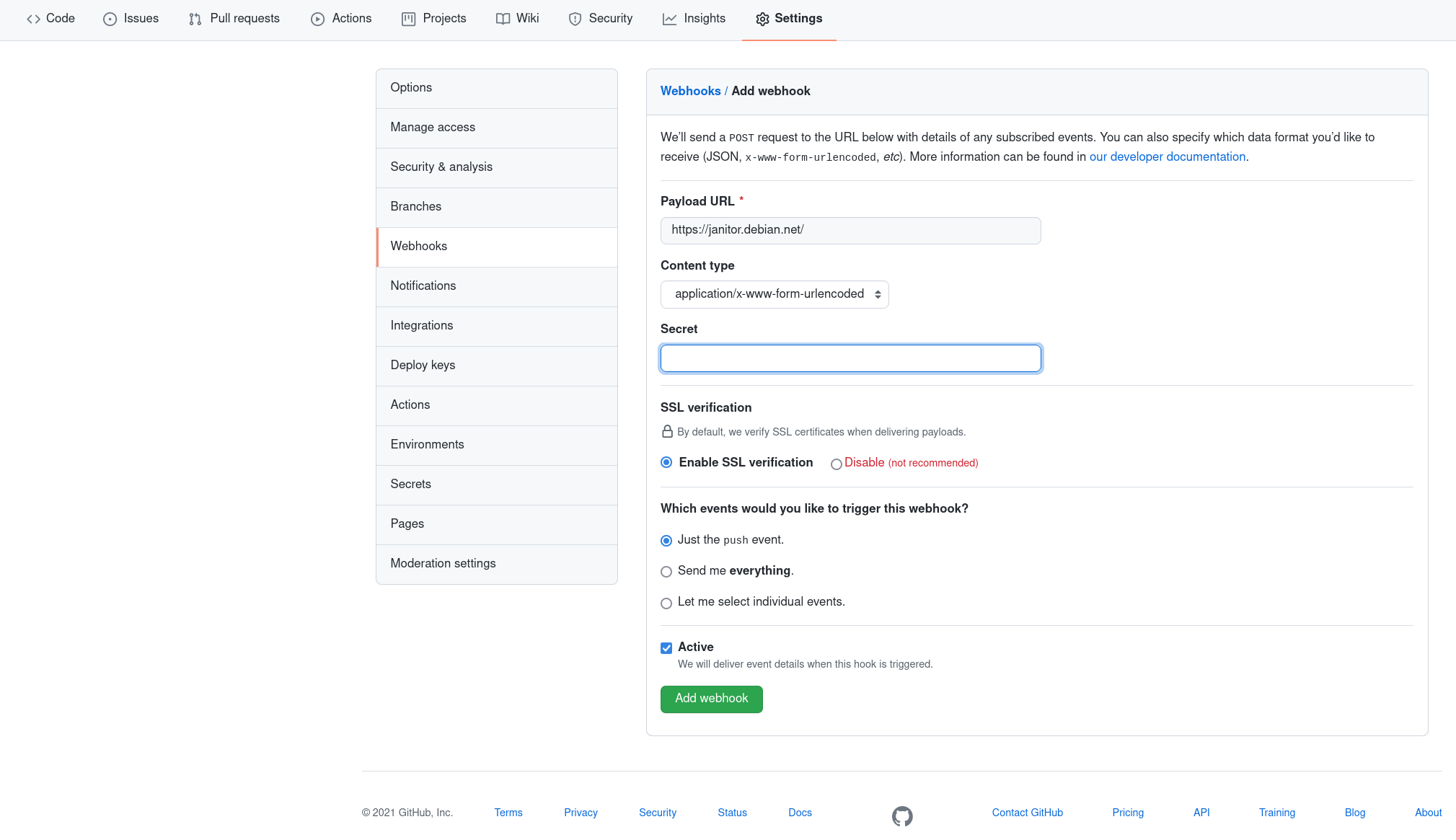
GitHub For GitHub, you can do so in the Webhooks section of the Settings tab. Fill the form as shown below and click on Add webhook:
GitLab On GitLab instances, you can find the Webhooks tab under the Settings menu for each repository (under the gear symbol). Fill the form in as shown below and click Add Webhook:
Launchpad For Launchpad, go to the repository (for Git) web view and click Manage Webhooks. From there, you can add a new webhook; fill the form in as shown below and click Add Webhook:

30 August 2021

Russell Coker: Links August 2021

Sciencealert has an interesting article on a game to combat misinformation by microdosing people [1]. The game seemed overly simplistic to me, but I guess I m not the target demographic. Research shows it to work. Vice has an interesting and amusing article about mass walkouts of underpaid staff in the US [2]. The way that corporations are fighting an increase in the minimum wage doesn t seem financially beneficial for them. An increase in the minimum wage means small companies have to increase salaries too and the ratio of revenue to payroll is probably worse for small companies. It seems that companies like McDonalds make oppressing their workers a higher priority than making a profit. Interesting article in Vice about how the company Shot Spotter (which determines the locations of gunshots by sound) forges evidence for US police [3]. All convictions based on Shot Spotter evidence should be declared mistrials. BitsNBites has an interesting article on the fundamental flaws of SIMD (Single Instruction Multiple Data) [4]. The Daily Dot has a disturbing article anbout the possible future of the QAnon movement [5]. Let s hope they become too busy fighting each other to hurt many innocent people. Ben Taylor wrote an interesting blog post suggesting that Web Assembly should be a default binary target [6]. I don t support that idea but I think that considering it is useful. Web assembly could be used more for non-web things and it would be a better option than Node.js for some things. There are also some interesting corner cases like games, Minecraft was written in Java and there s no reason that Web Assembly couldn t do the same things. Vice has an interesting article about the Phantom encrypted phone service that ran on Blackberry handsets [7]. Australia really needs legislation based on the US RICO law! Vice has an interesting article about an encrypted phone company run by drug dealers [8]. Apparently after making an encrypted phone system for their own use they decided to sell it to others and made millions of dollars. They could have run a successful legal business. Salon has an insightful interview with Michael Petersen about his research on fake news and people who share it because they need chaos [9]. Apparently low status people who are status seeking are a main contributor to this, they share fake news knowingly to spread chaos. A society with less inequality would have less problems with fake news. Salon has another insightful interview with Michael Petersen, about is later research on fake news as an evolutionary strategy [10]. People knowingly share fake news to mobilise their supporters and to signal allegiance to their group. The more bizarre the beliefs are the more strongly they signal allegiance. If an opposing group has a belief then they can show support for their group by having the opposite belief (EG by opposing vaccination if the other political side supports doctors). He also suggests that lying can be a way of establishing dominance, the more honest people are opposed by a lie the more dominant the liar may seem. Vice has an amusing article about how police took over the Encrochat encrypted phone network that was mostly used by criminals [11]. It s amusing to read of criminals getting taken down like this. It s also interesting to note that the authorities messed up by breaking the wipe facility which alerted the criminals that their security was compromised. The investigation could have continued for longer if they hadn t changed the functionality of compromised phones. A later vice article mentioned that the malware installed on Encrochat devices recorded MAC addresses of Wifi access points which was used to locate the phones even though they had the GPS hardware removed. Cory Doctorow wrote an insightful article for Locus about the insufficient necessity of interoperability [12]. The problem if monopolies is not just an inability to interoperate with other services or leave it s losing control over your life. A few cartel participants interoperating will be able to do all the bad things to us tha a single monopolist could do.

25 August 2021

Jelmer Vernooij: Thousands of Debian packages updated from their upstream Git repository

The Debian Janitor is an automated system that commits fixes for (minor) issues in Debian packages that can be fixed by software. It gradually started proposing merges in early December. The first set of changes sent out ran lintian-brush on sid packages maintained in Git. This post is part of a series about the progress of the Janitor. Linux distributions like Debian fulfill an important function in the FOSS ecosystem - they are system integrators that take existing free and open source software projects and adapt them where necessary to work well together. They also make it possible for users to install more software in an easy and consistent way and with some degree of quality control and review. One of the consequences of this model is that the distribution package often lags behind upstream releases. This is especially true for distributions that have tighter integration and standardization (such as Debian), and often new upstream code is only imported irregularly because it is a manual process - both updating the package, but also making sure that it still works together well with the rest of the system. The process of importing a new upstream used to be (well, back when I started working on Debian packages) fairly manual and something like this:

Ecosystem Improvements However, there have been developments over the last decade that make it easier to import new upstream releases into Debian packages.
Uscan and debian QA watch Uscan and debian/watch have been around for a while and make it possible to find upstream tarballs. A debian watch file usually looks something like this:
1
2
version=4
http://somesite.com/dir/filenamewithversion.tar.gz
The QA watch service regularly polls all watch locations in the archive and makes the information available, so it s possible to know which packages have changed without downloading each one of them.
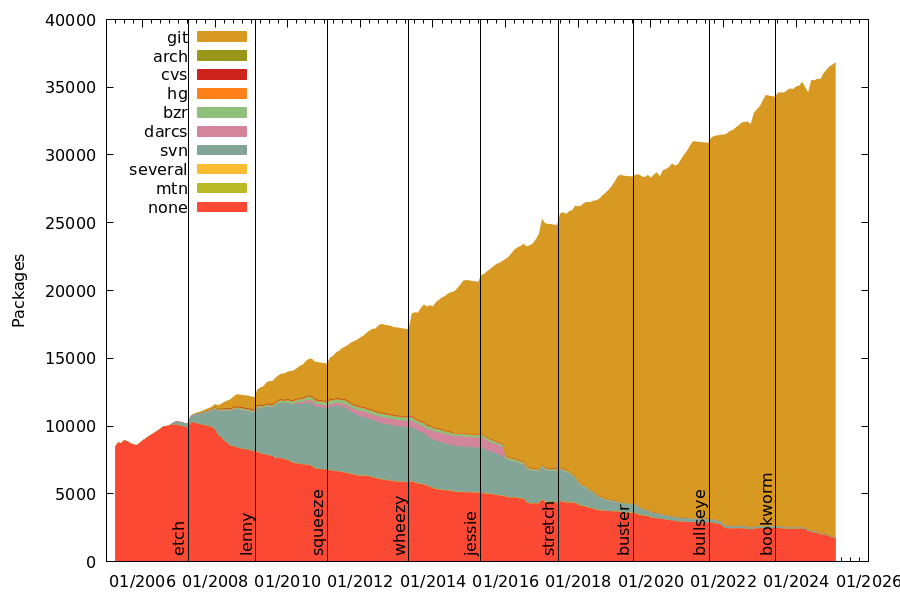
Git Git is fairly ubiquitous nowadays, and most upstream projects and packages in Debian use it. There are still exceptions that do not use any version control system or that use a different control system, but they are becoming increasingly rare. [1]
debian/upstream/metadata DEP-12 specifies a file format with metadata about the upstream project that a package was based on. In particular relevant for our case is the fact it has fields for the location of the upstream version control location. debian/upstream/metadata files look something like this:
1
2
3
---
Repository: https://www.dulwich.io/code/dulwich/
Repository-Browse: https://www.dulwich.io/code/dulwich/
While DEP-12 is still a draft, it has already been widely adopted - there are about 10000 packages in Debian that ship a debian/upstream/metadata file with Repository information.
Autopkgtest The Autopkgtest standard and associated tooling provide a way to run a defined set of tests against an installed package. This makes it possible to verify that a package is working correctly as part of the system as a whole. ci.debian.net regularly runs these tests against Debian packages to detect regressions.
Vcs-Git headers The Vcs-Git headers in debian/control are the equivalent of the Repository field in debian/upstream/metadata, but for the packaging repositories (as opposed to the upstream ones). They ve been around for a while and are widely adopted, as can be seen from zack s stats: The vcswatch service that regularly polls packaging repositories to see whether they have changed makes it a lot easier to consume this information in usable way.
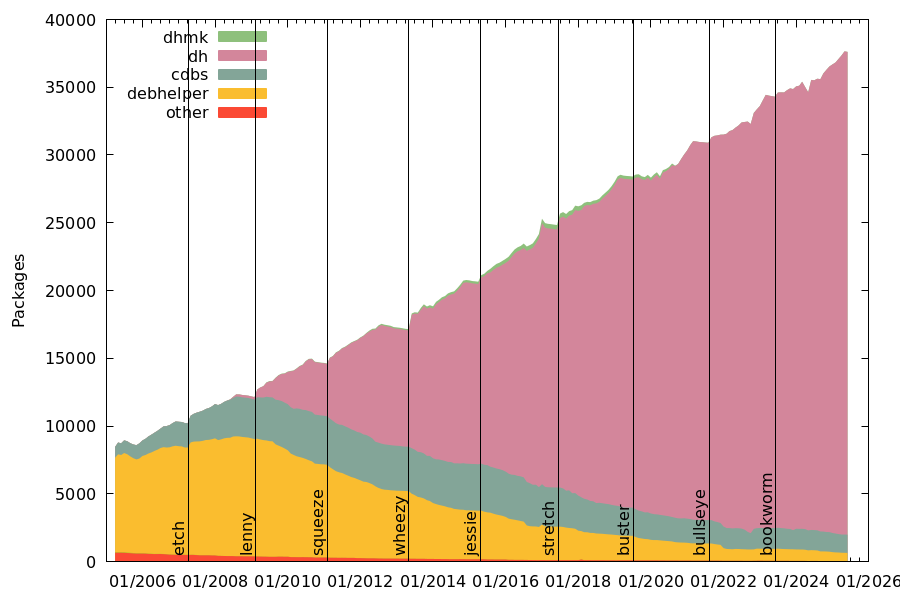
Debhelper adoption Over the last couple of years, Debian has slowly been converging on a single build tool - debhelper s dh interface. Being able to rely on a single build tool makes it easier to write code to update packaging when upstream changes require it.
Debhelper DWIM Debhelper (and its helpers) increasingly can figure out how to do the Right Thing in many cases without being explicitly configured. This makes packaging less effort, but also means that it s less likely that importing a new upstream version will require updates to the packaging. With all of these improvements in place, it actually becomes feasible in a lot of situations to update a Debian package to a new upstream version automatically. Of course, this requires that all of this information is available, so it won t work for all packages. In some cases, the packaging for the older upstream version might not apply to the newer upstream version. The Janitor has attempted to import a new upstream Git snapshot and a new upstream release for every package in the archive where a debian/watch file or debian/upstream/metadata file are present. These are the steps it uses:
  • Find new upstream version
    • If release, use debian/watch - or maybe tagged in upstream repository
    • If snapshot, use debian/upstream/metadata s Repository field
    • If neither is available, use guess-upstream-metadata from upstream-ontologist to guess the upstream Repository
  • Merge upstream version into packaging repository, possibly importing tarballs using pristine-tar
  • Update the changelog file to mention the new upstream version
  • Run some checks to ensure there are no unintentional changes, e.g.:
    • Scan diff between old and new for surprising license changes
      • Today, abort if there are any - in the future, maybe update debian/copyright
    • Check for obvious compatibility breaks - e.g. sonames changing
  • Attempt to update the packaging to reflect upstream changes
    • Refresh patches
  • Attempt to build the package with deb-fix-build, to deal with any missing dependencies
  • Run the autopkgtests with deb-fix-build to deal with missing dependencies, and abort if any tests fail
Results When run over all packages in unstable (sid), this process works for a surprising number of them.
Fresh Releases For fresh-releases (aka imports of upstream releases), processing all packages maintained in Git for which QA watch reports new releases (about 11,000): That means about 2300 packages updated, and about 4000 unchanged.
Fresh Snapshots For fresh-snapshots (aka imports of latest Git commit from upstream), processing all packages maintained in Git (about 26,000): Or 5100 packages updated and 2100 for which there was nothing to do, i.e. no upstream commits since the last Debian upload. As can be seen, this works for a surprising fraction of packages. It s possible to get the numbers up even higher, by both improving the tooling, the autopkgtests and the metadata that is provided by packages.
Using these packages All the packages that have been built can be accessed from the Janitor APT repository. More information can be found at https://janitor.debian.net/fresh, but in short - run:
1
2
3
4
5
6
echo deb "[arch=amd64 signed-by=/usr/share/keyrings/debian-janitor-archive-keyring.gpg]" \
    https://janitor.debian.net/ fresh-snapshots main   sudo tee /etc/apt/sources.list.d/fresh-snapshots.list
echo deb "[arch=amd64 signed-by=/usr/share/keyrings/debian-janitor-archive-keyring.gpg]" \
    https://janitor.debian.net/ fresh-releases main   sudo tee /etc/apt/sources.list.d/fresh-releases.list
sudo curl -o /usr/share/keyrings/debian-janitor-archive-keyring.gpg https://janitor.debian.net/pgp_keys
apt update
And then you can install packages from the fresh-snapshots (upstream git snapshots) or fresh-releases suites on a case-by-case basis by running something like:
1
apt install -t fresh-snapshots r-cran-roxygen2
Most packages are updated based on information provided by vcswatch and qa watch, but it s also possible for upstream repositories to call a web hook to trigger a refresh of a package. These packages were built against unstable, but should in almost all cases also work for testing.
Caveats Of course, since these packages are built automatically without human supervision it s likely that some of them will have bugs in them that would otherwise have been caught by the maintainer.
[1]I m not saying that a monoculture is great here, but it does help distributions.

Bits from Debian: DebConf21 welcomes its sponsors!

DebConf21 logo DebConf21 is taking place online, from 24 August to 28 August 2021. It is the 22nd Debian conference, and organizers and participants are working hard together at creating interesting and fruitful events. We would like to warmly welcome the 19 sponsors of DebConf21, and introduce them to you. We have five Platinum sponsors. Our first Platinum sponsor is Lenovo. As a global technology leader manufacturing a wide portfolio of connected products, including smartphones, tablets, PCs and workstations as well as AR/VR devices, smart home/office and data center solutions, Lenovo understands how critical open systems and platforms are to a connected world. Our next Platinum sponsor is Infomaniak. Infomaniak is Switzerland's largest web-hosting company, also offering backup and storage services, solutions for event organizers, live-streaming and video on demand services. It wholly owns its datacenters and all elements critical to the functioning of the services and products provided by the company (both software and hardware). Roche is our third Platinum sponsor. Roche is a major international pharmaceutical provider and research company dedicated to personalized healthcare. More than 100,000 employees worldwide work towards solving some of the greatest challenges for humanity using science and technology. Roche is strongly involved in publicly funded collaborative research projects with other industrial and academic partners and has supported DebConf since 2017. Amazon Web Services (AWS) is our fourth Platinum sponsor. Amazon Web Services is one of the world's most comprehensive and broadly adopted cloud platform, offering over 175 fully featured services from data centers globally (in 77 Availability Zones within 24 geographic regions). AWS customers include the fastest-growing startups, largest enterprises and leading government agencies. Google is our fifth Platinum sponsor. Google is one of the largest technology companies in the world, providing a wide range of Internet-related services and products such as online advertising technologies, search, cloud computing, software, and hardware. Google has been supporting Debian by sponsoring DebConf for more than ten years, and is also a Debian partner sponsoring parts of Salsa's continuous integration infrastructure within Google Cloud Platform. Our Gold sponsor is the Matanel Foundation. The Matanel Foundation operates in Israel, as its first concern is to preserve the cohesion of a society and a nation plagued by divisions. The Matanel Foundation also works in Europe, in Africa and in South America. Our Silver sponsors are: arm: the World s Best SoC Design Portfolio, Arm powered solutions have been supporting innovation for more than 30 years and are deployed in over 160 billion chips to date, Hudson-Trading, a company researching and developing automated trading algorithms using advanced mathematical techniques, Ubuntu the Operating System delivered by Canonical, Globo, the largest media conglomerate in Brazil, founded in Rio de Janeiro in 1925 and distributing high-quality content across multiple platforms, Two Sigma, rigorous inquiry, data analysis, and invention to help solve the toughest challenges across financial services and GitLab, an open source end-to-end software development platform with built-in version control, issue tracking, code review, CI/CD, and more. Bronze sponsors: Univention, Gandi.net, daskeyboard, InterFace AG and credativ. And finally, our Supporter level sponsor, ISG.EE. Thanks to all our sponsors for their support! Their contributions make it possible for a large number of Debian contributors from all over the globe to work together, help and learn from each other in DebConf21. Participating in DebConf21 online The 22nd Debian Conference is being held online, due to COVID-19, from August 24 to 28, 2021. Talks, discussions, panels and other activities run from 12:00 to 02:00 UTC. Visit the DebConf21 website at https://debconf21.debconf.org to learn about the complete schedule, watch the live streaming and join the different communication channels for participating in the conference.

4 August 2021

Petter Reinholdtsen: Mechanic's words in five languages, English, Norwegian and Northern S mi editions

Almost thirty years ago, some forward looking teachers at Samisk videreg ende skole og reindriftsskole teaching metal work and Northern S mi, decided to create a list of words used in Northern S mi metal work. After almost ten years this resulted in a dictionary database, published as the book "Mekanihkk rs nit : Mekanikerord = Mekaanisen alan sanasto = Mechanic's words" in 1999. The story of this work is available from the pen of Svein Lund, one of the leading actors behind this effort. They even got the dictionary approved by the S mi Language Council as the recommended metal work words to use. Fast forward twenty years, I came across this work when I recently became interested in metal work, and started watching educational and funny videos on the topic, like the ones from mrpete222 and This Old Tony. But they all talk English, but I wanted to know what the tools and techniques they used were called in Norwegian. Trying to track down a good dictionary from English to Norwegian, after much searching, I came across the database of words created almost thirty years ago, with translations into English, Norwegian, Northern S mi, Swedish and Finnish. This gave me a lot of the Norwegian phrases I had been looking for. To make it easier for the next person trying to track down a good Norwegian dictionary for the metal worker, and because I knew the person behind the database from my Skolelinux / Debian Edu days, I decided to ask if the database could be released to the public without any usage limitations, in other words as a Creative Commons licensed data set. And happily, after consulting with the S mi Parliament of Norway, the database is now available with the Creative Commons Attribution 4.0 International license from my gitlab repository. The dictionary entries look slightly different, depending on the language in focus. This is the same entry in the different editions. English
lathe
dreiebenk (nb) v rve, v rvenbea ka, jorahanbea ka, v tnanbea ka (se) svarv (sv) sorvi (fi)
Norwegian
dreiebenk
lathe (en) v rve, v rvenbea ka, jorahanbea ka, v tnanbea ka (se) svarv (sv) sorvi (fi)
(nb): sponskj rande bearbeidingsmaskin der ein med skj reverkt y lausgj r spon fr eit roterande arbetsstykke
Northern S mi
v rve, v rvenbea ka, jorahanbea ka, v tnanbea ka
dreiebenk (nb) lathe (en) svarv (sv) sorvi (fi)
(se): ma iidna mainna uohpp vuolahasaid jorri bargo vdnasis
(nb): sponskj rande bearbeidingsmaskin der ein med skj reverkt y lausgj r spon fr eit roterande arbetsstykke
The database included term description in both Norwegian and Northern S mi, but not English. Because of this, the Northern S mi edition include both descriptions, the Norwegian edition include the Norwegian description and the English edition lack a descripiton. Once the database was available without any usage restrictions, and armed with my experience in publishing books, I decided to publish a Norwegian/English dictionary as a book using the database, to make the data set available also on paper and as an ebook. Further into the project, it occurred to me that I could just as easily make an English dictionary, and talking to Svein and concluding that it was within reach, I decided to make a Northern S mi dictionary too. Thus I suddenly find myself publishing a Northern S mi dictionary, even though I do not understand the language myself. I hope it will be well received, and can help revive the impressive work done almost thirty years ago to document the vocabulary of metal workers. If I get some help, I might even extend it with some of the words I find missing, like collet, rotary broach, carbide, knurler, arbor press and others. But the first edition build from a lightly edited version of the original database, with no new entries added. If you would like to check it out, visit my list of published books and consider buying a paper or ebook copy from lulu.com. The paper edition is only available in hardcover to increase its durability in the workshop. I am very happy to report that in the process, and thanks to help from both Svein Lund and B rre Gaup who understand the language, the docbook tools I use to create books, dblatex and docbook-xsl, now include support for Northern S mi. Before I started, these lacked the needed locale settings for this language, but now the patches are included upstream. As usual, if you use Bitcoin and want to show your support of my activities, please send Bitcoin donations to my address 15oWEoG9dUPovwmUL9KWAnYRtNJEkP1u1b.

31 July 2021

Chris Lamb: Free software activities in July 2021

Here is my monthly update covering what I have been doing in the free software world during July 2021 (previous month): As part of my role of being the assistant Secretary of the Open Source Initiative and a board director of Software in the Public Interest I attended their respective monthly meetings. As outlined in last months posts, however, my term on the OSI board has been slightly extended due to the discovery of a vulnerability in OSI's recent election as a result, the 2021 election is currently being re-run. Reproducible Builds One of the original promises of open source software is that distributed peer review and transparency of process results in enhanced end-user security. However, whilst anyone may inspect the source code of free and open source software for malicious flaws, almost all software today is distributed as pre-compiled binaries. This allows nefarious third parties to compromise systems by injecting malicious code into ostensibly secure software during the various compilation and distribution processes. The motivation behind the Reproducible Builds effort is to ensure no flaws have been introduced during this compilation process by promising identical results are always generated from a given source, thus allowing multiple third-parties to come to a consensus on whether a build was compromised. This month, I: I also made the following changes to diffoscope, including preparing and uploading versions 178 and 179 to PyPI and Debian: Debian Bugs filed Uploads Debian LTS This month I have worked 18 hours on Debian Long Term Support (LTS) and 12 hours on its sister Extended LTS project. You can find out more about the project via the following video:

7 July 2021

Dirk Eddelbuettel: Rcpp 1.0.7: More Updates

rcpp logo The Rcpp team is pleased to announce release 1.0.7 of Rcpp which arrived at CRAN earlier today, and will be uploaded to Debian shortly. Windows and macOS builds should appear at CRAN in the next few days. This release continues with the six-months cycle started with release 1.0.5 last July. As a reminder, interim dev or rc releases will alwasys be available in the Rcpp drat repo; this cycle there were seven (!!). These rolling release tend to work just as well, and are also fully tested against all reverse-dependencies. Rcpp has become the most popular way of enhancing R with C or C++ code. As of today, 2323 packages on CRAN depend on Rcpp for making analytical code go faster and further, along with 227 in BioConductor. This release contains a change which Luke Tierney urged us to make a good year ago in #1081) (and which we had looked at earlier in #382). Implementing the change in a regular update proved a little tricky, and my initial branch lay dormant until I aki revived it, and finished the transition (which we then did in two PRs). The change concerns how Rcpp grows internal objects, and the new approach (thanks to the hint by Luke) closer to what R does guaranteeing linear behaviour. It turns out that we overlooked one aspect (of coping with Modules built under earlier Rcpp releases) so the initial upload to CRAN on Saturday revealed that we needed a small adjustment that we made for the final release. This version should now be more performant, and rest on a stable API. Based on the reverse depends checks by both us and CRAN (using the updated version), we expect no issues with existing code. However, it something does act up a fresh compilation of the packages using Rcpp may help. We also made a few other minor changes in the API such as silencing a silly compiler warning, ensuring global Rcout and Rcerr objects, adding support for a new Rcpp::message() call, completing a switch to uint32_t instead of unsigned int and including the cfloat header (which relates to STRICT_R_HEADERS discussed below). Similarly, the Rcpp Attributes feature was enhanced by coping better with packages with a dot in their name and their for per-package include files, along with support for more quiet compilation if desired. As some Rcpp users may have seen, we plan to enable STRICT_R_HEADERS by the next release (expected in January 2022). A long issue tick #1158 is laying the ground work. Maintainers of 81 packages which are affected and need a small change (such as for example switching from PI to M_PI); of these 56 have already responded. We plan to be in touch in the fall. Adding the cfloat header is one help in this transition (as the corresponding C header was pulled in when STRICT_R_HEADERS is not defined) as it ensures DBL_EPSILON and alike are defined. Last but not least this is also the first relase in which we welcome I aki as a new member of the Rcpp Core team. Yay! The NEWS file entries follow summarizing the nine key PRs in this release.

Changes in Rcpp release version 1.0.7 (2021-07-06)
  • Changes in Rcpp API:
    • Refactored Rcpp_PreserveObject and Rcpp_ReleaseObject which are now O(1) (Dirk and I aki in #1133 and #1135 fixing #382 and #1081).
    • A spuriously assigned variable was removed (Dirk in #1138 fixing #1137).
    • Global Rcout and Rcerr objects are supported via a compiler directive (I aki in #1139 fixing #928)
    • Add support for Rcpp::message (Dirk in #1146 fixing #1145).
    • The uint32_t type is used throughout instead of unsigned int (Dirk in #1153 fixing #1152).
    • The cfloat header for floating point limits is now included (Dirk in #1162 fixing #1161).
  • Changes in Rcpp Attributes:
    • Packages with dots in their name can now have per-package include files (Dirk in #1132 fixing #1129).
    • New argument echo to quieten optional evaluation in sourceCpp (Dirk in #1138 fixing #1126).
  • Forthcoming Changes in Rcpp API:
    • Starting with Rcpp 1.0.8 anticipated in January 2022, STRICT_R_HEADERS will be enabled by default, see #1126.

Thanks to my CRANberries, you can also look at a diff to the previous release. Questions, comments etc should go to the rcpp-devel mailing list off the R-Forge page. Bugs reports are welcome at the GitHub issue tracker as well (where one can also search among open or closed issues); questions are also welcome under rcpp tag at StackOverflow which also allows searching among the (currently) 2616 previous questions. If you like this or other open-source work I do, you can sponsor me at GitHub.

This post by Dirk Eddelbuettel originated on his Thinking inside the box blog. Please report excessive re-aggregation in third-party for-profit settings.

30 June 2021

Aigars Mahinovs: Keeping it as simple as possible

You know that you've had the same server too long when they discontinue the entire class of servers you were using and you need to migrate to a new instance. And you know you've not done anything with that server (and the blog running on it) for too long when you have no idea how that thing is actually working. Its a good opportunity to start over from scratch, and a good motivation to the new thing as simply as humanly possible, or even simpler. So I am switching to a statically generated blog as well. Not sure what took me so long, but thank good the tooling has really improved since the last time I looked. It was as simple as picking Nikola, finding its import_feed plugin, changing the BLOG_RSS_LIMIT in my Django Mezzanine blog to a thousand (to export all posts via RSS/ATOM feed), fixing some bugs in the import_feed plugin, waiting a few minutes for the full feed to generate and to be imported, adjusting the config of the resulting site, posting that to git and writing a simple shell script to pull that repo periodically and call nikola build on it, as well as config to serve ther result via ngnix. Done. After that creating a new blog post is just nikola new_post and editing it in vim and pushing to git. I prefer Markdown, but it supports all kinds of formats. And the old posts are just stored as HTML. Really simple. I think I will spend more time fighting with Google to allow me to forward email from my domain to my GMail postbox without it refusing all of it as spam.

Next.

Previous.