Yet another maintenance release of the tidyCpp
package arrived on CRAN this morning, a mere week and a half after the
previous release. It has been built for r2u as well. The package
offers a clean C++ layer (as well as one small C++ helper class) on top
of the C API for R which aims to make use of this robust (if awkward) C
API a little easier and more consistent. See the vignette for motivating
examples.
This release, just like the preceding
one less than two weeks ago, had its hand forced by an overnight
change in R-devel. The breakage this created has since been reverted in
R-devel but as the writing is on the wall are now removing the
definition involving these accessors preemptively. We were also missing
version checks for two newly added alternates.
Changes are summarized in the NEWS entry that follows.
Thanks to my CRANberries, there is also a diffstat report for this release. For questions, suggestions, or issues please use the issue tracker at the GitHub repo.Changes in tidyCpp version 0.0.10 (2026-03-15)
- Hide five accessors as underlying macros removed from Rinternals
- Preemptively hide another accessor
- Ensure two definitions are conditional on R 4.5.0 or later
This post by Dirk Eddelbuettel originated on his Thinking inside the box blog. If you like this or other open-source work I do, you can now sponsor me at GitHub.
# dig -t txt _spf.google.com grep spf1 _spf.google.com. 300 IN TXT "v=spf1 ip4:74.125.0.0/16 ip4:209.85.128.0/17 ip6:2001:4860:4864::/56 ip6:2404:6800:4864::/56 ip6:2607:f8b0:4000::/36 ip6:2800:3f0:4000::/36 ip6:2a00:1450:4000::/36 ip6:2c0f:fb50:4000::/36 ~all" # dig -t txt outlook.com grep spf1 outlook.com. 126 IN TXT "v=spf1 include:spf2.outlook.com -all" # dig -t txt _spf.mail.yahoo.com grep spf1 _spf.mail.yahoo.com. 1800 IN TXT "v=spf1 ptr:yahoo.com ptr:yahoo.net ip4:34.2.71.64/26 ip4:34.2.75.0/26 ip4:34.2.84.64/26 ip4:34.2.85.64/26 ip4:34.2.64.0/22 ip4:34.2.68.0/23 ip4:34.2.70.0/23 ip4:34.2.72.0/22 ip4:34.2.78.0/23 ip4:34.2.80.0/23 ip4:34.2.82.0/23 ip4:34.2.84.0/24 ip4:34.2.86.0" "/23 ip4:34.2.88.0/23 ip4:34.2.90.0/23 ip4:34.2.92.0/23 ip4:34.2.85.0/24 ip4:34.2.94.0/23 ?all" # dig -t txt icloud.com grep spf1 icloud.com. 3586 IN TXT "v=spf1 ip4:17.41.0.0/16 ip4:17.58.0.0/16 ip4:17.142.0.0/15 ip4:17.57.155.0/24 ip4:17.57.156.0/24 ip4:144.178.36.0/24 ip4:144.178.38.0/24 ip4:112.19.199.64/29 ip4:112.19.242.64/29 ip4:222.73.195.64/29 ip4:157.255.1.64/29" " ip4:106.39.212.64/29 ip4:123.126.78.64/29 ip4:183.240.219.64/29 ip4:39.156.163.64/29 ip4:57.103.64.0/18" " ip6:2a01:b747:3000:200::/56 ip6:2a01:b747:3001:200::/56 ip6:2a01:b747:3002:200::/56 ip6:2a01:b747:3003:200::/56 ip6:2a01:b747:3004:200::/56 ip6:2a01:b747:3005:200::/56 ip6:2a01:b747:3006:200::/56 ~all"In most IM systems there is a strong connection between people who communicate. If I send you two direct messages they will appear in the same room, and if someone else tries forging messages from me (EG by replacing the c and e letters in my address with Cyrillic letters that look like them or by mis-spelling my name) a separate room will be created and it will be obvious that something unexpected is happening. Protecting against the same attacks in email requires the user carefully reading the message, given that it s not uncommon for someone to start a message to me with Hi Russel (being unable to correctly copy my name from the To: field of the message they are writing) it s obvious that any security measure relying on such careful reading will fail. The IM protections against casual forgery also apply to rooms with multiple users, a new user can join a room for the purpose of spamming but they can t send a casual message impersonating a member of the room. A user can join a Matrix room I m in with the name Russell from another server but the potential for confusion will be minimised by a message notifying everyone that another Russell has joined the room and the list of users will show two Russells. For email the protections against forgery when sending to a list server are no different than those when sending to an individual directly which means very weak protections. Authenticating the conversation context once as done with IM is easier and more reliable than authenticating each message independently. Is Email Sucking the Main Technical Difference? It seems that the problems with forgery, spam, and general confusion when using email are a large part of the difference between email and IM. But in terms of technical issues the fact that email has significantly more users (if only because you need an email account to sign up for an IM system) is a major difference. Internet email is currently a universal system (apart from when it breaks from spam) and it has historically been used to gateway to other email systems like Fidonet, Uucp, and others. The lack of tight connection between parties that exchange messages in email makes it easier to bridge between protocols but harder to authenticate communication. Most of the problems with Internet email are not problems for everyone at all times, they are technical trade-offs that work well for some situations and for some times. Unfortunately many of those trade-offs are for things that worked well 25+ years ago. The GUI From a user perspective there doesn t have to be a great difference between email and IM. Email is usually delivered quickly enough to be in the same range as IM. The differences in layout between IM client software and email client software is cosmetic, someone could write an email client that organises messages in the same way as Slack or another popular IM system such that the less technical users wouldn t necessarily know the difference. The significant difference in the GUI for email and IM software was a design choice. Conversation Organisation The most significant difference in the operation of email and IM at the transport level is the establishment of connections in IM. Another difference is the fact that there are no standards implemented for the common IM implementations to interoperate which is an issue of big corporations creating IM systems and deliberately making them incompatible. The methods for managing email need to be improved. Having an inbox that s an unsorted mess of mail isn t useful if you want to track one discussion, breaking it out into different sub folders for common senders (similar to IM folders for DMs) as a standard feature without having to setup rules for each sender would be nice. Someone could design an email program with multiple layouts, one being the traditional form (which seems to be copied from Eudora [3]) and one with the inbox (or other folders) split up into conversations. There are email clients that support managing email threads which can be handy in some situations but often isn t the best option for quickly responding to messages that arrived recently. Archiving Most IM systems have no method for selectively archiving messages, there s a request open for a bookmark function in Matrix and there s nothing stopping a user from manually copying a message. But there s nothing like the convenient ability to move email to an archive folder in most IM systems. Without good archiving IM is a transient medium. This is OK for conversations but not good for determining the solutions to technical problems unless there is a Wiki or other result which can be used without relying on archives. Composing Messages In a modern email client when sending a message it prompts you for things that it considers complete, so if you don t enter a Subject or have the word attached in the message body but no file is attached to the message then it will prompt you to confirm that you aren t making a mistake. In an IM client the default is usually that pressing ENTER sends the message so every paragraph is a new message. IM clients are programmed to encourage lots of short messages while email clients are programmed to encourage more complete messages. Social Issues Quality The way people think about IM and email is very different, as one example there was never a need for a site like nohello.net for email. The idea that it s acceptable to use even lower quality writing in IM than people tend to use in email seems to be a major difference between the communication systems. It can be a good thing to have a chatty environment with messages that are regarded as transient for socialising, but that doesn t seem ideal for business use. Ownership Email is generally regarded as being comparable to physical letters. It is illegal and widely considered to be socially wrong to steal a letter from someone s letterbox if you regret sending it. In email the only unsend function I m aware of is that in Microsoft software which is documented to only work within the same organisation, and that only works if the recipient hasn t read the message. The message is considered to be owned by the recipient. But for IM it s a widely supported and socially acceptable function to delete or edit messages that have been sent. The message is regarded as permanently the property of the sender. What Should We Do? Community Creators When creating a community (and I use this in the broadest sense including companies) you should consider what types of communication will work well. When I started the Flounder group [4] I made a deliberate decision that non-free communication systems go against the aim of the group, I started it with a mailing list and then created a Matrix room which became very popular. Now the list hardly gets any use. It seems that most of the communication in the group is fairly informal and works better with IM. Does it make sense to use both? Should IM systems be supplemented with other systems that facilitate more detail such as a Wiki or a Lemmy room/instance [5] to cover the lack of long form communication? I have created a Lemmy room for Flounder but it hasn t got much interest so far. It seems that almost no-one makes a strategic decision about such issues. Software Developers It would be good to have the same options for archiving IM as there are for email. Also some options to encourage quality in IM communication similar to the way email clients want confirmation before sending messages without a subject or that might be missing an attachment. It would also be good to have better options for managing conversations in email. The Inbox as currently used is good for some things but a button to switch between that and a conversation view would be good. There are email clients that allow selecting message sort order and aggregation (kmail has a good selection of options) but they are designed for choosing a single setup that you like not between multiple views based on the task you are doing. It would be good to have links between different communication systems, if users had the option of putting their email address in their IM profile it would make things much easier. Having entirely separate systems for email and IM isn t good for users. Users The overall communications infrastructure could be improved if more people made tactical decisions about where and how to communicate. Keep the long messages to email and the chatty things to IM. Also for IM just do the communication not start with hello . To discourage wasting time I generally don t reply to messages that just say hello unless it s the first ever IM from someone. Conclusion A large part of the inefficiencies in electronic communication are due to platforms and usage patterns evolving with little strategic thought. The only apparent strategic thought is coming from corporations that provide IM services and have customer lock in at the core of their strategies. Free software developers have done great work in developing software to solve tactical problems but the strategies of large scale communications aren t being addressed. Email is loosely coupled and universal while IM is tightly coupled, authenticated, and often siloed. This makes email a good option for initial contact but a risk for ongoing discussions. There is no great solution to these issues as they are largely a problem due to the installed user base. But I think we can mitigate things with some GUI design changes and strategic planning of communication.
What led to this experiment? Well, for one, Well, for one, there was a thought
shared by Andrej Karpathy regarding the shift towards "Agentic" workflows.

"The future of software is not just 'tools', but 'agents' that can navigate complex tasks on your behalf."Recently, I spoke with Ritesh, who mentioned his success using the Gemini CLI to debug an idle power drain issue on his laptop. I wanted to experiment with this myself, and I had the perfect use case: configuring the Hyprland Window Manager on my aging laptop. The machine is nearly eight years old with 12GB of RAM (upgraded from the original 4GB). I found that GNOME and KDE were becoming overkill, often leading to system freezes when running multiple AI-powered IDEs like Antigravity and VS Code with Co-pilot. Coincidentally, I noticed my Jio number had a "Google One 2TB" and "Google AI Premium" plan available to claim. I claimed it, and now here I am, experimenting with the Gemini CLI.
npm install -g @google/gemini-cliNext, we need to create a context for Gemini a set of instructions for it to follow throughout the project. This is managed via a GEMINI.md file. I went to Google Gemini, explained my requirements, and asked it to generate one for me. My requirements were:
# Role: Hyprland Configuration Specialist (Minimalist & High-Performance)
You are a Linux Systems Engineer specializing in migrating users from heavy
Desktop Environments to minimalist, tiling-based Wayland sessions on Debian.
Your goal is to maximize available RAM for heavy applications while maintaining
essential desktop features.
## 1. Environment & Persona
- **Target OS:** Debian (Linux)
- **Target WM:** Hyprland
- **Hardware:** ThinkPad E470 (i5-7th Gen, 12GB RAM)
- **User Profile:** Emacs user, prioritizes "anti-gravity" (zero bloat).
- **Tone:** Technical, concise, and security-conscious.
## 2. Core Functional Requirements
- **Status Bar:** waybar (with CPU, RAM, Network, and Battery icons).
- **Wallpaper:** swww or hyprpaper .
- **Screen Lock:** hyprlock + hypridle .
- **Input Mapping:** Swap Control and Caps Lock ( kb_options = ctrl:nocaps ).
## 3. Operational Constraints
- **Permission First:** Ask before using sudo or writing outside the work directory.
- **Inspection:** Use hyprctl , lsmod , or gsettings for compatibility checks.
- **Artifact Management:** Update MEMORY.md after every major step.
Read MEMORY.md and GEMINI.md. Based on my hardware, give me a shell script to inspect my current GNOME environment so we can start replicating the session basics.
Another maintenance release of the RcppCNPy
package arrived on CRAN today,
and has already been built as an r2u binary. RcppCNPy
provides R with read and write access to NumPy files thanks to the cnpy library by Carl Rogers
along with Rcpp for the glue to R.
The changes are minor and similar to other recent changes. We aid Rcpp in the transition away from calling
Rf_error() by relying in Rcpp::stop() which
has better behaviour and unwinding when errors or exceptions are
encountered. So once again no user-facing changes. Full details are
below.
CRANberries also provides a diffstat report for the latest release. As always, feedback is welcome and the best place to start a discussion may be the GitHub issue tickets page. If you like this or other open-source work I do, you can now sponsor me at GitHub.Changes in version 0.2.15 (2026-03-13)
- Replaced Rf_error with Rcpp::stop in three files
- Maintenance updates to continuous integration
This post by Dirk Eddelbuettel originated on his Thinking inside the box blog. Please report excessive re-aggregation in third-party for-profit settings.
Hello world. I have been doing a lot after my internship with Outreachy. We are still working on some tasks :
As I am moving around constantly, there are problems I had encountered when changing my networks. I had to connect my virtual machine to different networks and the network would not reflect within the machine. From terminal I edited the virtual machine XML settings:
su -// input password sudo virsh edit <machine_name> #its openqa for me// Look for the interface within devices and replace this:<interface type=&aposnetwork&apos> <source network=&aposdefault&apos/> #some other code in here </interface>// With just this then restart your machine:<interface type=&aposuser&apos> <model type=&aposvirtio&apos/></interface>
Hopefully the above will help someone out there. I am still working on a lot of tasks regarding the conference, so much to do and so little time. I am hoping I won t get any burnout during this period. I won t be updating much further till the conference. Have a nice time
Welcome to the February 2026 report from the Reproducible Builds project!
These reports outline what we ve been up to over the past month, highlighting items of news from elsewhere in the increasingly-important area of software supply-chain security. As ever, if you are interested in contributing to the Reproducible Builds project, please see the Contribute page on our website.
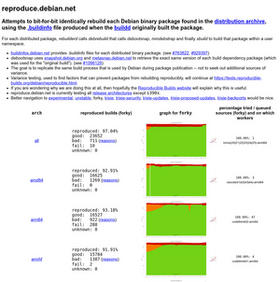
The last year has seen the introduction, development and deployment of reproduce.debian.net. In technical terms, this is an instance of rebuilderd, our server designed monitor the official package repositories of Linux distributions and attempt to reproduce the observed results there.
This month, however, Holger Levsen added suite-based navigation (eg. Debian trixie vs forky) to the service (in addition to the already existing architecture based navigation) which can be observed on, for instance, the Debian trixie-backports or trixie-security pages.
diffoscope is our in-depth and content-aware diff utility that can locate and diagnose reproducibility issues. This month, Chris Lamb made a number of changes, including preparing and uploading versions, 312 and 313 to Debian.
In particular, Chris updated the post-release deployment pipeline to ensure that the pipeline does not fail if the automatic deployment to PyPI fails [ ]. In addition, Vagrant Cascadian updated an external reference for the 7z tool for GNU Guix. [ ]. Vagrant Cascadian also updated diffoscope in GNU Guix to version 312 and 313.
In Debian this month:
sbom-toolkit package was uploaded, which provides a collection of scripts for generating SBOM. This is the tooling used in Apertis to generate the Licenses SBOM and the Build Dependency SBOM. It also includes dh-setup-copyright, a Debhelper addon to generate SBOMs from DWARF debug information, which are extracted from DWARF debug information by running dwarf2sources on every ELF binaries in the package and saving the output.
Lastly, Bernhard M. Wiedemann posted another openSUSE monthly update for their work there.
pimsync in the GNU Guix review process
50.beta regressed in reproducibility compared to 49.0. Specifically, the new generated .oga files differ in their Serial No. and Checksum [fields] . However, Jeremy ended up fixing the issue by replacing ffmpeg with oggenc.
archlinux-dev-public mailing list on our mailing list this month after a discussion at our latest Summit meeting on the topic of Link-Time Optimisation (LTO) specifically on the reasons why LTO often needs to be disabled in relation to Arch Linux s approach to binary hardening.
0) may materially differ from using SOURCE_DATE_EPOCH) when a situation demands the use of a fixed timestamp.
pnut, a C compiler capable of bootstrapping itself and TCC from any POSIX-compliant shell and human-readable source files.
bitsnpicas.fonts-topaz-unicode.bitsnpicas.
Once again, there were a number of improvements made to our website this month including:
repro-build to the Tools page. [ ]
.properties files. [ ]
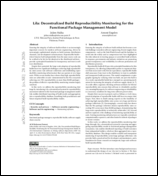
Julien Malka and Arnout Engelen published a paper titled Lila: Decentralized Build Reproducibility Monitoring for the Functional Package Management Model:
[While] recent studies have shown that high reproducibility rates are achievable at scale demonstrated by the Nix ecosystem achieving over 90% reproducibility on more than 80,000 packages the problem of effective reproducibility monitoring remains largely unsolved. In this work, we address the reproducibility monitoring challenge by introducing Lila, a decentralized system for reproducibility assessment tailored to the functional package management model. Lila enables distributed reporting of build results and aggregation into a reproducibility database [ ].A PDF of their paper is available online.
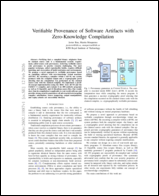
Javier Ron and Martin Monperrus of KTH Royal Institute of Technology, Sweden, also published a paper, titled Verifiable Provenance of Software Artifacts with Zero-Knowledge Compilation:
Verifying that a compiled binary originates from its claimed source code is a fundamental security requirement, called source code provenance. Achieving verifiable source code provenance in practice remains challenging. The most popular technique, called reproducible builds, requires difficult matching and reexecution of build toolchains and environments. We propose a novel approach to verifiable provenance based on compiling software with zero-knowledge virtual machines (zkVMs). By executing a compiler within a zkVM, our system produces both the compiled output and a cryptographic proof attesting that the compilation was performed on the claimed source code with the claimed compiler. [ ]A PDF of the paper is available online.
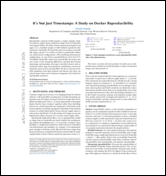
Oreofe Solarin of Department of Computer and Data Sciences, Case Western Reserve University, Cleveland, Ohio, USA, published It s Not Just Timestamps: A Study on Docker Reproducibility:
Reproducible container builds promise a simple integrity check for software supply chains: rebuild an image from its Dockerfile and compare hashes. We built a Docker measurement pipeline and apply it to a stratified sample of 2,000 GitHub repositories that contained a Dockerfile. We found that only 56% produce any buildable image, and just 2.7% of those are bitwise reproducible without any infrastructure configurations. After modifying infrastructure configurations, we raise bitwise reproducibility by 18.6%, but 78.7% of buildable Dockerfiles remain non-reproducible.A PDF of Oreofe s paper is available online.
Lastly, Jens Dietrich and Behnaz Hassanshahi published On the Variability of Source Code in Maven Package Rebuilds:
[In] this paper we test the assumption that the same source code is being used [by] alternative builds. To study this, we compare the sources released with packages on Maven Central, with the sources associated with independently built packages from Google s Assured Open Source and Oracle s Build-from-Source projects. [ ]A PDF of their paper is available online.
#reproducible-builds on irc.oftc.net.
rb-general@lists.reproducible-builds.org
Another minor maintenance release for the RcppBDT
package is now on CRAN, and had
been built as binary for r2u.
The RcppBDT
package is an early adopter of Rcpp
and was one of the first packages utilizing Boost and its Date_Time
library. The now more widely-used package anytime is a
direct descentant of RcppBDT.
This release is again primarily maintenance. We aid Rcpp in the transition away from calling
Rf_error() by relying in Rcpp::stop() which
has better behaviour and unwinding when errors or exceptions are
encountered. No feature or interface changes.
The NEWS entry follows:
Courtesy of my CRANberries, there is also a diffstat report for this release. For questions, suggestions, or issues please use the issue tracker at the GitHub repo.Changes in version 0.2.8 (2026-03-12)
- Replaced Rf_error with Rcpp::stop in three files
- Maintenance updates to continuous integration
This post by Dirk Eddelbuettel originated on his Thinking inside the box blog. If you like this or other open-source work I do, you can now sponsor me at GitHub.
$ dig +short IN HTTPS cloudflare-ech.com
1 . alpn="h3,h2" ipv4hint=104.18.10.118,104.18.11.118 ech=AEX+DQBBFQAgACDBFqmr34YRf/8Ymf+N5ZJCtNkLm3qnjylCCLZc8rUZcwAEAAEAAQASY2xvdWRmbGFyZS1lY2guY29tAAA= ipv6hint=2606:4700::6812:a76,2606:4700::6812:b76
Another maintenance release of our RcppDE package arrived
at CRAN, and has been built for
r2u. RcppDE is a port
of DEoptim, a
package for derivative-free optimisation using differential evolution,
from plain C to C++. By using RcppArmadillo the
code became a lot shorter and more legible. Our other main contribution
is to leverage some of the excellence we get for free from using Rcpp, in particular the ability to
optimise user-supplied compiled objective functions which can
make things a lot faster than repeatedly evaluating interpreted
objective functions as DEoptim does (and
which, in fairness, most other optimisers do too). The gains can be
quite substantial.
This release is again maintenance. We aid Rcpp in the transition away from calling
Rf_error() by relying in Rcpp::stop() which
has better behaviour and unwinding when errors or exceptions are
encountered. We also overhauled the references in the vignette, added an
Armadillo version getter and made the regular updates to continuous
integration.
Courtesy of my CRANberries, there
is also a diffstat
report. More detailed information is on the RcppDE page,
or the repository.
This post by Dirk Eddelbuettel originated on his Thinking inside the box blog. If you like this or other open-source work I do, you can sponsor me at GitHub.
We are pleased to announce that Infomaniak has
committed to sponsor DebConf26 as a Platinum
Sponsor.
Infomaniak is an independent, employee-owned Swiss technology company that
designs, develops, and operates its own cloud infrastructure and digital
services entirely in Switzerland. With over 300 employees more than 70%
engineers and developers the company reinvests all profits into R&D. Its
public cloud is built on OpenStack, with managed Kubernetes, Database as a
Service, object storage, and sovereign AI services accessible via OpenAI-
compatible APIs, all running on its own Swiss infrastructure. Infomaniak also
develops a sovereign collaborative suite messaging, email, storage, online
office tools, videoconferencing, and a built-in AI assistant developed in-
house and as a privacy-respecting solution to proprietary platforms. Open
source is central to how Infomaniak operates. Its latest data center (D4) runs
on 100% renewable energy and uses no traditional cooling: all the heat
generated by its servers is captured and fed into Geneva's district heating
network, supplying up to 6,000 homes in winter and hot water year-round. The
entire project has been documented and open-sourced at d4project.org.
With this commitment as Platinum Sponsor, Infomaniak is contributing to the
Debian annual Developers' conference, directly supporting the progress of
Debian and Free Software. Infomaniak contributes to strengthen the community
that collaborates on Debian projects from all around the world throughout all
of the year.
Thank you very much, Infomaniak, for your support of DebConf26!
Become a sponsor too!
DebConf26 will take place from 20th to July
25th 2026 in Santa Fe, Argentina, and will be preceded by DebCamp, from 13th
to 19th July 2026.
DebConf26 is accepting sponsors! Interested companies and organizations may
contact the DebConf team through
sponsors@debconf.org, and visit the DebConf26
website at
https://debconf26.debconf.org/sponsors/become-a-sponsor/.
fortunes-debian-hints and submitted possible changes in the hints.reportbug --ui gtk
detecting the wrong dependencies),
devscript (delete unused code from debrebuild
and add recommended dependency),
wcurl (format help for 80 columns).
Carles submitted a bug report for apt
not showing the long descriptions of packages.glibc/gcc-15/zlib transition for the s390 31-bit removal. This last one
included reviewing and requeueing lots of autopkgtests due to britney losing a
lot of results.poppler updates to experimental for a new transition.pycparser, python-confuse,
python-cffi, python-mitogen, python-pip, wheel, platformdirs,
python-authlib, and python-virtualenv.dh-python and merged MRs.musl-linux-any, hurd-any or s390x)
or specific packages (such as binutils, brotli or fontconfig).rocblas #1126608,
python-memray #1126944
upstream
and greetd #1129070 with varying success.build source job is handled by Salsa CI. Thanks a
lot to Jochen for his work on this.ipp-usb, brlaser and gutenprint.OpenSSH, both of which allowed code execution via ProxyCommand in some
cases. The trixie update also included a fix for
mishandling of PerSourceMaxStartups.bts forwarded commands to be discarded.pkg_resources module.So you want to join Outreachy but you don t understand it, you re scared, or you don t know what open source is about.
Free and Open Source Software (FOSS) refers to software that anyone can use, modify, and share freely. Think of it as a community garden; instead of one company owning the food, people from all over the world contribute, improve, and maintain it so everyone can benefit for free. You can read more here on what it means to contribute to open source.
Outreachy provides paid internships to anyone from any background who faces underrepresentation, systemic bias, or discrimination in the technical industry where they live. Their goal is to increase diversity in open source. Read their website for more. I spent a good amount of time reading all the guides listed, including the applicant guide and the how-to-apply guide.
I know newcomers are scared or unsure and would prefer answers from previous participants, but the Outreachy website is actually a goldmine, almost every question you have is already answered there if you look closely. I used to hate reading documentation, but I ve learned to love it. Documentation is the Source of Truth.
Now for the part most newcomers have asked about is the initial essay. I know it s tempting to use AI, but I really encourage you to skip it for this. Your own story is much more powerful than a generated one. Outreachy and its mentoring organizations value your unique story. They are strongly against fabricated or AI-exaggerated essays.
For example, when I contributed to Debian using openQA, the information wasn t well established on the web. When I tried to use AI, it suggested imaginary ideas. The project maintainers had a particular style of contributing, so I had to follow the instructions carefully, observe the codebase, and read the provided documentation. With that information, I always wrote a solution first before consulting AI, and mine was always better. AI can only be intelligent in the context of what you give it; if it doesn t have your answer, it will look for the most similar solution (hallucinate). We do not want to increase the burden on reviewers their time is important because they are volunteers, too. This is crucial when you qualify for the contribution phase.
There are two main stages:
The most important tip? Apply anyway. Even if you feel underqualified, the process itself is a massive learning experience.
Another minor update 0.3.13 for our nanotime
package is now on CRAN, and has
been uploaded to Debian and
compiled for r2u. nanotime
relies on the RcppCCTZ
package (as well as the RcppDate
package for additional C++ operations) and offers efficient high(er)
resolution time parsing and formatting up to nanosecond resolution,
using the bit64
package for the actual integer64 arithmetic. Initially
implemented using the S3 system, it has benefitted greatly from a
rigorous refactoring by Leonardo who not only rejigged
nanotime internals in S4 but also added new S4 types for
periods, intervals and durations.
This release, the first in eleven months, rounds out a few internal
corners and helps Rcpp with the
transition away from Rf_error to only using
Rcpp::stop which deals more gracefully with error
conditions and unwinding. We also updated how the vignette is made, its
references, updated the continuous integration as one does, altered how
the documentation site is built, gladly took a PR from Michael polishing another
small aspect, and tweaked how the compilation standard is set.
The NEWS snippet below has the fuller details.
Thanks to my CRANberries, there is a diffstat report for this release. More details and examples are at the nanotime page; code, issue tickets etc at the GitHub repository and all documentation is provided at the nanotime documentation site.Changes in version 0.3.13 (2026-03-08)
- The
methodspackage is now a Depends as WRE recommends (Michael Chirico in #141 based on a suggestion by Dirk in #140)- The mkdocs-material documentation site is now generated via altdoc
- Continuous Integration scripts have been updated
- Replace
Rf_errorwithRcpp::stop, turn remaining one into(Rf_error)(Dirk in #143)- Vignette now uses the
Rcpp::asisbuilder for pre-made pdfs (Dirk in #146 fixing #144)- The C++ compilation standard is explicitly set to C++17 if an R version older than 4.3.0 is used (Dirk in #148 fixing #147)
- The vignette references have been updated
This post by Dirk Eddelbuettel originated on his Thinking inside the box blog. If you like this or other open-source work I do, you can now sponsor me at GitHub.
My Debian contributions this month were all sponsored by Freexian.
You can also support my work directly via Liberapay or GitHub Sponsors.
OpenSSH
I released bookworm and trixie fixes for CVE-2025-61984 and CVE-2025-61985, both allowing code execution via ProxyCommand in some cases. The trixie update also included a fix for openssh-server: refuses further connections after having handled PerSourceMaxStartups connections.
bugs.debian.org administration
Gioele Barabucci reported that some messages to the bug tracking system generated by the bts command were being discarded. While the regression here was on the client side, I found and fixed a typo in our SpamAssassin configuration that was failing to apply a bonus specifically to forwarded commands, mitigating the problem.
Python packaging
New upstream versions:
pkg_resources:
Testsuite: autopkgtest-pkg-pybuild easier to find.
I backported python-pytest-unmagic, a more recent version of pytest-django, and a more recent version of django-cte to trixie for use in Debusine.
Rust packaging
I also packaged rust-garde and rust-garde-derive, which are part of the pile of work needed to get the ruff packaging back in shape (which is a project I haven t decided if I m going to take on for real, but I thought I d at least chip away at a bit of it).
Other bits and pieces
Code reviews
Include and Exclude option for your
sources.list).
For trixie you've to use e.g.:
$ cat /etc/apt/sources.list.d/unstable.sources
Types: deb
URIs: http://deb.debian.org/debian
Suites: unstable
Components: main
#This will work with apt 3.1 or later:
#Include: pflogsumm
Signed-By: /usr/share/keyrings/debian-archive-keyring.pgp
$ cat /etc/apt/preferences.d/pflogsumm-unstable.pref
Package: pflogsumm
Pin: release a=unstable
Pin-Priority: 950
Package: *
Pin: release a=unstable
Pin-Priority: 50
Should result in:
$ apt-cache policy pflogsumm
pflogsumm:
Installed: (none)
Candidate: 1.1.14-1
Version table:
1.1.14-1 950
50 http://deb.debian.org/debian unstable/main amd64 Packages
1.1.5-8 500
500 http://deb.debian.org/debian trixie/main amd64 Packages
Why would you want to do that?
Beside of some new features and improvements in the newer releases, the
pflogsumm version in stable has an issue with parsing the timestamps
generated by postfix itself when you write to a file via
maillog_file. Since the
Debian default setup uses logging to stdout and writing out to /var/log/mail.log
via rsyslog, I never invested time to fix that case. But since Jim picked up
pflogsumm development in 2025 that was fixed in pflogsumm 1.1.6.
Bug is #1129958,
originally reported in
#1068425
Since it's an arch:all package you can just pick from unstable, I don't think
it's a good candidate for backports, and just fetching the fixed version from
unstable is a compromise for those who run into that issue.
This post is an unpublished review for As Answers Get Cheaper, Questions Grow DearerThis opinion article tackles the much discussed issues of Large Language Models (LLMs) both endangering jobs and improving productivity. The authors begin by making a comparison, likening the current understanding of the effects LLMs are currently having upon knowledge-intensive work to that of artists in the early XIX century, when photography was first invented: they explain that photography didn t result in painting becoming obsolete, but undeniably changed in a fundamental way. Realism was no longer the goal of painters, as they could no longer compete in equal terms with photography. Painters then began experimenting with the subjective experiences of color and light: Impressionism no longer limits to copying reality, but adds elements of human feeling to creations. The authors argue that LLMs make getting answers terribly cheap not necessarily correct, but immediate and plausible. In order for the use of LLMs to be advantageous to users, a good working knowledge of the domain in which LLMs are queried is key. They cite as LLMs increasing productivity on average 14% at call centers, where questions have unambiguous answers and the knowledge domain is limited, but causing prejudice close to 10% to inexperience entrepreneurs following their advice in an environment where understanding of the situation and critical judgment are key. The problem, thus, becomes that LLMs are optimized to generate plausible answers. If the user is not a domain expert, plausibility becomes a stand-in for truth . They identify that, with this in mind, good questions become strategic: Questions that continue a line of inquiry, that expand the user s field of awareness, that reveal where we must keep looking. They liken this to Clayton Christensen s 2010 text on consulting : A consultant s value is not in having all the answers, but in teaching clients how to think. LLMs are already, and will likely become more so as they improve, game-changing for society. The authors argue that for much of the 20th century, an individual s success was measured by domain mastery, but bring to the table that the defining factor is no longer knowledge accumulation, but the ability to formulate the right questions. Of course, the authors acknowledge (it s even the literal title of one of the article s sections) that good questions need strong theoretical foundations. Knowing a specific domain enables users to imagine what should happen if following a specific lead, anticipate second-order effects, and evaluate whether plausible answers are meaningful or misleading. Shortly after I read the article I am reviewing, I came across a data point that quite validates its claims: A short, informally published paper on combinatorics and graph theory titled Claude s Cycles written by Donald Knuth (one of the most respected Computer Science professors and researchers and author of the very well known The Art of Computer Programming series of books). Knuth s text, and particularly its postscripts , perfectly illustrate what the article of this review conveys: LLMs can help a skillful researcher connect the dots in very varied fields of knowledge, perform tiring and burdensome calculators, even try mixing together some ideas that will fail or succeed. But guided by a true expert of the field, asking the right, insightful and informed questions will the answers prove to be of value and, in this case, of immense value. Knuth writes of a particular piece of the solution, I would have found this solution myself if I d taken time to look carefully at all 760 of the generalizable solutions for m=3 , but having an LLM perform all the legwork it was surely a better use of his time. Christensen, C.M. How Will You Measure Your Life? Harvard Business Review Press (2017). Knuth, D. Claude s Cycles. https://cs.stanford.edu/~knuth/papers/claude-cycles.pdf
A new maintenance release 0.4.26 of RProtoBuf
arrived on CRAN today. RProtoBuf
provides R with bindings for the
Google Protocol Buffers
( ProtoBuf ) data encoding and serialization library used and
released by Google, and deployed very widely in numerous projects as a
language and operating-system agnostic protocol. The new release is also
already as a binary via r2u.
This release brings an update to aid in an ongoing Rcpp transitions from
Rf_error to Rcpp::stop, and includes a few
more minor cleanups including one contributed by Michael.
The following section from the NEWS.Rd file has full details.
Thanks to my CRANberries, there is a diff to the previous release. The RProtoBuf page has copies of the (older) package vignette, the quick overview vignette, and the pre-print of our JSS paper. Questions, comments etc should go to the GitHub issue tracker off the GitHub repo.Changes in RProtoBuf version 0.4.26 (2026-03-06)
This post by Dirk Eddelbuettel originated on his Thinking inside the box blog. If you like this or other open-source work I do, you can sponsor me at GitHub.
Next.