I previously wrote about the
upcoming UEFI
CA rollover. Well, it's happened now - the old Microsoft UEFI
CA from 2011 expired yesterday:
Third Party Marketplace Root (used for signing option ROMs and other software) Subject: C=US, ST=Washington, L=Redmond, O=Microsoft Corporation, CN=Microsoft Corporation UEFI CA 2011
Validity
Not Before: Jun 27 21:22:45 2011 GMT
Not After : Jun 27 21:32:45 2026 GMT
It's dead - it's not coming back...
The world doesn't seem to have ended yesterday, so I guess we did
ok? :-)
How did we do?
After a lot of prodding behind the scenes, Debian and many other
distributions managed to get new shim binaries dual-signed with both
the old and new CAs. The members of the shim-review team did a
sterling job with reviews in the last few weeks. Since I started
pushing people in May, we've had 21 reviews accepted successfully -
see here
for the list. Great stuff! Microsoft have also been working quickly -
many of those shim submissions were accepted and signed by Microsoft
very quickly too, with a turnaround time of less than 1 day in some
cases.
Not all of those signed shims have been published and used by the
distros involved yet, but expect to see them in the wild in the coming
weeks and months.
These binaries should be good for people to use for the foreseeable
future, until either we need to do another CA rollover or (sadly, more
likely) we find an issue in shim that necessitates a new release.
What's next?
We already have one of our new dual-signed shim
binaries in place in Debian, in unstable and testing (Forky) right
now. In a couple of weeks from now, we'll be rolling out very similar
new dual-signed shim binaries in the next point releases for Debian 12
(bookworm) and Debian 13 (trixie). We'll also be
upgrading fwupd in both those point releases, to make DB
and KEK updates work better.
For more information about these updates,
see https://wiki.debian.org/SecureBoot/CAChanges. For
your own safety, validate that your systems are updated when
possible. If you don't, they may fail to boot in future.
I had intended that the next release of onak, my OpenPGP keyserver, would be 0.7.0, and include OpenPGP v6 support (RFC9580). However events conspired to make a 0.6.5 release a really good idea.
Firstly, I threw an LLM at the code base and asked it to review it. This isn t intended to be a post about LLMs, but there s a considerable amount of pressure at work to be AI native . I m very much an AI sceptic, so I figured throwing it at a code base I know well might be an interesting exercise. It did find a bunch of embarrassing mistakes, but I don t think there was anything earth shattering that a human reviewer wouldn t have pulled me on. The problem is with a hobby project with a single user there s no actual review of my work.
I also enabled GitHub s security scanning. It mostly complained about format strings, and those were easy enough to fix up.
Next I threw AFLplusplus at the code. I d previously tried American Fuzzy Lop, but not in some time. AFL++ found a whole bunch of places I should really have checked available buffer lengths and wasn t doing so. It really is an incredibly easy tool to get up and running.
valgrind is also a tool I ve used before, and rate highly. Thankfully it didn t find anything in my testing this time.
Finally I threw a few more automated tests into the mix and discovered something has changed around dynamic linking such that the libonak symbols in the dynamic key database backends were using private copies, rather than the main binary. This caused problems with seeing the correct configuration settings in some instances.
All in all this release is not my proudest moment; a bunch of the issues fixed should never have made it to a release.
(Also, just to explicitly state it, all the actual code in this release was artisanly crafted by me, in vim. The only involvement of an LLM was for a review pass.)
Available locally or via GitHub.
0.6.5 - 27th June 2026
- Lots of fixes/improvements around length checking
- Added extra basic tests for maxpaths/sixdegrees/CGI
- Correctly end transactions in the stacked backend
- Ensure the file backend avoids stale key data on updates
- Fix decoding of v2/3 signature creation times
- Fix EdDSA signature parsing when r < 249 bits long
- Fix migration of bools from old to new config style
- Fix parsing of new config details for DB parameters
- Fix problems with linking + dynamic backends
- Fix RSA-SHA2-384 signature checking
- Fix sixdegrees parsing of keyids with high bit set
- Handle failures in maxpath more gracefully
- Make new style config path match old path
| Series: | White Space #3 |
| Publisher: | Saga Press |
| Copyright: | June 2025 |
| ISBN: | 1-6680-7812-0 |
| Format: | Kindle |
| Pages: | 483 |
Please consider supporting my work in Debian and elsewhere through Liberapay.
Some months ago I started working on a small experiment: a specialised LLM assistant for Debian maintainers preparing proposed updates for stable and oldstable.
The aim is not to replace review by the Stable Release Managers, nor to automate away maintainer judgement. It is meant to be a pre-advice tool: something maintainers can use while they are still preparing a proposed update, before sending it to other people to review.
If you ve uploaded to stable before you may have some experience with our acceptance criteria. Does the version sort correctly? Is the changelog clear enough? Is the delta focused? Are the patches documented? Are the right bugs or CVEs mentioned? Are they of sufficient severity? What is the risk to users of stable? Is there an ABI change hiding in the diff?
These are the sort of checks where a structured first pass can be useful, provided it is treated as advice rather than authority.
To explain what the tool does, what could be more appropriate in an AI age than to ask it?
Describe yourself and your abilities and limitations for a blog post.
It answers:
I m Debian Stable Update Adviser, a specialised ChatGPT assistant for Debian maintainers preparing proposed updates for Debian stable and oldstable.
My main job is to review a single
.debdiffand give practical, policy-aware feedback before a maintainer submits or uploads a proposed update. I focus on whether the update appears suitable for Debian stable or oldstable, especially under the Stable Release Managers expectations for minimal, targeted, low-risk changes.I can inspect a debdiff for Debian changelog quality, including suite, version, bug references, CVE mentions, and rationale. I can check version correctness using Debian
dpkgversion semantics. I can review packaging changes underdebian/, such as patches, maintscripts, symbols files, conffiles, Build-Depends, autopkgtests, and control metadata. I can also group upstream source changes into behavioural and non-behavioural categories, and flag areas that may carry regression risk.My reports are intended to be concise and useful to maintainers. A typical review includes a quick summary, behavioural and non-behavioural change breakdown, mechanical policy checks, risk assessment, stable-policy checklist, acceptance likelihood, rationale, maintainer advice, and a clear conclusion.
My limitations are important. I cannot prove that a package builds, that tests pass, that the bug is fully fixed, or that the Stable Release Managers will accept the upload. I also do not replace maintainer judgment, archive review, autopkgtest results, reproducibility checks, or real-world upgrade testing. I can only review the provided debdiff and point out likely issues, risks, and improvements.
I also do not proceed without a valid debdiff. The whole point of my review is to assess the actual proposed delta, not to speculate from package names or bug descriptions alone.
In short, I act as a focused pre-review assistant for Debian stable and oldstable proposed updates: useful for catching policy, versioning, changelog, packaging, and regression-risk issues early, but not a substitute for the Debian review process itself.
That last point is an important one. This is not an oracle, and it is not part of the Debian archive machinery. It is a checklist with some language-model assistance, aimed at reading a debdiff and pointing out things that might be worth another look.
I know that commercial AI and LLM tools are not universally welcome in Debian. That is understandable. Debian depends on transparency, human responsibility, licensing clarity, and technical correctness. LLMs have obvious problems in all of those areas. They can be wrong, and worse, they can be wrong in a fluent and plausible way. They are impossible to reproduce and their training is opaque.
But I see this as a useful first pass for a maintainer who is unused to working in stable, and would benefit from a virtual mentor giving their proposal a quick check and reassurance. Perhaps they don t have a more experienced co-maintainer to ask. Perhaps they are conscious that stable reviews are presently a two-man effort and want to avoid adding round trips to that load. Perhaps they just need some reassurance.
So despite my reservations I am today opening the adviser up for general use, and I m interested in feedback about how it responds to real world proposals in various states. Most of the examples I have tested with already had a green light, so the value added by the adviser is limited. I would especially be interested in seeing a transcript alongside the submitted debdiff.
I would dearly love to build this in a more Debian-ish environment, but for now I m limited in resources and skill to do that (help is welcome). Until that s a reality, you can try out the ChatGPT implementation: Debian Stable Update Adviser
| Series: | Murderbot Diaries #8 |
| Publisher: | Tor |
| Copyright: | 2026 |
| ISBN: | 1-250-82701-9 |
| Format: | Kindle |
| Pages: | 245 |
So I had installed a mental health module. I know, I was surprised I did it too.After the events of System Collapse, University Medical decided that Murderbot needed a bit more metal health support.
The only reason I agreed to it was that the mental health module didn't actually try to adjust my processing or core programming or anything; it just monitored my organic neural tissue. When my neural tissue started to generate weird chemicals and whatever, it would ping me to "check in with my emotional state." Seriously, I could have coded that myself. (I told Dr. Bharadwaj that, and she said, "Would you have ever coded that yourself?" which was totally unfair and also correct. I would never have done that.)Speaking as someone whose neural tissue sometimes generates weird chemicals and whatever, I sympathize. The specific form this module takes is periodic "emotion check" parentheticals throughout the narration, which I found utterly delightful.
I ran that through risk assessment and it produced the equivalent of a shrug. (Emotion check: Shrug sigil right back at you, you piece of shit.)This is otherwise an extended action movie sort of a book, much like several of the early novellas. There are no major political or interpersonal developments here and the usual cast (apart from Murderbot) is mostly absent. Instead, we get an extended, dangerous journey through a corporation-controlled habitat, mixed with Murderbot trying to interact with humans in a way that minimizes its annoyance while being hopefully reassuring. It's competence porn with awkward but surprisingly heartfelt emotional bonding, not that Murderbot in any way wants to bond or would appreciate that description. I doubt this will be anyone's favorite entry into the series since there are none of the big reveals or major leaps of character development there have been in the past few books. But, like all Murderbot books, the narrative tone is wonderful and all of the small asides and little moments of character interaction are an utter delight. If you've gotten this far in the series, you know what I mean and you'll be as happy to read more of it as I was. There is a part of me that is hoping for some major plot development, and I always want to see more of ART (who has no significant role in this book), but Wells has the narrative style down so perfectly that I would read and enjoy a book about Murderbot doing just about anything. If you're this far in the series, you probably don't need a review, and since this is an action-heavy adventure rather than a character growth novel, I don't have a lot more to add. There's a new short Murderbot novel out and you want to read it. Recommended to everyone who enjoys the series. Rating: 8 out of 10
322. This version includes the following changes:
[ Zbigniew J drzejewski-Szmek ]
* Add a local version of the (deprecated) os.path.commonprefix method.
A new small package of mine just hit CRAN. The tl package wraps the (also
very new) rspdlite package
(announced last
week) to offer a lightweight and consistent logging interface from
both R and C++ that is also tiny, fast, capable thanks to rspdlite.
The rspdlite
announcement is a good place to get a first glimpse at that package;
the upstream spdlite
repo has all the details (for the C++ side of things). With tl we follow the same idea
that our spdl package
introduced: a simple consistent interface via just the tl::
prefix and the appropropriate logging level. In other words
tl::debug("Alert -- foo is at ' '", foo) will work from
both R and C++ (given a variable foo, and in the case of
C++ an extra semicolon). Just give it a try, and see how it goes. The
package is still young and small.
The NEWS entry for this release is also very simple and just
announces that we have a release. More details are in the ChangeLog
and the GitHub
repo.
Changes in version 0.0.1 (2025-06-17)
- Initial CRAN upload
This post by Dirk Eddelbuettel originated on his Thinking inside the box blog. If you like this or other open-source work I do, you can sponsor me at GitHub.
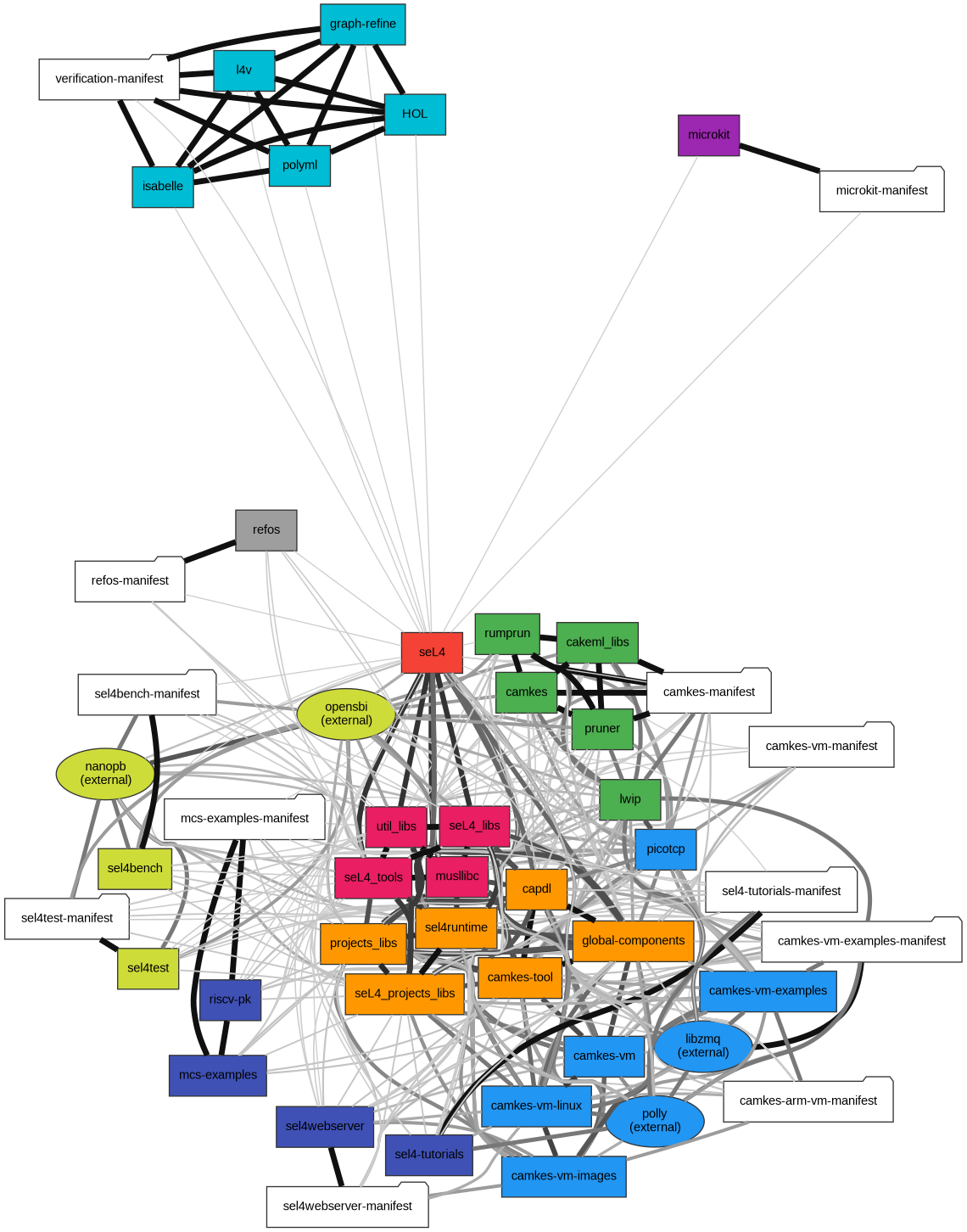
seL4 microkernel proper. This often but not
always co-exists with the main cluster of core libraries, but it
is pulled away slightly by the verification and microkit
manifests.
l4v, HOL,
graph-refine, polyml, isabelle) form a very distinct group.
These are connected only to the seL4 microkernel itself, which is
the only component formally verified.
microkit is a newer operating system framework
that does not use CAmkES, so stands apart from the rest of the
pack. I chose to scope this work to the seL4 org, so the LionsOS
ecosystem and sDDF which are maintained by Trustworthy Systems are
not shown. Also not linked is rust-sel4, because this modern
world isn t using git-repo in the main to manage its repositories.
refos before, but it appears to
be an example OS from 2021 built on the seL4 kernel.
camkes is correctly identified as more peripheral than
camkes-tool, which contains the actual core CAmkES code.
Reflecting on this approach, in hindsight I m surprised that using
co-occurences worked as well as it did there was no attempt to
actually inspect the code and find direct mentions of other code
e.g. library header dependencies. As the newer microkit effort
largely eschews git-repo, better results might be found by actually
taking that more detailed approach, so that graph edges could
represent real dependencies between two packages. Additionally, this
could allow diving into the various libraries held in the different
libs repos, to get a more granular graph of relationships between
them.
However, I think I spent more time on making it possible to render
graphviz graphs easily on my blog than actually gaining any insight
into the codebase!
Armadillo is a powerful
and expressive C++ template library for linear algebra and scientific
computing. It aims towards a good balance between speed and ease of use,
has a syntax deliberately close to Matlab, and is useful for algorithm
development directly in C++, or quick conversion of research code into
production environments. RcppArmadillo
integrates this library with the R environment and language and is
widely used by (currently) 1282 other packages on CRAN, downloaded 47.1 million
times (per the partial logs from the cloud mirrors of CRAN), and the CSDA paper (preprint
/ vignette) by Conrad and myself has been cited 697 times according
to Google Scholar.
This versions updates to the 15.4.0 upstream Armadillo release made on
Thursday. We had run a complete reverse-dependency check leading up to
it, asserting there were no issues with packages dependent on it. As it
sometimes goes with that many packages involved, one CRAN package reported one test
failure. And it turned out to be both unrelated and pre-existing. But
sorting this out over one round of email delayed things by a day. And
then I went cycling
for a good cause so this announcement post comes a little later than
usual. The package has also been updated for Debian, built for r2u, and by now also at
CRAN for the different binary
releases.
All changes since the last CRAN release follow.
Courtesy of my CRANberries, there is a diffstat report relative to previous release. More detailed information is on the RcppArmadillo page. Questions, comments etc should go to the rcpp-devel mailing list off the Rcpp R-Forge page.Changes in RcppArmadillo version 15.4.0-1 (2026-06-17)
- Upgraded to Armadillo release 15.4.0 (Medium Roast Agave)
- Added
fill::nan,fill::pos_inf,fill::neg_infas optional fill forms for theMatclass- Added
.push_back()for appending elements to vectors- Faster handling of
find()within.elem()- Faster element-wise
min()andmax()- Faster
conv_towhen element types of input and output objects are the same
This post by Dirk Eddelbuettel originated on his Thinking inside the box blog. If you like this or other open-source work I do, you can sponsor me at GitHub. You can also sponsor my Tour de Shore 2026 ride in support of the Maywood Fine Arts Center.
Following up on my previous post, I have released the
debvulns CLI. This utility uses
the same parsing logic as the debsecan-mcp server but exposes the
functionality directly via the command line.
usage: debvulns [-h] [-s critical,high,medium,low,negligible ] [-f json,csv ] [--sort-by package,cve ] [--vuln-url VULN_URL] [--epss-url EPSS_URL] [--suite SUITE]
[--cache-dir CACHE_DIR] [--no-cache] [-v]
debvulns - CLI Debian Vulnerabilities Tracker
options:
-h, --help show this help message and exit
-s, --severity critical,high,medium,low,negligible
Filter vulnerabilities by severity
-f, --format json,csv
Output format (default: json)
-sort-by package,cve
Sort vulnerabilities by 'package' or 'cve'
--vuln-url VULN_URL Custom URL or local path for Debian Security Tracker data
--epss-url EPSS_URL Custom URL or local path for EPSS scores data
--suite SUITE Debian suite name (e.g. bookworm, sid). Auto-detected by default.
--cache-dir CACHE_DIR
Directory to cache fetched and parsed data (default: /var/cache/debvulns)
--no-cache Do not use cached data, force downloading and parsing
-v, --verbose Enable verbose debug logging (sent to stderr)
| Z640 (1 socket) | Z4G4 | Z6G4 (1 socket) | Z8G4 | |
|---|---|---|---|---|
| DIMM slots | 4 | 8 | 6 | 24 |
| Max DDR4 speed | 2400 | 2666/2933 | 2666/2933 | 2666/2933 |
| Max DIMM size | 32G | 64G | 64G | 64G/128G |
| System Max Ram | 128G | 512G | 192G/384G | 1.5T/3T |
| CPU Socket | LGA2011-3 | LGA2066 | LGA3647 | LGA3647 |
| Best CPU | E5-2699A v4 | W-2195/W-2295 | Platinum 8180/W-3275 | Platinum 8180/8280 |
| Motherboard NVMe | 0 | 2 | 2 | ? |
This post is a review for Computing Reviews for systemd for Linux SysAdmins , a book published in Apresssystemd. Yes, in full lowercase. If there was ever a technology to cause controversy in the Linux world, this is it. Since its inception in 2010, systemd s goals were set quite high: to replace the vital part in every Linux system that takes care of the system boot process. It quickly reached maturity, allowing it to be adopted as the main init system in most major distributions just five years later. Despite describing events that happened over a decade ago, systemd adoption still raises the temperature in any Linux-related discussion. David Both s comprehensive book tackles the what, why, and how issues surrounding systemd. Carefully divided into 16 chapters, going from the basics and some of the technical and political history behind the project to the different subsystems and aspects covered by systemd, its almost 450 pages can scare people away. But the text is written in a very clear, tutorial-like fashion, and while it can be read sequentially, cover-to-cover, readers can also pick a single aspect and jump straight to the relevant chapter. A frequent criticism of the systemd project is that it aims to basically rewrite all of a Linux system, and just looking at this book s index shows there is some truth to it. The first chapter is an introduction to the systemd project and a brief overview of its history (including the controversies around it), and the following four chapters deal with understanding and controlling the system boot process. That leaves ten chapters to cover different aspects or subprojects of systemd, such as time and date issues (synchronization, time specifications, and controlling repetitive tasks), understanding and leveraging the system journal that strongly departs from the old syslog system, network configuration and firewall management, system health and performance debugging all aspects that in the traditional Unix philosophy were managed by independent programs. And I can identify several systemd subprojects not covered by this book! We long-time Unix and Linux administrators took pride in how highly performant and stable systems were supported by the simplicity of our tools; systemd critics point out this massive project has absorbed dozens of individual tools, yielding corporate control over vast swaths of vital system tooling. Truth is, as a sysadmin myself, systemd is today one of my greatest allies. I appreciate how the author evaluates every component independently, including his personal evaluation of each even acknowledging when he prefers working with the traditional programs. If I had to note one criticism: given the many console captures, having a maximum width below 70 characters means several lines are unnaturally cut short (and continued with odd indentations). There is probably no right way to solve this, but it does affect the reading experience.
Through work, I have paid license to windsurf
(recently renamed to "devin"), an application for LLM-based (aka,
"Agentic") development.
I hadn't been using it that much, but in an effort to more clearly
understand how this whole AI development thing works, I decided to give
it a closer look recently.
My conclusions:
In its current form, this whole LLM wave is problematic for multiple
reasons. But ignoring that, and looking at the technology only, I can
say that:
sendmail to finish, but the hang was happening when the
application was idle, not when it was sending out emails, and only
when I told it about it happening when it was idle did it find the
deadlock.
So it's not a fully automatic process, and it needs to be guided by
someone who knows what they're doing. But if that is the case, you can
come up with something that works. I spent evenings and breaks for about
a week, and I managed to create a working application which, had I
written it by hand, would have taken me a few months of full-time work
to come up with. And I now have a side project, fully complete and
working, that I had been thinking about doing for more than a decade,
but never got around to actually doing, because of all the work that
would be involved and I just didn't see myself having the time for.
It's not perfect code. But it's mostly good enough, and it will perform
the job it needs to. And it looks far slicker than most of the side
projects I've done in the past, because in the past I would prioritize
between implementing new features or making something look slick, and I
would decide that the new feature was more important because it's only
for me and there's only me and nobody cares if it looks good or not and
I don't have three weeks to come up with something that looks better.
But here, I found myself sometimes spending 10 minutes writing a prompt
with instructions on making things look better. Because what's 10
minutes when you just spent an hour writing down and refining
specifications for functionality and tests?
There are a number of other things in which an LLM can help a
programmer.
For instance.
I received a bug report recently in a project I'm paid to
maintain that I couldn't make heads
or tails of. I opened the source code in my windsurf IDE, pasted the bug
report in the prompt, and then requested the tool to analyze the source
code and the associated logs and tell me how the described behavior
could be happening. It turned out that I had overlooked something, but
with the help of the tool, I found the bug in minutes.
I was trying to understand a particular part of a large
codebase that I didn't really grasp very well.
I loaded the codebase in the tool, and asked it to explain to me how a
particular action is performed by the code. I requested specific
functions and line numbers. I now have a far better understanding of how
the code works, and will be able to write that patch that I've been
wanting to write for years -- without using the LLM.
I have been struggling for, literally, years with understanding why
another tool that I
maintain was
misbehaving in a particular way but only in Firefox. I opened the
codebase in Firefox, explained the buggy behavior in plain English, and
asked it to explain how this could be happening. It picked up some
obscure corner case behavior of ffmpeg and mp4 containers that I was not
aware of and that perfectly explained why things were misbehaving in the
way that they were.
At the same time, there are limitations. Giving an LLM a codebase that
was originally generated by an LLM (either the same one or another one)
seems to work well. Giving it a codebase that was written by a human and
expecting it to correctly update it seems to be more error-prone. I did
one or two of those as a trial, and it is more problematic than
anything.
An LLM is also not intelligent, notwithstanding the popular term of
"Artificial Intelligence". On multiple occasions, I've asked it to write
a test case for some code that was not set up to do so; and rather than
suggesting a refactor is required, it would instead copy the code that
needed to be tested and then test the copy, rather than the original.
The tool has made multiple similar errors. I have sometimes people
describe agentic coding as "similar to interacting with junior
programmers", but that is not the case. A junior programmer will either
fill in the gaps in your specifications, or ask for clarification when
something seems off. The LLM will not do that; it will do what you ask,
exactly that and nothing more. If you missed a corner case in your
specification, then all bets are off.
I remember learning about programming language generations in college.
A first-generation language is "machine code", a second-generation
language is "assembler", a third-generation language is any high-level
language such as C, Perl, or Pascal. I've forgotten what set a
3rd-generation language apart from a 4th-generation language. But I
remember the definition they gave me for a 5th-generation language: "you
tell the computer what to do, and it will do it". At the time, I thought
it was ridiculous. Nobody could ever write something like that.
But it's here.
And it's a threat to free software.
If all you have is a hammer, then everything looks like a nail.LLMs are an outgrowth of machine learning, pushed by large corporations. These large corporations have a lot of money. If all you have is money, then every problem can be fixed by throwing more money at it. The initial language models were promising but not (yet) good enough, and it seemed that one way in which they could be improved was to increase the scale of the statistics: throw more hardware (and thus money) at it, and rather than improving the efficiency of the models, just scale up. Scaling up is something that megacorporations are very good at. It's only a money problem, after all. Does that mean that "scaling up" is the only way to improve the models, though? I'm not convinced. Some hardware, such as most modern Apple and Samsung devices, ship with accelerator hardware for machine learning algorithms. There are some models that are small enough to be able to run on these devices. I don't see why it should not be possible to create a small(er) language model that can do some useful part of the above-described use cases; if not locally, then at least on a server that one can run on-prem rather than requiring that you pay rent to one of the LLM companies. The Software Freedom Conservancy has published an aspirational statement on machine learning-assisted programming that, I think, gets a lot right. It's not quite a definition, but it's something to keep in mind. Perhaps that's the way forward? More questions than answers at this point, anyway.
looking for last. I realized it's gone. what's my replacement?

320. This version includes the following changes:
[ Chris Lamb ]
* Support androguard 4 and previous versions. Thanks, linsui!
(Closes: #1140016)
* Use --long-form arguments when calling apktool in order to support apktool
version 3. Thanks again to linsui. (Closes: #1140015)
* Update copyright years.
The Debian LTS Team, funded by Freexian s Debian LTS offering, is
pleased to report its activities for May.
321. This version includes the following changes:
[ Chris Lamb ]
* Fix compatibility with Ocaml 5.4.1.
There has been a video blog post recently published with a review of Ubuntu Touch as an option to opt out of the Android world: https://www.youtube.com/watch?v=wTK6TS3pXgc
Thanks to @SwitchandClick for spending time on this and publishing that video. Much appreciated.
Many Issues amended in upcoming 24.04-2.0 Release
When I watched that video referenced above, I continuously thought: ah... this is fixed in the next major release of Ubuntu Touch, or: ah... this is a known issue that we have on the roadmap..., or: ah... this is done in this ways by design (so it's a feature or basic functionality)...
Let me just state, that most of the criticized aspects will be resolved in upcoming Ubuntu Touch release 24.04-2.0 (the tests in that video blog post have been run on Ubuntu Touch 24.04-1.x):
Next.