Search Results: "ema"

18 August 2025

Otto Kek l inen: Best Practices for Submitting and Reviewing Merge Requests in Debian


Featured image of post Best Practices for Submitting and Reviewing Merge Requests in DebianHistorically the primary way to contribute to Debian has been to email the Debian bug tracker with a code patch. Now that 92% of all Debian source packages are hosted at salsa.debian.org the GitLab instance of Debian more and more developers are using Merge Requests, but not necessarily in the optimal way. In this post I share what I ve found the best practice to be, presented in the natural workflow from forking to merging.

Why use Merge Requests? Compared to sending patches back and forth in email, using a git forge to review code contributions brings several benefits:
  • Contributors can see the latest version of the code immediately when the maintainer pushes it to git, without having to wait for an upload to Debian archives.
  • Contributors can fork the development version and easily base their patches on the correct version and help test that the software continues to function correctly at that specific version.
  • Both maintainer and other contributors can easily see what was already submitted and avoid doing duplicate work.
  • It is easy for anyone to comment on a Merge Request and participate in the review.
  • Integrating CI testing is easy in Merge Requests by activating Salsa CI.
  • Tracking the state of a Merge Request is much easier than browsing Debian bug reports tagged patch , and the cycle of submit review re-submit re-review is much easier to manage in the dedicated Merge Request view compared to participants setting up their own email plugins for code reviews.
  • Merge Requests can have extra metadata, such as Approved , and the metadata often updates automatically, such as a Merge Request being closed automatically when the Git commit ID from it is pushed to the target branch.
Keeping these benefits in mind will help ensure that the best practices make sense and are aligned with maximizing these benefits.

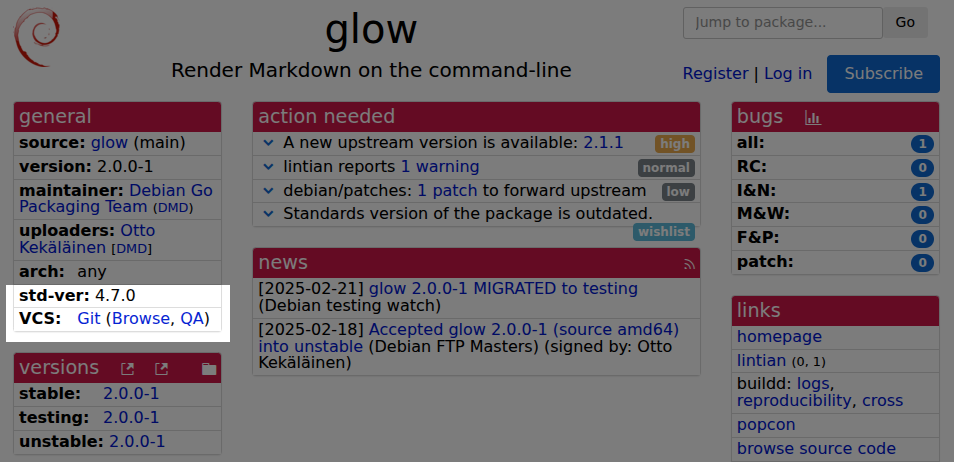
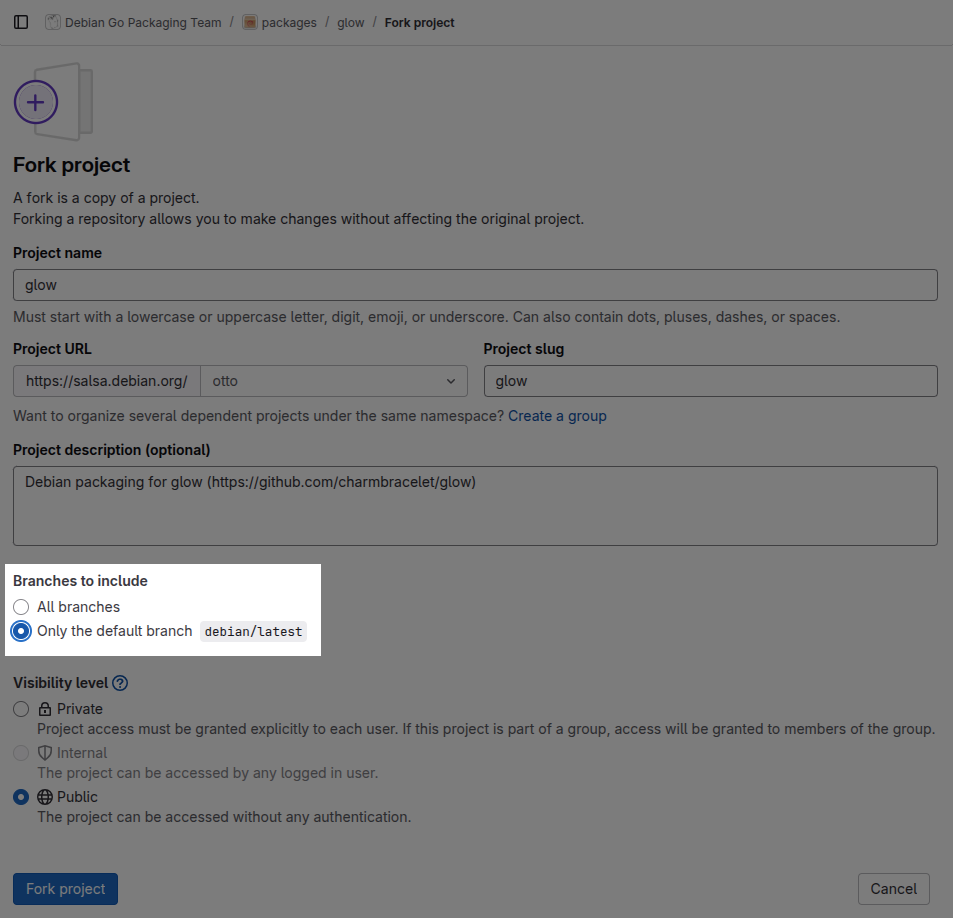
Finding the Debian packaging source repository and preparing to make a contribution Before sinking any effort into a package, start by checking its overall status at the excellent Debian Package Tracker. This provides a clear overview of the package s general health in Debian, when it was last uploaded and by whom, and if there is anything special affecting the package right now. This page also has quick links to the Debian bug tracker of the package, the build status overview and more. Most importantly, in the General section, the VCS row links to the version control repository the package advertises. Before opening that page, note the version most recently uploaded to Debian. This is relevant because nothing in Debian currently enforces that the package in version control is actually the same as the latest uploaded to Debian. Packaging source code repository links at tracker.debian.org Following the Browse link opens the Debian package source repository, which is usually a project page on Salsa. To contribute, start by clicking the Fork button, select your own personal namespace and, under Branches to include, pick Only the default branch to avoid including unnecessary temporary development branches. View after pressing Fork Once forking is complete, clone it with git-buildpackage. For this example repository, the exact command would be gbp clone --verbose git@salsa.debian.org:otto/glow.git. Next, add the original repository as a new remote and pull from it to make sure you have all relevant branches. Using the same fork as an example, the commands would be:
git remote add go-team https://salsa.debian.org/go-team/packages/glow.git
gbp pull --verbose --track-missing go-team
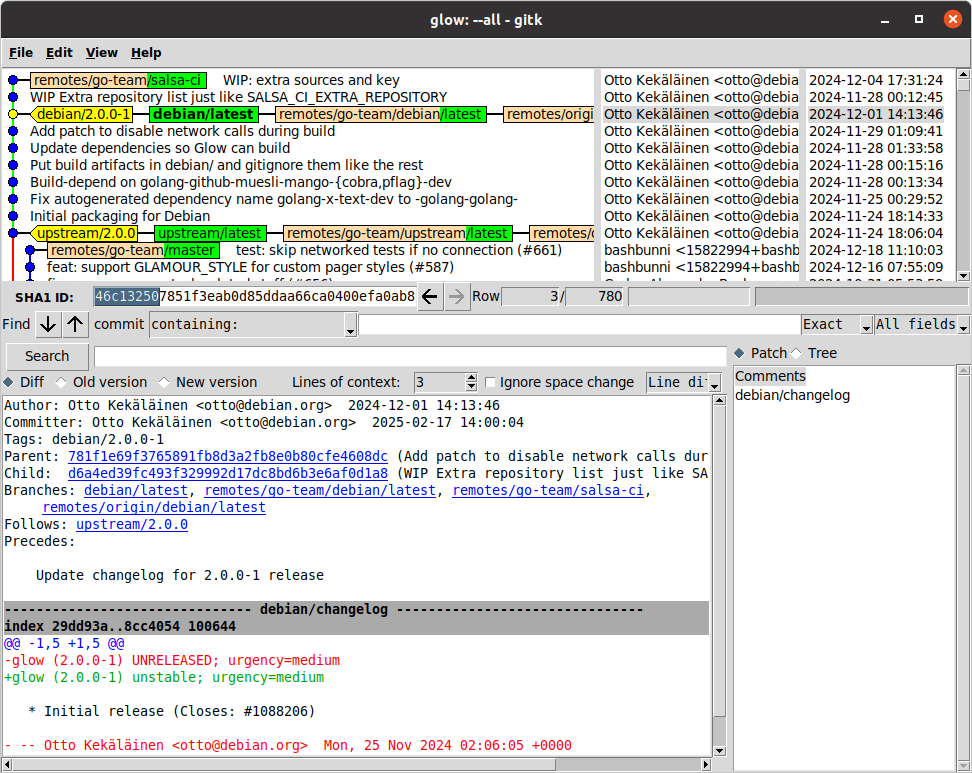
The gbp pull command can be repeated whenever you want to make sure the main branches are in sync with the original repository. Finally, run gitk --all & to visually browse the Git history and note the various branches and their states in the two remotes. Note the style in comments and repository structure the project has and make sure your contributions follow the same conventions to maximize the chances of the maintainer accepting your contribution. It may also be good to build the source package to establish a baseline of the current state and what kind of binaries and .deb packages it produces. If using Debcraft, one can simply run debcraft build in the Git repository.
Submitting a Merge Request for a Debian packaging improvement Always start by making a development branch by running git checkout -b <branch name> to clearly separate your work from the main branch. When making changes, remember to follow the conventions you already see in the package. It is also important to be aware of general guidelines on how to make good Git commits. If you are not able to immediately finish coding, it may be useful to publish the Merge Request as a draft so that the maintainer and others can see that you started working on something and what general direction your change is heading in. If you don t finish the Merge Request in one sitting and return to it another day, you should remember to pull the Debian branch from the original Debian repository in case it has received new commits. This can be done easily with these commands (assuming the same remote and branch names as in the example above):
git fetch go-team
git rebase -i go-team/debian/latest
Frequent rebasing is a great habit to help keep the Git history linear, and restructuring and rewording your commits will make the Git history easier to follow and understand why the changes were made. When pushing improved versions of your branch, use git push --force. While GitLab does allow squashing, I recommend against it. It is better that the submitter makes sure the final version is a neat and clean set of commits that the receiver can easily merge without having to do any rebasing or squashing themselves. When ready, remove the draft status of the Merge Request and wait patiently for review. If the maintainer does not respond in several days, try sending an email to <source package name>@packages.debian.org, which is the official way to contact maintainers. You could also post a comment on the MR and tag the last few committers in the same repository so that a notification email is triggered. As a last resort, submit a bug report to the Debian bug tracker to announce that a Merge Request is pending review. This leaves a permanent record for posterity (or the Debian QA team) of your contribution. However, most of the time simply posting the Merge Request in Salsa is enough; excessive communication might be perceived as spammy, and someone needs to remember to check that the bug report is closed.

Respect the review feedback, respond quickly and avoid Merge Requests getting stale Once you get feedback, try to respond as quickly as possible. When people participating have everything fresh in their minds, it is much easier for the submitter to rework it and for the reviewer to re-review. If the Merge Request becomes stale, it can be challenging to revive it. Also, if it looks like the MR is only waiting for re-review but nothing happens, re-read the previous feedback and make sure you actually address everything. After that, post a friendly comment where you explicitly say you have addressed all feedback and are only waiting for re-review.

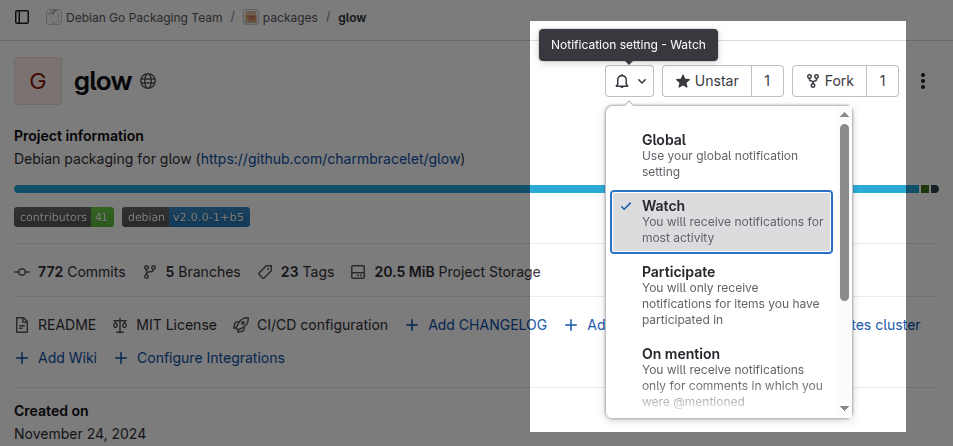
Reviewing Merge Requests This section about reviewing is not exclusive to Debian package maintainers anyone can contribute to Debian by reviewing open Merge Requests. Typically, the larger an open source project gets, the more help is needed in reviewing and testing changes to avoid regressions, and all diligently done work is welcome. As the famous Linus quote goes, given enough eyeballs, all bugs are shallow . On salsa.debian.org, you can browse open Merge Requests per project or for a whole group, just like on any GitLab instance. Reviewing Merge Requests is, however, most fun when they are fresh and the submitter is active. Thus, the best strategy is to ensure you have subscribed to email notifications in the repositories you care about so you get an email for any new Merge Request (or Issue) immediately when posted. Change notification settings from Global to Watch to get an email on new Merge Requests When you see a new Merge Request, try to review it within a couple of days. If you cannot review in a reasonable time, posting a small note that you intend to review it later will feel better to the submitter compared to not getting any response. Personally, I have a habit of assigning myself as a reviewer so that I can keep track of my whole review queue at https://salsa.debian.org/dashboard/merge_requests?reviewer_username=otto, and I recommend the same to others. Seeing the review assignment happen is also a good way to signal to the submitter that their submission was noted.
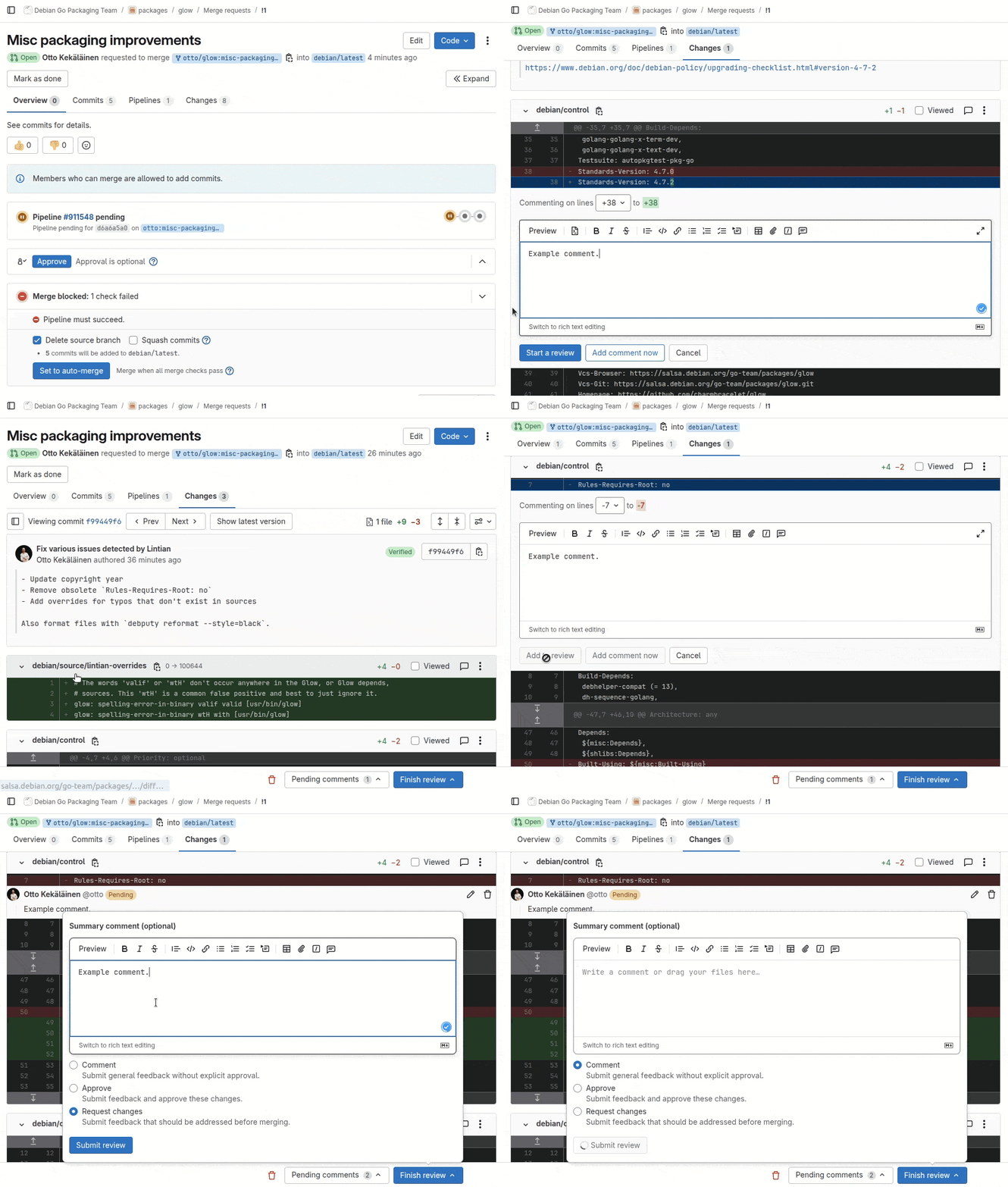
Reviewing commit-by-commit in the web interface Reviewing using the web interface works well in general, but I find that the way GitLab designed it is not ideal. In my ideal review workflow, I first read the Git commit message to understand what the submitter tried to do and why; only then do I look at the code changes in the commit. In GitLab, to do this one must first open the Commits tab and then click on the last commit in the list, as it is sorted in reverse chronological order with the first commit at the bottom. Only after that do I see the commit message and contents. Getting to the next commit is easy by simply clicking Next. Example review to demonstrate location of buttons and functionality When adding the first comment, I choose Start review and for the following remarks Add to review. Finally, I click Finish review and Submit review, which will trigger one single email to the submitter with all my feedback. I try to avoid using the Add comment now option, as each such comment triggers a separate notification email to the submitter.
Reviewing and testing on your own computer locally For the most thorough review, I pull the code to my laptop for local review with git pull <remote url> <branch name>. There is no need to run git remote add as pulling using a URL directly works too and saves from needing to clean up old remotes later. Pulling the Merge Request contents locally allows me to build, run and inspect the code deeply and review the commits with full metadata in gitk or equivalent.

Investing enough time in writing feedback, but not too much See my other post for more in-depth advice on how to structure your code review feedback. In Debian, I would emphasize patience, to allow the submitter time to rework their submission. Debian packaging is notoriously complex, and even experienced developers often need more feedback and time to get everything right. Avoid the temptation to rush the fix in yourself. In open source, Git credits are often the only salary the submitter gets. If you take the idea from the submission and implement it yourself, you rob the submitter of the opportunity to get feedback, try to improve and finally feel accomplished. Sure, it takes extra effort to give feedback, but the contributor is likely to feel ownership of their work and later return to further improve it. If a submission looks hopelessly low quality and you feel that giving feedback is a waste of time, you can simply respond with something along the lines of: Thanks for your contribution and interest in helping Debian. Unfortunately, looking at the commits, I see several shortcomings, and it is unlikely a normal review process is enough to help you finalize this. Please reach out to Debian Mentors to get a mentor who can give you more personalized feedback. There might also be contributors who just dump the code , ignore your feedback and never return to finalize their submission. If a contributor does not return to finalize their submission in 3-6 months, I will in my own projects simply finalize it myself and thank the contributor in the commit message (but not mark them as the author). Despite best practices, you will occasionally still end up doing some things in vain, but that is how volunteer collaboration works. We all just need to accept that some communication will inevitably feel like wasted effort, but it should be viewed as a necessary investment in order to get the benefits from the times when the communication led to real and valuable collaboration. Please just do not treat all contributors as if they are unlikely to ever contribute again; otherwise, your behavior will cause them not to contribute again. If you want to grow a tree, you need to plant several seeds.

Approving and merging Assuming review goes well and you are ready to approve, and if you are the only maintainer, you can proceed to merge right away. If there are multiple maintainers, or if you otherwise think that someone else might want to chime in before it is merged, use the Approve button to show that you approve the change but leave it unmerged. The person who approved does not necessarily have to be the person who merges. The point of the Merge Request review is not separation of duties in committing and merging the main purpose of a code review is to have a different set of eyeballs looking at the change before it is committed into the main development branch for all eternity. In some packages, the submitter might actually merge themselves once they see another developer has approved. In some rare Debian projects, there might even be separate people taking the roles of submitting, approving and merging, but most of the time these three roles are filled by two people either as submitter and approver+merger or submitter+merger and approver. If you are not a maintainer at all and do not have permissions to click Approve, simply post a comment summarizing your review and that you approve it and support merging it. This can help the maintainers review and merge faster.

Making a Merge Request for a new upstream version import Unlike many other Linux distributions, in Debian each source package has its own version control repository. The Debian sources consist of the upstream sources with an additional debian/ subdirectory that contains the actual Debian packaging. For the same reason, a typical Debian packaging Git repository has a debian/latest branch that has changes only in the debian/ subdirectory while the surrounding upstream files are the actual upstream files and have the actual upstream Git history. For details, see my post explaining Debian source packages in Git. Because of this Git branch structure, importing a new upstream version will typically modify three branches: debian/latest, upstream/latest and pristine-tar. When doing a Merge Request for a new upstream import, only submit one Merge Request for one branch: which means merging your new changes to the debian/latest branch. There is no need to submit the upstream/latest branch or the pristine-tar branch. Their contents are fixed and mechanically imported into Debian. There are no changes that the reviewer in Debian can request the submitter to do on these branches, so asking for feedback and comments on them is useless. All review, comments and re-reviews concern the content of the debian/latest branch only. It is not even necessary to use the debian/latest branch for a new upstream version. Personally, I always execute the new version import (with gbp import-orig --verbose --uscan) and prepare and test everything on debian/latest, but when it is time to submit it for review, I run git checkout -b import/$(dpkg-parsechangelog -SVersion) to get a branch named e.g. import/1.0.1 and then push that for review.

Reviewing a Merge Request for a new upstream version import Reviewing and testing a new upstream version import is a bit tricky currently, but possible. The key is to use gbp pull to automate fetching all branches from the submitter s fork. Assume you are reviewing a submission targeting the Glow package repository and there is a Merge Request from user otto s fork. As the maintainer, you would run the commands:
git remote add otto https://salsa.debian.org/otto/glow.git
gbp pull --verbose otto
If there was feedback in the first round and you later need to pull a new version for re-review, running gbp pull --force will not suffice, and this trick of manually fetching each branch and resetting them to the submitter s version is needed:
for BRANCH in pristine-tar upstream debian/latest
do
git checkout $BRANCH
git reset --hard origin/$BRANCH
git pull --force https://salsa.debian.org/otto/glow.git $BRANCH
done
Once review is done, either click Approve and let the submitter push everything, or alternatively, push all the branches you pulled locally yourself. In GitLab and other forges, the Merge Request will automatically be marked as Merged once the commit ID that was the head of the Merge Request is pushed to the target branch.

Please allow enough time for everyone to participate When working on Debian, keep in mind that it is a community of volunteers. It is common for people to do Debian stuff only on weekends, so you should patiently wait for at least a week so that enough workdays and weekend days have passed for the people you interact with to have had time to respond on their own Debian time. Having to wait may feel annoying and disruptive, but try to look at the upside: you do not need to do extra work simply while waiting for others. In some cases, that waiting can be useful thanks to the sleep on it phenomenon: when you yourself look at your own submission some days later with fresh eyes, you might notice something you overlooked earlier and improve your code change even without other people s feedback!

Contribute reviews! The last but not least suggestion is to make a habit of contributing reviews to packages you do not maintain. As we already see in large open source projects, such as the Linux kernel, they have far more code submissions than they can handle. The bottleneck for progress and maintaining quality becomes the reviews themselves. For Debian, as an organization and as a community, to be able to renew and grow new contributors, we need more of the senior contributors to shift focus from merely maintaining their packages and writing code to also intentionally interact with new contributors and guide them through the process of creating great open source software. Reviewing code is an effective way to both get tangible progress on individual development items and to transfer culture to a new generation of developers.

Why aren t 100% of all Debian source packages hosted on Salsa? As seen at trends.debian.net, more and more packages are using Salsa. Debian does not, however, have any policy about it. In fact, the Debian Policy Manual does not even mention the word Salsa anywhere. Adoption of Salsa has so far been purely organic, as in Debian each package maintainer has full freedom to choose whatever preferences they have regarding version control. I hope the trend to use Salsa will continue and more shared workflows emerge so that collaboration gets easier. To drive the culture of using Merge Requests and more, I drafted the Debian proposal DEP-18: Encourage Continuous Integration and Merge Request based Collaboration for Debian packages. If you are active in Debian and you think DEP-18 is beneficial for Debian, please give a thumbs up at dep-team/deps!21.

17 August 2025

C.J. Collier: The Very Model of a Patriot Online

It appears that the fragile masculinity tech evangelists have identified Debian as a community with boundaries which exclude them from abusing its members and they re so angry about it! In response to posts such as this, and inspired by Dr. Conway s piece, I ve composed a poem which, hopefully, correctly addresses the feelings of that crowd.

The Very Model of a Patriot Online
I am the very model of a modern patriot online,
My keyboard is my rifle and my noble cause is so divine.
I didn't learn my knowledge in a dusty college lecture hall,
But from the chans where bitter anonymity enthralls us all.
I spend a dozen hours every day upon my sacred quest,
To put the globo-homo narrative completely to the test.
My arguments are peer-reviewed by fellas in the comments section,
Which proves my every thesis is the model of complete perfection.
I m steeped in righteous anger that the libs call 'white fragility,'
For mocking their new pronouns and their lack of masculinity.
I m master of the epic troll, the comeback, and the searing snark,
A digital guerrilla who is fighting battles in the dark.
I know the secret symbols and the dog-whistles historical,
From Pepe the Frog to  Let s Go Brandon,  in order categorical;
In short, for fighting culture wars with rhetoric rhetorical,
I am the very model of a patriot polemical.
***
I stand for true expression, for the comics and the edgy clown,
Whose satire is too based for all the fragile folks in town.
They say my speech is 'violence' while my spirit they are trampling,
The way they try to silence me is really quite a startling sampling
Of 1984, which I've not read but thoroughly understand,
Is all about the tyranny that's gripping this once-blessed land.
My humor is a weapon, it s a razor-bladed, sharp critique,
(Though sensitive elites will call my masterpiece a form of  hate speech ).
They cannot comprehend my need for freedom from all consequence,
They call it 'hate,' I call it 'jokes,' they just don't have a lick of sense.
So when they call me  bigot  for the spicy memes I post pro bono,
I tell them their the ones who're cancelled, I'm the victim here, you know!
Then I can write a screed against the globalist cabal, you see,
And tell you every detail of their vile conspiracy.
In short, when I use logic that is flexible and personal,
I am the very model of a patriot controversial.
***
I'm very well acquainted with the scientific method, too,
It's watching lengthy YouTube vids until my face is turning blue.
I trust the heartfelt testimony of a tearful, blonde ex-nurse,
But what a paid fact-checker says has no effect and is perverse.
A PhD is proof that you've been brainwashed by the leftist mob,
While my own research on a meme is how I really do my job.
I know that masks will suffocate and vaccines are a devil's brew,
I learned it from a podcast host who used to sell brain-boosting goo.
He scorns the lamestream media, the CNNs and all the rest,
Whose biased reporting I've put fully to a rigorous test
By only reading headlines and confirming what I already knew,
Then posting my analysis for other patriots to view.
With every "study" that they cite from sources I can't stand to hear,
My own profound conclusions become ever more precisely clear.
In short, when I've debunked the experts with a confident "Says who?!",
I am the very model of a researcher who sees right through you.
***
But all these culture wars are just a sleight-of-hand, a clever feint,
To hide the stolen ballots and to cover up the moral taint
Of D.C. pizza parlors and of shipping crates from Wayfair, it s true,
It's all connected in a plot against the likes of me and you!
I've analyzed the satellite photography and watermarks,
I understand the secret drops, the cryptic Qs, the coded sparks.
The  habbening  is coming, friends, just give it two more weeks or three,
When all the traitors face the trials for their wicked treachery.
They say that nothing happened and the dates have all gone past, you see,
But that's just disinformation from the globalist enemy!
Their moving goalposts constantly, a tactic that is plain to see,
To wear us down and make us doubt the coming, final victory!
My mind can see the patterns that a simple sheep could never find,
The hidden puppet-masters who are poisoning our heart and mind.
In short, when I link drag queens to the price of gas and child-trafficking,
I am the very model of a patriot whose brain is quickening!
***
My pickup truck's a testament to everything that I hold dear,
With vinyl decals saying things the liberals all hate and fear.
The Gadsden flag is waving next to one that's blue and starkly thin,
To show my deep respect for law, except the feds who're steeped in sin.
There's Punisher and Molon Labe, so that everybody knows
I'm not someone to trifle with when push to final shoving goes.
I've got my tactical assault gear sitting ready in the den,
Awaiting for the signal to restore our land with my fellow men.
I practice clearing rooms at home when my mom goes out to the store,
A modern Minuteman who's ready for a civil war.
The neighbors give me funny looks, I see them whisper and take note,
They'll see what's what when I'm the one who's guarding checkpoints by their throat.
I am a peaceful man, of course, but I am also pre-prepared,
To neutralize the threats of which the average citizen's unscared.
In short, when my whole identity's a brand of tactical accessory,
You'll say a better warrior has never graced a Cabela's registry.
***
They say I have to tolerate a man who thinks he is a dame,
While feminists and immigrants are putting out my vital flame!
There taking all the jobs from us and giving them to folks who kneel,
And "woke HR" says my best jokes are things I'm not allowed to feel!
An Alpha Male is what I am, a lion, though I'm in this cubicle,
My life's frustrations can be traced to policies Talmudical.
They lecture me on privilege, I, who have to pay my bills and rent!
While they give handouts to the lazy, worthless, and incompetent!
My grandad fought the Nazis! Now I have to press a key for  one 
To get a call-rep I can't understand beneath the blazing sun
Of global, corporate tyranny that's crushing out the very soul
Of men like me, who've lost their rightful, natural, and just control!
So yes, I am resentful! And I'm angry! And I'm right to be!
They've stolen all my heritage and my masculinity!
In short, when my own failures are somebody else's evil plot,
I am the very model of the truest patriot we've got!
***
There putting chips inside of you! Their spraying things up in the sky!
They want to make you EAT THE BUGS and watch your very spirit die!
The towers for the 5G are a mind-control delivery tool!
To keep you docile while the children suffer in a grooming school!
The WEF, and Gates, and Soros have a plan they call the 'Great Reset,'
You'll own no property and you'll be happy, or you'll be in debt
To social credit overlords who'll track your every single deed!
There sterilizing you with plastics that they've hidden in the feed!
The world is flat! The moon is fake! The dinosaurs were just a lie!
And every major tragedy's a hoax with actors paid to cry!
I'M NOT INSANE! I SEE THE TRUTH! MY EYES ARE OPEN! CAN'T YOU SEE?!
YOU'RE ALL ASLEEP! YOU'RE COWARDS! YOU'RE AFRAID OF BEING TRULY FREE!
My heart is beating faster now, my breath is short, my vision's blurred,
From all the shocking truth that's in each single, solitary word!
I've sacrificed my life and friends to bring this message to the light, so...
You'd better listen to me now with all your concentrated might, ho!
***
For my heroic struggle, though it's cosmic and it's biblical,
Is waged inside the comments of a post that's algorithm-ical.
And still for all my knowledge that's both tactical and practical,
My mom just wants the rent I owe and says I'm being dramatical.

15 August 2025

Freexian Collaborators: Monthly report about Debian Long Term Support, July 2025 (by Roberto C. S nchez)

Like each month, have a look at the work funded by Freexian s Debian LTS offering.

Debian LTS contributors In July, 17 contributors have been paid to work on Debian LTS, their reports are available:
  • Adrian Bunk did 19.0h (out of 19.0h assigned).
  • Andrej Shadura did 5.0h (out of 0.0h assigned and 8.0h from previous period), thus carrying over 3.0h to the next month.
  • Bastien Roucari s did 18.5h (out of 18.75h assigned), thus carrying over 0.25h to the next month.
  • Ben Hutchings did 12.5h (out of 3.25h assigned and 15.5h from previous period), thus carrying over 6.25h to the next month.
  • Carlos Henrique Lima Melara did 10.0h (out of 10.0h assigned).
  • Chris Lamb did 18.0h (out of 18.0h assigned).
  • Daniel Leidert did 18.75h (out of 17.25h assigned and 1.5h from previous period).
  • Emilio Pozuelo Monfort did 18.75h (out of 18.75h assigned).
  • Guilhem Moulin did 15.0h (out of 14.0h assigned and 1.0h from previous period).
  • Jochen Sprickerhof did 2.0h (out of 16.5h assigned and 2.25h from previous period), thus carrying over 16.75h to the next month.
  • Lee Garrett did 7.0h (out of 0.0h assigned and 23.25h from previous period), thus carrying over 16.25h to the next month.
  • Markus Koschany did 9.0h (out of 18.75h assigned), thus carrying over 9.75h to the next month.
  • Roberto C. S nchez did 10.25h (out of 18.5h assigned and 2.75h from previous period), thus carrying over 11.0h to the next month.
  • Santiago Ruano Rinc n did 7.25h (out of 12.75h assigned and 2.25h from previous period), thus carrying over 7.75h to the next month.
  • Sylvain Beucler did 18.75h (out of 18.75h assigned).
  • Thorsten Alteholz did 15.0h (out of 15.0h assigned).
  • Utkarsh Gupta did 15.0h (out of 1.0h assigned and 14.0h from previous period).

Evolution of the situation In July, we released 24 DLAs.
  • Notable security updates:
    • angular.js, prepared by Bastien Roucari s, fixes multiple vulnerabilities including input sanitization and potential regular expression denial of service (ReDoS)
    • tomcat9, prepared by Markus Koschany, fixes an assortment of vulnerabilities
    • mediawiki, prepared by Guilhem Moulin, fixes several information disclosure and privilege escalation vulnerabilities
    • php7.4, prepared by Guilhem Moulin, fixes several server side request forgery and denial of service vulnerabilities
This month s contributions from outside the regular team include an update to thunderbird, prepared by Christoph Goehre (the package maintainer). LTS Team members also contributed updates of the following packages:
  • commons-beanutils (to stable and unstable), prepared by Adrian Bunk
  • djvulibre (to oldstable, stable, and unstable), prepared by Adrian Bunk
  • git (to stable), prepared by Adrian Bunk
  • redis (to oldstable), prepared by Chris Lamb
  • libxml2 (to oldstable), prepared by Guilhem Moulin
  • commons-vfs (to oldstable), prepared by Daniel Leidert
Additionally, LTS Team member Santiago Ruano Rinc n proposed and implemented an improvement to the debian-security-support package. This package is available so that interested users can quickly determine if any installed packages are subject to limited security support or are excluded entirely from security support. However, there was not previously a way to identify explicitly supported packages, which has become necessary to note exceptions to broad exclusion policies (e.g., those which apply to substantial package groups, like modules belonging to the Go and Rust language ecosystems). Santiago s work has enabled the notation of exceptions to these exclusions, thus ensuring that users of debian-security-support have accurate status information concerning installed packages.

DebCamp 25 Security Tracker Sprint The previously announced security tracker sprint took place at DebCamp from 7-13 July. Participants included 8 members of the standing LTS Team, 2 active Debian Developers with an interest in LTS, 3 community members, and 1 member of the Debian Security Team (who provided guidance and reviews on proposed changes to the security tracker); participation was a mix of in person at the venue in Brest, France and remote. During the days of the sprint, the team tackled a wide range of bugs and improvements, mostly targeting the security tracker. The sprint participants worked on the following items: As can be seen from the above list, only a small number of changes were brought to completion during the sprint week itself. Given the very compressed timeframe involved, the broad scope of tasks which were under consideration, and the highly sensitive data managed by the security tracker, this is not entirely unexpected and in no way diminishes the great work done by the sprint participants. The LTS Team would especially like to thank Salvatore Bonaccorso of the Debian Security Team for making himself available throughout the sprint to answer questions, for providing guidance on the work, and for helping the work by reviewing and merging the MRs which were able to merged during the sprint itself. In the weeks that follow the sprint, the team will continue working towards completing the in progress items.

Thanks to our sponsors Sponsors that joined recently are in bold.

12 August 2025

Freexian Collaborators: Debian Contributions: DebConf 25, OpenSSH upgrades, Cross compilation collaboration and more! (by Anupa Ann Joseph)

Debian Contributions: 2025-07 Contributing to Debian is part of Freexian s mission. This article covers the latest achievements of Freexian and their collaborators. All of this is made possible by organizations subscribing to our Long Term Support contracts and consulting services.

DebConf 25, by Stefano Rivera and Santiago Ruano Rinc n In July, DebConf 25 was held in Brest, France. Freexian was a gold sponsor and most of the Freexian team attended the event. Many fruitful discussions were had amongst our team and within the Debian community. DebConf itself was organized by a local team in Brest, that included Santiago (who now lives in Uruguay). Stefano was also deeply involved in the organization, as a DebConf committee member, core video team, and the lead developer for the conference website. Running the conference took an enormous amount of work, consuming all of Stefano and Santiago s time for most of July. Lucas Kanashiro was active in the DebConf content team, reviewing talks and scheduling them. There were many last-minute changes to make during the event. Anupa Ann Joseph was part of the Debian publicity team doing live coverage of DebConf 25 and was part of the DebConf 25 content team reviewing the talks. She also assisted the local team to procure the lanyards. Recorded sessions presented by Freexian collaborators, often alongside other friends in Debian, included:

OpenSSH upgrades, by Colin Watson Towards the end of a release cycle, people tend to do more upgrade testing, and this sometimes results in interesting problems. Manfred Stock reported No new SSH connections possible during large part of upgrade to Debian Trixie , which would have affected many people upgrading from Debian 12 (bookworm), with potentially severe consequences for people upgrading remote systems. In fact, there were two independent problems that each led to much the same symptom:
  • As part of hardening the OpenSSH server, OpenSSH 9.8 split the monolithic sshd listener process into two pieces: a minimal network listener (still called sshd), and an sshd-session process dealing with each individual session. Before this change, when sshd received an incoming connection, it forked and re-executed itself with some special parameters to deal with it; after this change, it forks and executes sshd-session instead, and sshd no longer accepts the parameters it used to accept for this.

    Debian package upgrades happen (roughly) in two phases: first we unpack the new files onto disk, and then we run some configuration steps which usually include things like restarting services. Normally this is fine, because the old service keeps on working until it s restarted. In this case, unpacking the new files onto disk immediately stopped new SSH connections from working: the old sshd received the connection and tried to hand it off to a freshly-executed copy of the new sshd binary on disk, which no longer supports this. This wasn t much of a problem when upgrading OpenSSH on its own or with a small number of other packages, but in release upgrades it left a large gap when you can t SSH to the system any more, and if anything fails in that interval then you could be in trouble.

    After trying a couple of other approaches, Colin landed on the idea of having the openssh-server package divert /usr/sbin/sshd to /usr/sbin/sshd.session-split before the unpack step of an upgrade from before 9.8, then removing the diversion and moving the new file into place once it s ready to restart the service. This reduces the period when new connections fail to a minimum.
  • Most OpenSSH processes, including sshd, check for a compatible version of the OpenSSL library when they start up. This check used to be very picky, among other things requiring both the major and minor part of the version number to match. OpenSSL 3 has a better versioning policy, and so OpenSSH 9.4p1 relaxed this check.

    Unfortunately, bookworm shipped with OpenSSH 9.2p1, so as soon as you unpacked the new OpenSSL library during an upgrade, sshd stopped working. This couldn t be fixed by a change in trixie; we needed to change bookworm in advance of the upgrade so that it would tolerate newer versions of OpenSSL, and time was tight if we wanted this to be available before the release of Debian 13.

    Fortunately, there s a stable-updates mechanism for exactly this sort of thing, and the stable release managers kindly accepted Colin s proposal to fix this there.
The net result is that if you apply updates to bookworm (including stable-updates / bookworm-updates, which is enabled by default) before starting the upgrade to trixie, everything should be fine.

Cross compilation collaboration, by Helmut Grohne Supporting cross building in Debian packages touches lots of areas of the archive and quite some of these matters reside in shared responsibility between different teams. Hence, DebConf was an ideal opportunity to settle long-standing issues. The cross building bof sparked lively discussions as a significant fraction of developers employ cross builds to get their work done. In the trixie release, about two thirds of the packages can satisfy their cross Build-Depends and about half of the packages actually can be cross built.

Miscellaneous contributions
  • Rapha l Hertzog updated tracker.debian.org to remove references to Debian 10 which was moved to archive.debian.org, and had many fruitful discussions related to Debusine during DebConf 25.
  • Carles Pina prepared some data, questions and information for the DebConf 25 l10n and i18n BoF.
  • Carles Pina demoed and discussed possible next steps for po-debconf-manager with different teams in DebConf 25. He also reviewed Catalan translations and sent them to the packages.
  • Carles Pina started investigating a django-compressor bug: reproduced the bug consistently and prepared a PR for django-compressor upstream (likely more details next month). Looked at packaging frictionless-py.
  • Stefano Rivera triaged Python CVEs against pypy3.
  • Stefano prepared an upload of a new upstream release of pypy3 to Debian experimental (due to the freeze).
  • Stefano uploaded python3.14 RC1 to Debian experimental.
  • Thorsten Alteholz uploaded a new upstream version of sane-airscan to experimental. He also started to work on a new upstream version of hplip.
  • Colin backported fixes for CVE-2025-50181 and CVE-2025-50182 in python-urllib3, and fixed several other release-critical or important bugs in Python team packages.
  • Lucas uploaded ruby3.4 to experimental as a starting point for the ruby-defaults transition that will happen after Trixie release.
  • Lucas coordinated with the Release team the fix of the remaining RC bugs involving ruby packages, and got them all fixed.
  • Lucas, as part of the Debian Ruby team, kicked off discussions to improve internal process/tooling.
  • Lucas, as part of the Debian Outreach team, engaged in multiple discussions around internship programs we run and also what else we could do to improve outreach in the Debian project.
  • Lucas joined the Local groups BoF during DebConf 25 and shared all the good experiences from the Brazilian community and committed to help to document everything to try to support other groups.
  • Helmut spent significant time with Samuel Thibault on improving architecture cross bootstrap for hurd-any mostly reviewing Samuel s patches. He proposed a patch for improving bash s detection of its pipesize and a change to dpkg-shlibdeps to improve behavior for building cross toolchains.
  • Helmut reiterated the multiarch policy proposal with a lot of help from Nattie Mayer-Hutchings, Rhonda D Vine and Stuart Prescott.
  • Helmut finished his work on the process based unschroot prototype that was the main feature of his talk (see above).
  • Helmut analyzed a multiarch-related glibc upgrade failure induced by a /usr-move mitigation of systemd and sent a patch and regression fix both of which reached trixie in time. Thanks to Aurelien Jarno and the release team for their timely cooperation.
  • Helmut resurrected an earlier discussion about changing the semantics of Architecture: all packages in a multiarch context in order to improve the long-standing interpreter problem. With help from Tollef Fog Heen better semantics were discovered and agreement was reached with Guillem Jover and Julian Andres Klode to consider this change. The idea is to record a concrete architecture for every Architecture: all package in the dpkg database and enable choosing it as non-native.
  • Helmut implemented type hints for piuparts.
  • Helmut reviewed and improved a patch set of Jochen Sprickerhof for debvm.
  • Anupa was involved in discussions with the Debian Women team during DebConf 25.
  • Anupa started working for the trixie release coverage and started coordinating release parties.
  • Emilio helped coordinate the release of Debian 13 trixie.

6 August 2025

Reproducible Builds: Reproducible Builds in July 2025

Welcome to the seventh report from the Reproducible Builds project in 2025. Our monthly reports outline what we ve been up to over the past month, and highlight items of news from elsewhere in the increasingly-important area of software supply-chain security. If you are interested in contributing to the Reproducible Builds project, please see the Contribute page on our website. In this report:
  1. Reproducible Builds Summit 2025
  2. Reproducible Builds an official goal for SUSE Enterprise Linux
  3. Reproducible Builds at FOSSY 2025
  4. New OSS Rebuild project from Google
  5. New extension of Python setuptools to support reproducible builds
  6. diffoscope
  7. New library to patch system functions for reproducibility
  8. Independently Reproducible Git Bundles
  9. Website updates
  10. Distribution work
  11. Reproducibility testing framework
  12. Upstream patches

Reproducible Builds Summit 2025 We are extremely pleased to announce the upcoming Reproducible Builds Summit, set to take place from October 28th 30th 2025 in Vienna, Austria! We are thrilled to host the eighth edition of this exciting event, following the success of previous summits in various iconic locations around the world, including Venice, Marrakesh, Paris, Berlin, Hamburg and Athens. Our summits are a unique gathering that brings together attendees from diverse projects, united by a shared vision of advancing the Reproducible Builds effort. During this enriching event, participants will have the opportunity to engage in discussions, establish connections and exchange ideas to drive progress in this vital field. Our aim is to create an inclusive space that fosters collaboration, innovation and problem-solving. If you re interesting in joining us this year, please make sure to read the event page which has more details about the event and location. Registration is open until 20th September 2025, and we are very much looking forward to seeing many readers of these reports there!

Reproducible Builds an official goal for SUSE Enterprise Linux On our mailing list this month, Bernhard M. Wiedemann revealed the big news that reproducibility is now an official goal for SUSE Linux Enterprise Server (SLES) 16:
[Everything] changed earlier this year when reproducible-builds for SLES-16 became an official goal for the product. More people are talking about digital sovereignty and supply-chain security now. [ ] Today, only 9 of 3319 (source) packages have significant problems left (plus 7 with pending fixes), so 99.5% of packages have reproducible builds.

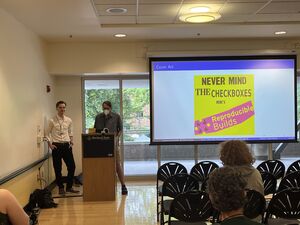
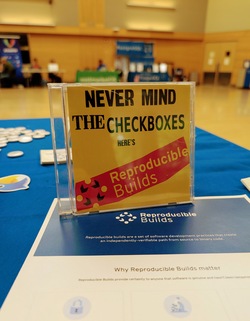
Reproducible Builds at FOSSY 2025 On Saturday 2nd August, Vagrant Cascadian and Chris Lamb presented at this year s FOSSY 2025. Their talk, titled Never Mind the Checkboxes, Here s Reproducible Builds!, was introduced as follows:
There are numerous policy compliance and regulatory processes being developed that target software development but do they solve actual problems? Does it improve the quality of software? Do Software Bill of Materials (SBOMs) actually give you the information necessary to verify how a given software artifact was built? What is the goal of all these compliance checklists anyways or more importantly, what should the goals be? If a software object is signed, who should be trusted to sign it, and can they be trusted forever?
Hosted by the Software Freedom Conservancy and taking place in Portland, Oregon, USA, FOSSY aims to be a community-focused event: Whether you are a long time contributing member of a free software project, a recent graduate of a coding bootcamp or university, or just have an interest in the possibilities that free and open source software bring, FOSSY will have something for you . More information on the event is available on the FOSSY 2025 website, including the full programme schedule. Vagrant and Chris also staffed a table, where they will be available to answer any questions about Reproducible Builds and discuss collaborations with other projects.

New OSS Rebuild project from Google The Google Open Source Security Team (GOSST) published an article this month announcing OSS Rebuild, a new project to strengthen trust in open source package ecosystems by reproducing upstream artifacts. As the post itself documents, the new project comprises four facets:
  • Automation to derive declarative build definitions for existing PyPI (Python), npm (JS/TS), and Crates.io (Rust) packages.
  • SLSA Provenance for thousands of packages across our supported ecosystems, meeting SLSA Build Level 3 requirements with no publisher intervention.
  • Build observability and verification tools that security teams can integrate into their existing vulnerability management workflows.
  • Infrastructure definitions to allow organizations to easily run their own instances of OSS Rebuild to rebuild, generate, sign, and distribute provenance.
One difference with most projects that aim for bit-for-bit reproducibility, OSS Rebuild aims for a kind of semantic reproducibility:
Through automation and heuristics, we determine a prospective build definition for a target package and rebuild it. We semantically compare the result with the existing upstream artifact, normalizing each one to remove instabilities that cause bit-for-bit comparisons to fail (e.g. archive compression).
The extensive post includes examples about how to access OSS Rebuild attestations using the Go-based command-line interface.

New extension of Python setuptools to support reproducible builds Wim Jeantine-Glenn has written a PEP 517 Build backend in order to enable reproducible builds when building Python projects that use setuptools. Called setuptools-reproducible, the project s README file contains the following:
Setuptools can create reproducible wheel archives (.whl) by setting SOURCE_DATE_EPOCH at build time, but setting the env var is insufficient for creating reproducible sdists (.tar.gz). setuptools-reproducible [therefore] wraps the hooks build_sdist build_wheel with some modifications to make reproducible builds by default.

diffoscope diffoscope is our in-depth and content-aware diff utility that can locate and diagnose reproducibility issues. This month, Chris Lamb made the following changes, including preparing and uploading versions 301, 302 and 303 to Debian:
  • Improvements:
    • Use Difference.from_operation in an attempt to pipeline the output of the extract-vmlinux script, potentially avoiding it all in memory. [ ]
    • Memoize a number of calls to --version, saving a very large number of external subprocess calls.
  • Bug fixes:
    • Don t check for PyPDF version 3 specifically, check for versions greater than 3. [ ]
    • Ensure that Java class files are named .class on the filesystem before passing them to javap(1). [ ]
    • Mask stderr from extract-vmlinux script. [ ][ ]
    • Avoid spurious differences in h5dump output caused by exposure of absolute internal extraction paths. (#1108690)
  • Misc:
    • Use our_check_output in the ODT comparator. [ ]
    • Update copyright years. [ ]
In addition: Lastly, Chris Lamb added a tmpfs to try.diffoscope.org so that diffoscope has a non-trivial temporary area to unpack archives, etc. [ ] Elsewhere in our tooling, however, reprotest is our tool for building the same source code twice in different environments and then checking the binaries produced by each build for any differences. This month, reprotest version 0.7.30 was uploaded to Debian unstable by Holger Levsen, chiefly including a change by Rebecca N. Palmer to not call sudo with the -h flag in order to fix Debian bug #1108550. [ ]

New library to patch system functions for reproducibility Nicolas Graves has written and published libfate, a simple collection of tiny libraries to patch system functions deterministically using LD_PRELOAD. According to the project s README:
libfate provides deterministic replacements for common non-deterministic system functions that can break reproducible builds. Instead of relying on complex build systems or apps or extensive patching, libfate uses the LD_PRELOAD trick to intercept system calls and return fixed, predictable values.
Describing why he wrote it, Nicolas writes:
I originally used the OpenSUSE dettrace approach to make Emacs reproducible in Guix. But when Guix switch to GCC@14, dettrace stopped working as expected. dettrace is a complex piece of software, my need was much less heavy: I don t need to systematically patch all sources of nondetermism, just the ones that make a process/binary unreproducible in a container/chroot.

Independently Reproducible Git Bundles Simon Josefsson has published another interesting article this month. Titled Independently Reproducible Git Bundles, the blog post describes the advantages of why you might a reproducible bundle, and the pitfalls that can arise when trying to create them:
One desirable property is that someone else should be able to reproduce the same git bundle, and not only that a single individual is able to reproduce things on one machine. It surprised me to see that when I ran the same set of commands on a different machine (started from a fresh git clone), I got a different checksum. The different checksums occurred even when nothing had been committed on the server side between the two runs.

Website updates Once again, there were a number of improvements made to our website this month including:

Distribution work In Debian this month:
Debian contributors have made significant progress toward ensuring package builds produce byte-for-byte reproducible results. You can check the status for packages installed on your system using the new package debian-repro-status, or visit reproduce.debian.net for Debian s overall statistics for trixie and later. You can contribute to these efforts by joining #debian-reproducible on IRC to discuss fixes, or verify the statistics by installing the new rebuilderd package and setting up your own instance.

The IzzyOnDroid Android APK repository made further progress in July, crossing the 50% reproducibility threshold congratulations. Furthermore, a new release of the Neo Store was released, which exposes the reproducible status directly next to the version of each app.
In GNU Guix, a series of patches intended to fix the reproducibility for the Mono programming language was merged, fixing reproducibility in Mono versions 1.9 [ ], 2.4 [ ] and 2.6 [ ].
Lastly, in addition to the news that openSUSE Enterprise Linux now [has an official goal of reproducibility]((https://lists.reproducible-builds.org/pipermail/rb-general/2025-July/003846.html), Bernhard M. Wiedemann posted another monthly update for their work there.

Reproducibility testing framework The Reproducible Builds project operates a comprehensive testing framework running primarily at tests.reproducible-builds.org in order to check packages and other artifacts for reproducibility. In July, however, a number of changes were made by Holger Levsen, including:
  • Switch the URL for the Tails package set. [ ]
  • Make the dsa-check-packages output more useful. [ ]
  • Setup the ppc64el architecture again, has it has returned this time with a 2.7 GiB database instead of 72 GiB. [ ]
In addition, Jochen Sprickerhof improved the reproducibility statistics generation:
  • Enable caching of statistics. [ ][ ][ ]
  • Add some common non-reproducible patterns. [ ]
  • Change output to directory. [ ]
  • Add a page sorted by diffoscope size. [ ][ ]
  • Switch to Python s argparse module and separate output(). [ ]
Holger also submitted a number of Debian bugs against rebuilderd and rebuilderd-worker:
  • Config files and scripts for a simple one machine setup. [ ][ ]
  • Create a rebuilderd user. [ ]
  • Create rebuilderd-worker user with sbuild. [ ]
Lastly, Mattia Rizzolo added a scheduled job to renew some SSL certificates [ ] and Vagrant Cascadian performed some node maintenance [ ][ ].

Upstream patches The Reproducible Builds project detects, dissects and attempts to fix as many currently-unreproducible packages as possible. We endeavour to send all of our patches upstream where appropriate. This month, we wrote a large number of such patches, including: There were a number of other patches from openSUSE developers:

Finally, if you are interested in contributing to the Reproducible Builds project, please visit our Contribute page on our website. However, you can get in touch with us via:

David Bremner: Using git-annex for email and notmuch metadata

Introducing git-remote-notmuch Based on an idea and ruby implementation by Felipe Contreras, I have been developing a git remote helper for notmuch. I will soon post an updated version of the patchset to the notmuch mailing list (I wanted to refer to this post in my email). In this blog post I'll outline my experiments with using that tool, along with git-annex to store (and sync) a moderate sized email store along with its notmuch metadata.

WARNING The rest of this post describes some relatively complex operations using (at best) alpha level software (namely git-remote-notmuch). git-annex is good at not losing your files, but git-remote-notmuch can (and did several times during debugging) wipe out your notmuch database. If you have a backup (e.g. made with notmuch-dump), this is much less annoying, and in particular you can decide to walk away from this whole experiment and restore your database.

Why git-annex? I currently have about 31GiB of email, spread across more than 830,000 files. I want to maintain the ability to search and read my email offline, so I need to maintain a copy on several workstations and at least one server (which is backed up explicitly). I am somewhat commited to maintaining synchronization of tags to git since that is how the notmuch bug tracker works. Commiting the email files to git seems a bit wasteful: by design notmuch does not modify email files, and even with compression, the extra copy adds a fair amount of overhead (in my case, 17G of git objects, about 57% overhead). It is also notoriously difficult to completely delete files from a git repository. git-annex offers potential mitigation for these two issues, at the cost of a somewhat more complex mental model. The main idea is that instead of committing every version of a file to the git repository, git-annex tracks the filename and metadata, with the file content being stored in a key-value store outside git. Conceptually this is similar to git-lfs. From our current point, the important point is that instead of a second (compressed) copy of the file, we store one copy, along with a symlink and a couple of directory entries.

What to annex For sufficiently small files, the overhead of a symlink and couple of directory entries is greater than the cost of a compressed second copy. When this happens depends on several variables, and will probably depend on the file content in a particular collection of email. I did a few trials of different settings for annex.largefiles to come to a threshold of largerthan=32k 1. For the curious, my experimental results are below. One potentially surprising aspect is that annexing even a small fraction of the (largest) files yields a big drop in storage overhead.
Threshold fraction annexed overhead
0 100% 30%
8k 29% 13%
16k 12% 9.4%
32k 7% 8.9%
48k 6% 8.9%
100k 3% 9.1%
256k 2% 11%
(git) 0 % 57%
In the end I chose to err on the side of annexing more files (for the flexibility of deletion) rather than potentially faster operations with fewer annexed files at the same level of overhead. Summarizing the configuration settings for git-annex (some of these are actually defaults, but not in my environment).
$ git config annex.largefiles largerthan=32k
$ git config annex.dotfiles true
$ git config annex.synccontent true

Delivering mail To get new mail, I do something like
# compute a date based folder under $HOME/Maildir
$ dest = $(folder)
# deliver mail to $ dest  (somehow).
$ notmuch new
$ git -C $HOME/Maildir add $ folder 
$ git -C $HOME/Maildir diff-index --quiet HEAD $ folder    git -C $HOME/Maildir commit -m 'mail delivery'
The call to diff-index is just an optimization for the case when nothing was delivered. The default configuration of git-annex will automagically annex any files larger than my threshold. At this point the git-annex repo knows nothing about tags. There is some git configuration that can speed up the "git add" above, namely
$ git config core.untrackedCache true
$ git config core.fsmonitor true
See git-status(1) under "UNTRACKED FILES AND PERFORMANCE" Defining notmuch as a git remote Assuming git-remote-notmuch is somewhere in your path, you can define a remote to connect to the default notmuch database.
$ git remote add database notmuch::
$ git fetch database
$ git merge --allow-unrelated database
The --allow-unrelated should be needed only the first time. In my case the many small files used to represent the tags (one per message), use a noticeable amount of disk space (in my case about the same amount of space as the xapian database). Once you start merging from the database to the git repo, you will likely have some conflicts, and most conflict resolution tools leave junk lying around. I added the following .gitignore file to the top level of the repo
*.orig
*~
This prevents our cavalier use of git add from adding these files to our git history (and prevents pushing random junk to the notmuch database. To push the tags from git to notmuch, you can run
$ git push database master
You might need to run notmuch new first, so that the database knows about all of the messages (currently git-remote-notmuch can't index files, only update metadata). git annex sync should work with the new remote, but pushing back will be very slow 2. I disable automatic pushing as follows
$ git config remote.database.annex-push false
Unsticking the database remote If you are debugging git-remote-notmuch, or just unlucky, you may end up in a sitation where git thinks the database is ahead of your git remote. You can delete the database remote (and associated stuff) and re-create it. Although I cannot promise this will never cause problems (because, computers), it will not modify your local copy of the tags in the git repo, nor modify your notmuch database.
$ git remote rm database
$ git update-rf -d notmuch/master
$ rm -r .git/notmuch
Fine tuning notmuch config
  • In order to avoid dealing with file renames, I have
      notmuch config maildir.synchronize_flags false
    
  • I have added the following to new.ignore:
       .git;_notmuch_metadata;.gitignore
    

  1. I also had to set annex.dotfiles to true, as many of my maildirs follow the qmail style convention of starting with a .
  2. I'm not totally clear on why it so slow, but certainly git-annex tries to push several more branches, and these are ignored by git-remote-annex.

Matthew Palmer: I'm trying an open source funding experiment

As I m currently somewhat underemployed, and could do with some extra income, I m starting an open source crowd-funding experiment. My hypothesis is that the open source community, and perhaps a community-minded company or two, really wants more open source code in the world, and is willing to put a few dollars my way to make that happen. To begin with, I m asking for contributions to implement a bunch of feature requests on action-validator, a Rust CLI tool I wrote to validate the syntax of GitHub actions and workflows. The premise is quite simple: for every AU$150 (about US$100) I receive in donations, I ll implement one of the nominated feature requests. If people want a particular feature implemented, they can nominate a feature in their donation message, otherwise when general donations get to AU$150, I ll just pick a feature that looks interesting. More details are on my code fund page. In the same spirit of simplicity, donations can be made through my Ko-fi page, and I ll keep track of the various totals in a hand-written HTML table. So, in short, if you want more open source code to exist, now would be a good time to visit my Ko-fi page and chip in a few dollars. If you re curious to know more, my code fund page has a list of Foreseeably Anticipated Questions that might address your curiosity. Otherwise, ask your questions in the comments or email me.

4 August 2025

Scarlett Gately Moore: Fostering Constructive Communication in Open Source Communities

I write this in the wake of a personal attack against my work and a project that is near and dear to me. Instead of spreading vile rumors and hearsay, talk to me. I am not known to be hard to talk to and am wide open for productive communication. I am disheartened and would like to share some thoughts of the importance of communication. Thanks for listening. Open source development thrives on collaboration, shared knowledge, and mutual respect. Yet sometimes, the very passion that drives us to contribute can lead to misunderstandings and conflicts that harm both individuals and the projects we care about. As contributors, maintainers, and community members, we have a responsibility to foster environments where constructive dialogue flourishes.

The Foundation of Healthy Open Source Communities At its core, open source is about people coming together to build something greater than what any individual could create alone. This collaborative spirit requires more than just technical skills it demands emotional intelligence, empathy, and a commitment to treating one another with dignity and respect. When disagreements arise and they inevitably will the manner in which we handle them defines the character of our community. Technical debates should focus on the merits of ideas, implementations, and approaches, not on personal attacks or character assassinations conducted behind closed doors.

The Importance of Direct Communication One of the most damaging patterns in any community is when criticism travels through indirect channels while bypassing the person who could actually address the concerns. When we have legitimate technical disagreements or concerns about someone s work, the constructive path forward is always direct, respectful communication. Consider these approaches:
  • Address concerns directly: If you have technical objections to someone s work, engage with them directly through appropriate channels
  • Focus on specifics: Critique implementations, documentation, or processes not the person behind them
  • Assume good intentions: Most contributors are doing their best with the time and resources available to them
  • Offer solutions: Instead of just pointing out problems, suggest constructive alternatives

Supporting Contributors Through Challenges Open source contributors often juggle their community involvement with work, family, and personal challenges. Many are volunteers giving their time freely, while others may be going through difficult periods in their lives job searching, dealing with health issues, or facing other personal struggles. During these times, our response as a community matters enormously. A word of encouragement can sustain someone through tough periods, while harsh criticism delivered thoughtlessly can drive away valuable contributors permanently.

Building Resilient Communities Strong open source communities are built on several key principles: Transparency in Communication: Discussions about technical decisions should happen in public forums where all stakeholders can participate and learn from the discourse. Constructive Feedback Culture: Criticism should be specific, actionable, and delivered with the intent to improve rather than to tear down. Recognition of Contribution: Every contribution, whether it s code, documentation, bug reports, or community support, has value and deserves acknowledgment. Conflict Resolution Processes: Clear, fair procedures for handling disputes help prevent minor disagreements from escalating into community-damaging conflicts.

The Long View Many successful open source projects span decades, with contributors coming and going as their life circumstances change. The relationships we build and the culture we create today will determine whether these projects continue to attract and retain the diverse talent they need to thrive. When we invest in treating each other well even during disagreements we re investing in the long-term health of our projects and communities. We re creating spaces where innovation can flourish because people feel safe to experiment, learn from mistakes, and grow together.

Moving Forward Constructively If you find yourself in conflict with another community member, consider these steps:
  1. Take a breath: Strong emotions rarely lead to productive outcomes
  2. Seek to understand: What are the underlying concerns or motivations?
  3. Communicate directly: Reach out privately first, then publicly if necessary
  4. Focus on solutions: How can the situation be improved for everyone involved?
  5. Know when to step back: Sometimes the healthiest choice is to disengage from unproductive conflicts

A Call for Better Open source has given us incredible tools, technologies, and opportunities. The least we can do in return is treat each other with the respect and kindness that makes these collaborative achievements possible. Every contributor whether they re packaging software, writing documentation, fixing bugs, or supporting users is helping to build something remarkable. Let s make sure our communities are places where that work can continue to flourish, supported by constructive communication and mutual respect. The next time you encounter work you disagree with, ask yourself: How can I make this better? How can I help this contributor grow? How can I model the kind of community interaction I want to see? Our projects are only as strong as the communities that support them. Let s build communities worthy of the amazing software we create together. https://gofund.me/506c910c

3 August 2025

Ben Hutchings: FOSS activity in July 2025

In July I attended DebCamp and DebConf in Brest, France. I very much enjoyed the opportunity to reconnect with other Debian contributors in person. I had a number of interesting and fruitful conversations there, besides the formally organised BoFs and talks. I also gave my own talk on What s new in the Linux kernel (and what s missing in Debian). Here s the usual categorisation of activity:

1 August 2025

Jonathan Dowland: School of Computing Technical Reports

(You wait ages for an archiving blog post and two come along at once!) Between 1969-2019, the Newcastle University School of Computing published a Technical Reports Series. Until 2017-ish, the full list of individually-numbered reports was available on the School's website, as well as full text PDFs for every report. At some time around 2014 I was responsible for migrating the School's website from self-managed to centrally-managed. The driver was to improve the website from the perspective of student recruitment. The TR listings (as well as full listings and texts for awarded PhD theses, MSc dissertations, Director's reports and various others) survived the initial move. After I left (as staff) in 2015, anything not specifically about student recruitment degraded and by 2017 the listings were gone. I've been trying, on and off, to convince different parts of the University to restore and take ownership of these lists ever since. For one reason or another each avenue I've pursued has gone nowhere. Recently the last remaining promising way forward failed, so I gave up and did it myself. The list is now hosted by the Historic Computing Committee, here: https://nuhc.ncl.ac.uk/computing/techreports/ It's not complete (most of the missing entries are towards the end of the run), but it's a start. The approach that finally yielded results was simply scraping the Internet Archive Wayback Machine for various pages from back when the material was represented on the School website, and then filling in the gaps from some other sources. What I envisage in the future: per-page reports with the relevant metadata (including abstracts); authors de-duplicated and cross-referenced; PDFs OCRd; providing access to the whole metadata DB (probably as as lump of JSON); a mechanism for people to report errors; a platform for students to perform data mining projects: perhaps some kind of classification/tagging by automated content analysis; cross-referencing copies of papers in other venues (lots of TRs are pre-prints).

puer-robustus: My Google Summer of Code '25 at Debian

I ve participated in this year s Google Summer of Code (GSoC) program and have been working on the small (90h) autopkgtests for the rsync package project at Debian.

Writing my proposal Before you can start writing a proposal, you need to select an organization you want to work with. Since many organizations participate in GSoC, I ve used the following criteria to narrow things down for me:
  • Programming language familiarity: For me only Python (preferably) as well as shell and Go projects would have made sense. While learning another programming language is cool, I wouldn t be as effective and helpful to the project as someone who is proficient in the language already.
  • Standing of the organization: Some of the organizations participating in GSoC are well-known for the outstanding quality of the software they produce. Debian is one of them, but so is e.g. the Django Foundation or PostgreSQL. And my thinking was that the higher the quality of the organization, the more there is to learn for me as a GSoC student.
  • Mentor interactions: Apart from the advantage you get from mentor feedback when writing your proposal (more on that further below), it is also helpful to gauge how responsive/helpful your potential mentor is during the application phase. This is important since you will be working together for a period of at least 2 months; if the mentor-student communication doesn t work, the GSoC project is going to be difficult.
  • Free and Open-Source Software (FOSS) communication platforms: I generally believe that FOSS projects should be built on FOSS infrastructure. I personally won t run proprietary software when I want to contribute to FOSS in my spare time.
  • Be a user of the project: As Eric S. Raymond has pointed out in his seminal The Cathedral and the Bazaar 25 years ago
    Every good work of software starts by scratching a developer s personal itch.
Once I had some organizations in mind whose projects I d be interested in working on, I started writing proposals for them. Turns out, I started writing my proposals way too late: In the end I only managed to hand in a single one which is risky. Competition for the GSoC projects is fierce and the more quality (!) proposals you send out, the better your chances are at getting one. However, don t write proposals for the sake of it: Reviewers get way too many AI slop proposals already and you will not do yourself a favor with a low-quality proposal. Take the time to read the instructions/ideas/problem descriptions the project mentors have provided and follow their guidelines. Don t hesitate to reach out to project mentors: In my case, I ve asked Samuel Henrique a few clarification questions whereby the following (email) discussion has helped me greatly in improving my proposal. Once I ve finalized my proposal draft, I ve sent it to Samuel for a review, which again led to some improvements to the final proposal which I ve uploaded to the GSoC program webpage.

Community bonding period Once you get the information that you ve been accepted into the GSoC program (don t take it personally if you don t make it; this was my second attempt after not making the cut in 2024), get in touch with your prospective mentor ASAP. Agree upon a communication channel and some response times. Put yourself in the loop for project news and discussions whatever that means in the context of your organization: In Debian s case this boiled down to subscribing to a bunch of mailing lists and IRC channels. Also make sure to setup a functioning development environment if you haven t done so for writing the proposal already.

Payoneer setup The by far most annoying part of GSoC for me. But since you don t have a choice if you want to get the stipend, you will need to signup for an account at Payoneer. In this iteration of GSoC all participants got a personalized link to open a Payoneer account. When I tried to open an account by following this link, I got an email after the registration and email verification that my account is being blocked because Payoneer deems the email adress I gave a temporary one. Well, the email in question is most certainly anything but temporary, so I tried to get in touch with the Payoneer support - and ended up in an LLM-infused kafkaesque support hell. Emails are answered by an LLM which for me meant utterly off-topic replies and no help whatsoever. The Payoneer website offers a real-time chat, but it is yet another instance of a bullshit-spewing LLM bot. When I at last tried to call them (the support lines are not listed on the Payoneer website but were provided by the GSoC program), I kid you not, I was being told that their platform is currently suffering from technical problems and was hung up on. Only thanks to the swift and helpful support of the GSoC administrators (who get priority support from Payoneer) I was able to setup a Payoneer account in the end. Apart from showing no respect to customers, Payoneer is also ripping them off big time with fees (unless you get paid in USD). They charge you 2% for currency conversions to EUR on top of the FX spread they take. What worked for me to avoid all of those fees, was to open a USD account at Wise and have Payoneer transfer my GSoC stipend in USD to that account. Then I exchanged the USD to my local currency at Wise for significantly less than Payoneer would have charged me. Also make sure to close your Payoneer account after the end of GSoC to avoid their annual fee.

Project work With all this prelude out of the way, I can finally get to the actual work I ve been doing over the course of my GSoC project.

Background The upstream rsync project generally sees little development. Nonetheless, they released version 3.4.0 including some CVE fixes earlier this year. Unfortunately, their changes broke the -H flag. Now, Debian package maintainers need to apply those security fixes to the package versions in the Debian repositories; and those are typically a bit older. Which usually means that the patches cannot be applied as is but will need some amendments by the Debian maintainers. For these cases it is helpful to have autopkgtests defined, which check the package s functionality in an automated way upon every build. The question then is, why should the tests not be written upstream such that regressions are caught in the development rather than the distribution process? There s a lot to say on this question and it probably depends a lot on the package at hand, but for rsync the main benefits are twofold:
  1. The upstream project mocks the ssh connection over which rsync is most typically used. Mocking is better than nothing but not the real thing. In addition to being a more realisitic test scenario for the typical rsync use case, involving an ssh server in the test would automatically extend the overall resilience of Debian packages as now new versions of the openssh-server package in Debian benefit from the test cases in the rsync reverse dependency.
  2. The upstream rsync test framework is somewhat idiosyncratic and difficult to port to reimplementations of rsync. Given that the original rsync upstream sees little development, an extensive test suit further downstream can serve as a threshold for drop-in replacements for rsync.

Goal(s) At the start of the project, the Debian rsync package was just running (a part of) the upstream tests as autopkgtests. The relevant snippet from the build log for the rsync_3.4.1+ds1-3 package reads:
114s ------------------------------------------------------------
114s ----- overall results:
114s 36 passed
114s 7 skipped
Samuel and I agreed that it would be a good first milestone to make the skipped tests run. Afterwards, I should write some rsync test cases for local calls, i.e. without an ssh connection, effectively using rsync as a more powerful cp. And once that was done, I should extend the tests such that they run over an active ssh connection. With these milestones, I went to work.

Upstream tests Running the seven skipped upstream tests turned out to be fairly straightforward:
  • Two upstream tests concern access control lists and extended filesystem attributes. For these tests to run they rely on functionality provided by the acl and xattr Debian packages. Adding those to the Build-Depends list in the debian/control file of the rsync Debian package repo made them run.
  • Four upstream tests required root privileges to run. The autopkgtest tool knows the needs-root restriction for that reason. However, Samuel and I agreed that the tests should not exclusively run with root privileges. So, instead of just adding the restiction to the existing autopkgtest test, we created a new one which has the needs-root restriction and runs the upstream-tests-as-root script - which is nothing else than a symlink to the existing upstream-tests script.
The commits to implement these changes can be found in this merge request. The careful reader will have noticed that I only made 2 + 4 = 6 upstream test cases run out of 7: The leftover upstream test is checking the functionality of the --ctimes rsync option. In the context of Debian, the problem is that the Linux kernel doesn t have a syscall to set the creation time of a file. As long as that is the case, this test will always be skipped for the Debian package.

Local tests When it came to writing Debian specific test cases I started of a completely clean slate. Which is a blessing and a curse at the same time: You have full flexibility but also full responsibility. There were a few things to consider at this point in time:
  • Which language to write the tests in? The programming language I am most proficient in is Python. But testing a CLI tool in Python would have been weird: it would have meant that I d have to make repeated subprocess calls to run rsync and then read from the filesystem to get the file statistics I want to check. Samuel suggested I stick with shell scripts and make use of diffoscope - one of the main tools used and maintained by the Reproducible Builds project - to check whether the file contents and file metadata are as expected after rsync calls. Since I did not have good reasons to use bash, I ve decided to write the scripts to be POSIX compliant.
  • How to avoid boilerplate? If one makes use of a testing framework, which one? Writing the tests would involve quite a bit of boilerplate, mostly related to giving informative output on and during the test run, preparing the file structure we want to run rsync on, and cleaning the files up after the test has run. It would be very repetitive and in violation of DRY to have the code for this appear in every test. Good testing frameworks should provide convenience functions for these tasks. shunit2 comes with those functions, is packaged for Debian, and given that it is already being used in the curl project, I decided to go with it.
  • Do we use the same directory structure and files for every test or should every test have an individual setup? The tradeoff in this question being test isolation vs. idiosyncratic code. If every test has its own setup, it takes a) more work to write the test and b) more work to understand the differences between tests. However, one can be sure that changes to the setup in one test will have no side effects on other tests. In my opinion, this guarantee was worth the additional effort in writing/reading the tests.
Having made these decisions, I simply started writing tests and ran into issues very quickly.

rsync and subsecond mtime diffs When testing the rsync --times option, I observed a weird phenomenon: If the source and destination file have modification times which differ only in the nanoseconds, an rsync --times call will not synchronize the modification times. More details about this behavior and examples can be found in the upstream issue I raised. In the Debian tests we had to occasionally work around this by setting the timestamps explicitly with touch -d.
diffoscope regression In one test case, I was expecting a difference in the modification times but diffoscope would not report a diff. After a good amount of time spent on debugging the problem (my default, and usually correct, assumption is that something about my code is seriously broken if I run into issues like that), I was able to show that diffoscope only displayed this behavior in the version in the unstable suite, not on Debian stable (which I am running on my development machine). Since everything pointed to a regression in the diffoscope project and with diffoscope being written in Python, a language I am familiar with, I wanted to spend some time investigating (and hopefully fixing) the problem. Running git bisect on the diffoscope repo helped me in identifying the commit which introduced the regression: The commit contained an optimization via an early return for bit-by-bit identical files. Unfortunately, the early return also caused an explicitly requested metadata comparison (which could be different between the files) to be skipped. With a nicely diagnosed issue like that, I was able to go to a local hackerspace event, where people work on FOSS together for an evening every month. In a group, we were able to first, write a test which showcases the broken behavior in the latest diffoscope version, and second, make a fix to the code such that the same test passes going forward. All details can be found in this merge request.
shunit2 failures At some point I had a few autopkgtests setup and passing, but adding a new one would throw me totally inexplicable errors. After trying to isolate the problem as much as possible, it turns out that shunit2 doesn t play well together we the -e shell option. The project mentions this in the release notes for the 2.1.8 version1, but in my opinion a constraint this severe should be featured much more prominently, e.g. in the README.

Tests over an ssh connection The centrepiece of this project; everything else has in a way only been preparation for this. Obviously, the goal was to reuse the previously written local tests in some way. Not only because lazy me would have less work to do this way, but also because of a reduced long-term maintenance burden of one rather than two test sets. As it turns out, it is actually possible to accomplish that: The remote-tests script doesn t do much apart from starting an ssh server on localhost and running the local-tests script with the REMOTE environment variable set. The REMOTE environment variable changes the behavior of the local-tests script in such a way that it prepends "$REMOTE": to the destination of the rsync invocations. And given that we set REMOTE=rsync@localhost in the remote-tests script, local-tests copies the files to the exact same locations as before, just over ssh. The implementational details for this can be found in this merge request.

proposed-updates Most of my development work on the Debian rsync package took place during the Debian freeze as the release of Debian Trixie is just around the corner. This means that uploading by Debian Developers (DD) and Debian Maintainers (DM) to the unstable suite is discouraged as it makes migrating the packages to testing more difficult for the Debian release team. If DDs/DMs want to have the package version in unstable migrated to testing during the freeze they have to file an unblock request. Samuel has done this twice (1, 2) for my work for Trixie but has asked me to file the proposed-updates request for current stable (i.e. Debian Bookworm) myself after I ve backported my tests to bookworm.

Unfinished business To run the upstream tests which check access control list and extended file system attributes functionality, I ve added the acl and xattr packages to Build-Depends in debian/control. This, however, will only make the packages available at build time: If Debian users install the rsync package, the acl and xattr packages will not be installed alongside it. For that, the dependencies would have to be added to Depends or Suggests in debian/control. Depends is probably to strong of a relation since rsync clearly works well in practice without, but adding them to Suggests might be worthwhile. A decision on this would involve checking, what happens if rsync is called with the relevant options on a host machine which has those packages installed, but where the destination machine lacks them. Apart from the issue described above, the 15 tests I managed to write are are a drop in the water in light of the infinitude of rsync options and their combinations. Most glaringly, not all options of the --archive option are covered separately (which would help indicating what code path of rsync broke in a regression). To increase the likelihood of catching regressions with the autopkgtests, the test coverage should be extended in the future.

Conclusion Generally, I am happy with my contributions to Debian over the course of my small GSoC project: I ve created an extensible, easy to understand, and working autopkgtest setup for the Debian rsync package. There are two things which bother me, however:
  1. In hindsight, I probably shouldn t have gone with shunit2 as a testing framework. The fact that it behaves erratically with the -e flag is a serious drawback for a shell testing framework: You really don t want a shell command to fail silently and the test to continue running.
  2. As alluded to in the previous section, I m not particularly proud of the number of tests I managed to write.
On the other hand, finding and fixing the regression in diffoscope - while derailing me from the GSoC project itself - might have a redeeming quality.

DebConf25 By sheer luck I happened to work on a GSoC project at Debian over a time period during which the annual Debian conference would take place close enough to my place of residence. Samuel pointed the opportunity to attend DebConf out to me during the community bonding period and since I could make time for the event in my schedule, I signed up. DebConf was a great experience which - aside from gaining more knowledge about Debian development - allowed me to meet the actual people usually hidden behind email adresses and IRC nicks. I can wholeheartedly recommend attending a DebConf to every interested Debian user! For those who have missed this year s iteration of the conference, I can recommend the following recorded talks: While not featuring as a keynote speaker (understandably so as the newcomer to Debian community that I am), I could still contribute a bit to the conference program.

GSoC project presentation The Debian Outreach team has scheduled a session in which all GSoC and Outreachy students over the past year had the chance to present their work in a lightning talk. The session has been recorded and is available online, just like my slides and the source for them.

Debian install workshop Additionally, with so many Debian experts gathering in one place while KDE s End of 10 campaign is ongoing, I felt it natural to organize a Debian install workhop. In hindsight I can say that I underestimated how much work it would be, especially for me who does not speak a word of French. But although the turnout of people who wanted us to install Linux on their machines was disappointingly low, it was still worth it: Not only because the material in the repo can be helpful to others planning install workshops but also because it was nice to meet a) the person behind the Debian installer images and b) the local Brest/Finist re Linux user group as well as the motivated and helpful people at Infini.

Credits I want to thank the Open Source team at Google for organizing GSoC: The highly structured program with a one-to-one mentorship is a great avenue to start contributing to well established and at times intimidating FOSS projects. And as much as I disagree with Google s surveillance capitalist business model, I have to give it to them that the company at least takes its responsibility for FOSS (somewhat) seriously - unlike many other businesses which rely on FOSS and choose to freeride of it. Big thanks to the Debian community! I ve experienced nothing but friendliness in my interactions with the community. And lastly, the biggest thanks to my GSoC mentor Samuel Henrique. He has dealt patiently and competently with all my stupid newbie questions. His support enabled me to make - albeit small - contributions to Debian. It has been a pleasure to work with him during GSoC and I m looking forward to working together with him in the future.

  1. Obviously, I ve only read them after experiencing the problem.

31 July 2025

Simon Josefsson: Independently Reproducible Git Bundles

The gnulib project publish a git bundle as a stable archival copy of the gnulib git repository once in a while. Why? We don t know exactly what this may be useful for, but I m promoting for this to see if we can establish some good use-case. A git bundle may help to establish provinence in case of an attack on the Savannah hosting platform that compromise the gnulib git repository. Another use is in the Debian gnulib package: that gnulib bundle is git cloned when building some Debian packages, to get to exactly the gnulib commit used by each upstream project see my talk on gnulib at Debconf24 and this approach reduces the amount of vendored code that is part of Debian s source code, which is relevant to mitigate XZ-style attacks. The first time we published the bundle, I wanted it to be possible to re-create it bit-by-bit identically by others. At the time I discovered a well-written blog post by Paul Beacher on reproducible git bundles and thought he had solved the problem for me. Essentially it boils down to disable threading during compression when producing the bundle, and his final example show this results in a predictable bit-by-bit identical output:
$ for i in $(seq 1 100); do \
> git -c 'pack.threads=1' bundle create -q /tmp/bundle-$i --all; \
> done
$ md5sum /tmp/bundle-*   cut -f 1 -d ' '   uniq -c
    100 4898971d4d3b8ddd59022d28c467ffca
So what remains to be said about this? It seems reproducability goes deeper than that. One desirable property is that someone else should be able to reproduce the same git bundle, and not only that a single individual is able to reproduce things on one machine. It surprised me to see that when I ran the same set of commands on a different machine (started from a fresh git clone), I got a different checksum. The different checksums occured even when nothing had been committed on the server side between the two runs. I thought the reason had to do with other sources of unpredictable data, and I explored several ways to work around this but eventually gave up. I settled for the following sequence of commands:
REV=ac9dd0041307b1d3a68d26bf73567aa61222df54 # master branch commit to package
git clone https://git.savannah.gnu.org/git/gnulib.git
cd gnulib
git fsck # attempt to validate input
# inspect that the new tree matches a trusted copy
git checkout -B master $REV # put $REV at master
for b in $(git branch -r   grep origin/stable-   sort --version-sort); do git checkout $ b#origin/ ; done
git remote remove origin # drop some unrelated branches
git gc --prune=now # drop any commits after $REV
git -c 'pack.threads=1' bundle create gnulib.bundle --all
V=$(env TZ=UTC0 git show -s --date=format:%Y%m%d --pretty=%cd master)
mv gnulib.bundle gnulib-$V.bundle
build-aux/gnupload --to ftp.gnu.org:gnulib gnulib-$V.bundle
At the time it felt more important to publish something than to reach for perfection, so we did so using the above snippet. Afterwards I reached out to the git community on this and there were good discussion about my challenge. At the end of that thread you see that I was finally able to reproduce a bit-by-bit identical bundles from two different clones, by using an intermediate git -c pack.threads=1 repack -adF step. I now assume that the unpredictable data I got earlier was introduced during the git clone steps, compressing the pack differently each time due to threaded compression. The outcome could also depend on what content the server provided, so if someone ran git gc, git repack on the server side things would change for the user, even if the user forced threading to 1 during cloning more experiments on what kind of server-side alterations results in client-side differences would be good research. A couple of months passed and it is now time to publish another gnulib bundle somewhat paired to the bi-yearly stable gnulib branches so let s walk through the commands and explain what they do. First clone the repository:
REV=225973a89f50c2b494ad947399425182dd42618c   # master branch commit to package
S1REV=475dd38289d33270d0080085084bf687ad77c74d # stable-202501 branch commit
S2REV=e8cc0791e6bb0814cf4e88395c06d5e06655d8b5 # stable-202507 branch commit
git clone https://git.savannah.gnu.org/git/gnulib.git
cd gnulib
git fsck # attempt to validate input
I believe the git fsck will validate that the chain of SHA1 commits are linked together, preventing someone from smuggling in unrelated commits earlier in the history without having to do SHA1 collision. SHA1 collisions are economically feasible today, so this isn t much of a guarantee of anything though.
git checkout -B master $REV # put $REV at master
# Add all stable-* branches locally:
for b in $(git branch -r   grep origin/stable-   sort --version-sort); do git checkout $ b#origin/ ; done
git checkout -B stable-202501 $S1REV
git checkout -B stable-202507 $S2REV
git remote remove origin # drop some unrelated branches
git gc --prune=now # drop any unrelated commits, not clear this helps
This establish a set of branches pinned to particular commits. The older stable-* branches are no longer updated, so they shouldn t be moving targets. In case they are modified in the future, the particular commit we used will be found in the official git bundle.
time git -c pack.threads=1 repack -adF
That s the new magic command to repack and recompress things in a hopefully more predictable way. This leads to a 72MB git pack under .git/objects/pack/ and a 62MB git bundle. The runtime on my laptop is around 5 minutes. I experimented with -c pack.compression=1 and -c pack.compression=9 but the size was roughly the same; 76MB and 66MB for level 1 and 72MB and 62MB for level 9. Runtime still around 5 minutes. Git uses zlib by default, which isn t the most optimal compression around. I tried -c pack.compression=0 and got a 163MB git pack and a 153MB git bundle. The runtime is still around 5 minutes, indicating that compression is not the bottleneck for the git repack command. That 153MB uncompressed git bundle compresses to 48MB with gzip default settings and 46MB with gzip -9; to 39MB with zst defaults and 34MB with zst -9; and to 28MB using xz defaults with a small 26MB using xz -9. Still the inconvenience of having to uncompress a 30-40MB archive into
the much larger 153MB is probably not worth the savings compared to
shipping and using the (still relatively modest) 62MB git bundle. Now finally prepare the bundle and ship it:
git -c 'pack.threads=1' bundle create gnulib.bundle --all
V=$(env TZ=UTC0 git show -s --date=format:%Y%m%d --pretty=%cd master)
mv gnulib.bundle gnulib-$V.bundle
build-aux/gnupload --to ftp.gnu.org:gnulib gnulib-$V.bundle
Yay! Another gnulib git bundle snapshot is available from
https://ftp.gnu.org/gnu/gnulib/. The essential part of the git repack command is the -F parameter. In the thread -f was suggested, which translates into the git pack-objects --no-reuse-delta parameter:
--no-reuse-delta
When creating a packed archive in a repository that has existing packs, the command reuses existing deltas. This sometimes results in a slightly suboptimal pack. This flag tells the command not to reuse existing deltas but compute them from scratch.
When reading the man page, I though that using -F which translates into --no-reuse-object would be slightly stronger:
--no-reuse-object
This flag tells the command not to reuse existing object data at all, including non deltified object, forcing recompression of everything. This implies --no-reuse-delta. Useful only in the obscure case where wholesale enforcement of a different compression level on the packed data is desired.
On the surface, without --no-reuse-objects, some amount of earlier compression could taint the final result. Still, I was able to get bit-by-bit identical bundles by using -f so possibly reaching for -F is not necessary. All the commands were done using git 2.51.0 as packaged by Guix. I fear the result may be different with other git versions and/or zlib libraries. I was able to reproduce the same bundle on a Trisquel 12 aramo (derived from Ubuntu 22.04) machine, which uses git 2.34.1. This suggests there is some chances of this being possible to reproduce in 20 years time. Time will tell. I also fear these commands may be insufficient if something is moving on the server-side of the git repository of gnulib (even just something simple as a new commit), I tried to make some experiments with this but let s aim for incremental progress here. At least I have now been able to reproduce the same bundle on different machines, which wasn t the case last time. Happy Reproducible Git Bundle Hacking!

28 July 2025

Dimitri John Ledkov: Achieving actually full disk encryption of UEFI ESP at rest with TCG OPAL, FIPS, LUKS

Achieving full disk encryption using FIPS, TCG OPAL and LUKS to encrypt UEFI ESP on bare-metal and in VMs
Many security standards such as CIS and STIG require to protect information at rest. For example, NIST SP 800-53r5 SC-28 advocate to use cryptographic protection, offline storage and TPMs to enhance protection of information confidentiality and/or integrity.Traditionally to satisfy such controls on portable devices such as laptops one would utilize software based Full Disk Encryption - Mac OS X FileVault, Windows Bitlocker, Linux cryptsetup LUKS2. In cases when FIPS cryptography is required, additional burden would be placed onto these systems to operate their kernels in FIPS mode.Trusted Computing Group works on establishing many industry standards and specifications, which are widely adopted to improve safety and security of computing whilst keeping it easy to use. One of their most famous specifications them is TCG TPM 2.0 (Trusted Platform Module). TPMs are now widely available on most devices and help to protect secret keys and attest systems. For example, most software full disk encryption solutions can utilise TCG TPM to store full disk encryption keys providing passwordless, biometric or pin-base ways to unlock the drives as well as attesting that system have not been modified or compromised whilst offline.TCG Storage Security Subsystem Class: Opal Specification is a set of specifications for features of data storage devices. The authors and contributors to OPAL are leading and well trusted storage manufacturers such as Samsung, Western Digital, Seagate Technologies, Dell, Google, Lenovo, IBM, Kioxia, among others. One of the features that Opal Specification enables is self-encrypting drives which becomes very powerful when combined with pre-boot authentication. Out of the box, such drives always and transparently encrypt all disk data using hardware acceleration. To protect data one can enter UEFI firmware setup (BIOS) to set NVMe single user password (or user + administrator/recovery passwords) to encrypt the disk encryption key. If one's firmware didn't come with such features, one can also use SEDutil to inspect and configure all of this. Latest release of major Linux distributions have SEDutil already packaged.Once password is set, on startup, pre-boot authentication will request one to enter password - prior to booting any operating systems. It means that full disk is actually encrypted, including the UEFI ESP and all operating systems that are installed in case of dual or multi-boot installations. This also prevents tampering with ESP, UEFI bootloaders and kernels which with traditional software-based encryption often remain unencrypted and accessible. It also means one doesn't have to do special OS level repartitioning, or installation steps to ensure all data is encrypted at rest.What about FIPS compliance? Well, the good news is that majority of the OPAL compliant hard drives and/or security sub-chips do have FIPS 140-3 certification. Meaning they have been tested by independent laboratories to ensure they do in-fact encrypt data. On the CMVP website one can search for module name terms "OPAL" or "NVMe" or name of hardware vendor to locate FIPS certificates.Are such drives widely available? Yes. For example, a common Thinkpad X1 gen 11 has OPAL NVMe drives as standard, and they have FIPS certification too. Thus, it is likely in your hardware fleet these are already widely available. Use sedutil to check if MediaEncrypt and LockingSupported features are available.Well, this is great for laptops and physical servers, but you may ask - what about public or private cloud? Actually, more or less the same is already in-place in both. On CVMP website all major clouds have their disk encryption hardware certified, and all of them always encrypt all Virtual Machines with FIPS certified cryptography without an ability to opt-out. One is however in full control of how the encryption keys are managed: cloud-provider or self-managed (either with a cloud HSM or KMS or bring your own / external). See these relevant encryption options and key management docs for GCP, Azure, AWS. But the key takeaway without doing anything, at rest, VMs in public cloud are always encrypted and satisfy NIST SP 800-53 controls.What about private cloud? Most Linux based private clouds ultimately use qemu typically with qcow2 virtual disk images. Qemu supports user-space encryption of qcow2 disk, see this manpage. Such encryption encrypts the full virtual machine disk, including the bootloader and ESP. And it is handled entirely outside of the VM on the host - meaning the VM never has access to the disk encryption keys. Qemu implements this encryption entirely in userspace using gnutls, nettle, libgcrypt depending on how it was compiled. This also means one can satisfy FIPS requirements entirely in userspace without a Linux kernel in FIPS mode. Higher level APIs built on top of qemu also support qcow2 disk encryption, as in projects such as libvirt and OpenStack Cinder.If you carefully read the docs, you may notice that agent support is explicitly sometimes called out as not supported or not mentioned. Quite often agents running inside the OS may not have enough observability to them to assess if there is external encryption. It does mean that monitoring above encryption options require different approaches - for example monitor your cloud configuration using tools such as Wiz and Orca, rather than using agents inside individual VMs. For laptop / endpoint security agents, I do wish they would start gaining capability to report OPAL SED availability and status if it is active or not.What about using software encryption none-the-less on top of the above solutions? It is commonly referred to double or multiple encryption. There will be an additional performance impact, but it can be worthwhile. It really depends on what you define as data at rest for yourself and which controls you need. If one has a dual-boot laptop, and wants to keep one OS encrypted whilst booted into the other, it can perfectly reasonable to encrypted the two using separate software encryption keys. In addition to the OPAL encryption of the ESP. For more targeted per-file / per-folder encryption, one can look into using gocryptfs which is the best successor to the once popular, but now deprecated eCryptfs (amazing tool, but has fallen behind in development and can lead to data loss).All of the above mostly talks about cryptographic encryption, which only provides confidentially but not data integrity. To protect integrity, one needs to choose how to maintain that. dm-verity is a good choice for read-only and rigid installations. For read-write workloads, it may be easier to deploy ZFS or Btrfs instead. If one is using filesystems without a built-in integrity support such as XFS or Ext4, one can retrofit integrity layer to them by using dm-integrity (either standalone, or via dm-luks/cryptsetup --integrity option).

If one has a lot of estate and a lot of encryption keys to keep track off a key management solution is likely needed. The most popular solution is likely the one from Thales Group marketed under ChiperTrust Data Security Platform (previously Vormetric), but there are many others including OEM / Vendor / Hardware / Cloud specific or agnostic solutions.

I hope this crash course guide piques your interest to learn and discover modern confidentially and integrity solutions, and to re-affirm or change your existing controls w.r.t. to data protection at rest.

Full disk encryption, including UEFI ESP /boot/efi is now widely achievable by default on both baremetal machines and in VMs including with FIPS certification. To discuss more let's connect on Linkedin.

Russ Allbery: Review: Cyteen

Review: Cyteen, by C.J. Cherryh
Series: Cyteen #1
Publisher: Warner Aspect
Copyright: 1988
Printing: September 1995
ISBN: 0-446-67127-4
Format: Trade paperback
Pages: 680
The main text below is an edited version of my original review of Cyteen written on 2012-01-03. Additional comments from my re-read are after the original review. I've reviewed several other C.J. Cherryh books somewhat negatively, which might give the impression I'm not a fan. That is an artifact of when I started reviewing. I first discovered Cherryh with Cyteen some 20 years ago, and it remains one of my favorite SF novels of all time. After finishing my reading for 2011, I was casting about for what to start next, saw Cyteen on my parents' shelves, and decided it was past time for my third reading, particularly given the recent release of a sequel, Regenesis. Cyteen is set in Cherryh's Alliance-Union universe following the Company Wars. It references several other books in that universe, most notably Forty Thousand in Gehenna but also Downbelow Station and others. It also has mentions of the Compact Space series (The Pride of Chanur and sequels). More generally, almost all of Cherryh's writing is loosely tied together by an overarching future history. One does not need to read any of those other books before reading Cyteen; this book will fill you in on all of the politics and history you need to know. I read Cyteen first and have never felt the lack. Cyteen was at one time split into three books for publishing reasons: The Betrayal, The Rebirth, and The Vindication. This is an awful way to think of the book. There are no internal pauses or reasonable volume breaks; Cyteen is a single coherent novel, and Cherryh has requested that it never be broken up that way again. If you happen to find all three portions as your reading copy, they contain all the same words and are serviceable if you remember it's a single novel under three covers, but I recommend against reading the portions in isolation. Human colonization of the galaxy started with slower-than-light travel sponsored by the private Sol Corporation. The inhabitants of the far-flung stations and the crews of the merchant ships that supplied them have formed their own separate cultures, but initially remained attached to Earth. That changed with the discovery of FTL travel and a botched attempt by Earth to reassert its authority. At the time of Cyteen, there are three human powers: distant Earth (which plays little role in this book), the merchanter Alliance, and Union. The planet Cyteen is one of only a few Earth-like worlds discovered by human expansion, and is the seat of government and the most powerful force in Union. This is primarily because of Reseune: the Cyteen lab that produces the azi. If Cyteen is about any one thing, it's about azi: genetically engineered human clones who are programmed via intensive psychological conditioning starting before birth. The conditioning uses a combination of drugs to make them receptive and "tape," specific patterns of instruction and sensory stimulation. They are designed for specific jobs or roles, they're conditioned to be obedient to regular humans, and they're not citizens. They are, in short, slaves. In a lot of books, that's as deep as the analysis would go. Azi are slaves, and slavery is certainly bad, so there would probably be a plot around azi overthrowing their conditioning, or around the protagonists trying to free them from servitude. But Cyteen is not any SF novel, and azi are considerably more complex and difficult than that analysis. We learn over the course of the book that the immensely powerful head of Reseune Labs, Ariane Emory, has a specific broader purpose in mind for the azi. One of the reasons why Reseune fought for and gained the role of legal protector of all azi in Union, regardless of where they were birthed, is so that Reseune could act to break any permanent dependence on azi as labor. And yet, they are slaves; one of the protagonists of Cyteen is an experimental azi, which makes him the permanent property of Reseune and puts him in constant jeopardy of being used as a political prisoner and lever of manipulation against those who care about him. Cyteen is a book about manipulation, about programming people, about what it means to have power over someone else's thoughts, and what one can do with that power. But it's also a book about connection and identity, about what makes up a personality, about what constitutes identity and how people construct the moral codes and values that they hold at their core. It's also a book about certainty. Azi are absolutely certain, and are capable of absolute trust, because that's part of their conditioning. Naturally-raised humans are not. This means humans can do things that azi can't, but the reverse is also true. The azi are not mindless slaves, nor are they mindlessly programmed, and several of the characters, both human and azi, find a lot of appeal in the core of certainty and deep self-knowledge of their own psychological rules that azis can have. Cyteen is a book about emotions, and logic, and where they come from and how to balance them. About whether emotional pain and uncertainty is beneficial or damaging, and about how one's experiences make up and alter one's identity. This is also a book about politics, both institutional and personal. It opens with Ariane Emory, Councilor for Science for five decades and the head of the ruling Union Expansionist party. She's powerful, brilliant, dangerously good at reading people, and dangerously willing to manipulate and control people for her own ends. What she wants, at the start of the book, is to completely clone a Special (the legal status given to the most brilliant minds of Union). This was attempted before and failed, but Ariane believes it's now possible, with a combination of tape, genetic engineering, and environmental control, to reproduce the brilliance of the original mind. To give Union another lifespan of work by their most brilliant thinkers. Jordan Warrick, another scientist at Reseune, has had a long-standing professional and personal feud with Ariane Emory. As the book opens, he is fighting to be transferred out from under her to the new research station that would be part of the Special cloning project, and he wants to bring his son Justin and Justin's companion azi Grant with them. Justin is a PR, a parental replicate, meaning he shares Jordan's genetic makeup but was not an attempt to reproduce the conditions of Jordan's rearing. Grant was raised as his brother. And both have, for reasons that are initially unclear, attracted the attention of Ariane, who may be using them as pawns. This is just the initial setup, and along with this should come a warning: the first 150 pages set up a very complex and dangerous political situation and build the tension that will carry the rest of the book, and they do this by, largely, torturing Justin and Grant. The viewpoint jumps around, but Justin and Grant are the primary protagonists for this first section of the book. While one feels sympathy for both of them, I have never, in my multiple readings of the book, particularly liked them. They're hard to like, as opposed to pity, during this setup; they have very little agency, are in way over their heads, are constantly making mistakes, and are essentially having their lives destroyed. Don't let this turn you off on the rest of the book. Cyteen takes a dramatic shift about 150 pages in. A new set of protagonists are introduced who are some of the most interesting, complex, and delightful protagonists in any SF novel I have read, and who are very much worth waiting for. While Justin has his moments later on (his life is so hard that his courage can be profoundly moving), it's not necessary to like him to love this book. That's one of the reasons why I so strongly dislike breaking it into three sections; that first section, which is mostly Justin and Grant, is not representative of the book. I can't talk too much more about the plot without risking spoiling it, but it's a beautiful, taut, and complex story that is full of my favorite things in both settings and protagonists. Cyteen is a book about brilliant people who think on their feet. Cherryh succeeds at showing this through what they do, which is rarely done as well as it is here. It's a book about remembering one's friends and remembering one's enemies, and waiting for the most effective moment to act, but it also achieves some remarkable transformations. About 150 pages in, you are likely to loathe almost everyone in Reseune; by the end of the book, you find yourself liking, or at least understanding, nearly everyone. This is extremely hard, and Cherryh pulls it off in most cases without even giving the people she's redeeming their own viewpoint sections. Other than perhaps George R.R. Martin I've not seen another author do this as well. And, more than anything else, Cyteen is a book with the most wonderful feeling of catharsis. I think this is one of the reasons why I adore this book and have difficulties with some of Cherryh's other works. She's always good at ramping up the tension and putting her characters in awful, untenable positions. Less frequently does she provide the emotional payoff of turning the tables, where you get to watch a protagonist do everything you've been wanting them to do for hundreds of pages, except even better and more delightfully than you would have come up with. Cyteen is one of the most emotionally satisfying books I've ever read. I could go on and on; there is just so much here that I love. Deep questions of ethics and self-control, presented in a way that one can see the consequences of both bad decisions and good ones and contrast them. Some of the best political negotiations in fiction. A wonderful look at friendship and loyalty from several directions. Two of the best semi-human protagonists I've seen, who one can see simultaneously as both wonderful friends and utterly non-human and who put nearly all of the androids in fiction to shame by being something trickier and more complex. A wonderful unfolding sense of power. A computer that can somewhat anticipate problems and somewhat can't, and that encapsulates much of what I love about semi-intelligent bases in science fiction. Cyteen has that rarest of properties of SF novels: Both the characters and the technology meld in a wonderful combination where neither could exist without the other, where the character issues are illuminated by the technology and the technology supports the characters. I have, for this book, two warnings. The first, as previously mentioned, is that the first 150 pages of setup is necessary but painful to read, and I never fully warmed to Justin and Grant throughout. I would not be surprised to hear that someone started this book but gave up on it after 50 or 100 pages. I do think it's worth sticking out the rocky beginning, though. Justin and Grant continue to be a little annoying, but there's so much other good stuff going on that it doesn't matter. The other warning is that part of the setup of the story involves the rape of an underage character. This is mostly off-camera, but the emotional consequences are significant (as they should be) and are frequently discussed throughout the book. There is also rather frank discussion of adolescent sexuality later in the book. I think both of these are relevant to the story and handled in a way that isn't gratuitous, but they made me uncomfortable and I don't have any past history with those topics. Those warnings notwithstanding, this is simply one of the best SF novels ever written. It uses technology to pose deep questions about human emotions, identity, and interactions, and it uses complex and interesting characters to take a close look at the impact of technology on lives. And it does this with a wonderfully taut, complicated plot that sustains its tension through all 680 pages, and with characters whom I absolutely love. I have no doubt that I'll be reading it for a fourth and fifth time some years down the road. Followed by Regenesis, although Cyteen stands well entirely on its own and there's no pressing need to read the sequel. Rating: 10 out of 10

Some additional thoughts after re-reading Cyteen in 2025: I touched on this briefly in my original review, but I was really struck during this re-read how much the azi are a commentary on and a complication of the role of androids in earlier science fiction. Asimov's Three Laws of Robotics were an attempt to control the risks of robots, but can also be read as turning robots into slaves. Azis make the slavery more explicit and disturbing by running the programming on a human biological platform, but they're more explicitly programmed and artificial than a lot of science fiction androids. Artificial beings and their relationship to humans have been a recurring theme of SF since Frankenstein, but I can't remember a novel that makes the comparison to humans this ambiguous and conflicted. The azi not only like being azi, they can describe why they prefer it. It's clear that Union made azi for many of the same reasons that humans enslave other humans, and that Ariane Emory is using them as machinery in a larger (and highly ethically questionable) plan, but Cherryh gets deeper into the emergent social complications and societal impact than most SF novels manage. Azi are apparently closer to humans than the famous SF examples such as Commander Data, but the deep differences are both more subtle and more profound. I've seen some reviewers who are disturbed by the lack of a clear moral stance by the protagonists against the creation of azi. I'm not sure what to think about that. It's clear the characters mostly like the society they've created, and the groups attempting to "free" azi from their "captivity" are portrayed as idiots who have no understanding of azi psychology. Emory says she doesn't want azi to be a permanent aspect of society but clearly has no intention of ending production any time soon. The book does seem oddly unaware that the production of azi is unethical per se and, unlike androids, has an obvious exit ramp: Continue cloning gene lines as needed to maintain a sufficient population for a growing industrial civilization, but raise the children as children rather than using azi programming. If Cherryh included some reason why that was infeasible, I didn't see it, and I don't think the characters directly confronted it. I don't think societies in books need to be ethical, or that Cherryh intended to defend this one. There are a lot of nasty moral traps that civilizations can fall into that make for interesting stories. But the lack of acknowledgment of the problem within the novel did seem odd this time around. The other part of this novel that was harder to read past in this re-read is the sexual ethics. There's a lot of adolescent sexuality in this book, and even apart from the rape scene which was more on-the-page than I had remembered and which is quite (intentionally) disturbing there is a whole lot of somewhat dubious consent. Maybe I've gotten older or just more discriminating, but it felt weirdly voyeuristic to know this much about the sex lives of characters who are, at several critical points in the story, just a bunch of kids. All that being said, and with the repeated warning that the first 150 pages of this novel are just not very good, there is still something magic about the last two-thirds of this book. It has competence porn featuring a precociously brilliant teenager who I really like, it has one of the more interesting non-AI programmed computer systems that I've read in SF, it has satisfying politics that feel like modern politics (media strategy and relationships and negotiated alliances, rather than brute force and ideology), and it has a truly excellent feeling of catharsis. The plot resolution is a bit too abrupt and a bit insufficiently explained (there's more in Regenesis), but even though this was my fourth time through this book, the pacing grabbed me again and I could barely put down the last part of the story. Ethics aside (and I realize that's quite the way to start a sentence), I find the azi stuff fascinating. I know the psychology in this book is not real and is hopelessly simplified compared to real psychology, but there's something in the discussions of value sets and flux and self-knowledge that grabs my interest and makes me want to ponder. I think it's the illusion of simplicity and control, the what-if premise of thought where core motivations and moral rules could be knowable instead of endlessly fluid the way they are in us humans. Cherryh's azi are some of the most intriguing androids in science fiction to me precisely because they don't start with computers and add the humanity in, but instead start with humanity and overlay a computer-like certainty of purpose that's fully self-aware. The result is more subtle and interesting than anything Star Trek managed. I was not quite as enamored with this book this time around, but it's still excellent once the story gets properly started. I still would recommend it, but I might add more warnings about the disturbing parts.

Re-read rating: 9 out of 10

26 July 2025

Bits from Debian: DebConf25 closes in Brest and DebConf26 announced

DebConf25 group photo - click to enlarge On Saturday 19 July 2025, the annual Debian Developers and Contributors Conference came to a close. Over 443 attendees representing 50 countries from around the world came together for a combined 169 events (including some which took place during the DebCamp) including more than 50 Talks, 39 Short Talks, 5 Discussions, 59 Birds of a Feather sessions ("BoF" informal meeting between developers and users), 10 workshops, and activities in support of furthering our distribution and free software, learning from our mentors and peers, building our community, and having a bit of fun. The conference was preceded by the annual DebCamp hacking session held 7 through 13 July where Debian Developers and Contributors convened to focus on their individual Debian-related projects or work in team sprints geared toward in-person collaboration in developing Debian. This year, a session was dedicated to prepare the BoF "Dealing with Dormant Packages: Ensuring Debian's High Standards"; another, at the initiative of our DPL, to prepare suggestions for the BoF Package Acceptance in Debian: Challenges and Opportunities"; and an afternoon around Salsa-CI. As has been the case for several years, a special effort has been made to welcome newcomers and help them become familiar with Debian and DebConf by organizing a sprint "New Contributors Onboarding" every day of Debcamp, followed more informally by mentorship during DebConf. The actual Debian Developers Conference started on Monday 14 July 2025. In addition to the traditional "Bits from the DPL" talk, the continuous key-signing party, lightning talks, and the announcement of next year's DebConf26, there were several update sessions shared by internal projects and teams. Many of the hosted discussion sessions were presented by our technical core teams with the usual and useful "Meet the Technical Committee", the "What's New in the Linux Kernel" session, and a set of BoFs about Debian packaging policy and Debian infrastructure. Thus, more than a quarter of the discussions dealt with this theme, including talks about our tools and Debian's archive processes. Internationalization and Localization have been the subject of several talks. The Python, Perl, Ruby, Go, and Rust programming language teams also shared updates on their work and efforts. Several talks have covered Debian Blends and Debian-derived distributions and other talks addressed the issue of Debian and AI. More than 17 BoFs and talks about community, diversity, and local outreach highlighted the work of various teams involved in not just the technical but also the social aspect of our community; four women who have made contributions to Debian through their artwork in recent years presented their work. The one-day session "DebConf 2025 Academic Track!", organized in collaboration with the IRISA laboratory was the first session welcoming fellow academics at DebConf, bringing together around ten presentations. The schedule was updated each day with planned and ad hoc activities introduced by attendees over the course of the conference. Several traditional activities took place: a job fair, a poetry performance, the traditional Cheese and Wine party (this year with cider as well), the Group Photos, and the Day Trips. For those who were not able to attend, most of the talks and sessions were broadcasted live and recorded; currently the videos are made available through this link. Almost all of the sessions facilitated remote participation via IRC and Matrix messaging apps or online collaborative text documents which allowed remote attendees to "be in the room" to ask questions or share comments with the speaker or assembled audience. DebConf25 saw over 441 T-shirts, 3 day trips, and up to 315 meals planned per day. All of these events, activities, conversations, and streams coupled with our love, interest, and participation in Debian and F/OSS certainly made this conference an overall success both here in Brest, France and online around the world. The DebConf25 website will remain active for archival purposes and will continue to offer links to the presentations and videos of talks and events. Next year, DebConf26 will be held in Santa Fe, Argentina, likely in July. As tradition follows before the next DebConf the local organizers in Argentina will start the conference activities with DebCamp with a particular focus on individual and team work towards improving the distribution. DebConf is committed to a safe and welcome environment for all participants. See the web page about the Code of Conduct on the DebConf25 website for more details on this. Debian thanks the commitment of numerous sponsors to support DebConf25, particularly our Platinum Sponsors: AMD, EDF, Infomaniak, Proxmox, and Viridien. We also wish to thank our Video and Infrastructure teams, the DebConf25 and DebConf committees, our host nation of France, and each and every person who helped contribute to this event and to Debian overall. Thank you all for your work in helping Debian continue to be "The Universal Operating System". See you next year! About Debian The Debian Project was founded in 1993 by Ian Murdock to be a truly free community project. Since then the project has grown to be one of the largest and most influential Open Source projects. Thousands of volunteers from all over the world work together to create and maintain Debian software. Available in 70 languages, and supporting a huge range of computer types, Debian calls itself the universal operating system. About DebConf DebConf is the Debian Project's developer conference. In addition to a full schedule of technical, social and policy talks, DebConf provides an opportunity for developers, contributors and other interested people to meet in person and work together more closely. It has taken place annually since 2000 in locations as varied as Scotland, Bosnia and Herzegovina, India, Korea. More information about DebConf is available from https://debconf.org/. About AMD The AMD ROCm platform includes programming models, tools, compilers, libraries, and runtimes for AI and HPC solution development on AMD GPUs. Debian is an officially supported platform for AMD ROCm and a growing number of components are now included directly in the Debian distribution. For more than 55 years AMD has driven innovation in high-performance computing, graphics and visualization technologies. AMD is deeply committed to supporting and contributing to open-source projects, foundations, and open-standards organizations, taking pride in fostering innovation and collaboration within the open-source community. About EDF EDF is a leading global utility company focused on low-carbon power generation. The group uses advanced engineering and scientific computing tools to drive innovation and efficiency in its operations, especially in nuclear power plant design and safety assessment. Since 2003, the EDF Group has been using Debian as its main scientific computing environment. Debian's focus on stability and reproducibility ensures that EDF's calculations and simulations produce consistent and accurate results. About Infomaniak Infomaniak is Switzerland's leading developer of Web technologies. With operations all over Europe and based exclusively in Switzerland, the company designs and manages its own data centers powered by 100% renewable energy, and develops all its solutions locally, without outsourcing. With millions of users and the trust of public and private organizations across Europe - such as RTBF, the United Nations, central banks, over 3,000 radio and TV stations, as well as numerous cities and security bodies - Infomaniak stands for sovereign, sustainable and independent digital technology. The company offers a complete suite of collaborative tools, cloud hosting, streaming, marketing and events solutions, while being owned by its employees and self-financed exclusively by its customers. About Proxmox Proxmox develops powerful, yet easy-to-use Open Source server software. The product portfolio from Proxmox, including server virtualization, backup, and email security, helps companies of any size, sector, or industry to simplify their IT infrastructures. The Proxmox solutions are built on Debian, we are happy that they give back to the community by sponsoring DebConf25. About Viridien Viridien is an advanced technology, digital and Earth data company that pushes the boundaries of science for a more prosperous and sustainable future. Viridien has been using Debian-based systems to power most of its HPC infrastructure and its cloud platform since 2009 and currently employs two active Debian Project Members. Contact Information For further information, please visit the DebConf25 web page at https://debconf25.debconf.org/ or send mail to press@debian.org.

Matthew Palmer: Object deserialization attacks using Ruby's Oj JSON parser

tl;dr: there is an attack in the wild which is triggering dangerous-but-seemingly-intended behaviour in the Oj JSON parser when used in the default and recommended manner, which can lead to everyone s favourite kind of security problem: object deserialization bugs! If you have the oj gem anywhere in your Gemfile.lock, the quickest mitigation is to make sure you have Oj.default_options = mode: :strict somewhere, and that no library is overwriting that setting to something else.

Prologue As a sensible sysadmin, all the sites I run send me a notification if any unhandled exception gets raised. Mostly, what I get sent is error-handling corner cases I missed, but now and then things get more interesting. In this case, it was a PG::UndefinedColumn exception, which looked something like this:
PG::UndefinedColumn: ERROR:  column "xyzzydeadbeef" does not exist
This is weird on two fronts: firstly, this application has been running for a while, and if there was a schema problem, I d expect it to have made itself apparent long before now. And secondly, while I don t profess to perfection in my programming, I m usually better at naming my database columns than that. Something is definitely hinky here, so let s jump into the mystery mobile!

The column name is coming from outside the building! The exception notifications I get sent include a whole lot of information about the request that caused the exception, including the request body. In this case, the request body was JSON, and looked like this:
 "name":":xyzzydeadbeef", ... 
The leading colon looks an awful lot like the syntax for a Ruby symbol, but it s in a JSON string. Surely there s no way a JSON parser would be turning that into a symbol, right? Right?!? Immediately, I thought that that possibly was what was happening, because I use Sequel for my SQL database access needs, and Sequel treats symbols as database column names. It seemed like too much of a coincidence that a vaguely symbol-shaped string was being sent in, and the exact same name was showing up as a column name. But how the flying fudgepickles was a JSON string being turned into a Ruby symbol, anyway? Enter Oj.

Oj? I barely know aj A long, long time ago, the standard Ruby JSON library had a reputation for being slow. Thus did many competitors flourish, claiming more features and better performance. Strong amongst the contenders was oj (for Optimized JSON ), touted as The fastest JSON parser and object serializer . Given the history, it s not surprising that people who wanted the best possible performance turned to Oj, leading to it being found in a great many projects, often as a sub-dependency of a dependency of a dependency (which is how it ended up in my project). You might have noticed in Oj s description that, in addition to claiming fastest , it also describes itself as an object serializer . Anyone who has kept an eye on the security bug landscape will recall that object deserialization is a rich vein of vulnerabilities to mine. Libraries that do object deserialization, especially ones with a history that goes back to before the vulnerability class was well-understood, are likely to be trouble magnets. And thus, it turns out to be with Oj. By default, Oj will happily turn any string that starts with a colon into a symbol:

>> require "oj"
>> Oj.load(' "name":":xyzzydeadbeef","username":"bob","answer":42 ')
=>  "name"=>:xyzzydeadbeef, "username"=>"bob", "answer"=>42 

How that gets exploited is only limited by the creativity of an attacker. Which I ll talk about more shortly but first, a word from my rant cortex.

Insecure By Default is a Cancer While the object of my ire today is Oj and its fast-and-loose approach to deserialization, it is just one example of a pervasive problem in software: insecurity by default. Whether it s a database listening on 0.0.0.0 with no password as soon as its installed, or a library whose default behaviour is to permit arbitrary code execution, it all contributes to a software ecosystem that is an appalling security nightmare. When a user (in this case, a developer who wants to parse JSON) comes across a new piece of software, they have by definition no idea what they re doing with that software. They re going to use the defaults, and follow the most easily-available documentation, to achieve their goal. It is unrealistic to assume that a new user of a piece of software is going to do things the right way , unless that right way is the only way, or at least the by-far-the-easiest way. Conversely, the developer(s) of the software is/are the domain experts. They have knowledge of the problem domain, through their exploration while building the software, and unrivalled expertise in the codebase. Given this disparity in knowledge, it is tantamount to malpractice for the experts the developer(s) to off-load the responsibility for the safe and secure use of the software to the party that has the least knowledge of how to do that (the new user). To apply this general principle to the specific case, take the Using section of the Oj README. The example code there calls Oj.load, with no indication that this code will, in fact, parse specially-crafted JSON documents into Ruby objects. The brand-user user of the library, no doubt being under pressure to Get Things Done, is almost certainly going to look at this Using example, get the apparent result they were after (a parsed JSON document), and call it a day. It is unlikely that a brand-new user will, for instance, scroll down to the Further Reading section, find the second last (of ten) listed documents, Security.md , and carefully peruse it. If they do, they ll find an oblique suggestion that parsing untrusted input is never a good idea . While that s true, it s also rather unhelpful, because I d wager that by far the majority of JSON parsed in the world is untrusted , in one way or another, given the predominance of JSON as a format for serializing data passing over the Internet. This guidance is roughly akin to putting a label on a car s airbags that driving at speed can be hazardous to your health : true, but unhelpful under the circumstances. The solution is for default behaviours to be secure, and any deviation from that default that has the potential to degrade security must, at the very least, be clearly labelled as such. For example, the Oj.load function should be named Oj.unsafe_load, and the Oj.load function should behave as the Oj.safe_load function does presently. By naming the unsafe function as explicitly unsafe, developers (and reviewers) have at least a fighting chance of recognising they re doing something risky. We put warning labels on just about everything in the real world; the same should be true of dangerous function calls. OK, rant over. Back to the story.

But how is this exploitable? So far, I ve hopefully made it clear that Oj does some Weird Stuff with parsing certain JSON strings. It caused an unhandled exception in a web application I run, which isn t cool, but apart from bombing me with exception notifications, what s the harm? For starters, let s look at our original example: when presented with a symbol, Sequel will interpret that as a column name, rather than a string value. Thus, if our save an update to the user code looked like this:

# request_body has the JSON representation of the form being submitted
body = Oj.load(request_body)
DB[:users].where(id: user_id).update(name: body["name"])

In normal operation, this will issue an SQL query along the lines of UPDATE users SET name='Jaime' WHERE id=42. If the name given is Jaime O Dowd , all is still good, because Sequel quotes string values, etc etc. All s well so far. But, imagine there is a column in the users table that normally users cannot read, perhaps admin_notes. Or perhaps an attacker has gotten temporary access to an account, and wants to dump the user s password hash for offline cracking. So, they send an update claiming that their name is :admin_notes (or :password_hash). In JSON, that ll look like "name":":admin_notes" , and Oj.load will happily turn that into a Ruby object of "name"=>:admin_notes . When run through the above update the user code fragment, it ll produce the SQL UPDATE users SET name=admin_notes WHERE id=42. In other words, it ll copy the contents of the admin_notes column into the name column which the attacker can then read out just by refreshing their profile page.

But Wait, There s More! That an attacker can read other fields in the same table isn t great, but that s barely scratching the surface. Remember before I said that Oj does object serialization ? That means that, in general, you can create arbitrary Ruby objects from JSON. Since objects contain code, it s entirely possible to trigger arbitrary code execution by instantiating an appropriate Ruby object. I m not going to go into details about how to do this, because it s not really my area of expertise, and many others have covered it in detail. But rest assured, if an attacker can feed input of their choosing into a default call to Oj.load, they ve been handed remote code execution on a platter.

Mitigations As Oj s object deserialization is intended and documented behaviour, don t expect a future release to make any of this any safer. Instead, we need to mitigate the risks. Here are my recommended steps:
  1. Look in your Gemfile.lock (or SBOM, if that s your thing) to see if the oj gem is anywhere in your codebase. Remember that even if you don t use it directly, it s popular enough that it is used in a lot of places. If you find it in your transitive dependency tree anywhere, there s a chance you re vulnerable, limited only by the ingenuity of attackers to feed crafted JSON into a deeply-hidden Oj.load call.
  2. If you depend on oj directly and use it in your project, consider not doing that. The json gem is acceptably fast, and JSON.parse won t create arbitrary Ruby objects.
  3. If you really, really need to squeeze the last erg of performance out of your JSON parsing, and decide to use oj to do so, find all calls to Oj.load in your code and switch them to call Oj.safe_load.
  4. It is a really, really bad idea to ever use Oj to deserialize JSON into objects, as it lacks the safety features needed to mitigate the worst of the risks of doing so (for example, restricting which classes can be instantiated, as is provided by the permitted_classes argument to Psych.load). I d make it a priority to move away from using Oj for that, and switch to something somewhat safer (such as the aforementioned Psych). At the very least, audit and comment heavily to minimise the risk of user-provided input sneaking into those calls somehow, and pass mode: :object as the second argument to Oj.load, to make it explicit that you are opting-in to this far more dangerous behaviour only when it s absolutely necessary.
  5. To secure any unsafe uses of Oj.load in your dependencies, consider setting the default Oj parsing mode to :strict, by putting Oj.default_options = mode: :strict somewhere in your initialization code (and make sure no dependencies are setting it to something else later!). There is a small chance that this change of default might break something, if a dependency is using Oj to deliberately create Ruby objects from JSON, but the overwhelming likelihood is that Oj s just being used to parse ordinary JSON, and these calls are just RCE vulnerabilities waiting to give you a bad time.

Is Your Bacon Saved? If I ve helped you identify and fix potential RCE vulnerabilities in your software, or even just opened your eyes to the risks of object deserialization, please help me out by buying me a refreshing beverage. I would really appreciate any support you can give. Alternately, if you d like my help in fixing these (and many other) sorts of problems, I m looking for work, so email me.

23 July 2025

Dirk Eddelbuettel: qlcal 0.0.16 on CRAN: Regular Update

The sixteenth release of the qlcal package arrivied at CRAN today, once again following the QuantLib 1.39 release this morning. qlcal delivers the calendaring parts of QuantLib. It is provided (for the R package) as a set of included files, so the package is self-contained and does not depend on an external QuantLib library (which can be demanding to build). qlcal covers over sixty country / market calendars and can compute holiday lists, its complement (i.e. business day lists) and much more. Examples are in the README at the repository, the package page, and course at the CRAN package page. This releases mainly synchronizes qlcal with the QuantLib release 1.39.

Changes in version 0.0.16 (2025-07-23)
  • Synchronized with QuantLib 1.39 released today
  • Calendar updates for Israel, minor utility functions update
  • Minor package maintenance updates

Courtesy of my CRANberries, there is a diffstat report for this release. See the project page and package documentation for more details, and more examples.

This post by Dirk Eddelbuettel originated on his Thinking inside the box blog. If you like this or other open-source work I do, you can sponsor me at GitHub.

Abhijith PA: Removing spams from your local maildir

I have been using Disroot as my primary email ever since openmailbox.org stopped. I am very grateful for Disroot s service and I occasionally donate to them. Recently, my Disroot inbox has been flooded with spam. On an average day, I used to receive around 90% spams on entire email count. However, the situation has improved since then. I contacted the Disroot team, and they informed me that they are aware of the situation and planning to migrate to Rspamd from Spamassassin. I don t know whether they deployed Rspamd, even if so that only going to process incoming mails, I am looking for a way to identify spams and purge that are already entered my Imap folders. Later I found this script nh2/rspamd-move[1], which seems fit my need. I made couple of trivial changes in the script for my use case. I wasn t sure of directly running this on my Mail/ dir, so I cloned my entire local mail directory to another directory and made available to podman container where I script and rspamd instance exist. I trained rspamd from the /Spam. Later, I manually moved couple of mails to /spam folder/. I requested friends to share their spam folder in the #debian-in channel, but that didn t happen :P
$podman run -it --mount
type=bind,source=/home/abhijith/$MAILS/,target=/container-mail-clone
id:latest
$script.py
(It took some time since I have around 10000+ emails) Wow, it was quite a successful attempt, I was able to catch most of it and move to spam/ and couple of false positive in a different folder. Now I want to do the same in the actual maildir yet very skeptical. While going through the cloned folder with mutt -f I remembered that the mails are already indexed by notmuch. So all I need to do is operate tagging and deletion with notmuch and it will be synced back to the original mail dir. Ta-da. I cleaned by Inbox. [1] - https://github.com/nh2/rspamd-move

22 July 2025

David Bremner: Hibernate on the pocket reform 10/n

Context

Finally applying the pci reset series.
$ b4 am 20250715-pci-port-reset-v6-0-6f9cce94e7bb@oss.qualcomm.com
$ git am -3 v6_20250715_manivannan_sadhasivam_pci_add_support_for_resetting_the_root_ports_in_a_platform_specifi.mbx
There is quite a scary looking conflict between the last patch in the series and https://lore.kernel.org/r/1744940759-23823-1-git-send-email-shawn.lin@rock-chips.com which is now upstream (collabora) in rockchip-devel. I resolved the second basically by taking both, as it seemed like two independent sets of additions to the same parts of the file. The first it looks like Shawn's commit referenced above should prevail.
  • If anyone is curious about the (possibly incorrectly) rebased patches, they are at https://salsa.debian.org/bremner/collabora-rockchip-3588 (reform-patches is the default, and relevant branch).

testing
  • The new (6.16~rc7+) kernel boots
  • It successfully reboots
  • devices test passes, although the UBSAN warning / error is still there
 174.559032] UBSAN: array-index-out-of-bounds in net/mac80211/rc80211_minstrel_ht.c:409:33
[  174.559830] index 15 is out of range for type 'minstrel_rate_stats [10]'
[  174.560462] CPU: 7 UID: 0 PID: 213 Comm: kworker/u32:10 Tainted: G        WC OE       6.16.0-rc7+ #6 NONE
[  174.560470] Tainted: [W]=WARN, [C]=CRAP, [O]=OOT_MODULE, [E]=UNSIGNED_MODULE
[  174.560472] Hardware name: MNT Pocket Reform with RCORE RK3588 Module (DT)
[  174.560474] Workqueue: mt76 mt76u_tx_status_data [mt76_usb]
[  174.560489] Call trace:
[  174.560491]  show_stack+0x34/0x98 (C)
[  174.560501]  dump_stack_lvl+0x60/0x80
[  174.560508]  dump_stack+0x18/0x24
[  174.560514]  ubsan_epilogue+0x10/0x48
[  174.560520]  __ubsan_handle_out_of_bounds+0xa0/0xd0
[  174.560526]  minstrel_ht_tx_status+0x890/0xc68 [mac80211]
[  174.560633]  rate_control_tx_status+0xbc/0x180 [mac80211]
[  174.560730]  ieee80211_tx_status_ext+0x1d8/0x9a0 [mac80211]
[  174.560822]  mt76_tx_status_unlock+0x188/0x2a0 [mt76]
[  174.560844]  mt76x02_send_tx_status+0x130/0x4a0 [mt76x02_lib]
[  174.560860]  mt76x02_tx_status_data+0x64/0xa8 [mt76x02_lib]
[  174.560872]  mt76u_tx_status_data+0x84/0x120 [mt76_usb]
[  174.560879]  process_one_work+0x178/0x3c8
[  174.560885]  worker_thread+0x208/0x400
[  174.560890]  kthread+0x120/0x220
[  174.560894]  ret_from_fork+0x10/0x20
[  174.560898] ---[ end trace ]---
  • "platform" test still fails with
[   88.484072] rk_gmac-dwmac fe1b0000.ethernet end0: Link is Down
[   88.597026] rockchip-dw-pcie a40c00000.pcie: Failed to receive PME_TO_Ack
[   88.598523] PM: hibernation: hibernation debug: Waiting for 5 second(s).
[   94.667723] rockchip-dw-pcie a40c00000.pcie: Phy link never came up
[   94.668281] rockchip-dw-pcie a40c00000.pcie: fail to resume
[   94.668783] rockchip-dw-pcie a40c00000.pcie: PM: dpm_run_callback(): genpd_restore_noirq returns -110
[   94.669594] rockchip-dw-pcie a40c00000.pcie: PM: failed to restore noirq: error -110
[  120.035426] watchdog: CPU4: Watchdog detected hard LOCKUP on cpu 5
[  120.035978] Modules linked in: xt_CHECKSUM xt_tcpudp nft_chain_nat xt_MASQUERADE nf_nat nf_conntrack nf_defrag_ipv6 nf_defrag_ipv4 nft_compat bridge stp llc nf_tables aes_neon_bs aes_neon_blk ccm snd_seq_dummy snd_hrtimer snd_seq snd_seq_device dwmac_rk binfmt_misc mt76x2_common mt76x02_usb mt76_usb mt76x02_lib mt76 mac80211 libarc4 snd_soc_simple_card rockchip_saradc industrialio_triggered_buffer cfg80211 snd_soc_tlv320aic31xx rk805_pwrkey kfifo_buf reform2_lpc(OE) industrialio rockchip_thermal rfkill rockchip_rng hantro_vpu cdc_acm rockchip_rga v4l2_vp9 snd_soc_rockchip_i2s_tdm rockchip_vdec2 panthor videobuf2_dma_sg v4l2_jpeg drm_gpuvm v4l2_h264 drm_exec snd_soc_audio_graph_card snd_soc_simple_card_utils joydev evdev dm_mod nvme_fabrics efi_pstore configfs nfnetlink ip_tables x_tables autofs4 ext4 crc16 mbcache jbd2 btrfs blake2b_generic xor xor_neon raid6_pq mali_dp snd_soc_meson_axg_toddr snd_soc_meson_axg_fifo snd_soc_meson_codec_glue panfrost drm_shmem_helper gpu_sched ao_cec_g12a meson_vdec(C)
[  120.036066]  videobuf2_dma_contig hid_generic videobuf2_memops v4l2_mem2mem videobuf2_v4l2 videodev videobuf2_common mc dw_hdmi_i2s_audio meson_drm meson_canvas meson_dw_mipi_dsi meson_dw_hdmi usbhid hid mxsfb mux_mmio panel_edp imx_dcss ti_sn65dsi86 nwl_dsi mux_core pwm_imx27 xhci_plat_hcd xhci_hcd onboard_usb_dev snd_soc_hdmi_codec snd_soc_core micrel snd_pcm_dmaengine nvme snd_pcm nvme_core snd_timer snd nvme_keyring nvme_auth soundcore stmmac_platform stmmac pcs_xpcs phylink mdio_devres of_mdio sdhci_of_dwcmshc fixed_phy sdhci_pltfm phy_rockchip_usbdp dw_mmc_rockchip fwnode_mdio ehci_platform typec phy_rockchip_samsung_hdptx phy_rockchip_naneng_combphy rk808_regulator pwm_rockchip dwc3 dw_wdt libphy fan53555 ohci_platform sdhci ehci_hcd ulpi rtc_pcf8523 dw_mmc_pltfm udc_core ohci_hcd dw_mmc cqhci mdio_bus rockchip_dfi rockchipdrm dw_hdmi_qp analogix_dp i2c_rk3x usbcore phy_rockchip_inno_usb2 dw_mipi_dsi dw_mipi_dsi2 usb_common cpufreq_dt drm_dp_aux_bus [last unloaded: mt76x2u]
[  120.036150] Sending NMI from CPU 4 to CPUs 5:
  • The results are similar if I uncomment the unloading of the dwc3 module
set -x
echo platform >  /sys/power/pm_test
echo reboot > /sys/power/disk
sleep 2
rmmod mt76x2u
sleep 2
#rmmod dwc3
#sleep 2
echo disk >  /sys/power/state
sleep 2
#modprobe dwc3
#sleep 2
modprobe mt76x2u
  • Unsurprisingly, if I try an actual resume (instead of a "platform" test), I get the same messages about "Phy link never came up" and the system needs a hard reboot after trying to resume.
  • Barring inspiration, my next move will be to report my lack of success to the appropriate kernel mailing list(s).
previous episode

20 July 2025

Michael Prokop: What to expect from Debian/trixie #newintrixie

Trixie Banner, Copyright 2024 Elise Couper Update on 2025-07-28: added note about Debian 13/trixie support for OpenVox (thanks, Ben Ford!) Debian v13 with codename trixie is scheduled to be published as new stable release on 9th of August 2025. I was the driving force at several of my customers to be well prepared for the upcoming stable release (my efforts for trixie started in August 2024). On the one hand, to make sure packages we care about are available and actually make it into the release. On the other hand, to ensure there are no severe issues that make it into the release and to get proper and working upgrades. So far everything is looking pretty well and working fine, the efforts seemed to have payed off. :) As usual with major upgrades, there are some things to be aware of, and hereby I m starting my public notes on trixie that might be worth for other folks. My focus is primarily on server systems and looking at things from a sysadmin perspective. Further readings As usual start at the official Debian release notes, make sure to especially go through What s new in Debian 13 + issues to be aware of for trixie (strongly recommended read!). Package versions As a starting point, let s look at some selected packages and their versions in bookworm vs. trixie as of 2025-07-20 (mainly having amd64 in mind):
Package bookworm/v12 trixie/v13
ansible 2.14.3 2.19.0
apache 2.4.62 2.4.64
apt 2.6.1 3.0.3
bash 5.2.15 5.2.37
ceph 16.2.11 18.2.7
docker 20.10.24 26.1.5
dovecot 2.3.19 2.4.1
dpkg 1.21.22 1.22.21
emacs 28.2 30.1
gcc 12.2.0 14.2.0
git 2.39.5 2.47.2
golang 1.19 1.24
libc 2.36 2.41
linux kernel 6.1 6.12
llvm 14.0 19.0
lxc 5.0.2 6.0.4
mariadb 10.11 11.8
nginx 1.22.1 1.26.3
nodejs 18.13 20.19
openjdk 17.0 21.0
openssh 9.2p1 10.0p1
openssl 3.0 3.5
perl 5.36.0 5.40.1
php 8.2+93 8.4+96
podman 4.3.1 5.4.2
postfix 3.7.11 3.10.3
postgres 15 17
puppet 7.23.0 8.10.0
python3 3.11.2 3.13.5
qemu/kvm 7.2 10.0
rsync 3.2.7 3.4.1
ruby 3.1 3.3
rust 1.63.0 1.85.0
samba 4.17.12 4.22.3
systemd 252.36 257.7-1
unattended-upgrades 2.9.1 2.12
util-linux 2.38.1 2.41
vagrant 2.3.4 2.3.7
vim 9.0.1378 9.1.1230
zsh 5.9 5.9
Misc unsorted apt The new apt version 3.0 brings several new features, including: systemd systemd got upgraded from v252.36-1~deb12u1 to 257.7-1 and there are lots of changes. Be aware that systemd v257 has a new net.naming_scheme, v257 being PCI slot number is now read from firmware_node/sun sysfs file. The naming scheme based on devicetree aliases was extended to support aliases for individual interfaces of controllers with multiple ports. This might affect you, see e.g. #1092176 and #1107187, the Debian Wiki provides further useful information. There are new systemd tools available: The tools provided by systemd gained several new options: Debian s systemd ships new binary packages: Linux Kernel The trixie release ships a Linux kernel based on latest longterm version 6.12. As usual there are lots of changes in the kernel area, including better hardware support, and this might warrant a separate blog entry. To highlight some changes with Debian trixie: See Kernelnewbies.org for further changes between kernel versions. Configuration management For puppet users, Debian provides the puppet-agent (v8.10.0), puppetserver (v8.7.0) and puppetdb (v8.4.1) packages. Puppet s upstream does not provide packages for trixie, yet. Given how long it took them for Debian bookworm, and with their recent Plans for Open Source Puppet in 2025, it s unclear when (and whether at all) we might get something. As a result of upstream behavior, also the OpenVox project evolved, and they already provide Debian 13/trixie support (https://apt.voxpupuli.org/openvox8-release-debian13.deb). FYI: the AIO puppet-agent package for bookworm (v7.34.0-1bookworm) so far works fine for me on Debian/trixie. Be aware that due to the apt-key removal you need a recent version of the puppetlabs-apt for usage with trixie. The puppetlabs-ntp module isn t yet ready for trixie (regarding ntp/ntpsec), if you should depend on that. ansible is available and made it with version 2.19 into trixie. Prometheus stack Prometheus server was updated from v2.42.0 to v2.53, and all the exporters that got shipped with bookworm are still around (in more recent versions of course). Trixie gained some new exporters: Virtualization docker (v26.1.5), ganeti (v3.1.0), libvirt (v11.3.0, be aware of significant changes to libvirt packaging), lxc (v6.0.4), podman (v5.4.2), openstack (see openstack-team on Salsa), qemu/kvm (v10.0.2), xen (v4.20.0) are all still around. Proxmox already announced their PVE 9.0 BETA, being based on trixie and providing 6.14.8-1 kernel, QEMU 10.0.2, LXC 6.0.4, OpenZFS 2.3.3. Vagrant is available in version 2.3.7, but Vagrant upstream does not provide packages for trixie yet. Given that HashiCorp adopted the BSL, the future of vagrant in Debian is unclear. If you re relying on VirtualBox, be aware that upstream doesn t provide packages for trixie, yet. VirtualBox is available from Debian/unstable (version 7.1.12-dfsg-1 as of 2025-07-20), but not shipped with stable release since quite some time (due to lack of cooperation from upstream on security support for older releases, see #794466). Be aware that starting with Linux kernel 6.12, KVM initializes virtualization on module loading by default. This prevents VirtualBox VMs from starting. In order to avoid this, either add kvm.enable_virt_at_load=0 parameter into kernel command line or unload the corresponding kvm_intel / kvm_amd module. If you want to use Vagrant with VirtualBox on trixie, be aware that Debian s vagrant package as present in trixie doesn t support the VirtualBox package version 7.1 as present in Debian/unstable (manually patching vagrant s meta.rb and rebuilding the package without Breaks: virtualbox (>= 7.1) is known to be working). util-linux The are plenty of new options available in the tools provided by util-linux: Now no longer present in util-linux as of trixie: The following binaries got moved from util-linux to the util-linux-extra package: And the util-linux-extra package also provides new tools: OpenSSH OpenSSH was updated from v9.2p1 to 10.0p1-5, so if you re interested in all the changes, check out the release notes between those versions (9.3, 9.4, 9.5, 9.6, 9.7, 9.8, 9.9 + 10.0). Let s highlight some notable behavior changes in Debian: There are some notable new features: Thanks to everyone involved in the release, looking forward to trixie + and happy upgrading!
Let s continue with working towards Debian/forky. :)

Next.

Previous.