Search Results: "edd"

24 July 2024

Dirk Eddelbuettel: RQuantLib 0.4.23 on CRAN: Updates

A new minor release 0.4.23 of RQuantLib just arrived at CRAN earlier today, and will be uploaded to Debian in due course. QuantLib is a rather comprehensice free/open-source library for quantitative finance. RQuantLib connects (some parts of) it to the R environment and language, and has been part of CRAN for more than twenty-two years (!!) as it was one of the first packages I uploaded. This release of RQuantLib updates to QuantLib version 1.35 released this morning. It accommodates some removals following earlier deprecations, and also updates most of the code in the function for a more readable and compact form of creating shared pointers via make_shared() along with auto.

Changes in RQuantLib version 0.4.23 (2024-07-23)
  • Adjustments for QuantLib 1.35 and removal of deprecated code (in utility functions and dividend case of vanilla options)
  • Adjustments for new changes in QuantLib 1.35
  • Refactoring most C++ files making more use of both auto and make_shared to simplify and shorten expressions

Courtesy of my CRANberries, there is also a diffstat report for the this release. As always, more detailed information is on the RQuantLib page. Questions, comments etc should go to the rquantlib-devel mailing list. Issue tickets can be filed at the GitHub repo. If you like this or other open-source work I do, you can now sponsor me at GitHub.

This post by Dirk Eddelbuettel originated on his Thinking inside the box blog. Please report excessive re-aggregation in third-party for-profit settings.

Dirk Eddelbuettel: qlcal 0.0.12 on CRAN: Calendar Updates

The twelveth release of the qlcal package arrivied at CRAN today. qlcal delivers the calendaring parts of QuantLib. It is provided (for the R package) as a set of included files, so the package is self-contained and does not depend on an external QuantLib library (which can be demanding to build). qlcal covers over sixty country / market calendars and can compute holiday lists, its complement (i.e. business day lists) and much more. Examples are in the README at the repository, the package page, and course at the CRAN package page. This releases synchronizes qlcal with the QuantLib release 1.35 (made today) and contains more updates to 2024 calendars.

Changes in version 0.0.12 (2024-07-22)
  • Synchronized with QuantLib 1.35 released today
  • Calendar updates for Chile, India, United States, Brazil

Courtesy of my CRANberries, there is a diffstat report for this release. See the project page and package documentation for more details, and more examples. If you like this or other open-source work I do, you can sponsor me at GitHub.

This post by Dirk Eddelbuettel originated on his Thinking inside the box blog. Please report excessive re-aggregation in third-party for-profit settings.

21 July 2024

Mike Gabriel: Polis - a FLOSS Tool for Civic Participation -- Issues extending Polis and adjusting our Goals

Here comes the 3rd article of the 5-episode blog post series on Polis, written by Guido Berh rster, member of staff at my company Fre(i)e Software GmbH. Enjoy also this read on Guido's work on Polis,
Mike
Table of Contents of the Blog Post Series
  1. Introduction
  2. Initial evaluation and adaptation
  3. Issues extending Polis and adjusting our goals (this article)
  4. Creating (a) new frontend(s) for Polis
  5. Current status and roadmap
Polis - Issues extending Polis and adjusting our Goals After the initial implementation of limited branding support, user feedback and the involvement of an UX designer lead to the conclusion that we needed more far-reaching changes to the user interface in order to reduce visual clutter, rearrange and improve UI elements, and provide better integration with the websites in which conversations are embedded. Challenges when visualizing Data in Polis Polis visualizes groups using a spatial projection of users based on similarities in voting behavior and places them in two to five groups using a clustering algorithm. During our testing and evaluation users were rarely able to interpret the visualization and often intuitively made incorrect assumptions e.g. by associating the filled area of a group with its significance or size. After consultation with a member of the Multi-Agent Systems (MAS) Group at the University of Groningen we chose to temporarily replace the visualization offered by Polis with simple bar charts representing agreement or disagreement with statements of a group or the majority. We intend to revisit this and explore different forms of visualization at a later point in time. The different factors playing into the weight attached to statements which determine the pseuodo-random order in which they are presented for voting ( comment routing ) proved difficult to explain to stakeholders and users and the admission of the ad-hoc and heuristic nature of the used algorithm1 by Polis authors lead to the decision to temporarily remove this feature. Instead, statements should be placed into three groups, namely
  1. metadata questions,
  2. seed statements,
  3. and participant statements
Statements should then be sorted by group but in a fully randomized order within the group so that metadata questions would be presented before seed statements which would be presented before participant s statements. This simpler method was deemed sufficient for the scale of our pilot projects, however we intend to revisit this decision and explore different methods of comment routing in cooperation with our scientific partners at a later point in time. An evaluation of the requirements for implementing mandatory authentication and adding support for additional authentication methods to Polis showed that significant changes to both the administration and participation frontend were needed due to a lack of an abstraction layer or extension mechanism and the current authentication providers being hardcoded in many parts of the code base. A New Frontend is born: Particiapp Based on the implementation details of the participation frontend, the invasive nature of the changes required, and the overhead of keeping up with active upstream development it became clear that a different, more flexible approach to development was needed. This ultimately lead to the creation of Particiapp, a new Open Source project providing the building blocks and necessary abstraction layers for rapid protoyping and experimentation with different fontends which are compatible with but independent from Polis.
  1. Small, Christopher T., Bjorkegren, Michael, Erkkil , Timo, Shaw, Lynette and Megill, Colin (2021). Polis: Scaling deliberation by mapping high dimensional opinion spaces. Recerca. Revista de Pensament i An lisi, 26(2), pp. 1-26.

19 July 2024

Dirk Eddelbuettel: dtts 0.1.3 on CRAN: More Maintenance

Leonardo and I are happy to announce the release of another maintenance release 0.1.3 of our dtts package which has been on CRAN for a good two years now. dtts builds upon our nanotime package as well as the beloved data.table to bring high-performance and high-resolution indexing at the nanosecond level to data frames. dtts aims to offers the time-series indexing versatility of xts (and zoo) to the immense power of data.table while supporting highest nanosecond resolution. This release contains two nice and focussed contributed pull requests. Tomas Kalibera, who as part of R Core looks after everything concerning R on Windows, and then some, needed an adjustment for pending / upcoming R on Windows changes for builds with LLVM which is what Arm-on-Windows uses. We happily obliged: neither Leonardo nor I see much of Windows these decades. (Easy thing to say on a day like today with its crowdstrike hammer falling!) Similarly, Michael Chirico supplied a PR updating one of our tests to an upcoming change at data.table which we are of course happy to support. The short list of changes follows.

Changes in version 0.1.3 (2024-07-18)
  • Windows builds use localtime_s with LLVM (Tomas Kalibera in #16)
  • Tests code has been adjusted for an upstream change in data.table tests for all.equal (Michael Chirico in #18 addressing #17)

Courtesy of my CRANberries, there is also a report with diffstat for this release. Questions, comments, issue tickets can be brought to the GitHub repo. If you like this or other open-source work I do, you can now sponsor me at GitHub.

This post by Dirk Eddelbuettel originated on his Thinking inside the box blog. Please report excessive re-aggregation in third-party for-profit settings.

17 July 2024

Dirk Eddelbuettel: Rcpp 1.0.13 on CRAN: Some Updates

rcpp logo The Rcpp Core Team is once again pleased to announce a new release (now at 1.0.13) of the Rcpp package. It arrived on CRAN earlier today, and has since been uploaded to Debian. Windows and macOS builds should appear at CRAN in the next few days, as will builds in different Linux distribution and of course r2u should catch up tomorrow too. The release was uploaded last week, but not only does Rcpp always gets flagged because of the grandfathered .Call(symbol) but CRAN also found two packages regressing which then required them to take five days to get back to us. One issue was known; another did not reproduce under our tests against over 2800 reverse dependencies leading to the eventual release today. Yay. Checks are good and appreciated, and it does take time by humans to review them. This release continues with the six-months January-July cycle started with release 1.0.5 in July 2020. As a reminder, we do of course make interim snapshot dev or rc releases available via the Rcpp drat repo as well as the r-universe page and repo and strongly encourage their use and testing I run my systems with these versions which tend to work just as well, and are also fully tested against all reverse-dependencies. Rcpp has long established itself as the most popular way of enhancing R with C or C++ code. Right now, 2867 packages on CRAN depend on Rcpp for making analytical code go faster and further, along with 256 in BioConductor. On CRAN, 13.6% of all packages depend (directly) on Rcpp, and 59.9% of all compiled packages do. From the cloud mirror of CRAN (which is but a subset of all CRAN downloads), Rcpp has been downloaded 86.3 million times. The two published papers (also included in the package as preprint vignettes) have, respectively, 1848 (JSS, 2011) and 324 (TAS, 2018) citations, while the the book (Springer useR!, 2013) has another 641. This release is incremental as usual, generally preserving existing capabilities faithfully while smoothing our corners and / or extending slightly, sometimes in response to changing and tightened demands from CRAN or R standards. The move towards a more standardized approach for the C API of R leads to a few changes; Kevin did most of the PRs for this. Andrew Johnsom also provided a very nice PR to update internals taking advantage of variadic templates. The full list below details all changes, their respective PRs and, if applicable, issue tickets. Big thanks from all of us to all contributors!

Changes in Rcpp release version 1.0.13 (2024-07-11)
  • Changes in Rcpp API:
    • Set R_NO_REMAP if not already defined (Dirk in #1296)
    • Add variadic templates to be used instead of generated code (Andrew Johnson in #1303)
    • Count variables were switches to size_t to avoid warnings about conversion-narrowing (Dirk in #1307)
    • Rcpp now avoids the usage of the (non-API) DATAPTR function when accessing the contents of Rcpp Vector objects where possible. (Kevin in #1310)
    • Rcpp now emits an R warning on out-of-bounds Vector accesses. This may become an error in a future Rcpp release. (Kevin in #1310)
    • Switch VECTOR_PTR and STRING_PTR to new API-compliant RO variants (Kevin in #1317 fixing #1316)
  • Changes in Rcpp Deployment:
    • Small updates to the CI test containers have been made (#1304)

Thanks to my CRANberries, you can also look at a diff to the previous release Questions, comments etc should go to the rcpp-devel mailing list off the R-Forge page. Bugs reports are welcome at the GitHub issue tracker as well (where one can also search among open or closed issues). If you like this or other open-source work I do, you can sponsor me at GitHub.

This post by Dirk Eddelbuettel originated on his Thinking inside the box blog. Please report excessive re-aggregation in third-party for-profit settings.

9 July 2024

Simon Josefsson: Towards Idempotent Rebuilds?

After rebuilding all added/modified packages in Trisquel, I have been circling around the elephant in the room: 99% of the binary packages in Trisquel comes from Ubuntu, which to a large extent are built from Debian source packages. Is it possible to rebuild the official binary packages identically? Does anyone make an effort to do so? Does anyone care about going through the differences between the official package and a rebuilt version? Reproducible-build.org s effort to track reproducibility bugs in Debian (and other systems) is amazing. However as far as I know, they do not confirm or deny that their rebuilds match the official packages. In fact, typically their rebuilds do not match the official packages, even when they say the package is reproducible, which had me surprised at first. To understand why that happens, compare the buildinfo file for the official coreutils 9.1-1 from Debian bookworm with the buildinfo file for reproducible-build.org s build and you will see that the SHA256 checksum does not match, but still they declare it as a reproducible package. As far as I can tell of the situation, the purpose of their rebuilds are not to say anything about the official binary build, instead the purpose is to offer a QA service to maintainers by performing two builds of a package and declaring success if both builds match. I have felt that something is lacking, and months have passed and I haven t found any project that address the problem I am interested in. During my earlier work I created a project called debdistreproduce which performs rebuilds of the difference between two distributions in a GitLab pipeline, and display diffoscope output for further analysis. A couple of days ago I had the idea of rewriting it to perform rebuilds of a single distribution. A new project debdistrebuild was born and today I m happy to bless it as version 1.0 and to announces the project! Debdistrebuild has rebuilt the top-50 popcon packages from Debian bullseye, bookworm and trixie, on amd64 and arm64, as well as Ubuntu jammy and noble on amd64, see the summary status page for links. This is intended as a proof of concept, to allow people experiment with the concept of doing GitLab-based package rebuilds and analysis. Compare how Guix has the guix challenge command. Or I should say debdistrebuild has attempted to rebuild those distributions. The number of identically built packages are fairly low, so I didn t want to waste resources building the rest of the archive until I understand if the differences are due to consequences of my build environment (plain apt-get build-dep followed by dpkg-buildpackage in a fresh container), or due to some real difference. Summarizing the results, debdistrebuild is able to rebuild 34% of Debian bullseye on amd64, 36% of bookworm on amd64, 32% of bookworm on arm64. The results for trixie and Ubuntu are disappointing, below 10%. So what causes my rebuilds to be different from the official rebuilds? Some are trivial like the classical problem of varying build paths, resulting in a different NT_GNU_BUILD_ID causing a mismatch. Some are a bit strange, like a subtle difference in one of perl s headers file. Some are due to embedded version numbers from a build dependency. Several of the build logs and diffoscope outputs doesn t make sense, likely due to bugs in my build scripts, especially for Ubuntu which appears to strip translations and do other build variations that I don t do. In general, the classes of reproducibility problems are the expected. Some are assembler differences for GnuPG s gpgv-static, likely triggered by upload of a new version of gcc after the original package was built. There are at least two ways to resolve that problem: either use the same version of build dependencies that were used to produce the original build, or demand that all packages that are affected by a change in another package are rebuilt centrally until there are no more differences. The current design of debdistrebuild uses the latest version of a build dependency that is available in the distribution. We call this a idempotent rebuild . This is usually not how the binary packages were built originally, they are often built against earlier versions of their build dependency. That is the situation for most binary distributions. Instead of using the latest build dependency version, higher reproducability may be achieved by rebuilding using the same version of the build dependencies that were used during the original build. This requires parsing buildinfo files to find the right version of the build dependency to install. We believe doing so will lead to a higher number of reproducibly built packages. However it begs the question: can we rebuild that earlier version of the build dependency? This circles back to really old versions and bootstrappable builds eventually. While rebuilding old versions would be interesting on its own, we believe that is less helpful for trusting the latest version and improving a binary distribution: it is challenging to publish a new version of some old package that would fix a reproducibility bug in another package when used as a build dependency, and then rebuild the later packages with the modified earlier version. Those earlier packages were already published, and are part of history. It may be that ultimately it will no longer be possible to rebuild some package, because proper source code is missing (for packages using build dependencies that were never part of a release); hardware to build a package could be missing; or that the source code is no longer publicly distributable. I argue that getting to 100% idempotent rebuilds is an interesting goal on its own, and to reach it we need to start measure idempotent rebuild status. One could conceivable imagine a way to rebuild modified versions of earlier packages, and then rebuild later packages using the modified earlier packages as build dependencies, for the purpose of achieving higher level of reproducible rebuilds of the last version, and to reach for bootstrappability. However, it may be still be that this is insufficient to achieve idempotent rebuilds of the last versions. Idempotent rebuilds are different from a reproducible build (where we try to reproduce the build using the same inputs), and also to bootstrappable builds (in which all binaries are ultimately built from source code). Consider a cycle where package X influence the content of package Y, which in turn influence the content of package X. These cycles may involve several packages, and it is conceivable that a cycle could be circular and infinite. It may be difficult to identify these chains, and even more difficult to break them up, but this effort help identify where to start looking for them. Rebuilding packages using the same build dependency versions as were used during the original build, or rebuilding packages using a bootsrappable build process, both seem orthogonal to the idempotent rebuild problem. Our notion of rebuildability appears thus to be complementary to reproducible-builds.org s definition and bootstrappable.org s definition. Each to their own devices, and Happy Hacking! Addendum about terminology: With idempotent rebuild I am talking about a rebuild of the entire operating system, applied to itself. Compare how you build the latest version of the GNU C Compiler: it first builds itself using whatever system compiler is available (often an earlier version of gcc) which we call step 1. Then step 2 is to build a copy of itself using the compiler built in step 1. The final step 3 is to build another copy of itself using the compiler from step 2. Debian, Ubuntu etc are at step 1 in this process right now. The output of step 2 and step 3 ought to be bit-by-bit identical, or something is wrong. The comparison between step 2 and 3 is what I refer to with an idempotent rebuild. Of course, most packages aren t a compiler that can compile itself. However entire operating systems such as Trisquel, PureOS, Ubuntu or Debian are (hopefully) a self-contained system that ought to be able to rebuild itself to an identical copy. Or something is amiss. The reproducible build and bootstrappable build projects are about improve the quality of step 1. The property I am interested is the identical rebuild and comparison in step 2 and 3. I feel the word idempotent describes the property I m interested in well, but I realize there may be better ways to describe this. Ideas welcome!

Steve Kemp: The CP/M emulator is good enough, I think.

My previous post mentioned that I'd added some custom syscalls to my CP/M emulator and that lead to some more updates, embedding a bunch of binaries within the emulator so that the settings can be tweaked at run-time, for example running:
!DEBUG 1
!CTRLC 1
!CCP ccpz
!CONSOLE adm-3a
Those embedded binaries show up on A: even if they're not in the pwd when you launch the emulator. Other than the custom syscalls I've updated the real BDOS/BIOS syscalls a bit more, so that now I can run things like the Small C compiler, BBC BASIC, and more. (BBCBasic.com used to launch just fine, but it turned out that the SAVE/LOAD functions didn't work. Ooops!) I think I've now reached a point where all the binaries I care about run, and barring issues I will slow down/stop development. I can run Turbo Pascal, WordStar, various BASIC interpreters, and I have a significantly improved understanding of how CP/M works - a key milestone in that understanding was getting SUBMIT.COM to execute, and understanding the split between the BDOS and the BIOS. I'd kinda like to port CP/M to a new (Z80-based) system - but I don't have such a thing to hand, and I guess there's no real need for it. Perhaps I can say I'm "done" with retro stuff, and go back to playing Super Mario Bros (1985) with my boy!

8 July 2024

Dirk Eddelbuettel: RcppArmadillo 14.0.0-1 on CRAN: New Upstream

armadillo image Armadillo is a powerful and expressive C++ template library for linear algebra and scientific computing. It aims towards a good balance between speed and ease of use, has a syntax deliberately close to Matlab, and is useful for algorithm development directly in C++, or quick conversion of research code into production environments. RcppArmadillo integrates this library with the R environment and language and is widely used by (currently) 1158 other packages on CRAN, downloaded 35.1 million times (per the partial logs from the cloud mirrors of CRAN), and the CSDA paper (preprint / vignette) by Conrad and myself has been cited 587 times according to Google Scholar. Conrad released a new major upstream version 14.0.0 a couple of days ago. We had been testing this new version extensively over several rounds of reverse-dependency checks across all 1100+ packages. This revealed nine packages requiring truly minor adjustments which eight maintainers made in a matter of days; all this was coordinated in issue #443. Following the upload, CRAN noticed one more issue (see issue #446) but this turned out to be local to the package. There are also renewed deprecation warnings with some Armadillo changes which we will need to address one-by-one. Last but not least with this release we also changed the package versioning scheme to follow upstream Armadillo more closely. The set of changes since the last CRAN release follows.

Changes in RcppArmadillo version 14.0.0-1 (2024-07-05)
  • Upgraded to Armadillo release 14.0.0 (Stochastic Parrot)
    • C++14 is now the minimum recommended C++ standard
    • Faster handling of compound expressions by as_scalar(), accu(), dot()
    • Faster interactions between sparse and dense matrices
    • Expanded stddev() to handle sparse matrices
    • Expanded relational operators to handle expressions between sparse matrices and scalars
    • Added .as_dense() to obtain dense vector/matrix representation of any sparse matrix expression
    • Updated physical constants to NIST 2022 CODATA values
  • New package version numbering scheme following upstream versions
  • Re-enabling ARMA_IGNORE_DEPRECATED_MARKE for silent CRAN builds

Courtesy of my CRANberries, there is a diffstat report relative to previous release. More detailed information is on the RcppArmadillo page. Questions, comments etc should go to the rcpp-devel mailing list off the Rcpp R-Forge page. If you like this or other open-source work I do, you can sponsor me at GitHub.

This post by Dirk Eddelbuettel originated on his Thinking inside the box blog. Please report excessive re-aggregation in third-party for-profit settings.

7 July 2024

Dirk Eddelbuettel: RcppSimdJson 0.1.12 on CRAN: Maintenance

A new maintenance release 0.1.12 of the RcppSimdJson package is now on CRAN. RcppSimdJson wraps the fantastic and genuinely impressive simdjson library by Daniel Lemire and collaborators. Via very clever algorithmic engineering to obtain largely branch-free code, coupled with modern C++ and newer compiler instructions, it results in parsing gigabytes of JSON parsed per second which is quite mindboggling. The best-case performance is faster than CPU speed as use of parallel SIMD instructions and careful branch avoidance can lead to less than one cpu cycle per byte parsed; see the video of the talk by Daniel Lemire at QCon. This release responds to another CRAN request, this time to accomodate compilation under C++20 with g++-14. As this was alreadt addressed upstream in simdjson it was simply a matter of upgrading to the current upstream which Daniel did in a PR. The (once again very short) NEWS entry for this release follows.

Changes in version 0.1.12 (2024-07-05)
  • Updated benchmarks now include 'yyjsonr'
  • simdjson was upgraded to version 3.95 (Daniel in #92 fixing #91)
  • Additional small update for C++20 compilation under g++-14

Courtesy of my CRANberries, there is also a diffstat report for this release. For questions, suggestions, or issues please use the issue tracker at the GitHub repo. If you like this or other open-source work I do, you can now sponsor me at GitHub.

This post by Dirk Eddelbuettel originated on his Thinking inside the box blog. Please report excessive re-aggregation in third-party for-profit settings.

6 July 2024

Dirk Eddelbuettel: binb 0.0.7 on CRAN: Maintenance

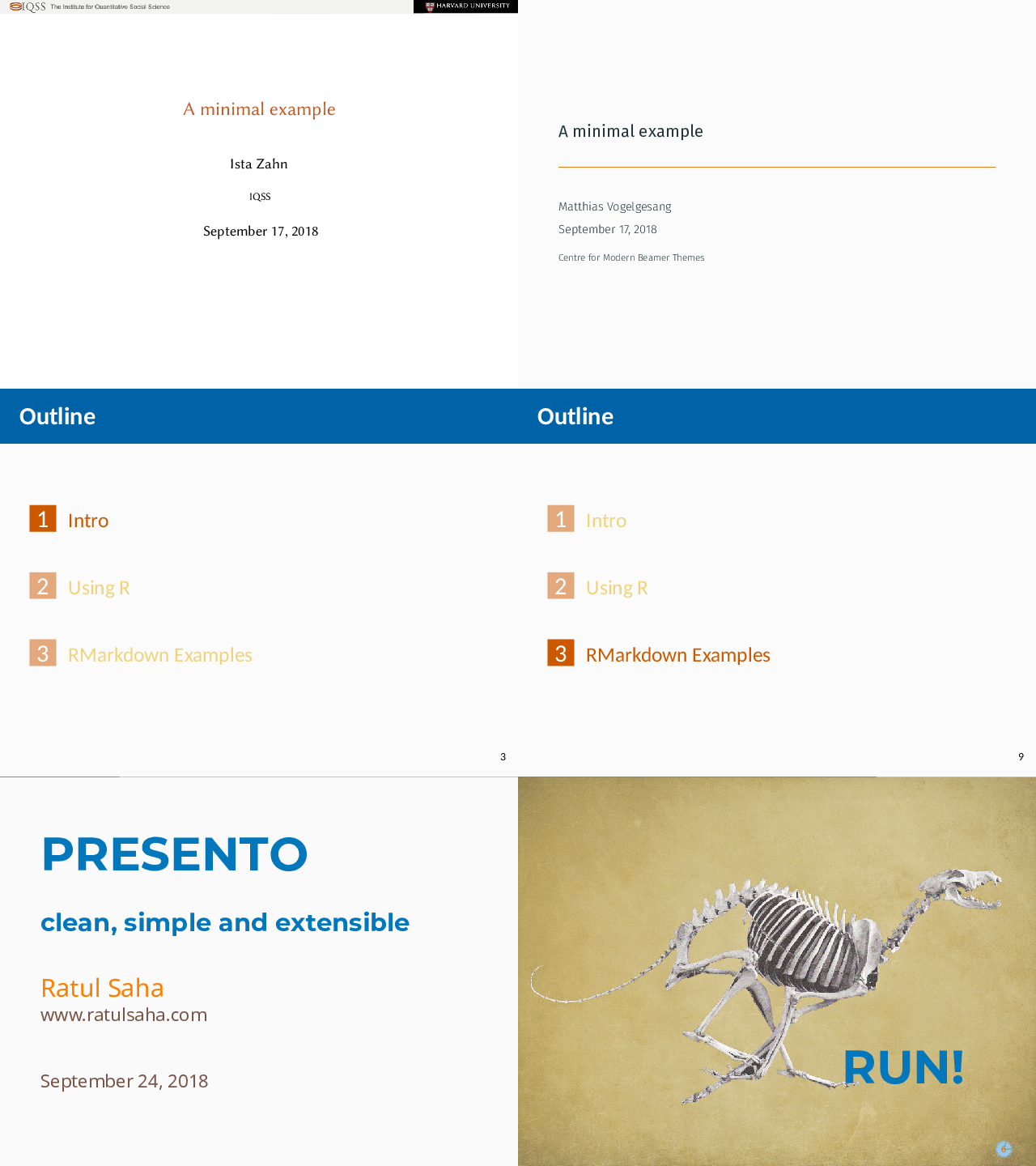
The seventh release of the binb package, and first in four years, is now on CRAN. binb regroups four rather nice themes for writing LaTeX Beamer presentations much more easily in (R)Markdown. As a teaser, a quick demo combining all four themes is available; documentation and examples are in the package. This release contains a CRAN-requested fix for a just-released new pandoc version which deals differently with overflowing bounding boxes from graphics; an added new LaTeX command is needed. We also polished continuous integration and related internals a few times but this does not contain directly user-facing changes in the package.

Changes in binb version 0.0.7 (2024-07-06)
  • Several rounds of small updates to ge continuous integration setup.
  • An additional LaTeX command needed by pandoc (>= 3.2.1) has been added.

CRANberries provides a summary of changes to the previous version. For questions or comments, please use the issue tracker at the GitHub repo. If you like this or other open-source work I do, you can now sponsor me at GitHub.

This post by Dirk Eddelbuettel originated on his Thinking inside the box blog. Please report excessive re-aggregation in third-party for-profit settings.

3 July 2024

Mike Gabriel: Polis - a FLOSS Tool for Civic Participation -- Initial Evaluation and Adaptation (episode 2/5)

Here comes the 2nd article of the 5-episode blog post series written by Guido Berh rster, member of staff at my company Fre(i)e Software GmbH. Enjoy also this read on Guido's work on Polis,
Mike
Table of Contents of the Blog Post Series
  1. Introduction
  2. Initial evaluation and adaptation (this article)
  3. Issues extending Polis and adjusting our goals
  4. Creating (a) new frontend(s) for Polis
  5. Current status and roadmap
Polis - Initial evaluation and adaptation The Polis code base consists of a number of components, the administration and participation interfaces, a common web backend, and a statistics processing server. Both frontends and the backend are written in a mixture of JavaScript and TypeScript, only the statistics processing server is written in Clojure. In case of self hosting the preferred method of deployment is via Docker containers using Docker Compose or any other orchestrator. The participation frontend for conversations can either be used as a standalone web page or be embedded via an iframe. For our planned use case we initially defined the following goals: After a preliminary evaluation of our own and consulting with Policy Lab UK who were also evaluating and testing Polis and had already made a range of improvements related to self-hosting as well as bug fixes and modernization changes we decided to take their work as a base for our adaptations with the intent of submitting generally useful changes back to the Polis project. Subsequently, a number of changes were implemented, including the removal of hardcoded domain names, the elimination of unnecessary cookies and third-party requests, support for an alternative email sending service, and the option of disabling Facebook and X integration. For the branding our approach was to add an option allowing websites which are embedding conversations in an iframe to load an alternative stylesheet for overriding the native Polis branding. For this to be practical we intended to use CSS custom properties for defining branding-related styles such as colors and fonts. That approach turned out to be problematic because although the Polis participation frontend stylesheet is generated via SCSS and some of the colors are parameterized, however, they are not used consistently throughout the SCSS stylesheets, unfortunately. In addition the frontend templates contain a large amount of hardcoded style attributes. While we succeeded in implementing user-defined stylesheets, it took a disproportionate amount of development resources to parameterize all used colors and fonts via CSS custom properties aggravated by the fact that the SCSS and template files are huge and contain many unused rules and code.

1 July 2024

Russell Coker: VoLTE in Australia

Introduction In Australia the 3G mobile frequencies are to be reused so they are in the process of shutting down the 3G service. That means that everyone has to use VoLTE (Voice Over LTE) for phone calls (including emergency calls). The shutdown time varies by telco, Kogan Mobile (one of the better services which has good value for money and generally works well) shut down their 3G service in January. Aldi Mobile (another one of the good services which is slightly more expensive but has included free calls to most first-world countries and uses the largest phone network) will shut theirs down at the end of August. For background there s a Fosdem talk about OpenSIPS with VoLTE and VoNR [1], it s more complex than you want to know. Also VoNR (Voice over New Radio) is the standard for 5G voice and it s different from VoLTE and has a fallback to VoLTE. Another good lecture for background information is the Fosdem talk on VoLTE at the handset end [2]. The PinePhonePro In October 2023 I tried using my PinePhonePro as my main phone but that only lasted a few days due to problems with calls and poor battery life [3]. Since then I went back to the Huawei Mate 10 Pro that I bought refurbished in June 2019 for $389. So that has been my main phone for 5 years now, giving a cost of $1.50 per week. I had tried using a Huawei Nova 7i running Android without Google Play as an experiment but that had failed, I do many things that need Android apps [4]. I followed the PinePhone wiki to get my PinePhonePro working with VoLTE [5]. That worked fine for me, the only difference from the instructions is that I had to use device /dev/ttyUSB3 and that the modem kept resetting itself during the process and when that happened I had to kill minicom and start again. After changing the setting and saving it the PinePhonePro seemed to work well with VoLTE on a Kogan Mobile SIM (so definitely not using 3G). One issue I have found is that Plasma Mobile (my preferred FOSS phone GUI) appears to have a library issue that results in polling every 14ms even when the screen is locked [6]. If you have a few processes doing that (which means the most lightly used Plasma system) it really hurts battery use. The maintainer has quite reasonably deferred action on this bug report given the KDE 6 transition. Later on in the Trixie development cycle I hope to get this issue resolved, I don t expect it to suddenly make battery life good. But it might make battery life acceptable. I am now idly considering carrying around my PinePhonePro in a powered off state for situations where I might need to do high security operations (root logins to servers or online banking) but for which carrying a laptop isn t convenient. It will do well for the turn on, do 30 mins of work that needs security, and then turn off scenario. Huawei Mate 10 Pro and Redmi 9A The Huawei Mate 10 Pro has been my main phone for 5 years and it has worked well, so it would be ideal if it could do VoLTE as the PinePhonePro isn t ready yet. All the web pages I ve seen about the Mate 10 Pro say that it will either allow upgrading to a VoLTE configuration if run with the right SIM or only support it with the right SIM. I did a test with a Chinese SIM which gave an option of turning on VoLTE but didn t allow any firmware updates and the VoLTE option went away when I put an Australian SIM in. Some forum comments had led me to believe that it would either permanently enable VoLTE or allow upgrading the firmware to one that enables VoLTE if I used a Chinese SIM but that is not the case. I didn t expect a high probability of success but I had to give it a go as it s a nice phone. I did some tests on a Redmi 9A (a terrible phone that has really bad latency on the UI in spite of having reasonably good hardware). The one I tested on didn t have VoLTE enabled when I got it, to test that I used the code *#*#4636#*#* in the dialler to get the menu of SIM information and it showed that VoLTE was not provisioned. I then had to update to the latest release of Android for that phone and enter *#*#86583#*#* in the dialler to enable VoLTE, the message displayed after entering that magic number must end in DISABLE . I get the impression that the code in question makes the phone not check certain aspects of whether the carrier is good for VoLTE and just do it. So apparently Kogan Mobile somehow gives the Redmi 9A the impression that VoLTE isn t supported but if the phone just goes ahead and connects it will work. I don t plan to use a Redmi 9A myself as it s too slow, but I added it to my collection to offer to anyone else I know who needs a phone with VoLTE and doesn t use the phone seriously or to someone who needs a known good phone for testing things. Samsung Galaxy Note 9 I got some Samsung Galaxy Note 9 phones to run Droidian as an experiment [7]. But Droidian dropped support for the Note 9 and I couldn t figure out how to enable VoLTE via Droidian, which was very annoying after I had spent $109 on a test phone and $215 on a phone for real use (I have no plans to try Droidian again at this time). I tried installing LineageOS on one Note 9 [8] which was much easier than expected (especially after previously installing Droidian). But VoLTE wasn t an option. According to Reddit LineageOS doesn t support VoLTE on Samsung devices and you can use a magisk module or a VoLTE enabler module but those aren t supported by LineageOS either [9]. I downloaded an original image for the Note 9 from SamsMobile.com [10]. That image booted past the orange stage (where if you have problems then your phone is probably permanently useless) but didn t boot into the OS. A friend helped me out with that and it turned out that the Heimdal flash tool on Linux didn t do something it needed to do and that Odin on Windows was required. After using Odin everything was fine and I have a Note 9 with VoLTE running the latest Samsung firmware which is security patch level 1st July 2022!!! So I have a choice between using a Note 9 for data and SMS while running a current version of Lineage OS with all security fixes or running a Samsung image with no security updates for 2 years which supports phone calls. So based on this I have to recommend Pixel as the phone of choice, it has a decent level of support from Google and long term support from LineageOS. According to the LineageOS web site you can run the current version of Lineage on the original Pixel phone from 2016! Of course getting VoLTE to work on it might be another saga, but it would probably be easier to do with LineageOS on a Pixel than on a Samsung phone. Conclusion The operation of the Note 9 for me is decent now apart from the potential security issues. The same goes for selling one of the phones. The PinePhonePro still has potential to become my daily driver at some future time if I and others can optimise power use. Also a complicating factor is that I want to have both Jabber and Matrix be actually instant IM systems not IM with a 5 minute delay, so suspend mode isn t a good option. Pixel phones will be a much higher priority when looking at phones to buy in future. The older Pixel phones go for as little as $100 on eBay and can still run the latest LineageOS. VoLTE seems needlessly complicated.

29 June 2024

Russ Allbery: Review: Bitter Angels

Review: Bitter Angels, by C.L. Anderson
Publisher: Ballantine Books
Copyright: 2009
ISBN: 0-553-59217-3
Format: Mass market
Pages: 438
Bitter Angels is a stand-alone science fiction novel. It won the Philip K. Dick award for best SF original paperback in 2010. C.L. Anderson is a pen name for Sarah Zettel. Terese was a Guardian, one of the agents of the Pax Solaris who find ways to keep the peace in troubled systems and high-stress situations with the help of an implanted Companion, an assistant AI. Forty years ago, on one of those missions, she was captured and her Companion was forcibly removed. She was rescued by her friend and mentor and retired afterwards, starting a new life and a new family, trying to leave the memories behind. Now, the woman who rescued her is dead. She was murdered on duty in the Erasmus system, a corporate hellhole that appears to be on the verge of exploding into a political hot spot. Bianca's last instructions asked for Terese to replace her. Terese's family is furious at her for even considering returning to the Guardians, but she can't say no. Duty, and Bianca's dying request, call too strongly. Amerand is Security on Dazzle, one of the Erasmus stations. He is one of the refugees from Oblivion, the station that the First Bloods who rule the system let die. He keeps his head above water and tries to protect his father and find his mother without doing anything that the ever-present Clerks might find concerning. Keeping an eye on newly-arriving Solaris saints is a typical assignment, since the First Bloods don't trust the meddling do-gooders. But something is not quite right, and a cryptic warning from his Clerk makes him even more suspicious. This is the second book by Sarah Zettel that I've read, and both of them have been tense, claustrophobic thrillers set in a world with harsh social inequality and little space for the characters to maneuver. In this case, the structure of her future universe reminded me a bit of Iain M. Banks's Culture, but with less advanced technology and only humans. The Pax Solaris has eliminated war within its borders and greatly extended lifespans. That peace is maintained by Guardians, who play a role similar to Special Circumstances but a bit more idealist and less lethal. They show up where there are problems and meddle, manipulating and pushing to try to defuse the problems before they reach the Pax Solaris. Like a Culture novel, nearly all of the action takes place outside the Pax Solaris in the Erasmus system. Erasmus is a corporate colony that has turned into a cross between a hereditary dictatorship and the Corporate Rim from Martha Wells's Murderbot series. Debt slavery is ubiquitous, economic inequality is inconceivably vast, and the Clerks are everywhere. Erasmus natives like Amerand have very little leeway and even fewer options. Survival is a matter of not drawing the attention of the wrong people. Terese and her fellow Guardians are appalled, but also keenly aware that destabilizing the local politics may make the situation even worse and get a lot of people killed. Bitter Angels is structured like a mystery: who killed Bianca, and what was her plan when she was killed? Unlike a lot of books of this type, the villains are not idiots and their plan is both satisfyingly complex and still depressingly relevant. I don't think I'm giving anything away by saying that I have read recent news articles about people with very similar plans, albeit involving less science-fiction technology. Anderson starts with a tense situation and increases the pressure relentlessly, leaving the heroes one step behind the villains for almost the entire novel. It is not happy or optimistic reading at times, the book is quite dark but it certainly was engrossing. The one world-building quibble that I had is that the Erasmus system is portrayed partly as a hydraulic empire, and while this is arguably feasible given that spaceship travel is strictly controlled, it seemed like a weird choice given the prevalence of water on the nearby moons. Water smuggling plays a significant role in the plot, and I wasn't entirely convinced of the politics and logistics behind it. If this sort of thing bugs you, there are some pieces that may require suspension of disbelief. Bitter Angels is the sort of tense thriller where catastrophe is barely avoided and the cost of victory is too high, so you will want to be in the mood for that before you dive in. But if that's what you're looking for, I thought Anderson delivered a complex and satisfying story. Content warning: major character suicide. Rating: 7 out of 10

27 June 2024

Russ Allbery: Review: Lyorn

Review: Lyorn, by Steven Brust
Series: Vlad Taltos #17
Publisher: Tor
Copyright: 2024
ISBN: 1-4668-8971-3
Format: Kindle
Pages: 274
Lyorn is the 17th Vlad Taltos book and a direct sequel to 2014's Hawk. (Yes, actual main story progress!) You do not want to start reading here; you would be hopelessly confused. When this series is complete, I want to re-read the entire thing from the beginning and pick up more of the bits I missed the first time. Vlad is not, in fact, free to see his friends and get entangled in imperial politics again as I thought after Hawk. Despite the successes of that story, there is one remaining small problem: incredibly powerful magic users still want to kill him. His immediate solution is to shelter in a theater, since Draegaran theaters are well-known for their excellent magical shielding. This works well enough at first, but the theater is rehearsing a play about Draegaran politics that is highly offensive to the Lyorn and the theater may be shut down because of it. Vlad's enemies are also willing to lean on his friends to find him and kill him. This series continues to be thoroughly enjoyable. Lyorn is "just" more of Vlad being Vlad, meddling in everyone's business and coming up with elaborate plans with too many moving parts that he somehow manages to pull off, but I'll happily read lots of books like that. Vlad is both anxious and grumpy, both of which give the plot some needed tension without being overwhelming. There are no truly major world-building revelations here (or, if there are, I missed them), but there's a lot of processing of what the reader learned in Tsalmoth. It's increasingly looking like the payoff from those revelations is going to be the series finale. This is the first Vlad book that contains solid confirmation of where the series as a whole is headed. Brust mentioned some time ago that the last book is titled The Last Contract, and Lyorn comes close to stating explicitly what that contract will be. I am sure that it will be more complicated than it appears now and there are misdirections yet to come, but I am excited to see where Brust takes this idea. Vlad has been insistently apolitical for much of the series, meddling in politics only when he has to or to help his friends and otherwise treating it as a system that he has to navigate and survive. That was the root of the conflict in Teckla, all the way back at the start of the series. This may be starting to change, and when Brust ties it together with the Jenoine, the Great Weapon Godslayer, and the rest of the world-building he's cued up, the results are going to be explosive. Two books left: Chreotha and The Last Contract. I can hardly wait. In every Vlad book, Brust plays some sort of structural game. This time, befitting the setting, it's a musical. The action is interspersed with quotes from a fictional history about the play the theater is putting on, a work called Song of the Presses about political censorship during the reign of a Lyorn emperor in the 14th cycle, thousands of years before the time of this book. This was, at times, nearly as interesting as the main plot. The chapters are also numbered like the acts and scenes of a play, although this I didn't notice as much since books often have that structure anyway. Since this is a musical, there are also songs. Specifically, each chapter is introduced by a parody of songs from various musicals in our world, rewritten so that they fit within Brust's fictional musical. Brust is also a musician and a filker, so these songs are actually good, or at least they amused me a great deal. I'm not much of a musical fan and I still could hear the tune playing when I read most of them. Lyorn is not so good that I would rave about it. It's one of those functional connective books of a series that advances the plot, tells a good story, and has some fun along the way. The guns on the mantelpiece of this world have not gone off yet, and Vlad is still maneuvering into position. But it's looking like we're going to get the conclusion, and it's going to be spectacular. If you have read this far, you will want to keep reading. Followed by Chreotha, which may be a bit of a wait because apparently Brust is going to write The Last Contract first to make sure he ties up loose ends properly. Rating: 7 out of 10

24 June 2024

Dirk Eddelbuettel: x13binary 1.1.61 on CRAN: Maintenance

The x13binary team is thrilled to share the availability of Release 1.1.61 of the x13binary package providing the X-13ARIMA-SEATS program by the US Census Bureau which arrived on CRAN earlier today. This release brings two updates suggested by the tireless CRAN maintainers. Kurt Hornik suggested to now also ignore stderr when calling the x13 binary via system: it appears that builds under the new-ish and clang-based flang-new now emit on stderr even if Fortran-based binaries did not before. So we adjust. And Brian Ripley pointed out that our Makefile for creating the x13 binary was not quite as is should be, which we adjusted. And I just realized I should have named this 1.1.60-2 to follow the upstream convention but didn t. Next time. Courtesy of my CRANberries, there is also a diffstat report for this release showing changes to the previous release. If you like this or other open-source work I do, you can sponsor me at GitHub.

This post by Dirk Eddelbuettel originated on his Thinking inside the box blog. Please report excessive re-aggregation in third-party for-profit settings.

Dirk Eddelbuettel: digest 0.6.36 on CRAN: Big endian, maintenance

Release 0.6.36 of the digest package arrived at CRAN today and has also been uploaded to Debian. digest creates hash digests of arbitrary R objects. It can use a number different hashing algorithms (md5, sha-1, sha-256, sha-512, crc32, xxhash32, xxhash64, murmur32, spookyhash, blake3,crc32c, xxh3_64 and xxh3_128), and enables easy comparison of (potentially large and nested) R language objects as it relies on the native serialization in R. It is a mature and widely-used package (with 69.1 million downloads just on the partial cloud mirrors of CRAN which keep logs) as many tasks may involve caching of objects for which it provides convenient general-purpose hash key generation to quickly identify the various objects. This release updates one contributed C++ function to be compliant with R s revent preference for explicit declaration of REMAP, and improves the behavior under the (increasingly rare) big endian system via a patch to blake3 as well as a hint that spookyhash under big endian may not meed its reference output from little endian . My CRANberries provides a summary of changes to the previous version. For questions or comments use the issue tracker off the GitHub repo. For documentation (including the changelog) see the documentation site. If you like this or other open-source work I do, you can now sponsor me at GitHub.

This post by Dirk Eddelbuettel originated on his Thinking inside the box blog. Please report excessive re-aggregation in third-party for-profit settings.

21 June 2024

Dirk Eddelbuettel: nanotime 0.3.9 on CRAN: Bugfix

A quick bug fix release 0.3.9 for our nanotime package is now on CRAN, following up on the 0.3.8 release made this week. nanotime relies on the RcppCCTZ package (as well as the RcppDate package for additional C++ operations) and offers efficient high(er) resolution time parsing and formatting up to nanosecond resolution, using the bit64 package for the actual integer64 arithmetic. Initially implemented using the S3 system, it has benefitted greatly from a rigorous refactoring by Leonardo who not only rejigged nanotime internals in S4 but also added new S4 types for periods, intervals and durations. The 0.3.8 release added a accurate parameter for POSIXct conversions, and it turns out that this did not test as expected on arm64 so we disabled the test on that platform. The NEWS snippet below has the full details.

Changes in version 0.3.9 (2024-06-21)
  • Condition two tests to not run on arm64 (Dirk in #129 fixing #128)

Thanks to my CRANberries, there is a diffstat report for this release. More details and examples are at the nanotime page; code, issue tickets etc at the GitHub repository and all documentation is provided at the nanotime documentation site. If you like this or other open-source work I do, you can sponsor me at GitHub.

This post by Dirk Eddelbuettel originated on his Thinking inside the box blog. Please report excessive re-aggregation in third-party for-profit settings.

Gunnar Wolf: A new RISC-V toy... requiring almost no tinkering

Shortly before coming back from Argentina, I got news of a very interesting set of little machines, the MilkV Duo. The specs looked really interesting and fun to play with, particularly those of the bigger model, Milk-V DUO S Some of the highlights: Milk-V Duo S Naturally, for close to only US$12 (plus shipping) for the configuration I wanted I bought one, and got it delivered in early May. The little box sat on my desk for close to six weeks until I had time to start tinkering with it I must say I am surprised. Not only the little bugger delivers what it promises, but it is way more mature than what I expected: It can be used right away without much tinkering with! I mean, I have played with it for less than an hour by now, and I ve even managed to get (almost) regular Debian working. Milk-V distributes a simple, 58.9MB compressed Linux image, based on Buildroot, a simple Linux image generator mostly used for embedded applications, as well as its source tree. I thought that would be a good starting point to work on setting up a minimal Debian filesystem, as I did with the CuBox-i4Pro ten years ago, and maybe even to grow towards a more official solution, akin to what we currently have for the Raspberry Pi family Until I discovered what looks like a friendly and very active online community of Milk-V users! I haven t yet engaged in it, but I stumbled across a thread announcing the availability of Debian images for the Milk-V family. And yes, it feels like a very normal Debian system. /etc/apt/sources.list does point to a third-party repository, but it s for only four packages, all related to pinmux controlfor CVITEK chips. It does feel like a completely normal Debian system! It is not as snappy and fast to load as Buildroot, but given Debian s generality, that s completely as expected. Even the wireless network, one of the usual pain points, works just out of the box! The Debian images can be built or downloaded from this Git repository. In case you wonder how is this system booting or what hardware it detects, I captured two boot logs:

20 June 2024

Daniel Lange: Fixing esptool read_flash above 2MB on some cheap ESP32 boards

esptool, the Espressif SoC serial bootloader utility, tends to dislike cheap Flash chips attached to the various incarnations of the ESP32 chip family. And it seems to dislike them even more when running esptool on Linux than on other OSs. The common error mode is seeing it break at the 2MB barrier when trying to dump (esptool read_flash) a 4MB flash configuration.
esptool -p /dev/ttyUSB0 -b 921600 read_flash 0 0x400000 flash_dump.bin
will fail with
esptool.py v4.7.0
Serial port /dev/ttyUSB0
Connecting....
Detecting chip type... ESP32
Chip is ESP32-D0WD-V3 (revision v3.1)
Features: WiFi, BT, Dual Core, 240MHz, VRef calibration in efuse, Coding Scheme None
Crystal is 40MHz
[..]
Detected flash size: 4MB
[..]
2097152 (50 %)
A fatal error occurred: Failed to read flash block (result was 01090000: CRC or checksum was invalid)
typically at the 2MB barrier. I found the solution in a rather unrelated esptool Github issue: Create an esptool.cfg file in the project directory (from where you will run esptool):
[esptool]
timeout = 30
max_timeout = 240
erase_write_timeout_per_mb = 40
mem_end_rom_timeout = 0.2
serial_write_timeout = 10
The timeout = 30 is the setting that fixed reading flash memory via esptool read_flash for me. When your esptool.cfg is read, esptool will tell you so in its second line of output:
$ esptool flash_id
esptool.py v4.7.0
Loaded custom configuration from /home/dl/[..]/Embedded_dev/ESP-32_Wemos/esptool.cfg
Found 1 serial ports
Serial port /dev/ttyUSB0
Connecting......
[..]
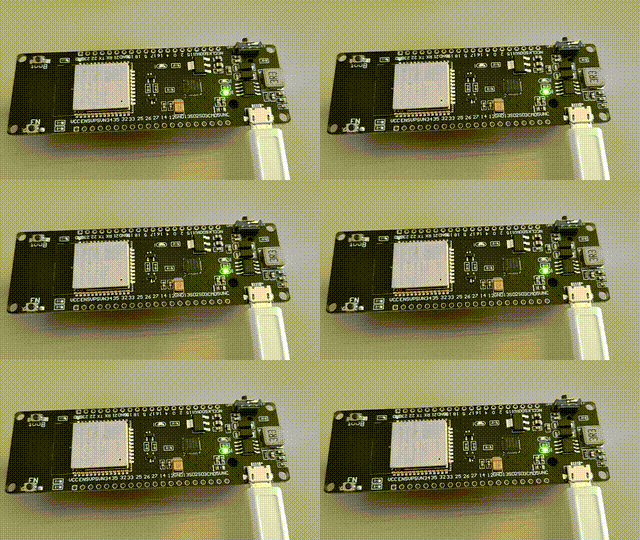
Animated GIF of an ESP32 board Thank you Radim Karnis and wibbit from the Github issue linked above.

19 June 2024

Dirk Eddelbuettel: nanotime 0.3.8 on CRAN: More Maintenance

Leonardo and I are happy to annunce that a new version 0.3.8 of our nanotime package arrived on CRAN today. It is the first release in over 1 1/2 years. nanotime relies on the RcppCCTZ package (as well as the RcppDate package for additional C++ operations) and offers efficient high(er) resolution time parsing and formatting up to nanosecond resolution, using the bit64 package for the actual integer64 arithmetic. Initially implemented using the S3 system, it has benefitted greatly from a rigorous refactoring by Leonardo who not only rejigged nanotime internals in S4 but also added new S4 types for periods, intervals and durations. This release responds to a number of enhancements including a new paramter accurate for POSIXct to nanotime conversions, a vector date converter, a switch to double return value when durations objects are dividded as well as a small battery of CRAN requests for changes and updates. This started with a move away from the now non-API function SET_S4_OBJECT which has been replaced by use of Rf_asS4. We also no longer need a custom compiler flag on Windows (where for some reasons nobody understands or remembers, bitfields are not packed) to small enhancements of manual page formatting and last-but-not-least avoidance of some new UBSAN warnings. The NEWS snippet has the full details.

Changes in version 0.3.8 (2024-06-19)
  • Time format documentation now has a reference to RcppCCTZ
  • The package no longer sets a default C++ compilation standard of C++11 (Dirk initially in #114, and later switched to C++17)
  • New accurate parameter for conversion from POSIXct to nanotime (Davor Josipovic and Leonardo in #116 closing #115)
  • The as.Date() function is now vectorized and can take a TZ argument (Leonardo and Dirk in #119 closing #118)
  • Use of internal function SET_S4_OBJECT has been replaced by API function Rf_asS4 (Leonardo in #121 closing #120)
  • An nanoduration / nanoduration expression now returns a double (Leonardo in #122 closing #117)
  • Bitfield calculations no longer require an Windows-only compiler switch (Leonardo in #124)
  • A simple manual page format nag involving has been addressed (Dirk in #126 fixing #125)
  • An set of tests tickling an UBSAN issue via Rcpp code no longer run unless CI is set (Dirk in #127 fixing #123)

Thanks to my CRANberries, there is a diffstat report for this release. More details and examples are at the nanotime page; code, issue tickets etc at the GitHub repository and all documentation is provided at the nanotime documentation site. If you like this or other open-source work I do, you can sponsor me at GitHub.

This post by Dirk Eddelbuettel originated on his Thinking inside the box blog. Please report excessive re-aggregation in third-party for-profit settings.

Next.

Previous.