Search Results: "daniel"

7 November 2016

Daniel Pocock: Quickstart SDR with gqrx, GNU Radio and the RTL-SDR dongle

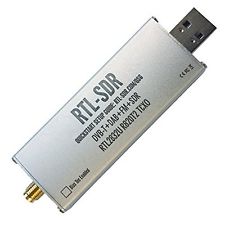
Software Defined Radio (SDR) provides many opportunities for both experimentation and solving real-world problems. It is not exactly a new technology but it has become significantly more accessible due to the increases in desktop computing power (for performing the DSP functions) and simultaneous reduction in the cost of SDR hardware. Thanks to the availability of a completely packaged gqrx and GNU Radio solution, you can now get up and running in less than half an hour and spending less than fifty dollars/pounds/euros. We provided a full demo of the Debian Hams gqrx solution at Mini DebConf Vienna (video) and hope to provide a similar demo at MiniDebConf Cambridge on the coming weekend of 12-13 November. gqrx is also available for Fedora users. Choosing hardware There are many different types of hardware, ranging from the low-cost RTL-SDR USB dongles to full duplex multi-transceiver systems. My recommendation is to start with an RTL-SDR dongle due to extremely low cost, this will give you an opportunity to reflect on the opportunities of this technology before putting money into one of the transceivers and their accessories. The RTL-SDR dongle also benefits from being a small self-contained solution that you can carry around and experiment with or demo just about anywhere. Important: Don't buy the cheapest generic RTL TV/radio receivers. It is absolutely essential to buy one of the units that has been explicitly promoted for SDR. These typically have a temperature compensated crystal oscillator (TCXO) which is absolutely essential for the reception of narrowband voice and digital signals. Without this, it is only possible to receive wideband broadcash FM radio and TV channels. For those who want to try it out with us at MiniDebConf Cambridge, Technofix has UK stock (online ordering), they are about 26. Getting gqrx up and running fast Note: to avoid the wrong kernel module being loaded automatically, it is recoemmended that you don't connect the RTL-SDR dongle before you install the packages. If you did already connect it, you may need to reboot or rmmod dvb_usb_rtl28xxu. If you are using a Debian jessie system, you can get all the necessary packages from jessie-backports. If you haven't already enabled backports, you can do so with a command like this:
$ sudo echo "deb http://ftp.ch.debian.org/debian jessie-backports main" >> /etc/apt/sources.list
Make sure your local index is updated and then install the necessary packages:
$ sudo apt-get update
$ sudo apt-get install -t jessie-backports gqrx-sdr rtl-sdr
Running it for the first time Once the packages are installed, connect the RTL-SDR dongle to the computer and then start the gqrx GUI from a terminal:
$ gqrx
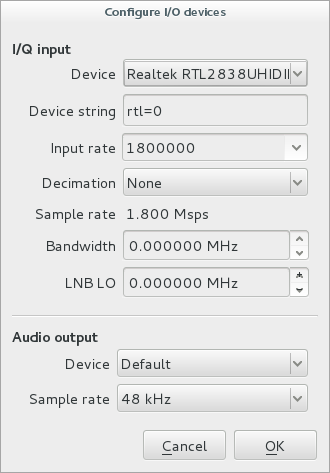
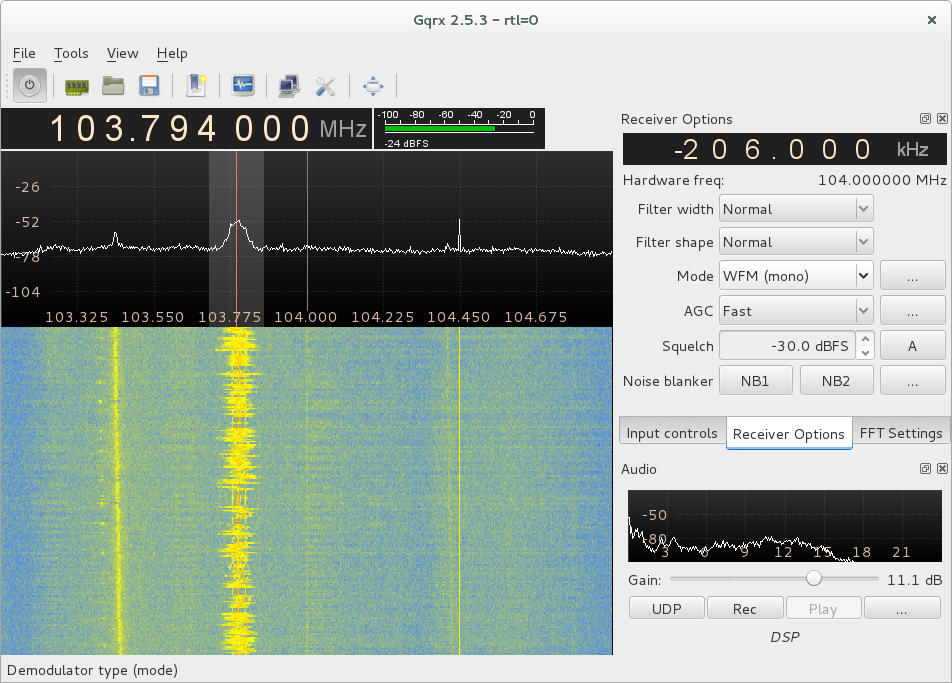
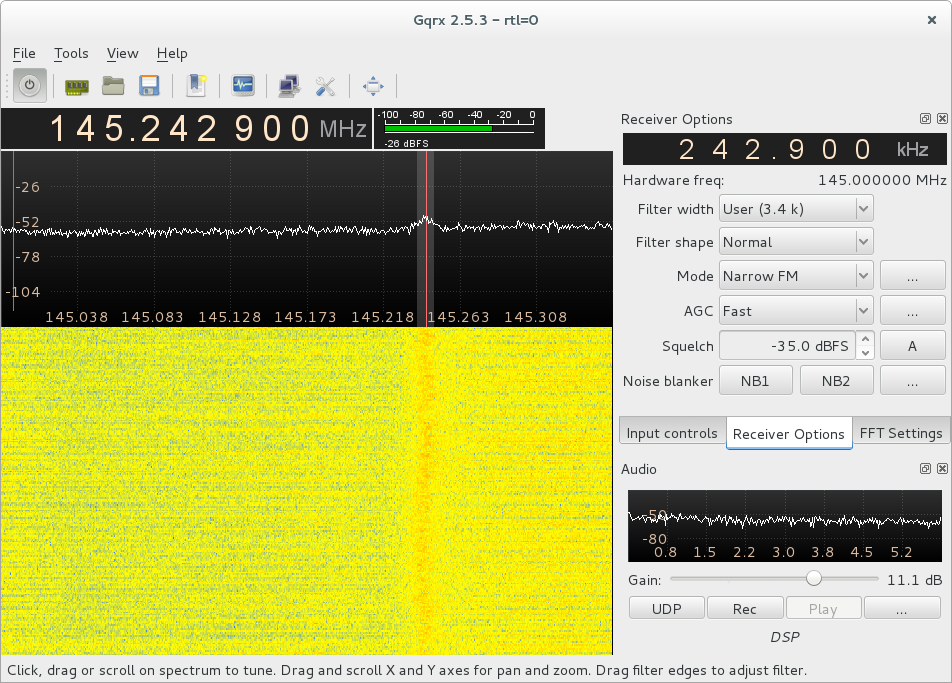
If the GUI fails to appear, look carefully at the error messages. It may be that the wrong kernel module has been loaded. The properties window appears, select the RTL-SDR dongle: Now the main screen will appear. Choose the wideband FM mode "WFM (mono)" and change the frequency to a value in the FM broadcast band such as 100MHz. Click the "Power on" button in the top left corner, just under the "File" menu, to start reception. Click in the middle of a strong signal to tune to that station. If you don't hear anything, check the squelch setting (it should be more negative than the signal strength value) and increase the Gain control at the bottom right hand side of the window. Looking for ham / amateur radio signals A popular band for hams is between 144 - 148 MHz (in some countries only a subset of this band is used). This is referred to as the two-meter band, as that is the wavelength at this frequency. Hams often use the narrowband FM mode in this band, especially with repeater stations. Change the "Mode" setting from "WFM" to "Narrow FM" and change the frequency to a value in the middle of the band. Look for signals in the radio spectrum and click on them to hear them. If you are not sure which part of the band to look in, search for the two-meter band plan for your country/region and look for the repeater output frequencies in the band plan.
5 November 2016

Elizabeth Ferdman: Applying to Debian for Outreachy 2016

This year, Outreachy featured internships from organizations such as Debian, Fedora, GNOME, the Linux Kernel, Mozilla, Python, and Wikimedia, just to name a few. Each organization features mentored projects and in order to apply, applicants must contact the mentor, introduce themselves on the appropriate channels and make a small contribution to the project. After that, applicants might be required to fulfill additional tasks to demonstrate their abilities. Successful applicants will make quality contributions, communicate effectively with mentors, ask questions, fulfill tasks, help out their peers via mailing lists, and/or blog about their experience. One of the projects I applied to was the Clean Room for PGP and X.509 (PKI) Key Management. The project aims to create a Live Disc that enables users to create and manage their PGP keys easily and securely, using a text-based UI. I ve been a Debian user for about a year, but before applying to the project I didn t know much about GnuPG or public key encryption. Since then, I ve made some contributions and attended my first keysigning event in San Francisco featuring a lecture by Neal Walfield (more on that below). For my initial contribution, Daniel Pocock, the mentor for this project, asked that I write a script that lists the USB flash devices connected to the system and specifies which device the system booted from. Here s the bash script that I wrote, and that was enough to submit an application for Debian. My next task was to write a dns hook script for the dehydrated project, a shell client for signing certificates with Let s Encrypt (for free!). The script completes a dns challenge sent by the ACME-server by provisioning a TXT record for a given domain in order to prove ownership of the domain. I chose to write it in python and used the dnspython API. I posted my solution on github and there are many more here. At the lecture, Neal talked about good practices for key creation and management. Here are a few of those points: See the slides for Neal s full presentation.

3 November 2016

Bits from Debian: New Debian Developers and Maintainers (September and October 2016)

The following contributors got their Debian Developer accounts in the last two months: The following contributors were added as Debian Maintainers in the last two months: Congratulations!

2 November 2016

Reproducible builds folks: Reproducible Builds: week 79 in Stretch cycle

What happened in the Reproducible Builds effort between Sunday October 23 and Saturday October 29 2016: Upcoming events The second Reproducible Builds World Summit will be held from December 13th-15th in Berlin! See the link for more details. Other events: Introduction to Reproducible Builds - Vagrant Cascadian will be presenting at the SeaGL.org Conference In Seattle, USA on November 12th, 2016. Reproducible Debian Hackathon - A small hackathon organized in Boston, USA on December 3rd and 4th. If you are interested in attending, contact Valerie Young - spectranaut in the #debian-reproducible IRC channel on irc.oftc.net. IRC meeting The next IRC meeting will be held on 2016-11-01 at 18:00 UTC. The meeting after that will be held on 2016-11-15 at 18:00 UTC. Reproducible work in other projects Ximin Luo has had his fix to bug 77985 accepted into GCC. This is needed to be able to write test cases for patches to make GCC produce debugging symbols that are reproducible regardless of the build path. There was continued discussion on the mailing list regarding our build path proposals. It has now been decided to use an environment variable SOURCE_PREFIX_MAP instead of the older proposal SOURCE_ROOT_DIR. This would be similar to GCC's existing -fdebug-prefix-map option, which allows for better disambiguation between paths from different packages. mandoc's makewhatis is now reproducible. It is used by all the BSDs, including FreeBSD, as well as Alpine Linux and Void Linux. Packages reviewed and fixed, and bugs filed Chris Lamb: Reiner Herrmann: Reviews of unreproducible packages 145 package reviews have been added, 608 have been updated and 94 have been removed in this week, adding to our knowledge about identified issues. 3 issue types have been updated: Weekly QA work During of reproducibility testing, some FTBFS bugs have been detected and reported by: tests.reproducible-builds.org Debian: General: diffoscope development Misc. This week's edition was written by Ximin Luo, Chris Lamb and Holger Levsen and reviewed by a bunch of Reproducible Builds folks on IRC.

26 October 2016

Daniel Pocock: FOSDEM 2017 Real-Time Communications Call for Participation

FOSDEM is one of the world's premier meetings of free software developers, with over five thousand people attending each year. FOSDEM 2017 takes place 4-5 February 2017 in Brussels, Belgium. This email contains information about:
  • Real-Time communications dev-room and lounge,
  • speaking opportunities,
  • volunteering in the dev-room and lounge,
  • related events around FOSDEM, including the XMPP summit,
  • social events (the legendary FOSDEM Beer Night and Saturday night dinners provide endless networking opportunities),
  • the Planet aggregation sites for RTC blogs
Call for participation - Real Time Communications (RTC) The Real-Time dev-room and Real-Time lounge is about all things involving real-time communication, including: XMPP, SIP, WebRTC, telephony, mobile VoIP, codecs, peer-to-peer, privacy and encryption. The dev-room is a successor to the previous XMPP and telephony dev-rooms. We are looking for speakers for the dev-room and volunteers and participants for the tables in the Real-Time lounge. The dev-room is only on Saturday, 4 February 2017. The lounge will be present for both days. To discuss the dev-room and lounge, please join the FSFE-sponsored Free RTC mailing list. To be kept aware of major developments in Free RTC, without being on the discussion list, please join the Free-RTC Announce list. Speaking opportunities Note: if you used FOSDEM Pentabarf before, please use the same account/username Real-Time Communications dev-room: deadline 23:59 UTC on 17 November. Please use the Pentabarf system to submit a talk proposal for the dev-room. On the "General" tab, please look for the "Track" option and choose "Real-Time devroom". Link to talk submission. Other dev-rooms and lightning talks: some speakers may find their topic is in the scope of more than one dev-room. It is encouraged to apply to more than one dev-room and also consider proposing a lightning talk, but please be kind enough to tell us if you do this by filling out the notes in the form. You can find the full list of dev-rooms on this page and apply for a lightning talk at https://fosdem.org/submit Main track: the deadline for main track presentations is 23:59 UTC 31 October. Leading developers in the Real-Time Communications field are encouraged to consider submitting a presentation to the main track. First-time speaking? FOSDEM dev-rooms are a welcoming environment for people who have never given a talk before. Please feel free to contact the dev-room administrators personally if you would like to ask any questions about it. Submission guidelines The Pentabarf system will ask for many of the essential details. Please remember to re-use your account from previous years if you have one. In the "Submission notes", please tell us about:
  • the purpose of your talk
  • any other talk applications (dev-rooms, lightning talks, main track)
  • availability constraints and special needs
You can use HTML and links in your bio, abstract and description. If you maintain a blog, please consider providing us with the URL of a feed with posts tagged for your RTC-related work. We will be looking for relevance to the conference and dev-room themes, presentations aimed at developers of free and open source software about RTC-related topics. Please feel free to suggest a duration between 20 minutes and 55 minutes but note that the final decision on talk durations will be made by the dev-room administrators. As the two previous dev-rooms have been combined into one, we may decide to give shorter slots than in previous years so that more speakers can participate. Please note FOSDEM aims to record and live-stream all talks. The CC-BY license is used. Volunteers needed To make the dev-room and lounge run successfully, we are looking for volunteers:
  • FOSDEM provides video recording equipment and live streaming, volunteers are needed to assist in this
  • organizing one or more restaurant bookings (dependending upon number of participants) for the evening of Saturday, 4 February
  • participation in the Real-Time lounge
  • helping attract sponsorship funds for the dev-room to pay for the Saturday night dinner and any other expenses
  • circulating this Call for Participation (text version) to other mailing lists
See the mailing list discussion for more details about volunteering. Related events - XMPP and RTC summits The XMPP Standards Foundation (XSF) has traditionally held a summit in the days before FOSDEM. There is discussion about a similar summit taking place on 2 and 3 February 2017. XMPP Summit web site - please join the mailing list for details. We are also considering a more general RTC or telephony summit, potentially in collaboration with the XMPP summit. Please join the Free-RTC mailing list and send an email if you would be interested in participating, sponsoring or hosting such an event. Social events and dinners The traditional FOSDEM beer night occurs on Friday, 3 February. On Saturday night, there are usually dinners associated with each of the dev-rooms. Most restaurants in Brussels are not so large so these dinners have space constraints and reservations are essential. Please subscribe to the Free-RTC mailing list for further details about the Saturday night dinner options and how you can register for a seat. Spread the word and discuss If you know of any mailing lists where this CfP would be relevant, please forward this email (text version). If this dev-room excites you, please blog or microblog about it, especially if you are submitting a talk. If you regularly blog about RTC topics, please send details about your blog to the planet site administrators:
Planet site Admin contact
All projects Free-RTC Planet (http://planet.freertc.org) contact planet@freertc.org
XMPP Planet Jabber (http://planet.jabber.org) contact ralphm@ik.nu
SIP Planet SIP (http://planet.sip5060.net) contact planet@sip5060.net
SIP (Espa ol) Planet SIP-es (http://planet.sip5060.net/es/) contact planet@sip5060.net
Please also link to the Planet sites from your own blog or web site as this helps everybody in the free real-time communications community. Contact For any private queries, contact us directly using the address fosdem-rtc-admin@freertc.org and for any other queries please ask on the Free-RTC mailing list. The dev-room administration team:

24 October 2016

Reproducible builds folks: Reproducible Builds: week 78 in Stretch cycle

What happened in the Reproducible Builds effort between Sunday October 16 and Saturday October 22 2016: Media coverage Upcoming events buildinfo.debian.net In order to build packages reproducibly, you not only need identical sources but also some external definition of the environment used for a particular build. This definition includes the inputs and the outputs and, in the Debian case, are available in a $package_$architecture_$version.buildinfo file. We anticipate the next dpkg upload to sid will create .buildinfo files by default. Whilst it's clear that we also need to teach dak to deal with them (#763822) its not actually clear how to handle .buildinfo files after dak has processed them and how to make them available to the world. To this end, Chris Lamb has started development on a proof-of-concept .buildinfo server to see what issues arise. Source Reproducible work in other projects Packages reviewed and fixed, and bugs filed Reviews of unreproducible packages 99 package reviews have been added, 3 have been updated and 6 have been removed in this week, adding to our knowledge about identified issues. 6 issue types have been added: Weekly QA work During of reproducibility testing, some FTBFS bugs have been detected and reported by: diffoscope development tests.reproducible-builds.org Misc. Our poll to find a good time for an IRC meeting is still running until Tuesday, October 25st; please reply as soon as possible. We need a logo! Some ideas and requirements for a Reproducible Builds logo have been documented in the wiki. Contributions very welcome, even if simply by forwarding this information. This week's edition was written by Chris Lamb & Holger Levsen and reviewed by a bunch of Reproducible Builds folks on IRC.

Daniel Silverstone: Gitano - Approaching Release - Deprecated commands

As mentioned previously I am working toward getting Gitano into Stretch. Last time we spoke about lace, on which a colleague and friend of mine (Richard Maw) did a large pile of work. This time I'm going to discuss deprecation approaches and building more capability out of fewer features. First, a little background -- Gitano is written in Lua which is a deliberately small language whose authors spend more time thinking about what they can remove from the language spec than they do what they could add in. I first came to Lua in the 3.2 days, a little before 4.0 came out. (The authors provide a lovely timeline in case you're interested.) With each of the releases of Lua which came after 3.2, I was struck with how the authors looked to take a number of features which the language had, and collapse them into more generic, more powerful, smaller, fewer features. This approach to design stuck with me over the subsequent decade, and when I began Gitano I tried to have the smallest number of core features/behaviours, from which could grow the power and complexity I desired. Gitano is, at its core, a set of files in a single format (clod) stored in a consistent manner (Git) which mediate access to a resource (Git repositories). Some of those files result in emergent properties such as the concept of the 'owner' of a repository (though that can simply be considered the value of the project.owner property for the repository). Indeed the concept of the owner of a repository is a fiction generated by the ACL system with a very small amount of collusion from the core of Gitano. Yet until recently Gitano had a first class command set-owner which would alter that one configuration value.
[gitano]  set-description ---- Set the repo's short description (Takes a repo)
[gitano]         set-head ---- Set the repo's HEAD symbolic reference (Takes a repo)
[gitano]        set-owner ---- Sets the owner of a repository (Takes a repo)
Those of you with Gitano installations may see the above if you ask it for help. Yet you'll also likely see:
[gitano]           config ---- View and change configuration for a repository (Takes a repo)
The config command gives you access to the repository configuration file (which, yes, you could access over git instead, but the config command can be delegated in a more fine-grained fashion without having to write hooks). Given the config command has all the functionality of the three specific set-* commands shown above, it was time to remove the specific commands.

Migrating If you had automation which used the set-description, set-head, or set-owner commands then you will want to switch to the config command before you migrate your server to the current or any future version of Gitano. In brief, where you had:
ssh git@gitserver set-FOO repo something
You now need:
ssh git@gitserver config repo set project.FOO something
It looks a little more wordy but it is consistent with the other features that are keyed from the project configuration, such as:
ssh git@gitserver config repo set cgitrc.section Fooble Section Name
And, of course, you can see what configuration is present with:
ssh git@gitserver config repo show
Or look at a specific value with:
ssh git@gitserver config repo show specific.key
As always, you can get more detailed (if somewhat cryptic) help with:
ssh git@gitserver help config
Next time I'll try and touch on the new PGP/GPG integration support.

23 October 2016

Vincent Sanders: Rabbit of Caerbannog

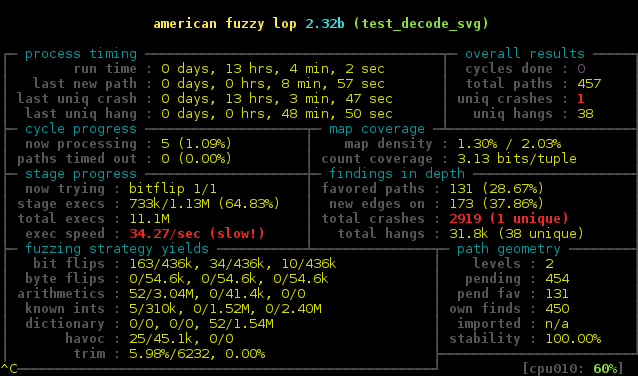
Subsequent to my previous use of American Fuzzy Lop (AFL) on the NetSurf bitmap image library I applied it to the gif library which, after fixing the test runner, failed to produce any crashes but did result in a better test corpus improving coverage above 90%

I then turned my attention to the SVG processing library. This was different to the bitmap libraries in that it required parsing a much lower density text format and performing operations on the resulting tree representation.

The test program for the SVG library needed some improvement but is very basic in operation. It takes the test SVG, parses it using libsvgtiny and then uses the parsed output to write out an imagemagick mvg file.

The libsvg processing uses the NetSurf DOM library which in turn uses an expat binding to parse the SVG XML text. To process this with AFL required instrumenting not only the XVG library but the DOM library. I did not initially understand this and my first run resulted in a "map coverage" indicating an issue. Helpfully the AFL docs do cover this so it was straightforward to rectify.

Once the test program was written and environment set up an AFL run was started and left to run. The next day I was somewhat alarmed to discover the fuzzer had made almost no progress and was running very slowly. I asked for help on the AFL mailing list and got a polite and helpful response, basically I needed to RTFM.

I must thank the members of the AFL mailing list for being so helpful and tolerating someone who ought to know better asking dumb questions.

After reading the fine manual I understood I needed to ensure all my test cases were as small as possible and further that the fuzzer needed a dictionary as a hint to the file format because the text file was of such low data density compared to binary formats.

Rabbit of Caerbannog. Death awaits you with pointy teeth
I crafted an SVG dictionary based on the XML one, ensured all the seed SVG files were as small as possible and tried again. The immediate result was thousands of crashes, nothing like being savaged by a rabbit to cause a surprise.

Not being in possession of the appropriate holy hand grenade I resorted instead to GDB and electric fence. Unlike the bitmap library crashes memory bounds issues simply did not feature in the crashes.Instead they mainly centered around actual logic errors when constructing and traversing the data structures.

For example Daniel Silverstone fixed an interesting bug where the XML parser binding would try and go "above" the root node in the tree if the source closed more tags than it opened which resulted in wild pointers and NULL references.

I found and squashed several others including dealing with SVG which has no valid root element and division by zero errors when things like colour gradients have no points.

I find it interesting that the type and texture of the crashes completely changed between the SVG and binary formats. Perhaps it is just the nature of the textural formats that causes this although it might be due to the techniques used to parse the formats.

Once all the immediately reproducible crashes were dealt with I performed a longer run. I used my monster system as previously described and ran the fuzzer for a whole week.

Summary stats
=============

Fuzzers alive : 10
Total run time : 68 days, 7 hours
Total execs : 9268 million
Cumulative speed : 15698 execs/sec
Pending paths : 0 faves, 2501 total
Pending per fuzzer : 0 faves, 250 total (on average)
Crashes found : 9 locally unique

After burning almost seventy days of processor time AFL found me another nine crashes and possibly more importantly a test corpus that generates over 90% coverage.

A useful tool that AFL provides is afl-cmin. This reduces the number of test files in a corpus to only those that are required to exercise all the code paths reached by the test set. In this case it reduced the number of files from 8242 to 2612

afl-cmin -i queue_all/ -o queue_cmin -- test_decode_svg @@ 1.0 /dev/null
corpus minimization tool for afl-fuzz by

[+] OK, 1447 tuples recorded.
[*] Obtaining traces for input files in 'queue_all/'...
Processing file 8242/8242...
[*] Sorting trace sets (this may take a while)...
[+] Found 23812 unique tuples across 8242 files.
[*] Finding best candidates for each tuple...
Processing file 8242/8242...
[*] Sorting candidate list (be patient)...
[*] Processing candidates and writing output files...
Processing tuple 23812/23812...
[+] Narrowed down to 2612 files, saved in 'queue_cmin'.

Additionally the actual information within the test files can be minimised with the afl-tmin tool. This must be run on each file individually and can take a relatively long time. Fortunately with GNU parallel one can run many of these jobs simultaneously which merely required another three days of CPU time to process. The resulting test corpus weighs in at a svelte 15 Megabytes or so against the 25 Megabytes before minimisation.

The result is yet another NetSurf library significantly improved by the use of AFL both from finding and squashing crashing bugs and from having a greatly improved test corpus to allow future library changes with a high confidence there will not be any regressions.

20 October 2016

Daniel Pocock: Choosing smartcards, readers and hardware for the Outreachy project

One of the projects proposed for this round of Outreachy is the PGP / PKI Clean Room live image. Interns, and anybody who decides to start using the project (it is already functional for command line users) need to decide about purchasing various pieces of hardware, including a smart card, a smart card reader and a suitably secure computer to run the clean room image. It may also be desirable to purchase some additional accessories, such as a hardware random number generator. If you have any specific suggestions for hardware or can help arrange any donations of hardware for Outreachy interns, please come and join us in the pki-clean-room mailing list or consider adding ideas on the PGP / PKI clean room wiki. Choice of smart card For standard PGP use, the OpenPGP card provides a good choice. For X.509 use cases, such as VPN access, there are a range of choices. I recently obtained one of the SmartCard HSM cards, Card Contact were kind enough to provide me with a free sample. An interesting feature of this card is Elliptic Curve (ECC) support. More potential cards are listed on the OpenSC page here. Choice of card reader The technical factors to consider are most easily explained with a table:

On disk Smartcard reader without PIN-pad Smartcard reader with PIN-pad
Software Free/open Mostly free/open, Proprietary firmware in reader
Key extraction Possible Not generally possible
Passphrase compromise attack vectors Hardware or software keyloggers, phishing, user error (unsophisticated attackers) Exploiting firmware bugs over USB (only sophisticated attackers)
Other factors No hardware Small, USB key form-factor Largest form factor
Some are shortlisted on the GnuPG wiki and there has been recent discussion of that list on the GnuPG-users mailing list. Choice of computer to run the clean room environment There are a wide array of devices to choose from. Here are some principles that come to mind:

  • Prefer devices without any built-in wireless communications interfaces, or where those interfaces can be removed
  • Even better if there is no wired networking either
  • Particularly concerned users may also want to avoid devices with opaque micro-code/firmware
  • Small devices (laptops) that can be stored away easily in a locked cabinet or safe to prevent tampering
  • No hard disks required
  • Having built-in SD card readers or the ability to add them easily
SD cards and SD card readers The SD cards are used to store the master private key, used to sign the certificates/keys on the smart cards. Multiple copies are kept. It is a good idea to use SD cards from different vendors, preferably not manufactured in the same batch, to minimize the risk that they all fail at the same time. For convenience, it would be desirable to use a multi-card reader: although the software experience will be much the same if lots of individual card readers or USB flash drives are used. Other devices One additional idea that comes to mind is a hardware random number generator (TRNG), such as the FST-01. Can you help with ideas or donations? If you have any specific suggestions for hardware or can help arrange any donations of hardware for Outreachy interns, please come and join us in the pki-clean-room mailing list or consider adding ideas on the PGP / PKI clean room wiki.
19 October 2016

Reproducible builds folks: Reproducible Builds: week 77 in Stretch cycle

What happened in the Reproducible Builds effort between Sunday October 9 and Saturday October 15 2016: Media coverage Documentation update After discussions with HW42, Steven Chamberlain, Vagrant Cascadian, Daniel Shahaf, Christopher Berg, Daniel Kahn Gillmor and others, Ximin Luo has started writing up more concrete and detailed design plans for setting SOURCE_ROOT_DIR for reproducible debugging symbols, buildinfo security semantics and buildinfo security infrastructure. Toolchain development and fixes Dmitry Shachnev noted that our patch for #831779 has been temporarily rejected by docutils upstream; we are trying to persuade them again. Tony Mancill uploaded javatools/0.59 to unstable containing original patch by Chris Lamb. This fixed an issue where documentation Recommends: substvars would not be reproducible. Ximin Luo filed bug 77985 to GCC as a pre-requisite for future patches to make debugging symbols reproducible. Packages reviewed and fixed, and bugs filed The following updated packages have become reproducible - in our current test setup - after being fixed: The following updated packages appear to be reproducible now, for reasons we were not able to figure out. (Relevant changelogs did not mention reproducible builds.) Some uploads have addressed some reproducibility issues, but not all of them: Some uploads have addressed nearly all reproducibility issues, except for build path issues: Patches submitted that have not made their way to the archive yet: Reviews of unreproducible packages 101 package reviews have been added, 49 have been updated and 4 have been removed in this week, adding to our knowledge about identified issues. 3 issue types have been updated: Weekly QA work During of reproducibility testing, some FTBFS bugs have been detected and reported by: tests.reproducible-builds.org Debian: Openwrt/LEDE/NetBSD/coreboot/Fedora/archlinux: Misc. We are running a poll to find a good time for an IRC meeting. This week's edition was written by Ximin Luo, Holger Levsen & Chris Lamb and reviewed by a bunch of Reproducible Builds folks on IRC.

14 October 2016

Daniel Silverstone: Gitano - Approaching Release - Changes

Continuing on from the previous article, here is a (probably incomplete) list of the critical changes to Gitano which have been, or will be, worked on during the run toward a 1.0 release. Each of these will have a blog posting to discuss what the changes mean for current and future users. Sometimes I'll aggregate postings, sometimes I won't. The following are some highlights from the past little while of development which has been undertaken by Richard and myself. Each item is, I feel, important enough to warrant commentary, even for those who already use Gitano. Any number of smaller things have been done which fall below some arbitrary barrier for telling you about. If you're aware of any of them and feel they are worthwhile telling the world about, then please prod me and I'll add an article to the series. Finally it's worth noting that the effort to get all this into Debian Stretch proceeds apace. Of the eight packages needed, at the time of posting: one was already in and has been updated (luxio), three have been accepted into Debian already (supple, clod, lua-scrypt), two are in NEW (gall and lace), and that leaves the newest library (tongue) and then Gitano itself still to go. The Debian FTP team have been awesome in helping me with all this, so thanks go to them.

11 October 2016

Daniel Pocock: Outreachy and GSoC 2017 opportunities in Computer Security, Cryptography, PGP and Python

I've proposed the PGP/PKI Clean Room as a topic in Outreachy this year. The topic will also be promoted as part of GSoC 2017. If you are interested in helping as either an intern or mentor, please follow the instructions there to make contact. Even if you can't participate, if you have the opportunity to promote the topic in a university or any other environment where potential interns will see it, please do so as this makes a big difference to the success of these programs.

Daniel Pocock: Outreachy and GSoC 2017 opportunities in Multimedia Real-Time Communication

I've proposed Free Real-Time Communication as a topic in Outreachy this year. The topic will also be promoted as part of GSoC 2017. If you are interested in helping as either an intern or mentor, please follow the instructions there to make contact. Even if you can't participate, if you have the opportunity to promote the topic in a university or any other environment where potential interns will see it, please do so as this makes a big difference to the success of these programs. The project could involve anything related to SIP, XMPP, WebRTC or peer-to-peer real-time communication, as long as it emphasizes a specific feature or benefit for the Debian community. If other Outreachy organizations would also like to have a Free RTC project for their community, then this could also be jointly mentored.

10 October 2016

Daniel Pocock: DVD-based Clean Room for PGP and PKI

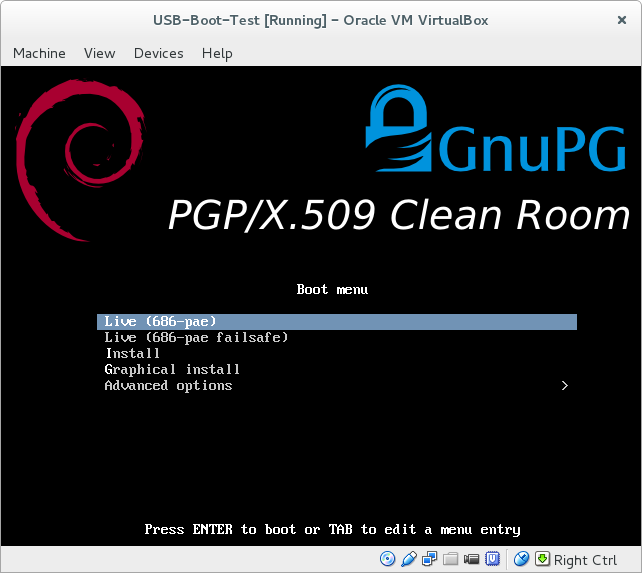
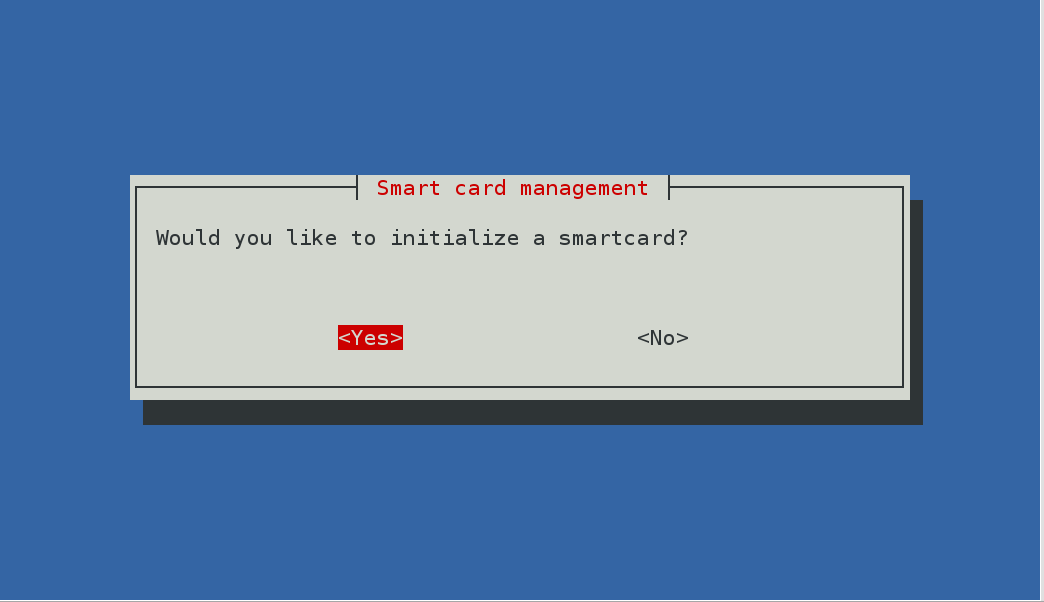
There is increasing interest in computer security these days and more and more people are using some form of PKI, whether it is signing Git tags, signing packages for a GNU/Linux distribution or just signing your emails. There are also more home networks and small offices who require their own in-house Certificate Authority (CA) to issue TLS certificates for VPN users (e.g. StrongSWAN) or IP telephony. Back in April, I started discussing the PGP Clean Room idea (debian-devel discussion and gnupg-users discussion), created a wiki page and started development of a script to build the clean room ISO using live-build on Debian. Keeping the master keys completely offline and putting subkeys onto smart cards and other devices dramatically lowers the risk of mistakes and security breaches. Using a read-only DVD to operate the clean-room makes it convenient and harder to tamper with. Trying it out in VirtualBox It is fairly easy to clone the Git repository, run the script to create the ISO and boot it in VirtualBox to see what is inside: At the moment, it contains a number of packages likely to be useful in a PKI clean room, including GnuPG, smartcard drivers, the lightweight pki utility from StrongSWAN and OpenSSL. I've been trying it out with an SPR-532, one of the GnuPG-supported smartcard readers with a pin-pad and the OpenPGP card. Ready to use today More confident users will be able to build the ISO and use it immediately by operating all the utilities from the command line. For example, you should be able to fully configure PGP smart cards by following this blog from Simon Josefsson. The ISO includes some useful scripts, for example, create-raid will quickly partition and RAID a set of SD cards to store your master key-pair offline. Getting involved To make PGP accessible to a wider user-base and more convenient for those who don't use GnuPG frequently enough to remember all the command line options, it would be interesting to create a GUI, possibly using python-newt to create a similar look-and-feel to popular text-based installer and system administration tools. If you are keen on this project and would like to discuss it further, please come and join the new pki-clean-room mailing list and feel free to ask questions or share your thoughts about it. One way to proceed may be to recruit an Outreachy or GSoC intern to develop the UI. Before they can get started, it would be necessary to more thoroughly document workflow requirements.

Reproducible builds folks: Reproducible Builds: week 76 in Stretch cycle

What happened in the Reproducible Builds effort between Sunday October 2 and Saturday October 8 2016: Media coverage Events Packages reviewed and fixed, and bugs filed Reviews of unreproducible packages 31 package reviews have been added, 27 have been updated and over 20 have been removed in this week, adding to our knowledge about identified issues. 3 issue types have been addded: 1 issue type has been updated: Weekly QA work During of reproducibility testing, some FTBFS bugs have been detected and reported by: tests.reproducible-builds.org Debian: Misc. This week's edition was written by Chris Lamb, Holger Levsen & Vagrant Cascadian and reviewed by a bunch of Reproducible Builds folks on IRC.

6 October 2016

Reproducible builds folks: Reproducible Builds: week 75 in Stretch cycle

What happened in the Reproducible Builds effort between Sunday September 25 and Saturday October 1 2016: Statistics For the first time, we reached 91% reproducible packages in our testing framework on testing/amd64 using a determistic build path. (This is what we recommend to make packages in Stretch reproducible.) For unstable/amd64, where we additionally test for reproducibility across different build paths we are at almost 76% again. IRC meetings We have a poll to set a time for a new regular IRC meeting. If you would like to attend, please input your available times and we will try to accommodate for you. There was a trial IRC meeting on Friday, 2016-09-31 1800 UTC. Unfortunately, we did not activate meetbot. Despite this participants consider the meeting a success as several topics where discussed (eg changes to IRC notifications of tests.r-b.o) and the meeting stayed within one our length. Upcoming events Reproduce and Verify Filesystems - Vincent Batts, Red Hat - Berlin (Germany), 5th October, 14:30 - 15:20 @ LinuxCon + ContainerCon Europe 2016. From Reproducible Debian builds to Reproducible OpenWrt, LEDE & coreboot - Holger "h01ger" Levsen and Alexander "lynxis" Couzens - Berlin (Germany), 13th October, 11:00 - 11:25 @ OpenWrt Summit 2016. Introduction to Reproducible Builds - Vagrant Cascadian will be presenting at the SeaGL.org Conference In Seattle (USA), November 11th-12th, 2016. Previous events GHC Determinism - Bartosz Nitka, Facebook - Nara (Japan), 24th September, ICPF 2016. Toolchain development and fixes Michael Meskes uploaded bsdmainutils/9.0.11 to unstable with a fix for #830259 based on Reiner Herrmann's patch. This fixed locale_dependent_symbol_order_by_lorder issue in the affected packages (freebsd-libs, mmh). devscripts/2.16.8 was uploaded to unstable. It includes a debrepro script by Antonio Terceiro which is similar in purpose to reprotest but more lightweight; specific to Debian packages and without support for virtual servers or configurable variations. Packages reviewed and fixed, and bugs filed The following updated packages have become reproducible in our testing framework after being fixed: The following updated packages appear to be reproducible now for reasons we were not able to figure out. (Relevant changelogs did not mention reproducible builds.) Some uploads have addressed some reproducibility issues, but not all of them: Patches submitted that have not made their way to the archive yet: Reviews of unreproducible packages 77 package reviews have been added, 178 have been updated and 80 have been removed in this week, adding to our knowledge about identified issues. 6 issue types have been updated: Weekly QA work As part of reproducibility testing, FTBFS bugs have been detected and reported by: diffoscope development A new version of diffoscope 61 was uploaded to unstable by Chris Lamb. It included contributions from: Post-release there were further contributions from: reprotest development A new version of reprotest 0.3.2 was uploaded to unstable by Ximin Luo. It included contributions from: Post-release there were further contributions from: tests.reproducible-builds.org Misc. This week's edition was written by Ximin Luo, Holger Levsen & Chris Lamb and reviewed by a bunch of Reproducible Builds folks on IRC.

4 October 2016

Daniel Silverstone: Gitano - Approaching Release - Work

I have been working quite hard, along with my friend and colleague Richard Maw, on getting Gitano ready for a release suitable for inclusion into Debian Stretch. You can see how we're doing on the various Trello boards for: As Richard and I work toward a version of Gitano we're prepared to support long-term in Debian we are making many changes to make our lives easier. For those of you who have been using Gitano over the past few years, you'll need to pay attention to some postings which will be coming soon about how to make the changes you need so as to not explode horribly when you upgrade to the version we're releasing soon. For those of you who are not yet using Gitano but feel like you might want to; I'll also be producing some postings about getting started with the packages. And for those happily running current HEAD of Gitano already, I'll be posting about some of the new features over the next little while in case you're not aware of them.
IMPORTANT: If you're using Gitano already and have any issues or feature requests then please please please let me know ASAP otherwise they're unlikely to be resolved/implemented before 1.0. irl already asked for the facility to verify GPG signed commits and tags, but if you want anything else considering then I need to know v. soon. (Ideally email me, but you may comment on this posting too if you must)

3 October 2016

Kees Cook: security things in Linux v4.7

Previously: v4.6. Onward to security things I found interesting in Linux v4.7: KASLR text base offset for MIPS Matt Redfearn added text base address KASLR to MIPS, similar to what s available on x86 and arm64. As done with x86, MIPS attempts to gather entropy from various build-time, run-time, and CPU locations in an effort to find reasonable sources during early-boot. MIPS doesn t yet have anything as strong as x86 s RDRAND (though most have an instruction counter like x86 s RDTSC), but it does have the benefit of being able to use Device Tree (i.e. the /chosen/kaslr-seed property) like arm64 does. By my understanding, even without Device Tree, MIPS KASLR entropy should be as strong as pre-RDRAND x86 entropy, which is more than sufficient for what is, similar to x86, not a huge KASLR range anyway: default 8 bits (a span of 16MB with 64KB alignment), though CONFIG_RANDOMIZE_BASE_MAX_OFFSET can be tuned to the device s memory, giving a maximum of 11 bits on 32-bit, and 15 bits on EVA or 64-bit. SLAB freelist ASLR Thomas Garnier added CONFIG_SLAB_FREELIST_RANDOM to make slab allocation layouts less deterministic with a per-boot randomized freelist order. This raises the bar for successful kernel slab attacks. Attackers will need to either find additional bugs to help leak slab layout information or will need to perform more complex grooming during an attack. Thomas wrote a post describing the feature in more detail here: Randomizing the Linux kernel heap freelists. (SLAB is done in v4.7, and SLUB in v4.8.) eBPF JIT constant blinding Daniel Borkmann implemented constant blinding in the eBPF JIT subsystem. With strong kernel memory protections (CONFIG_DEBUG_RODATA) in place, and with the segregation of user-space memory execution from kernel (i.e SMEP, PXN, CONFIG_CPU_SW_DOMAIN_PAN), having a place where user-space can inject content into an executable area of kernel memory becomes very high-value to an attacker. The eBPF JIT was exactly such a thing: the use of BPF constants could result in the JIT producing instruction flows that could include attacker-controlled instructions (e.g. by directing execution into the middle of an instruction with a constant that would be interpreted as a native instruction). The eBPF JIT already uses a number of other defensive tricks (e.g. random starting position), but this added randomized blinding to any BPF constants, which makes building a malicious execution path in the eBPF JIT memory much more difficult (and helps block attempts at JIT spraying to bypass other protections). Elena Reshetova updated a 2012 proof-of-concept attack to succeed against modern kernels to help provide a working example of what needed fixing in the JIT. This serves as a thorough regression test for the protection. The cBPF JITs that exist in ARM, MIPS, PowerPC, and Sparc still need to be updated to eBPF, but when they do, they ll gain all these protections immediatley. Bottom line is that if you enable the (disabled-by-default) bpf_jit_enable sysctl, be sure to set the bpf_jit_harden sysctl to 2 (to perform blinding even for root). fix brk ASLR weakness on arm64 compat There have been a few ASLR fixes recently (e.g. ET_DYN, x86 32-bit unlimited stack), and while reviewing some suggested fixes to arm64 brk ASLR code from Jon Medhurst, I noticed that arm64 s brk ASLR entropy was slightly too low (less than 1 bit) for 64-bit and noticeably lower (by 2 bits) for 32-bit compat processes when compared to native 32-bit arm. I simplified the code by using literals for the entropy. Maybe we can add a sysctl some day to control brk ASLR entropy like was done for mmap ASLR entropy. LoadPin LSM LSM stacking is well-defined since v4.2, so I finally upstreamed a small LSM that implements a protection I wrote for Chrome OS several years back. On systems with a static root of trust that extends to the filesystem level (e.g. Chrome OS s coreboot+depthcharge boot firmware chaining to dm-verity, or a system booting from read-only media), it s redundant to sign kernel modules (you ve already got the modules on read-only media: they can t change). The kernel just needs to know they re all coming from the correct location. (And this solves loading known-good firmware too, since there is no convention for signed firmware in the kernel yet.) LoadPin requires that all modules, firmware, etc come from the same mount (and assumes that the first loaded file defines which mount is correct , hence load pinning ). That s it for v4.7. Prepare yourself for v4.8 next!

2016, Kees Cook. This work is licensed under a Creative Commons Attribution-ShareAlike 3.0 License.
Creative Commons License

1 October 2016

Vincent Sanders: Paul Hollywood and the pistoris stone

There has been a great deal of comment among my friends recently about a particularly British cookery program called "The Great British Bake Off". There has been some controversy as the program is moving from the BBC to a commercial broadcaster.

Part of this discussion comes from all the presenters, excepting Paul Hollywood, declining to sign with the new broadcaster and partly because of speculation the BBC might continue with a similar format show with a new name.

Rob Kendrick provided the start to this conversation by passing on a satirical link suggesting Samuel L Jackson might host "cakes on a plane"

This caused a large number of suggestions for alternate names which I will be reporting but Rob Kendrick, Vivek Das Mohapatra, Colin Watson, Jonathan McDowell, Oki Kuma, Dan Alderman, Dagfinn Ilmari Manns ke, Lesley Mitchell and Daniel Silverstone are the ones to blame.


So that is our list, anyone else got better ideas?

Next.

Previous.