Search Results: "christoph"

25 April 2008

Joerg Jaspert: Some more merges and stuff

Following my first ftpmaster blog post, which got some nice replies, lets have the next, as I didn’t stop working on stuff. Not as much as I hoped, but well, something. So, what was done since then?
And as in my last blog post, lets add some items to the todo list: Having written all this - today (AKA Saturday, when writing this) won’t see code merges by me. I think most of my ftpmaster related work today will be fun with the NEW queue. For some unknown reason people keep uploading packages. Tsss. Comments: 3

21 April 2008

Christoph Haas: Our GSoC project has been accepted - yahoo! :)

This is pretty exciting. I have never bothered about Google’s Summer of Code and have literally been forced (curse you, Kumar) to propose my project I’m working on. And in the end I have a promising student and Google accepted our proposal. Watching #gsoc while everybody was waiting whether they got accepted caused more traffic than [...]

18 April 2008

Gregor Herrmann: surprise

when I woke up today (after sleeping in for the first time with my new roll-top in front of my bedroom window) I was surprised & confused by a couple of "congratulations!" messages in my irc away-log. it took me a bit of time & coffee (& looking into my mailbox) to begin to realize that my Debian account had indeed been created while I was asleep. — in fact I guess I still haven't completely realized my new status as Debian Developer.

as others I'd like to follow the good tradition of taking the opportunity to thank some of the people who helped me to get there: some final thoughts about the NM process from my point of view: & now it's time first to celebrate & then to try to fully grasp my new rights & responsibilities.

4 April 2008

Christoph Berg: Time between releases

19:19 <BTS> Closed #31581 in project by Christoph Berg (myon) Time between releases is too long . http://bugs.debian.org/31581 Sounds like now I can claim I've fixed Debian all by myself.
23 March 2008

Christoph Berg: debcheckout saves the day

I have a small set of config files and cfengine scripts that I want to deploy on every machine I own. Of course, the Debian way is to put them into a package, and install that. So far so good. Problems arise when trying to maintain this package on several different $HOME directories - depending on where I am when I want a change. Using $vcs (svn in this case) works, but I'd also like source packages. Only that I occasionally forget where I put the repository. Or uploading new source packages is too tedious. The later problem was solved by a cute combination of dput and reprepro. My .dput.cf has targets that rsync the package over to my server, and automatically install the packages into the repository there. For the repository problem, Stefano Zacchiroli's debcheckout comes to the rescue. Vcs-Svn: in debian/control points to my svn+ssh:// repository. Instant "DWIM" checkouts! (To actually make this work, the latest cfengine tweaks add deb-src lines for my local repository that were previously missing.)

21 March 2008

Christoph Berg: Tenace

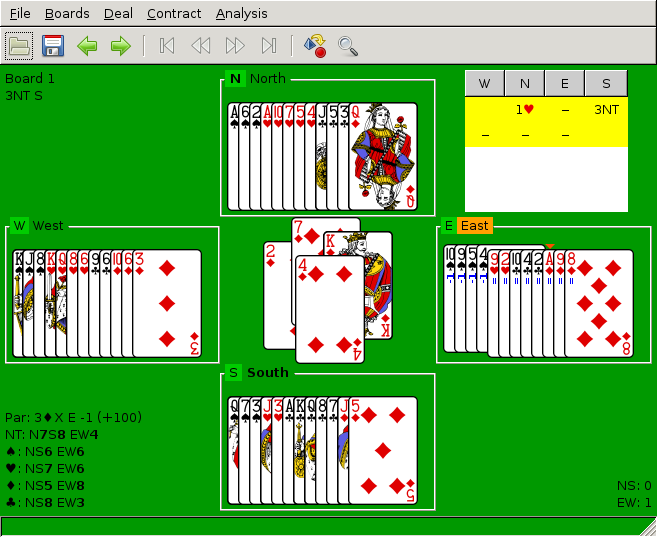
In contrast to chess, there is very little free software for bridge players. Some deal generators have been around for years, but basically, that was all. Nowadays major online bridge site is bridgebase.com. Their windows client actually runs quite well in cedega (and wine), with the notable exception that the built-in double dummy solver doesn't work there. (A double dummy solver is a program that computes the optimal line of play with all four hands open (both sides dummy), and hence can compute the theoretically optimal score for a given board.) Furthermore, viewing records of played boards is a bit tedious as launching the viewer of course requires wine as well. Editing boards is not possible. This is where I started writing some perl scripts that would at least dump the board records as text files. At the same time I thought about doing something interesting with Gnome's glade UI builder. Over the past two years, I have been working on a GTK+ version of a bridge hand viewer and editor I called tenace. When Bo Haglund released his double dummy solver library as GPL software, I packaged it for Debian and worked on integration into tenace. It will compute "best" cards to play, determine par scores. Now tenace should be stable enough so I can risk announcing it to the world. Coincidentally, the screenshot shows a board from last week's club championships. East can beat 3NT by returning a Spade, but at my table they didn't and so the board became my first squeeze hand :)

14 March 2008

Christoph Berg: Cruftiness

Definition: A system's cruftiness is the number of "apt-get remove deborphan " invocations needed to clean up.

2 March 2008

Christoph Berg: New toy

Soon after Bernd Zeimetz joined our company, he infected me with the geocaching virus. In the meantime, I bought a GPS receiver, and am now endeavoring around the town and the nearby woods, searching for caches. There's not that much free GPS and/or geocaching software around. gpsd works quite well, but I don't take my computer to the woods ;) Viking is very nice for visualizing waypoints and sorting them in categories, but is still somewhere between alpha and beta state. gpsbabel reads and writes a zillion different file format and talks to a vast array of receivers, but often needs several attempts to upload data to mine. Things are moving fast though and the GPS community looks active. Last week I started looking into OpenStreetMap and already added a few roads in my neighborhood. Compared to commercial maps, there's still much to do, especially for smaller tracks and features like foot bridges or woods outside bigger cities. I'll keep collecting GPS data :) For the free software side, neither OSM's online editor worked here (flash), nor the recommended tool for local use (java), so I tried merkaartor (qt4) which works nicely. It also has some bugs, but feels very usable (though sometimes slow). Starting from upstream's debian/ dir, building packages was straightforward, and after some more editing, packages are now in unstable. (The svn repository is in collab-maint, contributors welcome.)

22 February 2008

Christoph Berg: Time machine

Wanted: a device that will rewind time, turn off greylisting in my mail server, wait for the other side send the mail, and then resume business as before.

18 February 2008

Christoph Haas: pgadmin3 - now it s getting personal

I really don’t mind if Debian lags behind with package versions. And I’ve gotten used to running an ancient version of “pgadmin3″ (the GUI client for PostgreSQL). But now that I upgraded a few pgsql servers from 8.2 to 8.3 and started pgadmin3 I was surprised - in a not at all fun way. Several [...]

5 February 2008

Christoph Berg: Mouseover titles

Best(*) Firefox extension ever: Long Titles (Spotted on http://xkcd.org/about/) (*) PS: Of course Open in browser and Generic URL creator are also way cool.

4 February 2008

Daniel Baumann: My misc developement news (Januar 2008)

In the past I was not blogging small things if they were not worth a full blog entry on their own (or if I did not have the time to make up a full entry of it :). Inspired by the example of Raphaël Hertzog <hertzog@debian.org> with "News for Debian developers" for <debian-devel-announce@lists.debian.org>, I am intending to do the same on a monthly basis about my own Debian related work. This first entry about January 2008 also covers a few things from the last month of 2007. General News Package News Team News

30 January 2008

Russell Coker: Talking Fast

My previous post about my LCA mini-conf talk received an interesting comment from Christopher Neugebauer. He said that he had some trouble understanding me because I speak quickly, he wasn’t the first person to make that complaint (it’s the most common complaint I receive). If a talk goes well then I have a lot to say and little time to say it and end up speaking quickly if I don’t concentrate enough on speaking slowly. If a talk doesn’t go well then I get nervous and speak quickly. When a speaker talks too quickly it is appropriate to call out a request for them to speak more slowly. I know I’m not the only person who has difficulty in speaking slowly enough and I expect that others also wouldn’t mind such requests from the audience. Chris suggested giving a talk with a small number of words used on the projector, it’s an interesting idea and may be worth a try. However I have recently watched Lawrence Lessig’s talk published on TED.com [1] which used that technique, I was disappointed in the result. His talk appeared to be very well received by the audience, I’m not sure whether that is because the audience was less familiar with his ideas than I am or whether it’s a technique that works better for an audience than for a video. I would appreciate further suggestions in this regard. Update: It’s interesting to note that Bruce Schneier’s keynote for LCA had no presentation material, he spoke from written notes.

14 January 2008

MJ Ray: BeCTA advice, DfES e-Consultation

You may have seen the British Educational Communications and Technology Agency (Becta) advising:-
"Schools and colleges should make pupils, teachers and parents aware of the range of free-to-use products (such as office productivity suites) that are available, and how to use them,"
in reports like http://www.informationweek.com/windows/showArticle.jhtml?articleID=205602879&cid=RSSfeed_TechWeb There's also a consultation on "Home Access to Technology" running until Wednesday 2 April at http://www.dcsf.gov.uk/consultations/conDetails.cfm?consultationId=1522 where you may like to suggest that free software is a good route forwards. (Thanks to Christopher Dawkins for informing ALUG.) Are there other related things we could be doing? (Comments form goes to fsfe-uk.)

6 January 2008

Christoph Berg: mutt-patched

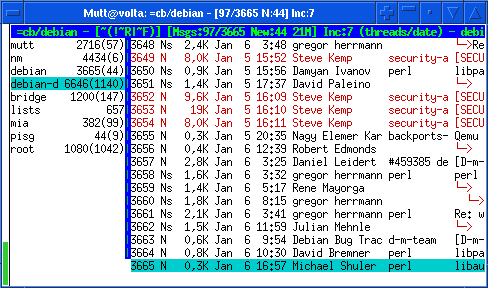
There have been several long-term wishlist bugs on Mutt to include the (in?)famous "sidebar" patch. It adds a panel on the left side of the screen to list mailboxes with message counts. We do ship several patches with Debian's Mutt package that are not considered for inclusion by the upstream authors, but this one is different. It touches the core of the UI renderer and adds extensive counting of messages. There's been quite a hype about the patch, it was even included in the (now discontinued [1]) mutt-ng fork. Unfortunately, the patch was technically questionable, it was written for the Mutt tarballs and didn't easily apply to CVS, and most versions floating around contained lots of cruft like backup files and temporary editor files. Furthermore, it is far from bug-free and even segfaults occasionally. Some months ago we decided we would build a second binary package to put the patch in so we don't destabilize the standard package. Thanks Dann Frazier, we got a clean patch, Adeodato had the right idea on how to build two binaries from the same, differently-patched source (make install would run havoc, the trick was to build the patched version before the regular one), and I resolved some more involved conflicts with the maildir-mtime patch. So, finally, there it is: mutt-patched. Disclaimer: As said, there are bugs. YMMV. On related news, there's now also a -dbg package now for the victims of the IMAP and header cache segfaults that we still see sometimes. Update: The sidebar patch was not the reason for the creation of mutt-ng, but many mutt-ng users were using it because of this patch. Update 2008-01-08: [1] mutt-ng used to be a Mutt fork. It is now maintained as a patch collection for Mutt.

30 December 2007

Christoph Haas: Debian Basement

My wife is a pretty good paintress and for Xmas painted a Debian logo at the wall of my basement terminal room. Now that’s comfy.

24 December 2007

Adam Rosi-Kessel: Jason s Lesson s Learned About the Legal Academy and Getting In

Pelican has decided to abandon his efforts to scale the walls of the legal academy and proposes this simple eight-step program for others who would follow in his footsteps:
  1. Don t do interdisciplinary work. The legal academy doesn t know what to make of it unless it is economics.
  2. Don t go to a school without a law review or grades. I did and it was a huge problem.
  3. Get on law review, clerk, write.
  4. Check the faculty listings at most law schools. Go to the most often listed schools: Harvard, Yale, etc. It does matter as law faculty select their own, usually. I was told by a faculty member as a 1L expressing interest in the academy that I should transfer immediately to Harvard if possible. I didn t.
  5. If you think you want to be a legal academic, look at what is on the FAR form in your first or second year. Orient your academic career to produce a good looking FAR.
  6. Remarkably, the legal academy does not care about your ability to raise research money or bring in grants.
  7. Don t publish in interdisciplinary journals. Publish only in law reviews writing only dense and impenetrable texts.
  8. Demonstrated impact of your work in policy or law is not relevant.
This critique could be extended broadly to much of the academy (not just law schools). I had once thought I might like to teach law, but now I can only really see myself as a clinician. Two contradictory academic trends: Technorati Tags: , , , , , , , ,

23 December 2007

Christoph Berg: Datamining

I'm just digging through OFTC's nickserv database to do some cleaning. We have a bit over 20k nicknames in the database on 18k accounts which means about 10% of registered nicks are linked to other master nicks. By the power of sql, here's some statistics on the domain names of the email addresses our users:
com  9144
net  2241
org  1778
de   1016
uk    392
nl    288
fr    223
edu   217
au    203
it    193
br    190
ru    174
ca    165
se     88
dk     74
at     70
fi     62
cx     59
info   58
gmail.com             3997
hotmail.com           1405
yahoo.com              843
gmx.de                 221
gmx.net                201
web.de                 156
debian.org             148
free.fr                 94
aol.com                 90
msn.com                 73
comcast.net             72
gentoo.org              71
mail.ru                 65
xs4all.nl               59
linuxmail.org           58
verizon.net             57
yahoo.co.uk             54
yahoo.com.br            45
googlemail.com          45
student.uq.edu.au       44
sbcglobal.net           36
earthlink.net           33
users.sourceforge.net   32
The numbers could use some aggregation as some providers use zillions of TLDs (yahoo, gmx). My personal favorite in there is root@localhorst :-)

22 December 2007

Christoph Haas: Handy Firefox/Icewasel keyword searches for (packages bugs *).debian.org

Just wanted to drop a tip on you about the Firefox keyword search feature. I use it to quickly access packages.debian.org on package information or to retrieve the BTS page for a bug number. With it you can use “bts 123456″ instead of “http://bugs.debian.org/123456″. May not appear much shorter but I like it anyway. Here [...]

17 December 2007

Christoph Haas: Tracking down Postfix breakage due to a libnss-ldap.conf upgrade

Now this has really been a waste of time. Months ago I convinced myself that NIS isn’t really a modern way to keep my user accounts network-wide - be it even only my home network. So I tried libnss-ldap and read wiki.debian.org on LDAP and literally found dozens of documents that describe how to do [...]

Next.

Previous.