Search Results: "bod"

19 February 2024

Valhalla's Things: Jeans, step one

Posted on February 19, 2024
Tags: madeof:atoms, craft:sewing, FreeSoftWear
CW for body size change mentions A woman wearing a pair of tight jeans. Just like the corset, I also needed a new pair of jeans. Back when my body size changed drastically of course my jeans no longer fit. While I was waiting for my size to stabilize I kept wearing them with a somewhat tight belt, but it was ugly and somewhat uncomfortable. When I had stopped changing a lot I tried to buy new ones in the same model, and found out that I was too thin for the menswear jeans of that shop. I could have gone back to wearing women s jeans, but I didn t want to have to deal with the crappy fabric and short pockets, so I basically spent a few years wearing mostly skirts, and oversized jeans when I really needed trousers. Meanwhile, I had drafted a jeans pattern for my SO, which we had planned to make in technical fabric, but ended up being made in a cotton-wool mystery mix for winter and in linen-cotton for summer, and the technical fabric version was no longer needed (yay for natural fibres!) It was clear what the solution to my jeans problems would have been, I just had to stop getting distracted by other projects and draft a new pattern using a womanswear block instead of a menswear one. Which, in January 2024 I finally did, and I believe it took a bit less time than the previous one, even if it had all of the same fiddly pieces. I already had a cut of the same cotton-linen I had used for my SO, except in black, and used it to make the pair this post is about. The parametric pattern is of course online, as #FreeSoftWear, at the usual place. This time it was faster, since I didn t have to write step-by-step instructions, as they are exactly the same as the other pattern. Same as above, from the back, with the crotch seam pulling a bit. A faint decoration can be seen on the pockets, with the line art version of the logo seen on this blog. Making also went smoothly, and the result was fitting. Very fitting. A big too fitting, and the standard bum adjustment of the back was just enough for what apparently still qualifies as a big bum, so I adjusted the pattern to be able to add a custom amount of ease in a few places. But at least I had a pair of jeans-shaped trousers that fit! Except, at 200 g/m I can t say that fabric is the proper weight for a pair of trousers, and I may have looked around online1 for some denim, and, well, it s 2024, so my no-fabric-buy 2023 has not been broken, right? Let us just say that there may be other jeans-related posts in the near future.

  1. I had already asked years ago for denim at my local fabric shops, but they don t have the proper, sturdy, type I was looking for.

16 February 2024

David Bremner: Generating ikiwiki markdown from org

My web pages are (still) in ikiwiki, but lately I have started authoring things like assignments and lectures in org-mode so that I can have some literate programming facilities. There is is org-mode export built-in, but it just exports source blocks as examples (i.e. unhighlighted verbatim). I added a custom exporter to mark up source blocks in a way ikiwiki can understand. Luckily this is not too hard the second time.
(with-eval-after-load "ox-md"
  (org-export-define-derived-backend 'ik 'md
    :translate-alist '((src-block . ik-src-block))
    :menu-entry '(?m 1 ((?i "ikiwiki" ik-export-to-ikiwiki)))))
(defun ik-normalize-language  (str)
  (cond
   ((string-equal str "plait") "racket")
   ((string-equal str "smol") "racket")
   (t str)))
(defun ik-src-block (src-block contents info)
  "Transcode a SRC-BLOCK element from Org to beamer
         CONTENTS is nil.  INFO is a plist used as a communication
         channel."
  (let* ((body  (org-element-property :value src-block))
         (lang  (ik-normalize-language (org-element-property :language src-block))))
    (format "[[!format <span class="error">Error: unsupported page format &#37;s</span>]]" lang body)))
(defun ik-export-to-ikiwiki
    (&optional async subtreep visible-only body-only ext-plist)
  "Export current buffer as an ikiwiki markdown file.
    See org-md-export-to-markdown for full docs"
  (require 'ox)
  (interactive)
  (let ((file (org-export-output-file-name ".mdwn" subtreep)))
    (org-export-to-file 'ik file
      async subtreep visible-only body-only ext-plist)))

9 February 2024

Abhijith PA: A new(kind of) phone

I was using a refurbished Xiaomi Redmi 6 Pro (codename: sakura . I do remember buying this phone to run LineageOS as I found this model had support. But by the time I bought it (there was a quite a gap between my research and the actual purchase) lineageOS ended the suport for this device. The maintainer might ve ended this port, I don t blame them. Its a non rewarding work. Later I found there is a DotOS custom rom available. I did a week of test run. There seems lot of bugs and it all was minor and I can live with that. Since there is no other official port for redmi 6 pro at the time, I settled on this buggy DotOS nightly build. The phone was doing fine all these(3+) years, but recently the camera started showing greyish dots on some areas to a point that I can t even properly take a photo. The outer body of the phone wasn t original, as it was a refurbished, thus the colors started to peel off and wasn t aesthetically pleasing. Then there is the Location detection issue which took a while to figure out location and battery drains fast. I recently started mapping public transportation routes, and the GPS issue was a problem for me. With all these problems combined, I decided to buy a new phone. But choosing a phone wasn t easy. There are far too many options in the market. However, one thing I was quite sure of was that I wouldn t be buying a brand new phone, but a refurbished one. It is my protest against all these phone manufacturers who have convinced the general public that a mobile phone s lifespan is only 2 years. Of course, there are a few exceptions, but the majority of players in the Indian market are not. Now I think about it, I haven t bought any brand new computing device, be it phones or laptops since 2015. All are refurbished devices except for an Orange pi. My Samsung R439 laptop which I already blogged about is still going strong. Back to picking phone. So I began by comparing LineageOS website to an online refurbished store to pick a phone that has an official lineage support then to reddit search for any reported hardware failures Google Pixel phones are well-known in the custom ROM community for ease of installation, good hardware and Android security releases. My above claims are from privacyguides.org and XDA-developers. I was convinced to go with this choice. But I have some one at home who is at the age of throwing things. So I didn t want to risk buying an expensive Pixel phone only to have it end up with a broken screen and edges. Perhaps I will consider buying a Pixel next time. After doing some more research and cross comparison I landed up on Redmi note 9. Codename: merlinx. Based on my previous experience I knew it is going to be a pain to unlock the bootloader of Xiaomi phones and I was prepared for that but this time there was an extra hoop. The phone came with ROM MIUI version 13. A small search on XDA forums and reddit told unless we downgrade to 12 or so it is difficult to unlock bootloader for this device. And performing this wasn t exactly easy as we need tools like SP Flash etc. It took some time, but I ve completed the downgrade process. From there, the rest was cakewalk as everything was perfectly documented in LineageOS wiki. And ta-da, I have a phone running lineageOS. I been using it for some time and honestly I haven t come across any bug in my way of usage. One advice I will give to you if you are going to flash a custom ROM. There are plenty of videos about unlocking bootloader, installing ROMs in Youtube. Please REFRAIN from watching and experimenting it on your phone unless you figured a way to un brick your device first.

1 February 2024

Russ Allbery: Review: System Collapse

Review: System Collapse, by Martha Wells
Series: Murderbot Diaries #7
Publisher: Tordotcom
Copyright: 2023
ISBN: 1-250-82698-5
Format: Kindle
Pages: 245
System Collapse is the second Murderbot novel. Including the novellas, it's the 7th in the series. Unlike Fugitive Telemetry, the previous novella that was out of chronological order, this is the direct sequel to Network Effect. A very direct sequel; it picks up just a few days after the previous novel ended. Needless to say, you should not start here. I was warned by other people and therefore re-read Network Effect immediately before reading System Collapse. That was an excellent idea, since this novel opens with a large cast, no dramatis personae, not much in the way of a plot summary, and a lot of emotional continuity from the previous novel. I would grumble about this more, like I have in other reviews, but I thoroughly enjoyed re-reading Network Effect and appreciated the excuse.
ART-drone said, I wouldn t recommend it. I lack a sense of proportional response. I don t advise engaging with me on any level.
Saying much about the plot of this book without spoiling Network Effect and the rest of the series is challenging. Murderbot is suffering from the aftereffects of the events of the previous book more than it expected or would like to admit. It and its humans are in the middle of a complicated multi-way negotiation with some locals, who the corporates are trying to exploit. One of the difficulties in that negotiation is getting people to believe that the corporations are as evil as they actually are, a plot element that has a depressing amount in common with current politics. Meanwhile, Murderbot is trying to keep everyone alive. I loved Network Effect, but that was primarily for the social dynamics. The planet that was central to the novel was less interesting, so another (short) novel about the same planet was a bit of a disappointment. This does give Wells a chance to show in more detail what Murderbot's new allies have been up to, but there is a lot of speculative exploration and detailed descriptions of underground tunnels that I found less compelling than the relationship dynamics of the previous book. (Murderbot, on the other hand, would much prefer exploring creepy abandoned tunnels to talking about its feelings.) One of the things this series continues to do incredibly well, though, is take non-human intelligence seriously in a world where the humans mostly don't. It perfectly fills a gap between Star Wars, where neither the humans nor the story take non-human intelligences seriously (hence the creepy slavery vibes as soon as you start paying attention to droids), and the Culture, where both humans and the story do. The corporates (the bad guys in this series) treat non-human intelligences the way Star Wars treats droids. The good guys treat Murderbot mostly like a strange human, which is better but still wrong, and still don't notice the numerous other machine intelligences. But Wells, as the author, takes all of the non-human characters seriously, which means there are complex and fascinating relationships happening at a level of the story that the human characters are mostly unaware of. I love that Murderbot rarely bothers to explain; if the humans are too blinkered to notice, that's their problem. About halfway into the story, System Collapse hits its stride, not coincidentally at the point where Murderbot befriends some new computers. The rest of the book is great. This was not as good as Network Effect. There is a bit less competence porn at the start, and although that's for good in-story reasons I still missed it. Murderbot's redaction of things it doesn't want to talk about got a bit annoying before it finally resolved. And I was not sufficiently interested in this planet to want to spend two novels on it, at least without another major revelation that didn't come. But it's still a Murderbot novel, which means it has the best first-person narrative voice I've ever read, some great moments, and possibly the most compelling and varied presentation of computer intelligence in science fiction at the moment.
There was no feed ID, but AdaCol2 supplied the name Lucia and when I asked it for more info, the gender signifier bb (which didn t translate) and he/him pronouns. (I asked because the humans would bug me for the information; I was as indifferent to human gender as it was possible to be without being unconscious.)
This is not a series to read out of order, but if you have read this far, you will continue to be entertained. You don't need me to tell you this nearly everyone reviewing science fiction is saying it but this series is great and you should read it. Rating: 8 out of 10

30 January 2024

Matthew Palmer: Why Certificate Lifecycle Automation Matters

If you ve perused the ActivityPub feed of certificates whose keys are known to be compromised, and clicked on the Show More button to see the name of the certificate issuer, you may have noticed that some issuers seem to come up again and again. This might make sense after all, if a CA is issuing a large volume of certificates, they ll be seen more often in a list of compromised certificates. In an attempt to see if there is anything that we can learn from this data, though, I did a bit of digging, and came up with some illuminating results.

The Procedure I started off by finding all the unexpired certificates logged in Certificate Transparency (CT) logs that have a key that is in the pwnedkeys database as having been publicly disclosed. From this list of certificates, I removed duplicates by matching up issuer/serial number tuples, and then reduced the set by counting the number of unique certificates by their issuer. This gave me a list of the issuers of these certificates, which looks a bit like this:
/C=BE/O=GlobalSign nv-sa/CN=AlphaSSL CA - SHA256 - G4
/C=GB/ST=Greater Manchester/L=Salford/O=Sectigo Limited/CN=Sectigo RSA Domain Validation Secure Server CA
/C=GB/ST=Greater Manchester/L=Salford/O=Sectigo Limited/CN=Sectigo RSA Organization Validation Secure Server CA
/C=US/ST=Arizona/L=Scottsdale/O=GoDaddy.com, Inc./OU=http://certs.godaddy.com/repository//CN=Go Daddy Secure Certificate Authority - G2
/C=US/ST=Arizona/L=Scottsdale/O=Starfield Technologies, Inc./OU=http://certs.starfieldtech.com/repository//CN=Starfield Secure Certificate Authority - G2
/C=AT/O=ZeroSSL/CN=ZeroSSL RSA Domain Secure Site CA
/C=BE/O=GlobalSign nv-sa/CN=GlobalSign GCC R3 DV TLS CA 2020
Rather than try to work with raw issuers (because, as Andrew Ayer says, The SSL Certificate Issuer Field is a Lie), I mapped these issuers to the organisations that manage them, and summed the counts for those grouped issuers together.

The Data
Lieutenant Commander Data from Star Trek: The Next Generation Insert obligatory "not THAT data" comment here
The end result of this work is the following table, sorted by the count of certificates which have been compromised by exposing their private key:
IssuerCompromised Count
Sectigo170
ISRG (Let's Encrypt)161
GoDaddy141
DigiCert81
GlobalSign46
Entrust3
SSL.com1
If you re familiar with the CA ecosystem, you ll probably recognise that the organisations with large numbers of compromised certificates are also those who issue a lot of certificates. So far, nothing particularly surprising, then. Let s look more closely at the relationships, though, to see if we can get more useful insights.

Volume Control Using the issuance volume report from crt.sh, we can compare issuance volumes to compromise counts, to come up with a compromise rate . I m using the Unexpired Precertificates colume from the issuance volume report, as I feel that s the number that best matches the certificate population I m examining to find compromised certificates. To maintain parity with the previous table, this one is still sorted by the count of certificates that have been compromised.
IssuerIssuance VolumeCompromised CountCompromise Rate
Sectigo88,323,0681701 in 519,547
ISRG (Let's Encrypt)315,476,4021611 in 1,959,480
GoDaddy56,121,4291411 in 398,024
DigiCert144,713,475811 in 1,786,586
GlobalSign1,438,485461 in 31,271
Entrust23,16631 in 7,722
SSL.com171,81611 in 171,816
If we now sort this table by compromise rate, we can see which organisations have the most (and least) leakiness going on from their customers:
IssuerIssuance VolumeCompromised CountCompromise Rate
Entrust23,16631 in 7,722
GlobalSign1,438,485461 in 31,271
SSL.com171,81611 in 171,816
GoDaddy56,121,4291411 in 398,024
Sectigo88,323,0681701 in 519,547
DigiCert144,713,475811 in 1,786,586
ISRG (Let's Encrypt)315,476,4021611 in 1,959,480
By grouping by order-of-magnitude in the compromise rate, we can identify three bands :
  • The Super Leakers: Customers of Entrust and GlobalSign seem to love to lose control of their private keys. For Entrust, at least, though, the small volumes involved make the numbers somewhat untrustworthy. The three compromised certificates could very well belong to just one customer, for instance. I m not aware of anything that GlobalSign does that would make them such an outlier, either, so I m inclined to think they just got unlucky with one or two customers, but as CAs don t include customer IDs in the certificates they issue, it s not possible to say whether that s the actual cause or not.
  • The Regular Leakers: Customers of SSL.com, GoDaddy, and Sectigo all have compromise rates in the 1-in-hundreds-of-thousands range. Again, the low volumes of SSL.com make the numbers somewhat unreliable, but the other two organisations in this group have large enough numbers that we can rely on that data fairly well, I think.
  • The Low Leakers: Customers of DigiCert and Let s Encrypt are at least three times less likely than customers of the regular leakers to lose control of their private keys. Good for them!
Now we have some useful insights we can think about.

Why Is It So?
Professor Julius Sumner Miller If you don't know who Professor Julius Sumner Miller is, I highly recommend finding out
All of the organisations on the list, with the exception of Let s Encrypt, are what one might term traditional CAs. To a first approximation, it s reasonable to assume that the vast majority of the customers of these traditional CAs probably manage their certificates the same way they have for the past two decades or more. That is, they generate a key and CSR, upload the CSR to the CA to get a certificate, then copy the cert and key somewhere. Since humans are handling the keys, there s a higher risk of the humans using either risky practices, or making a mistake, and exposing the private key to the world. Let s Encrypt, on the other hand, issues all of its certificates using the ACME (Automatic Certificate Management Environment) protocol, and all of the Let s Encrypt documentation encourages the use of software tools to generate keys, issue certificates, and install them for use. Given that Let s Encrypt has 161 compromised certificates currently in the wild, it s clear that the automation in use is far from perfect, but the significantly lower compromise rate suggests to me that lifecycle automation at least reduces the rate of key compromise, even though it doesn t eliminate it completely.

Explaining the Outlier The difference in presumed issuance practices would seem to explain the significant difference in compromise rates between Let s Encrypt and the other organisations, if it weren t for one outlier. This is a largely traditional CA, with the manual-handling issues that implies, but with a compromise rate close to that of Let s Encrypt. We are, of course, talking about DigiCert. The thing about DigiCert, that doesn t show up in the raw numbers from crt.sh, is that DigiCert manages the issuance of certificates for several of the biggest hosted TLS providers, such as CloudFlare and AWS. When these services obtain a certificate from DigiCert on their customer s behalf, the private key is kept locked away, and no human can (we hope) get access to the private key. This is supported by the fact that no certificates identifiably issued to either CloudFlare or AWS appear in the set of certificates with compromised keys. When we ask for all certificates issued by DigiCert , we get both the certificates issued to these big providers, which are very good at keeping their keys under control, as well as the certificates issued to everyone else, whose key handling practices may not be quite so stringent. It s possible, though not trivial, to account for certificates issued to these hosted TLS providers, because the certificates they use are issued from intermediates branded to those companies. With the crt.sh psql interface we can run this query to get the total number of unexpired precertificates issued to these managed services:
SELECT SUM(sub.NUM_ISSUED[2] - sub.NUM_EXPIRED[2])
  FROM (
    SELECT ca.name, max(coalesce(coalesce(nullif(trim(cc.SUBORDINATE_CA_OWNER), ''), nullif(trim(cc.CA_OWNER), '')), cc.INCLUDED_CERTIFICATE_OWNER)) as OWNER,
           ca.NUM_ISSUED, ca.NUM_EXPIRED
      FROM ccadb_certificate cc, ca_certificate cac, ca
     WHERE cc.CERTIFICATE_ID = cac.CERTIFICATE_ID
       AND cac.CA_ID = ca.ID
  GROUP BY ca.ID
  ) sub
 WHERE sub.name ILIKE '%Amazon%' OR sub.name ILIKE '%CloudFlare%' AND sub.owner = 'DigiCert';
The number I get from running that query is 104,316,112, which should be subtracted from DigiCert s total issuance figures to get a more accurate view of what DigiCert s regular customers do with their private keys. When I do this, the compromise rates table, sorted by the compromise rate, looks like this:
IssuerIssuance VolumeCompromised CountCompromise Rate
Entrust23,16631 in 7,722
GlobalSign1,438,485461 in 31,271
SSL.com171,81611 in 171,816
GoDaddy56,121,4291411 in 398,024
"Regular" DigiCert40,397,363811 in 498,732
Sectigo88,323,0681701 in 519,547
All DigiCert144,713,475811 in 1,786,586
ISRG (Let's Encrypt)315,476,4021611 in 1,959,480
In short, it appears that DigiCert s regular customers are just as likely as GoDaddy or Sectigo customers to expose their private keys.

What Does It All Mean? The takeaway from all this is fairly straightforward, and not overly surprising, I believe.

The less humans have to do with certificate issuance, the less likely they are to compromise that certificate by exposing the private key. While it may not be surprising, it is nice to have some empirical evidence to back up the common wisdom. Fully-managed TLS providers, such as CloudFlare, AWS Certificate Manager, and whatever Azure s thing is called, is the platonic ideal of this principle: never give humans any opportunity to expose a private key. I m not saying you should use one of these providers, but the security approach they have adopted appears to be the optimal one, and should be emulated universally. The ACME protocol is the next best, in that there are a variety of standardised tools widely available that allow humans to take themselves out of the loop, but it s still possible for humans to handle (and mistakenly expose) key material if they try hard enough. Legacy issuance methods, which either cannot be automated, or require custom, per-provider automation to be developed, appear to be at least four times less helpful to the goal of avoiding compromise of the private key associated with a certificate.

Humans Are, Of Course, The Problem
Bender, the robot from Futurama, asking if we'd like to kill all humans No thanks, Bender, I'm busy tonight
This observation that if you don t let humans near keys, they don t get leaked is further supported by considering the biggest issuers by volume who have not issued any certificates whose keys have been compromised: Google Trust Services (fourth largest issuer overall, with 57,084,529 unexpired precertificates), and Microsoft Corporation (sixth largest issuer overall, with 22,852,468 unexpired precertificates). It appears that somewhere between most and basically all of the certificates these organisations issue are to customers of their public clouds, and my understanding is that the keys for these certificates are managed in same manner as CloudFlare and AWS the keys are locked away where humans can t get to them. It should, of course, go without saying that if a human can never have access to a private key, it makes it rather difficult for a human to expose it. More broadly, if you are building something that handles sensitive or secret data, the more you can do to keep humans out of the loop, the better everything will be.

Your Support is Appreciated If you d like to see more analysis of how key compromise happens, and the lessons we can learn from examining billions of certificates, please show your support by buying me a refreshing beverage. Trawling CT logs is thirsty work.

Appendix: Methodology Limitations In the interests of clarity, I feel it s important to describe ways in which my research might be flawed. Here are the things I know of that may have impacted the accuracy, that I couldn t feasibly account for.
  • Time Periods: Because time never stops, there is likely to be some slight mismatches in the numbers obtained from the various data sources, because they weren t collected at exactly the same moment.
  • Issuer-to-Organisation Mapping: It s possible that the way I mapped issuers to organisations doesn t match exactly with how crt.sh does it, meaning that counts might be skewed. I tried to minimise that by using the same data sources (the CCADB AllCertificates report) that I believe that crt.sh uses for its mapping, but I cannot be certain of a perfect match.
  • Unwarranted Grouping: I ve drawn some conclusions about the practices of the various organisations based on their general approach to certificate issuance. If a particular subordinate CA that I ve grouped into the parent organisation is managed in some unusual way, that might cause my conclusions to be erroneous. I was able to fairly easily separate out CloudFlare, AWS, and Azure, but there are almost certainly others that I didn t spot, because hoo boy there are a lot of intermediate CAs out there.

29 January 2024

Russ Allbery: Review: Bluebird

Review: Bluebird, by Ciel Pierlot
Publisher: Angry Robot
Copyright: 2022
ISBN: 0-85766-967-2
Format: Kindle
Pages: 458
Bluebird is a stand-alone far-future science fiction adventure. Ten thousand years ago, a star fell into the galaxy carrying three factions of humanity. The Ascetics, the Ossuary, and the Pyrites each believe that only their god survived and the other two factions are heretics. Between them, they have conquered the rest of the galaxy and its non-human species. The only thing the factions hate worse than each other are those who attempt to stay outside the faction system. Rig used to be a Pyrite weapon designer before she set fire to her office and escaped with her greatest invention. Now she's a Nightbird, a member of an outlaw band that tries to help refugees and protect her fellow Kashrini against Pyrite genocide. On her side, she has her girlfriend, an Ascetic librarian; her ship, Bluebird; and her guns, Panache and Pizzazz. And now, perhaps, the mysterious Ginka, a Zazra empath and remarkably capable fighter who helps Rig escape from an ambush by Pyrite soldiers. Rig wants to stay alive, help her people, and defy the factions. Pyrite wants Rig's secrets and, as leverage, has her sister. What Ginka wants is not entirely clear even to Ginka. This book is absurd, but I still had fun with it. It's dangerous for me to compare things to anime given how little anime that I've watched, but Bluebird had that vibe for me: anime, or maybe Japanese RPGs or superhero comics. The storytelling is very visual, combat-oriented, and not particularly realistic. Rig is a pistol sharpshooter and Ginka is the type of undefined deadly acrobatic fighter so often seen in that type of media. In addition to her ship, Rig has a gorgeous hand-maintained racing hoverbike with a beautiful paint job. It's that sort of book. It's also the sort of book where the characters obey cinematic logic designed to maximize dramatic physical confrontations, even if their actions make no logical sense. There is no facial recognition or screening, and it's bizarrely easy for the protagonists to end up in same physical location as high-up bad guys. One of the weapon systems that's critical to the plot makes no sense whatsoever. At critical moments, the bad guys behave more like final bosses in a video game, picking up weapons to deal with the protagonists directly instead of using their supposedly vast armies of agents. There is supposedly a whole galaxy full of civilizations with capital worlds covered in planet-spanning cities, but politics barely exist and the faction leaders get directly involved in the plot. If you are looking for a realistic projection of technology or society, I cannot stress enough that this is not the book that you're looking for. You probably figured that out when I mentioned ten thousand years of war, but that will only be the beginning of the suspension of disbelief problems. You need to turn off your brain and enjoy the action sequences and melodrama. I'm normally good at that, and I admit I still struggled because the plot logic is such a mismatch with the typical novels I read. There are several points where the characters do something that seems so monumentally dumb that I was sure Pierlot was setting them up for a fall, and then I got wrong-footed because their plan worked fine, or exploded for unrelated reasons. I think this type of story, heavy on dramatic eye-candy and emotional moments with swelling soundtracks, is a lot easier to pull off in visual media where all the pretty pictures distract your brain. In a novel, there's a lot of time to think about the strategy, technology, and government structure, which for this book is not a good idea. If you can get past that, though, Rig is entertainingly snarky and Ginka, who turns out to be the emotional heart of the book, is an enjoyable character with a real growth arc. Her background is a bit simplistic and the villains are the sort of pure evil that you might expect from this type of cinematic plot, but I cared about the outcome of her story. Some parts of the plot dragged and I think the editing could have been tighter, but there was enough competence porn and banter to pull me through. I would recommend Bluebird only cautiously, since you're going to need to turn off large portions of your brain and be in the right mood for nonsensically dramatic confrontations, but I don't regret reading it. It's mostly in primary colors and the emotional conflicts are not what anyone would call subtle, but it delivers a character arc and a somewhat satisfying ending. Content warning: There is a lot of serious physical injury in this book, including surgical maiming. If that's going to bother you, you may want to give this one a pass. Rating: 6 out of 10

25 January 2024

Dimitri John Ledkov: Ubuntu Livepatch service now supports over 60 different kernels

Linux kernel getting a livepatch whilst running a marathon. Generated with AI.
Livepatch service eliminates the need for unplanned maintenance windows for high and critical severity kernel vulnerabilities by patching the Linux kernel while the system runs. Originally the service launched in 2016 with just a single kernel flavour supported.Over the years, additional kernels were added: new LTS releases, ESM kernels, Public Cloud kernels, and most recently HWE kernels too.Recently livepatch support was expanded for FIPS compliant kernels, Public cloud FIPS compliant kernels, and as well IBM Z (mainframe) kernels. Bringing the total of kernel flavours support to over 60 distinct kernel flavours supported in parallel. The table of supported kernels in the documentation lists the supported kernel flavours ABIs, the duration of individual build's support window, supported architectures, and the Ubuntu release. This work was only possible thanks to the collaboration with the Ubuntu Certified Public Cloud team, engineers at IBM for IBM Z (s390x) support, Ubuntu Pro team, Livepatch server & client teams.It is a great milestone, and I personally enjoy seeing the non-intrusive popup on my Ubuntu Desktop that a kernel livepatch was applied to my running system. I do enable Ubuntu Pro on my personal laptop thanks to the free Ubuntu Pro subscription for individuals.What's next? The next frontier is supporting ARM64 kernels. The Canonical kernel team has completed the gap analysis to start supporting Livepatch Service for ARM64. Upstream Linux requires development work on the consistency model to fully support livepatch on ARM64 processors. Livepatch code changes are applied on a per-task basis, when the task is deemed safe to switch over. This safety check depends mostly on kernel stacktraces. For these checks, CONFIG_HAVE_RELIABLE_STACKTRACE needs to be available in the upstream ARM64 kernel. (see The Linux Kernel Documentation). There are preliminary patches that enable reliable stacktraces on ARM64, however these turned out to be problematic as there are lots of fix revisions that came after the initial patchset that AWS ships with 5.10. This is a call for help from any interested parties. If you have engineering resources and are interested in bringing Livepatch Service to your ARM64 platforms, please reach out to the Canonical Kernel team on the public Ubuntu Matrix, Discourse, and mailing list. If you want to chat in person, see you at FOSDEM next weekend.

20 January 2024

Gunnar Wolf: A deep learning technique for intrusion detection system using a recurrent neural networks based framework

This post is a review for Computing Reviews for A deep learning technique for intrusion detection system using a recurrent neural networks based framework , a article published in Computer Communications
So let s assume you already know and understand that artificial intelligence s main building blocks are perceptrons, that is, mathematical models of neurons. And you know that, while a single perceptron is too limited to get interesting information from, very interesting structures neural networks can be built with them. You also understand that neural networks can be trained with large datasets, and you can get them to become quite efficient and accurate classifiers for data comparable to your dataset. Finally, you are interested in applying this knowledge to defensive network security, particularly in choosing the right recurrent neural network (RNN) framework to create an intrusion detection system (IDS). Are you still with me? Good! This paper might be right for you! The paper builds on a robust and well-written introduction and related work sections to arrive at explaining in detail what characterizes a RNN, the focus of this work, among other configurations also known as neural networks, and why they are particularly suited for machine learning (ML) tasks. RNNs must be trained for each problem domain, and publicly available datasets are commonly used for such tasks. The authors present two labeled datasets representing normal and hostile network data, identified according to different criteria: NSL-KDD and UNSW-NB15. They proceed to show a framework to analyze and compare different RNNs and run them against said datasets, segmented for separate training and validation phases, compare results, and finally select the best available model for the task measuring both training speed as well as classification accuracy. The paper is quite heavy due to both its domain-specific terminology many acronyms are used throughout the text and its use of mathematical notation, both to explain specific properties of each of the RNN types and for explaining the preprocessing carried out for feature normalization and selection. This is partly what led me to start the first paragraph by assuming that we, as readers, already understand a large body of material if we are to fully follow the text. The paper does begin by explaining its core technologies, but quickly ramps up and might get too technical for nonexpert readers. It is undeniably an interesting and valuable read, showing the state of the art in IDS and ML-assisted technologies. It does not detail any specific technology applying its findings, but we will probably find the information conveyed here soon enough in industry publications.

Niels Thykier: Making debputy: Writing declarative parsing logic

In this blog post, I will cover how debputy parses its manifest and the conceptual improvements I did to make parsing of the manifest easier. All instructions to debputy are provided via the debian/debputy.manifest file and said manifest is written in the YAML format. After the YAML parser has read the basic file structure, debputy does another pass over the data to extract the information from the basic structure. As an example, the following YAML file:
manifest-version: "0.1"
installations:
  - install:
      source: foo
      dest-dir: usr/bin
would be transformed by the YAML parser into a structure resembling:
 
  "manifest-version": "0.1",
  "installations": [
      
       "install":  
         "source": "foo",
         "dest-dir": "usr/bin",
        
      
  ]
 
This structure is then what debputy does a pass on to translate this into an even higher level format where the "install" part is translated into an InstallRule. In the original prototype of debputy, I would hand-write functions to extract the data that should be transformed into the internal in-memory high level format. However, it was quite tedious. Especially because I wanted to catch every possible error condition and report "You are missing the required field X at Y" rather than the opaque KeyError: X message that would have been the default. Beyond being tedious, it was also quite error prone. As an example, in debputy/0.1.4 I added support for the install rule and you should allegedly have been able to add a dest-dir: or an as: inside it. Except I crewed up the code and debputy was attempting to look up these keywords from a dict that could never have them. Hand-writing these parsers were so annoying that it demotivated me from making manifest related changes to debputy simply because I did not want to code the parsing logic. When I got this realization, I figured I had to solve this problem better. While reflecting on this, I also considered that I eventually wanted plugins to be able to add vocabulary to the manifest. If the API was "provide a callback to extract the details of whatever the user provided here", then the result would be bad.
  1. Most plugins would probably throw KeyError: X or ValueError style errors for quite a while. Worst case, they would end on my table because the user would have a hard time telling where debputy ends and where the plugins starts. "Best" case, I would teach debputy to say "This poor error message was brought to you by plugin foo. Go complain to them". Either way, it would be a bad user experience.
  2. This even assumes plugin providers would actually bother writing manifest parsing code. If it is that difficult, then just providing a custom file in debian might tempt plugin providers and that would undermine the idea of having the manifest be the sole input for debputy.
So beyond me being unsatisfied with the current situation, it was also clear to me that I needed to come up with a better solution if I wanted externally provided plugins for debputy. To put a bit more perspective on what I expected from the end result:
  1. It had to cover as many parsing errors as possible. An error case this code would handle for you, would be an error where I could ensure it sufficient degree of detail and context for the user.
  2. It should be type-safe / provide typing support such that IDEs/mypy could help you when you work on the parsed result.
  3. It had to support "normalization" of the input, such as
           # User provides
           - install: "foo"
           # Which is normalized into:
           - install:
               source: "foo"
4) It must be simple to tell  debputy  what input you expected.
At this point, I remembered that I had seen a Python (PYPI) package where you could give it a TypedDict and an arbitrary input (Sadly, I do not remember the name). The package would then validate the said input against the TypedDict. If the match was successful, you would get the result back casted as the TypedDict. If the match was unsuccessful, the code would raise an error for you. Conceptually, this seemed to be a good starting point for where I wanted to be. Then I looked a bit on the normalization requirement (point 3). What is really going on here is that you have two "schemas" for the input. One is what the programmer will see (the normalized form) and the other is what the user can input (the manifest form). The problem is providing an automatic normalization from the user input to the simplified programmer structure. To expand a bit on the following example:
# User provides
- install: "foo"
# Which is normalized into:
- install:
    source: "foo"
Given that install has the attributes source, sources, dest-dir, as, into, and when, how exactly would you automatically normalize "foo" (str) into source: "foo"? Even if the code filtered by "type" for these attributes, you would end up with at least source, dest-dir, and as as candidates. Turns out that TypedDict actually got this covered. But the Python package was not going in this direction, so I parked it here and started looking into doing my own. At this point, I had a general idea of what I wanted. When defining an extension to the manifest, the plugin would provide debputy with one or two definitions of TypedDict. The first one would be the "parsed" or "target" format, which would be the normalized form that plugin provider wanted to work on. For this example, lets look at an earlier version of the install-examples rule:
# Example input matching this typed dict.
#    
#       "source": ["foo"]
#       "into": ["pkg"]
#    
class InstallExamplesTargetFormat(TypedDict):
    # Which source files to install (dest-dir is fixed)
    sources: List[str]
    # Which package(s) that should have these files installed.
    into: NotRequired[List[str]]
In this form, the install-examples has two attributes - both are list of strings. On the flip side, what the user can input would look something like this:
# Example input matching this typed dict.
#    
#       "source": "foo"
#       "into": "pkg"
#    
#
class InstallExamplesManifestFormat(TypedDict):
    # Note that sources here is split into source (str) vs. sources (List[str])
    sources: NotRequired[List[str]]
    source: NotRequired[str]
    # We allow the user to write  into: foo  in addition to  into: [foo] 
    into: Union[str, List[str]]
FullInstallExamplesManifestFormat = Union[
    InstallExamplesManifestFormat,
    List[str],
    str,
]
The idea was that the plugin provider would use these two definitions to tell debputy how to parse install-examples. Pseudo-registration code could look something like:
def _handler(
    normalized_form: InstallExamplesTargetFormat,
) -> InstallRule:
    ...  # Do something with the normalized form and return an InstallRule.
concept_debputy_api.add_install_rule(
  keyword="install-examples",
  target_form=InstallExamplesTargetFormat,
  manifest_form=FullInstallExamplesManifestFormat,
  handler=_handler,
)
This was my conceptual target and while the current actual API ended up being slightly different, the core concept remains the same.
From concept to basic implementation Building this code is kind like swallowing an elephant. There was no way I would just sit down and write it from one end to the other. So the first prototype of this did not have all the features it has now. Spoiler warning, these next couple of sections will contain some Python typing details. When reading this, it might be helpful to know things such as Union[str, List[str]] being the Python type for either a str (string) or a List[str] (list of strings). If typing makes your head spin, these sections might less interesting for you. To build this required a lot of playing around with Python's introspection and typing APIs. My very first draft only had one "schema" (the normalized form) and had the following features:
  • Read TypedDict.__required_attributes__ and TypedDict.__optional_attributes__ to determine which attributes where present and which were required. This was used for reporting errors when the input did not match.
  • Read the types of the provided TypedDict, strip the Required / NotRequired markers and use basic isinstance checks based on the resulting type for str and List[str]. Again, used for reporting errors when the input did not match.
This prototype did not take a long (I remember it being within a day) and worked surprisingly well though with some poor error messages here and there. Now came the first challenge, adding the manifest format schema plus relevant normalization rules. The very first normalization I did was transforming into: Union[str, List[str]] into into: List[str]. At that time, source was not a separate attribute. Instead, sources was a Union[str, List[str]], so it was the only normalization I needed for all my use-cases at the time. There are two problems when writing a normalization. First is determining what the "source" type is, what the target type is and how they relate. The second is providing a runtime rule for normalizing from the manifest format into the target format. Keeping it simple, the runtime normalizer for Union[str, List[str]] -> List[str] was written as:
def normalize_into_list(x: Union[str, List[str]]) -> List[str]:
    return x if isinstance(x, list) else [x]
This basic form basically works for all types (assuming none of the types will have List[List[...]]). The logic for determining when this rule is applicable is slightly more involved. My current code is about 100 lines of Python code that would probably lose most of the casual readers. For the interested, you are looking for _union_narrowing in declarative_parser.py With this, when the manifest format had Union[str, List[str]] and the target format had List[str] the generated parser would silently map a string into a list of strings for the plugin provider. But with that in place, I had covered the basics of what I needed to get started. I was quite excited about this milestone of having my first keyword parsed without handwriting the parser logic (at the expense of writing a more generic parse-generator framework).
Adding the first parse hint With the basic implementation done, I looked at what to do next. As mentioned, at the time sources in the manifest format was Union[str, List[str]] and I considered to split into a source: str and a sources: List[str] on the manifest side while keeping the normalized form as sources: List[str]. I ended up committing to this change and that meant I had to solve the problem getting my parser generator to understand the situation:
# Map from
class InstallExamplesManifestFormat(TypedDict):
    # Note that sources here is split into source (str) vs. sources (List[str])
    sources: NotRequired[List[str]]
    source: NotRequired[str]
    # We allow the user to write  into: foo  in addition to  into: [foo] 
    into: Union[str, List[str]]
# ... into
class InstallExamplesTargetFormat(TypedDict):
    # Which source files to install (dest-dir is fixed)
    sources: List[str]
    # Which package(s) that should have these files installed.
    into: NotRequired[List[str]]
There are two related problems to solve here:
  1. How will the parser generator understand that source should be normalized and then mapped into sources?
  2. Once that is solved, the parser generator has to understand that while source and sources are declared as NotRequired, they are part of a exactly one of rule (since sources in the target form is Required). This mainly came down to extra book keeping and an extra layer of validation once the previous step is solved.
While working on all of this type introspection for Python, I had noted the Annotated[X, ...] type. It is basically a fake type that enables you to attach metadata into the type system. A very random example:
# For all intents and purposes,  foo  is a string despite all the  Annotated  stuff.
foo: Annotated[str, "hello world"] = "my string here"
The exciting thing is that you can put arbitrary details into the type field and read it out again in your introspection code. Which meant, I could add "parse hints" into the type. Some "quick" prototyping later (a day or so), I got the following to work:
# Map from
#      
#        "source": "foo"  # (or "sources": ["foo"])
#        "into": "pkg"
#      
class InstallExamplesManifestFormat(TypedDict):
    # Note that sources here is split into source (str) vs. sources (List[str])
    sources: NotRequired[List[str]]
    source: NotRequired[
        Annotated[
            str,
            DebputyParseHint.target_attribute("sources")
        ]
    ]
    # We allow the user to write  into: foo  in addition to  into: [foo] 
    into: Union[str, List[str]]
# ... into
#      
#        "source": ["foo"]
#        "into": ["pkg"]
#      
class InstallExamplesTargetFormat(TypedDict):
    # Which source files to install (dest-dir is fixed)
    sources: List[str]
    # Which package(s) that should have these files installed.
    into: NotRequired[List[str]]
Without me (as a plugin provider) writing a line of code, I can have debputy rename or "merge" attributes from the manifest form into the normalized form. Obviously, this required me (as the debputy maintainer) to write a lot code so other me and future plugin providers did not have to write it.
High level typing At this point, basic normalization between one mapping to another mapping form worked. But one thing irked me with these install rules. The into was a list of strings when the parser handed them over to me. However, I needed to map them to the actual BinaryPackage (for technical reasons). While I felt I was careful with my manual mapping, I knew this was exactly the kind of case where a busy programmer would skip the "is this a known package name" check and some user would typo their package resulting in an opaque KeyError: foo. Side note: "Some user" was me today and I was super glad to see debputy tell me that I had typoed a package name (I would have been more happy if I had remembered to use debputy check-manifest, so I did not have to wait through the upstream part of the build that happened before debhelper passed control to debputy...) I thought adding this feature would be simple enough. It basically needs two things:
  1. Conversion table where the parser generator can tell that BinaryPackage requires an input of str and a callback to map from str to BinaryPackage. (That is probably lie. I think the conversion table came later, but honestly I do remember and I am not digging into the git history for this one)
  2. At runtime, said callback needed access to the list of known packages, so it could resolve the provided string.
It was not super difficult given the existing infrastructure, but it did take some hours of coding and debugging. Additionally, I added a parse hint to support making the into conditional based on whether it was a single binary package. With this done, you could now write something like:
# Map from
class InstallExamplesManifestFormat(TypedDict):
    # Note that sources here is split into source (str) vs. sources (List[str])
    sources: NotRequired[List[str]]
    source: NotRequired[
        Annotated[
            str,
            DebputyParseHint.target_attribute("sources")
        ]
    ]
    # We allow the user to write  into: foo  in addition to  into: [foo] 
    into: Union[BinaryPackage, List[BinaryPackage]]
# ... into
class InstallExamplesTargetFormat(TypedDict):
    # Which source files to install (dest-dir is fixed)
    sources: List[str]
    # Which package(s) that should have these files installed.
    into: NotRequired[
        Annotated[
            List[BinaryPackage],
            DebputyParseHint.required_when_multi_binary()
        ]
    ]
Code-wise, I still had to check for into being absent and providing a default for that case (that is still true in the current codebase - I will hopefully fix that eventually). But I now had less room for mistakes and a standardized error message when you misspell the package name, which was a plus.
The added side-effect - Introspection A lovely side-effect of all the parsing logic being provided to debputy in a declarative form was that the generated parser snippets had fields containing all expected attributes with their types, which attributes were required, etc. This meant that adding an introspection feature where you can ask debputy "What does an install rule look like?" was quite easy. The code base already knew all of this, so the "hard" part was resolving the input the to concrete rule and then rendering it to the user. I added this feature recently along with the ability to provide online documentation for parser rules. I covered that in more details in my blog post Providing online reference documentation for debputy in case you are interested. :)
Wrapping it up This was a short insight into how debputy parses your input. With this declarative technique:
  • The parser engine handles most of the error reporting meaning users get most of the errors in a standard format without the plugin provider having to spend any effort on it. There will be some effort in more complex cases. But the common cases are done for you.
  • It is easy to provide flexibility to users while avoiding having to write code to normalize the user input into a simplified programmer oriented format.
  • The parser handles mapping from basic types into higher forms for you. These days, we have high level types like FileSystemMode (either an octal or a symbolic mode), different kind of file system matches depending on whether globs should be performed, etc. These types includes their own validation and parsing rules that debputy handles for you.
  • Introspection and support for providing online reference documentation. Also, debputy checks that the provided attribute documentation covers all the attributes in the manifest form. If you add a new attribute, debputy will remind you if you forget to document it as well. :)
In this way everybody wins. Yes, writing this parser generator code was more enjoyable than writing the ad-hoc manual parsers it replaced. :)

Thomas Koch: Know your tools - simple backup with rsync

Posted on June 9, 2022
I ve been using rsync for years and still did not know its full powers. I just wanted a quick and dirty simple backup but realised that rsnapshot is not in Debian anymore. However you can do much of rsnapshot with rsync alone nowadays. The --link-dest option (manpage) solves the part of creating hardlinks to a previous backup (found here). So my backup program becomes this shell script in ~/backups/backup.sh:
#!/bin/sh
SERVER="$ 1 "
BACKUP="$ HOME /backups/$ SERVER "
SNAPSHOTS="$ BACKUP /snapshots"
FOLDER=$(date --utc +%F_%H-%M-%S)
DEST="$ SNAPSHOTS /$ FOLDER "
LAST=$(ls -d1 $ SNAPSHOTS /????-??-??_??-??-?? tail -n 1)
rsync \
  --rsh="ssh -i $ BACKUP /sshkey -o ControlPath=none -o ForwardAgent=no" \
  -rlpt \
  --delete --link-dest="$ LAST " \
  $ SERVER ::backup "$ DEST "
The script connects to rsync in daemon mode as outlined in section USING RSYNC-DAEMON FEATURES VIA A REMOTE-SHELL CONNECTION in the rsync manpage. This allows to reference a module as the source that is defined on the server side as follows:
[backup]
path = /
read only = true
exclude from = /srv/rsyncbackup/excludelist
uid = root
gid = root
The important bit is the read only setting that protects the server against somebody with access to the ssh key to overwrit files on the server via rsync and thus gaining full root access. Finally the command prefix in ~/.ssh/authorized_keys runs rsync as daemon with sudo and the specified config file:
command="sudo rsync --config=/srv/rsyncbackup/config --server --daemon ."
The sudo setup is left as an exercise for the reader as mine is rather opinionated. Unfortunately I have not managed to configure systemd timers in the way I wanted and therefor opened an issue: Allow retry of timer triggered oneshot services with failed conditions or asserts . Any help there is welcome!

17 January 2024

Colin Watson: Task management

Now that I m freelancing, I need to actually track my time, which is something I ve had the luxury of not having to do before. That meant something of a rethink of the way I ve been keeping track of my to-do list. Up to now that was a combination of things like the bug lists for the projects I m working on at the moment, whatever task tracking system Canonical was using at the moment (Jira when I left), and a giant flat text file in which I recorded logbook-style notes of what I d done each day plus a few extra notes at the bottom to remind myself of particularly urgent tasks. I could have started manually adding times to each logbook entry, but ugh, let s not. In general, I had the following goals (which were a bit reminiscent of my address book): I didn t do an elaborate evaluation of multiple options, because I m not trying to come up with the best possible solution for a client here. Also, there are a bazillion to-do list trackers out there and if I tried to evaluate them all I d never do anything else. I just wanted something that works well enough for me. Since it came up on Mastodon: a bunch of people swear by Org mode, which I know can do at least some of this sort of thing. However, I don t use Emacs and don t plan to use Emacs. nvim-orgmode does have some support for time tracking, but when I ve tried vim-based versions of Org mode in the past I ve found they haven t really fitted my brain very well. Taskwarrior and Timewarrior One of the other Freexian collaborators mentioned Taskwarrior and Timewarrior, so I had a look at those. The basic idea of Taskwarrior is that you have a task command that tracks each task as a blob of JSON and provides subcommands to let you add, modify, and remove tasks with a minimum of friction. task add adds a task, and you can add metadata like project:Personal (I always make sure every task has a project, for ease of filtering). Just running task shows you a task list sorted by Taskwarrior s idea of urgency, with an ID for each task, and there are various other reports with different filtering and verbosity. task <id> annotate lets you attach more information to a task. task <id> done marks it as done. So far so good, so a redacted version of my to-do list looks like this:
$ task ls
ID A Project     Tags                 Description
17   Freexian                         Add Incus support to autopkgtest [2]
 7   Columbiform                      Figure out Lloyds online banking [1]
 2   Debian                           Fix troffcvt for groff 1.23.0 [1]
11   Personal                         Replace living room curtain rail
Once I got comfortable with it, this was already a big improvement. I haven t bothered to learn all the filtering gadgets yet, but it was easy enough to see that I could do something like task all project:Personal and it d show me both pending and completed tasks in that project, and that all the data was stored in ~/.task - though I have to say that there are enough reporting bells and whistles that I haven t needed to poke around manually. In combination with the regular backups that I do anyway (you do too, right?), this gave me enough confidence to abandon my previous text-file logbook approach. Next was time tracking. Timewarrior integrates with Taskwarrior, albeit in an only semi-packaged way, and it was easy enough to set that up. Now I can do:
$ task 25 start
Starting task 00a9516f 'Write blog post about task tracking'.
Started 1 task.
Note: '"Write blog post about task tracking"' is a new tag.
Tracking Columbiform "Write blog post about task tracking"
  Started 2024-01-10T11:28:38
  Current                  38
  Total               0:00:00
You have more urgent tasks.
Project 'Columbiform' is 25% complete (3 of 4 tasks remaining).
When I stop work on something, I do task active to find the ID, then task <id> stop. Timewarrior does the tedious stopwatch business for me, and I can manually enter times if I forget to start/stop a task. Then the really useful bit: I can do something like timew summary :month <name-of-client> and it tells me how much to bill that client for this month. Perfect. I also started using VIT to simplify the day-to-day flow a little, which means I m normally just using one or two keystrokes rather than typing longer commands. That isn t really necessary from my point of view, but it does save some time. Android integration I left Android integration for a bit later since it wasn t essential. When I got round to it, I have to say that it felt a bit clumsy, but it did eventually work. The first step was to set up a taskserver. Most of the setup procedure was OK, but I wanted to use Let s Encrypt to minimize the amount of messing around with CAs I had to do. Getting this to work involved hitting things with sticks a bit, and there s still a local CA involved for client certificates. What I ended up with was a certbot setup with the webroot authenticator and a custom deploy hook as follows (with cert_name replaced by a DNS name in my house domain):
#! /bin/sh
set -eu
cert_name=taskd.example.org
found=false
for domain in $RENEWED_DOMAINS; do
    case "$domain" in
        $cert_name)
            found=:
            ;;
    esac
done
$found   exit 0
install -m 644 "/etc/letsencrypt/live/$cert_name/fullchain.pem" \
    /var/lib/taskd/pki/fullchain.pem
install -m 640 -g Debian-taskd "/etc/letsencrypt/live/$cert_name/privkey.pem" \
    /var/lib/taskd/pki/privkey.pem
systemctl restart taskd.service
I could then set this in /etc/taskd/config (server.crl.pem and ca.cert.pem were generated using the documented taskserver setup procedure):
server.key=/var/lib/taskd/pki/privkey.pem
server.cert=/var/lib/taskd/pki/fullchain.pem
server.crl=/var/lib/taskd/pki/server.crl.pem
ca.cert=/var/lib/taskd/pki/ca.cert.pem
Then I could set taskd.ca on my laptop to /usr/share/ca-certificates/mozilla/ISRG_Root_X1.crt and otherwise follow the client setup instructions, run task sync init to get things started, and then task sync every so often to sync changes between my laptop and the taskserver. I used TaskWarrior Mobile as the client. I have to say I wouldn t want to use that client as my primary task tracking interface: the setup procedure is clunky even beyond the necessity of copying a client certificate around, it expects you to give it a .taskrc rather than having a proper settings interface for that, and it only seems to let you add a task if you specify a due date for it. It also lacks Timewarrior integration, so I can only really use it when I don t care about time tracking, e.g. personal tasks. But that s really all I need, so it meets my minimum requirements. Next? Considering this is literally the first thing I tried, I have to say I m pretty happy with it. There are a bunch of optional extras I haven t tried yet, but in general it kind of has the vim nature for me: if I need something it s very likely to exist or easy enough to build, but the features I don t use don t get in my way. I wouldn t recommend any of this to somebody who didn t already spend most of their time in a terminal - but I do. I m glad people have gone to all the effort to build this so I didn t have to.

16 January 2024

Thomas Koch: Missing memegen

Posted on May 1, 2022
Back at $COMPANY we had an internal meme-site. I had some reputation in my team for creating good memes. When I watched Episode 3 of Season 2 from Yes Premier Minister yesterday, I really missed a place to post memes. This is the full scene. Please watch it or even the full episode before scrolling down to the GIFs. I had a good laugh for some time. With Debian, I could just download the episode from somewhere on the net with youtube-dl and easily create two GIFs using ffmpeg, with and without subtitle:
ffmpeg  -ss 0:5:59.600 -to 0:6:11.150 -i Downloads/Yes.Prime.Minister.S02E03-1254485068289.mp4 tmp/tragic.gif
ffmpeg  -ss 0:5:59.600 -to 0:6:11.150 -i Downloads/Yes.Prime.Minister.S02E03-1254485068289.mp4 \
        -vf "subtitles=tmp/sub.srt:force_style='Fontsize=60'" tmp/tragic_with_subtitle.gif
And this sub.srt file:
1
00:00:10,000 --> 00:00:12,000
Tragic.
I believe, one needs to install the libavfilter-extra variant to burn the subtitle in the GIF. Some space to hide the GIFs. The Premier Minister just learned, that his predecessor, who was about to publish embarassing memories, died of a sudden heart attack: I can t actually think of a meme with this GIF, that the internal thought police community moderation would not immediately take down. For a moment I thought that it would be fun to have a Meme-Site for Debian members. But it is probably not the right time for this. Maybe somebody likes the above GIFs though and wants to use them somewhere.

Russ Allbery: Review: Making Money

Review: Making Money, by Terry Pratchett
Series: Discworld #36
Publisher: Harper
Copyright: October 2007
Printing: November 2014
ISBN: 0-06-233499-9
Format: Mass market
Pages: 473
Making Money is the 36th Discworld novel, the second Moist von Lipwig book, and a direct sequel to Going Postal. You could start the series with Going Postal, but I would not start here. The post office is running like a well-oiled machine, Adora Belle is out of town, and Moist von Lipwig is getting bored. It's the sort of boredom that has him picking his own locks, taking up Extreme Sneezing, and climbing buildings at night. He may not realize it, but he needs something more dangerous to do. Vetinari has just the thing. The Royal Bank of Ankh-Morpork, unlike the post office before Moist got to it, is still working. It is a stolid, boring institution doing stolid, boring things for rich people. It is also the battleground for the Lavish family past-time: suing each other and fighting over money. The Lavishes are old money, the kind of money carefully entangled in trusts and investments designed to ensure the family will always have money regardless of how stupid their children are. Control of the bank is temporarily in the grasp of Joshua Lavish's widow Topsy, who is not a true Lavish, but the vultures are circling. Meanwhile, Vetinari has grand city infrastructure plans, and to carry them out he needs financing. That means he needs a functional bank, and preferably one that is much less conservative. Moist is dubious about running a bank, and even more reluctant when Topsy Lavish sees him for exactly the con artist he is. His hand is forced when she dies, and Moist discovers he has inherited her dog, Mr. Fusspot. A dog that now owns 51% of the Royal Bank and therefore is the chairman of the bank's board of directors. A dog whose safety is tied to Moist's own by way of an expensive assassination contract. Pratchett knew he had a good story with Going Postal, so here he runs the same formula again. And yes, I was happy to read it again. Moist knows very little about banking but quite a lot about pretending something will work until it does, which has more to do with banking than it does with running a post office. The bank employs an expert, Mr. Bent, who is fanatically devoted to the gold standard and the correctness of the books and has very little patience for Moist. There are golem-related hijinks. The best part of this book is Vetinari, who is masterfully manipulating everyone in the story and who gets in some great lines about politics.
"We are not going to have another wretched empire while I am Patrician. We've only just got over the last one."
Also, Vetinari processing dead letters in the post office was an absolute delight. Making Money does have the recurring Pratchett problem of having a fairly thin plot surrounded by random... stuff. Moist's attempts to reform the city currency while staying ahead of the Lavishes is only vaguely related to Mr. Bent's plot arc. The golems are unrelated to the rest of the plot other than providing a convenient deus ex machina. There is an economist making water models in the bank basement with an Igor, which is a great gag but has essentially nothing to do with the rest of the book. One of the golems has been subjected to well-meaning older ladies and 1950s etiquette manuals, which I thought was considerably less funny (and somewhat creepier) than Pratchett did. There are (sigh) clowns, which continue to be my least favorite Ankh-Morpork world-building element. At least the dog was considerably less annoying than I was afraid it was going to be. This grab-bag randomness is a shame, since I think there was room here for a more substantial plot that engaged fully with the high weirdness of finance. Unfortunately, this was a bit like the post office in Going Postal: Pratchett dives into the subject just enough to make a few wry observations and a few funny quips, and then resolves the deeper issues off-camera. Moist tries to invent fiat currency, because of course he does, and Pratchett almost takes on the gold standard, only to veer away at the last minute into vigorous hand-waving. I suspect part of the problem is that I know a little bit too much about finance, so I kept expecting Pratchett to take the humorous social commentary a couple of levels deeper. On a similar note, the villains have great potential that Pratchett undermines by adding too much over-the-top weirdness. I wish Cosmo Lavish had been closer to what he appears to be at the start of the book: a very wealthy and vindictive man (and a reference to Cosimo de Medici) who doesn't have Moist's ability to come up with wildly risky gambits but who knows considerably more than he does about how banking works. Instead, Pratchett gives him a weird obsession that slowly makes him less sinister and more pathetic, which robs the book of a competent antagonist for Moist. The net result is still a fun book, and a solid Discworld entry, but it lacks the core of the best series entries. It felt more like a skit comedy show than a novel, but it's an excellent skit comedy show with the normal assortment of memorable Pratchettisms. Certainly if you've read this far, or even if you've only read Going Postal, you'll want to read Making Money as well. Followed by Unseen Academicals. The next Moist von Lipwig book is Raising Steam. Rating: 8 out of 10

15 January 2024

Russ Allbery: Review: The Library of Broken Worlds

Review: The Library of Broken Worlds, by Alaya Dawn Johnson
Publisher: Scholastic Press
Copyright: June 2023
ISBN: 1-338-29064-9
Format: Kindle
Pages: 446
The Library of Broken Worlds is a young-adult far-future science fantasy. So far as I can tell, it's stand-alone, although more on that later in the review. Freida is the adopted daughter of Nadi, the Head Librarian, and her greatest wish is to become a librarian herself. When the book opens, she's a teenager in highly competitive training. Freida is low-wetware, without the advanced and expensive enhancements of many of the other students competing for rare and prized librarian positions, which she makes up for by being the most audacious. She doesn't need wetware to commune with the library material gods. If one ventures deep into their tunnels and consumes their crystals, direct physical communion is possible. The library tunnels are Freida's second home, in part because that's where she was born. She was created by the Library, and specifically by Iemaja, the youngest of the material gods. Precisely why is a mystery. To Nadi, Freida is her daughter. To Quinn, Nadi's main political rival within the library, Freida is a thing, a piece of the library, a secondary and possibly rogue AI. A disruptive annoyance. The Library of Broken Worlds is the sort of science fiction where figuring out what is going on is an integral part of the reading experience. It opens with a frame story of an unnamed girl (clearly Freida) waking the god Nameren and identifying herself as designed for deicide. She provokes Nameren's curiosity and offers an Arabian Nights bargain: if he wants to hear her story, he has to refrain from killing her for long enough for her to tell it. As one might expect, the main narrative doesn't catch up to the frame story until the very end of the book. The Library is indeed some type of library that librarians can search for knowledge that isn't available from more mundane sources, but Freida's personal experience of it is almost wholly religious and oracular. The library's material gods are identified as AIs, but good luck making sense of the story through a science fiction frame, even with a healthy allowance for sufficiently advanced technology being indistinguishable from magic. The symbolism and tone is entirely fantasy, and late in the book it becomes clear that whatever the material gods are, they're not simple technological AIs in the vein of, say, Banks's Ship Minds. Also, the Library is not solely a repository of knowledge. It is the keeper of an interstellar peace. The Library was founded after the Great War, to prevent a recurrence. It functions as a sort of legal system and grand tribunal in ways that are never fully explained. As you might expect, that peace is based more on stability than fairness. Five of the players in this far future of humanity are the Awilu, the most advanced society and the first to leave Earth (or Tierra as it's called here); the Mah m, who possess the material war god Nameren of the frame story; the Lunars and Martians, who dominate the Sol system; and the surviving Tierrans, residents of a polluted and struggling planet that is ruthlessly exploited by the Lunars. The problem facing Freida and her friends at the start of the book is a petition brought by a young Tierran against Lunar exploitation of his homeland. His name is Joshua, and Freida is more than half in love with him. Joshua's legal argument involves interpretation of the freedom node of the treaty that ended the Great War, a node that precedent says gives the Lunars the freedom to exploit Tierra, but which Joshua claims has a still-valid originalist meaning granting Tierrans freedom from exploitation. There is, in short, a lot going on in this book, and "never fully explained" is something of a theme. Freida is telling a story to Nameren and only explains things Nameren may not already know. The reader has to puzzle out the rest from the occasional hint. This is made more difficult by the tendency of the material gods to communicate only in visions or guided hallucinations, full of symbolism that the characters only partly explain to the reader. Nonetheless, this did mostly work, at least for me. I started this book very confused, but by about the midpoint it felt like the background was coming together. I'm still not sure I understand the aurochs, baobab, and cicada symbolism that's so central to the framing story, but it's the pleasant sort of stretchy confusion that gives my brain a good workout. I wish Johnson had explained a few more things plainly, particularly near the end of the book, but my remaining level of confusion was within my tolerances. Unfortunately, the ending did not work for me. The first time I read it, I had no idea what it meant. Lots of baffling, symbolic things happened and then the book just stopped. After re-reading the last 10%, I think all the pieces of an ending and a bit of an explanation are there, but it's absurdly abbreviated. This is another book where the author appears to have been finished with the story before I was. This keeps happening to me, so this probably says something more about me than it says about books, but I want books to have an ending. If the characters have fought and suffered through the plot, I want them to have some space to be happy and to see how their sacrifices play out, with more detail than just a few vague promises. If much of the book has been puzzling out the nature of the world, I would like some concrete confirmation of at least some of my guesswork. And if you're going to end the book on radical transformation, I want to see the results of that transformation. Johnson does an excellent job showing how brutal the peace of the powerful can be, and is willing to light more things on fire over the course of this book than most authors would, but then doesn't offer the reader much in the way of payoff. For once, I wish this stand-alone turned out to be a series. I think an additional book could be written in the aftermath of this ending, and I would definitely read that novel. Johnson has me caring deeply about these characters and fascinated by the world background, and I'd happily spend another 450 pages finding out what happens next. But, frustratingly, I think this ending was indeed intended to wrap up the story. I think this book may fall between a few stools. Science fiction readers who want mysterious future worlds to be explained by the end of the book are going to be frustrated by the amount of symbolism, allusion, and poetic description. Literary fantasy readers, who have a higher tolerance for that style, are going to wish for more focused and polished writing. A lot of the story is firmly YA: trying and failing to fit in, developing one's identity, coming into power, relationship drama, great betrayals and regrets, overcoming trauma and abuse, and unraveling lies that adults tell you. But this is definitely not a straight-forward YA plot or world background. It demands a lot from the reader, and while I am confident many teenage readers would rise to that challenge, it seems like an awkward fit for the YA marketing category. About 75% of the way in, I would have told you this book was great and you should read it. The ending was a let-down and I'm still grumpy about it. I still think it's worth your attention if you're in the mood for a sink-or-swim type of reading experience. Just be warned that when the ride ends, I felt unceremoniously dumped on the pavement. Content warnings: Rape, torture, genocide. Rating: 7 out of 10

13 January 2024

Valhalla's Things: Mini Books

Posted on January 13, 2024
Tags: madeof:atoms, craft:bookbinding
Two coptic bound small books, seen from the top with the pages somewhat open. One has purple and orange triangles on the cover, the other one waves in two shades of greenish blue. In 2022 I read a post on the fediverse by somebody who mentioned that they had bought on a whim a cute tiny book years ago, and that it had been a companion through hard times. Right now I can t find the post, but it was pretty aaaaawwww. Two coptic bound small books, seen from the front. One of the covers is covered in grey paper, the other one is cardboard that has been spray-painted copper. At the same time, I had discovered Coptic binding, and I wanted to do some exercise to let my hands learn it, but apparently there is a limit to the number of notebooks and sketchbooks a person needs (I m not 100% sure I actually believe this, but I ve heard it is a thing). A coptic bound small book, seen from the front. The cover is made of white cernit, with thin lines painted in gold acrylic to form a sort of B shape. So I decided to start making minibooks with the intent to give them away: I settled (mostly) on the A8 size, and used a combination of found materials, leftovers from bigger projects and things I had in the Stash. As for paper, I ve used a variety of the ones I have that are at the very least good enough for non-problematic fountain pen inks. Two coptic bound small books, seen from the front. The covers are covered in grey paper with a piece of light blue lace on top. Thanks to the small size, and the way coptic binding works, I ve been able to play around with the covers, experimenting with different styles beyond the classic bookbinding cloth / paper covered cardboard, including adding lace, covering food box cardboard with gesso and decorating it with acrylic paints, embossing designs by gluing together two layers of cardboard, one of which has holes, making covers completely out of cernit, etc. Some of these I will probably also use in future full-scale projects, but it s nice to find out what works and what doesn t on a small scale. Two coptic bound small books, seen from the front. The covers are covered in grey paper, and they are half-covered by a piece of off-white tulle, cut on a diagonal. One of the two books has a cat eye embossed and painted in gold. Now, after a year of sporadically making these I have to say that the making went quite well: I enjoyed the making and the creativity in making different covers. The giving away was a bit more problematic, as I didn t really have a lot of chances to do so, so I believe I still have most of them. In 2024 I ll try to look for more opportunities (and if you live nearby and want one or a few feel free to ask!)
11 January 2024

Matthias Klumpp: Wayland really breaks things Just for now?

This post is in part a response to an aspect of Nate s post Does Wayland really break everything? , but also my reflection on discussing Wayland protocol additions, a unique pleasure that I have been involved with for the past months1.

Some facts Before I start I want to make a few things clear: The Linux desktop will be moving to Wayland2 this is a fact at this point (and has been for a while), sticking to X11 makes no sense for future projects. From reading Wayland protocols and working with it at a much lower level than I ever wanted to, it is also very clear to me that Wayland is an exceptionally well-designed core protocol, and so are the additional extension protocols (xdg-shell & Co.). The modularity of Wayland is great, it gives it incredible flexibility and will for sure turn out to be good for the long-term viability of this project (and also provides a path to correct protocol issues in future, if one is found). In other words: Wayland is an amazing foundation to build on, and a lot of its design decisions make a lot of sense! The shift towards people seeing Linux more as an application developer platform, and taking PipeWire and XDG Portals into account when designing for Wayland is also an amazing development and I love to see this this holistic approach is something I always wanted! Furthermore, I think Wayland removes a lot of functionality that shouldn t exist in a modern compositor and that s a good thing too! Some of X11 s features and design decisions had clear drawbacks that we shouldn t replicate. I highly recommend to read Nate s blog post, it s very good and goes into more detail. And due to all of this, I firmly believe that any advancement in the Wayland space must come from within the project.

But! But! Of course there was a but coming  I think while developing Wayland-as-an-ecosystem we are now entrenched into narrow concepts of how a desktop should work. While discussing Wayland protocol additions, a lot of concepts clash, people from different desktops with different design philosophies debate the merits of those over and over again never reaching any conclusion (just as you will never get an answer out of humans whether sushi or pizza is the clearly superior food, or whether CSD or SSD is better). Some people want to use Wayland as a vehicle to force applications to submit to their desktop s design philosophies, others prefer the smallest and leanest protocol possible, other developers want the most elegant behavior possible. To be clear, I think those are all very valid approaches. But this also creates problems: By switching to Wayland compositors, we are already forcing a lot of porting work onto toolkit developers and application developers. This is annoying, but just work that has to be done. It becomes frustrating though if Wayland provides toolkits with absolutely no way to reach their goal in any reasonable way. For Nate s Photoshop analogy: Of course Linux does not break Photoshop, it is Adobe s responsibility to port it. But what if Linux was missing a crucial syscall that Photoshop needed for proper functionality and Adobe couldn t port it without that? In that case it becomes much less clear on who is to blame for Photoshop not being available. A lot of Wayland protocol work is focused on the environment and design, while applications and work to port them often is considered less. I think this happens because the overlap between application developers and developers of the desktop environments is not necessarily large, and the overlap with people willing to engage with Wayland upstream is even smaller. The combination of Windows developers porting apps to Linux and having involvement with toolkits or Wayland is pretty much nonexistent. So they have less of a voice.
A quick detour through the neuroscience research lab I have been involved with Freedesktop, GNOME and KDE for an incredibly long time now (more than a decade), but my actual job (besides consulting for Purism) is that of a PhD candidate in a neuroscience research lab (working on the morphology of biological neurons and its relation to behavior). I am mostly involved with three research groups in our institute, which is about 35 people. Most of us do all our data analysis on powerful servers which we connect to using RDP (with KDE Plasma as desktop). Since I joined, I have been pushing the envelope a bit to extend Linux usage to data acquisition and regular clients, and to have our data acquisition hardware interface well with it. Linux brings some unique advantages for use in research, besides the obvious one of having every step of your data management platform introspectable with no black boxes left, a goal I value very highly in research (but this would be its own blogpost). In terms of operating system usage though, most systems are still Windows-based. Windows is what companies develop for, and what people use by default and are familiar with. The choice of operating system is very strongly driven by application availability, and WSL being really good makes this somewhat worse, as it removes the need for people to switch to a real Linux system entirely if there is the occasional software requiring it. Yet, we have a lot more Linux users than before, and use it in many places where it makes sense. I also developed a novel data acquisition software that even runs on Linux-only and uses the abilities of the platform to its fullest extent. All of this resulted in me asking existing software and hardware vendors for Linux support a lot more often. Vendor-customer relationship in science is usually pretty good, and vendors do usually want to help out. Same for open source projects, especially if you offer to do Linux porting work for them But overall, the ease of use and availability of required applications and their usability rules supreme. Most people are not technically knowledgeable and just want to get their research done in the best way possible, getting the best results with the least amount of friction.
KDE/Linux usage at a control station for a particle accelerator at Adlershof Technology Park, Germany, for reference (by 25years of KDE)3

Back to the point The point of that story is this: GNOME, KDE, RHEL, Debian or Ubuntu: They all do not matter if the necessary applications are not available for them. And as soon as they are, the easiest-to-use solution wins. There are many facets of easiest : In many cases this is RHEL due to Red Hat support contracts being available, in many other cases it is Ubuntu due to its mindshare and ease of use. KDE Plasma is also frequently seen, as it is perceived a bit easier to onboard Windows users with it (among other benefits). Ultimately, it comes down to applications and 3rd-party support though. Here s a dirty secret: In many cases, porting an application to Linux is not that difficult. The thing that companies (and FLOSS projects too!) struggle with and will calculate the merits of carefully in advance is whether it is worth the support cost as well as continuous QA/testing. Their staff will have to do all of that work, and they could spend that time on other tasks after all. So if they learn that porting to Linux not only means added testing and support, but also means to choose between the legacy X11 display server that allows for 1:1 porting from Windows or the new Wayland compositors that do not support the same features they need, they will quickly consider it not worth the effort at all. I have seen this happen. Of course many apps use a cross-platform toolkit like Qt, which greatly simplifies porting. But this just moves the issue one layer down, as now the toolkit needs to abstract Windows, macOS and Wayland. And Wayland does not contain features to do certain things or does them very differently from e.g. Windows, so toolkits have no way to actually implement the existing functionality in a way that works on all platforms. So in Qt s documentation you will often find texts like works everywhere except for on Wayland compositors or mobile 4. Many missing bits or altered behavior are just papercuts, but those add up. And if users will have a worse experience, this will translate to more support work, or people not wanting to use the software on the respective platform.

What s missing?

Window positioning SDI applications with multiple windows are very popular in the scientific world. For data acquisition (for example with microscopes) we often have one monitor with control elements and one larger one with the recorded image. There is also other configurations where multiple signal modalities are acquired, and the experimenter aligns windows exactly in the way they want and expects the layout to be stored and to be loaded upon reopening the application. Even in the image from Adlershof Technology Park above you can see this style of UI design, at mega-scale. Being able to pop-out elements as windows from a single-window application to move them around freely is another frequently used paradigm, and immensely useful with these complex apps. It is important to note that this is not a legacy design, but in many cases an intentional choice these kinds of apps work incredibly well on larger screens or many screens and are very flexible (you can have any window configuration you want, and switch between them using the (usually) great window management abilities of your desktop). Of course, these apps will work terribly on tablets and small form factors, but that is not the purpose they were designed for and nobody would use them that way. I assumed for sure these features would be implemented at some point, but when it became clear that that would not happen, I created the ext-placement protocol which had some good discussion but was ultimately rejected from the xdg namespace. I then tried another solution based on feedback, which turned out not to work for most apps, and now proposed xdg-placement (v2) in an attempt to maybe still get some protocol done that we can agree on, exploring more options before pushing the existing protocol for inclusion into the ext Wayland protocol namespace. Meanwhile though, we can not port any application that needs this feature, while at the same time we are switching desktops and distributions to Wayland by default.

Window position restoration Similarly, a protocol to save & restore window positions was already proposed in 2018, 6 years ago now, but it has still not been agreed upon, and may not even help multiwindow apps in its current form. The absence of this protocol means that applications can not restore their former window positions, and the user has to move them to their previous place again and again. Meanwhile, toolkits can not adopt these protocols and applications can not use them and can not be ported to Wayland without introducing papercuts.

Window icons Similarly, individual windows can not set their own icons, and not-installed applications can not have an icon at all because there is no desktop-entry file to load the icon from and no icon in the theme for them. You would think this is a niche issue, but for applications that create many windows, providing icons for them so the user can find them is fairly important. Of course it s not the end of the world if every window has the same icon, but it s one of those papercuts that make the software slightly less user-friendly. Even applications with fewer windows like LibrePCB are affected, so much so that they rather run their app through Xwayland for now. I decided to address this after I was working on data analysis of image data in a Python virtualenv, where my code and the Python libraries used created lots of windows all with the default yellow W icon, making it impossible to distinguish them at a glance. This is xdg-toplevel-icon now, but of course it is an uphill battle where the very premise of needing this is questioned. So applications can not use it yet.

Limited window abilities requiring specialized protocols Firefox has a picture-in-picture feature, allowing it to pop out media from a mediaplayer as separate floating window so the user can watch the media while doing other things. On X11 this is easily realized, but on Wayland the restrictions posed on windows necessitate a different solution. The xdg-pip protocol was proposed for this specialized usecase, but it is also not merged yet. So this feature does not work as well on Wayland.

Automated GUI testing / accessibility / automation Automation of GUI tasks is a powerful feature, so is the ability to auto-test GUIs. This is being worked on, with libei and wlheadless-run (and stuff like ydotool exists too), but we re not fully there yet.

Wayland is frustrating for (some) application authors As you see, there is valid applications and valid usecases that can not be ported yet to Wayland with the same feature range they enjoyed on X11, Windows or macOS. So, from an application author s perspective, Wayland does break things quite significantly, because things that worked before can no longer work and Wayland (the whole stack) does not provide any avenue to achieve the same result. Wayland does break screen sharing, global hotkeys, gaming latency (via no tearing ) etc, however for all of these there are solutions available that application authors can port to. And most developers will gladly do that work, especially since the newer APIs are usually a lot better and more robust. But if you give application authors no path forward except use Xwayland and be on emulation as second-class citizen forever , it just results in very frustrated application developers. For some application developers, switching to a Wayland compositor is like buying a canvas from the Linux shop that forces your brush to only draw triangles. But maybe for your avant-garde art, you need to draw a circle. You can approximate one with triangles, but it will never be as good as the artwork of your friends who got their canvases from the Windows or macOS art supply shop and have more freedom to create their art.

Triangles are proven to be the best shape! If you are drawing circles you are creating bad art! Wayland, via its protocol limitations, forces a certain way to build application UX often for the better, but also sometimes to the detriment of users and applications. The protocols are often fairly opinionated, a result of the lessons learned from X11. In any case though, it is the odd one out Windows and macOS do not pose the same limitations (for better or worse!), and the effort to port to Wayland is orders of magnitude bigger, or sometimes in case of the multiwindow UI paradigm impossible to achieve to the same level of polish. Desktop environments of course have a design philosophy that they want to push, and want applications to integrate as much as possible (same as macOS and Windows!). However, there are many applications out there, and pushing a design via protocol limitations will likely just result in fewer apps.

The porting dilemma I spent probably way too much time looking into how to get applications cross-platform and running on Linux, often talking to vendors (FLOSS and proprietary) as well. Wayland limitations aren t the biggest issue by far, but they do start to come come up now, especially in the scientific space with Ubuntu having switched to Wayland by default. For application authors there is often no way to address these issues. Many scientists do not even understand why their Python script that creates some GUIs suddenly behaves weirdly because Qt is now using the Wayland backend on Ubuntu instead of X11. They do not know the difference and also do not want to deal with these details even though they may be programmers as well, the real goal is not to fiddle with the display server, but to get to a scientific result somehow. Another issue is portability layers like Wine which need to run Windows applications as-is on Wayland. Apparently Wine s Wayland driver has some heuristics to make window positioning work (and I am amazed by the work done on this!), but that can only go so far.

A way out? So, how would we actually solve this? Fundamentally, this excessively long blog post boils down to just one essential question: Do we want to force applications to submit to a UX paradigm unconditionally, potentially loosing out on application ports or keeping apps on X11 eternally, or do we want to throw them some rope to get as many applications ported over to Wayland, even through we might sacrifice some protocol purity? I think we really have to answer that to make the discussions on wayland-protocols a lot less grueling. This question can be answered at the wayland-protocols level, but even more so it must be answered by the individual desktops and compositors. If the answer for your environment turns out to be Yes, we want the Wayland protocol to be more opinionated and will not make any compromises for application portability , then your desktop/compositor should just immediately NACK protocols that add something like this and you simply shouldn t engage in the discussion, as you reject the very premise of the new protocol: That it has any merit to exist and is needed in the first place. In this case contributors to Wayland and application authors also know where you stand, and a lot of debate is skipped. Of course, if application authors want to support your environment, you are basically asking them now to rewrite their UI, which they may or may not do. But at least they know what to expect and how to target your environment. If the answer turns out to be We do want some portability , the next question obviously becomes where the line should be drawn and which changes are acceptable and which aren t. We can t blindly copy all X11 behavior, some porting work to Wayland is simply inevitable. Some written rules for that might be nice, but probably more importantly, if you agree fundamentally that there is an issue to be fixed, please engage in the discussions for the respective MRs! We for sure do not want to repeat X11 mistakes, and I am certain that we can implement protocols which provide the required functionality in a way that is a nice compromise in allowing applications a path forward into the Wayland future, while also being as good as possible and improving upon X11. For example, the toplevel-icon proposal is already a lot better than anything X11 ever had. Relaxing ACK requirements for the ext namespace is also a good proposed administrative change, as it allows some compositors to add features they want to support to the shared repository easier, while also not mandating them for others. In my opinion, it would allow for a lot less friction between the two different ideas of how Wayland protocol development should work. Some compositors could move forward and support more protocol extensions, while more restrictive compositors could support less things. Applications can detect supported protocols at launch and change their behavior accordingly (ideally even abstracted by toolkits). You may now say that a lot of apps are ported, so surely this issue can not be that bad. And yes, what Wayland provides today may be enough for 80-90% of all apps. But what I hope the detour into the research lab has done is convince you that this smaller percentage of apps matters. A lot. And that it may be worthwhile to support them. To end on a positive note: When it came to porting concrete apps over to Wayland, the only real showstoppers so far5 were the missing window-positioning and window-position-restore features. I encountered them when porting my own software, and I got the issue as feedback from colleagues and fellow engineers. In second place was UI testing and automation support, the window-icon issue was mentioned twice, but being a cosmetic issue it likely simply hurts people less and they can ignore it easier. What this means is that the majority of apps are already fine, and many others are very, very close! A Wayland future for everyone is within our grasp!  I will also bring my two protocol MRs to their conclusion for sure, because as application developers we need clarity on what the platform (either all desktops or even just a few) supports and will or will not support in future. And the only way to get something good done is by contribution and friendly discussion.


Footnotes
  1. Apologies for the clickbait-y title it comes with the subject
  2. When I talk about Wayland I mean the combined set of display server protocols and accepted protocol extensions, unless otherwise clarified.
  3. I would have picked a picture from our lab, but that would have needed permission first
  4. Qt has awesome platform issues pages, like for macOS and Linux/X11 which help with porting efforts, but Qt doesn t even list Linux/Wayland as supported platform. There is some information though, like window geometry peculiarities, which aren t particularly helpful when porting (but still essential to know).
  5. Besides issues with Nvidia hardware CUDA for simulations and machine-learning is pretty much everywhere, so Nvidia cards are common, which causes trouble on Wayland still. It is improving though.

10 January 2024

Russell Coker: SAS vs SATA and Recovery

SAS and SATA are electrically compatible to a degree that allows connecting a SATA storage device to a SAS controller. The SAS controller understands the SATA protocol so this works. A SAS device can t be physically connected to a SATA controller and if you did manage to connect it then it wouldn t work. Some SAS RAID controllers don t permit mixing SAS and SATA devices in the same array, this is a software issue and could be changed. I know that the PERC controllers used by Dell (at least the older versions) do this and it might affect many/most MegaRAID controllers (which is what PERC is). If you have a hardware RAID array of SAS disks and one fails then you need a spare SAS disk and as the local computer store won t have any you need some on hand. The Linux kernel has support for the MegaRAID/PERC superblocks so for at least some of the RAID types supported by MegaRAID/PERC you can just connect the disks to a Linux system and have it work (I ve only tested on JBOD AKA a single-disk RAID-0). So if you have a server from Dell or IBM or any other company that uses MegaRAID which fails you can probably just put the disks into a non-RAID SAS controller and have them work. As Linux doesn t care about the difference between SAS and SATA at the RAID level you could then add a SATA disk to an array of SAS disks. If you want to move an array from a dead Dell to a working IBM server or the other way around then you need it to be all SATA or all SAS. You can use a Linux system to mount an array used by Windows or any other OS and then migrate the data to a different array. If you have an old array of SAS disks and one fails then it might be a reasonable option to just migrate the data to a new array of SATA SSDs. EG if you had 6*600G SAS disks you could move to 2*4TB SATA SSDs and get more storage, much higher performance, less power use, and less noise for a cost of $800 or so (you can spend more to get better performance) and some migration time. Having a spare SAS controller for data recovery is convenient. Having a spare SAS disk for any RAID-5/RAID-6 is a good thing. Having lots of spare SAS disks probably isn t useful as migrating to SATA is a better choice. SATA SSDs are bigger and faster than most SAS disks that are in production. I m sure that someone uses SAS SSDs but I haven t yet seen them in production, if you have a SAS system and need the performance that SSDs can give then a new server with U.2 (the SAS equivalent of NVMe) is the way to go). SATA hard drives are also the solution for seriously large storage, 16TB SATA hard drives are cheap and work in all the 3.5 SAS systems. It s hard to sell old SAS disks as there isn t much use for them.

8 January 2024

Antoine Beaupr : Last year on this blog

So this blog is now celebrating its 21st birthday (or 20 if you count from zero, or 18 if you want to be pedantic), and I figured I would do this yearly thing of reviewing how that went.

Number of posts 2022 was the official 20th anniversary in any case, and that was one of my best years on record, with 46 posts, surpassed only by the noisy 2005 (62) and matching 2006 (46). 2023, in comparison, was underwhelming: a feeble 11 posts! What happened! Well, I was busy with other things, mostly away from keyboard, that I will not bore you with here... The other thing that happened is that the one-liner I used to collect stats was broken (it counted folders and other unrelated files) and wildly overestimated 2022! Turns out I didn't write that much then:
anarc.at$ ls blog   grep '^[0-9][0-9][0-9][0-9].*.md'   se
d s/-.*//   sort   uniq -c    sort -n -k2
     57 2005
     43 2006
     20 2007
     20 2008
      7 2009
     13 2010
     16 2011
     11 2012
     13 2013
      5 2014
     13 2015
     18 2016
     29 2017
     27 2018
     17 2019
     18 2020
     14 2021
     28 2022
     10 2023
      1 2024
But even that is inaccurate because, in ikiwiki, I can tag any page as being featured on the blog. So we actually need to process the HTML itself because we don't have much better on hand without going through ikiwiki's internals:
anarcat@angela:anarc.at$ curl -sSL https://anarc.at/blog/   grep 'href="\./'   grep -o 20[0-9][0-9]   sort   uniq -c 
     56 2005
     42 2006
     19 2007
     18 2008
      6 2009
     12 2010
     15 2011
     10 2012
     11 2013
      3 2014
     15 2015
     32 2016
     50 2017
     37 2018
     19 2019
     19 2020
     15 2021
     28 2022
     13 2023
Which puts the top 10 years at:
$ curl -sSL https://anarc.at/blog/   grep 'href="\./'   grep -o 20[0-9][0-9]   sort   uniq -c    sort -nr   head -10
     56 2005
     50 2017
     42 2006
     37 2018
     32 2016
     28 2022
     19 2020
     19 2019
     19 2007
     18 2008
Anyway. 2023 is certainly not a glorious year in that regard, in any case.

Visitors In terms of visits, however, we had quite a few hits. According to Goatcounter, I had 122 300 visits in 2023! 2022, in comparison, had 89 363, so that's quite a rise.

What you read I seem to have hit the Hacker News front page at least twice. I say "seem" because it's actually pretty hard to tell what the HN frontpage actually is on any given day. I had 22k visits on 2023-03-13, in any case, and you can't see me on the front that day. We do see a post of mine on 2023-09-02, all the way down there, which seem to have generated another 10k visits. In any case, here were the most popular stories for you fine visitors:
  • Framework 12th gen laptop review: 24k visits, which is surprising for a 13k words article "without images", as some critics have complained. 15k referred by Hacker News. Good reference and time-consuming benchmarks, slowly bit-rotting. That is, by far, my most popular article ever. A popular article in 2021 or 2022 was around 6k to 9k, so that's a big one. I suspect it will keep getting traffic for a long while.
  • Calibre replacement considerations: 15k visits, most of which without a referrer. Was actually an old article, but I suspect HN brought it back to light. I keep updating that wiki page regularly when I find new things, but I'm still using Calibre to import ebooks.
  • Hacking my Kobo Clara HD: is not new but always gathering more and more hits, it had 1800 hits in the first year, 4600 hits last year and now brought 6400 visitors to the blog! Not directly related, but this iFixit battery replacement guide I wrote also seem to be quite popular
Everything else was published before 2023. Replacing Smokeping with Prometheus is still around and Looking at Wayland terminal emulators makes an entry in the top five.

Where you've been People send less and less private information when they browse the web. The number of visitors without referrers was 41% in 2021, it rose to 44% in 2023. Most of the remaining traffic comes from Google, but Hacker News is now a significant chunk, almost as big as Google. In 2021, Google represented 23% of my traffic, in 2022, it was down to 15% so 18% is actually a rise from last year, even if it seems much smaller than what I usually think of.
Ratio Referrer Visits
18% Google 22 098
13% Hacker News 16 003
2% duckduckgo.com 2 640
1% community.frame.work 1 090
1% missing.csail.mit.edu 918
Note that Facebook and Twitter do not appear at all in my referrers.

Where you are Unsurprisingly, most visits still come from the US:
Ratio Country Visits
26% United States 32 010
14% France 17 046
10% Germany 11 650
6% Canada 7 425
5% United Kingdom 6 473
3% Netherlands 3 436
Those ratios are nearly identical to last year, but quite different from 2021, where Germany and France were more or less reversed. Back in 2021, I mentioned there was a long tail of countries with at least one visit, with 160 countries listed. I expanded that and there's now 182 countries in that list, almost all of the 193 member states in the UN.

What you were Chrome's dominance continues to expand, even on readers of this blog, gaining two percentage points from Firefox compared to 2021.
Ratio Browser Visits
49% Firefox 60 126
36% Chrome 44 052
14% Safari 17 463
1% Others N/A
It seems like, unfortunately, my Lynx and Haiku users have not visited in the past year. It seems like trying to read those metrics is like figuring out tea leaves... In terms of operating systems:
Ratio OS Visits
28% Linux 34 010
23% macOS 28 728
21% Windows 26 303
17% Android 20 614
10% iOS 11 741
Again, Linux and Mac are over-represented, and Android and iOS are under-represented.

What is next I hope to write more next year. I've been thinking about a few posts I could write for work, about how things work behind the scenes at Tor, that could be informative for many people. We run a rather old setup, but things hold up pretty well for what we throw at it, and it's worth sharing that with the world... So anyway, thanks for coming, faithful reader, and see you in the coming 2024 year...

Russ Allbery: Review: The Faithless

Review: The Faithless, by C.L. Clark
Series: Magic of the Lost #2
Publisher: Orbit
Copyright: March 2023
ISBN: 0-316-54283-0
Format: Kindle
Pages: 527
The Faithless is the second book in a political fantasy series that seems likely to be a trilogy. It is a direct sequel to The Unbroken, which you should read first. As usual, Orbit made it unnecessarily hard to get re-immersed in the world by refusing to provide memory aids for readers who read books as they come out instead of only when the series is complete, but this is not the fault of Clark or the book and you've heard me rant about this before. The Unbroken was set in Qaz l (not-Algeria). The Faithless, as readers of the first book might guess from the title, is set in Balladaire (not-France). This is the palace intrigue book. Princess Luca is fighting for her throne against her uncle, the regent. Touraine is trying to represent her people. Whether and to what extent those interests are aligned is much of the meat of this book. Normally I enjoy palace intrigue novels for the competence porn: watching someone navigate a complex political situation with skill and cunning, or upend the entire system by building unlikely coalitions or using unexpected routes to power. If you are similar, be warned that this is not what you're going to get. Touraine is a fish out of water with no idea how to navigate the Balladairan court, and does not magically become an expert in the course of this novel. Luca has the knowledge, but she's unsure, conflicted, and largely out-maneuvered. That means you will have to brace for some painful scenes of some of the worst people apparently getting what they want. Despite that, I could not put this down. It was infuriating, frustrating, and a much slower burn than I prefer, but the layers of complex motivations that Clark builds up provided a different sort of payoff. Two books in, the shape of this series is becoming clearer. This series is about empire and colonialism, but with considerably more complexity than fantasy normally brings to that topic. Power does not loosen its grasp easily, and it has numerous tools for subtle punishment after apparent upstart victories. Righteous causes rarely call banners to your side; instead, they create opportunities for other people to maneuver to their own advantage. Touraine has some amount of power now, but it's far from obvious how to use it. Her life's training tells her that exercising power will only cause trouble, and her enemies are more than happy to reinforce that message at every opportunity. Most notable to me is Clark's bitingly honest portrayal of the supposed allies within the colonial power. It is clear that Luca is attempting to take the most ethical actions as she defines them, but it's remarkable how those efforts inevitably imply that Touraine should help Luca now in exchange for Luca's tenuous and less-defined possible future aid. This is not even a lie; it may be an accurate summary of Balladairan politics. And yet, somehow what Balladaire needs always matters more than the needs of their abused colony. Underscoring this, Clark introduces another faction in the form of a populist movement against the Balladairan monarchy. The details of that setup in another fantasy novel would make them allies of the Qaz l. Here, as is so often the case in real life, a substantial portion of the populists are even more xenophobic and racist than the nobility. There are no easy alliances. The trump card that Qaz l holds is magic. They have it, and (for reasons explored in The Unbroken) Balladaire needs it, although that is a position held by Luca's faction and not by her uncle. But even Luca wants to reduce that magic to a manageable technology, like any other element of the Balladairan state. She wants to understand it, harness it, and bring it under local control. Touraine, trained by Balladaire and facing Balladairan political problems, has the same tendency. The magic, at least in this book, refuses not in the flashy, rebellious way that it would in most fantasy, but in a frustrating and incomprehensible lack of predictable or convenient rules. I think this will feel like a plot device to some readers, and that is to some extent true, but I think I see glimmers of Clark setting up a conflict of world views that will play out in the third book. I think some people are going to bounce off this book. It's frustrating, enraging, at times melodramatic, and does not offer the cathartic payoff typically offered in fantasy novels of this type. Usually these are things I would be complaining about as well. And yet, I found it satisfyingly challenging, engrossing, and memorable. I spent a lot of the book yelling "just kill him already" at the characters, but I think one of Clark's points is that overcoming colonial relationships requires a lot more than just killing one evil man. The characters profoundly fail to execute some clever and victorious strategy. Instead, as in the first book, they muddle through, making the best choice that they can see in each moment, making lots of mistakes, and paying heavy prices. It's realistic in a way that has nothing to do with blood or violence or grittiness. (Although I did appreciate having the thin thread of Pruett's story and its highly satisfying conclusion.) This is also a slow-burn romance, and there too I think opinions will differ. Touraine and Luca keep circling back to the same arguments and the same frustrations, and there were times that this felt repetitive. It also adds a lot of personal drama to the politics in a way that occasionally made me dubious. But here too, I think Clark is partly using the romance to illustrate the deeper political points. Luca is often insufferable, cruel and ambitious in ways she doesn't realize, and only vaguely able to understand the Qaz l perspective; in short, she's the pragmatic centrist reformer. I am dubious that her ethics would lead her to anything other than endless compromise without Touraine to push her. To Luca's credit, she also realizes that and wants to be a better person, but struggles to have the courage to act on it. Touraine both does and does not want to manipulate her; she wants Luca's help (and more), but it's not clear Luca will give it under acceptable terms, or even understand how much she's demanding. It's that foundational conflict that turns the romance into a slow burn by pushing them apart. Apparently I have more patience for this type of on-again, off-again relationship than one based on artificial miscommunication. The more I noticed the political subtext, the more engaging I found the romance on the surface. I picked this up because I'd read several books about black characters written by white authors, and while there was nothing that wrong with those books, the politics felt a little too reductionist and simplified. I wanted a book that was going to force me out of comfortable political assumptions. The Faithless did exactly what I was looking for, and I am definitely here for the rest of the series. In that sense, recommended, although do not go into this book hoping for adroit court maneuvering and competence porn. Followed by The Sovereign, which does not yet have a release date. Content warnings: Child death, attempted cultural genocide. Rating: 7 out of 10

7 January 2024

Valhalla's Things: A Corset or Two

Posted on January 7, 2024
Tags: madeof:atoms, craft:sewing, period:victorian, FreeSoftWear
a black coutil midbust corset, from a 3/4 front view, showing the busk closure, a waist tape and external boning channels made of the same twill tape and placed about 1-2 cm from each other at waist level. CW for body size change mentions I needed a corset, badly. Years ago I had a chance to have my measurements taken by a former professional corset maker and then a lesson in how to draft an underbust corset, and that lead to me learning how nice wearing a well-fitted corset feels. Later I tried to extend that pattern up for a midbust corset, with success. And then my body changed suddenly, and I was no longer able to wear either of those, and after a while I started missing them. Since my body was still changing (if no longer drastically so), and I didn t want to use expensive materials for something that had a risk of not fitting after too little time, I decided to start by making myself a summer lightweight corset in aida cloth and plastic boning (for which I had already bought materials). It fitted, but not as well as the first two ones, and I ve worn it quite a bit. I still wanted back the feeling of wearing a comfy, heavy contraption of coutil and steel, however. After a lot of procrastination I redrafted a new pattern, scrapped everything, tried again, had my measurements taken by a dressmaker [#dressmaker], put them in the draft, cut a first mock-up in cheap cotton, fixed the position of a seam, did a second mock-up in denim [#jeans] from an old pair of jeans, and then cut into the cheap herringbone coutil I was planning to use. And that s when I went to see which one of the busks in my stash would work, and realized that I had used a wrong vertical measurement and the front of the corset was way too long for a midbust corset. a corset busk basted to a mock-up with scraps of fabric between each stud / loop. Luckily I also had a few longer busks, I basted one to the denim mock up and tried to wear it for a few hours, to see if it was too long to be comfortable. It was just a bit, on the bottom, which could be easily fixed with the Power Tools1. Except, the more I looked at it the more doing this felt wrong: what I needed most was a midbust corset, not an overbust one, which is what this was starting to be. I could have trimmed it down, but I knew that I also wanted this corset to be a wearable mockup for the pattern, to refine it and have it available for more corsets. And I still had more than half of the cheap coutil I was using, so I decided to redo the pattern and cut new panels. And this is where the or two comes in: I m not going to waste the overbust panels: I had been wanting to learn some techniques to make corsets with a fashion fabric layer, rather than just a single layer of coutil, and this looks like an excellent opportunity for that, together with a piece of purple silk that I know I have in the stash. This will happen later, however, first I m giving priority to the underbust. Anyway, a second set of panels was cut, all the seam lines marked with tailor tacks, and I started sewing by inserting the busk. And then realized that the pre-made boning channel tape I had was too narrow for the 10 mm spiral steel I had plenty of. And that the 25 mm twill tape was also too narrow for a double boning channel. On the other hand, the 18 mm twill tape I had used for the waist tape was good for a single channel, so I decided to put a single bone on each seam, and then add another piece of boning in the middle of each panel. Since I m making external channels, making them in self fabric would have probably looked better, but I no longer had enough fabric, because of the cutting mishap, and anyway this is going to be a strictly underwear only corset, so it s not a big deal. Once the boning channel situation was taken care of, everything else proceeded quite smoothly and I was able to finish the corset during the Christmas break, enlisting again my SO to take care of the flat steel boning while I cut the spiral steels myself with wire cutters. The same corset straight from the front: the left side is a few mm longer than the right side I could have been a bit more precise with the binding, as it doesn t align precisely at the front edge, but then again, it s underwear, nobody other than me and everybody who reads this post is going to see it and I was in a hurry to see it finished. I will be more careful with the next one. The same corset from the back, showing cross lacing with bunny ears at the waist and a lacing gap of about 8 cm. I also think that I haven t been careful enough when pressing the seams and applying the tape, and I ve lost about a cm of width per part, so I m using a lacing gap that is a bit wider than I planned for, but that may change as the corset gets worn, and is still within tolerance. Also, on the morning after I had finished the corset I woke up and realized that I had forgotten to add garter tabs at the bottom edge. I don t know whether I will ever use them, but I wanted the option, so maybe I ll try to add them later on, especially if I can do it without undoing the binding. The next step would have been flossing, which I proceeded to postpone until I ve worn the corset for a while: not because there is any reason for it, but because I still don t know how I want to do it :) What was left was finishing and uploading the pattern and instructions, that are now on my sewing pattern website as #FreeSoftWear, and finally I could post this on the blog.
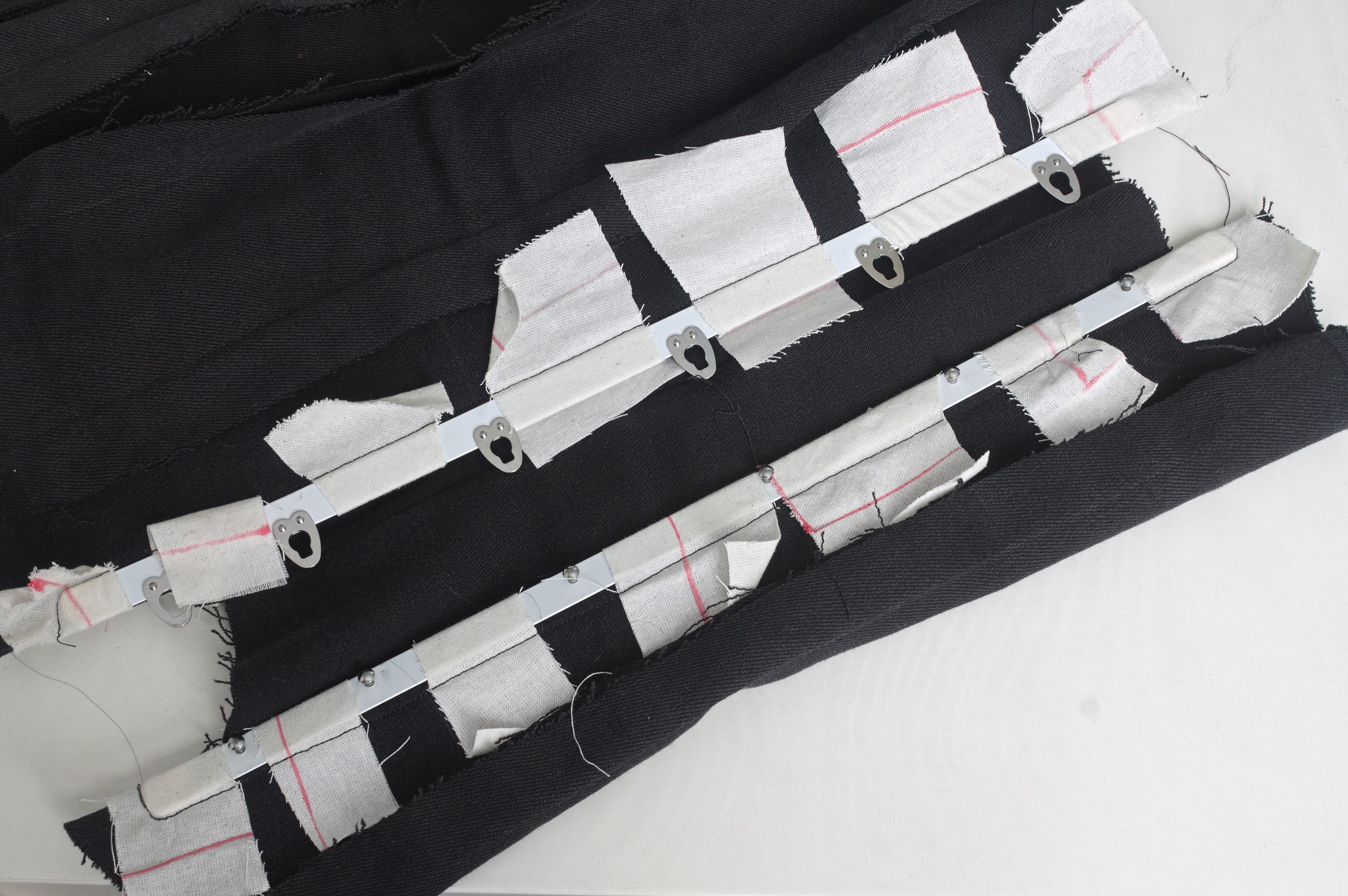

  1. i.e. by asking my SO to cut and sand it, because I m lazy and I hate doing that part :D

Next.

Previous.