Search Results: "benjamin"

23 December 2007

Benjamin Mako Hill: Computing in the Cloud

On January 15th, I'm going to be giving a talk on a panel at the Computing in the Cloud conference held by Ed Felton's Center for Information Technology Policy at Princeton University. The conference description says:
Computing in the cloud is one name for services that run in a Web browser and store information in a provider s data center ranging from adaptations of familiar tools such as email and personal finance to new offerings such as virtual worlds and social networks. This workshop will bring together experts from computer science, law, politics and industry to explore the social and policy implications of this trend.
I'm going to talk about the AGPL 3.0, why it's important that we put effort into figuring out what freedom for different technologies means, and what the components of freedom for web services might be. Registration is free and bags you a name-tag and lunch. Worth noting perhaps, the conference is sponsored by Microsoft.

22 December 2007

Benjamin Mako Hill: Interview

Sun's Barton George just published an audio interview he did with me a few months ago at FOSSCamp. We talked mostly about my joining the FSF this past year, what it means for myself and the organization, and how I got there. Check it out!

15 December 2007

Benjamin Mako Hill: Annual Free Software Foundation Fundraiser

It's an end of year tradition for non-profit organizations to do big fund-raising and membership pushes. As I mentioned several days ago, I am personally giving to two organizations this year: the Wikimedia Foundation and the Free Software Foundation. The FSF has a goal of 500 associate members by year-end and it's an important goal that will sustain the foundation's activities. While membership dues keep the lights on, the fact that the foundation has a robust and growing membership is equally, if not more, important. FSF executive director Peter Brown put an appeal online in both video and text versions. In it, he lays out some of the most important issues for the next year. You should watch the video version in OGG Theora or this YouTube version (requires Gnash or non-free Flash). The appeal briefly lays out the FSF's plans for next year. My partner Mika Matsuzaki and my friend Oliver Day shot and edited the video. Please pass the link around to those you feel might be interested. Here's my appeal:
Now is the time to join and give to Free Software Foundation. 2008 is going to be extraordinarily important year for free software. Eben Moglen likes to quote Gandhi's "first they ignore you, then they laugh at you, then they fight you, then you win" progression when describing the free software movement. As I pointed out when I joined the FSF board, we're beginning to see powerful interests fighting free software. It's going to increase in the next few years. Things will probably get a lot uglier for free software before they get better. We can win but things are far from settled. The FSF is the front-line organization in this fight and we need a robust and proactive foundation, and an active and involved membership, if we're going to win. Here are the issues that I'm going to pushing the FSF to pursue in the next year. Expanding activism outside our traditional technologist communities: In part through the work of projects like Defective By Design, we've seen the tide turn for DRM on music in what what may be the FSF's greatest success last year. I'm going to push the FSF to continue the campaign to attack DRM for video, eBooks, and the other places it is cropping up. The most remarkable thing to me about Defective By Design is that its participants and supporters are not, for the most part, people who develop or use GNU/Linux or even know what GNU is! If advocacy for software freedom involves a conversation we can only have with people who understand what POSIX is and how one uses it, we've already lost. Through DbD, BadVista, and other projects, the FSF has made major strides in the last year. It need to do much more and needs your support to do so. Get proactive about software patents: As a community, we've had our head in the sand about software patents for far too long. There are companies and patent trolls sitting on massive, growing piles of software patents. They are not our friends and they do not mean us well. One cannot write non-trivial software today without running a serious risk of infringing patents. The software patents minefield we've found ourselves in is a very fundamental threat to the success of free software and we've already begun to see the first casualties and costs. We must eliminate software patents. Now. The US is very important in this fight (much patent law is "exported" from the US) and almost no organization is working on software patent elimination there. Not enough people are thinking and acting strategically on this issue. The FSF is planning to make major steps in this fight in the coming year and we need your support to do so. Web services and the changing face of software: This last year, I worked to help launch the new version the AGPLv3. The license addresses the role of copyleft for software like web-services which, due to the legal particulars of the GPL, did not extend to the purveyors of web services. Of course, access to source code does not make the users of all web-services free (e.g., the GMails and the Facebooks). Nobody seems to know what freedom for webserver entails. There might not even be good answers. In the next year, I'm going to push the FSF to help start several conversation and to begin to follow up on what I think was an important first step with the AGPLv3. While this is not a major organizational priority yet, it's a major action item that I will be pursuing through the FSF. If you feel strongly about this issue, whatever your position, become a member, stay involved as these projects develop, and have your voice be heard. We don't know the answers yet and we need your input as much as we need your action.
Please, support the FSF in the efforts listed above, and in others, by giving generously. If you're not a member, please join the FSF as an associate member. If you are already a member, please consider making a tax-deductible donation. The FSF is a very lean, very humble organization of passionate and dedicated individuals working tirelessly for software freedom. Every little bit helps. Members pays USD $120 ($10/month) and student members pay half that. FSF has members across the world -- where a weak dollar often makes it even cheaper. Member support and participation builds capacity and credibility for the foundation and keep the organization responsible, responsive, and in tune with our community.

13 December 2007

Benjamin Mako Hill: SPARC Innovator

SPARC, the Scholarly Publishing and Academic Resources Coalition -- a large alliance of academic and research libraries and other organizations working on open access scholarly publishing issues -- just recognized me as a SPARC Innovator. The award/recognition is given semi-annually to honor contributions to the open access movement. I'm being singled out in part for my work on Overpriced Tags and for other OA work and advocacy. I'm sharing the stage with several friends -- all of whom are students active in the Free Culture movement. SPARC seems to see this set of innovator awards as an opportunity to recognize the contributions of the next generation of activists. I'm honored to be counted among them!

11 December 2007

Benjamin Mako Hill: Wikimedia and the Free Culture Movement

An essay I wrote for the Wikimedia Foundation fundraising drive was just published on the the foundation's Why Give blog. The essay, titled Wikimedia and the Free Culture Movement, discusses the movement for free culture, Wikimedia's central role in it, and the importance of supporting the foundation because, I argue, the immediate success of the free culture movement is intimately tied up in Wikimedia's efforts. It is very exciting to see an essay I wrote linked prominently from the top of every page in Wikipedia! It is also exciting to imagine that I might help the Wikimedia foundation at this important time in that organization's life. I am giving to two organizations in support of two causes this year: the Wikimedia Foundation in support of free culture and the Free Software Foundation in support of free software. No other two groups are as committed or are doing as much to build a world where knowledge, and the tools we use to use, produce, and communicate it, are and remain free.

7 December 2007

Benjamin Mako Hill: New Antifeatures Article and FSF Members' Bulletin

The FSF's fall members bulletin is out. For it, I spent some time refining the blogpost I recently wrote on antifeatures into an article. I got a whole lot of feedback last time (Thanks!), most of which criticized my choice of examples. I've structured this version around different, and I hope less controversial, examples. Please read the new article and leave comments here, especially if you criticized the old one. The bulletin also includes two pieces introducing a campaign against software patents that the FSF plans to launch early next year and a discussion of the AGPL by Brett Smith. This bulletin hints at what I think are the big issues that the FSF plans to take on next year: software patents, web services, and creative new takes on the free software message that are designed to resonant beyond our historically very technical community of hackers. I'll write more on this in the next week or so. To support this mission, and to receive future copies of the bulletin directly, please consider becoming an associate member today during the FSF's year-end members drive.

1 December 2007

Benjamin Mako Hill: Me++

My birthday is Sunday, December 2nd. To celebrate, my friends in Zagreb have organized a party for me at the club and cafe Kset at 20:00. It should be low-key and lots of fun. Since I don't actually know too many people here, other folks reading this should definitely feel free to drop by if they'd like to meet up. Rumor has it that we'll have another party at the Acetarium after I get back to Cambridge on the evening of Saturday, December 8th. Let us know if you want to drop by for that one.

28 November 2007

Benjamin Mako Hill: Errorism

I think that traveling extensively and working on my new blog Revealing Errors might make me an international errorist. My new life of errorism is, in any case, developing nicely. If you haven't yet, you should check the blog out.

26 November 2007

Benjamin Mako Hill: My MySpace

Of all of the problematic qualities and implications of MySpace, I think I might find the fact that it leads to constructions like "His MySpace," "Their MySpace" or even "My MySpace" the most objectionable.

20 November 2007

Benjamin Mako Hill: Free Culture Distilled for Free Software Folks

I've posted an an article on my website called Free Culture Advanced which I wrote for the last edition of the Free Software Foundation Members' Bulletin which went out several months ago. The bulletin is one of things you get when you become an associate member of the FSF. The article makes the case for free culture and a freedom definition in terms that are directed to and I hope will resonate with folks from the free software community. I've posted versions of the article in HTML, PDF, and LaTeX.

19 November 2007

Benjamin Mako Hill: Affero General Public License Version 3

The Free Software Foundation sent out a press release today announcing a new addition to the FSF stable of licenses: the Affero General Public License or AGPL. The FSF has also published a set of answers to anticipated questions in the GPL FAQ. The first paragraph of the release explains what the AGPL is:
This is a new license; it is based on version 3 of the GNU General Public License (GNU GPLv3), but has an additional term to ensure that users who interact with the licensed software over a network can receive the source for that program. By publishing this license, the FSF aims to begin fostering user and development communities around free software web services and other network-oriented software.
The GPL is designed to ensure that users of software have access to the source code -- source is prerequisite to freedom and to the type of collaboration that has made free software successful. However, the GPL doesn't say "users" when it talks about who gets freedom; instead, it references people to whom the software is distributed. It doesn't say users for two reasons. The first is that, under copyright, "distribution" is a much more meaningful term and a powerful hook than "use" which is not, in most cases, one of the copyright holder's exclusive rights. The second is that, until very recently, having a copy of software was prerequisite to using it; possession was prerequisite to use. Things have changed. A large part of many people's computing experience involves running web applications. These include email clients (e.g., GMail or other webmails), office applications (e.g., Google Docs), social network systems, and others. These applications all run on servers -- i.e., on other people's computers. The providers of these services, the Googles and the FaceBooks, build upon, modify and improve GPL software without giving back to their users or the community that they took their software from. The AGPL was created several years ago by FSF board member Henri Poole as a way to address this issue. The license took the form of the GPLv2 with one extra clause. It was a first stab at a license and was imperfect. The language and methods were clunky and, most problematically, the license was incompatible with software under the GPL. The new AGPL is based on the GPLv3 and the extra clause has been rethought and rewritten. It has been vetted using the GPLv3 comment process and dozens of insightful comments from dozens of lawyers, hackers, and users of free software have been incorporated. The new license fixes the issues that many folks -- including myself -- had with the first version of the license. More importantly it can now be linked to GPLv3 code which makes the license a whole lot more practical. I am quoted in the release being excited about the license and I really am. I've got 2-3 major development projects (including Selectricity) which I've been waiting to distribute so that I could do so under the AGPLv3. The AGPL isn't a complete answer to the problem faced by disempowered users of web services. Without data or the capacity (in terms of servers, money, and expertise) to run web applications, the state and quality of these users' freedom remains far from clear. Thankfully, there are a whole bunch of folks thinking about what freedom for users of services might be -- it's a conversation that I'm going to push the FSF to participate in and pursue moving forward. The AGPLv3 marks a first solid contribution to the process of answering that question. If you'd like to help supporting or assisting the FSF in this effort, please consider becoming an associate member or donating.

Benjamin Mako Hill: My Balkan Tour

I recently mentioned that I would visiting some friends at mi2 in Zagreb and would be traveling around the Balkans a bit to give some talks and workshops. Here's what the current plan includes: If you're in Novi Sad, Belgrade, Ljubljana, or Zagreb and would like to meet up, please consider coming to the events and exhibitions. If you can, and especially if you can not but would like to meet up anyway, feel free to drop me an email and let's try to organize a meeting. Thanks go to Tomislav Medak and Marcell Mars who organized System.hack(), this whole tour, and who helped do the work to bring me over. I'm looking forward to the next couple weeks.

12 November 2007

Benjamin Mako Hill: Debian Packaging Tutorial

Yesterday, when I posted the list of talks that I'll be giving this week, I forgot to mention that I will be giving a Cluedump at MIT tonight organized by SIPB. It will be in the form of a simple hands-on workshop to teach folks how make Debian or Ubuntu packages. The session is not aimed at teaching folks to make policy compliant packages or how to pass Debian's NM process but rather to be more of an, "Everything a Sysadmin Needs to Know about Debian and Ubuntu Packages," style introduction. The talk is tonight, November 12, 2007, at 20:30 at MIT in room 56-114. Feel free to read the longer description and to show up if you're interested.

Benjamin Mako Hill: Code of Conduct

The Ubuntu Code of Conduct is probably the most widely read document I've written. Agreement to it is prerequisite to participation in the Ubuntu community in all official and many unofficial capacities. It is has successfully set a positive tone and helped turn Ubuntu into what is probably the most friendly and civil free software project I've worked in. Over time, quite a few free software projects have copied or adapted the CoC. Tired of giving folks permission, the project went ahead and licensed the CoC under the Creative Commons Attribution-Sharealike license to explicitly allow reuse as long as attribution to the Ubuntu project is given and derivatives are similarly modifiable. In a recent development, it was adapted by the Fort Erie, Ontario town council for use government interactions of their business improvement areas! It's amazing to see the document gain so much traction! Unfortunately, the person who repurposed the CoC did not attribute the document correctly and was publicly accused of plagiarism by another council member! Ubuntu is happy to have Fort Erie, and anyone else, use or adapt the CoC. Folks should just take care to be honest about where it came from and maintain the BY-SA license.

Benjamin Mako Hill: Talks in Brooklyn and Ithaca

I'll be in New York State for the second half of this coming week. On Thursday, I'll be in New York City giving a talk as part of a interdisciplinary colloquium discussing free software and structured around Decoding Liberation, the recent book by Brooklyn College professors Samir Chopra and Scott Dexter. The talk will be Thursday, November 15, 2007 between 10:50 and 13:30 in the Glenwood Lounge in the Brooklyn College student center. See this flier for details. I'll be heading straight to Ithaca where I'll give a talk the next day at Cornell for the Code Review student group. My talk will try to introduce and discuss free software issues in the context of the OLPC project. The talk will be on Friday November 16th at 17:00 in Rockefeller 115. There's some more details on the Code Review website. Folks should feel free to attend either event. I'll be leaving soon after on a bit of a Balkan tour being organized by some of my friends from mi2 and will be spending a couple weeks in or based out of Zagreb. The details are still being ironed out but I'll be sure to post them here once I know dates, places, and times.

9 November 2007

Benjamin Mako Hill: Vacancies

My parents, both physicians, have frequently talked about running a bed and breakfast when they retire. Perhaps on the off-season, they will be doctors without boarders.

8 November 2007

Benjamin Mako Hill: Ideal Accidents

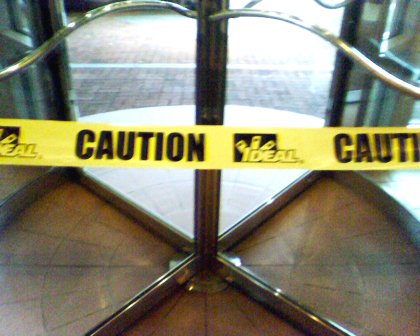
Although I have no idea what necessitated the use of Ideal caution tape on the revolving door at the Hotel @ MIT, I'm quite sure it wasn't. /copyrighteous/images/ideal_caution_tape.jpg

7 November 2007

Benjamin Mako Hill: Revealing Errors

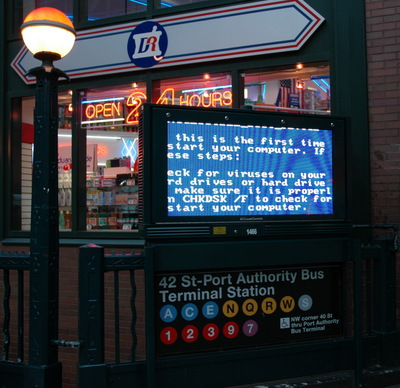
Groups that campaign for free technology, like the Free Software Foundation and the Electronic Frontier Foundation, tend to be supported primarily by technologists. Both groups have struggled to communicate their messages to non-geeks. I have written an article and helped create a new weblog, both called Revealing Errors, that attempt to address a root cause of this issue in what I hope is both an insightful and entertainingly manner. Geeks support groups like the FSF and EFF because, as people who understand technology, they understand just how powerful technology is. Geeks know that control of our communication technologies is control over what we can say, who we can say it to, and how and when we can say it. In an increasingly technologically mediated age, control over technology is not only the power to control our actions; it is the power to limit our possible actions. Our freedom to our technology is our freedom, full stop. This message fails to resonate with non-geeks but it does not fail because non-geeks are happy to hand over their freedom. It fails to resonate simply because the vast majority of people do not understand that technology, and control over it, is powerful enough to impact their freedom. Most people fail to see the power because, quite simply, most people fail to see technology. While we all see the effects of technologies, the technologies themselves are frequently hidden. We see emails but not mail transport agents. We see text messages but not the mobile phone network. Before one can argue that such systems must be free, one must reveal their existence. Technologists are keenly aware of the existence of these systems. To everyone else, they are completely invisible. Marc Weisner of Xerox PARC cited eyeglasses as an ideal technology because, with spectacles, "you look at the world, not the eyeglasses." When technology works smoothly, its nature and effects are invisible. But technologies do not always work smoothly. A tiny fracture or a smudge on a lens renders glasses quite visible to the wearer indeed. Similarly, people see their MTAs when messages bounce. They see Windows on their ATM or phone when the system crashes. Technological errors are moments when usually invisible technology becomes visible. They are, in this sense, also an educational opportunity. /copyrighteous/images/blue_screen.jpg I have recently published an article in Media/Culture Journal from the University of Melbourne within a special issue called Error. If you are interested in learning more about what I'm trying to do or looking at some examples, please read the article. With support and ontributions from Aaron Swartz, I have also created a new weblog, Revealing Errors, that reveals errors that reveal technology by posting descriptions of errors with commentary on what the error reveals. I've posted a few examples there already and I will be updating it regularly. The goal is to help explain the power and influence of technology in the service of broadening the base of people who can get excited about freedom to technology. Eventually, I hope to be able to communicate this message to a less technical audience. With that said, I hope that even seasoned technologists will learn things about their technological environment through the analysis and interaction. I hope readers of this blog will subscribe to it and, if possible, comment on and contribute to the project as it moves forward.
Roland Mas: Planet scores

Top posters in a few Debian-related Planets:

$ planet-scores.sh 
Planet Debian-FR :
     19 Rapha l Hertzog
      4 Roland Mas
      3 Jean-Christophe Dubacq
      2 Gr gory Colpart
      2 Alexis Sukrieh
Sometimes I think this should be renamed Planet Buxy.
Planet Debian-FR (utilisateurs) :
     10 Julien Candelier
      8 Emilien Macchi
      4 Guilhem Bonnefille
      3 Shams Fantar
      1 Rapha l Hertzog
      1 Olivier Berger (perso)
      1 Jean-Christophe Dubacq
      1 Jean-Baptiste H tier (djib)
      1 Eric Veiras Galisson
Newly added contributors to that planet have all their recent articles aggregated, not only the ones they wrote since they were added.
Planet Debian :
     40 Christian Perrier
      2 Russell Coker
      2 Raphael Geissert
      1 Wouter Verhelst
      1 Steve Kemp
      1 Romain Francoise
      1 NOKUBI Takatsugu
      1 Michal  iha 
      1 John Goerzen
      1 Joey Schulze
      1 Gerfried Fuchs
      1 Fathi Boudra
      1 Enrico Zini
      1 Emanuele Rocca
      1 Dirk Eddelbuettel
      1 David Welton
      1 Christine Spang
      1 Antti-Juhani Kaijanaho
      1 Adam Rosi-Kessel
Planet "Christian loves rugby".
debian-community.org :
      4 Holger Levsen
      3 Andrew Donnellan
      2 Evgeni Golov
      1 Wolfgang Lonien
      1 Rapha l Hertzog
      1 Martin Albisetti
      1 Marcos Marado
      1 Jean-Christophe Dubacq
      1 Cord Beermann
      1 Benjamin A'Lee
      1 Andreas Putzo
$
I know I have an encoding problem on some planets, but that script is a very basic curl+shell+sed+grep+recode+sort+uniq pipeline, and I only use it for the amusement value. Maybe I'll recode it with a proper RSS parser some day if I feel utterly bored.

3 November 2007

Benjamin Mako Hill: Accidentally Accurate

The label on this office product is correct, but for the wrong reason. /copyrighteous/images/stapler-small.jpg

Next.

Previous.