Search Results: "angel"

31 August 2020

Chris Lamb: Free software activities in August 2020

Here is another monthly update covering what I have been doing in the free software world during August 2020 (previous month): I uploaded Lintian versions 2.86.0, 2.87.0, 2.88.0, 2.89.0, 2.90.0, 2.91.0 and 2.92.0, as well as made the following changes:

Reproducible Builds One of the original promises of open source software is that distributed peer review and transparency of process results in enhanced end-user security. However, whilst anyone may inspect the source code of free and open source software for malicious flaws, almost all software today is distributed as pre-compiled binaries. This allows nefarious third-parties to compromise systems by injecting malicious code into ostensibly secure software during the various compilation and distribution processes. The motivation behind the Reproducible Builds effort is to ensure no flaws have been introduced during this compilation process by promising identical results are always generated from a given source, thus allowing multiple third-parties to come to a consensus on whether a build was compromised. The project is proud to be a member project of the Software Freedom Conservancy. Conservancy acts as a corporate umbrella allowing projects to operate as non-profit initiatives without managing their own corporate structure. If you like the work of the Conservancy or the Reproducible Builds project, please consider becoming an official supporter. This month, I:

diffoscope I made the following changes to diffoscope, including preparing and uploading versions 155, 156, 157 and 158 to Debian:

Debian Debian LTS This month I have worked 18 hours on Debian Long Term Support (LTS) and 12 hours on its sister Extended LTS project. You can find out more about the project via the following video:


Uploads to Debian

22 August 2020

Jelmer Vernooij: Debian Janitor: > 60,000 Lintian Issues Automatically Fixed

The Debian Janitor is an automated system that commits fixes for (minor) issues in Debian packages that can be fixed by software. It gradually started proposing merges in early December. The first set of changes sent out ran lintian-brush on sid packages maintained in Git. This post is part of a series about the progress of the Janitor.

Scheduling Lintian Fixes To determine which packages to process, the Janitor looks at the import of lintian output across the archive that is available in UDD [1]. It will prioritize those packages with the most and more severe issues that it has fixers for. Once a package is selected, it will clone the packaging repository and run lintian-brush on it. Lintian-brush provides a framework for applying a set of fixers to a package. It will run each of a set of fixers in a pristine version of the repository, and handles most of the heavy lifting.
The Inner Workings of a Fixer Each fixer is just an executable which gets run in a clean checkout of the package, and can make changes there. Most of the fixers are written in Python or shell, but they can be in any language. The contract for fixers is pretty simple:
  • If the fixer exits with non-zero, the changes are reverted and fixer is considered to have failed
  • If it exits with zero and made changes, then it should write a summary of its changes to standard out
If a fixer is uncertain about the changes it has made, it should report so on standard output using a pseudo-header. By default, lintian-brush will discard any changes with uncertainty but if you are running it locally you can still apply them by specifying --uncertain. The summary message on standard out will be used for the commit message and (possibly) the changelog message, if the package doesn t use gbp dch.
Example Fixer Let s look at an example. The package priority extra is deprecated since Debian Policy 4.0.1 (released August 2 017) see Policy 2.5 "Priorities". Instead, most packages should use the optional priority. Lintian will warn when a package uses the deprecated extra value for the Priority - the associated tag is priority-extra-is-replaced-by-priority-optional. Lintian-brush has a fixer script that can automatically replace extra with optional . On systems that have lintian-brush installed, the source for the fixer lives in /usr/share/lintian-brush/fixers/priority-extra-is-replaced-by-priority-optional.py, but here is a copy of it for reference:
 1
 2
 3
 4
 5
 6
 7
 8
 9
10
11
12
13
#!/usr/bin/python3
from debmutate.control import ControlEditor
from lintian_brush.fixer import report_result, fixed_lintian_tag
with ControlEditor() as updater:
    for para in updater.paragraphs:
        if para.get("Priority") == "extra":
            para["Priority"] = "optional"
            fixed_lintian_tag(
                para, 'priority-extra-is-replaced-by-priority-optional')
report_result("Change priority extra to priority optional.")
This fixer is written in Python and uses the debmutate library to easily modify control files while preserving formatting or back out if it is not possible to preserve formatting. All the current fixers come with tests, e.g. for this particular fixer the tests can be found here: https://salsa.debian.org/jelmer/lintian-brush/-/tree/master/tests/priority-extra-is-replaced-by-priority-optional. For more details on writing new fixers, see the README for lintian-brush. For more details on debugging them, see the manual page.
Successes by fixer Here is a list of the fixers currently available, with the number of successful merges/pushes per fixer:
Lintian Tag Previously merged/pushed Ready but not yet merged/pushed
uses-debhelper-compat-file 4906 4161
upstream-metadata-file-is-missing 4281 3841
package-uses-old-debhelper-compat-version 4256 3617
upstream-metadata-missing-bug-tracking 2438 2995
out-of-date-standards-version 2062 2936
upstream-metadata-missing-repository 1936 2987
trailing-whitespace 1720 2295
insecure-copyright-format-uri 1791 1093
package-uses-deprecated-debhelper-compat-version 1391 1287
vcs-obsolete-in-debian-infrastructure 872 782
homepage-field-uses-insecure-uri 527 1111
vcs-field-not-canonical 850 655
debian-changelog-has-wrong-day-of-week 224 376
debian-watch-uses-insecure-uri 314 242
useless-autoreconf-build-depends 112 428
priority-extra-is-replaced-by-priority-optional 315 194
debian-rules-contains-unnecessary-get-orig-source-target 35 428
tab-in-license-text 125 320
debian-changelog-line-too-long 186 190
debian-rules-sets-dpkg-architecture-variable 69 166
debian-rules-uses-unnecessary-dh-argument 42 182
package-lacks-versioned-build-depends-on-debhelper 125 95
unversioned-copyright-format-uri 43 136
package-needs-versioned-debhelper-build-depends 127 50
binary-control-field-duplicates-source 34 134
renamed-tag 73 69
vcs-field-uses-insecure-uri 14 109
uses-deprecated-adttmp 13 91
debug-symbol-migration-possibly-complete 12 88
copyright-refers-to-symlink-license 51 48
debian-control-has-unusual-field-spacing 33 66
old-source-override-location 32 62
out-of-date-copyright-format 20 62
public-upstream-key-not-minimal 43 30
older-source-format 17 54
custom-compression-in-debian-source-options 12 57
copyright-refers-to-versionless-license-file 29 39
tab-in-licence-text 33 31
global-files-wildcard-not-first-paragraph-in-dep5-copyright 28 33
out-of-date-copyright-format-uri 9 50
field-name-typo-dep5-copyright 29 29
copyright-does-not-refer-to-common-license-file 13 42
debhelper-but-no-misc-depends 9 45
debian-watch-file-is-missing 11 41
debian-control-has-obsolete-dbg-package 8 40
possible-missing-colon-in-closes 31 13
unnecessary-testsuite-autopkgtest-field 32 9
missing-debian-source-format 7 33
debhelper-tools-from-autotools-dev-are-deprecated 9 29
vcs-field-mismatch 8 29
debian-changelog-file-contains-obsolete-user-emacs-setting 33 0
patch-file-present-but-not-mentioned-in-series 24 9
copyright-refers-to-versionless-license-file 22 9
debian-control-has-empty-field 25 6
missing-build-dependency-for-dh-addon 10 20
obsolete-field-in-dep5-copyright 15 13
xs-testsuite-field-in-debian-control 20 7
ancient-python-version-field 13 12
unnecessary-team-upload 19 5
misspelled-closes-bug 6 16
field-name-typo-in-dep5-copyright 1 20
transitional-package-not-oldlibs-optional 4 17
maintainer-script-without-set-e 9 11
dh-clean-k-is-deprecated 4 14
no-dh-sequencer 14 4
missing-vcs-browser-field 5 12
space-in-std-shortname-in-dep5-copyright 6 10
xc-package-type-in-debian-control 4 11
debian-rules-missing-recommended-target 4 10
desktop-entry-contains-encoding-key 1 13
build-depends-on-obsolete-package 4 9
license-file-listed-in-debian-copyright 1 12
missing-built-using-field-for-golang-package 9 4
unused-license-paragraph-in-dep5-copyright 4 7
missing-build-dependency-for-dh_command 6 4
comma-separated-files-in-dep5-copyright 3 6
systemd-service-file-refers-to-var-run 4 5
copyright-not-using-common-license-for-apache2 3 5
debian-tests-control-autodep8-is-obsolete 2 6
dh-quilt-addon-but-quilt-source-format 2 6
no-homepage-field 3 5
font-packge-not-multi-arch-foreign 1 6
homepage-in-binary-package 1 4
vcs-field-bitrotted 1 3
built-using-field-on-arch-all-package 2 1
copyright-should-refer-to-common-license-file-for-apache-2 1 2
debian-pyversions-is-obsolete 3 0
debian-watch-file-uses-deprecated-githubredir 1 1
executable-desktop-file 1 1
skip-systemd-native-flag-missing-pre-depends 1 1
vcs-field-uses-not-recommended-uri-format 1 1
init.d-script-needs-depends-on-lsb-base 1 0
maintainer-also-in-uploaders 1 0
public-upstream-keys-in-multiple-locations 1 0
wrong-debian-qa-group-name 1 0
Total 29656 32209

Footnotes
[1]temporarily unavailable due to Debian bug #960156 but the Janitor is relying on historical data

For more information about the Janitor's lintian-fixes efforts, see the landing page

14 August 2020

John Goerzen: In Which COVID-19 Misinformation Leads To A Bunch of Graphs Made With Rust

A funny and by funny, I mean sad thing has happened. Recently the Kansas Department of Health and Environment (KDHE) has been analyzing data from the patchwork implementation of mask requirements in Kansas. They came to a conclusion that shouldn t be surprising to anyone: masks help. They published a chart showing this. A right-wing propaganda publication got ahold of this, and claimed the numbers were doctored because there were two-different Y-axes. I set about to analyze the data myself from public sources, and produced graphs of various kinds using a single Y-axis and supporting the idea that the graphs were not, in fact, doctored. Here s one graph that s showing that:
In order to do that, I had imported COVID-19 data from various public sources. Many states in the US are large enough to have significant variation in COVID-19 conditions, and many of the source people look at don t show county-level data over time. I wanted to do that. Eventually, I wrote covid19db, which ingests data from a number of public sources and generates a SQLite database file. Using Github Actions, this file is automatically updated every morning and available for download. Or, you can download the code and generate a database yourself locally. Then, I wrote covid19ks, which generates various pretty graphs covering the data. These graphs, incidentally, turn out to highlight just how poorly the United States is doing compared to the rest of the industrialized world. I hope that these resources, and especially covid19db, might be useful to others that would like to analyze the data. The code isn t the prettiest since it was done in a hurry, but I think that functionally this is useful.

6 August 2020

Sam Hartman: Good Job Debian: Compatibility back to 1999

So, I needed a container of Debian Slink (2.1), released back in 1999. I expected this was going to be a long and involved process. Things didn't look good from the start:
root@mount-peerless:/usr/lib/python3/dist-packages/sqlalchemy# debootstrap  slink /build/slink2 
http://archive.debian.org/debian                                                               
E: No such script: /usr/share/debootstrap/scripts/slink

Hmm, I thought I remembered slink support for debootstrap--not that slink used debootstrap by default--back when I was looking through the debootstrap sources years ago. Sure enough looking through the changelogs, slink support was dropped back in 2005.
Okay, well, this isn't going to work either, but I guess I could try debootstrapping sarge and from there go back to slink.
Except it worked fine.
Go us!

31 July 2020

Reproducible Builds (diffoscope): diffoscope 154 released

The diffoscope maintainers are pleased to announce the release of diffoscope version 154. This version includes the following changes:
[ Chris Lamb ]
* Add support for F2FS filesystems.
  (Closes: reproducible-builds/diffoscope#207)
* Allow "--profile" as a synonym for "--profile=-".
* Add an add_comment helper method so don't mess with our _comments list
  directly.
* Add missing bullet point in a previous changelog entry.
* Use "human-readable" over unhyphenated version.
* Add a bit more debugging around launching guestfs.
* Profile the launch of guestfs filesystems.
* Correct adding a comment when we cannot extract a filesystem due to missing
  guestfs module.
You find out more by visiting the project homepage.

27 July 2020

Russ Allbery: Summer haul

I'm buying rather too many books at the moment and not reading enough of them (in part because I got back into Minecraft and in part because I got a bit stuck on a few difficult books). I think I've managed to get myself unstuck again, though, and have started catching up on reviews. 2020. It's kind of a lot. And I'm not even that heavily affected. Katherine Addison The Angel of the Crows (sff)
Marie Brennan A Natural History of Dragons (sff)
Kacen Callender Queen of the Conquered (sff)
Jo Clayton Diadem from the Stars (sff)
Jo Clayton Lamarchos (sff)
Jo Clayton Irsud (sff)
Clifford D. Conner The Tragedy of American Science (nonfiction)
Kate Elliott Unconquerable Sun (sff)
Rory Fanning & Craig Hodges Long Shot (nonfiction)
Michael Harrington Socialism: Past & Future (nonfiction)
Nalo Hopkinson Brown Girl in the Ring (sff)
Kameron Hurley The Stars Are Legion (sff)
N.K. Jemisin Emergency Skin (sff)
T. Kingfisher A Wizard's Guide to Defensive Baking (sff)
T. Kingfisher Nine Goblins (sff)
Michael Lewis The Fifth Risk (nonfiction)
Paul McAuley War of the Maps (sff)
Gretchen McCulloch Because Internet (nonfiction)
Hayao Miyazaki Nausica of the Valley of the Wind (graphic novel)
Annalee Newitz The Future of Another Timeline (sff)
Nick Pettigrew Anti-Social (nonfiction)
Rivers Solomon, et al. The Deep (sff)
Jo Walton Or What You Will (sff)
Erik Olin Wright Stardust to Stardust (nonfiction) Of these, I've already read and reviewed The Fifth Risk (an excellent book).

25 July 2020

Niels Thykier: Support for Debian packaging files in IDEA (IntelliJ/PyCharm)

I have been using the community editions of IntelliJ and PyCharm for a while now for Python or Perl projects. But it started to annoy me that for Debian packaging bits it would revert into a fancy version of notepad. Being fed up with it, I set down and spent the last week studying how to write a plugin to fix this.

After a few prototypes, I have now released IDEA-debpkg v0.0.3 (Link to JetBrain s official plugin listing with screenshots). It provides a set of basic features for debian/control like syntax highlighting, various degree of content validation, folding of long fields, code completion and CTRL + hover documentation. For debian/changelog, it is mostly just syntax highlighting with a bit of fancy linking for now. I have not done anything for debian/rules as I noted there is a Makefile plugin, which will have to do for now.

The code is available from github and licensed under Apache-2.0. Contributors, issues/feature requests and pull requests are very welcome. Among things I could help with are:

I hope you will take it for spin if you have been looking for a bit of Debian packaging support to your PyCharm or other IDEA IDE.  Please do file bugs/issues if you run into issues, rough edges or unhelpful documentation, etc.

3 July 2020

Michael Prokop: Grml 2020.06 Codename Ausgehfuahangl

We did it again , at the end of June we released Grml 2020.06, codename Ausgehfuahangl. This Grml release (a Linux live system for system administrators) is based on Debian/testing (AKA bullseye) and provides current software packages as of June, incorporates up to date hardware support and fixes known issues from previous Grml releases. I am especially fond of our cloud-init and qemu-guest-agent integration, which makes usage and automation in virtual environments like Proxmox VE much more comfortable. Once as the Qemu Guest Agent setting is enabled in the VM options (also see Proxmox wiki), you ll see IP address information in the VM summary: Screenshot of qemu guest agent integration Using a cloud-init drive allows using an SSH key for login as user "grml", and you can control network settings as well: Screenshot of cloud-init integration It was fun to focus and work on this new Grml release together with Darsha, and we hope you enjoy the new Grml release as much as we do!
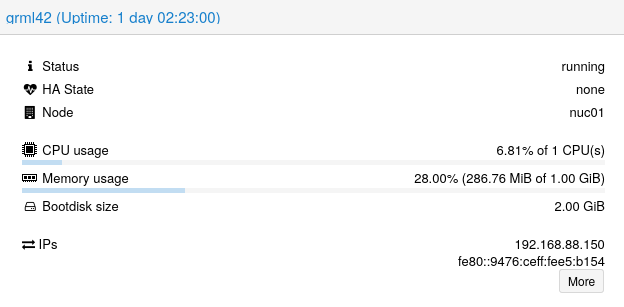
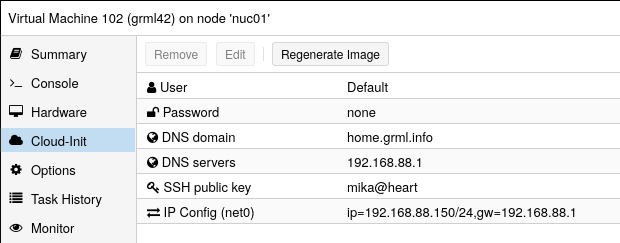
1 July 2020

Paul Wise: FLOSS Activities June 2020

Focus This month I didn't have any particular focus. I just worked on issues in my info bubble.

Changes

Issues

Review

Administration
  • Debian BTS: usertags QA
  • Debian IRC channels: fixed a channel mode lock
  • Debian wiki: unblock IP addresses, approve accounts, ping folks with bouncing email

Communication
  • Respond to queries from Debian users and developers on the mailing lists and IRC

Sponsors The ifenslave and apt-listchanges work was sponsored by my employer. All other work was done on a volunteer basis.

26 June 2020

Dirk Eddelbuettel: littler 0.3.11: docopt updates

max-heap image The twelveth release of littler as a CRAN package is now available, following in the fourteen-ish year history as a package started by Jeff in 2006, and joined by me a few weeks later. littler is the first command-line interface for R as it predates Rscript. It allows for piping as well for shebang scripting via #!, uses command-line arguments more consistently and still starts faster. It also always loaded the methods package which Rscript only started to do in recent years. littler lives on Linux and Unix, has its difficulties on macOS due to yet-another-braindeadedness there (who ever thought case-insensitive filesystems as a default where a good idea?) and simply does not exist on Windows (yet the build system could be extended see RInside for an existence proof, and volunteers are welcome!). See the FAQ vignette on how to add it to your PATH. A few examples are highlighted at the Github repo, as well as in the examples vignette. This release mostly responds to the recent docopt release 0.7.0 which brought a breaking change for quoted arguments. In short, it is for the better because an option --as-cran is now available parsed as opt$as_cran which is easier than the earlier form where we needed to back-tick protect as-cran containing an underscore. We also added a new portmanteau-ish option to roxy.r. The NEWS file entry is below.

Changes in littler version 0.3.11 (2020-06-26)
  • Changes in examples
    • Scripts check.r and rcc.r updated to reflect updated docopt 0.7.0 behaviour of quoted arguments
    • The roxy.r script has a new ease-of-use option -f --full regrouping two other options.

CRANberries provides a comparison to the previous release. Full details for the littler release are provided as usual at the ChangeLog page. The code is available via the GitHub repo, from tarballs and now of course also from its CRAN page and via install.packages("littler"). Binary packages are available directly in Debian as well as soon via Ubuntu binaries at CRAN thanks to the tireless Michael Rutter. Comments and suggestions are welcome at the GitHub repo. If you like this or other open-source work I do, you can now sponsor me at GitHub. For the first year, GitHub will match your contributions.

This post by Dirk Eddelbuettel originated on his Thinking inside the box blog. Please report excessive re-aggregation in third-party for-profit settings.

Chris Lamb: On the pleasure of hating

People love to tell you that they "don't watch sports" but the story of Lance Armstrong provides a fascinating lens through which to observe our culture at large. For example, even granting all that he did and all the context in which he did it, why do sports cheats act like a lightning rod for such an instinctive hatred? After all, the sheer level of distaste directed at people such as Lance eludes countless other criminals in our society, many of whom have taken a lot more with far fewer scruples. The question is not one of logic or rationality, but of proportionality. In some ways it should be unsurprising. In all areas of life, we instinctively prefer binary judgements to moral ambiguities and the sports cheat is a clich of moral bankruptcy cheating at something so seemingly trivial as a sport actually makes it more, not less, offensive to us. But we then find ourselves strangely enthralled by them, drawn together in admiration of their outlaw-like tenacity, placing them strangely close to criminal folk heroes. Clearly, sport is not as unimportant as we like to claim it is. In Lance's case in particular though, there is undeniably a Shakespearean quality to the story and we are forced to let go of our strict ideas of right and wrong and appreciate all the nuance.

There is a lot of this nuance in Marina Zenovich's new documentary. In fact, there's a lot of everything. At just under four hours, ESPN's Lance combines the duration of a Tour de France stage with the depth of the peloton an endurance event compared to the bite-sized hagiography of Michael Jordan's The Last Dance. Even for those who follow Armstrong's story like a mini-sport in itself, Lance reveals new sides to this man for all seasons. For me, not only was this captured in his clumsy approximations at being a father figure but also in him being asked something I had not read in countless tell-all books: did his earlier experiments in drug-taking contribute to his cancer? But even in 2020 there are questions that remain unanswered. By needlessly returning to the sport in 2009, did Lance subconsciously want to get caught? Why does he not admit he confessed to Betsy Andreu back in 1999 but will happily apologise to her today for slurring her publicly on this very point? And why does he remain so vindictive towards former-teammate Floyd Landis? In all of Armstrong's evasions and masterful control of the narrative, there is the gnawing feeling that we don't even know what questions we should be even asking. As ever, the questions are more interesting than the answers.

Lance also reminded me of how professional cycling's obsession with national identity. Although I was intuitively aware of it to some degree, I had not fully grasped how much this kind of stereotyping runs through the veins of the sport itself, just like the drugs themselves. Journalist Daniel Friebe first offers us the portrait of:
Spaniards tend to be modest, very humble. Very unpretentious. And the Italians are loud, vain and outrageous showmen.
Former directeur sportif Johan Bruyneel then asserts that "Belgians are hard workers... they are ambitious to a certain point, but not overly ambitious", and cyclist J rg Jaksche concludes with:
The Germans are very organised and very structured. And then the French, now I have to be very careful because I am German, but the French are slightly superior.
This kind of lazy caricature is nothing new, especially for those brought up on a solid diet of Tintin and Asterix, but although all these examples are seemingly harmless, why does the underlying idea of ascribing moral, social or political significance to genetic lineage remain so durable in today's age of anti-racism? To be sure, culture is not quite the same thing as race, but being judged by the character of one's ancestors rather than the actions of an individual is, at its core, one of the many conflations at the heart of racism. There is certainly a large amount of cognitive dissonance at work, especially when Friebe elaborates:
East German athletes were like incredible robotic figures, fallen off a production line somewhere behind the Iron Curtain...
... but then bermensch Jan Ullrich is immediately described as "emotional" and "struggled to live the life of a professional cyclist 365 days a year". We see the habit to stereotype is so ingrained that even in the face of this obvious contradiction, Friebe unironically excuses Ullrich's failure to live up his German roots due to him actually being "Mediterranean".

I mention all this as I am known within my circles for remarking on these national characters, even collecting stereotypical examples of Italians 'being Italian' and the French 'being French' at times. Contrary to evidence, I don't believe in this kind of innate quality but what I do suspect is that people generally behave how they think they ought to behave, perhaps out of sheer imitation or the simple pleasure of conformity. As the novelist Will Self put it:
It's quite a complicated collective imposture, people pretending to be British and people pretending to be French, and then they get really angry with each other over what they're pretending to be.
The really remarkable thing about this tendency is that even if we consciously notice it there is no seemingly no escape even I could not smirk when I considered that a brash Texan winning the Tour de France actually combines two of America's cherished obsessions: winning... and annoying the French.

22 June 2020

Evgeni Golov: mass-migrating modules inside an Ansible Collection

Im the Foreman project, we've been maintaining a collection of Ansible modules to manage Foreman installations since 2017. That is, 2 years before Ansible had the concept of collections at all. For that you had to set library (and later module_utils and doc_fragment_plugins) in ansible.cfg and effectively inject our modules, their helpers and documentation fragments into the main Ansible namespace. Not the cleanest solution, but it worked quiet well for us. When Ansible started introducing Collections, we quickly joined, as the idea of namespaced, easily distributable and usable content units was great and exactly matched what we had in mind. However, collections are only usable in Ansible 2.8, or actually 2.9 as 2.8 can consume them, but tooling around building and installing them is lacking. Because of that we've been keeping our modules usable outside of a collection. Until recently, when we decided it's time to move on, drop that compatibility (which costed a few headaches over the time) and release a shiny 1.0.0. One of the changes we wanted for 1.0.0 is renaming a few modules. Historically we had the module names prefixed with foreman_ and katello_, depending whether they were designed to work with Foreman (and plugins) or Katello (which is technically a Foreman plugin, but has a way more complicated deployment and currently can't be easily added to an existing Foreman setup). This made sense as long as we were injecting into the main Ansible namespace, but with collections the names be became theforemam.foreman.foreman_ <something> and while we all love Foreman, that was a bit too much. So we wanted to drop that prefix. And while at it, also change some other names (like ptable, which became partition_table) to be more readable. But how? There is no tooling that would rename all files accordingly, adjust examples and tests. Well, bash to the rescue! I'm usually not a big fan of bash scripts, but renaming files, searching and replacing strings? That perfectly fits! First of all we need a way map the old name to the new name. In most cases it's just "drop the prefix", for the others you can have some if/elif/fi:
prefixless_name=$(echo $ old_name   sed -E 's/^(foreman katello)_//')
if [[ $ old_name  == 'foreman_environment' ]]; then
  new_name='puppet_environment'
elif [[ $ old_name  == 'katello_sync' ]]; then
  new_name='repository_sync'
elif [[ $ old_name  == 'katello_upload' ]]; then
  new_name='content_upload'
elif [[ $ old_name  == 'foreman_ptable' ]]; then
  new_name='partition_table'
elif [[ $ old_name  == 'foreman_search_facts' ]]; then
  new_name='resource_info'
elif [[ $ old_name  == 'katello_manifest' ]]; then
  new_name='subscription_manifest'
elif [[ $ old_name  == 'foreman_model' ]]; then
  new_name='hardware_model'
else
  new_name=$ prefixless_name 
fi
That defined, we need to actually have a $ old_name . Well, that's a for loop over the modules, right?
for module in $ BASE /foreman_*py $ BASE /katello_*py; do
  old_name=$(basename $ module  .py)
   
done
While we're looping over files, let's rename them and all the files that are associated with the module:
# rename the module
git mv $ BASE /$ old_name .py $ BASE /$ new_name .py
# rename the tests and test fixtures
git mv $ TESTS /$ old_name .yml $ TESTS /$ new_name .yml
git mv tests/fixtures/apidoc/$ old_name .json tests/fixtures/apidoc/$ new_name .json
for testfile in $ TESTS /fixtures/$ old_name -*.yml; do
  git mv $ testfile  $(echo $ testfile   sed "s/$ old_name /$ new_name /")
done
Now comes the really tricky part: search and replace. Let's see where we need to replace first:
  1. in the module file
    1. module key of the DOCUMENTATION stanza (e.g. module: foreman_example)
    2. all examples (e.g. foreman_example: )
  2. in all test playbooks (e.g. foreman_example: )
  3. in pytest's conftest.py and other files related to test execution
  4. in documentation
sed -E -i "/^(\s+$ old_name  module):/ s/$ old_name /$ new_name /g" $ BASE /*.py
sed -E -i "/^(\s+$ old_name  module):/ s/$ old_name /$ new_name /g" tests/test_playbooks/tasks/*.yml tests/test_playbooks/*.yml
sed -E -i "/'$ old_name '/ s/$ old_name /$ new_name /" tests/conftest.py tests/test_crud.py
sed -E -i "/ $ old_name  / s/$ old_name /$ new_name /g' README.md docs/*.md
You've probably noticed I used $ BASE and $ TESTS and never defined them Lazy me. But here is the full script, defining the variables and looping over all the modules.
#!/bin/bash
BASE=plugins/modules
TESTS=tests/test_playbooks
RUNTIME=meta/runtime.yml
echo "plugin_routing:" > $ RUNTIME 
echo "  modules:" >> $ RUNTIME 
for module in $ BASE /foreman_*py $ BASE /katello_*py; do
  old_name=$(basename $ module  .py)
  prefixless_name=$(echo $ old_name   sed -E 's/^(foreman katello)_//')
  if [[ $ old_name  == 'foreman_environment' ]]; then
    new_name='puppet_environment'
  elif [[ $ old_name  == 'katello_sync' ]]; then
    new_name='repository_sync'
  elif [[ $ old_name  == 'katello_upload' ]]; then
    new_name='content_upload'
  elif [[ $ old_name  == 'foreman_ptable' ]]; then
    new_name='partition_table'
  elif [[ $ old_name  == 'foreman_search_facts' ]]; then
    new_name='resource_info'
  elif [[ $ old_name  == 'katello_manifest' ]]; then
    new_name='subscription_manifest'
  elif [[ $ old_name  == 'foreman_model' ]]; then
    new_name='hardware_model'
  else
    new_name=$ prefixless_name 
  fi
  echo "renaming $ old_name  to $ new_name "
  git mv $ BASE /$ old_name .py $ BASE /$ new_name .py
  git mv $ TESTS /$ old_name .yml $ TESTS /$ new_name .yml
  git mv tests/fixtures/apidoc/$ old_name .json tests/fixtures/apidoc/$ new_name .json
  for testfile in $ TESTS /fixtures/$ old_name -*.yml; do
    git mv $ testfile  $(echo $ testfile   sed "s/$ old_name /$ new_name /")
  done
  sed -E -i "/^(\s+$ old_name  module):/ s/$ old_name /$ new_name /g" $ BASE /*.py
  sed -E -i "/^(\s+$ old_name  module):/ s/$ old_name /$ new_name /g" tests/test_playbooks/tasks/*.yml tests/test_playbooks/*.yml
  sed -E -i "/'$ old_name '/ s/$ old_name /$ new_name /" tests/conftest.py tests/test_crud.py
  sed -E -i "/ $ old_name  / s/$ old_name /$ new_name /g' README.md docs/*.md
  echo "    $ old_name :" >> $ RUNTIME 
  echo "      redirect: $ new_name " >> $ RUNTIME 
  git commit -m "rename $ old_name  to $ new_name " $ BASE  tests/ README.md docs/ $ RUNTIME 
done
As a bonus, the script will also generate a meta/runtime.yml which can be used by Ansible 2.10+ to automatically use the new module names if the playbook contains the old ones. Oh, and yes, this is probably not the nicest script you'll read this year. Maybe not even today. But it got the job nicely done and I don't intend to need it again anyways.

15 June 2020

Russ Allbery: Radical haul

Along with the normal selection of science fiction and fantasy, a few radical publishers have done book giveaways due to the current political crisis in the United States. I've been feeling for a while like I've not done my homework on diverse political theory, so I downloaded those. (That's the easy part; making time to read them is the hard part, and we'll see how that goes.) Yarimar Bonilla & Marisol LeBr n (ed.) Aftershocks of Disaster (non-fiction anthology)
Jordan T. Camp & Christina Heatherton (ed.) Policing the Planet (non-fiction anthology)
Zachary D. Carter The Price of Peace (non-fiction)
Justin Akers Chac n & Mike Davis No One is Illegal (non-fiction)
Grace Chang Disposable Domestics (non-fiction)
Suzanne Collins The Ballad of Songbirds and Snakes (sff)
Angela Y. Davis Freedom is a Constant Struggle (non-fiction)
Danny Katch Socialism... Seriously (non-fiction)
Naomi Klein The Battle for Paradise (non-fiction)
Naomi Klein No is Not Enough (non-fiction)
Naomi Kritzer Catfishing on CatNet (sff)
Derek K nsken The Quantum Magician (sff)
Rob Larson Bit Tyrants (non-fiction)
Michael L wy Ecosocialism (non-fiction)
Joe Macar , Maya Schenwar, et al. (ed.) Who Do You Serve, Who Do You Protect? (non-fiction anthology)
Tochi Onyebuchi Riot Baby (sff)
Sarah Pinsker A Song for a New Day (sff)
Lina Rather Sisters of the Vast Black (sff)
Marta Russell Capitalism and Disbility (non-fiction)
Keeanga-Yamahtta Taylor From #BlackLivesMatter to Black Liberation (non-fiction)
Keeanga-Yamahtta Taylor (ed.) How We Get Free (non-fiction anthology)
Linda Tirado Hand to Mouth (non-fiction)
Alex S. Vitale The End of Policing (non-fiction)
C.M. Waggoner Unnatural Magic (sff)
Martha Wells Network Effect (sff)
Kai Ashante Wilson Sorcerer of the Wildeeps (sff)

3 June 2020

Dirk Eddelbuettel: littler 0.3.10: Some more updates

max-heap image The eleventh release of littler as a CRAN package is now available, following in the fourteen-ish year history as a package started by Jeff in 2006, and joined by me a few weeks later. littler is the first command-line interface for R as it predates Rscript. It allows for piping as well for shebang scripting via #!, uses command-line arguments more consistently and still starts faster. It also always loaded the methods package which Rscript only started to do in recent years. littler lives on Linux and Unix, has its difficulties on macOS due to yet-another-braindeadedness there (who ever thought case-insensitive filesystems as a default where a good idea?) and simply does not exist on Windows (yet the build system could be extended see RInside for an existence proof, and volunteers are welcome!). See the FAQ vignette on how to add it to your PATH. A few examples are highlighted at the Github repo, as well as in the examples vignette. This release adds a new helper / example script installBioc.r for BioConductor package installation, generalizes the roxygenize() wrapper roxy.r a little, and polished a couple of other corners. The NEWS file entry is below.

Changes in littler version 0.3.10 (2020-06-02)
  • Changes in examples
    • The update.r script only considers writeable directories.
    • The rcc.r script tries to report full logs by setting _R_CHECK_TESTS_NLINES_=0.
    • The tt.r script has an improved ncpu fallback.
    • Several installation and updating scripts set _R_SHLIB_STRIP_ to TRUE.
    • A new script installBioc.r was added.
    • The --error option to install2.r was generalized (Sergio Oller in #78).
    • The roxy.r script was extended a little.
  • Changes in package
    • Travis CI now uses R 4.0.0 and the bionic distro

CRANberries provides a comparison to the previous release. Full details for the littler release are provided as usual at the ChangeLog page. The code is available via the GitHub repo, from tarballs and now of course also from its CRAN page and via install.packages("littler"). Binary packages are available directly in Debian as well as soon via Ubuntu binaries at CRAN thanks to the tireless Michael Rutter. Comments and suggestions are welcome at the GitHub repo. If you like this or other open-source work I do, you can now sponsor me at GitHub. For the first year, GitHub will match your contributions.

This post by Dirk Eddelbuettel originated on his Thinking inside the box blog. Please report excessive re-aggregation in third-party for-profit settings.

1 June 2020

Paul Wise: FLOSS Activities May 2020

Focus This month I didn't have any particular focus. I just worked on issues in my info bubble.

Changes

Issues

Review

Administration
  • nsntrace: talk to upstream about collaborative maintenance
  • Debian: deploy changes, debug issue with GPS markers file generation, migrate bls/DUCK from alioth-archive to salsa
  • Debian website: ran map cron job, synced mirrors
  • Debian wiki: approve accounts, ping folks with bouncing email

Communication

Sponsors The apt-offline work and the libfile-libmagic-perl backports were sponsored. All other work was done on a volunteer basis.

30 May 2020

Reproducible Builds (diffoscope): diffoscope 146 released

The diffoscope maintainers are pleased to announce the release of diffoscope version 146. This version includes the following changes:
[ Chris Lamb ]
* Refactor .changes and .buildinfo handling to show all details (including
  the GPG header and footer components), even when referenced files are not
  present. (Closes: reproducible-builds/diffoscope#122)
* Normalise filesystem stat(2) "birth times" (ie. st_birthtime) in the same
  way we do with stat(1)'s "Access:" and "Change:" times to fix a
  nondetermistic build failure on GNU Guix.
  (Closes: reproducible-builds/diffoscope#74)
* Drop the (default) subprocess.Popen(shell=False) keyword argument so that
  the more unsafe shell=True is more obvious.
* Ignore lower vs. upper-case when ordering our file format descriptions.
* Don't skip string normalisation in Black.
[ Mattia Rizzolo ]
* Add a "py3dist" override for the rpm-python module (Closes: #949598)
* Bump the debhelper compat level to 13 and use the new
  execute_after_*/execture_before_* style rules.
* Fix a spelling error in changelog.
[ Daniel Fullmer ]
* Mount GuestFS filesystem images readonly.
[ Jean-Romain Garnier ]
* Prevent an issue where (for example) LibarchiveMember's has_same_content
  method is called regardless of the actual type of file.
You find out more by visiting the project homepage.

29 May 2020

Thomas Goirand: A quick look into Storcli packaging horror

So, Megacli is to be replaced by Storcli, both being proprietary tools for configuring RAID cards from LSI. So I went to download what s provided by Lenovo, available here:

https://support.lenovo.com/fr/en/downloads/ds041827 It s very annoying, because they force users to download a .zip file containing a deb file, instead of providing a Debian repository. Well, ok, though at least there s a deb file there. Let s have a look what s using my favorite tool before installing (ie: let s run Lintian).
Then it s a horror story. Not only there s obvious packaging wrong, like the package provide stuff in /opt, and all is statically linked and provide embedded copies of libm and ncurses, or even the package is marked arch: all instead of arch: amd64 (in fact, the package contains both i386 and amd64 arch files ), but there s also some really wrong things going on:
E: storcli: arch-independent-package-contains-binary-or-object opt/MegaRAID/storcli/storcli
E: storcli: embedded-library opt/MegaRAID/storcli/storcli: libm
E: storcli: embedded-library opt/MegaRAID/storcli/storcli: ncurses
E: storcli: statically-linked-binary opt/MegaRAID/storcli/storcli
E: storcli: arch-independent-package-contains-binary-or-object opt/MegaRAID/storcli/storcli64
E: storcli: embedded-library opt/MegaRAID/storcli/storcli64: libm
E: storcli: embedded-library use no-tag-display-limit to see all (or pipe to a file/program)
E: storcli: statically-linked-binary opt/MegaRAID/storcli/storcli64
E: storcli: changelog-file-missing-in-native-package
E: storcli: control-file-has-bad-permissions postinst 0775 != 0755
E: storcli: control-file-has-bad-owner postinst asif/asif != root/root
E: storcli: control-file-has-bad-permissions preinst 0775 != 0755
E: storcli: control-file-has-bad-owner preinst asif/asif != root/root
E: storcli: no-copyright-file
E: storcli: extended-description-is-empty
W: storcli: essential-no-not-needed
W: storcli: unknown-section storcli
E: storcli: depends-on-essential-package-without-using-version depends: bash
E: storcli: wrong-file-owner-uid-or-gid opt/ 1000/1000
W: storcli: non-standard-dir-perm opt/ 0775 != 0755
E: storcli: wrong-file-owner-uid-or-gid opt/MegaRAID/ 1000/1000
E: storcli: dir-or-file-in-opt opt/MegaRAID/
W: storcli: non-standard-dir-perm opt/MegaRAID/ 0775 != 0755
E: storcli: wrong-file-owner-uid-or-gid opt/MegaRAID/storcli/ 1000/1000
E: storcli: dir-or-file-in-opt opt/MegaRAID/storcli/
W: storcli: non-standard-dir-perm opt/MegaRAID/storcli/ 0775 != 0755
E: storcli: wrong-file-owner-uid-or-gid use no-tag-display-limit to see all (or pipe to a file/program)
E: storcli: dir-or-file-in-opt opt/MegaRAID/storcli/storcli
E: storcli: dir-or-file-in-opt use no-tag-display-limit to see all (or pipe to a file/program) Some of the above are grave security problems, like wrong Unix mode for folders, even with the preinst script installed as non-root.
I always wonder why this type of tool needs to be proprietary. They clearly don t know how to get packaging right, so they d better just provide the source code, and let us (the Debian community) do the work for them. I don t think there s any secret that they are keeping by hiding how to configure the cards, so it s not in the vendor s interest to keep everything closed. Or maybe they are just hiding really bad code in there, that they are ashamed to share? In any way, they d better not provide any package than this pile of dirt (and I m trying to stay polite here ).

23 May 2020

Reproducible Builds (diffoscope): diffoscope 145 released

The diffoscope maintainers are pleased to announce the release of diffoscope version 145. This version includes the following changes:
[ Chris Lamb ]
* Improvements:
  - Add support for Apple Xcode mobile provisioning .mobilepovision files.
    (Closes: reproducible-builds/diffoscope#113)
  - Add support for printing the signatures via apksigner(1).
    (Closes: reproducible-builds/diffoscope#121)
  - Use SHA256 over MD5 when generating page names for the HTML directory
    presenter, validate checksums for files referenced in .changes files
    using SHA256 too, and move to using SHA256 in "Too much input for diff"
    output too. (Closes: reproducible-builds/diffoscope#124)
  - Don't leak the full path of the temporary directory in "Command [..]
    exited with 1".  (Closes: reproducible-builds/diffoscope#126)
  - Identify "iOS App Zip archive data" files as .zip files.
    (Closes: reproducible-builds/diffoscope#116)
* Bug fixes:
  - Correct "differences" typo in the ApkFile handler.
    (Closes: reproducible-builds/diffoscope#127)
* Reporting/output improvements:
  - Never emit the same id="foo" TML anchor reference twice, otherwise
    identically-named parts will not be able to linked to via "#foo".
    (Closes: reproducible-builds/diffoscope#120)
  - Never emit HTML with empty "id" anchor lements as it is not possible to
    link to "#" (vs "#foo"). We use "#top" as a fallback value so it will
    work for the top-level parent container.
  - Clarify the message when we cannot find the "debian" Python module.
  - Clarify "Command [..] failed with exit code" to remove duplicate "exited
    with exit" but also to note that diffoscope is interpreting this as an
    error.
  - Add descriptions for the 'fallback' Debian module file types.
  - Rename the --debugger command-line argument to --pdb.
* Testsuite improvements:
  - Prevent CI (and runtime) apksigner test failures due to lack of
    binfmt_misc on Salsa CI and elsewhere.
* Codebase improvements:
  - Initially add a pair of comments to tidy up a slightly abstraction level
    violating code in diffoscope.comparators.mising_file and the
    .dsc/.buildinfo file handling, but replace this later by by inlining
    MissingFile's special handling of deb822 to prevent leaking through
    abstraction layers in the first place.
  - Use a BuildinfoFile (etc.) regardless of whether the associated files
    such as the orig.tar.gz and the .deb are present, but don't treat them as
    actual containers. (Re: reproducible-builds/diffoscope#122)
  - Rename the "Openssl" command class to "OpenSSLPKCS7" to accommodate other
    commands with this prefix.
  - Wrap a docstring across multiple lines, drop an inline pprint import and
    comment the HTMLPrintContext class, etc.
[ Emanuel Bronshtein ]
* Avoid build-cache in building the released Docker image.
  (Closes: reproducible-builds/diffoscope#123)
[ Holger Levsen ]
* Wrap long lines in older changelog entries.
You find out more by visiting the project homepage.

2 May 2020

Sylvain Beucler: Debian LTS and ELTS - April 2020

Debian LTS Logo Here is my transparent report for my work on the Debian Long Term Support (LTS) and Debian Extended Long Term Support (ELTS), which extend the security support for past Debian releases, as a paid contributor. In April, the monthly sponsored hours were split evenly among contributors depending on their max availability - I was assigned 28.75h for LTS (out of 30 max; all done) and 7.75h for ELTS (out of 20 max; I did 2.75). Escalation procedures were (internally) documented with a focus on discussing issues with team coordinator(s) first. Debian LTS had its first team meeting through IRC and lots of workflow question were discussed. This should help discuss questions that are a bit hard to bring up, and ensure everybody participates. There were lots of topics and it was a bit rushed, but this is something we want to repeat monthly now, possibly with audio/video in a couple months. Remarks from last month's report were discussed, strengthening the Front-Desk role. 10% of the global funding is now reserved for infrastructure work. What kind of work, and who (LTS or external) will do the work, will be discussed further. A fellow DD suggested (in a private conversation) that LTS may be taking time from the Debian Security team, due to additional commits to review. Conversely, this is another opportunity to mention all the global, non-LTS-specific work that LTS provides, which I usually highlight in my reports, and maybe I should be even more ;) ELTS - Wheezy LTS - Jessie Documentation/Scripts

30 April 2020

Chris Lamb: Free software activities in April 2020

Here is my monthly update covering what I have been doing in the free software world during April 2020 (previous month's report). Looking it over prior to publishing, I am surprised how much I got done this month I felt that I was not only failing to do all the extra things I had planned, but I was doing far less than normal. But let us go easy on ourselves; nobody is nailing this. In addition, I did more hacking on the Lintian static analysis tool for Debian packages:
Reproducible builds One of the original promises of open source software is that distributed peer review and transparency of process results in enhanced end-user security. However, whilst anyone may inspect the source code of free and open source software for malicious flaws, almost all software today is distributed as pre-compiled binaries. This allows nefarious third-parties to compromise systems by injecting malicious code into ostensibly secure software during the various compilation and distribution processes. The motivation behind the Reproducible Builds effort is to ensure no flaws have been introduced during this compilation process by promising identical results are always generated from a given source, thus allowing multiple third-parties to come to a consensus on whether a build was compromised. The initiative is proud to be a member project of the Software Freedom Conservancy, a not-for-profit 501(c)(3) charity focused on ethical technology and user freedom. Conservancy acts as a corporate umbrella allowing projects to operate as non-profit initiatives without managing their own corporate structure. If you like the work of the Conservancy or the Reproducible Builds project, please consider becoming an official supporter. Elsewhere in our tooling, I made the following changes to diffoscope, our in-depth and content-aware diff utility that can locate and diagnose reproducibility issues, including preparing and uploading versions 139, 140, 141 and 142 to Debian: Lastly, I made a large number of changes to our website and documentation in the following categories:
Debian LTS This month I have contributed 18 hours to Debian Long Term Support (LTS) and 7 hours on its sister Extended LTS project. You can find out more about the project via the following video:
Debian I only filed three bugs in April, including one against snapshot.debian.org to report that a Content-Type HTTP header is missing when downloading .deb files (#956471) and to report build failures in the macs & ruby-enumerable-statistics packages:

Next.

Previous.



